
Category: Q&A Strategy

31 Mar 2026
Professional managing a virtual Q&A session with multiple screens showing remote participants

Q&A for Virtual Presentations: Why the Format Changes Everything

Quick Answer: Virtual presentation Q&A operates entirely differently from in-person formats. You cannot read body language, manage chat overlaps, control the timing of interruptions, or employ standard panel management techniques. Executives who master this specific format gain a measurable advantage in digital engagement and approval-stage decisions.

A Virtual Q&A Turned the Deal Around

Henrik managed a funding presentation for a 200-person digital security firm. The slide deck was flawless, the narrative tight, the numbers compelling. When the live Q&A session began on Zoom, three things happened simultaneously: a question appeared in chat, another participant unmuted and spoke over him, and the host accidentally muted Henrik mid-answer. In thirty seconds, he lost control of the room. What could have derailed the outcome became, instead, a demonstration of composure and clarity. Henrik recovered by naming each question type, answering the chat query first, then addressing the unmuted interrupt, then asking to be unmuted by the host. By the end of the Q&A, the investors commented not on the disruptions but on his handling of them. The deal moved forward. The difference: he’d prepared specifically for virtual Q&A dynamics, not generic Q&A technique.

If virtual Q&A feels chaotic, it’s not lack of confidence. It’s lack of format-specific strategy. In-person Q&A and virtual Q&A are fundamentally different channels. They require different preparation, different timing, different interruption management, and different audience reading. This article teaches you the specific moves that work in the virtual environment.

Handling Chat Questions: The Visible Backlog Problem

In-person Q&A gives you a queue you control. Raise your hand. Wait for the host. Answer. Next. Virtual presentation Q&A gives you a visible backlog. Participants type questions simultaneously. Everyone watching can see unanswered questions stacking up. This creates psychological pressure: the longer your answer, the longer the unanswered queue grows, and the audience perceives you as slow or evasive.

The format-specific solution: acknowledge the backlog explicitly. Early in your Q&A, say: “I can see several questions here—I’m going to answer the top three in full, then circle back to the others after.” This move does three things. It signals you’ve seen the questions (addressing the visible-backlog anxiety). It sets boundaries on your time without appearing rushed. It gives you permission to move quickly without appearing dismissive.

Second, distinguish between chat questions and spoken questions. Many executives answer both the same way. Chat questions often signal something else: the participant wasn’t confident enough to unmute, or they wanted a record of the answer. Answer chat questions directly, briefly, and on-record. Spoken questions often signal something else: the participant wanted to be heard in real time, or they’re testing your composure. These typically require more engagement. Treating them differently changes your entire Q&A dynamic.

Master Virtual Q&A Handling in 6 Modules

The Executive Q&A Handling System £39 teaches you exactly how to prepare for—and dominate—virtual presentation Q&A. Learn format-specific timing, interruption recovery, chat management, and the psychological moves that keep approval-stage executives engaged.

£39 · Lifetime Access · 6 Training Modules

Access the System

Managing Unmuted Interruptions: The Real-Time Override

In-person Q&A, you see the hand raise. You invite the question. The interruption is structured. Virtual Q&A, someone unmutes and speaks. You’re mid-answer. The interruption is real-time and uncontrolled. This is the single most destabilising element of virtual presentation Q&A because it happens in live time and you must respond instantly.

The format-specific response: acknowledge the interruption without stopping. Do not finish your answer as if the interruption didn’t happen. Instead, pause, say the person’s name if you know it (or say “I hear you”), and ask if they can wait thirty seconds. Most will. You finish your answer, then directly address their point. This does three critical things: it signals you’re not avoiding them, it keeps your answer intact, and it demonstrates you can prioritise multiple speakers without losing your thread.

If the interruption is a genuine clarification question—something that makes your current answer irrelevant—stop mid-answer and say: “That’s a useful question. Let me address that first, then I’ll come back to my original point.” This signals flexibility and real-time listening, not rigidity. By contrast, ignoring the interruption makes you look either unprepared or dismissive, neither of which serves your credibility.

The distinction matters enormously: if you cannot distinguish between a clarifying interrupt and a derailing interrupt in real time, you cannot manage virtual Q&A effectively.

Navigating Delayed Responses: The Technology Gap

In-person Q&A, you answer immediately. Virtual Q&A, there are four potential delays: your microphone lag, the participant’s audio lag, the platform processing lag, and the internet bandwidth lag. These delays compound. You finish answering, genuinely believing the other person heard you, only to discover they’re still waiting for a response. Or you begin speaking at exactly the moment they start speaking, creating a collision. Or the host mutes you accidentally mid-answer because the platform glitched.

The format-specific preparation: before the Q&A begins, ask the host to confirm audio setup, agree on a silent signal if you need unmuting (usually a raised hand or typed message), and confirm whether questions will come from the floor or from the host reading them. Second, assume 2–3 seconds of processing delay. This means pausing after you finish an answer for 2–3 seconds before moving to the next question. It means speaking slightly more slowly than in-person, not because of intelligence but because of technology. It means repeating critical numbers and dates, because participants may have missed them due to the delay.
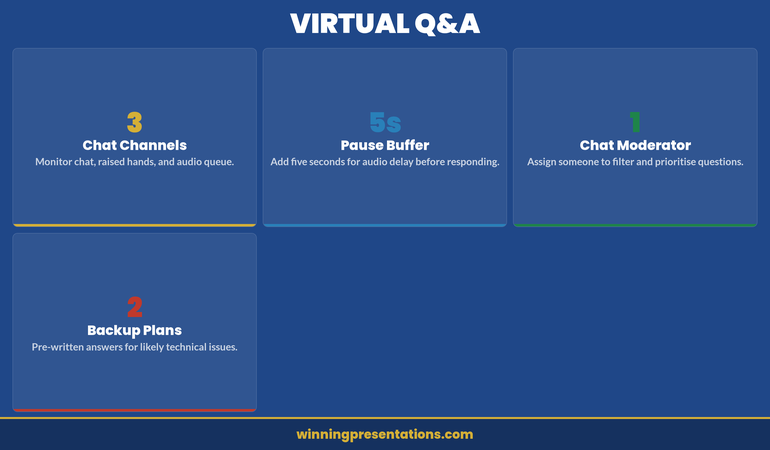
Virtual Q&A management dashboard showing chat channels to monitor, pause buffer duration, chat moderator role, and backup plans

The four pillars of virtual Q&A infrastructure: monitor three channels, buffer five seconds, assign a moderator, prepare backup plans.

The framework above identifies the four elements that separate controlled virtual Q&A from chaotic improvisation. Chat Channels — monitoring chat, raised hands, and audio queue simultaneously — is the first structural challenge. In-person, you have one input channel: someone raises a hand. Virtually, you have at least three. Without deliberate attention management, you’ll answer the loudest channel (audio) and ignore the others, which the audience sees as selective engagement. The fix: announce at the start which channels you’ll prioritise and in what order.

Pause Buffer — adding five seconds for audio delay before responding — prevents the collision problem Henrik experienced. Five seconds feels uncomfortably long when you’re the presenter, but the audience doesn’t experience it that way. They experience it as thoughtfulness. Without the buffer, you begin answering before the questioner has finished (because of lag), creating a pattern of talking over people that erodes trust rapidly in a virtual environment.

Chat Moderator — assigning someone to filter and prioritise questions — removes the cognitive load of managing both content and logistics simultaneously. In-person, a host can do this naturally. Virtually, the presenter is often expected to manage the platform and answer the questions, which splits attention in ways that visibly degrade performance. Even a junior colleague reading chat and flagging the three most substantive questions changes the dynamic entirely.

Backup Plans — pre-written answers for likely technical issues — address the reality that virtual Q&A includes a category of disruption that doesn’t exist in-person: platform failure. If your audio drops, if screen-share freezes, if the host accidentally ends the meeting, you need a pre-agreed recovery protocol. “I’ll rejoin within 60 seconds. If the meeting closes, [colleague name] will restart it.” That single sentence, agreed before the call, prevents the panic spiral that technical failures trigger mid-Q&A.

The psychological impact is significant: if you appear rushed or impatient during a delayed-response moment, the audience perceives it as lack of composure. If you build in deliberate pauses, the audience perceives it as confidence and control. The technology is the same; the interpretation is entirely different.

Want a step-by-step checklist for virtual Q&A timing? The Executive Q&A Handling System includes a detailed preparation guide for every platform—Zoom, Teams, WebEx—with exact timing protocols for each.

Strategic Q&A Preparation: The Three-Layer Model

Generic Q&A preparation teaches you to anticipate questions and prepare answers. Format-specific Q&A preparation teaches you to anticipate question types, interruption patterns, and timing scenarios unique to the virtual environment.

Layer One: Question Anticipation. Identify the 8–12 questions most likely to arise based on your presentation content, your audience, and your approval stage. This is standard. Where it becomes format-specific: for each question, prepare two versions—a full answer (60–90 seconds) and a cliff-note answer (15–20 seconds). Why? Because if a question appears in chat, you answer briefly. If someone unmutes and asks it, you have permission to answer fully. If the host reads it, you can calibrate based on time remaining. One question, three delivery modes, two answer lengths.

Layer Two: Interruption Scenario Mapping. Write out five scenarios: (1) you’re interrupted mid-answer by chat question, (2) you’re interrupted mid-answer by unmuted speaker, (3) you’re muted accidentally, (4) you experience audio lag and miss what was asked, (5) two people ask questions simultaneously. For each, write out your exact response in advance. This sounds mechanical, but in live pressure, you default to what you’ve already practised. Without this layer, you improvise, and improvisation under pressure typically looks like evasion.

Layer Three: Timing Architecture. Assign time budgets to each question type based on your Q&A length. If you have 30 minutes, you might allocate 3 minutes per substantive question, 1 minute per clarification, 30 seconds per chat question. Build in a 2-minute buffer. During the Q&A, manage to this architecture. This prevents you from spending eight minutes on the first question and leaving substantive questions unanswered—a common pattern that damages credibility in approval-stage scenarios.

The Format That Changes Everything

Virtual Q&A isn’t a minor variation of in-person Q&A. It’s a fundamentally different format requiring fundamentally different preparation. The Executive Q&A Handling System (£39) walks you through all three layers with real scenarios, timing models, and recovery techniques.

Learn the System

The shift from generic to format-specific preparation is where most executives go wrong. They prepare answers. They don’t prepare for the virtual Q&A environment itself. This means when a real interruption happens, or when they experience audio lag, or when the chat backlog grows, they respond as if they’re in an in-person Q&A, which doesn’t work. The executives who dominate virtual Q&A are those who’ve practised the format itself, not just the content.
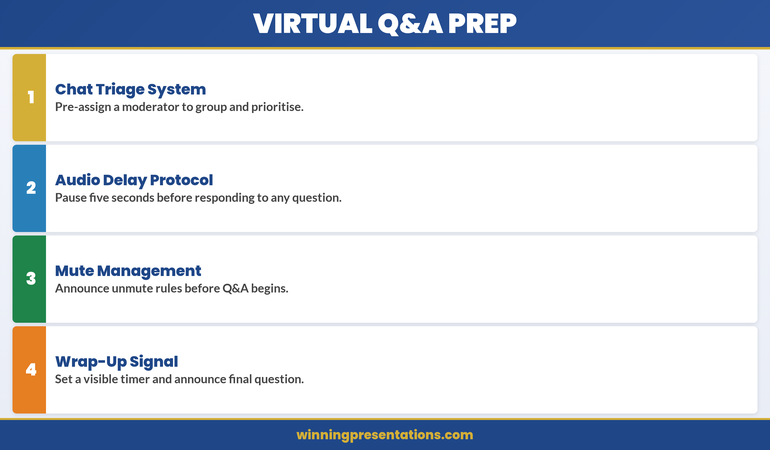
Four preparation steps for virtual Q&A: chat triage system, audio delay protocol, mute management, and wrap-up signal

The four-step virtual Q&A preparation protocol: triage, delay, mute rules, and wrap-up.

The preparation framework above translates the three-layer model into four actionable steps you complete before the Q&A begins. Chat Triage System means pre-assigning a moderator to group and prioritise incoming chat questions into three categories: decision-critical (answer immediately), clarification (answer briefly), and off-topic (acknowledge and defer). Without triage, you’re performing real-time sorting while also formulating answers, which is the cognitive equivalent of reading email while driving.

Audio Delay Protocol — pausing five seconds before responding to any question — is the single most impactful preparation step. It accounts for the platform lag that creates talking-over-each-other collisions, and it gives you processing time that in-person Q&A provides naturally through the physical act of someone standing or raising a hand. Announce this protocol at the start: “I’m going to pause briefly before each answer to ensure I’ve heard the full question.” The audience interprets this as professionalism, not hesitation.

Mute Management means announcing unmute rules before Q&A begins. “Please stay muted until I call on you. If you’d like to ask a question, use the raised hand feature or type it in chat.” This removes the ambiguity that creates unmuted interruptions. Without explicit rules, some participants will unmute spontaneously, others will type in chat, and the resulting overlap makes you look like you’re losing control of the room — when in reality, the room never had rules to begin with.

Wrap-Up Signal — setting a visible timer and announcing the final question — prevents the awkward fade-out that plagues virtual Q&A sessions. “We have time for one more question” is the verbal equivalent of a closing bell. Without it, sessions drift, participants leave silently, and the Q&A ends with a whimper rather than a controlled close. The signal also creates urgency: participants with important questions will ask them rather than assuming there’s unlimited time.

Frequently Asked Questions

Should I answer every question in chat, or can I select which ones to address? You can select, but you must signal this clearly at the start: “I’m going to prioritise questions that affect the core decision, and I’ll circle back to secondary questions in writing.” This is different from appearing to ignore questions. Transparency about your selection criteria actually increases credibility rather than diminishing it.

What do I do if someone asks a question I genuinely cannot answer in the moment? Say so directly: “That’s a specific question I want to answer accurately—I’ll follow up with you in writing within 24 hours.” Then do it. This is stronger than guessing or stalling, both of which signal uncertainty. A commitment to follow-up in writing actually increases trust, particularly in approval-stage scenarios where precision matters more than speed.

How do I prevent the Q&A from running over time and cutting into my presentation close? Build the timing architecture I described above, and announce it upfront: “We have 25 minutes for Q&A, which gives us time for roughly eight substantive questions. I want to make sure we cover the approval-critical items, so I’ll be managing our time to that target.” This gives you permission to move through questions efficiently without appearing rushed. You’re managing the format, not dodging engagement.

Get Weekly Insights on Executive Presentations

Join The Winning Edge for actionable strategies on structuring presentations for high-stakes approvals, managing Q&A in real time, and building executive credibility. Every Thursday, direct to your inbox.

Subscribe to The Winning Edge

The Format Changes Everything

Virtual presentation Q&A is not in-person Q&A delivered over Zoom. It’s a distinct format with its own rules, timing patterns, interruption dynamics, and psychological pressures. Executives who master it gain a measurable edge in approval-stage decisions, funding conversations, and board-level presentations. The difference is not confidence or intelligence—it’s preparation specific to the virtual environment.

Related Reading:

Today’s other articles: Succession Planning Presentations | Department Update Presentations | Presentation Anxiety Relapse


About the Author

Mary Beth Hazeldine is Owner & Managing Director of Winning Presentations. With 24 years of corporate banking experience at JPMorgan Chase, PwC, Royal Bank of Scotland, and Commerzbank, she advises executives across financial services, healthcare, technology, and government on structuring presentations for high-stakes funding rounds and approvals.

17 Mar 2026
Technical presenter explaining a complex concept to non-technical executive board members using simple visual language, modern boardroom, navy and gold corporate aesthetic

When Non-Technical Executives Ask Technical Questions: How to Translate Under Pressure

Quick answer: When a non-technical executive asks a technical question, they’re often not asking for technical depth—they’re asking “Will this work, and can I trust it?” Translate the question into the business risk underneath. Answer the risk, not the jargon.

Stuck in the boardroom when a non-technical executive asks a technical question you weren’t expecting? The gap between their question and your knowledge isn’t the problem—your translation speed is. The Executive Q&A Handling System teaches you to diagnose what non-technical executives actually need to hear, and answer it instantly without condescension.

Master technical Q&A for non-technical audiences → £39

A CFO asked a technology director: “How confident are you in the architecture?” It sounded technical. The director launched into a fifteen-minute explanation of microservices, API scalability, and load balancing. The CFO’s eyes glazed over. What he’d actually asked was: “Can this project stay on time and on budget?”

They were speaking the same language but answering different questions. The director was answering the technical question. The CFO was asking the business question. The gap between them killed the conversation and signalled that the director didn’t understand what executives care about.

This happens constantly in boardrooms. A non-technical executive asks a question that sounds technical. The presenter answers the technical version, misses the real intent, and walks out of the room thinking “They don’t understand this.” What actually happened: the presenter didn’t understand what the executive needed.

The Role-Mismatch Problem in Q&A

Non-technical executives ask technical questions, but their frame of reference is different from yours. You’re thinking: “How do I explain this correctly?” They’re thinking: “Is this a risk I need to manage?”

This creates a consistent pattern:

The executive asks about a technical detail. Something like: “What’s the data migration strategy?” or “How are you handling the API integration?” or “What’s your backup procedure if the vendor disappears?”

The presenter hears a technical question. So they answer technically, diving into details about databases, authentication protocols, redundancy systems. They’re being thorough.

The executive stops listening. They’ve lost the thread. They don’t need to understand microservices—they need to know whether the project will survive if something goes wrong.

The presenter thinks the executive is unsophisticated. “They just don’t get it. They asked a technical question but couldn’t follow the technical answer.” False. The executive asked a risk question and the presenter gave a detail answer.

The real skill in boardroom Q&A isn’t technical knowledge—it’s recognising which question is really being asked underneath the words, and answering that one.

What Non-Technical Executives Really Ask

A non-technical executive asking technical questions is almost always asking one of these five things:

1. “Is this a known risk or an unknown one?” When they ask “How will you handle scalability?”, they’re really asking: “Is this a solved problem or are you building something we’ve never done before?” Known risks can be managed. Unknown risks are threats.

2. “Can I trust the people running this?” When they ask “What’s your testing framework?”, they’re assessing your rigour and competence. They’re asking: “Does this team know what they’re doing?” Not: “Explain your testing framework.”

3. “What happens when the worst-case scenario occurs?” When they ask “What’s your disaster recovery plan?”, they’re not asking for technical detail. They’re asking: “Have you thought about failure? Can this organisation survive a major problem?” They want assurance that you’ve considered risk.

4. “Is this going to cost us more than we’ve budgeted?” When they ask technical questions about dependencies, timelines, or integration complexity, they’re often asking: “Will we go over budget?” Hidden inside the technical question is a financial risk question.

5. “Are you sure about this?” Sometimes they’re just checking your confidence level. A wavering answer feels risky. A confident answer (even if the answer is “We’ll figure that out”) feels manageable.

Once you understand that non-technical questions are actually risk questions, your entire approach to Q&A changes. You’re no longer explaining technical detail—you’re demonstrating that you’ve thought through risk.

Translation matrix infographic mapping four common technical questions to their executive translations showing the business concern behind each technical inquiry

The Translation Framework: From Technical Question to Risk Answer

Here’s the framework that lets you answer in real time:

Step 1: Hear the question but don’t answer it yet. When a non-technical executive asks “How are you handling data security?”, pause for one breath. Don’t jump straight into explaining encryption or compliance frameworks.

Step 2: Identify the risk underneath. Ask yourself silently: “What’s the actual concern here?” Data security questions usually mean: “Could we get breached and expose customer data?” or “Are we compliant with regulations?” Occasionally: “Will security requirements slow down the project?”

Step 3: Lead with the risk answer, then give technical detail only if asked. Instead of explaining security architecture, say: “Our data is encrypted both in transit and at rest. We’re fully compliant with GDPR and ISO 27001. Those are the two regulatory requirements that matter most for this project.” You’ve answered the risk. Now the executive knows you’ve thought about it.

Step 4: Pause and check their reaction. If they nod and move on, you’re done. You answered what they needed. If they lean forward or ask a follow-up, then give technical detail. You’ve earned the space to be technical because you answered the risk first.

Example: The Data Migration Question

Non-technical executive asks: “Walk me through the data migration strategy. What if something goes wrong during the cutover?”

Wrong answer: “We’re using an ETL tool with three-phase validation. Source system remains live during Phase 1 and 2, then we cut over in Phase 3 with a 48-hour rollback window. We’ve built dual-write logic to ensure consistency…”

Right answer: “The biggest risk in migration is data loss or inconsistency during cutover. We’re protecting against that with a 48-hour rollback window and full data validation before we go live. We’ve done this type of migration four times. The parallel run adds two weeks to the timeline, but that’s worth it for safety. The only scenario where we’d cut over without the rollback window is if the business explicitly chooses speed over safety—but we’re not recommending that.”

The difference: The right answer acknowledges the real risk (data loss), explains how you’re managing it (rollback window, validation, proven methodology), and puts the safety/speed tradeoff on the executive’s desk. The executive now understands the situation and can make a decision. The wrong answer buries the executive in technical detail that doesn’t help them decide anything.

Three-layer translation framework infographic showing what they asked at the technical level what they actually want to know at the business level and how to answer with business impact first

Responding in Real Time Under Pressure

The challenge with translating technical questions for non-technical executives is doing it in real time. You can’t take ten minutes to think. The best Q&A prep happens before you present, by anticipating the questions and mapping the translation beforehand.

Pre-presentation work: Three days before presenting, list the technical questions you might get. For each one, write down: “The risk they’re probably asking about is…” Once you’ve identified the risk, you know how to answer the question without over-explaining.

In the moment: When the question lands, you have a mental template. Take a breath. Think: “Risk question or detail question?” Then answer the risk first, detail only if asked.

If you get stuck: Ask a clarifying question: “When you ask about security, are you mostly concerned about compliance, data breaches, or operational disruption?” This buys you thinking time and also forces them to clarify what they actually care about. Often, their answer tells you exactly what risk they’re worried about.

Common Traps to Avoid When Answering Non-Technical Executives

Trap 1: Using jargon as a confidence signal. When nervous, presenters often double down on technical language, thinking “If I sound more technical, I’ll sound more credible.” The opposite is true with non-technical audiences. Jargon makes you sound like you’re hiding something.

Trap 2: Assuming they need the depth they’re asking for. “How does the API handle rate limiting?” sounds like a deep technical question. It often means: “Can we support the volume of requests we’ll get?” Answer the volume concern, not the API question.

Trap 3: Over-answering from anxiety. When you’re nervous about being found out, you add detail. You explain things they didn’t ask for. You hope something you say will prove your competence. This backfires. They stop listening because there’s too much noise.

Trap 4: Treating non-technical people like they’re stupid. Condescension is felt instantly, even if you don’t mean it. “Oh, that’s a great question!” (tone: surprised they understand) or over-simplified answers that feel patronising. Respect their intelligence. Explain the concept clearly, not simply.

Trap 5: Giving a technical answer when they’re asking for confidence. Sometimes a non-technical executive asks a technical question because they want to assess your confidence. A confident, clear answer—even if it admits uncertainty on a detail—feels more trustworthy than a technically comprehensive answer that wavers.

Trap 6: Forgetting that risk tolerance changes the answer. The CFO asking about disaster recovery has a different risk tolerance than the CTO. CFO wants: “Will we lose money?” CTO wants: “Will we lose data?” Same technical question, different real question. You need to know who’s asking.

Master the Risk Translation Framework for Boardroom Q&A

The Executive Q&A Handling System teaches you a real-time translation formula: hear the technical question, identify the risk underneath, answer the risk. You’ll learn to diagnose which questions are actually asking about risk, cost, timeline, or confidence—and answer accordingly.

  • The five questions non-technical executives are really asking (and what each one needs)
  • Risk identification in real time: How to hear the business question underneath the technical words
  • The answer architecture: Lead with risk, follow with detail (only if asked)
  • Question anticipation workbook: Map likely technical questions and translate them before you present
  • Live response patterns: Clarifying questions that buy thinking time and reveal what they actually care about

Get the Q&A System → £39

Includes the “Question Translation Template”—map your technical questions to business risks before presenting.

Need a formula to answer technical questions from non-technical executives instantly?

Learn the Framework → £39

The Role Difference and Why It Matters

The core issue: executives and specialists live in different mental models. A specialist thinks: “How does this work?” An executive thinks: “What could go wrong with this, and can I manage it?”

Neither model is wrong. They’re just different. Your job in boardroom Q&A is to translate between them.

When a non-technical executive asks a technical question, they’re not asking you to teach them engineering. They’re asking you to confirm that you’ve thought about risk and that you can manage it. Answering the risk question does that. Answering the technical question (in technical depth) doesn’t.

In board-level Q&A especially, this pattern is consistent. Directors care about risk, return, and reputation. They’re asking technical questions because they want to know: “Are we safe? Can we trust this team? Will we lose money or face?”

The presenter who recognises this pattern and answers accordingly walks out of the boardroom looking like they understand executive priorities. The presenter who answers the technical question in technical depth walks out looking like they’re focused on engineering, not business.

Building a Pre-Presentation Question Map

You can’t prepare for every question, but you can prepare for the likely ones. Three days before presenting, do this work:

Step 1: Predict the technical questions you might get. Based on your presentation content, what technical details might someone want to explore? List them.

Step 2: For each question, identify the risk underneath. “They might ask about X. That probably means they’re worried about Y risk.” Write it down.

Step 3: Prepare the risk answer first, then the technical detail. If they ask, you can go technical. But you’ve got the risk answer locked.

Step 4: Identify which executive roles will be in the room and what they care about. CFO cares about cost and timeline. CIO cares about integration and disruption. Chief Commercial Officer cares about customer impact. Different roles ask the same technical question but care about different risks. Map it.

This work happens before you present. Once you’re in the room, you just execute the translation. You’ve already done the thinking.

The Complete Q&A System: From Prediction to Response

The Executive Q&A Handling System covers the entire journey: predicting questions, translating business intent, answering under pressure, handling hostility, and recovering from gaps in knowledge. The translation framework is just one piece—but it’s the one that unlocks boardroom credibility.

  • Risk translation formula: Technical question → business risk → confident answer
  • Role-based risk mapping: What each executive role actually cares about
  • Question prediction workbook: Build your anticipated Q&A before presenting
  • Live response framework: Clarifying questions, confidence signals, time-buying techniques
  • Handling the “I don’t know” moment: How to survive admitting uncertainty and maintain credibility

Get the Q&A System → £39

Includes real Q&A examples from boardroom presentations that reveal how executives ask business questions in technical language.

Ready to translate technical questions in real time during your next presentation?

Start Here → £39

People Also Ask

What if the executive’s question is actually technical and they want technical depth? That’s rare, but you’ll know it by their reaction. If you give the risk answer and they’re unsatisfied, they’ll push back or ask for more detail. Then you go technical. But assume they want the risk first and let them ask for technical depth if they need it.

Is it condescending to simplify technical concepts for non-technical executives? No—it’s respectful. Dumbing down is condescending. Translating is respectful. There’s a difference: simplify the language, not the concept. “We’ve built redundancy so if one system fails, another takes over” is simpler than “We’ve implemented active-active failover in a distributed architecture,” but it’s not dumb. It’s clear.

What if I genuinely don’t know the answer to their technical question? Answer honestly and pivot to what you do know. “I don’t have that specific data on me, but here’s what I do know: we’ve budgeted for this contingency, and our vendor’s track record suggests it won’t be an issue. Let me follow up with the exact detail.” You’ve answered the risk (we’ve planned for it) even though you don’t know the technical detail.

Is This Right For You?

✓ This is for you if:

You present technical solutions to non-technical executives and you want to answer their questions in a way that actually lands.
You’re worried about how to handle Q&A when the audience is less technical than you are.
You want to diagnose which question is really being asked underneath the technical words.

✗ Not for you if:

You’re presenting to technical audiences who genuinely want technical depth. (Different framework applies.)
You believe executives should understand technology at a technical level and you’re not interested in translating.

FAQ

What’s the difference between translating and dumbing down?

Translating respects the intelligence of the audience while simplifying the language. “We’re using load balancing to ensure the system handles peak traffic” is translated. “We make it so the traffic doesn’t get too heavy” is dumbed down. Translation: clear language, full concept. Dumbing down: oversimplified concept.

How do I know if a non-technical executive actually wants technical detail?

Watch their body language and listen to their follow-ups. If you give the risk answer and they look satisfied, you’re done. If they lean forward and ask more questions, they want depth. If they look confused, your translation missed the mark and you need to simplify further.

Should I ask the executive which type of answer they prefer?

Not usually—it can feel like you’re putting them on the spot or suggesting they wouldn’t understand. Default to the risk answer first, then gauge their reaction. If you really need to know, ask it indirectly: “Should I focus on the impact to timeline, or would you like me to walk through the technical approach?”

What if the non-technical executive is actually asking a trick question to catch me out?

Possible, but rare. More often, they’re just asking a genuine question in language that makes sense to them. Even if it’s a test of your knowledge, the risk-first answer works: it shows you think like an executive, not just like a specialist.

Related: Your Presentation Didn’t Fail — The Decision Was Already Made Before You Walked In — Understanding pre-decision dynamics helps you anticipate which questions matter to which executives.

Related: The ‘One More Thing’ That Ruins Good Presentations: Why Anxiety Makes You Add Content — Nervous presenters often over-answer Q&A from anxiety. The translation framework helps you answer precisely instead.

Translate Technical Questions Into Executive Answers

Your next boardroom Q&A will include at least one technical question from a non-technical executive. When it lands, you now have a framework: identify the risk underneath, answer the risk, offer technical detail only if asked.

This doesn’t require you to understand less about the technology. It requires you to understand what executives actually care about. That’s a business skill, not a technical one. And it’s the skill that separates presenters who get heard from presenters who get interrupted.

You’re presenting next Thursday? Start mapping your anticipated questions now. For each one, write: “The risk they’re probably worried about is…” Once you’ve identified the risk, you know how to answer the question—even in real time, even under pressure.

Join executives learning to bridge the gap between technical depth and executive clarity. Subscribe to The Winning Edge newsletter for weekly frameworks on boardroom communication.

About the Author

Mary Beth Hazeldine is the Owner & Managing Director of Winning Presentations. With 24 years of corporate banking experience at JPMorgan Chase, PwC, Royal Bank of Scotland, and Commerzbank, she has delivered high-stakes presentations in boardrooms across three continents.

A qualified clinical hypnotherapist and NLP practitioner, Mary Beth combines executive communication expertise with evidence-based techniques for managing presentation anxiety. She has trained thousands of executives and supported high-stakes funding rounds and approvals.

Book a discovery call | View services

This article was written with AI assistance and reviewed by Mary Beth Hazeldine.