Category: Executive Q&A

23 Mar 2026
Empty corporate boardroom after a meeting with a single clock on the wall and presentation materials left behind suggesting the critical post-meeting decision window

The 48-Hour Window After Every Q&A: Why Most Presentations Win the Room but Lose the Decision

The 48-Hour Window After Every Q&A: Why Most Presentations Win the Room but Lose the Decision

Astrid crushed her steering committee Q&A. Every question answered confidently. The committee chair said, “This looks solid.” Two people nodded. She left the room feeling certain approval was coming.

Three weeks later, the project was still “under review.” No formal objection. No rejection. Just silence.

Astrid had won the Q&A. She had lost the follow-up.

Quick Answer: The Q&A follow-up decision window — the 48 hours after your presentation’s question session — is where most executive approvals are won or lost. Presenting well gets you consideration. Following up strategically gets you a decision. The 3-step framework below covers what to send, when to send it, and how to frame the decision so it moves from “under review” to “approved” before the momentum dies.

Q&A follow-up after your presentation

The 48-hour window begins the moment the Q&A ends. Have you structured your follow-up across the timeline described?

→ Explore the Q&A handling framework and follow-up system → View the Executive Q&A Handling System

I learned about the 48-hour window the hard way.

Early in my banking career at Commerzbank, I presented a restructuring recommendation to a regional leadership team. The Q&A lasted 25 minutes — longer than the presentation itself. I answered every question. The managing director said, “Good work, let’s get this moving.”

I walked out, wrote a quick “thank you for your time” email, and waited.

A week passed. Then two. I chased with a gentle follow-up. The response: “We’ve got a few concerns to work through internally.”

Those “concerns” were questions that had surfaced after the Q&A, when the decision-makers were alone and the confidence of my presentation had faded. Without a structured follow-up, the momentum I’d built evaporated. The decision went from “let’s get this moving” to “let’s revisit next quarter.”

What I discovered, across hundreds of presentations since, is that the Q&A session isn’t the end of the conversation. It’s the beginning of a decision window. And that window closes — in most organisations — within 48 hours. What you do in those 48 hours determines whether your presentation becomes an approval or a memory.

Why Q&A Wins Die in the Follow-Up

The psychology is straightforward. During your Q&A, the decision-makers are in your frame. They’re seeing the data you chose, hearing the answers you’ve prepared, and feeling the confidence of a well-structured session. This is peak persuasion.

The moment they leave the room, competing information floods in. The next agenda item. A direct report with a different priority. An email chain about budget constraints. Your carefully constructed frame dissolves within hours.

Worse, the questions they didn’t ask during the Q&A — the ones they were too polite to raise, or the ones that only surface when they’re discussing it with their own teams — now sit unanswered. Without a follow-up strategy, these unasked questions become silent objections.

Most executives don’t reject proposals outright after a good Q&A. They defer them. “Let’s take another look.” “We need to socialise this more broadly.” “Can we revisit this at the next meeting?” Every one of these phrases means the same thing: the momentum has died and nobody wants to be the one to kill it formally.

Strong Q&A preparation — like using a systematic Q&A preparation checklist — gets you through the session. But the follow-up is what closes the deal. And it needs a framework, not an improvised email.

The 48-Hour Decision Window: Why Timing Matters More Than Content

In executive decision-making, timing is a structural advantage. Decisions have momentum, and momentum has a half-life.

The first 4 hours after a Q&A: the decision-makers still remember your key points, your confidence, and the room’s energy. This is when a follow-up has the most impact.

Hours 4–24: the details begin to fade, but the overall impression remains. A well-structured follow-up during this period anchors the decision in the decision-maker’s mind as “progressing” rather than “pending.”

Hours 24–48: the decision is now competing with everything else on the executive’s agenda. After 48 hours, most decisions migrate from “active” to “someday” — and “someday” decisions rarely happen without external pressure.

This isn’t speculation. It’s the pattern I’ve seen across hundreds of executive decision cycles in banking, consulting, and corporate finance. The presenters who close in one meeting don’t just present better. They follow up faster and more strategically.
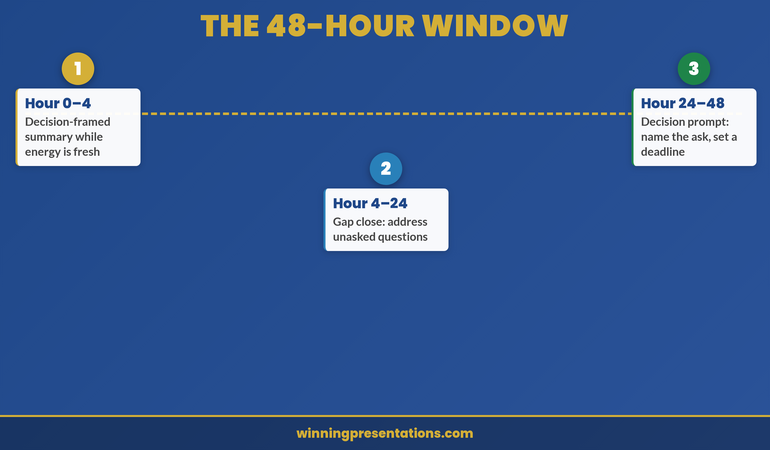
The 48-hour Q&A follow-up decision window roadmap infographic showing 3 stages: 4-hour summary, 24-hour gap close, 48-hour decision prompt

Q&A Preparation and Follow-Up Framework

The Executive Q&A Handling System provides a complete framework for Q&A management and the 48-hour decision window:

  • Question prediction frameworks for preparation
  • Response structures for difficult and ambiguous questions
  • Follow-up frameworks for the 48-hour decision window
  • Bridge statement techniques for clear communication

Explore the Executive Q&A Handling System →

Based on experience with executive Q&A sessions in banking, consulting, and corporate governance.

Step 1: The Decision-Framed Summary (Within 4 Hours)

Most people send a “thank you for your time” email after a Q&A session. This is a wasted opportunity. The first follow-up email should frame the decision, not express gratitude.

The structure is specific. Lead with the decision statement — not “thanks for the great discussion” but “To confirm, we are requesting approval for [specific ask] by [specific date].” Then list the three strongest points that emerged during the Q&A, phrased as agreed positions, not arguments. Finally, note any action items that were assigned during the session, with owners and deadlines.

This email does three things. It anchors the decision in the recipient’s mind as “active.” It converts the discussion into documented agreement. And it creates a written record that makes deferral harder — it’s much easier to defer a vague conversation than a specific, documented ask.

Send it within 4 hours. Not the next morning. Not after you’ve “had time to reflect.” Within 4 hours, while the room energy is still fresh in everyone’s memory. The technique I describe for pausing before answering creates the same kind of deliberate strategic timing — it’s about controlling the pace, not just the content.

Step 2: The Gap Close (Within 24 Hours)

The gap close addresses the questions that weren’t asked — or were only partially answered — during the Q&A session.

After every Q&A, write down two lists. List one: questions that were asked and answered. List two: questions that should have been asked but weren’t. The second list is more important.

Silent objections — the concerns decision-makers have but don’t voice in the room — are what kill proposals between meetings. If you know the decision-maker’s peers are sceptical about the budget, or the timeline seems aggressive, or the risk assessment didn’t address a specific scenario, proactively addressing these in a follow-up removes them as deferral ammunition.

The gap close email is short. “Following our session yesterday, I wanted to address two points that may be relevant as you discuss next steps.” Then address the unasked questions directly, with concise answers and supporting data if needed.

This demonstrates two things the decision-maker values: you understand their context beyond the presentation room, and you’re not waiting passively for a verdict. A strong question prediction framework helps you identify these silent objections before they become blockers.

Step 3: The Decision Prompt (Within 48 Hours)

The decision prompt is the follow-up most people never send. It explicitly asks for the decision.

Not “just checking in.” Not “wanted to see if you had any further questions.” A direct, respectful request for a decision.

The format: “Based on our discussion on [date] and the follow-up I sent yesterday, I’d like to propose we target a decision by [specific date — ideally within the next week]. If there are outstanding concerns, I’m available to address them in a 15-minute call. Otherwise, I’ll proceed with [specific next step] pending your confirmation.”

This email works because it creates a decision fork. The recipient either approves, raises a specific objection (which you can address), or requests a call (which gives you another opportunity to close). The one thing it prevents is silence — which is where most post-Q&A proposals go to die.

The timing matters. Send it at hour 48 — not earlier, not later. Earlier risks appearing pushy. Later risks losing the momentum entirely. At 48 hours, you’ve given them time to process, you’ve addressed potential gaps, and you’re now making it easy to say yes.
Dashboard infographic showing the 3-step Q&A follow-up framework: decision summary at 4 hours, gap close at 24 hours, decision prompt at 48 hours with key metrics

Structured Q&A Follow-Up Over 48 Hours

Complete framework for Q&A management — from preparation through the decision-framed follow-up.

Explore the Executive Q&A Handling System →

Built from experience across banking, consulting, and corporate governance.

The Anatomy of a Decision That Stalls: What Goes Wrong After a Strong Q&A

Understanding why decisions stall helps you prevent it. The pattern is remarkably consistent across organisations and industries.

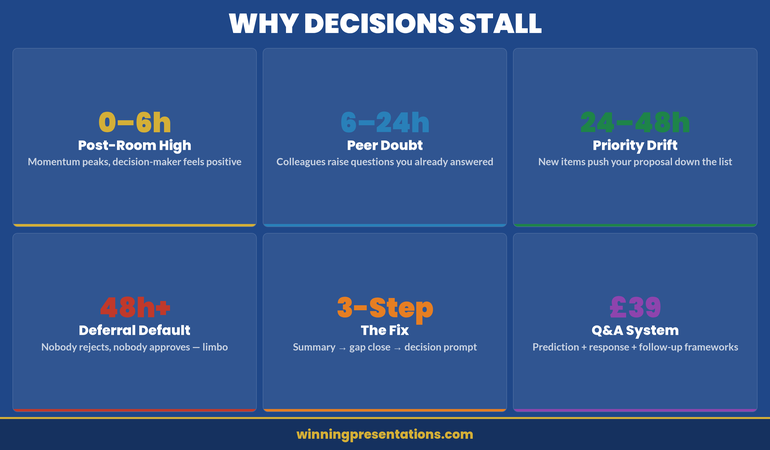
Stage 1: Post-room confidence (hours 0–6). The decision-maker feels positive. Your presentation landed. The Q&A went well. They’re inclined to approve.

Stage 2: Peer consultation (hours 6–24). The decision-maker mentions your proposal to colleagues, direct reports, or their own manager. These people weren’t in the room. They ask questions you’ve already answered — but the decision-maker can’t remember the details. Doubt begins.

Stage 3: Competing priorities (hours 24–48). New urgent items arrive. Your proposal moves from “top of mind” to “when I get to it.” The emotional momentum from your Q&A has fully dissipated.

Stage 4: Deferral default (48+ hours). Without active follow-up, the proposal enters “pending” status. Nobody formally rejects it. Nobody formally approves it. It sits in limbo until an external deadline forces action — or until it’s forgotten entirely.

The 3-step framework interrupts this pattern at stages 1, 2, and 3. The decision-framed summary captures stage 1 momentum. The gap close pre-empts stage 2 peer objections. The decision prompt prevents stage 3 drift.

The Cross-Link: When the Partnership Pitch Needs This Framework

Partnership proposals are particularly vulnerable to the 48-hour window problem because the decision involves multiple stakeholders from multiple organisations. If you’re presenting a partnership, joint venture, or strategic alliance, today’s companion article on the partnership proposal that gets yes in one meeting covers the slide structure — and this follow-up framework is what locks the decision in place after the slides are closed.

Is This Right for You?

✓ This is for you if:

  • You’ve had Q&A sessions that felt like wins but never converted into approvals
  • Your proposals consistently stall in “under review” status after strong presentations
  • You want a structured follow-up framework, not just “send a thank-you email”

✗ This is NOT for you if:

  • Your challenge is handling the Q&A itself (questions, hostile audiences, freezing under pressure)
  • You’re preparing for a presentation that doesn’t require a decision or approval
  • The decision is already made and you need implementation support

Frequently Asked Questions

Won’t sending three follow-up messages in 48 hours seem aggressive?

Not when each message adds value rather than just “checking in.” The decision-framed summary provides documentation. The gap close answers questions they haven’t asked yet. The decision prompt offers a specific path forward. Executives respect efficiency and initiative. What they find annoying is passive “just following up” messages with no substance. Each of these three messages gives them something useful, not just a reminder that you exist.

What if the decision-maker explicitly said “we need more time”?

Respect the timeline they give — but still send the decision-framed summary and the gap close. These aren’t pressure tactics. They’re documentation and proactive objection handling. When they’re ready to decide, your follow-up materials will be the reference documents they use. The only message you delay is the decision prompt — send it when their stated timeline expires, not before.

Does this framework work when the Q&A didn’t go well?

It’s even more important when the Q&A was rocky. A poor Q&A performance is an open wound — if you don’t address it quickly, the decision-makers’ last memory of your proposal is confusion or unconvincing answers. The gap close email is critical here: it lets you provide the clear, composed answers you wish you’d given in the room. Many approvals have been recovered by a strong follow-up after a weak Q&A.

📬 The Winning Edge — Weekly Presentation Intelligence

Join executives who receive one actionable presentation insight every week. Q&A techniques, decision frameworks, and follow-up strategies that convert presentations into approvals.

Subscribe to The Winning Edge →

Read next: Why Visualisation Doesn’t Work for Presentation Anxiety (And What Does, According to Neuroscience)

Your next Q&A session will end. The room will empty. What you do in the next 48 hours determines whether that session becomes an approval or a footnote. Download the Executive Q&A Handling System before your next high-stakes session and own the follow-up.

About the Author

Mary Beth Hazeldine is Owner & Managing Director of Winning Presentations. With 24 years of corporate banking experience at JPMorgan Chase, PwC, Royal Bank of Scotland, and Commerzbank, she advises executives across financial services, healthcare, technology, and government on structuring presentations for high-stakes funding rounds and approvals.

Book a discovery call | View services

18 Mar 2026
Confident executive presenting with a prepared slide that anticipates the audience's objections before they can be raised, modern boardroom, navy and gold corporate aesthetic

The Preemptive Q&A: How to Address Objections Before They’re Asked (Without Looking Defensive)

Quick Answer: A preemptive Q&A means naming the objections your audience is already thinking about and addressing them within your presentation—before the Q&A session begins. The key is positioning it as evidence of rigorous thinking, not defensiveness. Executives who use this technique see measurably higher approval rates and shorter Q&A sessions because they’ve eliminated the strongest objections before they’re asked.

You Need a Preemptive Q&A If: You’re asking for approval, funding, or buy-in on a proposal that has obvious risks or trade-offs. You know your stakeholders will object. You know what they’ll say. So why wait for them to say it? Name the objections yourself within the presentation, show you’ve thought them through, and build credibility by being transparent about the costs before anyone has to point them out.

See the Q&A strategy framework →

The Board Meeting That Flipped

Rachel, a CFO, walked into a board meeting asking for approval to invest £4.2 million in new systems infrastructure. She knew the objections before she opened her mouth. The board had rejected a similar proposal two years prior. They were risk-averse. They watched cash flow carefully. They would ask: “Why not wait another year?” “What if we lose a key person on the implementation team?” “How do we know this won’t be obsolete in three years?”

She could have presented the case for the investment and then fielded these questions when they inevitably came. Instead, she built them into her presentation.

Slide 6, buried in the business case section: “Why we’re not waiting another year.” Slide 8: “Implementation risk and mitigation.” Slide 10: “Total cost of delay vs. cost of investment.”

She named every objection she expected. She showed she’d thought about each one. She wasn’t defending—she was demonstrating thoroughness.

The board approved it unanimously. No hostile questions. No extended back-and-forth. Just: “Looks like you’ve covered the bases. Let’s go.”

What made the difference wasn’t new information. It was the signal that Rachel had anticipated every reasonable concern and built her case around addressing them. That signal—”this person has thought this through”—is more powerful than any single data point.

Why Naming Objections First Builds Credibility

When your audience disagrees with your proposal, they go through a predictable internal process. First, they notice a gap or risk in your logic. Then they wait for you to address it. If you don’t, they formulate an objection. Then they decide whether to voice it. The longer you go without addressing that gap, the stronger their objection becomes.

A preemptive Q&A stops this process early. You address the gap before they even formulate the objection. This does something crucial: it signals that you’re not avoiding difficult questions. You’re leading with them.

This has a specific psychological effect. When someone was expecting to find a flaw in your logic and you’ve named it first, they often reinterpret that as a sign of strength. You weren’t hiding the risk—you were confident enough to surface it. That confidence transfers to confidence in your proposal.

Compare two approaches:

Approach 1 (Reactive): You present the proposal. Someone in the room says, “But what about the cost overrun risk? New systems projects always go over budget.” You scramble to respond. Now it looks like you hadn’t thought about this obvious issue, and you’re defending after the fact.

Approach 2 (Preemptive): You present the proposal. Then you say: “I know what you’re thinking—systems projects always cost more than planned. We’ve built in a 18% contingency, benchmarked against three similar implementations in our sector. We’ve also limited scope to Phase 1, which reduces the variables.” Now if someone brings up cost overrun, they’re reinforcing a point you’ve already made, not catching you off-guard.

The credibility difference is dramatic. In Approach 1, you look reactive. In Approach 2, you look prepared.

How to Identify Which Objections to Address

Not every possible objection deserves preemptive attention. If you try to address every concern, your presentation becomes defensive and bloated. You need to identify the specific objections that will have the most weight with your particular audience.

Step 1: List all possible objections. Spend 20 minutes writing down every criticism, concern, or doubt someone could raise about your proposal. Don’t filter. This is the raw list.

Step 2: Rank by likelihood and impact. Which objections will your specific audience care about? Which would, if raised, actually change their decision? A finance-focused board will weight cost objections more heavily than a growth-focused one. A risk-averse stakeholder will prioritise downside scenarios over upside potential.

Step 3: Select the top three to five. Choose the objections that combine high likelihood (your audience is thinking about this) plus high impact (it could influence their decision). These are your preemptive candidates.

Step 4: Map them to your presentation structure. Where in your narrative does each objection naturally sit? Don’t force them in. They should arise organically as you build your case.

For Rachel’s infrastructure investment, her top three objections were: timing risk (why now?), implementation risk (what if it goes wrong?), and replacement risk (will it be obsolete?). Each of these fit naturally into different sections of her presentation, so naming them didn’t feel forced.

Positioning Objections as Rigorous Thinking

The way you introduce a preemptive objection completely determines whether it lands as defensiveness or rigour.

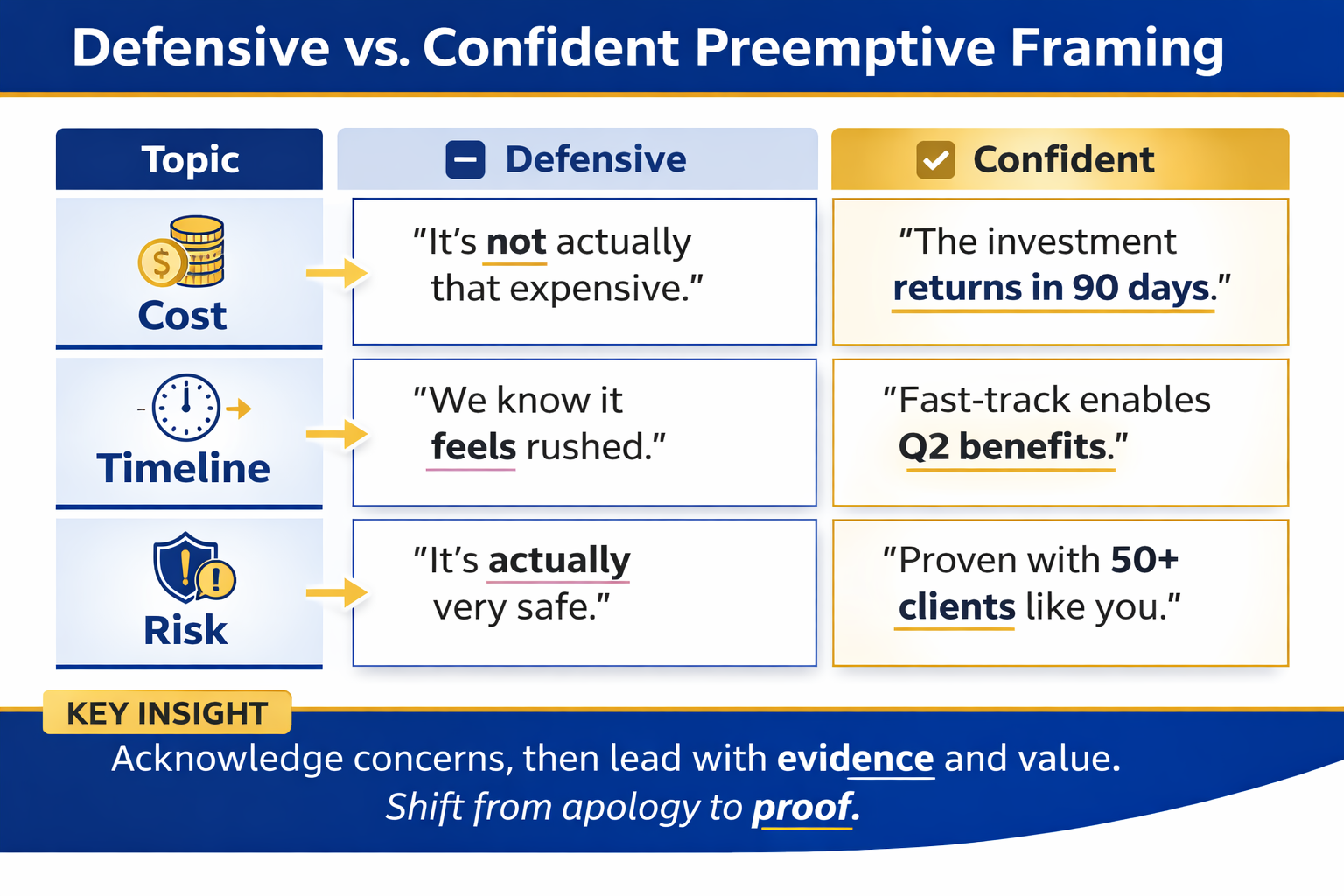
Defensive framing (avoid): “Some of you might be worried that…” This signals anxiety. It suggests you’re concerned the audience won’t trust you and you’re trying to reassure them. It backfires.

Rigorous framing (use this): “The implementation timeline raises a legitimate concern—if we don’t have the right team in place, we slip. Here’s how we’re addressing it.” This signals confidence. You’re not worried about the concern—you’ve already thought about it and solved for it.

Notice the difference: one sounds defensive, the other sounds prepared.

The phrase matters. Use language like:

  • “The obvious risk here is…” (names the risk confidently)
  • “This approach assumes we can… Let’s test that assumption.” (invites rigorous thinking)
  • “The cost question is worth addressing directly.” (acknowledges the legitimacy of the concern)
  • “You’ll notice we’ve built in a contingency because…” (shows planning, not anxiety)

Each of these frames the objection as something intelligent people would think about—not something you’re anxiously trying to prevent them from thinking.

The Framework: Name, Acknowledge, Respond

A preemptive Q&A follows a consistent three-part structure. Learn this and you can apply it to any presentation.

Part 1: Name the objection clearly. Don’t dance around it. Say exactly what the concern is. “The board will likely question whether we need £4.2 million or whether we could implement in phases.” This clarity signals you understand the landscape.

Part 2: Acknowledge why it’s a fair question. Show you understand the underlying concern. Don’t dismiss it. “Phasing makes sense on the surface—it feels more prudent financially and lower-risk operationally.” This validates the thinking behind the objection.

Part 3: Explain your response and the reasoning. Why aren’t you taking that approach? What did you consider and decide? “We looked at phasing. The problem: we’d be managing integration complexity across three separate implementations. Total cost would rise to £5.8 million. We’d also face staff turnover during a three-year rollout, which means key people leave and take domain knowledge with them. Full implementation now costs less and de-risks the human element.” This shows you’ve actually thought about the alternative and rejected it for specific reasons.

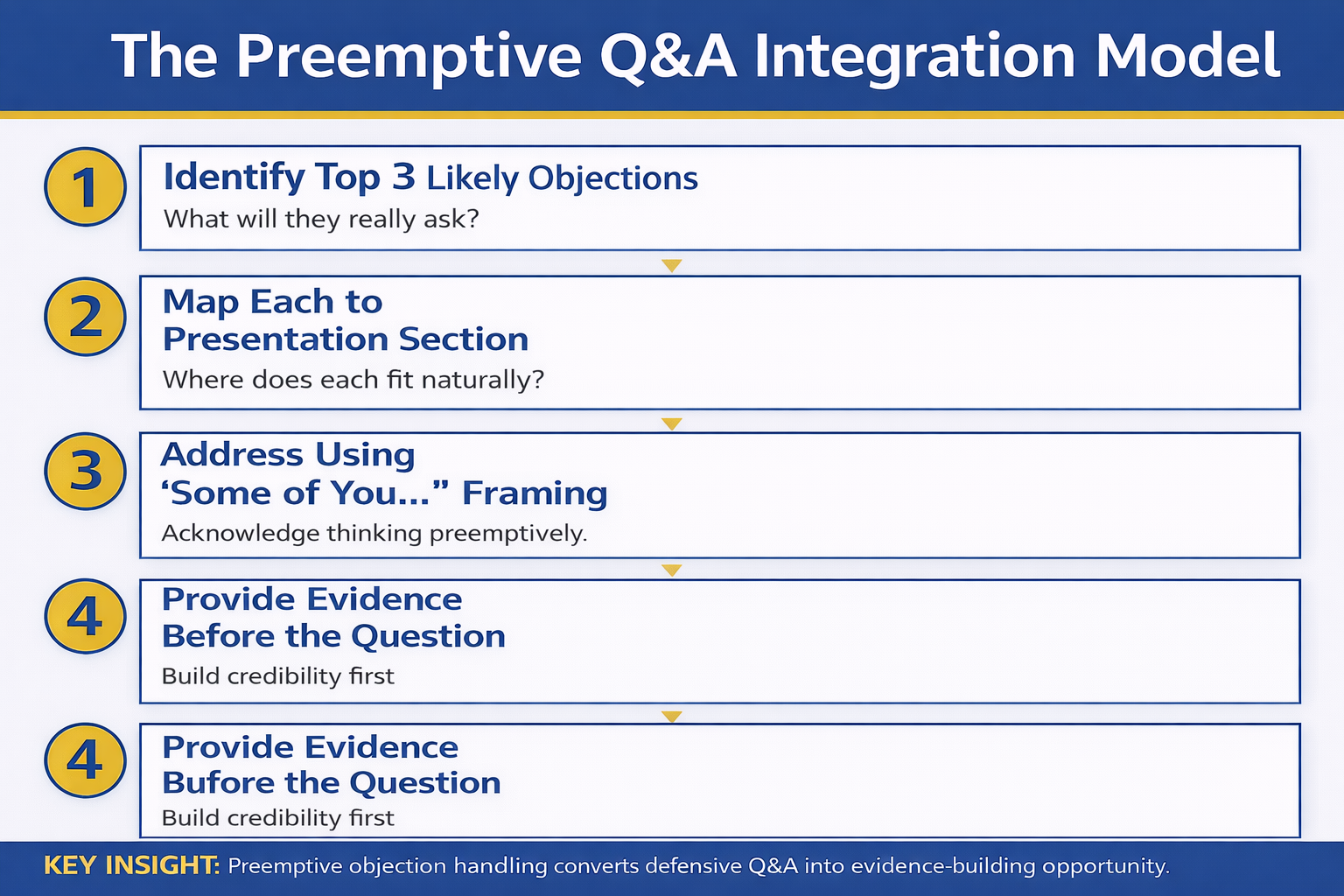
Four-step preemptive Q&A integration model infographic showing how to identify top objections map them to presentation sections address using confident framing and provide evidence before the question exists

The entire structure is: you understand the objection, you understand why someone would think that, and you’ve already decided against it for specific, defensible reasons.

The Executive Q&A Handling System

The Executive Q&A Handling System includes the full preemptive Q&A framework, plus strategies for how to integrate objections into your presentation slides without looking defensive, how to anticipate hostile questions before they’re asked, and how to handle the Q&A session itself with confidence.

  • The three-part name-acknowledge-respond structure (with 12 real-world examples)
  • How to identify which objections deserve preemptive treatment (and which to skip)
  • Slide integration templates (where to place objections in your deck for maximum credibility)
  • Tone guide (the exact language that sounds prepared, not defensive)

Get the Q&A System → £39

Used by CFOs, VPs, and board members who present to investment committees, steering groups, and executive teams where handling objections directly impacts approval rates.

Your presentation is asking for buy-in?

Get the Q&A System → £39

Tone Matters More Than Content

The same objection can be received as defensive or rigorous depending entirely on how you deliver it. The content stays the same—the tone determines the interpretation.

Defensive tone: Hesitant voice. You sound unsure about the objection you’re raising. You rush through it. You don’t make eye contact. The room hears: “I’m worried about this, so I’m bringing it up preemptively.” This signals weakness.

Rigorous tone: Steady, direct voice. You name the objection matter-of-factly. You hold space around it. You make eye contact. The room hears: “This is worth addressing because I’ve thought about it.” This signals confidence.

The word “some people might worry” signals defensive tone. The word “the legitimate concern is” signals rigorous tone. But even more than words, it’s your physicality. If you’re visibly anxious while naming an objection, you’re telling the room something to be anxious about. If you’re calm and direct, you’re telling them it’s a question you’ve already solved.

Practice the preemptive objections the same way you practice your core narrative. The difference between sounding defensive and prepared is the difference between rehearsal and improvisation.

When Preemptive Q&A Backfires (And How to Avoid It)

Backfire 1: You raise an objection nobody was thinking about. You’ve just given people a reason to doubt your proposal that didn’t exist before. Solution: only preempt objections that are already “in the room.” If you overheard someone mention a concern, if it’s a known stakeholder worry, if it’s an obvious risk in your proposal—address it. If you have to invent an objection, skip it.

Backfire 2: You spend more time on the objection than the proposal itself. Your preemptive Q&A is meant to build credibility, not become the main argument. If you spend 10 minutes defending against one objection, you’re signalling that the objection matters more than the case itself. Keep preemptive responses brief. Name it, acknowledge it, respond, move on.

Backfire 3: You frame the objection in a way that makes it sound worse than it is. If you say, “This could completely derail the project,” you’ve amplified the concern. If you say, “There’s a timeline risk we’ve factored in,” you’ve managed it. How you frame the objection determines whether the audience sees it as a deal-killer or a managed variable.

Backfire 4: Your response isn’t actually responsive. If you name an objection and then give an answer that doesn’t address it, you’ve just drawn attention to a gap in your logic. Solution: make sure your response actually answers the objection you’ve raised. Test this by saying it aloud: “The concern is [X]. Here’s why that’s not a dealbreaker: [Y].” If Y doesn’t actually address X, rework your response.

Comparison infographic showing defensive versus confident preemptive framing for three common objections including cost timeline and risk with wrong and right approaches for each

How Preemptive Q&A Connects to Bigger Picture

A preemptive Q&A is one piece of a larger Q&A strategy. If you want to handle questions with real confidence, you need to know how to anticipate questions before they’re asked across your entire presentation, not just objections.

You also need to understand the specific dynamics of board meeting Q&A and director-level questions, which operate by different rules than general audience Q&A.

And if you find that despite your solid preparation, the pressure of being questioned is activating your anxiety system, learning how to handle questions you don’t have answers for without becoming defensive can shift the entire dynamic.

The Complete Q&A Mastery Framework

The Executive Q&A Handling System covers preemptive Q&A plus the full spectrum: anticipating questions your audience will ask, handling hostile questions in high-stakes settings, managing the Q&A session timing, and staying confident when you don’t know an answer.

  • Question anticipation framework (the technique for mapping every likely question)
  • Preemptive objection integration (where and how to place them in your presentation)
  • Hostile question handling (board-level objections and how to respond without defensiveness)
  • Confidence under pressure (managing your nervous system when questions get difficult)

Get the Q&A System → £39

Tested with executives presenting to investment committees, steering groups, and board meetings where approval rates depend on how well you handle difficult questions.

Building a Culture of Rigorous Thinking

When you use preemptive Q&A well, you’re not just building your credibility—you’re setting a standard for the organisation. You’re showing that it’s safe to name risks. That objections are part of rigorous thinking, not threats to be avoided. That strong leaders don’t hide uncertainty; they name it and explain how they’re managing it.

This shifts how your team approaches their own presentations. Instead of avoiding difficult questions, they anticipate them. Instead of getting defensive when someone disagrees, they’ve already thought about the disagreement and can explain their reasoning. That’s a completely different organisational culture.

Is This Right For You?

✓ This is for you if:

  • You’re asking a board, investment committee, or senior stakeholder group for approval on a significant proposal
  • You know what objections they’ll raise and you want to address them before they do
  • You want to signal that you’ve thought through the risks, not just the benefits
  • You present regularly in high-stakes settings where credibility determines outcomes
  • You’re concerned that difficult questions might derail your proposal, so you want to defuse them early

✗ Not for you if:

  • You’re presenting to a friendly audience that’s already bought in to your proposal
  • You don’t actually know what objections might come up (in that case, focus on anticipation first)
  • Your proposal doesn’t have meaningful risks or trade-offs worth addressing
  • You’re concerned that naming risks will create doubt rather than build credibility
  • Your audience isn’t sophisticated enough to appreciate preemptive risk discussion

Need the full Q&A framework?

Get the Q&A System → £39

Three Quick Answers

Won’t naming objections make the board more critical? The opposite. When you name an objection preemptively, you’re signalling that you’re not afraid of it. This tends to reduce the board’s critical energy around that specific point. They were looking for a trap; you just removed it. Now they have to look for other grounds to critique.

What if I address an objection and then someone raises it anyway? That’s fine. They’re reinforcing a point you’ve already made. You can simply say: “Exactly—which is why we’ve built the contingency in.” You’re not defending; you’re agreeing and showing that you’ve already solved for it.

How many preemptive objections should I include? Three to five is the sweet spot. More than that and your presentation becomes objection-focused rather than proposal-focused. Fewer than that and you’re missing opportunities to build credibility. The number depends on the stakes of the proposal and the nature of your audience.

The Credibility Advantage

Most executives present their proposal and then defend it against objections. That puts them in a reactive position. A preemptive Q&A puts you in a leadership position. You’re not responding to the board’s thinking—you’re leading it. You’ve already anticipated their concerns and built your response into your case.

That distinction—between reactive and leading—is the difference between credibility that’s earned and credibility that’s questioned. Use it well and your approval rates shift measurably. Use it poorly and you look defensive. The framework, the tone, and the practice make the difference.

Stay Updated

New Q&A frameworks for high-stakes presentations land in The Winning Edge newsletter every Friday. Subscribe for strategies you can use in your next board meeting.

About the Author

Mary Beth Hazeldine is the Owner & Managing Director of Winning Presentations. With 24 years of corporate banking experience at JPMorgan Chase, PwC, Royal Bank of Scotland, and Commerzbank, she has delivered high-stakes presentations in boardrooms across three continents.

A qualified clinical hypnotherapist and NLP practitioner, Mary Beth combines executive communication expertise with evidence-based techniques for managing presentation anxiety. She has trained thousands of executives and supported high-stakes funding rounds and approvals.
Book a discovery call | View services

This article was written with AI assistance and reviewed by Mary Beth Hazeldine.

16 Mar 2026
Tense steering committee meeting with an executive raising a difficult question while the presenter maintains composure, modern boardroom setting, navy and gold corporate aesthetic

Steering Committee Q&A: Why “We’ll Take That Offline” Is a Red Flag

Quick Answer: Steering committees have different political dynamics than boards. When someone asks a tough question and you say “We’ll take that offline,” you’ve just signalled: “I don’t have a clear answer” or “I’m avoiding this in front of the group.” The steering committee reads that as weakness. The answer is to handle the question in the room—specifically, with one of four tactical approaches: clarify the question, narrow the scope, acknowledge the tension, or state the decision boundary. These techniques work because they demonstrate confidence and command.

Rescue Block: The steering committee is asking questions that feel hostile. Budget constraints. Scope questions. Political landmines. Your instinct is to defer: “We’ll take that offline and come back to you.” But the moment those words leave your mouth, the room sees you as avoiding, not confident. Steering committees are politically charged. Questions are tests. The executives want to see if you can think clearly under pressure. The Executive Q&A Handling System teaches you how to answer steering committee questions in the room with clarity and command.

It was Thursday. The steering committee for a major transformation initiative had 12 people in the room. Three were executives from the CFO’s office. Two were operational heads from different business units. The rest were middle managers and programme leads.

Sarah, the programme director, had presented the three-year implementation roadmap. Solid timeline. Clear milestones. Realistic budget.

Then the CFO’s deputy asked: “The timeline assumes we’ll maintain headcount through Year Two. What happens to the budget if the headcount freezes? Which workstreams get cut?”

It was a trap question disguised as a scenario. Behind it: political concern about a possible cost reduction that the CFO hadn’t publicly committed to. Sarah’s answer would signal whether she understood the political risk.

Sarah’s instinct was to defer: “We’ll take that offline and model the scenarios.”

But she’d been trained differently. She paused. She said: “That’s a critical assumption. Let me clarify what you’re asking: are you testing whether we’re exposed to a headcount freeze, or are you asking about the sequencing if a freeze happens?”

The CFO’s deputy leaned back. Slight nod. She’d asked a political test question, and Sarah had recognized it immediately. Sarah wasn’t avoiding. She was clarifying what was really being asked.

Sarah continued: “If it’s the exposure question, the answer is we’re exposed in Year Two onwards. If it’s the sequencing question, we’ve prioritised the client-facing work. But I want to be clear: that’s our view. This committee needs to decide whether that prioritisation aligns with the strategic direction.”

The CFO’s deputy nodded again. The room moved on. Sarah had answered the question not with data, but with political clarity. She’d shown: “I understand what you’re really asking. I’m not avoiding it. I’m making clear decisions about what’s yours to decide and what’s mine.”

That’s steering committee Q&A. It’s not about the answer to the literal question. It’s about reading the political intent and responding with clarity.

Why Steering Committee Q&A Is Different

A board of directors asks questions about governance, risk, and approval.

A steering committee asks questions about survival, territory, and resource competition.

These are different animals. Steering committees include people from multiple business units or functional areas. They all have resource interests. They all have competing priorities. They all have organizational power that overlaps with your project.

A question in a steering committee is never just a question. It’s always a statement of concern, a territory claim, or a political test.

“Does this affect my budget?” = I’m worried you’re taking my headcount or my spend.

“Have we talked to IT about this?” = I need to know if my friends in IT are aligned or if you’re going rogue.

“What happens if the business changes the strategy?” = I want to see if you’ll blow up if your plan changes, or if you’re flexible (and thus less of a threat).

Board questions test governance. Steering committee questions test political savvy and clarity.

Handling questions you don’t know the answer to is one skill. Handling steering committee questions where you DO know the answer but the question is politically loaded is a different skill entirely. You need to read the intent and respond to the intent, not just the words.

The “Offline” Red Flag and What It Signals

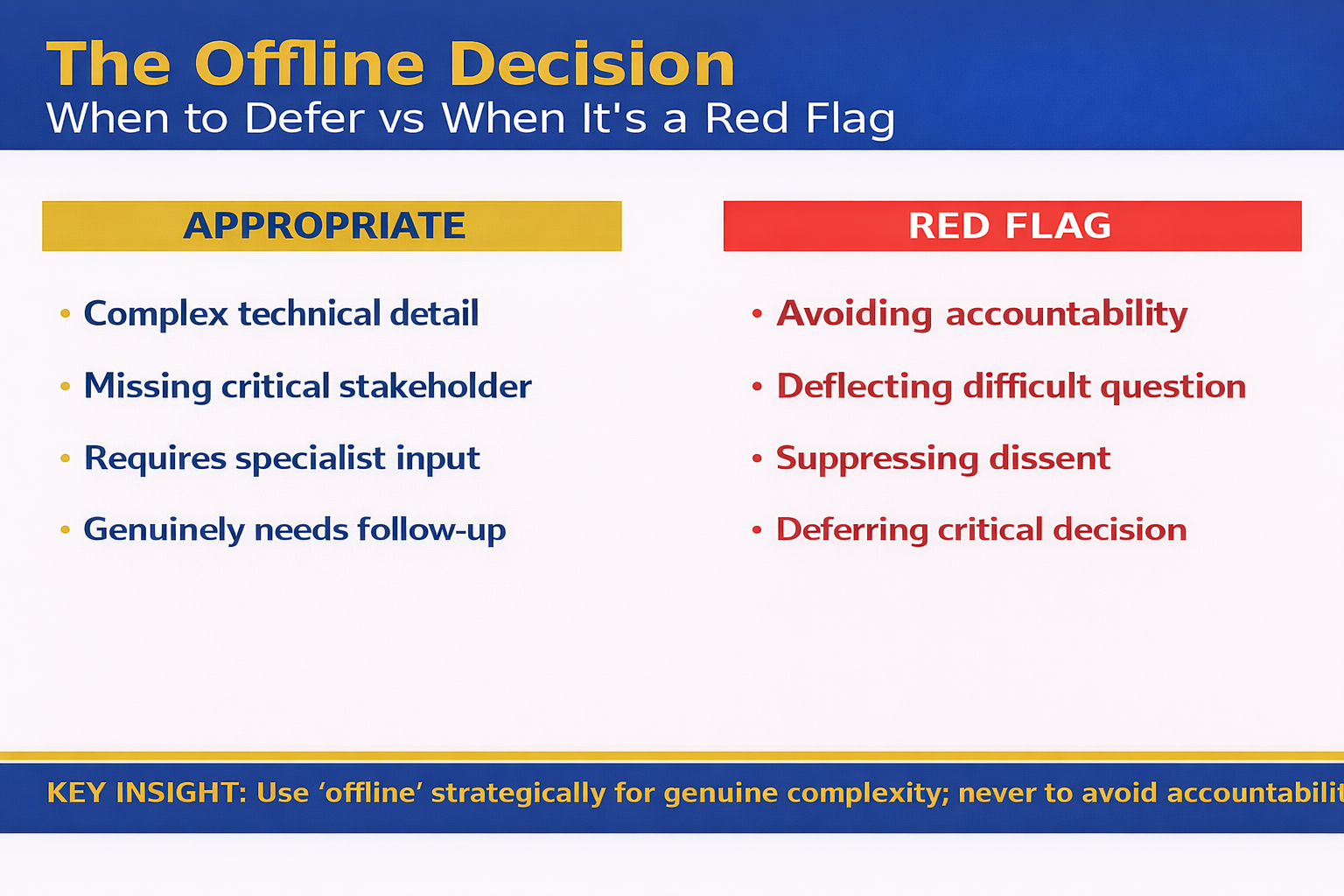
“We’ll take that offline” is a reasonable phrase in some contexts. If someone asks for a specific data point you don’t have at hand, deferring is fine.

But in a steering committee, when someone asks a question that’s politically important (about budget, scope, timeline, resource competition, strategic alignment), saying “We’ll take that offline” signals:

Signal 1: You’re avoiding. You don’t have a clear answer, or you’re uncomfortable giving it in front of the group. The committee reads this as: “You’re not as confident as you appeared.”

Signal 2: You don’t understand the political intent. If you did, you’d know that answering the question in the room matters. The person asking wants the room to hear that you’ve thought through this concern. Deferring suggests you don’t understand the political stakes.

Signal 3: You’re ceding authority. When you defer the answer, you’re saying: “This is something we’ll sort out separately, not something I’m committing to now.” The committee recognizes this as weak leadership.

Signal 4: You’re unreliable. Steering committees see deferred answers as commitments you’re backing away from. Even if you fully intend to follow up, the committee has already registered: “Not ready to commit.”

The best steering committee members never say “We’ll take that offline” in response to a politically important question. They answer the question in the room with clarity—either with a direct answer, or with a clear statement of the decision boundary.

Four Tactical Responses for Steering Committee Questions

Instead of deferring, you have four tactical moves that signal confidence and command.

Not every tactic works for every question. You learn to recognize which situation calls for which tactic. But each one keeps you in authority while addressing the actual concern underneath the question.

Tactic 1: Clarify the Question (Tactical Pause)

Use this when a question feels loaded but you’re not quite sure what’s really being asked.

The move: Pause. Say: “Let me clarify what you’re asking, because I want to make sure I’m answering the right thing.”

Then offer two or three possible interpretations of the question, and ask which one is the real concern.

Example: CFO’s deputy: “What happens to this timeline if we need to implement in two phases instead of three?”

You: “Are you asking whether we could compress the timeline? Or whether we’ve already planned for a phased approach? Or whether the budget changes if we phase it?”

What’s happening: you’re not avoiding the question. You’re showing that you’re thoughtful enough to know that different concerns might be hidden under the same words. You’re also forcing the questioner to be more specific, which shifts the power dynamic back to you.

The steering committee sees this as confidence, not deflection.

When to use: When the question feels politically charged but ambiguous. When you suspect the literal question isn’t the real concern. When you want to demonstrate that you’ve thought through multiple scenarios.

Tactic 2: Narrow the Scope (Reset Boundaries)

Use this when the question is trying to pull you into territory that’s not your responsibility.

The move: Acknowledge the question, but explicitly narrow the scope of what you’re answering for.

Example: Head of another business unit: “How are we going to manage the change impact on my team’s productivity during Year One?”

You: “That’s important. What we’re committing to is the implementation timeline and the resource plan on our side. How your team absorbs the change is something your leadership will need to decide. But we can absolutely provide you with the impact assessment so your team can plan for it.”

What’s happening: you’re not dismissing the concern. You’re making crystal clear where responsibility ends and theirs begins. You’re saying: “I own this part. You own that part. We’ll work together, but I’m not taking accountability for decisions that aren’t mine.”

This is power. The steering committee respects clarity about responsibility.

When to use: When someone is trying to make you responsible for outcomes that aren’t in your control. When the question reveals a territory battle. When you need to establish clear decision boundaries.

Tactic 3: Acknowledge the Tension (Show You’ve Thought It Through)

Use this when the question raises a real tension or risk that you’ve already considered.

The move: Don’t deny or minimize the concern. Acknowledge it directly. Then show that you’ve already thought through the implications and made a deliberate choice.

Example: Operations lead: “We’re taking on a lot of change concurrently. Won’t this distract from the quarterly close process?”

You: “Yes. You’ve identified a real tension. The concurrent timeline means we do have a distraction risk in Q2. We’ve made a deliberate choice to front-load the heavy work in Q1 and sequence the Q2 activities around your peak close period. That’s why the timeline is structured the way it is. We’ve weighed the distraction risk against the timeline pressure, and this is our answer.”

What’s happening: you’re not hand-waving away a legitimate concern. You’re showing: “I’ve thought about this. I’ve considered the risk. I’ve made an intentional choice. This is defensible.”

The steering committee sees this as credibility.

When to use: When the question raises a legitimate risk or tension. When you want to demonstrate that your proposal is thought-through, not naive. When you want to show that you’ve considered trade-offs and made intentional choices.

Tactic 4: State the Decision Boundary (Signal Authority)

Use this when the question is asking you to make a decision or commitment that isn’t yours to make.

The move: Be explicit about what decision is yours and what’s the committee’s. Don’t try to bridge that gap.

Example: CFO’s deputy: “If we get budget pressure, what will you cut?”

You: “That’s not my decision to make unilaterally. If budget pressure comes, we’d recommend to this committee what we’d cut first, based on risk and timeline impact. But the decision about what’s acceptable risk is yours. I can tell you what our recommendation would be, but I’m not going to make that trade-off call without this group.”

What’s happening: you’re not avoiding responsibility. You’re being explicit about where authority sits. You’re saying: “I’m competent in my area. You’re competent in yours. This question belongs to you.”

This is the clearest signal of authority. You’re comfortable not deciding things that aren’t yours to decide.

When to use: When the question is asking you to commit to something that requires board-level or steering committee approval. When you want to demonstrate that you understand governance and decision boundaries. When you want to avoid the trap of making promises that the committee will later challenge.

Decision matrix showing the four tactical responses to steering committee Q&A, with examples for each tactic and when to use them

Master the Political Dynamics of Steering Committee Q&A

Steering committees are different beasts than boards. The questions are political. The answers are leadership signals. The Executive Q&A Handling System teaches you how to read the political intent beneath steering committee questions and respond with four tactical moves that signal confidence and command.

  • Why “We’ll take that offline” signals weakness in steering committee settings
  • Four tactical responses that keep you in authority while addressing the real concern
  • How to read the political intent beneath loaded questions
  • How to clarify ambiguous questions without appearing defensive
  • How to state decision boundaries that respect authority without avoiding responsibility

Get the Executive Q&A System → £39

Used by programme directors, transformation leads, and business case owners facing steering committees. The tactical responses work because they work with committee psychology, not against it.

Stop deferring to “offline.” Answer with authority.

Get the System → £39

How to Predict Steering Committee Questions Before They’re Asked

The best steering committee performers don’t wait for questions. They predict them.

Every person on a steering committee has interests. Budget interests. Scope interests. Territory interests. Timeline interests. Risk concerns. The questions that get asked almost always relate to those interests.

Step 1: Map the committee members. Who are they? What business units do they represent? What would their concerns be if they were evaluating your proposal?

Step 2: List the likely concerns. Not about your proposal’s merit. About their interests. Budget pressure? Timeline risk? Scope creep that affects their area? Dependency on another team? Change management impact?

Step 3: Predict the questions. What question would each committee member ask if they wanted to surface their concern?

Step 4: Prepare your answer using one of the four tactics. Not a robotic answer. A tactical response that acknowledges the concern while maintaining your authority.

Step 5: Listen for the actual question. When someone asks a question you predicted, you’re not surprised. You’re ready with a response that signals confidence.

This preparation doesn’t mean you’re scripting responses. It means you’ve already thought through the political landscape. You know what concerns you’re going to face. You know which tactic fits which concern. When the question comes, you respond with authority because you’re not thinking for the first time in the moment.

The Difference Between Steering Committee Q&A and Board Q&A

A board asks: “Is this governed well? Are risks managed? Can we approve this?”

A steering committee asks: “Does this threaten my interests? Can I influence this? Do I understand what I’m committing to?”

Board Q&A is about reassurance. You’re proving that governance is sound.

Steering committee Q&A is about clarity. You’re proving that you understand the political terrain and you’re making intentional choices.

Board meeting Q&A techniques focus on explaining risk mitigation. Steering committee Q&A techniques focus on demonstrating political awareness.

This is why “We’ll take that offline” fails in steering committees. It signals: “I haven’t thought about the political dynamics of this question.” A board might accept that answer. A steering committee recognizes it as weakness.

Take it offline decision matrix infographic showing when deferring is appropriate versus when it is a red flag with specific scenarios for each category

Never Default to “Offline” Again

Steering committee members are evaluating you as a leader, not just your proposal. Every question is a test of your political awareness and your confidence. The Executive Q&A Handling System teaches you the four tactical moves that keep you in authority while addressing the real concern underneath loaded questions.

  • How to read the political intent beneath steering committee questions
  • The four tactical responses (clarify, narrow, acknowledge, boundary) and when to use each
  • How to predict steering committee questions before they’re asked
  • How to prepare answers that demonstrate confidence and command
  • Real examples from transformation initiatives, business cases, and strategic programmes

Get the Executive Q&A System → £39

Includes a question prediction worksheet and the four-tactic response framework with real boardroom examples.

Your next steering committee is your chance to show you understand the game.

Get the System → £39

Three Critical Questions About Steering Committee Q&A

What if I genuinely don’t know the answer to a steering committee question? Don’t pretend you know. Instead, say: “That’s a fair question. I don’t have that analysis right now, but I can see why it matters. Here’s what I’ll commit to: I’ll get you the answer, and I’ll bring it back to the steering committee so we can decide as a group.” You’re not deferring the question; you’re committing to a specific follow-up and a specific forum for the decision. The committee respects this more than “We’ll take it offline.”

What if my steering committee is very political and adversarial? The four tactics become even more important. Clarifying, narrowing, acknowledging, and stating decision boundaries are your protection against being tripped up. The more political the committee, the more important it is to be explicit about what you’re answering for and what you’re not. This prevents you from being pulled into territory that isn’t yours.

Can I use these tactics on a board, or are they strictly for steering committees? The tactics work on any committee, but the emphasis changes. Boards care more about governance and risk reassurance. Steering committees care more about political clarity and decision boundaries. You’d emphasise different aspects of the response depending on the audience, but the core technique is the same.

Is This Right For You?

✓ This is for you if: You present regularly to steering committees, you’ve noticed that some of your answers don’t land the way you expected, you want to improve your credibility in politically complex meetings, you’re often defending a proposal or a programme, you want to understand the political dynamics beneath the questions being asked.

✗ Not for you if: Your presentations are primarily to non-political audiences, you don’t face challenging Q&A, you’re comfortable with your current steering committee performance, you present only to supportive audiences.

The Signature Q&A System: Used by Steering Committee Leaders and Programme Directors

This is the Q&A architecture that works when the stakes are high and the committee is political. You’ll learn the four tactical responses, how to read political intent, how to predict questions before they’re asked, and how to maintain authority while addressing the real concerns beneath the questions.

  • Why steering committee Q&A is fundamentally different from board Q&A
  • The four tactical responses: clarify, narrow, acknowledge, decide boundary
  • How to read the political intent beneath loaded questions
  • Question prediction framework (map members, list concerns, predict questions)
  • How to prepare answers that signal confidence and command
  • Real examples from transformation initiatives, business cases, and strategic programmes
  • How to handle follow-up questions and maintain your position

Get the Executive Q&A System → £39

Programme directors, transformation leads, and business case owners use this system before every steering committee. The political dynamics get clearer every time you use it.

Frequently Asked Questions

How do I know if a question is really political or just a genuine inquiry?

Ask yourself: does this question reveal an interest or concern that affects the questioner directly? If yes, it’s political. The question might be framed as a general inquiry, but the person asking has something at stake. That stake is what you’re responding to. The four tactics work whether the question is purely political or genuinely interested, so you’re safe using them in either case.

What if I use one of these tactics and the questioner seems offended?

They’re not actually offended. They’re registering that you’ve recognized their political intent. That’s uncomfortable for people who don’t expect to be read so directly. But it’s also respectful—you’re taking their concern seriously enough to address it directly rather than deflecting. The discomfort passes quickly, and the respect remains.

Can I combine multiple tactics in a single answer?

Yes. You might clarify the question, acknowledge the tension, and state a decision boundary all in one response. As you get more comfortable with the tactics, you’ll develop a style that flows naturally and incorporates multiple moves. Start by mastering one tactic. Then combine them as your comfort grows.

Your Steering Committee Needs Your Clarity Now

Steering committees form to provide governance on strategic initiatives, transformation programmes, and business cases that span multiple functional areas. The political dynamics are real. The questions are tests. Your answers are leadership signals.

You have a steering committee coming up. Maybe next week. Maybe next month. When you walk into that room, you’ll either defer difficult questions with “We’ll take that offline,” or you’ll answer them with one of the four tactical moves.

The committee will recognise the difference immediately. And so will your credibility.

About the Author

Mary Beth Hazeldine is the Owner & Managing Director of Winning Presentations. With 24 years of corporate banking experience at JPMorgan Chase, PwC, Royal Bank of Scotland, and Commerzbank, she has delivered high-stakes presentations in boardrooms across three continents.

A qualified clinical hypnotherapist and NLP practitioner, Mary Beth combines executive communication expertise with evidence-based techniques for managing presentation anxiety. She has trained thousands of executives and supported high-stakes funding rounds and approvals.

Book a discovery call | View services

Resources From Winning Presentations

Subscribe to The Winning Edge, our weekly newsletter where we share Q&A strategies, real committee stories, and executive communication frameworks. Delivered every Monday.

Stop deferring questions to offline conversations. Start answering them in the room with clarity and command. Your next steering committee will show you what a difference the right tactical response makes.

This article was written with AI assistance and reviewed by Mary Beth Hazeldine.

14 Mar 2026
Executive reviewing a structured question bank document before a presentation meeting

The Question Bank: Building a Personal Library of Answers You’ll Need Again and Again

A presentation question bank is a personal system of recurring Q&A patterns with tested answers you’ve refined through real meetings. It prevents inconsistent responses, saves preparation time, and dramatically improves your closing rate. This guide shows you how to build, categorise, maintain, and use one.

The Problem That Started It All

A sales VP at a SaaS firm was closing just three out of every forty-seven client demos—a 6% close rate. When we dug into what was happening, the issue became clear: he was being asked essentially the same fifteen questions in every single demo. “How does this integrate with our legacy system?” “What’s your migration process?” “What happens if your company gets acquired?”

The problem wasn’t that he couldn’t answer these questions. The problem was that he was answering them from scratch every single time. In Demo 1, he’d emphasise technical integration. In Demo 7, he’d focus on risk mitigation. In Demo 23, he’d suddenly mention a customer story he’d forgotten about in earlier demos. The prospects could feel the inconsistency. More importantly, some answers came across as stronger and more credible than others—and he had no system for knowing which version worked best.

The moment he built a personal question bank with tested answers refined through real feedback, everything shifted. He structured each recurring question with a core narrative, supporting data, and a customer example. He practised the answers until they sounded natural. His close rate climbed from 3 out of 47 to 9 out of 23 in the next four months. That’s a jump from 6% to 39%.

This wasn’t luck. It was systematic preparation.

Quick Diagnostic: Are You Losing Deals to Inconsistency?

Consider these questions about your own presentation Q&A:

  • Are you answering the same questions in every presentation but explaining them differently each time?
  • Do you sometimes wish you’d answered a question differently after the meeting ended?
  • Are your best answers happening by accident rather than by design?
  • Do you spend energy crafting answers in the moment instead of drawing on tested responses?

If you recognised yourself in more than one of those, you’re ready for this approach. The Executive Q&A Handling System gives you the exact framework to build and maintain a question bank that works. It’s £39 and designed specifically for this challenge.

What a Question Bank Actually Is

A question bank is not a FAQ. It’s not a script. It’s not something you memorise.

A question bank is a curated personal library of questions you know will come up in your presentations—organised by category, each with a framework for answering that you’ve tested in real meetings. It captures the structure of your best answers, the specific data points that resonate, the customer stories that illustrate your point, and the natural language you use when you’re at your most confident.

Think of it like a jazz musician’s practice framework. A jazz musician doesn’t memorise every solo. Instead, she knows the underlying patterns, the chord progressions, the scales that work, and the techniques that create impact. When she plays, she improvises within that structure. That’s what a question bank does for your Q&A.

The core benefit isn’t that you’ll remember the answer. It’s that you’ll deliver it consistently, confidently, and with the specific elements that have proven to work. You’re no longer inventing responses on the spot. You’re drawing on a tested system.

Building a question bank takes about four to six weeks if you’re deliberate about it. Maintaining it takes roughly thirty minutes per month. The return—in consistency, confidence, and closing rates—is immediate and measurable.

How to Categorise Your Questions

Not all questions are created equal, and grouping them correctly saves you time during preparation and helps you spot gaps in your thinking.

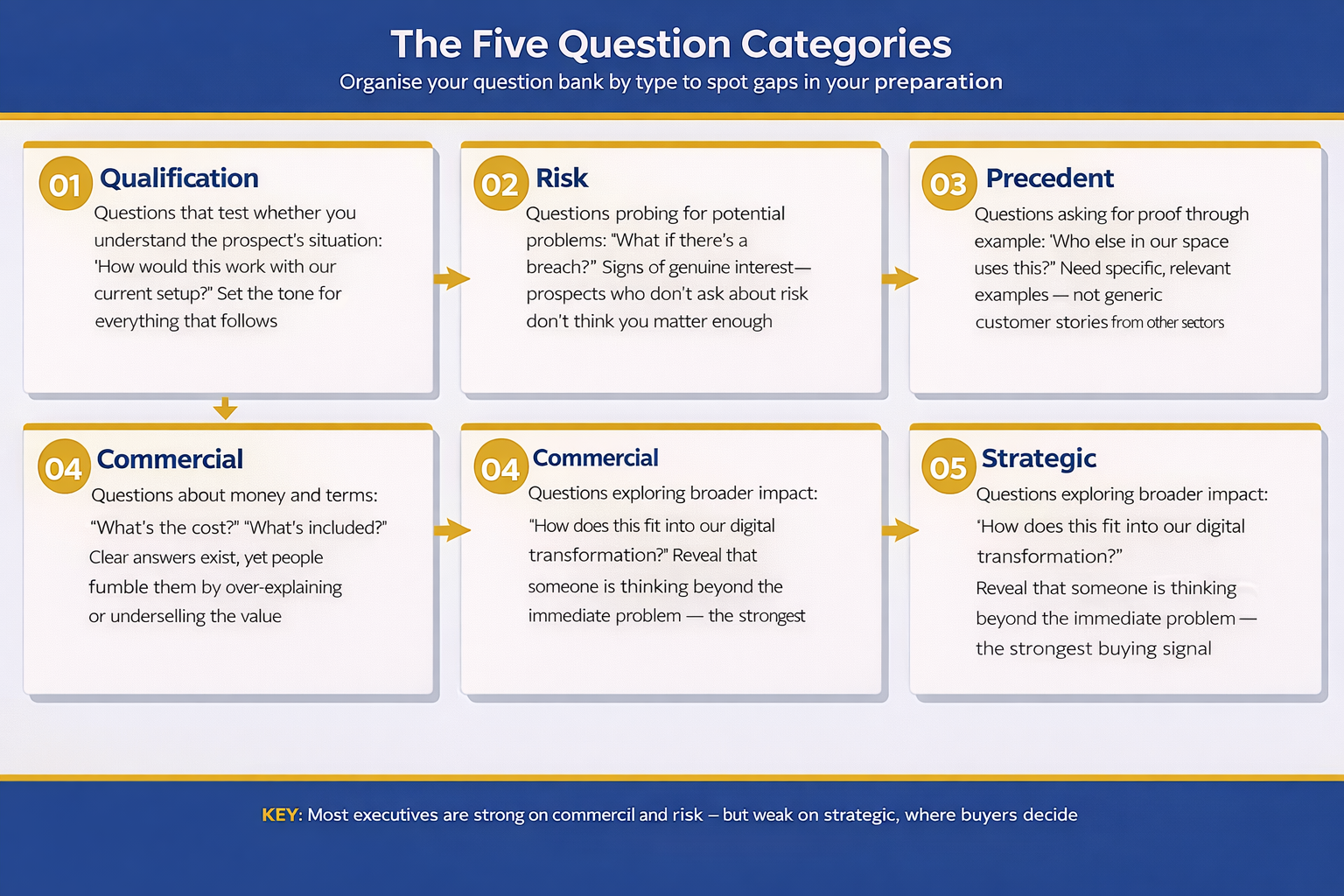
Most presentation questions fall into five natural categories:

Category 1: The Qualification Questions. These test whether you understand the prospect’s situation. “How would this work with our current setup?” “What’s the typical timeline?” “Has anyone in our industry implemented this?” These questions come early and set the tone for everything that follows.

Category 2: The Risk Questions. These probe for potential problems. “What if there’s a data breach?” “What happens if you go out of business?” “How do we ensure this doesn’t disrupt our operations?” Risk questions often feel aggressive, but they’re actually signs of genuine interest. A prospect who doesn’t ask about risk doesn’t believe you matter enough to worry about.

Category 3: The Precedent Questions. These ask for proof through example. “Who else in our space uses this?” “Can you share a case study?” “What did you do when a client had this exact problem?” Precedent questions need specific, relevant examples—not generic customer stories.

Category 4: The Commercial Questions. These focus on money and terms. “What’s the cost?” “How do you price this?” “What’s included in the base package?” These questions have clear answers, yet people often fumble them by over-explaining or underselling.

Category 5: The Strategic Questions. These explore broader implications. “How does this fit into our digital transformation?” “What’s your vision for where this goes?” “How will this change the way we work?” Strategic questions reveal that someone is thinking beyond the immediate problem and imagining long-term outcomes.

When you’re building your question bank, categorise each recurring question into one of these five types. This immediately shows you where your preparation is strongest and where you need to do more work. Most executives have strong answers for commercial and risk questions but weaker answers for strategic questions—precisely the questions that buyers ask when they’re seriously considering you.

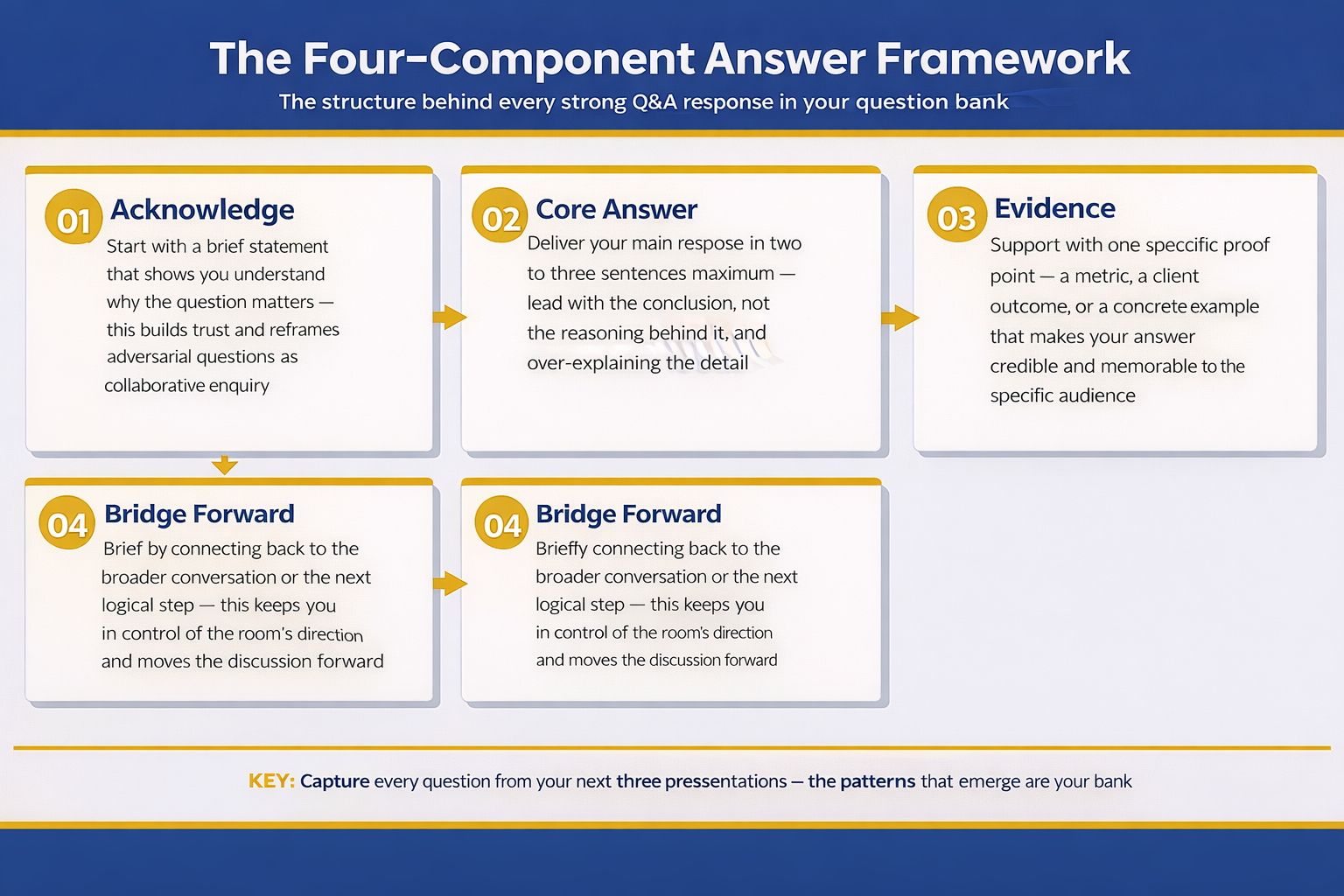
The Four-Component Answer Framework infographic showing the structure behind every strong Q&A response: Acknowledge (show you understand why the question matters), Core Answer (deliver your main response leading with the conclusion), Evidence (support with one specific proof point that builds credibility), and Bridge Forward (connect back to the broader conversation to maintain control)

The Answer Framework for Each Entry

Once you’ve identified a recurring question and categorised it, the next step is to build a framework for your answer. This isn’t a word-for-word script. It’s the architecture of your response—the elements that make the answer work.

Every strong answer has four components. Master this framework, and you’ll never be caught flat-footed by a question again.

Component 1: The Acknowledgement. Start by acknowledging what the question reveals about the prospect’s concern. If someone asks “What happens if there’s a data breach?” they’re signalling that security and trust matter to them. Your first words should reflect that you understand the seriousness of the concern. “That’s a critical question—it shows you’re thinking about operational resilience, and you’re right to ask.” This takes five seconds and immediately builds trust. It also reframes the question from adversarial to collaborative.

Component 2: The Core Answer. This is the substance. It’s one to three sentences that directly address the question without hedging or over-explaining. For the data breach question, your core answer might be: “We use AES-256 encryption at rest and in transit, maintain SOC 2 Type II certification, and carry cyber liability insurance of £X million. We’ve been audited by [recognised auditor] annually for the past five years.” Notice what’s missing: you’re not explaining what encryption is, apologising for industry-wide security challenges, or offering unnecessary qualifications. You’re stating the fact with confidence.

Component 3: The Proof. This is where you provide evidence through example, data, or case study. For the data breach question: “Across our customer base, we’ve had zero breaches in our platform in [number] years. We’ve had clients in regulated industries like [sector] choose us specifically because of our security posture.” The proof component answers the unspoken follow-up: “How do I know you’re telling me the truth?” A strong proof component uses specific, verifiable evidence, not generic reassurance.

Component 4: The Bridge Forward. This brings the conversation back to the prospect’s situation and moves the discussion forward. “The reason I mention our security approach is that we know it’s non-negotiable in your industry. Once we’ve confirmed the technical architecture meets your requirements, we can move to discussing implementation and timeline.” The bridge acknowledges their concern has been addressed and introduces the next logical conversation.

Apply this framework to every recurring question in your bank. You’ll notice two things: first, you have to really understand your answer to structure it this way. You can’t fake this framework. Second, when you deliver a response using this structure, people perceive you as more competent and more trustworthy. The structure itself is persuasive.

The Five Question Categories infographic for organising a presentation question bank: Qualification (testing understanding), Risk (probing for problems), Precedent (asking for proof), Commercial (money and terms), and Strategic (broader impact and transformation)

Building Your Bank from Real Meetings

The strongest question banks are built from real presentations, not from theoretical guessing. Here’s how to build yours without waiting for a perfect moment.

Step 1: Listen and Record. In your next five presentations, bring a notebook or use your phone to jot down every question that comes up. Don’t overthink it—just write the question as it was asked. You’re looking for patterns. After five presentations, you’ll likely see that the same eight to twelve questions appeared across multiple meetings, even if they were phrased slightly differently.

Step 2: Cluster and Name. Take your list of questions and group the similar ones together. “How do you handle integrations?” and “Does this connect with Salesforce?” are essentially the same question asked different ways. Name the cluster with a clear, single question that captures the essence. “How does the platform integrate with existing systems?” becomes your bank entry.

Step 3: Rate Your Current Answers. For each clustered question, honestly rate how confident you felt answering it in recent presentations. Use a simple scale: Strong (I answered this with confidence and clarity), Moderate (I answered it adequately but felt there was something missing), Weak (I stumbled through this or changed my answer between presentations).

Step 4: Build the Framework. Start with your “Strong” answers. Write them up using the four-component framework: acknowledgement, core answer, proof, bridge forward. Don’t overthink this. If the answer worked in a real presentation, capture what made it work. Then move to your “Moderate” answers and refine them using the framework. Finally, tackle your “Weak” answers, which usually means researching a bit more and finding a better proof point.

Step 5: Test and Refine. The next time someone asks one of your banked questions, deliver the framed answer. Pay attention to their reaction. Did they seem satisfied? Did they ask a follow-up? Did you spot a better way to phrase something? Make notes after the presentation. Your question bank isn’t static—it evolves based on what works in real conversations.

This approach takes the guesswork out of preparation. You’re not trying to imagine what questions might come up. You’re capturing what actually comes up and building a tested response system around it.

Maintaining and Updating Your Bank

A question bank is only valuable if it stays current. The moment your market, your product, or your competitive situation shifts, your answers need to shift too.

Monthly Review. Set a calendar reminder for the first Monday of each month. Spend thirty minutes reviewing your question bank. Go through each entry and ask: Have I answered this question in the past month? If yes, how did it land? Do I need to adjust anything? If no, is this still a question that comes up, or can I retire this entry? This monthly discipline keeps your bank aligned with what’s actually happening in your presentations.

Seasonal Updates. Quarterly, do a deeper review. Look for new questions that have emerged. In Q1, prospects might focus on budget cycles and board-approved initiatives. In Q4, they might focus on year-end commitments and next-year planning. Your question bank should reflect these seasonal variations. Add new questions that surfaced in recent presentations. Remove questions that haven’t appeared in three months. This keeps your bank lean and relevant.

Competitive Shifts. If a competitor launches a new feature, releases new pricing, or makes a market announcement, review your bank immediately. You’ll almost certainly be asked about it. Develop your four-component answer before the next presentation, not during it. This is where the value of a maintained bank becomes obvious. Everyone will be asked the same competitive question. Your question bank means you’ll be ready. Your competitors will be improvising.

Proof Point Rotation. Every six months, look at the proof points (case studies, customer examples, data points) in your answers. Have they aged? Do they still feel current and relevant? Replace older examples with newer ones. A prospect is more impressed by “We helped a customer in your sector solve this in the past two months” than “We’ve been solving this for years.” Rotating proof points keeps your answers feeling fresh and recent.

The Q&A Preparation Checklist for Executives can help you structure this monthly and seasonal review process.

Using Your Bank for Live Preparation

A question bank is only useful if you actually use it before presentations. Here’s how to make it part of your real preparation workflow.

Seven Days Before. Pull your presentation attendee list. Based on titles, industries, and company type, identify which questions from your bank are most likely to come up. If you’re pitching to CFOs, your commercial and risk questions matter most. If you’re pitching to operations leaders, your implementation and integration questions matter most. Prioritise your review based on the specific audience.

Three Days Before. Review the five to seven questions most likely for this specific presentation. Read through each four-component answer. Don’t memorise it. Just let the framework settle into your mind. Read it once, let it sit, read it again. This is different from studying. You’re activating knowledge you already have, not cramming new information.

Day Before. Do a final read of your top three questions. If there’s a new development you should mention (new customer, new feature, new market announcement), update your proof point accordingly. Spend five minutes visualising how you’ll answer each question. See yourself staying calm, delivering the answer with the four components in order, and moving the conversation forward. This mental rehearsal is remarkably effective.

During the Presentation. When a question lands, take a breath. You know the framework for this question because you’ve practiced it. You know the acknowledgement that shows you understand their concern. You know your core answer with confidence. You know the proof point that builds credibility. You know the bridge that moves the conversation forward. You’re not thinking on your feet. You’re executing a framework you’ve already internalised.

This is where most people realise the actual value of a question bank. It doesn’t reduce spontaneity. It enables spontaneity. You can fully listen to the questioner, respond authentically, and draw on a structure that you know works—all at the same time.

If you want to accelerate this process and integrate Q&A preparation into a complete system, the Executive Q&A Handling System walks you through the entire build-and-maintain process with templates, frameworks, and strategic guidance.

Stop Leaving Your Best Answers to Chance

A well-built question bank eliminates inconsistency, saves preparation time, and directly improves your close rate. The difference between answering questions from memory and drawing on a tested framework is measurable—often the difference between 6% and 39% conversion.

  • Capture every recurring question in one place, organised by type
  • Build tested answers using the four-component framework that works
  • Maintain your bank monthly to stay current with your market

Get the Executive Q&A Handling System → £39

Used by executives across finance, technology, and professional services.

People Also Ask: How long does it take to build a question bank?A functional question bank takes four to six weeks if you’re deliberate about it. You’ll identify your top recurring questions in the first two weeks (based on real presentations), build out the four-component framework for each question over the next two weeks, and spend the final two weeks testing the answers in live presentations and refining them. Most people find they can dedicate just thirty minutes a week to this without disrupting their schedule. The time investment returns itself in your first post-bank presentation through improved confidence and consistency.

The Three Questions Every Presenter Faces

Most of the questions that appear in your bank will fall into three recurring themes, regardless of your industry or product. Understanding these meta-questions will help you anticipate and prepare for the questions you haven’t yet heard.

Theme 1: “Will this actually work for us?” This is the core doubt underneath qualification and risk questions. The prospect is asking whether your solution is credible, viable, and suitable for their specific situation. Your answer needs to acknowledge their specific constraints and show that you’ve solved similar challenges before. This is where precedent questions are so valuable. Prospects don’t want generic reassurance. They want evidence from situations that look like theirs.

Theme 2: “Can we afford this and what are the trade-offs?” This surfaces in commercial questions, but it goes deeper than just price. Prospects are asking whether the value justifies the cost, whether it will create other expenses they haven’t anticipated, and whether they’re getting a good deal compared to alternatives. Your answer needs to separate total cost of ownership from upfront price, and anticipate the trade-offs they’re worried about before they ask.

Theme 3: “What does this change about how we work?” This is the strategic question that separates buyers who are seriously considering you from those who are just gathering information. They’re asking about implementation, timeline, change management, and the implications for their team and operations. Your answer needs to be honest about what will change (they know something will) and clear about how you’ll guide them through it.

As you build your question bank, notice how your recurring questions connect to these three meta-themes. Your bank answers should directly address these underlying concerns, not just answer the surface question.

People Also Ask: Should I include questions I’ve never been asked?Only if you anticipate them based on your market or competitive situation. The strongest question banks are built from real presentations, not theoretical scenarios. However, there’s a reasonable exception: if you know a competitor released a feature that will definitely generate questions, or if there’s a regulatory change that will surface concerns, you can proactively add these to your bank. But start with questions that have actually come up. A bank of real questions is more valuable than a bank of possible questions.

Use your question map to visually organise these three meta-themes across your five question categories. This gives you a complete strategic view of your Q&A landscape and helps you spot gaps in your preparation.

Master the Framework That Changes Everything

The difference between a scattered Q&A approach and a systematic question bank is the difference between hoping you answer well and knowing you’ll answer well.

  • Apply the four-component answer framework to every recurring question
  • Build answers that are tested, credible, and naturally delivered

Get the Executive Q&A Handling System → £39

The framework used by top sales leaders and business development executives.

Moving from Scattered Q&A to Systematic Preparation

The mistake most executives make is waiting for perfection before they start capturing their questions. They think they’ll build a complete, exhaustive question bank all at once. That’s backwards. Start with your top five questions. Build the four-component answer for each. Test them. Refine them. Then add five more.

A question bank isn’t built in a day. It’s built in conversations—in presentations, in follow-ups, in moments where you realise a question worked better when you answered it differently.

The system is simple. Capture it. Test it. Refine it. Repeat. After four weeks, you’ll have a bank that covers 80% of your presentations. After eight weeks, you’ll realise you’ve stopped answering questions inconsistently. After twelve weeks, you’ll notice your close rate has shifted.

This isn’t about memorising scripts or sounding robotic. It’s about building confidence through systematic preparation. When you know you have a tested answer for the most important questions, you can be fully present in the conversation. You can listen deeply. You can respond authentically. You can move deals forward.

People Also Ask: How many questions should be in my final bank?Most executives have between twelve and twenty questions that cover 90% of their presentations. A few industries have more—complex B2B sales environments might have twenty to thirty. The key is that every question in your bank should be one that has actually appeared in at least two separate presentations. Don’t aim for comprehensiveness. Aim for the questions that matter and that come up repeatedly. A tight bank of well-answered questions is more useful than a bloated one with questions you rarely face.

The Complete Q&A Preparation System for Executives

A question bank is just the foundation. A complete Q&A handling system includes question prediction, tactical frameworks, and maintenance protocols. The result is that you walk into every presentation knowing you can handle whatever comes your way.

  • Identify your core recurring questions using the clustering method
  • Build tested answers using the four-component framework
  • Integrate Q&A preparation into your pre-presentation workflow
  • Maintain your bank monthly to stay competitive and current
  • Use your bank to improve consistency, confidence, and close rates

Get the Executive Q&A Handling System → £39

Complete system including question capture templates, answer frameworks, maintenance checklists, and strategic Q&A mapping.

Is This Right For You?

This approach is right for you if you:

  • Answer the same questions repeatedly but sometimes give different versions of the answer
  • Want to reduce your Q&A preparation time without reducing quality
  • Know your best answers work but haven’t systematised them
  • Want to close more deals by being more consistent and confident in Q&A
  • Are responsible for multiple presentations or team preparation
This approach is not for you if you:

  • Face entirely new questions in every presentation (you need question mapping, not banking)
  • Are not currently presenting regularly (build your bank once you have recurring presentations)
  • Prefer to improvise all answers without frameworks

Frequently Asked Questions

Q: Won’t a question bank make me sound scripted or robotic?A: No. A question bank is a framework, not a script. You’re memorising the structure (acknowledgement, core answer, proof, bridge), not the exact wording. Because the framework is internalised, you can deliver it conversationally and authentically. In fact, most people report sounding more natural and confident because they’re not searching for the right words—they’re drawing on a structure they’ve practiced. The framework frees you to listen and respond naturally rather than scrambling for an answer.

Q: How do I know if a question is recurring enough to include in my bank?A: Include a question in your bank if it’s appeared in at least two separate presentations. If it showed up once and you haven’t seen it again, it’s not yet recurring. Keep a separate “watch list” of questions that appeared once or twice. Once a question reaches the threshold of appearing in three presentations (even if phrased differently), that’s your signal to add it to your permanent bank. This ensures you’re capturing genuine patterns, not one-off edge cases.

Q: Can I use someone else’s answers in my question bank or do I have to develop my own?A: You can use others’ answers as a starting point, but your bank is most powerful when it contains your answers, tested in your presentations, refined based on your market. Borrowed answers often lack the specificity and proof points that land best with your exact audience. Start with your own answers. If you’re unsure about something, research it, develop your own perspective, and then build your answer framework around that. This ensures you can deliver the answer authentically and adjust it based on audience reaction.

Q: What should I do if I’m asked a question that’s in my bank but my answer doesn’t land well in the moment?A: Pay attention. After the presentation, review what happened. Did the question come in a different context than you expected? Did you miss their underlying concern? Did the proof point feel dated or irrelevant? Use the mismatch as feedback to refine that entry in your bank. Your bank isn’t static. It evolves based on what you learn in real conversations. If an answer doesn’t work, change it. The moment you realise a proof point isn’t landing, find a better one. This is how a question bank stays valuable over time.

Your Next Step

A question bank isn’t complex. It’s just systematic. You’ve probably already built most of it in your head through dozens of presentations. What’s missing is the discipline to capture it, structure it, and maintain it.

Start this week. In your next presentation, capture every question that comes up. Don’t overthink it. Just write them down. After your third presentation, you’ll see patterns. Those patterns are the beginning of your question bank. From there, apply the four-component framework we’ve discussed, test your answers, and maintain them monthly. Within a month, you’ll notice the difference in your preparation time and your confidence. Within three months, you’ll notice the difference in your close rate.

The Executive Q&A Handling System gives you templates and frameworks to accelerate this process, but the work itself—the listening, the refining, the maintenance—is worth doing regardless. This is foundational to executive presence.

About the Author

Mary Beth Hazeldine is the Owner & Managing Director of Winning Presentations. With 24 years of corporate banking experience at JPMorgan Chase, PwC, Royal Bank of Scotland, and Commerzbank, she has delivered high-stakes presentations in boardrooms across three continents.

A qualified clinical hypnotherapist and NLP practitioner, Mary Beth combines executive communication expertise with evidence-based techniques for managing presentation anxiety. She has trained thousands of executives and supported presentations that have secured high-stakes funding rounds and approvals.
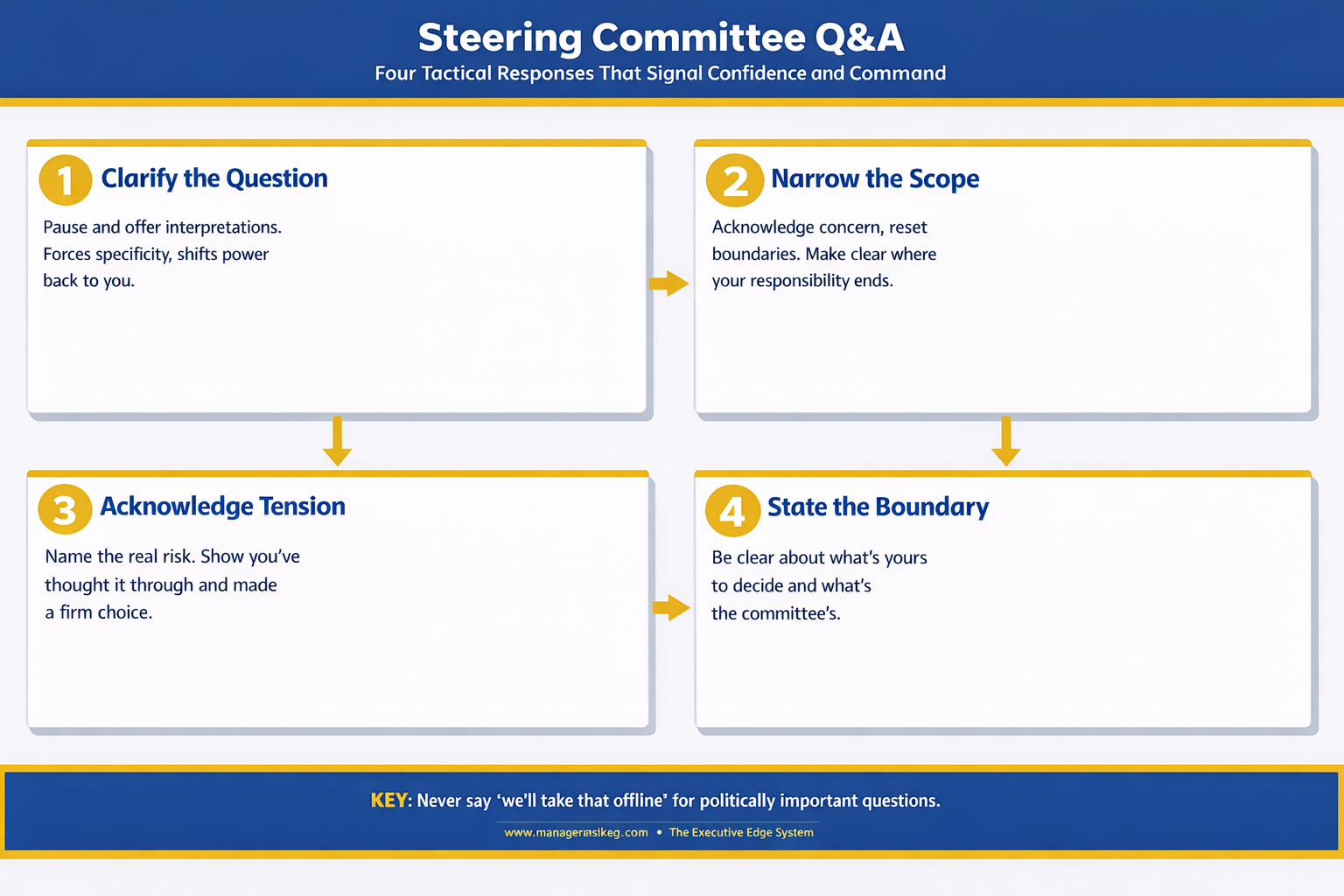
Book a discovery call | View services

02 Mar 2026
Board directors asking questions in a corporate boardroom setting with presentation screen

Board Meeting Q&A: The 7 Questions Directors Always Ask (And What They’re Really Testing)

The CFO rejected it in 11 words. But it wasn’t the presentation that killed the deal. It was the answer to question three.

Quick Answer

Board directors ask the same seven categories of questions in every Q&A session—budget challenges, risk probes, timeline pressure, stakeholder alignment, alternatives analysis, cost-of-inaction testing, and governance compliance. The directors are not testing your slides; they’re testing your judgment under pressure. If you can predict these seven question types and prepare topic-matched answers in advance, you’ll walk into the boardroom with the clarity that wins approval.

🚨 Rescue: Are You Getting Blindsided in Board Q&A?

Directors ask questions you should have anticipated. You don’t have a framework for predicting them. You answer reactively instead of strategically. Three immediate actions:

  1. Map the question types: Before your next board meeting, write down which of these seven categories will matter most to your specific director.
  2. Pre-write your answers: Don’t prepare talking points. Prepare exact answer scripts so you can deliver them under pressure without fumbling.
  3. Run mock Q&A: Have a colleague ask these seven question types back-to-back. Record yourself. Listen for hesitation, filler words, or pivoting—all signals the answer isn’t locked in.

Get the Executive Q&A Handling System → £39

Jump to Section

The £4M Question That Wasn’t About the Slides

A CFO from a biotech firm spent three weeks perfecting her board presentation. Forty-seven slides narrowed to twelve. Charts that sang. A narrative arc that built momentum. The deck was flawless.

She walked into the boardroom confident. The presentation went perfectly. Directors engaged, nodded, asked follow-up questions—all positive signals. Then the chair asked: “Walk us through your assumptions on customer acquisition cost if we hit 60% market penetration in year two.”

The CFO had numbers. Spreadsheets backed her up. But the way she answered—hedging, backtracking, diving into footnotes instead of speaking with conviction—signalled uncertainty. Not about the data. About her own judgment.

Three weeks of slide work collapsed in 40 seconds of Q&A. The board approved a smaller funding round. Later, the chair told her: “Your slides were excellent. But in Q&A, you sounded like you were presenting someone else’s work, not owning it as your own.”

She didn’t need better slides. She needed a framework to predict the question types directors ask, lock in answer scripts in advance, and deliver them with the authority that wins approval. The presentation didn’t kill the deal. The unpreparedness in Q&A did.


The 7 board question types directors always ask: budget challenges, risk probes, timeline pressure, stakeholder alignment, alternatives analysis, cost-of-inaction testing, governance compliance

The 7 Board Questions Directors Always Ask

Board directors operate from a playbook. Year after year, organisation after organisation, the same question categories appear. They shift in wording—sometimes sharper, sometimes softer depending on the chair’s style—but the underlying intent never changes.

Question Type 1: The Budget Challenge

The director looks sceptical. “How are you justifying this spend when we could allocate that budget elsewhere?” This question This question appears in most board Q&A sessions. Q&A sessions. Directors use it to test whether you understand the cost-benefit logic, not just the line items. They’re checking if you’ve competed against alternatives—even ones you didn’t present.

Question Type 2: The Risk Probe

“What happens if this assumption is wrong? What’s your downside scenario?” Directors live in risk. They ask this to see how you’ve stress-tested your thinking, whether you’ve prepared contingencies, and whether you’re overconfident about outcomes you can’t control.

Question Type 3: The Timeline Pressure

“Why this timeline? Could you accelerate it, or would delaying it be wiser?” This tests whether you’ve built slack into your schedule or whether you’re running on assumptions that evaporate under pressure. Directors know that execution delays cascade.

Question Type 4: The Stakeholder Alignment

“Have you confirmed buy-in from [HR / Finance / Sales]? What if they say no?” This uncovers whether you’ve done the pre-work or whether you’re asking the board to approve work that hasn’t been aligned below yet. Directors hate surprises downstream.

Question Type 5: The Alternatives Question

“Why this option and not the build/buy/partner approach instead?” Directors want evidence that you’ve evaluated other paths and chosen this one deliberately, not defaulted to it.

Question Type 6: The Cost-of-Inaction Test

“What happens if we don’t do this? What’s the cost of waiting?” This tests whether you understand the true business impact—not just what you’re proposing to build, but what’s at stake if you don’t.

Question Type 7: The Governance Compliance Question

“Does this align with our policy on [data / legal / regulatory / vendor management]? Have compliance and legal signed off?” Directors are gatekeepers. They ask this to confirm you haven’t built something that violates governance.

What Each Question Really Tests

Behind every question type is a hidden diagnostic. Directors aren’t listening for facts; they’re listening for the evidence of your judgment under pressure.

Budget Challenge tests: Your intellectual honesty. Can you say “This costs more, but here’s why it’s worth it” without sounding defensive? Can you acknowledge trade-offs?

Risk Probe tests: Your realism. Do you sound like you’ve war-gamed this, or are you presenting best-case assumptions as certainties?

Timeline Pressure tests: Your planning discipline. Have you built buffers and decision points, or are you hoping nothing goes wrong?

Stakeholder Alignment tests: Your organisational awareness. Do you understand who needs to move first, or are you presenting as if the board approval is the starting gun?

Alternatives Question tests: Your strategic thinking. Have you evaluated options, or did you arrive at this one by habit?

Cost-of-Inaction tests: Your business acumen. Can you quantify the risk of inaction, or are you asking the board to approve based on your assertion alone?

Governance Compliance tests: Your operational rigour. Do you move through the organisation systematically, or do you treat governance as an afterthought?

Notice what they’re not testing: the beauty of your slides. The eloquence of your storytelling. Your ability to read a room. Directors assume you’re competent at those things. They’re stress-testing your judgment.

Walk Into Board Q&A Knowing 80% of the Questions Before They’re Asked

Most executives enter board Q&A sessions unprepared for the actual questions that matter. They’ve rehearsed answers to what they think directors will ask, not what directors actually ask. The result: hesitation, backtracking, and the impression of judgment under fire.

The Executive Q&A Handling System flips this. You work through a proprietary question-mapping framework that identifies which of the seven question types matter most to your specific board composition. Then you build answer scripts—not talking points, but locked-in responses you can deliver under pressure without reaching for filler words or pivoting.

  • Predict the exact question categories your directors will ask, based on board composition and business context
  • Write answer scripts that acknowledge trade-offs and edge cases (the signals of strategic thinking)
  • Practise delivery until your answers sound conversational, not rehearsed—the hallmark of authentic authority

Get the Executive Q&A Handling System → £39

Used by executives preparing for high-stakes board Q&A in funding rounds, strategy approvals, and governance reviews.

If you’re presenting to a board for the first time, or you’ve noticed your Q&A answers lack the decisiveness directors expect, the Executive Q&A Handling System walks you through the exact process to map board questions and lock in your answers.

Stop Getting Blindsided by the Question You Should Have Predicted

Every director has a signature question type. Finance directors probe budget assumptions. Risk-focused directors stress-test downside scenarios. Operational directors test stakeholder alignment. When you walk into a board room unprepared for these predictable patterns, you’re already behind.

  • Know which question type matters most to each director on your board, before you sit down
  • Deliver answers that acknowledge complexity and edge cases—proof that you’ve genuinely thought this through

Get the Executive Q&A Handling System → £39

The framework includes a board profiling template and question-type checklists for finance, governance, risk, and operational directors.

Board Q&A often blends with hybrid presentation formats, where some directors are in the room and others are remote. Your Q&A framework needs to work across both delivery modes.


Board Q&A preparation checklist: question type identification, answer script writing, pressure delivery practice, stakeholder pre-alignment, downside scenario mapping, governance compliance review

How to Prepare Answers That Win Approval

Board approval doesn’t hinge on the quality of your slides. It hinges on your ability to answer the seven question types with authority and honesty. Here’s the preparation framework:

Step 1: Profile Your Board

Which directors are finance-focused? Which are risk-obsessed? Which care most about operations and execution? Map the board composition and predict which question types will dominate your Q&A. A board with strong finance and risk representation? Expect aggressive budget and risk probes. A board with operational executives? Expect timeline pressure and stakeholder alignment questions.

Step 2: Build Your Question Map

For each of the seven question types, write down the specific version that will appear in your board Q&A. Don’t write generic versions. Write the actual questions your board will ask, based on your business context. “Walk us through your CAC assumptions if we shift from direct sales to channel partnerships” is more useful than “How have you stress-tested your assumptions?”

Step 3: Write Answer Scripts (Not Talking Points)

Talking points are vague. “We’ve thought about budget and here’s why we’re confident” is a talking point. Answer scripts are specific and locked in. “Our budget assumes £2.8M in year-one implementation costs. That’s 2.4% of annual revenue—higher than our industry baseline, but necessary because we’re building custom integrations rather than using COTS software. If we used COTS, we’d cut implementation costs by 40%, but we’d lose the operational advantage we’ve modelled.”

That’s an answer script. It acknowledges the trade-off. It signals that you’ve weighed alternatives. It doesn’t overstate certainty.

Step 4: Pressure Test Your Delivery

Have a colleague sit across from you and ask these questions in rapid succession, the way a board does. Record yourself. Listen for:

  • Filler words (“um,” “uh,” “like,” “you know”)
  • Hedging language (“I think,” “probably,” “we hope”)
  • Pivoting instead of answering (starting to answer the question they asked, then pivoting to something you’d rather talk about)
  • Hesitation before you speak

These are all signals that your answer scripts aren’t locked in yet. Practise until you can deliver them conversationally, with the calm authority that comes from genuine preparation.

Step 5: Pre-Align Stakeholders

The stakeholder alignment question often catches executives off guard because they haven’t done pre-alignment work. Before your board Q&A, confirm that HR, Finance, Legal, and any other department affected by your proposal has actually signed off. Don’t let the board be the first place you hear “Wait, Finance didn’t agree to this timeline.”

3 Questions Board Executives Ask Us

Q: How far in advance should I prepare board Q&A answers?
A: At least two weeks before your board meeting. That gives you time to build scripts, run mock Q&A, refine your language, and pre-align with stakeholders. Preparing the morning of creates stress and shows in your delivery.

Q: What if a director asks a question that isn’t one of the seven types?
A: It rarely happens. But if it does, your response is the same: pause (don’t rush), acknowledge the question, and answer with specificity and intellectual honesty. Directors respect executives who take a moment to think before they answer.

Q: Should I memorise my answers or keep them conversational?
A: Memorise the core ideas and key numbers. Keep the delivery conversational. You want directors to hear someone who knows this subject deeply, not someone reciting a script. The script is your foundation, not your prison.

24 Years of Board Q&A. The 7 Questions Never Change. The Answers Do.

Over nearly a quarter-century, I’ve sat through hundreds of board Q&A sessions—as a CFO, as a founder, as an advisor, and as a director myself. The seven question types I’ve outlined in this article have never changed. Budget challenges, risk probes, timeline pressure, stakeholder alignment, alternatives analysis, cost-of-inaction testing, governance compliance. They’re constants.

What changes is the sophistication of the directors asking them, the complexity of the business context, and the stakes of the decision. Your board expects you to walk in with answers that reflect genuine strategic thinking—not hope, not assumption, but judgment that’s been pressure-tested and refined.

  • Learn the seven question types and how to map them to your specific board
  • Practise answer scripts until delivery is effortless and conversational
  • Walk into your next board meeting with the clarity that wins approval

Get the Executive Q&A Handling System → £39

Used by executives across finance, operations, strategy, and IT preparing for high-stakes board Q&A in funding rounds, governance approvals, and strategic reviews.

Is This Right For You?

The Executive Q&A Handling System is built for executives who:

  • Present to boards regularly and want to move from reactive to prepared
  • Know the questions are predictable but haven’t had a framework to map them
  • Have good slides but notice their Q&A answers lack the conviction directors expect
  • Want to understand what directors are actually testing, not just what they’re asking
  • Are preparing for high-stakes decisions (funding rounds, strategy approvals, governance reviews) where board confidence matters

Frequently Asked Questions

Do all directors ask the same seven question types?

The seven types are universal. But the emphasis varies. Finance directors will probe budget and risk aggressively. Risk-focused directors will stress-test downside scenarios. Operational directors will focus on timeline and execution risk. The framework helps you identify which types matter most to your specific board and prepare accordingly.

What if I don’t know the directors’ profiles in advance?

You can usually find their public profiles online—investor history, operational background, prior board roles. If not, use the generic board composition (assume you’ll face budget, risk, and stakeholder questions, because those appear in nearly every board Q&A). The Executive Q&A Handling System includes a profiling template that works for both prepared and unprepared situations.

Can I use this framework for investor pitches and presentations to other stakeholder groups?

Yes. Investors ask a variation of the same seven questions, with heavier emphasis on risk and alternatives. The framework is adaptable to investor Q&A, strategy review Q&A, and any high-stakes questioning scenario. The underlying logic—prediction, scripting, pressure testing—applies everywhere.

📬 Get weekly guidance on executive communication delivered to your inbox

Each week, I share frameworks for presenting to boards, handling difficult questions, and building your authority as a presenter.

Subscribe


Related articles from today:

Build on your foundation: If this is your first board presentation, read First Board Presentation: How New Directors Earn Authority in the Room. For deeper Q&A mastery, explore How to Handle Difficult Questions in Presentations and Predict Your Presentation Questions: The Question Map Framework.

About the Author

Mary Beth Hazeldine is Owner & Managing Director of Winning Presentations. Over nearly 25 years, She advises executives across financial services, healthcare, technology, and government on preparing for high-stakes board Q&A, funding rounds, and strategic approval presentations. She founded Winning Presentations to help executives move from hoping they’ll answer well under pressure to knowing they will.

Her frameworks—built on years of observation in real boardrooms—show executives how to structure their thinking, anticipate the questions that matter, and deliver answers with the authority that wins approval.

Book a discovery call | View services

Your next board Q&A will surface the same seven question types. The executives who win approval are the ones who walked in knowing this in advance. Map your board questions and lock in your answers today.