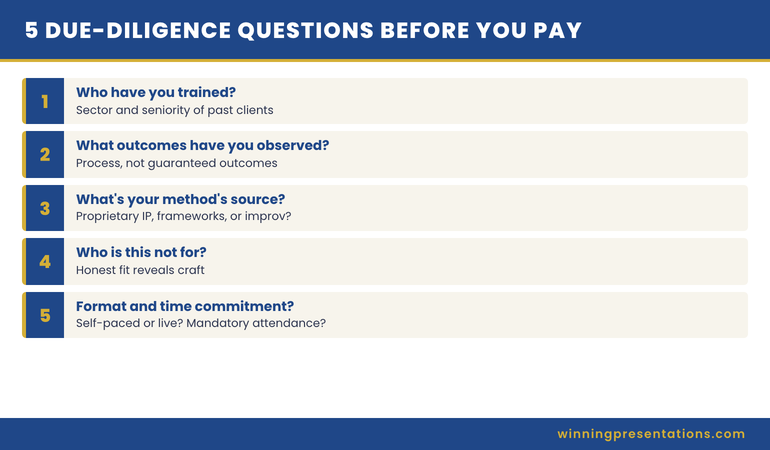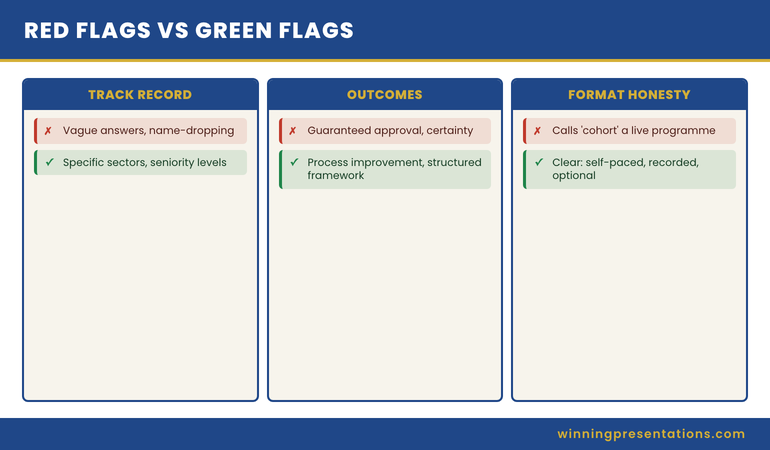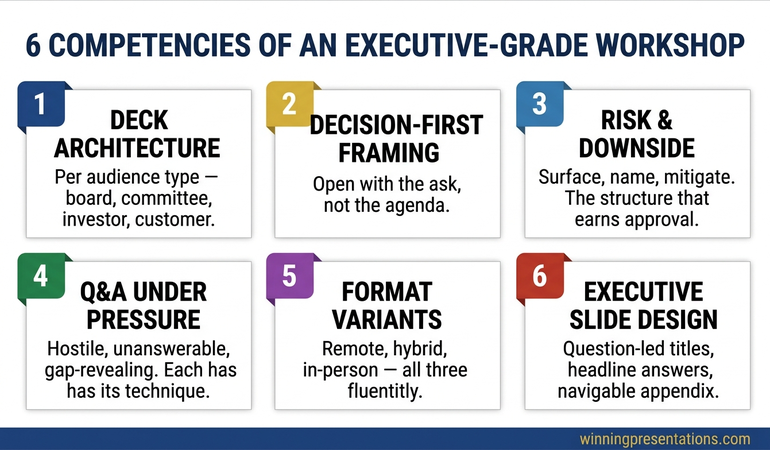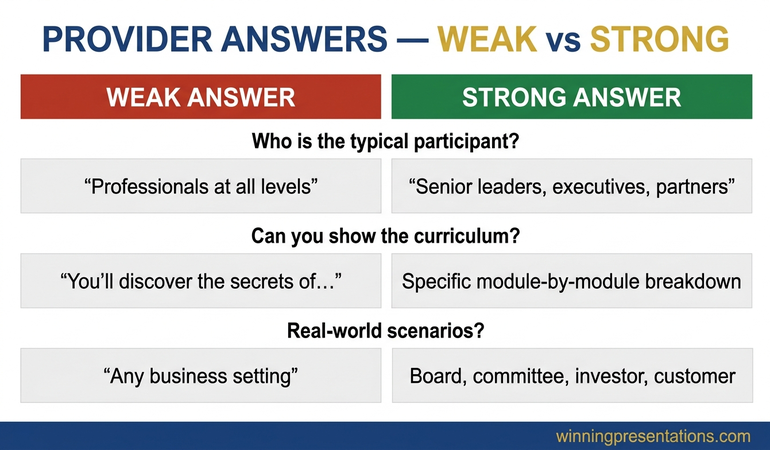
Tag: executive presentation training

26 Apr 2026
Executive presenting board approval case in a modern boardroom with engaged directors

Board Approval Presentation Training That Secures Executive Decisions

Quick answer: Board approval presentation training teaches executives to structure proposals around board-level decision criteria — risk, return, strategic alignment — rather than operational detail. The most effective training builds a repeatable framework for translating complex initiatives into the concise, evidence-led narratives that non-executive directors and senior committees require before committing resources.

Gavin had been a divisional director for nine years. He knew his numbers inside out. He had built a digital transformation programme that would save his organisation £2.3 million annually, and his operational team was unanimously behind it.

The board rejected it in eleven minutes.

Not because the programme was flawed. Because his presentation spoke the language of implementation — timelines, resource plans, vendor comparisons — when the board needed to hear about strategic risk, competitive positioning, and shareholder value. He had prepared exhaustively for the wrong audience. When he came to me, he said something I hear regularly: “I know this material better than anyone in that room. So why couldn’t I get them to say yes?”

The answer is almost always the same. Expertise in a subject and expertise in presenting that subject to a board are entirely different skills. Board approval presentation training bridges that gap — and when it is done well, it transforms how executives communicate upward for the rest of their careers.

Looking for a structured approach to board presentations?

The Maven Executive Buy-In Presentation System covers the complete framework for securing executive approval — from board-level narrative structure to objection handling and evidence packaging.

Learn more about the programme →

Why Most Board Presentations Fail Before Slide One

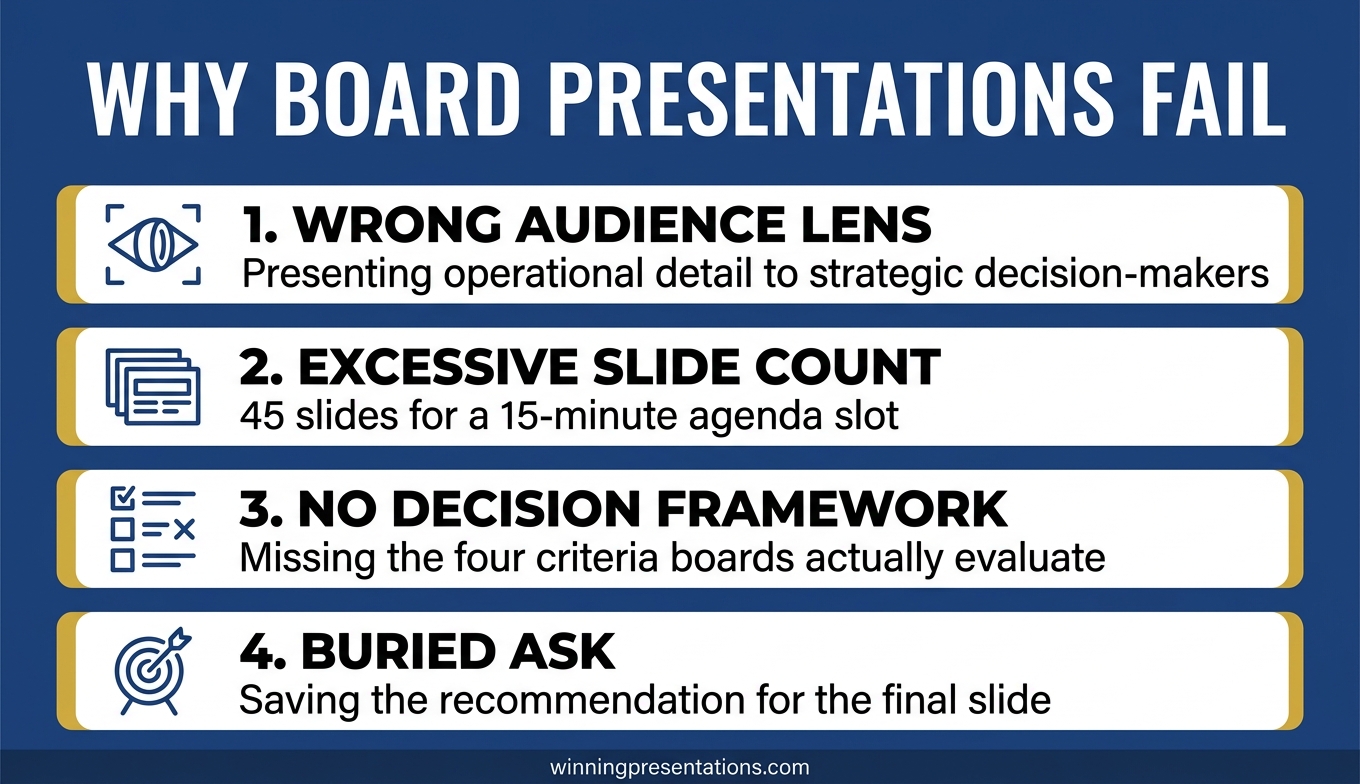
The failure pattern is remarkably consistent. An executive spends weeks assembling a thorough proposal — financial models, implementation timelines, risk registers, vendor evaluations — and walks into the boardroom with forty-five slides and absolute confidence in the detail.

The board chair glances at the agenda, notes that this item has been allocated fifteen minutes, and the entire dynamic shifts. What follows is usually a rushed sprint through material that was designed for a two-hour deep dive.

This is the fundamental misalignment that board approval presentation training addresses. Boards do not operate like project steering committees. They are not evaluating your methodology. They are making a binary decision — approve, defer, or reject — based on whether your proposal meets a specific set of criteria that most presenters never explicitly address.

The executives who consistently secure board approval have learned to think backwards: start with the decision the board needs to make, then provide only the evidence required to make that decision with confidence. Everything else is an appendix — available if requested, invisible unless needed.

This is a skill that can be taught. It requires unlearning habits that serve executives well in every other context — thoroughness, technical depth, comprehensive stakeholder coverage — and replacing them with a board-specific communication framework.

Infographic showing four reasons board presentations fail: wrong audience lens, excessive detail, no decision framework, and missing risk analysis

The Four Decision Criteria Every Board Applies

Regardless of sector, board size, or governance structure, directors typically evaluate proposals through four lenses. Effective board approval presentation training teaches executives to address all four explicitly, rather than hoping the board will extract the answers from a general briefing.

1. Strategic Alignment

Does this initiative advance the organisation’s stated strategic priorities? Boards approve proposals that connect directly to objectives they have already endorsed. If your transformation programme supports a strategic pillar the board set eighteen months ago, lead with that connection. If it doesn’t map to an existing priority, you have a harder argument to make — and training helps you frame it as an emerging strategic necessity rather than an operational preference.

2. Financial Impact and Return

Boards think in terms of return on investment, payback periods, and opportunity cost. They want to know what the organisation gains, what it costs, and when the investment pays for itself. The most persuasive presenters express financial impact in terms the finance director has already used in previous board papers — consistency of language signals that you understand the board’s financial framework.

3. Risk Exposure

Every proposal carries risk. Boards expect you to name those risks, quantify them where possible, and present mitigation strategies. The error most executives make is minimising risk to make their proposal more attractive. Boards interpret this as either naivety or concealment — neither builds the confidence required for approval. Structured training teaches a risk-framing technique that demonstrates awareness without undermining the case.

4. Governance and Accountability

Who is responsible for delivery? What are the decision points where the board will be asked to review progress? How will success be measured? Boards approve proposals when they can see a clear governance pathway — and defer them when accountability feels vague. Your presentation must answer these questions before a director has to ask them.

When your presentation addresses all four criteria within the first five minutes, the board’s posture changes. Instead of probing for gaps, they begin discussing implementation — which is where you want them.

Maven Executive Buy-In Presentation System

A self-paced programme that teaches the complete framework for securing executive and board-level approval — from structuring your narrative around decision criteria to handling difficult questions under pressure. Enrolment is open — join at your own pace. £499 per seat.

  • Board-level narrative structuring and evidence packaging
  • Objection anticipation and real-time response frameworks
  • Financial impact framing for non-executive audiences
  • Optional recorded coaching sessions — watch back anytime

Explore the Programme → £499/seat

Self-paced with new cohorts opening regularly. Join at your own pace.

A Presentation Structure That Matches Board Thinking

Most presentation training teaches a generic structure: problem, solution, benefits, next steps. That works for internal team briefings and client pitches. It falls apart in the boardroom because it forces directors to wait until the end for the information they need at the beginning.

Board-specific training introduces what I call the “decision-first” structure. The principle is straightforward: open with the decision you are asking the board to make, then provide the evidence that supports that decision in order of the board’s priorities, not yours.

In practice, this means your opening slide states the ask: “I am requesting approval for a £1.8 million investment in [initiative], with implementation beginning in Q3 and full return anticipated within eighteen months.” The board now knows exactly what they are evaluating. Every subsequent slide serves that evaluation.

This feels counterintuitive to many executives. They want to build the case gradually, creating a narrative arc that culminates in the recommendation. But boards are not audiences — they are decision-making bodies with constrained time. Giving them the conclusion first allows them to listen to your evidence with purpose rather than impatience.

The structure I teach in board presentation structure training follows a specific sequence: Decision Request → Strategic Context → Financial Case → Risk and Mitigation → Governance Framework → Recommended Action. Each section is designed to be self-contained — if the board interrupts with questions (and they will), you can address them without losing the thread of your argument.

Packaging Evidence for Sceptical Decision-Makers

Board members are professional sceptics. Their governance role requires them to challenge assumptions, probe financial projections, and test the resilience of proposals. This is not hostility — it is their fiduciary duty. But it means your evidence must be packaged differently from how you would present it to a project sponsor or line manager.

Three principles govern how evidence lands with a board:

Comparability. Boards make better decisions when they can compare your proposal against alternatives — including the alternative of doing nothing. Present your financial case alongside a “cost of inaction” scenario. What does the organisation lose by deferring this decision? What competitive ground is conceded? This reframes the board’s choice from “should we spend this money?” to “can we afford not to?”

Understanding the psychology behind stakeholder buy-in is essential here. Decision-makers respond to loss aversion more powerfully than they respond to projected gains.

Credibility of sources. Internal projections carry less weight than external validation. Where possible, anchor your financial case in third-party research, industry benchmarks, or the outcomes of comparable initiatives in peer organisations. A board that hears “our internal modelling suggests a 23% efficiency gain” will be less persuaded than one that hears “three comparable implementations in our sector achieved efficiency gains between 18% and 27%, according to [named consultancy].”

Granularity on request. Your presentation should contain the headline numbers. Your appendix should contain the detailed calculations. Your spoken narrative should signal that the detail exists without displaying it: “The full financial model is in appendix C — I am happy to walk through any assumptions the board would like to examine.” This demonstrates both thoroughness and respect for the board’s time.

Infographic comparing weak versus strong evidence packaging for board presentations across three dimensions: comparability, source credibility, and granularity

If you regularly present to boards and want a structured approach to evidence framing and decision-first narrative design, the Maven Executive Buy-In Presentation System covers these techniques in depth.

Anticipating and Addressing Objections Before They Surface

The highest-impact skill in board approval presentation training is pre-emptive objection handling. This is the practice of identifying the three or four most likely challenges to your proposal and addressing them within your presentation — before a director raises them.

Why does this matter? Because once an objection is voiced in a board meeting, it takes on social weight. Other directors may align with it. The chair may suggest deferring the decision pending further analysis. What might have been a minor concern becomes a blocker.

But when you address the same concern proactively — “The board may reasonably ask whether this timeline is realistic given our current programme commitments. Here is how we have stress-tested the schedule” — you neutralise it. You demonstrate that you have thought about the proposal from the board’s perspective, not just your own.

Effective objection anticipation requires research. Review the minutes of previous board meetings where similar proposals were discussed. Speak to the company secretary about recurring themes in board feedback. If possible, have a pre-meeting conversation with one or two directors to understand their priorities. This preparation is as important as the slides themselves.

The executives I have worked with over the past sixteen years who consistently win board approval share a common trait: they spend as much time preparing for questions as they do preparing their presentation. In many cases, the questions are where the real decision gets made. Your slides open the door — your answers close it.

What Effective Board Presentation Training Actually Covers

Not all presentation training is equal, and generic programmes rarely address the specific dynamics of board-level communication. When evaluating board approval presentation training, look for coverage of these areas:

Board psychology and governance dynamics. Understanding how boards make decisions — the role of the chair, the influence dynamics between executive and non-executive directors, the impact of committee pre-reads — is foundational. Without this, even a well-structured presentation can misread the room.

If you are preparing for a specific board meeting and want to explore the structural elements in more depth, this article on executive buy-in presentation training covers the broader programme design.

Narrative construction for decision-makers. This is not generic storytelling. It is the specific skill of translating operational complexity into a concise narrative that addresses strategic priorities, financial implications, and risk factors within a constrained time window — typically ten to fifteen minutes of speaking time.

Slide design for senior audiences. Board slides should be sparse, data-led, and designed to support verbal delivery rather than replace it. Training should cover how to create slides that a director can absorb in seconds — because they will glance at the slide while listening to you, not read it line by line.

Rehearsal under pressure. The gap between knowing your material and delivering it under scrutiny is significant. Quality training includes practice sessions where participants present to a simulated board and receive structured feedback on both content and delivery — particularly on how they handle unexpected challenges.

A related article that explores how to prepare for a specific board context is this piece on remuneration committee presentations, which illustrates how the same principles apply to specialist committee environments.

Ready to Transform How You Present to Boards?

The Maven Executive Buy-In Presentation System gives you a repeatable framework for structuring proposals that secure approval — not just attention. Self-paced, with optional recorded coaching. £499 per seat.

Explore the Programme → £499/seat

Enrolment is open — join at your own pace.

Frequently Asked Questions

How long should a board approval presentation be?

Most board agenda items are allocated ten to twenty minutes. Your presentation should use no more than half that time for formal delivery, leaving the remainder for questions and discussion. In practice, this means eight to twelve slides with focused speaking points. The most effective board presenters can make their core case in under seven minutes — brevity signals confidence and respect for the board’s time.

What is the biggest mistake executives make in board presentations?

Leading with operational detail rather than strategic context. Boards need to understand why this proposal matters to the organisation’s direction before they can evaluate how it will be delivered. When you open with implementation timelines and resource requirements, you are answering questions the board has not yet asked — while leaving their actual questions unanswered.

Can board presentation skills be learned through self-paced training?

Yes. The core skills — narrative structuring, evidence packaging, objection anticipation — are framework-based and can be learned through structured self-paced programmes. The key advantage of self-paced training is the ability to revisit modules before specific board meetings and apply techniques directly to live proposals. Optional coaching sessions provide additional feedback for executives who want personalised guidance.

How does board presentation training differ from general presentation skills training?

General presentation training focuses on delivery mechanics — voice, body language, slide design. Board-specific training addresses the decision-making context: how boards evaluate proposals, what governance frameworks require, how to frame financial cases for non-executive scrutiny, and how to handle the particular pressure of presenting to people who hold approval authority. The skills overlap, but the application is fundamentally different.

The Winning Edge — Weekly Executive Presentation Insights

Practical strategies for board presentations, stakeholder communication, and executive presence — delivered every Thursday.

Subscribe to The Winning Edge →

Board approval is not about having the best proposal. It is about presenting your proposal in the language boards use to make decisions. If you have been preparing for board meetings by refining your content when you should have been refining your communication framework, that is the shift that training makes possible.

Start with the four decision criteria. Structure your next presentation around them. The board’s response will tell you whether the approach is working.

About the Author

Mary Beth Hazeldine is the Owner & Managing Director of Winning Presentations. With 24 years of corporate banking experience at JPMorgan Chase, PwC, Royal Bank of Scotland, and Commerzbank, she advises executives across financial services, healthcare, technology, and government on structuring presentations for high-stakes funding rounds and board approvals.

26 Apr 2026
Featured image for Confident Presenting Course for Executives: What Actually Delivers Results

Confident Presenting Course for Executives: What Actually Delivers Results

Quick Answer

A confident presenting course worth investing in should address nervous system regulation, cognitive reframing under pressure, and physical symptom management — not just delivery technique. Most generic courses treat confidence as a mindset problem. For executives, it is a performance problem with neurological roots. This guide covers the criteria that separate programmes that deliver lasting results from those that produce a temporary lift.

Linnea had delivered quarterly updates to her bank’s risk committee for three years without incident. Then she was promoted to Head of Regulatory Affairs, and the audience changed.

The same material. The same preparation ritual. But now the room included three board members and the group CFO. Within two presentations, she noticed her hands trembling visibly when advancing slides. Her voice thinned. She started rushing through her summary to escape the room faster.

She tried a one-day presentation skills course her company offered. It covered body language, vocal projection, and positive visualisation. None of it addressed what was actually happening: her nervous system was interpreting senior scrutiny as threat, and no amount of positive thinking was going to override that neurological response. She needed something designed for the specific problem she had.

Struggling with presentation anxiety despite being experienced?

Conquer Your Fear of Public Speaking is a neuroscience-based programme that addresses the root causes of presentation anxiety — nervous system regulation, cognitive reframing, and physical symptom management — rather than surface-level confidence techniques.

Explore Conquer Your Fear of Public Speaking →

Why Generic Confidence Courses Fail Executives

Most presentation confidence programmes are built for a general audience. They assume the participant lacks basic experience, needs foundational speaking technique, and will benefit from group exercises that build comfort through repetition. For a graduate or early-career professional, this model works reasonably well.

For an executive who has been presenting for fifteen or twenty years, this model fails — and not because the content is wrong. It fails because it addresses the wrong problem. An experienced executive does not lack presentation knowledge. They lack the ability to access their competence under specific high-pressure conditions.

This distinction matters when evaluating any presenting confidence programme. The question is not “Will I learn something new about presenting?” The question is “Will this programme change how my body and mind respond when I stand up in front of a room that matters?”

Generic courses typically cover vocal projection, body language, storytelling frameworks, and slide design. These are useful topics. But they do not address the trembling hands, the voice constriction, the cognitive fog, or the post-presentation shame spiral that characterises executive-level presentation anxiety. Those symptoms have neurological roots, and they require a neurological intervention.

What an Effective Presenting Programme Must Include

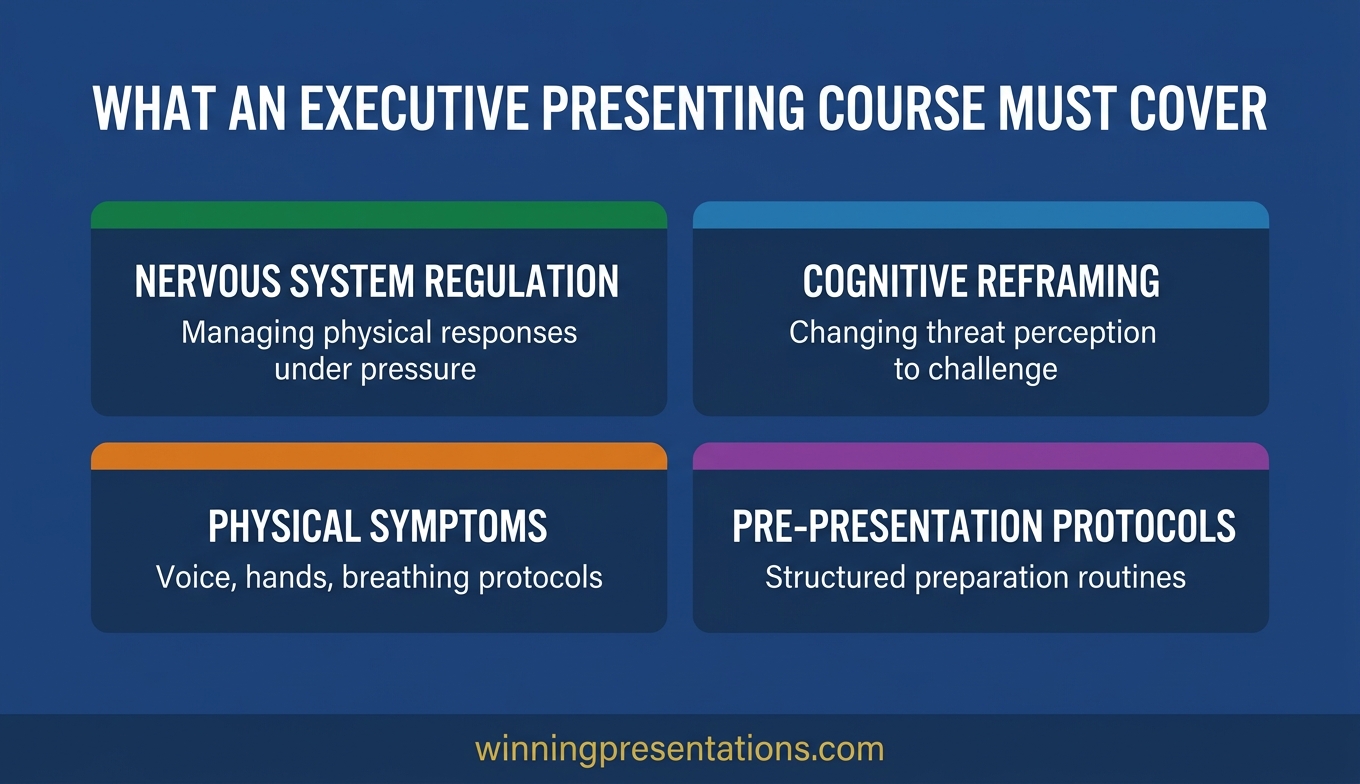
A programme that produces lasting confidence — not just a temporary lift after a motivational workshop — needs to address four interconnected systems. If any one is missing, the results will be partial.

1. Nervous system regulation. Presentation anxiety is not a thinking problem. It is a nervous system activation problem. Your sympathetic nervous system interprets the high-stakes presentation as a threat, triggering the same fight-or-flight cascade that would activate if you were in physical danger. Heart rate increases. Hands tremble. Breathing becomes shallow. Peripheral vision narrows. A presenting confidence programme that does not teach you to regulate this activation — to bring your nervous system back into a functional range before and during the presentation — is missing the most critical component.

2. Cognitive reframing under pressure. Anxiety produces distorted thinking patterns: catastrophising (“This will end my career”), mind-reading (“They can all see I’m nervous”), and all-or-nothing evaluation (“If I stumble once, the whole thing is ruined”). These thought patterns are not rational, but they feel completely real under pressure. Effective programmes teach you to identify and interrupt these patterns in the moment — not as a general self-help exercise, but as a specific protocol you deploy before and during presentations.

3. Physical symptom management. Executives need practical techniques for managing the visible symptoms that undermine their credibility: voice tremor, shaking hands, dry mouth, flushing, and the urge to rush. These symptoms are not character flaws — they are physiological responses that can be managed with the right preparation. Any programme that dismisses physical symptoms as “just nerves” is not addressing what the executive actually needs.

4. Pre-presentation protocols. The thirty minutes before a high-stakes presentation determine more of the outcome than most people realise. What you do with your body, your breathing, your mental rehearsal, and your environment in that window can either prime your nervous system for performance or accelerate the anxiety cascade. A complete programme includes specific, timed protocols for this pre-presentation period.


Infographic showing the four components an executive presenting course must include: nervous system regulation, cognitive reframing, physical symptom management, and pre-presentation protocols

Address the Root Cause, Not Just the Symptoms

Conquer Your Fear of Public Speaking — £39, instant access — is a neuroscience-based programme designed for experienced professionals whose presentation anxiety has neurological roots, not knowledge gaps:

  • Nervous system regulation techniques to manage the fight-or-flight response before it takes hold
  • Cognitive reframing protocols for the distorted thinking patterns that intensify under pressure
  • Physical symptom management for trembling, voice constriction, and visible anxiety signs
  • Pre-presentation preparation sequences you can deploy in the thirty minutes before any high-stakes presentation

Get Conquer Your Fear of Public Speaking →

Designed for executives and senior professionals who present at board, committee, and leadership level.

How Executive Presenting Is Different

Executive presentations carry specific pressures that general-audience programmes do not account for. Understanding these differences is essential when evaluating whether a presenting confidence programme will actually help at your level.

The audience has authority over your career. When you present to a board, a senior leadership team, or an investment committee, the people in the room have direct influence on your promotion, your budget, or your project’s survival. This is not the same as presenting to peers. The stakes are not hypothetical — they are career-defining, and your nervous system knows it.

The tolerance for visible anxiety is lower. At executive level, visible nervousness signals something different than it does in a training room. In a workshop, nerves are expected and sympathised with. In a boardroom, visible anxiety can be interpreted as a lack of conviction in your own recommendation — which undermines the entire purpose of the presentation.

Q&A is unpredictable and consequential. Senior audiences ask questions that go beyond the prepared material. They challenge assumptions. They probe for weaknesses. They ask questions designed to test your thinking, not just your content. If your anxiety management strategy only covers the prepared portion of the presentation, you are vulnerable in the exact moment that matters most.

Repetition is not an option. In most presentation skills courses, you practise in front of the group, receive feedback, and try again. In executive presenting, there is no second attempt. The board meeting happens once. The funding review happens once. The promotion panel happens once. Any programme that relies on gradual desensitisation through repeated exposure misses the reality of executive presenting: you need to perform in a context where the first attempt is the only one.

This is why the right presentation anxiety course for executives focuses on equipping you to manage a single high-stakes event, not building comfort through volume.

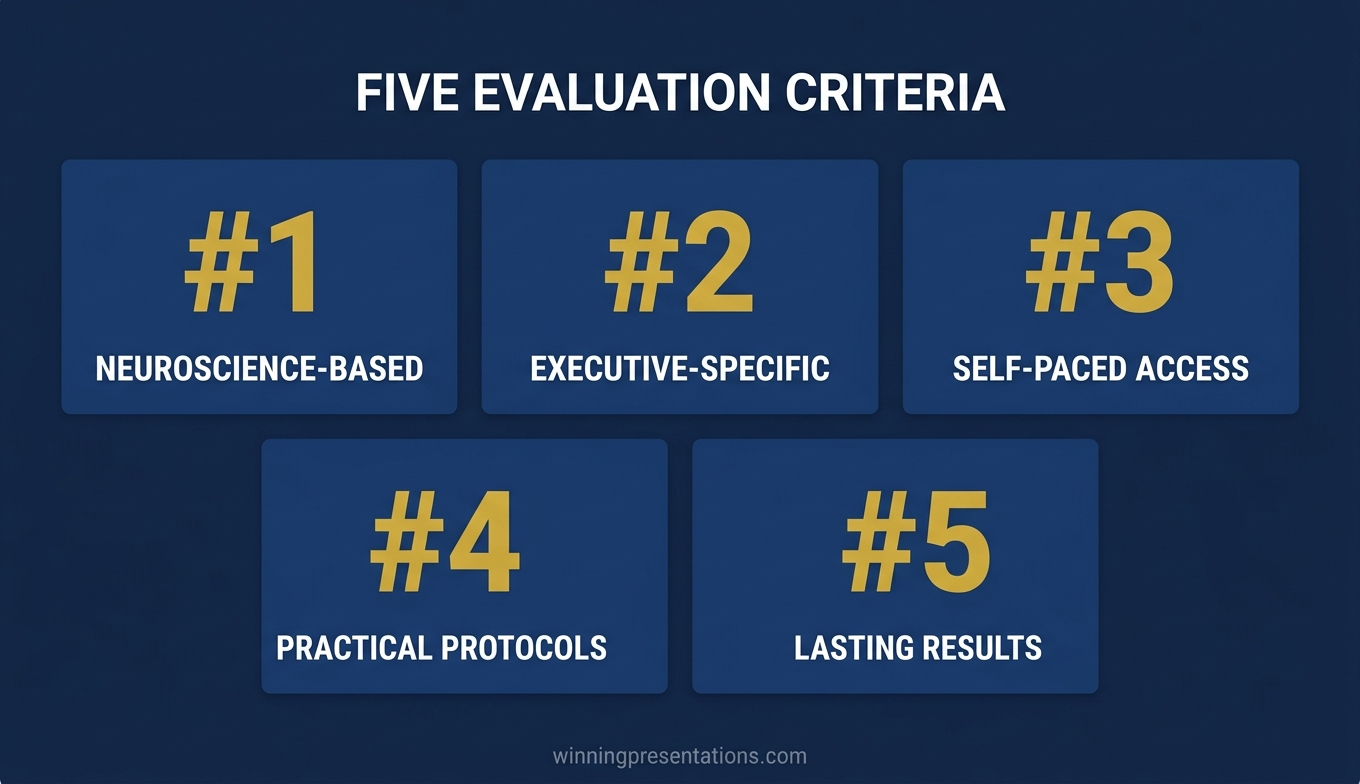
Five Criteria for Evaluating Any Programme

If you are comparing options and trying to determine which executive presenting programme will actually deliver results at your level, apply these five criteria. They separate programmes designed for real-world executive conditions from those that sound good in a brochure.

1. Does it address the nervous system, or just mindset? If the programme’s primary approach to anxiety is “think positively” or “visualise success,” it is not addressing the physiological activation that drives presentation anxiety. Look for content that explicitly covers nervous system regulation, breathing techniques designed for pre-presentation deployment, and somatic approaches that work with the body rather than trying to override it with willpower.

2. Is it designed for self-paced application, or does it require group attendance? Senior executives have unpredictable schedules. A programme that requires you to attend fixed sessions on specific dates may be impractical. Self-paced programmes that you can work through around your actual schedule — and return to when a specific high-stakes presentation is approaching — tend to produce better long-term results because you use them when you need them.

3. Does it include protocols you can deploy immediately? Theory without application is an academic exercise. Effective programmes give you specific, step-by-step sequences you can use before your next presentation. Not principles to reflect on — actions to take in the thirty minutes before you walk into the room.

Conquer Your Fear of Public Speaking includes exactly these kinds of deployable protocols — nervous system regulation, cognitive reframing, and pre-presentation preparation sequences you can use before any high-stakes event.

4. Does it acknowledge that confidence is context-dependent? You may be confident presenting to your team but anxious presenting to the board. A programme that treats confidence as a single quality — “build your confidence and it will transfer everywhere” — is oversimplifying. Look for content that addresses the specific contexts where your confidence breaks down: seniority of audience, formality of setting, unpredictability of Q&A, personal career stakes.

5. Does it address what happens after the presentation? Many executives experience a post-presentation shame spiral — replaying every stumble, every question they handled imperfectly, every moment where their anxiety was visible. This post-event rumination reinforces the anxiety for next time. Programmes that address this cycle, not just the presentation itself, produce more durable improvement.


Infographic showing five evaluation criteria for executive presenting courses: nervous system focus, self-paced format, deployable protocols, context-specific confidence, and post-presentation support

Common Objections — and What the Evidence Shows

“I should be able to handle this without a course.” This is the most common objection, and it reflects a misunderstanding of how presentation anxiety works. You cannot think your way out of a nervous system activation any more than you can think your way out of a racing heart during a sprint. The neurological response is not a character weakness — it is a predictable physiological pattern that responds to specific interventions, not to willpower. Executives who struggle with this are typically high-performers in every other dimension. The anxiety is a system problem, not a competence problem.

“I’ve tried courses before and they didn’t help.” If the courses you tried focused on delivery technique, body language, and motivational exercises, they were not addressing presentation anxiety. They were addressing presentation skill — a related but different challenge. A programme designed for anxiety-driven performance issues works at the neurological level: regulating the nervous system, interrupting catastrophic thinking patterns, and managing the physical symptoms that undermine delivery. If your previous courses did not include these components, you have not yet tried the approach most likely to help.

“At my level, people will judge me for needing help with this.” The reality is precisely the opposite. Senior professionals who invest in managing their presentation performance are making a strategic career decision. The executives who struggle most are the ones who avoid addressing the problem and instead develop elaborate avoidance strategies — delegating presentations, reading from scripts, or limiting their visibility. These strategies cap career progression far more visibly than seeking professional development.

See also: how your physical position affects presentation confidence and delivery.

Ready to Address the Real Problem?

Conquer Your Fear of Public Speaking — £39, instant access — gives you the neuroscience-based protocols to manage presentation anxiety at its source. Nervous system regulation. Cognitive reframing. Physical symptom management. Pre-presentation preparation. Work through it at your own pace, and return to it before any high-stakes event.

Get Conquer Your Fear of Public Speaking →

Designed for executives and senior professionals who need to present with authority under pressure.

Frequently Asked Questions

Is a confident presenting course worth it for someone who already presents regularly?

Yes — if the course addresses the specific gap you are experiencing. Presenting regularly without addressing underlying anxiety or performance issues simply reinforces the patterns you already have. A programme that targets nervous system regulation, cognitive reframing, and physical symptom management gives you tools your experience alone will not provide. The investment pays for itself the first time you walk into a board presentation and manage your physiological response rather than being managed by it.

How long does it take to see results from a presentation confidence programme?

The nervous system regulation and pre-presentation protocols can produce a noticeable difference in your very next presentation — these are techniques you deploy immediately, not skills that require months of practice. The cognitive reframing component typically takes longer to become automatic, usually two to four high-stakes presentations before the new thinking patterns begin to override the old ones. Full integration — where the techniques become your default response rather than something you consciously deploy — generally occurs over eight to twelve weeks of regular use.

Does this work for virtual presentations as well as in-person ones?

The underlying neuroscience is identical regardless of format. Your nervous system activates in response to perceived threat — and a virtual presentation to a senior audience triggers the same fight-or-flight response as an in-person one. The regulation techniques, cognitive reframing protocols, and pre-presentation preparation sequences work in both contexts. Some executives find virtual presentations more anxiety-inducing because they cannot read the room as easily, which creates additional uncertainty. The programme addresses this through the cognitive reframing component, which targets the specific thought patterns that escalate anxiety when feedback cues are limited.

What if my anxiety is specific to Q&A rather than the presentation itself?

Q&A anxiety is one of the most common patterns at executive level, because Q&A is the least controllable part of any presentation. The nervous system regulation techniques in Conquer Your Fear of Public Speaking are designed to be deployed in real time — including during transitions from prepared content to unscripted Q&A. The cognitive reframing component specifically addresses the catastrophic thinking that Q&A triggers: “What if I don’t know the answer?”, “What if they think my analysis is weak?”, “What if they ask about the one thing I’m not prepared for?” These thought patterns are predictable and interruptible with the right protocol.

The Winning Edge — Weekly Presentation Intelligence

Every Thursday, one framework or technique for presenting with authority at executive level — drawn from 25 years of boardroom experience and 16 years training senior professionals. Join The Winning Edge →

Mary Beth Hazeldine is the Owner & Managing Director of Winning Presentations. With 25 years of corporate banking experience at JPMorgan Chase, PwC, Royal Bank of Scotland, and Commerzbank, she advises executives across financial services, healthcare, technology, and government on structuring presentations for high-stakes funding rounds, board briefings, and leadership decisions.

24 Apr 2026
Confident female executive presenting stakeholder alignment strategy to senior business professionals in a modern boardroom with navy and gold tones

Stakeholder Alignment Presentation Training: What Works

Quick answer: Stakeholder alignment presentation training teaches senior professionals how to structure and deliver presentations that bring multiple decision-makers to a shared position — rather than simply informing them and hoping for consensus. Effective training addresses the architecture of the argument, the sequencing of information for different stakeholder priorities, and the handling of resistance and competing agendas. The Executive Buy-In Presentation System is a self-paced programme designed for exactly this context — building presentations that move rooms to a clear yes.

Lucinda had been the Group Head of Compliance for three years. Her presentations were thorough — well-researched, carefully evidenced, meticulously structured. She could answer any question thrown at her. But her proposals kept stalling. Not rejected — stalled. The board would thank her for the work, acknowledge the risk, and then defer the decision to the next meeting. After the third deferral of a critical regulatory remediation programme, she asked the Chief Risk Officer for honest feedback. His answer was blunt: “Everyone in that room agrees with your analysis. The problem is they each think someone else should fund it.” The issue was not the quality of her case. It was the absence of alignment — she was presenting to a room of individual decision-makers who had not been brought to a shared position on ownership, cost allocation, or timeline before she opened her slides. When she restructured her approach — mapping each stakeholder’s specific concern, addressing the cost question explicitly before the meeting, and designing the presentation to move from shared problem to shared commitment — her next proposal was approved in a single session. No deferrals. Same data. Different architecture.

Looking for stakeholder alignment presentation training? The Executive Buy-In Presentation System is a self-paced programme for senior professionals who present to boards and committees. New cohorts open monthly. Explore the programme →

What Stakeholder Alignment Actually Means at Senior Level

Stakeholder alignment is one of those phrases that sounds straightforward until you try to do it in a room where the stakeholders have competing priorities, different risk tolerances, and unequal influence over the final decision. At junior levels, alignment usually means getting people to agree with your recommendation. At senior level, it means something considerably more complex: bringing decision-makers to a shared position on what the problem is, who owns the solution, what resources are required, and what timeline is acceptable — before the formal decision point.

The distinction matters because most presentation training treats alignment as a delivery problem. It assumes that if you present clearly enough, with compelling enough data and confident enough body language, the room will align. That assumption breaks down the moment you have a CFO concerned about capital allocation, a COO focused on operational disruption, and a non-executive director asking about regulatory risk — all in the same meeting, all with legitimate but different lenses on the same proposal.

Genuine stakeholder alignment presentation training addresses this complexity directly. It teaches you to design presentations that acknowledge competing priorities rather than ignoring them, that sequence information to build shared understanding before requesting a shared decision, and that handle the political dimension of multi-stakeholder rooms without pretending it does not exist.

Understanding the psychology behind stakeholder buy-in is foundational here — it explains why rational arguments alone rarely move a room when the decision requires multiple people to agree, each of whom has different criteria for what constitutes a good outcome.

Stakeholder alignment failure points: four common reasons executive presentations stall — competing priorities, unclear ownership, absent pre-alignment, and mixed decision criteria — shown as stacked diagnostic cards

Why Standard Presentation Training Fails on Alignment

Most presentation training — even training marketed as “executive” — is built around a single-audience model. It teaches you to identify your audience, understand their needs, and structure your message accordingly. That works when your audience is functionally homogeneous: a team of engineers, a marketing committee, a group of analysts who share the same framework for evaluating information.

It breaks down in the rooms where senior professionals actually present. A board is not a single audience. It is a collection of individuals with different functional responsibilities, different appetites for detail, different political positions, and different definitions of success. Presenting to a board as though it were a single audience with a single set of needs is one of the most common structural errors at director level and above.

Standard training also tends to focus on the presentation itself — the forty-five minutes in the room — as though that is where alignment happens. In practice, alignment at senior level is largely determined before the slides are opened. The conversations that happen in corridors, in one-to-one briefings, in pre-reads and preparatory calls — these are where positions are tested, objections are surfaced, and the ground is prepared for what happens in the formal session.

Stakeholder alignment presentation training that ignores this pre-meeting architecture is addressing only half the problem. It is teaching you to perform well in the room while leaving unaddressed the work that determines whether the room is ready to decide.

Build the Case. Align the Room. Secure the Decision.

The Executive Buy-In Presentation System teaches senior professionals how to structure and deliver presentations that move boards and committees to a clear yes. Self-paced, £499, new cohorts open monthly. Optional Q&A calls are fully recorded — watch back anytime.

Explore the Programme →

Built from 25 years of corporate banking experience at JPMorgan Chase, PwC, RBS, and Commerzbank

What Effective Stakeholder Alignment Training Actually Covers

Training that genuinely addresses stakeholder alignment — rather than just using the phrase in its marketing — covers several areas that standard presentation courses typically omit.

Stakeholder mapping for decision rooms. This is not the generic stakeholder analysis taught in project management courses. It is specific to presentation contexts: who in the room has formal decision authority, who has informal veto power, who is the swing vote, and what does each person need to hear before they can commit. This mapping directly informs how you sequence your slides and where you place your key asks.

Argument architecture for multi-stakeholder audiences. When your audience includes a finance director, a chief operating officer, and two non-executive directors, you cannot build a single linear argument and expect it to land with all of them. Effective training teaches you to construct presentations with a shared narrative that branches into different value propositions — addressing financial return, operational feasibility, strategic fit, and risk mitigation within the same presentation structure without losing coherence.

Objection anticipation and pre-emption. At board level, the most dangerous objections are the ones that are not voiced in the room but discussed afterwards. Training that addresses alignment teaches you to identify likely objections, address them proactively within the presentation, and create space for the room to surface concerns rather than suppress them.

Decision facilitation. There is a specific skill in moving a room from discussion to decision. Many senior professionals are comfortable presenting information but less practiced at the moment where the presentation transitions from informing to asking. Alignment training addresses this explicitly — how to frame the ask, when to make it, and how to handle the silence that follows.

The Executive Buy-In Presentation System covers each of these areas as part of a structured, self-paced curriculum — designed for professionals who need a systematic approach rather than ad hoc advice.

The Pre-Meeting Architecture Most Training Ignores

If you have presented at board or committee level more than a few times, you will recognise this pattern: the presentation goes well, the questions are answered competently, but no decision is made. The chair says something like, “Thank you — let us reflect on this and return to it at the next meeting.” Two months later, you are back with the same deck, updated numbers, and the same result.

This is almost always an alignment failure, not a presentation failure. The room was not ready to decide because the pre-meeting work was not done — or was not done effectively. Pre-meeting architecture is the structured preparation that happens before the formal presentation, and it is where most alignment is actually achieved or lost.

Effective pre-meeting architecture includes several elements. First, identifying the two or three stakeholders whose position will determine the outcome — and having direct conversations with them before the meeting. Not to lobby, but to understand their specific concerns, test your framing with them, and adjust your presentation accordingly. Second, ensuring the chair knows what you are going to ask and is prepared to facilitate a decision — a surprised chair will almost always defer. Third, circulating a pre-read that sets up the key question clearly, so the room arrives having thought about the decision rather than hearing the information for the first time.

The article on stakeholder alignment before major proposals covers this process in more detail — the specific steps that transform a presentation from an information event into a decision event.

Training that addresses this pre-meeting layer gives you a systematic approach to the work that happens before the slides. It is not a substitute for a good presentation — you still need to be clear, well-structured, and confident in the room. But it is the preparation that makes the difference between a presentation that informs and one that decides.

Pre-meeting alignment roadmap showing five stages: stakeholder mapping, one-to-one briefings, chair preparation, pre-read circulation, and decision-ready presentation — shown as a sequential roadmap

What to Look For in a Programme

If you are evaluating stakeholder alignment presentation training, there are several indicators that distinguish genuinely useful programmes from generic presentation skills courses.

Board-level specificity. Does the programme address the particular dynamics of multi-stakeholder decision rooms — boards, investment committees, executive leadership teams? Or is it generic “persuasive presentation” training repackaged with the word “stakeholder” in the title? The specificity of the examples, case studies, and frameworks will tell you quickly.

Structural method, not just delivery coaching. Delivery is important, but alignment is a structural problem. Look for a programme that teaches you how to build the architecture of your argument for a multi-stakeholder room — not just how to speak more confidently or design cleaner slides.

Pre-meeting preparation. If the training starts when you open your slides, it is missing the most important part. A programme that includes systematic pre-meeting preparation — stakeholder mapping, one-to-one conversations, chair briefing — addresses the full process of alignment, not just the visible portion.

Facilitator credibility. The person who designed and facilitates the programme should have direct experience of the environments they are teaching for. Ask about their background. Have they operated in the kinds of rooms their participants present to? Do they understand the political and interpersonal dynamics that make multi-stakeholder alignment genuinely difficult?

For a broader discussion of what effective board-level preparation looks like, the article on board presentation best practices covers the structural and strategic preparation that separates presentations which earn decisions from those that earn deferrals. You may also find the related discussion on boardroom presentation skills useful if you are building capability across multiple presentation types.

The Executive Buy-In Presentation System

A self-paced programme for senior professionals who present to boards, committees, and decision-making groups. Learn to build the case, align the room, and secure the decision. £499 — new cohorts open monthly. Optional Q&A calls are fully recorded.

Explore the Programme →

Designed by Mary Beth Hazeldine — 25 years in corporate banking, 16 years training senior professionals

Frequently Asked Questions

What is stakeholder alignment presentation training?

Stakeholder alignment presentation training is a specialised form of executive communication development that focuses on the specific challenge of presenting to multi-stakeholder decision rooms — boards, investment committees, executive leadership teams. Unlike generic presentation skills training, it addresses how to structure arguments for audiences with competing priorities, how to manage pre-meeting preparation to build alignment before the formal session, and how to facilitate the transition from information sharing to decision-making. It is most relevant for directors, heads of function, and senior leaders who present regularly to groups where the decision requires multiple people to agree.

How is stakeholder alignment training different from standard presentation coaching?

Standard presentation coaching typically addresses delivery skills — confidence, vocal projection, slide design, audience engagement — and is built around a single-audience model. Stakeholder alignment training addresses the structural and strategic challenge of presenting to a room where different decision-makers have different priorities, different information needs, and different criteria for what constitutes a good outcome. It covers argument architecture for multi-stakeholder audiences, pre-meeting preparation and stakeholder mapping, objection anticipation, and decision facilitation — areas that standard coaching rarely touches.

Can stakeholder alignment presentation skills be learned online?

Yes — effectively, if the programme is well-designed. The structural and strategic elements of stakeholder alignment — how to map a decision room, how to sequence an argument for multiple audiences, how to prepare for pre-meeting conversations — translate well to online learning. A self-paced programme with a structured curriculum allows participants to work through material at their own speed and apply frameworks to their actual upcoming presentations. The key is that the programme provides a systematic method, not just general advice. Optional live Q&A sessions, when available and recorded for later viewing, add an additional layer of support without requiring fixed attendance.

Who benefits most from stakeholder alignment presentation training?

The professionals who benefit most are typically directors, heads of function, or senior leaders who present regularly to boards, committees, or executive leadership teams — and who find that their proposals are being deferred rather than decided. They are usually technically competent presenters whose challenge is not delivery but architecture: how to build a case that moves a room of decision-makers with competing priorities to a shared commitment. If your presentations are well-received but rarely result in same-meeting decisions, stakeholder alignment training is likely to address the gap that delivery coaching alone will not.

The Winning Edge

Weekly insights on executive presentations, board communication, and high-stakes delivery — for senior professionals.

Subscribe Free

About the author

Mary Beth Hazeldine, Owner & Managing Director, Winning Presentations. With 25 years of corporate banking experience at JPMorgan Chase, PwC, Royal Bank of Scotland, and Commerzbank, she has spent 16 years training senior professionals to present with greater clarity and confidence at board and executive committee level.

23 Apr 2026
Professional preparing a polished board presentation on a laptop in a modern office, focused and confident, editorial photography style

How to Improve Presentation Skills for Work: The Structured Approach That Actually Works

Quick Answer

To improve presentation skills for work you need three things working in parallel: a reliable structure so you stop rebuilding every deck from scratch, a system for managing delivery under pressure, and deliberate practice in conditions that match the real stakes of the presentations you need to give. Courses that only address one of these three typically produce temporary improvement. This guide covers all three.

Kwame had been told to “work on his presentation skills” three times in four years.

Once by a line manager after a client pitch that didn’t land. Once in a 360-degree feedback report after a town hall that received mixed responses. And once — most directly — by the head of his division, who told him in a performance review that he was “technically exceptional but needed to develop his executive presence in front of senior stakeholders.”

Each time, Kwame tried to act on the feedback. He watched YouTube videos. He read books. He took a one-day communication course his company funded. He rehearsed more. None of it moved the dial in the ways that mattered. He still rebuilt every presentation from scratch. He still felt exposed in Q&A. His delivery still tightened when the room was senior enough to matter.

The problem wasn’t effort. It was that the advice he was following addressed surface symptoms — delivery tips, confidence mantras, filler-word elimination — without addressing the underlying structural deficits that were producing them. When your presentations don’t have a reliable skeleton, you will always be improvising. And improvisation under pressure produces exactly the symptoms he was trying to fix.

Told to improve your presentation skills but not sure where to start?

The Executive Slide System gives you the structural foundation that removes the rebuilding problem — so you walk into every presentation with a proven framework rather than starting from a blank slide.

Explore the Executive Slide System →

Why Most Presentation Tips Don’t Stick

The internet contains thousands of presentation tips. Most of them are accurate. Almost none of them produce lasting change when applied in isolation, because they address individual behaviours without building the system those behaviours need to operate within.

“Make eye contact” is a useful tip. But if you’re using working memory to track your place in a poorly structured deck, your attention is on the slides — not your audience. The eye contact tip won’t help until the structural problem is resolved.

“Speak more slowly” is a useful tip. But if you’re anxious because you don’t know how to handle the Q&A that’s coming, you’ll speed up again as soon as a challenging question arrives. The delivery tip won’t help until the Q&A preparation problem is resolved.

“Use pauses instead of filler words” is a useful tip. But if your nervous system hasn’t been recalibrated to tolerate the silence, the pause will feel unbearable and you’ll default to “um” within seconds. The filler word tip won’t help until the nervous system regulation problem is resolved.

This is why presentation improvement initiatives that focus on tips — however accurate — tend to produce temporary results. You leave the workshop feeling equipped. You apply the tips in the next few presentations. Then the high-stakes presentation arrives, and you revert to baseline. Because tips are not a system. Presentation skills training that actually sticks has to address the underlying components, not just the surface behaviours.

The Three Components of Lasting Improvement

To improve presentation skills for work in a way that holds under pressure, you need to work on three components simultaneously. Each one reinforces the others. Fixing only one or two will produce partial improvement at best.

Component 1: Structure — a repeatable framework for building presentations that you don’t have to reinvent for every new context. Most professionals spend the majority of their preparation time trying to figure out what to put on each slide and in what order. A reliable structure eliminates this problem. You know the architecture; the work becomes filling it with the specific content for this presentation.

Component 2: Delivery under pressure — the ability to maintain composure, clarity, and authority when the stakes are high, the room is difficult, or the Q&A goes somewhere unexpected. This is a nervous system and rehearsal challenge, not a knowledge challenge. You can know your material completely and still feel exposed when a senior executive asks a question you hadn’t anticipated.

Component 3: Deliberate practice — a method of building skill that goes beyond simply giving more presentations and hoping improvement happens. Most people’s presentation skills plateau because they keep practising the same behaviours in the same conditions. Deliberate practice targets the specific gaps that matter and creates conditions that are challenging enough to produce genuine improvement.

The Structural Foundation Every Executive Presenter Needs

If you are rebuilding every presentation from scratch, you are solving the wrong problem before every meeting. The Executive Slide System — £39, instant access — gives you the structural framework that removes that problem permanently:

  • 22 PowerPoint templates covering the executive scenarios you actually encounter
  • 51 AI prompt cards to build content into any template fast
  • Scenario playbooks for board presentations, budget cases, client pitches, and more
  • Checklists that catch the structural errors that lose rooms before Q&A begins

Get the Executive Slide System →

Designed for professionals who need to present with confidence at executive and board level.

Structure: The Fastest Lever to Pull

Of the three components, structure produces the fastest visible improvement because it addresses the most common root cause of weak presentations: the absence of a clear decision logic.

Most professionals build presentations by gathering all the relevant information and then arranging it in a logical sequence. The problem with this approach is that “logical sequence” usually means chronological — how the situation developed, how the analysis was done, what was found, and then what is recommended. This is the right order for a research paper. It is the wrong order for an executive presentation.

Executive audiences want to know the recommendation first, the supporting evidence second, and the analysis third — if at all. This is the pyramid principle applied to presentations, and it runs counter to how most professionals were trained to present information at school and university. The result is that competent, well-prepared professionals produce presentations that bury the point, overwhelm the audience with context before the recommendation, and leave senior stakeholders frustrated even when the underlying thinking is excellent.

The executive presentation structure that works consistently follows this pattern: start with the conclusion, support it with three to four reasons or evidence points, and provide the detail as supporting material rather than the main event. This structure is learnable and replicable. Once you have internalised it, every presentation becomes easier to build — because you always know what goes where.

The templates in the Executive Slide System are built around this structure — so you don’t have to reinvent the architecture for each new presentation, you just load your content into a proven framework.

Delivery: What Changes When the Stakes Are Real

Good delivery in a low-stakes environment does not automatically transfer to good delivery in a high-stakes one. This surprises many professionals who feel confident in informal presentations but notice their delivery deteriorating when the room is more senior or the decision more significant.

What changes under pressure is the availability of cognitive resources. When the stakes feel high, part of your working memory is occupied by threat-monitoring — tracking how the room is responding, anticipating questions, managing any anxiety symptoms. This leaves less resource available for fluency, word retrieval, and the deliberate choices that constitute good delivery: eye contact, pacing, pausing.

Improving delivery under pressure therefore requires two parallel approaches. First, reduce the cognitive load of the presentation itself — a reliable structure and well-rehearsed content means less working memory is needed for the material, leaving more available for delivery choices. Second, reduce the baseline activation level of the threat response — through preparation, rehearsal in conditions that mimic the real stakes, and where necessary, nervous system regulation techniques that bring down arousal before you begin.

The specific presentation skills development work that addresses delivery under pressure includes: practising in front of people whose opinion you care about (not just in front of a mirror), recording yourself in full-dress rehearsals and watching it back, and simulating the most challenging Q&A scenarios you are likely to face. Each of these creates the conditions for genuine improvement rather than improvement in controlled practice environments that don’t translate.

Deliberate Practice: How to Improve Without More Presentations

Most professionals improve their presentation skills by giving presentations and hoping the experience produces improvement. This works to a point — you do get more comfortable with the mechanics of presenting — but it stops working once your skills plateau, because you are practising the same strengths in the same conditions.

Deliberate practice is different. It targets the specific gap, creates challenge that is slightly beyond your current capability, and builds in feedback so you can see whether you improved. Here is what deliberate practice looks like for the three most common development areas.

For structure: Take a presentation you have already given and rebuild it using a different structural logic — starting with the conclusion rather than the context, or organising by stakeholder concern rather than analytical sequence. Compare the two versions and assess which one a senior audience would find easier to act on. Repeat with three to five different past presentations until the new structure becomes your default approach.

For delivery under pressure: Ask a trusted colleague or manager to play the role of a challenging committee member during a rehearsal — specifically tasked with asking questions you won’t have prepared for, expressing scepticism, or cutting across your slides mid-sentence. This is uncomfortable. It is also the only way to build the skills you need for those conditions. Rehearsal against a supportive audience does not prepare you for a difficult one.

For verbal habits and fluency: Record two minutes of yourself explaining your current project — without notes — and watch it back with the sound off, then again with sound only. The visual and audio separation often reveals habits that are invisible when you’re watching both together. Identify the single most distracting habit and target it explicitly in the following week’s practice sessions, rather than trying to fix everything at once.

See today’s related articles: the specific verbal habits that damage executive credibility, how to present a pilot as a commercial case, and how to take a technology roadmap to the board.

Stop Rebuilding Presentations From Scratch

The Executive Slide System — £39, instant access — gives you the structural foundation, templates, and AI prompt cards that remove the biggest time drain in presentation preparation. Build better presentations faster, and walk in with a structure you trust.

Get the Executive Slide System →

Designed for professionals who need to present with confidence at executive and board level.

Frequently Asked Questions

What is the fastest way to improve presentation skills for work?

Fix your structure first. Most presentation problems — unclear delivery, loss of confidence in Q&A, audiences that seem disengaged — trace back to a structural problem: the presentation doesn’t make the recommendation early enough, or doesn’t organise information in the way a senior audience expects to receive it. Once the structure is reliable, delivery and confidence tend to follow because you’re spending less cognitive resource on figuring out where you are in the deck and more on connecting with the room.

Is it worth taking a presentation skills course for work?

It depends entirely on what the course addresses. A one-day communication workshop that covers tips and techniques without addressing structure, Q&A handling, or delivery under pressure will produce limited lasting improvement. Look for resources that provide a replicable structural framework — one you can use in your actual work presentations rather than a course-specific exercise — and that address the specific challenges you face: whether that is senior audience management, anxiety, Q&A, or deck construction. The most effective development work is targeted, not generic.

How do I improve presentation skills when I don’t present very often?

Treat every meeting where you speak as a presentation opportunity. The informal explanation you give in a team meeting, the project update you provide on a call, the recommendation you make in a one-to-one — these are all opportunities to practise structuring your thinking, leading with the conclusion, and managing the question that follows. Frequency of formal presentations is less important than the quality of practice. Deliberate work on structure and delivery in everyday professional communication builds the same capabilities you need in formal presentations.

Why do my presentation skills seem to get worse when I’m presenting to senior people?

Because senior audiences activate a stronger threat response, which takes cognitive resource away from fluency and delivery. This is a normal neurological pattern, not a sign of inadequate preparation. The mitigation is twofold: reduce the cognitive load of the presentation itself through structure and rehearsal, and reduce your baseline arousal level before you present through preparation rituals and, where needed, nervous system regulation techniques. Most professionals find that the combination of better structure and targeted rehearsal in high-stakes conditions produces measurable improvement within four to six presentations.

The Winning Edge — Weekly Presentation Intelligence

Every Thursday, one framework or technique for high-stakes presenting at work — drawn from 25 years of boardroom experience and 16 years training executives. Join The Winning Edge →

Not ready for the full system? Start here: download the free Executive Presentation Checklist — a one-page reference covering the structure and slides every work presentation needs before it goes to a senior audience.

About the Author

Mary Beth Hazeldine is the Owner & Managing Director of Winning Presentations. With 25 years of corporate banking experience at JPMorgan Chase, PwC, Royal Bank of Scotland, and Commerzbank, she advises executives across financial services, healthcare, technology, and government on structuring presentations for high-stakes funding rounds and approvals.

Book a discovery call | View services

21 Apr 2026
A senior executive commanding a boardroom presentation, speaking with authority to a small C-suite audience, projected slides visible, editorial photography style

Senior Executive Presentation Skills: The Structured Approach That Works

Quick Answer

Senior executive presentation skills are a distinct capability set — not simply “good presenting” scaled up. At C-suite and board level, the ability to structure your thinking, command a room, and move a decision forward in a single meeting is what separates executives who advance from those who plateau. This article sets out the four core skills, a structured development approach, and practical tools for embedding them permanently.

Ines had been Head of Risk for six years. She knew the numbers cold. She knew the regulators. She knew every objection her board would raise before they raised it.

Her first presentation as Group CRO went sideways in the third minute.

Not because she was wrong. Not because she was unprepared. She was stopped because the Chair said, quietly but unmistakably: “Ines, can you tell me why you’re recommending this before you tell me what it is?”

She had walked into a board presentation with a director-level deck. At director level, you build the context, walk through the data, and arrive at the recommendation by page twelve. At board level, that structure is read as uncertainty. They want the conclusion first, then the evidence, then the decision they need to make. In under seven slides.

Ines recovered well. But she told me later: “Nobody told me the structure changes completely when you change level. I had to learn it under fire.”

That is the gap this article addresses.

For Executives Who Want a Structured Approach

The Executive Slide System gives you 22 slide templates built for C-suite and board-level scenarios — plus 51 AI prompt cards to build your deck fast. If you want a ready-made framework rather than a blank canvas, it is worth a look.

Explore the Executive Slide System →

Why Senior-Level Presentations Are Fundamentally Different

The skills that make someone an effective presenter at management level actively work against them at executive level. This is not obvious until it goes wrong.

At middle management, detailed context-building signals thoroughness. At senior executive level, it signals that you have not yet decided what you think. The most senior rooms — boards, executive committees, investment panels — are not looking for a briefing. They are looking for a recommendation from someone who has already done the thinking.

The second difference is time. A board director may be looking at eight agenda items in a two-hour meeting. A minute spent on scene-setting that everyone already knows is a minute taken from their Q&A. Executives who understand this respect the room. Those who do not, however thorough their preparation, are perceived as failing to read the context.

Third, the political dimension increases sharply. At board level, every word is read for signal. How you frame risk, how you handle disagreement, how you respond when a non-executive challenges your figures — these are not just presentational moments. They are data points that shape how you are assessed as an executive.

Understanding these shifts is the first step. Building specific skills to address them is the work.

The Four Skills That Define Executive-Level Presenting

Across more than twenty years of advising executives on high-stakes presentations, four capabilities separate those who command senior rooms from those who survive them.

1. Recommendation-Led Structuring

The instinct to build context before the recommendation is almost universal. It comes from a legitimate desire to bring the room with you before asking for something. At senior executive level, this logic reverses. Lead with your recommendation. State it in plain language in your first sentence. Then provide the evidence that supports it. Then address the objections you expect.

This structure — sometimes called the Pyramid Principle — is not new, but most executives only apply it partially. They use it for the headline but revert to bottom-up logic by the third slide. Consistent application, from title to close, is a learned and practised skill. See how executive presentation structure works in practice for a full walk-through of how to apply it across a complete deck.

2. Precision Language Under Scrutiny

Senior boards and executive committees ask hard questions. The quality of your response in that moment matters as much as the quality of your deck. Precision language means choosing words that are accurate without being defensive, confident without being overcommitted, and clear without being simplistic.

Executives who hedge excessively — “it could be”, “in some scenarios”, “it depends” — signal uncertainty even when the evidence is strong. Executives who overclaim — “this will definitely”, “we are certain” — invite the kind of forensic challenge that derails a presentation. The middle path is language that is calibrated: specific enough to demonstrate command, honest enough to hold up under questioning.

3. Stakeholder Psychology at Board Level

Every person in a senior room has a position, a concern, and a risk appetite. Presenting without mapping these in advance is presenting blind. Understanding stakeholder buy-in psychology is not manipulation — it is preparation. Knowing that your CFO cares about capital efficiency, your Chief People Officer cares about change impact, and your CEO cares about competitive positioning allows you to frame the same recommendation in language that each person finds compelling.

This does not mean different decks for different stakeholders. It means deliberate language choices and sequencing that address the concerns of the room you are in.

4. Composure in High-Stakes Moments

Being challenged mid-presentation is a test that every senior executive faces regularly. The ability to receive a hard challenge without becoming defensive, without losing the thread of your argument, and without showing the anxiety that the challenge may provoke — this is a trainable skill, not a personality trait.

Composure at this level is partly physical (voice, pace, posture) and partly cognitive (the ability to acknowledge the challenge, buy yourself three seconds of thinking time, and respond from your evidence). Both dimensions respond to deliberate practice.

Executive Slide System

Stop Rebuilding Your Decks From Scratch Every Time

The Executive Slide System — £39, instant access — gives you 22 slide templates built for the exact scenarios senior executives face: board presentations, investment cases, change approvals, and stakeholder briefings. Includes 51 AI prompt cards to draft each section and a set of playbooks and checklists for high-stakes preparation. Designed for executives who present to boards, executive committees, and senior leadership teams.

Get the Executive Slide System →

22 templates · 51 AI prompt cards · Playbooks and checklists for senior presentations

How to Structure Your Thinking Before You Structure Your Slides

The most common mistake in senior executive presentation preparation is opening PowerPoint too early. When the blank slide is the starting point, the temptation is to fill it with data — and data-led decks rarely lead to decisions at board level.

Before any slide is built, three questions must be answered:

What decision do you need this room to make? Not “what do I want to present” — what decision, in this meeting, on this day? If you cannot state it in a single sentence, your preparation is not complete.

What is the single most powerful argument for that decision? Most presentations carry five or six arguments of roughly equal weight. Senior audiences do not retain five or six arguments. One strong argument, supported by credible evidence, is more effective than six moderate ones competing for attention.

What objection will be hardest to answer? Identify it before the presentation, not during. Prepare a response that acknowledges the concern directly rather than deflecting it. Executives who can say “I know your concern on timeline — here is how we have addressed it in the plan” demonstrate command of the subject. Those who are surprised by the objection appear under-prepared regardless of the quality of their underlying work.

The answers to these three questions define the skeleton of a senior executive presentation. The slides carry the evidence. They do not carry the thinking — that has to happen before the deck is built.

For a structured guide to board-level preparation, board presentation best practices covers the full preparation sequence from first principles.

If you want a structured template set that applies this thinking-first approach to 22 common executive scenarios, the Executive Slide System builds the decision logic into every template, so the structure supports your thinking rather than replacing it.

Reading the Room at C-Suite Level

Senior rooms have dynamics that are not visible on the agenda. Who deferred to whom in the last meeting? Which non-executive is most likely to challenge on governance? Has there been a recent disagreement between two committee members that might surface through their responses to your presentation?

These dynamics shape how your presentation will land, independent of its quality. Executives who read and adapt to them in real time demonstrate political intelligence — a capability that is valued at senior level precisely because it is rare.

Reading the room at C-suite level means three specific things in practice:

Pace adaptation. If the Chair is signalling impatience through body language or brief questions, compress your slides and move to Q&A earlier. Rigidly following a prepared structure when the room has moved on is a form of not listening.

Challenge differentiation. Not all challenges are the same. A challenge that comes from genuine concern (“I am not sure we have the risk appetite for this”) requires a different response than a challenge that comes from positional signalling (“In my experience, these projects always overrun”). The first needs evidence. The second needs acknowledgement and a bridge back to your argument.

Silence management. After a key recommendation, silence often means the room is processing, not that your recommendation has failed. Many executives fill silence with additional explanation — which can undermine a recommendation that was actually landing well. Learning to hold silence is a practised skill that takes nerve and repetition.

Building a Development Practice That Actually Sticks

“Work on your presentation skills” is advice that most executives have received at least once. Almost none of them have been told specifically what to work on, how to do it, or how to know when it is working. Without that specificity, the feedback is not actionable.

A development practice for senior executive presentation skills needs three components:

Deliberate preparation habits. The single highest-impact habit change for most senior executives is to prepare the verbal narrative separately from the slides. Build the deck, then rehearse what you will say at each slide out loud — not reading from notes, but speaking it as if to the actual room. The gap between what you planned to say and what comes out under pressure is usually large until this rehearsal becomes routine.

Post-presentation review. Within twenty-four hours of every significant presentation, note three things: what worked exactly as planned, what did not land as expected, and one thing you would change in the preparation process. Over six to eight weeks, patterns emerge — and patterns are what make development systematic rather than reactive.

Structured formats for high-stakes scenarios. Most executives who struggle with senior presentations are not struggling with delivery skills. They are struggling with structure — particularly in scenarios they encounter less frequently: investment committee presentations, crisis briefings, major change announcements. Having a tested template for each of these scenarios removes the blank-page problem and frees cognitive capacity for the strategic thinking the room actually needs from you.

The acceleration path for executives working on their promotion case, which explores how presentation skills connect directly to advancement, is covered in depth at how to make the business case for your own promotion.

Already Know What You Need — Want the Templates?

22 Senior Executive Presentation Templates, Ready to Use

The Executive Slide System — £39, instant access — includes templates for the scenarios this article covers: board presentations, investment cases, change approvals, and stakeholder briefings. Each template has the decision logic built in. Pairs with 51 AI prompt cards that draft the content for you.

Get the Executive Slide System →

Designed for executives presenting to boards, executive committees, and senior leadership teams

Frequently Asked Questions

What makes executive presentation skills different from general presentation skills?

At senior executive level, the structure, language, and political awareness required are substantially different from general presentation skills. Boards and executive committees expect a recommendation-led structure, precision language under challenge, and clear decision framing — not the context-first, evidence-building approach that works at management level. The skills are related but not the same, and the gap typically only becomes visible once an executive is already presenting at the new level.

How long does it take to develop senior executive presentation skills?

With a structured approach — deliberate preparation habits, post-presentation review, and structured templates for high-stakes scenarios — most executives see a meaningful improvement within six to eight weeks. The most important variable is whether the development is systematic (specific habits, specific review, clear feedback loop) or generic (“work on your presentations”). Generic feedback rarely produces change. Structured practice consistently does.

What is the most common mistake executives make in board presentations?

The most common mistake is leading with context and arriving at the recommendation late — usually on page eight or ten of a fifteen-slide deck. Board members are often looking at six to eight agenda items in a single meeting. An executive who buries the recommendation in the second half of their presentation has, in effect, asked the board to process twelve minutes of evidence before they know what they are processing it for. Starting with the recommendation, supporting it with evidence, and addressing the anticipated objections directly is the structure that works consistently at board level.

Is an executive presentation skills course worth it for a senior leader?

The value depends on what the course addresses. Generic presentation skills training — designed for managers or team leaders — rarely addresses the specific demands of board and C-suite presenting. What works for a senior executive is structured template work for high-stakes scenarios, deliberate Q&A handling practice, and specific guidance on recommendation-led structuring. A course that addresses those elements is worth serious consideration. One that covers confidence, body language, and general slide design is likely not calibrated to where the gap actually sits.

The Winning Edge — Weekly Newsletter

Practical frameworks for senior executives — delivered every Thursday. One technique. One application. No filler.

Subscribe to The Winning Edge →

Not ready for the full system? Start here instead: download the free Executive Presentation Checklist — a one-page pre-presentation review covering structure, language, and stakeholder framing for senior-level decks.

About the Author

Mary Beth Hazeldine is Owner & Managing Director of Winning Presentations. With 25 years of corporate banking experience at JPMorgan Chase, PwC, Royal Bank of Scotland, and Commerzbank, she advises executives across financial services, healthcare, technology, and government on structuring presentations for high-stakes funding rounds, board approvals, and executive committee decisions. She has been delivering presentation skills training to senior leaders for 16 years.

09 Apr 2026
Senior professional woman presenting to a board committee in a corporate boardroom, authoritative and composed, navy and gold tones

Executive Presentation Training Online

Quick Answer

Executive presentation training online takes several forms — self-study courses, pre-recorded video programmes, and live cohort-based training. For senior professionals presenting to boards and committees, live cohort training with expert feedback produces the most transferable results. The AI-Enhanced Presentation Mastery programme is a structured online cohort programme covering strategic structure, AI-assisted preparation, and high-stakes delivery for executives presenting at board level — 8 self-paced modules, optional live coaching sessions, and lifetime access to all content. This page explains what to look for in any executive presentation training programme, and why live structured cohorts outperform self-paced alternatives for the specific demands of senior-level communication.

When Valentina was promoted to Managing Director at a mid-sized infrastructure firm, she had fifteen years of experience presenting to clients. What she was not prepared for was the board. The pace was different. The questions came before she had finished her second slide. The CFO wanted the conclusion first; the chair wanted the risk mitigation before she had even explained the proposal. In her third board presentation, she watched the chair check his phone while she was three minutes into her opening. She had a reputation as an engaging speaker. None of that counted for anything in that room.

She did not need a public speaking course. She needed to understand how boards receive information, how to structure a recommendation so it survives the first thirty seconds, and how to use her preparation time in a way that produced documents — not just rehearsed scripts. What she needed was executive presentation training that understood the specific demands of senior leadership communication. She found a live cohort programme. Six weeks later, she presented to the same board and received approval for a £4.2M capital programme before reaching slide four.

Looking for structured guidance on presenting to senior stakeholders? The AI-Enhanced Presentation Mastery cohort is built for exactly that. A self-paced programme with optional live coaching for executives presenting at board level. Explore the programme →

What Executive Presentation Training Online Actually Covers

Executive presentation training at the senior level addresses a different set of challenges than standard presentation skills training. Most professionals can manage a client update or a team briefing without formal support. The difficulty emerges when the audience is a board, a committee, a C-suite, or a room where decisions are made by people who are simultaneously sceptical, time-pressed, and expert in scrutiny.

Quality executive presentation training covers four interconnected areas. The first is strategic structure — how to organise a complex business case so that the most important information reaches the decision-maker before their attention narrows. This is fundamentally different from how most presentations are taught. The instinct is to build context before the recommendation, to earn the conclusion through exposition. Executive audiences reverse this. They want the recommendation first, and they want to know whether to engage with the rest of the presentation at all.

The second area is slide architecture. A slide that works in a client meeting — text-heavy, sequential, narrative — often fails in a board presentation. Executive presentation training teaches the logic of decision-focused slides: what belongs on a slide, what belongs in the spoken presentation, and what belongs in an appendix. Getting this wrong does not just make a deck look cluttered; it signals to the board that the presenter does not understand what the board needs.

The third area is delivery under pressure. Not public speaking confidence in the general sense — but the specific skills required when a board member interrupts before slide two, when a hostile question reframes the entire premise of your proposal, or when the chair calls for a vote and you need to close clearly. These are not scenarios that general presentation training addresses. They require practice in conditions that mirror the real environment.

The fourth area is AI-assisted preparation. Senior professionals increasingly use tools such as Microsoft Copilot and ChatGPT to build first drafts of presentations, sharpen language, and test arguments. Executive presentation training that integrates these tools — and that teaches how to prompt them for board-level outputs rather than generic slide content — closes a gap that most self-study programmes do not address.

Self-Paced vs Live Cohort: Which Format Works for Executives

Online executive presentation training exists across a spectrum of formats: self-paced video courses, cohort-based live programmes, and one-to-one coaching delivered remotely. Each format suits a different situation. Understanding the differences prevents a significant investment of time and money in the wrong approach.

Self-paced video courses are the most widely available and lowest-cost option. Their advantage is flexibility — they can be accessed around a busy diary and paused when work demands spike. Their limitation is feedback. A video module can explain how to structure a recommendation slide; it cannot tell you whether your specific slide achieves that goal, or why the CFO in your organisation might respond differently to a particular framing. For executives who already have a strong foundation and need to refine specific techniques, self-paced courses can be valuable. For executives preparing for a significant step up in presentation context — a first board appearance, a funding round, a new organisation — they frequently fall short.

Live cohort programmes offer a structured learning environment with expert input and, critically, feedback on real work. Participants bring their own presentations and receive coaching on their specific decks rather than working through generic exercises. The cohort element also provides a form of peer learning that is often underestimated: seeing how others from different industries and functions approach the same structural challenges accelerates the transfer of new skills into practice.

One-to-one coaching delivers the most personalised attention but at a significantly higher time and financial investment. For executives with a specific high-stakes event on the near horizon — a board appearance, an investor presentation, a merger announcement — one-to-one coaching is often the appropriate choice. For building durable skills over time, cohort-based learning is typically more effective because it sustains practice beyond a single event.

The AI-Enhanced Presentation Mastery cohort sits at the intersection of live expert coaching and cohort-based peer learning — self-paced modules with optional live coaching and feedback on real executive presentations.

New Cohorts Open Every Month

AI-Enhanced Presentation Mastery is a structured online cohort programme for executives presenting at board level. 8 self-paced modules, optional live coaching sessions, and lifetime access — covering strategic structure, AI-assisted preparation, and high-stakes delivery for senior professionals.

  • ✓ 8 self-paced modules with 83 lessons — work at your own pace
  • ✓ Strategic structure framework for board and C-suite audiences
  • ✓ AI tools (Copilot + ChatGPT) integrated throughout — built for executive outputs
  • ✓ Optional live coaching sessions, fully recorded — lifetime access to all content

Explore the Programme → £499/seat

New cohorts open monthly — enrol and begin with the next available start date

How AI Tools Are Changing Executive Presentation Preparation

The executive presentation workflow has changed materially in the past two years. Microsoft Copilot, embedded in the Office suite used by most large organisations, can now generate slide drafts from written briefs. ChatGPT can restructure an argument, sharpen language, and flag logical gaps in a business case. These tools are increasingly present in the preparation stage of senior presentations — whether or not the organisation has formally adopted them.

The gap that has emerged is not access to the tools; it is knowing how to direct them. Generic prompts produce generic outputs. A Copilot prompt that asks for “a board presentation on the Q3 results” will produce a competent but structurally weak document — one that follows the instincts of a general presentation rather than the logic of board communication. The executives who get the most value from AI preparation tools are those who understand what a board needs and can translate that into specific, targeted prompts.

This is one reason that executive presentation training and AI tool proficiency have converged. Learning to structure a board presentation and learning to prompt AI to assist with that structure are now related skills. Training that addresses only the structural framework — without integrating the AI tools that executives are already using — leaves a meaningful gap in the preparation workflow.

The AI-Enhanced Presentation Mastery cohort integrates Copilot and ChatGPT throughout — not as an add-on module, but as a thread running through how participants build, refine, and finalise their presentations. The goal is not to replace judgment with automation; it is to use automation to handle the mechanical work while executive judgment focuses on the strategic decisions that AI cannot make.

What Board-Level Presentation Training Actually Looks Like

Board-level presentation training is distinct from general executive communication training in the specificity of its scenarios. A boardroom is not simply a bigger meeting room with more senior people in it. It operates according to governance conventions, information hierarchies, and decision-making dynamics that are specific to the context. Training that does not address these specifics will improve general presentation skills without improving board communication.

Quality board presentation training covers the pre-meeting phase — understanding the paper trail your presentation sits within, knowing which committee members have already formed views, and identifying the one question that will determine whether your proposal advances. It covers the structure of a board paper versus a live presentation, and how the two need to work together rather than duplicate each other. It covers the decision architecture of the presentation itself — the specific sequence of information that gives a busy, expert, sceptical audience the fastest possible path to a clear decision.

It also covers the post-meeting phase: what happens after the presentation ends, how to manage a decision that was deferred rather than declined, and how to structure follow-up communication that maintains the momentum built in the room. Executives who focus exclusively on the live presentation and treat everything before and after as administrative work consistently underperform relative to those who manage the entire decision cycle.

The live cohort format allows participants to work through real presentations — their own current decks — rather than hypothetical cases. Feedback is applied to material that will actually be delivered in the near term, which means the learning transfers immediately rather than waiting for a future opportunity.

The AI-Enhanced Presentation Mastery cohort applies this approach across eight self-paced modules — building from strategic structure through slide architecture, delivery under pressure, and AI-assisted preparation.

Choosing the Right Programme: Questions to Ask Before You Enrol

Executive presentation training represents a real investment of time, money, and professional attention. Before committing to any programme, it is worth asking a small number of questions that quickly distinguish programmes built for senior professionals from those that have simply repositioned general training materials.

The first question is: does the programme address board and committee presentation specifically, or does it cover presentations in general? General presentation skills training will help with pace, clarity, and slide design. It will not help with the specific dynamics of a board room — the interruptions, the paper-reading environment, the governance conventions that determine how information is received. Ask the programme provider to describe a specific module on board or committee presentations and what it covers.

The second question is: does the programme include feedback on real presentations, or only on exercises? The transfer from learning to performance happens at the point where a participant receives specific feedback on their own material. A programme that delivers frameworks but never responds to actual presentations will produce participants who understand the theory but struggle to apply it to their specific organisation, audience, and subject matter.

The third question is: who delivers the training, and what is their background in executive communication? Presentation skills trainers often come from theatre, media, or coaching backgrounds. These backgrounds produce excellent insights on delivery. They do not always produce reliable insights on the strategic and structural dimensions of senior executive communication. Look for trainers with direct experience advising executives on high-stakes presentations — board appearances, funding rounds, regulatory hearings — rather than those whose expertise is primarily performance-based.

The fourth question is: does the programme integrate AI preparation tools in a way that reflects how executives actually work, or does it treat them as an optional extra? AI tools are now embedded in most senior professionals’ preparation workflows. Training that ignores this leaves participants to figure out the integration on their own — which often means reverting to manual methods when under pressure.

Build the Skills That Board Presentations Actually Require

The AI-Enhanced Presentation Mastery programme is built around the structure, tools, and guidance every board-level presenter needs. 8 self-paced modules, optional live coaching, and lifetime access. New cohorts open every month — join the next available start date.

Explore the Programme → £499/seat

Frequently Asked Questions

What is the best executive presentation training online?

The best online training for executive presentations combines live expert coaching with a structured framework designed for high-stakes scenarios — board presentations, funding rounds, and C-suite approval processes. The AI-Enhanced Presentation Mastery cohort on Maven provides exactly this: a self-paced programme with optional live coaching covering strategic structure, AI-assisted preparation, and delivery under pressure, designed specifically for senior professionals who present to boards and committees. New cohorts open every month. Enrol and begin with the next available start date.

Is there an online presentation course specifically for executives and directors?

Yes. The AI-Enhanced Presentation Mastery cohort is designed specifically for executives, directors, and senior managers who present to boards, committees, or senior leadership teams. It is not a general public speaking course. Every module is built around the real dynamics of senior executive communication — including how boards receive information, how to structure a recommendation that survives interruption, and how to use AI tools to build board-level presentations efficiently.

How long does online presentation training for executives take?

The AI-Enhanced Presentation Mastery cohort is self-paced with 8 modules and 83 lessons. Optional live coaching sessions are available and fully recorded. The programme is designed around the reality of senior professional schedules — not student timetables. Most participants find they can integrate the weekly sessions without disrupting existing commitments, and the practical exercises use real work they are preparing anyway rather than adding separate workload.

What does executive presentation training for directors cover that standard courses do not?

Director-level presentation training addresses the specific governance and decision-making dynamics of board and committee contexts. This means understanding how board papers relate to live presentations, how to manage expert sceptical audiences who read while you speak, how to close clearly when a decision has been deferred rather than declined, and how to structure a presentation so that the recommendation survives the first ninety seconds of scrutiny. These are not skills that general presentation training develops — they require a framework built explicitly for high-stakes executive communication.

The Winning Edge

Weekly insights on executive presentations, slide strategy, and boardroom communication — for senior professionals who need to communicate at the highest level.

Subscribe Free

About the author

Mary Beth Hazeldine, Owner & Managing Director, Winning Presentations. With 25 years of corporate banking experience at JPMorgan Chase, PwC, Royal Bank of Scotland, and Commerzbank, and 16 years training senior professionals, she advises executives across financial services, healthcare, technology, and government on structuring presentations for high-stakes funding rounds, board approvals, and regulatory hearings.

30 Jan 2026
Senior executive looking bored during generic presentation training course that doesn't match her level

Why Most Presentation Courses Fail Senior Professionals (And What Actually Works)

I sat through a full-day presentation skills course last year. By lunch, I’d learned how to make eye contact and use hand gestures.

I’ve been presenting to boards and C-suites for 24 years. I didn’t need tips on eye contact. I needed to know how to restructure a 47-slide deck for a CFO who gives me 10 minutes. I needed frameworks for handling hostile questions from stakeholders who’ve already decided to say no. I needed strategies for presenting when I’m the most junior person in the room and everyone else has an agenda.

The course taught none of that. It taught what every presentation course teaches: basics that senior professionals mastered a decade ago.

Quick answer: Most presentation courses fail senior professionals because they’re designed for beginners. They focus on foundational skills—eye contact, body language, slide design basics—that executives already have. What senior professionals actually need is strategic-level training: how to structure for executive audiences, how to navigate organisational politics in presentations, how to handle high-stakes situations where the content is complex and the stakes are real. A presentation course for executives should spend 70% of its time on frameworks and strategy, not performance basics.

Why Standard Presentation Courses Fail Executives

After 24 years in corporate banking—JPMorgan Chase, PwC, Royal Bank of Scotland, Commerzbank—and now running a presentation training business, I’ve seen both sides of this problem. I’ve been the frustrated executive in generic courses, and I’ve trained enough senior professionals to know exactly where most programmes go wrong.

The fundamental issue is mismatch. Most presentation courses are built for a general audience—people who present occasionally, who need foundational skills, who haven’t yet developed their own style. These courses cover:

• How to stand and move on stage
• Making eye contact with the audience
• Using hand gestures effectively
• Creating visually appealing slides
• Overcoming basic nervousness

For someone giving their first all-hands presentation, this is valuable. For a VP who presents to the board quarterly, it’s remedial. And sitting through remedial training when you have strategic problems to solve isn’t just boring—it’s actively demotivating.

The second problem is context. Generic courses assume a generic presenting situation: you have time to prepare, your audience is receptive, and your goal is simply to inform or persuade. But senior professional presentations rarely look like that. You’re often:

• Presenting to people more senior than you who have limited time
• Navigating political dynamics where some stakeholders want you to fail
• Handling complex information that can’t be simplified into “three key points”
• Responding to unexpected questions that challenge your credibility
• Presenting bad news without damaging relationships

No amount of eye contact advice helps with these challenges. They require strategic frameworks, not performance tips.

Comparison of generic presentation courses versus executive-level training showing different focus areas and strategy ratios

What Senior Professionals Actually Need

When I work with executives on their presentations, we rarely discuss body language. We discuss structure, strategy, and stakeholder management. Here’s what senior professionals actually need from presentation training:

Executive-specific frameworks

How do you structure a presentation when your CFO gives you 10 minutes but you have 30 minutes of content? How do you open when everyone in the room already knows the background? How do you present a recommendation when you know the CEO has a different preference? These situations require specific frameworks—not general principles.

Stakeholder psychology

Senior presentations are rarely about information transfer. They’re about alignment, buy-in, and political navigation. Understanding what different stakeholders actually want (which is rarely what they say they want), how to handle blockers, and how to build champions before you present—this is the real skill of executive presenting.

High-stakes scenario handling

What do you do when a board member interrupts you on slide 2 with a hostile question? How do you recover when your technology fails in front of the leadership team? How do you present when you’re nervous specifically because the stakes are high and the audience is intimidating? These scenarios need dedicated practice, not a mention in passing. If you struggle with the physical symptoms of high-stakes pressure, techniques like stopping nervous rambling are more useful than generic confidence advice.

Efficiency and leverage

Senior professionals don’t have time to spend hours building a presentation. They need systems for creating executive-quality decks efficiently—often in a fraction of the time traditional approaches require. They need to know which parts of preparation actually matter and which are wasted effort. This is where AI-enhanced workflows become critical—not as a gimmick, but as a genuine time multiplier.

⭐ Presentation Training Built for Senior Professionals

AI-Enhanced Presentation Mastery is a cohort-based course designed specifically for executives and senior professionals—70% strategic frameworks, 30% AI-powered efficiency.

What makes it different:

  • Executive-specific frameworks for board presentations, budget requests, and stakeholder buy-in
  • AI workflows that significantly reduce presentation build time (many participants see 50–75% savings once embedded)
  • Live cohort sessions with peer feedback from other senior professionals
  • No basics—we assume you already know how to present

See Dates & Curriculum on Maven →

Cohort dates and availability listed on Maven. Limited to 20 participants for quality interaction.

The Framework Gap: Strategy vs. Performance

The biggest gap in most presentation courses is the ratio of strategy to performance. Generic courses spend 80% of time on performance (delivery, slides, presence) and 20% on strategy (structure, audience, objectives). For senior professionals, that ratio should be inverted.

Here’s what I mean:

Performance skills are how you deliver: your voice, your movement, your slides, your eye contact. These are important, but they’re also skills that executives have already developed through years of practice. Diminishing returns set in quickly.

Strategic skills are how you think about presenting: how you structure for a specific audience, how you anticipate objections, how you sequence information for decision-makers, how you handle the political context of any given presentation. These skills compound—every improvement makes every future presentation better.

A presentation course for executives should focus on strategic skills because that’s where the leverage is. Teaching a VP to gesture more confidently might marginally improve one presentation. Teaching that same VP how to structure a board update for maximum impact improves every board presentation for the rest of their career.

For more on why most training programmes miss this distinction, see my analysis of why presentation training fails.

How to Evaluate a Presentation Course (Before You Waste Time)

Before investing time in any presentation course, senior professionals should ask these questions:

1. Who is the target audience?

If the course description mentions “overcome fear of public speaking” or “learn the basics of slide design” prominently, it’s not designed for you. Look for language about “executive presentations,” “stakeholder communication,” or “high-stakes scenarios.”

2. What’s the framework-to-tips ratio?

Review the curriculum. Count the modules on strategic frameworks versus the modules on delivery skills. If delivery dominates, the course is built for beginners. You want at least 60% of content focused on structure, audience analysis, and scenario handling.

3. Does it address executive-specific scenarios?

Look for coverage of: board presentations, budget requests, presenting to senior leadership, handling difficult questions, presenting bad news, and navigating organisational politics. If the scenarios are generic (“presenting to a team,” “giving a conference talk”), the course won’t address your real challenges.

4. Is there peer interaction with other senior professionals?

One of the most valuable parts of executive-level training is learning from peers. A cohort of other senior professionals provides context, feedback, and shared experience that solo courses can’t match. Self-paced video courses miss this entirely.

5. Does it incorporate modern tools and efficiency?

In 2026, any presentation course that ignores AI-enhanced workflows is already outdated. Senior professionals need to know how to leverage tools that save time without sacrificing quality. Courses that treat presentation creation as a purely manual process are teaching yesterday’s skills.

For more on the skills gap most training misses, see the presentation skills gap.

⭐ A Course Designed for How Executives Actually Present

AI-Enhanced Presentation Mastery passes every evaluation criteria above—because it was built specifically for senior professionals who are already good at presenting but want to be exceptional.

The curriculum includes:

  • The Executive Presentation Framework (structure for any high-stakes situation)
  • Stakeholder Mapping and Pre-Meeting Alignment strategies
  • AI workflows for 90-minute deck creation
  • Live practice with feedback from instructor and senior peers

See Dates & Curriculum on Maven →

Cohort-based on Maven. See current dates and investment details.

The AI Factor: Why 2026 Changes Everything

There’s a reason I emphasise AI-enhanced presentation skills specifically for senior professionals: time leverage.

Executives don’t have hours to build a presentation. They have limited windows between meetings. The old approach—start from scratch, build slides manually, iterate through multiple drafts—doesn’t fit executive schedules. AI changes this equation fundamentally.

But here’s what most people get wrong about AI and presentations: they think it’s about generating slides. That’s the least valuable application. The real power of AI for executives is in:

Rapid structure iteration — Testing three different presentation structures in 20 minutes instead of building one structure in 3 hours.

Audience analysis at scale — Understanding what matters to different stakeholders before you present, not after.

Content transformation — Taking a 50-page report and extracting the 12 slides that actually matter for an executive audience.

Rehearsal and refinement — Using AI to identify weak points in your argument before a hostile questioner finds them.

The executives who master these workflows don’t just save time—they produce better presentations because they can iterate more. They can test more structures, anticipate more objections, and refine more thoroughly in the same time it used to take to build a first draft.

This is why any presentation course for executives in 2026 must include AI-enhanced workflows. Not as an add-on or a gimmick, but as a core component of how modern executive presenting works.

What should executives look for in a presentation course?

Executives should look for courses that spend at least 60% of time on strategic frameworks rather than delivery basics. Key indicators include: executive-specific scenarios (board presentations, budget requests, stakeholder buy-in), peer interaction with other senior professionals, coverage of AI-enhanced workflows, and explicit acknowledgment that participants already have foundational skills. Avoid courses that prominently feature “overcome fear of public speaking” or “slide design basics” in their marketing.

Why don’t generic presentation courses work for senior professionals?

Generic courses are designed for beginners who need foundational skills like eye contact, body language, and basic slide design. Senior professionals mastered these years ago. What executives need is strategic-level training: how to structure for time-pressed decision-makers, how to navigate organisational politics, how to handle high-stakes scenarios with complex information. The mismatch between what’s taught and what’s needed makes generic courses frustrating and low-value for experienced presenters.

Is AI-enhanced presentation training worth it for executives?

Yes—if the course treats AI as a time multiplier rather than a slide generator. The value for executives isn’t having AI create presentations; it’s using AI to iterate faster, test more structures, transform complex content, and identify weaknesses before presenting. Executives who master these workflows often see significant time savings while producing higher-quality outputs. That time leverage alone makes AI-enhanced training worth the investment.

⭐ Ready for Presentation Training That Matches Your Level?

AI-Enhanced Presentation Mastery is the course I wish existed when I was navigating executive presentations in banking. No basics. No remedial content. Just frameworks and workflows for senior professionals.

What you’ll master:

  • Executive presentation frameworks for any high-stakes situation
  • Stakeholder psychology and pre-meeting alignment
  • AI-powered workflows that significantly reduce creation time
  • Live practice with feedback from peers at your level

See Dates & Curriculum on Maven →

Cohort-based learning with senior professionals. See Maven for dates.

Frequently Asked Questions

How much should executives expect to pay for quality presentation training?

Quality executive presentation training typically costs £500-£2,000 for cohort-based programmes with live instruction and peer interaction. Self-paced video courses are cheaper but miss the peer learning and live feedback that makes executive training valuable. The cost should reflect the level of content, the quality of interaction, and the instructor’s relevant experience. Beware of programmes that charge executive prices but deliver generic content.

Can I improve executive presentation skills on my own?

Partially. You can read frameworks, study examples, and practice independently. But the highest-leverage improvements come from structured feedback and peer interaction—seeing how other senior professionals handle similar challenges, and getting real-time input on your specific presentation problems. Self-study builds knowledge; cohort-based training builds skill. For senior professionals, the combination is most effective.

What’s the time commitment for executive presentation training?

Quality programmes typically require 8-15 hours total, spread across several weeks to allow for practice between sessions. This is significantly less than generic multi-day courses because executive training skips the basics and focuses on high-leverage skills. The time investment should feel efficient—if a course requires days of your time on content you already know, it’s not designed for senior professionals.

How do I know if I’m ready for executive-level presentation training?

You’re ready if: you present regularly to senior audiences, you’ve already developed a personal presentation style, and your challenges are strategic (structure, stakeholder management, high-stakes scenarios) rather than foundational (basic nervousness, slide design, body language). If you’re still working on foundational confidence, start there first—executive presentation skills training builds on basics rather than teaching them.

📧 The Winning Edge Newsletter

Weekly insights on executive presentations, strategic communication, and AI-enhanced workflows for senior professionals.

Subscribe Free →

Your Next Step

If you’ve sat through presentation training that felt too basic, the problem wasn’t you—it was the course. Senior professionals need different content, different frameworks, and different peer interaction than general-audience training provides.

Before investing in any presentation course, evaluate it against the criteria above. Ask specifically about executive scenarios, strategic frameworks, and AI-enhanced workflows. If the provider can’t speak to these directly, the course isn’t designed for your level.

The presentations you give in the next year will shape your reputation, your influence, and your career trajectory. They deserve training that matches the stakes.

Related: If unclear structure is causing you to ramble in presentations, see how to stop rambling when nervous—a structuralised approach helps both your slides and your delivery.

29 Jan 2026
Confident business leader reviewing presentation on laptop with focused expression and minimal workspace

I Had 4 Hours a Week to Improve My Presentations. Here’s What Actually Moved the Needle

My calendar was a disaster. Back-to-back meetings. Endless email. Two direct reports who needed constant coaching.

And somewhere in that chaos, I was supposed to “work on my presentation skills.”

Every article I found assumed I had hours to practice. Record yourself! Watch it back! Do it again! Join Toastmasters! Find a speaking buddy!

I had maybe four hours a week—total—that weren’t already claimed. And most of those were fragmented: 30 minutes here, 45 minutes there.

So I stopped trying to follow the standard advice. Instead, I reverse-engineered what actually moves the needle for busy leaders. The answer wasn’t more practice time. It was smarter practice—focused on the three levers that create 80% of the impact.

Quick Answer: Presentation skills development for busy leaders requires ruthless prioritisation. Focus on three levers: structure (how you organise information), delivery (how you use voice and pacing), and presence (how you command attention). Most leaders only need 2-4 hours per week of focused practice—but it must target the right skills in the right order. Framework first, then refinement.

⏱️ Presenting This Week? Your 25-Minute Head Start

Before diving into the full roadmap, here are three things you can do right now:

  1. Rewrite your opening (10 min) — Start with your recommendation or key message, not background. What do you want them to do?
  2. Cut 30% of your slides (10 min) — Move anything that’s “nice to have” to an appendix. Keep only what directly supports your ask.
  3. Script your close (5 min) — Write the exact words you’ll use to ask for the decision. “I’d like your approval to [specific action] by [date].”

These three changes will improve your next presentation more than hours of slide polishing. Now read on for the complete system.

🎯 Is This Your Situation?

  • You’re senior enough that presentations matter—but too busy to spend hours practicing
  • You’ve plateaued at “good enough” and can’t seem to break through
  • Generic advice (“just practice more!”) doesn’t fit your reality
  • You want a roadmap, not a random collection of tips
  • You need results in weeks, not years

If this sounds familiar, keep reading. This roadmap was built for exactly your constraints.

The Realisation That Changed Everything

I spent years believing I needed more time to improve. More practice sessions. More feedback. More reps.

Then I noticed something odd: the best presenters in my organisation weren’t the ones with the most free time. They were often the busiest—running divisions, managing crises, juggling impossible demands.

What they had wasn’t more time. It was a system. A framework they could apply to any presentation, regardless of how little prep time they had.

When I finally asked one of them directly—a CFO who could command any room despite preparing most presentations on the train—she said something I’ve never forgotten:

“I don’t practice presentations. I practice principles. The presentation just follows.”

That’s when I understood: improving your presentations isn’t about finding more hours. It’s about knowing exactly which skills to develop, in which order, with which exercises. Everything else is noise.

Why Generic Presentation Advice Fails Busy Leaders

Most presentation advice is written for people with unlimited time and no constraints. It assumes you can:

— Record every presentation and review it
— Attend weekly practice groups
— Rehearse the same deck five times before delivery
— Hire a coach for ongoing feedback

If you’re a senior leader, none of that is realistic. You’re preparing presentations in the gaps between other work. Sometimes you get the deck 30 minutes before you present it. Sometimes you’re presenting someone else’s material entirely.

The real question isn’t “how do I practice more?”

It’s “what’s the minimum effective dose that actually improves my presentations?”

After 24 years of presenting in banking environments—and training executives who face the same constraints—I’ve identified three levers that create the vast majority of impact. Everything else is optimisation at the margins.

For more on how frameworks beat generic tips, see my guide on the executive presentation framework that AI can’t replace.

The Three Levers That Create 80% of Impact

Presentation skills development isn’t one skill—it’s a cluster of skills that interact. But not all skills are equal. Three levers drive most of the results:

Lever 1: Structure

How you organise information determines whether audiences follow you or lose you. Structure is invisible when done well—the presentation just “flows.” But when structure is weak, no amount of charisma saves you.

Structure is also the highest-leverage skill because it transfers. Learn to structure once, and every presentation improves automatically.

Lever 2: Delivery

Voice, pacing, pauses, emphasis. Delivery is how you bring structure to life. The same content delivered with poor pacing feels boring; delivered with good pacing, it feels compelling.

Delivery is trainable but requires deliberate practice. Most people never improve because they never isolate the specific delivery skills that need work.

Lever 3: Presence

How you occupy space. How you handle silence. How you respond when challenged. Presence is what separates good presenters from people who command rooms.

Presence is partly psychological (confidence, calm under pressure) and partly physical (posture, eye contact, movement). Both can be developed.

Presentation skills development roadmap showing three phases structure delivery and presence with timeline

The order matters. Structure first, because it’s foundational. Delivery second, because it activates structure. Presence third, because it multiplies everything else.

Trying to develop presence before you have solid structure is like polishing a car with a broken engine. It might look good, but it won’t get you anywhere.

⭐ The Complete Development System for Busy Leaders

AI-Enhanced Presentation Mastery is a structured cohort programme that develops all three levers—in the right order, with the right exercises, in a time-efficient format designed for senior professionals.

What you’ll develop:

  • The executive structure framework (70% of the programme)
  • AI-enhanced preparation workflows that often cut creation time significantly
  • Delivery and presence techniques for high-stakes environments

Learn More About the Programme →

Live cohort programme on Maven. Limited to 20 participants for hands-on feedback.

Phase 1: Structure (Weeks 1-4)

Structure is where most presentation improvement should begin—and where most busy leaders skip ahead too quickly.

Week 1-2: The Core Framework

Learn one structural framework deeply. Not five frameworks superficially. One framework you can apply to any presentation type: board updates, client pitches, team meetings, all-hands presentations.

The framework I teach has three components: Context (why this matters now), Content (what you need to know), and Call-to-action (what happens next). Every presentation maps to this structure.

Week 3-4: Application Practice

Take three real presentations from your calendar. Restructure each using the framework. You don’t need to deliver them differently—just reorganise the information.

This is where the skill becomes automatic. By the end of Week 4, you should be able to look at any presentation and immediately see where the structure is weak.

Time investment: 2-3 hours per week. Can be done in fragments.

For more on why structure is foundational, see my guide on presentation skills training that actually works.

Phase 2: Delivery (Weeks 5-8)

With structure solid, delivery becomes the multiplier. The same well-structured content can land with impact or fall flat—delivery makes the difference.

Week 5-6: Voice and Pacing

Most leaders speak too fast when presenting. Not because they’re nervous (though that’s part of it) but because they’ve never practised deliberate pacing.

Exercise: Take one section of an upcoming presentation. Deliver it three times: first at normal speed, then deliberately 30% slower, then finding the pace that feels right. Record the third version.

Week 7-8: Strategic Pauses

Pauses are the most underused tool in presentation delivery. A pause before a key point creates anticipation. A pause after creates absorption time. Most presenters fill every silence with “um” or “so.”

Exercise: Identify three moments in your next presentation where a 2-second pause would add impact. Mark them in your notes. Deliver them deliberately.

Time investment: 2-3 hours per week. Requires some uninterrupted practice time.

Want Delivery Exercises Designed for Senior Professionals?

AI-Enhanced Presentation Mastery includes specific delivery drills calibrated for busy leaders, plus live feedback on your actual presentations.

Learn More About the Programme →

Phase 3: Presence (Weeks 9-12)

Presence is what remains when structure and delivery are handled. It’s the quality that makes some presenters magnetic—and it’s more trainable than most people believe.

Week 9-10: Physical Presence

Posture, eye contact, use of space. These aren’t soft skills—they’re signals that audiences read unconsciously.

Exercise: Before your next presentation, stand for 2 minutes in an expansive posture (feet shoulder-width, arms uncrossed, chest open). Many leaders find this helps shift their physiological state before high-stakes moments. Then carry that posture into the room.

Week 11-12: Psychological Presence

The ability to stay calm when challenged. To handle silence without rushing to fill it. To respond to hostile questions without becoming defensive.

This is partly technique (specific frameworks for handling Q&A) and partly mindset (understanding that presence comes from internal state, not external validation).

Time investment: 2-4 hours per week. Includes real presentation opportunities.

How long does it take to improve presentation skills?

With focused practice on the right skills, most leaders notice meaningful improvement within 4-6 weeks. Significant transformation typically takes 90 days of consistent work. The key is deliberate practice on specific skills—not generic “presenting more often.”

Can you improve presentation skills without a coach?

Yes, but progress is typically slower without feedback. Self-study works for structure and some delivery skills. Presence and advanced delivery usually benefit from external perspective—whether a coach, peer group, or structured programme with feedback built in.

What’s the fastest way to get better at presentations?

Focus on structure first. It’s the highest-leverage skill and transfers to every presentation. Most leaders who feel stuck are actually stuck on structure—they’ve been trying to improve delivery and presence without the foundation. Fix structure, and everything else becomes easier.

⭐ Accelerate Your Development With Expert Guidance

The roadmap above works. But working through it with expert feedback and a cohort of peers accelerates results dramatically.

AI-Enhanced Presentation Mastery includes:

  • Live sessions covering structure, delivery, and presence
  • AI workflows that often cut preparation time significantly
  • Direct feedback on your actual presentations

Learn More About the Programme →

Next cohort starts soon. 70% framework, 30% AI enhancement.

The 4-Hour Weekly Rhythm

Here’s how to structure your limited time for maximum impact:

Hour 1: Learning (can be fragmented)

Read, watch, or listen to material on your current focus area. This can happen in 15-minute blocks: commute time, lunch, waiting for meetings to start.

Hour 2: Application (needs focus)

Take what you learned and apply it to a real upcoming presentation. Restructure. Rewrite. Mark delivery points. This works best in a single focused block.

Hour 3: Practice (needs privacy)

Actually deliver a section out loud. Not in your head—out loud. Record if possible. This requires uninterrupted time, but even 30 minutes twice per week compounds.

Hour 4: Reflection (can be fragmented)

After each real presentation, spend 15 minutes noting what worked and what didn’t. This is where learning consolidates. Most people skip this—and lose 80% of the development value.

Four hours. Sixteen weeks. The three levers. That’s the roadmap.

Want to Compress This Timeline?

AI-Enhanced Presentation Mastery covers the complete framework in a structured cohort format—with expert guidance and peer feedback built in.

Learn More About the Programme →

For more on how AI can enhance (not replace) your presentation workflow, see my guide on AI presentation workflows that actually work.

⭐ Ready to Accelerate Your Presentation Development?

AI-Enhanced Presentation Mastery is a live cohort programme for senior professionals who want to develop executive-level presentation skills in a time-efficient format.

What makes it different:

  • 70% framework development, 30% AI enhancement (not an AI gimmick)
  • Limited to 20 participants for meaningful feedback
  • Designed for busy leaders with real time constraints

Learn More About the Programme →

Live on Maven. Built from 24 years of executive presentation experience.

Frequently Asked Questions

How much time per week do I really need to improve my presentations?

Four hours per week is the minimum effective dose for meaningful improvement. Less than that and progress is too slow to maintain momentum. More than that isn’t necessary for most leaders—it’s about quality of practice, not quantity. The key is consistency over 12-16 weeks rather than intensity over a few weeks.

Should I focus on one skill at a time or work on everything?

Focus on one skill at a time, in sequence. Structure first (weeks 1-4), then delivery (weeks 5-8), then presence (weeks 9-12). Trying to improve everything simultaneously dilutes focus and slows progress. Each skill builds on the previous one.

What if I don’t have time to practice before presentations?

That’s actually the point of framework-based development. Once you’ve internalised the structure framework, you don’t need hours of prep—you can apply it quickly to any content. The 90-day development period is an investment that pays dividends in every future presentation.

Is presentation development different for senior leaders?

Yes. Senior leaders face unique constraints (less prep time, higher stakes, more diverse audiences) and unique opportunities (more real presentation reps, more authority in the room). Generic presentation advice doesn’t account for these differences. Development programmes designed for executives focus on high-leverage skills that work under real-world constraints.

Get Weekly Presentation Insights

Actionable advice for busy leaders—no fluff, just what works.

Subscribe to The Winning Edge →

Related: Structure starts with understanding what your audience actually needs. Read What Executives Actually Want From Your Presentation to see how decision-first structure works in practice.

The Bottom Line

Presentation skills development doesn’t require endless hours. It requires focus on the right skills, in the right order, with deliberate practice.

Structure first. Delivery second. Presence third. Four hours per week. Twelve to sixteen weeks.

That’s the roadmap. The question is whether you’ll actually follow it—or keep waiting for more time that never comes.

Your next step: Identify your next presentation. Before you build any slides, write out the structure: Context (why this matters now), Content (what they need to know), Call-to-action (what happens next). That single exercise will improve your presentation more than hours of slide polishing.

Mary Beth Hazeldine is the Owner of Winning Presentations, with 24 years of experience presenting in high-stakes banking environments at JPMorgan Chase, PwC, Royal Bank of Scotland, and Commerzbank. She has trained thousands of executives on presentation capability that works within real-world time constraints.

13 Dec 2025
What 24 years in banking taught me about high-stakes presentations

What 24 Years in Banking Taught Me About High-Stakes Presentations

📅 Updated: December 2025

What 25 years in banking taught me about high-stakes presentations

If you want a ready-made framework for executive presentations: Explore The Executive Slide System →

Templates, AI prompts, and scenario playbooks for building board-ready slides.

Quick Answer

Executive presentation training rarely teaches what actually matters. After 25 years $2 JPMorgan, PwC, RBS, and Commerzbank, I learned that high-stakes presentations aren’t won with better slides — they’re won with better preparation, political awareness, and the ability to read a room. The presenters who consistently got approvals weren’t the most polished speakers. They were the ones who’d done the work before they walked in.

🎁 FREE DOWNLOAD

Executive Presentation Checklist

12-point checklist I wish I’d had when I started. One page. Print it before your next big meeting.

Download Free Checklist →

No spam. Unsubscribe anytime.


I still remember my first presentation to JPMorgan’s Executive Committee.

I was 26. I’d spent three weeks building a 45-slide deck. I knew every number, every assumption, every footnote. I’d rehearsed my talking points until I could recite them in my sleep.

Seven minutes in, the Global Head of Operations held up his hand. “What’s the ask?”

I froze. My ask was on slide 38.

“I’ll… I’ll get to that,” I managed.

“I don’t have time for you to get to it. What do you want us to do?”

I fumbled forward, completely thrown off my script. The meeting ended with a polite “send us a one-pager” — which in banking means no.

That moment was the beginning of everything I know about high-stakes presentations.

Lesson 1: The Decision Happens Before the Meeting

Here’s what they don’t teach in executive presentation training: by the time you walk into that room, most decisions are already made.

At a UK hight street bank, I watched a colleague present a flawless recommendation for a £3M technology investment. Perfect slides. Clear ROI. Confident delivery.

The CFO said no in under two minutes.

What my colleague didn’t know: the CFO had already committed that budget to another initiative. The decision was made three weeks earlier in a conversation he wasn’t part of.

The best presenters I worked with at JPMorgan spent more time before the meeting than during it. They’d walk the halls, grab coffee with stakeholders, understand the politics. By the time they presented, they already knew who would support them, who would push back, and what objections they’d face.

The presentation wasn’t where they made their case. It was where they confirmed what they’d already built.

Lesson 2: Executives Buy Confidence, Not Content

In 2008, I was presenting a risk assessment to the bank’s board during the financial crisis. Markets were collapsing. Nobody knew what would happen next.

I had two options: present the uncertainty honestly, or project confidence I didn’t feel.

I chose honesty. I said: “I don’t know what’s going to happen. Nobody does. But here’s what we do know, here’s what we’re watching, and here’s how we’ll respond to each scenario.”

After the meeting, the Chief Risk Officer pulled me aside. “That was the most credible presentation I’ve seen all week. Everyone else is pretending they have answers. You gave us a framework for decisions we can actually make.”

Confidence isn’t about having all the answers. It’s about being clear on what you know, what you don’t know, and what you recommend despite the uncertainty.

Executives don’t expect you to predict the future. They expect you to help them make good decisions with incomplete information. That’s what they do every day.

If you want the slide frameworks distilled from decades of corporate presenting, The Executive Slide System gives you 22 ready-made templates to start from.

Seven lessons from 25 years of banking presentations

Lesson 3: Your Slides Are Not Your Presentation

At PwC, I worked with a partner who was legendary for client presentations. He’d walk in with three slides — sometimes two — and walk out with seven-figure engagements.

I once asked him how he did it.

“The slides are a prop,” he said. “They’re not the show. The show is what happens in the room. The conversation. The questions. The moment you see them lean forward because you’ve said something that matters to them.”

He was right. I’ve seen beautiful 50-slide decks put people to sleep. I’ve seen scribbled whiteboards close deals.

The difference isn’t the slides. It’s the presenter’s ability to:

  • Read the room and adjust in real-time
  • Answer questions they didn’t prepare for
  • Make the audience feel heard, not talked at
  • Create space for the decision to emerge naturally

Related: Executive Presentation Template: 12 Slides That Command the Room

📄
Want the Checklist?

12 things to do before every executive presentation. The prep work that actually matters.

Download Free →

Build Your Next High-Stakes Presentation in Under an Hour

The Executive Slide System gives you 10 board-ready slide templates and 30 AI prompt cards.

Executive Slide System — £39, instant access.

  • 10 executive presentation templates (QBR, board update, budget request, and more)
  • 30 AI prompts to build each slide type in minutes
  • Narrative structure built in — no blank-slide panic

Designed for directors and senior managers who present to boards, leadership teams, and investors.

Lesson 4: The Question You Don’t Expect Will Define You

At a US Investment Bank., I was presenting a £8M operations initiative to the regional CEO. Everything was going perfectly. Slides landing. Heads nodding. I was about to close with my ask.

Then the CEO asked: “What happens to the 47 people in Mumbai whose jobs this eliminates?”

I hadn’t prepared for that question. It wasn’t in my risk assessment. It wasn’t in my stakeholder analysis. I’d been so focused on ROI and efficiency that I’d completely missed the human element.

I stumbled through something about “redeployment opportunities” and “natural attrition.” It was vague and everyone knew it.

The CEO said: “Come back when you’ve thought about the people, not just the numbers.”

That presentation taught me something that’s shaped every executive conversation since: the question you don’t expect reveals what you haven’t thought through. And executives notice.

The best way to prepare for unexpected questions isn’t to anticipate every possible question. It’s to think more broadly about your recommendation in the first place. Who’s affected? What could go wrong? What would make you change your mind?

Related: How to Present to a CFO: The Finance-First Framework

Lesson 5: Vulnerability Builds More Trust Than Perfection

This one took me years to learn.

Early in my career, I thought executive presentations were performances. I needed to appear competent, polished, in control. Any sign of uncertainty was weakness.

Then I watched a Managing Director at RBS do something that changed my perspective.

She was presenting a strategy that had partially failed. Instead of burying the failure in positive spin, she opened with: “I want to tell you what went wrong, what I learned, and what I’d do differently.”

The room leaned in. For the next 20 minutes, she had complete attention. When she finished, the Chief Executive said: “That’s the most useful strategy review I’ve heard this year.”

She got more budget, not less.

Executives are surrounded by people telling them what they want to hear. Honesty — even uncomfortable honesty — is rare and valuable. The presenter who admits what didn’t work, explains why, and shows they’ve learned is more credible than the one with a perfect track record they can’t explain.

Lesson 6: Presence Trumps Content Every Time

At Commerzbank, I sat through hundreds of presentations. I started noticing a pattern.

The presenters who got approvals weren’t always the ones with the best analysis. They were the ones who:

  • Walked in like they belonged there
  • Made eye contact with decision-makers, not their slides
  • Spoke at a pace that commanded attention
  • Paused after making important points
  • Handled pushback without getting defensive

Executive presence is hard to define but easy to recognise. You know it when you see it. And it’s not about being the most charismatic person in the room — some of the most effective presenters I’ve worked with were quiet, understated people who simply projected certainty.

It can be learned. I’ve seen people transform their presence in a matter of months. But it requires deliberate practice, feedback, and usually someone who can show you what you can’t see in yourself.

Lesson 7: AI Won’t Save You

I’ve been using AI tools for presentations since they became available. They’re remarkable for certain things — generating first drafts, formatting consistently, iterating quickly.

But here’s what 24 years taught me that no AI can replicate:

  • Knowing that the CFO and COO don’t speak to each other, so you need separate pre-meetings
  • Sensing that the room has turned and you need to skip ahead
  • Hearing the question behind the question
  • Building relationships that mean your call gets answered

AI makes the mechanical parts of presentations faster. That’s valuable. But the mechanical parts were never the hard part.

The hard part is everything that happens between humans — the trust, the politics, the unspoken dynamics. That’s where presentations are won or lost. And that hasn’t changed in 24 years.

Related: Why AI Won’t Replace Presentation Skills (But Will Amplify Them)

The best presenters spent more time before the meeting than during it

The presentation is the opening act. The Q&A is where trust is built or lost.

The Executive Slide System gives you the frameworks to structure both.

Executive Slide System — £39, instant access.

Designed for executives who present where decisions are made.

What I’d Tell My 26-Year-Old Self

If I could go back to that first JPMorgan Chase presentation, here’s what I’d say:

Stop building slides. Start building relationships. The people in that room are more important than anything on your screen. Know what they care about before you walk in.

Lead with the ask. Respect their time. Tell them what you want, then justify it. Not the other way around.

Prepare for the conversation, not the presentation. Your slides will take 15 minutes. The Q&A will take 45. Prepare accordingly.

Get comfortable being uncomfortable. The moment that terrifies you — the hard question, the pushback, the silence — is where trust is built. Don’t run from it.

Find people who’ll tell you the truth. You can’t see your own blind spots. Get feedback from people who’ll be honest, not kind.

Why I Started Teaching This

After 25 years in banking, I’d collected a lot of lessons. Most of them learned the hard way.

When I moved into training, I discovered that most executive presentation training focused on the wrong things. Slide design. Speaking techniques. Body language tips.

All useful. But none of it addressed what actually determines outcomes: the strategic preparation, the stakeholder management, the ability to read a room and adapt in real-time.

So I built a programme that teaches what I wish I’d known at 26. Not theory — the actual skills and frameworks that worked in real boardrooms with real money on the line.

Reading vs. Doing

What You Get Free Articles AI-Enhanced Mastery (£249)
Awareness of what matters
structured frameworks (AVP, 132, S.E.E.) Mentioned ✓ Deep training
8 structured learning modules ✓ Self-paced
Live coaching sessions ✓ 2 sessions
Templates & prompt packs Examples ✓ Full library
Before/after transformations ✓ Real examples
Outcome Know what to do Actually do it

Frequently Asked Questions

How is executive presentation training different from regular presentation skills?

Regular presentation training focuses on delivery — how to stand, how to speak, how to use slides. Executive presentation training focuses on outcomes — how to get decisions, how to manage stakeholders, how to handle high-stakes situations. The audience, the stakes, and the dynamics are fundamentally different.

Can presentation skills really be taught?

Yes, but not through lectures. The skills that matter — reading a room, handling pushback, projecting confidence — require practice with feedback. That’s why the Maven course includes live coaching sessions, not just video content.

What if I don’t work in banking?

The principles apply across industries. I’ve trained executives in biotech, SaaS, consulting, and manufacturing. The dynamics of high-stakes presentations — managing stakeholders, leading with conclusions, handling tough questions — are universal.

How long does it take to see improvement?

Most people see significant improvement within their first 2-3 presentations after training. The frameworks give you structure immediately. The confidence builds with practice.

📧
The Winning Edge Newsletter

Weekly insights on executive presentations from 16 years of training executives leaders. No fluff. No theory. Just what works.

Subscribe Free →

Related Reading

About the Author

Mary Beth Hazeldine spent 25 years in corporate banking at JPMorgan Chase, PwC, Royal Bank of Scotland, and Commerzbank before moving into executive training. She teaches at Winning Presentations and is launching the AI-Enhanced Presentation Mastery course in January 2026.