

The Presentation Skills Gap: Why Most Professionals Plateau (And What Actually Closes It)
Here’s a pattern I’ve seen repeatedly across 16 years coaching senior professionals: most hit a presentation skills gap around year 3-5 of their career. It’s not about practice. It’s about systems.
They’re competent. They can get through a deck without disaster. They’re not embarrassing themselves.
But they’re not improving. And they can’t figure out why.
The advice they get — “practice more,” “get feedback,” “study great speakers” — isn’t wrong. It’s just incomplete. If you want to genuinely improve presentation skills, you need more than repetition. Because the real gap isn’t about delivery or confidence or slide design.
The real gap is systems.
🎁 Free Download: The Executive Presentation Checklist — a systematic pre-presentation checklist for high-stakes presentations.
Why Presentation Skills Plateau
The professionals who plateau share three patterns:
1. They spend 80% of their time on the wrong 20%.
Most preparation time goes to slides — formatting, tweaking layouts, finding images. Meanwhile, the things that actually determine success (structure, the ask, Q&A prep) get squeezed into the final hour.
2. They rebuild from scratch every time.
No frameworks. No templates that actually work. Every presentation is a blank page, which means every presentation takes too long and produces inconsistent results.
3. They improve through repetition, not reflection.
Doing the same thing 100 times doesn’t make you better if the approach is flawed. It just makes you faster at a mediocre process.
I watched this happen to a senior manager at RBS. Brilliant analyst, solid presenter — but stuck. She’d been “good enough” for five years. Every presentation was a struggle: 8 hours of prep, decent delivery, polite applause, nothing changed. When I asked about her process, she described rebuilding every deck from scratch, spending most of her time on formatting, and never quite knowing if her structure was right until she was in the room.
Six months later, after learning the AVP framework and building an AI-assisted workflow, she was preparing board presentations in 90 minutes. Not because she’d practiced more — because she finally had systems.
Related: Business Presentation Skills: What Actually Matters in Corporate Environments
What Actually Closes the Presentation Skills Gap
The professionals who keep improving — who go from “competent” to “the person everyone wants presenting to the board” — do something different.
They build systems.
Structure systems: Frameworks like AVP (Action-Value-Proof) they can apply to any presentation type, so they’re not inventing from scratch every time.
Messaging systems: Formulas like S.E.E. (Story-Evidence-Emotion) that transform jargon-heavy content into executive-ready messaging.
AI systems: Customised prompts that handle the 80% that doesn’t require human judgment, so they can focus on the 20% that does.
This is the shift that changed how I work — and what I now teach.
Related: AI Presentation Workflow: How I Cut Creation Time from 6 Hours to 90 Minutes
How AI Helps You Improve Presentation Skills Faster
Most people use AI for presentations wrong. They ask ChatGPT to “create a presentation about X” and get generic garbage.
That’s not how AI closes the skills gap.
Here’s what actually works:
- AI for structure: Use AVP prompts to build compelling outlines in minutes, not hours
- AI for messaging: Transform jargon-heavy content into executive-ready language that sounds like you
- AI for data storytelling: Turn KPIs and analytics into narratives that guide decisions
- AI for quality control: Run a 10-minute deck audit that catches what you’d miss
The result: first drafts in 30 minutes using your personal AI playbook. Presentations that used to take 6-8 hours now take 90 minutes — and the quality is better, because you’re spending time on strategy instead of formatting.
Related: Best Copilot Prompts for PowerPoint
Close the Gap Over 4 Months
AI-Enhanced Presentation Mastery gives you the systems that separate professionals who plateau from professionals who keep improving — 8 self-paced modules:
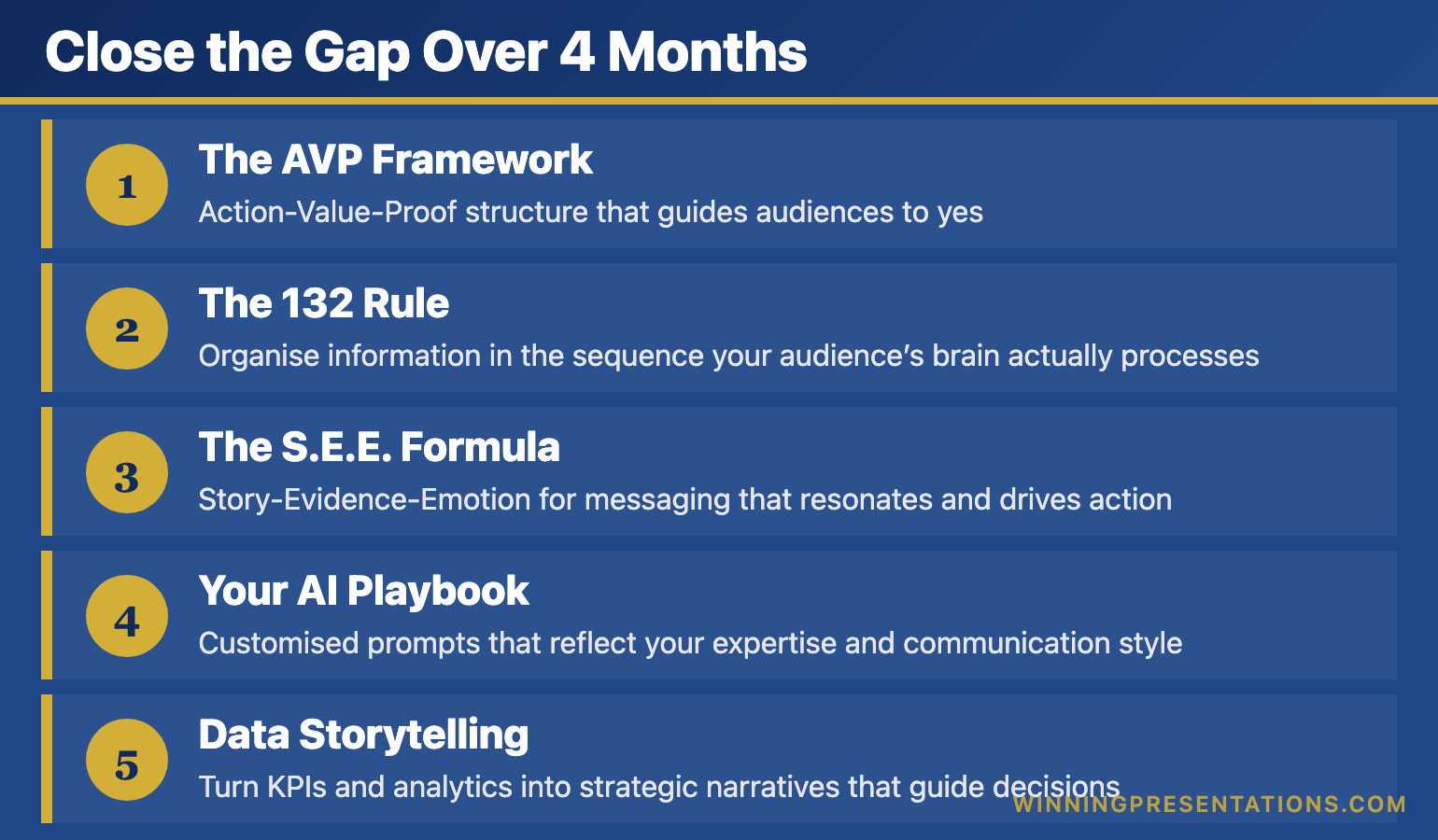
- The AVP Framework: Action-Value-Proof structure that guides audiences to yes
- The 132 Rule: Organise information in the sequence your audience’s brain actually processes
- The S.E.E. Formula: Story-Evidence-Emotion for messaging that resonates and drives action
- Your AI Playbook: Customised prompts that reflect your expertise and communication style
- Data Storytelling: Turn KPIs and analytics into strategic narratives that guide decisions
Plus: 2 live coaching sessions, Master Prompt Pack, templates, before/after examples, and lifetime access to everything.
Join the next cohort — self-paced with live coaching and lifetime access.
Why January Is the Right Time to Improve Your Presentation Skills
The course delivers 8 self-paced modules — one new module every couple of weeks. This pacing is intentional.
It means you’re building these skills while you’re actually presenting:
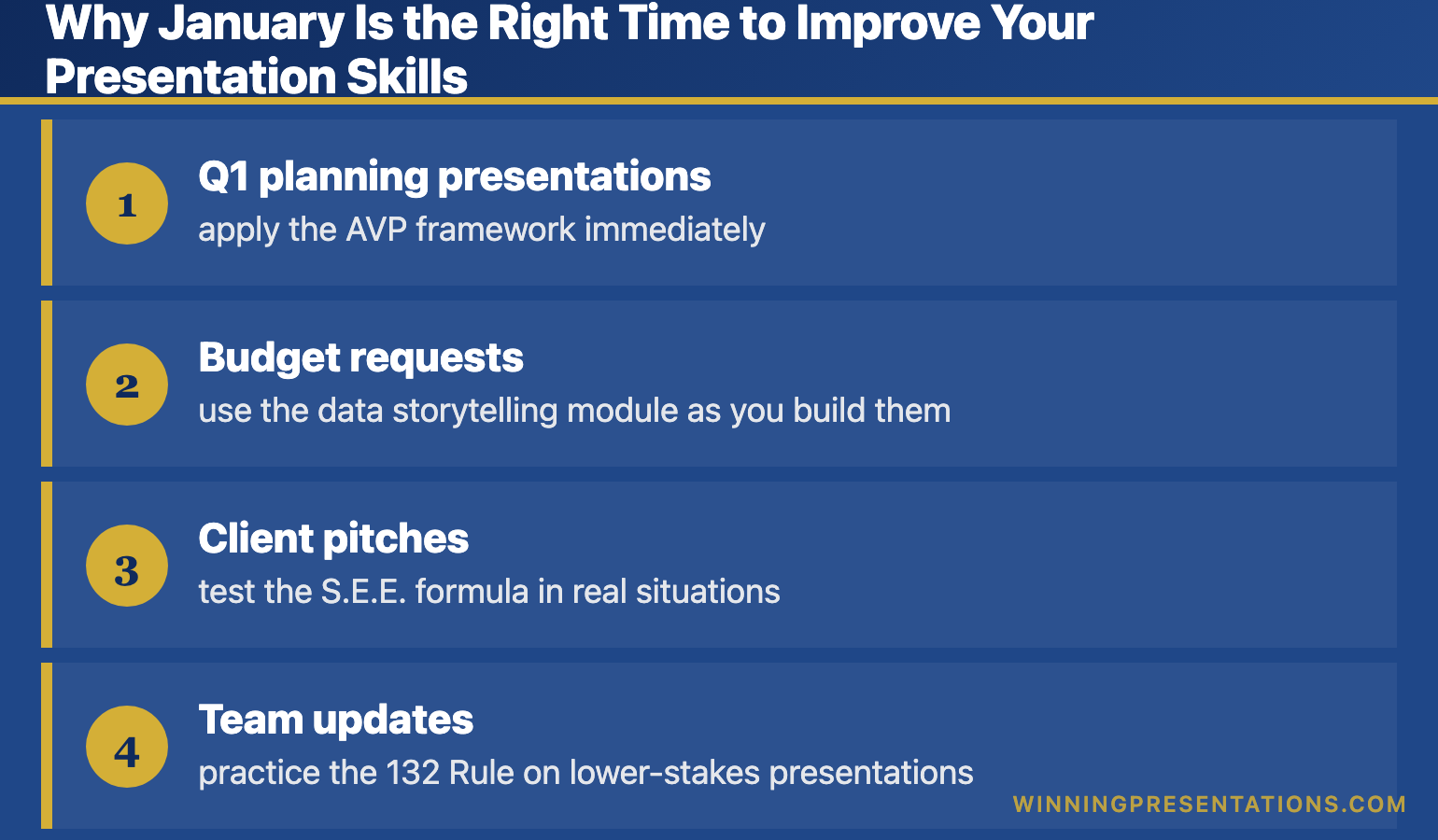
- Q1 planning presentations — apply the AVP framework immediately
- Budget requests — use the data storytelling module as you build them
- Client pitches — test the S.E.E. formula in real situations
- Team updates — practice the 132 Rule on lower-stakes presentations
By April, when the live coaching sessions happen, you’ll have four months of practice and real questions to bring.
Build the systems now. Apply them to every presentation this year. Compound the improvement.
Related: Presentation Structure: 7 Frameworks That Actually Work
FAQ: How to Improve Presentation Skills
I’m already decent at presentations. Is this for me?
Yes — “decent” is exactly the plateau this course addresses. If you’re getting through presentations but not getting promoted off the back of them, the systems in this course close that gap.
Do I need to be technical with AI?
No. This is not a software tutorial. You’ll learn to use AI as a thinking partner. The prompts are copy-paste ready. If you can use ChatGPT at a basic level, you can use everything in this course.
What if I can’t attend the live sessions?
All sessions are recorded. You’ll receive lifetime access to recordings, and you can join the next cohort at no additional cost if you want live participation later.
Your Next Step
The gap between “competent presenter” and “presenter who advances” isn’t about talent. It’s about systems.
📖 Go deeper: Business Presentation Skills: What Actually Matters — today’s comprehensive guide.
🎓 Build the systems: AI-Enhanced Presentation Mastery — 8 self-paced modules with live coaching; join the next cohort.
Mary Beth Hazeldine spent 24 years in corporate banking before founding Winning Presentations. She now trains executives in AI-enhanced presentation systems — the frameworks and tools that close the gap between competent and compelling.