Tag: Maven course

13 Feb 2026
Executive reviewing printed presentation slides with pen while comparing to AI-generated deck on screen

Your AI Presentation Has Structure. It Doesn’t Have Persuasion. Here’s the Missing Layer.

Quick answer: AI tools are excellent at organising information into clear, logical structures. What they consistently fail to produce is persuasion — the layer that makes executives act, not just nod. The S.E.E. formula (Story-Evidence-Emotion) is the human review layer that transforms AI-structured content into presentations that drive decisions. Below: exactly how it works, why AI can’t do it for you, and how to apply it to any AI-generated deck in under 20 minutes.

⚡ Presenting this week? Do this on your next deck in 7 minutes:

  • Story: Add one specific client or internal example to each major section (2 min)
  • Evidence: Add a benchmark or consequence to every data point (3 min)
  • Emotion: On your recommendation slide, answer: “What do I need them to feel?” (2 min)

Want the full system with templates for each step? Get the S.E.E. Templates + Workflow →

The Board Said “So What?” After a Deck That Took 6 Hours to Build.

A client — head of strategy at a mid-sized financial services firm — came to me after what she described as “the most embarrassing board meeting of my career.” She’d used AI to build a 22-slide strategic review. The structure was immaculate. Clear sections. Logical flow. Data on every slide. The AI had done exactly what she’d asked: organise the quarterly results into a coherent deck.

She presented for eighteen minutes. The board listened politely. Then the chairman said five words that made her stomach drop: “What do you want us to do?”

She had the data. She had the structure. She had the logic. What she didn’t have was a reason for anyone in that room to care — or act. The deck was informative. It wasn’t persuasive. And in a boardroom, informative without persuasive is just a well-organised waste of everyone’s time.

When we audited the deck together, the problem was obvious. Every slide followed the same pattern: here’s what happened, here are the numbers, here’s the next slide. No context for why the numbers mattered. No connection to what the board actually cared about. No emotional stakes. The AI had produced a report disguised as a presentation.

This is the gap that nearly every AI-generated presentation falls into. Not a structure problem. A persuasion problem. And it’s a gap that AI can’t close on its own — because making AI slides persuasive requires something AI doesn’t have: knowledge of what your specific audience fears, wants, and needs to hear before they’ll say yes.

🎯 Learn the Complete S.E.E. Framework Inside the Course

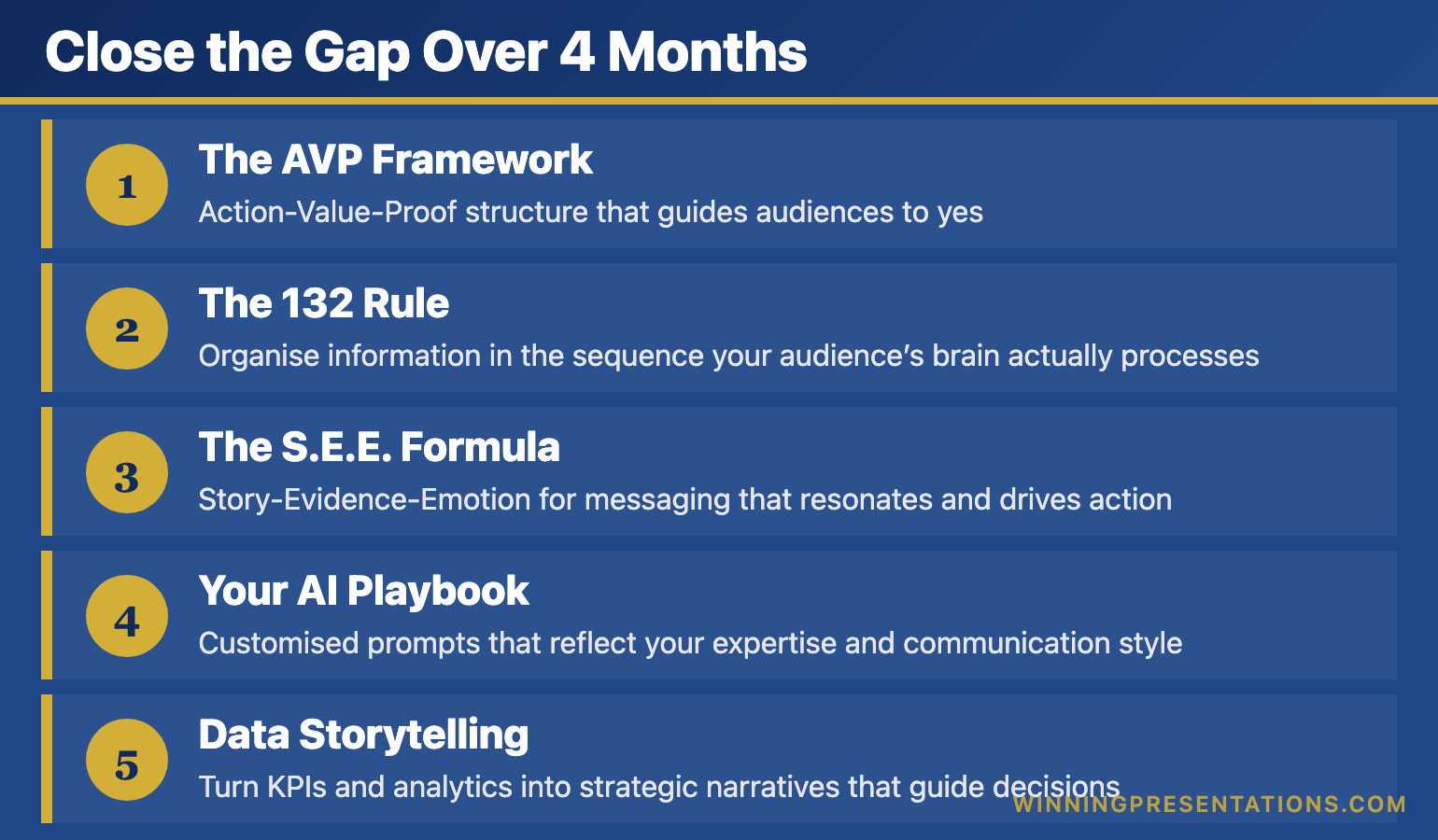
AI-Enhanced Presentation Mastery teaches you the full S.E.E. formula (Story-Evidence-Emotion) alongside AVP structure, the 132 Rule, and the Insight-Implication-Action framework for data — the complete system for turning AI output into presentations that drive executive decisions. Self-study modules releasing through April 2026, plus live Q&A sessions. Join anytime — you get all released modules immediately.

Get the S.E.E. Templates + Full Workflow →

Presale pricing: £249 — moves to £299 early bird, then £499 full price. 60-seat cap.

The Structure-Persuasion Gap: Why AI Output Feels Flat

AI is remarkably good at one thing: organising information logically. Give it data, a topic, and a prompt, and it will produce sections, headings, bullet points, and a sequence that makes rational sense. This is genuinely useful — it handles the tedious structural work that used to take hours.

But structure and persuasion are different skills. Structure answers “What information goes where?” Persuasion answers “Why should anyone care?” A well-structured deck can be completely unpersuasive. An unstructured but emotionally compelling argument can move a room. The ideal presentation has both — and AI consistently delivers only the first.

Here’s why. Persuasion requires three things AI doesn’t have access to: the specific context your audience is operating in, the emotional stakes attached to the decision, and the proof points that this particular group of people will find credible. AI can’t know that the CFO is worried about Q3 cash flow, that the board rejected a similar proposal six months ago, or that the CEO responds to client stories but switches off during spreadsheet reviews. These are human-intelligence inputs, and they’re exactly what transforms a structured deck into a persuasive one.

The reason most AI presentations fail isn’t that the AI is bad. It’s that the human skips the layer that makes AI slides persuasive, assuming structure is enough.

The S.E.E. Formula: Story, Evidence, Emotion

The S.E.E. formula is the persuasion layer you apply after AI has handled the structure. It stands for Story, Evidence, Emotion — three elements that, when woven into an AI-structured deck, transform it from a report into an argument that moves people to act.

Think of it this way: AI builds the skeleton. S.E.E. adds the muscle, the nervous system, and the heartbeat.

Each element serves a different persuasion function. Story provides context and makes your point memorable. Evidence provides credibility and makes your case defensible. Emotion creates urgency and makes your audience care enough to decide. A presentation that has all three is extremely difficult to dismiss. A presentation missing any one of them has a predictable failure mode.
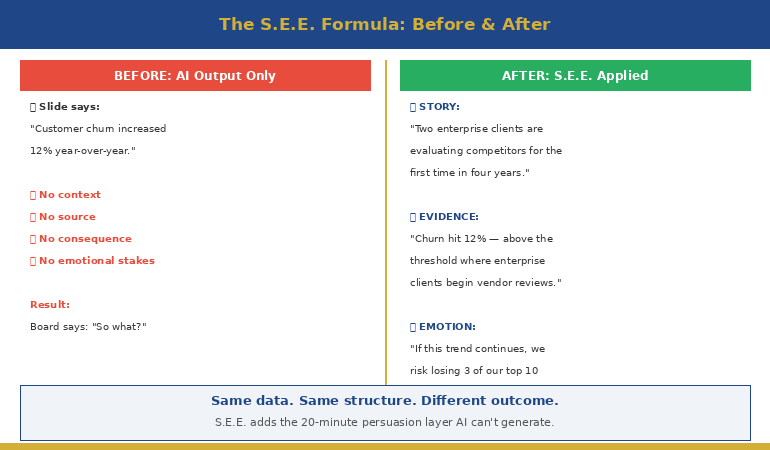

Side by side comparison of AI output before and after applying the S.E.E. formula showing transformation from facts to persuasion

Layer 1: Story — The Context AI Doesn’t Know

Story in a business presentation doesn’t mean “once upon a time.” It means context — the specific situation that makes your recommendation relevant, urgent, and grounded in reality.

AI output typically starts with the general: “Market conditions have shifted.” “Customer satisfaction has declined.” “Revenue targets are at risk.” These statements are accurate but they don’t anchor to anything your audience can feel. They’re abstract. And abstract doesn’t persuade.

The S.E.E. Story layer asks you to add one specific, concrete example to each major section of your deck. Not fiction — a real situation from your organisation that illustrates the point.

For example, instead of AI’s “Customer churn has increased 12% year-over-year,” the Story layer adds: “When I spoke with three of our enterprise clients last month, two mentioned they’re evaluating competitors for the first time in four years. One said — and I’m quoting directly — ‘Your platform used to be ahead. Now it’s keeping pace.’ That’s the shift the 12% represents.”

Now the board isn’t processing a number. They’re processing a threat. The data hasn’t changed. But the context makes it matter.

This is something AI fundamentally cannot generate — because it doesn’t know which clients you spoke to, what they said, or which anecdote will land with this particular audience. It’s human intelligence applied to AI structure.

📋 The S.E.E. formula is one of six frameworks inside the course.

AI-Enhanced Presentation Mastery includes the complete system: AVP structure, 132 Rule, S.E.E. formula, data storytelling frameworks, plus AI prompt templates for each. Study at your own pace — modules releasing through April 2026.

Get All 6 Frameworks + AI Prompt Packs →

Layer 2: Evidence — Turning Data Into Proof

AI is very good at including data. It’s surprisingly bad at turning data into proof. There’s a crucial difference.

Data is a number. Proof is a number plus its implication. AI will give you “NPS declined from 72 to 61.” That’s data. Proof sounds like: “NPS declined from 72 to 61 — a drop below the threshold where enterprise clients typically begin vendor reviews, based on our last three contract cycles.”

The Evidence layer in S.E.E. asks you to do three things with every data point AI generates:

First, contextualise it. What does this number mean relative to a benchmark your audience recognises? Industry average, last quarter, a target they set, a competitor’s performance. Data without context is just a number. Data with context is a signal.

Second, source it credibly. AI often presents data without attribution. Executives discount unsourced numbers. Add where the data came from — even “based on our Q3 finance review” adds credibility. If it’s external data, name the source. If it’s your own analysis, say so.

Third, connect it to consequence. What happens if this number continues? What happens if it reverses? The consequence is what transforms data from interesting to actionable. The Insight-Implication-Action framework from the course formalises this — every data point needs an insight (what it means), an implication (why it matters), and an action (what to do about it).

This evidence layer is where AI-enhanced presentations diverge from AI-generated ones. The AI handles the organisation. You handle the meaning.

Layer 3: Emotion — The Decision Trigger

This is the layer most professionals skip, and it’s the one that matters most for executive decisions.

Executives don’t make decisions based on logic alone. Research in decision science consistently shows that emotion drives action — logic justifies it afterward. A presentation that’s logically perfect but emotionally flat produces “let me think about it.” A presentation that creates the right emotional response — urgency, opportunity, risk — produces “let’s move on this.”

The Emotion layer isn’t about manipulation. It’s about connecting your recommendation to something your audience genuinely cares about. Every executive in every meeting has emotional stakes: protecting their team, delivering on promises they’ve made, avoiding the embarrassment of backing the wrong initiative, capitalising on an opportunity before a competitor does.

AI can’t identify these emotional stakes because they’re not in any dataset. They’re in the politics, relationships, and pressures of your specific organisation. Only you know that the VP of Operations is under pressure to show efficiency gains. Only you know that the CEO mentioned supply chain risk at the last all-hands meeting. Only you know that this proposal’s biggest blocker lost a similar bet two years ago and is risk-averse as a result.

The Emotion layer asks one question for each key slide: “What does my audience feel about this — and what do I need them to feel instead?” If the current state is complacency, you need urgency. If the current state is fear, you need confidence. If the current state is scepticism, you need proof that reduces perceived risk.

This is the layer that took my client’s deck from “so what?” to a follow-up meeting where the board asked her to accelerate the initiative. Same data. Same structure. Different emotional framing.

📊 The Full Persuasion System — Not Just One Formula

AI-Enhanced Presentation Mastery teaches S.E.E. alongside five other frameworks that work together: AVP for slide structure, 132 Rule for information sequencing, Insight-Implication-Action for data storytelling, plus customised AI prompt templates that make each framework faster to apply. 8 self-study modules + 2 live Q&A sessions.

Turn AI Slides Into Executive Decisions →

Presale pricing: £249 — moves to £499 full price soon. Join anytime — get all released modules immediately.

Applying S.E.E. to Any AI Deck in 20 Minutes

Here’s the practical workflow. You’ve used AI to build your deck — structure is solid, data is in place, flow makes sense. Now apply S.E.E. in three passes:

Pass 1: Story scan (5 minutes). Review each major section. For each one, ask: “Is there a specific, concrete example from our organisation that illustrates this point?” Write one sentence per section — a client conversation, an internal metric, a project outcome, a competitor move. You’re adding the anchor that makes abstract data feel real. If you can’t find a story, the section may be filler.

Your AI workflow handled the structure. This pass handles the meaning.

Pass 2: Evidence upgrade (5–10 minutes). Review every data point. For each one, add: context (vs what benchmark?), source (where did this come from?), and consequence (what happens if this continues?). Delete any data that doesn’t have a clear implication. More data with no context is worse than less data with clear meaning. Senior leaders don’t need all the information — they need the right information, framed so the conclusion is obvious.

Pass 3: Emotion check (5 minutes). For each key decision slide — recommendations, proposals, asks — answer: “What does my audience currently feel about this topic? What do I need them to feel? What one change to this slide creates that emotional shift?” Sometimes it’s reframing the opening line. Sometimes it’s adding a consequence slide. Sometimes it’s removing a defensive caveat that signals your own uncertainty.

Total time: roughly 20 minutes on top of whatever the AI took to generate the deck. That 20 minutes is the difference between “good presentation” and “approved.”

🔍 Want the complete workflow — AI structure + S.E.E. persuasion + templates?

The course includes before/after deck transformations, S.E.E. wording templates, and AI prompt packs designed to make each pass faster. Study at your own pace.

Get the Complete AI → Executive Workflow →

How do I make AI presentations more persuasive?

Apply the S.E.E. formula after AI handles structure: add Story (specific examples from your organisation), upgrade Evidence (contextualise every data point with benchmarks and consequences), and layer in Emotion (connect your recommendation to what your audience cares about). This 20-minute review transforms AI output from informative to actionable.

Why do AI-generated presentations feel flat?

AI excels at logical organisation but lacks access to three persuasion inputs: the specific context your audience operates in, the emotional stakes attached to the decision, and the proof points this particular group will find credible. Without these, AI produces structured reports rather than persuasive arguments.

What is the S.E.E. formula for presentations?

S.E.E. stands for Story-Evidence-Emotion. Story provides concrete, real-world context that makes abstract data feel tangible. Evidence transforms raw numbers into proof by adding benchmarks, sources, and consequences. Emotion connects your recommendation to what your audience fears, wants, or needs — the trigger that turns understanding into action.

🏆 AI-Enhanced Presentation Mastery: The Complete System

S.E.E. is one framework inside a complete course that transforms how you build presentations with AI. What’s included:

  • AVP framework — Action-Value-Proof slide structure
  • 132 Rule — information sequencing for how brains process
  • S.E.E. formula — Story-Evidence-Emotion persuasion layer
  • Insight-Implication-Action — data storytelling framework
  • AI prompt templates — customised for each framework
  • Before/after deck transformations — real examples
  • 8 self-study modules — releasing through April 2026
  • 2 live Q&A sessions — April 2026
  • Lifetime access — all recordings, templates, and future updates

Designed for busy professionals who create presentations regularly and want to save hours while dramatically improving impact.

Get the Complete AI Presentation System →

Presale pricing: £249 — moves to £499 full price soon. 60-seat cap. Join anytime — get all released modules immediately.

Frequently Asked Questions

Can I use the S.E.E. formula with any AI tool?

Yes. S.E.E. is a human review layer applied after AI generates the initial structure. It works with ChatGPT, Copilot, Claude, Gemini, or any other AI tool. The formula is tool-agnostic — it addresses the persuasion gap that all AI tools share.

How is S.E.E. different from general storytelling advice?

General storytelling advice tells you to “add stories” without specifying where, what kind, or how they interact with data and emotional framing. S.E.E. is a systematic three-pass review designed specifically for AI-generated business presentations, with each layer serving a distinct persuasion function.

Do I need presentation design skills for this?

No. S.E.E. operates at the messaging and content level, not the design level. You’re changing what the slides say and how the argument is framed — not formatting or layout. The AI handles structure and design; you handle persuasion.

How long does the full AI-Enhanced Presentation Mastery course take?

The course is 8 self-study modules released between January and April 2026, designed for busy professionals. Each module takes 60–90 minutes. You study at your own pace, with 2 live Q&A sessions in April for questions and feedback. Lifetime access means you can revisit any material whenever needed.

📬 The Winning Edge Newsletter

Weekly strategies for AI-enhanced presentations, executive communication, and confident delivery. No filler.

Subscribe Free →

📥 Free: Executive Presentation Checklist

A quick-reference checklist for reviewing any executive presentation before delivery — including a simplified S.E.E. review prompt.

Download Free Checklist →

Related reading: The presentation was perfect — the Q&A lost the deal — once your deck has the persuasion layer, prepare for the decision-making conversation that follows.

Your next step: Take the last AI-generated deck you built. Run the three S.E.E. passes: Story scan (add one concrete example per section), Evidence upgrade (contextualise every data point), Emotion check (connect each recommendation to what your audience cares about). Twenty minutes. And if you want the complete system — S.E.E. plus AVP, 132 Rule, data storytelling, and AI prompt templates for each — AI-Enhanced Presentation Mastery (£249) gives you everything in one self-study programme.

About the Author

Mary Beth Hazeldine is the Owner & Managing Director of Winning Presentations. With 24 years of corporate banking experience at JPMorgan Chase, PwC, Royal Bank of Scotland, and Commerzbank, she has delivered high-stakes presentations in boardrooms across three continents.

A certified hypnotherapist and NLP practitioner, Mary Beth combines executive communication expertise with practical techniques for managing presentation nerves. She has trained senior professionals and executive audiences over many years.

Book a discovery call | View services

08 Feb 2026
Maven presentation courses at test pricing showing AI-Enhanced Mastery at £249 and Executive Buy-In System at £199 with savings up to £1,152

Two Executive Presentation Courses: One for Speed, One for Buy-In

Test pricing is temporary. This transparency isn’t.

When I launched these two Maven courses, I deliberately priced them low — not as a “launch discount” marketing gimmick, but to genuinely test demand while I was still building out the content. I wanted to know: would busy professionals actually invest in comprehensive presentation training?

The answer was yes. Resoundingly yes.

Which means the test pricing window is closing. And once it does, these courses will never be available at these prices again.

Here’s what’s about to change:

  • AI-Enhanced Presentation Mastery: Currently £249 → Rising to £399 (self-study) or £750 (live cohort)
  • Executive Buy-In Presentation System: Currently £199 → Rising to £499 (self-study) or £850 (live cohort)

That’s not marketing spin. The current prices represent 37-76% savings compared to what future students will pay. And the content is identical — built from 24 years in corporate banking and consulting, plus 14+ years training senior professionals globally.

Both courses have already started, which is actually better for you — more modules are immediately available, so you can start applying the frameworks this week rather than waiting for content to release.

Let me show you exactly what each course delivers.

Quick answer: If you spend too many hours building presentations and want to cut creation time in half using AI — choose AI-Enhanced Presentation Mastery (£249 now, £399-£750 later). If you struggle to get approvals and face stakeholder resistance — choose Executive Buy-In Presentation System (£199 now, £499-£850 later). If you want speed AND buy-in, the best value is both courses for £448 — less than the future self-study price of Executive Buy-In alone (£499).

Best Value: Get Both Courses

£448

Future value: £898 self-study | £1,600 live cohort — Save up to £1,152

Lock In Test Pricing →

Or scroll down to choose just one course

💰 The Numbers Don’t Lie: Test Pricing vs. Future Pricing

Course Test Price Self-Study Live Cohort You Save
AI-Enhanced Mastery £249 £399 £750 Up to £501
Executive Buy-In £199 £499 £850 Up to £651
BOTH COURSES £448 £898 £1,600 Up to £1,152

Test pricing includes lifetime access to all materials, live Q&A sessions, and future updates.

AI-Enhanced Presentation Mastery (£249)

The problem this solves: You’re spending 4-6 hours building presentations that should take 90 minutes. You’ve tried AI tools but end up with generic outputs that need complete rewrites. You know AI could help, but you haven’t found a system that actually works for executive-level content.

What you’ll learn:

This isn’t an AI tutorial. It’s a strategic system for using AI as a thinking partner — not a content generator.

  • The AVP Framework (Action-Value-Proof) — Structure presentations that are impossible to ignore. Create compelling outlines in minutes that guide audiences to yes.
  • The 132 Rule — Organize information in the exact sequence your audience’s brain processes and remembers it.
  • The S.E.E. Formula (Story-Evidence-Emotion) — Make your proof memorable and your recommendations impossible to dismiss.
  • Your Personal AI Playbook — Customised prompts that reflect your expertise and communication style. Create first drafts in 30 minutes.
  • Data Storytelling with AI — Transform KPIs and analytics into strategic narratives using the Insight-Implication-Action framework.

What’s included:

  • 8 self-paced modules (releasing January–April 2026)
  • 2 live 60-minute coaching sessions
  • AI-powered outline generators
  • 30+ prompt templates for different presentation types
  • Before/after slide transformations
  • Master Prompt Pack
  • Lifetime access to all materials and future updates

The practical result: You’ll cut presentation creation time by 50%+ while dramatically improving quality. One client used the AVP framework to rebuild a 47-slide deck into 12 focused slides — and got approval in the first meeting after three previous rejections.

AI-Enhanced Presentation Mastery

Test Price: £249

Future: £399 self-study | £750 live cohort

Lock In Test Pricing → £249

Modules already available. Start applying frameworks this week.

Executive Buy-In Presentation System (£199)

The problem this solves: You create solid presentations but struggle to get approval. Stakeholders push back. Decision-makers say “let me think about it” instead of “yes.” You know your recommendations are sound, but you can’t seem to get the room on your side.

What you’ll learn:

This is about influence, not information. You’ll learn the psychology of how decisions actually get made in organisations — and how to position yourself on the winning side.

  • The Champion Strategy — How to get someone fighting FOR your proposal before you even present. Pre-meeting tactics that make your presentation a formality.
  • The Objection Map — Find resistance before it finds you. Identify blockers, skeptics, and hidden agendas before you walk into the room.
  • Stakeholder Psychology — Why “alignment” fails and “enrollment” wins. The difference between people nodding and people actually supporting you.
  • The Pre-Decision Conversation — Where approvals actually happen (hint: it’s not in the presentation). How to have the conversations that matter.
  • Handling “Let Me Think About It” — Scripts and frameworks for converting hesitation into commitment.

What’s included:

  • Complete self-paced module library
  • Live Q&A coaching sessions
  • Stakeholder mapping templates
  • Pre-meeting preparation frameworks
  • Objection handling scripts
  • Decision architecture templates
  • Lifetime access to all materials and future updates

The practical result: You’ll stop being the person who presents and start being the person who gets things approved. One executive used the Champion Strategy to secure a £2M budget — the decision was essentially made before the formal presentation even started.

Executive Buy-In Presentation System

Test Price: £199

Future: £499 self-study | £850 live cohort

Lock In Test Pricing → £199

Modules already available. Start applying frameworks this week.

Is This the Right Presentation Skills Course for You?

Here’s the honest breakdown:

Choose AI-Enhanced Presentation Mastery (£249 — saves up to £501) if:

  • You spend too many hours building presentations
  • You want to use AI but haven’t found a system that works
  • You need to produce more presentations without sacrificing quality
  • You’re already decent at getting buy-in but want faster creation
  • Your main pain is time, not approval

Choose Executive Buy-In System (£199 — saves up to £651) if:

  • You create good presentations but struggle to get approval
  • You face resistance, skepticism, or “let me think about it”
  • You need to influence stakeholders without formal authority
  • Politics and hidden agendas derail your recommendations
  • Your main pain is approval, not creation time

Take both courses (£448 — saves up to £1,152) if:

  • You want the complete system — fast creation AND reliable approval
  • You’re at a career inflection point where presentations really matter
  • You recognise that £448 for both is less than the future self-study price of Executive Buy-In alone (£499)
  • You want to lock in lifetime access before prices triple

🚫 These courses are NOT for you if:

  • You’re looking for a quick PowerPoint tutorial (these are strategic frameworks, not software training)
  • You need presentation skills for academic or personal contexts (these are built for corporate/executive environments)
  • You want someone to build your slides for you (these teach you to build better, faster)
  • You’re not willing to invest 2-3 hours per week in learning and applying the frameworks

For more on executive presentation structure, see my guide on executive presentation structure. For AI presentation workflows, see AI presentation workflow. For stakeholder influence, see how to get executive buy-in.

Why Test Pricing Exists (And Why It’s Ending)

I want to be completely honest about why these prices exist — because understanding this helps you see why it’s genuinely a limited window.

I needed to validate demand. Before investing hundreds of hours building comprehensive courses, I needed to know: would busy executives actually pay for in-depth presentation training? Would the frameworks I’ve used for 24 years translate to a self-paced format?

So I priced both courses low enough to test the market while I built the content. Not “discounted” — genuinely priced to test.

The test worked. Students enrolled. They’re getting results. The feedback is shaping the final versions of both courses. But now the content is nearly complete, and there’s no longer a reason to keep prices at testing levels.

Here’s what you get at test pricing that future students won’t:

  • The same content — Identical frameworks, templates, and live sessions
  • Lifetime access — Including all future updates and improvements
  • Live Q&A sessions — Worth the price difference alone
  • Maven Guarantee — Full refund eligible up until halfway point
  • 37-76% lower price — Compared to what the exact same course will cost in 3 months

The maths is simple:

If you wait and buy AI-Enhanced Presentation Mastery at the future self-study price (£399), you’ll pay £150 more for exactly the same course. If you want the live cohort experience later, that’s £750 — three times today’s price.

If you wait and buy Executive Buy-In at the future self-study price (£499), you’ll pay £300 more. The live cohort? £850 — more than four times today’s price.

If you buy both now (£448), you pay less than the future self-study price of Executive Buy-In alone (£499). Here’s the simple price logic: test pricing exists to validate demand, not to be permanent.

Lock In Test Pricing Before It Disappears

AI-Enhanced Mastery

£249 £399-£750

Save up to £501

Lock In Test Pricing →

Executive Buy-In System

£199 £499-£850

Save up to £651

Lock In Test Pricing →

BOTH COURSES: £448 (Future value: £898-£1,600)

Lifetime access. Live Q&A sessions. Maven Guarantee.

Frequently Asked Questions

The courses have already started — am I too late?

The opposite. Because modules release over time, joining now means you get immediate access to everything that’s already available — more content ready to consume than early joiners had. You can catch up at your own pace, the live Q&A sessions are still ahead, and you’re paying the same test price. If anything, you’re getting better value than the earliest students.

Why are these prices so much lower than future pricing?

Honestly? I priced them low to test demand while building the courses. I needed to validate that busy professionals would invest in comprehensive presentation training before committing hundreds of hours to create it. The test worked — students enrolled and are getting results. Now that the content is nearly complete, there’s no reason to keep prices at testing levels. Future students will pay £399-£750 for AI-Enhanced and £499-£850 for Executive Buy-In.

What if I can’t attend the live sessions?

All live sessions are recorded and added to your course portal. You’ll have lifetime access to watch them whenever convenient. The courses are designed for busy professionals — self-paced learning with live sessions as a bonus, not a requirement.

Can my company reimburse the cost?

Yes — many employers cover professional development courses. Maven provides documentation and receipts suitable for expense claims. Both courses include certificates of completion you can share with your employer or add to LinkedIn. At test pricing, this is an easy approval — you’re essentially getting live-cohort-quality training at a fraction of typical corporate training costs.

Will test pricing return later?

No. Test pricing exists because I was validating demand while building the courses. Once the programmes are complete and established, they move to standard pricing: £399 (self-study) or £750 (live cohort) for AI-Enhanced, and £499 (self-study) or £850 (live cohort) for Executive Buy-In. This window is genuinely limited.

What’s the refund policy?

Both courses are backed by Maven’s satisfaction guarantee. You’re eligible for a full refund up until the halfway point of the course if it’s not what you expected. There’s no risk in trying — except the risk of waiting and paying 2-4x more later.

Your Next Step

Let me make this simple.

If you wait three months and buy these courses at regular pricing, you’ll pay £898 for self-study access to both — or £1,600 for live cohort access.

If you act now, you pay £448 for both. That’s less than the future self-study price of Executive Buy-In alone.

The content is identical. The frameworks took me 24 years to develop. The only difference is whether you lock in test pricing or pay 2-4x more later.

If your main pain is spending too many hours building presentations:
AI-Enhanced Presentation Mastery — £249 (future: £399-£750)

If your main pain is getting approval and buy-in:
Executive Buy-In Presentation System — £199 (future: £499-£850)

If you want the complete toolkit:
Both courses — £448 total (future: £898-£1,600)

These frameworks work. I’ve used them to train thousands of executives. You can start applying them this week. The only question is whether you’ll pay test prices or full prices for the same result.

⏰ Test Pricing Window Is Closing

Once these courses are fully established, prices rise to £399-£850 per course. Lock in test pricing now and save up to £1,152.

Best Value: Get Both Courses → £448

📧 Not Ready to Commit? Get the Newsletter First

Weekly insights on executive communication, presentation structure, and high-stakes delivery — free. See if my approach resonates before investing in a course.

Subscribe to The Winning Edge →

About the Author

Mary Beth Hazeldine is the Owner & Managing Director of Winning Presentations. With 24 years in corporate banking and consulting — including senior roles at JPMorgan Chase, PwC, Royal Bank of Scotland, and Commerzbank — she has delivered high-stakes presentations in boardrooms across three continents.

A qualified clinical hypnotherapist and NLP practitioner, Mary Beth combines executive communication expertise with evidence-based techniques for influence and persuasion. She has trained thousands of executives and supported presentations that have secured significant funding and approvals.

Book a discovery call | View services

27 Dec 2025
Presentation skills for promotion - what actually gets you ahead in corporate environments

Presentation Skills for Promotion: What Actually Gets You Ahead

What I learned from watching 24 years of promotions (and non-promotions) in corporate banking

Presentation skills for promotion matter more than most professionals realize. I’ve sat in hundreds of promotion discussions. Not as the candidate — as the observer. First as a junior banker watching who got tapped for senior roles, then as a trainer noticing which clients advanced and which plateaued.

The link between presentation skills and promotion became undeniable. The conversation is never “Who has the best technical skills?” It’s “Who can we put in front of the board? Who will represent us well?”

Those questions all have the same answer: the person with presentation skills that drive promotion.

Why Presentation Skills for Promotion Matter So Much

This isn’t about corporate politics or style over substance. It’s about what leadership roles actually require.

The higher you go, the less you do the work yourself. Your job shifts from execution to influence — getting others to act on your recommendations. That requires communication skills that most technical training never develops.

When a senior leader evaluates you for promotion, they’re running a mental simulation: “Can I picture this person presenting to the executive committee? Will they hold their own when challenged? Can they explain complex issues simply?”

Your spreadsheet skills don’t answer those questions. Your presentation skills do — and that’s why presentation skills drive promotion decisions.

Related: Professional Presentation Skills: What Sets Top Performers Apart

Infographic for: presentation skills for promotion (image 1)

The 3 Presentation Skills for Promotion That Matter Most

Not all presentation skills matter equally for advancement. These three consistently separate people who get promoted from people who don’t:

1. Leading With Conviction

Promoted professionals don’t just present information — they take positions. They tell the room what they think in the first 60 seconds, then defend it.

This signals ownership. It shows you’ve processed the information and formed a judgment. Executives don’t promote people who wait for others to interpret their data.

The difference:

  • Analyst: “Here’s the data. What do you think we should do?”
  • Leader: “I’m recommending Option B. Here’s why.”

2. Composure Under Challenge

Every promotion decision includes an unspoken evaluation: “How will this person handle pressure from the board? From difficult clients? From hostile stakeholders?”

The answer shows up in how you respond when challenged. If you get defensive, justify immediately, or repeat yourself more forcefully — that’s noticed. If you acknowledge the concern, stay calm, and respond substantively — that’s noticed too.

One graceful response under fire is worth ten smooth presentations. It’s the moment senior leaders remember when your name comes up for promotion.

3. Strategic Brevity

The ability to explain complex issues simply is rare — and highly valued. When you can communicate in 10 minutes what others take 40 minutes to say, you demonstrate two things executives prize: deep understanding and respect for their time.

Brevity isn’t about dumbing down. It’s about ruthless prioritisation — knowing what must be said versus what could be said. That judgment is a leadership skill in itself.

Related: How to Create Executive Presentations That Get Results

Quick Reference for Promotion-Ready Presentations

The Public Speaking Cheat Sheets (£14.99) give you pocket-sized reminders for all three skills — plus frameworks for openings, closings, and handling tough questions.

Get the Cheat Sheets →

Why Most Professionals Never Develop Presentation Skills for Promotion

If these presentation skills drive promotion so reliably, why don’t more people develop them?

No one teaches them explicitly. Business schools teach analysis, not communication. Corporate training focuses on slide design, not strategic presence. Most professionals are left to figure it out through trial and error — in high-stakes situations where errors are costly.

Practice happens under pressure. You don’t get 20 rehearsals before a board presentation. You get one shot, with your reputation on the line. That’s a terrible environment for skill development.

Feedback is vague or absent. “Good presentation” tells you nothing. “You got defensive when the CFO pushed back and it created doubt about your recommendation” — that’s actionable. But most professionals never receive feedback that specific.

This is why deliberate training matters. You need to develop these skills in low-stakes environments with specific feedback before deploying them when it counts.

Related: Business Presentation Skills: What Actually Matters in Corporate Environments

Develop Presentation Skills for Promotion Systematically

AI-Enhanced Presentation Mastery is designed specifically to build the presentation skills that drive promotion — with frameworks, practice, and personalised feedback.

8 self-paced modules (January–April 2026):

  • The AVP Framework: Action-Value-Proof structure that forces conviction upfront
  • The 132 Rule: How to cut ruthlessly without losing impact
  • Q&A Handling: Frameworks for staying composed under hostile questioning
  • The S.E.E. Formula: Story-Evidence-Emotion for persuasive messaging
  • NLP Delivery Techniques: Composure and presence under pressure
  • AI-Powered Preparation: Build presentations faster so you can rehearse more

Plus: 2 live coaching sessions (April 2026) with personalised feedback on your real presentations. This is where the skill becomes permanent — practicing under observation with specific, actionable feedback.

Presale price: £249 (increases to £299 early bird, then £499 full price)

60 seats total. Lifetime access to all materials.

See the full curriculum and reserve your seat →

Infographic for: presentation skills for promotion (image 2)

The Career ROI of Presentation Skills for Promotion

Let’s be direct about what’s at stake.

A promotion typically comes with a 15-25% salary increase. For a professional earning £80,000, that’s £12,000-£20,000 annually. Over a career, the compound effect of earlier promotions is measured in hundreds of thousands of pounds.

The professionals who develop these presentation skills don’t just get promoted once. They get promoted repeatedly — because the same skills that got them the first advancement continue working at each level.

The investment in developing presentation skills for promotion isn’t an expense. It’s a multiplier on your entire career trajectory.


Your Next Step: Build Presentation Skills for Promotion

You can continue developing presentation skills through trial and error in high-stakes situations. Most people do.

Or you can build them systematically — with frameworks, practice, and feedback — so they’re ready when the moment matters.

📖 Read the complete guide: Professional Presentation Skills: What Sets Top Performers Apart — all 7 skills that distinguish those who advance.

📋 Get the quick reference (£14.99): Public Speaking Cheat Sheets — pocket-sized reminders for high-stakes moments.

🎓 Build the skills systematically (£249): AI-Enhanced Presentation Mastery — 8 modules + 2 live coaching sessions. January–April 2026, 60 seats.


Mary Beth Hazeldine spent 24 years in corporate banking at JPMorgan, PwC, Royal Bank of Scotland, and Commerzbank — watching which professionals advanced and which plateaued. She now trains executives in the presentation skills that drive promotion and career growth.

27 Dec 2025
Professional presentation skills - what sets top performers apart in corporate environments

Professional Presentation Skills: What Sets Top Performers Apart

After 24 years in corporate banking, here’s what actually separates those who get promoted from those who don’t

In 24 years at JPMorgan, PwC, Royal Bank of Scotland, and Commerzbank, I watched hundreds of talented professionals present. Most were competent. Some were forgettable. A handful were exceptional — and they’re the ones who got promoted.

The difference wasn’t intelligence or even presentation “talent.” It was a specific set of professional presentation skills that most people never develop because no one teaches them explicitly.

I’m going to teach them to you now.

🎁 Free Download: 7 Presentation Frameworks — the structures top performers use consistently. Print-ready PDF.

What Professional Presentation Skills Actually Look Like

First, let’s define what we’re talking about. Professional presentation skills aren’t about being charismatic or having a “stage presence” personality. They’re about:

  • Clarity under pressure — delivering complex information simply, even when stakes are high
  • Executive alignment — structuring content for how senior leaders actually think
  • Credibility without arrogance — demonstrating expertise while remaining approachable
  • Decisive recommendations — telling the room what you think, not just presenting options
  • Composure during challenge — handling tough questions without defensiveness

These skills are observable, teachable, and learnable. They’re not personality traits. They’re behaviours you can practise until they become automatic.

Related: Business Presentation Skills: What Actually Matters in Corporate Environments

The 7 Professional Presentation Skills That Get You Promoted

I’ve distilled 24 years of observation into seven specific skills. Master these, and you’ll stand out in any corporate environment.

1. Lead With the Recommendation

Junior presenters build to their conclusion. Senior presenters start with it.

The executives I watched get promoted fastest all did this: they told the room what they wanted in the first 60 seconds. “I’m recommending we proceed with Option B. Here’s why.”

This isn’t arrogance — it’s respect for the audience’s time. It also forces clarity in your own thinking. If you can’t state your recommendation in one sentence, you haven’t thought hard enough.

What this looks like:

  • “I’m recommending we invest £2M in customer retention. Let me show you why.”
  • “My conclusion: we should proceed with the acquisition. Here’s the analysis.”
  • “Bottom line: this project is at risk unless we add resources. Here’s the evidence.”

2. Answer the Question Actually Being Asked

I’ve watched brilliant analysts torpedo their careers by answering the wrong question. A board member asks “What’s the risk?” and they launch into methodology. A CFO asks “Can we afford this?” and they explain the technical requirements.

Top performers listen to the actual question, pause, and answer it directly — even if briefly — before providing context.

The pattern:

  1. Answer the question in one sentence
  2. Provide essential context
  3. Check if that’s sufficient: “Does that address your concern?”

This sounds simple. In practice, it’s remarkable how few people do it.

3. Cut Your Content in Half (Then Cut Again)

Every presenter thinks they need more slides. Every executive wishes they had fewer.

The people who got promoted in my observation consistently presented with fewer slides than their peers. A 30-page deck became 10 pages. A 60-minute presentation became 20 minutes with 40 minutes for discussion.

This requires ruthless prioritisation: what absolutely must be said, versus what would be nice to say?

The test: For each slide, ask “If I cut this, would the recommendation change?” If no, cut it.

Related: How to Create Executive Presentations That Get Results

4. Own the Room Physically

Professional presentation skills include how you use space. Top performers:

  • Stand (when possible) rather than sit — it commands more attention
  • Use purposeful movement, not nervous pacing
  • Make eye contact with decision-makers during key points
  • Pause before important statements, rather than rushing through
  • Keep hands visible and gestures controlled

None of this requires natural confidence. It requires practice until the behaviours feel automatic.

5. Handle Challenge Without Defensiveness

This is where careers are made or broken. When a senior leader challenges your recommendation, how do you respond?

Defensive presenters:

  • Justify immediately
  • Explain why the challenger doesn’t understand
  • Get visibly flustered
  • Repeat their original point, louder

Professional presenters:

  • Acknowledge the challenge: “That’s a fair concern.”
  • Clarify if needed: “Can I ask what’s driving that question?”
  • Respond substantively, not emotionally
  • Concede when appropriate: “You’re right — I hadn’t considered that angle.”

The ability to receive challenge gracefully signals confidence more than any power pose ever will.

Presentation mistakes that stall careers - what to avoid and what to do instead

6. Show Your Thinking, Not Just Your Conclusion

This seems to contradict “lead with the recommendation” — but it doesn’t. You state your conclusion first, then briefly show how you got there.

The key word is “briefly.” You’re not walking through every step of your analysis. You’re highlighting the 2-3 key considerations that shaped your thinking.

Example: “I’m recommending Option B. The three factors that drove this: cost efficiency, implementation timeline, and team capacity. Let me show you each briefly.”

This builds credibility. It shows you’ve done rigorous work without subjecting the audience to all of it.

7. Close With Clarity

The final professional presentation skill: ending decisively. Too many presenters trail off: “So, um, that’s the analysis. Any questions?”

Top performers end like this:

“Based on what we’ve discussed, I’m recommending we proceed with Option B, starting in Q1. I need your approval today to begin procurement. Can I get that?”

Note what this does: restates the recommendation, specifies timing, names the ask, requests a decision. No ambiguity.

Related: Public Speaking Tips That Actually Work in Corporate Settings

Quick Reference for Your Next Presentation

The Public Speaking Cheat Sheets (£14.99) give you pocket-sized reminders for all seven skills — plus 15 more techniques for handling nerves, structuring content, and commanding attention.

What’s included:

  • 7-skill checklist from this article
  • Opening and closing templates
  • Body language quick reference
  • Tough question response frameworks

Get the Cheat Sheets →

Why Most Professionals Don’t Develop These Skills

If these professional presentation skills are so valuable, why don’t more people have them?

1. No one teaches them explicitly. Business schools teach case analysis, not presentation skills. Most corporate training focuses on slide design, not strategic communication.

2. Practice happens in high-stakes moments. You don’t get to rehearse a board presentation 20 times. You get one shot, under pressure, with your reputation on the line. That’s a terrible learning environment.

3. Feedback is rare and vague. “Good presentation” tells you nothing. “You answered the CFO’s question indirectly and it created doubt” — that’s actionable. But most professionals never receive feedback that specific.

4. The wrong things get rewarded. In many organisations, comprehensive decks are praised over concise ones. Being “thorough” is valued over being decisive. The incentives work against developing professional presentation skills.

This is why deliberate training matters. You need to practise these skills in a low-stakes environment with specific feedback before you deploy them in high-stakes situations.

Professional Presentation Skills vs. Natural Talent

I’ve trained thousands of professionals. The ones who improve fastest aren’t the naturally confident ones — they’re the ones who practise systematically.

Professional presentation skills are like any other skill: they improve with deliberate practice and specific feedback. The “natural” presenters often plateau because they’ve never had to work at it. The “nervous” presenters often surpass them because they’ve built robust systems.

Some of the best presenters I know still get nervous. The difference is they have frameworks that work regardless of how they feel.

Related: How to Present Like a CEO: Executive Presentation Skills for Leadership

Develop Professional Presentation Skills Systematically

AI-Enhanced Presentation Mastery teaches all seven skills from this article — plus AI-powered workflows that help you prepare faster and practise more effectively.

8 self-paced modules (January–April 2026):

  • The AVP Framework: Action-Value-Proof for executive-level structure
  • The 132 Rule: How to cut content ruthlessly without losing impact
  • Q&A handling frameworks for hostile and challenging questions
  • NLP delivery techniques for composure under pressure
  • AI prompts that accelerate preparation and practice

Plus: 2 live coaching sessions with personalised feedback on your real presentations.

Presale price: £249 (increases to £299, then £499)

60 seats total. Lifetime access.

See the full curriculum →

Frequently Asked Questions About Professional Presentation Skills

How long does it take to develop professional presentation skills?

You can see noticeable improvement in 2-4 weeks with deliberate practice. Mastery takes longer — typically 6-12 months of consistent application. The key is getting specific feedback on real presentations, not just reading about techniques.

Can introverts develop strong presentation skills?

Absolutely. Some of the best presenters I’ve trained are introverts. Professional presentation skills are about clarity and structure, not extroversion. Introverts often excel because they prepare more thoroughly and listen more carefully to questions.

What’s the single most important skill to develop first?

Lead with your recommendation. It forces clarity in your thinking and immediately differentiates you from presenters who build to their conclusion. Practice stating your recommendation in one sentence before you do anything else.

How do I practise when I don’t have many presentation opportunities?

Create opportunities. Present in team meetings, even briefly. Record yourself presenting to your laptop. Join groups like Toastmasters. The skills transfer — a 5-minute team update uses the same fundamentals as a board presentation.

Are professional presentation skills different in virtual settings?

The core skills are identical: lead with recommendation, answer questions directly, cut ruthlessly. What changes is execution: eye contact means looking at the camera, energy must be 20% higher to read through the screen, and visuals matter more when you’re competing with distractions.


Your Next Step: Pick One Skill and Master It

Don’t try to develop all seven professional presentation skills simultaneously. Pick the one that would make the biggest difference for you right now, and focus on it for your next 3-5 presentations.

For most people, I recommend starting with “Lead with the recommendation.” It’s the highest-leverage change and it forces improvement in everything else.

🎁 START FREE: Download 7 Presentation Frameworks — including the structures top performers use consistently.

📋 GET THE QUICK REFERENCE (£14.99): Public Speaking Cheat Sheets — pocket-sized reminders for all seven skills plus body language, openings, closings, and Q&A handling.

🎓 MASTER IT ALL (£249): AI-Enhanced Presentation Mastery — 8 modules covering professional presentation skills, AI tools, and delivery. January–April 2026, 60 seats.

The professionals who get promoted aren’t more talented. They’ve developed skills that most people never bother to learn. You can be one of them.


Mary Beth Hazeldine spent 24 years in corporate banking at JPMorgan, PwC, Royal Bank of Scotland, and Commerzbank, observing which professionals advanced and which plateaued. She now trains executives in the professional presentation skills that drive career growth.

24 Dec 2025
Persuasive presentations - how to change minds without manipulation using ethical influence

Persuasive Presentations: How to Change Minds Without Manipulation

NLP-based influence techniques that get decisions — without tricks or pressure tactics

Early in my banking career, I watched a senior director get a £12 million budget approved in under 15 minutes. No hard sell. No pressure. No clever tricks. The room simply… agreed.

I’d spent weeks on a similar request and been rejected twice. What was he doing differently?

It took me years to understand: persuasive presentations aren’t about convincing people you’re right. They’re about helping people convince themselves. The difference is everything.

As a qualified NLP practitioner and clinical hypnotherapist, I’ve spent decades studying ethical influence — how to change minds without manipulation. Here’s what actually works in business contexts.

🎁 Free Download: Executive Presentation Checklist — includes the persuasion framework from this article. Print-ready PDF.

What Makes a Presentation Persuasive (It’s Not What You Think)

Most people think persuasion means stronger arguments. Better data. More compelling logic.

It doesn’t.

Neuroscientist Antonio Damasio studied patients with damage to emotional brain centres. They could analyse options perfectly — but couldn’t make decisions. His conclusion: emotion isn’t the enemy of reason. It’s the engine.

A persuasive presentation doesn’t overwhelm with logic. It creates the emotional conditions for agreement. The logic provides justification after the decision is already made.

This is why:

  • A CFO approves a budget wrapped in a client story but rejects the same numbers in a spreadsheet
  • A board says yes to a recommendation framed as risk mitigation but no to the same recommendation framed as opportunity
  • An investor funds a founder who tells a compelling origin story over one with better metrics

The information is identical. The emotional frame is different.

Related: Storytelling in Presentations: The NLP Techniques That Captivate Any Audience

Persuasive Presentation Techniques: The Ethical Approach

There’s a line between influence and manipulation. Manipulation exploits. Influence aligns.

Ethical persuasion helps people see how your recommendation serves their interests. It removes friction, addresses concerns, and makes the right decision feel obvious. It never tricks, pressures, or exploits cognitive biases against someone’s own interests.

Here are the techniques that work:

1. Lead With Their Problem, Not Your Solution

Most presenters start with what they want: “I’m recommending we invest £2 million in…”

Persuasive presenters start with what the audience wants to solve: “We’re losing 15% of deals in the final stage. Here’s why — and how to fix it.”

When you articulate someone’s problem better than they can, you earn the right to propose solutions. They lean in because you understand them.

2. Use the “Yes Ladder”

Before your main ask, get a series of small agreements. Each “yes” makes the next one more likely — this is called “commitment consistency” in psychology.

Example:

  • “Would you agree that customer retention is our biggest growth lever right now?” (Yes)
  • “And that our current churn rate is higher than the industry benchmark?” (Yes)
  • “So addressing this should be a priority for Q1?” (Yes)
  • “Here’s the investment that would make that happen…”

By the time you reach your recommendation, they’ve already agreed with the logic that leads there.

3. Name the Objection Before They Do

If you know people will worry about cost, timeline, or risk — say it first.

“You’re probably thinking this sounds expensive. Let me show you the numbers…”

This does two things: it builds trust (you’re not hiding concerns) and it lets you frame the objection on your terms. An objection you raise is half-answered. An objection they raise feels like a discovery.

4. Give Them the “Out”

Counterintuitively, acknowledging alternatives strengthens your position.

“We could do nothing and accept the current results. We could try a smaller pilot first. Or we could commit fully and capture the market window. Here’s why I’m recommending option three…”

When you present options fairly, people trust your judgment more. You’re not selling — you’re advising.

5. End With the Decision, Not the Data

Weak closings: “So that’s the analysis. Any questions?”

Strong closings: “Based on what we’ve seen, I’m recommending we proceed with Option A, starting in Q1. Can I get your approval to move forward?”

A persuasive presentation always ends with a clear ask. If you don’t ask, you don’t get.

Related: How to Create Executive Presentations That Get Results

Persuasive presentation techniques - 5 ethical influence methods: lead with problem, yes ladder, name objections, give the out, end with decision

The NLP Framework for Persuasive Presentations

In NLP, we talk about “pacing and leading.” Pacing means matching someone’s current state — their concerns, their language, their worldview. Leading means guiding them toward a new perspective.

You can’t lead someone you haven’t paced first. This is why jumping straight to your recommendation fails.

The sequence:

1. Pace their current reality. Show that you understand where they are. Use their language. Acknowledge their constraints. Reference their priorities.

“I know Q4 budget is already stretched. I know we’ve had implementation challenges before. And I know the board is focused on profitability over growth right now.”

2. Bridge with shared goals. Connect their current concerns to the outcome you’re proposing.

“Which is exactly why this matters. This isn’t about spending more — it’s about spending smarter. It directly addresses the profitability mandate.”

3. Lead to your recommendation. Now that you’re aligned, introduce your solution as the logical next step.

“Here’s what I’m proposing, and how it gets us to the outcome we both want…”

This isn’t manipulation. It’s communication that works with human psychology instead of against it.

Related: How to Present to Your CFO: The Financial Language That Gets Buy-In

Structure Your Persuasive Presentations

The Executive Slide System (£39) gives you the frameworks to structure presentations that get decisions.

What’s included:

  • The 3-slide decision framework
  • Before/after examples from real client work
  • Templates for budget requests, strategic recommendations, and board presentations
  • The “yes ladder” structure built into slide flow

Get the Executive Slide System →

What Persuasive Presentations Avoid

Knowing what not to do matters as much as knowing what works.

Don’t overwhelm with options. Three choices maximum. More than that creates decision paralysis, not persuasion.

Don’t hide weaknesses. If your recommendation has risks or limitations, acknowledge them. Audiences aren’t stupid — they’ll find the holes anyway. Better to address them on your terms.

Don’t mistake length for thoroughness. A 60-slide deck isn’t more persuasive than 15 slides. It’s less persuasive. Every slide that doesn’t advance your argument dilutes it.

Don’t end with Q&A. Q&A should happen, but it shouldn’t be your closing. After Q&A, return to your recommendation and ask for the decision. The last thing they hear should be your ask, not their own objections.

Don’t confuse agreement with action. “That makes sense” isn’t a yes. “Let me think about it” isn’t a yes. Push gently for a concrete next step: “Can I schedule the kickoff meeting for next week?”

Related: The Board Presentation Structure Nobody Teaches You

Frequently Asked Questions About Persuasive Presentations

How do I make a presentation persuasive without being pushy?

Focus on their interests, not yours. A persuasive presentation shows how your recommendation solves their problem. If you’ve done that clearly, you don’t need to push — the logic carries itself. The “pushy” feeling comes from asking for something without establishing why it matters to them.

What’s the most important element of a persuasive presentation?

Starting with their problem, not your solution. When you articulate someone’s challenge better than they can, you earn credibility. Everything else builds on that foundation. If you skip this step, no technique will save you.

How do I handle a hostile or sceptical audience?

Name it directly: “I know there’s scepticism about this approach — and I understand why. Let me address that head-on.” Then acknowledge the valid concerns before making your case. Fighting resistance amplifies it. Acknowledging resistance dissolves it.

Can I be persuasive with data-heavy content?

Absolutely — but lead with the insight, not the data. “We’re leaving £2 million on the table annually. Here’s the analysis that shows why.” The number creates interest. The analysis provides proof. Most presenters reverse this and lose the audience before they reach the point.

What’s the difference between persuasion and manipulation?

Intent and alignment. Persuasion helps people make decisions that serve their interests. Manipulation exploits cognitive biases against their interests. If your recommendation genuinely helps them, advocating for it strongly isn’t manipulation — it’s service.


Master Persuasive Presentations + AI + Structure

AI-Enhanced Presentation Mastery teaches the complete persuasion system — from frameworks to delivery to handling resistance.

8 self-paced modules (January–April 2026):

  • The S.E.E. Formula: Story-Evidence-Emotion for persuasive messaging
  • The AVP Framework: Action-Value-Proof structure for recommendations
  • The 132 Rule: Structure that executives prefer
  • Handling tough Q&A and hostile audiences
  • NLP delivery techniques for influence
  • AI prompts that build persuasive narratives

Plus: 2 live coaching sessions (April 2026) with personalised feedback.

Presale price: £249 (increases to £299, then £499)

60 seats total. Lifetime access.

See the full curriculum →

Your Next Step: Build Your Persuasion Toolkit

Persuasive presentations aren’t about being slick or clever. They’re about understanding how decisions actually get made — and structuring your communication to work with that process.

The techniques here are ethical, effective, and learnable. Start with one: lead with their problem, not your solution. Master that, and the rest follows.

🎁 START FREE: Download the Executive Presentation Checklist — includes the persuasion framework from this article.

📘 GET THE STRUCTURE (£39): The Executive Slide System gives you templates and frameworks for presentations that get decisions.

🎓 MASTER IT ALL (£249): AI-Enhanced Presentation Mastery — 8 modules covering persuasion, structure, AI tools, and delivery. January–April 2026, 60 seats.


Mary Beth Hazeldine is a qualified NLP practitioner and clinical hypnotherapist who spent 24 years in corporate banking at JPMorgan, PwC, Royal Bank of Scotland, and Commerzbank. She now trains executives in the ethical influence techniques that drive decisions — combining boardroom experience with the psychology of persuasion.

23 Dec 2025
Storytelling for business presentations - why facts don't persuade and stories do

Why Facts Don’t Persuade (And Stories Do): The Neuroscience of Business Storytelling

The science behind why your data-heavy presentations aren’t landing — and what to do instead

I once watched a brilliant analyst present flawless data to a credit committee. Every number was right. Every chart was clear. The recommendation was sound.

They said no.

The next week, a colleague presented the same recommendation with weaker data — but wrapped it in a story about a client relationship at risk. Same ask, different frame.

They said yes.

For years, I thought storytelling for business presentations was a “nice to have.” Something for TED talks and keynotes, not boardrooms. Then I learned the neuroscience — and realised I’d been handicapping myself for a decade.

Why Facts Fail: The Neuroscience of Storytelling for Business Presentations

When you present facts, you activate two brain regions: Broca’s area (language processing) and Wernicke’s area (comprehension). That’s it. The analytical brain processes your data — and immediately starts looking for holes.

When you tell a story, something different happens.

The listener’s brain activates the motor cortex (if you describe action), the sensory cortex (if you describe sights, sounds, smells), and the frontal cortex (if you trigger emotion). Their brain literally synchronises with yours — a phenomenon researchers call “neural coupling.”

Here’s why that matters for business:

  • Stories bypass the critical filter. When someone is absorbed in a narrative, they’re less likely to mentally object. This is called “narrative transport.”
  • Stories are 22x more memorable. Stanford research found that statistics embedded in stories are retained far longer than statistics alone.
  • Decisions are made emotionally. Neuroscientist Antonio Damasio’s research shows that people with damage to emotional brain centres can’t make decisions — even with perfect logic. Emotion isn’t the enemy of reason; it’s the engine.

This explains why your CFO approves budgets wrapped in client stories but rejects the same numbers in a spreadsheet. The information hasn’t changed. The delivery has.

Related: Storytelling in Presentations: The NLP Techniques That Captivate Any Audience

The Business Storytelling Gap

Most professionals know they should tell more stories. So why don’t they?

1. They don’t have a system. Knowing “tell stories” doesn’t help when you’re staring at a blank slide. Without frameworks, stories feel like something you either have or you don’t.

2. They haven’t mined their experience. Everyone has stories — they just haven’t learned to recognise them. The moment a project almost failed. The client who taught you something. The mistake that changed your approach.

3. They confuse data and persuasion. Data informs. Stories persuade. You need both, but most presentations are 90% data and 10% narrative. The ratio should be closer to 50/50.

I spent five years in banking presenting data-heavy slides before I learned this. Once I started wrapping my numbers in stories — client situations, competitive threats, past lessons — my approval rates changed dramatically.

Related: Business Presentation Skills: What Actually Matters in Corporate Environments

Start With the Storytelling System

The Business Storytelling Mini-Course (£29) gives you the frameworks and exercises to find, structure, and deliver stories that persuade.

What’s included:

  • 5 story structures designed for business contexts
  • The S.E.E. Formula (Story-Evidence-Emotion)
  • Story-mining exercises to uncover your best material
  • NLP delivery techniques

Get the Storytelling Mini-Course →

What Effective Business Storytelling Looks Like

Storytelling for business presentations isn’t about long anecdotes or personal confessions. It’s about strategic narrative — using story structures to make your data land.

The S.E.E. Formula: Story → Evidence → Emotion

Start with a specific example (one client, one project, one moment). Back it with data that proves this isn’t an outlier. Then land the emotional implication — what this means for the listener.

Example:

“Last quarter, a biotech client came to us with a 60-slide investor deck. Three months of work, zero meetings booked. [STORY] When we analysed 50 successful biotech raises, we found that decks over 20 slides had a 40% lower response rate. [EVIDENCE] If your deck is sitting in inboxes unopened, the problem might not be your science — it might be your slide count. [EMOTION]”

That’s 45 seconds. It does more persuasive work than 10 slides of analysis.

Related: How to Create Executive Presentations That Get Results

Master Business Storytelling + AI + Persuasion

The Business Storytelling Mini-Course gives you the foundations. If you want the complete system — storytelling, structure, AI tools, and delivery — AI-Enhanced Presentation Mastery covers it all.

8 self-paced modules (January–April 2026):

  • Module 1: The S.E.E. Formula — Story-Evidence-Emotion for persuasive messaging
  • Module 2: The AVP Framework — Action-Value-Proof structure for any presentation
  • Module 3: AI prompts that help you mine stories from your experience
  • Module 4: Data storytelling — turn numbers into narratives
  • Module 5: The 132 Rule — structure that executives prefer
  • Module 6: Delivery techniques from NLP and hypnotherapy
  • Module 7: Q&A handling — frameworks for tough questions
  • Module 8: AI workflow — build presentations in 90 minutes

Plus: 2 live coaching sessions (April 2026) with personalised feedback on your presentations.

Presale price: £249 (increases to £299 early bird, then £499 full price)

60 seats total. Lifetime access to all materials.

See the full curriculum and reserve your seat →

The Shift That Changes Everything

Most presentations fail not because the data is wrong, but because the frame is wrong.

Data answers “what.” Stories answer “so what.”

When you learn to wrap your numbers in narrative — client situations, competitive context, lessons from experience — you stop presenting information and start creating momentum.

The neuroscience is clear: if you want decisions, you need emotion. And the most reliable way to create emotion in a business context is through story.


Your Next Step

📖 Read the complete guide: Storytelling in Presentations: The NLP Techniques That Captivate Any Audience — 5 structures, delivery techniques, and how to find your stories.

📘 Get the system (£29): Business Storytelling Mini-Course — templates, exercises, and NLP techniques for stories that persuade.

🎓 Master it all (£249): AI-Enhanced Presentation Mastery — 8 modules covering storytelling, structure, AI tools, and delivery. January–April 2026, 60 seats.


Mary Beth Hazeldine is a qualified NLP practitioner and clinical hypnotherapist who spent 24 years in corporate banking at JPMorgan, PwC, Royal Bank of Scotland, and Commerzbank. She now trains executives in the storytelling and persuasion techniques that drive decisions.

23 Dec 2025
Storytelling in presentations - NLP techniques that captivate any audience

Storytelling in Presentations: The NLP Techniques That Captivate Any Audience

Why some presenters hold attention effortlessly — and how to use the same neurological triggers

I’ve watched hundreds of presentations where the data was solid, the slides were clean, and the recommendation made sense. And still, the audience checked out within three minutes.

Then I’ve watched presenters with weaker data and simpler slides hold a room captive for 45 minutes. The difference wasn’t charisma. It was storytelling in presentations — specifically, story structures that work at a neurological level.

As a qualified NLP practitioner and clinical hypnotherapist, I’ve spent years studying why certain narratives bypass resistance and embed in memory. This isn’t presentation theory. It’s applied neuroscience — and it’s the reason my clients have raised over £250 million using these techniques.

Here’s what actually works.

🎁 Free Download: 7 Presentation Frameworks — including the story structures in this article. Print-ready PDF.

Why Storytelling in Presentations Works (The Neuroscience)

When you present facts, you activate two areas of the brain: Broca’s area (language processing) and Wernicke’s area (language comprehension). That’s it.

When you tell a story, you activate those areas plus the motor cortex, sensory cortex, and frontal cortex. The listener’s brain literally synchronises with yours — a phenomenon called “neural coupling.”

This matters because:

  • Stories are 22x more memorable than facts alone (Stanford research)
  • Narrative transport reduces counter-arguing — when someone is absorbed in a story, they’re less likely to mentally object
  • Emotional engagement drives action — decisions are made emotionally and justified rationally, not the other way around

In NLP terms, stories access the unconscious mind directly. Facts hit the conscious filter first — where objections live. Stories slip past.

This is why a CFO who would reject a data-heavy slide deck will approve the same budget request when it’s wrapped in narrative. The information hasn’t changed. The delivery has.

Related: How to Create Executive Presentations That Get Results

The 5 Storytelling Structures That Work in Business Presentations

Not all stories work in professional settings. The hero’s journey is great for Hollywood, but it’ll get you laughed out of a board meeting.

These five structures are specifically designed for business storytelling in presentations:

1. The S.E.E. Formula (Story-Evidence-Emotion)

This is my go-to structure for persuasive presentations. It works because it hits all three levels of processing:

  • Story: A specific, concrete example that illustrates your point
  • Evidence: Data that validates the story isn’t an outlier
  • Emotion: The implication — what this means for the listener

Example:

“Last quarter, a biotech client came to us with a 60-slide investor deck. Three months of work, zero meetings booked. [STORY] When we analysed 50 successful biotech raises, we found that decks over 20 slides had a 40% lower response rate. [EVIDENCE] If your deck is sitting in inboxes unopened, the problem might not be your science — it might be your slide count. [EMOTION]”

2. The Before-After-Bridge

Paint the current painful state, show the future desired state, then bridge the gap with your solution.

Example:

“Right now, your team spends 6-8 hours building each presentation. [BEFORE] Imagine cutting that to 90 minutes — same quality, less burnout. [AFTER] The bridge is a systematic AI workflow that handles the 80% that doesn’t require human judgment. [BRIDGE]”

This works because the brain is wired to resolve tension. You create the gap, then fill it.

3. The Contrast Story

Two characters, two approaches, two outcomes. Let the audience draw their own conclusion.

Example:

“Two analysts at RBS, similar experience, similar technical skills. One led with data every time — comprehensive, thorough, exhausting. The other wrapped her data in client stories. Same information, different frame. Guess who made Director first.”

The power of contrast stories is that you never explicitly state the lesson. The audience internalises it themselves, which makes it stickier.

4. The “What I Learned” Frame

Personal vulnerability + insight = credibility + connection.

Example:

“Early in my banking career, I presented quarterly results to a credit committee. I had 47 slides of analysis. I was thorough. I was comprehensive. I was also completely ignored. The senior partner stopped me on slide 12 and asked, ‘What’s the recommendation?’ I learned that day: executives don’t want your journey. They want your conclusion.”

This structure works because it positions you as someone who’s made mistakes and grown — not an untouchable expert.

5. The Nested Loop

Start a story, pause it, tell another story that illuminates the first, then close both. This is an advanced NLP technique that creates cognitive tension — the audience stays engaged because they need closure.

Example:

“I was about to present to the biggest client of my career… [PAUSE — don’t resolve] Let me tell you about something my mentor told me years earlier. She said, ‘Mary Beth, the room decides in the first 30 seconds whether they’ll listen to you.’ [SECOND STORY] So there I was, about to walk into that meeting, and I remembered her words. I threw out my opening slide and started with a question instead. [CLOSE BOTH]”

Nested loops are what make TED talks feel magnetic. The audience is holding multiple open threads, which keeps attention locked.

Related: Presentation Structure: 7 Frameworks That Actually Work

5 storytelling structures for business presentations: S.E.E. Formula, Before-After-Bridge, Contrast Story, What I Learned, Nested Loop

How to Find Stories for Your Presentations (The NLP Approach)

The biggest objection I hear: “I don’t have any good stories.”

Yes, you do. You just haven’t learned to recognise them.

In NLP, we use a technique called “anchoring” — attaching emotional states to specific memories. You can reverse-engineer this to find stories:

Step 1: Identify the emotion you want your audience to feel.

Do you want them to feel urgency? Relief? Curiosity? Confidence? Name it specifically.

Step 2: Recall a moment when YOU felt that emotion.

Not a concept. A moment. Where were you? Who was there? What happened immediately before?

Step 3: Extract the universal principle.

Your story is specific, but the lesson applies broadly. That bridge is what makes the story relevant to your audience.

Example:

I want my audience to feel confident that they can handle tough Q&A. So I recall a moment when I felt that confidence — specifically, a board meeting where I answered a hostile question calmly and the room’s energy shifted. The universal principle: preparation plus a framework equals composure under pressure.

Now I have a story that creates the emotion I want my audience to feel.

Related: Business Presentation Skills: What Actually Matters in Corporate Environments

Master Business Storytelling in 2 Hours

The Business Storytelling Mini-Course gives you the complete system for finding, structuring, and delivering stories that persuade.

What’s included:

  • All 5 story structures with fill-in templates
  • The “Story Mining” exercise to uncover your best material
  • NLP techniques for emotional delivery
  • Before/after examples from real client presentations
  • The S.E.E. Formula worksheet

£29Get the Storytelling Mini-Course →

Storytelling Mistakes That Kill Business Presentations

Stories can backfire. Here’s what to avoid:

1. Stories that make you the hero.

If every story ends with you saving the day, you’ll come across as arrogant. Better: stories where you learned something, or where your client/colleague succeeded.

2. Stories without a point.

“And then we had lunch” endings kill momentum. Every story needs a clear “so what” — the reason you’re telling it.

3. Stories that are too long.

Business stories should be 60-90 seconds maximum. If you’re going longer, you’re including unnecessary detail. Cut the scene-setting and get to the tension faster.

4. Stories that feel rehearsed.

A story told the same way every time loses its energy. Know your beats, not your script. Let the words vary while the structure stays consistent.

5. Stories without specificity.

“A client once came to us with a problem” is weak. “Last March, a biotech CEO called me at 7am, panicking because their Series B pitch was in 48 hours and nothing was working” is strong. Specific details create believability.

Related: How to Present Like a CEO: Executive Presentation Skills for Leadership

How to Deliver Stories in Presentations (NLP Techniques)

The structure is only half the equation. Delivery determines whether your story lands or falls flat.

Pace changes: Slow down at emotional moments. Speed up during action. The contrast signals importance to the brain.

Sensory language: “I walked into the boardroom” is weak. “I walked into a boardroom that smelled like stale coffee and anxiety” engages more brain regions.

Present tense for climax: Shift from past to present tense at the critical moment. “And then he says to me…” This pulls the audience into the scene.

The pause: Before your key insight, pause. Two full seconds. The silence creates anticipation and signals that what comes next matters.

Eye contact during the lesson: Tell the story to the room generally, but deliver the insight to specific individuals. This creates personal connection with your conclusion.

These techniques come from hypnotherapy — they’re designed to create trance states, which is essentially deep engagement. You don’t need to hypnotise your audience, but you can use the same tools to hold attention.

Go Deeper: Master Storytelling + AI + Persuasion

AI-Enhanced Presentation Mastery includes a complete module on the S.E.E. Formula and business storytelling — plus AI prompts that help you find and structure stories faster.

8 self-paced modules (January–April 2026):

  • The S.E.E. Formula: Story-Evidence-Emotion for persuasive messaging
  • The AVP Framework: Action-Value-Proof structure for any presentation
  • AI prompts that help you mine stories from your experience
  • Data storytelling: turn numbers into narratives
  • 2 live coaching sessions with personalised feedback

Presale price: £249 (increases to £299, then £499)

60 seats total.

See the full curriculum →

Frequently Asked Questions About Storytelling in Presentations

How long should a story be in a business presentation?

60-90 seconds for most business contexts. You can go longer (2-3 minutes) if the story is central to your argument, but never longer than that. If your story takes 5 minutes, it’s a monologue, not a story.

Can I use the same story in multiple presentations?

Absolutely. Your best stories should become part of your repertoire. Adjust the framing to match the audience and context, but the core narrative can stay the same. Great speakers have 5-10 signature stories they deploy strategically.

What if my work isn’t “interesting” enough for stories?

Every field has stories — you just need to recognise them. The moment a project almost failed. The client who taught you something unexpected. The mistake that changed how you work. Interest comes from tension and transformation, not from the subject matter itself.

How do I transition from a story back to my slides?

End your story with the lesson explicitly stated, then link it to your next point: “That’s why [lesson from story]. And it’s the reason I’m recommending [next slide content].” The story should feel like setup for what comes next, not a detour.

Is storytelling appropriate for technical presentations?

More appropriate than you think. Technical audiences are still human — they respond to narrative just like everyone else. The difference is that your stories should feature technical challenges, elegant solutions, and lessons learned. The structure stays the same.


Your Next Step: Build Your Story Repertoire

Storytelling in presentations isn’t a talent. It’s a skill — and like any skill, it improves with structure and practice.

🎁 START FREE: Download 7 Presentation Frameworks — including story structures you can use immediately.

📘 GET THE SYSTEM (£29): The Business Storytelling Mini-Course gives you templates, exercises, and NLP techniques for finding and delivering stories that persuade.

🎓 MASTER IT ALL (£249): AI-Enhanced Presentation Mastery — 8 modules covering storytelling, structure, AI tools, and delivery. January–April 2026, 60 seats.

The presenters who captivate aren’t born. They’ve learned to structure their experiences into narratives that stick. You can learn it too.


Mary Beth Hazeldine is a qualified NLP practitioner and clinical hypnotherapist who spent 24 years in corporate banking at JPMorgan, PwC, Royal Bank of Scotland, and Commerzbank. She now trains executives in the storytelling and persuasion techniques that drive decisions — combining boardroom experience with the psychology of influence.

22 Dec 2025
The presentation skills gap - why most professionals plateau and how AI-enhanced systems close it

The Presentation Skills Gap: Why Most Professionals Plateau (And What Actually Closes It)

Here’s something I’ve noticed after training 5,000+ executives: most professionals hit a presentation skills gap around year 3-5 of their career. It’s not about practice. It’s about systems.

They’re competent. They can get through a deck without disaster. They’re not embarrassing themselves.

But they’re not improving. And they can’t figure out why.

The advice they get — “practice more,” “get feedback,” “study great speakers” — isn’t wrong. It’s just incomplete. If you want to genuinely improve presentation skills, you need more than repetition. Because the real gap isn’t about delivery or confidence or slide design.

The real gap is systems.

🎁 Free Download: The Executive Presentation Checklist — a systematic pre-presentation checklist for high-stakes presentations.

Why Presentation Skills Plateau

The professionals who plateau share three patterns:

1. They spend 80% of their time on the wrong 20%.

Most preparation time goes to slides — formatting, tweaking layouts, finding images. Meanwhile, the things that actually determine success (structure, the ask, Q&A prep) get squeezed into the final hour.

2. They rebuild from scratch every time.

No frameworks. No templates that actually work. Every presentation is a blank page, which means every presentation takes too long and produces inconsistent results.

3. They improve through repetition, not reflection.

Doing the same thing 100 times doesn’t make you better if the approach is flawed. It just makes you faster at a mediocre process.

I watched this happen to a senior manager at RBS. Brilliant analyst, solid presenter — but stuck. She’d been “good enough” for five years. Every presentation was a struggle: 8 hours of prep, decent delivery, polite applause, nothing changed. When I asked about her process, she described rebuilding every deck from scratch, spending most of her time on formatting, and never quite knowing if her structure was right until she was in the room.

Six months later, after learning the AVP framework and building an AI-assisted workflow, she was preparing board presentations in 90 minutes. Not because she’d practiced more — because she finally had systems.

Related: Business Presentation Skills: What Actually Matters in Corporate Environments

What Actually Closes the Presentation Skills Gap

The professionals who keep improving — who go from “competent” to “the person everyone wants presenting to the board” — do something different.

They build systems.

Structure systems: Frameworks like AVP (Action-Value-Proof) they can apply to any presentation type, so they’re not inventing from scratch every time.

Messaging systems: Formulas like S.E.E. (Story-Evidence-Emotion) that transform jargon-heavy content into executive-ready messaging.

AI systems: Customised prompts that handle the 80% that doesn’t require human judgment, so they can focus on the 20% that does.

This is the shift that changed how I work — and what I now teach.

Related: AI Presentation Workflow: How I Cut Creation Time from 6 Hours to 90 Minutes

How AI Helps You Improve Presentation Skills Faster

Most people use AI for presentations wrong. They ask ChatGPT to “create a presentation about X” and get generic garbage.

That’s not how AI closes the skills gap.

Here’s what actually works:

  • AI for structure: Use AVP prompts to build compelling outlines in minutes, not hours
  • AI for messaging: Transform jargon-heavy content into executive-ready language that sounds like you
  • AI for data storytelling: Turn KPIs and analytics into narratives that guide decisions
  • AI for quality control: Run a 10-minute deck audit that catches what you’d miss

The result: first drafts in 30 minutes using your personal AI playbook. Presentations that used to take 6-8 hours now take 90 minutes — and the quality is better, because you’re spending time on strategy instead of formatting.

Related: Best Copilot Prompts for PowerPoint

Close the Gap Over 4 Months

AI-Enhanced Presentation Mastery gives you the systems that separate professionals who plateau from professionals who keep improving — 8 self-paced modules delivered January through April 2026:

Infographic for: presentation skills gap (image 1)

  • The AVP Framework: Action-Value-Proof structure that guides audiences to yes
  • The 132 Rule: Organise information in the sequence your audience’s brain actually processes
  • The S.E.E. Formula: Story-Evidence-Emotion for messaging that resonates and drives action
  • Your AI Playbook: Customised prompts that reflect your expertise and communication style
  • Data Storytelling: Turn KPIs and analytics into strategic narratives that guide decisions

Plus: 2 live coaching sessions in April, Master Prompt Pack, templates, before/after examples, and lifetime access to everything.

Presale price: £249 (increases to £299 when modules release, then £499)

60 seats total.

See the full curriculum and join →

Why January Is the Right Time to Improve Your Presentation Skills

The course delivers 8 modules from January through April — one new module every couple of weeks. This pacing is intentional.

It means you’re building these skills while you’re actually presenting:

Infographic for: presentation skills gap (image 2)

  • Q1 planning presentations — apply the AVP framework immediately
  • Budget requests — use the data storytelling module as you build them
  • Client pitches — test the S.E.E. formula in real situations
  • Team updates — practice the 132 Rule on lower-stakes presentations

By April, when the live coaching sessions happen, you’ll have four months of practice and real questions to bring.

Build the systems now. Apply them to every presentation this year. Compound the improvement.

Related: Presentation Structure: 7 Frameworks That Actually Work

FAQ: How to Improve Presentation Skills

I’m already decent at presentations. Is this for me?

Yes — “decent” is exactly the plateau this course addresses. If you’re getting through presentations but not getting promoted off the back of them, the systems in this course close that gap.

Do I need to be technical with AI?

No. This is not a software tutorial. You’ll learn to use AI as a thinking partner. The prompts are copy-paste ready. If you can use ChatGPT at a basic level, you can use everything in this course.

What if I can’t attend the live sessions in April?

All sessions are recorded. You’ll receive lifetime access to recordings, and you can join the next cohort at no additional cost if you want live participation later.


Your Next Step

The gap between “competent presenter” and “presenter who advances” isn’t about talent. It’s about systems.

📖 Go deeper: Business Presentation Skills: What Actually Matters — today’s comprehensive guide.

🎓 Build the systems: AI-Enhanced Presentation Mastery — 8 modules from January–April 2026, presale price £249 (60 seats).


Mary Beth Hazeldine spent 24 years in corporate banking before founding Winning Presentations. She now trains executives in AI-enhanced presentation systems — the frameworks and tools that close the gap between competent and compelling.

22 Dec 2025
Business presentation skills guide - what actually matters in corporate environments from 24 years in banking

Business Presentation Skills: What Actually Matters in Corporate Environments (From 24 Years in Banking)

The presentation skills that get you noticed, promoted, and trusted — and the ones that don’t matter nearly as much as you think

[IMAGE: business-presentation-skills-corporate-guide.png]

Alt text: Business presentation skills guide – what actually matters in corporate environments from 24 years in banking

Most business presentation skills advice is written by people who’ve never sat through a 7am credit committee meeting where careers hang in the balance.

I have. For 24 years.

At JPMorgan, PwC, Royal Bank of Scotland, and Commerzbank, I watched hundreds of professionals present. Some got promoted. Some got ignored. Some got shown the door. The difference wasn’t charisma or confidence or “executive presence” — at least not in the way most training programs define it.

The difference was a specific set of business presentation skills that nobody explicitly teaches. Skills that matter when the CFO is checking her phone, when the board has 47 slides to get through before lunch, when your recommendation needs sign-off from people who’ve heard a hundred pitches this quarter.

This guide covers what I learned — and what I now teach to executives who need results, not applause.

🎁 Free Download: The Executive Presentation Checklist — the pre-presentation checklist I use with C-suite clients. 2 pages, printable.

Why Most Business Presentation Skills Training Misses the Point

Here’s what most presentation training focuses on:

  • Eye contact and body language
  • Voice projection and pacing
  • Slide design principles
  • How to “engage” your audience
  • Managing nervousness

These aren’t wrong. But they’re about 20% of what determines whether your presentation actually works in a corporate environment.

The other 80%? Nobody talks about it.

The skills that actually matter in business:

  • Knowing what to leave out
  • Reading the room before you’ve said a word
  • Structuring for decision-makers who won’t read your slides
  • Handling questions that are really objections
  • Recovering when things go sideways
  • Making the ask without apologising for it

I learned these the hard way. Five years as a terrified junior banker, presenting to credit committees and client meetings, watching what worked and what didn’t. Then 19 more years refining them. Now I train executives who don’t have five years to figure it out themselves.

Related: How to Create Executive Presentations That Get Results

The Business Presentation Skills That Actually Get You Promoted

Let me be specific. These are the skills I’ve seen separate people who advance from people who stall.

1. Structuring for Skimmers (Not Readers)

Here’s a truth nobody tells you: executives don’t read your slides. They skim. They jump to the recommendation. They flip to the financials. They look for the one number that matters.

Most presenters structure for narrative flow — “let me take you on a journey.” Corporate decision-makers don’t want journeys. They want answers.

What works instead:

  • Lead with your recommendation (not your process)
  • Put the “so what” in slide titles, not buried in bullets
  • Design every slide to be understood in 5 seconds if someone jumps to it
  • Include an executive summary that actually summarises

I once watched a brilliant analyst lose a promotion because his presentations required too much work to understand. His analysis was better than anyone else’s. But the partners couldn’t figure out what he was recommending without reading 40 slides. His colleague, with simpler analysis but clearer structure, got the nod.

Related: Presentation Structure: 7 Frameworks That Actually Work

2. Reading the Room Before You Start

The first 30 seconds of any business presentation should be spent reading, not speaking.

Who’s checking their phone? Who’s leaning back? Who asked to be here versus who was told to attend? Who’s the actual decision-maker versus the most senior person in the room? (Not always the same.)

I learned this at RBS during a client pitch. I’d prepared for the CFO, who was technically the decision-maker. But within 30 seconds, I could see the Head of Operations was the one everyone looked at before responding. I pivoted my entire presentation to address her concerns. We won the work.

If I’d stuck to my script, we’d have lost.

What to look for:

  • Who do people glance at before speaking?
  • Who’s taking notes versus who’s waiting for it to end?
  • What’s the energy in the room — rushed, sceptical, engaged, distracted?
  • Did something happen before you walked in that changed the dynamic?

This isn’t mystical. It’s pattern recognition. And it’s trainable.

3. Answering the Question Behind the Question

In business presentations, questions are rarely just questions. They’re concerns wearing a question’s clothing.

“How did you arrive at that number?” often means “I don’t trust that number.”

“What’s the timeline?” often means “This sounds like it’ll take forever.”

“Who else has done this?” often means “I’m nervous about being first.”

The skill isn’t answering the literal question. It’s identifying the concern underneath and addressing that.

Example from my banking days:

A board member asked, “What’s the competitive landscape?” The literal answer would have been a market overview. But I could tell from his tone he was really asking, “Are we too late?” So I answered that question: “We’re not first, but here’s why being second actually works in our favour…”

He nodded and moved on. If I’d given the literal answer, he’d have asked three more questions trying to get to what he actually wanted to know.

Related: How to Present Like a CEO: Executive Presentation Skills for Leadership

Business presentation skills that matter: structure for skimmers, read the room, answer the real question, know what to cut, make the ask

4. Knowing What to Cut

Every presentation is too long. Every single one.

The skill isn’t adding more content. It’s having the judgment to remove content that doesn’t serve your goal — even if it took you hours to create.

I’ve seen presentations fail because someone included every piece of analysis they did, rather than just the analysis that mattered. I’ve seen pitches lose momentum because the presenter couldn’t bear to cut their favourite slide.

The rule I use: If a slide doesn’t directly support your recommendation or answer a question someone will definitely ask, cut it. Move it to the appendix. Better yet, delete it entirely.

One of my clients — a biotech executive — had a 60-slide investor pitch. We cut it to 12. He was terrified. Then he raised £4.2 million. The investors told him it was the clearest pitch they’d seen all quarter.

Cutting isn’t about dumbing down. It’s about respecting your audience’s time and attention.

5. Making the Ask Without Apologising

This is where most business presentations fall apart.

You’ve done the analysis. You’ve built the case. You’ve handled the questions. And then, when it’s time to ask for what you want — the budget, the approval, the decision — you soften it.

“So maybe we could consider…”

“If you think it makes sense…”

“I was hoping we might…”

This kills more presentations than bad slides ever will.

The business presentation skill that separates senior people from junior people is the ability to make a clear ask without hedging, apologising, or leaving room for ambiguity.

What works:

“I’m recommending we approve the £2.3 million budget for Q2 implementation. I need your sign-off today to hit the timeline.”

What doesn’t:

“So that’s the proposal. Let me know what you think, and maybe we can discuss next steps when you have time?”

The first one might get a no. But at least you’ll know where you stand. The second one gets a “let’s circle back” — which is a no that wastes another three weeks.

Want Slides That Match These Skills?

The Executive Slide System gives you templates and frameworks for the business presentations that matter — board updates, budget requests, strategic recommendations.

What’s included:

  • 12 executive slide templates (PowerPoint/Google Slides)
  • The CFO-approved budget request format
  • Board presentation structure guide
  • Before/after examples from real clients

£39Get the Executive Slide System →

The Business Presentation Skills That Don’t Matter as Much as You Think

Controversial opinion: some “essential” presentation skills are overrated in corporate settings.

Perfect Delivery

I’ve seen people with mediocre delivery get promoted because their thinking was sound. I’ve seen polished presenters get ignored because their content was empty.

In business, clarity beats charisma. Every time.

That doesn’t mean delivery doesn’t matter. But if you’re spending 80% of your prep time on how you’ll say things and 20% on what you’ll say, you’ve got it backwards.

“Engaging” Your Audience

Most advice about audience engagement assumes you’re giving a keynote or a TED talk. In a corporate setting, your audience doesn’t want to be engaged. They want to make a decision and get on with their day.

Don’t ask rhetorical questions. Don’t pause for dramatic effect. Don’t try to make them laugh. Just be clear, be direct, and be done.

The most “engaging” thing you can do in a business presentation is respect their time by finishing early.

Memorising Your Script

Memorised presentations sound memorised. And in business settings, they fall apart the moment someone asks a question that takes you off script.

What works better: knowing your material so well that you could present it in any order, answer any question, and still hit your key points. That’s different from memorisation. It’s internalisation.

How to Develop Business Presentation Skills (A Realistic Framework)

Most people try to improve their business presentation skills by:

  1. Reading a book
  2. Maybe attending a workshop
  3. Going back to presenting exactly the same way

That doesn’t work. Here’s what does.

Step 1: Get Honest Feedback on One Specific Thing

Not “how was my presentation?” — that gets you vague reassurance.

Ask: “Did you know what I was recommending within the first two minutes?” or “Was there a point where you got lost?” or “What would you cut?”

Specific questions get useful answers.

Step 2: Watch People Who Are Good at This

Not TED talks. Not keynote speakers. Watch people in your organisation who consistently get buy-in. Notice what they do:

  • How do they structure?
  • How do they handle pushback?
  • How do they make the ask?
  • What don’t they do that you expected them to?

The patterns will emerge.

Step 3: Practice the Hard Parts, Not the Easy Parts

Most people practice their opening (easy) and ignore their Q&A (hard). They rehearse their slides (easy) and wing their recommendation (hard).

Flip it. Spend your practice time on:

  • Answering the three toughest questions you might get
  • Making your ask clearly and without hedging
  • Explaining your recommendation without slides

If you can do those three things well, the rest takes care of itself.

Related: Why Most Presentation Skills Training Fails (And What Actually Works)

The Business Presentation Skills Gap Nobody Talks About

Here’s something I’ve observed across 24 years and thousands of presentations: there’s a specific gap between “competent presenter” and “presenter who gets results.”

Competent presenters can:

  • Create reasonable slides
  • Speak clearly
  • Answer basic questions
  • Get through their material

Presenters who get results can do all that, plus:

  • Adapt in real-time based on room dynamics
  • Make complex recommendations feel simple
  • Handle hostile questions without getting defensive
  • Close with a clear ask that gets a clear answer

That gap is where careers accelerate or plateau. And most presentation training never addresses it.

Close the Gap Over 4 Months

AI-Enhanced Presentation Mastery is my course for professionals who want to level up their business presentation skills — with proven frameworks, AI tools to cut prep time, and live coaching.

8 self-paced modules (January–April 2026):

  • The AVP Framework: Structure that guides audiences to yes
  • The S.E.E. Formula: Messaging that resonates and drives action
  • Your AI Playbook: Customised prompts that save 10+ hours weekly
  • Data Storytelling: Turn numbers into narratives that guide decisions
  • 2 live coaching sessions in April with personalised feedback
  • Master Prompt Pack, templates, and lifetime access

Presale price: £249 (increases to £299, then £499)

60 seats total.

See the full curriculum →

Frequently Asked Questions About Business Presentation Skills

What’s the most important business presentation skill?

Clarity. The ability to make your point understandable in 30 seconds, even if your supporting material takes 30 minutes. If someone asks “what’s the bottom line?” and you can’t answer in one sentence, you’re not ready to present.

How do I improve my business presentation skills quickly?

Focus on structure first. Most presentation problems are structure problems in disguise. Use a proven framework (Situation-Complication-Resolution, Problem-Solution-Benefit, or the Pyramid Principle), lead with your recommendation, and cut anything that doesn’t directly support your ask. You’ll see improvement immediately.

How do I handle nervousness in business presentations?

Preparation beats breathing exercises. When you know your material cold — especially your recommendation, your key numbers, and your answers to likely questions — nervousness drops naturally. The remaining nervousness actually helps; it keeps you sharp. Don’t try to eliminate it entirely.

What’s the difference between presenting to executives vs. regular meetings?

Executives have less time, more context, and higher expectations for directness. Lead with the ask, not the background. Assume they’ve read nothing. Be ready to present your entire recommendation in 60 seconds if they cut you off. And don’t fill silence — if they’re thinking, let them think.

How long should a business presentation be?

Shorter than you think. In my experience, the right length is about 60% of the time slot you’ve been given. If you have 30 minutes, prepare for 18-20 minutes of presenting and 10-12 minutes for questions. If you finish early, everyone’s happy. If you run over, you’ve failed before you’ve even made your ask.


Your Next Step: Build Business Presentation Skills That Get Results

You’ve just read what most presentation training won’t tell you. But knowing isn’t the same as doing.

Choose your path:

🎁 START FREE: Download the Executive Presentation Checklist — a pre-presentation checklist for high-stakes business presentations.

📘 GET THE TEMPLATES (£39): The Executive Slide System gives you the slide structures that work in corporate environments — board presentations, budget requests, strategic recommendations.

🎓 BUILD THE SKILLS (£249): Join AI-Enhanced Presentation Mastery — 8 modules over 4 months with frameworks, AI tools, and live coaching to close the gap between competent and compelling. January cohort, 60 seats, early bird ends December 31st.

Business presentation skills compound. Every presentation you give is practice for the next one. The question is whether you’re practising the right things.


Mary Beth Hazeldine spent 24 years in corporate banking at JPMorgan, PwC, Royal Bank of Scotland, and Commerzbank before founding Winning Presentations. She’s trained over 5,000 executives in the presentation skills that actually matter in corporate environments — the ones that get budgets approved, deals closed, and careers advanced.

21 Dec 2025
How to use AI for presentations - complete guide to saving hours and creating better slides with AI tools

How to Use AI for Presentations: Save Hours and Create Better Slides

A practical guide to using AI for presentations — with 50+ prompts, proven frameworks, and a complete workflow from a presentation skills trainer

If you want to learn how to use AI for presentations effectively, you’re in the right place. Most professionals are either ignoring AI completely or using it badly — getting generic content that sounds like a robot wrote it.

There’s a better way.

Last month, I watched a senior consultant spend an entire Sunday preparing a 20-minute client presentation. Research. Structure. Slides. Rewrites. More rewrites. Eight hours for twenty minutes of content.

The following week, I helped another consultant prepare a similar presentation. We used AI strategically throughout the process.

Total time: 90 minutes. And honestly? The second presentation was better.

This isn’t about AI replacing your skills. It’s about AI amplifying them — so you create better presentations in a fraction of the time. After 24 years of corporate presenting and training over 5,000 executives, I’ve developed a systematic approach to using AI for presentations that actually works.

🎁 Free Download: Get my Executive Presentation Checklist — includes the AI prompts I use for rapid presentation preparation.

Why Most People Use AI for Presentations Wrong

Here’s what traditional presentation preparation looks like:

  1. Stare at blank slides
  2. Write too much content
  3. Reorganize everything
  4. Cut half of it
  5. Redesign slides
  6. Practice and realize the structure doesn’t flow
  7. Reorganize again
  8. Run out of time
  9. Deliver something “good enough”

Sound familiar?

Now here’s what most people do when they try using AI for presentations: they ask ChatGPT to “write a presentation about X” and get generic, bloated content that sounds nothing like them.

The problem isn’t AI. It’s how they’re using it.

AI works when you use it for specific tasks within a proven framework — not as a magic button that does everything.

Related: Microsoft Copilot for Presentations: What Works and What Doesn’t

AI presentation tools workflow showing how to use AI for research, structure, content, and Q&A preparation

The Right Way to Use AI for Presentations

AI changes presentation preparation completely — but not by doing the work for you. It accelerates every step of a proven process:

  • Research that took 2 hours now takes 15 minutes
  • First drafts that took an afternoon now take 20 minutes
  • Anticipating questions becomes systematic, not guesswork
  • Structure emerges quickly instead of through painful iteration

The result? Better presentations in less time. And when you’re well-prepared with a solid structure, you naturally feel more confident delivering it.

Here’s the framework I teach:

Step 1: Start With Structure (Before You Touch AI)

Before you use any AI tool, you need to know what you’re building. I use a simple 3-part framework that works for any presentation:

  • Opening: Hook them in 30 seconds with a problem, question, or surprising fact
  • Body: 3-5 key points maximum (one idea per slide)
  • Close: Clear call to action or key takeaway

This takes 5 minutes to sketch out — and it transforms how you use AI because now you have specific sections to fill, not a blank page.

Related: Presentation Structure: The 3-Part Framework That Works Every Time

Step 2: Use AI for Research and Content Generation

Now AI becomes powerful. Instead of “write me a presentation,” you prompt:

  • “Give me 5 compelling statistics about [topic] that would surprise a senior executive”
  • “What are the 3 strongest counterarguments to [my recommendation] and how would I address them?”
  • “Write a 2-sentence opening hook for a presentation about [topic] to [audience]”

Specific prompts = useful outputs. Generic prompts = generic garbage.

Step 3: Use AI for Q&A Preparation

This is where AI saves the most stress. Prompt:

“I’m presenting [topic] to [audience]. What are the 10 toughest questions they might ask, and give me a 2-sentence answer for each.”

You’ll walk in prepared for questions you never would have anticipated.

Step 4: Refine (Don’t Use Raw AI Output)

Raw AI content sounds like AI. Your job is to:

  • Add your stories and examples
  • Cut the filler words AI loves
  • Adjust the tone to sound like you
  • Verify any facts or statistics

AI does the heavy lifting. You add the human elements that make presentations land.

Related: 10 ChatGPT Prompts for Better Presentations

AI for presentations time savings - preparation reduced from 6-8 hours to 90 minutes with AI workflow

Want the Complete AI Presentation System?

My AI-Enhanced Presentation Mastery course gives you the full framework — 50+ tested prompts, proven structures for any presentation type, and live coaching to apply it to your specific work.

What’s included:

  • 4 weeks of structured curriculum (frameworks + AI tools)
  • 50+ copy-paste AI prompts for research, structure, content, and Q&A
  • 2 live coaching sessions with personalized feedback
  • Community access for peer support
  • Lifetime access and all future updates

January cohort: £249 (increases to £499 in April)

Only 60 seats. Early bird ends December 31st.

See the full curriculum →

Executive Resource

Stop Writing AI Prompts From Scratch

The Executive Prompt Pack gives you 50 battle-tested prompts for executive-level presentations — board updates, budget requests, investor briefs, and Q&A preparation. Built for PowerPoint Copilot and ChatGPT.

Get the Executive Prompt Pack →

Used by executives preparing for board briefings, budget requests, and high-stakes presentations.

Best AI Tools for Presentations in 2025

You don’t need expensive tools to use AI for presentations effectively. Here’s what actually works:

For Research and Content

ChatGPT (Free or Plus): Best for brainstorming, research synthesis, and generating first drafts. The free version works fine for most tasks.

Claude: Better for longer, more nuanced content. Excellent for refining messaging and anticipating objections.

Perplexity: Best for research with sources. Use when you need verified facts and statistics.

For Slides

Microsoft Copilot for PowerPoint: Creates slides from prompts or documents. Good for first drafts, but requires heavy editing. Best if you’re already in the Microsoft ecosystem.

Gamma: Creates beautiful presentations from prompts. Better design than Copilot, but less control over structure.

Your existing tools + AI-generated content: Often the best approach. Use AI to create the content, then build slides in whatever tool you already know.

Related: Microsoft Copilot for PowerPoint: Complete Guide

My Recommendation

Start with ChatGPT or Claude for content, and your existing slide tool. Don’t add complexity until you’ve mastered the fundamentals. The prompts matter more than the tools.

Complete AI Presentation Workflow: Step by Step

Here’s exactly how I use AI for presentations — the same workflow I teach in my course:

Phase 1: Preparation (15 minutes)

  1. Define your audience and their key concerns
  2. Clarify your one main message (if they remember one thing, what is it?)
  3. Sketch the 3-part structure: hook, 3-5 key points, close

Phase 2: AI-Assisted Content Creation (30-45 minutes)

  1. Use AI for research: statistics, examples, counterarguments
  2. Generate first draft content for each section
  3. Create your opening hook (test 3-5 options)
  4. Prepare Q&A responses for tough questions

Phase 3: Refinement (30 minutes)

  1. Add your personal stories and examples
  2. Cut anything that doesn’t serve your main message
  3. Adjust tone to sound like you
  4. Verify facts and statistics

Phase 4: Slides (20-30 minutes)

  1. One idea per slide
  2. Minimal text (your words, not the slides, do the work)
  3. Use AI-generated content as speaker notes, not slide text

Total time: 90 minutes to 2 hours for a presentation that used to take 6-8 hours.

“The AI workflow alone was worth the course fee. I used to spend entire weekends preparing for Monday presentations. Now I do it in a couple of hours on Friday afternoon. The prompts are incredibly specific and practical.”

— James T., Product Manager

Common Mistakes When Using AI for Presentations

Avoid these errors that make AI-generated presentations sound robotic:

Mistake 1: Using AI output without editing. Raw AI content is generic. Always add your voice, stories, and specific examples.

Mistake 2: Prompting too broadly. “Write me a presentation” gives you garbage. “Write a 2-sentence hook for [specific audience] about [specific topic]” gives you gold.

Mistake 3: Skipping the structure step. AI can’t read your mind about what the presentation needs to accomplish. Define structure first, then use AI to fill sections.

Mistake 4: Trusting AI facts without verification. AI makes things up. Always verify statistics, quotes, and specific claims.

Mistake 5: Putting AI text directly on slides. AI-generated text belongs in your speaker notes or script, not on the slides your audience sees.

Related: The 10 Presentation Mistakes That Kill Your Credibility

“I was skeptical about AI for presentations — I thought it would make everything sound generic. But Mary Beth’s approach is different. The AI accelerates the slow parts (research, first drafts, Q&A prep) while you keep control of what matters (story, strategy, voice). My presentations are better AND faster now.”

— Rachel K., Strategy Consultant

AI Presentation Prompts That Actually Work

Here are 10 prompts from my collection of 50+ that I use regularly:

For Research

1. “Give me 5 surprising statistics about [topic] that would make a [job title] pay attention. Include sources.”

2. “What are the 3 biggest misconceptions about [topic] that my audience of [description] probably believes?”

For Structure

3. “I need to present [topic] to [audience] in [X] minutes. Give me a structured outline with timing for each section.”

4. “What’s the most compelling order to present these 5 points: [list points]? Explain your reasoning.”

For Opening Hooks

5. “Write 5 different opening hooks for a presentation about [topic] to [audience]. Include: a surprising statistic, a provocative question, a brief story, a counterintuitive statement, and a vivid scenario.”

For Q&A Preparation

6. “I’m presenting [recommendation] to [audience]. What are the 10 toughest questions they might ask? Give me a confident 2-sentence response for each.”

7. “What are the strongest objections to [my proposal] and how would I address each one?”

For Storytelling

8. “Help me turn this data point [insert data] into a brief story that illustrates why it matters to [audience].”

For Slides

9. “Reduce this paragraph to a 6-word slide headline that captures the key message: [paste paragraph]”

10. “What visual or diagram would best illustrate this concept: [describe concept]?”

The full course includes 50+ prompts across research, structure, storytelling, slides, and Q&A — plus the context for when and how to use each one.

Frequently Asked Questions About Using AI for Presentations

Can AI create an entire presentation for me?

Technically yes, but you shouldn’t let it. AI-generated presentations without human refinement sound generic and miss the nuances of your specific audience and message. Use AI for the time-consuming parts (research, first drafts, Q&A prep) and add the human elements yourself (stories, insights, your voice).

What’s the best AI tool for presentations?

For content creation, ChatGPT and Claude are both excellent — and free tiers work fine. For slides, Microsoft Copilot works if you’re already in PowerPoint; Gamma creates better-looking slides but with less control. Start with AI for content + your existing slide tool before adding new platforms.

How do I make AI-generated content sound like me?

Three techniques: First, give AI examples of your previous writing and ask it to match the tone. Second, always edit AI output to add your specific stories and examples. Third, read the content aloud — if it doesn’t sound like something you’d say, rewrite it until it does.

Will my audience know I used AI?

Not if you use it correctly. When you use AI for research and first drafts, then add your own stories, examples, and voice, the result is distinctly yours. The only presentations that “sound like AI” are ones where someone used raw AI output without refinement.

How much time can AI really save on presentations?

In my experience and my students’ experience: 60-70%. A presentation that took 6-8 hours typically takes 2-3 hours with a proper AI workflow. The biggest time savings come from research (AI synthesizes information faster), first drafts (no more staring at blank pages), and Q&A prep (systematic instead of guesswork).

“I was preparing a board presentation and dreading the usual weekend of work. Used the Week 3 prompts and had a solid draft in 45 minutes. The frameworks from Week 1 meant I knew exactly what to include. Game changer.”

— David L., Finance Director

AI-Enhanced Presentation Mastery course overview - 4 weeks covering structure, storytelling, AI tools, and delivery

Learn the Complete AI Presentation System

This article covers the fundamentals — but there’s much more to master.

My AI-Enhanced Presentation Mastery course gives you the complete system:

Week 1: Structure That Works Every Time

Proven frameworks for client pitches, board updates, team meetings, and keynotes. The foundation that makes AI useful (instead of a source of generic content).

Week 2: Storytelling That Connects

How to turn data into compelling narratives. Finding stories in “boring” business content. The emotional arc that keeps audiences engaged.

Week 3: AI-Powered Preparation

50+ prompts for research, structure, storytelling, and slides. My complete workflow for client presentations. How to refine AI output so it sounds like you.

Week 4: Delivery and Executive Presence

Present your well-prepared content with confidence. Handle Q&A (including “I don’t know”). Virtual and in-person techniques.


Your Next Step: Master AI for Presentations

You now have a complete framework for using AI to create better presentations in less time. But knowledge isn’t transformation — implementation is.

Choose your path:

🎁 START FREE: Download the Executive Presentation Checklist — includes AI prompts for rapid preparation.

📘 GO DEEPER (£39): Get Presentations with AI: The Complete Prompt Collection — 50+ prompts with examples and use cases.

🎓 GET THE FULL SYSTEM (£249): Join AI-Enhanced Presentation Mastery — 4 weeks of curriculum, live coaching, community, and personalized feedback. Early bird ends December 31st.

AI is changing how presentations get made. The professionals who master this now will have a significant advantage over those still spending weekends on slide decks.

AI-Enhanced Presentation Mastery

Proven frameworks + 50+ AI prompts + Live coaching

£249 £499

Early bird ends December 31st • 60 seats • Full refund guarantee

Enroll Now →


Mary Beth Hazeldine is Managing Director of Winning Presentations, with 24 years of corporate banking experience at JPMorgan, PwC, Royal Bank of Scotland, and Commerzbank. She’s trained over 5,000 executives in presentation skills and specializes in AI-powered presentation techniques — testing every method on real client work before teaching it.