I gave presentations for eight years without getting meaningfully better. I wasn’t bad. I was stuck at “competent”—and I had no idea why I couldn’t break through.
Quick answer: The presentation mastery curve is a predictable progression with four stages: Survival (just getting through it), Competence (adequate but forgettable), Confidence (good but plateaued), and Mastery (commanding and persuasive). Most professionals get stuck between Competence and Confidence—where presentations are “fine” but not remarkable. The breakthrough requires deliberate structure work, not more practice of the same approach.
In practice, moving from “competent presenter” to “master presenter” requires recognising which stage you’re actually at, understanding why you’re stuck there, and applying the specific intervention that unlocks the next level.
When you break through to the next stage:
- People stop saying “let me think about it”
- Your ask becomes easier to say yes to
- You stop needing 30 slides to feel credible
Written by Mary Beth Hazeldine — executive presentation coach, 24 years corporate banking, trained 5,000+ executives. I’ve coached executives inside global banks, consulting teams, and high-stakes leadership environments—where one presentation can change funding, strategy, or careers. Last updated: January 2026 with new stage diagnostic + “presenting this week” reset.
🚨 Presenting THIS WEEK? Here’s how to break through immediately:
- Identify your stage using the diagnostic below (be honest—most overestimate)
- Apply the ONE intervention for your stage (don’t skip ahead)
- Focus on structure for this presentation, not delivery polish
- Get one piece of feedback on whether your argument was clear (not on your style)
One presentation with deliberate structure work beats ten presentations on autopilot.
📅 Want to systematically move through the mastery curve?
The difference between professionals who stay stuck and those who break through is structured progression with the right interventions at each stage. This article maps the curve—and shows you exactly where you are.
When I finally understood the mastery curve, I realised I’d been applying Confidence-stage interventions while stuck at the Competence stage. I was polishing delivery when my structure was broken. No wonder nothing changed.
The executives I train often have the same realisation. They’ve been working on the wrong things—not because they’re not trying, but because they didn’t know which stage they were actually at.
If you’ve ever felt like your presentations should be better than they are—despite years of experience—this article explains exactly why, and what to do about it.
In this article:
The Four Stages of Presentation Mastery
After training 5,000+ executives, I’ve observed that the presentation mastery curve follows a remarkably consistent pattern. Almost everyone moves through the same four stages—the difference is how long they stay stuck at each one.
Stage 1: Survival (0-2 years presenting)
At this stage, your primary goal is getting through the presentation without disaster. You’re focused on not forgetting your words, not visibly shaking, not running out of things to say.
Markers: Heavy reliance on notes or slides as a script. Significant anxiety before and during. Relief when it’s over. Little memory of what actually happened.
The trap: Some people stay here for years because avoidance feels safer than exposure. They present as little as possible, which prevents them from ever building the reps needed to advance.
Stage 2: Competence (2-5 years presenting)
You can deliver a presentation that’s “fine.” The audience doesn’t notice anything wrong. You hit your points, stay on time, answer questions adequately. But you’re forgettable.
Markers: Lower anxiety, but not excitement. Presentations feel like tasks to complete, not opportunities to influence. You get polite feedback but rarely enthusiastic response.
The trap: This is where most professionals get permanently stuck. “Fine” doesn’t trigger a need for improvement. The pain isn’t acute enough to drive change.
Stage 3: Confidence (5-10+ years… or never)
You’re comfortable presenting. You might even enjoy it. Your delivery is polished. But something’s still missing—you’re not commanding rooms or driving decisions the way you know is possible.
Markers: Good style, but structure might still be weak. You can present well, but can’t necessarily teach others why. Inconsistent results depending on the topic or audience.
The trap: At this stage, the problem is invisible. You look and feel competent. Others might even compliment you. But you’ve hit a ceiling you can’t identify, let alone break through.
Stage 4: Mastery (Rare)
You don’t just present information—you shape how people think. Your presentations create clarity where there was confusion, momentum where there was stagnation, decisions where there was paralysis.
Markers: Presentations feel like conversations, not performances. You adapt in real-time based on the room. The structure serves the argument so seamlessly that it’s invisible. People act differently after hearing you speak.
The truth: Most professionals never reach this stage—not because they can’t, but because they don’t know the specific interventions required to break through from Stage 3.

⭐ A Structured Path Through the Mastery Curve
AI-Enhanced Presentation Mastery is designed for professionals stuck between Competence and Mastery—with the specific interventions that unlock each stage.
What makes it different:
- Stage-appropriate frameworks (not one-size-fits-all advice)
- Structure interventions first (the actual breakthrough), delivery polish second
- Live cohort sessions for real-time feedback on your actual presentations
Next cohort starts soon. Limited to 20 participants for hands-on progression.
📦 What You Get (Specifically):
- 4 executive presentation frameworks — the structure interventions that create breakthrough
- AI-enhanced creation workflow — cut creation time by 70% so you can focus on mastery, not mechanics
- Live cohort sessions — practice with feedback at your actual stage
- Stage-specific exercises — interventions matched to where you are, not generic advice
- Real presentation application — apply everything to presentations you’re actually building
📌 What this course gives you that experience alone can’t:
- Diagnosis — honest assessment of your actual stage (most overestimate by one level)
- Stage-appropriate intervention — the specific work that unlocks YOUR next level
- Acceleration — compress years of trial-and-error into focused, structured progression
Experience gives you reps. Structure gives you breakthrough.
Where Most Professionals Get Stuck (And Why)
The most common sticking point is between Stage 2 (Competence) and Stage 3 (Confidence). Here’s why:
The “Good Enough” Trap
At Stage 2, presentations work. They’re not embarrassing. They don’t cause problems. This eliminates the urgent need for improvement.
A marketing VP named David described it perfectly: “I’d been presenting for seven years. My presentations were fine. Nobody complained. But I noticed that when I asked for resources or decisions, I’d get ‘let me think about it’ instead of ‘yes.’ I didn’t connect those two things until much later.”
The absence of failure isn’t the same as the presence of success. But it feels like it.
The Wrong Intervention Problem
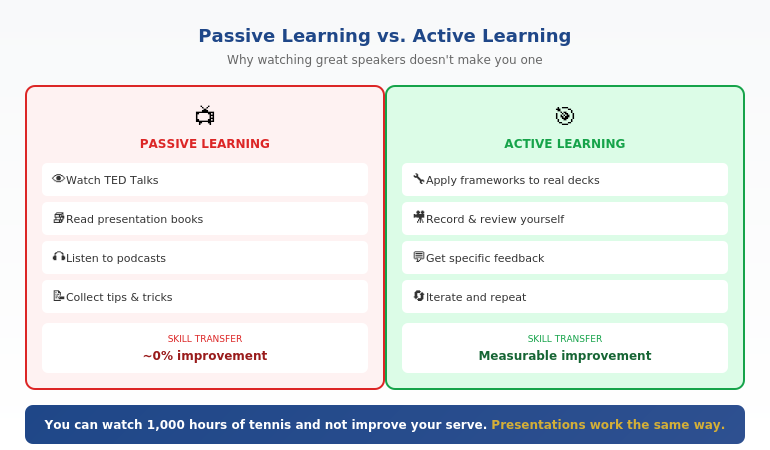
When professionals at Stage 2 try to improve, they often apply Stage 3 or 4 interventions: vocal variety, body language, storytelling polish, slide design aesthetics.
These are the wrong tools. The breakthrough from Stage 2 to Stage 3 isn’t about delivery—it’s about structure. Your argument needs to be clearer, your ask needs to be sharper, your logic needs to be tighter.
A product director named Jennifer spent a year working with a speaking coach on her delivery. “My voice got better, my posture improved, but my presentations still weren’t landing. Then someone pointed out that my structure was a mess—I was burying my point on slide 15. All that delivery work was polishing a broken argument.”
The Experience Illusion
There’s a dangerous assumption that more presenting automatically means better presenting. It doesn’t.
If you’ve been driving the same way for 20 years, you have 20 years of experience. But you’re not a better driver than you were at year 5. Presentation skills work the same way—repetition without deliberate intervention just reinforces your current level.
I see this constantly: executives with 15+ years of presenting experience who are still firmly at Stage 2. They’ve never been forced to confront the structural weaknesses that are holding them back.
For more on why traditional approaches fail, see why most presentation training fails.
Ready for the structure intervention that creates breakthrough? AI-Enhanced Presentation Mastery focuses on the actual bottleneck—argument structure—not the symptoms. See the Curriculum →
The Honest Diagnostic: Which Stage Are You Really At?
Most professionals overestimate their stage by at least one level. Here’s an honest diagnostic:
You’re at Stage 1 (Survival) if:
- You avoid presenting when possible
- You rely heavily on notes or reading from slides
- Your primary emotion before presenting is dread
- You can’t remember much of what happened during presentations
- You measure success by “getting through it”
You’re at Stage 2 (Competence) if:
- You can present without disaster, but it feels like a task
- Audience feedback is polite but not enthusiastic
- You often hear “that was good” but rarely see action result from your presentations
- You struggle to articulate why some presentations land better than others
- Your structure varies significantly from presentation to presentation
You’re at Stage 3 (Confidence) if:
- You’re comfortable presenting, even to senior audiences
- Your delivery is polished and consistent
- But you still have presentations that inexplicably fall flat
- You can’t reliably replicate your best performances
- You feel like there’s another level you can’t quite reach
You’re at Stage 4 (Mastery) if:
- You can adapt your presentation in real-time based on the room
- People consistently act differently after hearing you speak
- You could teach others exactly why your approach works
- Your structure is so clear that the audience never feels lost
- Presenting feels like a conversation, not a performance
Be honest with yourself. The intervention that works depends entirely on an accurate diagnosis.
Related: See the presentation skills gap most professionals don’t see.

⭐ If You’ve Been Stuck at “Good Enough” for Years
That’s not a failure of effort—it’s a misdiagnosis of stage. AI-Enhanced Presentation Mastery includes honest assessment and stage-appropriate interventions that actually create movement.
Why it works when experience hasn’t:
- Diagnoses your actual stage (not the one you think you’re at)
- Applies the intervention that matches YOUR bottleneck
- Structure-first approach (the real breakthrough, not delivery polish)
Limited to 20 participants • Hands-on feedback • Next cohort starting soon.
The Intervention That Unlocks Each Stage
Each stage has a specific intervention that creates breakthrough. Applying the wrong intervention is why most people stay stuck.
Stage 1 → Stage 2: Exposure + Simple Structure
The intervention: More reps with a basic framework. You need to present enough times that the survival fear diminishes. But you also need a simple structure to follow so each presentation has a foundation.
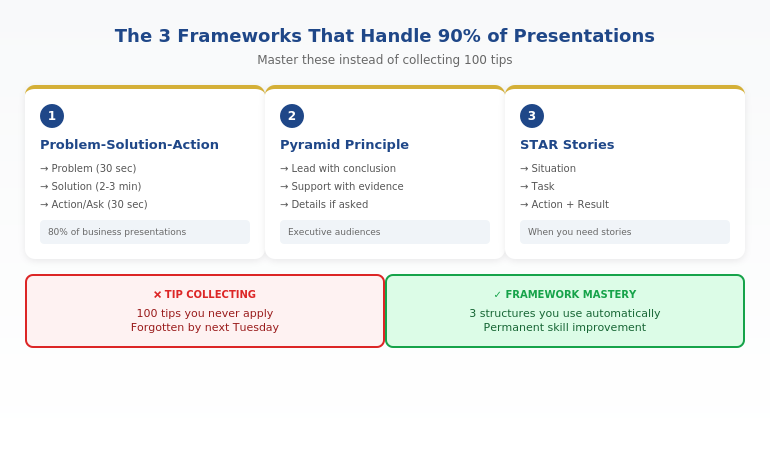
Specifically: Use the Problem-Solution-Action framework for every presentation. Don’t worry about polish—just hit the structure every time. Volume matters at this stage.
Stage 2 → Stage 3: Structure Mastery
The intervention: Deep work on argument structure. This is where most improvement efforts fail—they focus on delivery when structure is the actual bottleneck.
Specifically: Master the Pyramid Principle (conclusion first, then evidence). Learn to identify and eliminate structural weaknesses: buried leads, unclear asks, logic gaps. Record yourself and analyse structure, not delivery.
A finance director named Marcus described his breakthrough: “I’d been working on my ‘presence’ for years. Then I rewatched a presentation and ignored how I looked—I just mapped the structure. It was a mess. My conclusion came on slide 18. Once I fixed that, everything changed.”
Stage 3 → Stage 4: Adaptive Mastery
The intervention: Real-time adaptation and invisible structure. At this stage, you need to internalise frameworks so deeply that you can deploy them without thinking—and adjust based on audience response.
Specifically: Practice presenting the same content with different structures. Learn to read the room and pivot. Develop the ability to explain your framework choices—if you can teach it, you’ve mastered it.
For more on effective training approaches, see what to look for in presentation skills training.
Want the specific frameworks for each stage transition? AI-Enhanced Presentation Mastery maps the interventions to your actual level—not generic advice for everyone. Learn More →
The Realistic Timeline for Mastery
Here’s what progression along the presentation mastery curve actually looks like with deliberate practice:
Stage 1 → Stage 2: 3-6 months
With consistent exposure (presenting at least weekly) and a simple framework, most professionals can move past survival mode within a few months. The key is volume—you need enough reps for the fear to subside.
Stage 2 → Stage 3: 6-18 months
This is the hardest transition because it requires recognising invisible structural weaknesses. With deliberate structure work, feedback, and focused practice, most professionals can break through within a year. Without intervention, many stay stuck here forever.
Stage 3 → Stage 4: 12-24+ months
Mastery requires deep internalisation of frameworks and real-time adaptation skills. This stage is about refinement, not revolution. Consistent practice with increasingly challenging audiences and situations builds the adaptive capacity that defines mastery.
The Acceleration Factor
These timelines assume deliberate practice with appropriate interventions. With structured guidance—a coach, a programme, a systematic approach—each transition can be compressed significantly. Without it, most professionals never complete the journey.
A senior VP named Robert shared his experience: “I was stuck at Stage 2 for probably ten years. Once I understood the structure intervention, I moved to Stage 3 within four months. Ten years of being stuck, four months to break through—because I finally had the right diagnosis.”
Frequently Asked Questions
Can you skip stages on the presentation mastery curve?
Not really. Each stage builds capabilities that the next stage requires. Trying to work on Stage 4 skills (adaptive mastery) while still struggling with Stage 2 issues (structural clarity) will frustrate you and produce inconsistent results. The progression is sequential for a reason—foundations matter.
How do I know if I’m stuck or just progressing slowly?
If your presentations have felt roughly the same for more than two years, you’re stuck. Normal progression—even slow progression—shows visible improvement over that timeframe. Stuckness feels like running in place: lots of effort, no movement. If colleagues would describe your presentations the same way they would have described them two years ago, that’s stuckness.
Why does focusing on delivery not work at Stage 2?
Because delivery polish can’t compensate for structural weakness. A beautifully delivered presentation with a buried conclusion still fails. The audience might enjoy watching you, but they won’t act on your message because they can’t follow your argument. Structure is the foundation—delivery is the finish. You can’t finish what isn’t built.
Is Stage 4 mastery actually achievable for most people?
Yes, but it requires sustained deliberate practice—and most people don’t maintain that commitment. Stage 4 is rare not because the skills are impossibly difficult, but because the path requires consistent work over years. Most professionals find Stage 3 “good enough” and stop pushing. That’s a valid choice—but it’s a choice, not a limitation.
What’s the biggest mistake people make when trying to improve?
Applying interventions from the wrong stage. Stage 2 presenters working on “executive presence.” Stage 3 presenters taking basic courses designed for Stage 1. The intervention must match the diagnosis. Most improvement efforts fail because they skip honest assessment and jump to generic advice.
How important is feedback in moving through the stages?
Critical at every stage, but the type of feedback changes. Stage 1 needs encouragement and basic correction. Stage 2 needs structural feedback (not style feedback). Stage 3 needs feedback on argument effectiveness and audience impact. Stage 4 needs feedback on adaptation and invisible framework choices. Generic “that was good” feedback doesn’t help at any stage.
Can I diagnose myself accurately?
Somewhat, but most people overestimate by one level. We judge ourselves on intent; audiences judge us on impact. Recording yourself and analysing structure (not watching how you look) helps. But external assessment from someone who understands the stages is more reliable. That’s one reason coaching and structured programmes accelerate progress—they provide accurate diagnosis.
Is This Course Right For You?
✓ This is for you if:
- You’ve been presenting for years but feel stuck at “good enough”
- You want stage-appropriate interventions, not generic tips
- You’re ready for honest assessment of where you actually are
- You’re willing to do structure work before delivery polish
✗ This is NOT for you if:
- You’re at Stage 1 and need basic exposure first
- You want quick fixes rather than systematic progression
- You’re not currently presenting at work
- You prefer to work on delivery polish only
⭐ I Was Stuck for 8 Years. Here’s What Finally Worked.
The mastery curve explained everything. I’d been applying wrong-stage interventions for nearly a decade. AI-Enhanced Presentation Mastery is what I wish existed when I was stuck—stage-appropriate frameworks that actually create movement.
What you’ll actually get:
- Honest stage diagnosis (most overestimate)
- The specific intervention for YOUR transition
- Structure frameworks that create breakthrough
Next cohort starting soon. Limited to 20 participants.
📧 Optional: Get weekly presentation frameworks in The Winning Edge newsletter (free).
Your Next Step
If you’ve been working on your presentations for years without meaningful improvement, you now understand why: you’ve likely been applying wrong-stage interventions, or not applying any intervention at all.
Presentation mastery development isn’t mysterious. It follows a predictable curve with specific transitions. The breakthrough comes when you accurately diagnose your stage and apply the matching intervention.
Use the diagnostic above. Be honest about where you are. Then focus on the one intervention that unlocks your next level—structure work for most professionals.
For structured progression with expert guidance, see the AI-Enhanced Presentation Mastery curriculum.
P.S. If you’re presenting this week and want to understand what your slides communicate beyond your words, see what your slides actually say about you.
About the Author
Mary Beth Hazeldine is the Owner & Managing Director of Winning Presentations and creator of AI-Enhanced Presentation Mastery. The “8 years stuck” admission that opened this article is real—and understanding the mastery curve was the breakthrough that finally created movement.
With 24 years of corporate experience at JPMorgan Chase, PwC, Royal Bank of Scotland, and Commerzbank, plus having trained 5,000+ executives through the mastery curve, she now teaches the stage-appropriate approach that actually creates progression.