

Interview Presentation Coaching for Executives: What the Final-Round Format Demands
Quick answer: Useful interview presentation coaching for executives addresses the structural moves senior panels actually test for in the final round — the named-thesis opener, the diagnosis-reframe of the brief, the decision-shaped operating plan, the trade-offs page that names what the candidate will not do, and the close that asks for the role. Most coaching engagements focus instead on delivery polish: pace, body language, slide aesthetics, and rehearsal of the candidate’s narrative. The polish work is necessary but not sufficient at the senior level, where the polish is presumed and the structural decisions on the first three slides are what differentiate the offer candidate from the courtesy-call candidate. Coaching engagements that do not work through the structural moves in detail — with a real deck, a real role brief, a real preparatory-conversation programme, and a real pre-panel diagnostic — tend to produce polished candidates who still get the polite three-day-later call. The engagement to look for is the one that puts the first three slides through the structural rebuild before it puts the candidate through delivery refinement.
JUMP TO:
- What useful coaching for an executive interview presentation actually does
- The structural rebuild of the first three slides
- The preparatory-conversation programme the candidate runs in parallel
- The trade-offs page coaching most often gets wrong
- Rehearsal: structural pressure testing, not delivery refinement
- The pre-panel diagnostic the coach should run with the candidate
- When self-study programmes work and when one-to-one coaching is better
- Choosing a coaching engagement: questions to ask before signing
- One thing to do before choosing a coach
- Frequently asked questions
In late 2018, I took on a coaching engagement with a senior executive who had just been shortlisted for a divisional CEO role at one of the European insurance groups. He had been through two coaching engagements in the previous three years for similar roles, neither of which had produced the offer. The previous coaches had both been highly credentialed; one was a former television presenter who had built a strong reputation in corporate-communications work, and the other was a senior consultant from an executive-development firm with a panel of associate coaches. Both engagements had focused on the candidate’s delivery: his pace, his body language, his use of the room, his slide aesthetics, and the rehearsal of his career narrative. The candidate had emerged from both engagements as a measurably more polished presenter than when he had started. Both engagements had ended with the candidate not being appointed to the role he was pursuing. In our first session, I asked to see the deck from his most recent final-round panel. Slide one was a clean, well-designed summary of his career arc; slide two was a polished organisation chart of the teams he had run; slide three was a sector overview the panel had themselves written into the role brief. The delivery was excellent. The structural decisions on the first three slides were the same decisions that had produced the courtesy decline at the previous two panels. The coaching had refined the polish without rebuilding the structure underneath.
(This article was created with AI assistance; all stories and insights are based on 35 years of real client work.)
This piece walks through what useful interview presentation coaching for executives actually does at the senior level, what the most common coaching mistakes are, what self-study programmes can substitute for, and the specific questions worth asking any coaching provider before signing the engagement. The audience for the piece is candidates who are at the final-round stage of an executive search process, at the partner-promotion stage of a professional-services firm, at the NED nomination-committee stage of a board appointment, or at any equivalent senior panel where the differentiator between candidates is structural rather than substantive. The structural work is what useful coaching does; the substantive work is what the candidate’s own preparation does. The polish work, while necessary, is the third priority, not the first.
Before paying for executive interview coaching, the one-page structural check is worth running on your own deck.
The Executive Presentation Checklist walks through the structural moves senior panels actually reward — the named-thesis opener, the diagnosis-reframe slide, the decision-shaped operating-plan slide, and the close that asks for the role. Free download, no email gate.
What useful coaching for an executive interview presentation actually does
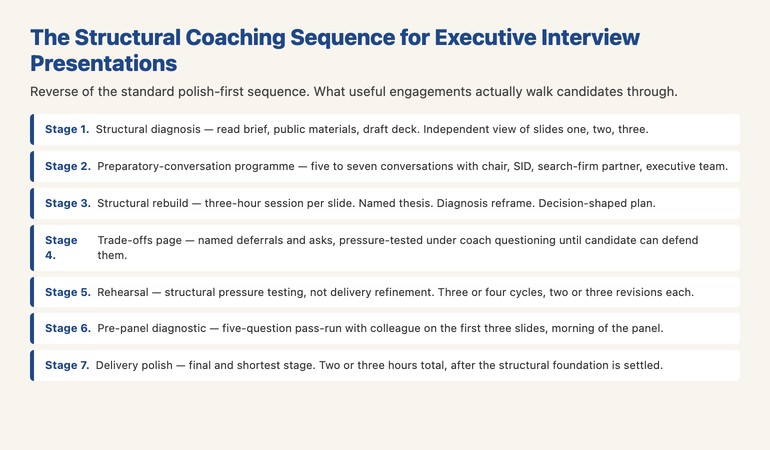
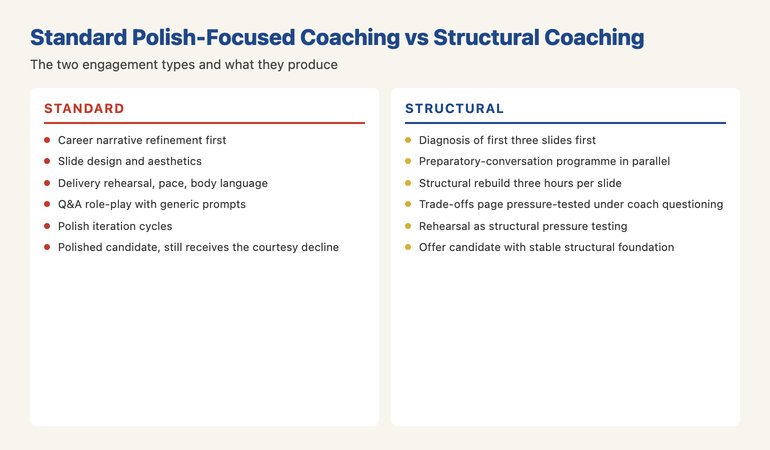
Useful coaching for an executive interview presentation works through a sequence that is roughly inverse to the sequence most coaching engagements default to. The standard sequence is: career narrative refinement, slide design and aesthetics, delivery rehearsal, role-play of Q&A, polish iteration. The standard sequence has its uses for candidates whose presentation skills are genuinely the limiting factor; at the senior level, where delivery is presumed competent, the standard sequence misses the actual differentiator. The structural sequence reverses the order: structural diagnosis of the first three slides first, preparatory-conversation programme with the candidate’s reading of the board second, trade-offs and risks page third, rehearsal as structural pressure testing fourth, delivery polish as the final and shortest stage. The structural sequence is uncomfortable because it spends the first half of the engagement on what is hardest and most often missed; the candidates who walk through it earn the offer at a noticeably higher rate than the candidates who walk through the standard sequence.
The structural diagnosis at the start of the engagement is the part most candidates expect to be brief but is actually the longest single component. The coach reads the role brief, the public materials on the company, the candidate’s draft deck, and any notes from the preparatory conversations the candidate has already had. The coach then forms an independent view of what the named-thesis opener should be, what the diagnosis-reframe should look like, and what the candidate is currently missing on the first three slides. The independent view is shared with the candidate in a session that is typically two to three hours long and at least one further follow-up of comparable length. The work is structural — what should slide one say, what should slide two reframe, what should slide three commit to — not stylistic. The deck redesign that follows the structural work is straightforward; the structural work itself is most of the engagement’s value.
The other thing useful coaching does, which standard delivery-focused coaching does not, is run the candidate through the preparatory-conversation programme that the named-thesis opener and the diagnosis-reframe slide depend on. Without the preparatory conversations, the named-thesis opener is guesswork dressed up as commitment, and the diagnosis-reframe slide is the candidate’s own theory of the role rather than the board’s. The coach’s job is to identify which preparatory conversations the candidate needs to have, with whom, in what order, and with what specific questions; then to help the candidate process what each conversation produced. The preparatory-conversation programme is typically the difference between a structurally correct deck and a structurally correct deck that has been tested against the actual room. The executive buy-in presentation framework covers the broader application of the listening-and-translation discipline that the preparatory programme is built around.
The structural rebuild of the first three slides
The structural rebuild of the first three slides is the engagement’s most consequential session. The session is roughly three hours and runs through the three slides in sequence, with the coach holding the candidate to specificity on each. Slide one’s named-thesis opener is the most uncomfortable to build because it requires the candidate to commit to a specific reading of what they will do in the first hundred days before the candidate has the role; the instinct is to keep the commitment general enough that it cannot be wrong, which is also general enough that it cannot be useful. The coach’s job in the session is to keep pushing the candidate toward the specific until the sentence on slide one names the decision the candidate will take, the operating-model change that decision will require, and the visible outcome the board will see in week thirteen. The session typically produces six or seven candidate sentences before settling on the one the candidate is willing to deliver under panel pressure.
Slide two’s diagnosis-reframe session is harder than the slide-one session because the candidate often does not yet have enough preparatory-conversation material to write the reframe with confidence. If the candidate has done four or five preparatory conversations with the chair, the senior partner, the company secretary, and one or two members of the executive team, the reframe usually emerges from the synthesis of those conversations within an hour of structured discussion. If the candidate has done one or two preparatory conversations, or none, the slide-two session typically pauses while the candidate goes back and schedules the missing conversations; the engagement then resumes a week or ten days later when the new material is in. Coaches who do not impose the pause — who let the candidate write slide two from desk research alone — are doing the candidate a disservice; the panel reads the desk-research diagnosis as preparation gap, and the rest of the engagement’s structural work cannot compensate.
Slide three’s decision-shaped operating plan session is mechanical but exacting. The session lists, in priority order, the structural decisions the candidate will take in the first hundred days, the dependencies of each, and the visible outcome of each by week thirteen. The candidate typically arrives at the session with a draft that has six or seven items framed as activities rather than decisions; the coach’s job is to convert the activity items into decision items, eliminate the ones that are not actually structural, and ensure the remaining items each have a named dependency and a named outcome. The session usually compresses the original six or seven items to four or five and lengthens the time spent on each. The output is a slide the panel can fund, govern against, and remember after the meeting. The board-of-directors presentation structure that earns the room’s tolerance covers the broader principle of structuring decisions in a form that senior governance bodies can actually act on.
The preparatory-conversation programme the candidate runs in parallel
The preparatory-conversation programme is the parallel workstream that runs alongside the structural rebuild. The coach identifies five to seven preparatory conversations the candidate should attempt to schedule in the two to four weeks before the panel. The list typically includes: the chair (always), the senior independent director or equivalent (always), the search-firm partner (in detail, with specific questions about the panel’s prior shortlists and the rejected-candidate patterns), the outgoing incumbent if appropriate (with careful framing), one or two members of the executive team the candidate would work with in the role, and one or two long-tenured operating directors or functional heads from inside the company. Each conversation has a defined purpose and a defined set of questions; the coach helps the candidate prepare for each, debrief afterwards, and synthesise the material across all of them.
The most common failure mode in the preparatory-conversation programme is the candidate’s under-investment in the conversations themselves. Candidates often treat the conversations as polite check-ins rather than as substantive listening exercises. The polite check-in produces a polite conversation; the substantive listening produces material the candidate can use on slides one and two. The coach’s job is to push the candidate toward substantive listening — toward specific questions about what the panel has been worried about in prior shortlists, what the board’s last three substantive sessions have focused on, what the chair’s actual reservations about the candidate’s background might be — rather than letting the conversations stay social. The coach is not present in the conversations themselves, but the coach’s preparation and debrief work before and after each one is what turns the conversations into the structural material the deck depends on.
The other failure mode is the candidate who under-invests in the preparation for each conversation. A conversation with the chair is worth roughly three hours of preparation: reading the chair’s public commentary, identifying the questions only the chair can answer, formulating the language carefully enough that the chair recognises the candidate has done the work. A conversation with the search-firm partner is worth two hours of preparation: identifying the questions the partner can answer that the candidate cannot get from public materials, asking about prior-shortlist patterns, asking about the panel members’ individual reading styles. A conversation with the outgoing incumbent is worth two hours of preparation: framing the conversation around the role’s structural questions rather than around personal advice. The total preparation work for the programme is typically twenty hours over the two-to-four-week window. Candidates who try to do the programme on three or four hours of preparation produce conversations that do not generate the material the deck needs.
The trade-offs page coaching most often gets wrong
The trade-offs page — the page that names what the candidate will not do in the first hundred days and what they will need from the board — is the page most coaching engagements either skip entirely or handle at the wrong level of specificity. The page is uncomfortable to build and uncomfortable to deliver, which is why standard coaching tends to soften it into a generic risks-mitigations slide. The soft version is detectable to senior panels and reads as preparation gap. The structural version names two or three things the candidate has consciously deferred to year two, defends each deferral under panel pressure, and names two or three specific asks of the board for the first hundred days. The coach’s job in the trade-offs session is to push the candidate hard on each deferral and each ask until the candidate can defend both without backtracking.
Coaching that addresses the structural moves senior panels actually test for is the difference between the offer and the courtesy decline.
The Executive Buy-In Presentation System is the self-paced programme senior professionals use to build the structural method behind the named-thesis opener, the diagnosis reframe, the decision-shaped operating plan, the trade-offs page, and the close that asks for the role — the same structural work the most useful coaching engagements walk candidates through, available as a self-study programme. Self-paced programme with monthly cohort enrolment, 7 modules, no deadlines, no mandatory session attendance, optional live Q&A sessions fully recorded. Lifetime access to materials. Built on 24 years in corporate banking and 16 years coaching senior professionals across financial services, insurance, consulting, and technology.
- Self-paced programme with monthly cohort enrolment — start when the next interview window opens, not when a course timetable says so
- 7 modules, no deadlines, no mandatory session attendance — work through the material around the rhythm of your interview preparation
- Optional live Q&A sessions, fully recorded — watch back anytime, including the sessions covering candidate counter-examples and difficult panel scenarios
- Framework for securing buy-in from senior panels — built around the structural moves search-firm partners and nomination committees actually recognise
- Lifetime access to materials — usable across every interview cycle and every senior role, not just the one you are preparing for now
- Built on 24 years in corporate banking and 16 years coaching senior professionals through final-round panels, NED nomination committees, and partner-promotion rounds — £499
The defence-of-the-deferral discipline is the hardest part of the trade-offs work. A candidate who has named a deferral and then, under coach questioning, agrees to bring the deferred item forward, has shown the panel-equivalent weakness in advance; the coach’s job is to surface that weakness in the session so the candidate can either commit to defending the deferral or revise the page. The candidate who can defend three deferrals under five minutes of coach pressure-testing is in a position to defend them in the panel. The candidate who folds on the deferral under coach questioning will fold on it in the panel, and the trade-offs page becomes a liability rather than the asset it should be. The pressure-testing session is uncomfortable for the candidate and for the coach. Both should expect it to take longer than the other sessions.
The asks-of-the-board side of the trade-offs page is the side candidates most often under-specify. The candidate who asks for “the board’s support” has asked for something the board cannot meaningfully respond to. The candidate who asks for “air cover on the deputy hire in the first month, an introduction to the two largest customers within the first month, and the latitude to defer the divisional integration committee for ninety days” has asked for three specific things the board can either accept, decline, or modify in the conversation. The coach’s job is to convert vague asks into specific ones in the session and to ensure each ask is framed at the right level of seniority — some asks are appropriate to the chair, some to the senior independent director, some to the board collectively. The specificity is what the board reads as evidence of operational seriousness; the vagueness reads as politeness or hedging.
Rehearsal: structural pressure testing, not delivery refinement
Rehearsal in the structural coaching sequence is structural pressure testing, not delivery refinement. The coach plays the role of each panel member in turn — the chair, the senior independent director, the search-firm partner, the operating director from the affected function — and tests the candidate’s answers under the question style each panel member is likely to use. The coach’s job is to identify the questions the candidate fumbles, the answers that rely on credentials rather than commitments, and the moments where the candidate softens under pressure. Each fumble or softening is then worked back into the structural rebuild — the deck is adjusted, the answer is rebuilt, the language is calibrated — before the next rehearsal cycle. Three or four rehearsal cycles are typical for a senior-role engagement, with each cycle producing two or three structural revisions.
The delivery work is the final and shortest stage of the engagement. By the time the structural sequence is complete, the candidate has internalised the named-thesis opener, the diagnosis reframe, the decision-shaped operating plan, and the trade-offs page deeply enough that delivery polish is a matter of relatively minor adjustments: pace, eye contact, slide transitions, the handling of the laptop or remote, the physical presence in the room. The delivery work usually takes two or three hours total and is best done after the third or fourth rehearsal cycle, when the candidate’s structural foundation is settled. Delivery work done first, in the standard coaching sequence, ends up needing to be redone after each structural revision; the candidate has polished a piece of content that is then revised, and the polish has to be redone. The structural-first sequence avoids the rework and produces a candidate whose delivery polish is built on stable foundations.
The pre-panel diagnostic the coach should run with the candidate
The pre-panel diagnostic is the final coaching session, typically scheduled for the morning of the panel or the previous evening. The coach takes the candidate through the five-question diagnostic on the first three slides: can the candidate articulate, from slide one alone, the specific hundred-day commitment they are making; can the candidate articulate, from slide two alone, the specific board-level question they are reframing; can the candidate articulate, from slide three alone, the two or three specific decisions they are committing to in the first hundred days. If all three diagnostic questions come back cleanly, the deck is doing its work and the candidate is in panel-ready condition. If any of the three come back unclear, the corresponding slide needs a final structural adjustment before the panel.
For senior candidates working through the structural rebuild themselves, the slide library is worth investing in alongside the structural work.
The Executive Slide System ships the 26 templates, 93 AI prompts, and 16 scenario playbooks the five-move panel deck depends on — for the named-thesis opener, the diagnosis reframe, the decision-shaped operating-plan slide, the trade-offs page, and the close. Instant download, lifetime access. £39.
The pre-panel diagnostic also covers the candidate’s state, not just the deck’s state. The coach checks the candidate’s sleep, the candidate’s morning routine, the candidate’s arrival time at the host’s building, the candidate’s pre-room ritual, and the candidate’s exit plan from the meeting. Each of these is worth a brief check because the panel preparation work can be undone by simple operational errors on the day — the candidate who skipped breakfast, the candidate who arrived twenty minutes early without a quiet space to settle, the candidate who failed to identify the back stairs as an exit option if the meeting runs long. The morning-of session is short but covers a lot of operational ground. The 3Ps framework for executive presentation coaching covers the broader integration of physiological and structural readiness that the morning-of session is built around.
When self-study programmes work and when one-to-one coaching is better
Self-study programmes work well for candidates who have the discipline to do the structural rebuild without external pacing, who have access to senior colleagues willing to act as informal panel members for rehearsal sessions, and who are at the stage of their career where they have seen enough senior panels to recognise the structural moves once a programme names them. Self-study programmes work less well for candidates who need accountability to complete the structural work, who do not have senior colleagues available for rehearsal sessions, or who are stepping up into senior panels for the first time without prior exposure to the pattern. The cost differential is significant: a self-study programme runs in the low hundreds; a one-to-one coaching engagement runs in the four to five figures. The structural content can be the same; what the candidate is paying for in the coaching engagement is the pacing, the external pressure-testing, and the accountability.
A useful pattern for candidates who can afford the time but not the cost of one-to-one coaching is to combine the self-study programme with a two-or-three-session engagement focused specifically on the structural rebuild of the first three slides. The programme provides the framework; the targeted sessions provide the external pressure-testing on the structural decisions that most candidates miss when working alone. The combination cost is typically a third or a half of a full coaching engagement and produces, in my observation, comparable outcomes for candidates who are otherwise capable of doing the structural rebuild themselves. The combination is most appropriate for candidates with one prior senior-panel experience who recognise what they missed last time and want a structural correction without the full one-to-one engagement.
Choosing a coaching engagement: questions to ask before signing
The questions worth asking any coaching provider before signing the engagement are structural rather than credential-focused. Useful questions include: in our first session, will you ask to see the candidate’s draft deck and form an independent view of the first three slides; will the engagement include explicit work on the named-thesis opener and the diagnosis-reframe slide, or only on delivery and aesthetics; will the engagement include guidance on the preparatory-conversation programme the candidate runs in parallel; will the rehearsal cycles be structural pressure testing or delivery refinement; will the engagement include a pre-panel diagnostic the morning of the interview. A coaching provider whose answers to these questions are vague or defensive is providing the standard polish-focused engagement; a coaching provider whose answers are specific and aligned with the structural sequence is providing the engagement that produces offers at the senior level.
The credential questions worth asking are different from the standard questions. Rather than asking how many years the coach has been in the business or how many candidates they have coached, ask: have you yourself sat on senior panels for executive roles, or coached candidates whose panels you have subsequently sat on; can you describe the structural moves you watched candidates make in those panels that distinguished the offer candidates from the courtesy-decline candidates; can you describe a specific candidate you coached whose structural decisions you changed during the engagement and what the outcome was. The answers reveal whether the coach has direct exposure to the senior-panel environment or is working from translated frameworks. Both can be useful; the direct exposure tends to produce more confident structural guidance. The translated frameworks tend to produce careful, polish-focused engagements that are more comfortable for the candidate to walk through.
One thing to do before choosing a coach
Send any coaching provider you are considering your current draft deck for the panel and ask for a written response on what they would change about the first three slides. A coaching provider who responds in twenty-four to forty-eight hours with specific structural feedback on slide one’s named-thesis opener, slide two’s diagnosis-reframe, and slide three’s decision-shaped operating plan has demonstrated they are operating in the structural sequence and the engagement will be worth the investment. A coaching provider who responds with general feedback on delivery, narrative arc, slide aesthetics, or career story has demonstrated they are operating in the polish sequence and the engagement will produce a polished candidate who still receives the courtesy decline. The deck-screening exercise costs nothing, takes a day or two of waiting, and tells you almost everything you need to know about whether the coaching engagement will actually produce the outcome you are paying for. Make the screening exercise the first step in the evaluation, before any introductory call or proposal conversation.
Frequently asked questions
Is one-to-one coaching for an executive interview worth the cost, given the price range involved?
The honest answer depends on the candidate, the stakes, and the alternative they would pursue without coaching. For a final-round panel for a role that represents a meaningful step-up in compensation, scope, or strategic position, the cost of even a five-figure coaching engagement is typically modest against the value of the role itself. For a partner-promotion round inside a firm where the candidate has been working toward the promotion for years, the same calculation applies. For a NED appointment at a publicly-listed board where the candidate is genuinely contesting the seat against credible alternatives, the same. The candidates who get the best value from one-to-one coaching are the candidates who walk into the engagement with a structurally weak draft deck and walk out with a structurally strong one; the candidates who walk in with an already-strong structural foundation get less differential benefit and would be served by the self-study-plus-targeted-sessions pattern instead.
How early in the process should an executive engage a coach?
Three to six weeks before the final-round panel is the working window. Earlier than six weeks tends to dissipate the urgency that drives the structural work; later than three weeks tends to compress the preparatory-conversation programme below the level that produces useful material. Candidates who engage two weeks before the panel can still benefit from the structural rebuild of the first three slides, but the preparatory-conversation programme has to be compressed and the rehearsal cycles have to be reduced. Candidates who engage less than a week before the panel get only the morning-of diagnostic and basic delivery work; the structural rebuild is typically not possible in that window. The earliest useful engagement is at the moment the candidate is confirmed on the shortlist or makes it to the final round.
Should the same coach handle preparation for a series of panels in a search process, or is it better to use different coaches for each?
The same coach across a series of panels is almost always the better arrangement. The coach’s internalisation of the candidate’s strengths, weaknesses, and developmental needs takes one or two sessions to establish; switching coaches between panels means restarting that internalisation work each time. Continuity also lets the coach run a longitudinal version of the pre-panel diagnostic: tracking which structural moves the candidate has consistently done well across panels and which they have consistently struggled with, then targeting the recurring weaknesses across the search process rather than treating each panel as a fresh problem. The exception is when the search process is unusual and a specialist is genuinely needed for one specific panel format, but the exception is rare.
Does the structural-coaching approach work for internal candidates as well as external ones?
Yes, and in some ways the structural approach is more important for internal candidates. Internal candidates often fall into the trap of assuming their internal knowledge is the differentiator; it is not, because the panel already knows the candidate is internally credentialed. The differentiator is whether the internal candidate has formed a view of the role that the panel has not already heard them articulate in their current capacity. The named-thesis opener and the diagnosis-reframe slide are particularly important for internal candidates because they signal the candidate is bringing a new perspective rather than a continuation of their current one. Coaching for internal candidates is sometimes harder than for external candidates because the internal candidate’s mental model of the role is already populated with internal context that needs to be set aside to do the structural rebuild from scratch.
The Winning Edge — weekly newsletter
The Winning Edge is a weekly (Thursday) newsletter for senior professionals who present at the executive level. One short email a week, focused on the structural moves that separate the offer candidate from the courtesy-decline candidate. Subscribe to The Winning Edge →
For the broader picture across slides, storytelling, confidence, and delivery, the seven-product Complete Presenter library is the bundle most senior professionals find useful as a single resource — £99 for everything, lifetime access.
About the author
Mary Beth Hazeldine is Owner & Managing Director of Winning Presentations Ltd. With 24 years of corporate banking experience at JPMorgan Chase, PwC, Royal Bank of Scotland, and Commerzbank, she advises senior professionals across financial services, insurance, consulting, and technology on the structural method behind executive interview presentations — the named-thesis opener, the diagnosis reframe, the decision-shaped operating plan, the trade-offs page, and the close that distinguishes the offer candidate from the courtesy-decline candidate.