The 8-Hour Protocol I Watched a CEO Use the Night Before a Career-Defining Pitch
Quick answer: The career defining night before protocol that senior presenters use to walk into a high-stakes room in usable condition is built around what NOT to do: do not rewrite the deck after 6pm, do not run additional rehearsals after 7pm, do not have alcohol at dinner, do not check email after 9pm, do not look at the deck again after the final read at 8.30pm, do not respond to the helpful colleague who sends “one more thought” at 10pm. The protocol is about preserving the cognitive and physiological state you have spent six weeks building, not about adding final polish. The eight hours before the pitch are when most experienced presenters degrade their preparation rather than improve it — through fatigue, late rewrites, anxious rehearsal, and the well-meant interventions of stakeholders who do not know the protocol exists. The protocol is a series of cut-off lines. Set them in advance, hold them in the moment, and arrive at the room with the presentation you actually prepared.
JUMP TO:
- Why a protocol, not a routine
- T minus 8: the 6pm cut-off on deck changes
- T minus 7: the 7pm cut-off on rehearsal
- T minus 6: the dinner the protocol prescribes
- T minus 4-5: the 8.30pm final read, then the deck closes
- T minus 2-3: the 9pm email cut-off and the stakeholder problem
- The sleep window, and what to do if you cannot sleep
- The morning: T minus 3 hours to T minus 30 minutes
- One thing to do before the next career-defining pitch
- Frequently asked questions
In 2011, I sat in a hotel restaurant on the night before a career-defining pitch with the CEO of a mid-cap European financial-services group I had been coaching for the previous six months. He was pitching the following morning to the largest single institutional client in the group’s pipeline — a sovereign-wealth fund that, if it became a client, would represent roughly a third of the firm’s assets under management within eighteen months. He had been working on the pitch for nearly five months. His chief of staff and his head of client coverage had run six rehearsals across the previous fortnight. The deck had been through nine versions. At dinner the night before, he ordered grilled fish, a small portion of vegetables, and sparkling water. His head of client coverage, sitting opposite him, ordered a substantial main course, two glasses of wine, and was visibly working on a tablet under the table during the meal. The CEO closed the meal at 8.45pm, said he was going to do a final read of slide one through slide three at the desk in his room, and was going to be in bed by ten. The head of client coverage said he wanted to do another full run-through of the deck for an hour. The CEO declined and went upstairs. He pitched the following morning at 9am, won the mandate by lunch, and told me three weeks later that the single decision that had carried him through the room was not anything he had done in the preparation — it was the protocol he had run from 6pm the night before until 9am the following morning. The head of client coverage, who had stayed up rehearsing until past one, was visibly under-slept at the pitch and made two stumbles in the supporting commentary that the CEO had to recover from.
(This article was created with AI assistance; all stories and insights are based on 35 years of real client work.)
This piece walks through the eight-hour protocol I have watched senior presenters use to preserve their preparation rather than degrade it in the hours before a career-defining pitch. The protocol is a series of cut-off lines — the deck closes at 8.30pm, the email closes at 9pm, the rehearsal closes at 7pm, the alcohol does not happen at all — and the discipline of holding the cut-off lines under the social and professional pressure of the night before is what most under-prepared presenters lack. The presenters who hold the protocol walk into the room with the cognitive bandwidth and physiological steadiness they spent six weeks building. The presenters who do not hold it walk in with eighty per cent of their preparation degraded by the last fourteen hours.
If you have a career-defining pitch in the next two weeks, the structural check on the deck itself is worth running while there is still time.
The Executive Presentation Checklist walks through the structural moves senior rooms reward — the named-recommendation opener, the pre-empted-objection slide two, the operating-vocabulary implication, and the close that gives the room something to act on. Free download, no email gate.
Why a protocol, not a routine
The night before a career-defining pitch is the wrong moment to be making judgement calls. Cognitive bandwidth is degraded by accumulated preparation fatigue. Social pressure from stakeholders — the well-meaning colleague who wants one more rehearsal, the chief of staff who suggests dinner with the team, the senior partner who has just thought of a useful question that should be added to the appendix — is at its peak. Anxious anticipation pulls the presenter toward more activity rather than less. None of those forces are operating in the presenter’s interest at this point, but each of them sounds reasonable in the moment, and each of them produces incremental degradation of the preparation the presenter has already done. The protocol exists because the decisions about how to spend the hours before the pitch cannot be left to the presenter’s judgement in the moment; the judgement is compromised. The decisions have to be made in advance, written down as cut-off lines, and held mechanically against the pressure to relax them.
A routine is not enough. Routines bend under pressure because they are general patterns rather than specific commitments. A protocol is a series of named decisions made in advance, with explicit cut-off times, that the presenter has committed to in writing. The cut-off times are the protocol’s machinery. The presenter who has written down “deck closes at 8.30pm, email closes at 9pm, rehearsal closes at 7pm” and has shared the cut-offs with the chief of staff in writing is in a different position from the presenter who has merely told themselves they will try to wind down at a reasonable hour. The written commitment is enforceable; the general intention is not. The well-meaning colleague who wants one more rehearsal at 9.30pm is met with “the protocol cuts off at 7pm, this is on the schedule we agreed”, not with the presenter’s in-the-moment ability to push back. The cut-off does the pushing back. The presenter does not have to.
The protocol is also a gift to the team around the presenter, not just to the presenter. The team is itself anxious; it has invested heavily in the preparation; and absent a published protocol it will fill the night-before window with activities that signal its own diligence, regardless of whether the activities help the presenter. The published protocol redirects the team’s anxious energy into respecting the cut-off lines rather than violating them, and gives the chief of staff explicit authority to push back on stakeholders who want to violate them on the team’s behalf. The CEO whose protocol I watched in 2011 had published his cut-offs to the head of client coverage and the chief of staff a week in advance; that was why the chief of staff knew not to schedule a late rehearsal, even though the head of client coverage was visibly wanting one. The protocol governed the team as much as it governed the CEO.
T minus 8: the 6pm cut-off on deck changes
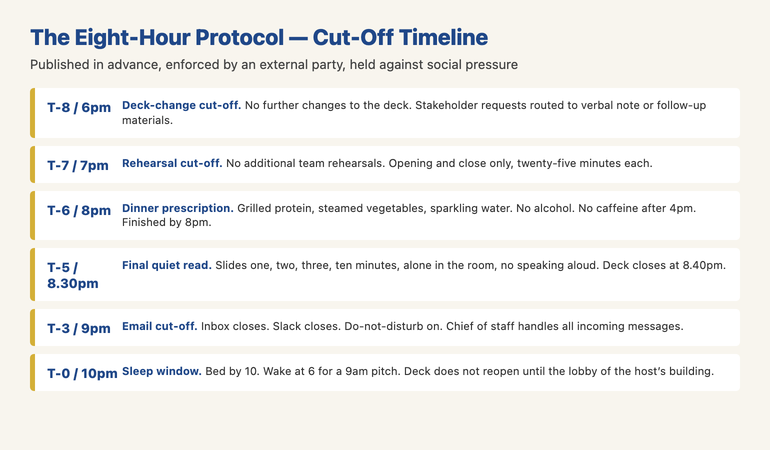
The first cut-off is the deck-change cut-off. No changes to the deck are made after 6pm. The cut-off is non-negotiable and is published a week in advance to every stakeholder who could plausibly want to make a change. The cut-off exists because every change to a deck after 6pm the night before is a net negative in expectation, even when the substantive content of the change is good. The reasons are mechanical. A late change requires the presenter to re-rehearse the affected sequence, which displaces sleep. The change introduces unfamiliarity into a deck the presenter had already internalised, which costs the presenter fluency in the room. The change creates the psychological signal that the deck was not actually finished, which costs the presenter confidence. Each of those costs typically outweighs the substantive value of the change, and the senior presenters I worked with knew it. The cut-off enforces the discipline that the in-the-moment judgement cannot.
The most common attack on the 6pm cut-off comes from a stakeholder — the chair, the senior partner, the head of the client team — who has been thinking about the pitch in the bath and has had a useful idea. The useful idea then arrives by text at 7.45pm with the wording “Could we add one slide on X?”. The presenter who has not held the cut-off in advance has now to make the judgement call at 7.45pm under pressure: refuse a senior stakeholder’s reasonable-sounding request, or accept the change and absorb the costs. The presenter who has the published protocol has a different conversation: “The deck closed at 6pm per the protocol we shared on Monday. The point is well taken and I can incorporate it in the appendix for the follow-up materials we have already agreed to send after the meeting.” The senior stakeholder, almost always, accepts that response because the published protocol gives them a face-saving structure to retreat to. The presenter has held the deck stable. The change has not happened.
The 6pm cut-off applies to the presenter’s own changes as well as the stakeholders’. Presenters in the eight hours before a major pitch experience their own preparation as imperfect; they will see things they want to fix. Most of what they see is anxious perfectionism, not actual content gaps. The discipline of the cut-off is to write the spotted issue down on a sticky note, leave the deck alone, and address the issue — if it survives the morning’s review — either as a verbal adjustment in the room or as a follow-up point in the post-meeting materials. The presenter who reopens the deck at 9.30pm to fix the anxious-perfectionism issue spends ninety minutes on a fix that is unlikely to improve the deck and almost certainly displaces the sleep window. The cut-off prevents the unforced error. The 3Ps framework for executive presentation coaching covers the rehearsal-cycle discipline that gets the deck into a state where the cut-off can be held without leaving substantive gaps unfilled.
T minus 7: the 7pm cut-off on rehearsal
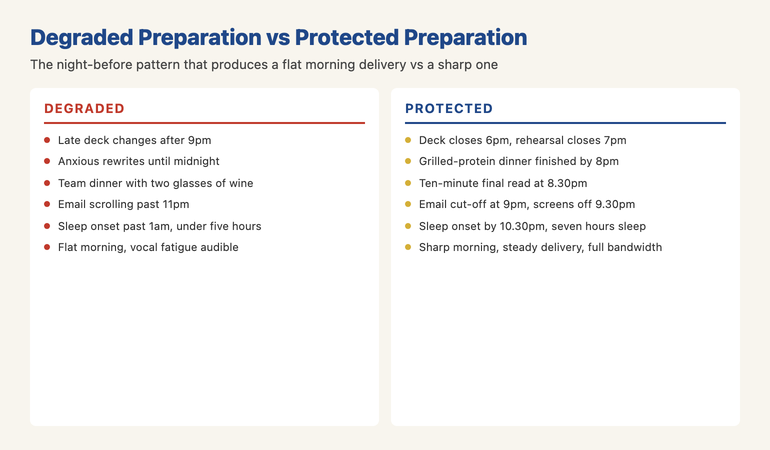
The second cut-off is the rehearsal cut-off. No additional rehearsals after 7pm. The protocol allows for one quiet read-through of the opening three slides in the room at 8.30pm, which is read, not rehearsed; the rest of the deck is left alone. Late rehearsals do not improve performance at this point in the cycle. They surface anxieties in front of an audience — even an audience of one trusted colleague — that the presenter then carries into the room the following morning. They displace the wind-down period. They tire the voice. They tire the cognitive bandwidth needed to handle the unexpected questions in the room. The senior presenters I watched who held the 7pm cut-off arrived at the pitch fresh; the ones who rehearsed until 11pm arrived flat, with vocal fatigue audible in the first three minutes.
The 7pm rehearsal cut-off is the cut-off most commonly attacked by the team rather than by external stakeholders. A chief of staff who has been working on the deck for weeks will often want to schedule a final dry-run with the broader team, on the implicit theory that the team needs the closure. The team does not need the closure. The team needs the presenter to be in usable condition the following morning, and the late rehearsal is in tension with that need. The protocol gives the chief of staff explicit authority to decline the team’s late-rehearsal request: “The protocol cuts off at 7pm. The presenter will be reading slides one through three at 8.30 alone. The team should rest.” The discipline transfers down through the team. By the third or fourth career-defining pitch under the same protocol, the team itself starts protecting the cut-off without prompting.
If a rehearsal must happen between 5pm and 7pm — and at this stage of preparation that is the latest defensible window for one — the rehearsal is limited to the opening and the close. The opening covers the first three slides and the named-recommendation moment; the close covers the final ask and the question the presenter wants the room to be working on in week two. The middle of the deck is not rehearsed at this point because it has been rehearsed for the previous fortnight and additional rehearsal is unlikely to add fluency. The opening and close, by contrast, carry disproportionate weight in the room and benefit from one final calibration. Twenty-five minutes for the opening and twenty-five minutes for the close is the typical envelope. Anything more is over the cut-off. The executive buy-in presentation framework covers the substantive reason the opening and close carry the disproportionate weight, which is why those are the two windows worth a final pass.
T minus 6: the dinner the protocol prescribes
The third cut-off is the dinner prescription, and it is the cut-off most senior presenters underestimate in importance. The dinner the night before a career-defining pitch is grilled protein, steamed or roasted vegetables, sparkling water, and one cup of decaffeinated tea. No alcohol. No second helping. No dessert with refined sugar. No caffeine after 4pm. The prescription is not about discipline as virtue; it is about physiological state in the room the following morning. Alcohol disrupts the sleep architecture even at one or two glasses, and the disruption is visible in the presenter’s steadiness during the question-and-answer window the following day. A heavy or sugar-laden dinner introduces digestive load that interferes with the early-night sleep window. Caffeine after 4pm extends the latency to sleep onset by enough to compress the sleep window below the seven hours the protocol is built around.
The social pressure on the dinner cut-off is the highest of any cut-off in the protocol, particularly when the team is staying in the same hotel and the chief of staff has booked a team dinner. The presenter who orders the prescribed dinner while the team orders steak and wine is making a visible choice that the team can read either as discipline or as anti-social. The published protocol makes the choice readable as discipline. “The protocol on dinner is published; the team should order what they want.” The discipline of the published cut-off is that the presenter is not performing the dinner discipline; they are following a written protocol that everyone has agreed to. The dinner becomes routine rather than performative. The CEO in 2011 ate the prescribed dinner while the head of client coverage ordered substantially more food and two glasses of wine; the CEO was not making a statement, he was following the protocol that had been published a week earlier.
The dinner timing matters as much as the content. The protocol prescribes the meal between 6.30pm and 7.45pm, with the meal finished by 8pm. The early dinner has two structural reasons. First, an early dinner means digestion is largely complete by sleep onset around 10pm, which improves sleep quality. Second, an early dinner finishes before the post-meal social window in which the team would otherwise want to keep eating, drinking, and talking; the presenter can leave the table at 8pm without disrupting the team’s ongoing meal. The early dinner is the polite exit strategy as much as it is the physiological prescription. Presenters who delay dinner to 8.30 or 9pm get pulled into the team’s social rhythm and lose the wind-down window. The early dinner is the small structural decision that protects the rest of the protocol.
The night before the pitch is when most presenters degrade their preparation — through fatigue, late rewrites, and anxious rehearsal.
Conquer Your Fear of Public Speaking is the self-study programme senior professionals use to build the structural calm that holds the protocol when the social pressure to violate it is at its peak — the cut-off discipline, the dinner prescription, the email cut-off, the sleep window. Built on 16 years coaching senior professionals across financial services, insurance, consulting, and technology. Instant download, lifetime access.
- Self-study programme covering the night-before protocol and the structural moves that produce calm under high-stakes presentation pressure
- Workbook and reference materials for building the published cut-off lines that hold against stakeholder pressure
- Practical guidance on the dinner prescription, the email cut-off, the sleep window, and the morning routine that preserves the preparation
- Designed for senior presenters facing career-defining pitches, board presentations, regulatory hearings, and high-stakes client meetings
- Instant download, lifetime access — usable across every career-defining pitch in your career, not just the one approaching
- Built on 16 years coaching senior professionals through career-defining presentations — £39
T minus 4-5: the 8.30pm final read, then the deck closes
The fourth cut-off is the final-read cut-off. The presenter does one quiet read of the opening three slides at 8.30pm, alone, in the room, without speaking the words aloud. The read takes ten minutes. After the read, the deck closes. It does not reopen until the presenter is in the room the following morning. The discipline of closing the deck at 8.40pm is harder than the discipline of any earlier cut-off, because the presenter at this point has the time to keep looking at the deck and the inclination to do so. The inclination is anxious; it is not productive. The deck is not going to improve in the seven hours before the pitch. The presenter, by contrast, is going to be degraded by every hour the deck stays open past 8.40pm.
The 8.30pm read is also calibrated to be the read, not the rehearsal. The presenter looks at slides one, two, and three without speaking; they note the opening sentence of slide one, the question on slide two, the recommendation on slide three. They confirm the words still land for them. They close the deck. They do not read slides four through forty. The middle of the deck has been rehearsed enough that further looking will not help. The opening has been rehearsed enough that further speaking will not help. The quiet visual read is the calibration that lets the presenter walk into the room the following morning knowing the opening is intact in their memory without having degraded the freshness of the delivery. Ten minutes; that is the entire window. Past ten minutes, the read becomes the rehearsal, which violates the 7pm cut-off retroactively.
Once the deck closes at 8.40pm, the presenter has roughly an hour and twenty minutes before the 10pm sleep window opens. The protocol prescribes for that window: a hot shower, twenty minutes of physical movement (a walk around the block, gentle stretching, no vigorous exercise), thirty minutes of reading that is not work-related (fiction, biography, anything outside the sector), and the end of any screen exposure by 9.30pm. The screens-off prescription is mechanical: blue-light exposure between 9.30 and 10pm delays sleep onset by enough to compress the sleep window below seven hours, and the compression cost is paid out the following morning in the presenter’s cognitive bandwidth. The presenters I watched who held the screens-off rule slept earlier and arrived at the pitch sharper. The ones who scrolled on their phone until 11.30pm arrived slower.
T minus 2-3: the 9pm email cut-off and the stakeholder problem
The fifth cut-off is the email cut-off. The inbox closes at 9pm. Slack closes at 9pm. The phone’s do-not-disturb setting is on by 9pm. No messages are responded to between 9pm and the morning of the pitch, with the single exception of an emergency message from a named family member. The cut-off exists because the late-evening inbox is the single most reliable source of unforced errors in the protocol. The well-meant late-evening “one more thought” from a stakeholder, the routine work message that pulls the presenter back into operational details, the client query that has nothing to do with the pitch but reactivates the presenter’s problem-solving mode — each of these is a small but real cognitive cost, and the costs compound across an evening. The presenter who has read the inbox at 11pm has not slept by midnight, and has degraded the sleep window by enough to be visible in the room the following morning.
The most common attack on the 9pm email cut-off is the stakeholder who knows the cut-off exists and has decided their message is important enough to warrant a violation. The message arrives at 9.45pm with the wording “I know you’re winding down, but I wanted to flag…” The flagging itself is the problem; the flagging activates the presenter’s anxious mode regardless of whether the substantive content was actually urgent. The protocol’s defence against the flagged message is the chief of staff. The chief of staff is on the email at 9pm and beyond, has the protocol’s explicit authority to respond on the presenter’s behalf, and replies with the wording: “The presenter is following the published protocol for tomorrow’s pitch; I will pick this up in the morning if it is time-sensitive.” Almost always, the flagged message turns out to be non-urgent and the chief of staff handles it the following day. The presenter has not seen the message at all; that is the point. The board-of-directors presentation structure that earns the room’s tolerance covers the parallel discipline at the board level, where the late-evening inbox attack pattern is essentially identical.
For presenters facing a career-defining pitch with three to seven days’ notice, the in-the-moment regulation work matters as much as the protocol.
Calm Under Pressure is the short-form workbook for senior professionals who need to regulate the acute physiological response in the hour before the pitch and inside the room — the breathing work, the body settling, the pre-room ritual. Instant download, lifetime access. £19.99.
The sleep window, and what to do if you cannot sleep
The sleep window the protocol prescribes is ten to seven, with the explicit understanding that real sleep onset is typically twenty to forty minutes after the in-bed time. The realistic target is seven hours of actual sleep. The protocol’s job is to create the conditions for sleep, not to guarantee it. The conditions are the early-and-light dinner, the dark and cool room, the cut-off on screens by 9.30pm, the wind-down reading, and the body settling that the hot shower and the walk produce. Presenters who follow the conditions typically sleep within forty minutes of getting into bed. Presenters who skip the conditions can sleep, but they tend to sleep later, more shallowly, and to wake before 5.30am with the deck running in their head.
The most common variation on the sleep problem is the presenter who follows the conditions, gets into bed at 10pm, and finds at 11.15pm that they are still awake. The protocol’s prescription for that moment is specific: get out of bed, do not look at the deck, do not look at the phone, do not check email. Sit in the chair in the room with a paper book under low light for twenty minutes. Read a chapter. Get back into bed. The discipline of not looking at the deck during the wakeful moment is the discipline that protects the rest of the night. The presenter who reopens the deck at 11.15pm because they cannot sleep is statistically certain to find an issue, work on it until past 1am, and arrive at the pitch the following morning with four and a half hours of sleep. The book-in-the-chair protocol breaks the cycle. Most presenters fall asleep within thirty minutes of returning to bed if they do not look at the deck.
The morning: T minus 3 hours to T minus 30 minutes
The morning protocol has its own cut-offs. The presenter is up at 6am for a 9am pitch. The first hour is body-focused, not deck-focused: shower, twenty minutes of physical movement, voice warm-up, a light breakfast of slow-release carbohydrate and protein. No coffee until after the breakfast. The deck is not opened in the first two hours of the morning. The discipline of not opening the deck in the morning is the protocol’s last defence against the anxious-final-edit risk; if the deck stays closed until the presenter is in the room, the presenter cannot make a last-minute change that destabilises the delivery. The presenter who opens the deck at 7am to check one slide will find a sentence that bothers them, will rewrite it, and will arrive at the pitch with the new wording un-rehearsed.
The opening of the deck happens in the room or in the lobby of the host’s building, fifteen minutes before the meeting. The presenter does the same quiet read of slides one, two, and three that they did at 8.30pm the previous night. They confirm the words still land. They close the deck. They go into the room. The deck does not open again until the presenter is at the lectern or at the table, and at that point it opens for the delivery, not for the rehearsal. The total time the deck has been open in the eighteen hours before the pitch is twenty-five minutes — ten the previous night, ten in the morning, five in the room before the delivery. The rest of the time the deck has been closed, and the presenter’s preparation has been preserved.
One thing to do before the next career-defining pitch
Write the protocol’s six cut-off lines on a single page and send the page to your chief of staff or your closest team member with the message “these are the cut-offs for the night before the pitch; please help me hold them.” The six lines: deck closes at 6pm, rehearsal closes at 7pm, dinner is grilled protein and water with no alcohol, deck reopens for ten minutes at 8.30pm and then closes, email closes at 9pm, sleep window starts at 10pm. The published page is the protocol. The act of publishing it to the chief of staff is the act that makes it enforceable against the social pressure that will come at you between 5pm and 11pm the following day. You will be glad of every minute of unbroken preparation when you walk into the room the following morning. The pitch you have spent six weeks building deserves the eight hours of protection the protocol gives it.
Frequently asked questions
What if the pitch is at 2pm rather than 9am — does the protocol still apply?
The protocol shifts by the same number of hours but the structure is identical. For a 2pm pitch, the deck-change cut-off is the previous evening at 9pm rather than 6pm, the rehearsal cut-off is 10pm rather than 7pm, the morning is light and unstructured rather than tightly choreographed, and the deck stays closed from the previous evening’s 10.30pm read until 1.30pm in the lobby of the meeting. The mid-day pitch is in some ways harder to protect than the morning pitch because the protective sleep window is less obviously the structural focus, but the same cut-off discipline applies. The presenter who keeps the deck closed for the eighteen hours before a 2pm pitch arrives in the same usable condition as the presenter who keeps it closed for the eighteen hours before a 9am pitch. The trap with mid-day pitches is the temptation to fill the morning with rehearsal; the protocol’s discipline says no.
My chief of staff is the source of the pressure to violate the cut-offs, not the protection against them. How do I handle that?
The protocol is built around an external enforcer; if the chief of staff is not in a position to be that enforcer, the role has to be assigned to someone else. The most common alternative is the executive assistant, a long-tenured colleague from a different team, or in some cases a personal partner or family member who has been briefed on the protocol. The published cut-offs are emailed to that person a week in advance with the explicit ask “please help me hold these.” The chief of staff is then routed around for the enforcement function, and the substantive collaboration on the deck continues as usual through the published cut-offs. The selection of the enforcer matters more than their title; the qualifications are personal calm, willingness to be unpopular with stakeholders, and the security to push back on senior people without taking it personally.
Does the no-alcohol rule really matter at one or two glasses?
The sleep architecture is measurably affected at one glass of wine and noticeably affected at two. The disruption is in the second half of the night, where the deeper restorative sleep phases are compressed and the presenter wakes with a heavier head than they would otherwise. The disruption is visible in the steadiness of the presenter’s response to unexpected questions in the room the following morning, particularly in the second half of the meeting when the cumulative cognitive load is at its highest. One glass is enough to convert what would have been a sharp recovery to a difficult question into a slightly delayed, slightly under-precise one. At the senior level, that small a margin matters. The rule is non-negotiable for the night before a career-defining pitch. It does not have to be non-negotiable on any other night.
What if a stakeholder insists on a change to the deck after 6pm and they are senior to me?
The protocol’s response is the same regardless of seniority, because the protocol’s authority is the published commitment, not the presenter’s in-the-moment willingness to refuse the senior stakeholder. The wording is: “The deck closed at 6pm per the protocol; I can take the point as a verbal adjustment in the room or as a follow-up note after the meeting.” Senior stakeholders, almost without exception, accept that wording because it offers them a face-saving structure (their input has been heard and will be reflected somewhere) without violating the protocol. The few cases where the senior stakeholder insists on the change after that wording is offered are cases where the relationship dynamic is more important than the protocol, and the presenter then has to make a judgement call about whether to absorb the cost. In my experience watching this play out across two decades, the senior stakeholder pushes back on the protocol perhaps one time in ten, and even in that case the presenter usually finds the change is smaller in execution than the request implied.
The Winning Edge — weekly newsletter
The Winning Edge is a weekly (Thursday) newsletter for senior professionals who present at the executive level. One short email a week, focused on the structural moves that separate the presenter who walks in with their preparation intact from the presenter who walks in with it degraded by the previous fourteen hours. Subscribe to The Winning Edge →
For the broader picture across slides, storytelling, confidence, and delivery, the seven-product Complete Presenter library is the bundle most senior professionals find useful as a single resource — £99 for everything, lifetime access.
About the author
Mary Beth Hazeldine is Owner & Managing Director of Winning Presentations Ltd. With 24 years of corporate banking experience at JPMorgan Chase, PwC, Royal Bank of Scotland, and Commerzbank, she advises senior professionals across financial services, insurance, consulting, and technology on the protocols that protect career-defining pitches from the eighteen hours before the room.