Tag: professional development

04 Apr 2026
Professional woman standing at a podium looking composed but internally conflicted, corporate presentation setting, editorial photography

Imposter Syndrome in Presentations: Why High Performers Feel Like Frauds at the Podium

Imposter syndrome in presentations does not target the unprepared. It targets the competentβ€”the executives who know enough to recognise the gap between what they understand and what the audience expects. The paradox is that the more you know, the more exposed you feel. Here is why imposter syndrome intensifies at the podium and what to do when it arrives.

Beatriz had been promoted to Head of Strategy at a consumer goods company six months earlier, following a decade in management consulting. She was presenting the annual strategic review to the executive committeeβ€”twelve people she’d worked alongside for half a year. She knew the material. She’d built the analysis herself. But standing at the front of the room, she felt a familiar constriction in her chest: the conviction that someone was about to ask a question that would reveal she didn’t belong here. That the consulting background was a costume, and the strategy role was borrowed. She delivered the presentation competentlyβ€”steady voice, clear slides, controlled pace. Afterwards, the CEO told her it was one of the strongest strategy reviews he’d seen. She nodded, smiled, and spent the following weekend replaying every answer she’d given in Q&A, searching for the moment she’d been exposed. She never found it, because it didn’t happen. But the search itself was exhausting. Beatriz didn’t need better slides. She needed to understand why her brain was running an audit she’d never pass.

Does presentation anxiety feel out of proportion to your preparation? The Conquer Speaking Fear programme addresses the psychological patterns that drive presentation anxiety for experienced professionals.

Why Presentations Trigger Imposter Syndrome More Than Other Work

In written work, you can edit. In meetings, you can defer. In one-to-one conversations, you can redirect. A presentation offers none of these escape routes. You are standing in front of an audience, delivering content you cannot take back, being evaluated in real time by people whose opinions affect your career. For someone whose internal narrative already questions their legitimacy, a presentation is the highest-stakes version of the test they’ve been dreading.

Imposter syndrome in presentations is amplified by a specific cognitive distortion: the belief that the audience knows more than you do. In a boardroom presentation, you’re often speaking to people with decades of experience. Your brain interprets their seniority as superior knowledgeβ€”forgetting that you were asked to present precisely because you have expertise they lack. The finance director isn’t presenting the strategic review because strategy isn’t their domain. You are presenting it because it is yours. But imposter syndrome flattens that distinction and tells you that everyone in the room could do what you’re doing, only better.

The second amplifier is visibility. Imposter syndrome thrives in privateβ€”the quiet conviction that you’re somehow less capable than your role implies. In daily work, this stays manageable because there’s no single moment of exposure. A presentation creates exactly that moment. Every eye is on you. Every hesitation is observed. Every answer is assessed. The internal experience is of a spotlight focused on the gap between who you are and who the audience expects you to be. This is why competent professionals who manage perfectly well in meetings, workshops, and negotiations can feel genuinely terrified when asked to present.

Understanding this mechanism matters because it changes the intervention. The solution is not more preparationβ€”you’re already well-prepared. The solution is recognising that the fear signal is being generated by a threat-detection system that has misidentified the situation. You are not being exposed. You are being consulted. The physiological response is identical, but the interpretation changes everything.

Present With Authority When Your Inner Voice Says You Can’t

Conquer Speaking Fear addresses the psychological patterns that drive presentation anxiety for experienced professionalsβ€”including the imposter cycle that preparation alone can’t fix.

  • βœ“ Evidence-based anxiety reduction frameworks
  • βœ“ Cognitive reframing techniques for high achievers
  • βœ“ Practical pre-presentation routines that build confidence

Get Conquer Speaking Fear β†’ Β£39

For professionals whose anxiety is out of proportion to their preparation

The Competence Gap Illusion: What Your Brain Gets Wrong

The Dunning-Kruger effect is usually cited to explain why incompetent people overestimate their abilities. The less-discussed corollary is equally important: competent people systematically underestimate theirs. When you know a subject deeply, you become acutely aware of its complexity, its ambiguities, and the limits of your understanding. This awarenessβ€”which is actually a sign of expertiseβ€”feels like evidence of inadequacy.

In a presentation context, this manifests as the conviction that someone in the audience will ask a question you can’t answer, and that this single moment will invalidate everything you’ve said. What your brain fails to calculate is the probability. You’ve prepared extensively. You know the subject. The chance of a genuinely unanswerable question is lowβ€”and the appropriate response to one is not shame but honest acknowledgement. β€œI don’t have that specific data to handβ€”I’ll follow up with you this afternoon” is a perfectly professional answer that no reasonable audience member would interpret as incompetence.

The competence gap illusion also distorts your assessment of the audience. You assume they process information the way you doβ€”noticing every nuance, every simplification, every point where you chose to summarise rather than elaborate. They don’t. Your audience is processing at a much higher level: Does this person seem credible? Is the recommendation clear? Do I trust this analysis? They’re evaluating your authority, not auditing your footnotes.

The practical intervention is a pre-presentation reality check. Before you stand up to speak, write down three things you know about this topic that nobody else in the room knows in as much depth. Not impressive thingsβ€”just specific things. The regulatory change you researched last week. The client conversation that shaped your recommendation. The data point that surprised even you. These are your anchors. When imposter syndrome whispers β€œyou don’t belong here,” these anchors remind you that you were invited for a reason. For more on the perfectionism and anxiety cycle that feeds imposter syndrome in presentations, that guide examines why the pursuit of a flawless delivery often intensifies the anxiety it’s trying to prevent.
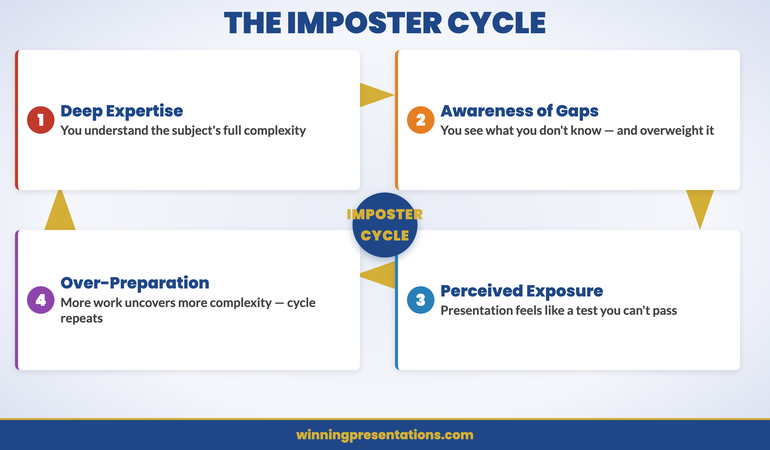
The competence gap illusion showing how expertise creates awareness of complexity that feels like inadequacy

Reframing Authority: You Were Invited to Speak for a Reason

Imposter syndrome tells you that you’re at the front of the room by accidentβ€”that circumstances conspired to put you here, and discovery is imminent. The structural reality is different. Someone decided this meeting needed a presentation. Someone decided you were the person to deliver it. Someone scheduled the room, invited the attendees, and allocated time on the agenda for your content. None of these decisions were accidental.

This reframe is not positive thinking. It is factual analysis. The question is not β€œAm I good enough to present this?” The question is β€œWhy did a rational group of professionals decide I should present this?” The answer is always some version of: because you have knowledge, access, analysis, or perspective that the room needs. Your role is not to prove you belong. Your role is to deliver the content they asked for.

A useful cognitive shift is to move from β€œI am the expert” to β€œI am the messenger.” The first framing invites scrutiny of your credentials. The second invites scrutiny of your messageβ€”which is where you want the attention. You are not standing at the front of the room to demonstrate your intelligence. You are standing there to communicate findings, recommendations, or analysis that the audience needs to make a decision. This repositioning reduces the personal stakes dramatically. If the audience challenges your recommendation, they’re challenging the analysisβ€”not your right to be there.

The Over-Preparation Trap: When More Work Makes It Worse

Imposter syndrome creates a paradoxical relationship with preparation. The more anxious you feel, the more you prepare. The more you prepare, the more complexity you uncover. The more complexity you uncover, the more exposed you feel. And the more exposed you feel, the more you prepare. This cycle can consume entire weekends before a Monday presentation.

The trap is that over-preparation reinforces the underlying belief. Each additional hour of work sends a signal to your brain: β€œThis is so important and so precarious that I need to keep working.” Your nervous system interprets excessive preparation as confirmation that the threat is real. A presentation you’ve prepared for ten hours feels more dangerous than one you’ve prepared for threeβ€”not because the content is riskier, but because your behaviour has told your brain the stakes are higher.

The intervention is a preparation boundary. Set a fixed number of hours for preparation and stop when you reach it. If the content isn’t ready in that time, the issue is scopeβ€”you’re trying to cover too muchβ€”not effort. Reduce the scope rather than extending the hours. A presentation that covers three points thoroughly is more authoritative than one that covers seven points superficially. Your audience will remember your clarity, not your comprehensiveness.

The most effective preparation for imposter-syndrome-driven anxiety is rehearsal, not research. Rehearse the opening sixty seconds until it feels automatic. Rehearse transitions between sections. Rehearse the close. When you stand up to present, the first words should come without thoughtβ€”because those first sixty seconds set the tone for how your brain processes the rest of the presentation. If the opening is smooth, your nervous system recalibrates: β€œThis is going well. Reduce the alert level.” The cognitive restructuring approach offers additional techniques for interrupting the thought patterns that drive this cycle.

If your anxiety pattern includes physical symptoms alongside the imposter narrative, Conquer Speaking Fear addresses both the cognitive and physiological dimensions of presentation anxiety.
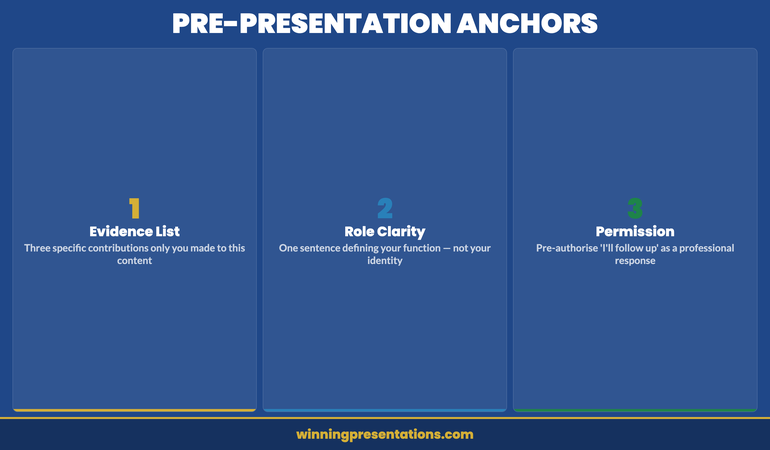
The over-preparation trap cycle showing how excessive preparation reinforces imposter syndrome in presentations

Practical Anchors for the Ten Minutes Before You Present

Imposter syndrome peaks in the ten minutes before you speak. The gap between sitting in the audience and standing at the front is where the anxiety compounds. These practical anchors are not about eliminating the feelingβ€”they’re about preventing it from controlling your delivery.

Anchor 1: The Evidence List. Before the meeting, write three specific contributions you’ve made to the content you’re presenting. Not β€œI worked hard on this”—specific, verifiable contributions. β€œI identified the supplier risk that saved the project Β£180K.” β€œI conducted the twelve stakeholder interviews that shaped this recommendation.” β€œI built the financial model from the raw data.” Read the list silently. These are facts, not affirmations.

Anchor 2: The Role Clarity Statement. Remind yourself of your role in one sentence: β€œI am here to present the findings from the strategic review so the committee can make a decision.” This strips away the identity threat. You’re not being evaluated as a person. You’re performing a function. The function has a clear purpose. Your job is to serve that purpose, not to prove yourself.

Anchor 3: The Permission to Be Imperfect. Give yourself explicit permission to not know everything. Before you walk to the front, say internally: β€œIf someone asks a question I can’t answer, I will say β€˜I’ll follow up on that’ and the meeting will continue.” This pre-authorises the response that imposter syndrome tells you is forbidden. In practice, β€œI’ll follow up on that” is one of the most professional responses in any executive meetingβ€”it signals honesty and discipline. For more on the self-compassion approach to presentation anxiety, that guide covers how reducing self-criticism before a presentation produces a measurably calmer delivery.

Break the Imposter Cycle Before Your Next Presentation

Conquer Speaking Fear gives you the cognitive and physiological frameworks to present with authorityβ€”even when your inner voice is running a different script. For Β£39.

Get Conquer Speaking Fear β†’ Β£39

Frequently Asked Questions

Does imposter syndrome ever go away completely?

For most professionals, it doesn’t disappearβ€”it becomes manageable. The goal isn’t to eliminate the feeling but to change your relationship with it. Experienced presenters who experience imposter syndrome learn to notice it arriving, acknowledge it as a familiar pattern rather than a truthful assessment, and proceed with the presentation regardless. Over time, the intensity diminishes because your brain accumulates evidence that the feared outcomeβ€”being exposed as a fraudβ€”never actually materialises. Each successful presentation is a data point against the narrative.

Why does imposter syndrome seem worse in senior roles?

Seniority increases both visibility and accountability. In a junior role, a weak presentation is forgotten quickly. In a senior role, it becomes part of how colleagues assess your leadership capability. The stakes feel genuinely higherβ€”and they are, to some degree. But imposter syndrome exaggerates the risk dramatically. A mediocre strategy review won’t end your career. An honest answer of β€œI’ll look into that” won’t undermine your authority. Your brain is conflating β€œthis matters” with β€œthis could destroy me,” and the distinction between those two is where the work lies.

Should I tell my audience that I’m nervous?

Generally, no. Your audience processes your nervousness differently than you do. What feels to you like visible anxiety often reads to the audience as focused energy. Announcing nervousness redirects the audience’s attention from your content to your emotional stateβ€”which is the opposite of what you want. The exception is if you’re in a context where vulnerability is expected and valued, such as a personal development workshop or a leadership team offsite focused on authenticity. In a standard executive presentation, keep the focus on the message and let your delivery speak for itself.

The Winning Edge

Weekly insights on executive presentations, confidence building, and boardroom communication.

Subscribe Free

If your imposter syndrome also triggers anxiety about handling questions after the presentation, our guide to defending your data in presentations covers the Q&A strategies that maintain authority under scrutiny.

About the author

Mary Beth Hazeldine, Owner & Managing Director, Winning Presentations. With 24 years of corporate banking experience at JPMorgan Chase, PwC, Royal Bank of Scotland, and Commerzbank, she advises executives across financial services, healthcare, technology, and government on structuring presentations for high-stakes funding rounds and approvals.

28 Mar 2026
Abstract representation of anticipatory anxiety before a high-stakes presentation showing a lone figure in a dimly lit corridor

The Anticipatory Anxiety Loop: Why Dreading the Presentation Is Worse Than Giving It

Most executives don’t fear the presentation itself. They fear the days leading up to it. The dread starts on Monday when the presentation is Friday. It builds through the weekβ€”rehearsal feedback loops in your mind, worst-case scenarios feel plausible, sleep becomes difficult. Then Thursday night arrives and you’re exhausted before you’ve even stepped in front of the room. The paradox is that the actual presentation, once it starts, rarely feels as bad as the week of anticipating it.

Amara had scheduled a board presentation for March 15th. It was importantβ€”a funding case for a new product line, the kind of thing that could accelerate her career if she landed it. When she put it on her calendar on February 28th, it felt manageable.

By March 10th, five days before, her stomach started tightening every morning. She rehearsed in her head while commuting. She woke at 3 a.m. replaying questions she imagined the board might ask. She changed slides twiceβ€”not because they were broken, but because she was searching for safety that no slide could provide.

On March 14th, exhausted, she called a colleague. “I’m not sleeping. I’m stressed about this. I don’t know if I’m ready.” The colleague asked: “Do you know your material?” “Yes,” she said. “Could you explain the investment case to me right now?” “Yes, easily.” “Then the presentation will be fine. The dread you’re feeling isn’t about readinessβ€”it’s just dread.”

It was the most useful thing anyone said to her that week. Not “You’ll be great,” which felt hollow. Not “Don’t be nervous,” which is impossible. Just: “That feeling isn’t information. It’s just the anticipatory loop running.”

If presentation anxiety is making the week before your big talk harder than the talk itself, you might explore Conquer Speaking Fear. It’s structured specifically for acute presentation anxietyβ€”with nervous system techniques, reframing exercises, and practical tools designed for the hours leading up to high-stakes presentations.

Explore Conquer Speaking Fear β†’

What is anticipatory anxiety?

Anticipatory anxiety is the worry you experience before an eventβ€”in this case, a presentation. It’s not the nervousness you feel when the presentation actually starts. It’s the dread that builds in the days (or hours) leading up to it.

The distinction matters because the two anxieties serve different purposes. Nervousness during the event is your nervous system preparing you to perform. Adrenaline, focus, heightened awarenessβ€”these are useful. Your mind narrows, your perception sharpens, you adapt to the room’s energy.

Anticipatory anxiety is different. It’s abstract worry about something that hasn’t happened yet. Your mind runs through scenarios. You imagine questions you can’t answer. You rehearse failed moments. You lose sleep. You check the slides one more time looking for problems. You might feel physically unwellβ€”nausea, chest tightness, difficulty concentrating.

And here’s the cruel part: anticipatory anxiety doesn’t improve your performance. It just makes the waiting harder. By the time the presentation arrives, you’re already depleted.

Why it intensifies the longer you wait

Anticipatory anxiety follows a predictable pattern. The further away the presentation, the more abstract your fear. “I have a board presentation in six weeks.” Manageable. “I have a board presentation next Friday.” Now it’s concrete. “I have a board presentation tomorrow.” Now your nervous system is engaged.

Each day that passes without the event happening allows your mind to generate new “what if” scenarios. What if the projector fails? What if I forget my key points? What if they ask me something I can’t answer? What if I panic?

Most executives, particularly those who care about performance, respond to anticipatory anxiety by preparing harder. You run the presentation again. You revise the slides. You rehearse answers to tougher questions. This is rationalβ€”if I’m more prepared, I’ll be less anxious.

But the research is clear: beyond a certain point, additional preparation doesn’t reduce anticipatory anxiety. It reinforces it. Each rehearsal is another opportunity to find something “wrong” or to imagine the audience’s judgment. You’re feeding the anxiety loop, not breaking it.

The anticipatory anxiety cycle showing four stages: trigger, catastrophise, avoid, and escalate

Techniques Designed for Presentation Anxiety

Conquer Speaking Fear gives you nervous system techniques, reframing exercises, and decision-making frameworks designed for acute presentation anxietyβ€”the kind that starts days before and peaks the morning of.

  • Nervous system reset techniques for anxiety spirals
  • Reframing exercises that separate dread from actual risk
  • Pre-presentation routines that build confidence
  • Tools to manage the anxious mind without ignoring it

Explore Conquer Speaking Fear β€” Β£39

Designed for executives managing acute presentation anxiety

The neuroscience of dread

Your brain doesn’t distinguish between anticipating something bad and experiencing it. When you imagine the board asking a question you can’t answer, your amygdala (your brain’s threat detector) activates as if it’s happening right now. Your nervous system releases cortisol and adrenaline. Your heart rate rises. You feel the physical symptoms of anxiety even though the threat is imagined.

This is useful when you’re genuinely in danger. Your body prepares you to fight or flee. But when the threat is abstractβ€””What if I mess this up?”β€”the physical response becomes a problem. You can’t fight or flee from a presentation. You can only sit with the activation.

The longer the time between now and the presentation, the more time your mind has to rehearse worst-case scenarios. Each rehearsal deepens the neural pathway, making the anxiety feel more real, more inevitable. By Thursday night, your brain has convinced you that failure is probable, even though nothing has actually happened.

Add sleep disruption to this equation, and your emotional regulation gets worse. You’re more irritable, more prone to catastrophic thinking, less able to distinguish between real risk and imagined risk. The presentation itself hasn’t changed. Your mental state has deteriorated.

How to break the loop

The first step is recognising that anticipatory anxiety is not information about your readiness. It’s a feeling that your nervous system is generating based on threat-perception, not on actual risk assessment.

This seems obvious when you read it. But in practice, when you’re exhausted and anxious, your mind treats dread as evidence. “I’m this anxious, so something must be genuinely wrong.” In fact, you can be completely prepared and still experience intense anticipatory anxiety. The two are independent.

The second step is stopping the preparation loop. Once you reach a threshold of readinessβ€”you know your material, you’ve done one solid rehearsal, you have answers to likely questionsβ€”additional rehearsal is counterproductive. It gives your anxious mind more material to worry about.

Instead of rehearsing more, you need to:

  1. Name the loop: “This is anticipatory anxiety, not actual danger. It will pass.”
  2. Interrupt the rehearsal: When you notice yourself running through scenarios, consciously stop. Physical activity (a walk, a gym session) interrupts the mental loop more effectively than trying to think your way out of it.
  3. Reset your nervous system: Breathing techniques, cold water, grounding exercisesβ€”these activate your parasympathetic nervous system and counteract the threat activation.
  4. Establish a boundary: “I will prepare until Wednesday. After that, no more slides, no more rehearsal.” This protects you from the preparation loop extending into the presentation day.
  5. Redirect attention: The night before, shift focus away from the presentation. Read something unrelated. Spend time with people you care about. Let your mind rest from the threat narrative.

If your anticipatory anxiety is severe enough to disrupt your sleep or work in the days before a presentation, Conquer Speaking Fear includes specific nervous system techniques designed for those hours when the dread feels most intense.

Four-step roadmap for breaking the anticipatory anxiety loop before presentations

In practice, breaking the anticipatory anxiety loop follows four moves. The first is to acknowledge β€” name the dread without judging yourself for feeling it. “I’m anxious about Thursday’s presentation” is a statement of fact, not a confession of weakness. The moment you name it, you create distance between yourself and the feeling. You’re observing the anxiety rather than being consumed by it.

The second move is to prepare early β€” start with one slide to break the avoidance pattern. Anticipatory anxiety often creates a paradox: the dread makes you avoid the very preparation that would reduce it. Opening the presentation file and writing a single slide title β€” even a bad one β€” interrupts avoidance. Action, however small, breaks the freeze.

The third is to rehearse aloud β€” speak the opening three times to build familiarity. Not a full run-through. Just the first sixty seconds. Your voice forming the words builds a physical memory that your body can fall back on when anxiety spikes. The opening is where panic is strongest. If your mouth already knows the first two sentences, your nervous system calms faster.

The fourth move is to reframe β€” shift your focus from performance to contribution. Instead of “Will I do well?”, ask “What does the room need from me?” When you reframe the presentation as a contribution rather than a test, the threat perception drops. You’re not being judged; you’re providing something valuable. That distinction changes how your nervous system responds to the approaching event.

Practical strategies that shift anxiety to readiness

Beyond interrupting the anxiety loop, there are specific practices that help executives convert anticipatory dread into something more useful: focused readiness.

Compartmentalise the presentation time. Instead of thinking about “the presentation” as this amorphous future threat, break it into concrete actions: What do you do 10 minutes before you start? What’s your opening line? Where do you stand? What do you do if you forget a point? When you focus on specific micro-actions rather than “Will I perform well?”, your brain shifts from threat-assessment to task-execution.

Create a pre-presentation routine. The night before, the morning of, the hour beforeβ€”develop a specific sequence of actions that signal to your nervous system, “This is expected. This is manageable.” For some people it’s a specific breakfast, a particular walk, a few minutes of breathing. The content matters less than the consistency. Routines reduce the novelty and uncertainty that feed anticipatory anxiety.

Identify your specific “what if” fears and reality-test them. Not generallyβ€”specifically. If your fear is “What if they ask me something I don’t know?”, the reality is: “If they ask something I don’t know, I’ll say, ‘That’s a great questionβ€”let me follow up with you separately.’ And the presentation continues.” You’re not avoiding the fear; you’re proving to yourself that you can handle it.

Separate the days before from the day of. What you do Monday through Thursday should be different from what you do Friday morning. Early in the week, preparation and rehearsal are valuable. As you approach presentation day, shift to rest, routine, and nervous system regulation. This signals a boundary between “get ready” and “be ready.”

Managing the evening before

The evening before a high-stakes presentation is often the worst moment for anticipatory anxiety. You’ve done all the prep you can. The event is real and imminent. Your mind is searching for something to control.

Here’s what actually helps:

Do not rehearse the presentation. You’ve already rehearsed. One more run-through will not make you more confident. It will only give your anxious mind more material to second-guess. Close the laptop. Put the slides away.

Engage in something that requires focus. Cook a meal. Watch a film that demands your attention. Play a game that requires strategy. Anything that pulls your conscious mind away from the anticipatory narrative. You’re not ignoring the anxiety; you’re not giving it the spotlight.

Manage the physical symptoms directly. If you can’t sleep, don’t lie in bed fighting the insomnia. Get up. Read. Stretch. The pressure to “get good sleep before the big day” can itself generate anxiety. Sleep matters, but obsessing about sleep is counterproductive. A mediocre night’s sleep followed by a good presentation is far better than an anxious night spent worrying about sleep.

Remember that the nervousness you feel the morning of is not a problem to solveβ€”it’s your nervous system preparing you. Some anxiety on presentation day is actually useful. It sharpens focus. It elevates your energy. The goal is not to eliminate it. The goal is to interpret it correctly: “This is not danger. This is readiness.”

Nervous System Tools for Presentation Anxiety

Conquer Speaking Fear includes breathing techniques, reframing exercises, and pre-presentation routines designed for the hours when anxiety is most intense.

Get the Tools β€” Β£39

Frequently asked questions

Is it normal to feel this anxious about a presentation?

Yes. High-stakes presentations trigger real physiological responses. Your nervous system perceives public performance as a potential threat. This is true across cultures and industries. The executives who manage it best aren’t those who don’t feel anxietyβ€”they’re those who understand what anticipatory anxiety is and have tools to work with it.

Does better preparation reduce anticipatory anxiety?

To a point, yes. But after you’ve reached competenceβ€”you know your material, you can answer likely questions, you’ve done a full rehearsalβ€”additional preparation doesn’t reduce anxiety. It often increases it because each rehearsal creates new opportunities for self-criticism. The threshold is usually after one to two solid rehearsals, not five or ten.

What if my anxiety is so severe that I’m considering cancelling the presentation?

Severe anticipatory anxiety (where you’re genuinely considering avoidance) is a signal to get support. This might be a coach, a therapist, or someone trained in anxiety management. Avoidance reinforces anxietyβ€”it tells your nervous system, “This is genuinely dangerous.” But with structured support and targeted techniques, even severe anticipatory anxiety can be managed. You do not have to cancel.

Get practical frameworks for high-stakes presentations. Join The Winning Edge, a weekly newsletter for executives who lead with confidence. Presentation techniques, communication frameworks, anxiety managementβ€”sent to your inbox every Thursday.

Subscribe to The Winning Edge β†’

Related: If you’re presenting quarterly results or a strategic plan, read The Q2 Planning Presentation: Setting Your Team Up for the Next 90 Days for a structural framework that reduces the pressure on delivery.

Anticipatory anxiety is not a sign of weakness or lack of readiness. It’s how your nervous system responds to stakes. The executives who manage it best don’t ignore the dreadβ€”they work with it. They understand what it is, they interrupt the rehearsal loop, they protect their sleep, they develop routines, and they remember that the anxiety before the presentation is almost always worse than the presentation itself. You don’t need it to disappear. You need to understand it, and then move forward anyway.

Mary Beth Hazeldine is Owner & Managing Director of Winning Presentations. With 24 years of corporate banking experience at JPMorgan Chase, PwC, Royal Bank of Scotland, and Commerzbank, she advises executives across financial services, healthcare, technology, and government on structuring presentations for high-stakes funding rounds and approvals.

15 Feb 2026
Professional sitting alone in quiet reflection before a high-stakes presentation β€” imposter syndrome moment in modern office

The Imposter Syndrome That Hits Hardest When You’re the Most Qualified Person in the Room

Quick answer: Imposter syndrome doesn’t fade as you get promoted β€” it often intensifies. The higher the stakes, the louder the voice that says “they’re about to find out.” This isn’t a confidence problem you can think your way out of. It’s a nervous system pattern that requires a nervous system intervention. This article explains why seniority makes imposter syndrome worse, why common advice fails, and the evidence-based reset that actually stops it before you present.

She was the most qualified person in the room and she knew it.

Twenty-two years of experience. Two promotions ahead of schedule. A track record that included the largest restructuring her division had ever completed. She’d been invited to present to the executive committee specifically because she was the acknowledged expert.

And forty-five minutes before the meeting, she was in a bathroom stall, hands shaking, rehearsing her opening sentence for the fourteenth time, absolutely certain they were about to discover she didn’t belong there.

She told me afterwards: “The bizarre thing is, I know I’m qualified. I can see it objectively. But the moment I stand up to present to senior people, something switches off the rational part of my brain and this voice starts saying: you got lucky, you’re not as good as they think, today’s the day they figure it out.

I’ve heard versions of this story repeatedly over the years β€” in 24 years of corporate banking at JPMorgan Chase, PwC, Royal Bank of Scotland, and Commerzbank, and then across 15 years as a clinical hypnotherapist specialising in presentation anxiety. Imposter syndrome doesn’t discriminate by competence. If anything, it targets the competent more relentlessly than anyone else.

Why Seniority Makes Imposter Syndrome Worse

Most people assume imposter syndrome fades with experience. The logic seems obvious: the more you achieve, the more evidence you accumulate that you’re competent. The voice should get quieter.

It doesn’t. For many senior professionals, it gets louder. Here’s why.

The stakes keep rising. When you were junior, a bad presentation meant embarrassment. Now it means losing a client, stalling a programme, or undermining your credibility with the board. Imposter syndrome feeds on consequence. The higher the stakes, the more ammunition it has.

The audience keeps getting more senior. You’ve mastered presenting to your peers. But every promotion puts you in front of a new audience β€” people who are more experienced, more powerful than the last group you got comfortable with. Imposter syndrome resets every time the room changes.

The breadth of expectation widens. As a subject matter expert, you understood your content deeply. As a senior leader, you’re expected to speak credibly about strategy, finance, operations, people β€” areas where you may feel less certain. The breadth of expectation at senior levels creates more surface area for doubt.

You have more to lose. Early in your career, failure is a learning experience. At VP level and above, failure feels existential. Your identity is more tightly bound to your professional role. The thought “what if they find out?” carries a weight at 45 that it didn’t carry at 28.

PAA: Why does imposter syndrome get worse with seniority?
Because the stakes, audience, and expectations all escalate with promotion. Each new level puts you in front of more senior people, across broader topics, with higher consequences. Imposter syndrome isn’t driven by incompetence β€” it’s driven by the gap between what you feel and what the situation demands. That gap widens as you climb.

Your Brain Is Lying to You. Here’s How to Stop It.

Conquer Speaking Fear is built for experienced professionals whose anxiety doesn’t match their ability. It combines clinical hypnotherapy techniques with NLP-based cognitive resets β€” a structured system for interrupting imposter syndrome before it hijacks your next presentation.

Get Conquer Speaking Fear β†’ Β£39

Created by a clinical hypnotherapist who spent 5 years battling presentation terror in corporate banking β€” and 15 years teaching others how to overcome it.

The Three Triggers Before High-Stakes Presentations

Imposter syndrome before a presentation isn’t a single feeling. It’s a cascade β€” and understanding the sequence is the first step to interrupting it.

Trigger 1: The Comparison Spiral. This starts hours or days before the presentation. You think about who’s in the room. You compare yourself to them. You calculate all the ways they’re more experienced, more credible, more articulate. The comparison is always unfair β€” you’re measuring your internal doubt against their external composure. But the feeling is real: I don’t belong in this room.

Trigger 2: The Credibility Audit. As the meeting approaches, your brain starts questioning every piece of content. Is this data strong enough? Will they challenge this assumption? What if someone asks something I can’t answer? This isn’t constructive preparation β€” it’s your nervous system scanning for threats. The content hasn’t changed since you prepared it. Your perception of it has.

Trigger 3: The Physical Takeover. In the final minutes before presenting, the cognitive symptoms become physical. Racing heart. Shallow breathing. Tight throat. Shaking hands. At this point, rational self-talk is largely useless β€” your prefrontal cortex (the rational brain) has been overridden by your amygdala (the threat-detection system). This is why “just remember you’re qualified” doesn’t help when you’re already in fight-or-flight.

If you’ve experienced the physical takeover before high-stakes presentations, you know that the problem isn’t just in your head. It’s in your body. And the solution has to start there.


The 4-minute pre-presentation reset framework for imposter syndrome showing physiological sigh, peripheral vision, anchor state, and first-sentence rehearsal

🧠 Recognise this cascade? Conquer Speaking Fear (Β£39) includes specific techniques for interrupting each stage β€” before the physical symptoms take over.

Why “Just Remember Your Achievements” Doesn’t Work

The most common advice for imposter syndrome is some version of: make a list of your achievements, remind yourself of your qualifications, look at the evidence that you’re competent.

This advice is well-intentioned and almost completely ineffective β€” for a specific neurological reason.

When imposter syndrome activates before a presentation, your amygdala has already classified the situation as a threat. Once that happens, your prefrontal cortex β€” the part of your brain that processes rational evidence β€” is suppressed. Blood flow literally shifts away from the rational brain toward the survival brain.

Telling someone in an amygdala hijack to “remember their achievements” is like telling someone having a panic attack to “just calm down.” The instruction requires the exact cognitive function that the anxiety has disabled.

This is why so many intelligent, accomplished professionals feel stuck. They know they’re qualified. They can see the evidence. And it makes absolutely no difference when the nervous system takes over.

Other common advice that fails for the same reason:

“Fake it till you make it.” This adds a second layer of imposter syndrome. Now you’re not only feeling like a fraud β€” you’re deliberately acting like one. For people who value authenticity (which describes most senior professionals), this advice actively increases anxiety.

“Power posing.” The original research has been heavily contested in replication studies. Even if holding a pose for two minutes slightly shifts hormonal markers, it doesn’t address the underlying nervous system activation that drives imposter feelings. It’s a surface intervention for a deep-pattern problem.

“Visualise success.” Visualisation works well β€” when you’re already calm. When your nervous system is activated, trying to visualise a positive outcome while your body is signalling danger creates cognitive dissonance that can make anxiety worse.

The approaches that actually work target the nervous system first, the cognitive patterns second. That’s exactly how clinical hypnotherapy and NLP approach the problem β€” and it’s why I retrained in both disciplines after watching rational confidence-building approaches fail the presentation confidence needs of my clients for years.

Rational Self-Talk Can’t Fix a Nervous System Problem

Conquer Speaking Fear uses clinical hypnotherapy and NLP techniques to reset the nervous system pattern that drives imposter syndrome β€” not just manage the symptoms. Designed for senior professionals whose anxiety hasn’t responded to conventional advice.

Get Conquer Speaking Fear β†’ Β£39

Created by a clinical hypnotherapist and NLP practitioner with 24 years of corporate banking experience. Evidence-based techniques designed for busy professionals β€” not therapy-style time commitments.

The Nervous System Approach That Actually Helps

The clinical approach to imposter syndrome works in the opposite direction from conventional advice. Instead of starting with thoughts (“remind yourself you’re qualified”), it starts with the body (“regulate your nervous system so your rational brain comes back online”).

This sequence matters. Once the nervous system is regulated, rational thinking returns naturally β€” and then the evidence of your competence actually lands.

Three evidence-based techniques that work at the nervous system level:

1. Physiological sigh (immediate reset). A double inhale through the nose followed by a long exhale through the mouth. Stanford neuroscientist Andrew Huberman’s research shows this is the fastest known way to downregulate the sympathetic nervous system in real time. One cycle takes about 8 seconds. Three cycles can shift your nervous system state measurably. Do this in the corridor before you walk into the room.

2. Peripheral vision activation (anxiety disruptor). Imposter syndrome narrows your visual focus β€” you literally get tunnel vision, focused on the threat. Deliberately softening your gaze to take in your peripheral vision activates the parasympathetic nervous system. This is an NLP technique I teach every executive I work with. Soften your eyes while looking straight ahead so you can see the edges of the room without moving your head. Hold for 30 seconds. The anxiety drops perceptibly.

3. Anchor state (conditioned confidence). This is a clinical hypnotherapy technique. Before the high-stakes presentation, you deliberately recall a specific moment when you felt genuinely competent and in control β€” not a vague memory, but a precise one. Where were you standing? What could you see? What did your body feel like? By associating a physical gesture (pressing thumb and forefinger together, for example) with that state, you create an anchor you can fire in the moments before presenting. With practice, the anchor activates the confident state in seconds.

These three techniques address the three triggers in reverse order: the physiological sigh stops the physical takeover, peripheral vision interrupts the credibility audit, and anchor state breaks the comparison spiral. Together, they take about 4 minutes.

PAA: How do you overcome imposter syndrome before a presentation?
Start with the body, not the mind. Use a physiological sigh (double inhale, long exhale) to downregulate the nervous system. Activate peripheral vision to disrupt the tunnel-focus of anxiety. Then fire an anchor state β€” a conditioned association between a physical gesture and a genuine memory of competence. This 4-minute sequence brings the rational brain back online so your actual qualifications can override the imposter voice.

PAA: Can imposter syndrome affect your presentation performance?
Yes β€” but not the way most people assume. Imposter syndrome rarely makes senior professionals incompetent. It makes them over-prepare, over-qualify every statement, speak faster, avoid eye contact, and hedge their recommendations. The audience sees someone who lacks conviction β€” not because they lack knowledge, but because their nervous system is overriding their confidence. Addressing the nervous system pattern restores the delivery that matches the expertise.

The 4-Minute Pre-Presentation Reset

Here’s the exact sequence I teach executives who experience imposter syndrome before high-stakes presentations. Do this in the 5 minutes before you enter the room.

Minutes 0-1: Three physiological sighs. Double inhale through the nose (two quick sniffs), then a long slow exhale through the mouth. Repeat three times. Your heart rate will start to slow by the second cycle.

Minutes 1-2: Peripheral vision hold. Stand still. Look straight ahead at a fixed point. Without moving your eyes, expand your awareness to include your full peripheral vision β€” the edges of the corridor, the ceiling, the floor. Hold this soft gaze for 60 seconds. You’ll feel the tension in your shoulders start to release.

Minutes 2-3: Anchor state activation. Press your thumb and forefinger together (or whatever physical anchor you’ve conditioned). Recall your specific competence memory β€” the boardroom where you nailed it, the client who said “that’s exactly what we needed,” the moment you knew your expertise made the difference. Stay in the memory for 30-45 seconds. Let the feeling settle into your body.

Minutes 3-4: First-sentence rehearsal. Say your opening sentence out loud, once, at the pace you want to deliver it. Not the whole presentation. Just the first sentence. This gives your voice a “warm start” and confirms to your nervous system that speaking is safe. The confidence from the first sentence carries into the second, and the second into the third.

Presenting this week and feeling the imposter voice already?

Try this tonight: practise the 4-minute reset sequence once, using a real presentation memory as your anchor. Tomorrow, do it again before your morning meeting β€” even if it’s low-stakes. By the time your high-stakes presentation arrives, the sequence will be familiar enough that your body responds automatically.

If you want the full system β€” including the conditioning protocol for building a permanent anchor state β€” Conquer Speaking Fear (Β£39) walks you through it step by step.

The reason this works when rational self-talk doesn’t: you’re resetting the nervous system before you ask the cognitive brain to do anything. By the time you reach the anchor state, your prefrontal cortex is back online. The evidence of your competence β€” the 22 years, the track record, the expertise β€” can finally be heard over the imposter voice.

If the fear of being judged has been running your presentation experience, this sequence changes the starting point. You walk in regulated, not reactive.

🧠 Want the full conditioning protocol? Conquer Speaking Fear (£39) includes the step-by-step anchor-building process, the pre-presentation reset sequence, and the long-term pattern interrupt that reduces imposter activation over time.

You’re Not a Fraud. Your Nervous System Is Just Louder Than Your CV.

Conquer Speaking Fear gives you the clinical techniques to reset imposter syndrome at the source β€” the nervous system patterns that rational self-talk can’t reach. Includes the anchor conditioning protocol, the pre-presentation reset sequence, and long-term pattern interrupts for professionals who are done letting anxiety override their expertise.

Get Conquer Speaking Fear β†’ Β£39

Created by a clinical hypnotherapist and NLP practitioner. 24 years in corporate banking. 15 years helping executives present without the imposter voice running the show.

Frequently Asked Questions

Is imposter syndrome a sign that I’m not ready to present at this level?

No β€” it’s often a sign of the opposite. Research by psychologists Pauline Clance and Suzanne Imes, who first identified imposter syndrome, found it disproportionately affects high-achieving professionals. The pattern tends to intensify with competence, not incompetence. If you’re experiencing it before a senior presentation, it usually means you care about performing well and you’re self-aware enough to recognise the gap between how you feel and what the situation requires.

Can imposter syndrome actually be “cured,” or do I just learn to manage it?

Both are realistic outcomes. Many professionals find that nervous system techniques (like the 4-minute reset) reduce the intensity significantly β€” sometimes to the point where it no longer interferes with performance. Others find the voice never fully disappears but becomes quieter and easier to override. The goal isn’t to eliminate self-doubt entirely β€” some degree of it keeps you prepared. The goal is to stop it from controlling your delivery.

Does imposter syndrome affect men and women differently in presentations?

The original research focused on women, but subsequent studies have found imposter syndrome across all genders at similar rates in professional settings. What often differs is how it manifests: some professionals overcompensate by over-preparing (14-hour deck builds), while others withdraw by avoiding presentations entirely. Both are imposter-driven responses. The nervous system techniques work regardless of how the pattern presents itself.

What if I’ve tried therapy and it didn’t help with my presentation anxiety?

Traditional talk therapy is excellent for many things, but it primarily works at the cognitive level β€” exploring beliefs, reframing thoughts, building insight. If your imposter syndrome is a nervous system pattern (which presentation-specific anxiety usually is), you may need interventions that target the body first. Clinical hypnotherapy and NLP work at the subconscious and somatic level, which is why they’re often effective when talk therapy alone hasn’t resolved presentation-specific fear.

πŸ“¬ The Winning Edge Newsletter

Weekly strategies for executive presentations, speaking confidence, and the psychology behind high-stakes communication. No fluff.

Subscribe free β†’

🎯 Free: Executive Presentation Checklist

The pre-presentation checklist I give every executive before a high-stakes meeting. Covers structure, messaging, and the confidence preparation steps that reduce anxiety before you walk in.

Download free β†’

Optional: Preparation reduces anxiety. If you also want executive slide templates, the Executive Slide System (Β£39) includes confident-presenter formats designed to minimise preparation stress.

Related: Imposter syndrome often spikes when you’re presenting results that could lead to a big decision. If you’re about to present pilot programme results to executives, the 8-slide pilot-to-rollout structure gives you a framework that reduces the “am I doing this right?” uncertainty β€” which is one of imposter syndrome’s favourite triggers.

Imposter syndrome isn’t a character flaw. It’s a nervous system pattern. And like any pattern, it can be interrupted, reconditioned, and eventually quietened β€” if you use the right techniques.

Start with the 4-minute pre-presentation reset. And if you want the full system for building a permanent anchor state and long-term pattern interrupt, Conquer Speaking Fear (Β£39) has everything you need.

About the Author

Mary Beth Hazeldine is the Owner & Managing Director of Winning Presentations. With 24 years of corporate banking experience at JPMorgan Chase, PwC, Royal Bank of Scotland, and Commerzbank, she spent five of those years battling severe presentation anxiety before retraining as a clinical hypnotherapist and NLP practitioner to understand β€” and overcome β€” the problem at its source.

Mary Beth now combines executive communication expertise with evidence-based anxiety techniques, helping senior professionals present with confidence in boardrooms, client meetings, and high-stakes pitches across three continents.

Book a discovery call | View services

08 Feb 2026
Maven presentation courses at test pricing showing AI-Enhanced Mastery at Β£249 and Executive Buy-In System at Β£199 with savings up to Β£1,152

Two Executive Presentation Courses: One for Speed, One for Buy-In

Test pricing is temporary. This transparency isn’t.

When I launched these two Maven courses, I deliberately priced them low β€” not as a “launch discount” marketing gimmick, but to genuinely test demand while I was still building out the content. I wanted to know: would busy professionals actually invest in comprehensive presentation training?

The answer was yes. Resoundingly yes.

Which means the test pricing window is closing. And once it does, these courses will never be available at these prices again.

Here’s what’s about to change:

  • AI-Enhanced Presentation Mastery: Currently Β£249 β†’ Rising to Β£399 (self-study) or Β£750 (live cohort)
  • Executive Buy-In Presentation System: Currently Β£199 β†’ Rising to Β£499 (self-study) or Β£850 (live cohort)

That’s not marketing spin. The current prices represent 37-76% savings compared to what future students will pay. And the content is identical β€” built from 24 years in corporate banking and consulting, plus 14+ years training senior professionals globally.

Both courses have already started, which is actually better for you β€” more modules are immediately available, so you can start applying the frameworks this week rather than waiting for content to release.

Let me show you exactly what each course delivers.

Quick answer: If you spend too many hours building presentations and want to cut creation time in half using AI β€” choose AI-Enhanced Presentation Mastery (Β£249 now, Β£399-Β£750 later). If you struggle to get approvals and face stakeholder resistance β€” choose Executive Buy-In Presentation System (Β£199 now, Β£499-Β£850 later). If you want speed AND buy-in, the best value is both courses for Β£448 β€” less than the future self-study price of Executive Buy-In alone (Β£499).

Best Value: Get Both Courses

Β£448

Future value: Β£898 self-study | Β£1,600 live cohort β€” Save up to Β£1,152

Lock In Test Pricing β†’

Or scroll down to choose just one course

πŸ’° The Numbers Don’t Lie: Test Pricing vs. Future Pricing

Course Test Price Self-Study Live Cohort You Save
AI-Enhanced Mastery Β£249 Β£399 Β£750 Up to Β£501
Executive Buy-In Β£199 Β£499 Β£850 Up to Β£651
BOTH COURSES Β£448 Β£898 Β£1,600 Up to Β£1,152

Test pricing includes lifetime access to all materials, live Q&A sessions, and future updates.

AI-Enhanced Presentation Mastery (Β£249)

The problem this solves: You’re spending 4-6 hours building presentations that should take 90 minutes. You’ve tried AI tools but end up with generic outputs that need complete rewrites. You know AI could help, but you haven’t found a system that actually works for executive-level content.

What you’ll learn:

This isn’t an AI tutorial. It’s a strategic system for using AI as a thinking partner β€” not a content generator.

  • The AVP Framework (Action-Value-Proof) β€” Structure presentations that are impossible to ignore. Create compelling outlines in minutes that guide audiences to yes.
  • The 132 Rule β€” Organize information in the exact sequence your audience’s brain processes and remembers it.
  • The S.E.E. Formula (Story-Evidence-Emotion) β€” Make your proof memorable and your recommendations impossible to dismiss.
  • Your Personal AI Playbook β€” Customised prompts that reflect your expertise and communication style. Create first drafts in 30 minutes.
  • Data Storytelling with AI β€” Transform KPIs and analytics into strategic narratives using the Insight-Implication-Action framework.

What’s included:

  • 8 self-paced modules (releasing January–April 2026)
  • 2 live 60-minute coaching sessions
  • AI-powered outline generators
  • 30+ prompt templates for different presentation types
  • Before/after slide transformations
  • Master Prompt Pack
  • Lifetime access to all materials and future updates

The practical result: You’ll cut presentation creation time by 50%+ while dramatically improving quality. One client used the AVP framework to rebuild a 47-slide deck into 12 focused slides β€” and got approval in the first meeting after three previous rejections.

AI-Enhanced Presentation Mastery

Test Price: Β£249

Future: Β£399 self-study | Β£750 live cohort

Lock In Test Pricing β†’ Β£249

Modules already available. Start applying frameworks this week.

Executive Buy-In Presentation System (Β£199)

The problem this solves: You create solid presentations but struggle to get approval. Stakeholders push back. Decision-makers say “let me think about it” instead of “yes.” You know your recommendations are sound, but you can’t seem to get the room on your side.

What you’ll learn:

This is about influence, not information. You’ll learn the psychology of how decisions actually get made in organisations β€” and how to position yourself on the winning side.

  • The Champion Strategy β€” How to get someone fighting FOR your proposal before you even present. Pre-meeting tactics that make your presentation a formality.
  • The Objection Map β€” Find resistance before it finds you. Identify blockers, skeptics, and hidden agendas before you walk into the room.
  • Stakeholder Psychology β€” Why “alignment” fails and “enrollment” wins. The difference between people nodding and people actually supporting you.
  • The Pre-Decision Conversation β€” Where approvals actually happen (hint: it’s not in the presentation). How to have the conversations that matter.
  • Handling “Let Me Think About It” β€” Scripts and frameworks for converting hesitation into commitment.

What’s included:

  • Complete self-paced module library
  • Live Q&A coaching sessions
  • Stakeholder mapping templates
  • Pre-meeting preparation frameworks
  • Objection handling scripts
  • Decision architecture templates
  • Lifetime access to all materials and future updates

The practical result: You’ll stop being the person who presents and start being the person who gets things approved. One executive used the Champion Strategy to secure a Β£2M budget β€” the decision was essentially made before the formal presentation even started.

Executive Buy-In Presentation System

Test Price: Β£199

Future: Β£499 self-study | Β£850 live cohort

Lock In Test Pricing β†’ Β£199

Modules already available. Start applying frameworks this week.

Is This the Right Presentation Skills Course for You?

Here’s the honest breakdown:

Choose AI-Enhanced Presentation Mastery (Β£249 β€” saves up to Β£501) if:

  • You spend too many hours building presentations
  • You want to use AI but haven’t found a system that works
  • You need to produce more presentations without sacrificing quality
  • You’re already decent at getting buy-in but want faster creation
  • Your main pain is time, not approval

Choose Executive Buy-In System (Β£199 β€” saves up to Β£651) if:

  • You create good presentations but struggle to get approval
  • You face resistance, skepticism, or “let me think about it”
  • You need to influence stakeholders without formal authority
  • Politics and hidden agendas derail your recommendations
  • Your main pain is approval, not creation time

Take both courses (Β£448 β€” saves up to Β£1,152) if:

  • You want the complete system β€” fast creation AND reliable approval
  • You’re at a career inflection point where presentations really matter
  • You recognise that Β£448 for both is less than the future self-study price of Executive Buy-In alone (Β£499)
  • You want to lock in lifetime access before prices triple

🚫 These courses are NOT for you if:

  • You’re looking for a quick PowerPoint tutorial (these are strategic frameworks, not software training)
  • You need presentation skills for academic or personal contexts (these are built for corporate/executive environments)
  • You want someone to build your slides for you (these teach you to build better, faster)
  • You’re not willing to invest 2-3 hours per week in learning and applying the frameworks

For more on executive presentation structure, see my guide on executive presentation structure. For AI presentation workflows, see AI presentation workflow. For stakeholder influence, see how to get executive buy-in.

Why Test Pricing Exists (And Why It’s Ending)

I want to be completely honest about why these prices exist β€” because understanding this helps you see why it’s genuinely a limited window.

I needed to validate demand. Before investing hundreds of hours building comprehensive courses, I needed to know: would busy executives actually pay for in-depth presentation training? Would the frameworks I’ve used for 24 years translate to a self-paced format?

So I priced both courses low enough to test the market while I built the content. Not “discounted” β€” genuinely priced to test.

The test worked. Students enrolled. They’re getting results. The feedback is shaping the final versions of both courses. But now the content is nearly complete, and there’s no longer a reason to keep prices at testing levels.

Here’s what you get at test pricing that future students won’t:

  • The same content β€” Identical frameworks, templates, and live sessions
  • Lifetime access β€” Including all future updates and improvements
  • Live Q&A sessions β€” Worth the price difference alone
  • Maven Guarantee β€” Full refund eligible up until halfway point
  • 37-76% lower price β€” Compared to what the exact same course will cost in 3 months

The maths is simple:

If you wait and buy AI-Enhanced Presentation Mastery at the future self-study price (Β£399), you’ll pay Β£150 more for exactly the same course. If you want the live cohort experience later, that’s Β£750 β€” three times today’s price.

If you wait and buy Executive Buy-In at the future self-study price (Β£499), you’ll pay Β£300 more. The live cohort? Β£850 β€” more than four times today’s price.

If you buy both now (Β£448), you pay less than the future self-study price of Executive Buy-In alone (Β£499). Here’s the simple price logic: test pricing exists to validate demand, not to be permanent.

Lock In Test Pricing Before It Disappears

AI-Enhanced Mastery

Β£249 Β£399-Β£750

Save up to Β£501

Lock In Test Pricing β†’

Executive Buy-In System

Β£199 Β£499-Β£850

Save up to Β£651

Lock In Test Pricing β†’

BOTH COURSES: Β£448 (Future value: Β£898-Β£1,600)

Lifetime access. Live Q&A sessions. Maven Guarantee.

Frequently Asked Questions

The courses have already started β€” am I too late?

The opposite. Because modules release over time, joining now means you get immediate access to everything that’s already available β€” more content ready to consume than early joiners had. You can catch up at your own pace, the live Q&A sessions are still ahead, and you’re paying the same test price. If anything, you’re getting better value than the earliest students.

Why are these prices so much lower than future pricing?

Honestly? I priced them low to test demand while building the courses. I needed to validate that busy professionals would invest in comprehensive presentation training before committing hundreds of hours to create it. The test worked β€” students enrolled and are getting results. Now that the content is nearly complete, there’s no reason to keep prices at testing levels. Future students will pay Β£399-Β£750 for AI-Enhanced and Β£499-Β£850 for Executive Buy-In.

What if I can’t attend the live sessions?

All live sessions are recorded and added to your course portal. You’ll have lifetime access to watch them whenever convenient. The courses are designed for busy professionals β€” self-paced learning with live sessions as a bonus, not a requirement.

Can my company reimburse the cost?

Yes β€” many employers cover professional development courses. Maven provides documentation and receipts suitable for expense claims. Both courses include certificates of completion you can share with your employer or add to LinkedIn. At test pricing, this is an easy approval β€” you’re essentially getting live-cohort-quality training at a fraction of typical corporate training costs.

Will test pricing return later?

No. Test pricing exists because I was validating demand while building the courses. Once the programmes are complete and established, they move to standard pricing: Β£399 (self-study) or Β£750 (live cohort) for AI-Enhanced, and Β£499 (self-study) or Β£850 (live cohort) for Executive Buy-In. This window is genuinely limited.

What’s the refund policy?

Both courses are backed by Maven’s satisfaction guarantee. You’re eligible for a full refund up until the halfway point of the course if it’s not what you expected. There’s no risk in trying β€” except the risk of waiting and paying 2-4x more later.

Your Next Step

Let me make this simple.

If you wait three months and buy these courses at regular pricing, you’ll pay Β£898 for self-study access to both β€” or Β£1,600 for live cohort access.

If you act now, you pay Β£448 for both. That’s less than the future self-study price of Executive Buy-In alone.

The content is identical. The frameworks took me 24 years to develop. The only difference is whether you lock in test pricing or pay 2-4x more later.

If your main pain is spending too many hours building presentations:
AI-Enhanced Presentation Mastery β€” Β£249 (future: Β£399-Β£750)

If your main pain is getting approval and buy-in:
Executive Buy-In Presentation System β€” Β£199 (future: Β£499-Β£850)

If you want the complete toolkit:
Both courses β€” Β£448 total (future: Β£898-Β£1,600)

These frameworks work. I’ve used them to train thousands of executives. You can start applying them this week. The only question is whether you’ll pay test prices or full prices for the same result.

⏰ Test Pricing Window Is Closing

Once these courses are fully established, prices rise to Β£399-Β£850 per course. Lock in test pricing now and save up to Β£1,152.

Best Value: Get Both Courses β†’ Β£448

πŸ“§ Not Ready to Commit? Get the Newsletter First

Weekly insights on executive communication, presentation structure, and high-stakes delivery β€” free. See if my approach resonates before investing in a course.

Subscribe to The Winning Edge β†’

About the Author

Mary Beth Hazeldine is the Owner & Managing Director of Winning Presentations. With 24 years in corporate banking and consulting β€” including senior roles at JPMorgan Chase, PwC, Royal Bank of Scotland, and Commerzbank β€” she has delivered high-stakes presentations in boardrooms across three continents.

A qualified clinical hypnotherapist and NLP practitioner, Mary Beth combines executive communication expertise with evidence-based techniques for influence and persuasion. She has trained thousands of executives and supported presentations that have secured significant funding and approvals.

Book a discovery call | View services

27 Dec 2025
Presentation mistakes that stall careers - what to avoid and what to do instead

Presentation Mistakes That Stall Careers (And What to Do Instead)

The habits that keep talented professionals stuck β€” even when their work is excellent

Some of the most talented professionals I’ve worked with never got promoted. Not because they lacked skills. Because they made presentation mistakes that made leadership question their readiness.

These aren’t obvious errors like reading from slides or going over time. They’re subtle habits that create doubt β€” often without the presenter realising it.

Here are the career-stalling mistakes I’ve seen most often, and what to do instead.

🎁 Free Download: 7 Presentation Frameworks β€” structures that prevent these mistakes automatically.

5 Presentation Mistakes That Make Leadership Question Your Readiness

1. Building to Your Conclusion

The mistake: Walking through all your analysis before revealing your recommendation. “First, let me show you the data… then the methodology… and here’s what I think we should do.”

Why it stalls careers: Executives assume you’re not confident enough to lead with your position. It signals “analyst” not “leader.”

Do this instead: State your recommendation in the first 60 seconds. “I’m recommending Option B. Here’s why.” Then provide supporting evidence.

2. Answering Questions You Weren’t Asked

The mistake: Someone asks “What’s the risk?” and you explain your entire methodology. Someone asks “Can we afford this?” and you discuss technical requirements.

Why it stalls careers: Leaders conclude you can’t listen, can’t prioritise, or you’re avoiding the real question. None of those perceptions help you.

Do this instead: Answer the actual question directly β€” even if briefly β€” before adding context. “The main risk is timeline. Here’s why…”

3. Including Everything You Know

The mistake: 40 slides when 15 would do. Covering every angle because “they might ask.” Confusing thoroughness with effectiveness.

Why it stalls careers: It signals you can’t distinguish what matters from what doesn’t β€” a critical leadership skill. Executives don’t promote people who waste their time.

Do this instead: Cut ruthlessly. For each slide, ask: “If I remove this, does my recommendation change?” If no, cut it.

Related: Professional Presentation Skills: What Sets Top Performers Apart

4. Getting Defensive When Challenged

The mistake: A senior leader pushes back and you immediately justify, explain why they don’t understand, or repeat your point more forcefully.

Why it stalls careers: This is the biggest one. Defensiveness signals insecurity. Leadership roles require handling challenge gracefully β€” in board meetings, with clients, with stakeholders. If you can’t do it internally, why would they put you in front of external audiences?

Do this instead: Acknowledge first: “That’s a fair concern.” Clarify if needed: “Can I ask what’s driving that question?” Then respond substantively, not emotionally.

5. Ending With “Any Questions?”

The mistake: Trailing off at the end. “So, um, that’s the analysis. Any questions?” Then sitting down without a clear ask.

Why it stalls careers: You had the room’s attention and you gave it away. Leaders notice when you don’t close. It suggests you’re uncomfortable asking for what you want β€” not a trait they’re looking for in senior roles.

Do this instead: End with your recommendation, the specific ask, and a request for decision. “Based on this, I’m recommending Option B, starting Q1. I need approval today to begin. Can I get that?”

Related: Professional Presentation Skills: What Sets Top Performers Apart β€” the complete 7-skill framework.

Avoid These Mistakes Under Pressure

The Public Speaking Cheat Sheets (Β£14.99) give you pocket-sized reminders for high-stakes moments β€” openings, closings, handling tough questions, and recovering when things go wrong.

Get the Cheat Sheets β†’

Why These Mistakes Are So Damaging

The frustrating part: you can do excellent work and still make these mistakes. They’re not about competence β€” they’re about perception.

When leadership evaluates you for promotion, they’re not reviewing your spreadsheets. They’re recalling how you showed up in presentations. Did you seem ready for the next level? Could they picture you in front of the board?

These five mistakes all create the same doubt: “Not quite ready yet.”

The good news: they’re all fixable. They’re habits, not personality traits. With awareness and practice, you can replace them with behaviours that signal leadership readiness instead.

Related: Business Presentation Skills: What Actually Matters in Corporate Environments


Your Next Step

Pick the mistake you recognise most in yourself. Focus on fixing that one first β€” it will make the biggest difference fastest.

πŸ“– Go deeper: Professional Presentation Skills: What Sets Top Performers Apart β€” the 7 skills that replace these mistakes.

🎁 Get the frameworks: 7 Presentation Frameworks β€” free, structures that prevent these errors automatically.

πŸ“‹ Get the quick reference: Public Speaking Cheat Sheets (Β£14.99) β€” reminders for high-stakes moments.


Mary Beth Hazeldine spent 24 years in corporate banking watching talented professionals stall β€” and others accelerate past them. The difference was rarely about skill.

22 Dec 2025
The presentation skills gap - why most professionals plateau and how AI-enhanced systems close it

The Presentation Skills Gap: Why Most Professionals Plateau (And What Actually Closes It)

Here’s something I’ve noticed after training 5,000+ executives: most professionals hit a presentation skills gap around year 3-5 of their career. It’s not about practice. It’s about systems.

They’re competent. They can get through a deck without disaster. They’re not embarrassing themselves.

But they’re not improving. And they can’t figure out why.

The advice they get β€” “practice more,” “get feedback,” “study great speakers” β€” isn’t wrong. It’s just incomplete. If you want to genuinely improve presentation skills, you need more than repetition. Because the real gap isn’t about delivery or confidence or slide design.

The real gap is systems.

🎁 Free Download: The Executive Presentation Checklist β€” a systematic pre-presentation checklist for high-stakes presentations.

Why Presentation Skills Plateau

The professionals who plateau share three patterns:

1. They spend 80% of their time on the wrong 20%.

Most preparation time goes to slides β€” formatting, tweaking layouts, finding images. Meanwhile, the things that actually determine success (structure, the ask, Q&A prep) get squeezed into the final hour.

2. They rebuild from scratch every time.

No frameworks. No templates that actually work. Every presentation is a blank page, which means every presentation takes too long and produces inconsistent results.

3. They improve through repetition, not reflection.

Doing the same thing 100 times doesn’t make you better if the approach is flawed. It just makes you faster at a mediocre process.

I watched this happen to a senior manager at RBS. Brilliant analyst, solid presenter β€” but stuck. She’d been “good enough” for five years. Every presentation was a struggle: 8 hours of prep, decent delivery, polite applause, nothing changed. When I asked about her process, she described rebuilding every deck from scratch, spending most of her time on formatting, and never quite knowing if her structure was right until she was in the room.

Six months later, after learning the AVP framework and building an AI-assisted workflow, she was preparing board presentations in 90 minutes. Not because she’d practiced more β€” because she finally had systems.

Related: Business Presentation Skills: What Actually Matters in Corporate Environments

What Actually Closes the Presentation Skills Gap

The professionals who keep improving β€” who go from “competent” to “the person everyone wants presenting to the board” β€” do something different.

They build systems.

Structure systems: Frameworks like AVP (Action-Value-Proof) they can apply to any presentation type, so they’re not inventing from scratch every time.

Messaging systems: Formulas like S.E.E. (Story-Evidence-Emotion) that transform jargon-heavy content into executive-ready messaging.

AI systems: Customised prompts that handle the 80% that doesn’t require human judgment, so they can focus on the 20% that does.

This is the shift that changed how I work β€” and what I now teach.

Related: AI Presentation Workflow: How I Cut Creation Time from 6 Hours to 90 Minutes

How AI Helps You Improve Presentation Skills Faster

Most people use AI for presentations wrong. They ask ChatGPT to “create a presentation about X” and get generic garbage.

That’s not how AI closes the skills gap.

Here’s what actually works:

  • AI for structure: Use AVP prompts to build compelling outlines in minutes, not hours
  • AI for messaging: Transform jargon-heavy content into executive-ready language that sounds like you
  • AI for data storytelling: Turn KPIs and analytics into narratives that guide decisions
  • AI for quality control: Run a 10-minute deck audit that catches what you’d miss

The result: first drafts in 30 minutes using your personal AI playbook. Presentations that used to take 6-8 hours now take 90 minutes β€” and the quality is better, because you’re spending time on strategy instead of formatting.

Related: Best Copilot Prompts for PowerPoint

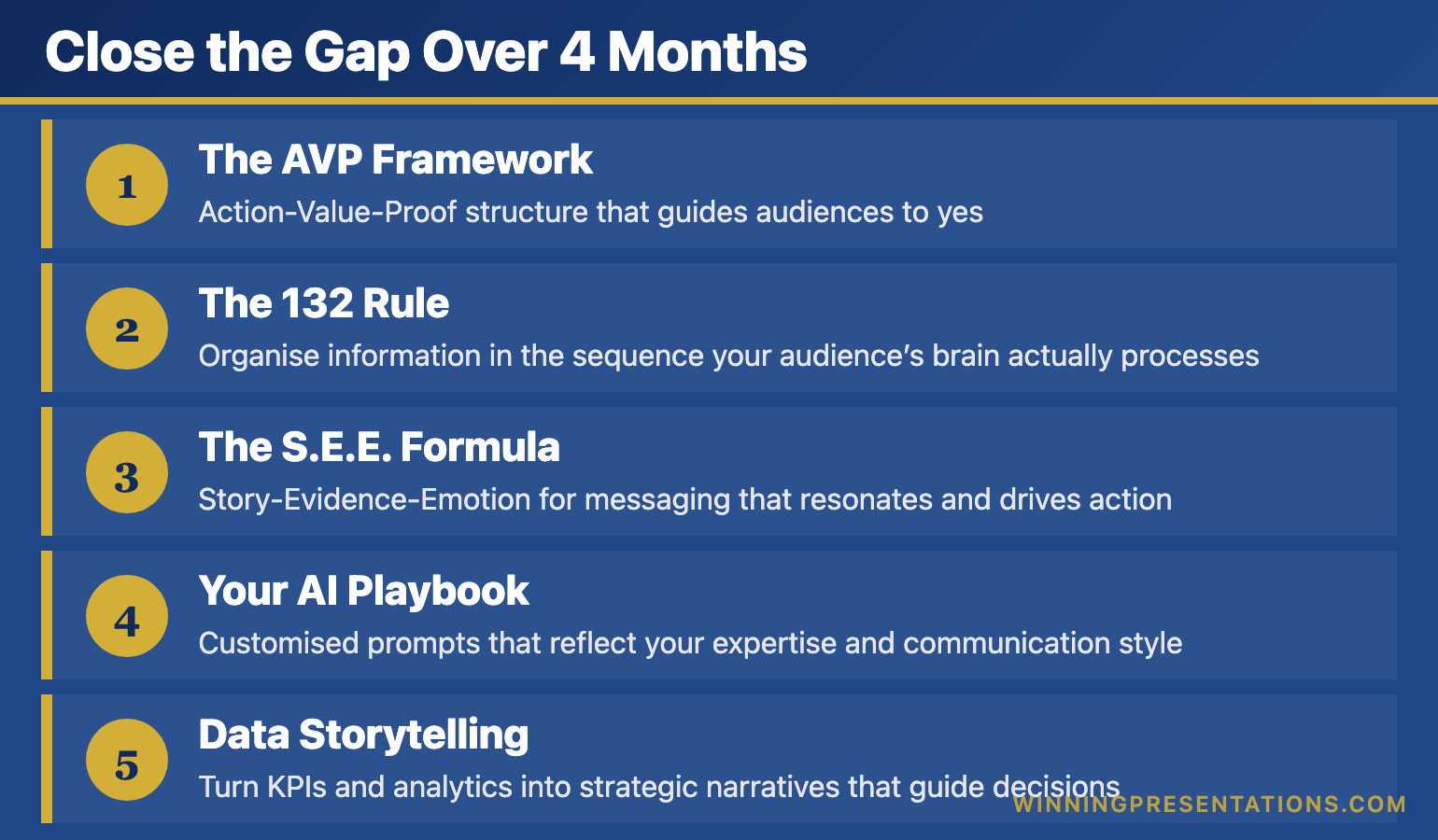
Close the Gap Over 4 Months

AI-Enhanced Presentation Mastery gives you the systems that separate professionals who plateau from professionals who keep improving β€” 8 self-paced modules delivered January through April 2026:

  • The AVP Framework: Action-Value-Proof structure that guides audiences to yes
  • The 132 Rule: Organise information in the sequence your audience’s brain actually processes
  • The S.E.E. Formula: Story-Evidence-Emotion for messaging that resonates and drives action
  • Your AI Playbook: Customised prompts that reflect your expertise and communication style
  • Data Storytelling: Turn KPIs and analytics into strategic narratives that guide decisions

Plus: 2 live coaching sessions in April, Master Prompt Pack, templates, before/after examples, and lifetime access to everything.

Presale price: Β£249 (increases to Β£299 when modules release, then Β£499)

60 seats total.

See the full curriculum and join β†’

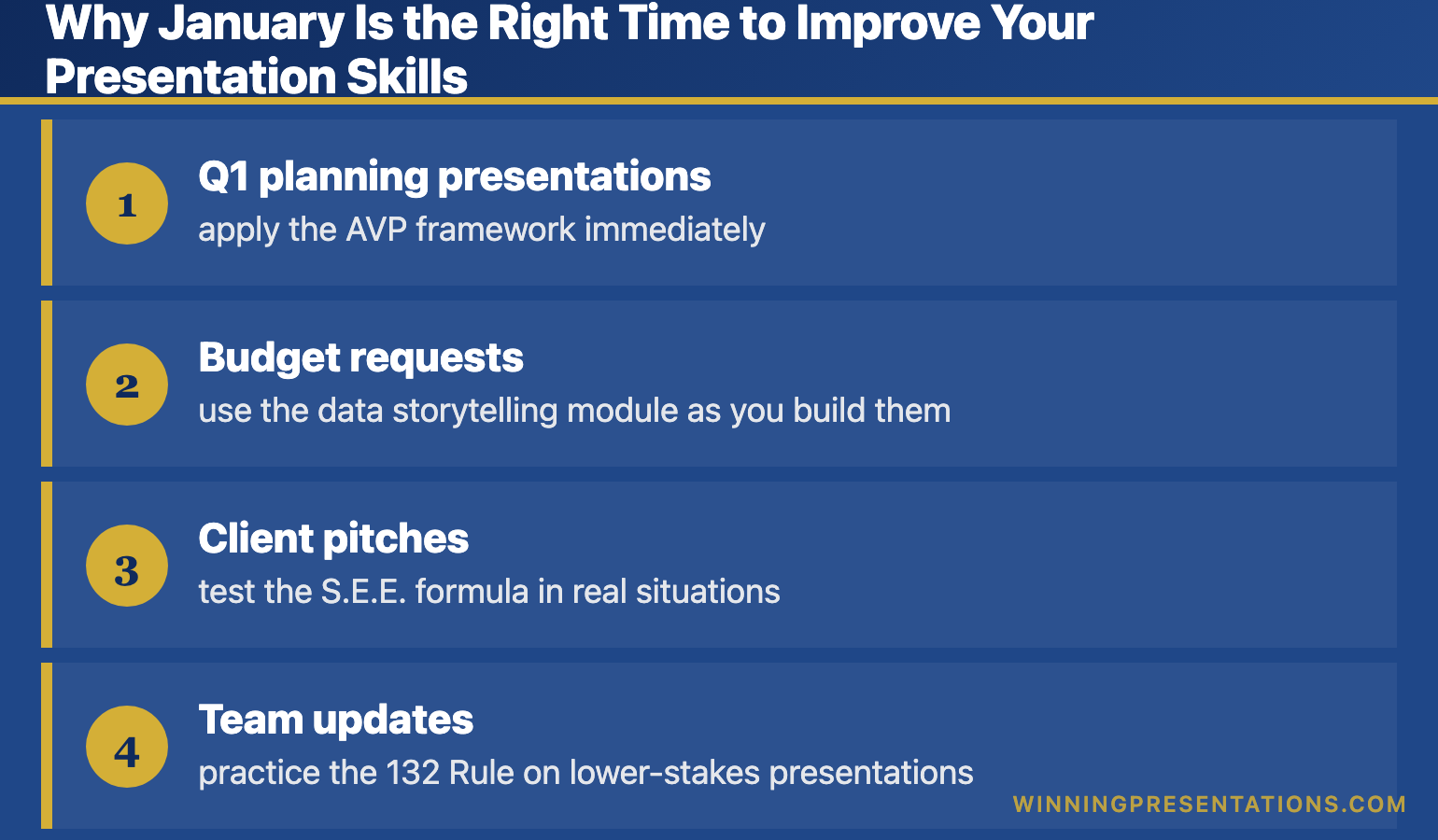
Why January Is the Right Time to Improve Your Presentation Skills

The course delivers 8 modules from January through April β€” one new module every couple of weeks. This pacing is intentional.

It means you’re building these skills while you’re actually presenting:

  • Q1 planning presentations β€” apply the AVP framework immediately
  • Budget requests β€” use the data storytelling module as you build them
  • Client pitches β€” test the S.E.E. formula in real situations
  • Team updates β€” practice the 132 Rule on lower-stakes presentations

By April, when the live coaching sessions happen, you’ll have four months of practice and real questions to bring.

Build the systems now. Apply them to every presentation this year. Compound the improvement.

Related: Presentation Structure: 7 Frameworks That Actually Work

FAQ: How to Improve Presentation Skills

I’m already decent at presentations. Is this for me?

Yes β€” “decent” is exactly the plateau this course addresses. If you’re getting through presentations but not getting promoted off the back of them, the systems in this course close that gap.

Do I need to be technical with AI?

No. This is not a software tutorial. You’ll learn to use AI as a thinking partner. The prompts are copy-paste ready. If you can use ChatGPT at a basic level, you can use everything in this course.

What if I can’t attend the live sessions in April?

All sessions are recorded. You’ll receive lifetime access to recordings, and you can join the next cohort at no additional cost if you want live participation later.


Your Next Step

The gap between “competent presenter” and “presenter who advances” isn’t about talent. It’s about systems.

πŸ“– Go deeper: Business Presentation Skills: What Actually Matters β€” today’s comprehensive guide.

πŸŽ“ Build the systems: AI-Enhanced Presentation Mastery β€” 8 modules from January–April 2026, presale price Β£249 (60 seats).


Mary Beth Hazeldine spent 24 years in corporate banking before founding Winning Presentations. She now trains executives in AI-enhanced presentation systems β€” the frameworks and tools that close the gap between competent and compelling.