

Board Approval Presentation Training That Secures Executive Decisions
What you’ll find in this article:
- Why most board presentations fail before slide one
- The four decision criteria every board applies
- A presentation structure that matches board thinking
- Packaging evidence for sceptical decision-makers
- Anticipating and addressing objections before they surface
- What effective board presentation training actually covers
- Frequently asked questions
Gavin had been a divisional director for nine years. He knew his numbers inside out. He had built a digital transformation programme that would save his organisation £2.3 million annually, and his operational team was unanimously behind it.
The board rejected it in eleven minutes.
Not because the programme was flawed. Because his presentation spoke the language of implementation — timelines, resource plans, vendor comparisons — when the board needed to hear about strategic risk, competitive positioning, and shareholder value. He had prepared exhaustively for the wrong audience. When he came to me, he said something I hear regularly: “I know this material better than anyone in that room. So why couldn’t I get them to say yes?”
The answer is almost always the same. Expertise in a subject and expertise in presenting that subject to a board are entirely different skills. Board approval presentation training bridges that gap — and when it is done well, it transforms how executives communicate upward for the rest of their careers.
Looking for a structured approach to board presentations?
The Maven Executive Buy-In Presentation System covers the complete framework for securing executive approval — from board-level narrative structure to objection handling and evidence packaging.
Why Most Board Presentations Fail Before Slide One
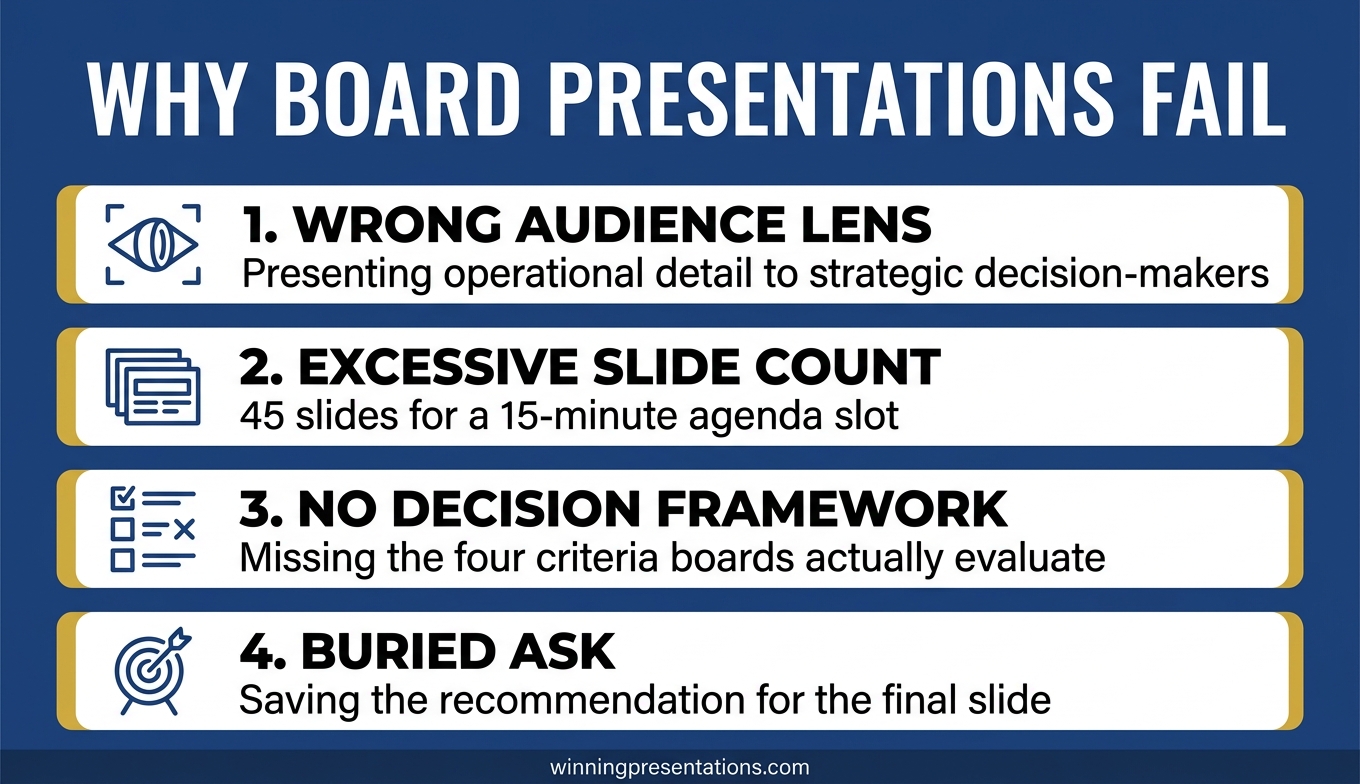
The failure pattern is remarkably consistent. An executive spends weeks assembling a thorough proposal — financial models, implementation timelines, risk registers, vendor evaluations — and walks into the boardroom with forty-five slides and absolute confidence in the detail.
The board chair glances at the agenda, notes that this item has been allocated fifteen minutes, and the entire dynamic shifts. What follows is usually a rushed sprint through material that was designed for a two-hour deep dive.
This is the fundamental misalignment that board approval presentation training addresses. Boards do not operate like project steering committees. They are not evaluating your methodology. They are making a binary decision — approve, defer, or reject — based on whether your proposal meets a specific set of criteria that most presenters never explicitly address.
The executives who consistently secure board approval have learned to think backwards: start with the decision the board needs to make, then provide only the evidence required to make that decision with confidence. Everything else is an appendix — available if requested, invisible unless needed.
This is a skill that can be taught. It requires unlearning habits that serve executives well in every other context — thoroughness, technical depth, comprehensive stakeholder coverage — and replacing them with a board-specific communication framework.
The Four Decision Criteria Every Board Applies
Regardless of sector, board size, or governance structure, directors typically evaluate proposals through four lenses. Effective board approval presentation training teaches executives to address all four explicitly, rather than hoping the board will extract the answers from a general briefing.
1. Strategic Alignment
Does this initiative advance the organisation’s stated strategic priorities? Boards approve proposals that connect directly to objectives they have already endorsed. If your transformation programme supports a strategic pillar the board set eighteen months ago, lead with that connection. If it doesn’t map to an existing priority, you have a harder argument to make — and training helps you frame it as an emerging strategic necessity rather than an operational preference.
2. Financial Impact and Return
Boards think in terms of return on investment, payback periods, and opportunity cost. They want to know what the organisation gains, what it costs, and when the investment pays for itself. The most persuasive presenters express financial impact in terms the finance director has already used in previous board papers — consistency of language signals that you understand the board’s financial framework.
3. Risk Exposure
Every proposal carries risk. Boards expect you to name those risks, quantify them where possible, and present mitigation strategies. The error most executives make is minimising risk to make their proposal more attractive. Boards interpret this as either naivety or concealment — neither builds the confidence required for approval. Structured training teaches a risk-framing technique that demonstrates awareness without undermining the case.
4. Governance and Accountability
Who is responsible for delivery? What are the decision points where the board will be asked to review progress? How will success be measured? Boards approve proposals when they can see a clear governance pathway — and defer them when accountability feels vague. Your presentation must answer these questions before a director has to ask them.
When your presentation addresses all four criteria within the first five minutes, the board’s posture changes. Instead of probing for gaps, they begin discussing implementation — which is where you want them.
Maven Executive Buy-In Presentation System
A self-paced programme that teaches the complete framework for securing executive and board-level approval — from structuring your narrative around decision criteria to handling difficult questions under pressure. Enrolment is open — join at your own pace. £499 per seat.
- Board-level narrative structuring and evidence packaging
- Objection anticipation and real-time response frameworks
- Financial impact framing for non-executive audiences
- Optional recorded coaching sessions — watch back anytime
Explore the Programme → £499/seat
Self-paced with new cohorts opening regularly. Join at your own pace.
A Presentation Structure That Matches Board Thinking
Most presentation training teaches a generic structure: problem, solution, benefits, next steps. That works for internal team briefings and client pitches. It falls apart in the boardroom because it forces directors to wait until the end for the information they need at the beginning.
Board-specific training introduces what I call the “decision-first” structure. The principle is straightforward: open with the decision you are asking the board to make, then provide the evidence that supports that decision in order of the board’s priorities, not yours.
In practice, this means your opening slide states the ask: “I am requesting approval for a £1.8 million investment in [initiative], with implementation beginning in Q3 and full return anticipated within eighteen months.” The board now knows exactly what they are evaluating. Every subsequent slide serves that evaluation.
This feels counterintuitive to many executives. They want to build the case gradually, creating a narrative arc that culminates in the recommendation. But boards are not audiences — they are decision-making bodies with constrained time. Giving them the conclusion first allows them to listen to your evidence with purpose rather than impatience.
The structure I teach in board presentation structure training follows a specific sequence: Decision Request → Strategic Context → Financial Case → Risk and Mitigation → Governance Framework → Recommended Action. Each section is designed to be self-contained — if the board interrupts with questions (and they will), you can address them without losing the thread of your argument.
Packaging Evidence for Sceptical Decision-Makers
Board members are professional sceptics. Their governance role requires them to challenge assumptions, probe financial projections, and test the resilience of proposals. This is not hostility — it is their fiduciary duty. But it means your evidence must be packaged differently from how you would present it to a project sponsor or line manager.
Three principles govern how evidence lands with a board:
Comparability. Boards make better decisions when they can compare your proposal against alternatives — including the alternative of doing nothing. Present your financial case alongside a “cost of inaction” scenario. What does the organisation lose by deferring this decision? What competitive ground is conceded? This reframes the board’s choice from “should we spend this money?” to “can we afford not to?”
Understanding the psychology behind stakeholder buy-in is essential here. Decision-makers respond to loss aversion more powerfully than they respond to projected gains.
Credibility of sources. Internal projections carry less weight than external validation. Where possible, anchor your financial case in third-party research, industry benchmarks, or the outcomes of comparable initiatives in peer organisations. A board that hears “our internal modelling suggests a 23% efficiency gain” will be less persuaded than one that hears “three comparable implementations in our sector achieved efficiency gains between 18% and 27%, according to [named consultancy].”
Granularity on request. Your presentation should contain the headline numbers. Your appendix should contain the detailed calculations. Your spoken narrative should signal that the detail exists without displaying it: “The full financial model is in appendix C — I am happy to walk through any assumptions the board would like to examine.” This demonstrates both thoroughness and respect for the board’s time.

If you regularly present to boards and want a structured approach to evidence framing and decision-first narrative design, the Maven Executive Buy-In Presentation System covers these techniques in depth.
Anticipating and Addressing Objections Before They Surface
The highest-impact skill in board approval presentation training is pre-emptive objection handling. This is the practice of identifying the three or four most likely challenges to your proposal and addressing them within your presentation — before a director raises them.
Why does this matter? Because once an objection is voiced in a board meeting, it takes on social weight. Other directors may align with it. The chair may suggest deferring the decision pending further analysis. What might have been a minor concern becomes a blocker.
But when you address the same concern proactively — “The board may reasonably ask whether this timeline is realistic given our current programme commitments. Here is how we have stress-tested the schedule” — you neutralise it. You demonstrate that you have thought about the proposal from the board’s perspective, not just your own.
Effective objection anticipation requires research. Review the minutes of previous board meetings where similar proposals were discussed. Speak to the company secretary about recurring themes in board feedback. If possible, have a pre-meeting conversation with one or two directors to understand their priorities. This preparation is as important as the slides themselves.
The executives I have worked with over the past sixteen years who consistently win board approval share a common trait: they spend as much time preparing for questions as they do preparing their presentation. In many cases, the questions are where the real decision gets made. Your slides open the door — your answers close it.
What Effective Board Presentation Training Actually Covers
Not all presentation training is equal, and generic programmes rarely address the specific dynamics of board-level communication. When evaluating board approval presentation training, look for coverage of these areas:
Board psychology and governance dynamics. Understanding how boards make decisions — the role of the chair, the influence dynamics between executive and non-executive directors, the impact of committee pre-reads — is foundational. Without this, even a well-structured presentation can misread the room.
If you are preparing for a specific board meeting and want to explore the structural elements in more depth, this article on executive buy-in presentation training covers the broader programme design.
Narrative construction for decision-makers. This is not generic storytelling. It is the specific skill of translating operational complexity into a concise narrative that addresses strategic priorities, financial implications, and risk factors within a constrained time window — typically ten to fifteen minutes of speaking time.
Slide design for senior audiences. Board slides should be sparse, data-led, and designed to support verbal delivery rather than replace it. Training should cover how to create slides that a director can absorb in seconds — because they will glance at the slide while listening to you, not read it line by line.
Rehearsal under pressure. The gap between knowing your material and delivering it under scrutiny is significant. Quality training includes practice sessions where participants present to a simulated board and receive structured feedback on both content and delivery — particularly on how they handle unexpected challenges.
A related article that explores how to prepare for a specific board context is this piece on remuneration committee presentations, which illustrates how the same principles apply to specialist committee environments.
Ready to Transform How You Present to Boards?
The Maven Executive Buy-In Presentation System gives you a repeatable framework for structuring proposals that secure approval — not just attention. Self-paced, with optional recorded coaching. £499 per seat.
Explore the Programme → £499/seat
Enrolment is open — join at your own pace.
Frequently Asked Questions
How long should a board approval presentation be?
Most board agenda items are allocated ten to twenty minutes. Your presentation should use no more than half that time for formal delivery, leaving the remainder for questions and discussion. In practice, this means eight to twelve slides with focused speaking points. The most effective board presenters can make their core case in under seven minutes — brevity signals confidence and respect for the board’s time.
What is the biggest mistake executives make in board presentations?
Leading with operational detail rather than strategic context. Boards need to understand why this proposal matters to the organisation’s direction before they can evaluate how it will be delivered. When you open with implementation timelines and resource requirements, you are answering questions the board has not yet asked — while leaving their actual questions unanswered.
Can board presentation skills be learned through self-paced training?
Yes. The core skills — narrative structuring, evidence packaging, objection anticipation — are framework-based and can be learned through structured self-paced programmes. The key advantage of self-paced training is the ability to revisit modules before specific board meetings and apply techniques directly to live proposals. Optional coaching sessions provide additional feedback for executives who want personalised guidance.
How does board presentation training differ from general presentation skills training?
General presentation training focuses on delivery mechanics — voice, body language, slide design. Board-specific training addresses the decision-making context: how boards evaluate proposals, what governance frameworks require, how to frame financial cases for non-executive scrutiny, and how to handle the particular pressure of presenting to people who hold approval authority. The skills overlap, but the application is fundamentally different.
The Winning Edge — Weekly Executive Presentation Insights
Practical strategies for board presentations, stakeholder communication, and executive presence — delivered every Thursday.
Board approval is not about having the best proposal. It is about presenting your proposal in the language boards use to make decisions. If you have been preparing for board meetings by refining your content when you should have been refining your communication framework, that is the shift that training makes possible.
Start with the four decision criteria. Structure your next presentation around them. The board’s response will tell you whether the approach is working.
About the Author
Mary Beth Hazeldine is the Owner & Managing Director of Winning Presentations. With 24 years of corporate banking experience at JPMorgan Chase, PwC, Royal Bank of Scotland, and Commerzbank, she advises executives across financial services, healthcare, technology, and government on structuring presentations for high-stakes funding rounds and board approvals.