

Board Presentation Opening Lines
Quick Answer
The most effective board presentation opening lines follow one principle: tell the board what they need to decide before you tell them why. Start with the recommendation, the decision, or the single number that frames everything else. Anything else is delay — and delay costs credibility.
Fatima had been working on the proposal for six weeks. The numbers were solid. The risk analysis was thorough. Her opening slide said: “Agenda.”
The chair of the audit committee looked at it, glanced at his phone, and didn’t look up again for four minutes.
She recovered — eventually — but she lost the room before she said her second sentence. The agenda slide wasn’t just a weak choice. It was a signal: I don’t know what decision you need to make yet. And senior executives interpret that signal immediately.
I’ve watched hundreds of board presentations open this way. The presenter believes they’re being professional and organised. The board experiences it as someone who hasn’t done the work to understand what matters at that level.
Already have strong content but losing the room at the start?
The Executive Slide System includes opening slide frameworks designed specifically for boardroom and approval presentations — the structures that get executives oriented fast and decisions made sooner.
Why most board presentation openings fail in the first 30 seconds
Most people open a board presentation the way they were taught to open any presentation: orient the audience, set context, preview the agenda, then build your argument. In academic settings and general business presentations, this works reasonably well.
In boardrooms, it destroys momentum before you’ve started.
Board members are not a general audience. They have typically received a pre-read. They already have context. What they’re waiting for — consciously or not — is the one thing they need to engage with: the decision, the recommendation, or the number that frames everything.
When you open with context they already have, you signal that you don’t understand their workflow. When you open with an agenda slide, you’re asking them to wait even longer before you reach the point. The attention loss is immediate, and it affects how they receive everything that follows.
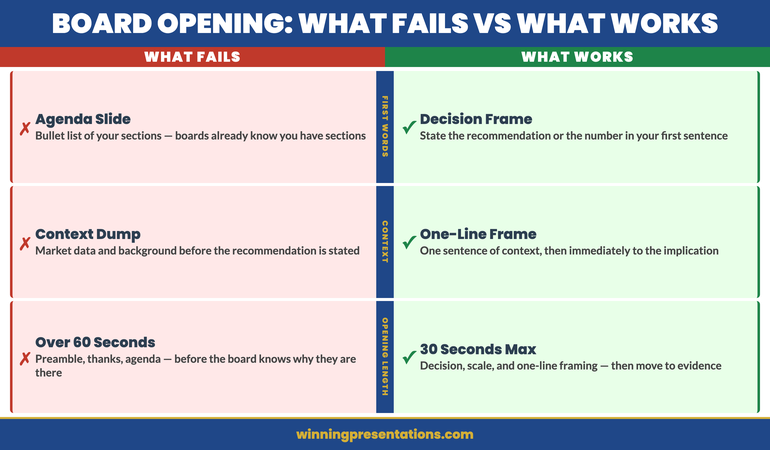
The three most common failing opening structures are:
- The orientation delay: “Good morning, thank you for the opportunity to present today. I’ll be covering three areas: background, analysis, and recommendation.” You’ve used 15 seconds and said nothing of value.
- The agenda slide: Bullet points listing your section headings. Boards don’t need to know you have three sections. They need to know what’s in them.
- The context dump: Opening with market data, company history, or project background before you’ve stated your recommendation. This makes them sit through context before they know what you want them to do with it.
Each of these has the same root problem: they put the presenter’s structure ahead of the board’s need to decide.
What boards actually want to hear first
I spent 24 years in corporate banking at JPMorgan Chase, PwC, Royal Bank of Scotland, and Commerzbank. I sat in hundreds of board and steering committee meetings on both sides of the table. The single most consistent pattern I observed: the presentations that held attention from the first sentence always led with the decision frame.
Not the process frame. Not the background frame. The decision frame.
A decision frame answers one question before any other: What are you asking us to do, or what do you need us to know in order to act?
This isn’t the same as a recommendation. Sometimes the board isn’t being asked to approve anything — they’re being given an update that requires awareness. A decision frame still works: “The programme is on track. The one item requiring board attention is the supplier risk in Q3.”
That sentence tells them exactly where to direct their scrutiny. Everything that follows is supporting detail. They’re not waiting for the point. The point arrived in your first sentence.
According to research into executive communication, senior decision-makers form an initial assessment of a presenter’s credibility within the first minute of a presentation. That first impression shapes how they interpret every data point that follows. An opening that respects their time and intelligence creates a halo effect. An opening that delays the point creates the opposite.
Your Opening Line Shouldn’t Be an Apology for Making Them Wait
The Executive Slide System — £39, instant access — includes the opening slide structures used in boardroom and high-stakes approval presentations. Lead with the decision frame, not the agenda. Your first slide should tell them what they need to know before you explain why.
- Opening slide frameworks for board and approval presentations
- Decision-first structure templates for different meeting types
- AI prompt cards to draft opening lines in under 5 minutes
- Slide templates for context, recommendation, and risk framing
Get the Executive Slide System →
Designed for board, approval, and investor presentations at executive level.
Four opening structures that work at executive level
There isn’t one perfect opening structure. Context matters: the type of meeting, what the board has already seen, the level of urgency, and whether you’re seeking approval or providing a report. These four structures cover the main scenarios.
1. The direct recommendation opening
Use this when you are seeking a decision or approval.
“We’re recommending [specific action]. The investment required is [amount]. Subject to board approval, we can move to contract by [date].”
Everything after this is evidence. The board knows what you want from them before you’ve showed them a single piece of supporting data. They can now evaluate your evidence against a clear decision framework. This is genuinely helpful — it changes how they listen.
2. The single-number opening
Use this when one metric defines the situation.
“Revenue is [X]. That’s [above/below] plan by [Y]. I want to spend our time on the two structural factors driving that variance — they’re different from what we expected.”
A specific number commands attention in a way that “overview of our quarterly performance” never does. It grounds the board immediately. They know the scale, the direction, and the frame for the discussion before you move to your second sentence.
3. The one-thing-to-know opening
Use this for updates where you’re not seeking a decision but awareness matters.
“Everything is on track. The one item I want to make sure you’re aware of is [issue]. It doesn’t require a decision today, but I want to ensure it’s visible at board level.”
This structure respects their time and shows judgement. You’ve told them what to care about and what not to worry about in a single breath. That’s a significant signal of executive competence.
4. The context-then-implication opening
Use this when the board needs a small amount of new context before your recommendation makes sense — but the context should take 30 seconds, not five minutes.
“Since our last meeting, [one significant external development]. That changes our position on [topic] in one specific way: [implication and recommendation].”
The key is compression. One development, one implication, one recommendation. Then you expand. The internal structure of your presentation can be as detailed as needed — your opening sentence sets the frame.

Phrases to eliminate from every board opening
Certain phrases appear in board presentations so frequently that they’ve lost all meaning. More damaging, they’ve become signals of a presenter who hasn’t thought carefully about their opening. If you use any of these, you’re starting with borrowed language rather than a clear frame.
“Thank you for having me” / “Thank you for the opportunity to present.” This is not wrong, exactly. But it consumes your first sentence on politeness that everyone understands is implied. The board didn’t invite you to be thanked — they invited you because they need information. Get to it.
“Before I begin…” This tells the board that whatever follows is not the actual presentation — it’s preamble. You’ve signalled delay before you’ve started.
“As you’ll see from the agenda…” If your opening sentence refers to your agenda, your opening sentence is about your structure rather than their decision. That’s the wrong priority.
“I know you’re all very busy…” Acknowledging their busyness doesn’t make your presentation faster. It suggests you’re worried about their patience, which makes them more aware of time.
“This is a complex topic, but…” Anything that follows “but” in an opening sentence carries anxiety about whether your argument will land. Boards don’t need forewarning about complexity — they need your clearest summary of what it means.
Removing these phrases is not about being brusque. It’s about using your opening line for what it should do: establish the decision frame and earn attention through clarity.
If you want to see how the internal structure of a high-stakes presentation supports a strong opening, the article on executive presentation structure covers this in detail. And for the specific difference between a board paper and a board presentation — which changes what your opening needs to do — see board paper vs board presentation.
The first slide rule that changes everything
Your opening words and your first slide are not the same thing. But they should be aligned.
The most effective first slides for board presentations share one characteristic: they show the conclusion, not the agenda. This is counterintuitive for most presenters trained in traditional presentation structures. The instinct is to ease the audience in — set up the problem before revealing the solution.
Boards don’t want to be eased in. They want to know immediately what position you’re advocating, then evaluate whether your supporting evidence holds.
A first slide that shows your recommendation (with the supporting rationale compressed to three bullet points) lets the board challenge the right things from the start. If they see a problem with your recommendation in the first minute, they’ll tell you — and you can address it before spending 20 minutes on analysis that doesn’t resolve their concern.
Compare these two first-slide approaches for a budget approval request:
Approach A: Title: “FY2027 Budget Request — Technology Infrastructure Division.” Content: Agenda.
Approach B: Title: “We’re requesting £2.4M for infrastructure replacement — here’s why it’s the only option.” Content: Three-line summary of the business case and the alternative cost of inaction.
Approach B tells the board what decision they’re being asked to make, frames the scale, and gives them the argument in compressed form. If they want more detail, your subsequent slides provide it. If they have a question about the assumption behind the recommendation, they can raise it now rather than at slide 22.
The principles behind strong board presentation structure — including how to open, present, and close effectively — are covered in depth in the guide to how to start a presentation.
If you’d prefer a complete ready-made framework rather than building your opening structure from scratch, the Executive Slide System includes opening slide templates designed specifically for board and approval presentations.
Stop Rebuilding Your Board Slides From Scratch
The Executive Slide System — £39, instant access — is designed for executives who need a structured, repeatable format for high-stakes presentations. No more guessing what to put on slide one. The opening frameworks tell you exactly what information belongs where and why.
Get the Executive Slide System →
Designed for boardroom and executive approval presentations.
Frequently Asked Questions
Should I introduce myself at the start of a board presentation?
Only if you are presenting to a board for the first time and there are members who don’t know your role. In that case, one sentence is sufficient: “I’m [name], [role], and I’m responsible for [area].” If the board already knows you, skip the introduction entirely. Your time is better spent on the decision frame.
How long should a board presentation opening be?
The opening — from your first spoken word to your first piece of supporting evidence — should take 30 to 60 seconds. If it takes longer, you have too much preamble. The opening’s job is to establish the decision frame, not to explain your thinking process. Thinking is shown through the structure of your evidence, not the length of your introduction.
What if I need to provide context before the board can understand my recommendation?
Keep the context to one sentence and state the recommendation anyway. “Since our last meeting, the regulator has issued updated guidance — our recommendation is [X] to stay compliant” gives both context and recommendation without the extended build-up. If the context requires more than one sentence, that’s a sign that your pre-read document needed to be stronger, not that your opening needs to be longer.
The Winning Edge
Weekly strategies for executives who want to present with clarity and conviction. Every Thursday.
Not ready for the full system? Start here instead: download the free Executive Presentation Checklist — a single-page reference for the structure, opening, and closing every executive presentation needs.
For executives presenting in hybrid or virtual environments, where opening line technique requires additional adaptation, see when to turn your camera off in virtual presentations — a related consideration for how presence translates across formats.
Your next board presentation deserves a first sentence that earns attention rather than waits for it. Start with the decision. Let the evidence follow. The board will notice the difference.
About the Author
Mary Beth Hazeldine is Owner & Managing Director of Winning Presentations. With 24 years of corporate banking experience at JPMorgan Chase, PwC, Royal Bank of Scotland, and Commerzbank, she advises executives across financial services, healthcare, technology, and government on structuring presentations for high-stakes funding rounds and approvals. She is a qualified clinical hypnotherapist and NLP practitioner.