Tag: presentation opening

22 Apr 2026
A confident executive woman standing at the head of a boardroom table delivering her opening line to attentive board members, navy suit, professional lighting, editorial photography style

Board Presentation Opening Lines

Quick Answer

The most effective board presentation opening lines follow one principle: tell the board what they need to decide before you tell them why. Start with the recommendation, the decision, or the single number that frames everything else. Anything else is delay — and delay costs credibility.

Fatima had been working on the proposal for six weeks. The numbers were solid. The risk analysis was thorough. Her opening slide said: “Agenda.”

The chair of the audit committee looked at it, glanced at his phone, and didn’t look up again for four minutes.

She recovered — eventually — but she lost the room before she said her second sentence. The agenda slide wasn’t just a weak choice. It was a signal: I don’t know what decision you need to make yet. And senior executives interpret that signal immediately.

I’ve watched hundreds of board presentations open this way. The presenter believes they’re being professional and organised. The board experiences it as someone who hasn’t done the work to understand what matters at that level.

Already have strong content but losing the room at the start?

The Executive Slide System includes opening slide frameworks designed specifically for boardroom and approval presentations — the structures that get executives oriented fast and decisions made sooner.

Explore the Executive Slide System →

Why most board presentation openings fail in the first 30 seconds

Most people open a board presentation the way they were taught to open any presentation: orient the audience, set context, preview the agenda, then build your argument. In academic settings and general business presentations, this works reasonably well.

In boardrooms, it destroys momentum before you’ve started.

Board members are not a general audience. They have typically received a pre-read. They already have context. What they’re waiting for — consciously or not — is the one thing they need to engage with: the decision, the recommendation, or the number that frames everything.

When you open with context they already have, you signal that you don’t understand their workflow. When you open with an agenda slide, you’re asking them to wait even longer before you reach the point. The attention loss is immediate, and it affects how they receive everything that follows.

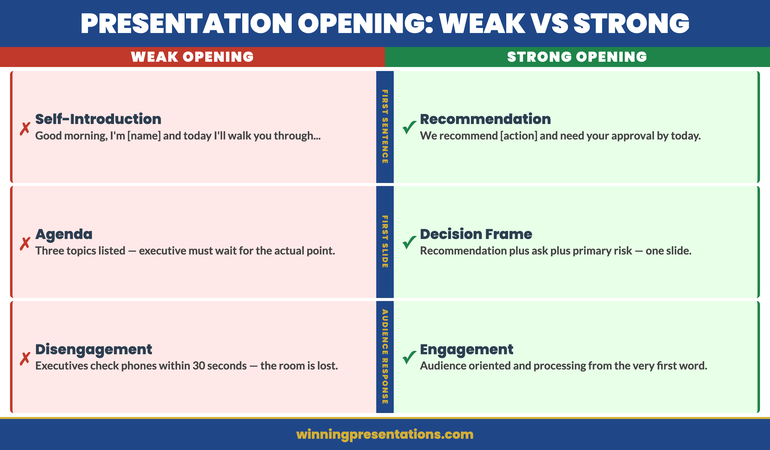
The three most common failing opening structures are:

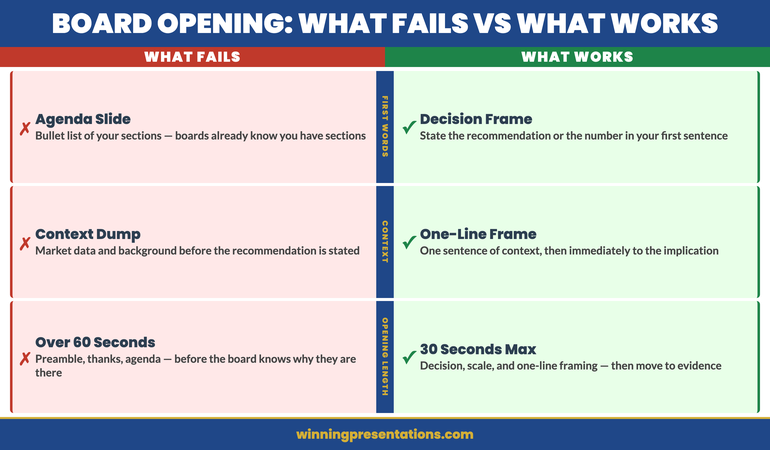
  • The orientation delay: “Good morning, thank you for the opportunity to present today. I’ll be covering three areas: background, analysis, and recommendation.” You’ve used 15 seconds and said nothing of value.
  • The agenda slide: Bullet points listing your section headings. Boards don’t need to know you have three sections. They need to know what’s in them.
  • The context dump: Opening with market data, company history, or project background before you’ve stated your recommendation. This makes them sit through context before they know what you want them to do with it.

Each of these has the same root problem: they put the presenter’s structure ahead of the board’s need to decide.
Infographic showing three failing board presentation opening structures — orientation delay, agenda slide, and context dump — contrasted with the decision-first approach

What boards actually want to hear first

I spent 24 years in corporate banking at JPMorgan Chase, PwC, Royal Bank of Scotland, and Commerzbank. I sat in hundreds of board and steering committee meetings on both sides of the table. The single most consistent pattern I observed: the presentations that held attention from the first sentence always led with the decision frame.

Not the process frame. Not the background frame. The decision frame.

A decision frame answers one question before any other: What are you asking us to do, or what do you need us to know in order to act?

This isn’t the same as a recommendation. Sometimes the board isn’t being asked to approve anything — they’re being given an update that requires awareness. A decision frame still works: “The programme is on track. The one item requiring board attention is the supplier risk in Q3.”

That sentence tells them exactly where to direct their scrutiny. Everything that follows is supporting detail. They’re not waiting for the point. The point arrived in your first sentence.

According to research into executive communication, senior decision-makers form an initial assessment of a presenter’s credibility within the first minute of a presentation. That first impression shapes how they interpret every data point that follows. An opening that respects their time and intelligence creates a halo effect. An opening that delays the point creates the opposite.

Your Opening Line Shouldn’t Be an Apology for Making Them Wait

The Executive Slide System — £39, instant access — includes the opening slide structures used in boardroom and high-stakes approval presentations. Lead with the decision frame, not the agenda. Your first slide should tell them what they need to know before you explain why.

  • Opening slide frameworks for board and approval presentations
  • Decision-first structure templates for different meeting types
  • AI prompt cards to draft opening lines in under 5 minutes
  • Slide templates for context, recommendation, and risk framing

Get the Executive Slide System →

Designed for board, approval, and investor presentations at executive level.

Four opening structures that work at executive level

There isn’t one perfect opening structure. Context matters: the type of meeting, what the board has already seen, the level of urgency, and whether you’re seeking approval or providing a report. These four structures cover the main scenarios.

1. The direct recommendation opening

Use this when you are seeking a decision or approval.

“We’re recommending [specific action]. The investment required is [amount]. Subject to board approval, we can move to contract by [date].”

Everything after this is evidence. The board knows what you want from them before you’ve showed them a single piece of supporting data. They can now evaluate your evidence against a clear decision framework. This is genuinely helpful — it changes how they listen.

2. The single-number opening

Use this when one metric defines the situation.

“Revenue is [X]. That’s [above/below] plan by [Y]. I want to spend our time on the two structural factors driving that variance — they’re different from what we expected.”

A specific number commands attention in a way that “overview of our quarterly performance” never does. It grounds the board immediately. They know the scale, the direction, and the frame for the discussion before you move to your second sentence.

3. The one-thing-to-know opening

Use this for updates where you’re not seeking a decision but awareness matters.

“Everything is on track. The one item I want to make sure you’re aware of is [issue]. It doesn’t require a decision today, but I want to ensure it’s visible at board level.”

This structure respects their time and shows judgement. You’ve told them what to care about and what not to worry about in a single breath. That’s a significant signal of executive competence.

4. The context-then-implication opening

Use this when the board needs a small amount of new context before your recommendation makes sense — but the context should take 30 seconds, not five minutes.

“Since our last meeting, [one significant external development]. That changes our position on [topic] in one specific way: [implication and recommendation].”

The key is compression. One development, one implication, one recommendation. Then you expand. The internal structure of your presentation can be as detailed as needed — your opening sentence sets the frame.

Roadmap infographic showing the four board presentation opening structures: direct recommendation, single-number, one-thing-to-know, and context-then-implication

Phrases to eliminate from every board opening

Certain phrases appear in board presentations so frequently that they’ve lost all meaning. More damaging, they’ve become signals of a presenter who hasn’t thought carefully about their opening. If you use any of these, you’re starting with borrowed language rather than a clear frame.

“Thank you for having me” / “Thank you for the opportunity to present.” This is not wrong, exactly. But it consumes your first sentence on politeness that everyone understands is implied. The board didn’t invite you to be thanked — they invited you because they need information. Get to it.

“Before I begin…” This tells the board that whatever follows is not the actual presentation — it’s preamble. You’ve signalled delay before you’ve started.

“As you’ll see from the agenda…” If your opening sentence refers to your agenda, your opening sentence is about your structure rather than their decision. That’s the wrong priority.

“I know you’re all very busy…” Acknowledging their busyness doesn’t make your presentation faster. It suggests you’re worried about their patience, which makes them more aware of time.

“This is a complex topic, but…” Anything that follows “but” in an opening sentence carries anxiety about whether your argument will land. Boards don’t need forewarning about complexity — they need your clearest summary of what it means.

Removing these phrases is not about being brusque. It’s about using your opening line for what it should do: establish the decision frame and earn attention through clarity.

If you want to see how the internal structure of a high-stakes presentation supports a strong opening, the article on executive presentation structure covers this in detail. And for the specific difference between a board paper and a board presentation — which changes what your opening needs to do — see board paper vs board presentation.

The first slide rule that changes everything

Your opening words and your first slide are not the same thing. But they should be aligned.

The most effective first slides for board presentations share one characteristic: they show the conclusion, not the agenda. This is counterintuitive for most presenters trained in traditional presentation structures. The instinct is to ease the audience in — set up the problem before revealing the solution.

Boards don’t want to be eased in. They want to know immediately what position you’re advocating, then evaluate whether your supporting evidence holds.

A first slide that shows your recommendation (with the supporting rationale compressed to three bullet points) lets the board challenge the right things from the start. If they see a problem with your recommendation in the first minute, they’ll tell you — and you can address it before spending 20 minutes on analysis that doesn’t resolve their concern.

Compare these two first-slide approaches for a budget approval request:

Approach A: Title: “FY2027 Budget Request — Technology Infrastructure Division.” Content: Agenda.

Approach B: Title: “We’re requesting £2.4M for infrastructure replacement — here’s why it’s the only option.” Content: Three-line summary of the business case and the alternative cost of inaction.

Approach B tells the board what decision they’re being asked to make, frames the scale, and gives them the argument in compressed form. If they want more detail, your subsequent slides provide it. If they have a question about the assumption behind the recommendation, they can raise it now rather than at slide 22.

The principles behind strong board presentation structure — including how to open, present, and close effectively — are covered in depth in the guide to how to start a presentation.

If you’d prefer a complete ready-made framework rather than building your opening structure from scratch, the Executive Slide System includes opening slide templates designed specifically for board and approval presentations.

Stop Rebuilding Your Board Slides From Scratch

The Executive Slide System — £39, instant access — is designed for executives who need a structured, repeatable format for high-stakes presentations. No more guessing what to put on slide one. The opening frameworks tell you exactly what information belongs where and why.

Get the Executive Slide System →

Designed for boardroom and executive approval presentations.

Frequently Asked Questions

Should I introduce myself at the start of a board presentation?

Only if you are presenting to a board for the first time and there are members who don’t know your role. In that case, one sentence is sufficient: “I’m [name], [role], and I’m responsible for [area].” If the board already knows you, skip the introduction entirely. Your time is better spent on the decision frame.

How long should a board presentation opening be?

The opening — from your first spoken word to your first piece of supporting evidence — should take 30 to 60 seconds. If it takes longer, you have too much preamble. The opening’s job is to establish the decision frame, not to explain your thinking process. Thinking is shown through the structure of your evidence, not the length of your introduction.

What if I need to provide context before the board can understand my recommendation?

Keep the context to one sentence and state the recommendation anyway. “Since our last meeting, the regulator has issued updated guidance — our recommendation is [X] to stay compliant” gives both context and recommendation without the extended build-up. If the context requires more than one sentence, that’s a sign that your pre-read document needed to be stronger, not that your opening needs to be longer.

The Winning Edge

Weekly strategies for executives who want to present with clarity and conviction. Every Thursday.

Subscribe Free →

Not ready for the full system? Start here instead: download the free Executive Presentation Checklist — a single-page reference for the structure, opening, and closing every executive presentation needs.

For executives presenting in hybrid or virtual environments, where opening line technique requires additional adaptation, see when to turn your camera off in virtual presentations — a related consideration for how presence translates across formats.

Your next board presentation deserves a first sentence that earns attention rather than waits for it. Start with the decision. Let the evidence follow. The board will notice the difference.

About the Author

Mary Beth Hazeldine is Owner & Managing Director of Winning Presentations. With 24 years of corporate banking experience at JPMorgan Chase, PwC, Royal Bank of Scotland, and Commerzbank, she advises executives across financial services, healthcare, technology, and government on structuring presentations for high-stakes funding rounds and approvals. She is a qualified clinical hypnotherapist and NLP practitioner.

08 Apr 2026

How to Start a Presentation: The Opening That Gets Executives to Listen

Quick Answer

To start a presentation effectively with executives, lead with your recommendation or key finding in the first sentence — not your agenda, not your name, not context. State what you need them to decide, approve, or know before you say anything else. Then follow with your supporting rationale. This approach respects their time, signals confidence, and keeps them engaged from word one.

Valentina had prepared for three weeks. The strategy review was the most important presentation of her year — a proposed restructuring of the European operations division that needed sign-off from the CEO and two board members. She had a strong recommendation, solid data, and a 22-slide deck she’d rebuilt from scratch.

She opened with: “Good morning, everyone. I’m Valentina, Director of Strategy, and today I’m going to walk you through our European operations review, covering the current landscape, our three-year trajectory, and the options we’ve identified.”

The CEO glanced at his phone after eight seconds. One board member poured water. The third opened a different document. Valentina was still on slide one.

It wasn’t the strategy that failed. It was the opening. Three weeks of preparation, and the audience had mentally checked out before the first substantive word.

Presenting to the board or senior leadership this week?

Before you rehearse the deck, check whether your opening passes this test:

  • Does your first sentence contain your recommendation or key finding?
  • Can someone who arrives 30 seconds late still understand what you’re asking for?
  • Have you removed every word of context that comes before the point?

If your opening doesn’t pass all three, the Executive Slide System includes opening slide frameworks built specifically for board and executive settings. Explore the System →

Why the First 30 Seconds Determine Everything

Executive time is genuinely scarce. A CFO chairing a governance committee review may sit through six or seven presentations in a single day. By the time yours begins, their cognitive bandwidth is already stretched. They are not waiting, fresh and curious, to be guided through your thinking. They are looking — consciously or not — for a reason to stop paying close attention.

Your opening either gives them a reason to lean in or confirms it’s safe to disengage. Within 30 seconds, they have formed a working hypothesis about whether this presentation will be worth their full attention. If your opening contains nothing that answers the questions “what does this mean for me?” or “what am I being asked to decide?” — they will drift.

This is not laziness or rudeness. It is rational prioritisation. Understanding that changes everything about how you should structure those first moments.

The presentations that hold executive attention from the first word share one feature: the audience knows what they’re there to do before the presenter moves to slide two. That clarity — delivered in the opening — is the single most powerful structural choice available to you.

It also works for the presenter. When you know that your first sentence contains the recommendation, you eliminate the low-level panic of “are they following this?” because you’ve already given them everything they need to follow it. The rest of the presentation is evidence for something they already know you’re arguing.

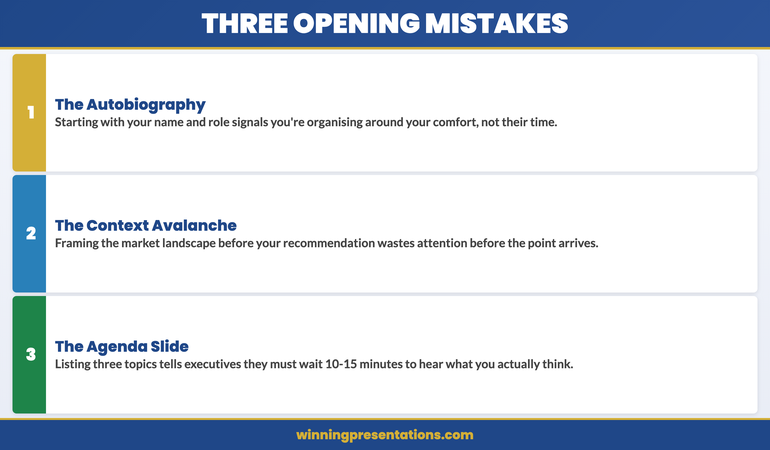
The Three Opening Mistakes That Lose Executive Rooms

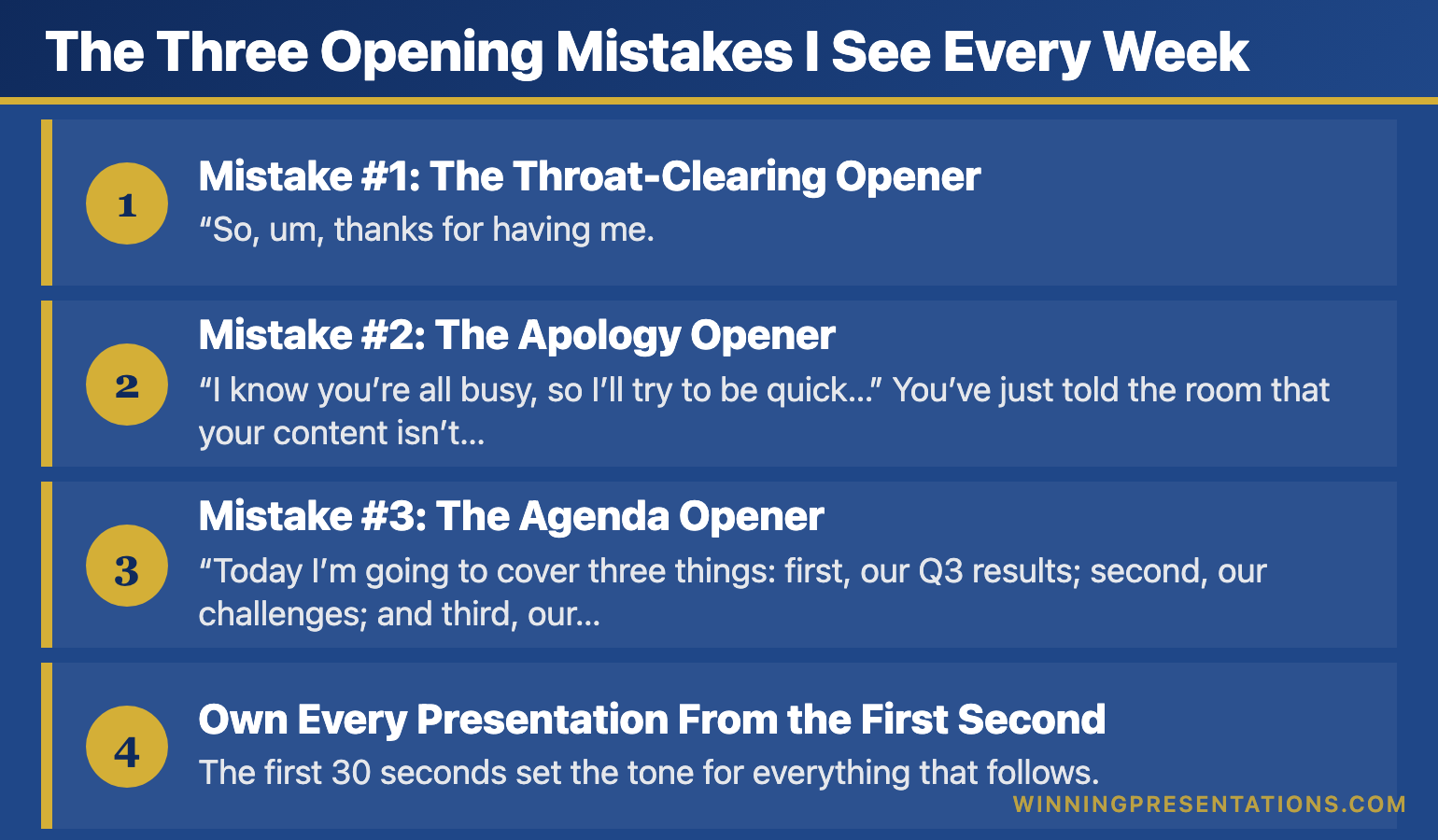
Three common executive presentation opening mistakes shown in a comparison infographic

Most presenters make one of three structural errors at the start. Each one has the same effect: it delays the executive’s understanding of why they are in the room.

Mistake 1: The autobiography opening. “Good morning, I’m [name], and I’m the Head of [function], and today I’m going to walk you through…” The audience already knows who you are. They approved your invitation to present. Opening with your own name signals that you’re organising the presentation around your own comfort, not their time.

Mistake 2: The context avalanche. Beginning with market background, regulatory landscape, historical performance, or “where we’ve come from” before stating what you’re recommending. Executives live inside this context. They don’t need to be reminded of the environment before they hear your view of it. Start with your view; let context emerge as justification.

Mistake 3: The agenda slide. “Today I’ll cover three areas: the current situation, the options we considered, and our recommendation.” This opening tells executives they will need to wait — often 10 to 15 minutes — before they learn what you think. Most will fill that wait by multitasking. The agenda format is deeply embedded in corporate culture, but it is structurally wrong for executive audiences.

All three mistakes share a root cause: the presenter is building up to the point rather than starting with it. This is natural — it mirrors the way we think through problems. But executives are not there to watch you think. They are there to evaluate your conclusion.

The fix is to invert the structure. Put the conclusion first. Let the thinking follow. See how to structure this in board presentation versus board paper: what executives actually want.

The Opening Framework That Gets Executives to Listen

Stop building up to your point. The Executive Slide System gives you the slide-by-slide structure that places your recommendation first — and keeps executive attention through to the close.

  • Opening slide templates for decisions, updates, and approval requests — built for the recommendation-first format
  • AI prompt cards to draft your opening sentence and executive summary in under 10 minutes
  • Scenario playbooks for board presentations, steering committees, CFO reviews, and project approvals
  • Slide-by-slide frameworks showing exact sequence for 12 executive presentation types

Get the Executive Slide System → £39

Designed for executives who need a board-ready opening structure — not generic presentation tips.

The Recommendation-First Opening Structure

The recommendation-first opening is sometimes called the Pyramid Principle or BLUF (Bottom Line Up Front). The terminology varies, but the principle is consistent: state your conclusion before you build the case for it.

In practice, this means your first spoken sentence — and your first slide — contains the most important thing you need your audience to know or do. Not the most important thing chronologically. The most important thing strategically.

For a decision-seeking presentation, that sentence might be: “We are recommending a consolidation of the Frankfurt and Amsterdam operations, with a target completion date of Q3, and I’m here today to ask for board approval.” For a financial update, it might be: “Revenue is tracking 7% below plan for the quarter, primarily driven by two enterprise contract delays, and I want to walk you through how we’re addressing both.” For a project update, it might be: “Phase one is complete and on budget; phase two has a risk I need to flag before we proceed.”

Notice what each of these openings does: it tells the audience what kind of presentation this is going to be. Decision? Briefing? Risk escalation? They know what role they’re playing — evaluator, recipient of information, risk adjudicator — from the first sentence. That clarity dramatically increases engagement because it gives them a cognitive frame to hang everything else on.

It also demonstrates confidence. Executives who bury their recommendation until the final third of a presentation are often doing so unconsciously out of anxiety — if I build the case first, they’ll have to accept the conclusion. But the effect is the opposite. Executives who can see where a presentation is going are far more patient with the journey. Executives who cannot see where it’s going lose patience with the journey entirely.

For in-depth guidance on structuring the full slide deck around this approach, see presentation pacing and rhythm for executive attention spans.

How to Write Your Opening Sentence

The opening sentence is the hardest sentence in the presentation to write, and the most important one to get right. Most presenters never actually write it down — they just start talking. That is why most presentations begin poorly.

A strong opening sentence for an executive audience needs to contain three elements:

1. What the situation is (one clause). Not a detailed description — a single phrase that locates the audience in the context. “Following the Q1 review…” or “With the procurement timeline now confirmed…” The situation clause should be no longer than the time it takes to say aloud comfortably.

2. What you are recommending or reporting (the main clause). This is the substance of the sentence. “…we are recommending an 18-month partnership with Hargreaves Digital…” or “…the project is tracking to plan with one exception I want to walk you through.” This clause must contain the actual point.

3. What you need from them (the action clause). For decision presentations: “…and I need a decision today to keep the procurement window open.” For updates: “…and I’d welcome your input on the risk-mitigation approach.” For briefings, this clause may be implicit. But for any presentation where a decision or endorsement is being sought, it must be explicit.

Three clauses, one sentence. Write it out before the presentation. Read it aloud. If it runs beyond 25 words, it’s too long. Cut until the point is clear at normal speaking pace. If it sounds awkward, practise it until it doesn’t — the awkwardness is almost always familiarity, not structure.

Crucially: do not start the sentence with “I” or “Today.” Starting with the situation or the recommendation (“Following the strategic review…” or “We are recommending…”) immediately signals to the audience that this is about them and their decision, not about the presenter’s performance.

If you’re building several executive presentations across different scenarios this quarter, the Executive Slide System includes opening slide templates for 12 different executive scenarios — from budget approvals to board strategy reviews — with AI prompt cards to draft the opening sentence for each.

The 60-Second Opening Framework

60-second presentation opening framework: four steps from opening sentence to first supporting point

Once you have your opening sentence, the next 60 seconds of your presentation should follow a consistent structure. This is not a script — it is a sequencing principle.

Seconds 0–15: The opening sentence. State your recommendation, finding, or key message as described above. Pause after you finish. Resist the urge to immediately move forward. That pause — even if it feels long — creates emphasis. It gives the audience a moment to register what you’ve said before you continue.

Seconds 15–30: One sentence of calibration. Immediately after the opening, give the audience a single sentence that tells them what kind of evidence you’re going to share. “I’m going to walk you through the commercial case and the three risks we’ve stress-tested.” Or: “I have five slides — I’d like 12 minutes and then we can open for questions.” This sentence does two things: it sets the audience’s expectations and it signals that you have control of the time. Both reduce resistance.

Seconds 30–50: One sentence of context (if needed). If there is any background the audience genuinely needs to understand the recommendation — and cannot reasonably be assumed to know — this is where it goes. One sentence only. “The context you need: the procurement window closes at end of April, which is why we need a decision today rather than at the May committee.” If no contextual sentence is genuinely necessary, skip this step. Most experienced executives do not need it.

Seconds 50–60: Transition to first evidence point. “So let me start with the commercial case.” “The first thing I want to show you is the risk assessment.” This sentence bridges the opening to the body of the presentation and gives the audience permission to follow you into the detail.

Sixty seconds. Four moves. Opening sentence, calibration, context (optional), transition. If you have delivered those four elements clearly, you have given your executive audience everything they need to engage with everything that follows. The rest of the presentation — however complex — is now being processed through a clear frame.

For board-specific applications of this framework, see presenting to non-executive directors: what changes and what doesn’t.

When You’re Presenting Data or Analysis, Not a Decision

The recommendation-first approach is straightforward when you’re asking for approval. But many executive presentations are informational — quarterly updates, risk briefings, market analysis, performance dashboards. There is no single recommendation to lead with. So how does the same principle apply?

The answer: replace “recommendation” with “implication.” Every data presentation has a headline — the most important thing the data says. Your opening sentence should carry that headline, not the data itself.

A performance update that begins with “Revenue is down 3%, operating costs are tracking to plan, and the pipeline is recovering faster than anticipated in two of our four regions” is an executive summary. It has a headline. By contrast, “Today I’m going to walk you through the Q1 performance dashboard” is an agenda. It has no headline.

The discipline here is the same: identify, before you walk into the room, the single most important thing the data is saying. Not the most interesting finding. Not the most surprising outlier. The most important thing from an executive decision-making perspective. Write it down. Lead with it.

This approach also changes what questions you receive. When you open with an agenda, executives often start asking questions before you’ve reached the relevant slide — because they are trying to determine the point. When you open with the headline, questions tend to come at the end, when they have the full picture. This produces better discussion and saves time.

If the data has no clear headline — no dominant implication — that is a signal to revisit the analysis before the presentation, not something to surface in the opening. Arriving in front of an executive team with a data set that doesn’t have a central message is a structural problem in the preparation, not the presentation.

Stop Rebuilding Your Opening from Scratch Every Time

The Executive Slide System includes scenario-specific opening slide templates — for decisions, updates, risk escalations, and financial reviews — so you’re not rewriting the structure for every presentation.

Get the Executive Slide System → £39

Designed for executives presenting at board and senior leadership level across financial services, technology, and professional services.

Frequently Asked Questions

What should the first slide of a presentation to executives look like?

The first slide should contain your recommendation, key finding, or the decision you’re asking for — not your agenda, not a title slide, and not a list of context bullets. The most effective first slide is one where an executive who glances at it for five seconds knows exactly why the presentation is happening and what they are being asked to do. A title plus one sentence is often sufficient.

Is it unprofessional to skip an agenda slide when presenting to senior executives?

Not only is it not unprofessional — for executive audiences, skipping the agenda slide is often the more credible choice. Agenda slides delay the substance of your presentation and signal that you’re structuring around your own comfort rather than the audience’s time. A brief verbal calibration sentence (“I have five slides and I’ll need 12 minutes”) serves the same navigational purpose without slowing the opening. For presentations of fewer than 30 minutes, an agenda slide adds no practical value for an executive audience.

What if I need to give background context before I can state my recommendation?

The question to ask is whether the context is genuinely necessary for the audience to understand the recommendation — or whether it is context you are providing to reassure yourself that you’ve done the groundwork. Most of the time, executives either already know the context or can infer it from the recommendation itself. If specific contextual facts are essential, include one brief calibration sentence before the first evidence slide. Do not spend the first five minutes building context the audience already has.

How long should my presentation opening last?

For executive presentations, the opening — from the first word to the first evidence slide — should take no longer than 60 to 90 seconds. This includes your opening sentence, a calibration phrase, optional context, and a transition to your first point. If your opening is running longer than this, you are building up to your recommendation rather than leading with it. Identify what you’re saving for the end and move it to the start.

The Winning Edge — Weekly Insights for Executive Presenters

Practical frameworks for structuring high-stakes presentations, managing executive audiences, and building decks that get decisions. Delivered every Thursday.

Join The Winning Edge →

Free resource: Executive Presentation Checklist — the pre-presentation checklist used to prepare board-level presentations across financial services and corporate finance.

About the Author

Mary Beth Hazeldine is the Owner & Managing Director of Winning Presentations. With 24 years of corporate banking experience at JPMorgan Chase, PwC, Royal Bank of Scotland, and Commerzbank, she has delivered high-stakes presentations in boardrooms across three continents.

A qualified clinical hypnotherapist and NLP practitioner, Mary Beth advises executives across financial services, healthcare, technology, and government on structuring presentations for high-stakes funding rounds and approvals.

Book a discovery call | View services

14 Jan 2026
persuasive presentation opening techniques - the first 10 seconds that determine whether your audience says yes or no

Persuasive Presentation Opening: The First 10 Seconds That Determine Everything

Quick Answer: Your audience decides in the first 10 seconds whether to engage or resist. Most presenters waste this window on introductions and agendas. Persuasive openings activate a problem the audience already feels—creating psychological readiness for your solution before resistance forms.

Two presentations. Same recommendation. Same data. Completely different outcomes.

The first opened with: “Today I’ll walk you through our Q3 marketing analysis and recommendations for budget reallocation.”

The board checked their phones within 30 seconds.

The second opened with: “We’re leaving £2.3 million on the table every quarter. I’m going to show you exactly where it’s going and how to capture it.”

The board leaned forward.

Same presenter. Same room. Same data. The only difference was the first 10 seconds.

After watching hundreds of pitches succeed and fail at JPMorgan, I became obsessed with what separates openings that persuade from openings that lose the room before you’ve even started.

The difference isn’t charisma. It’s psychology.

⭐ Want a Structured Framework Instead?

If you want ready-made slide structures that guide your delivery — so you spend less time rehearsing and more time connecting — the Executive Slide System gives you exactly that.

Explore the Executive Slide System →

⭐ Slides That Persuade From Slide One

The Executive Slide System includes opening slide frameworks designed to capture attention and prime agreement—not just inform. Your first slide sets the psychological frame for everything that follows.

Get the Executive Slide System → £39

Why the First 10 Seconds Determine Everything

Your audience isn’t a blank slate. They arrive with competing priorities, natural skepticism, and limited attention. In the first 10 seconds, they’re unconsciously answering one question:

“Is this worth my attention?”

Open with your agenda, and the answer is “probably not.” Open with something that activates a problem they already feel, and the answer is “tell me more.”

This isn’t manipulation. It’s recognising that persuasion has a sequence. You can’t convince someone of your solution until they’re engaged with the problem. And you can’t engage them with the problem by talking about yourself.

The first 10 seconds set the frame. Everything after either reinforces that frame or fights against it.

For the complete psychology of influence in presentations, see our guide to persuasive presentations.

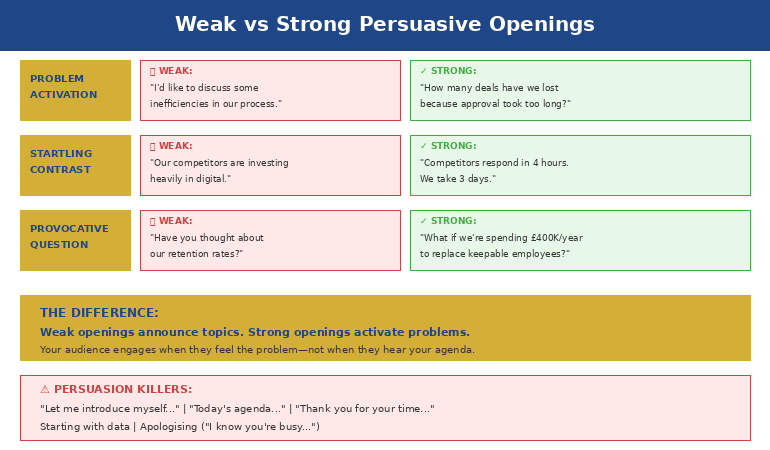
Comparison of weak vs strong persuasive presentation openings - what loses the room vs what captures attention

Three Persuasive Opening Techniques

1. The Problem Activation

Start with a problem your audience already feels—not one you need to convince them exists.

Weak: “I’d like to discuss some inefficiencies in our approval process.”

Strong: “How many deals have we lost because approval took too long?”

The weak version announces a topic. The strong version activates a frustration they’ve already experienced. Now they want to hear your solution.

2. The Startling Contrast

Juxtapose where they are with where they could be.

Weak: “Our competitors are investing heavily in digital transformation.”

Strong: “Our competitors respond to customer inquiries in 4 hours. We take 3 days. That gap is costing us market share every week.”

The contrast creates urgency. The specificity makes it real.

3. The Provocative Question

Ask something they can’t ignore.

Weak: “Have you thought about our retention rates?”

Strong: “What if I told you we’re spending £400,000 a year to replace employees we could have kept?”

The question engages their mind. The specific number demands attention.

These techniques are part of a broader framework for persuasive presentations that work at every level.

What to Avoid in Persuasive Openings

The most common persuasion-killers I’ve seen in 25 years:

  • “Let me introduce myself…” — They don’t care about you yet. Make them care about the problem first.
  • “Today’s agenda covers…” — Agendas are administrative, not persuasive. Save them for after you’ve hooked attention.
  • “Thank you for your time…” — Gratitude is fine, but it signals you’re about to take, not give.
  • Starting with data — Numbers without context invite analysis, not agreement. Establish why the numbers matter first.
  • Apologising — “I know you’re busy” or “This might be boring” primes them to disengage.

Every one of these openings puts the focus on you or on neutral information. Persuasive openings put the focus on a problem the audience cares about solving.

🏆 Master Executive Persuasion

The Executive Buy-In Presentation System teaches the complete psychology of persuading senior leadership—from opening frames to closing techniques that get yes.

Learn More → £199

📧 Join 2,000+ professionals getting weekly presentation insights. Subscribe to The Winning Edge →

Frequently Asked Questions

Why are the first 10 seconds so important for persuasion?

Your audience decides in the first 10 seconds whether to engage or resist. Open with data, and they’re already forming counterarguments. Open by activating a problem they feel, and they’re primed to hear your solution. You’re not just starting—you’re setting the psychological frame for everything that follows. More techniques in our persuasive presentations guide.

What’s the best way to open a persuasive presentation?

Start with a problem your audience already feels, not with your solution. “What would it mean if you could cut approval time in half?” activates desire before resistance. Then your recommendation becomes the answer to their question, not an idea they need to evaluate.

Should I start a persuasive presentation with data or story?

Neither—start with a question or statement that activates a felt problem. Data invites analysis; stories take time to land. A sharp question that hits an existing pain point creates immediate engagement. Save data and stories for after you’ve captured attention. See our full persuasive presentations framework for sequencing.

📥 Free Download: 7 Presentation Frameworks

Get structured structures for persuasive presentations—including opening frameworks that capture attention and prime agreement.

Download Free →

Related: Persuasive Presentations: How to Change Minds Without Manipulation


Mary Beth Hazeldine spent 25 years at JPMorgan, PwC, RBS, and Commerzbank. She’s a clinical hypnotherapist and MD of Winning Presentations.

03 Jan 2026
Presentation hook techniques - how to grab your audience in the first 10 seconds

Presentation Hook: How to Grab Your Audience in the First 10 Seconds [2026]

Your presentation hook is the difference between an audience that leans in and one that checks out. You have roughly 10 seconds to earn their attention — and most presenters waste it on introductions nobody asked for.I learned this lesson painfully.

Early in my banking career, I opened every presentation the same way: “Good morning, I’m Mary Beth from the credit team, and today I’ll be covering…” By the time I finished that sentence, half the room had mentally left.

It took me years — and hundreds of presentations at JPMorgan Chase, PwC, Royal Bank of Scotland, and Commerzbank — to understand what a real presentation hook looks like. Not a greeting. Not an agenda. A pattern interrupt that makes people want to hear what comes next.

In this guide, I’ll show you exactly how to craft a presentation hook that grabs attention — with 12 formulas you can use immediately.

This article expands on the hook techniques in my complete guide: How to Open a Presentation: The First 30 Seconds That Win Your Audience

⭐ Want Presentation Structures That Hook From Slide One?

The hook is the first decision in a working executive presentation method — get this wrong and the rest of the deck rarely recovers.

If you want ready-made frameworks that capture attention from your first slide and maintain it throughout — the Executive Slide System includes opening, middle, and closing structures for every executive scenario.

Explore the Executive Slide System →

What Is a Presentation Hook (And Why Most Presenters Get It Wrong)

A presentation hook is your opening statement — the first thing you say that captures attention and creates interest in what follows.

Most presenters confuse a hook with an introduction. They’re not the same thing:

Introduction (weak): “Hi everyone, my name is Sarah, I’m from the marketing team, and today I’ll be presenting our Q4 campaign results.”

Presentation hook (strong): “We spent £2 million on marketing last quarter. I’m about to show you which half was wasted — and how we fix it.”

See the difference? The introduction tells people who you are and what you’ll cover. The presentation hook tells people why they should care.

A strong presentation hook does three things:

  • Interrupts the pattern. Your audience expects a standard opening. A hook breaks that expectation and triggers attention.
  • Creates a knowledge gap. It raises a question the audience wants answered: “Which half was wasted?”
  • Signals value. It promises that paying attention will be worth their time.

The Presentation Hook Formula: 3 Elements in 10 Seconds

Every effective presentation hook contains three elements, delivered in roughly 10 seconds:

Element 1: The Pattern Interrupt (2-3 seconds)

Something unexpected that breaks through the noise. A number. A question. A bold claim. A moment of silence.

Element 2: The Relevance Anchor (3-4 seconds)

Connect the interrupt to something your audience cares about. Their problem. Their goal. Their fear. Their opportunity.

Element 3: The Forward Pull (3-4 seconds)

Create momentum toward the rest of your presentation. What will they learn? What question will be answered?

Example presentation hook using the formula:

“£4.2 million.” [Pattern Interrupt] “That’s how much delayed decisions cost this company last year.” [Relevance Anchor] “Today I’m going to show you how to cut that number in half.” [Forward Pull]

Total time: 8 seconds. Total impact: The room is paying attention.

Presentation hook formula - Pattern Interrupt (2-3 sec), Relevance Anchor (3-4 sec), Forward Pull (3-4 sec) with what and how for each element

12 Presentation Hook Formulas That Work

Here are 12 structured presentation hook formulas, each with examples you can adapt.

Presentation Hook #1: The Shocking Number

Lead with a statistic that surprises.

Formula: “[Surprising number]. That’s [what it means]. Today I’ll show you [promise].”

Examples:

  • “78%. That’s how many presentations fail to achieve their objective. Today I’ll show you how to be in the other 22%.”
  • “6 hours. That’s how long the average professional spends creating a single presentation. I’m going to show you how to do it in 90 minutes.”
  • “£150,000. That’s what this problem cost us last month. Here’s how we stop the bleeding.”

Presentation Hook #2: The Provocative Question

Ask something that makes people think.

Formula: “What would happen if [provocative scenario]? [Bridge to topic].”

Examples:

  • “What would happen if we lost our three biggest clients tomorrow? That’s not hypothetical — it’s what we’re risking right now.”
  • “How many hours did you spend in meetings last week that could have been emails? Let’s talk about getting that time back.”
  • “What if I told you everything you know about [topic] is holding you back?”

Presentation Hook #3: The Bold Claim

Make a statement that demands attention.

Formula: “[Bold claim]. [Why it matters]. [What you’ll show them].”

Examples:

  • “Your presentation skills are capping your career. Most people never realise it. Today I’ll show you exactly where the ceiling is — and how to break through it.”
  • “Everything you’ve been told about [topic] is wrong. The data proves it. Give me 15 minutes to change your mind.”
  • “This presentation will save you 200 hours this year. I’ll prove it before you leave this room.”

Presentation Hook #4: The Story Opening

Drop your audience into a scene.

Formula: “[Time/place marker]. [Specific detail]. [Why it matters].”

Examples:

  • “Last Tuesday, 4pm. A client called me in a panic. Board presentation in 3 hours, zero slides ready. What happened next is why we’re here today.”
  • “Three years ago, I sat in a boardroom and watched a £5 million deal die. Not because of the numbers. Because of one slide.”
  • “6:45am, Heathrow Terminal 5. I’m rehearsing a pitch that would change my career. What I didn’t know was that I was about to fail spectacularly.”

Your Hook Lands — Then What?

A strong opening earns you 10 seconds of attention. The Executive Slide System gives you the slide structures to keep it — 22 templates, 51 AI prompts, and 15 scenario playbooks that guide your entire presentation. £39, instant access.

Get the Executive Slide System →

Designed for executives who present in high-stakes settings.

Presentation Hook #5: The Contrast

Show the gap between current state and possible state.

Formula: “[Current reality]. [Better alternative]. [What you’ll cover].”

Examples:

  • “Most teams take 6 weeks to make this decision. The best take 6 days. Today I’ll show you what they do differently.”
  • “Your competitors close deals in 30 days. We take 60. That gap is costing us £3 million annually. Here’s how we close it.”
  • “You can spend your weekend preparing this presentation. Or you can use what I’m about to show you and finish by lunch.”

Presentation Hook #6: The Direct Address

Acknowledge what your audience is thinking.

Formula: “I know you’re [thinking/feeling X]. [Redirect]. [Promise].”

Examples:

  • “I know you’ve sat through a dozen presentations about [topic]. This one is different. Give me 10 minutes to prove it.”
  • “You’re probably wondering why we called another meeting. Fair question. The answer is £2 million — and I’ll explain in the next 5 minutes.”
  • “I can see some sceptical faces. Good. Scepticism means you’re paying attention. Let me earn your attention for the next 15 minutes.”

Presentation Hook #7: The “What If” Scenario

Paint a picture of a better future.

Formula: “What if [desirable outcome]? [Make it concrete]. [Your presentation delivers this].”

Examples:

  • “What if you could walk into any presentation with complete confidence? Not fake it — actually feel it. That’s what we’re building today.”
  • “What if every slide you created got the reaction you wanted? I’m going to show you exactly how to make that happen.”
  • “What if this time next year, you’re presenting to the board instead of presenting to your manager? Let me show you the path.”

Presentation Hook #8: The Callback

Reference shared context.

Formula: “In [previous context], [something happened]. Today I have [the answer/update/result].”

Examples:

  • “Last month, someone asked me a question I couldn’t answer. I’ve spent four weeks finding that answer. Here it is.”
  • “Remember the challenge we identified in Q3? We solved it. Here’s how.”
  • “In Monday’s all-hands, the CEO asked us to think differently about [topic]. This presentation is my answer.”

Presentation Hook #9: The Admission

Vulnerability creates connection.

Formula: “I [failure/struggle/mistake]. [What I learned]. [How it helps them].”

Examples:

  • “I spent five years terrified of presenting. Physically sick before every meeting. What I learned getting past that fear is what I’m sharing today.”
  • “Last year, I gave the worst presentation of my career. I’m going to show you exactly what went wrong — so you never make the same mistake.”
  • “I used to think presentation skills didn’t matter for technical people. I was wrong. Here’s what changed my mind.”

Presentation Hook #10: The Challenge

Directly challenge assumptions.

Formula: “[Common belief] is wrong. [Why]. [What you’ll show instead].”

Examples:

  • “You’ve been told to ‘practice more’ to get better at presenting. That advice is incomplete — and it’s why most people plateau. Let me show you what actually works.”
  • “The standard approach to [topic] is costing us money. I’m going to challenge it — and propose something better.”
  • “Most presentation advice is designed for TED talks, not boardrooms. Today I’ll give you what actually works in corporate environments.”

Presentation Hook #11: The Time Pressure

Create urgency.

Formula: “[Deadline/window]. [What’s at stake]. [What we need to decide].”

Examples:

  • “We have 30 days to make this decision. After that, the opportunity closes. Here’s what you need to know to decide.”
  • “Our competitors are moving now. Every week we wait costs us market share. Today I’ll show you how we catch up.”
  • “The budget cycle closes in two weeks. This presentation is your case for the resources you need. Let me show you how to make it.”

Presentation Hook #12: The Promise

Tell them exactly what they’ll get.

Formula: “By the end of this presentation, you’ll [specific outcome]. [Why it matters].”

Examples:

  • “By the end of this presentation, you’ll have a complete action plan for [goal]. Not theory — specific steps you can start today.”
  • “In 15 minutes, you’ll know exactly how to [skill]. I’ll give you a framework you can use in your next meeting.”
  • “When you leave this room, you’ll have everything you need to make this decision with confidence.”

If you want a structured approach to building presentations that hook from the first slide, the Executive Slide System gives you 22 templates with built-in narrative frameworks.

How to Choose the Right Presentation Hook

Match your presentation hook to your context:

For executive audiences: Use Shocking Number, Contrast, Direct Address, or Promise. Executives want efficiency — get to the point fast.

For sales presentations: Use Provocative Question, What If, or Bold Claim. Create desire for the outcome you’re offering.

For team meetings: Use Story Opening, Callback, or Admission. Build connection before content.

For conference talks: Use Bold Claim, Admission, or Challenge. Stand out from other speakers.

For difficult conversations: Use Direct Address or Admission. Acknowledge the tension, then move forward.

Which presentation hook for which situation - matching guide for executive audiences, sales presentations, team meetings, conference talks, and difficult news

Presentation Hook Mistakes to Avoid

Even good hooks can fail if you make these mistakes:

Mistake 1: The hook doesn’t connect to your content. If you open with a dramatic story but your presentation is about spreadsheet updates, you’ve created whiplash. Your hook must lead naturally into your topic.

Mistake 2: The hook is longer than 15 seconds. A hook should be punchy. If you’re still “hooking” after 15 seconds, you’re just giving a long introduction.

Mistake 3: The hook makes promises you don’t keep. If you say “I’m going to change how you think about X,” you’d better actually change how they think about X. Broken promises destroy trust.

Mistake 4: The hook is all style, no substance. Gimmicks wear thin. Your hook should signal real value, not just be clever for cleverness’s sake.

Presentation Hook: Common Questions

How long should a presentation hook be?

10-15 seconds maximum — roughly 25-40 words. Your hook should capture attention quickly, then let your content do the work.

Should I memorise my presentation hook?

Yes, word-for-word. Your hook is the one part of your presentation you should know cold. This ensures smooth delivery even when you’re nervous.

What if my topic is boring?

No topic is inherently boring — but the way it’s presented can be. Find the human element: What problem does it solve? What’s at stake? Who benefits? Your hook should surface that relevance.

Can I use the same presentation hook for different audiences?

Usually not. Different audiences care about different things. Adapt your hook to what matters most to the specific people in the room.

Your Presentation Hook Toolkit

You now have 12 formulas for crafting a presentation hook that grabs attention. Here’s how to go deeper:

Need the Full Presentation Framework — Not Just the Hook?

The hook opens the door. The Executive Slide System builds the room. 22 executive slide templates with built-in narrative flow — so your opening, middle, and close work as one coherent argument. £39, instant access.

Get the Executive Slide System →

Designed for board meetings, investor pitches, and leadership presentations.


Related Articles:

Frequently Asked Questions

How long should a presentation hook be?

A presentation hook should be 10–15 seconds at most. The most effective hooks are a single sentence — sometimes just a number or question — that creates immediate curiosity before you transition to your main content.

Can you use the same presentation hook for different audiences?

The structure can stay the same, but the content should change. A hook that works for a board meeting won’t work for a team update. Adapt the specifics — the number, the pain point, the surprise — to match what each audience cares about.

What if my presentation hook falls flat?

If the room doesn’t react, don’t pause and wait — move straight into your first point with confidence. Sometimes hooks land quietly; the audience is processing, not disengaged. Keep your energy steady and let the content build.

Should a presentation hook always be dramatic?

No. Quiet hooks work just as well — sometimes better. A calm, specific statement like “There are three decisions in this room today, and two of them are already made” can be more effective than theatrical delivery. Match the tone to your audience and setting.

📧 Get The Winning Edge

Weekly presentation techniques and frameworks from 25 years in corporate boardrooms.

Subscribe Free →


Mary Beth Hazeldine spent 25 years in corporate banking at JPMorgan Chase, PwC, Royal Bank of Scotland, and Commerzbank. She now advises professionals on high-stakes presentations through Winning Presentations.

03 Jan 2026
How to open a presentation - the first 30 seconds that win your audience

[2026]How to Open a Presentation: The First 30 Seconds That Win Your Audienc

You have 30 seconds. That’s how long your audience takes to decide whether you’re worth their attention. Most presenters lose them before slide two.I learned this the hard way.

Early in my banking career at JPMorgan Chase, I opened a critical client pitch with: “Good morning, I’m Mary Beth, and today I’ll be walking you through our Q3 performance…”

I watched the CFO check his phone before I finished the sentence.

That presentation didn’t fail because of bad data or weak recommendations. It failed in the first 30 seconds — because I didn’t know how to open a presentation properly.

Over 25 years and hundreds of executive presentations later, I’ve developed a systematic approach to opening presentations that commands attention. Not tricks. Not gimmicks. A framework that works whether you’re pitching to investors, updating your board, or presenting to your team.

In this guide, I’ll show you exactly how to open a presentation that makes your audience lean in — with 20 techniques you can use immediately.

⭐ Want a Framework for Opening Every Presentation?

If you want ready-made slide structures that guide your opening, middle, and close — the Executive Slide System includes 22 templates for every executive scenario, so you always know how to start strong.

Explore the Executive Slide System →

Why How You Open a Presentation Determines Everything That Follows

The opening of your presentation isn’t just important — it’s decisive.

Research in cognitive psychology shows that first impressions form within milliseconds and are remarkably resistant to change. In presentations, this means your audience is making judgments about your competence, credibility, and whether you’re worth listening to before you’ve finished your first paragraph.

Here’s what happens neurologically when you open a presentation:

The attention gate opens (or closes). Your audience’s prefrontal cortex decides whether to allocate cognitive resources to processing your message. A strong opening triggers engagement. A weak one triggers the “this isn’t worth my full attention” response — and that phone comes out.

Expectations crystallise. Within 30 seconds, your audience forms predictions about the entire presentation. Will this be valuable? Will it be boring? Will it waste my time? These predictions become self-fulfilling — people find what they expect to find.

Social proof activates. In group settings, audience members look to each other for cues. If you open strong and capture the room, others follow. If you stumble, scepticism spreads.

The executives I work with — in corporate banking and financial services — all say the same thing: they know within 30 seconds whether a presentation will be good. Learning how to open a presentation properly isn’t a nice-to-have. It’s the difference between being heard and being ignored.

The 5 Fatal Mistakes When Opening a Presentation

Before I show you what works, let’s eliminate what doesn’t. These opening mistakes kill presentations:

Mistake 1: The Autobiographical Opening

“Good morning, my name is Sarah, I’m the Director of Marketing, and I’ve been with the company for seven years…”

Unless you’re speaking to complete strangers, your audience knows who you are. Even if they don’t, they don’t care — yet. Your credentials matter only after you’ve demonstrated value. Opening with your biography is like a restaurant describing the chef’s CV before letting you taste the food.

Mistake 2: The Agenda Recitation

“Today I’m going to cover four main areas: first, the market analysis; second, our competitive position; third, the proposed strategy; and fourth, the implementation timeline…”

Agendas are useful — but not as openings. They tell people what’s coming without giving them a reason to care. It’s like a film trailer that just lists the scenes in order.

Mistake 3: The Apology Opening

“I know you’re all busy, so I’ll try to keep this brief…” or “I’m not really an expert on this, but…” or “Sorry, I’m a bit nervous…”

Apologetic openings destroy your authority before you’ve established it. They signal that even you don’t think what you’re saying is worth their time. Never apologise for presenting.

Mistake 4: The Technical Difficulties Opening

“Can everyone see this okay? Let me just… hold on… is this working? Sorry, technical issues…”

Test your technology before you present. Technical problems in your opening signal poor preparation and immediately put you on the back foot.

Mistake 5: The Housekeeping Opening

“Before we begin, just a few housekeeping items — toilets are down the hall, fire exits are here and here, please silence your phones…”

Housekeeping can wait. Or be handled by someone else. Or be skipped entirely. Don’t waste your most valuable real estate on logistics.

Every one of these mistakes shares the same flaw: they’re about you, not your audience. A powerful opening answers one question immediately: why should I pay attention to this?

5 fatal presentation opening mistakes to avoid - the autobiography, agenda recitation, apology, tech check, and housekeeping

How to Open a Presentation: The 30-Second Framework

After analysing thousands of presentations — the ones that succeeded and the ones that failed — I’ve identified a framework that consistently works. Here’s how to open a presentation in 30 seconds:

Second 0-10: The Hook

Capture attention with a surprising statement, question, statistic, or story opening. This is your “pattern interrupt” — something that breaks through the noise and signals “this is different.”

Second 10-20: The Relevance Bridge

Connect your hook to something your audience cares about. Why does this matter to them? What’s at stake? This transforms curiosity into investment.

Second 20-30: The Promise

Tell them what they’ll get from paying attention. What will they know, be able to do, or decide by the end? This creates forward momentum.

Let me show you this framework in action with 20 specific techniques.

The 30-second presentation opening framework - Hook (0-10 seconds), Relevance (10-20 seconds), Promise (20-30 seconds)

How to Open a Presentation: 20 structured Techniques

Here are 20 ways to open a presentation that commands attention. Each one follows the 30-second framework and can be adapted to any context.

Category 1: Question Openings

Questions activate your audience’s brain. They can’t help but start formulating answers — which means they’re engaged.

Technique 1: The Pain Point Question

“How many hours did your team spend on presentations last month? For most companies I work with, the answer is shocking — and most of that time is wasted. Today I’m going to show you how to cut that number by 70%.”

Technique 2: The Thought-Provoking Question

“What would you do with an extra £2 million in your budget? That’s not hypothetical — it’s what’s at stake in the decision we’re making today.”

Technique 3: The Show of Hands Question

“By show of hands, how many of you have sat through a presentation this month that should have been an email? [Wait for hands] Keep your hand up if you’ve given one. [Pause] Today we’re fixing that.”

Technique 4: The Rhetorical Challenge

“What if everything you believe about [topic] is holding you back? In the next 15 minutes, I’m going to challenge three assumptions that are costing this company money.”

Category 2: Story Openings

Stories are neurologically powerful. They release oxytocin, activate multiple brain regions, and are remembered 22 times more than facts alone.

Technique 5: The Personal Failure Story

“Three years ago, I nearly lost our biggest client. Not because of bad work — because of a presentation I thought was good but wasn’t. What I learned from that failure is why we’re here today.”

Technique 6: The Client Success Story

“Last month, a client called me in a panic. Board presentation in four hours, zero slides ready. By the time she walked into that boardroom, she had 12 polished slides and the confidence to deliver them. The board approved her £5 million proposal. Here’s the method she used.”

Technique 7: The “I Was There” Story

“I was sitting in the boardroom at [Company] when the CEO said something that changed how I think about [topic]. She said: ‘[Quote].’ Today I’m going to show you how to apply that insight.”

Technique 8: The Contrast Story

“Two teams. Same data. Same deadline. Same stakeholders. One got their proposal approved in the first meeting. The other is still waiting after six months. The difference? How they opened their presentation.”

Your Opening Sets the Frame — Your Slides Keep It

A strong opening earns attention. The Executive Slide System gives you the structures to sustain it — 22 templates, 51 AI prompts, and 15 scenario playbooks for every executive presentation. £39, instant access.

Get the Executive Slide System →

Designed for executives who present in high-stakes settings.

Category 3: Data Openings

The right statistic stops people in their tracks. The key word is “right” — it needs to be surprising, relevant, and immediately graspable.

Technique 9: The Shocking Statistic

“£2.3 million. That’s how much this problem cost us last year. Today I’m going to show you how to cut that number in half — with an investment of £150,000.”

Technique 10: The Comparison Statistic

“Our competitors close deals in 45 days. We take 78. That 33-day gap is costing us £4 million annually in delayed revenue. This presentation is about closing that gap.”

Technique 11: The Time-Based Statistic

“In the time it takes to give this presentation — 15 minutes — we’ll lose £12,000 to [problem]. By the end, you’ll know how to stop that leak.”

Technique 12: The Personal Statistic

“I’ve given over 500 presentations in my career. Exactly 3 of them changed my life. Today I’m going to show you what made those 3 different — and how to apply it to your next presentation.”

Category 4: Bold Statement Openings

Bold statements signal confidence and create immediate intrigue. They work when you can back them up.

Technique 13: The Contrarian Statement

“Everything you’ve been told about [topic] is wrong. The conventional wisdom is costing companies millions — and I have the data to prove it.”

Technique 14: The Prediction Statement

“By 2027, half the companies in this industry will be gone. The ones that survive will have done one thing differently. That’s what we’re here to discuss.”

Technique 15: The Promise Statement

“In the next 15 minutes, I’m going to give you a framework that will cut your presentation prep time from 6 hours to 90 minutes. And I’ll prove it works before you leave this room.”

Technique 16: The Challenge Statement

“I’m going to challenge you to think differently about [topic]. Some of you will resist. By the end, I think you’ll agree the change is worth it.”

Category 5: Situational Openings

These openings acknowledge the specific context and create immediate relevance.

Technique 17: The Current Event Opening

“You’ve seen the news this morning about [relevant event]. What you might not realise is how directly it affects what we’re deciding today. Let me show you the connection.”

Technique 18: The Callback Opening

“In our last meeting, someone asked a question I couldn’t fully answer. I’ve spent the past two weeks finding that answer — and it led me somewhere unexpected.”

Technique 19: The Elephant in the Room Opening

“I know what you’re thinking: not another presentation about [topic]. I thought the same thing before I saw these numbers. Give me 10 minutes to change your mind.”

Technique 20: The Direct Address Opening

“You asked for a recommendation on [topic]. My recommendation is [answer]. The rest of this presentation is the evidence. If you’re convinced after 10 minutes, we can stop early.”

20 structured presentation opening techniques organized by category - Questions, Stories, Data, Bold Claims, and Situational approaches with audience matching guide

If you want a structured approach to building presentations that open strong, the Executive Slide System gives you 22 templates with built-in opening frameworks for every executive scenario.

How to Open a Presentation: Matching Technique to Context

Not every opening works for every situation. Here’s how to choose:

For Board Presentations

Best techniques: Direct Address (#20), Shocking Statistic (#9), Promise Statement (#15)

Board members are time-poor and decision-focused. Open with your recommendation or the key number, then support it. Don’t make them wait.

For Sales Pitches

Best techniques: Pain Point Question (#1), Client Success Story (#6), Comparison Statistic (#10)

Sales openings should connect to the prospect’s world immediately. Lead with their problem or a result someone like them achieved.

For Team Meetings

Best techniques: Show of Hands (#3), Personal Failure Story (#5), Contrast Story (#8)

Teams respond to connection and authenticity. Stories and interactive elements build engagement.

For Conference Talks

Best techniques: Contrarian Statement (#13), Personal Statistic (#12), Thought-Provoking Question (#2)

Conference audiences have chosen to be there but are easily distracted. Open with something memorable and different.

For Investor Pitches

Best techniques: Time-Based Statistic (#11), Prediction Statement (#14), “I Was There” Story (#7)

Investors want to see pattern recognition and urgency. Show you understand where the market is going and why now matters.

How to Open a Presentation: The First Slide Question

Your opening isn’t just what you say — it’s what you show. Here’s how to handle your first slide:

Rule 1: Your first slide should support your opening, not replace it.

If you’re opening with a statistic, your first slide might display that number in large text. If you’re opening with a question, your first slide might show that question. If you’re opening with a story, your first slide might be a simple image that sets the scene.

Rule 2: Avoid the title card trap.

The standard “Title / Your Name / Date / Company Logo” slide is wasted space. It tells your audience nothing and creates no engagement. Skip it or replace it with something that hooks.

Rule 3: Consider starting with a black screen.

For high-stakes presentations, try opening with no slide at all. Just you, speaking directly to the room. Advance to your first visual only after you’ve delivered your hook. This creates presence and signals confidence.

For more on this, see: The First 30 Seconds: Why Most Presenters Lose Their Audience Immediately

How to Open a Presentation: Practice Protocol

Knowing how to open a presentation isn’t enough — you need to execute it smoothly. Here’s my practice protocol:

Step 1: Write your opening word-for-word.

Don’t wing the most important 30 seconds of your presentation. Script it precisely.

Step 2: Time it.

Your opening should be 30-45 seconds maximum. If it’s longer, cut it.

Step 3: Memorise it.

Your opening is the one part of your presentation you should know cold. You should be able to deliver it while walking into the room, without notes, without slides.

Step 4: Practice it out loud 10 times.

Not in your head — out loud. Record yourself. Listen back. Refine.

Step 5: Practice the transition.

The move from your opening to your first main point should be seamless. Practice this bridge until it’s automatic.

This protocol takes 30 minutes. It’s the highest-ROI time you can spend on any presentation.

How to Open a Presentation: Common Questions

How long should a presentation opening be?

30-45 seconds maximum. That’s roughly 75-100 words spoken at a natural pace. Your opening should hook attention, establish relevance, and create forward momentum — then get out of the way.

Should I introduce myself when opening a presentation?

Only if the audience genuinely doesn’t know who you are. Even then, keep it to one sentence after your hook, not before it. Establish value first, credentials second.

How do I open a presentation when I’m nervous?

Memorise your opening word-for-word. When you know your first 30 seconds cold, you can deliver them on autopilot while your nerves settle. Most presentation anxiety peaks in the first minute — a solid, memorised opening gets you through it.

What if my opening doesn’t land?

Keep going. Don’t acknowledge it, don’t apologise, don’t try a different opening. Commit to your approach and trust your content. One flat moment doesn’t define a presentation.

Can I use humour to open a presentation?

Only if you’re genuinely funny and the context supports it. Bad humour is worse than no humour. If you’re unsure, use a different technique. A compelling question or statistic is safer and often more effective than a joke.

Your Presentation Opening Toolkit

Now you know how to open a presentation. Here are resources to help you execute:

Want Slide Structures That Open Strong Every Time?

The Executive Slide System gives you 22 executive slide templates with built-in opening frameworks — board meetings, investor pitches, quarterly reviews. Stop building from blank slides and start with structures that work. £39, instant access.

Get the Executive Slide System →

Designed for board meetings, investor pitches, and leadership presentations.

🎓 Master High-Stakes Presentations

Knowing how to open a presentation is just the beginning. The Executive Buy-In Presentation System teaches you how to structure for approval, handle tough questions, and deliver with authority.

  • 7 modules of video training
  • Opening frameworks for every executive scenario
  • Live practice sessions with feedback
  • AI prompt sequences that actually work

Learn More About the Course →


Related Articles:

Frequently Asked Questions

What is the best way to open a presentation?

Open with something your audience cares about — a problem they face, a question that matters to them, or a specific result they want. The worst openings are self-introductions and agenda slides. Your first 30 seconds should answer the audience’s unspoken question: “Why should I pay attention?”

How do you open a presentation without being nervous?

Memorise your first two sentences word-for-word. This gives you a reliable start while your nerves settle. Once you’ve delivered those first lines confidently, adrenaline works for you rather than against you. Structure removes uncertainty, and uncertainty is what amplifies nerves.

Should you start a presentation with a joke?

Only if it’s genuinely relevant to your topic and you’re confident in the delivery. Most business presentations are better served by a striking fact, a problem statement, or a short story. A joke that misses creates awkwardness; a strong opening statement creates authority.

How do you open a presentation to senior executives?

Lead with the decision or recommendation, not the background. Senior executives want to know what you’re asking for and why it matters before they’ll invest attention in your evidence. Open with the outcome, then work backwards through the logic.

📧 Get The Winning Edge

Weekly presentation techniques, opening scripts, and frameworks from 25 years in corporate boardrooms.

Subscribe Free →


Mary Beth Hazeldine spent 25 years in corporate banking at JPMorgan Chase, PwC, Royal Bank of Scotland, and Commerzbank. She now advises professionals on high-stakes presentations through Winning Presentations. She advises executives across financial services, healthcare, technology, and government on structuring presentations for high-stakes scenarios.

16 Dec 2025
The First 30 Seconds: Why Most Presenters Lose Their Audience Immediately

The First 30 Seconds: Why Most Presenters Lose Their Audience Immediately

I’ve sat through over 500 executive presentations in my career.

Board meetings at JPMorgan. Investor pitches at PwC. Strategy sessions at RBS. Budget reviews at Commerzbank.

And I can tell you the exact moment most presenters lose their audience: somewhere between second 5 and second 30.

Not minute 5. Not slide 5. Second 5.

After 25 years in investment banking and 16 years training executives, I’ve seen the pattern so many times I can predict it. The presenter walks up, clears their throat, and says some version of:

“Good morning everyone. Thanks for having me. Today I’m going to talk about our Q3 results and the strategic initiatives we’re planning for next year. I’ll try to keep this brief because I know you’re all busy.”

And just like that — before a single piece of content has been delivered — the room is gone.

Phones come out. Eyes glaze over. The CFO starts reviewing emails. The CEO is mentally planning their next meeting.

The presenter hasn’t even started, and they’ve already lost.

What’s Actually Happening in Those First 30 Seconds

Here’s what most people don’t understand about audiences: they’re not neutral. They’re not sitting there thinking, “I can’t wait to hear what this person has to say.”

They’re thinking: “Is this going to be worth my time?”

That’s the only question running through their minds. And they answer it fast — usually within 10-30 seconds.

Neuroscientists call this the “primacy effect.” We form impressions quickly and then spend the rest of our time confirming them. If you open weak, you’re fighting that first impression for the next 20 minutes.

If you open strong, everything that follows lands better.

The stakes couldn’t be higher. And most presenters waste this moment completely.

The Three Opening Mistakes I See Every Week

After training over 10,000 executives, I’ve identified the three opening mistakes that kill presentations before they start:

Mistake #1: The Throat-Clearing Opener

“So, um, thanks for having me. Let me just get my slides up here… okay, there we go. So today I’m going to talk about…”

This signals nervousness, lack of preparation, and — worst of all — that what’s coming isn’t important enough to be planned properly.

Mistake #2: The Apology Opener

“I know you’re all busy, so I’ll try to be quick…”

You’ve just told the room that your content isn’t valuable enough to deserve their full attention. Why would they give it to you?

Mistake #3: The Agenda Opener

“Today I’m going to cover three things: first, our Q3 results; second, our challenges; and third, our plan for next year.”

Boring. Predictable. Zero reason to pay attention. You’ve just told them everything they’re going to hear, so now they don’t need to listen.

The Pattern I’ve Noticed: The executives who get promoted, who close deals, who get their budgets approved — they never open this way. They’ve learned (often through painful experience) that the first 30 seconds determine everything that follows.

Own Every Presentation From the First Second

The first 30 seconds set the tone for everything that follows. The Executive Slide System gives you the exact opening frameworks senior leaders use to command attention and establish authority from the very first word.

Executive Slide System →

What I Learned from a £4 Million Mistake

Early in my banking career, I watched a senior colleague lose a £4 million deal in the first 30 seconds of a pitch.

He walked in, fumbled with the projector, apologized for being “a bit under the weather,” and opened with: “So, I know you’ve seen a lot of these pitches, but hopefully we can show you something different today.”

Hopefully? Hopefully?

The investors checked out immediately. I watched their body language shift — arms crossed, eyes down, phones appearing. The rest of the presentation was technically excellent, but it didn’t matter. The decision had already been made.

Afterwards, the lead investor told us: “You lost me at ‘hopefully.’ If you’re not certain your solution is different, why should I be?”

That moment changed how I thought about presentations forever.

If your first slides need to earn attention instead of losing it, The Executive Slide System gives you 22 ready-made templates to start from.

The 30-Second Framework That Changes Everything

After years of testing, refining, and watching what actually works in high-stakes situations, I developed a simple framework for the first 30 seconds:

Seconds 1-5: PRESENCE
Don’t speak immediately. Walk to your spot. Plant your feet. Make eye contact with three people. Breathe. This silence signals confidence and commands attention.

Seconds 6-15: HOOK
Open with something that creates curiosity — a surprising statistic, a bold statement, a relevant story, or a thought-provoking question. Make them need to hear what comes next.

Seconds 16-25: RELEVANCE
Connect your hook to their world. Why should they care? What’s at stake for them? Make it personal and immediate.

Seconds 26-30: PREVIEW
Tell them exactly what they’ll get from the next few minutes. Be specific about the value you’re delivering.

That’s it. Thirty seconds to transform your presentation from forgettable to commanding.

After the First 30 Seconds, Then What?

The Executive Slide System gives you the complete structure to follow through on a powerful opening — so every presentation you deliver is as strong at the end as it was at the start.

Executive Slide System →

Master Your First 30 Seconds (And Everything After)

The 30-Second Framework is just one module in my comprehensive AI-Enhanced Presentation Mastery course on Maven.

Over 6 weeks, you’ll learn:

  • How to open any presentation with confidence
  • The structure that keeps executives engaged
  • How to handle tough Q&A without freezing
  • Using AI tools to cut preparation time by 80%
  • The closing techniques that drive action

This isn’t theory — it’s the exact system I’ve used to train 10,000+ executives at companies from startups to leading organisations.

Live cohort starts January 2026.

Join the Course →

Why This Matters More Than Ever

In an age of Zoom fatigue and shrinking attention spans, the first 30 seconds matter more than they ever have.

Your audience has more distractions than ever. More tabs open. More messages pinging. More reasons to tune out.

But here’s what hasn’t changed: humans are still wired to pay attention to what’s interesting, relevant, and delivered with confidence.

Master those first 30 seconds, and you’ve earned the right to the next 30 minutes.

Waste them, and you’re talking to a room that’s already moved on.

The choice is yours.


Frequently Asked Questions

Why are the first 30 seconds of a presentation so important?

Research on first impressions shows audiences form judgements about a speaker’s credibility within seconds. If you open weakly — fumbling with slides, apologising, or reading your agenda — the audience mentally downgrades everything that follows. A strong opening creates a halo effect that carries through the entire presentation.

How do I make a strong first impression in a presentation?

Pause before speaking, make eye contact with the room, and deliver your opening line with conviction. Your first sentence should be surprising, relevant, or emotionally resonant — not logistical. Physical presence matters as much as words: stand still, speak clearly, and project confidence even if you do not feel it.

What should I say in the first 30 seconds of a presentation?

Lead with a hook: a striking observation, a question the audience has been thinking, or a brief scenario that illustrates the problem you are solving. Follow immediately with why this matters to them specifically. Do not introduce yourself or outline your agenda — save that for after you have earned their attention.

How do I recover if I start a presentation badly?

Pause, take a breath, and reset. You can say something like “Let me start with the most important point” — this reframes the opening without drawing attention to the stumble. Audiences are forgiving of a rocky start if the content that follows is strong. The recovery matters more than the mistake.

Mary Beth Hazeldine spent 25 years in investment banking at JPMorgan, PwC, RBS, and Commerzbank before becoming an executive presentation coach. She has trained over 10,000 executives and her clients have raised over £250 million using her presentation frameworks. Learn more at Winning Presentations.

One More Thing — Before You Go

Owning the first 30 seconds is the hardest part. The Executive Slide System gives you the structure to back it up — a complete decision-first framework that keeps executives with you all the way through.

Explore the System

Related Reading:

08 Dec 2025
The 60-Second Board Opening Framework showing the 4 elements: State Action Required, Establish Timeline, Preview Recommendation, Set Discussion Expectations

How to Open a Board Meeting So Everyone Knows What’s Expected

I watched a CFO lose a £4 million approval in eleven words.

“Let me walk you through our Q3 performance and then discuss…”

That was it. Eleven words. The moment he said “walk you through,” I saw three directors reach for their phones. By the time he got to his actual request — 22 minutes later — the room had mentally moved on. The board deferred his decision to next quarter. The delay cost his company £400K in interim licensing fees.

I’ve sat in hundreds of board presentations over 25 years at JPMorgan Chase, PwC, Royal Bank of Scotland, and Commerzbank. The pattern is unmistakable: presenters who open with context and background lose the room in 60 seconds. Those who open with clarity about what’s needed get decisions in 15 minutes.

Directors aren’t impatient — they’re fiduciaries with packed agendas. When you don’t establish expectations immediately, they spend your entire presentation wondering “what does this person actually want from me?”

That uncertainty kills decisions.

Here’s exactly how to open a board meeting so everyone knows what’s expected — and you walk out with the outcome you need.

The 60-Second Board Opening Framework showing the 4 elements: State Action Required, Establish Timeline, Preview Recommendation, Set Discussion ExpectationsThe 4-part framework that’s helped my clients secure board approvals for major strategic initiatives

Presenting to an open board meeting in the next 30 days?

The Executive Slide System includes board presentation templates built for open sessions — with AI prompt cards so you can customise the narrative for your specific proposal in under an hour.

If you want a ready-made framework for executive presentations: Explore The Executive Slide System →

Templates, AI prompts, and scenario playbooks for building board-ready slides.

Why the First 60 Seconds Determine Everything

Board meetings operate differently from other executive meetings. Directors carry fiduciary responsibility. They’re evaluating risk, thinking about governance implications, mentally categorising every agenda item as “decision required” or “information only.”

When you open with “Let me walk you through our Q3 performance,” directors enter passive information-receiving mode. They’ll listen, nod, ask polite questions. But they’re not primed to decide anything.

When you open with “I’m requesting board approval for a £2M infrastructure investment with expected 18-month payback,” the dynamic shifts entirely. Directors immediately know their role. They’re evaluating a specific decision with specific parameters. Questions become focused. Discussion becomes productive.

The way you open a board meeting establishes everything that follows.

The 4-Part Framework for Your First 60 Seconds

Your opening slide and opening words should cover four elements — in this order:

1. State the Board Action Required

Lead with exactly what you need. Not context. Not background. The action.

Weak: “Today I’ll be presenting our technology modernisation initiative and the progress we’ve made over the past quarter.”

Strong: “I’m requesting board approval for Phase 2 of our technology modernisation — a £2M investment over 18 months.”

When directors hear the action first, everything that follows supports a specific decision. They’re not wondering where you’re headed.

2. Establish the Timeline

Tell directors when you need the decision and why timing matters.

Example: “I’m requesting approval today because vendor contracts expire January 15th. Delaying this decision by one quarter costs approximately £400K in interim licensing.”

This isn’t manipulation — it’s information directors need to prioritise their attention. Without timeline clarity, the default response becomes “let’s revisit this next quarter.”

3. Preview Your Recommendation

Give away your conclusion immediately. Don’t make directors wait 20 minutes to discover what you think they should do.

Example: “My recommendation is to approve the full £2M investment with Vendor A, rather than the phased approach or Vendor B alternative. I’ll walk you through the analysis supporting this recommendation.”

This might feel counterintuitive — shouldn’t you build to your recommendation? No. When directors know your position upfront, they can evaluate your supporting evidence against a clear thesis. They’re engaged, not guessing.

4. Set Discussion Expectations

Tell directors how you’ve structured the presentation and where you want their input.

Example: “I’ll take 10 minutes to walk through the business case and risk assessment. I’d particularly value the board’s perspective on vendor selection criteria and implementation timeline. I’ve reserved 15 minutes for questions.”

This maintains your control of the discussion while inviting meaningful input exactly where you need it.

Want the exact template?

The Executive Slide System includes a board meeting template with this opening structure built in — plus 9 other executive presentation frameworks. The same templates clients have used to secure approvals totalling over

Side-by-side comparison showing a weak board meeting opening versus a strong opening that gets decisions
The difference between getting a decision and getting a deferral

The Complete 60-Second Script

Here’s the exact script I give my clients. Adapt it to your specific situation:

“Good morning. I’m here to request board approval for [specific action] — [financial amount or scope] with [timeline or payback period].

I’m requesting this decision today because [urgency/timeline driver]. Delaying would result in [cost of inaction].

My recommendation is [clear recommendation]. I’ll walk you through the business case and risk assessment in 10 minutes, then I’d welcome the board’s questions — particularly on [specific areas where you want input].

Let me start with [first section].”

That’s 45-60 seconds. Every director now knows exactly what’s expected. No confusion. No wondering what you want. Just clarity — and a room that’s ready to decide.

The 60-second board meeting opening script template with checklist
Save this script template — it works for any board presentation

If you want to start your board meetings with a slide deck that sets the right tone, The Executive Slide System gives you 22 ready-made templates to start from.

5 Opening Mistakes That Kill Decisions

After hundreds of board presentations, these are the patterns I see destroy momentum before it starts:

Mistake 1: Opening with context. “Let me give you some background…” signals a long presentation ahead. Directors mentally check out. Start with the action; add context only as needed to support your ask.

Mistake 2: Opening with an agenda slide. Directors don’t need to see “Background, Analysis, Options, Recommendation, Next Steps.” They need to know what you want them to decide. Use your first slide for the Board Action Requested, not a table of contents.

Mistake 3: Opening without a clear ask. “I wanted to share our progress on digital transformation” makes directors think: “Why is this at board level? What am I supposed to do with this?” Always connect to a decision — even if it’s “I’m seeking board feedback on our approach.”

Mistake 4: Opening with apologies. “I know you’re busy” or “I’ll try to keep this brief” undermines your authority before you’ve established it. Open with confidence and clarity, not apology.

Mistake 5: Not knowing your number. “Approximately £2 million” sounds unprepared. “£2.1 million over 18 months, with £800K in Year 1” sounds like someone who’s done the work. Know your numbers cold.

After the 5 mistakes section, before "Adapting the Framework for Different Scenarios"
Avoid these five mistakes and you’re already ahead of 80% of presenters

Adapting the Framework for Different Scenarios

Requesting budget approval: “I’m requesting board approval for [amount] to [purpose], with [payback period/ROI]. Decision needed by [date] because [timeline driver].”

Presenting strategic recommendations: “I’m seeking board endorsement of [strategic direction], which requires [resource/commitment]. This supports our [strategic priority] and positions us for [outcome].”

Reporting on progress: “I’m providing the quarterly update on [initiative]. We’re [on track/behind/ahead] with [key metric]. I’m seeking board feedback on [specific decision point] and requesting [any needed approvals].”

Presenting risk or bad news: “I need to bring a [risk/issue] to the board’s attention. [State the issue directly]. I’m recommending [mitigation approach] and requesting [any needed authorisation].”

Open board meetings are different. The templates need to be too.

The Executive Slide System includes board presentation templates structured for open sessions — with layouts for agenda framing, stakeholder Q&A, and decision slides.

Executive Slide System — £39, instant access.

Designed for executives presenting where decisions are made.

Frequently Asked Questions

What if I’m not requesting a decision — just providing an update?

Even updates need a point. Clarify what you want from directors: “I’m providing this update and seeking the board’s guidance on [specific question]” or “I’m sharing this for awareness and will return next quarter with a formal proposal.” Updates without purpose waste board time.

What if someone else chairs the meeting and introduces me?

Still lead with your own framing. After the introduction, say “Thank you. I’m here today to request…” Don’t rely on the chair to establish your purpose.

How detailed should my opening be?

Cover the four elements in 60 seconds or less. Details come in the body of your presentation. The opening establishes the frame — it doesn’t make the entire case.

What if I’m not sure the board will approve?

Still lead with a clear recommendation. Hedging your opening (“I wanted to explore whether the board might consider…”) signals uncertainty. If you’ve done the analysis and believe in your recommendation, present it with conviction. Let the board decide — that’s their job.

Get the Complete Board Presentation System

The Executive Slide System includes the board meeting template with this exact opening structure — plus the complete framework for business case, risk assessment, and recommendation slides.

Clients have used these templates to secure board approvals totalling over 10 templates. 30 AI prompts. Instant download.

GET INSTANT ACCESS →

30-day money-back guarantee • Instant PDF download • Use on unlimited presentations


Related: How to Create Executive Presentations That Get Approved in 2025

📧 The Winning Edge Newsletter

Weekly insights on executive presentations, QBR strategies, and what’s actually working in boardrooms right now.

Subscribe Free →