

The First 30 Seconds: Why Most Presenters Lose Their Audience Immediately
I’ve sat through over 500 executive presentations in my career.
Board meetings at JPMorgan. Investor pitches at PwC. Strategy sessions at RBS. Budget reviews at Commerzbank.
And I can tell you the exact moment most presenters lose their audience: somewhere between second 5 and second 30.
Not minute 5. Not slide 5. Second 5.
After 25 years in investment banking and 16 years training executives, I’ve seen the pattern so many times I can predict it. The presenter walks up, clears their throat, and says some version of:
“Good morning everyone. Thanks for having me. Today I’m going to talk about our Q3 results and the strategic initiatives we’re planning for next year. I’ll try to keep this brief because I know you’re all busy.”
And just like that — before a single piece of content has been delivered — the room is gone.
Phones come out. Eyes glaze over. The CFO starts reviewing emails. The CEO is mentally planning their next meeting.
The presenter hasn’t even started, and they’ve already lost.
What’s Actually Happening in Those First 30 Seconds
Here’s what most people don’t understand about audiences: they’re not neutral. They’re not sitting there thinking, “I can’t wait to hear what this person has to say.”
They’re thinking: “Is this going to be worth my time?”
That’s the only question running through their minds. And they answer it fast — usually within 10-30 seconds.
Neuroscientists call this the “primacy effect.” We form impressions quickly and then spend the rest of our time confirming them. If you open weak, you’re fighting that first impression for the next 20 minutes.
If you open strong, everything that follows lands better.
The stakes couldn’t be higher. And most presenters waste this moment completely.
The Three Opening Mistakes I See Every Week
After training over 10,000 executives, I’ve identified the three opening mistakes that kill presentations before they start:
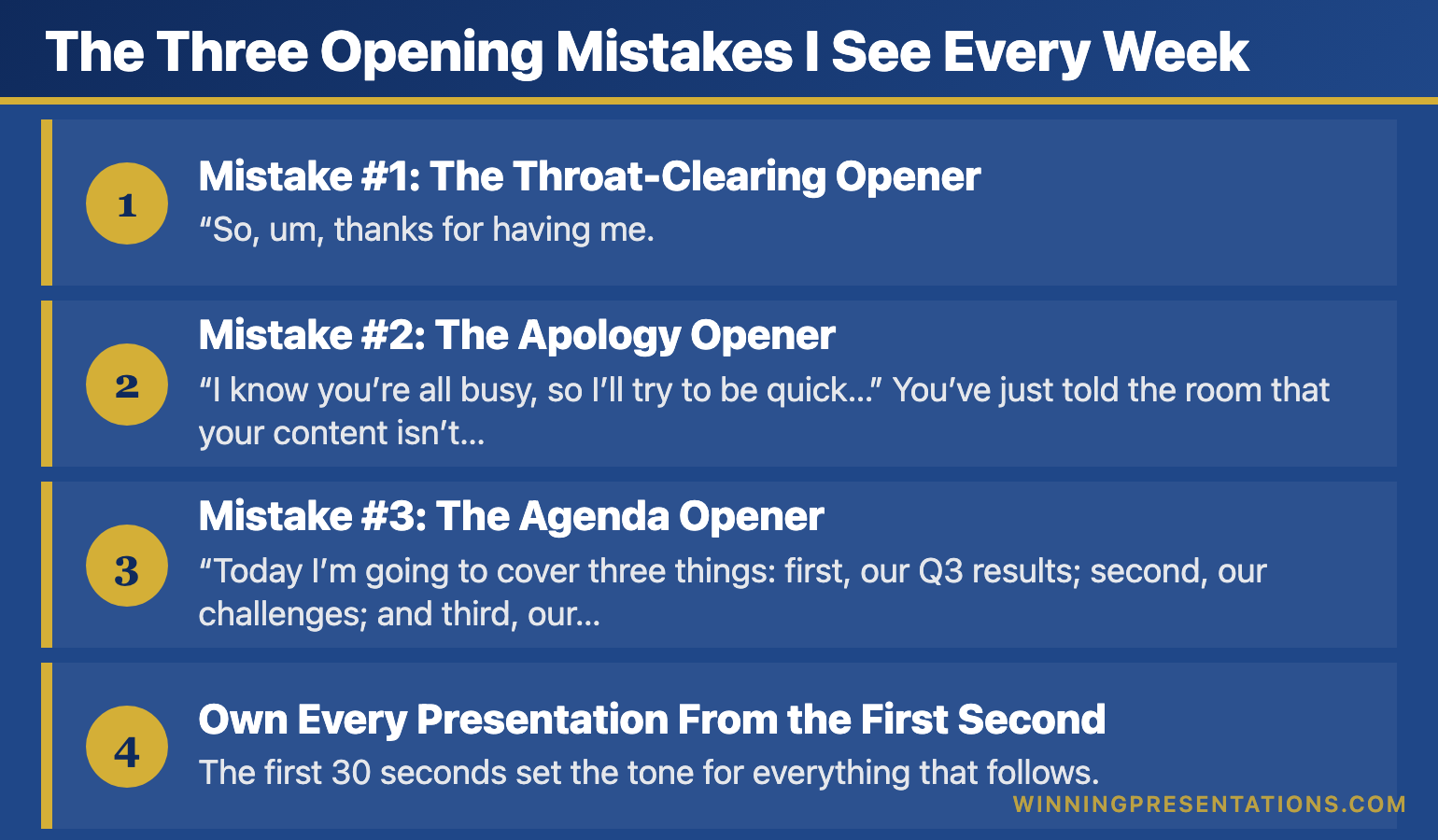
Mistake #1: The Throat-Clearing Opener
“So, um, thanks for having me. Let me just get my slides up here… okay, there we go. So today I’m going to talk about…”
This signals nervousness, lack of preparation, and — worst of all — that what’s coming isn’t important enough to be planned properly.
Mistake #2: The Apology Opener
“I know you’re all busy, so I’ll try to be quick…”
You’ve just told the room that your content isn’t valuable enough to deserve their full attention. Why would they give it to you?
Mistake #3: The Agenda Opener
“Today I’m going to cover three things: first, our Q3 results; second, our challenges; and third, our plan for next year.”
Boring. Predictable. Zero reason to pay attention. You’ve just told them everything they’re going to hear, so now they don’t need to listen.
Own Every Presentation From the First Second
The first 30 seconds set the tone for everything that follows. The Executive Slide System gives you the exact opening frameworks senior leaders use to command attention and establish authority from the very first word.
What I Learned from a £4 Million Mistake
Early in my banking career, I watched a senior colleague lose a £4 million deal in the first 30 seconds of a pitch.
He walked in, fumbled with the projector, apologized for being “a bit under the weather,” and opened with: “So, I know you’ve seen a lot of these pitches, but hopefully we can show you something different today.”
Hopefully? Hopefully?
The investors checked out immediately. I watched their body language shift — arms crossed, eyes down, phones appearing. The rest of the presentation was technically excellent, but it didn’t matter. The decision had already been made.
Afterwards, the lead investor told us: “You lost me at ‘hopefully.’ If you’re not certain your solution is different, why should I be?”
That moment changed how I thought about presentations forever.
If your first slides need to earn attention instead of losing it, The Executive Slide System gives you 22 ready-made templates to start from.
The 30-Second Framework That Changes Everything
After years of testing, refining, and watching what actually works in high-stakes situations, I developed a simple framework for the first 30 seconds:
Seconds 1-5: PRESENCE
Don’t speak immediately. Walk to your spot. Plant your feet. Make eye contact with three people. Breathe. This silence signals confidence and commands attention.
Seconds 6-15: HOOK
Open with something that creates curiosity — a surprising statistic, a bold statement, a relevant story, or a thought-provoking question. Make them need to hear what comes next.
Seconds 16-25: RELEVANCE
Connect your hook to their world. Why should they care? What’s at stake for them? Make it personal and immediate.
Seconds 26-30: PREVIEW
Tell them exactly what they’ll get from the next few minutes. Be specific about the value you’re delivering.
That’s it. Thirty seconds to transform your presentation from forgettable to commanding.
After the First 30 Seconds, Then What?
The Executive Slide System gives you the complete structure to follow through on a powerful opening — so every presentation you deliver is as strong at the end as it was at the start.
Master Your First 30 Seconds (And Everything After)
The 30-Second Framework is just one module in my comprehensive AI-Enhanced Presentation Mastery course on Maven.
Over 6 weeks, you’ll learn:
- How to open any presentation with confidence
- The structure that keeps executives engaged
- How to handle tough Q&A without freezing
- Using AI tools to cut preparation time by 80%
- The closing techniques that drive action
This isn’t theory — it’s the exact system I’ve used to train 10,000+ executives at companies from startups to leading organisations.
Live cohort starts January 2026.
Why This Matters More Than Ever
In an age of Zoom fatigue and shrinking attention spans, the first 30 seconds matter more than they ever have.
Your audience has more distractions than ever. More tabs open. More messages pinging. More reasons to tune out.
But here’s what hasn’t changed: humans are still wired to pay attention to what’s interesting, relevant, and delivered with confidence.
Master those first 30 seconds, and you’ve earned the right to the next 30 minutes.
Waste them, and you’re talking to a room that’s already moved on.
The choice is yours.
Frequently Asked Questions
Why are the first 30 seconds of a presentation so important?
Research on first impressions shows audiences form judgements about a speaker’s credibility within seconds. If you open weakly — fumbling with slides, apologising, or reading your agenda — the audience mentally downgrades everything that follows. A strong opening creates a halo effect that carries through the entire presentation.
How do I make a strong first impression in a presentation?
Pause before speaking, make eye contact with the room, and deliver your opening line with conviction. Your first sentence should be surprising, relevant, or emotionally resonant — not logistical. Physical presence matters as much as words: stand still, speak clearly, and project confidence even if you do not feel it.
What should I say in the first 30 seconds of a presentation?
Lead with a hook: a striking observation, a question the audience has been thinking, or a brief scenario that illustrates the problem you are solving. Follow immediately with why this matters to them specifically. Do not introduce yourself or outline your agenda — save that for after you have earned their attention.
How do I recover if I start a presentation badly?
Pause, take a breath, and reset. You can say something like “Let me start with the most important point” — this reframes the opening without drawing attention to the stumble. Audiences are forgiving of a rocky start if the content that follows is strong. The recovery matters more than the mistake.
Mary Beth Hazeldine spent 25 years in investment banking at JPMorgan, PwC, RBS, and Commerzbank before becoming an executive presentation coach. She has trained over 10,000 executives and her clients have raised over £250 million using her presentation frameworks. Learn more at Winning Presentations.
One More Thing — Before You Go
Owning the first 30 seconds is the hardest part. The Executive Slide System gives you the structure to back it up — a complete decision-first framework that keeps executives with you all the way through.