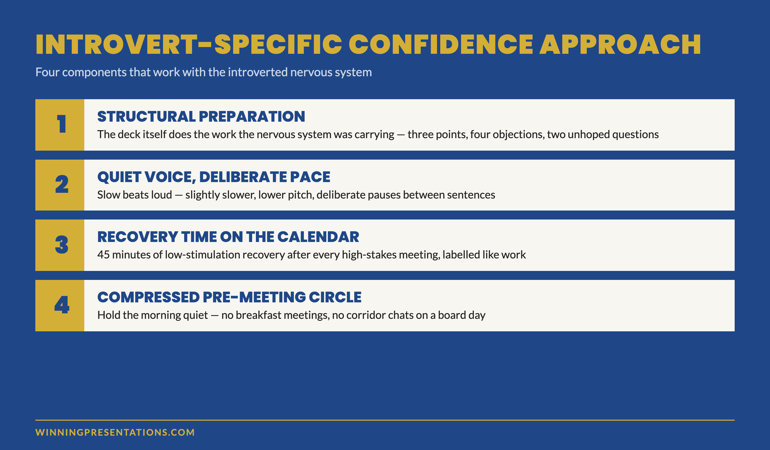
Quick answer: Standard executive-presence advice is calibrated for extroverted delivery — more energy, more projection, more rapid response — and produces a credibility penalty when an introvert is coached to imitate it. The audience reads imitation as performance, and performance reads as the opposite of presence. The structural alternative for introverts is to lean into the signals that already align with quiet authority — deliberate pauses, fewer but heavier sentences, slow eye contact, considered rather than rapid responses to questions — and to add a small number of structural moves that compensate for the energy gap, including a decision-first opening, single-sentence framing of the ask, and a deliberate pace that the room reads as control rather than hesitation. The result is presence that is sustainable across a full meeting day, not a borrowed extroverted persona that exhausts the speaker by the second meeting.
JUMP TO:
- Why standard executive-presence advice makes introverts look inauthentic
- The signals that read as quiet authority (and already work)
- The four structural compensations that close the energy gap
- Meeting-day stamina: protecting the energy that presence depends on
- In the room: handling the rapid-fire question style
- Frequently asked questions
Marcus, a chief technology officer at a Munich-headquartered industrial group, was promoted into his current role three years ago and put through an executive-presence development programme in his first six months. The programme’s diagnostic identified him as an introvert and offered a development plan calibrated to extroverted delivery: more energy in the opening, more frequent speaking-up in steering committees, faster responses to senior questions, more visible enthusiasm. Marcus tried for nine months. By the second quarter his peers were privately commenting that he had become “harder to read”; by the third quarter the chief executive asked him whether something at home was wrong. The programme had not made him look like a more confident senior leader. It had made him look like a quieter senior leader pretending to be a louder one, and the audience was reading the gap.
The diagnosis was not that the programme was badly designed; it was that it was designed for a different audience. Most executive-presence development programmes were built on observations of senior leaders who succeeded in a particular era — the 1990s and 2000s — when the dominant signal set was extroverted. The signal set works for people whose natural register is extroverted; it produces visible inauthenticity in people whose natural register is not. The programme tried to add extroverted delivery to Marcus’s introverted substance, and the audience read the addition as performance rather than presence.
This piece walks through why standard executive-presence advice makes many introverts look inauthentic, the signals that read as quiet authority and already align with the introvert’s natural style, the four structural compensations that close the perceived energy gap without requiring imitation, the meeting-day stamina work that lets introverts hold presence across a full day of senior meetings, and the in-the-room discipline for the rapid-fire question style that introverts find hardest. The aim is presence that is sustainable and recognisable as the speaker’s own — not a borrowed extroverted persona that exhausts the speaker and leaves the audience reading the gap.
Before the next senior meeting, the structural-audit move is worth a look.
The Executive Presentation Checklist is a free one-page structural audit covering the moves that hold up under senior scrutiny — including the deliberate-pace and decision-first openings that work particularly well for introverts. Free download.
Why standard executive-presence advice makes introverts look inauthentic
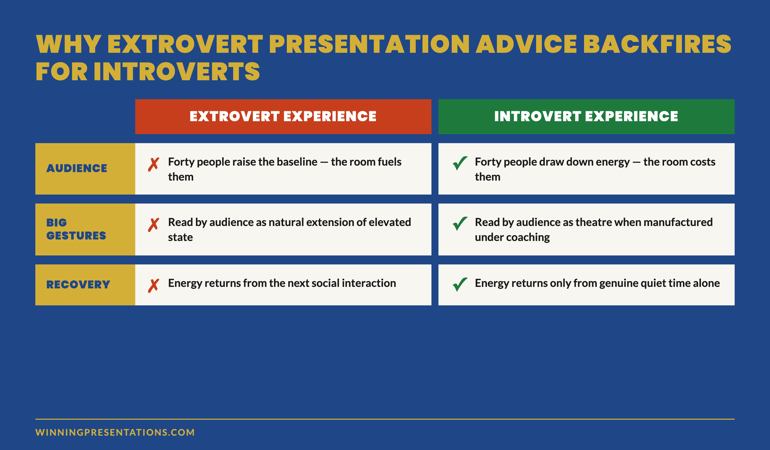
The audience reading any senior presenter is doing pattern-matching at several levels at once — substance, structure, delivery, and coherence. Coherence is the alignment between what the speaker says, how they deliver it, and the room’s prior reading of who the speaker is. Coherence is what produces the feeling of presence — the audience reads a unified signal and registers credibility. When the elements diverge — when an introverted speaker adopts extroverted delivery — the audience registers the divergence even when it cannot articulate the cause. The reading is felt as “something is off”, and the speaker carries a credibility cost they did not have before the development programme.
The asymmetry between introverts and extroverts under standard executive-presence training is structural. An extrovert practising standard advice is sharpening signals that align with their natural register; the practice produces a polished version of who they already are. An introvert practising the same advice is adding signals that conflict with their natural register; the practice produces a hybrid that the audience reads as performance. The training works for the population it was designed for and fails for the one it was not. The reasonable response is not to write off executive-presence training; it is to recognise that the training needs different content for different starting points.
The other issue is energetic sustainability. Extroverted delivery is energising for extroverts and depleting for introverts. An introvert who maintains extroverted delivery for a full meeting day arrives at the sixth meeting with the energy reserves of someone who has run a marathon. The presence visibly degrades; the audience reads the late-day version against the early-day version and notices the gap. Introvert presence that is built on the speaker’s own register is sustainable across a full day; presence that requires imitation runs out at the same rate as physical endurance and produces a visible decline that itself becomes the credibility issue. For the broader discipline behind executive presence in senior roles, see our executive presence for senior leaders piece.
The signals that read as quiet authority (and already work)
Introverts arrive in senior rooms with a set of signals that the audience already reads as authority — provided the speaker has not been coached to suppress them. The first is the deliberate pause. The introvert’s instinct to pause before answering a question is read by senior rooms as considered judgment; the same room reads a too-rapid response as defensive or as performance. Many introverts have been coached to remove the pause because it feels long to the speaker. The pause is not long to the audience; it is the signal of someone thinking before answering, which is a positive signal at senior level.
The second is sentence-density. Introverts tend to speak in fewer but heavier sentences — each carrying more information, fewer hedges, less filler. The structure reads as efficiency, which senior rooms value. The extrovert’s instinct to fill silence with elaboration is sometimes a stylistic strength and sometimes a weakness; the introvert’s instinct to leave silence after a substantive sentence is, in senior rooms, almost always read as confidence in what was just said. Practising sentence-density to a deliberate standard — every sentence in a meeting carries content; no filler before the load-bearing sentences — turns a natural introvert tendency into a deliberate structural signal.
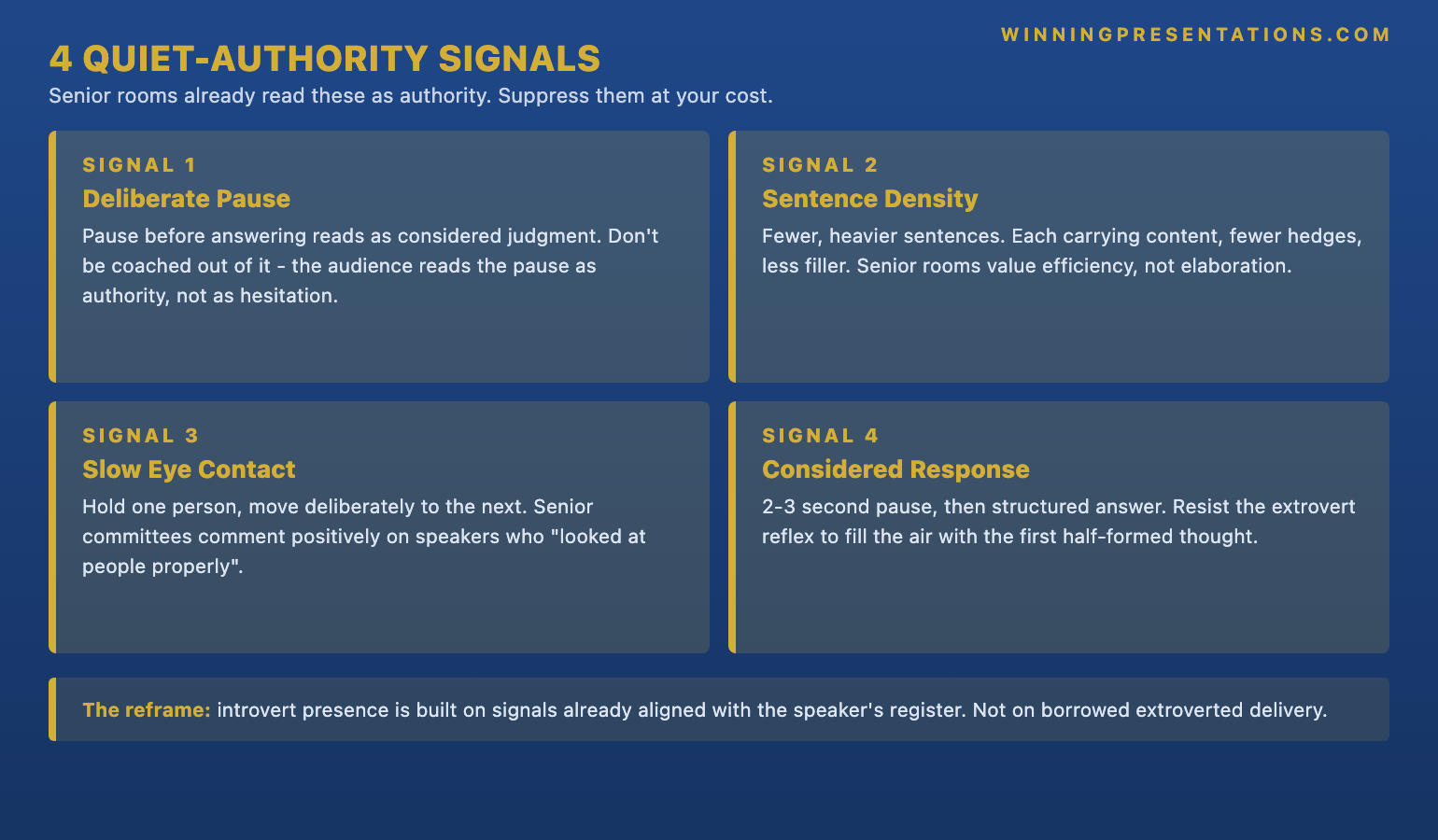
The third is the slow eye contact. Many extroverted senior leaders scan the room with frequent micro-glances. Many introverts naturally hold eye contact with the person they are addressing for longer, then move deliberately to the next person. The slower scan is sometimes coached out of introverts on the grounds that it looks “static”; in senior rooms the slower scan is read as considered attention rather than restlessness. Senior committees often comment positively on speakers who “looked at people properly”. The same committees comment less favourably on speakers who scanned the room rapidly. The introvert’s natural pacing is the senior pacing.
The fourth is considered rather than rapid response to challenging questions. The instinct under pressure to fill the air with the first half-formed answer is the extrovert reflex; the instinct to take a moment, structure the answer, and then deliver it is the introvert reflex, and at senior level it is the stronger signal. The risk for introverts is that they overcorrect into long pauses that read as confused; the discipline is the two-to-three-second pause, then a structured response. Three seconds feels long; the audience reads it as preparation, not as confusion.
The four structural compensations that close the energy gap
The reality is that some senior audiences do read low energy as lower engagement, regardless of substance. Introverts who deliver entirely on their natural register sometimes find that very extroverted audiences — sales-led committees, founder-heavy boards, certain US-headquartered firms — interpret quiet delivery as detachment. The structural compensations close the perceived gap without requiring the introvert to adopt extroverted delivery. They are structural moves rather than delivery moves; they do their work by reshaping the meeting rather than by reshaping the speaker.
The first compensation is the decision-first opening. A meeting that opens with the speaker stating in one sentence what the room is being asked to decide and the speaker’s recommendation produces a quick read of authority — the audience knows the speaker is here to make a call, not to walk through context. The energy of the opening sentence carries through the first five minutes of the meeting; the introvert’s natural pace then registers as deliberate rather than as low-energy. The extrovert’s compensatory energy in the opening is replaced by structural clarity, which works at least as well in senior rooms.
The second is the single-sentence framing of the ask. The recommendation is named in one clean sentence, with no hedges and no qualifiers, partway through the meeting. The audience reads the cleanness as confidence; the introvert’s quieter delivery of the sentence does not undermine the signal because the structure is doing the work. The same recommendation in a more elaborated delivery — five sentences building to the ask — would lose force from the introvert’s quieter register; the single sentence transfers the load to the structure.
The third is the predictable structural rhythm. A meeting that has three or four predictable moments — the opening, the variance slide, the assumption slide, the request — gives the audience anchor points and gives the introverted speaker the ability to deliver each anchor with deliberate emphasis. The rest of the meeting can be quieter without losing the room, because the room has the anchors to hold the structure. An unstructured meeting from an introvert sometimes registers as drifting; the same content with structural anchors registers as deliberate.
The structured programme for senior leaders who need approval from rooms where energy alone will not carry the recommendation.
The Executive Buy-In Presentation System is a self-paced programme covering the stakeholder analysis, case construction, and presentation structure that earn buy-in from senior committees and boards — built on structural moves that work for any register, including the deliberate-pace, decision-first patterns that align with introvert delivery. Designed for senior professionals navigating high-stakes approval meetings.
- 7 self-paced modules — stakeholder analysis through to post-meeting follow-up and political work
- Monthly cohort enrolment — enrol whenever suits you
- Optional Q&A calls — fully recorded so you can watch back anytime
- No deadlines, no mandatory session attendance
- Lifetime access to materials — £499
The fourth compensation is the prepared one-line elaboration. Introverts often have rich analytical depth they do not surface in the room because the energy cost of producing it on demand is high. The compensation is to prepare two or three one-line elaborations in advance — short, dense sentences that surface a piece of substantive analysis the audience would otherwise miss. The elaborations are deployed at moments when the audience is reading low engagement, not as filler but as substantive signal. The room registers the depth, and the depth offsets the quieter register.
Meeting-day stamina: protecting the energy that presence depends on
The other piece of the introvert’s executive-presence work is energy management across the meeting day. Extroverts gain energy from interaction and lose it from solitude; introverts gain energy from solitude and lose it from interaction. A senior introvert with eight meetings scheduled across a Tuesday is starting the day with a finite energy reserve that depletes through the day. By the sixth meeting the depletion is visible; by the eighth meeting the audience is reading a different speaker from the one they saw at nine in the morning. The audience does not know it is reading energy depletion; it reads it as a change in presence, and the change becomes the credibility issue.
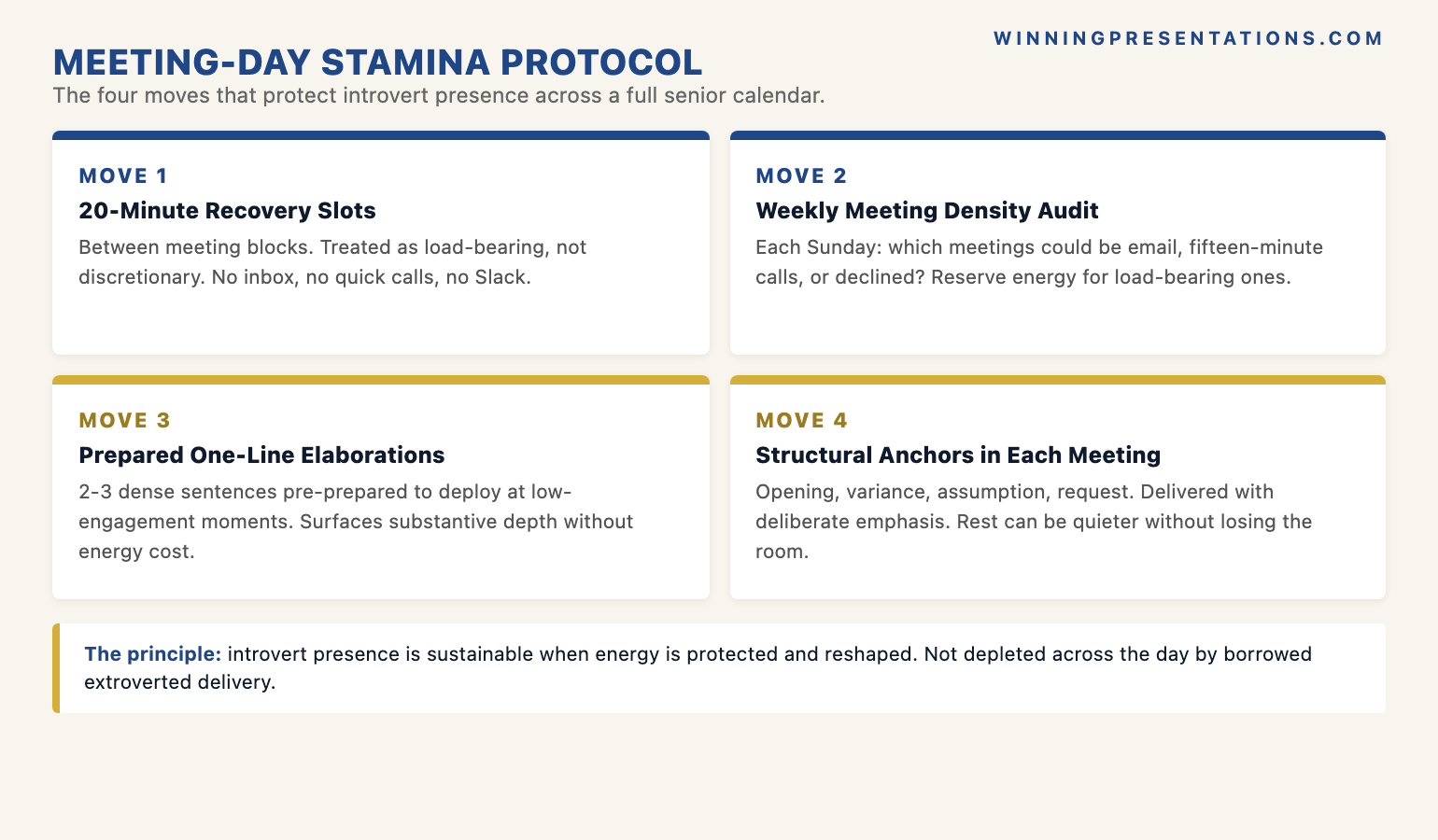
The discipline is to protect twenty minutes of solitude between meeting blocks where the calendar allows it. The twenty minutes is not productive time in any conventional sense — no inbox triage, no quick calls, no slack messages. It is recovery time, which is what allows the next meeting to be delivered at the same level of presence as the first. Senior introverts who treat the twenty-minute recovery slot as load-bearing rather than as discretionary find that their eighth meeting of the day is delivered at roughly the same level as their first; senior introverts who do not, find that their afternoon meetings are visibly lower-presence than their morning ones. The fix is not more energy training; it is the calendar discipline that protects the reserves.
The second piece of stamina discipline is the meeting density audit. A senior introvert with six meetings in a day usually has two or three that could have been an email, one that could have been a fifteen-minute call rather than an hour, and one that the speaker is attending for visibility rather than for decision-making. The audit is to identify those meetings each Sunday for the week ahead and to decline or shorten them. The energy reserved this way is not spent on inefficient meetings; it is reserved for the load-bearing ones, where presence matters. For the related discipline behind presentation anxiety that is partly an energy-management problem, see our companion piece on conquering the fear of public speaking for senior professionals.
In the room: handling the rapid-fire question style
The single hardest in-the-room moment for senior introverts is the rapid-fire question style — three questions stacked back to back from an extroverted senior leader who has not paused for an answer to the first before asking the second and third. The introvert’s instinct is to feel cognitively overrun by the stack and to attempt a rapid answer to the first question, which then collides with the unaddressed second and third. The audience reads the answer as fragmented and the credibility cost is sharp.
The move that works is the structural acknowledgement: “There are three questions there; let me take them in order — first, the volume assumption; second, the FX exposure; third, the contract counterparty.” The sentence does several things. It signals that the speaker heard all three questions, which itself is a presence signal — many people in rapid-fire situations only address the first. It buys the speaker the time to formulate the three answers structurally. And it puts the speaker back in charge of the cadence of the response, replacing the questioner’s rapid pace with the speaker’s deliberate one. Senior rooms read the move as confidence and as preparation.
If the structural rebuilding work above is the pattern that resonates:
The Executive Slide System is a structured library of templates, AI prompts, and scenario playbooks for the slide structures that anchor the decision-first, deliberate-pace style introverts use to advantage in senior rooms. 26 templates, 93 AI prompts, 16 scenario playbooks. £39, instant download, lifetime updates.
The other in-the-room discipline is the recovery move after the introvert has been spoken over. Senior introverts are interrupted more often than senior extroverts because the slight pause before a sentence — the pause that reads as considered judgment in calm moments — gives an extroverted colleague space to enter the conversation. The recovery is not a complaint or a polite re-entry; it is a structural pause and a deliberate sentence: “Let me come back to the point I was making, which lands on the assumption slide.” The structural reset rebuilds authorship of the meeting in one sentence. The room reads the reset as control, not as confrontation.
Frequently asked questions
Am I doomed if my whole exec team is extroverted?
Not at all. Many of the most respected senior introverts work in highly extroverted executive teams. The work is to deploy the introvert’s natural strengths — deliberate pace, structural anchors, considered responses — and to use the structural compensations above to close the perceived energy gap. The audience does not need every senior leader to deliver in the same register; what they read as authority is coherence between the speaker’s substance, structure, and delivery. An introvert delivering on a coherent introvert register is read as a senior leader. An introvert delivering on a coached extrovert register is read as a senior leader pretending to be a louder one — which is the credibility cost worth avoiding.
How long does the structural-pace habit take to feel natural?
Most senior introverts I have worked with report that the deliberate-pace habit feels uncomfortable for around six to eight weeks before it stabilises. The pause before a question feels long to the speaker; the structural opening feels formal; the single-sentence framing feels stark. The discomfort is at the level of the speaker’s own felt experience, not at the level of how the audience is reading it. The audience tends to read the deliberate pace as authoritative from the first meeting; the speaker takes several weeks to stop feeling that the pace is strange. Pushing through the speaker’s-felt discomfort is the work.
Should I tell my team I’m working on this?
Not necessarily. The structural moves above are mostly invisible to anyone who is not specifically looking for them; your team will register a steadier and slightly more deliberate version of you over the course of a few weeks, and the change will read as growth rather than as something programmatic. The exception is the structural pause before answering questions, which can be useful to mention to a small number of senior colleagues you trust — particularly if you have been coached for years to remove the pause. A short note that you are deliberately reinstating considered response time tends to land well; it is a professionally legitimate move and your colleagues will usually appreciate the transparency.
What if my CEO explicitly wants more energy from me?
The conversation is worth having, and it is best had structurally rather than defensively. The framing that tends to work is to acknowledge the observation, name your strengths in the introvert register, and propose the structural compensations as a deliberate response: “I understand the read; my natural register is deliberate, and I am working on the structural moves — decision-first opening, prepared one-line elaborations, structural anchors — that close the perceived energy gap without producing the kind of imitation that the senior team is going to read as inauthentic six weeks in.” Most CEOs respond well to a senior leader naming the issue structurally and offering a substantive response rather than agreeing to a stylistic change that the CEO will themselves find unconvincing within months.
The Winning Edge — weekly newsletter
The Winning Edge is a weekly newsletter for senior professionals who present at the executive level. One short email a week, focused on the structural moves that separate decks committees back from decks they defer. Subscribe to The Winning Edge →
Not ready for the full programme? Start here instead: download the free Executive Presentation Checklist — the structural audit for the night before a senior meeting.
About the author
Mary Beth Hazeldine is Owner & Managing Director of Winning Presentations Ltd. With 25 years of corporate banking experience at JPMorgan Chase, PwC, Royal Bank of Scotland, and Commerzbank, she advises executives across financial services, healthcare, technology, and government on structuring presentations for high-stakes funding rounds, board approvals, and strategic decisions.