

Imposter Syndrome at the C-Suite Table: Why It Intensifies Rather Than Fades With Seniority
Quick answer: Imposter syndrome at the C-suite table intensifies rather than fades with seniority because the structural conditions that produce it sharpen, not soften, the further up the organisation a leader goes. At senior level the leader is, by design, the person in the room with the least specific operational knowledge of whatever is being discussed, the most expected to render a confident judgement on it, and the most exposed if the judgement turns out to be wrong. The mid-career version of imposter syndrome — “I’m not as competent as people think” — gives way to the senior version, which is closer to “I am being asked to be certain about things I cannot actually be certain about”. The senior version is not a confidence deficit; it is an accurate read of a structurally asymmetric position. The four moves that turn the signal from threat into competence are described below.
JUMP TO:
In 2019 I coached a chief operating officer at a publicly-listed financial services group who had been in the role for three years and was, by every external measure, succeeding. The business was growing, the board respected her, her chief executive trusted her, and the executive committee functioned well with her in it. She came to me not for confidence work in any obvious sense but for what she described as “the seventy-second problem”. For approximately seventy seconds before every executive committee meeting, sitting in her car in the underground car park before going up to the boardroom floor, she would experience a wave of certainty that she did not belong in the meeting she was about to chair. The wave passed by the time she reached the lift. The meeting went well. The pattern had been continuous for three years. She had expected it to fade as she settled into the role. It had not. It had, if anything, intensified slightly each quarter.
What she was describing is a version of imposter syndrome that I now recognise as structurally specific to the C-suite table rather than the generic mid-career version most leadership literature describes. The mid-career version is comparative — the leader assesses themselves against peers and concludes they are less competent than the peer group thinks. The senior version is asymmetric — the leader assesses themselves against the room they are now in and concludes, accurately, that they are being asked to render confident judgements on matters where their specific operational knowledge is structurally limited. The chief operating officer was not deluded about her competence. She was correctly reading that her role required her to be confident about decisions where the deepest operational expertise sat with people two layers below her in the organisation. The seventy seconds in the car park was a structural read, not a personality flaw.
(This article was created with AI assistance; all stories and insights are based on 35 years of real client work.)
I worked with a chief technology officer in 2021 at a mid-cap European software company who described almost exactly the same phenomenon in different language. His version was “the lift problem”. The fifteen-second lift ride to the executive committee floor produced a reliable spike of “I do not know enough about this to chair this conversation”, followed by a fast settling once the meeting began. He had also expected the pattern to fade with tenure; it had also intensified slightly. The structural overlap between the two cases was striking. Two senior leaders in entirely different sectors, both succeeding, both reporting the same structural signal at the same structural moment, both interpreting the signal as a personal flaw rather than as an accurate read of the asymmetric position they were in. That structural overlap is the entry point into the work that actually shifts the signal — not work on confidence, which is not the underlying problem, but work on how the signal itself is interpreted.
If you experience the structural version of imposter syndrome at senior level:
Conquer Your Fear of Public Speaking is the structured programme for senior professionals working through the specific anxiety that arises from speaking with authority in rooms where the stakes are real. It is built on the work of recovering from a five-year period of presentation anxiety in corporate banking — not motivational, structural.
Why imposter syndrome intensifies rather than fades at senior level
The standard expectation about imposter syndrome is that it should fade with experience. The leader gets the promotion, succeeds in the role for a year or two, accumulates evidence of competence, and the internal voice that says “I don’t belong here” should quieten as the evidence stacks against it. For mid-career imposter syndrome this expectation is broadly accurate. For C-suite imposter syndrome it is structurally wrong, because the conditions that produce the senior version are not about evidence and not about competence; they are about the specific asymmetry of the senior position itself. The asymmetry does not soften with time. If anything, it sharpens, because the longer a leader is in a senior role, the more clearly they see what they cannot fully see.
The asymmetry has three components. The first is information distance. A chief operating officer in a large organisation is structurally further from the operational coalface than the function heads who report to them, who are themselves further from the coalface than the team leads beneath them. By the time the operational reality of any particular issue reaches the executive committee table, it has been summarised, framed, and interpreted by multiple layers of management. The senior leader is rendering judgement on a version of the operational situation that has been compressed for their consumption. The compression is necessary — nobody can run an organisation from raw operational data — but it is also structurally lossy, and the leader knows it.
The second component is accountability concentration. The senior leader is the person who owns the consequences of the decisions made at the executive committee table. The function heads below them carry execution accountability but not strategic accountability; the board above them carries oversight accountability but not operational accountability. The C-suite executive is in the structurally narrow position where every strategic decision lands on them personally, regardless of which function executed the work and regardless of which board approved the direction. The third component is the visibility premium. Junior errors are invisible to most of the organisation; mid-career errors are visible within a function; senior errors are visible across the organisation and often outside it. The accumulated effect of these three components is that the senior leader is, accurately, being asked to render confident judgements with less specific information and more concentrated accountability than at any earlier stage of their career. The signal that produces is correctly read as structural pressure. Calling it imposter syndrome misnames it.
The senior version is structurally different from the mid-career version
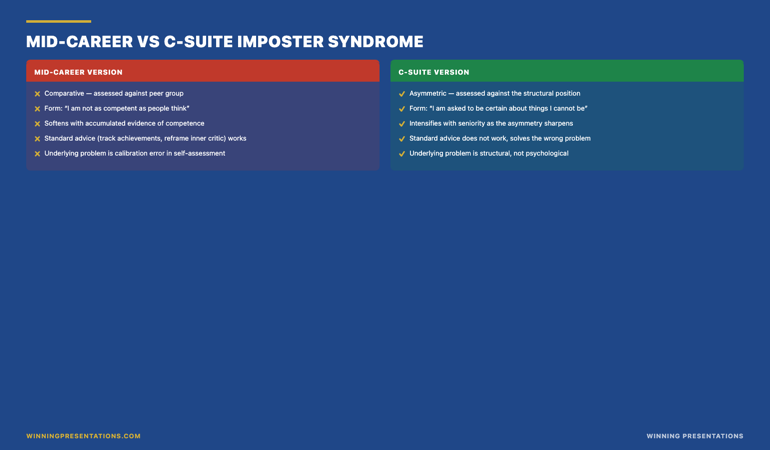
The mid-career version of imposter syndrome takes the form “I am not as competent as the people around me think I am”. It is comparative; it implies that the leader is over-estimated by peers; it tends to soften when the leader accumulates clear evidence of competence relative to peers. The standard advice about imposter syndrome — track your achievements, reframe your inner critic, recognise that you are not alone — works reasonably well on the mid-career version because the underlying problem is a calibration error between self-assessment and external assessment. The leader is in fact more competent than they feel; the work is to update the self-assessment to match the external evidence. That work is real and useful and the literature on it is sound.
The senior version takes a structurally different form: “I am being asked to be certain about things I cannot actually be certain about, and the room expects the certainty regardless.” It is not comparative; it is asymmetric. The leader is not less competent than peers; they are in a position where the relationship between available information and required confidence is structurally strained. The standard imposter syndrome advice does not work on this version, because it is solving the wrong problem. Tracking achievements does not address the asymmetry. Reframing the inner critic does not address the asymmetry. Recognising that you are not alone is true but unhelpful, because the issue is not loneliness; it is the structural shape of the role. Senior leaders who try to apply the mid-career advice to the senior phenomenon almost always report that the advice does not land, and many conclude there is something specifically wrong with them. There is not. They are using the wrong tool.
The senior phenomenon needs to be treated as what it actually is: an accurate read of structural asymmetry that becomes a problem only when the leader interprets the read as evidence of personal inadequacy rather than as a feature of the role. A senior leader who can hold the seventy seconds in the car park as “this is the role doing what the role does to whoever is in it” rather than as “this is evidence that I should not be here” experiences the same physical signal with a completely different downstream consequence. The signal itself does not disappear; the relationship to it changes. The work is interpretive, not cathartic. There is nothing to overcome, in the sense of conquering an inner enemy. There is something to recognise, in the sense of correctly naming what the body is responding to.
The four moves that turn the signal from threat into competence
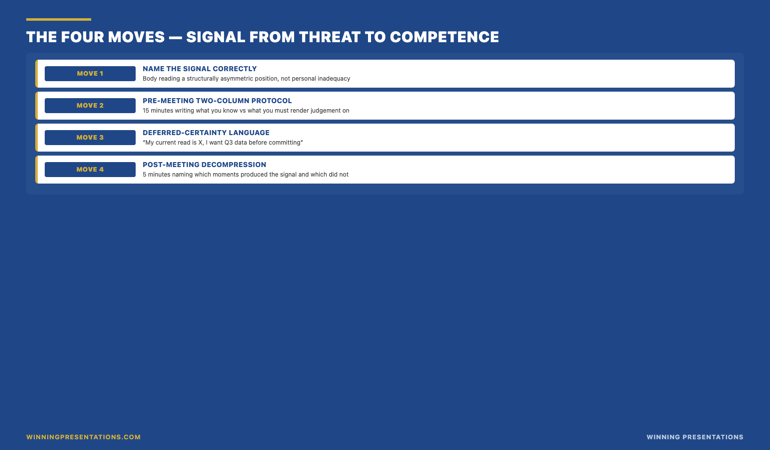
The first move is naming the signal correctly. The seventy seconds in the car park, the fifteen seconds in the lift, the wave of “I don’t belong here” before a high-stakes presentation — these are body-level reads of a structurally asymmetric position. The body is not lying. The body is responding accurately to the gap between available information and required confidence. The reframe is to greet the signal as competence rather than as inadequacy: “my body is telling me I am about to render judgement on a matter I cannot fully see; that is what this role does.” The leader who can name the signal this way stops trying to suppress it, which is the second-order anxiety that often makes the original signal worse. The original signal becomes a piece of information; the secondary anxiety about the signal disappears.
The second move is the structural-pre-meeting protocol. Most senior leaders prepare for high-stakes meetings by reviewing the deck and the supporting materials. The structural-pre-meeting protocol adds a single fifteen-minute step: writing down, in two columns, what the leader actually knows about the matter and what they are being asked to render judgement on. The two columns almost never match cleanly. Naming the gap explicitly — before the meeting, in private — reduces the gap’s capacity to produce in-meeting anxiety. The leader walks into the room having already absorbed the gap rather than discovering it under pressure. The protocol does not close the gap; nothing closes it, because it is structural. The protocol just removes the surprise. For the broader pre-meeting preparation work that addresses the structural sources of senior-leader anxiety, see executive presentation anxiety and the wider presentation coaching services.
The third move is the deferred-certainty language. Senior leaders who do well at the executive committee table tend to share a specific linguistic pattern: they distinguish, in real time, between matters where they are rendering a definite judgement and matters where they are offering a position-pending-more-information. “My current read is X; I want to see the operational data from Q3 before committing to that position for next year.” That sentence holds confidence and humility in the same breath. It signals to the room that the leader knows what they know and what they do not, which is structurally more credible than performing uniform certainty across all matters. The mid-career instinct — perform certainty to project competence — is the wrong instinct at senior level; the room reads it as either naivety or evasion. The deferred-certainty language is what genuinely senior leaders do, and it can be installed with practice. The fourth move is the post-meeting decompression ritual described below.
Stop reading the structural anxiety of senior leadership as evidence you do not belong.
Conquer Your Fear of Public Speaking is the structured programme for senior professionals working through the specific anxiety that arises from speaking with authority in rooms where the stakes are real. Built on the work of recovering from a five-year period of presentation anxiety in corporate banking — not motivational, structural. The protocols translate directly to the senior-leader version of imposter syndrome described in this article.
The specific kinds of moments when the signal genuinely fades
The signal does fade in specific kinds of moments, even at senior level, and naming the pattern is itself useful. It fades when the leader is rendering judgement on a matter where their own deep operational expertise is the most relevant in the room — the chief financial officer adjudicating a financial restructuring question, the chief technology officer adjudicating a platform architecture question. In those specific moments the asymmetry disappears, because the leader is the person in the room with the most specific information rather than the least. The signal also fades when the leader is in the chairing position rather than the contributing position — chairing structurally calls for facilitating others’ judgements rather than rendering one’s own, which removes the gap between available information and required confidence that produces the signal in the first place.
The pattern is useful because it lets senior leaders calibrate when the signal is providing accurate information about their position in the room and when it has become a generalised background hum that is no longer doing useful work. A leader who only experiences the signal in the structurally appropriate moments — high-stakes asymmetric judgements where their information distance is real — is using the signal correctly. A leader who experiences the signal in every executive committee meeting regardless of subject is over-generalising, and the work is to recover the specificity. The fourth move I referred to above is part of the recalibration: a five-minute post-meeting decompression where the leader names, in writing, which moments in the meeting produced the signal and which did not. Over six to eight meetings the pattern becomes visible, and the signal returns to its appropriate specificity.
None of this resolves into “the signal disappears”. The signal is structural and will not disappear as long as the leader holds a senior role. What changes is the leader’s relationship to it: from interpreting the signal as evidence of personal inadequacy to recognising it as a body-level read of structural position. The chief operating officer I worked with in 2019 still experiences the seventy seconds in the car park, six years on. She no longer treats it as imposter syndrome. She treats it as her body correctly noticing that she is about to render confident judgements on matters where her information is structurally limited — which is what the role requires of her, and which is what she is paid to do. The signal is, in that sense, the price of the role rather than evidence of a flaw in the holder of it. Naming it correctly is the work.
Frequently asked questions
Is the standard imposter syndrome advice ever useful at senior level?
Occasionally, in specific contexts. If the senior leader is genuinely new to the role and the signal they are experiencing is calibration error rather than structural asymmetry — common in the first six months of a new C-suite appointment — the standard advice about tracking achievements and reframing the inner critic can do useful work. After about six months the calibration error usually resolves on its own as evidence accumulates, and what is left is the structural asymmetry described in this article. At that point the standard advice stops being useful and can become actively counter-productive, because it tells the leader to look for evidence of competence to soothe the signal, when the signal is not actually about competence. Match the tool to the underlying problem; the mid-career and senior phenomena need different work.
What is the most common mistake senior leaders make about this signal?
Trying to suppress it. The senior leader who reads the seventy seconds in the car park as something to defeat will spend energy fighting their own body, which produces a secondary anxiety on top of the original signal. The original signal is information, not threat. Suppressed, it tends to intensify; greeted as information, it becomes background and stops producing downstream consequence. Most senior leaders I have worked with on this report that the suppression strategy is what made the phenomenon feel like a problem, not the underlying signal itself. The reframe takes about three weeks of practice and produces a noticeable shift in how the leader feels going into high-stakes rooms. The signal is still there; the relationship to it has changed.
Does this work the same way for senior leaders in highly technical fields?
Mostly yes, with one variation. Senior leaders in highly technical fields experience the structural asymmetry slightly differently because their own deep expertise is more often the most relevant in the room than for a generalist C-suite role. The chief medical officer in a healthcare organisation, the chief engineer in a manufacturing organisation, the chief science officer in a biotechnology company — these leaders experience the signal in fewer meetings than a chief operating officer or chief executive, because their information distance is shorter in the meetings most relevant to their expertise. But they experience it sharply when the meeting moves outside their core expertise, which it inevitably does. The work is the same; the frequency and the trigger pattern are slightly different. The four moves apply identically.
How long does it take to see meaningful change once you start the work?
The reframe is usually visible in two to three weeks — the body still produces the signal, but the secondary anxiety about the signal fades quickly once the leader stops treating it as evidence of inadequacy. The structural pre-meeting protocol shows up in performance inside two months, because the absence of in-meeting surprise about the information gap produces a perceptibly calmer presence at the table. The deferred-certainty language takes longer — usually three to six months of deliberate practice to feel natural — because it requires unlearning the mid-career instinct to perform uniform certainty. The post-meeting decompression ritual produces the specificity recovery inside six to eight executive committee meetings. Cumulatively the work takes about six months to fully install, and produces a noticeably different relationship to the senior phenomenon for the rest of the leader’s career.
The Winning Edge — weekly newsletter
The Winning Edge is a weekly newsletter for senior professionals who present at the executive level. One short email a week on the structural moves that separate decks committees back from decks they defer. Subscribe to The Winning Edge →
For the wider library of presentation assets that pair with the anxiety work on senior-leader confidence — the slide system, the Q&A taxonomy, the storytelling primer, the delivery references — the Complete Presenter bundle (£99) collects them in one place.
About the author
Mary Beth Hazeldine is Owner & Managing Director of Winning Presentations Ltd. With 24 years of corporate banking experience at JPMorgan Chase, PwC, Royal Bank of Scotland, and Commerzbank, she advises executives across financial services, healthcare, technology, and government on structuring presentations for high-stakes funding rounds, board approvals, and strategic decisions.
The next time the seventy seconds in the car park arrives before your executive committee meeting, do three things instead: name the signal as your body’s accurate read of a structurally asymmetric position rather than as evidence you do not belong; write the two-column gap between what you know and what you are being asked to render judgement on; and let the meeting itself use the deferred-certainty language that distinguishes definite judgement from position-pending-more-information. The signal will not disappear. It is the price of the role. Naming it correctly is what turns it from threat into competence, and what separates the senior leaders who carry the asymmetry from the ones it slowly wears down.