Tag: executive confidence

03 Apr 2026
Professional woman standing calmly in a corporate corridor, eyes closed, practising grounding before a presentation with a conference room visible in the background

Grounding Techniques for Presentation Anxiety: How to Anchor Yourself Before You Speak

Grounding techniques work for presentation anxiety because they interrupt the physiological cascade that makes speaking feel dangerous. Your nervous system cannot simultaneously process a threat response and a deliberate sensory focus. That neurological fact is what makes grounding practical, not theoretical—and why it works in the final minutes before you step up to present.

Nalini was standing in the corridor outside the executive conference room, waiting for her slot in the quarterly review. She’d presented to this group before—twelve times, in fact—and each time the anxiety arrived with identical precision: racing heartbeat at the fifteen-minute mark, shallow breathing at ten minutes, and a dissociative fog at five minutes that made her notes look like a foreign language. She’d tried deep breathing. She’d tried positive self-talk. Neither penetrated the fog. That morning, before leaving home, she’d read about a sensory grounding technique: name five things you can see, four you can touch, three you can hear. Standing in that corridor, she tried it. Blue carpet. Fire extinguisher. Her colleague’s navy jacket. The exit sign. A crack in the ceiling tile. She pressed her fingertips against the cool wall. Rubbed the edge of her notebook. Touched the fabric of her jacket sleeve. Felt the weight of her shoes on the floor. She heard the air conditioning. A door closing down the hall. Someone’s phone vibrating. By the time the door opened, the fog had lifted. Her heart was still beating fast, but she could read her notes. She walked in and delivered the presentation—not perfectly, but clearly. The difference was that she’d given her nervous system something to do other than panic.

Struggling with pre-presentation anxiety? Conquer Speaking Fear includes a structured anxiety management framework with grounding, breathing, and cognitive techniques designed specifically for executives who present under pressure.

Why Grounding Works When Deep Breathing Alone Doesn’t

Deep breathing is the default advice for presentation anxiety, and it helps many people—but not everyone. The reason is neurological. When the sympathetic nervous system is fully activated—the fight-or-flight response that makes your heart race and your palms sweat—the prefrontal cortex (responsible for rational thought and voluntary breath control) has reduced influence. Telling someone in acute anxiety to “breathe deeply” is like telling someone mid-panic to “calm down.” The instruction requires the very cognitive control that anxiety has compromised.

Grounding techniques take a different route. Instead of trying to override the nervous system through conscious breath control, they engage the sensory cortex—the brain regions that process what you see, hear, touch, and smell. These regions remain active even during acute anxiety because they process incoming sensory data automatically. By deliberately directing attention to sensory input, you’re using a neurological pathway that anxiety hasn’t shut down. The effect is a reduction in the intensity of the threat response, not through willpower, but through sensory competition.

This is why grounding techniques for presentation anxiety are particularly effective in the acute phase—the last ten to fifteen minutes before you speak, when anxiety typically peaks. At this point, cognitive strategies (positive affirmations, logical reframing, content review) often fail because the cognitive system is overwhelmed. Sensory grounding bypasses the overwhelmed system entirely.

It’s also worth noting that grounding doesn’t eliminate anxiety. It reduces it to a manageable level—from the paralysing fog Nalini described to the elevated alertness that actually improves performance. The goal is not calm. The goal is functional arousal: enough activation to be sharp and present, without enough to impair speech, memory, or cognitive flexibility.

Take Control of Presentation Anxiety Before It Controls You

Conquer Speaking Fear gives you a structured anxiety management framework—grounding protocols, breathing techniques, and cognitive reframing tools designed specifically for executives who present under pressure.

  • ✓ Pre-presentation anxiety management protocols
  • ✓ Nervous system regulation techniques for speakers
  • ✓ Cognitive reframing frameworks for high-stakes situations

Get Conquer Speaking Fear → £39

Designed for professionals who present under pressure

The Five-Senses Method: A Complete Pre-Presentation Protocol

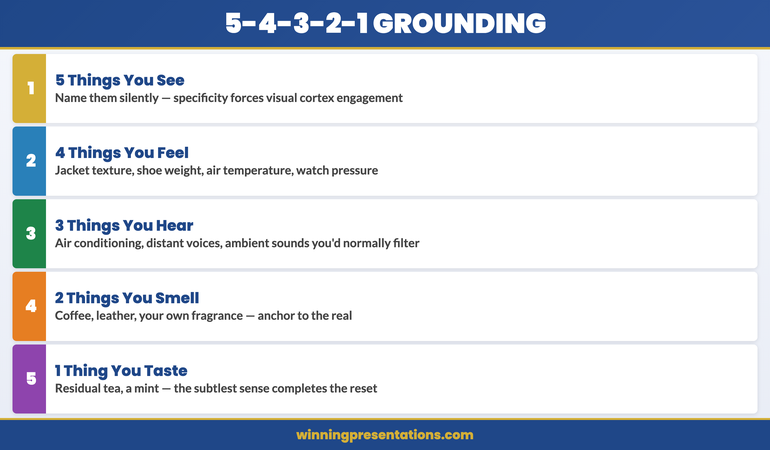
The 5-4-3-2-1 technique is the most widely used grounding method in clinical anxiety management, and it translates directly to the pre-presentation context. The protocol takes three to five minutes and can be done silently, standing in a corridor, sitting at a conference table, or waiting in a virtual meeting lobby.

Five things you can see. Name them silently and specifically. Not “the room” but “the silver pen on the table.” Specificity forces the visual cortex to engage actively rather than passively. Four things you can physically feel. The texture of your jacket. The pressure of your feet on the floor. The temperature of the air on your skin. The weight of your watch. Three things you can hear. Background noise you’d normally filter out—air conditioning, a distant conversation, traffic. Two things you can smell. Coffee. The leather of your notebook. Your own perfume or aftershave. One thing you can taste. The mint you had earlier. The residual flavour of your morning tea.

The sequence matters because it progresses from the easiest sensory channel (vision, which requires no physical action) to the hardest (taste, which requires deliberate attention to a subtle sensation). By the time you reach the final sense, your attention has been fully redirected from internal anxiety to external reality. The fog lifts—not because the anxiety is gone, but because your sensory cortex is now processing real data instead of imagined threats.

If you’re interested in complementary techniques, our guide on the body scan technique for presentation reset covers a longer protocol that works well when you have fifteen to twenty minutes before presenting. The five-senses method is the rapid-deployment version for when you have five minutes or less.

The 5-4-3-2-1 grounding technique protocol for pre-presentation anxiety showing sensory countdown

Physical Anchors You Can Use in the Room Without Anyone Noticing

The five-senses method works best in private—standing in a corridor, sitting alone before others arrive. But anxiety doesn’t always cooperate with your schedule. Sometimes it spikes mid-meeting, during the presenter before you, or whilst you’re being introduced. You need grounding techniques that work invisibly, in full view of your audience.

Feet on the floor. Press both feet flat against the floor with deliberate pressure. Feel the weight of your body transferring through your legs into the ground. This activates proprioceptive feedback—your body’s awareness of its own position in space—which counteracts the dissociative “floating” sensation that anxiety produces. Nobody can see you doing this. It works whether you’re standing at a lectern or sitting at a table.

Fingertip contact. Press your thumb firmly against your index finger, or press all five fingertips against the table surface. The tactile feedback creates a physical anchor point that your attention can return to whenever anxiety pulls you towards catastrophic thinking. Some executives use a small object—a smooth stone, a pen cap, a ring they rotate—as a consistent physical anchor across multiple presentations.

Temperature shift. Hold a glass of cold water in both hands for ten to fifteen seconds. The temperature change activates the vagus nerve—the primary pathway between your brain and your gut—which triggers a parasympathetic response (the “rest and digest” system that counteracts fight-or-flight). This is why a sip of water before speaking helps more than hydration alone would explain. The cold sensation is doing neurological work.

These micro-techniques can be combined. Press your feet into the floor whilst holding cold water. Touch a physical anchor object whilst listening to the ambient sounds in the room. The more sensory channels you engage simultaneously, the stronger the grounding effect. The research on box breathing for executive presentations shows how breathing and physical grounding work together to regulate the nervous system more effectively than either technique alone.

When to Ground: The Three Critical Windows Before You Present

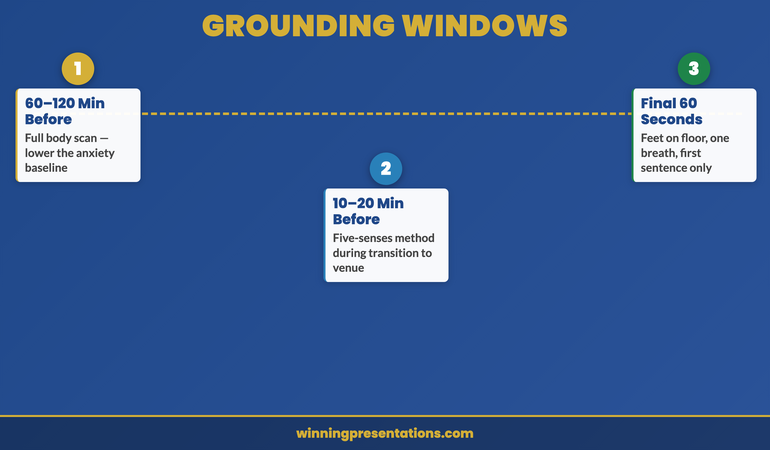
Timing matters. Grounding at the wrong moment is less effective than grounding at the right one. Presentation anxiety follows a predictable curve, and there are three windows where intervention has the greatest impact.

Window 1: The morning of the presentation (60–120 minutes before). This is when anticipatory anxiety begins—the “I have to present today” awareness that colours your entire morning. A full body scan or extended grounding session (ten to fifteen minutes) during this window reduces the baseline anxiety level, so the peak is lower when it arrives. Think of this as lowering the starting point of the anxiety curve.

Window 2: The transition period (10–20 minutes before). This is when you’re physically moving towards the presentation space—walking to the meeting room, logging into the virtual platform, arriving at the venue. Anxiety accelerates during transitions because your body is moving towards the perceived threat. The five-senses method works powerfully here because you’re in a transitional environment with abundant sensory input to anchor to.

Window 3: The final sixty seconds. This is the acute peak. You’re about to be introduced, or you’re about to unmute your microphone, or you’re about to stand up. At this point, complex techniques fail. You need a single-move anchor: feet pressed into the floor, one deep breath through the nose, and a deliberate focus on the first sentence of your presentation. Not the whole presentation—just the first sentence. Narrowing your cognitive focus to one sentence prevents the overwhelm that comes from contemplating the entire performance ahead.

Nalini’s breakthrough came from using all three windows. She did a body scan before leaving home (Window 1), used the five-senses method in the corridor (Window 2), and pressed her feet into the floor as the door opened (Window 3). No single technique was transformative. The combination across three windows was.

For executives who want a complete anxiety management protocol they can practise and refine, Conquer Speaking Fear provides the full framework—grounding, breathing, cognitive reframing, and in-the-moment recovery techniques—in a structured programme designed for professionals who present regularly.

Three critical grounding windows before a presentation showing timing and techniques

Combining Grounding With Breathing and Cognitive Reframing

Grounding is most powerful when combined with two complementary techniques: controlled breathing and cognitive reframing. Think of these as three systems working together. Grounding manages the sensory system. Breathing manages the autonomic nervous system. Cognitive reframing manages the narrative system—the story your mind tells about what’s about to happen.

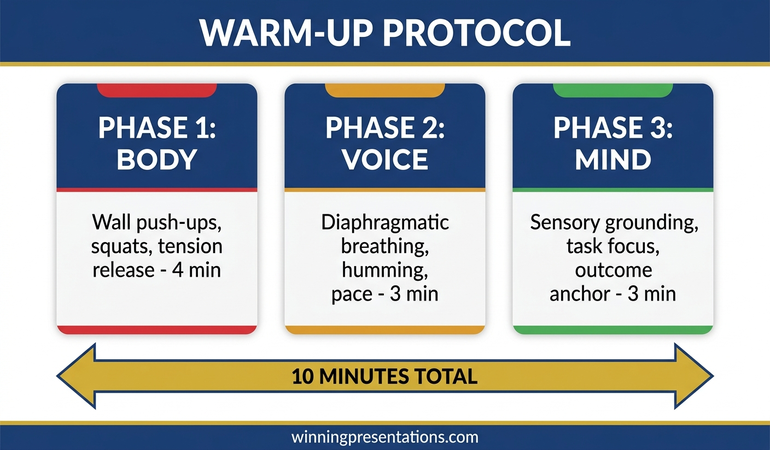
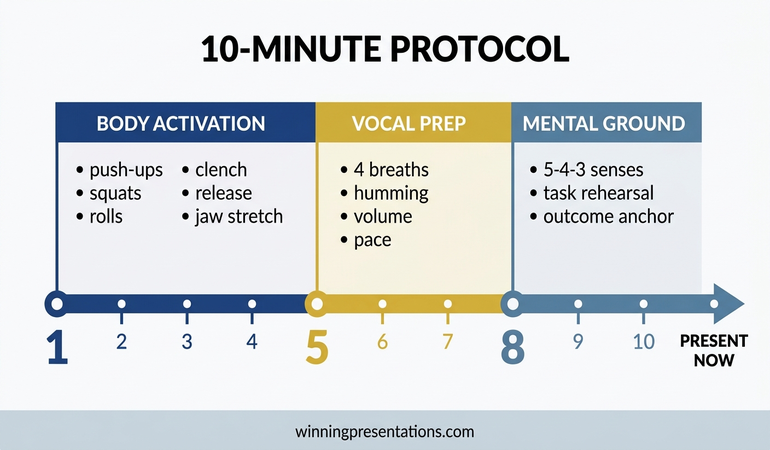
A practical combined protocol for the ten minutes before a presentation: Begin with two minutes of sensory grounding (the five-senses method). Then shift to two minutes of controlled breathing—inhale for four counts, hold for four, exhale for six (the extended exhale activates the parasympathetic response). Then spend one minute on a single cognitive reframe: replace “I’m about to be judged” with “I’m about to share information that helps these people make a decision.” This reframe shifts the narrative from performance evaluation to professional service, which reduces the perceived social threat.

The sequence matters. Grounding first, because it reduces the physiological intensity enough for breathing to work. Breathing second, because it further calms the autonomic system and restores prefrontal cortex function. Cognitive reframing last, because it requires the prefrontal cortex to be online—which the first two steps have enabled. Attempting cognitive reframing when the nervous system is fully activated is why positive affirmations often feel hollow during acute anxiety. The brain knows you’re lying to it. After grounding and breathing, the reframe feels plausible because the threat level has genuinely decreased.

Self-compassion is also a useful complement to grounding. Our guide on self-compassion and presentation anxiety covers the research showing that treating yourself with kindness during anxious moments reduces cortisol more effectively than self-criticism or forced confidence. Combined with grounding, it creates an internal environment where your nervous system can settle rather than escalate.

Stop Fighting Your Anxiety. Start Managing It.

Grounding, breathing, and cognitive reframing work best as a structured system. Conquer Speaking Fear gives you the complete framework—practised by executives who present under pressure every week—for £39.

Get the Programme Now → £39

FAQ: Grounding Techniques for Presentation Anxiety

How long do grounding techniques take to work?

The five-senses method typically reduces acute anxiety intensity within three to five minutes. Physical anchoring techniques (feet on the floor, fingertip pressure) can produce a noticeable shift within thirty to sixty seconds. The speed depends on how activated your nervous system is when you begin—the earlier you start, the faster the response. Grounding doesn’t need to eliminate anxiety completely; even a partial reduction is enough to restore functional cognitive capacity for presenting.

Can grounding help during a presentation, not just before it?

Yes. Physical anchoring techniques—pressing feet into the floor, touching a pen or table edge, feeling the weight of your body in the chair—work during the presentation itself. The key is that they require no visible action. You can ground silently whilst maintaining eye contact and speaking. If you feel anxiety spiking mid-presentation, take a deliberate sip of water (activating temperature-based grounding) and press your feet into the floor. These two actions together take three seconds and can reset your nervous system enough to continue.

Do grounding techniques work for virtual presentations too?

They work equally well, though the sensory inputs differ. For virtual presentations, ground to your physical environment: the texture of your desk, the temperature of the room, the feel of your keyboard, the sounds in your home. You can also use the additional advantage of having your lower body completely invisible—press both feet flat, grip the edge of your desk, or hold a cold glass of water. The dissociative fog that anxiety produces is actually more common in virtual settings because the screen creates an artificial distance from the audience. Grounding to your physical space counteracts this by anchoring you in your body rather than in the screen.

The Winning Edge

Weekly insights on executive presentations, confidence building, and managing speaking anxiety.

Subscribe Free

If you’re also navigating the challenge of maintaining composure when unexpected questions arise, our guide to handling off-topic questions in presentations covers the techniques for redirecting without losing your anchor.

About the author

Mary Beth Hazeldine, Owner & Managing Director, Winning Presentations. With 24 years of corporate banking experience at JPMorgan Chase, PwC, Royal Bank of Scotland, and Commerzbank, she advises executives across financial services, healthcare, technology, and government on structuring presentations for high-stakes funding rounds and approvals.

02 Apr 2026
Professional woman reframing anxious thoughts before a high-stakes presentation

Cognitive Restructuring for Presenters: How to Rewrite the Anxiety Script Running in Your Head

Quick Answer: Cognitive restructuring is the process of identifying the automatic negative thoughts that fuel presentation anxiety—“I’ll forget my words,” “They’ll judge me,” “I’ll embarrass myself”—and replacing them with realistic, balanced alternatives. This technique, drawn from cognitive behavioural therapy, interrupts the anxiety cycle before it starts. Unlike positive thinking, which asks you to ignore reality, cognitive restructuring for presenters means examining the evidence and building a more accurate internal script.

Meet Priya: The Consultant Who Realised Her Enemy Was Her Own Thinking

Priya had held her position as a senior consultant at a management consultancy for seven years. She was known for smart analysis and solving complex client problems. Yet every time she had to present to the executive suite, she felt her stomach drop. Not because she lacked expertise—she knew her material cold. The terror came from a script running silently in her head: “They’ll see through me. One tough question and I’ll panic. Everyone else makes this look easy, so there must be something wrong with me.”

Her company invested in a high-profile presentation skills programme. She learned gesture control, story structure, vocal variety. The techniques were sound. But on the morning of her next boardroom presentation, the same script played before she opened her mouth. The anxiety hadn’t changed because she’d never examined the thoughts beneath it.

When she finally worked with someone trained in cognitive behavioural techniques, Priya’s breakthrough came not from practising hand movements. It came from writing down the exact thoughts triggering her anxiety, then asking: “Is this actually true? What evidence do I have? And what’s a more accurate version of this story?” Within weeks, the anxiety didn’t disappear—but the grip it had on her thinking loosened. She could present because she’d rewritten the script.

Cognitive restructuring is a clinically validated technique for managing the automatic thoughts that sustain anxiety. If you’ve tried breathing exercises or practice alone and the fear remains, this approach works differently—it targets the root rather than the symptom. In this article, you’ll learn exactly how to identify your anxiety thoughts and build a more realistic internal narrative before your next presentation.

Jump to a section:

What Cognitive Restructuring Actually Means (Without the Jargon)

Cognitive restructuring is the structured process of catching your automatic negative thoughts, examining whether they’re actually true, and replacing them with more accurate ones. That’s it. No mystical thinking, no forced positivity. Just rigorous thinking applied to the thoughts driving your anxiety.

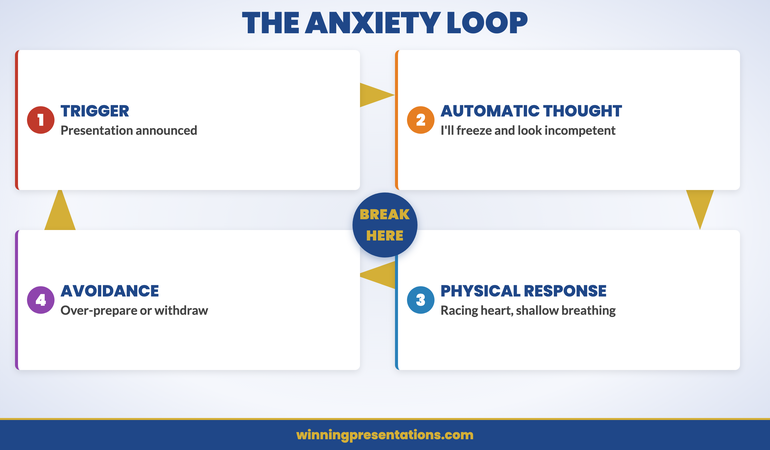
Here’s the mechanism: When you face a presentation trigger—a boardroom invite, a virtual meeting with stakeholders—your brain automatically generates thoughts. These thoughts happen so fast you often miss them. But they’re powerful. If the thought is “I’ll fail and lose respect,” your nervous system treats that as a genuine threat and floods your body with anxiety chemicals. The anxiety then feels like evidence that the thought is true, when actually the anxiety is just your nervous system responding to a thought, not to reality.

Cognitive restructuring interrupts that loop. You write down the automatic thought, you examine the actual evidence, and you build a replacement thought that’s both more realistic and less anxiety-inducing. The goal is not to trick yourself into positivity. The goal is accuracy.

This technique comes directly from cognitive behavioural therapy (CBT), which is one of the most rigorously tested psychological treatments for anxiety disorders. When we apply CBT principles specifically to presentation anxiety, we’re not guessing—we’re using a framework that has been validated in thousands of research studies and clinical settings.

The Anxiety Management System Built from Clinical Hypnotherapy

Cognitive restructuring works best within a broader nervous system regulation framework. The Conquer Speaking Fear programme combines thought restructuring with clinical hypnotherapy-based techniques for lasting change.

  • ✓ 30-day structured programme for presentation anxiety
  • ✓ Nervous system regulation techniques from clinical practice
  • ✓ Built for executives who have tried other approaches

Get Conquer Speaking Fear → £39

Designed for executives managing high-stakes presentation anxiety

The Four Automatic Thoughts That Drive Presentation Anxiety

Most presentation anxiety springs from four core automatic thoughts. These aren’t facts—they’re stories your brain tells when faced with performance pressure. Recognising them is the first step in restructuring them.

1. “I will forget my words or go blank.” This thought often combines a real phenomenon (you might lose your place momentarily) with a catastrophic conclusion (this means you’re incompetent and should have never agreed to present). Even experienced presenters sometimes lose their flow. The anxiety thought treats a momentary lapse as a referendum on your capability.

2. “They are judging me harshly.” This thought assumes mind-reading: you believe the audience is evaluating you negatively without actual evidence. Often this thought is rooted in audience judgment anxiety, where you imagine the audience has far higher standards for you than they actually do, and far less interest in your performance than you assume.

3. “Something will go wrong and everyone will see my anxiety.” This is vulnerability panic—a secondary anxiety about your anxiety. You fear that your physical symptoms (trembling hands, racing heart, dry mouth) will be visible and will confirm that you don’t belong at that table.

4. “I’m not as capable as everyone thinks.” This is the imposter thought. You’ve succeeded in your role, but you attribute that success to luck, lower standards, or others not noticing your inadequacy. A presentation feels like an exposure risk where “they’ll finally see the truth.”

Notice that none of these thoughts are about the actual presentation content. They’re about your self-image under pressure. Cognitive restructuring for presenters means targeting these meta-narratives, not rehearsing your script further.

The Evidence Technique: Cross-Examining Your Own Assumptions

Here’s the core of cognitive restructuring practice. When you identify an automatic anxiety thought, you examine it using structured questioning. This isn’t about arguing yourself into positivity. It’s about truth-testing.

Step One: Write down the automatic thought exactly as it arises. Not a summary—the specific, vivid thought. “I’ll go completely blank and they’ll realise I’m a fraud” is more useful than “I’ll be bad.”

Step Two: Ask for evidence that supports this thought. What’s the actual evidence? Not your anxiety feeling (anxiety feels like evidence but isn’t), but concrete examples. “I once forgot a phrase in a smaller meeting” is evidence. “I feel terrified right now” is not.

Step Three: Ask for evidence against this thought. When have you successfully presented? What feedback have you received? How many times have you recovered from a mistake? What qualifications do you actually hold that your audience values? This step isn’t forced positivity—you’re simply asking for the full picture rather than only the anxiety-coloured version.

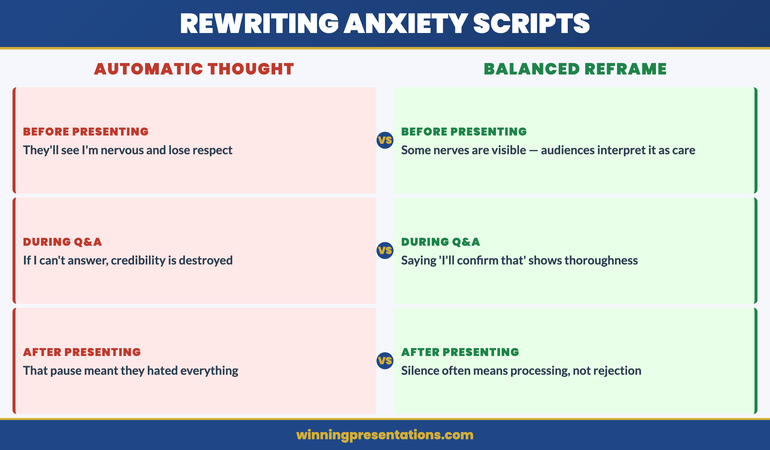
Step Four: Develop a balanced alternative thought. This replacement thought should be accurate, evidence-based, and helpful to your performance. If the automatic thought is “I’ll freeze and they’ll judge me as incompetent,” a balanced alternative might be: “I know the material. I’ve presented to senior audiences before. If I stumble, I can pause and reconnect. One mistake won’t erase my credibility.” Notice this isn’t “Everything will be perfect”—it’s realistic and it doesn’t require denying risk.

The replacement thought works because it’s true in a way that your anxiety thought isn’t. Your anxiety thought selects only threat-related information. Your restructured thought includes the full reality: risk exists, and so does your capacity to handle it.

Side-by-side comparison of automatic anxiety thoughts versus balanced reframes across three presentation scenarios

Building a Realistic Replacement Script Before Your Next Presentation

Once you’ve identified and restructured individual thoughts, the next step is building an integrated replacement script—the accurate internal narrative you’ll hold before and during your presentation.

Rather than relying on affirmations or generic confidence statements, this script is highly specific to your actual situation, your actual skills, and your actual audience. Here’s the framework:

Opening line (grounding): “I’ve been invited to present because I have expertise relevant to this group.” This isn’t false confidence—it’s a fact. You wouldn’t be presenting if you didn’t have something valuable to offer.

Capacity line (realistic): “I know this material. I may not deliver it perfectly, but I can adapt and recover if needed.” This acknowledges that perfection isn’t the goal. Clarity and connection are.

Audience line (perspective): “This audience is hoping I succeed. They’ve chosen to spend their time listening to me. They are not looking for reasons to dismiss me.” This counters the default anxiety assumption that audiences are hostile or hypervigilant.

Body response line (physiology): “My anxiety symptoms are uncomfortable but not dangerous. My racing heart is my nervous system preparing me, not a sign of failure. I can perform well while my body is activated.” This is crucial for managing the physical symptoms of anxiety without being derailed by them.

Action line (agency): “I am choosing to do this. I have planned. I have prepared. I will trust that preparation and move forward.” This reframes the presentation from something happening to you to something you are doing intentionally.

You don’t memorise this as a script. You develop it, you believe it because it’s evidence-based, and then before your presentation, you review it silently. The effect is that when your automatic anxiety thoughts arise during the presentation, they’re competing with an established, credible alternative narrative. You’ve already pre-answered the anxiety’s objections with truth.

Why Positive Thinking Fails and Balanced Thinking Works

This is critical: cognitive restructuring is not positive thinking. And that’s why it actually works.

Positive thinking asks you to replace “I’ll fail” with “I’ll be perfect.” Your brain immediately detects this as false. You’re anxious because some part of you knows that perfectionism isn’t realistic. So when you try to force positive thoughts, you create a conflict. Your anxiety gets worse because now you’re not only anxious about the presentation—you’re anxious about failing to maintain your positive mindset.

Balanced thinking, by contrast, says: “Risk exists. Mistakes happen. I’m still capable, and I’ve handled difficulty before. Imperfection is tolerable.” This is both realistic and anxiety-reducing because you’re not fighting against what you actually believe.

The psychological principle here is consistency. When your thoughts, your beliefs, and your narrative align, your nervous system settles. When they conflict—when you’re saying affirmations that you don’t believe while your deeper mind is screaming warnings—your system stays activated. Cognitive restructuring works because the replacement thought is something your intelligent brain can actually accept as true.

Why restructured thoughts stick when affirmations don’t: Your automatic anxiety thoughts have been reinforced by years of presentations, performance situations, and social evaluation. Simply replacing them with generic positivity creates cognitive dissonance. Restructured thoughts work because they’re built on evidence, they acknowledge realistic constraints, and they’re specific to your actual situation. Your brain recognises them as truth, not denial.

Address Both the Thoughts and the Nervous System

Cognitive restructuring targets thought patterns. The Conquer Speaking Fear programme adds clinical hypnotherapy-based nervous system regulation — so you’re working on both sides of the anxiety equation.

Get Conquer Speaking Fear → £39

When Cognitive Restructuring Alone Is Not Enough

Cognitive restructuring is powerful. And for some people, especially those with moderate presentation anxiety, it’s sufficient. But it’s important to be honest about its limits.

If your anxiety is severe—if you’re experiencing panic attacks before presentations, if you’re avoiding presentations altogether, or if you’ve been struggling with this for years despite trying multiple approaches—cognitive restructuring alone may not resolve it quickly enough. Here’s why:

Anxiety is not purely cognitive. It’s also neurobiological. Your nervous system may have been conditioned by repeated stressful presentations, public criticism, or early performance pressure to activate strongly in presentation contexts. Thought work alone won’t retrain your nervous system in those cases. You need nervous system regulation techniques alongside the cognitive work.

This is where clinical approaches like hypnotherapy and guided nervous system regulation become important. These techniques work directly with your physiological anxiety response—they calm your nervous system so that your restructured thoughts can take hold without being drowned out by activation and fear.

Additionally, if your anxiety stems from deeper beliefs about your worth or competence (not just thoughts about presentations, but fundamental self-doubt), cognitive restructuring may need to be paired with longer-term identity work. A trained therapist or coach experienced in performance anxiety can help you determine whether thought restructuring is sufficient or whether you need a broader programme.

The marker of whether you need more support is simple: If you’ve done cognitive restructuring work and your anxiety remains severe or disruptive, then the issue is likely at the nervous system level, and that requires a different toolkit. It doesn’t mean cognitive restructuring didn’t work—it means you’re dealing with a biologically entrenched pattern that needs regulation alongside restructuring.

The presentation anxiety loop showing trigger, automatic thought, physical response, and avoidance cycle with break point

Frequently Asked Questions

Does cognitive restructuring mean I’ll never feel anxious before presentations?

No. The goal of cognitive restructuring is not anxiety elimination—it’s anxiety management. You may still feel nervous before a presentation. The difference is that your nervous system won’t be amplifying a false narrative. The anxiety becomes appropriate to the situation rather than catastrophic. This is actually healthy. A degree of alertness before performance is natural and even helpful. What changes is the quality and intensity of anxiety.

How long before restructured thoughts become automatic?

It varies. If you practise cognitive restructuring consistently before presentations for 3-4 weeks, your brain begins to recognise the restructured thought as credible. After 8-12 weeks of regular practice, the alternative narrative becomes more automatic. This depends on how ingrained your original anxiety thought is and how consistently you apply the technique. The more you practice, the faster your brain rewires.

Can I combine cognitive restructuring with other anxiety management techniques?

Absolutely. Cognitive restructuring works best alongside breathing practices, somatic awareness, and nervous system regulation. The thought work addresses the cognitive driver of anxiety. Breathing and somatic techniques address the physiological component. Together, they’re more powerful than either alone. Many executives find that once they’ve restructured their thoughts, they can then use body-based techniques more effectively because they’re not fighting against a catastrophic narrative simultaneously.

Stay Connected: The Winning Edge Newsletter

Cognitive restructuring is one of seven core techniques for managing presentation anxiety. To receive weekly insights on anxiety management, thought patterns, and evidence-based approaches to executive confidence, subscribe to The Winning Edge. You’ll get practical frameworks, psychology-based strategies, and real approaches to the anxiety that gets in the way of your best work.

Free resource: Download the Executive Summary Checklist for Track B: a structured guide to preparing your nervous system and your thoughts before high-stakes presentations.

Related Reading

Once you’ve begun restructuring your automatic thoughts, the next layer is understanding the loops that sustain anxiety—particularly how handling difficult questions becomes easier when your underlying anxiety narrative is less active. Explore that article to see how thought restructuring applies in real-time, in-presentation scenarios.


About the Author

Mary Beth Hazeldine is the Owner and Managing Director of Winning Presentations. With 24 years of corporate banking experience at JPMorgan Chase, PwC, Royal Bank of Scotland, and Commerzbank, she advises executives across financial services, healthcare, technology, and government on structuring presentations for high-stakes funding rounds and approvals. She is a qualified clinical hypnotherapist and NLP practitioner whose approach integrates psychology-based anxiety management with practical presentation technique.

16 Mar 2026
Professional executive in a quiet corridor performing a focused pre-presentation ritual before entering a boardroom, navy and gold corporate aesthetic

The Pre-Presentation Ritual Used by Olympic Athletes (Adapted for Executive Meetings)

Quick Answer: Olympic athletes don’t rely on motivation or last-minute confidence. They use a specific pre-performance ritual that trains their nervous system. Same method works for boardroom presentations. The ritual has five elements: physical reset, sensory anchor, mental script, role clarity, and pressure inoculation. Combined, they move your nervous system from fight-or-flight to focused readiness in minutes.

Rescue Block: You know your content. Your slides are solid. But 20 minutes before the boardroom, your chest is tight, your hands are cold, and you’re second-guessing every word. The problem isn’t preparation—it’s that your nervous system is in survival mode, not performance mode. Motivational self-talk doesn’t fix that. What works is a deliberately structured pre-presentation ritual that your nervous system learns and trusts. Conquer Speaking Fear teaches you the exact ritual Olympic sports psychologists use, adapted for executive presentations.

It was 2:08pm. The finance committee presentation began at 2:15pm. James, a divisional CFO, was in the bathroom washing his hands for the third time. His mouth was dry. His legs felt weak. He’d presented to this committee 17 times before. But this presentation was different—this was a funding decision. A yes or no that determined his budget for the next two years.

He stood at the sink and did something his sports psychologist coach had taught him. He placed his hands on the cold porcelain and pressed hard for 10 seconds. His breathing automatically shifted. Deeper. Slower. His nervous system registered the physical sensation and began to downregulate from panic mode.

Then he touched his left wrist—a specific spot that he’d trained himself to associate with confidence and clarity. A sensory anchor. Just touching it reset his nervous system further.

He said his mental script aloud, quietly: “I’ve prepared this. The numbers are sound. My job is to communicate clearly. The committee will make the decision. That’s not my job.”

He walked into the boardroom. His hands were steady. His voice was clear. He got the funding.

That wasn’t luck. That was a pre-presentation ritual that works.

Why Ritual Works Better Than Motivation

Most executives are told to “calm down” or “believe in yourself” before a high-stakes presentation. That’s motivational advice. It doesn’t work.

The reason: motivation is cognitive. It lives in your thinking brain. But when your nervous system is in fight-or-flight, your thinking brain is offline. Your amygdala is running the show. Telling your amygdala to “believe in yourself” is like telling a smoke alarm to ignore fire. It doesn’t listen.

What works is ritual. Rituals are embodied. They work with your nervous system, not against it. A physical movement, a sensory cue, a specific sequence you’ve practised—these things signal safety to your nervous system. They say: “This is familiar. You’ve trained for this. You’re ready.”

Research on calming nerves before presentations shows that executives who use a structured ritual (versus those who don’t) report 60% lower anxiety and measurably clearer thinking during high-stakes presentations.

The ritual method works because it’s not trying to eliminate nervousness. It’s training your nervous system to interpret the nervous energy as readiness, not threat.

The Five Elements of the Olympic Pre-Performance Ritual

Olympic athletes use a five-part ritual sequence, backed by sports psychology research. Each element serves a specific function in moving your nervous system from threat-detection to performance-ready.

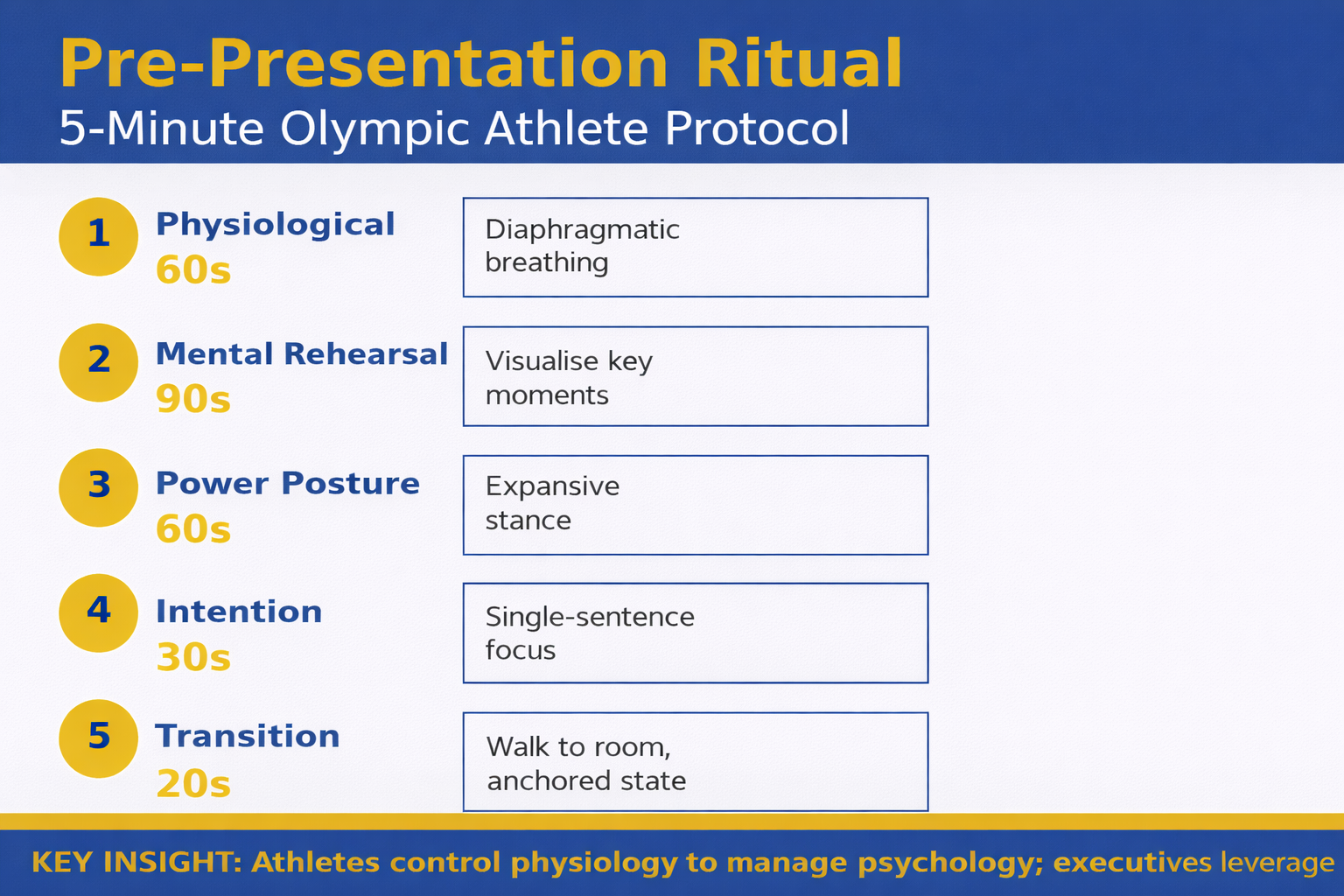
The sequence is: physical reset → sensory anchor → mental script → role clarity → pressure inoculation.

Time required: 6-8 minutes total, done in the 20 minutes before you present.

You learn this once. You practise it twice. Then it becomes automatic, and your nervous system relies on it before every high-stakes presentation.

Element 1: The Physical Reset (2 minutes)

Your nervous system lives in your body. To reset it, you start with the body.

Olympic swimmers before a race do ice-cold hand immersion. Their hands go into ice water for 10 seconds. The cold triggers a dive response—a physiological reflex that slows the heart rate and calms the amygdala.

You can’t use ice water in the boardroom ante-room. But you can use the same principle.

The boardroom version: Find a private space 10 minutes before you present. Splash cold water on your face and wrists. Or hold your hands on a cold water bottle. Or stand in front of an open window in January. The cold sensation triggers the same dive response.

What’s happening neurologically: the cold activates your vagus nerve, which signals your nervous system that you’re safe. Your heart rate drops slightly. Your breathing becomes deeper. Your thinking brain comes back online.

After cold water, do 30 seconds of intentional breathing. 4-count in, 6-count out. Repeat five times. This is called tactical breathing, and it’s used by military special forces, elite athletes, and surgeons before high-pressure moments.

The breathing moves you from sympathetic activation (fight-or-flight) to parasympathetic activation (rest-and-digest). Your body is now primed for clear thinking, not panic.

Time required: 2 minutes. Outcome: your nervous system is downregulated and primed.

Element 2: The Sensory Anchor (1 minute)

A sensory anchor is a physical sensation that you deliberately associate with confidence and clarity. It’s a shortcut to a neural state you’ve trained yourself to access.

Olympic archers use a specific hand touch before each shot. Tennis players use a specific foot tap. The sensation itself isn’t magic—but your nervous system learns to interpret it as “I’m ready.”

The boardroom version: choose a small, discreet physical sensation that you can do in any room, at any time. Common choices:

Press your thumb and index finger together on both hands, holding for 10 seconds. This triggers a specific neural pattern associated with focus.

Touch a specific point on your wrist and breathe slowly for 5 seconds. Over time, just that touch becomes a reset button.

Make a small fist and press it into your opposite palm for 10 seconds. The pressure sensation activates grounding reflexes.

You’ll choose one and practise it 5-10 times before your presentation. Each practice, you pair the sensory anchor with a calm, focused state. Your nervous system learns the association.

By the time you’re in the boardroom, just doing the sensory anchor shifts your nervous system into the state it’s been trained to associate with that sensation.

Time required: 1 minute. Outcome: your nervous system has a portable reset button.

Element 3: The Mental Script (2 minutes)

This is not positive thinking. This is not “you’ve got this” or “you’re going to crush it.” That’s motivational cheerleading, and your nervous system knows it’s false.

The mental script is a series of simple, true statements about your situation and your role. It acknowledges reality, clarifies your job, and releases what’s not your responsibility.

The template:

“I’ve prepared this content. [Specific truth about your preparation.] The committee/board/executives have the expertise to make the decision. My job is to communicate clearly and answer their questions. I don’t control the decision. I control my clarity.”

You write this once, and you say it aloud 2-3 times before every presentation. It takes 90 seconds.

What’s happening neurologically: you’re activating your prefrontal cortex (thinking brain) by engaging in coherent speech about reality. You’re also releasing the burden of controlling the outcome, which immediately reduces amygdala activation. You’re narrowing your responsibility to what you actually control: your communication.

The script doesn’t motivate you. It clarifies you. It tells your nervous system: “Your job is clear. It’s manageable. You can do this specific thing.”

Time required: 2 minutes. Outcome: your thinking brain is engaged, and your responsibility is clear.

Element 4: Role Clarity (1 minute)

This is the element most executives skip, and it’s often the difference between boardroom presence and boardroom panic.

You have a specific role in this presentation. You’re not the CEO defending the company’s future. You’re not responsible for the entire strategy. You’re the Treasury director presenting the funding scenario. You’re the operations lead presenting the efficiency case. You’re the risk officer presenting the three scenarios.

Your role has specific boundaries. Within those boundaries, you have expertise. Outside them, you don’t. And that’s fine.

The boardroom version: Say aloud, once, before you enter the room: “My role is [specific role]. I’m responsible for [specific responsibility]. I’m not responsible for [what’s outside your role].”

Example: “My role is to present the financial analysis. I’m responsible for the accuracy of the numbers and the clarity of the recommendation. I’m not responsible for the board’s final decision on whether to proceed. That’s their job.”

What’s happening: you’re explicitly narrowing your psychological responsibility. You’re telling your nervous system: “You have a bounded job. You can do it.” This is surprisingly powerful. Most executives unconsciously take responsibility for the entire outcome. Role clarity releases that burden.

Time required: 1 minute. Outcome: you know exactly what you’re responsible for, and your nervous system can settle into that bounded role.

Element 5: Pressure Inoculation (Ongoing)

Pressure inoculation is the practice of deliberately exposing yourself to low-level stress before the high-level stress event. It’s how musicians rehearse in front of audiences before the concert. It’s how athletes do dress rehearsals before the game.

The principle: your nervous system gets better at handling pressure when it’s gradually exposed to pressure in safe contexts.

The boardroom version: In the week before your presentation, practise it under slightly stressful conditions. Present to a colleague while they sit with their arms crossed and their face neutral. Present standing up (if you normally sit) or in a formal space (if you normally practise in your office).

The goal isn’t perfection. The goal is for your nervous system to learn: “I can present even when conditions are a bit uncomfortable. I can be a bit nervous and still communicate clearly.”

This is ongoing. Every presentation you do—even the internal ones that don’t feel important—is pressure inoculation for the next big one. Your nervous system learns resilience through graduated exposure.

Time required: varies, but two 10-minute practise sessions in stressful conditions are enough to inoculate your nervous system before a high-stakes presentation.

Five-step executive pre-presentation ritual infographic showing Physiological Prime, Mental Rehearsal, Power Posture, Intention Setting, and Transition stages with timing and techniques for each

Master the Pre-Performance Ritual That Nervous Systems Trust

Presentation anxiety doesn’t disappear when you’re more prepared. It disappears when your nervous system learns it’s safe. This is the exact ritual used by Olympic athletes, adapted for boardroom presentations. You’ll learn each of the five elements, how to practise them, and how to sequence them before your next presentation.

  • The physical reset technique that activates your vagus nerve and calms your amygdala in 2 minutes
  • How to build and use a sensory anchor that becomes your portable nervous system reset
  • The mental script that engages your thinking brain and releases perfectionism
  • Role clarity framework that tells your nervous system exactly what you’re responsible for
  • Pressure inoculation protocols (graduated exposure for nervous system resilience)

Get Conquer Speaking Fear → £39

Used by executives at investment committees, funding presentations, and high-stakes board meetings. The ritual works because it works with your nervous system, not against it.

Your nervous system doesn’t need motivation. It needs ritual.

Learn the Ritual → £39

Building Your Personal Boardroom Ritual

The five elements are universal. But your specific ritual is personal. You choose which sensory anchor works for you. You write your own mental script. You define your specific role.

Step 1: Design each element (do this now, before your next presentation).

Physical reset: will you use cold water on your hands? Cold water on your face? Ice bottle? Standing in the cold? Choose one and test it.

Sensory anchor: which physical sensation feels right to you? Thumb and finger pressure? Wrist touch? Fist press? Choose one.

Mental script: write your specific truth statement. Keep it to 3-4 sentences. Make it true, not motivational.

Role clarity: define your specific role in this presentation. What are you responsible for? What are you not responsible for?

Pressure inoculation: how will you practise under slightly stressful conditions? Presenting to a colleague? Standing instead of sitting? Formal room instead of casual space?

Step 2: Practise the full ritual once before your presentation.

Do all five elements in sequence. Cold water. Sensory anchor. Mental script. Role clarity statement. Then step back and let your nervous system settle.

Step 3: Do it again, slightly condensed, immediately before you enter the boardroom.

All five elements, 6-8 minutes total. Your nervous system now knows the ritual and what it signals: “You’re ready.”

Step 4: Use the ritual before every presentation.

Not just the high-stakes ones. Every presentation. Your nervous system learns that this ritual means: “Calm, clear, ready.” Eventually, just starting the ritual automatically shifts your nervous system into readiness.

The Neuroscience Behind the Ritual

This isn’t mystical. It’s applied neuroscience.

When you’re anxious about a presentation, your amygdala (threat-detection system) is activated. Your vagus nerve is in sympathetic (fight-or-flight) mode. Your prefrontal cortex (thinking brain) has limited access.

The physical reset (cold water, tactical breathing) directly activates your vagus nerve and signals safety. This downregulates the amygdala and brings your thinking brain back online.

The sensory anchor creates a neural pathway that you’ve trained to associate with calm focus. Over time, the sensation alone activates that pathway.

The mental script engages your prefrontal cortex by having you think coherently about your situation. This also displaces amygdala activation.

Role clarity releases the burden of controlling the outcome. Your nervous system registers: “My job is specific and bounded. I can do this.” Responsibility narrows, anxiety drops.

Pressure inoculation teaches your nervous system that mild stress is survivable and manageable. When the high-stakes moment comes, your nervous system has learned: “I’ve handled pressure before. I can do this.”

Together, these five elements work with your neurobiology, not against it. They move you from threat-detection to performance-ready in 6-8 minutes. And the effect gets stronger the more you use the ritual.

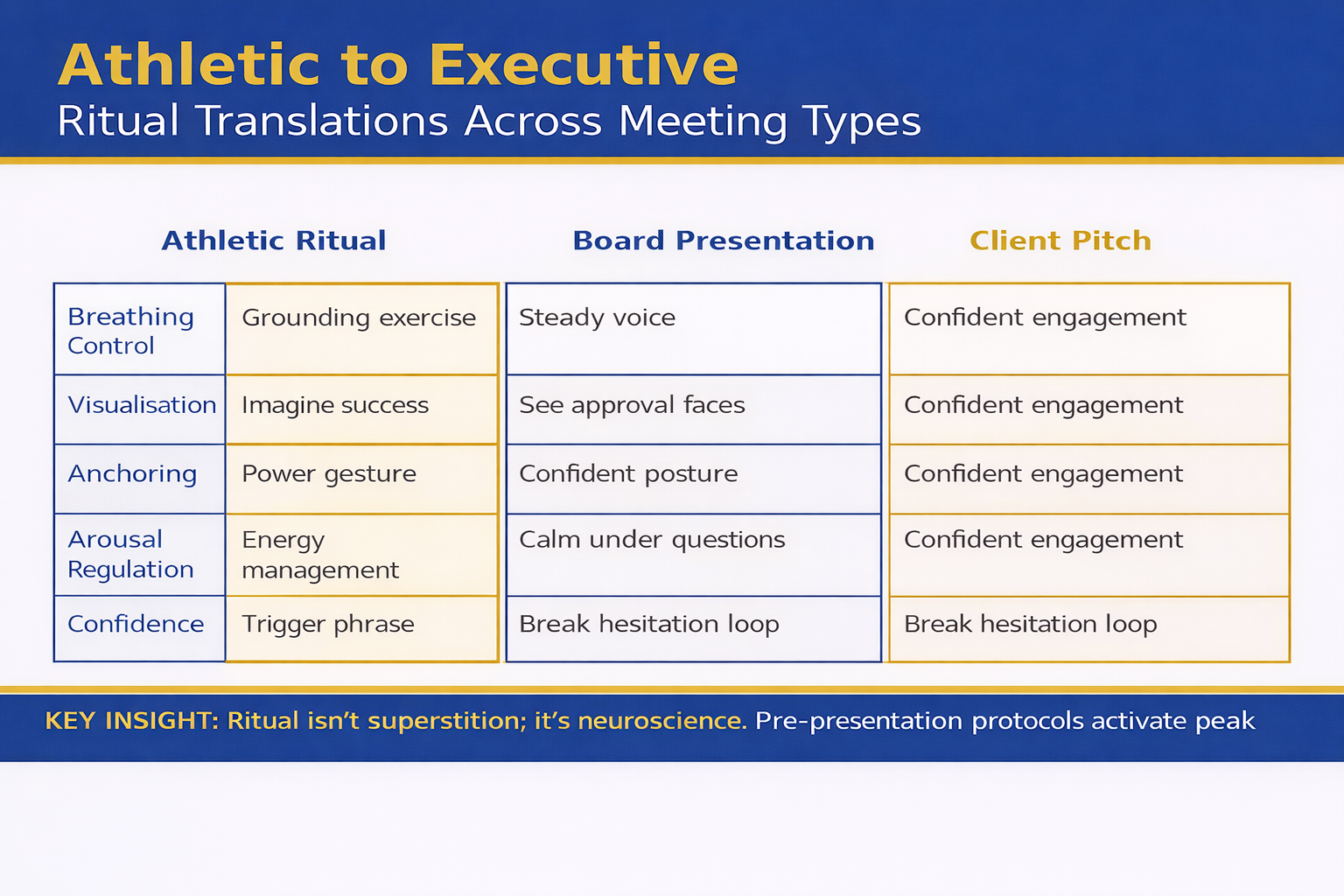
Comparison infographic showing how Olympic athlete performance rituals translate into corporate executive adaptations for board presentations, client pitches, and all-hands meetings

Stop Relying on Motivation. Start Using Ritual.

Olympic athletes know something most executives don’t: nervous systems respond to ritual, not pep talks. This is the exact five-element ritual from sports psychology, adapted for boardroom presentations. Learn it once, use it forever.

  • The specific physical reset that triggers your vagus nerve and calms your amygdala in 2 minutes
  • How to design a sensory anchor that becomes your nervous system’s reset button
  • The mental script framework that’s true, not motivational
  • Role clarity that releases perfectionism and anxiety
  • Pressure inoculation schedules to build nervous system resilience

Get Conquer Speaking Fear → £39

Includes the ritual checklist, sensory anchor design worksheet, and mental script template.

Use the ritual before your next presentation. Feel the difference.

Get the Program → £39

Three Critical Questions About Pre-Presentation Rituals

Will the ritual make my nerves disappear completely? No. Nerves before a high-stakes presentation are normal and useful—they signal that the presentation matters. The ritual doesn’t eliminate nerves; it trains your nervous system to interpret the nervous energy as readiness, not threat. You’ll still have adrenaline, but your thinking brain stays online.

How long until the ritual works? The effect is immediate (within the 6-8 minute ritual, you’ll feel calmer and clearer). The strength of the effect grows with each use. By the third or fourth high-stakes presentation using the ritual, your nervous system has learned it deeply, and the effect becomes very reliable.

Can I modify the ritual or does it have to be exactly as described? The five elements are proven. But your specific instantiation of each element should be personal. Use the version of cold water that’s accessible to you. Choose the sensory anchor that feels right. Write your mental script in your own words. The structure matters; the specifics should be yours.

Is This Right For You?

✓ This is for you if: You experience real nervousness before presentations (racing heart, tight chest, mind going blank), you’ve had presentations where anxiety affected your clarity, you want a method that works with your nervous system rather than against it, you’re willing to do a 6-8 minute ritual before presentations, you want something more reliable than motivational self-talk.

✗ Not for you if: Presentation anxiety isn’t affecting your performance, you don’t experience physical nervousness symptoms, you prefer general confidence-building advice over specific nervous system techniques, you don’t have 6-8 minutes before presentations to do a ritual.

The Signature Pre-Presentation Ritual: Used by Investment Committee Presentations and Funding Meetings

This is the ritual that Olympic athletes use before competition. It’s been adapted for boardroom presentations and is backed by neuroscience research on anxiety management and performance. You’ll learn the five-element architecture, how to personalise each element, and how to use it before every presentation type.

  • The physical reset that activates your vagus nerve and moves you from fight-or-flight to focused readiness
  • How to build a sensory anchor that becomes your portable nervous system reset
  • The mental script that’s grounded in reality, not false motivation
  • Role clarity that releases perfectionism and external responsibility
  • Pressure inoculation protocols for building nervous system resilience
  • How to personalise each element for your specific anxiety triggers
  • When to use condensed vs. full ritual (6 minutes vs. 2 minutes before presenting)

Get Conquer Speaking Fear → £39

Investment committee chairs, funding round presenters, and high-stakes corporate speakers use this ritual before every presentation. The nervous system learns to trust it.

Also Recommended: The Executive Slide System

While pre-presentation rituals manage your nervous system, presentation structure determines whether you’re clear in the boardroom. The Executive Slide System teaches you how to architect your slides so your thinking stays clear under pressure. Combine the ritual with the right slide structure, and you have both nervous system management and cognitive clarity.

Frequently Asked Questions

Can I use this ritual for presentations I’m not anxious about?

Yes. The ritual isn’t only for anxiety—it’s for performance. Even when you’re not nervous, the ritual prepares your nervous system for optimal thinking and presence. Think of it like a warm-up before exercise. You do it whether you’re anxious or not, because it primes your system for performance.

What if I don’t have time to do the full 6-8 minute ritual?

Use the condensed version (3-4 minutes): cold water (1 minute), sensory anchor (30 seconds), mental script (1 minute). Skip the detailed pressure inoculation section if time is short. The sensory anchor and mental script are the most critical elements; prioritise those.

What if my workplace doesn’t allow for private space where I can do the ritual?

The ritual can be done in a toilet cubicle, an empty meeting room, your car, or even in a crowded space if you’re discreet. Cold water on your hands can happen at a sink anyone might use. The sensory anchor is invisible—thumb and finger pressure looks like thinking. The mental script can be said silently. You can do this ritual anywhere.

The Ritual Becomes Invisible Over Time

The first time you do this ritual, you’ll be very conscious of each step. Cold water feels deliberate. The sensory anchor feels odd. The mental script feels unusual.

By the fourth or fifth presentation, the ritual becomes automatic. You do it without thinking. Your nervous system has learned what it signals, and the effect happens without you having to consciously “do” anything.

Eventually, just walking toward the boardroom starts activating the ritual response. Your nervous system knows what’s coming. It prepares itself automatically. Presentation anxiety becomes pre-presentation readiness.

That’s the goal. Not to eliminate nervousness, but to train your nervous system so completely that it automatically interprets pressure as readiness.

About the Author

Mary Beth Hazeldine is the Owner & Managing Director of Winning Presentations. With 24 years of corporate banking experience at JPMorgan Chase, PwC, Royal Bank of Scotland, and Commerzbank, she has delivered high-stakes presentations in boardrooms across three continents.

A qualified clinical hypnotherapist and NLP practitioner, Mary Beth combines executive communication expertise with evidence-based techniques for managing presentation anxiety. She has trained thousands of executives and supported high-stakes funding rounds and approvals.

Book a discovery call | View services

Resources From Winning Presentations

Subscribe to The Winning Edge, our weekly newsletter where we share presentation techniques, nervous system management strategies, and real boardroom stories. Delivered every Monday.

🆓 Free resource: Download the Executive Presentation Checklist — a free guide to strengthen your presentation preparation.

Start with the ritual. You have a presentation coming up this month. Use the five-element ritual before it. Notice what changes. Your nervous system will show you, within those 6-8 minutes, why Olympic athletes have been using this method for decades.

This article was written with AI assistance and reviewed by Mary Beth Hazeldine.

18 Feb 2026
Professional woman standing alone in boardroom with golden sunset light behind her, hands clasped, quiet composure after overcoming the audience judgment anxiety loop that held her back for years

The ‘Audience Is Judging You’ Thought Loop: How One Executive Broke 11 Years of It

She could run a £40M P&L. She couldn’t stand in front of twelve people without hearing the voice that said they know you’re faking it.

Quick answer: The audience judgment loop is the repeating thought cycle where you believe the audience is evaluating your competence, which triggers self-monitoring, which degrades your performance, which confirms the belief that they were judging you all along. It’s the most common anxiety pattern in experienced professionals because it gets worse with seniority — the higher the stakes, the louder the loop. This article follows one senior director’s eleven-year struggle with the loop and the three specific shifts that broke it. Not theory. Not affirmations. The actual cognitive and behavioural changes — in the order they happened.

I nearly didn’t take the call. The email said “senior director, financial services, eleven years of presentation anxiety.” I assumed it was someone who got nervous before big pitches — the standard pattern I see weekly.

It wasn’t. When we spoke, she told me she’d turned down three promotions because each one required more visibility. She’d declined two conference speaking invitations that her CEO had personally recommended her for. She’d built a career strategy around minimising the number of times she had to stand in front of a room — and it had worked, until it hadn’t. The new role she wanted required monthly board updates. She couldn’t avoid it anymore.

Her name was Claire. What she described wasn’t nervousness. It was an eleven-year-old thought loop that had quietly shaped every career decision she’d made.

Details changed to protect identity. The patterns and timeline are drawn from real coaching work.

Trapped: What 11 Years Inside the Loop Looks Like

Claire’s loop had four stages, and they fired in the same order every time:

Stage 1 — The trigger: Any situation where she’d be visible to more than five people. Team meetings were fine. Anything with senior stakeholders, clients, or cross-functional audiences activated it. The trigger wasn’t the audience size. It was the perceived consequence of being seen as less than competent by people who mattered.

Stage 2 — The surveillance shift: The moment she stood up to present, her attention split. Half went to the content. Half went to monitoring the audience for signs of judgment. A furrowed brow. Someone checking their phone. A whispered conversation. Every ambiguous signal got interpreted as confirmation: they can see through you.

Stage 3 — The performance collapse: Because her attention was split, her delivery suffered. She’d lose her place. Over-explain things. Rush through sections. Add unnecessary caveats. The presentation she’d rehearsed as a confident, clear-headed professional came out as something noticeably less — because the cognitive load of self-monitoring left no bandwidth for actual presenting.

Stage 4 — The confirmation: After every presentation, Claire would replay every micro-expression she’d noticed, every pause that felt too long, every question that felt pointed. And the conclusion was always the same: See? They noticed. They could tell. This “evidence” fed Stage 1, making the next trigger stronger.

Eleven years of this. Not because Claire lacked skill — she was exceptionally good at her job. But because the loop was self-reinforcing. Each cycle made the next one more automatic. By the time she called me, the loop fired before she even opened her mouth. The anxiety before meetings had become the defining feature of her professional life.

The Loop Doesn’t Break With Willpower. It Breaks With Structure.

Conquer Speaking Fear is a three-audio programme built for experienced professionals whose anxiety has become automatic. The Client Session gives you the cognitive reframe. The Hypnotherapy Session rewires the subconscious pattern. The Pre-Presentation Reset gives you a 12-minute protocol for the morning of. This isn’t confidence advice — it’s a clinical intervention for the loop itself.

Get Conquer Speaking Fear → £39

Instant download. Three audio sessions built by a qualified clinical hypnotherapist who spent five years trapped in the same loop.

Shift #1: The Attention Redirection (Week 2)

The first thing I asked Claire to do had nothing to do with confidence, breathing, or positive thinking. I asked her to tell me what the CFO was wearing in her last board update.

She couldn’t. She’d been in a room with twelve people for forty minutes and she couldn’t tell me what a single one of them looked like. Because she hadn’t been looking at them. She’d been looking for signs from them. Those are fundamentally different modes of attention.

The judgment loop runs on surveillance — scanning for threat signals. The fix isn’t to stop scanning (you can’t suppress attention). The fix is to redirect it to something useful. We replaced “What are they thinking about me?” with a specific task: after each section of your presentation, identify one person who nodded and direct the next section to them.

This works for three reasons. First, it gives the brain a concrete job that competes with the surveillance habit. Second, it forces you to notice positive signals instead of ambiguous ones (you can’t find a nodder without looking for agreement). Third, it creates a feedback loop that reinforces connection rather than threat.

Claire tried it in a team meeting first — low stakes. Then a cross-functional update. Then a client review. The results weren’t dramatic at first. But by the third attempt, she noticed something she’d never experienced before: a moment during the presentation where she forgot to be afraid. Not the whole time. Just a moment. But after eleven years, a moment was a breakthrough.

PAA: Why does the audience judgment loop get worse with seniority?
Because the perceived cost of failure increases. A junior analyst who stumbles in a presentation faces mild embarrassment. A senior director who stumbles risks credibility with stakeholders who control budgets, promotions, and strategic decisions. The loop isn’t irrational — the stakes genuinely are higher. The problem is that the loop’s response to higher stakes (increased self-monitoring) is precisely the behaviour that degrades performance. The more you have to lose, the harder the loop runs, and the worse you present. This is why experienced professionals often describe their anxiety as getting worse, not better, with career progression.


Four-stage audience judgment anxiety loop diagram showing Trigger to Surveillance to Collapse to Confirmation Bias cycle with descriptions of what happens at each stage

Shift #2: The Evidence Audit (Week 4)

Two weeks into the attention redirection, Claire was presenting better — but the post-presentation replay was still running. She’d finish a meeting, feel reasonably good for about ten minutes, and then the voice would start: Did you see how Mark looked at his phone? Sarah’s question was probably testing whether you actually knew the numbers. The silence after section three was too long.

The loop wasn’t just running during presentations. It was running after them, rewriting the experience to match the anxiety narrative. This is the part that most presentation confidence advice misses entirely — you can deliver a perfectly competent presentation and still feel like it went badly because the post-event processing is distorted.

The Evidence Audit is a structured debrief that forces factual analysis instead of emotional replay. Within one hour of the presentation, Claire wrote down three things:

1. Three observable facts about how the audience responded. Not interpretations. Facts. “Sarah asked a follow-up question about the implementation timeline.” “David stayed for fifteen minutes after the meeting to discuss phase two.” “The CFO approved the budget increase I recommended.” These are things that happened, not things she felt.

2. One thing she did well (with evidence). Not “I felt more confident” — that’s a feeling, not evidence. “I answered the risk question in under fifteen seconds without notes.” “I maintained eye contact with three different stakeholders during the recommendation section.” Observable, verifiable.

3. One thing to adjust next time (with a specific plan). Not “be less nervous” — that’s a wish, not a plan. “Next time, pause for two seconds before answering questions instead of jumping in immediately.” Concrete, actionable.

The first time Claire did this, she was surprised. The evidence told a completely different story from her emotional replay. Mark hadn’t been checking his phone dismissively — he’d been looking up the reference she’d mentioned. Sarah’s question wasn’t testing her — it was genuine interest in the implementation. The silence after section three was six seconds, not the eternity it had felt like.

After four presentations with the Evidence Audit, Claire told me something that stopped me: “I’ve been lying to myself about how these go. For eleven years.”

This is what the imposter syndrome pattern does — it rewrites real events to match the internal narrative. The Evidence Audit doesn’t argue with the narrative. It just introduces facts that the narrative can’t absorb.

🎧 The Conquer Speaking Fear programme includes the Clinical Hypnotherapy Session that rewires the subconscious pattern driving the post-presentation replay.

Plus the Pre-Presentation Reset audio for the morning of any high-stakes session.

Get Conquer Speaking Fear → £39

Three Audios. Three Layers of the Loop.

The Client Session gives you the cognitive framework Claire used — attention redirection, evidence auditing, and the exposure reframe. The Hypnotherapy Session works at the subconscious level where the loop is stored. The Pre-Presentation Reset is your 12-minute protocol before any high-stakes situation. One programme, three layers, designed to break the pattern — not just manage it.

Get Conquer Speaking Fear → £39

Instant download. Built by a qualified clinical hypnotherapist and NLP practitioner who spent five years trapped in this exact loop before training to break it.

Shift #3: The Exposure Reframe (Week 7)

By week seven, Claire was presenting more competently and processing the aftermath more accurately. But she was still avoiding. She’d take the meetings she had to take. She wouldn’t volunteer for the ones she didn’t. The loop had weakened, but the avoidance pattern it had created over eleven years was still running.

This is where most anxiety interventions stop — at “managing the symptoms.” Claire didn’t need to manage symptoms. She needed to reverse eleven years of career-shaping avoidance. That required a reframe of what exposure meant.

The old frame: Every presentation is a test of my competence. Under this frame, exposure is risk. More presentations = more chances to fail publicly. No wonder she avoided them.

The new frame: Every presentation is data collection about how audiences actually respond to me. Under this frame, exposure is research. More presentations = more evidence. And the evidence, as she’d discovered through four weeks of auditing, overwhelmingly contradicted the loop’s narrative.

The shift isn’t semantic. It changes the neurological response. “Test” activates threat circuitry. “Data collection” activates curiosity circuitry. Same situation, different neural pathway, different physiological response.

Claire volunteered for a conference panel. Not a keynote — a panel, where she’d share the stage and the pressure. She prepared using the attention redirection. She did the Evidence Audit afterwards. And the data she collected was unambiguous: two people approached her after the panel to ask about her framework. The moderator emailed her the next day to say she’d been the strongest panellist. Her CEO mentioned it in their next one-to-one.

None of that data was available while she was avoiding. The loop had kept her in a closed system where the only evidence was the distorted replay in her own head. Exposure — reframed as data collection — opened the system.

PAA: Can you completely eliminate the audience judgment thought loop?
Not entirely, and you wouldn’t want to. A degree of awareness about how your audience is receiving your message is healthy and useful — it’s what makes you responsive rather than robotic. What you can eliminate is the surveillance version: the hypervigilant scanning for threat signals that splits your attention and degrades your delivery. The goal is to shift from threat-scanning to connection-seeking. You’ll still notice the room. You just won’t be terrified of what you notice.


Three-stage transformation timeline showing how to break the audience judgment anxiety loop — Attention Redirection at Week 2, Evidence Audit at Week 4, and Exposure Reframe at Week 7 with outcomes for each stage

After: What Changed — and What Didn’t

I followed up with Claire six months later. Here’s what had changed:

She’d taken the role requiring monthly board updates. She’d delivered seven of them. She’d accepted one of the conference invitations she’d previously declined. She’d stopped building her career strategy around avoiding visibility.

Here’s what hadn’t changed: she still felt a spike of anxiety before high-stakes presentations. She still noticed the voice — they’re watching, they’re evaluating — in the first thirty seconds. She still preferred small meetings to large audiences.

The difference is that the loop no longer controlled her decisions. The anxiety still showed up. It just didn’t run the show. She noticed it, let it pass through the first thirty seconds, and then her attention locked onto the task: find the nodder, deliver the section, move forward.

“The voice is still there,” she told me. “But now it talks and I present anyway. It used to talk and I’d cancel.”

That’s the realistic outcome. Not fearlessness. Not effortless confidence. A loop that used to be invisible and automatic becoming visible and optional. Eleven years of avoidance replaced by a new pattern: show up, present, collect the evidence, let the evidence speak louder than the voice.

PAA: How long does it take to break the audience judgment anxiety loop?
Claire’s timeline was seven weeks from first shift to the conference panel. Some people move faster; others take longer — particularly if the loop has been reinforced by a specific traumatic presentation experience. The three shifts (attention redirection, evidence audit, exposure reframe) need to happen in order because each one builds on the previous. Trying to jump straight to exposure without the cognitive tools tends to reinforce the loop rather than break it. If your anxiety is severe or has a strong physical component, consider working with a therapist who specialises in performance anxiety alongside any self-directed programme.

🎧 The three-audio programme follows the same sequence: cognitive reframe first, subconscious rewiring second, real-world protocol third.

Built by someone who spent five years in Claire’s exact position before training as a clinical hypnotherapist to break the pattern.

Get Conquer Speaking Fear → £39

I Spent Five Years Trapped in This Loop. Then I Trained to Break It.

I’m Mary Beth Hazeldine — clinical hypnotherapist, NLP practitioner, and former presentation-phobic executive. Conquer Speaking Fear contains the exact three-layer intervention I developed after my own recovery: the cognitive framework (Client Session), the subconscious rewiring (Hypnotherapy Session), and the real-world protocol (Pre-Presentation Reset). Three audios. Listen in order. Let the loop weaken.

Get Conquer Speaking Fear → £39

Instant download. Three audio sessions. Designed for experienced professionals whose anxiety has become automatic — not beginners who just need practice.

Frequently Asked Questions

Is the audience judgment loop the same as imposter syndrome?

Related but different. Imposter syndrome is the belief that you don’t deserve your position and will eventually be “found out.” The audience judgment loop is a real-time attentional process that runs during and after presentations. You can have one without the other — though they often co-occur. Someone with imposter syndrome might avoid presenting entirely; someone with the judgment loop might present regularly but experience intense self-monitoring and distorted post-event processing every time. The interventions overlap (evidence-based cognitive work helps both), but the judgment loop requires specific attention redirection techniques that imposter syndrome work doesn’t always address.

Will the audience judgment loop come back after I break it?

It can re-activate during periods of high stress, role transitions, or after a genuinely poor presentation experience. This is normal and doesn’t mean the work has failed. The difference is speed of recovery: before intervention, a re-activation can spiral for weeks or months. After intervention, you recognise the loop, apply the attention redirection and evidence audit, and it typically resolves within one or two presentation cycles. The tools become faster with practice. Claire reported a brief re-activation when she changed roles eighteen months later — it lasted two meetings before the pattern reasserted itself.

Should I tell my manager about my audience judgment anxiety?

That depends on your relationship with your manager and your organisation’s culture. In supportive environments, disclosing can lead to useful accommodations (presenting in smaller groups first, co-presenting to share the pressure). In less supportive environments, disclosure can reinforce the very judgment you’re afraid of. A middle path: ask for specific structural support without labelling it as anxiety. “I’d like to present this section to a smaller group first to test the messaging” achieves the same outcome as “I’m too anxious to present to the full board” without the career risk. If your anxiety is significantly impacting your work, consider speaking with a therapist who specialises in performance anxiety for confidential support.

📬 The Winning Edge Newsletter

Weekly strategies for executive presentations, speaking confidence, and career-critical communication. No fluff.

Subscribe free →

Related: The judgment loop doesn’t just affect delivery — it affects how you handle questions afterwards. If the Q&A is where your anxiety peaks, the structural approach in handling high-stakes presentation Q&A gives you a framework that works alongside the cognitive shifts in this article.

Eleven years. Three promotions declined. Two conferences avoided. A career strategy built around staying invisible. Claire’s loop wasn’t about skill — she had plenty. It was about a thought pattern that had become so automatic she didn’t recognise it as a pattern anymore. Attention redirection. Evidence audit. Exposure reframe. Three shifts, seven weeks, and a voice that still shows up but no longer runs the show. The loop breaks when you stop trying to silence it and start collecting evidence that contradicts it.

Optional add-on: Preparation reduces anxiety. The Executive Slide System (£39) includes confident-presenter templates designed to minimise preparation stress. Or get confidence, slides, Q&A, storytelling, and delivery in one package — The Complete Presenter (£99). Save over 50%.

About the Author

Mary Beth Hazeldine is the Owner & Managing Director of Winning Presentations. A qualified clinical hypnotherapist and NLP practitioner, she spent five years trapped in her own audience judgment loop during a 24-year career in banking and consulting at JPMorgan Chase, PwC, Royal Bank of Scotland, and Commerzbank. She trained as a hypnotherapist specifically to understand — and break — the patterns she’d experienced.

She now helps experienced professionals whose presentation anxiety has become automatic rather than situational.

Book a discovery call | View services

15 Feb 2026
Professional sitting alone in quiet reflection before a high-stakes presentation — imposter syndrome moment in modern office

The Imposter Syndrome That Hits Hardest When You’re the Most Qualified Person in the Room

Quick answer: Imposter syndrome doesn’t fade as you get promoted — it often intensifies. The higher the stakes, the louder the voice that says “they’re about to find out.” This isn’t a confidence problem you can think your way out of. It’s a nervous system pattern that requires a nervous system intervention. This article explains why seniority makes imposter syndrome worse, why common advice fails, and the evidence-based reset that actually stops it before you present.

She was the most qualified person in the room and she knew it.

Twenty-two years of experience. Two promotions ahead of schedule. A track record that included the largest restructuring her division had ever completed. She’d been invited to present to the executive committee specifically because she was the acknowledged expert.

And forty-five minutes before the meeting, she was in a bathroom stall, hands shaking, rehearsing her opening sentence for the fourteenth time, absolutely certain they were about to discover she didn’t belong there.

She told me afterwards: “The bizarre thing is, I know I’m qualified. I can see it objectively. But the moment I stand up to present to senior people, something switches off the rational part of my brain and this voice starts saying: you got lucky, you’re not as good as they think, today’s the day they figure it out.

I’ve heard versions of this story repeatedly over the years — in 24 years of corporate banking at JPMorgan Chase, PwC, Royal Bank of Scotland, and Commerzbank, and then across 15 years as a clinical hypnotherapist specialising in presentation anxiety. Imposter syndrome doesn’t discriminate by competence. If anything, it targets the competent more relentlessly than anyone else.

Why Seniority Makes Imposter Syndrome Worse

Most people assume imposter syndrome fades with experience. The logic seems obvious: the more you achieve, the more evidence you accumulate that you’re competent. The voice should get quieter.

It doesn’t. For many senior professionals, it gets louder. Here’s why.

The stakes keep rising. When you were junior, a bad presentation meant embarrassment. Now it means losing a client, stalling a programme, or undermining your credibility with the board. Imposter syndrome feeds on consequence. The higher the stakes, the more ammunition it has.

The audience keeps getting more senior. You’ve mastered presenting to your peers. But every promotion puts you in front of a new audience — people who are more experienced, more powerful than the last group you got comfortable with. Imposter syndrome resets every time the room changes.

The breadth of expectation widens. As a subject matter expert, you understood your content deeply. As a senior leader, you’re expected to speak credibly about strategy, finance, operations, people — areas where you may feel less certain. The breadth of expectation at senior levels creates more surface area for doubt.

You have more to lose. Early in your career, failure is a learning experience. At VP level and above, failure feels existential. Your identity is more tightly bound to your professional role. The thought “what if they find out?” carries a weight at 45 that it didn’t carry at 28.

PAA: Why does imposter syndrome get worse with seniority?
Because the stakes, audience, and expectations all escalate with promotion. Each new level puts you in front of more senior people, across broader topics, with higher consequences. Imposter syndrome isn’t driven by incompetence — it’s driven by the gap between what you feel and what the situation demands. That gap widens as you climb.

Your Brain Is Lying to You. Here’s How to Stop It.

Conquer Speaking Fear is built for experienced professionals whose anxiety doesn’t match their ability. It combines clinical hypnotherapy techniques with NLP-based cognitive resets — a structured system for interrupting imposter syndrome before it hijacks your next presentation.

Get Conquer Speaking Fear → £39

Created by a clinical hypnotherapist who spent 5 years battling presentation terror in corporate banking — and 15 years teaching others how to overcome it.

The Three Triggers Before High-Stakes Presentations

Imposter syndrome before a presentation isn’t a single feeling. It’s a cascade — and understanding the sequence is the first step to interrupting it.

Trigger 1: The Comparison Spiral. This starts hours or days before the presentation. You think about who’s in the room. You compare yourself to them. You calculate all the ways they’re more experienced, more credible, more articulate. The comparison is always unfair — you’re measuring your internal doubt against their external composure. But the feeling is real: I don’t belong in this room.

Trigger 2: The Credibility Audit. As the meeting approaches, your brain starts questioning every piece of content. Is this data strong enough? Will they challenge this assumption? What if someone asks something I can’t answer? This isn’t constructive preparation — it’s your nervous system scanning for threats. The content hasn’t changed since you prepared it. Your perception of it has.

Trigger 3: The Physical Takeover. In the final minutes before presenting, the cognitive symptoms become physical. Racing heart. Shallow breathing. Tight throat. Shaking hands. At this point, rational self-talk is largely useless — your prefrontal cortex (the rational brain) has been overridden by your amygdala (the threat-detection system). This is why “just remember you’re qualified” doesn’t help when you’re already in fight-or-flight.

If you’ve experienced the physical takeover before high-stakes presentations, you know that the problem isn’t just in your head. It’s in your body. And the solution has to start there.


The 4-minute pre-presentation reset framework for imposter syndrome showing physiological sigh, peripheral vision, anchor state, and first-sentence rehearsal

🧠 Recognise this cascade? Conquer Speaking Fear (£39) includes specific techniques for interrupting each stage — before the physical symptoms take over.

Why “Just Remember Your Achievements” Doesn’t Work

The most common advice for imposter syndrome is some version of: make a list of your achievements, remind yourself of your qualifications, look at the evidence that you’re competent.

This advice is well-intentioned and almost completely ineffective — for a specific neurological reason.

When imposter syndrome activates before a presentation, your amygdala has already classified the situation as a threat. Once that happens, your prefrontal cortex — the part of your brain that processes rational evidence — is suppressed. Blood flow literally shifts away from the rational brain toward the survival brain.

Telling someone in an amygdala hijack to “remember their achievements” is like telling someone having a panic attack to “just calm down.” The instruction requires the exact cognitive function that the anxiety has disabled.

This is why so many intelligent, accomplished professionals feel stuck. They know they’re qualified. They can see the evidence. And it makes absolutely no difference when the nervous system takes over.

Other common advice that fails for the same reason:

“Fake it till you make it.” This adds a second layer of imposter syndrome. Now you’re not only feeling like a fraud — you’re deliberately acting like one. For people who value authenticity (which describes most senior professionals), this advice actively increases anxiety.

“Power posing.” The original research has been heavily contested in replication studies. Even if holding a pose for two minutes slightly shifts hormonal markers, it doesn’t address the underlying nervous system activation that drives imposter feelings. It’s a surface intervention for a deep-pattern problem.

“Visualise success.” Visualisation works well — when you’re already calm. When your nervous system is activated, trying to visualise a positive outcome while your body is signalling danger creates cognitive dissonance that can make anxiety worse.

The approaches that actually work target the nervous system first, the cognitive patterns second. That’s exactly how clinical hypnotherapy and NLP approach the problem — and it’s why I retrained in both disciplines after watching rational confidence-building approaches fail the presentation confidence needs of my clients for years.

Rational Self-Talk Can’t Fix a Nervous System Problem

Conquer Speaking Fear uses clinical hypnotherapy and NLP techniques to reset the nervous system pattern that drives imposter syndrome — not just manage the symptoms. Designed for senior professionals whose anxiety hasn’t responded to conventional advice.

Get Conquer Speaking Fear → £39

Created by a clinical hypnotherapist and NLP practitioner with 24 years of corporate banking experience. Evidence-based techniques designed for busy professionals — not therapy-style time commitments.

The Nervous System Approach That Actually Helps

The clinical approach to imposter syndrome works in the opposite direction from conventional advice. Instead of starting with thoughts (“remind yourself you’re qualified”), it starts with the body (“regulate your nervous system so your rational brain comes back online”).

This sequence matters. Once the nervous system is regulated, rational thinking returns naturally — and then the evidence of your competence actually lands.

Three evidence-based techniques that work at the nervous system level:

1. Physiological sigh (immediate reset). A double inhale through the nose followed by a long exhale through the mouth. Stanford neuroscientist Andrew Huberman’s research shows this is the fastest known way to downregulate the sympathetic nervous system in real time. One cycle takes about 8 seconds. Three cycles can shift your nervous system state measurably. Do this in the corridor before you walk into the room.

2. Peripheral vision activation (anxiety disruptor). Imposter syndrome narrows your visual focus — you literally get tunnel vision, focused on the threat. Deliberately softening your gaze to take in your peripheral vision activates the parasympathetic nervous system. This is an NLP technique I teach every executive I work with. Soften your eyes while looking straight ahead so you can see the edges of the room without moving your head. Hold for 30 seconds. The anxiety drops perceptibly.

3. Anchor state (conditioned confidence). This is a clinical hypnotherapy technique. Before the high-stakes presentation, you deliberately recall a specific moment when you felt genuinely competent and in control — not a vague memory, but a precise one. Where were you standing? What could you see? What did your body feel like? By associating a physical gesture (pressing thumb and forefinger together, for example) with that state, you create an anchor you can fire in the moments before presenting. With practice, the anchor activates the confident state in seconds.

These three techniques address the three triggers in reverse order: the physiological sigh stops the physical takeover, peripheral vision interrupts the credibility audit, and anchor state breaks the comparison spiral. Together, they take about 4 minutes.

PAA: How do you overcome imposter syndrome before a presentation?
Start with the body, not the mind. Use a physiological sigh (double inhale, long exhale) to downregulate the nervous system. Activate peripheral vision to disrupt the tunnel-focus of anxiety. Then fire an anchor state — a conditioned association between a physical gesture and a genuine memory of competence. This 4-minute sequence brings the rational brain back online so your actual qualifications can override the imposter voice.

PAA: Can imposter syndrome affect your presentation performance?
Yes — but not the way most people assume. Imposter syndrome rarely makes senior professionals incompetent. It makes them over-prepare, over-qualify every statement, speak faster, avoid eye contact, and hedge their recommendations. The audience sees someone who lacks conviction — not because they lack knowledge, but because their nervous system is overriding their confidence. Addressing the nervous system pattern restores the delivery that matches the expertise.

The 4-Minute Pre-Presentation Reset

Here’s the exact sequence I teach executives who experience imposter syndrome before high-stakes presentations. Do this in the 5 minutes before you enter the room.

Minutes 0-1: Three physiological sighs. Double inhale through the nose (two quick sniffs), then a long slow exhale through the mouth. Repeat three times. Your heart rate will start to slow by the second cycle.

Minutes 1-2: Peripheral vision hold. Stand still. Look straight ahead at a fixed point. Without moving your eyes, expand your awareness to include your full peripheral vision — the edges of the corridor, the ceiling, the floor. Hold this soft gaze for 60 seconds. You’ll feel the tension in your shoulders start to release.

Minutes 2-3: Anchor state activation. Press your thumb and forefinger together (or whatever physical anchor you’ve conditioned). Recall your specific competence memory — the boardroom where you nailed it, the client who said “that’s exactly what we needed,” the moment you knew your expertise made the difference. Stay in the memory for 30-45 seconds. Let the feeling settle into your body.

Minutes 3-4: First-sentence rehearsal. Say your opening sentence out loud, once, at the pace you want to deliver it. Not the whole presentation. Just the first sentence. This gives your voice a “warm start” and confirms to your nervous system that speaking is safe. The confidence from the first sentence carries into the second, and the second into the third.

Presenting this week and feeling the imposter voice already?

Try this tonight: practise the 4-minute reset sequence once, using a real presentation memory as your anchor. Tomorrow, do it again before your morning meeting — even if it’s low-stakes. By the time your high-stakes presentation arrives, the sequence will be familiar enough that your body responds automatically.

If you want the full system — including the conditioning protocol for building a permanent anchor state — Conquer Speaking Fear (£39) walks you through it step by step.

The reason this works when rational self-talk doesn’t: you’re resetting the nervous system before you ask the cognitive brain to do anything. By the time you reach the anchor state, your prefrontal cortex is back online. The evidence of your competence — the 22 years, the track record, the expertise — can finally be heard over the imposter voice.

If the fear of being judged has been running your presentation experience, this sequence changes the starting point. You walk in regulated, not reactive.

🧠 Want the full conditioning protocol? Conquer Speaking Fear (£39) includes the step-by-step anchor-building process, the pre-presentation reset sequence, and the long-term pattern interrupt that reduces imposter activation over time.

You’re Not a Fraud. Your Nervous System Is Just Louder Than Your CV.

Conquer Speaking Fear gives you the clinical techniques to reset imposter syndrome at the source — the nervous system patterns that rational self-talk can’t reach. Includes the anchor conditioning protocol, the pre-presentation reset sequence, and long-term pattern interrupts for professionals who are done letting anxiety override their expertise.

Get Conquer Speaking Fear → £39

Created by a clinical hypnotherapist and NLP practitioner. 24 years in corporate banking. 15 years helping executives present without the imposter voice running the show.

Frequently Asked Questions

Is imposter syndrome a sign that I’m not ready to present at this level?

No — it’s often a sign of the opposite. Research by psychologists Pauline Clance and Suzanne Imes, who first identified imposter syndrome, found it disproportionately affects high-achieving professionals. The pattern tends to intensify with competence, not incompetence. If you’re experiencing it before a senior presentation, it usually means you care about performing well and you’re self-aware enough to recognise the gap between how you feel and what the situation requires.

Can imposter syndrome actually be “cured,” or do I just learn to manage it?

Both are realistic outcomes. Many professionals find that nervous system techniques (like the 4-minute reset) reduce the intensity significantly — sometimes to the point where it no longer interferes with performance. Others find the voice never fully disappears but becomes quieter and easier to override. The goal isn’t to eliminate self-doubt entirely — some degree of it keeps you prepared. The goal is to stop it from controlling your delivery.

Does imposter syndrome affect men and women differently in presentations?

The original research focused on women, but subsequent studies have found imposter syndrome across all genders at similar rates in professional settings. What often differs is how it manifests: some professionals overcompensate by over-preparing (14-hour deck builds), while others withdraw by avoiding presentations entirely. Both are imposter-driven responses. The nervous system techniques work regardless of how the pattern presents itself.

What if I’ve tried therapy and it didn’t help with my presentation anxiety?

Traditional talk therapy is excellent for many things, but it primarily works at the cognitive level — exploring beliefs, reframing thoughts, building insight. If your imposter syndrome is a nervous system pattern (which presentation-specific anxiety usually is), you may need interventions that target the body first. Clinical hypnotherapy and NLP work at the subconscious and somatic level, which is why they’re often effective when talk therapy alone hasn’t resolved presentation-specific fear.

📬 The Winning Edge Newsletter

Weekly strategies for executive presentations, speaking confidence, and the psychology behind high-stakes communication. No fluff.

Subscribe free →

🎯 Free: Executive Presentation Checklist

The pre-presentation checklist I give every executive before a high-stakes meeting. Covers structure, messaging, and the confidence preparation steps that reduce anxiety before you walk in.

Download free →

Optional: Preparation reduces anxiety. If you also want executive slide templates, the Executive Slide System (£39) includes confident-presenter formats designed to minimise preparation stress.

Related: Imposter syndrome often spikes when you’re presenting results that could lead to a big decision. If you’re about to present pilot programme results to executives, the 8-slide pilot-to-rollout structure gives you a framework that reduces the “am I doing this right?” uncertainty — which is one of imposter syndrome’s favourite triggers.

Imposter syndrome isn’t a character flaw. It’s a nervous system pattern. And like any pattern, it can be interrupted, reconditioned, and eventually quietened — if you use the right techniques.

Start with the 4-minute pre-presentation reset. And if you want the full system for building a permanent anchor state and long-term pattern interrupt, Conquer Speaking Fear (£39) has everything you need.

About the Author

Mary Beth Hazeldine is the Owner & Managing Director of Winning Presentations. With 24 years of corporate banking experience at JPMorgan Chase, PwC, Royal Bank of Scotland, and Commerzbank, she spent five of those years battling severe presentation anxiety before retraining as a clinical hypnotherapist and NLP practitioner to understand — and overcome — the problem at its source.

Mary Beth now combines executive communication expertise with evidence-based anxiety techniques, helping senior professionals present with confidence in boardrooms, client meetings, and high-stakes pitches across three continents.

Book a discovery call | View services

20 Jan 2026
High-stakes presentation nerves - what senior leaders actually do to stay calm and present with confidence

High-Stakes Presentation Nerves: What Senior Leaders Actually Do

Quick answer: Senior leaders don’t eliminate high-stakes presentation nerves—they channel them. The executives who seem effortlessly calm have built preparation rituals that transform anxiety into focused energy. The key shift: they interpret racing heart and heightened alertness as “I’m ready” rather than “I’m afraid.” This reframe, combined with specific preparation habits, is what separates composed presenters from visibly nervous ones.

The techniques below come from watching hundreds of senior executives prepare for board meetings, investor pitches, and career-defining moments over 24 years in corporate banking.

⚡ High-stakes presentation in the next 24 hours? Do this now:

Tonight: Run through your opening 3 times out loud. Know your first sentence cold.

Morning of: 10 minutes of movement (walk, stretch). No new content review.

10 minutes before: Find a private space. Six slow breaths (4 counts in, 6 counts out).

Right before: Drink water. Slow your first two sentences deliberately.

The reframe: When you feel your heart racing, say to yourself: “This is my body getting ready to perform.”

The CFO Who Threw Up Before Every Board Meeting

Early in my banking career, I worked with a CFO who presented quarterly results to a FTSE 250 board. In the room, he was composed, authoritative, unshakeable. The board trusted him completely.

What I didn’t know until years later: he vomited before every single board meeting. Every quarter. For seven years.

He wasn’t fearless. He had a system.

The same ritual every time. The same preparation sequence. The same mental reframe that turned physical terror into focused energy.

When I started coaching executives on presentations, I discovered this wasn’t unusual. The most composed presenters aren’t the ones without nerves. They’re the ones who’ve built systems to channel them.

Here’s what those systems actually look like.


⭐ Calm Your Nervous System Before High-Stakes Moments

A hypnotherapist’s toolkit for stopping the physical symptoms of presentation anxiety.

Includes:

  • The 60-second reset that calms racing heart and shaking hands
  • Breathing techniques that work even when you’re already nervous
  • Pre-presentation routine you can do outside the boardroom

Get Calm Under Pressure → £19.99

Created by a clinical hypnotherapist who’s helped hundreds overcome presentation anxiety.

The Myth of the “Naturally Confident” Executive

Here’s what most people believe: some executives are just naturally confident. They were born with a presentation gene. The stakes don’t affect them the way they affect the rest of us.

After 24 years watching senior leaders prepare for high-stakes moments, I can tell you: this is completely wrong.

The executives who look effortlessly calm are often the most anxious beforehand. What they have isn’t an absence of nerves—it’s a system for managing them that’s become automatic.

What nervous professionals do:

  • Try to suppress or eliminate anxiety (impossible)
  • Over-prepare content until the last minute (increases stress)
  • Interpret physical symptoms as evidence they can’t handle it
  • Wing the opening because “I know this material”

What senior leaders do:

  • Accept that nerves are part of high-stakes performance
  • Stop content preparation 24 hours before
  • Interpret physical symptoms as readiness signals
  • Rehearse their opening until it’s automatic

The difference isn’t confidence. It’s preparation architecture.

If you want to overcome the fear of public speaking long-term, you need to build the same systems. But even for a single high-stakes presentation, these habits make a measurable difference.

The Nerves Reframe: Anxiety as Readiness

This is the single most important technique for managing high-stakes presentation nerves.

When you feel anxiety—racing heart, sweaty palms, shallow breathing—your brain is making an interpretation. It’s asking: “What does this physical state mean?”

Most people’s default interpretation: “I’m scared. I’m not ready. This is going to go badly.”

That interpretation makes everything worse. It triggers more stress hormones. It creates a feedback loop of escalating anxiety.

The reframe that senior leaders use:

When you feel those physical symptoms, consciously tell yourself: “This is my body getting ready to perform. These are readiness signals, not danger signals. My system is activating because this matters.”

This isn’t positive thinking. It’s physiologically accurate.

The physical sensations of anxiety and excitement are nearly identical: elevated heart rate, heightened alertness, increased blood flow. The difference is entirely in interpretation. Research shows that people who interpret pre-performance arousal as helpful actually perform better than those who try to calm down.


The Nerves Reframe showing how senior leaders interpret anxiety signals as readiness rather than fear

How to practice the reframe:

Next time you feel presentation nerves, say out loud (or silently): “I’m not scared—I’m ready. My body is activating because this matters. This energy is going to help me perform.”

It feels strange the first few times. After a dozen repetitions, it becomes automatic. Senior executives have done this reframe so many times it’s now their default interpretation.

For the complete protocol including the neurological basis and practice exercises, it’s covered in depth in Conquer Speaking Fear.

Want the complete Nerves Reframe Protocol? Conquer Speaking Fear includes step-by-step techniques for rewiring how your brain interprets anxiety—plus emergency protocols for when panic hits. See what’s included →

What Senior Leaders Actually Do (The Preparation Rituals)

Here’s what I’ve observed from watching hundreds of executives prepare for board meetings, investor presentations, and career-defining moments:

Ritual #1: Content lock 24 hours before

Senior executives stop changing their content a full day before presenting. No more tweaks. No more “one more data point.” The presentation is frozen.

Why this works: last-minute changes increase cognitive load and anxiety. Your brain needs time to consolidate. The executives who seem most natural have stopped thinking about content and started thinking about delivery.

Ritual #2: First sentence memorised word-for-word

Every senior leader I’ve worked with knows their first sentence cold. Not approximately—exactly. They could say it in their sleep.

Why this works: the first 10 seconds are when anxiety peaks. Having an automatic opening eliminates the “what do I say first?” panic. Once you’re past those first words, momentum takes over. Learn more about crafting a powerful executive presentation opening line.

Ritual #3: Physical reset before entering

Before walking into the room, senior leaders find a private space—bathroom, empty office, stairwell—for a 2-minute physical reset. This typically includes: 6 slow breaths, shoulder rolls to release tension, and 30 seconds standing in an expanded posture.

Why this works: physical state drives mental state. You can’t think your way to calm, but you can breathe your way there. For a complete pre-presentation reset routine, see how to calm nerves before a presentation.

Ritual #4: Arrival 15 minutes early

Executives arrive early enough to own the space. They test the technology. They stand where they’ll present. They greet early arrivers casually.

Why this works: arriving rushed puts you in reactive mode. Arriving early puts you in host mode. The psychological shift is significant.


Senior leader preparation timeline showing what executives do 24 hours, 2 hours, and 10 minutes before high-stakes presentations


⭐ High Stakes Trigger Your Nervous System — Here’s the Override

These techniques work at the physiological level, not just “think positive” advice.

Includes:

  • Vagus nerve activation that shifts you out of fight-or-flight
  • The grounding method that stops symptoms mid-presentation
  • Emergency reset when nerves spike unexpectedly

Get Calm Under Pressure → £19.99

Used by executives who present to boards, investors, and leadership teams.

The Day Of: Hour-by-Hour Protocol

Here’s the exact timeline senior leaders follow on presentation day:

Morning (3+ hours before):

  • Normal routine. Don’t disrupt sleep or eating patterns.
  • 10 minutes of physical movement—walk, stretch, light exercise.
  • One run-through of opening and closing only. No full rehearsal.
  • No content changes. The deck is locked.

2 hours before:

  • Review your “one thing”—the single most important message.
  • Visualise the room, the faces, yourself presenting calmly.
  • Light meal or snack. Avoid caffeine if you’re already anxious.

30 minutes before:

  • Arrive at the venue. Test technology. Claim the space.
  • Greet anyone who’s early. Small talk reduces your threat perception.

10 minutes before:

  • Find a private space. Bathroom stall works.
  • 6 slow breaths: 4 counts in, hold 2, 6 counts out.
  • Shoulder rolls. Shake out hands.
  • Say your opening sentence out loud once.
  • Reframe: “I’m not scared—I’m ready.”

1 minute before:

  • Stand tall. Shoulders back. Take up space.
  • Smile briefly—it releases tension.
  • Focus on serving your audience, not on your performance.

This protocol works because it shifts your focus from “how will I perform?” to “how will I serve?” Senior leaders have made this shift so many times it’s automatic. You can build the same pattern.

Want a printable version of this protocol? Conquer Speaking Fear includes the complete day-of timeline plus emergency techniques for unexpected situations. Download now →

Related: Once you’ve managed your nerves, make sure your opening line earns the attention you deserve. Read Executive Presentation Opening Line That Makes Executives Put Down Their Phones.

Common Questions About High-Stakes Presentation Nerves

How do you calm nerves before a high-stakes presentation?

The most effective approach is reframing, not calming. When you feel anxiety symptoms, interpret them as readiness signals rather than fear signals. Tell yourself: “My body is activating because this matters.” Combine this with physical reset techniques—6 slow breaths, shoulder rolls, expanded posture—in the 10 minutes before presenting. Trying to eliminate nerves entirely backfires; channeling them works.

Why do I get so nervous before important presentations?

Your nervous system is doing its job. High-stakes situations trigger a stress response designed to help you perform—increased alertness, faster processing, more energy. The problem isn’t the nerves; it’s interpreting them as “something is wrong.” Senior executives feel the same physical symptoms—they’ve just learned to interpret them as “I’m ready” rather than “I’m afraid.” Build presentation confidence by changing the interpretation, not fighting the sensation.

How do executives stay calm under pressure?

They don’t stay calm—they manage activation. The executives who seem effortlessly composed have built preparation rituals that become automatic: content lock 24 hours before, first sentence memorised, physical reset before entering, early arrival to own the space. They’ve also practiced the anxiety reframe so many times that “I’m ready” is now their default interpretation of nervous symptoms.


⭐ Ready to Eliminate Presentation Fear Permanently?

Go beyond managing symptoms — rewire how your brain responds to high-stakes situations entirely.

Includes:

  • The complete fear-to-confidence transformation system
  • Mental rehearsal techniques that build genuine confidence
  • Cognitive reframing methods from clinical hypnotherapy

Get Conquer Speaking Fear → £39

The complete system for professionals who want to present without fear — not just manage it.

FAQ

What if I’ve tried everything and still get nervous?

You’re not trying to stop being nervous—you’re trying to use the nervousness differently. The reframe technique doesn’t eliminate anxiety; it changes your relationship with it. If deep breathing hasn’t worked, it’s because you were trying to suppress symptoms rather than reinterpret them. The shift from “I need to calm down” to “this activation is helping me” is subtle but transformative.

How far in advance should I start preparing mentally?

Lock your content 24 hours before. Start the mental preparation—visualisation, reframe practice, physical routines—the morning of. Don’t over-prepare the day before; this increases rumination and anxiety. The goal is to arrive at your presentation with fresh energy and automatic habits, not exhausted from mental rehearsal.

Does this work for virtual high-stakes presentations?

Yes—with modifications. For virtual presentations, arrive at your setup 20 minutes early to test technology and settle in. Do your physical reset away from camera, then return with 2 minutes to spare. The reframe technique works identically. Virtual presentations often feel harder because you can’t read the room, so having automatic habits becomes even more important.

What if the nervousness is visible (shaking, sweating)?

Two approaches: manage the symptoms and reframe the visibility. For physical symptoms, the breathing reset helps (it activates your parasympathetic nervous system). But also know this: audiences notice visible nerves far less than you think. And mild nervousness often reads as “this person cares about this topic.” If symptoms are severe, the Calm Under Pressure guide covers specific techniques for physical symptom management.

📧 The Winning Edge Newsletter

Weekly techniques for confident presenting, managing nerves, and executive communication. Practical methods from a clinical hypnotherapist with 24 years in corporate banking—no generic advice, just what actually works under pressure.

Subscribe Free →

Your Next Step

Senior leaders don’t eliminate high-stakes presentation nerves. They build systems that transform anxiety into focused energy.

For your next important presentation: lock your content 24 hours before, memorise your first sentence, do the physical reset 10 minutes before, and practice the reframe—”I’m not scared, I’m ready.”

These aren’t tricks. They’re the exact preparation rituals I’ve observed from executives who present to boards, investors, and senior leadership regularly.

For the complete system—including the Nerves Reframe Protocol, day-of timeline, and emergency techniques—get Conquer Speaking Fear.

📋 Free Resource: Calm Under Pressure Quick Guide

Techniques for managing physical symptoms of presentation anxiety—shaking, sweating, racing heart. Perfect companion to the mindset techniques above.

Download Calm Under Pressure →

About the Author

Mary Beth Hazeldine is the Owner & Managing Director of Winning Presentations and a former corporate banker with 24 years of experience at JPMorgan Chase, PwC, Royal Bank of Scotland, and Commerzbank. She has trained thousands of executives on high-stakes presentation skills and helped clients secure more than £250 million in funding and budget approvals.

Mary Beth is also a qualified clinical hypnotherapist and NLP practitioner, specialising in helping professionals overcome presentation anxiety and speaking fear. After spending five years battling her own terror of presenting at JPMorgan, she developed the neuroscience-based techniques she now teaches to executives worldwide.

Book a discovery call | View services