Tag: senior leader anxiety

25 Jun 2026
Imposter Syndrome at the C-Suite Table: Why It Intensifies Rather Than Fades With Seniority

Imposter Syndrome at the C-Suite Table: Why It Intensifies Rather Than Fades With Seniority

Quick answer: Imposter syndrome at the C-suite table intensifies rather than fades with seniority because the structural conditions that produce it sharpen, not soften, the further up the organisation a leader goes. At senior level the leader is, by design, the person in the room with the least specific operational knowledge of whatever is being discussed, the most expected to render a confident judgement on it, and the most exposed if the judgement turns out to be wrong. The mid-career version of imposter syndrome — “I’m not as competent as people think” — gives way to the senior version, which is closer to “I am being asked to be certain about things I cannot actually be certain about”. The senior version is not a confidence deficit; it is an accurate read of a structurally asymmetric position. The four moves that turn the signal from threat into competence are described below.

In 2019 I coached a chief operating officer at a publicly-listed financial services group who had been in the role for three years and was, by every external measure, succeeding. The business was growing, the board respected her, her chief executive trusted her, and the executive committee functioned well with her in it. She came to me not for confidence work in any obvious sense but for what she described as “the seventy-second problem”. For approximately seventy seconds before every executive committee meeting, sitting in her car in the underground car park before going up to the boardroom floor, she would experience a wave of certainty that she did not belong in the meeting she was about to chair. The wave passed by the time she reached the lift. The meeting went well. The pattern had been continuous for three years. She had expected it to fade as she settled into the role. It had not. It had, if anything, intensified slightly each quarter.

What she was describing is a version of imposter syndrome that I now recognise as structurally specific to the C-suite table rather than the generic mid-career version most leadership literature describes. The mid-career version is comparative — the leader assesses themselves against peers and concludes they are less competent than the peer group thinks. The senior version is asymmetric — the leader assesses themselves against the room they are now in and concludes, accurately, that they are being asked to render confident judgements on matters where their specific operational knowledge is structurally limited. The chief operating officer was not deluded about her competence. She was correctly reading that her role required her to be confident about decisions where the deepest operational expertise sat with people two layers below her in the organisation. The seventy seconds in the car park was a structural read, not a personality flaw.

(This article was created with AI assistance; all stories and insights are based on 35 years of real client work.)

I worked with a chief technology officer in 2021 at a mid-cap European software company who described almost exactly the same phenomenon in different language. His version was “the lift problem”. The fifteen-second lift ride to the executive committee floor produced a reliable spike of “I do not know enough about this to chair this conversation”, followed by a fast settling once the meeting began. He had also expected the pattern to fade with tenure; it had also intensified slightly. The structural overlap between the two cases was striking. Two senior leaders in entirely different sectors, both succeeding, both reporting the same structural signal at the same structural moment, both interpreting the signal as a personal flaw rather than as an accurate read of the asymmetric position they were in. That structural overlap is the entry point into the work that actually shifts the signal — not work on confidence, which is not the underlying problem, but work on how the signal itself is interpreted.

If you experience the structural version of imposter syndrome at senior level:

Conquer Your Fear of Public Speaking is the structured programme for senior professionals working through the specific anxiety that arises from speaking with authority in rooms where the stakes are real. It is built on the work of recovering from a five-year period of presentation anxiety in corporate banking — not motivational, structural.

See Conquer Your Fear of Public Speaking →

Why imposter syndrome intensifies rather than fades at senior level

The standard expectation about imposter syndrome is that it should fade with experience. The leader gets the promotion, succeeds in the role for a year or two, accumulates evidence of competence, and the internal voice that says “I don’t belong here” should quieten as the evidence stacks against it. For mid-career imposter syndrome this expectation is broadly accurate. For C-suite imposter syndrome it is structurally wrong, because the conditions that produce the senior version are not about evidence and not about competence; they are about the specific asymmetry of the senior position itself. The asymmetry does not soften with time. If anything, it sharpens, because the longer a leader is in a senior role, the more clearly they see what they cannot fully see.

The asymmetry has three components. The first is information distance. A chief operating officer in a large organisation is structurally further from the operational coalface than the function heads who report to them, who are themselves further from the coalface than the team leads beneath them. By the time the operational reality of any particular issue reaches the executive committee table, it has been summarised, framed, and interpreted by multiple layers of management. The senior leader is rendering judgement on a version of the operational situation that has been compressed for their consumption. The compression is necessary — nobody can run an organisation from raw operational data — but it is also structurally lossy, and the leader knows it.

The second component is accountability concentration. The senior leader is the person who owns the consequences of the decisions made at the executive committee table. The function heads below them carry execution accountability but not strategic accountability; the board above them carries oversight accountability but not operational accountability. The C-suite executive is in the structurally narrow position where every strategic decision lands on them personally, regardless of which function executed the work and regardless of which board approved the direction. The third component is the visibility premium. Junior errors are invisible to most of the organisation; mid-career errors are visible within a function; senior errors are visible across the organisation and often outside it. The accumulated effect of these three components is that the senior leader is, accurately, being asked to render confident judgements with less specific information and more concentrated accountability than at any earlier stage of their career. The signal that produces is correctly read as structural pressure. Calling it imposter syndrome misnames it.

The senior version is structurally different from the mid-career version

The mid-career version of imposter syndrome takes the form “I am not as competent as the people around me think I am”. It is comparative; it implies that the leader is over-estimated by peers; it tends to soften when the leader accumulates clear evidence of competence relative to peers. The standard advice about imposter syndrome — track your achievements, reframe your inner critic, recognise that you are not alone — works reasonably well on the mid-career version because the underlying problem is a calibration error between self-assessment and external assessment. The leader is in fact more competent than they feel; the work is to update the self-assessment to match the external evidence. That work is real and useful and the literature on it is sound.

The senior version takes a structurally different form: “I am being asked to be certain about things I cannot actually be certain about, and the room expects the certainty regardless.” It is not comparative; it is asymmetric. The leader is not less competent than peers; they are in a position where the relationship between available information and required confidence is structurally strained. The standard imposter syndrome advice does not work on this version, because it is solving the wrong problem. Tracking achievements does not address the asymmetry. Reframing the inner critic does not address the asymmetry. Recognising that you are not alone is true but unhelpful, because the issue is not loneliness; it is the structural shape of the role. Senior leaders who try to apply the mid-career advice to the senior phenomenon almost always report that the advice does not land, and many conclude there is something specifically wrong with them. There is not. They are using the wrong tool.

The senior phenomenon needs to be treated as what it actually is: an accurate read of structural asymmetry that becomes a problem only when the leader interprets the read as evidence of personal inadequacy rather than as a feature of the role. A senior leader who can hold the seventy seconds in the car park as “this is the role doing what the role does to whoever is in it” rather than as “this is evidence that I should not be here” experiences the same physical signal with a completely different downstream consequence. The signal itself does not disappear; the relationship to it changes. The work is interpretive, not cathartic. There is nothing to overcome, in the sense of conquering an inner enemy. There is something to recognise, in the sense of correctly naming what the body is responding to.
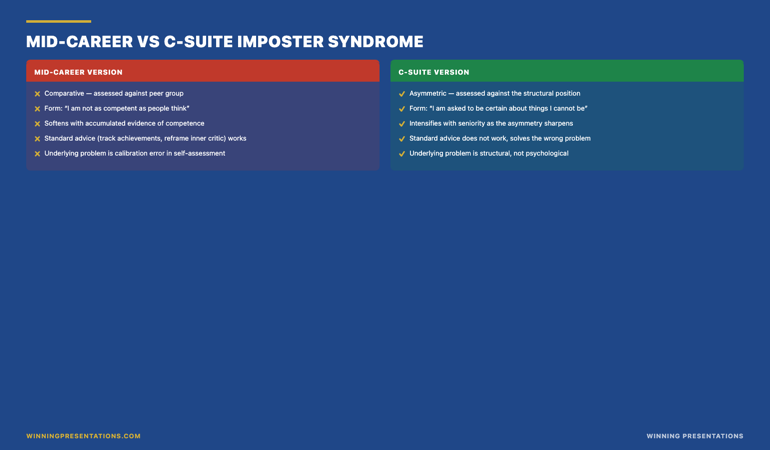
Mid-career imposter syndrome vs C-suite imposter syndrome infographic: mid-career version (comparative, takes the form ‘I am not as competent as peers think’, softens with accumulated evidence of competence, standard advice works because the underlying problem is calibration error between self-assessment and external assessment); C-suite version (asymmetric, takes the form ‘I am being asked to be certain about things I cannot actually be certain about’, intensifies with seniority because the asymmetry sharpens, standard advice does not work because the underlying problem is structural rather than psychological, the work is interpretive — correctly naming what the body is responding to rather than overcoming an inner enemy).

The four moves that turn the signal from threat into competence

The first move is naming the signal correctly. The seventy seconds in the car park, the fifteen seconds in the lift, the wave of “I don’t belong here” before a high-stakes presentation — these are body-level reads of a structurally asymmetric position. The body is not lying. The body is responding accurately to the gap between available information and required confidence. The reframe is to greet the signal as competence rather than as inadequacy: “my body is telling me I am about to render judgement on a matter I cannot fully see; that is what this role does.” The leader who can name the signal this way stops trying to suppress it, which is the second-order anxiety that often makes the original signal worse. The original signal becomes a piece of information; the secondary anxiety about the signal disappears.

The second move is the structural-pre-meeting protocol. Most senior leaders prepare for high-stakes meetings by reviewing the deck and the supporting materials. The structural-pre-meeting protocol adds a single fifteen-minute step: writing down, in two columns, what the leader actually knows about the matter and what they are being asked to render judgement on. The two columns almost never match cleanly. Naming the gap explicitly — before the meeting, in private — reduces the gap’s capacity to produce in-meeting anxiety. The leader walks into the room having already absorbed the gap rather than discovering it under pressure. The protocol does not close the gap; nothing closes it, because it is structural. The protocol just removes the surprise. For the broader pre-meeting preparation work that addresses the structural sources of senior-leader anxiety, see executive presentation anxiety and the wider presentation coaching services.

The third move is the deferred-certainty language. Senior leaders who do well at the executive committee table tend to share a specific linguistic pattern: they distinguish, in real time, between matters where they are rendering a definite judgement and matters where they are offering a position-pending-more-information. “My current read is X; I want to see the operational data from Q3 before committing to that position for next year.” That sentence holds confidence and humility in the same breath. It signals to the room that the leader knows what they know and what they do not, which is structurally more credible than performing uniform certainty across all matters. The mid-career instinct — perform certainty to project competence — is the wrong instinct at senior level; the room reads it as either naivety or evasion. The deferred-certainty language is what genuinely senior leaders do, and it can be installed with practice. The fourth move is the post-meeting decompression ritual described below.

Stop reading the structural anxiety of senior leadership as evidence you do not belong.

Conquer Your Fear of Public Speaking is the structured programme for senior professionals working through the specific anxiety that arises from speaking with authority in rooms where the stakes are real. Built on the work of recovering from a five-year period of presentation anxiety in corporate banking — not motivational, structural. The protocols translate directly to the senior-leader version of imposter syndrome described in this article.

Get Conquer Your Fear of Public Speaking — £39 →

The specific kinds of moments when the signal genuinely fades

The signal does fade in specific kinds of moments, even at senior level, and naming the pattern is itself useful. It fades when the leader is rendering judgement on a matter where their own deep operational expertise is the most relevant in the room — the chief financial officer adjudicating a financial restructuring question, the chief technology officer adjudicating a platform architecture question. In those specific moments the asymmetry disappears, because the leader is the person in the room with the most specific information rather than the least. The signal also fades when the leader is in the chairing position rather than the contributing position — chairing structurally calls for facilitating others’ judgements rather than rendering one’s own, which removes the gap between available information and required confidence that produces the signal in the first place.

The pattern is useful because it lets senior leaders calibrate when the signal is providing accurate information about their position in the room and when it has become a generalised background hum that is no longer doing useful work. A leader who only experiences the signal in the structurally appropriate moments — high-stakes asymmetric judgements where their information distance is real — is using the signal correctly. A leader who experiences the signal in every executive committee meeting regardless of subject is over-generalising, and the work is to recover the specificity. The fourth move I referred to above is part of the recalibration: a five-minute post-meeting decompression where the leader names, in writing, which moments in the meeting produced the signal and which did not. Over six to eight meetings the pattern becomes visible, and the signal returns to its appropriate specificity.

None of this resolves into “the signal disappears”. The signal is structural and will not disappear as long as the leader holds a senior role. What changes is the leader’s relationship to it: from interpreting the signal as evidence of personal inadequacy to recognising it as a body-level read of structural position. The chief operating officer I worked with in 2019 still experiences the seventy seconds in the car park, six years on. She no longer treats it as imposter syndrome. She treats it as her body correctly noticing that she is about to render confident judgements on matters where her information is structurally limited — which is what the role requires of her, and which is what she is paid to do. The signal is, in that sense, the price of the role rather than evidence of a flaw in the holder of it. Naming it correctly is the work.
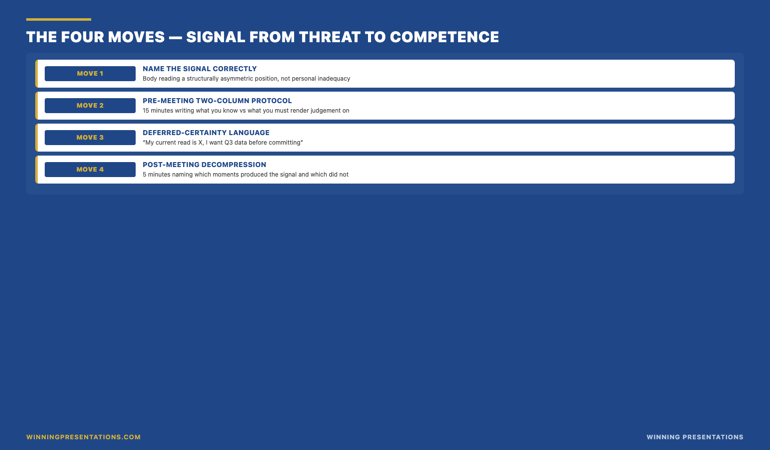
The four moves that turn the signal from threat into competence infographic: move one (name the signal correctly — the body is reading a structurally asymmetric position rather than evidence of personal inadequacy); move two (structural pre-meeting protocol — fifteen minutes writing what you actually know and what you are being asked to render judgement on, in two columns); move three (deferred-certainty language — distinguish in real time between definite judgement and position-pending-more-information, ‘my current read is X, I want to see Q3 data before committing’); move four (post-meeting decompression ritual — five minutes writing which moments produced the signal and which did not, recovers specificity over six to eight meetings).

Frequently asked questions

Is the standard imposter syndrome advice ever useful at senior level?

Occasionally, in specific contexts. If the senior leader is genuinely new to the role and the signal they are experiencing is calibration error rather than structural asymmetry — common in the first six months of a new C-suite appointment — the standard advice about tracking achievements and reframing the inner critic can do useful work. After about six months the calibration error usually resolves on its own as evidence accumulates, and what is left is the structural asymmetry described in this article. At that point the standard advice stops being useful and can become actively counter-productive, because it tells the leader to look for evidence of competence to soothe the signal, when the signal is not actually about competence. Match the tool to the underlying problem; the mid-career and senior phenomena need different work.

What is the most common mistake senior leaders make about this signal?

Trying to suppress it. The senior leader who reads the seventy seconds in the car park as something to defeat will spend energy fighting their own body, which produces a secondary anxiety on top of the original signal. The original signal is information, not threat. Suppressed, it tends to intensify; greeted as information, it becomes background and stops producing downstream consequence. Most senior leaders I have worked with on this report that the suppression strategy is what made the phenomenon feel like a problem, not the underlying signal itself. The reframe takes about three weeks of practice and produces a noticeable shift in how the leader feels going into high-stakes rooms. The signal is still there; the relationship to it has changed.

Does this work the same way for senior leaders in highly technical fields?

Mostly yes, with one variation. Senior leaders in highly technical fields experience the structural asymmetry slightly differently because their own deep expertise is more often the most relevant in the room than for a generalist C-suite role. The chief medical officer in a healthcare organisation, the chief engineer in a manufacturing organisation, the chief science officer in a biotechnology company — these leaders experience the signal in fewer meetings than a chief operating officer or chief executive, because their information distance is shorter in the meetings most relevant to their expertise. But they experience it sharply when the meeting moves outside their core expertise, which it inevitably does. The work is the same; the frequency and the trigger pattern are slightly different. The four moves apply identically.

How long does it take to see meaningful change once you start the work?

The reframe is usually visible in two to three weeks — the body still produces the signal, but the secondary anxiety about the signal fades quickly once the leader stops treating it as evidence of inadequacy. The structural pre-meeting protocol shows up in performance inside two months, because the absence of in-meeting surprise about the information gap produces a perceptibly calmer presence at the table. The deferred-certainty language takes longer — usually three to six months of deliberate practice to feel natural — because it requires unlearning the mid-career instinct to perform uniform certainty. The post-meeting decompression ritual produces the specificity recovery inside six to eight executive committee meetings. Cumulatively the work takes about six months to fully install, and produces a noticeably different relationship to the senior phenomenon for the rest of the leader’s career.

The Winning Edge — weekly newsletter

The Winning Edge is a weekly newsletter for senior professionals who present at the executive level. One short email a week on the structural moves that separate decks committees back from decks they defer. Subscribe to The Winning Edge →

For the wider library of presentation assets that pair with the anxiety work on senior-leader confidence — the slide system, the Q&A taxonomy, the storytelling primer, the delivery references — the Complete Presenter bundle (£99) collects them in one place.

About the author

Mary Beth Hazeldine is Owner & Managing Director of Winning Presentations Ltd. With 24 years of corporate banking experience at JPMorgan Chase, PwC, Royal Bank of Scotland, and Commerzbank, she advises executives across financial services, healthcare, technology, and government on structuring presentations for high-stakes funding rounds, board approvals, and strategic decisions.

The next time the seventy seconds in the car park arrives before your executive committee meeting, do three things instead: name the signal as your body’s accurate read of a structurally asymmetric position rather than as evidence you do not belong; write the two-column gap between what you know and what you are being asked to render judgement on; and let the meeting itself use the deferred-certainty language that distinguishes definite judgement from position-pending-more-information. The signal will not disappear. It is the price of the role. Naming it correctly is what turns it from threat into competence, and what separates the senior leaders who carry the asymmetry from the ones it slowly wears down.

16 May 2026
Featured image for Presentation Anxiety at 50+: Why Confidence Drops and What Rebuilds It

Presentation Anxiety at 50+: Why Confidence Drops and What Rebuilds It

Quick Answer

Presentation anxiety at 50+ is rarely the same anxiety a younger presenter has. The body has more years of accumulated meeting memory — wins, losses, near-misses, the colleague who challenged you in 2014 — and the nervous system reads each high-stakes meeting through that longer lens. The fix is not the breathing exercise from a junior training course. It is a combination of nervous-system work that addresses the accumulated load, structural preparation that gives the senior brain something concrete to anchor on, and the deliberate rebuilding of pre-meeting routines that have quietly fallen away.

Annette had run divisional reviews for the European arm of a reinsurance group for eleven years. She was the one who had stayed calm in 2018 when the chair walked out mid-presentation; she was the one her own director sent in when a board paper needed a senior face on it. In March, three weeks before the half-year strategic review, she sat at her desk on a Tuesday morning and felt her hand shake while opening the financials. Nothing on the agenda was unusual. She was 53, three years from the role she had been working towards her entire career. And the anxiety she had not felt since her late twenties had walked back into her body without warning.

What Annette experienced is not unusual. Presentation anxiety in the 50+ stage of senior leadership is one of the least-discussed patterns in executive coaching, partly because the people experiencing it are reluctant to name it. By this stage of a career, the cultural script says you should be past it. The room expects calm. The colleagues expect calm. You expect calm of yourself. When the body produces something else, the first response is often to hide it — which extends the problem rather than addressing it.

The pattern has accelerated in the last three years. Several mid-career senior professionals I work with describe the same arc: a long stretch of confident presenting through their thirties and forties, then a sharp return of anxiety in their early fifties — sometimes triggered by a new role, sometimes by a difficult board, sometimes by nothing identifiable at all. The body is doing something the cognitive story has not caught up with.

If your presentation anxiety has returned in your 50s

It is not a sign that the years of confident presenting were a fluke. The accumulated meeting load, the nervous system shifts of the perimenopausal and post-menopausal years, the rising stakes of senior roles — all of it lands on a body whose recovery margins are different from twenty years ago. The work that addresses this is different from the work that addressed your first board presentation.

Explore Conquer Your Fear of Public Speaking →

Why presentation anxiety often arrives — or returns — at 50+

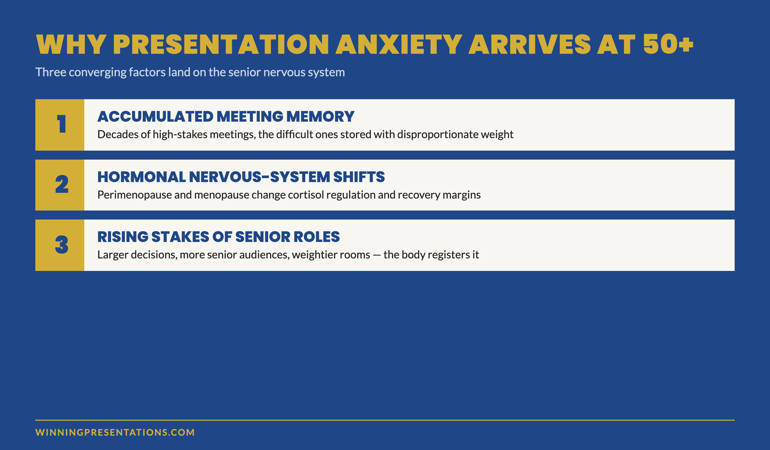
The body that walks into a high-stakes meeting at 53 is not the body that walked into the same kind of meeting at 33. Three things have changed simultaneously, and the combination — not any single factor — produces the pattern.

The first change is accumulated meeting memory. By 50, a senior professional has been in the room for hundreds, sometimes thousands of high-stakes meetings. Most of those went well. A handful did not. The brain stores the difficult ones with disproportionate weight — the chair who interrupted in 2014, the board member who flagged a number you had wrong in 2017, the moment in 2020 you cannot remember without your stomach tightening. None of these meetings ended your career. All of them left a trace. By midlife, the trace is dense enough that the nervous system uses it as a baseline, not an exception.

The second change is hormonal. Perimenopause and menopause shift the body’s stress response in ways that the medical literature is only recently catching up with. Cortisol regulation changes. Sleep architecture changes. The body’s tolerance for sustained activation drops. None of this means the senior leader has become less capable. It means the same meeting load that the body absorbed at 35 produces a different physiological response at 53. The recovery margins are smaller. The same trigger lands harder.

The third change is the rising stakes of senior roles. The presentations themselves are higher-consequence than they used to be. A divisional review at 53 affects more people than a project update at 33 did. The decisions are larger, the audience is more senior, the room has more weight in it. Even when the senior leader does not consciously register this — and most do not — the body does. The activation level the body settles to in the moments before walking in is correctly higher, because the stakes correctly are higher. What used to be a moderate physiological response is now a high one.

None of these is a deficit. All three are accurate physiological responses to actual changes in life and career. The work is not to suppress the response. The work is to give the nervous system something that addresses the actual load — not the load a junior presenter would face.

Three converging factors that produce presentation anxiety at 50+: accumulated meeting memory across decades, hormonal stress-response shifts in perimenopause and menopause, and the rising stakes of senior roles — shown as overlapping pressures on the senior nervous system

The three patterns mid-career anxiety takes

Senior professionals describe the anxiety in one of three patterns. Most have one dominant pattern; some shift between them depending on the meeting. Identifying which pattern is in play matters because the recovery work for each is different.

Pattern 1 — The “this used to be easy” pattern

The anxiety surprises you because the meeting type is one you have run hundreds of times. Quarterly reviews. Divisional updates. Pipeline presentations. The format is familiar, the audience is familiar, the material is familiar. And yet the pre-meeting feeling is now what it used to be at the start of your career. The cognitive story is “I should be past this,” which adds a layer of self-judgement on top of the physiological response.

This pattern is most common in senior professionals whose role has not changed recently. The body has shifted underneath the work. The work has not shifted to compensate. The recovery practice for this pattern is centred on rebuilding pre-meeting routines that have quietly fallen away — the morning walk, the printed-deck review, the silence in the car park before going in.

Pattern 2 — The “new role, old body” pattern

You moved into a more senior role in the last 18 months. The presentations are higher-stakes, the audience is more senior, and the body is responding to the larger load — but you are pattern-matching the new role against the routines that worked at the previous level. The old routines were calibrated for a smaller meeting. They are not calibrated for the new one.

This pattern is most common in senior professionals promoted into divisional or executive committee roles in their early fifties. The recovery practice is structural: rebuild the pre-meeting routine specifically for the higher-stakes context, not by intensifying what worked before but by adding components — the longer wind-down the night before, the deliberate physical exercise in the morning, the half hour of silence before the meeting starts.

Pattern 3 — The “physiological background” pattern

The anxiety is not specific to the meeting. The body has shifted into a higher-baseline activation state across many areas of life — sleep is lighter, recovery from a difficult day takes longer, the morning starts at a tension level that used to belong to the afternoon. The presentation anxiety is one expression of a broader nervous-system shift, often associated with perimenopausal or menopausal transitions but also with the cumulative load of a long executive career.

This pattern is most common in senior professionals between 48 and 56. The recovery practice for this pattern is the broadest — it is not specifically about presentations. It is about giving the nervous system the kind of recovery that the body now needs, which is more than it needed at 35.

The 6-week rebuild — what works at this stage of career

The single biggest mistake senior professionals make with mid-career presentation anxiety is borrowing the techniques that worked when they were younger. Power posing in the bathroom mirror, repeating affirmations, shallow box breathing, visualising the audience naked — these are the techniques of junior training programmes, and they were borderline useful for a 28-year-old. For a 53-year-old senior leader with twenty years of meeting memory and a different physiology, they are not the right tools.

What works at this stage is a 6-week rebuild that addresses the actual factors driving the anxiety. The components are not glamorous. They are calibrated for a senior nervous system carrying a senior load.

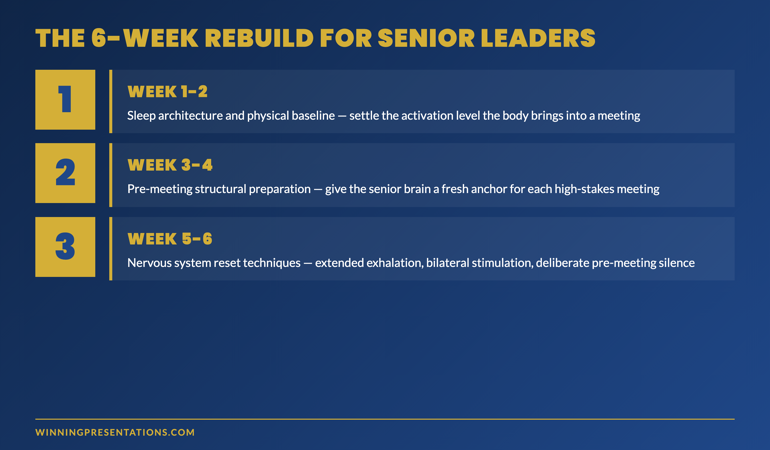
Week 1–2: Sleep architecture and physical baseline

The first two weeks are not about presentations at all. They are about giving the body a baseline that can absorb the meeting load. The work: tighten the sleep window to a consistent eight-and-a-half hours, remove caffeine after 11am, walk for 45 minutes a day at a pace that is brisk but not gym-intensity, and stop reading email after 8pm. None of this is specific to presentation anxiety. All of it changes the baseline activation level the body brings into a meeting.

Two weeks of this baseline produces a measurable shift in what the body feels like the morning of a high-stakes meeting. The shift is subtle but it is real. Without it, every other piece of the rebuild is being installed on top of an over-activated baseline.

Week 3–4: Pre-meeting structural preparation

Weeks three and four address the cognitive load. Senior professionals at this stage often skip preparation that they consider beneath them — they have run quarterly reviews for fifteen years, why would they need to prepare? The body knows the answer. The familiar meeting still has variability in it; the body is still scanning for the unexpected; the absence of fresh structural preparation leaves the senior brain without a recent anchor to return to under pressure.

The work for these two weeks: print the deck the night before every high-stakes meeting, walk through it once aloud in the morning, name the three points where you most expect challenge, and write the one-sentence response to each. This is not over-preparation. It is the structural anchor that the body uses to settle in the moments before walking in. The more senior the role, the more this matters — because the body has more to settle.

The 6-week presentation anxiety rebuild for senior leaders 50 plus: Week 1-2 sleep and physical baseline, Week 3-4 pre-meeting structural preparation, Week 5-6 nervous system reset techniques — with each phase shown as a milestone in a sequential roadmap

Week 5–6: Nervous system reset techniques

The last two weeks add the techniques that work directly on the nervous system at the level senior professionals need. These are not box breathing or counting backwards from ten. They are slower-onset techniques that produce sustained shifts: extended exhalation breathing (six seconds in, eight seconds out, twelve cycles), bilateral stimulation while walking, and a deliberate 20-minute pre-meeting silence with no input — no phone, no email, no music. The senior nervous system responds to depth more than intensity.

By the end of week six, most senior professionals report a meaningful shift — not the absence of activation, but a return to the baseline they used to know. The body has not gone back to 35. It has settled into the version of itself that 53 actually is.

For the deeper nervous-system work senior leaders need

Conquer Your Fear of Public Speaking — clinical hypnotherapy programme

  • Recorded clinical hypnotherapy sessions designed for senior professionals carrying years of accumulated meeting memory
  • Works on the embodied response that surface techniques do not reach — the body’s pre-meeting baseline rather than the in-the-moment symptom
  • Listen at home before the high-stakes meeting cycle — most senior participants notice a shift inside the first two weeks
  • Built on five years of recovery work after my own presentation anxiety in financial services

Conquer Your Fear of Public Speaking — £39, instant access, lifetime use.

Get Conquer Your Fear of Public Speaking →

For senior professionals whose presentation anxiety has returned despite years of confident presenting.

What does not work (and is sometimes still recommended)

A number of techniques persist in mainstream presentation training that do not serve senior professionals well at this stage of career. They are sometimes recommended by well-meaning HR teams, sometimes by general public-speaking coaches, sometimes by colleagues who used them at junior level and have not updated their advice. Knowing what to leave alone is part of the work.

Power posing. The original research has not held up well to replication. For a 28-year-old going into their first board presentation, two minutes of arms-overhead in the bathroom mirror produces a small placebo effect. For a 53-year-old senior leader, it produces nothing useful and can introduce a layer of self-consciousness that makes the next ten minutes worse.

Speaking of preparation routines that need updating with stage of career, my colleague Lara, who runs internal communications at a UK bank, told me she had been using the same five-minute pre-meeting routine since her late twenties and had not noticed how thin it had become for the kind of meeting she now ran. Conquer Your Fear of Public Speaking rebuilds the routine for the senior load — the same insight she described from the inside.

Beta blockers as the primary tool. Many senior professionals reach for propranolol because it works for the acute symptoms — the heart rate stays down, the hand stops shaking. The risk is using the medication as a workaround that prevents the underlying nervous-system rebuild. For occasional acute meetings, beta blockers are reasonable. As the daily strategy for a senior leader presenting weekly, they leave the broader pattern unaddressed and the body does not get the chance to rebuild its own settling capacity.

Visualisation of the audience naked, or any of the other 1980s public-speaking tropes. These work weakly even at junior level. At senior level, they introduce a frame that is incongruent with the audience the body is actually responding to. The body knows the audience is the executive committee. Asking it to imagine otherwise produces dissonance, not calm.

Affirmations and mantras. Repeating “I am calm, I am confident” produces measurable cognitive friction in someone whose body is signalling otherwise. The brain notes the contradiction. The signal that the practice was meant to settle is amplified by the contradiction itself. This is well-documented in the cognitive-behavioural literature and yet still appears in presentation training programmes aimed at senior leaders.

For the physical symptoms in the moment — shaking, racing heart, dry mouth

Calm Under Pressure covers rapid-response techniques for the physical symptoms of presentation anxiety. Methods you can use in the room, in the moment, without anyone noticing — the in-the-meeting layer that complements the longer rebuild work. £19.99, instant access.

Get Calm Under Pressure →

Rapid-response techniques for shaking hands, racing heart, trembling voice — designed for senior leaders.

Frequently asked questions

Why has my presentation anxiety come back when I have been confident for twenty years?

Three factors usually combine: accumulated meeting memory whose weight has been growing for years, hormonal nervous-system shifts in the perimenopausal and menopausal years, and the higher stakes of senior-level meetings. None of these means the years of confident presenting were a fluke — they mean the body’s load and capacity have shifted, and the routine that used to absorb the load is now too thin. Rebuilding the routine for the current stage of career is what closes the gap.

Should I tell my colleagues or my manager that I am experiencing this?

Most senior professionals choose not to, and that is a reasonable choice in most environments. The exception is when the anxiety is interfering with attendance or performance to a degree that is becoming visible. In that case, naming it briefly to one trusted person — a peer or a manager who has shown discretion — usually reduces the load rather than increasing it. The fear of being seen tends to be larger than the consequence of being seen.

Is hormone replacement therapy relevant to presentation anxiety in this stage?

For some senior professionals, yes. Where the anxiety is part of a broader perimenopausal or menopausal pattern — sleep disruption, mood shifts, baseline activation rise — addressing the hormonal shift can change the nervous-system baseline that the presentation anxiety is sitting on top of. This is a conversation for a menopause specialist or experienced GP, not a presentation coach. But if you have not had the conversation, it is often worth having before assuming the anxiety is purely psychological.

How long does the 6-week rebuild take to produce a noticeable shift?

Most senior professionals notice a baseline shift in week three — the morning of a high-stakes meeting feels meaningfully different from how it felt at the start. The full rebuild produces a sustainable change by week six. After that, the work becomes maintenance — the components are no longer interventions, they are the new routine. The rebuild does not need to be repeated unless something larger shifts in life or role.

Is clinical hypnotherapy genuinely useful for senior professionals or is it more of a wellness intervention?

Clinical hypnotherapy works on the embodied response that conscious techniques do not reach. For senior professionals carrying decades of accumulated meeting memory, it addresses the specific layer that surface techniques cannot — the body’s pre-meeting baseline rather than the in-the-moment symptom. It is not a replacement for the structural rebuild. It is the component that addresses the part of the pattern the rebuild alone does not reach.

The Winning Edge — weekly newsletter for senior presenters

One framework, one micro-story, one slide pattern — every Thursday morning, ten minutes’ read. For senior professionals who want my best material before it appears anywhere else.

Subscribe to The Winning Edge →

Not ready for the full programme? Start here: download the free Executive Presentation Checklist — a one-page reference for the structural questions every executive deck must answer before the meeting.

For more on the deeper nervous-system work, see what happens in a clinical hypnotherapy session for public speaking.

Mary Beth Hazeldine — Owner & Managing Director, Winning Presentations Ltd. After 24 years in corporate banking at JPMorgan Chase, PwC, Royal Bank of Scotland and Commerzbank, and five years recovering from her own presentation anxiety, she works with senior professionals across financial services, healthcare, and technology on the embodied side of high-stakes presenting.