

Why the Best Non-Executive Director Candidates Always Open the Same Way
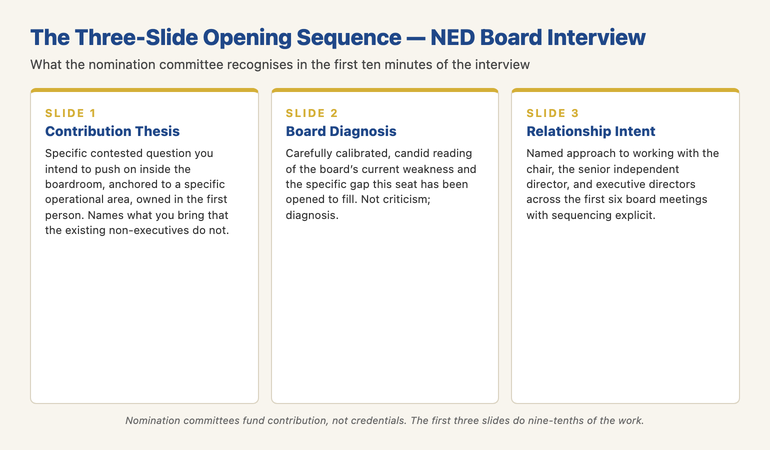
Quick answer: The board interview presentation NED candidates who get appointed run a three-slide opening sequence nomination committees recognise: (1) a contribution thesis that names what specific question the candidate intends to push on inside the boardroom, not the candidate’s governance experience in summary form; (2) a reading of the board’s current weakness, written carefully but candidly, that signals the candidate has done the work to understand why this seat is open; (3) a relationship intent slide that names how the candidate will work with the chair, the senior independent director, and the executive directors in the first six board meetings. The candidates who lead with their CV in summary form, their governance training, or their sector credentials get the courtesy interview. The candidates who put a contribution thesis and a board diagnosis on the table get the seat. Nomination committees fund contribution, not credentials.
JUMP TO:
- What the nomination committee is actually testing
- Slide one: the contribution thesis, not the CV
- Slide two: the candid reading of the board’s current weakness
- Slide three: relationship intent with the chair and SID
- The six-board-meeting horizon the committee is funding against
- The independence question, and how to answer it cleanly
- The close: naming the conversation you want with the chair in week two
- The counter-example I watched succeed at a FTSE-listed nomination committee
- One thing to do before the next nomination committee
- Frequently asked questions
In 2014, I sat in on a nomination-committee interview for a non-executive directorship at a publicly-listed financial-services group. The committee was made up of the chair, the senior independent director, the head of the remuneration committee, and the lead partner from the search firm running the appointment. The candidate was a deeply credible former divisional CEO from an adjacent sector with a clean track record, two prior NED appointments at well-respected mid-cap companies, and references from both his current chair and a former regulator. He opened slide one with a chronological summary of his governance experience. Slide two listed the boards he had served on. Slide three was a governance-best-practice framework lifted from one of the major audit firms. The chair of the nomination committee had served as a non-executive for eighteen years across seven appointments and had personally chaired three nomination committees before this one. She put her copy of the deck down at slide two. The candidate spent the next twenty-three minutes walking the committee through his background and his approach to governance in the abstract. He was thanked, given a courtesy second conversation, and was not invited to join the board. The seat went to a candidate the committee met the following week whose first slide read, “Inside this board, the question I intend to push on is whether the consolidation of the two divisional treasury functions in 2022 has actually produced the risk transparency the board was promised at the time.” The chair of the committee closed her deck at minute nine.
(This article was created with AI assistance; all stories and insights are based on 35 years of real client work.)
This piece walks through the structural moves I have watched succeed in board interview presentations for non-executive directorships across two decades of advising senior candidates — at FTSE-listed companies, at large mutuals, at private-equity-owned mid-caps, and at financial-services regulators. The moves are sector-agnostic. They are not about polish, governance vocabulary, or NED experience in summary form; the candidates who lose at this level are almost always the polished, well-credentialed, governance-fluent ones whose first slides put the credentials on the table instead of putting the contribution on it. The article covers the three opening slides nomination committees recognise, the six-board-meeting horizon they are quietly funding against, the independence question that comes up in almost every interview and the clean way to handle it, and the close that names a specific conversation the candidate wants with the chair in the first two weeks.
Before the next nomination-committee interview, a one-page structural check on the opening three slides is worth a look.
The Executive Presentation Checklist walks through the openings nomination committees actually reward — the contribution-thesis slide one, the board-diagnosis slide two, the relationship-intent slide three, and the close that names the week-two conversation. Free download, no email gate.
What the nomination committee is actually testing
Nomination committees for non-executive appointments are testing a question the formal role description does not name. The visible question is whether the candidate has the experience, independence, and time commitment to discharge the duties of a non-executive director on this board. The visible question has already been answered before the interview by the search firm’s shortlist process; if the candidate is in the room, the visible question is resolved. The actual question the committee is asking is narrower and more difficult to answer in conversation: what specific contribution will this candidate make to this board, on the questions this board is currently struggling to make progress on, that the existing non-executives are not already making? The committee is not looking for governance generalists; the existing non-executives are governance generalists. The committee is looking for the specific contribution this candidate, distinguished by their particular background and frame of reference, will bring that the current board does not have. A candidate who answers the visible question, however well, has not answered the actual question. A candidate who answers the actual question has earned the seat.
The actual question is also why the standard CV-summary opener fails so reliably at NED interviews. The chair and the senior independent director have read the CV; the search firm walked them through it before the shortlist. Recapping the CV in slide form, however cleanly, tells the committee nothing they did not already know. It also signals that the candidate has not formed a view of the specific contribution they intend to make, because if they had, they would lead with the contribution rather than the credentials. The signal is read accurately, almost universally, by experienced nomination committees, and it produces the polite-decline outcome regardless of how strong the candidate’s actual prospective contribution might have been. The candidates who get the seat are the ones who skip the CV recap and go directly to the contribution.
The nomination committee is also reading for evidence the candidate has done the work to understand the current dynamics of the board they are being asked to join. The work is harder for external candidates than for internal-recommended ones, and the difficulty is part of what the committee is testing. The candidate who has spent two or three hours in preparatory conversations with the chair, the senior independent director, the company secretary, and ideally one of the executive directors will have a view of the board’s current dynamics that the candidate who has only read the annual report does not. The slide-two reading of the board’s current weakness is where the difference becomes visible. The candidate who has done the listening puts a credible diagnosis on slide two; the candidate who has not falls back on governance generalities that the committee reads as preparation gap. The board-of-directors presentation structure that earns the room’s tolerance covers the broader context of how senior boards read prepared content, which transfers directly to the interview situation.
Slide one: the contribution thesis, not the CV
Slide one of the board interview deck names the specific question or theme the candidate intends to push on inside the boardroom over the first eighteen months. The sentence has three parts: the specific contested question on which the candidate intends to take a position, the specific operational area the question lives in, and the specific perspective the candidate is bringing that the existing non-executives are not. “Inside this board, the question I intend to push on is whether the consolidation of the two divisional treasury functions in 2022 has actually produced the risk transparency the board was promised at the time” passes the test. The sentence names a specific question, names the operational area, and signals a perspective that is not already inside the board. “I bring eighteen years of governance experience and a strong track record of constructive challenge in the boardroom” does not pass; it names credentials, not contribution. The first sentence earns the committee’s attention. The second loses it.
The question on slide one needs to be contested, not platitudinous. A question on which everyone already agrees is not a contribution; it is a comfortable place to stand. “I will push on the question of culture in the boardroom” is not a contestable question because no one will disagree that culture in the boardroom matters. “I will push on the question of whether the current board agenda spends enough time on succession planning for the next CEO transition, given the chair’s public commitment to a 2027 handover” is contestable, specific, and rooted in publicly-available information. The committee can interrogate it, push back on it, or build on it. The candidate who puts a contestable question on slide one is signalling they are prepared to be wrong about a specific thing, which is the signal nomination committees are reading for. The candidate who keeps the question safe is signalling the opposite, accurately, regardless of intent.
The discipline of writing slide one is the discipline of doing the listening work before drafting it. The contestable question cannot be written from desk research alone; it has to come from the preparatory conversations the candidate has been having with the chair, the senior independent director, the company secretary, and ideally one or two executive directors in the weeks before the interview. The candidates who get the slide right have done six to ten hours of preparatory conversations and have used those conversations to identify two or three candidate questions, then chosen the one that is best matched to their particular background. The candidates who get the slide wrong have read the annual report and have written what they thought sounded plausible. The two outputs are very different. The committee reads the difference accurately within the first sentence of slide one.
Slide two: the candid reading of the board’s current weakness
Slide two presents the candidate’s reading of the board’s current weakness, written carefully but candidly. The slide is the most uncomfortable to deliver, and the discomfort is the signal it is doing its work. A nomination committee opening a non-executive seat is opening it because the existing board has a gap; the gap is the reason for the hire. A candidate who pretends the gap does not exist, by presenting the board in glowing terms or describing the boardroom culture as already exemplary, is signalling either that they have not understood why the seat is open or that they are unwilling to put a candid view on the table. Both signals produce the polite decline. The candidate who names the gap directly, in language calibrated for the committee’s sensitivities, is signalling they understand the role and are willing to do the difficult conversation in the boardroom rather than the comfortable one.
The discipline of the candid slide is the calibration of the language. The committee will not tolerate language that reads as criticism of the existing board, the executive team, or the chair. They will tolerate — and reward — language that reads as a thoughtful diagnosis of a specific area where the board would benefit from a contribution that is not currently present. The difference is the framing. “The board has been weak on technology-risk oversight since the 2020 restructuring” is criticism and loses the room. “The board’s technology-risk oversight is, on the public record, primarily executive-led; the seat that has been opened, on my reading, is for a non-executive who can bring an independent challenge to the executive view in that area — and that is the contribution I am positioning to make” is diagnosis and earns the room. The substantive content is similar; the framing is the difference between the offer and the decline.
The candidate who gets slide two right almost always does so by having tested the language in advance with the chair or the senior independent director in one of the preparatory conversations. The test is not a request for permission to make the diagnosis; it is a request for the chair’s sensibility about the language. A chair who is asked privately “if I were to articulate the gap this seat is being opened to fill in roughly these terms, would that read as candid or as out of step?” will usually give a useful read. The candidate who has had that conversation walks into the formal interview with a slide that has been pressure-tested against the chair’s sensibility. The candidate who has not had the conversation is operating on guesswork. Guesswork on slide two is detectable, and it produces the polite decline. The executive buy-in presentation framework covers the broader application of the candour-and-calibration discipline across senior-approval contexts.
Slide three: relationship intent with the chair and SID
Slide three names the candidate’s working approach with the chair, the senior independent director, and the executive directors in the first six board meetings. The slide is structurally important because nomination committees fund relationships, not solo contributions. A non-executive director does not deliver value alone; they deliver value as part of the dynamic of the board they sit on. The committee is testing whether the candidate has thought about how they will integrate with the dynamic, where they will support the chair, where they will push back, and how they will read the timing of when to do each. The candidate who has not thought about these questions in advance presents the relationship intent as vague reassurance — “I would expect to work collaboratively with the chair and the existing non-executives” — and the committee reads the vagueness accurately.
The first three slides of a NED interview deck do nine-tenths of the work — and they are the slides most candidates spend the least time building.
The Executive Slide System is the slide library senior candidates use to build the contribution-thesis opener, the candid board-diagnosis slide, and the named relationship-intent close that the three-slide NED opening sequence depends on — without rebuilding them from scratch for every appointment cycle. 26 Executive Templates, 93 AI Prompts, 16 Scenario Playbooks, Master Checklist, Framework Reference. Built on 24 years in corporate banking and 16 years coaching senior professionals across financial services, insurance, consulting, and technology. Instant download, lifetime access.
- 26 Executive Templates — including the three-slide opening sequence for NED panels and the close that names the week-two conversation with the chair
- 93 AI Prompts — for the language calibration work on the candid board-diagnosis slide where most candidates spend their hardest hour
- 16 Scenario Playbooks — covering NED interviews, search-firm screens, chair-led preparatory conversations, and the variants between them
- Master Checklist — the pre-interview diagnostic to run on the first three slides the day before the nomination committee
- Framework Reference — the structural moves nomination committees recognise, written up as a permanent reference
- Instant download, lifetime access — £39
The relationship intent slide is most powerful when it names specific contributions to specific board meetings rather than describing a general working style. Useful items: “In the first meeting, I would expect to listen, not push on the contribution thesis; I would want to use the meeting to test my reading of the dynamic. In the second meeting, I would expect to ask the chair for the opportunity to bring a short paper on the treasury-consolidation question, after I have had the chance to meet the group treasurer. In the third meeting, I would expect to start putting the thesis on the table in committee discussion, having tested the substantive view with the chair and the senior independent director privately in the intervening period.” The sequencing signals the candidate has thought about timing as well as content, and timing is what experienced non-executives are best calibrated on.
The most common failure mode on slide three is the over-promise. A candidate who signals they will start pushing on the contribution thesis in the first board meeting is signalling either inexperience or impatience, and the committee reads both as risk. Boards integrate new non-executives over a window that runs from the first to the third or fourth meeting; the candidate who signals they understand the integration window earns the committee’s confidence. The candidate who signals they will start contributing forcefully from day one signals they have not understood the integration dynamic, regardless of how well-intentioned the forcefulness is. The patient relationship intent is the signal of the experienced non-executive. The impatient relationship intent is the signal of the executive who has not yet adjusted to the rhythm of the board environment.
The six-board-meeting horizon the committee is funding against
The horizon the nomination committee is funding against is roughly six board meetings, or one full annual cycle. The committee is not appointing a candidate for one meeting; they are appointing for the rhythm of the year, which includes the strategy session, the budget approval, the year-end results discussion, the AGM preparation, and two or three substantive committee-focused meetings in between. The candidate who frames their contribution against the six-meeting horizon is matched to the committee’s actual funding model. The candidate who frames their contribution against a one-meeting or one-quarter horizon is mismatched, and the mismatch reads as inexperience even when the substantive content is strong. The six-meeting horizon should appear, implicitly or explicitly, in the relationship intent slide and the close.
The six-meeting horizon also explains why the candid board-diagnosis slide is more important than candidates typically appreciate. The diagnosis is what gives the candidate something to work toward across the six meetings; without a diagnosis there is no working thesis, and without a working thesis the non-executive becomes a reactive participant in the board’s discussion rather than a proactive contributor to it. The committee is appointing for proactive contribution, not reactive participation. The diagnosis on slide two is the candidate’s evidence they have something to be proactive about. A candidate who has no diagnosis has signalled, implicitly, that they intend to be a reactive participant; the committee reads the implicit signal and passes them over for the candidate who has put a diagnosis on the table.
The independence question, and how to answer it cleanly
The independence question comes up in almost every NED interview at the senior level and is typically asked by the senior independent director or the chair. The question is some variant of: “Given your prior relationship with [X person or institution connected to the company], how do you intend to maintain independence in your contribution to the board?” The question is almost never an attempt to disqualify the candidate; it is an invitation for the candidate to demonstrate they have thought about the independence dynamic specifically rather than abstractly. Candidates who answer the question by reasserting their independence in general terms — “I have always operated independently and I would do so here” — are missing the test. The test is specificity. The candidate who answers by naming the specific situations they have identified as potential independence risks, and the specific decisions they have made about how to handle each one, passes the test.
A clean answer typically has three parts. First, the candidate names the specific relationship or context the questioner is referring to and confirms they have thought about its implications. Second, the candidate names the specific protocol they intend to follow when board discussions touch on the relationship — usually some combination of disclosure to the chair, voluntary recusal from specific decisions, and willingness to step out of the room when the chair judges it appropriate. Third, the candidate names the specific external relationship they intend to use as a check on their own independence in the relevant area — usually a former chair, a former regulator, or a long-tenured peer who can act as an informal sounding board. The three-part answer demonstrates the specificity the committee is testing for and resolves the independence question cleanly in under two minutes. The 3Ps framework for executive presentation coaching covers the rehearsal work that prepares the candidate to give this kind of specific answer under live questioning.
The close: naming the conversation you want with the chair in week two
The close of the NED interview is the part most candidates leave inert. The standard close — “Thank you, I would welcome any further questions” — is the close that produces the courtesy-second-conversation outcome. The close that produces the offer names the specific conversation the candidate wants to have with the chair in week two if appointed. “If the committee chooses to appoint me, the conversation I would want to have with the chair in the second week is about timing: when in the first three meetings would you want me to bring the treasury-consolidation question into committee discussion, and would you want me to test the substantive view privately with the senior independent director and the group treasurer in the intervening period, or to introduce it through committee process?” The close names a specific conversation, signals the candidate has already thought about integration timing, and gives the chair something concrete to respond to. The committee reads all three signals and gives the candidate’s offer-decision priority over candidates who closed inertly.
The counter-example I watched succeed at a FTSE-listed nomination committee
The counter-example worth carrying into the preparation comes from a nomination-committee interview I sat in on for a NED appointment at a FTSE-listed industrial group in 2016. The candidate was a former divisional CFO from a different sector with two prior NED appointments, both at smaller companies. He was the third candidate the committee interviewed that week. The first two candidates had been more obviously credentialed for the role on paper. The committee comprised the chair, the senior independent director, the audit-committee chair, and the search-firm partner. The candidate opened slide one with: “Inside this board, the question I intend to push on is whether the cash-conversion improvement programme announced at last September’s investor day is actually producing structural change in working-capital management at divisional level, or whether the improvement is being booked at group level through treasury timing. My reading of the company’s last three quarterly disclosures is that the question is open, and the audit committee’s annual report commentary suggests the existing non-executives have not yet reached a settled view on it.”
For senior candidates with a NED interview approaching, the structural method behind the three-slide opening is worth investing in.
The Executive Buy-In Presentation System is the self-paced programme senior professionals use to build the structural method behind the contribution-thesis, board-diagnosis, and relationship-intent opening sequence. Self-paced programme with monthly cohort enrolment, 7 modules, no deadlines, no mandatory session attendance, optional live Q&A sessions fully recorded. Lifetime access to materials. £499.
The audit-committee chair, who had been on the committee for nine years and was widely considered the most influential non-executive on the board, sat forward in her chair. The candidate’s slide two reframed the role brief into a specific reading of the audit committee’s current limitations: “The audit committee, on my reading of the public disclosures, has the technical depth to interrogate the working-capital question but, from the structure of the committee meetings, may not currently have the air-time to do so given the volume of routine assurance work on the agenda. The contribution I would expect to make is to support the audit-committee chair in creating that air-time, by carrying some of the routine assurance work and by bringing a specific working-capital paper to the third meeting of my appointment.” Slide three named the relationship intent across the first six meetings, with the audit-committee chair’s sequencing explicitly. The chair of the nomination committee, the audit-committee chair, and the senior independent director all nodded at minute eight. The candidate was offered the seat within seventy-two hours.
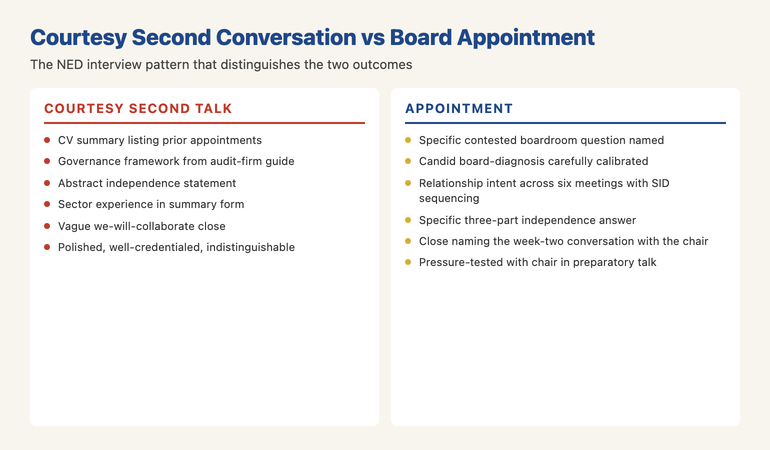
The contrast with the polished CV-led candidate from two years earlier was not about the two candidates’ relative seniority, governance experience, or even sector fit; the CV-led candidate was, on paper, the more obviously qualified appointment. The contrast was structural. The CV-led candidate had used his first three slides to confirm what the committee already knew; the offered candidate had used his first three slides to put a contribution on the table that the committee could fund. The committee’s decision was made by minute nine in both cases. The first three slides were the decision.
One thing to do before the next nomination committee
Write the contribution-thesis sentence for slide one and read it aloud to a colleague who has served as a non-executive on at least one publicly-listed or large mutual board, asking them whether the sentence sounds like a candidate who has read the brief or like a candidate who has read the room. The two outputs are very different. The candidate who has read the brief writes a sentence that names governance experience or relevant credentials; the candidate who has read the room writes a sentence that names a specific contested question on which the candidate intends to push. The reading-the-room version is the version the committee is funding for. If your colleague’s reaction is “that sounds like every other candidate’s opening”, the sentence is not yet right. Rewrite it before you walk in. The discipline of the contribution thesis is the discipline that separates the offered NED candidate from the courtesy-second-conversation candidate, and the courage to write a specific contested question is more important than the polish of any of the slides that follow it.
Frequently asked questions
Is it appropriate to ask the chair for a private preparatory conversation before the nomination-committee interview?
Almost always yes, and the request itself is read as a positive signal. Experienced chairs expect serious candidates to want one or two preparatory conversations before the formal interview. The conversation is not a backdoor to the appointment decision; it is the candidate’s opportunity to test the contribution thesis, calibrate the board-diagnosis language, and understand the chair’s sensibilities about how the role will be integrated. Candidates who skip the preparatory conversation almost always present a deck that the chair finds preparation-shallow regardless of how polished the delivery is. The request is best made through the search firm partner, framed as a substantive preparation request rather than as a social call. Most chairs will accept the request; some will route it through the senior independent director or the company secretary instead. Both routings are useful.
What if the chair signals during the preparatory conversation that they want the candidate to focus on governance experience rather than substantive contribution?
The signal is worth taking seriously, but in practice it almost always means the chair wants the contribution wrapped inside a governance frame rather than presented without one. A candidate who responds to the signal by removing the contribution thesis and presenting purely on governance experience is solving the wrong problem; the chair did not want the contribution removed, they wanted it presented with governance credibility around it. The right response is to lead slide one with a sentence that combines the contribution thesis with a brief governance-credibility anchor: “With eighteen years of audit-committee experience across two prior mid-cap appointments, the question I intend to push on inside this board is…”. The opener carries the governance credibility the chair wanted while still putting the contribution on the table. Candidates who get this balance right are the ones the chair recommends to the committee with the strongest support.
How does the framework change for a NED appointment at a private company or a private-equity-owned business rather than a listed company?
The underlying structural moves are unchanged; the framing of the contribution thesis adapts to the ownership context. At a private-equity-owned business, the contribution thesis is typically framed against the value-creation plan the sponsor put in place at the time of the investment, and the diagnosis slide reads the gap between the value-creation plan’s assumptions and the operating reality the business has settled into. At a family-owned business, the contribution thesis adapts to the family’s priorities and the candidate’s reading of the family-versus-management dynamic. The independence question takes a different shape at private companies because the public-company independence framework does not strictly apply, but the spirit of the question — will this candidate be able to bring a contribution distinct from the existing decision-makers? — is the same. The three-slide opening sequence transfers cleanly; the language adapts to the context.
Should the candidate present standing up or seated during the interview?
The protocol almost always resolves itself by reference to the room. If the room has been set up theatre-style with a screen and a presenter position, the candidate should present standing. If the room has been set up boardroom-style around a table, the candidate should present seated, with the deck shared via screens or printed copies. The search-firm partner can clarify the room setup before the interview; the candidate should ask. The bigger error is the candidate who insists on standing in a boardroom-style room because they feel more confident standing, or who insists on sitting in a theatre-style room because they want to seem less formal. Both signal a candidate who is reading their own preference rather than the room. Read the room.
The Winning Edge — weekly newsletter
The Winning Edge is a weekly (Thursday) newsletter for senior professionals who present at the executive and board level. One short email a week, focused on the structural moves that separate proposals senior committees and panels approve from proposals they defer. Subscribe to The Winning Edge →
For the broader picture across slides, storytelling, confidence, and delivery, the seven-product Complete Presenter library is the bundle most senior professionals find useful as a single resource — £99 for everything, lifetime access.
About the author
Mary Beth Hazeldine is Owner & Managing Director of Winning Presentations Ltd. With 24 years of corporate banking experience at JPMorgan Chase, PwC, Royal Bank of Scotland, and Commerzbank, she advises senior professionals across financial services, insurance, consulting, and technology on the structural moves that distinguish offered NED candidates from candidates who receive the courtesy second conversation.