Tag: pre-presentation routine

06 Apr 2026
An executive in smart business attire walking purposefully through a bright modern lobby, calm and composed expression, early morning light, editorial photography style

Morning Presentation Protocol: What to Do in the Two Hours Before You Present

What you do in the two hours before a high-stakes presentation matters more than most people realise. By the time you walk into the room, the window for preparation has closed. The anxiety management techniques, the physical regulation, the mental framing — all of it has to happen before that moment. A structured morning protocol is not a luxury for performers and athletes. It is a practical, evidence-based approach to ensuring that the version of yourself that walks into the room is the one you intended to bring.

Astrid had given hundreds of presentations over a fifteen-year career in healthcare management. She was competent, prepared, and well-regarded. But the morning of a significant board presentation, her routine collapsed. She woke early and immediately began reviewing her slides — forty minutes of anxious re-reading that convinced her three sections were unclear. She rewrote them. Then she was late leaving the house, arrived at the venue with ten minutes to spare, grabbed a coffee, and sat in the boardroom trying to remember which version of slide fourteen she had updated. By the time the room filled, her heart was racing and her mouth was dry. The presentation went reasonably well — she was experienced enough to recover — but it was not her best work. She knew it. What she did not know was that the problem was not the slides, or the venue, or the nerves. It was the absence of a deliberate morning protocol. What she had done in those two hours had amplified her anxiety rather than managed it. When she eventually built a structured morning routine — consistent, timed, and designed around her nervous system rather than her slide deck — her presentations changed significantly.

Struggling with anxiety on the day of a big presentation? Conquer Speaking Fear is a structured 30-day programme that addresses the nervous system patterns behind presentation anxiety — so the morning of a high-stakes presentation stops feeling like a crisis. Explore the programme →

Why the Two Hours Before Presenting Matter Most

The nervous system does not respond to logic in the way we would like it to. In the hours before a high-stakes event, your body is already preparing its stress response — regardless of how experienced or well-prepared you are. Cortisol rises, muscle tension increases, and attention narrows. These are physiological processes, not character weaknesses. The question is not whether they happen. The question is whether you have a structured approach to working with them.

What distinguishes executives who consistently perform well under pressure from those who find high-stakes presentations draining and inconsistent is not talent. It is routine. When the two hours before a presentation are unstructured — filled with last-minute review, anxious checking, caffeine, and hurried logistics — the nervous system’s stress response compounds without interruption. When those same two hours are deliberately structured around physical regulation, cognitive preparation, and practical readiness, the presentation experience changes fundamentally.

There is also a practical dimension. The two-hour window is the last point at which you can do anything useful. After that window closes, the logistics are fixed and the slides are final. What remains is your state — your focus, your physical regulation, your relationship to the material. Managing your state is not a soft skill. It is the most high-leverage activity available to you in those final hours.

The pre-presentation rituals that athletes use before high-stakes performance follow exactly this logic — the research on elite performance preparation maps closely to what works for executives facing important presentations.

Stop Dreading Presentation Day. Start Managing It.

Conquer Speaking Fear is a structured 30-day programme that uses nervous system regulation and clinical hypnotherapy techniques to address presentation anxiety at its root — so you walk into high-stakes rooms feeling ready, not wired.

  • ✓ 30-day structured programme for presentation anxiety
  • ✓ Nervous system regulation techniques for high-pressure scenarios
  • ✓ Clinical hypnotherapy approaches adapted for executive contexts

Get Conquer Speaking Fear → £39

Designed for executives managing presentation anxiety

The Four-Phase Morning Protocol

The morning presentation protocol divides the two-hour window into four distinct phases, each with a specific purpose. The phases are designed to move from physical regulation through to mental focus, ending with a period of deliberate quiet before you enter the room. This sequence is not arbitrary — each phase prepares the conditions for the next.

Phase one: Physical activation (T minus 120 to 90 minutes). The first thirty minutes of the protocol addresses your body before your mind. Physical movement — a brisk walk, light exercise, or stretching — changes the neurochemical environment of anxiety. Movement processes the stress hormones that have been building since you woke and introduces endorphins that reduce subjective anxiety. This is not a training session. Fifteen to twenty minutes of moderate movement is sufficient. The key is doing it before engaging with any presentation material.

Phase two: Review and lock (T minus 90 to 60 minutes). The second phase is for content, not creation. If you have not finished preparing by this point, you are in a different kind of problem. This phase is for one final, structured review of your opening and closing only — not the full deck. Read your opening paragraph aloud. Say your closing sentence. These are the moments that shape first and last impressions, and they benefit from one deliberate rehearsal. After this review, the slides are locked. No more changes.

Phase three: Practical logistics (T minus 60 to 30 minutes). The third phase handles everything that needs to be in place before you leave for the venue: technology checked, slides saved to multiple locations, travel confirmed, contingency plans noted. Practical readiness removes the background hum of logistical anxiety that can occupy mental bandwidth during the presentation itself. If you will be presenting in a room you do not know, arrive early enough to check the AV setup, test your slides on the room screen, and stand at the front before anyone else arrives. Physical familiarity with a space significantly reduces situational anxiety.

Phase four: State management (T minus 30 to 0 minutes). The final thirty minutes before presenting are reserved for deliberate state management. This means quiet — no email, no phone calls, no last-minute preparation. Use this time for breathing techniques, a short mindfulness practice, or simply sitting in a calm environment and allowing your nervous system to settle. The goal is not to eliminate activation — some level of physiological arousal is useful for performance. The goal is to bring that activation to a level you can work with rather than a level that works against you.
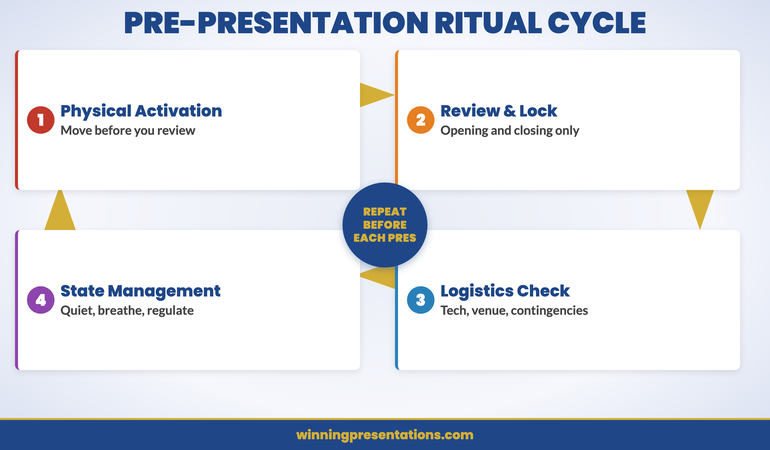
The four-phase morning presentation protocol infographic: physical activation, review and lock, practical logistics, and state management with timing guidance

The Nervous System Reset: Physical Techniques That Work

The physical techniques that are most effective for pre-presentation anxiety management are those that directly engage the parasympathetic nervous system — the branch responsible for the rest-and-digest state that counterbalances the fight-or-flight response. These techniques work because they change your physiology, not just your thoughts about your physiology.

Controlled breathing is the most accessible and fastest-acting of these techniques. Breathing with a longer exhale than inhale — for example, four counts in and six counts out — activates the vagal nerve and shifts the nervous system toward a calmer baseline. This is not a new-age practice. It is physiology. The vagal nerve is the direct pathway between your breath and your autonomic nervous system, and it responds consistently to specific breathing patterns. Five minutes of extended-exhale breathing during phase four of the morning protocol can meaningfully change your physiological state before you walk in.

Progressive muscle relaxation — the sequential tensing and releasing of major muscle groups — is particularly effective for presenters whose anxiety manifests physically: tight shoulders, clenched jaw, tension in the hands and forearms. Ten minutes of systematic relaxation removes the physical tension that often remains even after breathing exercises have addressed the heart rate. It also directs attention to the body rather than the catastrophising thoughts that tend to dominate anxious minds in the final minutes before a presentation.

Grounding techniques — deliberate sensory engagement with the present environment — are useful for managing the mind’s tendency to project into the presentation room before the body has arrived there. For a detailed breakdown of grounding techniques specifically adapted for executives, our guide to grounding techniques for presentation anxiety covers the evidence-based approaches that work in professional settings.

For those whose anxiety involves persistent negative thought patterns — catastrophic predictions, harsh self-judgement, fixed beliefs about their performance under pressure — the techniques covered in our guide to cognitive restructuring for presentation anxiety address the mental layer that physical techniques alone cannot always reach.

If you want to build morning protocol management into a consistent practice, Conquer Speaking Fear provides the structured 30-day framework that takes these individual techniques and builds them into a coherent approach to managing presentation anxiety over time.

What to Avoid in the Two Hours Before You Present

The morning protocol is as much about what you do not do as what you do. Several common pre-presentation behaviours reliably increase anxiety rather than managing it, and most executives do them habitually without recognising the pattern.

Rewriting slides. Making changes to your presentation material in the two hours before delivery introduces a specific kind of anxiety: uncertainty about your own content. You no longer know which version of slide six you are presenting. The muscle memory of your flow is disrupted. If the changes were significant enough to be necessary this morning, the preparation process had a problem that no last-minute revision will fix. If they were not significant enough to be necessary, you have introduced uncertainty for no benefit. Lock the slides before the protocol begins.

Excessive caffeine. Caffeine is a stimulant that increases heart rate, heightens physical arousal, and can amplify the physiological symptoms of anxiety — the shaking hands, the dry mouth, the racing pulse. For presenters who already manage moderate to high pre-presentation anxiety, a strong coffee in the final hour before presenting is contraindicated by basic physiology. Caffeine consumed more than ninety minutes before presenting has a different effect; it is the timing that matters. In the final hour, a glass of water serves you better than an espresso.

Catastrophic rehearsal. Running through worst-case scenarios in your head — the slide clicker failing, the room going cold, the senior stakeholder asking the question you cannot answer — is a form of mental rehearsal that primes your nervous system for threat rather than performance. The mind does not distinguish cleanly between imagined and real scenarios. When you rehearse disaster, you trigger the same physiological response the real disaster would produce. Use the final thirty minutes for deliberate positive rehearsal, or for state management techniques, not for anticipatory problem-solving that generates anxiety without solutions.

Seeking reassurance. Calling a colleague to talk through your nerves, or asking a peer to quickly review your slides, feels helpful but often has the opposite effect. It externalises your confidence and makes it contingent on someone else’s response. It also invites feedback — and any critical feedback received in the final hour before presenting cannot be acted on, but it can unsettle you. Build your confidence in the preparation period. Protect it in the final two hours.
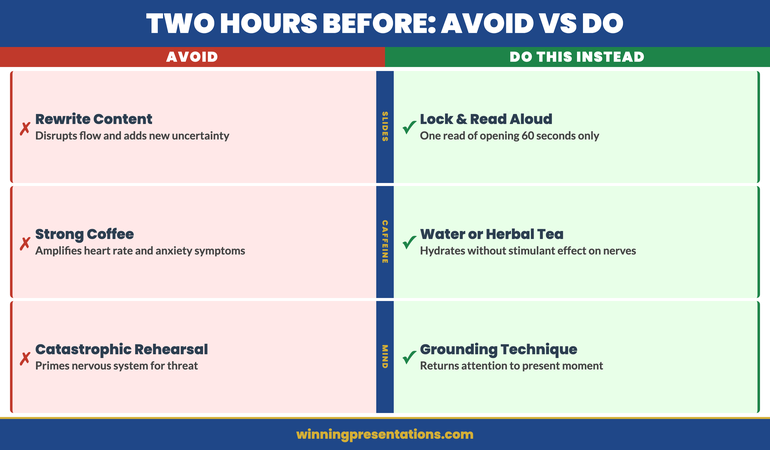
Four behaviours to avoid before presenting: rewriting slides, excessive caffeine, catastrophic rehearsal, and seeking reassurance, with better alternatives for each

Building the Protocol Into a Repeatable Routine

The morning protocol works best when it becomes automatic. The more consistent the routine, the less cognitive bandwidth it requires — and the more reliable the state it produces. Elite performers in every discipline report that pre-performance routines become conditioning: the body learns to associate the ritual with a particular state, and begins to produce that state in response to the ritual itself.

Building this kind of conditioned response requires consistency. The first few times you use the morning protocol, it will feel deliberate and slightly artificial. By the tenth presentation, it will feel natural. By the twentieth, it will be a trigger — and the physiological calm it produces will begin to appear earlier in the sequence, before you have even completed the protocol, simply because the familiar routine signals to the nervous system that this is a manageable situation.

Adapt the protocol to your specific circumstances. If you present remotely, your logistics phase looks different — the technology checks happen at your desk rather than in a venue. If your presentations often require same-day travel, build the physical activation phase into your journey rather than your morning routine. The structure matters more than the specific implementation. What you are creating is a reliable sequence that moves you, consistently, from anxious to ready.

Track what works. After each presentation, spend five minutes noting which parts of the morning felt effective and which did not. Anxiety patterns are individual — what regulates one person’s nervous system may not work for another. The protocol is a starting framework. Your version of it should be personalised over time based on what your own data tells you about your own pattern. And if you are working on a presentation that involves a challenging Q&A session, our guide to managing fishing questions during presentations covers how to handle the Q&A scenarios that most reliably spike anxiety.

Build the Foundation That Makes Morning Protocols Work

Conquer Speaking Fear gives you the 30-day structured programme to address the nervous system patterns that make presentation anxiety so persistent — so your morning protocol has solid ground to work with, not just a surface fix. £39.

Get Conquer Speaking Fear → £39

Frequently Asked Questions

What if I only have thirty minutes before my presentation, not two hours?

With thirty minutes, prioritise state management over content review. Skip the review phase entirely — the slides are done and re-reading them now will either confirm what you already know or introduce new uncertainty, neither of which is useful. Use the available time for breathing techniques and physical regulation: a short walk, extended-exhale breathing, and grounding. The logistics check should have been completed earlier. In thirty minutes, the most valuable thing you can do is manage your nervous system, not your slides.

Does the morning protocol work for presentations later in the day, not just morning presentations?

Yes — the protocol is named for the most common scenario (a morning presentation) but applies equally to afternoon or evening presentations. The key is the two-hour window before your presentation time, regardless of when that falls in the day. For afternoon presentations, schedule the physical activation phase immediately after lunch rather than at the start of the day. Avoid heavy meals in the two hours before presenting — digestion competes with the physical energy you need for delivering effectively under pressure.

I tend to feel more anxious when I try to relax before presenting. Is that normal?

Yes — this is a recognised phenomenon called relaxation-induced anxiety, and it is more common among high performers than is widely acknowledged. If deliberate relaxation techniques increase your anxiety, the issue is often the contrast between your activated state and the target calm state, which registers as a loss of control. In this case, redirect from relaxation to focused activation: a brisk walk, light movement, or deliberate mental rehearsal of a confident moment. The goal is not a specific state — it is your optimal performance state, which for some people involves a higher level of activation than the standard protocol assumes. Track what works for you specifically over time.

The Winning Edge

Weekly insights on executive presentations, presentation anxiety, and boardroom communication.

Subscribe Free

If your pre-presentation anxiety is compounded by the prospect of difficult questions, our guide to fishing questions in presentations covers how to recognise and respond to the Q&A tactics that most reliably put executives on the back foot.

About the author

Mary Beth Hazeldine, Owner & Managing Director, Winning Presentations. With 24 years of corporate banking experience at JPMorgan Chase, PwC, Royal Bank of Scotland, and Commerzbank, she advises executives across financial services, healthcare, technology, and government on structuring presentations for high-stakes funding rounds and approvals. A qualified clinical hypnotherapist and NLP practitioner, she brings a nervous-system-informed approach to presentation anxiety that goes beyond technique.

09 Jan 2026
Confidence before big meetings - why positive thinking fails and what actually works

Confidence Before Big Meetings: Why ‘Just Think Positive’ Fails (A Hypnotherapist’s 5-Minute Reset)

Quick Answer: Positive thinking fails before big meetings because it tries to override your nervous system with logic. When anxiety has triggered your fight-or-flight response, rational thoughts can’t stop it. The solution is a physical reset that calms your nervous system first—then clear thinking follows naturally. This 5-minute protocol works with your biology, not against it.

“Just think positive. You’ve got this.”

I said this to myself a thousand times before important presentations at JPMorgan. It never worked. The more I told myself to be confident, the more my racing heart reminded me I wasn’t.

Building genuine confidence before big meetings requires something different—something I didn’t understand until I trained as a clinical hypnotherapist.

The problem isn’t your mindset. It’s your nervous system. No amount of positive thinking can override biology.

Here’s the 5-minute reset protocol I now teach executives—one that works with your nervous system instead of fighting it.

Conquering Speaking Fear

The complete system for managing presentation anxiety—including the full pre-meeting protocol and nervous system techniques used by executives at JPMorgan, PwC, and Commerzbank.

Get the Complete System →

Why Positive Thinking Backfires

When you’re anxious, your amygdala has already triggered a cascade of stress hormones. Your heart races. Your palms sweat. Your thinking narrows.

Telling yourself “I’m confident” creates cognitive dissonance. Your body screams danger while your mind insists everything is fine. The mismatch increases anxiety.

A senior director at RBS described it perfectly: “The more I told myself to calm down, the worse I felt. My brain knew I was lying to myself.”

For a comprehensive approach to building lasting confidence, see my complete guide: Presentation Confidence: How to Build It (And Why Faking It Fails).

The 5-Minute Nervous System Reset

This protocol addresses physiology first, then psychology. Your nervous system can’t be reasoned with—but it can be regulated.

Minutes 1-2: Exhale Breathing

Slow exhales activate your parasympathetic nervous system—the “rest and digest” response.

Breathe in for 4 counts. Breathe out for 6-8 counts. The extended exhale triggers calm. Repeat 6-8 times.

A managing partner at PwC does this before every client meeting: “It’s the only thing that slows my heart rate.”

Minutes 2-3: Physical Grounding

Anxiety pulls you into your head. Grounding brings you back to your body.

Feel your feet on the floor. Press your palms flat against your desk. This interrupts the anxiety loop by redirecting attention to present-moment physical reality.

Minutes 3-4: Outcome Visualization

Now—after your nervous system has calmed—visualization can work.

Picture the meeting ending well. Don’t visualize perfection; visualize competence. Your brain doesn’t distinguish vividly imagined success from real success.

Minutes 4-5: Centering Phrase

Choose one factual phrase: “I’ve prepared for this.” “I know my material.” This isn’t positive thinking—it’s a statement that reminds you of reality rather than trying to override it.

Confidence before big meetings - the 5-minute nervous system reset protocol

Before Your Next Big Meeting

A CFO at Commerzbank had quarterly board presentations that left him depleted. His pre-meeting routine included notes review, practice, affirmations, energy music. None helped the physical anxiety.

We replaced everything except note review with this 5-minute protocol. “For the first time, I walked into a board meeting without my heart pounding. I could actually think.”

The technique works because it respects how your nervous system functions. Calm body first. Clear thinking follows.

FAQ: Confidence Before Big Meetings

How can I feel more confident before a big meeting?

True pre-meeting confidence comes from nervous system regulation, not positive thinking. Use physical resets (exhale breathing, grounding) combined with preparation. The goal is physiological calm, not forced optimism.

Why doesn’t positive thinking work before important meetings?

Positive thinking tries to override your nervous system with logic. When anxiety has triggered fight-or-flight, rational thoughts can’t stop it. Physical techniques reset your nervous system directly.

What’s the best pre-meeting routine for confidence?

A hypnotherapist-designed routine: 5 minutes of slow exhale breathing, physical grounding, brief visualization, and a centering phrase. This works with your nervous system rather than against it.

📧 Join 2,000+ professionals getting weekly insights on presentation confidence and anxiety management techniques that actually work. Subscribe to The Winning Edge →

📋 Free Download: Calm Under Pressure

The complete nervous system reset protocol on one page. Keep it on your phone for the 5 minutes before any high-stakes meeting.

Get Your Free Guide →


About the Author

Mary Beth Hazeldine spent 24 years at JPMorgan, PwC, RBS, and Commerzbank. She’s a clinical hypnotherapist and MD of Winning Presentations.

19 Dec 2025
How to calm nerves before a presentation - 5 minute reset technique for presentation anxiety

How to Calm Nerves Before a Presentation: The 5-Minute Reset That Actually Works

A hypnotherapist’s structured technique for stopping presentation anxiety before you walk into the room

You’re about to present. Your heart is racing. Your hands are shaking. Your mind is going blank.

You need something that works in the next five minutes — not a week-long course on confidence.

I’m going to give you exactly that. As a clinical hypnotherapist who applies evidence-based clinical techniques to managing presentation anxiety.

It takes five minutes. It works every time. And by the end of this article, you’ll have a pre-presentation routine you can use for the rest of your career.

Why You Can’t “Think” Your Way Out of Presentation Anxiety

Here’s what most people get wrong when trying to calm nerves before a presentation: they try to think their way out of a physiological response.

“Relax.” “You’ve got this.” “Stop being nervous.”

It doesn’t work. In my hypnotherapy practice, I saw this pattern time and again with executive clients. Presentation anxiety isn’t a thinking problem — it’s a nervous system response. Your brain has detected a threat (the audience) and triggered fight-or-flight.

No amount of positive self-talk will override that biological reaction. You need to speak directly to your nervous system.

That’s exactly what the 5-Minute Reset does.

Related: Public Speaking Tips: 15 Techniques That Actually Work

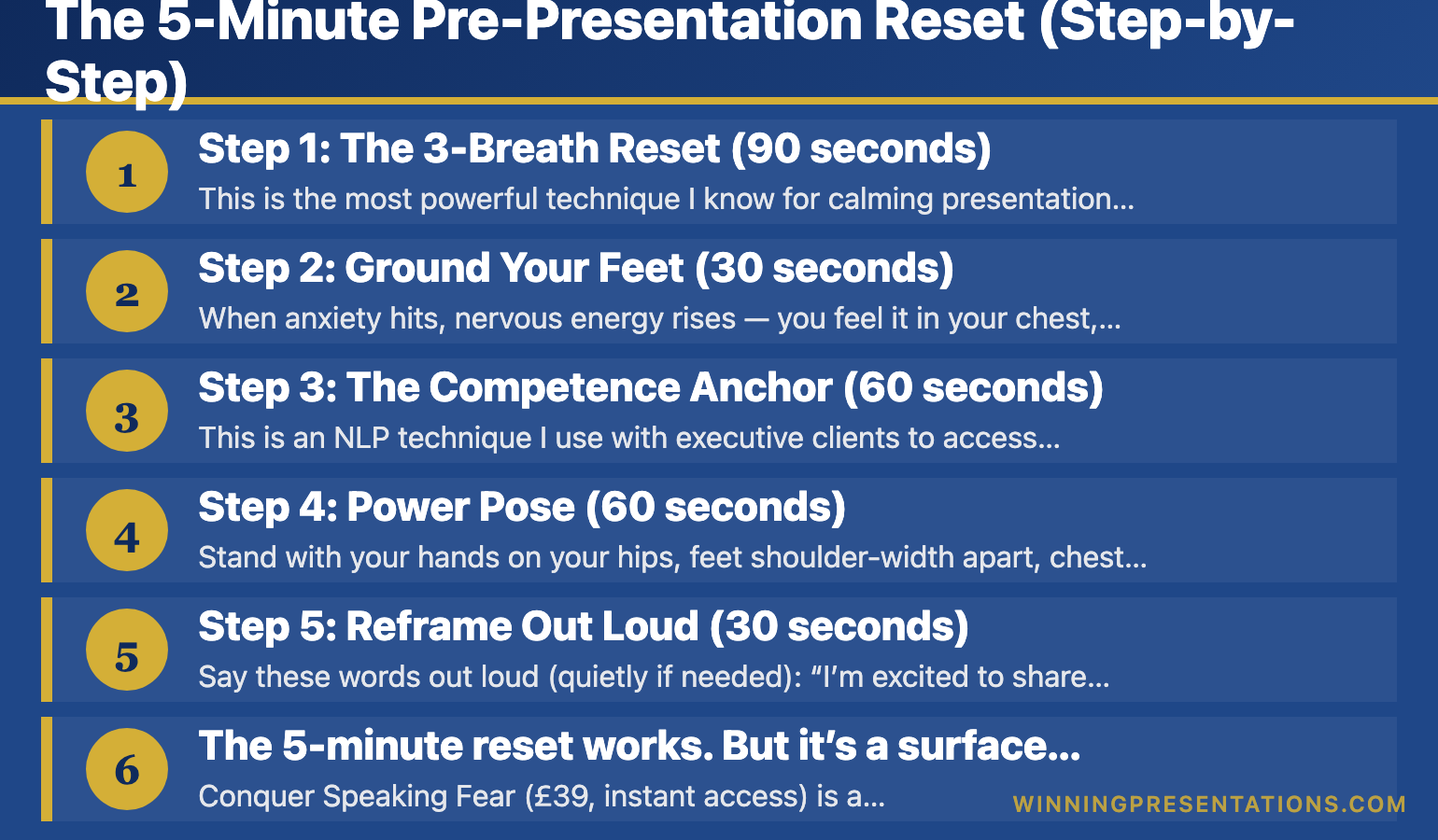
The 5-Minute Pre-Presentation Reset (Step-by-Step)

Do this sequence in order, ideally somewhere private — a bathroom, your car, an empty corridor. It takes five minutes and will change your physiological state completely.

Step 1: The 3-Breath Reset (90 seconds)

This is the most powerful technique I know for calming presentation nerves. I used it with panic attack clients for years before bringing it into executive training.

How to do it:

  1. Breathe in through your nose for 4 counts
  2. Hold for 4 counts
  3. Breathe out through your mouth for 6 counts
  4. Repeat 3 times

Why it works: The extended exhale activates your parasympathetic nervous system — literally telling your brain the threat is over. This isn’t relaxation advice; it’s how your nervous system is wired. I’ve used this exact technique to help clients stop panic attacks in their tracks.

Three breaths. Ninety seconds. Do it every single time.

Step 2: Ground Your Feet (30 seconds)

When anxiety hits, nervous energy rises — you feel it in your chest, throat, and head. Your feet want to pace or shift.

Counter this by pressing your feet firmly into the floor. Feel the ground beneath you. Imagine roots growing from your feet into the earth.

This “grounding” technique redirects nervous energy downward and creates physical stability that will translate to vocal stability when you speak. It’s a core technique in anxiety therapy that I used extensively in my clinical hypnotherapy practice before adapting it for presenters.

Related: How to Start a Presentation: 15 Powerful Opening Techniques

Step 3: The Competence Anchor (60 seconds)

This is an NLP technique I use with executive clients to access confident states on demand. It’s one of the most effective ways to calm nerves before a presentation because it gives you a physical trigger you can use anywhere.

How to create it:

  1. Remember a time you felt completely confident — any context
  2. Close your eyes and fully re-experience that moment
  3. When the feeling peaks, press your thumb and forefinger together firmly
  4. Hold for 5 seconds, then release

You’ve now created a physical trigger. Before you present, press your thumb and forefinger together to access that state. Your nervous system doesn’t distinguish between remembered confidence and current confidence.

This is the same anchoring technique I used to help anxiety clients access calm states on demand. It works for presentations too.

Step 4: Power Pose (60 seconds)

Stand with your hands on your hips, feet shoulder-width apart, chest open. Hold for 60 seconds.

Research on power posing is mixed, but I’ve seen it work consistently with the executives I train. At minimum, it interrupts the closed, protective posture that presentation anxiety creates — hunched shoulders, crossed arms, shallow breathing.

That posture change affects your mental state. Open body, open mind.

Step 5: Reframe Out Loud (30 seconds)

Say these words out loud (quietly if needed): “I’m excited to share this.”

Not “I’m calm” — your body knows that’s a lie. “I’m excited” works because the physiological response to excitement is identical to anxiety: racing heart, heightened alertness, energy surge. The only difference is the label you put on it.

Research shows that reframing anxiety as excitement actually improves performance. One sentence. Say it out loud. It matters.

🎯 Want This Entire Routine on a Printable Card?

The include the 5-Minute Reset, voice warm-ups, power poses, and 20+ techniques on printable cards you can keep in your bag. Review them before any high-stakes presentation.

Stop managing nerves. Eliminate them.

The 5-minute reset works. But it’s a surface technique — and you know it.

Conquer Speaking Fear (£39, instant access) is a hypnotherapist-designed system that targets the root cause of presentation anxiety — not just the symptoms. Use the reset in the short term; use the system to stop needing it.

  • Fear Type Assessment — identify exactly what drives your anxiety response
  • 10 evidence-based techniques with structured practice
  • 5 word-for-word scripts for worst-case scenarios
  • 30-day structured plan — build lasting confidence

Get Conquer Speaking Fear → £39

âš¡ Presenting this week?

If you’re heading into a high-stakes presentation this week and need more than a 5-minute reset, Conquer Speaking Fear gives you the complete system — including the pre-presentation protocols that make the nerves manageable every time.

Explore Conquer Speaking Fear →

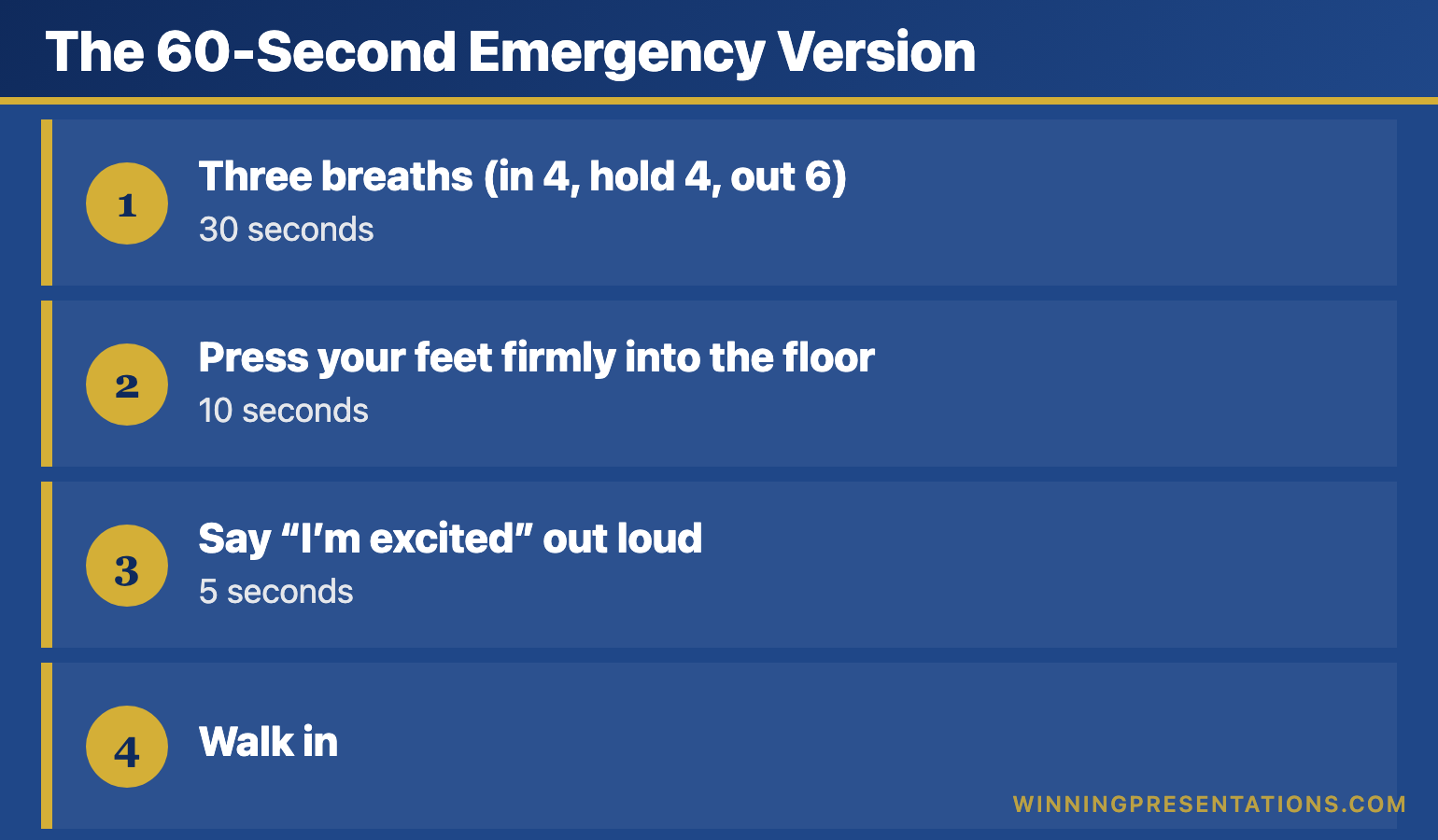
The 60-Second Emergency Version

No time for the full reset? Here’s how to calm presentation nerves in under a minute:

  1. Three breaths (in 4, hold 4, out 6) — 30 seconds
  2. Press your feet firmly into the floor — 10 seconds
  3. Say “I’m excited” out loud — 5 seconds
  4. Walk in

Forty-five seconds. It won’t eliminate your nerves completely, but it will take the edge off enough to get through your opening — and the first 60 seconds are when presentation anxiety is highest. After that, you’ll settle.

What to Do If Your Mind Goes Blank During the Presentation

Even with preparation, it happens. You’re mid-sentence and suddenly — nothing. Your mind is completely empty.

Here’s your recovery plan:

  1. Pause. It feels like an eternity to you. To the audience, it looks like confidence.
  2. Look at your slide or notes. No one judges you for this.
  3. Say: “Let me come back to that point…” and move to the next section.

The audience rarely notices these moments as much as you fear. And knowing you have a recovery plan removes the panic that makes blanking worse.

Related: How to End a Presentation: 7 Closing Techniques That Work

Why This Works When Other Techniques Don’t

Most advice for calming nerves before a presentation focuses on what to think. But as I learned in my clinical hypnotherapy practice, you can’t think your way out of a physiological state.

The 5-Minute Reset works because it targets your nervous system directly:

  • Breathing activates the parasympathetic response
  • Grounding redirects nervous energy
  • Anchoring accesses stored confident states
  • Posture interrupts anxiety body language
  • Reframing changes how your brain interprets the arousal

Each step builds on the last. Together, they create a reliable state change that works whether you’re presenting to five people or five hundred.

Related: How to Create Executive Presentations That Get Results

Building Long-Term Presentation Confidence

The 5-Minute Reset is a powerful tool for calming nerves before any presentation. But if presentation anxiety is a recurring challenge, you’ll want to build deeper confidence over time.

That means:

  • Knowing your opening cold — Memorise your first 30 seconds word-for-word so you don’t have to think when nerves are highest
  • Arriving early — Get to the room first and make the space yours
  • Creating a consistent ritual — Use the same pre-presentation routine every time so your brain learns to associate it with successful outcomes
  • Practising in stressful conditions — Rehearse standing up, in front of colleagues, in the actual room when possible

I cover all 15 of these techniques in my comprehensive guide: Public Speaking Tips: 15 Techniques That Actually Work

Ready to build confidence that works long-term?

Conquer Speaking Fear is a complete system for executives who understand their material but still feel the anxiety response before every presentation. 75-page workbook. Evidence-based. Immediate download.

Want to stop relying on the reset and start walking in composed? Conquer Speaking Fear builds the foundation underneath the techniques →

Learn more about Conquer Speaking Fear → £39

Frequently Asked Questions

How do I stop shaking before a presentation?

Shaking comes from adrenaline — you can’t stop the adrenaline, but you can process it. Do the 3-Breath Reset (breathe in 4, hold 4, out 6, repeat 3 times), then hold something in your hands — a clicker, pen, or notes — to occupy them. The shaking usually subsides within 60-90 seconds of starting your presentation if you don’t fight it.

What if I get nervous again during the presentation?

Use a micro-reset: take one slow breath (in 4, out 6), press your feet into the floor, and continue. You can do this while speaking or during a natural pause. The audience won’t notice.

Does the 5-Minute Reset work for virtual presentations?

Absolutely. Do the full routine before you go on camera. The only adaptation: during the presentation, you can ground your feet while seated, and focus your eye contact on the camera lens (not the screen) to create connection.

What if I only have 2 minutes before presenting?

Use the 60-Second Emergency Version: three breaths (30 seconds), ground your feet (10 seconds), say “I’m excited” out loud (5 seconds), then walk in. It’s enough to take the edge off your presentation anxiety.

Why do I get presentation anxiety when I know the material?

Because anxiety isn’t about knowledge — it’s about perceived threat. Your nervous system interprets being watched and judged as danger, regardless of how prepared you are. That’s why techniques that target the nervous system directly (like the 5-Minute Reset) work better than “just know your stuff” advice.


📬 The Winning Edge Newsletter

Weekly strategies for speaking confidence, executive presence, and career-critical presentation moments.

Subscribe free →

Your Next Step

You now have a structured technique to calm nerves before any presentation. Here’s what I want you to do:

  1. Save this article — bookmark it or print the steps
  2. Use the 5-Minute Reset before your next presentation — even a low-stakes meeting
  3. Notice the difference — in your body, your voice, your confidence

Once you’ve experienced how well this works, you’ll never present without it again.

Go deeper: Public Speaking Tips: 15 Techniques That Actually Work — the complete guide to confident presenting, from a hypnotherapist who specialises in executive presentation skills.


Mary Beth Hazeldine is a qualified clinical hypnotherapist and Managing Director of Winning Presentations. She spent 25 years in corporate banking at JPMorgan, PwC, Royal Bank of Scotland, and Commerzbank, and applies evidence-based clinical techniques to managing presentation anxiety. She advises executives across financial services, healthcare, technology, and government.

Not ready for the full system? Start here instead: subscribe to The Winning Edge — weekly strategies for executive confidence and presentation skills, free.