Tag: board Q&A

19 May 2026
Featured image for Most Senior in the Room, Least Prepared: How to Recover Mid-Meeting

Most Senior in the Room, Least Prepared: How to Recover Mid-Meeting

QUICK ANSWER

Being the most senior person in the room and feeling the least prepared is a real, recurring scenario in senior careers. The technique is not to fake confidence. It is a structured response: name the moment internally, slow the pace, ask one targeted question that buys preparation time without losing authority, and route the discussion to the part you are strongest on while the room helps fill the gap. Senior credibility survives lack of preparation. It does not survive pretending.

Yusuf was a partner at a London consultancy, dropped into a client meeting an hour before it started because the lead engagement partner had been called to a regulator. The client expected a recommendation on a topic Yusuf knew at one level of remove and was now meant to chair. Twelve people around the table. Yusuf, technically, was the most senior of them. He was also the least prepared person in the room.

That gap — senior-by-role, junior-by-readiness — arrives in every senior career, often more than once. Sometimes it is structural, like Yusuf’s. Sometimes it is a meeting that turned in an unexpected direction. Sometimes it is a presentation that gets to a slide you did not personally build. The detail varies. The pattern is the same: you are the senior name in the room, and the work has just outrun your preparation.

This article is about how to handle that moment without spending senior credibility — and how to set up your preparation discipline so it happens to you less often. Both halves matter. The recovery technique is for now. The discipline is for next time.

When the question lands and you do not have the answer

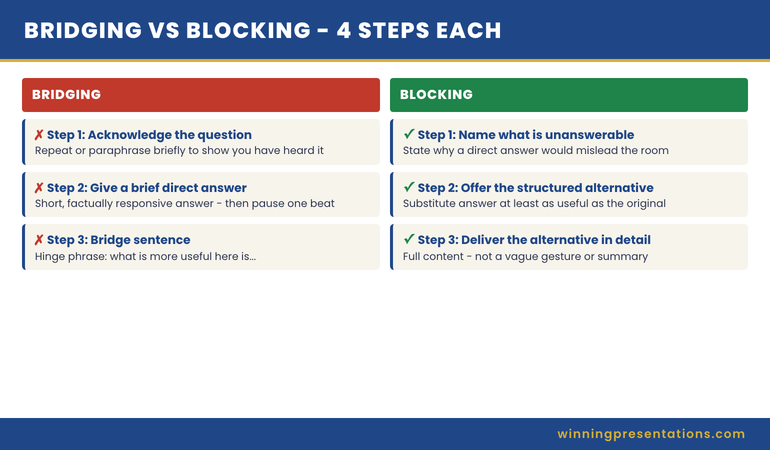
The Executive Q&A Handling System is the structured framework for handling difficult, unexpected, and high-stakes questions in the moment without losing authority. Designed for senior professionals who present at board level.

Explore the system →

Why this scenario keeps happening at senior levels

The senior-but-unprepared moment is not a sign of poor planning. It is a structural feature of senior work. Senior professionals are pulled into meetings on short notice precisely because they are senior. Crises route to seniority. Escalations route to seniority. Topics outside your specialism get routed to you because you are the senior name available.

The other structural factor is the breadth of senior remit. The work covered by a senior role is wider than any one person can hold in working memory. Junior specialists know their area cold and rarely encounter something outside it. Senior generalists handle a portfolio that crosses functions, clients, geographies, and stakeholder types. The probability that any given meeting will surface a topic where your preparation is thin is much higher at senior level than at any other point in a career.

This means the underprepared moment is not avoidable in the long run. The discipline is not “be perfectly prepared for every meeting” — it is “have a reliable response for the moments where you are not.” The senior leaders who handle this well are not the ones who are always prepared. They are the ones who have a structured way to operate when they are not.

The wrong instinct: faking confidence

The most expensive instinct in this moment is to project full confidence and answer anyway. Senior credibility, in front of professional audiences, does not survive a fabricated answer. The audience usually knows. Even if no one says anything in the moment, the room recalibrates. The reading of you shifts from “senior person with deep grip” to “senior person who guesses when cornered.” That recalibration is hard to reverse and very expensive to carry.

The instinct to project full confidence comes from the wrong assumption: that admitting any gap is admitting weakness. At senior level, the opposite is closer to true. The professionals who maintain credibility under pressure are the ones who can name a gap precisely without appearing flustered, and route around it cleanly. That requires confidence, but it is confidence in your own authority over the conversation rather than confidence in a specific answer you do not have.

The other wrong instinct is to apologise excessively. A single, clean acknowledgement of the gap is fine. Repeated apologies, hedging language, or framing yourself as the wrong person for the meeting drains authority faster than the unprepared moment itself ever could. The room tolerates a senior person handling a gap competently. It does not tolerate a senior person performing inadequacy.

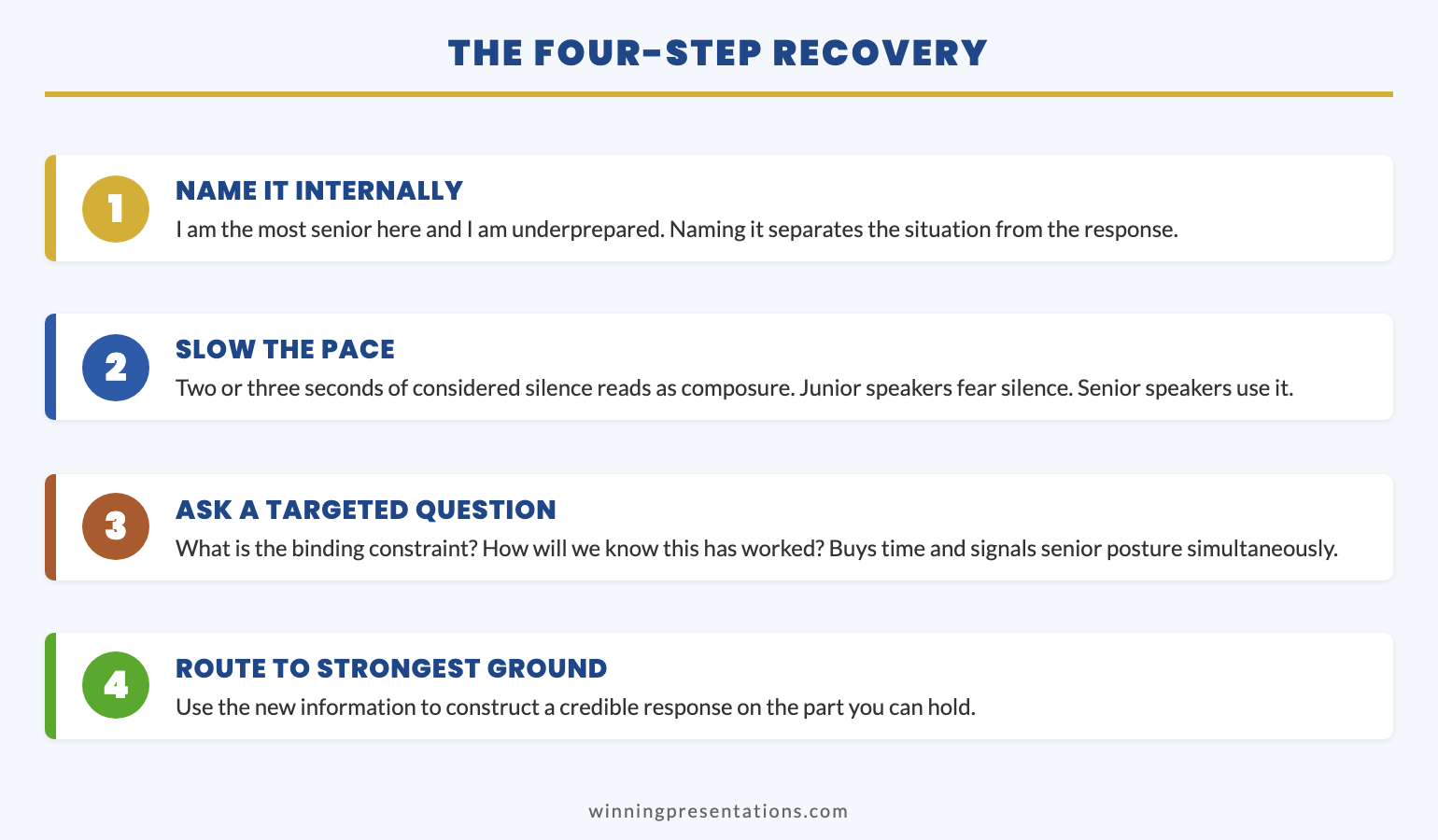
Stacked cards infographic showing the four-step recovery framework for senior leaders who feel underprepared: name the moment internally, slow the pace, ask a targeted question, and route to strongest ground

The four-step recovery

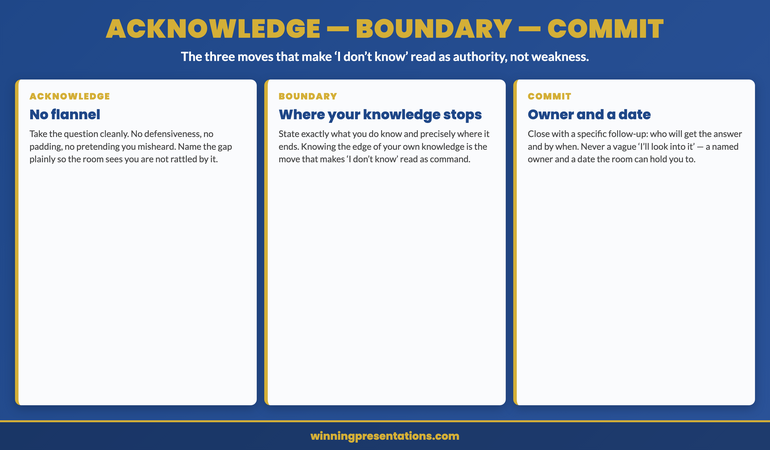
Step one: name the moment internally. Before you respond externally, name what is happening inside your own head: I am the most senior person here and I am underprepared on this. That internal naming is critical. It separates the situation from the response. Senior leaders who skip this step often respond to the situation as if it were a threat, which produces the wrong external behaviours — defensiveness, fabrication, performative confidence. Naming it internally allows you to handle it as a structural problem, which is what it is.

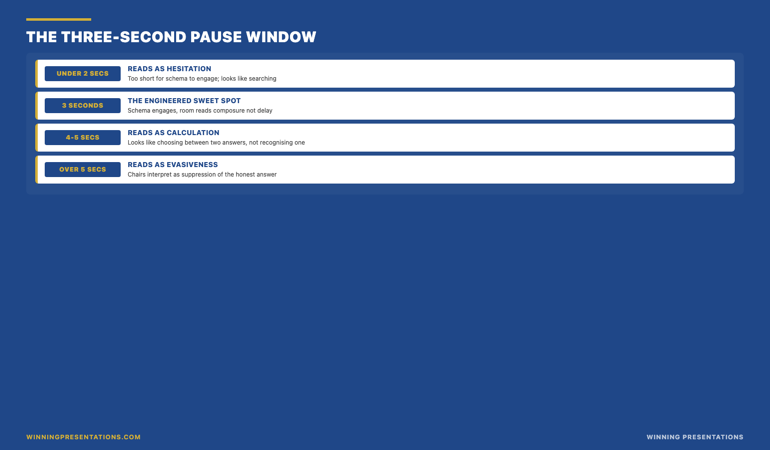
Step two: slow the pace. The room is reading your tempo as much as your words. A senior leader who slows the pace by half a second before responding signals composure. A senior leader who responds at speed signals stress. Slowing the pace also gives you time to think, which is the literal thing you need most in this moment. Two or three seconds of considered silence in a senior meeting is not awkward — it is what the room expects from a senior person who is thinking carefully. Junior speakers fear silence. Senior speakers use it.

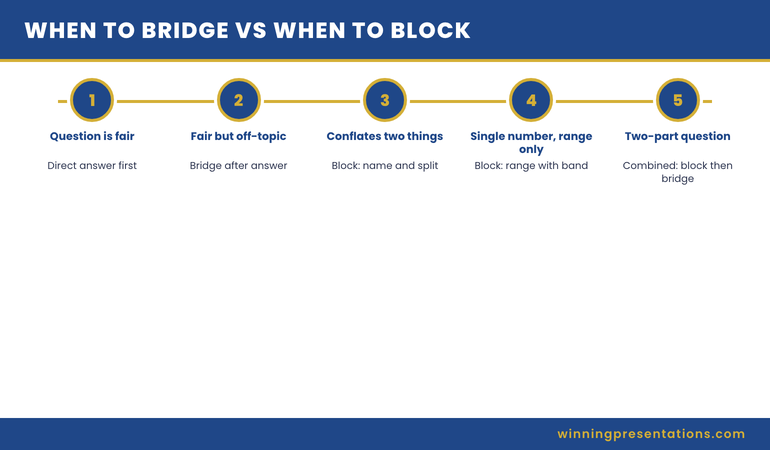
Step three: ask a targeted question. This is the move that buys you the most time and authority simultaneously. Not “could you say more?” — that reads as deflection. A targeted question signals that you have a structured frame for thinking about the topic, even if you do not yet have the specific answer. For example, “Before I respond, what is driving the urgency on this from your side?” or “What is the constraint we are most worried about — cost, timing, or stakeholder alignment?” Each of these moves the conversation forward, gives you information you needed, and signals senior posture. Handling difficult board questions covers the linguistic patterns for this in more depth.

Step four: route to your strongest ground. Once the targeted question has produced a response, you have both information and a framing to work with. Route the conversation to the part of the topic you can speak to with full grip, and use that to construct a credible response to the original question. You are not faking the answer. You are giving the genuinely strong answer to the part you are strongest on, and being honest about the parts that need follow-up.

EXECUTIVE Q&A HANDLING SYSTEM

Decision-safe answers in 45 seconds, even on questions you didn’t see coming

The Executive Q&A Handling System gives you the structured frameworks senior professionals use when the room asks something they have not fully prepared for. Calm authority, decision-safe responses, and the linguistic patterns that hold up under pressure.

  • Frameworks for answering tough, hostile, or unexpected questions
  • Linguistic patterns for buying time without sounding evasive
  • Scenario playbooks for common senior Q&A situations
  • Designed for board, investment committee, and executive client meetings
  • Instant download, no subscription

£39, instant access. Designed for senior professionals navigating high-stakes Q&A.

Get the system →

Designed for senior professionals presenting to boards and investment committees.

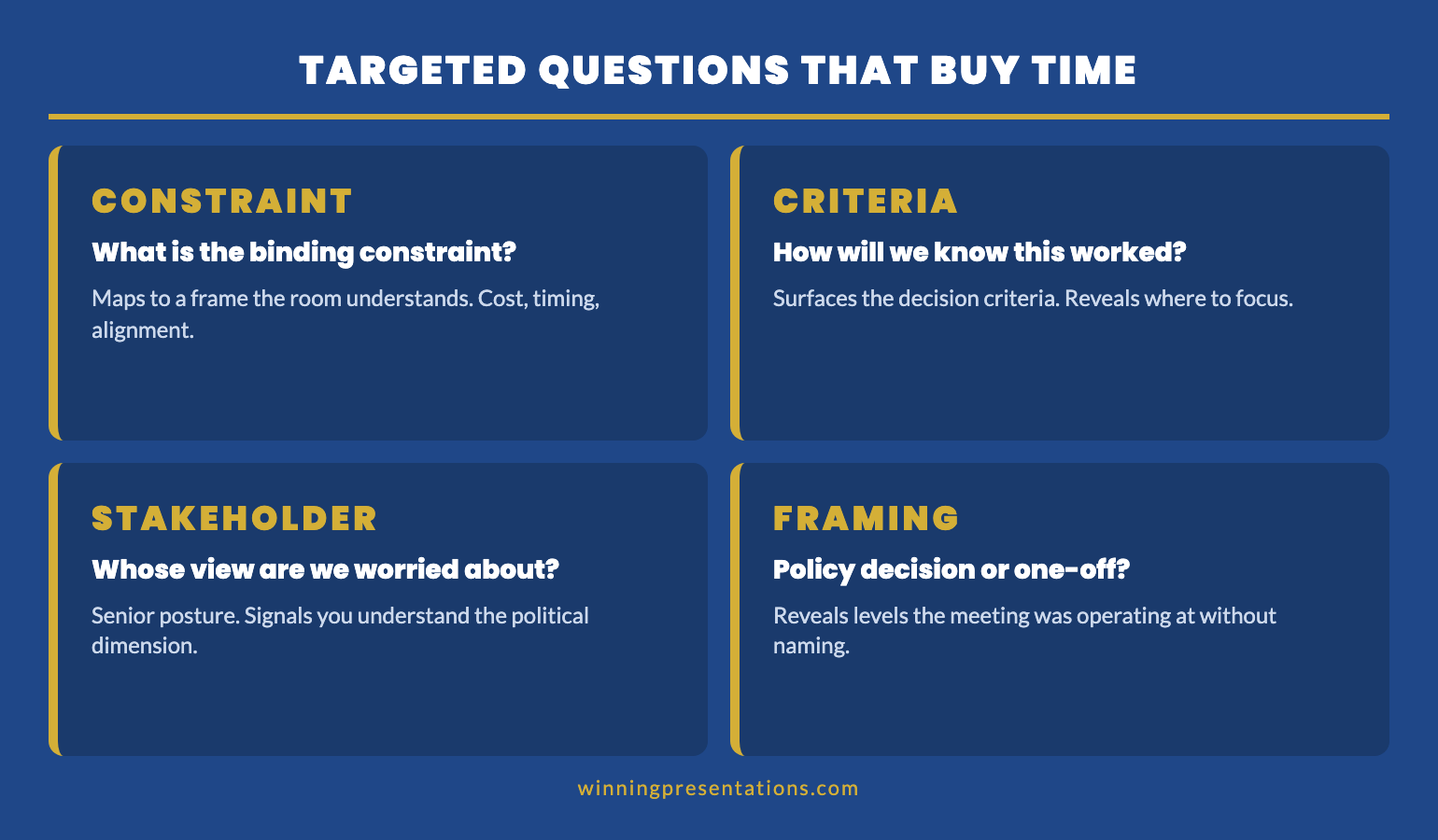
Targeted questions that buy time without losing authority

Not every question buys you time at senior level. Some readbacks make the situation worse. The questions that work share three properties: they sound like the kind of question a senior person would ask, they produce information you genuinely need, and they shift the conversation in a direction that helps you.

Constraint questions. “What is the binding constraint here — budget, timing, or stakeholder alignment?” These are good because they map to a frame the room understands and gives you a structural starting point for the response.

Decision-criteria questions. “How will we know this has worked?” or “What does success look like from your side?” These are useful when the meeting is moving toward a decision but the criteria have not been made explicit. The answer almost always reveals where to focus.

Stakeholder questions. “Who else needs to be aligned on this?” or “Whose view are we most worried about losing?” These work in meetings where the substance is unclear but the politics are doing real work. The question signals you understand the political dimension — which is itself a senior posture.

Clarification questions on framing. “Are we discussing this as a policy decision or a one-off?” or “Is the question whether to do it, or how to do it?” These are particularly useful when the meeting itself has not been clear about the level of discussion. The answer often reveals that the room itself was operating at different levels, which lets you contribute meaningfully without needing the specific knowledge you do not have.

What these have in common is that they are not deflection. They are structurally useful questions that the meeting needed someone to ask. Asking them positions you as the senior thinker in the room even when your subject-matter preparation is thin.

Dashboard infographic showing four categories of targeted questions senior leaders can use when underprepared: constraint questions, decision-criteria questions, stakeholder questions, and framing-clarification questions

Letting the room do part of the work

Senior leaders who handle these moments well usually have one further move: they let other people in the room contribute to the response without losing the chair of the conversation. This is structurally different from punting the question to a colleague (which signals you cannot answer) and from chairing it formally (which can feel ceremonial in a working meeting). It is closer to inviting expertise into the conversation while continuing to direct it.

The phrasing matters. “Stefan, you have done more recent work on this — what is the current state?” allows Stefan to contribute the specific knowledge while you continue to hold the senior posture. Once Stefan has answered, you weave his contribution into the senior frame: “That tracks with the strategic position. Given that, the trade-off we are really looking at is X.” The room sees a senior leader using the team well, not a senior leader hiding behind the team.

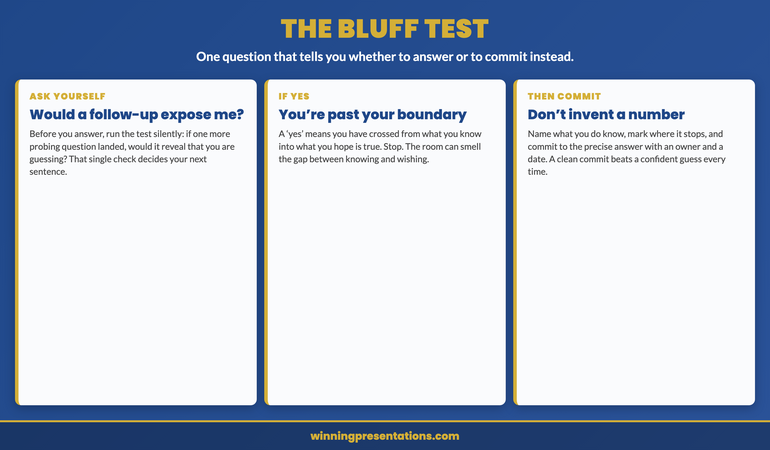
This works only when there is genuinely someone in the room with the relevant expertise. If there is not, the move does not work, and trying it makes the gap more visible. The fallback in that case is honesty plus structure: “I want to give you a properly grounded answer rather than improvise. I will come back to you on that specific point by Friday. The structural question I can speak to now is…” That is also a senior move, performed correctly.

Buy-in mastery covers the broader curriculum of senior approval work, including the stakeholder analysis that makes targeted questions land more reliably in real meetings.

When the underlying issue is preparation discipline, not Q&A technique

If the senior-but-underprepared moments are happening too often, the gap is usually upstream of the meeting. The Executive Buy-In Presentation System works through the structural disciplines — stakeholder analysis, case construction, objection pre-handling — that prevent these moments from arriving at all.

Executive Buy-In System — £499 →

Prevention next time: the discipline that reduces frequency

You cannot prevent every senior-but-underprepared moment. You can reduce how often they happen. The discipline is structural, not heroic.

The first preventive move is the pre-meeting brief. For any meeting where you are the most senior person and the topic is not your daily area, request a fifteen-minute pre-brief from the colleague closest to the work. Three questions: what is the meeting actually deciding, who needs to be aligned, what is the most likely awkward question. That brief, done in fifteen minutes the day before, removes most of the underprepared scenarios that would otherwise have arrived in the meeting.

The second is calendar discipline. Most senior leaders accept too many short-notice meetings on topics they cannot prepare for. A simple rule helps: any meeting that is going to ask you to take a public position on something you have not engaged with in the last quarter requires a pre-brief, or it gets pushed to allow time for one. The professional cost of pushing the meeting back twenty-four hours is much smaller than the credibility cost of being underprepared in it. Executive presentation skills covers this part of senior professional discipline more broadly.

The third is structural reading. Senior leaders who run on a healthy preparation cycle usually have a small portfolio of structures they can use to reason about almost any topic on first encounter — constraint maps, stakeholder grids, decision-criteria frames, risk-and-mitigation patterns. When the meeting surfaces a topic you have not specifically prepared for, those structures let you contribute usefully even on first contact. They are the senior version of having a method ready when the content is unfamiliar.

EXECUTIVE Q&A HANDLING SYSTEM

Calm authority on the questions you didn’t see coming

Frameworks, scenario playbooks, and linguistic patterns for senior Q&A. Designed for board, investment committee, and high-stakes client meetings. £39, instant access.

Get the system →

Designed for senior professionals navigating tough Q&A.

Why composure beats coverage

Senior credibility is not built on always being prepared. It is built on handling whatever the meeting brings with consistent professional posture. The leaders the room trusts most are not the ones who never get caught short. They are the ones who, when they do, slow down, ask the right targeted question, and route the conversation to ground they can hold. That is a teachable competence. It is also the part of senior presence that scales across topics, audiences, and decades.

Frequently asked questions

Is it ever right to admit “I do not have an answer to that” in a senior meeting?

Yes, when it is paired with structure. “I do not have a properly grounded answer to that today — I will come back to you by Friday. The framework I would use to think about it is…” preserves credibility. The bare admission, without follow-up structure, drains authority. The pairing matters.

Will the room respect a senior leader who slows the pace before answering?

Almost always. Considered silence in a senior meeting reads as composure, not hesitation, provided the body language and eye contact stay steady. Junior speakers worry about awkward silence. Senior speakers use silence as a tool. Two to three seconds is usually optimal — long enough to signal thought, short enough to maintain pace.

What if my colleague’s contribution makes me look less prepared by comparison?

That risk exists, and the framing is what handles it. Inviting a colleague to contribute the specific subject-matter detail and weaving it into the senior frame (“That tracks with the strategic position. Given that, the trade-off we are looking at is…”) keeps you positioned as the senior thinker. The room sees a leader using the team well. It does not see a leader being outshone, unless your re-framing is weak. The re-framing is the part to rehearse.

How do I prevent these moments from happening as often?

The strongest prevention is the fifteen-minute pre-brief from the colleague closest to the work, on any meeting where you will be the most senior person on a topic outside your daily area. Three questions: what is the meeting deciding, who needs to be aligned, what is the most likely awkward question. The pre-brief removes most of the senior-but-underprepared scenarios before they arrive. The leaders who do this consistently rarely get caught short, even when their portfolio is broad.

The Winning Edge

A weekly newsletter for senior professionals who present at board level. One specific structural idea per issue, drawn from real boardroom and committee work. No filler.

Subscribe to The Winning Edge →

If this article landed, the natural companion is High-stakes presentation burnout. It covers the related pattern that arrives when senior leaders run the high-stakes cycle for years without restoring the recovery phase.

Next step: rehearse the four-step recovery once, out loud, on a topic you do not know well. The rehearsal is what makes it usable when you actually need it.

Mary Beth Hazeldine is the Owner & Managing Director of Winning Presentations. With 24 years of corporate banking experience at JPMorgan Chase, PwC, Royal Bank of Scotland, and Commerzbank, she advises senior professionals across financial services, healthcare, technology, and government on structuring presentations for high-stakes funding rounds and approvals. She speaks German and works extensively with the German-speaking financial markets.

07 May 2026
Professional woman in a navy blazer sits at a table with papers, speaking to colleagues during a business meeting margins.

“Why Should I Believe Your Numbers?” — Answering the Hardest Q&A Challenge

Quick answer: The credibility-attack question — “why should I believe your numbers?” — is not a request for data. It is a test of composure and source transparency. The response that works has three moves in 30 seconds: name the specific source, surface the one limitation the questioner has not yet seen, and invite them to a deeper follow-up. Attempting to defend the numbers on their merits loses the moment. Attempting to counter-challenge the questioner loses the room.

Ines was presenting a market analysis to the investment committee at a mid-size asset manager. She had been at the firm eight months. Her analysis recommended reducing exposure to a specific sector by four percent. The work was careful. The sources were solid. The conclusion was defensible.

Partway through, the senior partner — who had championed the sector for twenty years — put down his pen. “Ines. Why should I believe your numbers?” Not “where did you get that figure” or “how did you account for the recent regulatory change.” The broader challenge. To her analysis, her judgement, and by implication her presence on the committee.

She had thirty seconds. What she did in those thirty seconds decided not just whether the recommendation got approved that day but whether she would be invited to present to the committee again. She chose the response that held. The sector reduction was not approved, but Ines was asked to lead the follow-on analysis the same afternoon. The senior partner later told her manager, “She handled the challenge well.”

Want a structured approach to handling tough executive questions?

The Executive Q&A Handling System covers the frameworks for predicting, preparing, and delivering composed responses to executive challenges — including the credibility-attack pattern described in this article.

Explore the Executive Q&A Handling System →

Why this question is never really about the numbers

Senior executives who ask “why should I believe your numbers?” are almost never asking you to walk them through the data. They have been in rooms with data their whole career. They know what careful analysis looks like. The question is a different kind of probe.

It is a composure test. The question is deliberately broader than it needs to be. It forces the presenter to choose between defending the data in detail — which reads as not quite understanding the question — and responding at a higher level, which reads as confident. Most presenters reach for the detail, because the detail is comfortable ground. Reaching for the detail is exactly what the questioner is watching for.

It is also a source transparency check. Part of what the executive wants to see is whether you know, at a speaking-level fluency, where your numbers came from. Not the page number. The underlying dataset, the methodology, and the known limitations. If you have to pause to look these up, the executive has their answer — your ownership of the analysis is not as deep as it needs to be.

And it is sometimes a signalling move to the rest of the room. A senior executive who questions a junior presenter’s numbers in front of the committee is reminding everyone who holds the final judgement on analysis. This is not malicious. It is an organisational norm in many firms. The presenter’s job is not to resent it. The presenter’s job is to pass the test cleanly.

The three-move response that holds

The response needs to happen inside 30 seconds. Not because speed is impressive, but because a longer response extends the zone in which the presenter can make a mistake. The shorter, cleaner response closes the moment and returns control to the meeting.

Move one: name the source precisely. Not “the data came from our market team.” Specific. “The underlying data is from the MSCI sector attribution series, February 2026 release, cross-referenced against the Bloomberg consensus forecast for the same period. I pulled the cuts myself on the 28th.” That sentence does three things. It signals specific source knowledge. It signals recency. It signals personal ownership of the analysis. A presenter who says “I pulled the cuts myself” is not outsourcing the defence.

Move two: name the limitation before they do. “The piece I would flag is that the MSCI series does not yet reflect the March regulatory change. For the sector we are discussing, that adjustment would move the estimate by roughly 1 to 1.5 percentage points in the same direction.” This is the move that separates strong presenters from everyone else. Surfacing your own analytical limitation, unprompted, is the fastest way to restore credibility under a credibility attack. It tells the executive you have thought about what could be wrong, not just what is right.

Move three: invite the deeper follow-up. “I can walk through the full source methodology and sensitivity analysis in a separate 30-minute session if that would be useful, or I can return with a written note by end of day.” Now the decision of how much further to probe sits with the executive. You have offered both a rapid deliverable and a deeper one. Most executives will accept one or the other, or ask one tightened follow-up question. The credibility-attack pattern has ended.

The three-move response framework shown as a 30-second timeline infographic: name the source precisely, name the limitation before they do, invite the deeper follow-up, with each move's function annotated

Four failure modes (and why each one loses the room)

The credibility attack generates predictable failure modes. Knowing them by name helps you catch yourself in the moment.

Failure mode 1: the data defence. The presenter reaches for specific numbers and starts walking through methodology. “Well, the four percent comes from taking the MSCI data on slide 14 and adjusting for…” This extends the moment and signals that the presenter has not understood the question. The room reads defensiveness. The executive’s concern is confirmed rather than answered.

Failure mode 2: the appeal to authority. The presenter cites who approved the analysis — “this was reviewed by the quant team and signed off by head of research last week.” This deflects responsibility away from the presenter and onto an absent third party. Executives read this as unwillingness to own the analysis. The sign-off may have happened. The presenter’s name is still on the work.

Failure mode 3: the counter-challenge. The presenter pushes back — “what specifically are you concerned about?” — or worse, questions the questioner’s assumptions. In some rooms this works. In most executive settings it reads as lack of composure. The credibility attack is social, not analytical, and responding with a social counter-attack escalates rather than de-escalates.

Failure mode 4: the apology. The presenter says some variant of “I understand if the analysis is not where you want it to be.” This concedes the attack on the presenter’s behalf. Executives rarely expect the presenter to concede. They expect a composed defence. The apology forfeits the ground the presenter was standing on.

The three-move response is designed to avoid all four failure modes. It does not defend the data, appeal to authority, counter-challenge, or apologise. It owns the source, names the known limitation, and offers a deeper session. That is the exit the room is looking for.

Preparing the response before the meeting

You cannot compose the three-move response live, under pressure, in front of a senior executive. The response has to be drafted before the meeting, for the two or three pieces of analysis most likely to be challenged.

Step one is to identify the attackable numbers. Usually three or four in any deck. They tend to cluster around one of three things: a central recommendation figure (the percentage change, the revenue estimate, the risk-adjusted return), a comparative benchmark (how the proposed option stacks up against the status quo), or a forward-looking projection (any number with a future date attached). For each attackable number, assume a credibility attack will come. If no attack comes, you have wasted thirty minutes of preparation. If an attack comes and you have not prepared, you have lost thirty minutes of meeting time and an unknowable amount of credibility.

Step two is to write the three moves for each attackable number. Specifically. With the exact phrasing you will use. “The underlying data is from the MSCI sector attribution series…” is a line you rehearse, not improvise. Read it aloud three times. Make sure the sentence is delivered as a single unit — if you have to pause mid-sentence to remember the next word, the pause itself reads as hesitation. Keep the sentences short enough to survive being spoken under pressure.

Step three is the limitation. Most presenters find this step uncomfortable. They are trained to present strength, and surfacing limitations feels like conceding ground. In the credibility-attack context, the opposite is true. The limitation is the strongest move you have. For each attackable number, identify one real, material, currently unresolved limitation. Not a trivial caveat. A real one. Write the limitation in the form you will say it. Practise saying it without apologising. “The piece I would flag…” is the opener that works. “I have to be honest with you…” is the opener that does not.

The Executive Q&A Handling System covers the structured preparation process for these responses in more detail, including the scenario playbooks for different executive meeting types.

Harder variants and how they shift the response

The pure “why should I believe your numbers?” is the standard form. Several variants are harder and require response adjustments.

Variant 1: “I have seen this analysis before, and I did not believe it then either.” This adds a historical layer. The response has to acknowledge the earlier context without litigating it. “That is useful context — I was not involved in the earlier piece, and my version uses the February MSCI release rather than the previous year’s. The piece I would flag…” Then continue into the three-move structure. Do not ask about the earlier work. Do not defend the earlier work. Acknowledge and redirect.

Four Q&A failure modes shown as a grid infographic: the data defence, the appeal to authority, the counter-challenge, and the apology — each with the reason it loses the room

Variant 2: “Your analysis assumes something I do not think is true.” This is sharper because it names a specific assumption. The response is adjusted. Move one becomes the assumption you used, specifically, and the reason you chose it. Move two becomes what happens to the conclusion if the assumption is wrong — you have already done the sensitivity analysis, haven’t you? Move three stays the same: offer the deeper session.

Variant 3: “What would change your mind about this?” This is actually the most respectful variant, and the easiest to underestimate. It sounds like an attack but it is an invitation. The response is direct. Name two or three specific pieces of evidence that would update your analysis. “Three things would move me. A regulatory development in the opposite direction. A change in the baseline rate assumption above 250 basis points. Or confirmation that the MSCI methodology revision, expected in Q3, materially changes the sector attribution.” Presenters who cannot answer this question usually have not done the full analysis.

The full system for handling executive Q&A

The Executive Q&A Handling System — £39, instant access — gives you the frameworks for predicting, preparing, and delivering composed responses to executive challenges. Covers the credibility-attack pattern, the detailed technical question, the hostile challenge, and the ambiguous meta-question. Designed for senior professionals presenting to boards, investment committees, and executive sponsors.

  • Response frameworks for the most common executive challenge patterns
  • Preparation protocols for predictable question types
  • Scenario playbooks covering boardroom, investment committee, and executive sponsor settings
  • Master checklist and framework reference materials
  • Instant download, lifetime access, no subscription

Get the Executive Q&A Handling System →

Designed for senior professionals facing structured executive questioning.

When the follow-up session matters more than the original meeting

If you offer the deeper 30-minute follow-up session and the executive accepts, the follow-up matters more than the original meeting. It is the moment you demonstrate, on your own terms, that the credibility concern was unfounded.

Prepare the follow-up differently from the original presentation. Strip the slides to two or three, at most. Bring the source files, the sensitivity analysis, and the specific methodology documentation. Open the session by naming the question that triggered the follow-up. “We are here because you raised a credibility question on the sector attribution. I want to address that directly.” Then walk through the three elements: exact source, specific methodology steps, complete sensitivity analysis.

The executive’s behaviour in this session tells you which of two things is happening. If they engage deeply with the detail, they were genuinely interested in the analysis and will likely update their view. If they engage lightly and move quickly to other topics, the original question was primarily a composure test and you have now passed it. Either outcome is good. Both require the same preparation.

Need the slide layouts that support defensible analysis?

The Executive Slide System — £39 — includes 26 templates, 93 AI prompts, and 16 scenario playbooks, including layouts for source-transparent analysis slides that make the three-move response easier to execute.

Get the Executive Slide System →

FAQ

What if I genuinely do not know the exact source of a number in my deck?

Do not guess. Do not improvise a source. Say so, honestly: “I can confirm the exact source and methodology within the next two hours — let me come back with a precise answer rather than approximate it now.” This preserves credibility. Approximating a source that turns out to be wrong loses it permanently. Executives do not expect presenters to know every detail live. They expect presenters to know what they do and do not know.

Is it ever correct to push back on the question itself?

Occasionally, and only with a specific form. If the question contains a factual error — for example, the executive has misremembered which dataset you used — a brief, neutral correction is appropriate. “Just to clarify, the data is from MSCI not FactSet — and the February release, not the December one.” Delivered flat, without defensiveness. This is a correction, not a counter-challenge. It protects the accuracy of the exchange without escalating the social dynamic.

How do I prepare if I do not know which numbers will be attacked?

Attackable numbers cluster predictably around the recommendation, comparative benchmarks, and forward-looking projections. For a deck of any length, there are usually three to five such numbers. Prepare the three-move response for each. Yes, you will not use most of them. That is the point. Having the response ready for numbers you were not attacked on is the price of being ready for the one that matters.

What if the credibility attack comes from someone other than the most senior person in the room?

The three-move response is the same. What changes is whether the senior person interjects. Sometimes a chair will step in to redirect after a junior committee member has pushed a credibility attack too hard. If that happens, accept the redirect and continue. Do not return to the earlier question unless directly invited. The chair has already signalled that the moment is over.

The Winning Edge — Thursday newsletter

The Winning Edge covers one specific technique per Thursday — Q&A handling, slide structure, executive communication, and delivery under pressure. Subscribe to The Winning Edge →

Want a simpler place to start? Download the free 7 Presentation Frameworks Quick Reference Card — useful for matching the right structure to the right kind of executive meeting before the Q&A preparation begins.

Next step: take the next deck you are preparing, identify the three most attackable numbers, and draft the three-move response for each one. Thirty minutes of preparation you may not use. The one time you do use it is the one time it matters.

Related reading: How to preempt objections in executive Q&A before they are raised.

About the author. Mary Beth Hazeldine is Owner & Managing Director of Winning Presentations Ltd, founded in 1990. With 24 years of corporate banking experience at JPMorgan Chase, PwC, Royal Bank of Scotland, and Commerzbank, she advises executives across financial services, healthcare, technology, and government on structuring presentations for high-stakes funding rounds, approvals, and board-level decisions.

30 Apr 2026
Emotional Regulation in Q&A: The 5-Second Reset Between Tough Questions

Emotional Regulation in Q&A: The 5-Second Reset Between Tough Questions

Quick answer: Emotional regulation in Q&A is the skill of managing your physiological response in the five seconds between receiving a hostile question and beginning to answer. A structured three-part micro-reset — controlled breath, physical anchor, verbal acknowledgement — interrupts the amygdala spike that narrows your thinking under pressure. Used correctly, the reset looks like considered engagement, not hesitation. It is the difference between an answer shaped by panic and one shaped by judgement.

Osman Yildiz had been CFO of a London-listed infrastructure group for five years when he walked into his first AGM as the company’s public face. The share price had fallen 18 per cent in the preceding quarter. Seven hundred retail shareholders were in the hall. The chair’s introduction was smooth. His own opening remarks landed cleanly. By slide 11, he felt he had the room.

Then a shareholder at the back stood up and asked, with a calm that was somehow more cutting than anger: “Mr Yildiz, do you personally believe the board has been honest with shareholders about the write-down in the Manchester joint venture?” The question had not been in the pre-submitted list. Osman’s face tightened visibly before a single word came out. A press photographer’s flash went off. The silence stretched for four seconds. When he finally spoke, his voice had thinned. His answer was technically accurate, but the photograph that ran in the financial press the next morning showed a man who looked cornered.

Two weeks later, working with a Q&A coach, Osman learned what had happened physiologically: the hostile framing of the question had triggered an amygdala response before his prefrontal cortex had time to engage. His face had given him away because his body had reacted faster than his thinking. He had not been unprepared for the content of the question. He had been unprepared for the five seconds between the question landing and his mouth opening.

The reset he built afterwards — three deliberate actions taking no more than five seconds — is what he now uses in every investor Q&A, every board session, and every media interview. At the following year’s AGM, facing a question equally hostile, the photograph in the next morning’s paper showed a composed executive holding a pen, pausing briefly, then answering with measured authority. The question had not become easier. He had become harder to rattle.

If you want a structured approach to handling hostile, technical, and off-script questions at board and investor level, the Executive Q&A Handling System provides frameworks for the full Q&A cycle — from the five-second reset through to structured answers and controlled bridging.

Explore the Executive Q&A Handling System →

Why the First Five Seconds Decide the Answer

When a hostile or emotionally charged question lands, your nervous system responds before your thinking does. The amygdala — the brain’s threat-detection system — processes the tone and framing of a question in roughly 150 to 300 milliseconds. That response triggers a physiological cascade: heart rate accelerates, breathing shortens, blood is redirected away from the prefrontal cortex to the large muscle groups. Within two to three seconds, the part of your brain responsible for nuanced judgement has measurably less capacity than it did when you were presenting calmly on slide 10.

This narrowing of thinking is the core problem. Under amygdala activation, executives tend to default to one of three unhelpful responses: over-defending, over-explaining, or collapsing into a hedged non-answer. None of these reflect the quality of thinking the executive is actually capable of. They reflect a brain trying to protect itself, not a brain trying to communicate.

The five-second window between the question ending and your answer beginning is therefore not dead time. It is the window in which you either allow the amygdala response to shape your answer or you actively interrupt it. A structured reset during these five seconds restores access to the executive brain you rely on. Without it, you are answering from a diminished version of yourself — and the audience can see it.

There is a second reason the window matters: audience perception. Research on persuasion consistently shows that audiences form judgements about credibility within the first few seconds of a response. If the first signal they receive is a tightened face, a rushed inhalation, or a defensive micro-expression, your subsequent words have to fight uphill to recover authority. A composed five-second opening establishes that you have control of yourself, which is the precondition for the audience trusting that you have control of the content. The same dynamic shapes effective hostile question handling, where composure is the prerequisite for credibility, not an afterthought.

Stop Losing the First Five Seconds of Every Tough Answer

The Executive Q&A Handling System is a structured playbook for handling hostile, technical, and off-script questions at board and investor level. Response frameworks, bridging templates, pre-mortem prompts, and pressure drills — designed for executives who cannot afford to be caught flat-footed in live Q&A.

£39 — instant access. For executives who present under scrutiny.

Get the Executive Q&A Handling System →

The 3-Part Micro-Reset: Breath, Anchor, Acknowledge

An effective reset is not a single action — it is a short sequence of three deliberate steps that together take no more than five seconds. Each step addresses a distinct aspect of the stress response. Done in sequence, they restore physiological composure, re-anchor attention, and buy you the cognitive window you need to choose a response rather than react.

Step 1: Breath (1–2 seconds). The moment the question ends, take a single controlled inhalation through the nose, count of two, and release slowly. This is not a deep diaphragmatic breath — that would be obvious and slow. It is a measured, normal-volume inhalation that signals to your autonomic nervous system that the threat response can stand down. Physiologically, a controlled exhalation activates the vagus nerve and begins to lower heart rate within seconds. Behaviourally, it interrupts the rushed inhale that audiences read as nerves.

Step 2: Anchor (1–2 seconds). Use a small physical anchor to redirect attention away from the internal stress response and into the external environment. Effective anchors are subtle: the feel of a pen between your fingers, the pressure of your feet on the floor, a glance at a single point on your notes. The anchor does two things. It pulls your focus out of your own body’s alarm system, and it gives you a consistent physical cue that you associate with composure through repetition. Over time, the anchor itself becomes a trigger for the calm state.

Step 3: Acknowledge (1–2 seconds). Open your answer with a short verbal acknowledgement of the question — not a stall, not a hedge, but a sentence that confirms you have heard and understood. Examples: “That’s an important question, and I want to answer it directly.” “Let me take that in two parts.” “I appreciate you raising that — here is how I would frame it.” The acknowledgement serves three purposes simultaneously. It gives your prefrontal cortex another one to two seconds to engage. It signals respect to the questioner, which often de-escalates hostility. And it gives you a cognitive runway into the structured answer that follows.

Together, the three steps form a sequence that fits inside the natural pause audiences expect between a question and an answer. The sequence is: Breath → Anchor → Acknowledge → Answer. Executives who build this into a reflex report that the reset becomes automatic within six to eight weeks of deliberate practice.


The 3-part Q&A micro-reset framework showing breath step, anchor step, and acknowledge step with timing and physiological purpose of each

How long should the pause between a question and an answer be? Between three and five seconds is the natural range for a considered response at executive level. Anything shorter reads as reactive. Anything longer begins to read as uncertainty. The three-part reset is calibrated to fit inside this window, so the pause looks like judgement rather than hesitation.

The Difference Between a Reset and Stalling

The instinct under pressure is often to buy time with verbal filler — “that’s a great question,” long throat-clearing, or a restatement of the question back to the room. These tactics feel like a reset but are actually stalling. The audience reads them correctly: you are not thinking, you are delaying. Once that perception lands, the credibility cost of your subsequent answer is substantial.

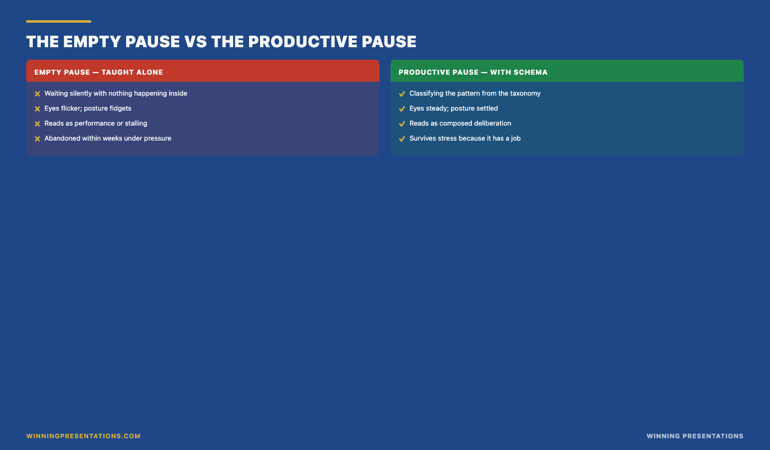
A genuine reset is physiologically and behaviourally different. It is short — five seconds, not fifteen. It is silent in its first two steps, and the verbal acknowledgement step is tight and purposeful, not a hedge. It moves you into the answer, rather than holding you in a holding pattern.

The test is simple. A stall delays the answer. A reset prepares the answer. If the audience cannot distinguish your pause from thoughtful engagement, you are executing a reset. If they are shifting in their seats, checking the chair’s face, or beginning to smell weakness, you have drifted into stalling. The cue is your body’s state: a reset ends with you calmer and more focused than when the question landed; a stall ends with you more agitated because the pressure has compounded while you searched for words.

Stalling also has a corrosive second-order effect: it trains you to associate pauses with panic. Over time, presenters who stall habitually develop an aversion to silence itself, which degrades their delivery long after the Q&A ends. A disciplined reset does the opposite — it teaches you that silence is an asset you can use deliberately, which is a pattern also central to the bridging technique in Q&A, where controlled pauses are part of the structural move, not a sign of struggle.

If you want a structured set of response frameworks to go with the reset reflex, the Executive Q&A Handling System provides templates for answering after the reset lands — including bridging structures, pre-mortem question libraries, and hostile-question response patterns.

How to Use the Reset Without Looking Frozen

The fear many executives have about pausing is that it will look like paralysis. This is a real risk — a poorly executed reset can look worse than a rushed answer. The difference comes down to three execution choices.

Keep the face neutral-engaged. During the reset, your face should show engagement, not blankness or a defensive hardening. Slight forward lean, a small nod of acknowledgement, eyes on the questioner or moving calmly between the questioner and the wider room. The goal is an expression that reads as “I am considering your question with the seriousness it deserves,” not one that reads as “I have stopped functioning.”

Keep the hands deliberate. Nervous hands — shuffling papers, tapping the lectern, touching the face — broadcast the internal stress response that the reset is meant to interrupt. The simplest solution is a physical anchor that occupies the hands purposefully: holding a pen, resting one hand on the lectern, or holding a clicker still. Deliberate stillness is far more composed than fidgeting, and it supports the anchor step of the reset.

Keep the eyes calm. Under threat response, eyes tend to dart or lock. Neither looks composed. Practice a soft, steady gaze: on the questioner during the breath step, drifting to a neutral point during the anchor step, returning to the questioner as the acknowledgement begins. This pattern is natural enough to read as engaged thinking and slow enough to mask the internal work of the reset.

Executives who find the reset feels mechanical in the first few attempts are experiencing exactly what should happen. Deliberate sequences always feel mechanical before they become automatic. The point is not to perform the reset visibly — the point is for the reset to become invisible through repetition, leaving only a composed executive who happens to take a thoughtful three to five seconds before answering hard questions.


Reset versus stalling comparison table showing behavioural markers of a composed micro-reset against the audience-visible signals of a panicked stall

Answer Tough Questions With Structure, Not Reflex

The Executive Q&A Handling System includes the full response library — reset drills, bridging frameworks, hostile-question playbooks, and pre-mortem templates — for board, investor, media, and regulator Q&A.

£39 — instant access.

Get the Executive Q&A Handling System →

A Drill to Build the Reflex Under Pressure

Knowing the reset intellectually is not the same as having it available when your heart rate is climbing in a live Q&A. The reflex is built through deliberate practice in conditions that approximate the stress of the real setting. Reading about the reset will not install it. The following drill will.

Step 1: Build a hostile question bank. Write down 20 questions that would genuinely rattle you if asked in your next board, investor, or media setting. These are not generic challenge questions — they are the specific ones you dread. Include questions about personal judgement, assumptions, credibility, decisions you made that did not land well, and anything a well-informed adversarial questioner would raise. This tough question response framework approach — building your own worst-case library — makes the practice meaningful rather than abstract.

Step 2: Practise the reset in isolation first. Record yourself on video. Have a colleague read one question at a time, with the hostile tone intact. Your only job on the first pass is to execute the reset — breath, anchor, acknowledge — without rushing into the answer. Watch the recording. Check facial composure, hand stillness, and eye behaviour. Repeat until the three steps take consistently between three and five seconds and look deliberately composed, not mechanical.

Step 3: Add physiological load. Do the drill after 30 press-ups, or after sprinting on the spot for 45 seconds. Elevated heart rate approximates the physiological state you will be in during live Q&A. If the reset holds under that load, it will hold in the boardroom. If it collapses, you have found the work you actually need to do.

Step 4: Combine reset with structured answer. Once the reset is stable, extend the drill to include a structured answer after the acknowledgement. Practise bridging from the reset into a clear, two- or three-sentence response. This is the full sequence: breath → anchor → acknowledge → answer. Run through the full sequence on all 20 questions. The goal is not perfect answers — the goal is consistent composure, so that your judgement is what shapes the answer rather than your alarm system.

Twenty minutes of this drill, three times a week, for six weeks, is enough to make the reset reflexive for most executives. It is a small investment for a skill that can determine how you are photographed, quoted, and remembered in your most consequential public moments.

When the Reset Fails — and How to Recover

Even well-practised executives occasionally meet a question that overrides the reset. It may be unusually personal, factually ambushing, or timed cruelly. When this happens — and it will — the priority shifts from composure to recovery.

The single most effective recovery move is explicit. A short, honest line — “That question landed harder than I expected. Let me think about it for a moment.” — is almost always received better than a fumbled answer delivered through visible stress. Audiences forgive a moment of honest composure-gathering far more readily than they forgive a defensive or incoherent response. The trick is to do it once, briefly, and then deliver a clear answer. Recovery is not a second reset — it is a reset made audible.

The second recovery move is to write down, immediately after the Q&A, exactly what triggered the override. Was it a specific word? A tone? A reference to a decision you still feel conflicted about? Each override you document becomes material for your next question bank. Over time, the set of questions that can blow through your reset shrinks toward zero — not because the questions become easier, but because you have pre-rehearsed the specific ones that exploit your remaining vulnerabilities.

This discipline — treat every override as data, not failure — is the quiet difference between executives who plateau after their first difficult Q&A and those who keep getting harder to rattle year after year. The reset is the tool. The drill installs it. The review after overrides sharpens it. Together, they turn emotional regulation in Q&A from a wish into a reliable reflex.

Frequently Asked Questions

What is the 5-second reset in Q&A?

The 5-second reset is a structured three-step sequence used between receiving a difficult question and beginning to answer. It consists of a controlled breath, a physical anchor, and a short verbal acknowledgement. The purpose is to interrupt the amygdala-driven stress response that narrows executive thinking under pressure, so that the answer is shaped by judgement rather than reaction. Done well, the reset fits inside the natural pause the audience expects between a question and a considered response.

Does pausing before answering make me look uncertain?

A three-to-five-second pause reads as considered engagement, not uncertainty — provided your face, hands, and eyes remain composed during the pause. Uncertainty is communicated by fidgeting, darting eyes, tightened expression, or verbal filler. Calm stillness during a short pause reads as executive-level thinking. The pause only becomes problematic when it extends past five or six seconds or when the body language during the pause broadcasts internal panic. A well-executed reset is, in fact, one of the clearest signals of composure an audience can receive.

How do I stop my face giving me away during hostile questions?

The facial response to hostile questions is driven by the same stress cascade that narrows your thinking — which means the reset addresses both at once. The breath step lowers the physiological activation that produces the micro-expression. The anchor step redirects attention away from the internal alarm system. Over time, the combined effect is a softer, more neutral facial response during the opening seconds. Video practice is essential here. Most executives significantly underestimate what their face is doing and only see it clearly when they review footage.

How long does it take to build the reset into a reflex?

With deliberate practice — 20 minutes, three times a week, using a hostile question bank and ideally some physiological load — most executives report the reset becoming reflexive within six to eight weeks. The first two weeks feel mechanical. Weeks three and four introduce stability. By week six, the sequence runs without conscious effort in moderate-pressure settings, and by week eight it typically holds in the live high-stakes settings it was designed for. The timeline can be shorter for executives who already have meditation or breathwork experience, and longer for those whose Q&A history includes a specific traumatic incident they are still processing.

Join The Winning Edge

Free weekly newsletter for executives who present under scrutiny. Q&A handling, composure techniques, and structural frameworks for board, investor, and media settings — delivered every Thursday.

Subscribe Free →

Read next: If the anxiety you feel in Q&A is compounded by a wider sense that you are being tested for a role you are not sure you deserve, see Imposter Syndrome and Promotion Anxiety: How Senior Executives Stay Composed Under Internal Scrutiny for the cognitive framework behind long-term composure.

Next step: If your next board, investor, or media Q&A is already on the calendar, build your 20-question hostile bank this week and begin the reset drill. Emotional regulation in Q&A is not a personality trait — it is a reflex, and it is trainable.

Mary Beth Hazeldine is the Owner & Managing Director of Winning Presentations. With 25 years of corporate banking experience at JPMorgan Chase, PwC, Royal Bank of Scotland, and Commerzbank, she advises executives across financial services, healthcare, technology, and government on structuring presentations and handling Q&A in high-stakes scenarios.