

The Bigger the Job, the Smaller You Feel on Stage: Why Senior Promotions Trigger Worse Presentation Anxiety
Quick answer: New role presentation anxiety is not a regression. It is a structural response to three things that change the moment a senior leader steps into a bigger role — the audience composition, the stakes of a misstep, and the identity the room expects you to inhabit. The three-shifts diagnostic names which of the three is loudest for your next presentation, gives the anxiety a shape, and gives the preparation somewhere to land. The fix is not “more confidence.” The fix is naming the shift, writing three sentences before any slide work, and accepting that the dread becomes structural calm rather than going away. The senior leaders who name the shift get calmer with each presentation. The senior leaders who treat the anxiety as personal weakness do not.
JUMP TO:
- Why promotions trigger worse presentation anxiety, not less
- Shift 1: the audience composition has changed
- Shift 2: the stakes of a misstep have changed
- Shift 3: the identity the room expects has changed
- The three sentences to write before any slide work
- What to do before your next presentation in the new role
- Frequently asked questions
In 2017 I sat in the corner office of a newly-appointed director at one of the banks where I had worked years earlier — a woman I had known when she was a vice-president running a single product desk. She had been promoted six weeks before to run a regional business unit with three hundred and twenty people in it, and her first major presentation in the new role was scheduled to start in two hours. The meeting was a strategy update to the regional executive committee: eight peer-level managing directors, the regional CEO, and two members of the group risk function dialled in from elsewhere in Europe. She was sitting at her desk. The print-out of her deck was face-down on the right of her keyboard. There was a mug of tea on the left, made by her assistant at 12:10pm, untouched at 12:50pm and visibly cold. She was looking at her hands — not because they were shaking, but because she did not seem to want to look at anything else in the room. She had presented to credit committees, to regulators, to clients with multi-billion mandates, and to internal town halls of two hundred people for nine years before the promotion. She told me, when I sat down opposite her, that she could not remember the last time she had felt like this before a meeting. She said it in the past tense, as if it were already happening to someone else. The presentation went fine. The presentation she gave four months later, on the same agenda cycle, was unrecognisable from the first.
(This article was created with AI assistance; all stories and insights are based on 35 years of real client work.)
I have watched the same pattern across newly-appointed directors, recently-elevated managing directors, freshly-promoted partners in professional services, and first-time executive committee members in publicly-listed industrials. Different sectors, different organisations, different personalities, different prior experience levels. The same response to the same set of structural changes. None of them were less able than the person they had been the month before the promotion. None of them had lost the underlying skills that had got them the bigger job. What had changed was the architecture of the room they were now walking into — and because the architecture had changed, the anxiety they had managed for years in the old role was suddenly the wrong size, in the wrong shape, pointed in the wrong direction. This article walks through the three structural shifts that cause new role presentation anxiety, the diagnostic that lets you name which shift is loudest for your next meeting, and the concrete preparation move to make before you build any slides.
Before your next presentation in the new role, a one-page preparation check is worth a look.
The Executive Presentation Checklist walks through the structural moves a senior presenter makes before high-stakes meetings — the opening sixty seconds, the audience read, the room-settling first move. Free download, no email gate, no upsell.
Why promotions trigger worse presentation anxiety, not less
The instinct, when an experienced senior professional notices unexpected anxiety before a presentation in a new role, is to treat the anxiety as a personal failure. “I should be past this by now.” “I have presented for years; this should be easier, not harder.” “The promotion was supposed to mean I had arrived; why am I shaking before a meeting I would have walked into without thinking last quarter?” The instinct is wrong and the framing is the source of most of the damage. New role presentation anxiety is not a failure of personal resilience and it is not a regression of skill. It is a structural response to a room that has changed shape underneath you. The body picks up the change before the conscious mind does. The conscious mind, when it cannot find a name for what the body is responding to, defaults to “something is wrong with me.” Everything that follows from that interpretation makes the anxiety worse, not better.
I spent five years terrified of presenting in my own corporate banking career, long before I ever ran a coaching practice. I know the texture of the dread from the inside. I also know — from the same direct experience and from the years of watching other senior operators walk through their own version of this — that the dread is not what does the damage. The damage comes from the interpretation. The senior professional who frames new role anxiety as personal weakness spends the two hours before the meeting performing reassurance for themselves; the senior professional who frames it as a structural signal spends the same two hours doing the work that gives the anxiety somewhere to go. The two hours produce different meetings. The body responds to the new role’s architecture either way. What changes is whether the response gets converted into preparation or absorbed into self-doubt.
The three-shifts diagnostic is the framework I have built from watching this pattern repeat. It names the three structural changes that come with a senior promotion, gives the anxiety a shape, and gives the preparation work something concrete to land on. The three shifts are not psychological reframes. They are descriptions of how the room you now present in is genuinely different from the room you presented in before the promotion. Naming the difference is what converts dread into structured calm. Refusing to name it is what leaves the dread free to run the meeting.
Shift 1: the audience composition has changed
The first shift is the one most newly-promoted senior leaders feel without being able to articulate. In the previous role, the audiences were structurally familiar: superiors above you, reports below you, and a small number of peers at the same level. The room had a clear gradient. You presented up to people who outranked you and down to people who reported to you, and you knew which mode you were in. The new role flattens the gradient. The audience now includes peers — managing directors, partners, regional heads, executive committee members — who sit at your level, who are checking you against their own internal benchmarks for what someone in your seat should sound like, and who can challenge you laterally rather than from above or below.
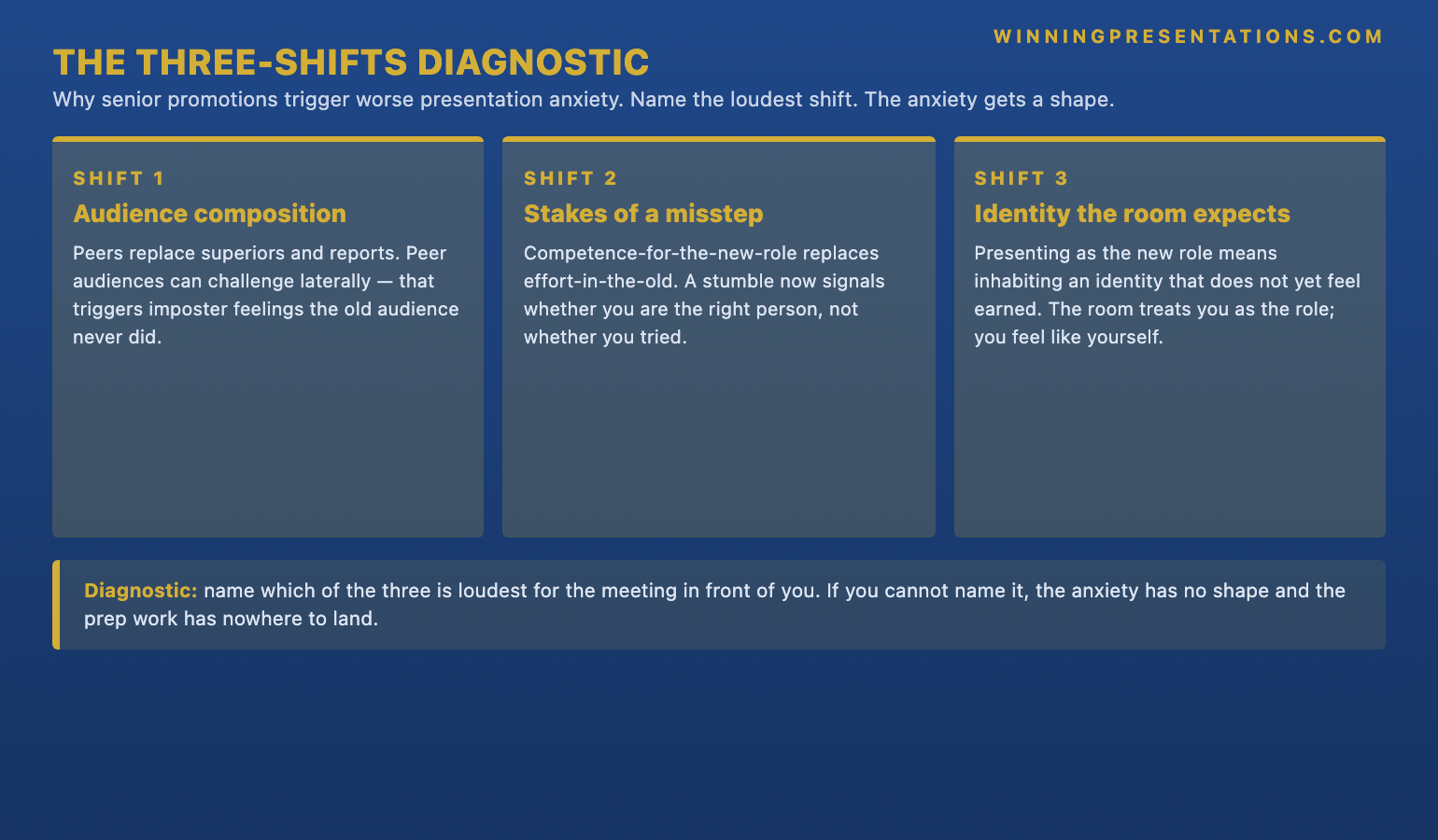
Peer audiences trigger imposter feelings in a way that vertical audiences do not. When you presented up, the worst-case interpretation was that you fell short of what a more senior person would have done — an expected pattern, easy to recover from. When you presented down, the worst-case interpretation was that your reports learned something they were going to learn anyway. The new audience is a peer group of people who do not have a structural reason to give you the benefit of the doubt. They are checking, quietly and in real time, whether the firm has put the right person in the seat. They are not hostile. They are not even necessarily competitive. They are simply running their own checks — the things senior operators look for when a new peer joins the room — and the checks happen whether or not you have noticed them. The body picks up the lateral scrutiny instantly. The conscious mind takes longer to recognise that the audience composition has changed at all.
The newly-appointed director in the 2017 story I opened with told me, three months later when she had reflected on the first presentation, that the moment the dread had crystallised was when she walked into the room and registered who was already seated. Three of the eight peer managing directors had been at her level for between five and twelve years. One of them had been a competitor for the role she had just been promoted into. She had known all of this beforehand — the headcount, the seniority, the internal politics of the unit — in an abstract way. She had not registered, until her body did, that the architecture of the audience had inverted. She was no longer the most senior product specialist in a room of less senior people. She was the newest entrant in a room of established peers. The presentation content was the same content she would have given in the old role. The audience composition was not. That is the first shift, and naming it is what lets the preparation work address it.
Shift 2: the stakes of a misstep have changed
The second shift is the one most newly-promoted senior leaders intellectualise correctly and feel wrongly. In the old role, a misstep in a presentation signalled effort — “she did not prepare enough for this one,” “he was caught off guard by that question,” “the deck was rushed.” The interpretation was about that specific meeting and that specific preparation cycle. The interpretation did not extend to the question of whether you were the right person for the job, because the job you had was already settled. In the new role, the same misstep signals something different. It signals competence-for-the-new-role. The internal narrative the room writes after a wobble in your first major presentation is no longer “she was under-prepared for this one.” It is “is she the right person for this seat at all?” The misstep no longer belongs to the meeting. It belongs to the appointment.
The body knows this before the conscious mind frames it. The conscious mind, when asked, will often deny that the stakes have changed — “of course one meeting does not decide anything” — and the senior professional walks into the room reassuring themselves that the standard logic applies. The body, meanwhile, is operating from the accurate read: a misstep here is read as a referendum on the appointment for at least the first three to six months of the new role. Both reads are correct in different ways. The standard logic applies in the long run. The referendum reading applies in the short run. The body is responding to the short run, which is the run the meeting actually happens in. Naming the shift — saying out loud, in the preparation work, “this meeting is not just a meeting; in the first six months it is also a signal about whether I belong in this seat” — is what stops the body from carrying the recognition alone.
The work, once the shift is named, is not to lower the stakes through reassurance. The stakes are what they are. The work is to direct the preparation specifically at the signal-content of the meeting rather than only at the agenda content. Senior leaders who do this well prepare the meeting in two layers: the surface layer (what is on the agenda, what the slides contain, what the decisions are) and the signal layer (what the conduct of the meeting will say to the room about whether they belong in the seat). The signal layer is rarely on the agenda. It shows up in the opening sentence, in the way questions are handled, in the way disagreement is metabolised, in the way the meeting is closed. Senior leaders who only prepare the surface layer leave the signal layer to chance, and the body, knowing that, refuses to settle.
Shift 3: the identity the room expects has changed
The third shift is the deepest and the one most senior leaders find hardest to name. The promotion came with a new role — “regional managing director,” “head of unit,” “executive partner,” “chief commercial officer.” The new role carries an identity that the room expects you to inhabit on the first day. The identity is not the same as the title. The title is given in an email. The identity is what the room watches for in your first meeting, your first all-hands, your first board presentation. The identity is the way someone in this seat is expected to walk in, open the room, hold the agenda, handle the difficult question, and close. The newly-promoted senior leader, on day one of the new role, has the title but does not yet have the lived experience of inhabiting the identity. Presenting “as the new role” therefore means inhabiting an identity that does not yet feel earned. The body’s response to that gap is the third source of new role presentation anxiety, and it is the one the standard nerves-management techniques least address.
I worked in 2014 with a newly-promoted partner in a professional services firm — promoted from senior director to partner in the same financial year that the firm had restructured the partnership review process. Her first major presentation in the new role was a client pitch where she was now the lead partner rather than the senior director supporting a lead partner. She had run the analysis for the pitch. She had built the deck. She had presented sections of it under a previous lead partner three times in the prior eighteen months. The content was familiar. What was not familiar was the seat. The lead partner seat is structurally different from the senior director seat — the lead partner opens the meeting in a way the senior director never does, holds the silences differently, makes the commitments the firm will be on the hook for, and closes the meeting with a decision sentence that did not previously belong to her to say. She took a structured approach. She named the identity shift explicitly in her preparation notes. She wrote out the three sentences (audience, conduct, opening move) for the meeting before she touched the deck. She practised the opening sixty seconds aloud, on her feet, three times. The first pitch went well enough. The second pitch — six weeks later, same structural seat, same kind of audience — was unrecognisable from the first. She told me afterwards that the second one was the meeting where the seat had stopped feeling like a costume.
For the broader pattern of “I am in a senior seat and I feel like I have not earned it” — which is the identity shift’s emotional signature when it goes unnamed — see also the work on imposter syndrome in presentations. The identity shift and imposter syndrome overlap but they are not identical: the identity shift is a structural response to a role change, time-bounded, and resolves with repetitions; imposter syndrome is the longer-running pattern of self-doubt that can sit in a senior professional for years independent of any specific promotion.
Convert promotion dread into structured calm.
I spent five years terrified of presenting before I built the system I now teach. Conquer Your Fear of Public Speaking is the self-paced programme for senior professionals walking into board presentations, executive committee updates, and first-major-meetings-in-a-new-role with racing heart, shaking hands, and a tremor in the voice — despite being good at the work. The programme teaches the pre-presentation mental rehearsal that gives the anxiety somewhere to go, the in-room reset techniques that settle the body in the first sixty seconds, and the structured calm that holds when the room’s architecture has changed underneath you. Lifetime access, instant download. £39.
- The pre-presentation mental rehearsal — the structured walk-through senior operators use in the two hours before a meeting
- In-room reset techniques that work in the first sixty seconds without anyone noticing
- Nerves-management for the specific shape of new role anxiety — peer audiences, stakes inflation, identity gap
- Post-presentation reset structure so one wobble does not contaminate the next three months in the seat
- Lifetime access, instant download — £39
The three sentences to write before any slide work
The three-shifts diagnostic produces a single practical move: before you build any slides for your next presentation in the new role, write three sentences in full, on paper or in a document, in your own words. The three sentences are not bullet points and not phrases. They are full sentences, written deliberately, reread until they sit cleanly on the page. They are the structural floor under everything that follows in the preparation cycle — the slides, the rehearsal, the opening minutes. Without them, the slides become a defence against the anxiety rather than a vehicle for the meeting. With them, the slides become the supporting evidence for a conversation you already know the shape of.
The first sentence names the audience and the loudest shift. “The audience is the regional executive committee — eight peers, the regional CEO, and two group risk dial-ins. The loudest shift for me with this audience is the audience shift, because three of the eight peers have been at this level for more than five years and one of them was a candidate for the role I now hold.” That kind of specificity is what gives the preparation a target. A sentence that says “the audience is senior people and I am a bit nervous” gives the preparation nothing to grip. A sentence that names the audience and identifies which of the three shifts is loudest tells you which kind of preparation matters most.
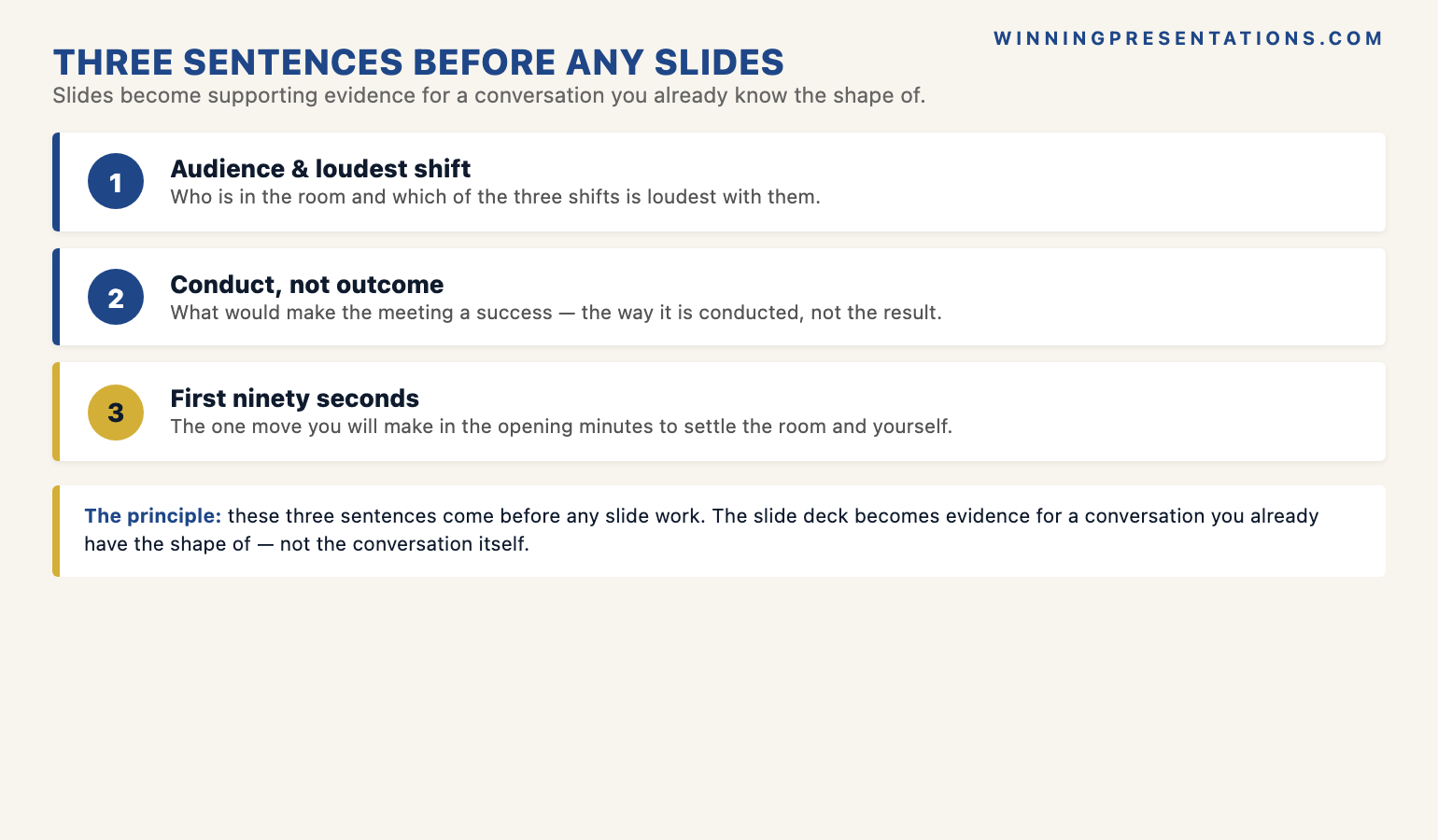
The second sentence names what would make the meeting a success — but not the outcome, the conduct. The temptation is to write “the meeting will be a success if the committee approves the proposal” or “the pitch will be a success if the client signs.” Outcome sentences are useful for accountability and useless for anxiety. They concentrate all the meaning of the meeting in a single binary that is partly outside your control, which is exactly the condition the body responds to with dread. The conduct sentence is different. “The meeting will be a success if I open with the decision I am asking the committee for, hold the room through the two hostile questions I expect from the head of risk, and close with a clear sentence about what happens next regardless of what is decided in the room.” Conduct sentences are fully inside your control. They give the body a target it can actually reach and the dread something it can resolve into.
The third sentence names the one move you will make in the first ninety seconds to settle the room and yourself. It is one move, not three or four. The room settles when the senior leader settles, and the senior leader settles when there is a single, prepared, deliberate first move — not a sequence of moves to remember. “I will open with the decision I am asking the committee for, stated in one sentence, before I show the first slide.” Or: “I will pause for two seconds after walking to the front, look at the regional CEO directly, and open with the single sentence I have rehearsed three times this morning.” The specific move matters less than the fact that it is named, rehearsed, and singular. The first ninety seconds carries disproportionate weight; a settled opening buys you the next thirty minutes regardless of what the agenda contains. For more on what the in-room version of “settle the room and yourself” looks like when the meeting goes live, the partner article on calm presenting techniques walks through the live-room recovery moves the three sentences cannot fully prevent.
What to do before your next presentation in the new role
Before your next major presentation in the new role, block thirty minutes in your calendar at least forty-eight hours before the meeting. Do not put it next to the meeting; put it at a distance, when the body is not yet in the heightened state. Treat the block the way you would a one-to-one with a board chair. No calls, no email, no quick conversations. Open a blank document or a fresh page in a notebook. Read the three-shifts diagnostic to yourself: audience shift, stakes shift, identity shift. Write down which of the three is loudest for the meeting in front of you. If you cannot decide, write down why — the inability to name the loudest shift is itself useful diagnostic information. Then write the three sentences, in full, in your own words: audience and loudest shift, conduct of a successful meeting, first ninety seconds.
Reread the three sentences once at the end of the thirty minutes. Leave them. Come back to them twelve to twenty-four hours later. Edit the sentences so they sound like the person you want to be in the room rather than the person the dread wants to make you. Do not skip the gap; the gap is what lets the second draft be honest about what the first draft was avoiding. Only after the three sentences are written and edited should you begin building the slides, the supporting analysis, the rehearsal of the agenda. The slides built on a foundation of three honest sentences are different slides from the ones built straight onto the anxiety. The rehearsal that follows a named-shift diagnostic is different rehearsal from the undirected pacing that fills the body with adrenalin three days out and leaves nothing for the meeting itself. Do not rehearse the slides one more time when you could write the three sentences instead. The slides are the conversation’s evidence, not its structure.
The senior leader who names the shift gets calmer with each presentation in the new role. The senior leader who treats the anxiety as personal weakness does not. The dread itself, for what it is worth, does not go away — not in the new role, not in the role after that, not in the seat the bigger job leads to in five years. The dread is the standing condition of caring about the meeting enough to take it seriously. What changes is whether the dread gets converted into the three sentences and then into a meeting, or whether it gets absorbed into self-doubt and then into a meeting the room remembers for the wrong reasons. The newly-appointed director in the 2017 story still presents in that seat, three years on; she told me last year that the dread before the quarterly executive committee meeting is the same dread it was the first time. The difference is that she now writes the three sentences in fifteen minutes, the meeting itself is the meeting, and the dread has somewhere to go.
Built from 24 years in corporate banking, five years terrified of presenting, and 16 years coaching senior professionals through promotion-level meetings.
Conquer Your Fear of Public Speaking is the system Mary Beth built from walking into credit committees, client meetings, and executive presentations with racing heart, shaking hands, and a trembling voice — despite being good at the work. The programme is structured around the pre-presentation mental rehearsal senior operators actually use, the in-room reset techniques that work in the first sixty seconds, and the post-meeting calm that stops one hard presentation from contaminating the next quarter in the seat. Self-paced. Lifetime access. £39, instant download.
Frequently asked questions
I have presented at senior levels for years. Why would a promotion make me more anxious, not less?
Because the architecture of the room has changed underneath you, even though the skill of presenting has not. In the previous role you were presenting from a settled position to audiences with a clear vertical gradient. In the new role you are presenting from an unsettled position to audiences that include peers running lateral checks on whether you belong in the seat. The body picks up the structural change before the conscious mind names it. Years of presenting experience do not insulate you from a new room shape; they only insulate you from the experience of finding presenting itself unfamiliar. The work is to name the shift, not to deny the body’s accurate read of it.
Which of the three shifts is the most common trigger for newly-promoted senior leaders?
The identity shift, in my observation, is the most common and the most underestimated. The audience shift is recognised quickly — senior leaders notice peer audiences within the first few meetings. The stakes shift is recognised intellectually even when it is not felt accurately. The identity shift is the one that runs quietly under both, because it is the hardest to name without sounding self-indulgent. “I do not yet feel like the person this seat expects me to be” reads as soft when said out loud, which is why most senior leaders do not say it. The dread, meanwhile, runs harder the longer the identity shift goes unnamed. Naming it in writing, privately, in the preparation work, is the most reliable single move I know.
Aren’t the standard box-breathing and power-pose techniques enough for promotion anxiety?
The standard techniques settle the body, which is useful work. They do not address the structural source of new role presentation anxiety, which is the room’s changed architecture rather than the body’s elevated state. Box-breathing in the lift on the way up to the meeting will steady the breath. It will not name the audience shift, identify the stakes shift, or close the identity gap. Senior leaders who rely only on the body-level techniques typically describe the same pattern: the techniques help in the moment but the dread returns at the same intensity before the next meeting in the new role. The three-shifts diagnostic addresses the source. The body-level techniques are still useful for the live-room moments; they are the safety net, not the primary preparation.
How long does it take for the anxiety to stabilise after a promotion?
For most senior leaders I have watched, the elevated anxiety stabilises somewhere between the third and the sixth major presentation in the new role — typically four to six months, depending on the meeting cadence. The reduction is not because the role becomes easier; it is because repetitions close the identity gap. The first presentation is from a costume; the fifth is from a seat. The three-shifts diagnostic compresses the timeline by giving the dread a shape from the first presentation rather than waiting for repetitions to do the same work organically. Leaders who use the diagnostic from the start typically report stabilisation closer to the third presentation rather than the sixth. The dread itself does not disappear at any point; it becomes the standing condition that keeps attention sharp, rather than the state that controls the voice.
Is new role presentation anxiety something I should disclose to my new boss, or hide?
Neither, in most cases. Disclose if the anxiety is affecting the work in ways your boss will eventually see anyway — a presentation that has slipped, a meeting you have moved twice, visible physical symptoms in front of the team. Disclose in a structural frame, not a confessional one: “I am in the predictable adjustment window of a senior promotion and I am doing the preparation work I need to do; here is what I am working on this month.” That frame reads as a senior operator managing a known pattern, not as a request for reassurance. Do not disclose pre-emptively before the work has been affected; that frame reads as needing managing rather than self-managing, which is the wrong signal in the first six months of a senior seat.
The Winning Edge — weekly newsletter
The Winning Edge is a weekly (Thursday) newsletter for senior professionals walking into high-stakes meetings — board updates, executive committee presentations, first-major-meetings-in-a-new-role — and looking for the structural moves that hold the room. One short email a week, focused on the preparation rituals senior operators actually use. Subscribe to The Winning Edge →
For the broader picture across slides, storytelling, confidence, and delivery as the new role demands more than one skill at once, the Complete Presenter bundle is the seven-product library most senior professionals find useful as a single set — £99 for everything, lifetime access.
About the author
Mary Beth Hazeldine is Owner & Managing Director of Winning Presentations Ltd. With 24 years of corporate banking experience at JPMorgan Chase, PwC, Royal Bank of Scotland, and Commerzbank, she advises executives across financial services, healthcare, technology, and government on structuring high-stakes presentations and managing the anxiety that comes with senior promotions.