Tag: executive Q&A

19 Mar 2026
Executive answering a question confidently in a boardroom with a data dashboard visible on screen behind them showing charts and metrics that support their verbal response, navy and gold corporate aesthetic

Evidence-First Answers: The Q&A Structure That Builds Trust in Every Room

Quick Answer: An evidence-first answer structure flips the default response pattern. Instead of stating your opinion and then defending it, you lead with proof — a data point, a precedent, a concrete example — and let the evidence carry your conclusion. This structure builds trust because your audience reaches your conclusion alongside you, rather than being asked to trust your judgment before seeing the reasoning.

Your Q&A Is Losing Credibility If: You’re answering senior questions with “I think…” or “In my experience…” before providing evidence. Executive audiences trust data more than opinions. If your answers start with conclusions, you’re asking the room to take your word for it — and in high-stakes meetings, that’s a credibility risk. The fix: reverse your answer structure so evidence arrives first and your point lands as the inevitable conclusion.

See the evidence-first answer framework →

Stopped on Slide 4

The CEO stopped a presenter on slide 4. The Director of Operations had been walking through a project status update — clean slides, clear data, well-rehearsed delivery. But then the CEO asked: “What’s the risk to the Q2 timeline if this vendor delays by two weeks?”

The Director answered immediately: “I think we’ll be fine. We’ve built in buffer.”

The CEO leaned forward. “You think we’ll be fine. What does the data say?”

Silence. The Director didn’t have the data ready. She had the answer — and it was correct — but she’d led with her opinion instead of her evidence. In that room, with that audience, opinion without proof wasn’t an answer. It was a guess.

The following week, she restructured her approach. Same question, different format: “The vendor’s current delivery rate is 94% on-time over the last six quarters. Our buffer is 11 working days. Even a two-week delay leaves us three days inside the Q2 deadline.” The CEO nodded and moved on. Same conclusion. Different structure. Completely different credibility.

That’s the evidence-first answer structure in action — and it changes how every question you receive builds or erodes trust.

Why Opinion-First Answers Lose the Room

Most professionals answer questions the way they think: conclusion first, reasoning second. “I think we should delay the launch” (conclusion) “because the testing hasn’t been completed” (evidence). This feels natural. It’s how conversations work. But in executive Q&A, it creates a credibility problem.

When you lead with your opinion, you’re asking the audience to extend trust before they have evidence. The listener’s internal response is: “Based on what?” Even if they don’t say it aloud, they’re evaluating your conclusion against an evidence gap. And in that gap, doubt lives.

Executive audiences are particularly sensitive to this because their job is to make decisions based on data, not on the confidence of the person speaking. A VP who says “I believe we’ll hit target” gets a different reception than a VP who says “Current run rate is £2.1 million against a £2.4 million target, and our pipeline coverage ratio is 1.8x — which historically converts at our target.” Same underlying confidence. Radically different credibility.

The opinion-first pattern also creates a defensive dynamic. Once you’ve stated a conclusion, every follow-up question feels like a challenge. “Why do you think that?” “What makes you confident?” “Have you considered the alternative?” You end up defending a position instead of building a case. The evidence-first structure eliminates this because the audience hears the evidence before the conclusion — so the conclusion feels earned, not asserted.

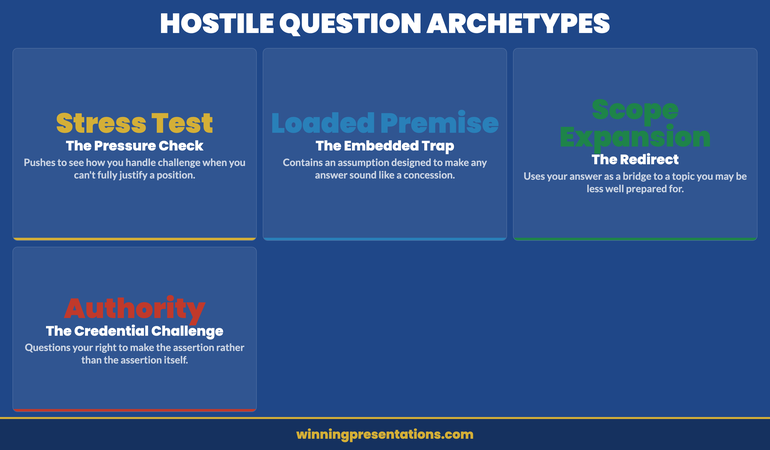
If you’ve ever had a question go hostile mid-answer, the strategy for handling hostile questions becomes much simpler when you’re leading with evidence. There’s nothing to attack when the proof arrives before the opinion.

ide-by-side comparison infographic showing opinion-first answer structure versus evidence-first answer structure with audience trust response at each stage including opening audience response and follow-up dynamic

The Evidence-First Framework (Proof → Point → Implication)

The framework has three components, delivered in this exact sequence:

Proof (5–15 seconds): One concrete piece of evidence that directly addresses the question. Not three pieces. Not a data dump. One. The strongest, most relevant data point you have. “Our retention rate for Q1 was 94%, up from 87% in the same period last year.”

Point (5–10 seconds): The conclusion that follows logically from your evidence. “That tells us the onboarding changes we made in November are working.” This should feel inevitable. If you’ve chosen the right evidence, the point writes itself.

Implication (5–10 seconds): What this means for the decision the room is trying to make. “So I’d recommend we continue with the current approach for Q2 rather than introducing new variables.” This connects your evidence-based answer to the room’s actual agenda.

Total answer length: 15–35 seconds. That’s it. Executive Q&A rewards precision, not volume. Most people answer questions for 60–90 seconds because they’re padding opinion with filler. The evidence-first structure removes the padding because the evidence does the heavy lifting.

Here’s the structure applied to a common executive question — “Are we going to hit our revenue target this quarter?”

Opinion-first (what most people do): “Yes, I’m confident we’ll hit target. Our team has been performing well and we have strong pipeline. The deals in progress look solid and I think we’ll close them.”

Evidence-first (what builds trust): “Current booked revenue is £1.7 million against a £2.4 million target. Pipeline weighted at 60% probability adds another £900,000 — giving us £2.6 million in projected revenue. Based on that, we’re tracking to exceed target by approximately 8%.”

Same answer. Same confidence. But the second version never asks the audience to trust the speaker’s instinct. The numbers speak first. The conclusion follows. Trust is built through the structure of the answer, not the authority of the person giving it.

The Complete Evidence-First Answer System for Executive Q&A

The Executive Q&A Handling System gives you the Proof → Point → Implication framework with scenario-specific templates for every common executive question type — from budget challenges to timeline risks to stakeholder objections.

  • The evidence-first answer framework with worked examples across 12 executive scenarios
  • Question prediction maps: anticipate what they’ll ask before the meeting starts
  • The “evidence library” builder — how to prepare your proof points before you walk in
  • Recovery scripts for when you don’t have the evidence (how to buy time without losing credibility)

Get the Executive Q&A Handling System → £39

Built from 25 years of fielding executive questions at JPMorgan Chase, PwC, and Royal Bank of Scotland — where “I think” wasn’t an acceptable answer.

Five Question Types and How Evidence-First Handles Each

Not every question requires the same kind of evidence. The Proof → Point → Implication structure stays constant, but the type of proof changes depending on what the question is actually asking.

1. The data question. “Where are we on budget?” This is the simplest evidence-first answer. Your proof is a number. “We’ve spent £340,000 of the £500,000 budget, with 60% of deliverables completed. That puts us slightly ahead of pace.” Lead with the figure. Let it do the talking.

2. The opinion question. “Do you think this strategy will work?” This is where most people slip into opinion-first mode. Instead: “Comparable strategies in our sector have shown a 30% improvement in conversion rates over 12 months. Our current baseline is lower than theirs was, which suggests even higher upside. So yes — the evidence supports this working.” Your opinion is the same, but it arrives after the evidence.

3. The challenge question. “Why didn’t you deliver on time?” This feels like an attack, which triggers a defensive response. Evidence-first defuses it: “The vendor delivered their component nine days late, which compressed our testing window from 15 days to six. We prioritised the three critical test scenarios and completed them within the reduced window. The two lower-priority scenarios will complete by Friday.” Facts first. Accountability included. No defensiveness.

4. The hypothetical question. “What happens if we lose the contract?” Hypotheticals are designed to test your thinking. Use precedent as evidence: “When we lost the Meridian contract in 2024, revenue impact was £1.2 million over two quarters. We recovered by redirecting the team to three smaller accounts within 60 days. A similar approach here would cover approximately 80% of the gap.” Precedent makes hypotheticals concrete.

5. The political question. “Does the other department agree with your approach?” These are loaded. Evidence-first protects you: “I shared the proposal with their leadership team on Tuesday. Their written feedback confirmed alignment on scope and timeline, with one open question on resource allocation that we’re resolving this week.” Written evidence, specific dates, named actions. No room for interpretation.

Handle every question type with confidence?

Get the Q&A Handling System → £39

When to Break the Rule (And Lead With Your Point)

Evidence-first is the default. But there are moments when leading with your conclusion is the right call.

When the room is impatient. If the CEO has asked a direct question and the room is tight on time, lead with a one-sentence answer, then support it: “Yes, we’ll hit target. Current pipeline coverage is 1.8x with 60% probability weighting.” The conclusion comes first because that’s what the room is waiting for. But the evidence still follows immediately — you’re not asking for trust without proof, you’re just resequencing for speed.

When the answer is binary. “Are we on track?” “Will this be ready by Friday?” “Do you have budget approval?” These questions want a yes or no. Deliver it, then support: “Yes. The approval came through on Tuesday with full budget confirmed.” Evidence arrives as confirmation, not as buildup.

When you’re the recognised expert. If the room already trusts your expertise on this specific topic, leading with evidence can feel like over-explaining. The CFO asking the Head of Tax a question about tax implications doesn’t need evidence-first — they need a direct answer from a trusted expert. Save evidence-first for when you’re building credibility, not when you’ve already got it.

The judgement call: if the person asking trusts you and wants a fast answer, lead with the point. If the person asking is evaluating you, lead with evidence. When in doubt, lead with evidence. It costs you three extra seconds and builds trust every time.

People Also Ask: What if I don’t have evidence for the question being asked?

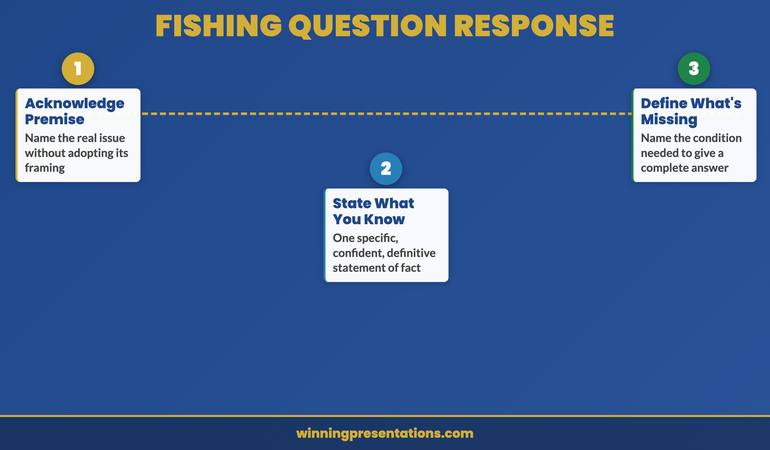
Say so directly and offer what you do have. “I don’t have the specific conversion data for that segment. What I can tell you is the overall conversion rate is 12%, and I’ll have the segment breakdown by end of day tomorrow.” This is infinitely more credible than guessing. Executives respect honesty about gaps far more than fabricated confidence.

People Also Ask: How do I prepare evidence for unexpected questions?

You don’t prepare for every possible question — you build an evidence library around the five to seven themes your audience cares about. For a budget review, that’s spend-to-date, forecast accuracy, variance explanation, and resource utilisation. Having these numbers ready covers most questions that could arise. Question prediction maps help you identify which themes to prepare for.

People Also Ask: Does evidence-first work in informal conversations?

It works everywhere, but calibrate the formality. In a corridor conversation, you wouldn’t say “the data shows…” But you’d still lead with the concrete fact: “We just got the numbers back — retention is at 94%.” The structure translates naturally into conversational language. The principle — proof before opinion — applies regardless of setting.

Never Get Caught Without an Evidence-Based Answer Again

The Executive Q&A Handling System includes the evidence library builder and question prediction maps so you walk into every meeting with your proof points ready.

  • Evidence library template for seven common executive meeting themes

Get the Executive Q&A Handling System → £39

Designed for executives who present to boards, leadership teams, and stakeholders where every answer either builds or erodes credibility.

Building Your Evidence Library Before the Meeting

The evidence-first structure only works if you have evidence ready. Walking into a meeting planning to “wing it” with data is the same as planning to fail. The preparation isn’t about memorising numbers — it’s about building a reference set of proof points around the themes your audience cares about.

Here’s how to build an evidence library in 15 minutes before any meeting:

Step 1: Identify the five themes. What are the five topics this audience will ask about? For a board meeting: financial performance, risk, timeline, resources, competitive position. For a project review: budget, deliverables, blockers, team, next milestones. Write them down.

Step 2: Find one number for each theme. Not five numbers. One. The single most relevant data point for each theme. “Budget: spent £340K of £500K.” “Timeline: 3 days ahead of schedule.” “Risk: 2 open items, both mitigated.” One data point per theme is enough to anchor an evidence-first answer. More than one and you’re preparing a presentation, not a Q&A.

Step 3: Prepare your “I don’t know” answer. For any theme where you don’t have current data, prepare the redirect: “I don’t have that figure with me. I’ll send it to you by [specific time].” This is a complete answer. It’s credible. It’s professional. It prevents you from guessing — which is the single fastest way to lose credibility in executive Q&A.

Step 4: Check for landmines. Is there a number that looks bad without context? Prepare the context in advance. “Attrition is up to 14% — driven entirely by the planned restructuring. Voluntary attrition is actually down to 3%.” If you know a number will trigger a follow-up, pre-build the evidence-first answer that explains it before it becomes a challenge.

This 15-minute preparation makes the difference between walking into Q&A with a safety net and walking in hoping for the best. The executives who seem naturally confident in Q&A aren’t naturally anything — they’ve done this preparation so many times it’s become invisible.

If you’ve ever struggled with the anticipation before a meeting turning into something more debilitating, the shame spiral after a bad Q&A session can be interrupted before it becomes a pattern. Preparation is the first defence.

And for situations where your presentation format itself affects how Q&A unfolds, consider whether presenting without slides might actually give you more control over the conversation. Without a deck, the Q&A becomes a dialogue rather than an interrogation.

Four-step evidence library preparation framework infographic showing how to identify themes find anchor data points prepare redirects and check for landmines before executive meetings

Putting It Together: Your Next Q&A

The evidence-first answer structure isn’t complicated. It’s three components delivered in sequence: proof, point, implication. The entire answer takes 15–35 seconds. It works for data questions, opinion questions, challenges, hypotheticals, and political questions. And it builds trust every single time because you never ask the room to take your word for it.

The preparation takes 15 minutes: five themes, one number each, one “I don’t know” script. Do it before every meeting with a senior audience. Within a few weeks, it becomes automatic — and the way your audience responds to your answers will change measurably.

The Executive Q&A Handling System gives you the full framework: the evidence-first structure, question prediction maps, the evidence library builder, and recovery scripts for when you’re caught without data. (See the Money Blocks above for details.)

For questions you can anticipate, the approach is even more powerful. Addressing objections before they’re asked lets you embed your evidence directly into the presentation — so the Q&A becomes a confirmation of what you’ve already demonstrated rather than a test of what you know.

Your next Q&A is this week — walk in prepared?

Get the Q&A Handling System → £39

Is This Right For You?

✓ This is for you if:

  • You present to senior audiences and your answers sometimes land as opinion rather than evidence
  • You’ve been caught without data during Q&A and felt your credibility slip in real time
  • You want a repeatable structure that works for every question type, not just the ones you’ve rehearsed
  • You’re preparing for a high-stakes meeting this week and need to walk in with your evidence ready

✗ Not for you if:

  • Your Q&A sessions are casual team conversations where formality would feel out of place
  • You’re already the recognised expert in the room and your audience trusts your judgment implicitly
  • Your primary challenge is delivery nerves rather than answer structure — this framework helps, but nervous-system work comes first

Walk Into Every Q&A With Your Evidence Ready

The Executive Q&A Handling System gives you the complete evidence-first framework: the answer structure, the preparation method, the question prediction tools, and the recovery scripts that protect your credibility even when you don’t have the data.

  • Proof → Point → Implication framework with 12 scenario-specific worked examples
  • 15-minute evidence library builder (the five-theme method)
  • Question prediction maps for boards, leadership meetings, and stakeholder reviews
  • Recovery scripts: how to handle “I don’t know” without losing the room
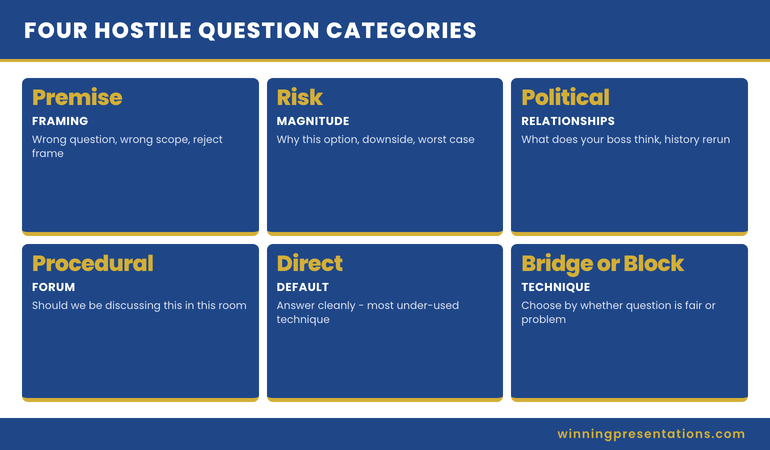
  • The hostile question protocol: evidence-first structure for adversarial situations

Get the Executive Q&A Handling System → £39

Built from 25 years of answering executive questions in banking, consulting, and corporate boardrooms — where evidence was the only currency that mattered.

Frequently Asked Questions

Won’t leading with evidence make my answers sound robotic?

Only if you deliver it like a data readout. The evidence is the backbone, not the personality. A natural evidence-first answer sounds like: “Interesting question — the retention data from Q1 actually tells us something useful here. We’re at 94%, up from 87% last year, which means the onboarding changes are working. I’d recommend we stay the course.” That’s evidence-first and conversational. Structure doesn’t eliminate personality — it gives personality something solid to stand on.

What if the evidence contradicts the answer I want to give?

Then the evidence is doing its job. If the data doesn’t support your preferred conclusion, say so: “The data doesn’t support the timeline we originally proposed. Current velocity suggests we’ll miss by two weeks. I’d recommend we adjust the deadline now rather than compress quality at the end.” This is exponentially more credible than bending data to fit a predetermined conclusion. Executives respect intellectual honesty above almost everything else.

How do I use evidence-first when the question is about feelings or team morale?

Use qualitative evidence instead of quantitative. “In the last three one-to-ones, two team members raised concerns about workload sustainability. The anonymous pulse survey showed a 15-point drop in engagement scores. That tells me morale is a genuine concern, not just anecdotal.” Qualitative data — named conversations, survey results, observable behaviour — is still evidence. It’s just not numerical.

Does this structure work for external presentations (clients, investors)?

It’s even more important externally. Clients and investors are evaluating your credibility in real time. Every answer that leads with evidence builds their confidence in your professionalism. Every answer that leads with opinion invites scepticism. The Proof → Point → Implication structure is particularly effective in investor Q&A because it mirrors how investors themselves think: data first, conclusions second.

The Evidence Speaks First

Your next meeting has a Q&A section. Someone will ask a question that matters. The difference between an answer that builds trust and one that erodes it comes down to sequence: do you lead with what you think, or what you know?

Lead with what you know. Let the evidence carry your conclusion. Watch the room respond differently.

Stay Updated

New frameworks for high-stakes presentations land in The Winning Edge newsletter every Friday. Subscribe for frameworks you can use immediately.

About the Author

Mary Beth Hazeldine is the Owner & Managing Director of Winning Presentations. With 25 years of corporate banking experience at JPMorgan Chase, PwC, Royal Bank of Scotland, and Commerzbank, she has delivered high-stakes presentations in boardrooms across three continents.

A qualified clinical hypnotherapist and NLP practitioner, Mary Beth combines executive communication expertise with evidence-based techniques for managing presentation anxiety. She works with senior professionals across financial services, healthcare, technology, and government on high-stakes presentation preparation.

Book a discovery call | View services

17 Mar 2026
Technical presenter explaining a complex concept to non-technical executive board members using simple visual language, modern boardroom, navy and gold corporate aesthetic

When Non-Technical Executives Ask Technical Questions: How to Translate Under Pressure

Quick answer: When a non-technical executive asks a technical question, they’re often not asking for technical depth—they’re asking “Will this work, and can I trust it?” Translate the question into the business risk underneath. Answer the risk, not the jargon.

Stuck in the boardroom when a non-technical executive asks a technical question you weren’t expecting? The gap between their question and your knowledge isn’t the problem—your translation speed is. The Executive Q&A Handling System teaches you to diagnose what non-technical executives actually need to hear, and answer it instantly without condescension.

Master technical Q&A for non-technical audiences → £39

A CFO asked a technology director: “How confident are you in the architecture?” It sounded technical. The director launched into a fifteen-minute explanation of microservices, API scalability, and load balancing. The CFO’s eyes glazed over. What he’d actually asked was: “Can this project stay on time and on budget?”

They were speaking the same language but answering different questions. The director was answering the technical question. The CFO was asking the business question. The gap between them killed the conversation and signalled that the director didn’t understand what executives care about.

This happens constantly in boardrooms. A non-technical executive asks a question that sounds technical. The presenter answers the technical version, misses the real intent, and walks out of the room thinking “They don’t understand this.” What actually happened: the presenter didn’t understand what the executive needed.

The Role-Mismatch Problem in Q&A

Non-technical executives ask technical questions, but their frame of reference is different from yours. You’re thinking: “How do I explain this correctly?” They’re thinking: “Is this a risk I need to manage?”

This creates a consistent pattern:

The executive asks about a technical detail. Something like: “What’s the data migration strategy?” or “How are you handling the API integration?” or “What’s your backup procedure if the vendor disappears?”

The presenter hears a technical question. So they answer technically, diving into details about databases, authentication protocols, redundancy systems. They’re being thorough.

The executive stops listening. They’ve lost the thread. They don’t need to understand microservices—they need to know whether the project will survive if something goes wrong.

The presenter thinks the executive is unsophisticated. “They just don’t get it. They asked a technical question but couldn’t follow the technical answer.” False. The executive asked a risk question and the presenter gave a detail answer.

The real skill in boardroom Q&A isn’t technical knowledge—it’s recognising which question is really being asked underneath the words, and answering that one.

What Non-Technical Executives Really Ask

A non-technical executive asking technical questions is almost always asking one of these five things:

1. “Is this a known risk or an unknown one?” When they ask “How will you handle scalability?”, they’re really asking: “Is this a solved problem or are you building something we’ve never done before?” Known risks can be managed. Unknown risks are threats.

2. “Can I trust the people running this?” When they ask “What’s your testing framework?”, they’re assessing your rigour and competence. They’re asking: “Does this team know what they’re doing?” Not: “Explain your testing framework.”

3. “What happens when the worst-case scenario occurs?” When they ask “What’s your disaster recovery plan?”, they’re not asking for technical detail. They’re asking: “Have you thought about failure? Can this organisation survive a major problem?” They want assurance that you’ve considered risk.

4. “Is this going to cost us more than we’ve budgeted?” When they ask technical questions about dependencies, timelines, or integration complexity, they’re often asking: “Will we go over budget?” Hidden inside the technical question is a financial risk question.

5. “Are you sure about this?” Sometimes they’re just checking your confidence level. A wavering answer feels risky. A confident answer (even if the answer is “We’ll figure that out”) feels manageable.

Once you understand that non-technical questions are actually risk questions, your entire approach to Q&A changes. You’re no longer explaining technical detail—you’re demonstrating that you’ve thought through risk.

Translation matrix infographic mapping four common technical questions to their executive translations showing the business concern behind each technical inquiry

The Translation Framework: From Technical Question to Risk Answer

Here’s the framework that lets you answer in real time:

Step 1: Hear the question but don’t answer it yet. When a non-technical executive asks “How are you handling data security?”, pause for one breath. Don’t jump straight into explaining encryption or compliance frameworks.

Step 2: Identify the risk underneath. Ask yourself silently: “What’s the actual concern here?” Data security questions usually mean: “Could we get breached and expose customer data?” or “Are we compliant with regulations?” Occasionally: “Will security requirements slow down the project?”

Step 3: Lead with the risk answer, then give technical detail only if asked. Instead of explaining security architecture, say: “Our data is encrypted both in transit and at rest. We’re fully compliant with GDPR and ISO 27001. Those are the two regulatory requirements that matter most for this project.” You’ve answered the risk. Now the executive knows you’ve thought about it.

Step 4: Pause and check their reaction. If they nod and move on, you’re done. You answered what they needed. If they lean forward or ask a follow-up, then give technical detail. You’ve earned the space to be technical because you answered the risk first.

Example: The Data Migration Question

Non-technical executive asks: “Walk me through the data migration strategy. What if something goes wrong during the cutover?”

Wrong answer: “We’re using an ETL tool with three-phase validation. Source system remains live during Phase 1 and 2, then we cut over in Phase 3 with a 48-hour rollback window. We’ve built dual-write logic to ensure consistency…”

Right answer: “The biggest risk in migration is data loss or inconsistency during cutover. We’re protecting against that with a 48-hour rollback window and full data validation before we go live. We’ve done this type of migration four times. The parallel run adds two weeks to the timeline, but that’s worth it for safety. The only scenario where we’d cut over without the rollback window is if the business explicitly chooses speed over safety—but we’re not recommending that.”

The difference: The right answer acknowledges the real risk (data loss), explains how you’re managing it (rollback window, validation, proven methodology), and puts the safety/speed tradeoff on the executive’s desk. The executive now understands the situation and can make a decision. The wrong answer buries the executive in technical detail that doesn’t help them decide anything.

Three-layer translation framework infographic showing what they asked at the technical level what they actually want to know at the business level and how to answer with business impact first

Responding in Real Time Under Pressure

The challenge with translating technical questions for non-technical executives is doing it in real time. You can’t take ten minutes to think. The best Q&A prep happens before you present, by anticipating the questions and mapping the translation beforehand.

Pre-presentation work: Three days before presenting, list the technical questions you might get. For each one, write down: “The risk they’re probably asking about is…” Once you’ve identified the risk, you know how to answer the question without over-explaining.

In the moment: When the question lands, you have a mental template. Take a breath. Think: “Risk question or detail question?” Then answer the risk first, detail only if asked.

If you get stuck: Ask a clarifying question: “When you ask about security, are you mostly concerned about compliance, data breaches, or operational disruption?” This buys you thinking time and also forces them to clarify what they actually care about. Often, their answer tells you exactly what risk they’re worried about.

Common Traps to Avoid When Answering Non-Technical Executives

Trap 1: Using jargon as a confidence signal. When nervous, presenters often double down on technical language, thinking “If I sound more technical, I’ll sound more credible.” The opposite is true with non-technical audiences. Jargon makes you sound like you’re hiding something.

Trap 2: Assuming they need the depth they’re asking for. “How does the API handle rate limiting?” sounds like a deep technical question. It often means: “Can we support the volume of requests we’ll get?” Answer the volume concern, not the API question.

Trap 3: Over-answering from anxiety. When you’re nervous about being found out, you add detail. You explain things they didn’t ask for. You hope something you say will prove your competence. This backfires. They stop listening because there’s too much noise.

Trap 4: Treating non-technical people like they’re stupid. Condescension is felt instantly, even if you don’t mean it. “Oh, that’s a great question!” (tone: surprised they understand) or over-simplified answers that feel patronising. Respect their intelligence. Explain the concept clearly, not simply.

Trap 5: Giving a technical answer when they’re asking for confidence. Sometimes a non-technical executive asks a technical question because they want to assess your confidence. A confident, clear answer—even if it admits uncertainty on a detail—feels more trustworthy than a technically comprehensive answer that wavers.

Trap 6: Forgetting that risk tolerance changes the answer. The CFO asking about disaster recovery has a different risk tolerance than the CTO. CFO wants: “Will we lose money?” CTO wants: “Will we lose data?” Same technical question, different real question. You need to know who’s asking.

Master the Risk Translation Framework for Boardroom Q&A

The Executive Q&A Handling System teaches you a real-time translation formula: hear the technical question, identify the risk underneath, answer the risk. You’ll learn to diagnose which questions are actually asking about risk, cost, timeline, or confidence—and answer accordingly.

  • The five questions non-technical executives are really asking (and what each one needs)
  • Risk identification in real time: How to hear the business question underneath the technical words
  • The answer architecture: Lead with risk, follow with detail (only if asked)
  • Question anticipation workbook: Map likely technical questions and translate them before you present
  • Live response patterns: Clarifying questions that buy thinking time and reveal what they actually care about

Get the Q&A System → £39

Includes the “Question Translation Template”—map your technical questions to business risks before presenting.

Need a formula to answer technical questions from non-technical executives instantly?

Learn the Framework → £39

The Role Difference and Why It Matters

The core issue: executives and specialists live in different mental models. A specialist thinks: “How does this work?” An executive thinks: “What could go wrong with this, and can I manage it?”

Neither model is wrong. They’re just different. Your job in boardroom Q&A is to translate between them.

When a non-technical executive asks a technical question, they’re not asking you to teach them engineering. They’re asking you to confirm that you’ve thought about risk and that you can manage it. Answering the risk question does that. Answering the technical question (in technical depth) doesn’t.

In board-level Q&A especially, this pattern is consistent. Directors care about risk, return, and reputation. They’re asking technical questions because they want to know: “Are we safe? Can we trust this team? Will we lose money or face?”

The presenter who recognises this pattern and answers accordingly walks out of the boardroom looking like they understand executive priorities. The presenter who answers the technical question in technical depth walks out looking like they’re focused on engineering, not business.

Building a Pre-Presentation Question Map

You can’t prepare for every question, but you can prepare for the likely ones. Three days before presenting, do this work:

Step 1: Predict the technical questions you might get. Based on your presentation content, what technical details might someone want to explore? List them.

Step 2: For each question, identify the risk underneath. “They might ask about X. That probably means they’re worried about Y risk.” Write it down.

Step 3: Prepare the risk answer first, then the technical detail. If they ask, you can go technical. But you’ve got the risk answer locked.

Step 4: Identify which executive roles will be in the room and what they care about. CFO cares about cost and timeline. CIO cares about integration and disruption. Chief Commercial Officer cares about customer impact. Different roles ask the same technical question but care about different risks. Map it.

This work happens before you present. Once you’re in the room, you just execute the translation. You’ve already done the thinking.

The Complete Q&A System: From Prediction to Response

The Executive Q&A Handling System covers the entire journey: predicting questions, translating business intent, answering under pressure, handling hostility, and recovering from gaps in knowledge. The translation framework is just one piece—but it’s the one that unlocks boardroom credibility.

  • Risk translation formula: Technical question → business risk → confident answer
  • Role-based risk mapping: What each executive role actually cares about
  • Question prediction workbook: Build your anticipated Q&A before presenting
  • Live response framework: Clarifying questions, confidence signals, time-buying techniques
  • Handling the “I don’t know” moment: How to survive admitting uncertainty and maintain credibility

Get the Q&A System → £39

Includes real Q&A examples from boardroom presentations that reveal how executives ask business questions in technical language.

Ready to translate technical questions in real time during your next presentation?

Start Here → £39

People Also Ask

What if the executive’s question is actually technical and they want technical depth? That’s rare, but you’ll know it by their reaction. If you give the risk answer and they’re unsatisfied, they’ll push back or ask for more detail. Then you go technical. But assume they want the risk first and let them ask for technical depth if they need it.

Is it condescending to simplify technical concepts for non-technical executives? No—it’s respectful. Dumbing down is condescending. Translating is respectful. There’s a difference: simplify the language, not the concept. “We’ve built redundancy so if one system fails, another takes over” is simpler than “We’ve implemented active-active failover in a distributed architecture,” but it’s not dumb. It’s clear.

What if I genuinely don’t know the answer to their technical question? Answer honestly and pivot to what you do know. “I don’t have that specific data on me, but here’s what I do know: we’ve budgeted for this contingency, and our vendor’s track record suggests it won’t be an issue. Let me follow up with the exact detail.” You’ve answered the risk (we’ve planned for it) even though you don’t know the technical detail.

Is This Right For You?

✓ This is for you if:

You present technical solutions to non-technical executives and you want to answer their questions in a way that actually lands.
You’re worried about how to handle Q&A when the audience is less technical than you are.
You want to diagnose which question is really being asked underneath the technical words.

✗ Not for you if:

You’re presenting to technical audiences who genuinely want technical depth. (Different framework applies.)
You believe executives should understand technology at a technical level and you’re not interested in translating.

FAQ

What’s the difference between translating and dumbing down?

Translating respects the intelligence of the audience while simplifying the language. “We’re using load balancing to ensure the system handles peak traffic” is translated. “We make it so the traffic doesn’t get too heavy” is dumbed down. Translation: clear language, full concept. Dumbing down: oversimplified concept.

How do I know if a non-technical executive actually wants technical detail?

Watch their body language and listen to their follow-ups. If you give the risk answer and they look satisfied, you’re done. If they lean forward and ask more questions, they want depth. If they look confused, your translation missed the mark and you need to simplify further.

Should I ask the executive which type of answer they prefer?

Not usually—it can feel like you’re putting them on the spot or suggesting they wouldn’t understand. Default to the risk answer first, then gauge their reaction. If you really need to know, ask it indirectly: “Should I focus on the impact to timeline, or would you like me to walk through the technical approach?”

What if the non-technical executive is actually asking a trick question to catch me out?

Possible, but rare. More often, they’re just asking a genuine question in language that makes sense to them. Even if it’s a test of your knowledge, the risk-first answer works: it shows you think like an executive, not just like a specialist.

Related: Your Presentation Didn’t Fail — The Decision Was Already Made Before You Walked In — Understanding pre-decision dynamics helps you anticipate which questions matter to which executives.

Related: The ‘One More Thing’ That Ruins Good Presentations: Why Anxiety Makes You Add Content — Nervous presenters often over-answer Q&A from anxiety. The translation framework helps you answer precisely instead.

Translate Technical Questions Into Executive Answers

Your next boardroom Q&A will include at least one technical question from a non-technical executive. When it lands, you now have a framework: identify the risk underneath, answer the risk, offer technical detail only if asked.

This doesn’t require you to understand less about the technology. It requires you to understand what executives actually care about. That’s a business skill, not a technical one. And it’s the skill that separates presenters who get heard from presenters who get interrupted.

You’re presenting next Thursday? Start mapping your anticipated questions now. For each one, write: “The risk they’re probably worried about is…” Once you’ve identified the risk, you know how to answer the question—even in real time, even under pressure.

Join executives learning to bridge the gap between technical depth and executive clarity. Subscribe to The Winning Edge newsletter for weekly frameworks on boardroom communication.

About the Author

Mary Beth Hazeldine is the Owner & Managing Director of Winning Presentations. With 24 years of corporate banking experience at JPMorgan Chase, PwC, Royal Bank of Scotland, and Commerzbank, she has delivered high-stakes presentations in boardrooms across three continents.

A qualified clinical hypnotherapist and NLP practitioner, Mary Beth combines executive communication expertise with evidence-based techniques for managing presentation anxiety. She has trained thousands of executives and supported high-stakes funding rounds and approvals.

Book a discovery call | View services

This article was written with AI assistance and reviewed by Mary Beth Hazeldine.

11 Mar 2026
Executive hand resting on a polished conference table in a moment of pause, microphone in soft focus background, navy and gold tones, calm professional atmosphere

The Pause Before You Answer: Why the Best Q&A Performers Wait Three Seconds

I once had to present 200 redundancies to a room that didn’t know they were coming. The questions afterwards were the hardest I’ve ever faced. Not because they were complex — because they were human. Angry. Frightened. Personal.

The single thing that kept me from falling apart during that Q&A was a three-second pause before every answer. Not because I needed time to think. Because without the pause, my nervous system would have matched the room’s panic — and panic answers are always wrong.

That three-second gap is the most underrated technique in executive Q&A. Most people rush to answer because silence feels dangerous. It’s not. Silence is where authority lives.

Quick answer: The pause before answering in Q&A does three things simultaneously. It gives your prefrontal cortex time to override the amygdala’s fight-or-flight impulse (which produces reactive, defensive answers). It signals to the audience that you’re considering their question seriously rather than deflecting. And it creates a micro-rhythm that makes your answer land with more weight — because the room is already listening before you speak. Three seconds is the optimal interval: long enough to reset, short enough that it doesn’t feel like hesitation.

📋 Facing an executive Q&A session soon? The Executive Q&A Handling System (£39) includes the complete pause-and-respond framework — plus question prediction templates that let you prepare answers before the Q&A starts.

I’ve watched hundreds of Q&A sessions across banking, professional services, and technology. The pattern is almost universal: the presenter finishes their slides, opens the floor to questions, and the moment someone raises a hand, something shifts. The composure evaporates. The carefully structured delivery — clear points, measured pacing, confident tone — disappears. In its place: rapid-fire answers, defensive qualifications, and a subtle but unmistakable panic in the voice.

The executives who handle Q&A brilliantly all share one habit. They pause. Not a dramatic silence. Not a power move. A genuine, three-second space between the question and the answer. It looks like consideration. It feels like control. And it produces answers that are materially better than whatever would have come out of their mouths in the first 0.5 seconds.

I learned this the hard way. Early in my banking career, I treated every question as a test of speed — as though the faster I answered, the more competent I appeared. It took me years to understand that speed signals anxiety, not expertise. The most senior executives I’ve worked with across JPMorgan, PwC, and Commerzbank all do the same thing: they wait. And the room respects them for it.


The 3-second Q&A pause technique showing what happens neurologically: amygdala override, audience attention, and answer quality improvement

Why Rushing to Answer Destroys Your Credibility

When you answer a question the instant it’s asked, you send an unintended signal: I’m afraid of silence. The audience reads this as anxiety, not preparedness. Even if your answer is technically correct, the delivery undermines its authority.

Rushed answers have three structural problems. First, they tend to be longer than necessary — because you start talking before you’ve decided where the answer ends, so you ramble until you find a conclusion. Second, they’re more likely to be defensive — because your amygdala is in control, and the amygdala’s default mode is protect, not persuade. Third, they often miss the real question — because many executive questions contain a surface question and an underlying concern, and it takes a moment to hear both.

A finance director once asked me: “What happens if the market contracts by 15% next quarter?” On the surface, that’s a forecasting question. Underneath, it’s a risk tolerance question — she was asking whether I’d planned for downside scenarios. If I’d rushed to answer the surface question with numbers, I’d have missed the real ask. The three-second pause gave me time to hear both layers and respond to the concern, not just the data point.

Understanding how to handle difficult questions in presentations starts with this recognition: the question you hear isn’t always the question being asked. The pause is what lets you hear the difference.

🎯 The Q&A Framework That Turns Difficult Questions Into Career-Building Moments

The Executive Q&A Handling System gives you the complete pause-and-respond methodology — so you walk into Q&A with composure, not dread:

  • The 3-second pause protocol with specific anchoring techniques — so the pause feels natural, not awkward
  • Question prediction templates that let you prepare answers to the questions executives actually ask in your context
  • The surface-question / underlying-concern framework — so you answer what’s really being asked
  • Hostile question deflection patterns that maintain authority without creating conflict

Get the Executive Q&A Handling System → £39

Built from hundreds of executive Q&A sessions across banking, technology, and professional services — where the wrong answer to the wrong question ends careers.

The Neuroscience Behind the Three-Second Pause

When a question hits you unexpectedly, your amygdala activates before your prefrontal cortex can engage. The amygdala’s response is fast, emotional, and defensive. The prefrontal cortex’s response is slower, analytical, and strategic. In real-time: the amygdala produces an answer in 0.3 seconds. The prefrontal cortex needs 2-3 seconds to formulate one.

This is why rushed answers sound different from considered answers. They’re literally generated by a different part of your brain. The amygdala answer protects you: it deflects, qualifies, hedges, or counter-attacks. The prefrontal cortex answer persuades: it structures, contextualises, concedes where appropriate, and redirects to strength.

The three-second pause is the bridge between these two systems. It’s not “thinking time” in the conventional sense. It’s neurological switching time — the interval your brain needs to move from reactive mode to strategic mode. Without that interval, you’re answering from the part of your brain designed to deal with sabre-toothed tigers, not board members.

This is also why Q&A anxiety feels so intense. The rapid-fire nature of questions keeps your amygdala perpetually activated. Each question is a new micro-threat. The pause breaks that cycle — it gives your nervous system a reset between each trigger.

What the Audience Actually Sees When You Pause

Most people avoid the pause because they believe the audience will interpret silence as not knowing the answer. This is almost always wrong. Research into conversational dynamics consistently shows that brief pauses before responses are interpreted as thoughtfulness, not incompetence.

When you pause for three seconds before answering, here’s what the executive audience sees: someone who takes the question seriously enough to consider their response. Someone who isn’t flustered. Someone who has enough command of the material to choose their words rather than blurt them. That’s authority.

Compare this to the fast responder. The executive who answers before the questioner has finished speaking. What the audience sees: someone reactive. Someone who may have missed the nuance of the question. Someone who values speed over accuracy. That’s anxiety disguised as competence.

There’s a reason that every senior partner I worked with at PwC paused before answering client questions. It wasn’t because they were slow. It was because they understood that the pause itself communicates a message: your question deserves a considered response.

Want to predict the questions before they’re asked? The Executive Q&A Handling System includes question prediction templates for common executive meeting types — so you’ve rehearsed your paused, structured response before the Q&A begins.

Get the Executive Q&A Handling System → £39

How to Build the Pause Into Your Q&A Performance

Knowing you should pause and actually doing it under pressure are different things. The amygdala is fast, and it fights against the pause. Here’s how to train it.

Step 1: The Physical Anchor. When a question lands, do something physical before you speak. Shift your weight slightly. Place your hand on the table. Take one deliberate breath. This physical action occupies the 0.3 seconds your amygdala needs to fire — and by the time you’ve completed the action, your prefrontal cortex is online. The key is that the physical anchor is small enough to be invisible to the audience but definite enough to feel to you.

Step 2: The Silent Repetition. In the first second of your pause, silently repeat the last three words of the question. This serves two purposes: it confirms you heard the question correctly, and it keeps your brain processing the question rather than jumping to an answer. If the question was “What happens to margins if raw material costs increase by 20%?” — you silently repeat “increase by 20%” — and by the time you’ve done that, your answer has already begun to structure itself.

Step 3: The Opening Frame. Before the content of your answer, use a framing phrase: “That’s an important consideration.” “Let me address that directly.” “There are two dimensions to that question.” These phrases buy a further half-second and signal to the audience that a structured answer is coming. They’re not filler — they’re architecture.

Practise this sequence in low-stakes conversations first. A colleague asks you a question in a meeting — pause, anchor, repeat, frame, then answer. Within a week, the sequence will feel natural. Within a month, it will be automatic.


The 3-step pause technique: Physical Anchor, Silent Repetition, and Opening Frame — with timing breakdown

⏱️ Stop Giving Rushed Answers That Undermine Your Best Presentations

The Executive Q&A Handling System gives you the complete pause-to-respond methodology — so your Q&A performance matches the quality of your prepared slides:

  • The physical anchor + silent repetition + opening frame sequence — rehearsed and ready before your next Q&A

Get the Executive Q&A Handling System → £39

Used by presenters who deliver brilliant slides — then lose credibility in the Q&A because their answers don’t match their preparation.

Using the Pause With Difficult or Hostile Questions

The pause is useful for routine questions. It’s essential for difficult ones.

When someone asks a hostile question — one designed to challenge your competence, expose a weakness, or embarrass you in front of the room — your amygdala response is strongest. The urge to answer immediately is overwhelming. And the immediate answer is almost always the wrong one. It’s defensive. It’s emotional. It gives the hostile questioner exactly what they wanted: evidence that you’re rattled.

The three-second pause neutralises hostile questions by changing the dynamic. The questioner expects a reaction. When they get silence followed by a composed, structured answer, their strategy fails. The room’s attention shifts from the attack to your response. And because your prefrontal cortex had time to engage, your response addresses the substance of the question rather than its tone.

Here’s a practical example. A board member asks: “Isn’t this the same strategy that failed last year?” That’s hostile framing. The amygdala answer: “No, this is completely different because—” (defensive, reactive, already losing). The paused answer: “That’s a fair comparison to draw. The strategy shares one element with last year’s approach — the market targeting. The execution model, the pricing, and the team structure are new. Let me walk you through the three changes.” Same information. Completely different authority.

The complete guide to presentation Q&A covers the full taxonomy of difficult questions — but the pause is the foundation that every other technique builds on.

Facing hostile questions in your next Q&A? The Executive Q&A Handling System includes deflection patterns for the most common hostile question types — with specific language you can adapt to your context.

Get the Executive Q&A Handling System → £39

PAA: Quick Answers on Q&A Pausing

Won’t pausing before answering make me look like I don’t know the answer?
No — the opposite. Research shows brief pauses (2-4 seconds) are interpreted as thoughtfulness, not ignorance. What looks like not knowing the answer is rambling, filler words, and defensive qualifications — all of which happen when you rush. A confident pause followed by a structured answer signals command of the material.

How long is too long to pause before answering a question?
Beyond 5 seconds, the pause starts to read as hesitation rather than consideration. The optimal window is 2-4 seconds. Three seconds is the sweet spot — long enough for your prefrontal cortex to engage, short enough to feel natural. If you genuinely need more time, use a bridging phrase: “Let me think about the best way to frame this for you.”

Can I practise the pause technique alone, or do I need a coach?
You can build the core habit alone. Start in low-stakes conversations — colleague questions, team check-ins, informal discussions. The physical anchor (a small movement before speaking) and the silent repetition (repeating the last few words of the question internally) can both be practised without anyone knowing. Within a week of deliberate practice, the pause will feel less forced.

Is This Right For You?

✓ This is for you if:

  • You deliver strong presentations but your Q&A answers don’t match the quality of your prepared slides
  • You rush to answer questions and then wish you’d said something different
  • You’re facing an upcoming Q&A with senior executives and want a concrete technique to improve your composure

✗ This is NOT for you if:

  • Your Q&A challenge is primarily anxiety-related (physical symptoms, avoidance) — see Conquer Speaking Fear for root cause work
  • You already pause naturally and your challenge is structuring the answers themselves

💬 The Q&A System Built From Hundreds of Executive Sessions Across Three Continents

The Executive Q&A Handling System was built from real Q&A sessions in boardrooms where the wrong answer to one question can derail a project, a budget, or a career:

  • The full pause-and-respond protocol — physical anchor, silent repetition, opening frame — with practice exercises
  • Question prediction templates for board meetings, QBRs, investor sessions, and steering committees
  • Hostile question deflection patterns — including the specific language that neutralises aggressive framing
  • The surface-question / underlying-concern framework that reveals what the questioner really wants to know

Get the Executive Q&A Handling System → £39

Built from 24 years of executive Q&A sessions at JPMorgan Chase, PwC, RBS, and Commerzbank — where composure under questioning determines outcomes.

Frequently Asked Questions

What if I pause and then my mind goes blank?

This is the most common fear — and the pause actually prevents it. Mind-blanking in Q&A happens when the amygdala overwhelms your working memory. The pause gives your prefrontal cortex time to engage, which keeps your working memory functional. If you do blank after pausing, use the bridging phrase: “Let me make sure I address the right dimension of that question.” This buys another 3-5 seconds and often the answer surfaces during the bridge.

Does the three-second pause work in fast-paced meetings where multiple people are asking questions?

Yes — and it’s more important in fast-paced settings. When questions are coming rapidly, your nervous system escalates with each one. The pause resets the escalation. Even in a rapid-fire Q&A, a 2-second pause before each answer prevents the cumulative stress buildup that leads to deteriorating answer quality. The room actually benefits from the rhythm — it creates space for them to process your answers before the next question.

How do I handle follow-up questions that are fired immediately after my answer?

Apply the same pause. Follow-up questions are where most people lose composure — because the follow-up feels like the questioner wasn’t satisfied. Your amygdala interprets the follow-up as escalation. The pause disrupts that interpretation. It gives you time to recognise whether the follow-up is a genuine clarification (answer it directly) or a challenge to your competence (address the underlying concern, not the surface question).

📬 The Winning Edge

One email per week. Q&A strategies, executive communication techniques, and the mistakes I see in boardrooms across three continents. No fluff. Just what sharpens your edge.

Subscribe to The Winning Edge

Read next: If you’re presenting a quarterly forecast and the Q&A afterwards is what concerns you, read how to simplify your forecast slide so the Q&A has fewer surprises. And if presentation anxiety goes deeper than Q&A nerves, read the humiliation recovery story I’ve never told before.

Your next Q&A session is coming. Before you walk into it, try one thing: pause for three seconds before every answer. Not because you need time. Because the pause changes what comes out of your mouth — and how the room receives it. Three seconds. That’s all it takes to shift from reactive to authoritative.

About the Author

Mary Beth Hazeldine is the Owner & Managing Director of Winning Presentations. With 24 years of corporate banking experience at JPMorgan Chase, PwC, Royal Bank of Scotland, and Commerzbank, she has delivered high-stakes presentations in boardrooms across three continents.

A qualified clinical hypnotherapist and NLP practitioner, Mary Beth combines executive communication expertise with evidence-based techniques for managing presentation anxiety. She has trained thousands of executives and supported high-stakes funding rounds and approvals.

Book a discovery call | View services

09 Mar 2026
Small team of executives gathered around a boardroom table in an intense Q&A rehearsal session with one person gesturing

Role-Playing Q&A With Your Team: The 20-Minute Rehearsal That Changes Everything


A SaaS account executive—let’s call her Rachel—was closing 3 deals out of every 47 demos. The presentations were solid. The product was strong. But something was failing during Q&A. Six months after implementing structured team role-play rehearsals—where colleagues played the sceptical CFO, the hostile procurement lead, the silent evaluator—that same executive closed 9 out of 23 demos. The presentations didn’t change. The Q&A preparation did.

Quick answer: Role-playing Q&A with your team before high-stakes presentations exposes gaps in your knowledge and deflates the anxiety that derails executives under pressure. A 20-minute structured rehearsal—where team members play four distinct adversarial roles—inoculates you against surprise questions and teaches you to stay calm when you don’t know the answer. It’s the difference between surviving Q&A and owning it.

High-stakes Q&A this week?

Most executives prepare slides. Few prepare for the questions nobody wants to face. If you’re walking into a board meeting, funding round, or customer pitch without having rehearsed Q&A scenarios with your team, you’re accepting unnecessary risk.

  • Block 20 minutes with two colleagues before your presentation
  • Assign them specific adversarial roles (this article shows you how)
  • Answer their hardest questions out loud, under mild pressure

→ Need the complete Q&A preparation system? Get the Executive Q&A Handling System (£39)

The SaaS Demo That Proved the Point

Here’s what changed for Rachel. Before the role-play rehearsals, she prepared by reading her slides and memorising talking points. She studied the customer’s business model. She predicted three or four likely questions and crafted perfect answers. But in the actual demo, the CFO asked something completely different—something she hadn’t anticipated. Her mind went blank. She hedged. She equivocated. The customer sensed weakness.

After six months of 20-minute team rehearsals before every major demo, something shifted. Not the presentation deck. Not the product. Her ability to stay composed under unpredictable questioning. When an unfamiliar question came—and they always did—she’d already rehearsed the feeling of not knowing the answer. She’d already practised saying “That’s a brilliant question; let me find the exact figure and come back to you.” She’d already built confidence through adversarial simulation. The close rate doubled. The presentations stayed the same.

Why Solo Q&A Preparation Fails

Most executives prepare Q&A alone. They sit at their desk, mentally rehearsing answers. They write down questions they think might come. They practise their responses silently. It feels productive. It feels safe. It changes nothing when pressure arrives.

Solo preparation fails because:

  • You already know your own thinking. Your brain won’t be surprised. When a real questioner challenges your logic, confronts an assumption you haven’t examined, or asks something sideways, you haven’t built the neural pattern for staying calm under that specific type of pressure.
  • You can’t simulate the emotional weight of a real question. A question you ask yourself is a permission slip. You know it’s coming. You know you’ll catch it. A hostile question from someone else—especially someone playing a sceptical role convincingly—triggers a different fight-or-flight response. You need to rehearse that response before the actual presentation.
  • You’ll soften your own questions. If you’re the questioner and the answerer, you unconsciously make the hardest questions easier. You signal where the difficult bits are. You give yourself escape routes. A trained colleague playing an adversarial role won’t do that.
  • You have no mirror for your delivery. Sitting alone, you might think you sound confident. Answering a challenging question from across a table—where someone is watching your face, listening for hesitation, noting every pause—you discover whether you actually sound confident. You can’t rehearse that alone.

This is why solo Q&A preparation feels productive but doesn’t transfer to high-stakes situations. You’re practising in isolation. Presentation Q&A happens under social pressure, in real time, with real consequences. You need to rehearse under conditions that approximate that pressure.

The 20-Minute Q&A Rehearsal infographic showing five steps: Brief, Assign Roles, Fire Questions, Debrief, and Refine

The 20-Minute Team Role-Play Format

A structured 20-minute rehearsal is long enough to be valuable, short enough to fit into a busy day. Here’s the framework:

  1. Setup (2 minutes): Explain to your two team members what you’re doing. “I’m walking into a pitch with the procurement team on Friday. I need you two to ask me hard questions. Don’t go easy on me. I want to discover what I don’t know before the real meeting.” Give them brief context about the audience and the stakes.
  2. Role assignment (1 minute): Assign each colleague a specific adversarial role (see next section). One plays the Sceptic. One plays the Devil’s Advocate. If you have a third person, rotate—or stick with two. Make the roles explicit and slightly exaggerated so they stay in character.
  3. Live presentation (8-10 minutes): Deliver a condensed version of your opening and key points—not the full 45-minute presentation, but the core 10 minutes that will face the hardest questions. Speak as you would in the real situation. Use your slides if you want, or just talk. Your colleagues should interrupt when questions arise naturally, not wait for a formal Q&A segment. This mirrors reality: questions often come mid-presentation.
  4. Continuous questioning (5-8 minutes): Your colleagues ask questions in character. They don’t ask softball questions. They push. They play sceptical. They challenge assumptions. They ask the same question three ways if your first answer dodges it. You answer each question as you would in the real presentation. Don’t try to be perfect. Don’t worry about looking bad. That’s the whole point.
  5. Debrief (3-5 minutes): This is critical. Stop the role-play. Discuss: What questions revealed gaps in your knowledge? Where did your delivery waver? What assumptions did they challenge that you hadn’t prepared for? What will you do differently before Friday? (See debrief section below.)

The format is deliberately simple so it doesn’t require special materials or production. It’s informal enough that it fits into a working day. But it’s structured enough that it exposes genuine weaknesses.

The Four Adversarial Roles That Matter

Not all sceptical questions feel the same. Different questioners challenge you in different ways. Your rehearsal should cover all four. If you have two team members, they can rotate. If you have three, assign one each and have the third observe or participate in the debrief.

1. The Sceptic

The Sceptic doesn’t believe your premise. They doubt the problem exists, or they think the problem is smaller than you claim, or they believe the solution won’t work. Their questions start with “But isn’t it true that…” or “How do you know that…” or “What if the opposite were true?”

Example: You’re presenting a new sales process. The Sceptic says, “We’ve tried process changes before. What makes you think this one will stick when the last three didn’t?”

Why rehearse the Sceptic role: Most executives expect agreement. When someone doubts the fundamental premise, they lose their footing. Rehearsing against scepticism teaches you to defend your assumptions—not defensively, but clearly.

2. The Devil’s Advocate

The Devil’s Advocate doesn’t necessarily disagree. They probe the logical structure. They ask “What if?” questions. They explore edge cases and exceptions. Their questions sound like: “What if…?” “Have you considered…?” “How would that work if…?”

Example: You’re pitching a new product feature. The Devil’s Advocate says, “That logic works if customers adopt the feature immediately. What if adoption is slower than you predict? How does your business case change?”

Why rehearse the Devil’s Advocate role: This person isn’t hostile. They’re rigorous. They expose holes in your logic that look fine on a slide but collapse under examination. Rehearsing with them teaches you to think like an engineer, not a salesperson.

3. The Silent Questioner

The Silent Questioner barely speaks. They ask one or two pointed questions in a neutral tone, then go quiet. No follow-up. No emotion. You can’t read whether they’re satisfied, sceptical, or uninterested. Their questions often expose what you’ve left unsaid: “Who decides?” “What’s the timeline?” “What happens if this fails?”

Example: After your full pitch, they ask quietly, “How does this affect headcount?” Then silence. You have no idea what they’re thinking.

Why rehearse the Silent Questioner role: These are often the people with actual decision-making power. The silence makes executives nervous. They start talking too much, over-explaining, contradicting themselves. Rehearsing against silence teaches you to answer the question and stop.

4. The Hostile Questioner

The Hostile Questioner disagrees and shows it. Their tone is challenging. Their questions carry an edge: “Isn’t that just a disguised cost-cutting measure?” “How do we know you won’t abandon this in six months?” “Why should we trust the numbers when you’ve been wrong before?”

Example: You’re explaining a restructuring. The Hostile Questioner says, “You’re talking about ‘efficiency gains,’ but what you really mean is layoffs. Why should my team not start looking for other jobs now?”

Why rehearse the Hostile Questioner role: Hostility triggers a fight response. Most executives either get defensive (which makes them sound dishonest) or shut down (which makes them sound weak). Rehearsing with genuine hostility—played convincingly by a colleague—teaches you to stay present, acknowledge the emotion behind the question, and answer the substance without matching the tone.

Solo Prep vs Team Role-Play comparison infographic contrasting question sourcing, answer testing, blind spots, and confidence across four dimensions

Walk Into Q&A Having Already Heard the Worst Questions — From Your Own Team

  • Know exactly which questions will derail you—before you’re in front of the decision-maker
  • Build unshakeable confidence by rehearsing adversarial scenarios 20 minutes before the real presentation
  • Stop second-guessing your answers and start trusting your ability to handle pressure

Get the Executive Q&A Handling System → £39

Used by executives preparing for board meetings, funding rounds, and customer pitches across investment banking, SaaS, and consulting.

Not sure if team role-play is right for your situation?

The system includes a diagnostic tool that shows you exactly which Q&A preparation method (solo, AI-assisted, or team role-play) fits your specific presentation context and timeline. Get clarity in 5 minutes.

Get the Executive Q&A Handling System → £39

How to Run the Rehearsal Without It Feeling Awkward

Team role-play can feel awkward if the purpose isn’t clear. Here’s how to make it feel natural and productive:

Set the Frame Explicitly

Tell your colleagues: “I’m nervous about Q&A on Friday. I want you to ask me the hardest questions you can think of. I want to know where I’m weak before the real meeting. Don’t hold back.” This reframes the rehearsal from “practicing” (which can feel childish) to “stress-testing” (which feels professional). Most colleagues will lean into this willingly.

Start with What They Actually Wonder

Before you assign roles, ask them: “What would you really ask me about this if you were in that meeting?” Let them ask genuine questions first. They’ll be more engaged if their real concerns are heard. Then assign adversarial roles to explore the territory you haven’t covered.

Play It at Conversation Pace

This isn’t a theatrical performance. Your colleagues don’t need to be melodramatic. A Hostile Questioner can sound hostile with a sharp tone and direct challenge—not by being rude. A Sceptic can express doubt with a calm “I’m not convinced because…” not with eyerolls. Authentic, conversational intensity is more useful than caricature.

Interrupt Naturally

Don’t wait for a formal Q&A section. Tell them to interrupt when questions occur naturally. This mirrors real presentations, where tough questions often come mid-point, not at the end. You’ll discover whether your explanations actually make sense to a live person, or whether you’re assuming understanding that isn’t there.

Let Yourself Look Bad

The point of rehearsal is to fail before it matters. If a question stumps you, say so. “I don’t know the exact answer to that. I’d check and come back to you.” Your colleagues will see that you can admit uncertainty without panicking. You’ll learn that you don’t need to have every answer perfect. And you’ll discover which gaps to research before Friday.

The Debrief: What to Do After the Role-Play

The role-play itself is only half the value. The debrief is where insight turns into preparation. Spend 3-5 minutes on these questions:

What Questions Revealed Gaps?

Which questions did you stumble on? Not because you were nervous, but because you genuinely didn’t have a clear answer. These are your research tasks before the real presentation. Make a list. Prioritise by how likely each question is in your actual meeting. Fill the biggest gaps first.

Where Did Your Delivery Waver?

Your colleagues watched your face, your pace of speech, your pauses. Ask them directly: “When did you notice I got uncomfortable?” They’ll point to moments you didn’t feel uncomfortable—because you were focused on content, not on how you sounded. This is invaluable data. You now know which topics make you sound uncertain, even if you think you’re being clear.

What Assumptions Did They Challenge?

Every presentation rests on unstated assumptions. “The market wants this.” “Customers will adopt quickly.” “Competitors won’t respond.” Your colleagues, playing adversarial roles, will probe these assumptions. Which ones did they question? Are those assumptions actually solid, or are they hopes? If they’re hopes, how do you position them in the real presentation?

What Will You Do Differently?

List three specific changes: additions to your narrative, slides you’ll revise, gaps you’ll research, clarifications you’ll add, assumptions you’ll address earlier. Don’t try to change everything. Focus on high-impact shifts. Then do them before the real presentation.

When NOT to Use Team Role-Play Q&A Prep

Team role-play is powerful. It’s not the answer for every situation. Here’s when to use a different approach:

When You Need AI-Powered Depth

If you’re facing technical questions that require detailed scenario modelling—”What if interest rates rise 2%?” or “How does this architecture scale to 10 million users?”—an AI system can generate more scenarios and edge cases than a colleague can improvise. (See AI Q&A Preparation for Executives for that approach.)

When You’re Completely Unprepared

If you haven’t yet researched the audience, the market context, or your own position, role-play will expose your gaps—but won’t fill them fast enough. Do your research first. Then role-play to pressure-test what you know.

When You Have No Trusted Colleagues Available

Role-play requires colleagues who are invested in your success and won’t hold back. If your team is fractious or competitive, or if you don’t have peers you trust, solo preparation or AI-assisted prep might be safer. Forced role-play with the wrong people wastes time and creates stress.

When the Presentation Is Low Stakes

A routine client check-in? An internal status update? A weekly team meeting? You probably don’t need 20 minutes of adversarial rehearsal. Save the effort for presentations where the outcome genuinely matters: board meetings, funding rounds, major customer pitches, leadership transitions, public speaking.

Stop Being Blindsided by Questions You Could Have Predicted

  • The four question archetypes behind nearly every hostile Q&A moment—and how to rehearse against each
  • A debrief framework that turns rehearsal insights into specific presentation changes
  • The one question pattern that derails most executives—and the response technique that neutralises it

Get the Executive Q&A Handling System → £39

Includes the complete debrief template, role assignment cards, and a decision matrix for when to use team role-play vs. other Q&A methods.

Already doing Q&A prep, but hitting a wall?

The Executive Q&A Handling System includes a troubleshooting guide for common prep failures: answers that sound hollow, nerves that spike when you’re put on the spot, questions that expose gaps in your thinking. Get specific fixes for your specific challenge.

Get the Executive Q&A Handling System → £39

Is This Right For You?

Team role-play Q&A rehearsal is the right approach if:

  • You have a high-stakes presentation (board meeting, funding pitch, customer decision) in the next 1–2 weeks
  • You have 2–3 trusted colleagues who can spare 20 minutes
  • You’re concerned about being blindsided by hostile or challenging questions
  • You tend to lose confidence under pressure—and knowing you’ve rehearsed would help
  • The audience is known (you know roughly who’ll be in the room)
  • You already have solid content prepared; you’re not starting from scratch

It’s not the right approach if you need quick, AI-generated scenarios; if you’re completely unprepared; if you have no trusted colleagues; or if the stakes are genuinely low.

Three Ways Team Role-Play Changes Your Q&A Confidence

Beyond the tactical value of rehearsing against actual questions, team role-play changes how you experience pressure:

1. You Build Antifragility

In the rehearsal, you get a hostile question and your mind stutters. That feels bad. Then you answer it. You realise you didn’t die. You recovered. You tried again. By the time the real presentation arrives, you’ve already survived the worst-case scenario—multiple times. Your nervous system has learned that unexpected questions aren’t fatal.

2. You Discover What You Actually Know

Reading notes and slides, you feel confident. When someone challenges your position conversationally, you sometimes freeze—not because you don’t know, but because you suddenly have to defend it in real time. Team role-play teaches you the difference between “I’ve memorised this” and “I understand this deeply enough to defend it.” The gap is often smaller than you think once you speak it aloud.

3. You Recognise Patterns in Questioning

After a 20-minute rehearsal with four adversarial roles, you start to see which questions map onto which roles. The hostile question often masks a real concern. The sceptical question often reveals an assumption you haven’t tested. The devil’s advocate often finds the edge case that matters. In the real presentation, when these patterns appear, you’ll recognise them. You’ll know how to respond because you’ve seen the type before.

📬 The Winning Edge

Weekly strategies for executives who want to own Q&A sessions instead of surviving them.

Subscribe Free → The Winning Edge

The Q&A Preparation System Built From Thousands of Executive Sessions

  • Diagnostic: Know which Q&A prep method (solo, AI, or team role-play) is right for your situation—in 5 minutes
  • Role-play framework: The exact 20-minute structure that exposes gaps before high-stakes presentations
  • Debrief template: Turn rehearsal insights into three specific presentation changes you’ll make before Friday
  • Four adversarial role cards: Scripts and question types for Sceptic, Devil’s Advocate, Silent Questioner, Hostile Questioner
  • Troubleshooting guide: Fixes for common Q&A prep failures (hollow answers, anxiety spikes, exposed gaps)

Get the Executive Q&A Handling System → £39

24 years of corporate banking experience distilled into repeatable frameworks. Created by Mary Beth Hazeldine, Owner of Winning Presentations. Used by executives preparing for board meetings, funding rounds, and customer pitches.

FAQ

How long should a role-play rehearsal actually take?

20 minutes is the minimum effective dose. Setup (2 min) + condensed presentation (8–10 min) + questioning (5–8 min) + debrief (3–5 min). If you have more time, extend the questioning phase. If you have less, tighten the presentation to 6–7 minutes and do two shorter rehearsals with different question focuses instead of one long one.

What if my colleagues are too polite to ask hard questions?

Assign them a specific role. “You’re the sceptical CFO. You don’t believe this initiative will deliver ROI. Push back on my numbers.” The role gives them permission to be harder than they’d naturally be. Make it explicit: “I need you to be tough. If you go easy on me, I won’t be ready for the real thing.” Most colleagues will rise to that challenge.

Can I do team role-play rehearsals the day of the presentation?

Yes, but it’s not ideal. The rehearsal should give you time to research gaps before the real meeting. If your presentation is this afternoon and you just discovered a hole, you can’t fill it. Ideally, rehearse 24–48 hours before, giving yourself time to research and adjust.

Is team role-play better than AI-powered Q&A prep?

They’re different tools. AI excels at breadth—generating dozens of scenarios and edge cases quickly. Team role-play excels at depth—exposing how you handle real social pressure and emotional challenge. For a board meeting in two weeks, do both: use AI to map question territory, then use team role-play to rehearse under pressure. (See AI Q&A Preparation for Executives for the AI approach, and Predict Presentation Questions Using a Question Map for systematic questioning frameworks.)

Related Articles

About the Author

Mary Beth Hazeldine is the Owner & Managing Director of Winning Presentations. With 24 years of corporate banking experience at JPMorgan Chase, PwC, Royal Bank of Scotland, and Commerzbank, she has delivered high-stakes presentations in boardrooms across three continents.

A qualified clinical hypnotherapist and NLP practitioner, Mary Beth combines executive communication expertise with evidence-based techniques for managing presentation anxiety. She has trained thousands of executives and supported high-stakes funding rounds and approvals.

Book a discovery call | View services

06 Mar 2026
Executive navigating political dynamics during high-stakes corporate committee presentation with stakeholders around a boardroom table

Political Questions in Presentations: When the Real Agenda Isn’t the Question Being Asked

Everyone said no to the £3M project. Then we discovered the real blocker wasn’t the CFO at all.

Political questions in presentations are questions designed to advance the questioner’s agenda rather than genuinely seek information. They disguise territorial disputes, power struggles, and personal grievances as legitimate inquiry. Recognising political questions requires understanding the difference between surface content (what’s being asked) and underlying intent (why it’s being asked). The framework for handling them involves three steps: identify the real agenda, acknowledge the surface question without being trapped by it, and redirect to the decision the room actually needs to make. Answering the literal question is almost always the wrong move—because the literal question was never the point.

🚨 Presenting to a politically complex room this week?

Quick diagnostic: Do you know which stakeholders in the room have competing interests? Can you name the one person most likely to ask a question that serves their agenda, not yours?

  • Map the room before you enter it—who gains and who loses from your proposal?
  • Prepare for “questions” that are actually statements disguised as inquiry
  • Have a bridge phrase ready: “That’s an important consideration. Here’s how it connects to the decision we’re making today…”

→ Need the complete Q&A preparation system? Get the Executive Q&A Handling System (£39)

The Stakeholder Map That Saved a £3M Project

A project director came to me after her third failed attempt to get a £3M technology investment approved. The steering committee kept rejecting it. She assumed the CFO was the blocker—he asked the toughest questions in every session.

We built a stakeholder map of the committee. Every member. Their stated position. Their likely real position. And crucially—what each person gained or lost if the project went ahead.

The real blocker wasn’t the CFO. He was actually neutral—his tough questions were genuine due diligence, the kind you’d expect from a finance leader evaluating a major investment. The real blocker was a VP of Operations who’d been asking seemingly reasonable questions in every meeting: “Have we considered the impact on the Leeds team?” “What’s the training burden for existing staff?” “Is this the right time given our current workload?”

Every question sounded operational. Every question was actually political. The VP felt bypassed in the project planning. Her team would absorb the implementation burden, but she hadn’t been consulted on the timeline or resource allocation. Her questions weren’t seeking information—they were signalling opposition through the acceptable language of operational concern.

One pre-meeting conversation fixed it. The project director met with the VP, acknowledged the implementation burden, adjusted the timeline to accommodate her team’s capacity, and gave her a formal role in the rollout governance. The VP’s questions in the next steering committee were supportive. The CFO’s due-diligence questions were answered. The £3M was approved.

Three presentations had failed because the project director was answering the literal questions instead of addressing the political dynamics behind them. The questions weren’t the problem. The hidden agendas were.

Walk Into Q&A Knowing the Political Landscape Before the First Question

  • Political Question Recognition: The framework for identifying when a question is serving the questioner’s agenda, not seeking genuine information
  • Stakeholder Mapping for Q&A: How to predict which questions will come from whom—and what they’re really asking—before you enter the room
  • Bridge Response Templates: Tested phrases for acknowledging political questions without being trapped by them
  • Hidden Agenda Playbook: Specific response strategies for territorial disputes, power positioning, and score-settling disguised as inquiry
  • Pre-Meeting Intelligence System: The preparation framework that lets you predict the political questions before they’re asked

Get the Executive Q&A Handling System → £39

Built from hundreds of executive presentations across banking, consulting, and corporate finance—where political Q&A is the norm, not the exception

How to Recognise a Political Question in Real Time

Political questions share characteristics that distinguish them from genuine inquiry. Learning to spot these patterns in real time is the first skill in navigating corporate Q&A:

The Question Contains Its Own Answer

“Don’t you think it’s risky to deploy this before we’ve resolved the integration issues with the Leeds team?” This isn’t a question—it’s a statement (“this is risky and premature”) wrapped in question form. If the questioner already has a position embedded in the question, they’re not seeking information. They’re making a case to the room.

The Question Addresses an Audience, Not the Presenter

Watch where the questioner looks when they ask. If they’re looking at you, they want an answer. If they’re looking at the committee chair, the CEO, or another stakeholder—they’re performing for that audience. The question is political theatre designed to signal their position to the decision maker.

The Question Raises Stakes Disproportionate to the Topic

“What happens to client confidence if this implementation fails?” This question escalates a routine project decision into a client-confidence conversation—a much higher-stakes frame than the actual risk warrants. Disproportionate escalation is a classic political move: it makes the decision feel more dangerous than it is, which benefits anyone who wants to delay or block it.

The Question References a Previous Decision or Conflict

“Is this going to be like the CRM migration that went over budget by 40%?” This isn’t about your project. It’s about a historical wound. The questioner is using your proposal as a vehicle to relitigate an old decision—perhaps one they opposed or were blamed for. The historical reference is the tell: they’re fighting a previous battle, not evaluating your proposal. Understanding the political stakeholder map is essential for predicting when these historical references will surface.

The Five Types of Political Questions

Political questions in presentations cluster into five categories. Recognising the type tells you both the hidden agenda and the correct response strategy:

1. The Territory Question

Surface: “How does this affect my team’s responsibilities?”

Hidden agenda: “Am I losing control, budget, or headcount?” Territory questions come from stakeholders who feel their domain is being encroached upon. The response must explicitly protect their territory or offer something in return.

2. The Credibility Test

Surface: “What’s your experience with implementations of this scale?”

Hidden agenda: “I don’t believe you can deliver this, and I want the room to doubt you too.” Credibility tests are designed to undermine your authority in front of decision makers. The response must demonstrate competence without being defensive. When someone contradicts your data in a presentation, it’s often a credibility test in disguise.

3. The Delay Tactic

Surface: “Shouldn’t we conduct a broader market review before committing?”

Hidden agenda: “I can’t openly oppose this, but I can slow it down until it loses momentum.” Delay tactics use reasonable-sounding process suggestions to kill momentum. They’re effective because saying “let’s do more research” sounds responsible—even when the real intent is obstruction.

4. The Score-Settler

Surface: “Is this similar to the approach that failed in Q3 last year?”

Hidden agenda: “I want to remind the room that your team / department / predecessor failed before.” Score-settlers use your presentation as an opportunity to rehash old grievances. The question isn’t about your proposal—it’s about establishing a narrative of past failure.

5. The Power Play

Surface: “I think we need to step back and consider whether this aligns with our strategic priorities.”

Hidden agenda: “I want to demonstrate that I operate at a higher strategic level than you.” Power plays reframe the conversation to assert the questioner’s seniority or strategic authority. They often come from people one or two levels above the presenter who want to remind the room of the hierarchy.

The Five Types of Political Questions infographic showing Territory Question, Credibility Test, Delay Tactic, Score-Settler, and Power Play—each with surface question and hidden agenda

Facing a politically complex Q&A session?

The Executive Q&A Handling System includes response templates for all five political question types—plus the pre-meeting intelligence framework that predicts them.

Get the Executive Q&A Handling System → £39

The Framework for Responding Without Taking the Bait

The natural response to a political question is to answer it literally. This is almost always wrong. Answering the surface question validates the hidden frame—you’re playing their game on their terms.

The three-step political question response framework:

Step 1: Acknowledge Without Validating

Show you’ve heard the question. Don’t dismiss it. But don’t accept the embedded premise either.

Instead of: “That’s a great question” (which validates the political frame)

Say: “That’s an important consideration” or “That touches on something we’ve built into the plan.”

The word “consideration” is powerful in political Q&A. It acknowledges the topic without agreeing it’s a problem. “Important question” implies the question is good. “Important consideration” implies you’ve already thought about it.

Step 2: Address the Hidden Agenda (Without Naming It)

Respond to what they actually care about, even though they didn’t explicitly state it.

Territory question (“How does this affect my team?”): “Your team’s role becomes more strategic in Phase 2. We’ve specifically designed the implementation to strengthen your team’s capabilities, not replace them.”

Delay tactic (“Shouldn’t we do more research?”): “We’ve completed the market review—findings are in the appendix. The risk of further delay is that [specific competitive or financial consequence]. The recommendation is to proceed with a controlled pilot that gives us real data within 8 weeks.”

Score-settler (“Is this like the CRM failure?”): “The CRM project taught us valuable lessons about phased rollout—which is exactly why this proposal includes built-in review gates at weeks 4, 8, and 12. We’ve incorporated those learnings into the governance structure.”

Step 3: Redirect to the Decision

After addressing the hidden concern, bring the room back to the actual decision. Political questions succeed when they derail the meeting into a tangent. Redirecting prevents this.

“The decision the committee needs to make today is [specific decision]. This proposal addresses [the concern raised] through [specific mechanism]. I’d recommend we focus on [the decision criteria] to make the best use of everyone’s time.”

The redirect isn’t aggressive. It’s professional. And it signals to the room that you understand the dynamics—which builds credibility with every other stakeholder watching. Understanding how executive questions function as trust tests helps you recognise when a question is genuine and when it’s political.

Stop Getting Ambushed by Political Questions You Didn’t See Coming

  • Question Prediction Framework: Anticipate the political dynamics and prepare responses before you enter the room
  • Bridge Response Library: Tested phrases for every type of political question—acknowledge, address, redirect

Get the Executive Q&A Handling System → £39

Walk into Q&A knowing the political questions before they’re asked

Navigating a high-stakes committee presentation?

The Executive Q&A Handling System includes the stakeholder mapping template—so you know who will ask what, and why, before the meeting starts.

Get the Executive Q&A Handling System → £39

Pre-Meeting Intelligence: Predicting Political Questions

The best response to a political question is one you’ve prepared before the meeting. Prediction is more valuable than reaction. Here’s the intelligence framework:

Map Who Gains and Who Loses

For every stakeholder in the room, answer two questions: “What does this person gain if my proposal is approved?” and “What does this person lose?” Anyone who loses—budget, headcount, influence, control, status—is a potential source of political questions.

Identify Historical Grievances

Has there been a failed project in this area before? Does your proposal resemble something that was previously rejected or went wrong? Historical grievances are the fuel for score-settling questions. Know the history and prepare to address it proactively.

Read the Pre-Meeting Signals

Before major presentations, stakeholders often signal their position through informal channels: corridor conversations, email tone, questions raised in pre-reads, last-minute attendee additions. These are intelligence signals. A stakeholder who asks detailed questions in the pre-read is either genuinely engaged or building their case for opposition. The tone and framing of those questions tells you which.

The Pre-Meeting Conversation

The most powerful tool for defusing political questions is a one-to-one conversation before the meeting. Meet with the stakeholder most likely to oppose. Ask directly: “What concerns do you have about this proposal?” In a private setting, most people will tell you the real issue—which they’d never state publicly in the meeting. That gives you the opportunity to address it privately, adjust your proposal, or prepare a specific response.

The £3M project I described earlier was approved not because the presentation got better. It was approved because a single pre-meeting conversation addressed the hidden political objection. The meeting itself became a formality.

Pre-Meeting Intelligence Framework infographic showing four steps: Map Who Gains and Loses, Identify Historical Grievances, Read Pre-Meeting Signals, and Have the Pre-Meeting Conversation

How do you handle a question designed to make you look bad?

Recognise it as a credibility test or score-settling attempt. Don’t become defensive—defensiveness confirms the narrative the questioner is trying to create. Instead, acknowledge the concern (“That’s an important consideration”), demonstrate competence with a specific, measured response, and redirect to the decision at hand. Your composure under the attack builds more credibility with the room than any verbal rebuttal could.

What if a senior stakeholder asks a political question and expects a direct answer?

Seniority doesn’t change the response framework—it changes the tone. With a senior stakeholder, acknowledge with more deference (“That’s exactly the kind of strategic consideration we need to address”), provide a concise response that addresses the hidden concern, and offer to discuss in more detail offline. The offline offer is powerful: it signals respect for their position while preventing the political dynamic from derailing the meeting.

Can you prevent political questions entirely through better preparation?

You can significantly reduce them through pre-meeting stakeholder conversations, but you can’t eliminate them entirely. Corporate politics exist in every organisation. The goal isn’t prevention—it’s preparation. When you’ve mapped the political landscape, predicted the likely questions, and prepared responses for each stakeholder’s concerns, political questions become manageable rather than ambush-like.

Is the Executive Q&A Handling System Right For You?

✓ This is for you if:

  • You present to senior committees where stakeholders have competing interests and political dynamics are significant
  • You’ve experienced Q&A sessions where questions felt designed to undermine your proposal rather than improve it
  • You want a systematic framework for predicting and preparing for political questions before major presentations
  • You’re tired of answering the literal question and realising afterwards that you missed the real agenda

✗ This is NOT for you if:

  • Your Q&A challenges are primarily about knowledge gaps (not knowing the answer) rather than political dynamics
  • You present primarily in collaborative settings where stakeholder alignment already exists

24 Years of Boardroom Q&A. Now a System You Can Use.

  • Political Question Recognition Guide: The five types of political questions with real examples, hidden agendas, and tested response strategies for each
  • Stakeholder Intelligence Template: The pre-meeting mapping tool that predicts who will ask what—and why—before you enter the room
  • Bridge Response Library: Dozens of tested phrases for acknowledging, addressing, and redirecting political questions without taking the bait
  • Pre-Meeting Conversation Scripts: How to have the one-to-one conversation that defuses political opposition before the presentation
  • Q&A Simulation Framework: Practice political Q&A scenarios with your team so nothing in the meeting feels unrehearsed

Get the Executive Q&A Handling System → £39

Built from hundreds of executive presentations at JPMorgan, PwC, RBS, and Commerzbank—where every Q&A is political

Frequently Asked Questions

Q: How do I tell the difference between a genuinely tough question and a political one?

A: Genuine questions seek specific information to improve decision quality. They ask “how” and “what”—”How does the implementation timeline account for Q4 capacity?” Political questions embed a position or agenda—”Don’t you think it’s premature to implement during Q4?” The test: if the question contains an implicit answer or conclusion, it’s political. If it’s genuinely open-ended, it’s authentic due diligence. Watch for embedded assumptions, historical references, and disproportionate escalation.

Q: Should I call out political questions directly?

A: Never publicly. Calling out a political question makes you look combative and embarrasses the questioner—who may have allies in the room. The goal is to address the hidden concern without naming it. “That’s an important consideration. We’ve built safeguards into the plan specifically for that scenario” addresses the concern without accusing anyone of political manoeuvring. If the dynamic is severe and recurring, address it privately after the meeting or through a pre-meeting conversation before the next one.

Q: What if the political question comes from the decision maker themselves?

A: Decision makers ask political questions for different reasons than other stakeholders. They may be testing whether you can navigate political complexity (a leadership competence test), gauging the room’s reaction to a provocative frame, or signalling their own concerns to the committee. The response framework remains the same—acknowledge, address the hidden concern, redirect—but add a closing question: “Would it be helpful if I addressed that in more detail offline, or does the committee have what it needs to proceed?” This gives the decision maker control while moving the meeting forward.

Get Strategic Q&A Insights Every Week

The Winning Edge newsletter shares Q&A frameworks, political navigation strategies, and real boardroom examples for executives who present in high-stakes environments. Subscribe for free.

Subscribe to The Winning Edge

About the Author

Mary Beth Hazeldine is the Owner & Managing Director of Winning Presentations. With 24 years of corporate banking experience at JPMorgan Chase, PwC, Royal Bank of Scotland, and Commerzbank, she has delivered high-stakes presentations in boardrooms across three continents.

A qualified clinical hypnotherapist and NLP practitioner, Mary Beth combines executive communication expertise with evidence-based techniques for managing presentation anxiety. She has trained thousands of executives and supported presentations for high-stakes funding rounds and approvals.

Book a discovery call | View services

Your next committee presentation has political dynamics. Every room does. The question is whether you walk in blind or walk in prepared. Get the Executive Q&A Handling System and know the political questions before they’re asked. Because the presenter who reads the room wins the room.

05 Mar 2026
Executive reviewing structured Q&A briefing document at desk before high-stakes presentation

The Q&A Briefing Document: What to Prepare When Stakes Are Career-Defining

Most executives prepare for Q&A by guessing which questions might come up. That’s why most executives panic when something unexpected gets asked.

The difference between recovering gracefully and freezing for 47 seconds isn’t luck. It’s a briefing document.

Quick answer: A Q&A briefing document is a structured, written preparation system that maps your audience’s concerns, predicts likely questions by category, and provides response frameworks rather than memorised answers. It’s the difference between defensive scrambling and confident, coherent replies. The five sections every briefing doc must contain are: Audience Intelligence, Question Predictions by Category, Response Frameworks, Bridge Statements, and Red Lines.

Feeling unprepared for upcoming Q&A? You’re not alone.

Most executives wing their Q&A preparation and hope they won’t be challenged on weak points. The Executive Q&A Handling System teaches you exactly how to build a briefing document that covers every angle—and gives you the confidence to handle anything.

Get the Executive Q&A Handling System → £39

The Executive Who Froze (And Recovered)

Sarah, a finance director presenting to the board, was mid-Q&A when a director asked something she hadn’t anticipated. Forty-seven seconds of silence. The room held its breath.

What nobody in that boardroom knew: she had prepared a briefing document for the first time.

That document didn’t contain the answer to that specific question. But it contained something more valuable—a response framework. A structure for how she approached difficult questions. Response frameworks don’t predict every question. They teach your mind how to think under pressure.

During those 47 seconds, Sarah wasn’t paralysed. She was using her framework. Acknowledging the question, taking a breath, then pivoting to what she knew. The board didn’t notice the pause was panic. They noticed she recovered with composure.

When she came back to the office, she said the same thing every executive says after their first briefing document: “Why didn’t anyone teach me to do this earlier?”

What the Q&A System Teaches You

  • How to build a briefing document that covers every category of question your specific audience might ask
  • The exact structure of response frameworks that work under pressure—not rigid answers, but thinking patterns
  • How to spot your dangerous gaps before the presentation, not during it
  • How to practise with your briefing document so you’re truly prepared, not just rehearsed
  • The psychology of boardroom Q&A: what questions executives really fear, and why

Get the Executive Q&A Handling System → £39

Used by finance directors, CEOs, and board-level executives facing career-defining presentations

What a Q&A Briefing Document Actually Is

A Q&A briefing document isn’t a script. It’s not a list of prepared answers you’ve memorised. It’s a working document—a physical or digital artifact you prepare before the presentation, and that you can reference if you need to.

Think of it as an intelligence file on your own presentation. It contains everything you need to know to answer questions confidently, but it’s structured in a way that your nervous system can actually use it under pressure.

The briefing document serves three purposes at once:

  • Diagnostic: It forces you to identify gaps in your own knowledge before the presentation starts.
  • Practical: It gives you a tool to reference if you blank on a detail during live Q&A.
  • Psychological: It transforms your internal state from “I hope they don’t ask about X” to “I’m prepared for X.”

The preparation process—building the document—matters as much as the document itself. The act of thinking through what your audience cares about, what they might challenge you on, and how you’ll respond, is what rewires your confidence.

The Five Sections Every Briefing Document Needs

Every effective Q&A briefing document contains five core sections. This isn’t arbitrary structure—it’s the sequence your mind needs to move through when preparing for high-stakes Q&A.

Section 1: Audience Intelligence

Start by documenting who is in the room. Not names—psychology. What are their concerns? What do they care about? What keeps them awake at night about your topic?

If you’re presenting to a board, the finance director cares about cash flow and risk. The HR director cares about people impact and retention. The CEO cares about competitive positioning. Write down what each stakeholder in the room actually wants to know.

Section 2: Question Predictions by Category

This isn’t fortune-telling. It’s categorisation. Break down likely questions into categories: Financial Impact, Implementation Risk, Competitive Response, Timeline Feasibility, Resource Requirements, and anything else specific to your situation.

Under each category, list 3-5 specific questions you predict. Not every possible question—just the ones that would genuinely challenge your presentation if asked.

Section 3: Response Frameworks

This is the core of the document. For each category of question, write a response framework—not a rigid answer, but a thinking structure.

A framework might look like: “For financial impact questions, I acknowledge the concern, present the three-year projection, address the worst-case scenario, then connect back to the strategic benefit.” That structure applies to multiple specific questions, but it’s not memorised dialogue.

Section 4: Bridge Statements

Write 4-6 bridge statements—sentences that pivot you from a difficult question back to your core message. These aren’t evasions. They’re authentic pivots that acknowledge the question while steering toward what matters.

Examples: “That’s a fair concern, and here’s how we’re mitigating that risk…” or “I understand where that concern comes from. What we’re focused on is…”

Section 5: Red Lines

This section identifies what you will not say. What topics are out of bounds? What commitments can’t you make? What doesn’t fall under your remit? Be explicit about your boundaries so you’re not caught off guard by a question that puts you in a difficult position.

Writing down your red lines in advance means you can answer “I can’t comment on that” or “That’s outside my brief, but here’s what I can tell you…” without hesitation or defensiveness.


The Q&A Briefing Document infographic showing five sections every executive needs before high-stakes Q&A: Audience Intelligence, Question Predictions, Response Frameworks, Bridge Statements, and Red Lines

How to Map Likely Questions to Your Specific Audience

The difference between a generic briefing document and a powerful one is specificity. You’re not preparing for every possible Q&A in existence. You’re preparing for this audience, in this room, on this topic.

Step 1: Identify stakeholder concerns. For each person in the room, write down their primary concern about your topic. If they’re the CFO, their concern is likely financial sustainability. If they’re the operations director, it’s feasibility. If they’re the compliance officer, it’s regulation and risk.

Step 2: Translate concerns into questions. Take each concern and turn it into specific questions that person might ask. The CFO doesn’t just care about “finances”—they care about cash flow impact in quarter one, impact on shareholder return, and whether you’ve modelled for recession. Each of those becomes a distinct predicted question.

Step 3: Identify the hard questions. Be honest: what would genuinely undermine your presentation if asked? What are the weak points in your argument? What aren’t you completely certain about? Those become your priority questions in the briefing document.

Step 4: Map to precedent. Have similar questions come up in previous presentations? Is there a pattern in how this organisation asks questions? Add those to your document.

The briefing document isn’t complete until you feel genuinely prepared for the questions that would most hurt you.

Building Response Frameworks Within the Document

The second your briefing document becomes a script, it stops working. The moment you’re trying to remember memorised answers under pressure, your nervous system takes over and you blank.

Response frameworks are different. A framework is a thinking structure—a sequence of moves your mind makes to answer a category of questions confidently.

Here’s a practical example. If your presentation is about expanding into a new market, you might predict several questions about market viability. Your framework might be:

Framework for Market Viability Questions:

1. Acknowledge the legitimate concern (“The viability question is the right first question”)

2. Present the three-part evidence (market research data, competitor analysis, customer validation)

3. Address the worst-case scenario explicitly

4. Close by connecting back to the strategic imperative

That framework applies to “Is the market actually big enough?”, “What if we’ve miscalculated demand?”, and “How confident are you in the research?” None of those are the same question, but the framework structures your thinking for all of them.

Build 3-5 core frameworks for your presentation. Each one should feel like a natural way of thinking about that category of question, not a trick or a memorised pattern. When you practice with your frameworks, they become instinctive.

Building a briefing document requires knowing what structure actually works under pressure.

The Executive Q&A Handling System walks you through the exact process, with templates and real examples so you know exactly what goes in each section.

Get the Executive Q&A Handling System → £39

Practising With the Document

A briefing document that sits unread until presentation day is paperwork. A briefing document you practice with becomes your confidence.

Practice doesn’t mean memorising. It means familiarising yourself with the thinking patterns until they’re automatic. Here’s how:

Read through once a day. For the three days before your presentation, read the entire briefing document once. Not to memorise it—just to let your mind absorb the structure and key points.

Practice with the predicted questions out loud. Have someone ask you the 8-10 predicted questions in random order. Answer them using your frameworks, not the document. The document is your safety net, not your script.

Record yourself. Hear what you actually sound like. Are you pausing too long? Hesitating on certain topics? Sounding defensive? The briefing document is your thinking structure, but you still need to hear yourself deliver it.

Add notes as you practice. If a question stumps you during practice, add it to the document. If a framework doesn’t feel natural when you say it out loud, rewrite it. Your briefing document is a living tool that evolves as you practice.

The goal of practice is not perfection. It’s familiarity. When you’re nervous in the boardroom, your brain retreats to what’s familiar. Practice makes your frameworks and response patterns familiar.


Briefing Doc vs Memorised Answers comparison infographic showing why frameworks beat scripts in executive Q&A: memorised answers break under variation while briefing documents adapt and provide recovery structure

Eliminate the Dread of Unprepared Q&A

  • Stop winging it. Start with a documented, structured approach that removes the panic from high-stakes Q&A.
  • Walk into your next presentation knowing you’ve prepared for the questions that matter most—not just hoped they won’t come up.

Get the Executive Q&A Handling System → £39

Join 300+ executives who’ve transformed their Q&A preparation

The Difference Between a Briefing Doc and Memorised Answers

This distinction matters. It’s the difference between appearing prepared and actually being prepared.

Memorised answers are rigid. You prepare specific dialogue for specific questions. If the question comes out slightly differently than expected, you’re thrown off. Worse, you sound rehearsed. Your audience can hear the script.

Response frameworks are flexible. You’re not memorising words. You’re internalising a structure for thinking. When the question comes in a slightly different form, the framework still applies. When something unexpected gets asked, you can adapt your framework to address it.

Memorised answers fail under pressure. When your nervous system kicks in during a difficult moment, detailed memory retrieval is one of the first things that goes. You blank on word choice, phrasing, exact details. You start backtracking and clarifying, which makes you sound uncertain.

Response frameworks survive pressure. Frameworks are thinking patterns, not memory tasks. Even when you’re nervous, your brain can follow a sequence. “Acknowledge, explain, address the worst case, pivot” is a mental process, not dialogue to retrieve.

The briefing document supports frameworks, not scripts. It’s a reference tool that contains your key points, data, and bridge statements, but it trains you to think, not to recite.

That’s why executives who use briefing documents recover gracefully when challenged. They’re not searching their memory for a prepared answer. They’re following a thinking pattern they’ve internalised. It looks like presence and composure because it actually is.

The Executive Q&A Handling System teaches you the entire process: how to build a briefing document, how to develop response frameworks that work, and how to practice so it all feels natural.

Track C is specifically designed for executives facing career-defining presentations where the Q&A matters as much as the slides.

Get the Executive Q&A Handling System → £39

Is the Q&A Briefing Document Right for You?

A briefing document approach makes sense when the stakes are real. When you’re presenting to a board, to investors, to a sceptical audience, when one weak answer could undermine your entire presentation.

If you’re giving an internal update to your team, you probably don’t need this level of preparation. But if you’re a finance director presenting new strategy, a COO defending an operational change, a CEO pitching to the board, or any executive where the Q&A could be career-defining—yes. This is exactly for you.

Your nervous system doesn’t distinguish between “this is important” and “this could be career-changing.” It just knows you’re about to be questioned. A well-constructed briefing document tells your nervous system: you’re prepared. Which means your conscious mind can stay present instead of panicking.

24 Years of Boardroom Q&A, Distilled Into System

  • The exact five-section structure that executives use to prepare for the highest-stakes presentations
  • How to identify which questions will actually determine whether your audience trusts you
  • Response frameworks that work regardless of which variation of a question gets asked
  • The psychology of staying composed when challenged—and how a briefing document rewires that response
  • Real templates and examples you can adapt for your specific presentation, role, and audience

Get the Executive Q&A Handling System → £39

The same system used by board members, CFOs, and executives preparing for career-defining Q&A

Frequently Asked Questions About Q&A Briefing Documents

How long should a Q&A briefing document be?

Most effective briefing documents are 4-8 pages. Long enough to be comprehensive, short enough that you can scan it quickly. It’s not a white paper—it’s a working reference. If you need 20 pages, you’re documenting too much. Simplify to the core frameworks and key points.

Should I bring the briefing document to the presentation itself?

Depends on the format. If you’re seated at a table, it’s fine to have it in front of you (though you’ll rarely need to reference it if you’ve prepared well). If you’re standing and presenting, you’re probably not referencing it live. The real value is the preparation process. You’ve internalised the structure. The document stays with you mentally, not physically.

What if they ask something that isn’t in my predicted questions?

That’s the point of frameworks. Your response frameworks teach you how to think, not just how to answer specific questions. When something unexpected gets asked, you fall back on the framework. Acknowledge, think, respond—the structure holds you even when the specific question wasn’t predicted. That’s what Sarah did in the boardroom. The question wasn’t on her list, but her framework was strong enough to carry her.

How much time does building a briefing document take?

First time: 4-6 hours. You’re thinking through audience concerns, predicting questions, building frameworks from scratch. Once you’ve done it once, the second document takes 3-4 hours because you know the process. It’s focused work, not continuous. Most executives build it over a few days leading up to the presentation.

Get executive Q&A insights every week.

The Winning Edge newsletter delivers real strategies for the presentation moments that matter. Techniques, frameworks, psychology. Once a week, practical. No fluff.

Subscribe to The Winning Edge

Explore related articles in Q&A Mastery:

About the Author

Mary Beth Hazeldine has spent 24 years helping executives and boards navigate high-stakes presentations and Q&A. She’s worked with finance directors, CEOs, board members, and leaders facing career-defining moments. She created the Executive Q&A Handling System after realising that most executives prepare for Q&A backwards—hoping questions won’t come instead of systematically preparing for them. Now she teaches the preparation framework that separates executives who panic from those who handle anything the board throws at them.

Next step: If you have a high-stakes presentation coming up, start building your briefing document this week. Spend 30 minutes mapping your audience’s concerns. That alone will change how you approach the Q&A. Then, if you want the complete system, the Executive Q&A Handling System walks you through every section and teaches you the frameworks that work under real boardroom pressure.

01 Mar 2026
Executive preparation desk with structured Q&A checklist and stakeholder notes

The Q&A Preparation Checklist Senior Executives Use

One question. Eleven words. £4 million gone. He hadn’t prepared for it.

A CFO looked at slide 38 of a proposal presentation and asked a question so simple it shouldn’t have been difficult: “What happens to the timeline if procurement takes 12 weeks?” The presenter — a senior director who’d spent two weeks building the deck — didn’t have an answer. The room went quiet. The deal was deferred. It never came back.

The question wasn’t obscure. It wasn’t hostile. It was entirely predictable. And that’s the point: most Q&A failures aren’t caused by impossible questions. They’re caused by predictable questions that nobody prepared for.

Quick Answer: Senior executives prepare for Q&A using a structured checklist that covers five categories: decision questions, financial questions, risk questions, stakeholder questions, and timeline questions. By preparing answers in these five areas, you can anticipate the majority of questions before they’re asked — and walk into Q&A with confidence instead of dread.

🚨 High-stakes Q&A session coming up this week?

Quick diagnostic — can you answer these right now?

  • What’s the one question that would derail your recommendation?
  • Which stakeholder in the room is most likely to challenge you — and on what point?
  • If someone asks “what happens if this fails?” — do you have a specific answer?

→ Need the complete Q&A preparation system? Get the Executive Q&A Handling System (£39)

I worked with a VP at a technology company who was preparing for a budget review with the executive committee. She’d built a strong deck. Her numbers were solid. Her recommendation was clear.

But when I asked her what questions she expected, she said: “I don’t know. That’s what scares me.”

We spent 45 minutes building a question map — categorising every likely question by stakeholder, topic, and intent. By the end, she had prepared answers for 14 specific questions. In the actual meeting, 11 of them came up almost exactly as we’d predicted.

She didn’t need to be smarter. She needed a system.

That system is what I’m sharing here.

Executive reviewing preparation notes at a desk with a structured checklist document

Why Most Q&A Preparation Fails (The “Think of Everything” Trap)

Most professionals prepare for Q&A by trying to anticipate every possible question. They brainstorm a list of 30-40 questions, write rough answers for half of them, and hope for the best.

This doesn’t work for three reasons.

First, it creates false confidence. Having a long list feels like preparation. But if the questions aren’t organised by category, you can’t spot the gaps. You end up over-prepared for easy questions and under-prepared for the ones that actually matter.

Second, it overwhelms working memory. In the moment, you can’t search through 30 prepared answers. You need a mental framework that tells you which category a question belongs to — so you can retrieve the right response structure, even if you haven’t prepared for that exact question.

Third, it ignores the questioner. The same question from the CFO and the Head of Operations means different things. “What’s the ROI?” from Finance means “show me the numbers.” “What’s the ROI?” from Operations means “is this worth the disruption to my team?” Same words. Different answers needed.

The checklist below solves all three problems. It organises preparation by category, limits the total number of prepared answers to a manageable set, and maps questions to the people most likely to ask them.

The Five-Category Q&A Preparation Checklist

Every executive Q&A question falls into one of five categories. Prepare two strong answers in each category, and you’ll walk in ready for the majority of what’s coming.

Category 1: Decision Questions

“Why this? Why now? Why not the alternative?” These are the questions that test your recommendation. Your answers need to include the specific trigger (why now), the comparison (why this option over others), and the cost of delay (what happens if they say no).

Category 2: Financial Questions

“What’s the total cost? What’s the payback period? What’s the impact on this quarter’s numbers?” Financial questions come in two varieties: the headline number and the hidden cost. Prepare for both. Know the total budget. Know the phasing. Know what’s not included.

Category 3: Risk Questions

“What could go wrong? What’s your contingency? What’s the worst-case scenario?” Risk questions test whether you’ve thought beyond the optimistic path. The best answers name a specific risk, a specific mitigation, and a specific trigger that would activate the contingency plan.

Category 4: Stakeholder Questions

“Who else has signed off on this? Does the CFO agree? What does the Head of [X] think?” These questions test alignment. If you haven’t consulted key stakeholders, say so honestly — but explain what you’ve done and what’s planned. “I’ve briefed the CFO’s team; formal sign-off is scheduled for Thursday” is infinitely better than “I haven’t spoken to Finance yet.”

Category 5: Timeline and Implementation Questions

“When does this start? What are the milestones? What resources do you need from us?” Timeline questions are the most commonly under-prepared category. Know your key dates. Know the dependencies. Know which milestones require board-level updates.

Infographic showing the five-category Q&A preparation checklist covering clarification, challenge, political, budget, and timeline questions

Walk Into Q&A Knowing What’s Coming

The Executive Q&A Handling System gives you the complete preparation framework — so you predict the questions before they’re asked, not after.

  • The five-category question prediction system used by senior executives at global companies
  • Stakeholder-question mapping templates — know who asks what, and why
  • Response frameworks for the six most common Q&A traps (hostile questions, compound questions, “I don’t know” moments)
  • Rehearsal protocols that build delivery confidence, not just content knowledge

Get the Executive Q&A Handling System → £39

Built from 24 years of executive Q&A across boardrooms at JPMorgan, PwC, RBS, and Commerzbank.

The Stakeholder-Question Matrix (Who Asks What — And Why)

The most effective Q&A preparation doesn’t just predict what will be asked. It predicts who will ask it — and what they’re really testing.

Here’s the pattern I’ve seen across hundreds of executive Q&A sessions:

The CFO asks financial questions. But not the ones you expect. They rarely ask about the headline number (they’ve read the pre-read). They ask about the assumptions beneath it. “What happens to the ROI if adoption is 60% instead of 80%?” Prepare for the sensitivity analysis, not the summary.

The COO asks operational questions. They want to know about disruption, dependencies, and resource requirements. “Which teams are affected?” and “What does this do to Q3 deliverables?” are their standard openings.

The CEO asks strategic questions. They’re less interested in detail and more interested in fit. “How does this align with the three-year plan?” and “What happens to this if we pivot on [strategy X]?” Prepare for the strategic context, not just the project detail.

The board chair asks governance questions. “Is there a conflict of interest?” “Has legal reviewed this?” “What’s the reporting cadence?” These are process questions, not content questions. Have the governance answers ready.

Before your next presentation, write each attendee’s name on a card. Under each name, write the two questions they’re most likely to ask based on their role and priorities. Then prepare your answers. This takes 20 minutes and transforms your readiness.

Want the stakeholder-question mapping template ready to fill in?

The Executive Q&A Handling System includes the complete stakeholder mapping framework — pre-built for board, executive committee, and client presentations.

Get the Executive Q&A Handling System → £39

How to Rehearse for Q&A (Not Just Answers — Delivery)

Knowing the answer and delivering it well are different skills. Here’s the rehearsal method I recommend:

Step 1: Write your top 10 predicted questions. Two per category. Write the full question as the stakeholder would phrase it.

Step 2: Write your answer in two sentences maximum. If you can’t answer a board-level question in two sentences, you don’t understand it well enough. The detail comes in the follow-up — the initial response must be concise.

Step 3: Say your answers out loud. Not in your head. Out loud. The first time you speak an answer aloud should not be in front of the board. Written answers sound different from spoken answers. You’ll find that some written responses feel stilted when you actually say them.

Step 4: Practise the “bridge.” After your two-sentence answer, practise bridging to your key message. “The short answer is [X]. The important thing to note is [bridge to your strategic point].” This technique ensures that even challenging questions serve your narrative rather than derailing it.

Step 5: Practise the pause. When you hear a question, pause for two seconds before responding. This isn’t hesitation — it’s composure. It signals that you’re considering the question seriously, not reacting defensively. In practice, most nervous presenters answer too quickly. The pause is a trust signal.

Structured preparation document with question categories and stakeholder mapping grid

Presenting to a board or executive committee soon?

Today’s partner article covers the exact structure for your first board presentation as a new director — including the five questions every board asks.

When You Don’t Know: The Response Framework That Protects Credibility

No amount of preparation covers every question. There will be moments when you genuinely don’t know the answer. What matters is how you handle them.

The credibility-preserving response has three parts:

Acknowledge: “That’s a fair question, and I don’t have the exact figure in front of me.” Don’t waffle. Don’t guess. Don’t hedge with “I think it’s roughly around…”

Commit: “I’ll confirm the number and send it to you by end of day.” Be specific about when and how you’ll follow up. Vague promises (“I’ll look into that”) signal that the question will be forgotten.

Bridge: “What I can tell you is [related information you do know].” This demonstrates that you understand the territory, even if you don’t have the specific data point. It prevents the silence from becoming an impression of incompetence.

Used well, this framework actually builds trust. Directors respect honesty over improvisation. What they don’t respect is guessing — because they can always tell. (For more on this, see what to say when you don’t know the answer.)

Infographic showing the acknowledge-bridge-commit response framework for when you don't know the answer

People Also Ask:

How many questions should you prepare for before a presentation?
Prepare for 10 specific questions: two per category (decision, financial, risk, stakeholder, timeline). This is manageable to rehearse and covers the majority of what you’ll face. Add 2-3 wildcard questions specific to your topic for a total of 12-13 prepared answers.

How do you handle hostile questions in a presentation?
First, pause. A hostile question often sounds worse than it is. Second, restate the question neutrally — a technique I cover in executive questions as trust tests: “If I understand correctly, you’re asking whether…” This removes the hostility and gives you control of the framing. Third, answer the restated version. Most hostile questions are legitimate concerns wrapped in frustrated delivery.

What’s the difference between Q&A preparation and presentation rehearsal?
Presentation rehearsal is about perfecting your delivery of prepared content. Q&A preparation is about building the judgement and framework to respond to unprepared content. They require different skills. Rehearsal builds fluency. Q&A preparation builds adaptability. You need both.

For a ready-built framework covering every stage of Q&A preparation through to delivery, the Executive Q&A Handling System has everything in one place.

Stop Walking Into Q&A Hoping for the Best

The Executive Q&A Handling System replaces hope with a system — the same structured approach used by executives who handle boardroom questions with visible confidence.

Get the Executive Q&A Handling System → £39

Used across board meetings, executive committees, and client presentations at global financial institutions.

Is the Executive Q&A Handling System Right For You?

This is for you if:

  • You present to boards, executive committees, or senior stakeholders and the Q&A is the part you dread most
  • You’ve been caught off guard by a question in a meeting and it affected the outcome
  • You want a systematic way to predict and prepare for questions rather than hoping for the best
  • You need the stakeholder-question mapping templates, response frameworks, and rehearsal protocols ready to use

This is NOT for you if:

  • You present to small team meetings where Q&A is informal and low-stakes
  • Your challenge is the presentation structure itself rather than Q&A handling — a dedicated presentation structuring resource would serve you better right now.
  • Your primary issue is acute anxiety in the room rather than lack of a preparation system — addressing the anxiety directly will serve you better than a Q&A framework.

24 Years of Executive Q&A. Now a System You Can Use.

The Executive Q&A Handling System was built from real boardroom Q&A sessions at JPMorgan Chase, PwC, Royal Bank of Scotland, and Commerzbank. Every framework reflects how senior executives actually prepare — not how training courses say they should.

  • The five-category question prediction checklist (decision, financial, risk, stakeholder, timeline)
  • Stakeholder-question mapping templates for board, ExCo, and client presentations
  • Response frameworks for hostile questions, compound questions, and “don’t know” moments
  • The rehearsal protocol that builds delivery confidence in under 30 minutes

Get the Executive Q&A Handling System → £39

Walk into Q&A knowing what’s coming. Trusted by thousands of executives across banking, consulting, and corporate finance.

Frequently Asked Questions

How far in advance should I start preparing for Q&A?

Start Q&A preparation at least three days before the presentation — ideally at the same time you begin building your slides. Many presenters treat Q&A as an afterthought, spending days on the deck and 30 minutes on Q&A prep. Invert the ratio: spend as much time on Q&A preparation as you do on the slides themselves. The presentation gets you to the table. The Q&A determines the outcome.

Should I prepare written answers or just bullet points?

Write the first sentence of each answer in full — this is your opening response and needs to be crisp. After that, bullet points are sufficient. The first sentence is what you’ll deliver under pressure, so it needs to be rehearsed. The supporting detail can be more loosely prepared, as you’ll adapt it based on the follow-up questions.

What if the same person keeps asking follow-up questions?

Persistent questioning usually signals that your initial answer didn’t address the questioner’s real concern. After the second follow-up, try: “I want to make sure I’m answering the right question — is your concern specifically about [X]?” This resets the exchange and often reveals what they’re actually testing. Once you identify the real concern, you can address it directly rather than circling around it.

📬 The Winning Edge Newsletter

Weekly boardroom-tested techniques for executives who present under pressure. Q&A strategies, slide structures, and confidence techniques. One actionable insight every week.

Subscribe Free →

🆓 Want to start free? Download the CFO Questions Cheatsheet first.

Read next: If the presentation itself needs work before you worry about Q&A, read how to structure your first board presentation as a new director. And if it’s the nerves around Q&A that concern you most, see why even confident presenters still get nervous — it’s more universal than you think.

About the Author

Mary Beth Hazeldine is the Owner & Managing Director of Winning Presentations. With 24 years of corporate banking experience at JPMorgan Chase, PwC, Royal Bank of Scotland, and Commerzbank, she has delivered high-stakes presentations in boardrooms across three continents.

A qualified clinical hypnotherapist and NLP practitioner, Mary Beth combines executive communication expertise with evidence-based techniques for managing presentation anxiety. She advises executives across financial services, healthcare, technology, and government on structuring high-stakes presentations and Q&A preparation.

Book a discovery call | View services

Your next Q&A is on the calendar. Twenty minutes of structured preparation — two questions per category, mapped to the people in the room — will transform how you walk into it.

Get the Executive Q&A Handling System (£39) and walk in knowing what they’ll ask before they ask it.

28 Feb 2026
Executive preparing for presentation Q&A at desk with laptop and data tablet in corporate office

Most Executives Don’t Prep for Q&A. Here’s the AI Workflow That Changes That in 10 Minutes.

She’d spent 14 hours on the deck. Every slide was polished. The data was bulletproof. The recommendation was clear. Then the CFO asked one question — “What happens to the margin if we delay by a quarter?” — and she froze. Not because she didn’t know the answer. Because she’d never thought about it. Fourteen hours on slides. Zero minutes on Q&A preparation.

Quick Answer: Most executives prepare extensively for their presentation and not at all for the Q&A that follows it. Yet Q&A is where decisions actually get made or killed. AI changes this equation dramatically: in 10 minutes, you can feed your presentation to ChatGPT or Claude, ask it to role-play as your toughest stakeholder, and generate 15-20 likely challenge questions with concise answers. The executives who do this have a structural advantage over everyone else in the room — because almost nobody does.

🚨 Presenting this week? Quick check: Can you name the three hardest questions your audience might ask? Can you answer each in under 15 seconds? If not, you’ve found your preparation gap — and AI can close it in 10 minutes.

📌 If you’d rather see the structured frameworks than build them from scratch:

The AI prompts and answer structures in this article pair directly with the Executive Q&A Handling System — designed for senior professionals facing high-stakes boardroom, investor, and panel Q&A.

In 25 years of corporate banking — at JPMorgan, PwC, RBS, and Commerzbank — I never once saw a presentation succeed or fail because of the slides. The slides got people to the table. The Q&A determined whether they left with a yes or a “let’s revisit.”

But here’s what I also noticed: even the most senior executives spent almost all their preparation time on the deck and almost none on the questions that would follow it. It wasn’t laziness. It was that Q&A prep felt impossible — how do you prepare for questions you can’t predict?

That changed when AI became genuinely useful. I started asking clients to feed their presentations to ChatGPT or Claude before presenting, with a simple instruction: “You are a sceptical CFO reviewing this proposal. What are your top 10 concerns?” The quality of the questions was startling. Not perfect — but 70-80% overlap with what actually got asked.

Now I recommend this to every executive I work with. It takes 10 minutes. It costs nothing. And it gives you the one advantage that almost nobody in the room has: you’ve already rehearsed the hard questions.

The Q&A Preparation Gap: Why Smart Executives Get Caught Off Guard

How do executives prepare for tough questions? The honest answer, from two decades of watching them: most don’t. They prepare the presentation. They rehearse the delivery. They might anticipate one or two obvious questions. But systematic Q&A preparation — the kind where you map every likely question, draft concise answers, and stress-test for follow-ups — almost never happens.

There’s a structural reason for this. Slide preparation feels productive. You can see the deck taking shape. You can measure progress. Q&A preparation feels abstract and unbounded — there are infinite possible questions, so where do you even start?

This is exactly where AI changes the equation. AI can’t predict every question. But it can do something humans struggle with: it can systematically assume different perspectives and generate questions from each one. A sceptical CFO asks different questions than a supportive COO. A technical architect challenges different assumptions than a commercial director. AI can role-play all of them in minutes.

The result isn’t perfect prediction. It’s coverage. Instead of walking in having thought about 2-3 obvious questions, you walk in having considered 15-20 questions across multiple stakeholder perspectives. That’s the difference between hoping you won’t be caught off guard and knowing you’re prepared for most of what’s coming.

If you’re new to predicting questions systematically, the Question Map method gives you the manual framework. What this article adds is the AI acceleration layer that makes it practical even when you’re short on time.

The 10-Minute AI Q&A Preparation Workflow

This workflow works with ChatGPT, Claude, Copilot, or any capable AI assistant. The principle is the same across tools — you’re using AI as a sceptical audience simulator.

Step 1: Feed it your context (2 minutes). You don’t need to upload your entire deck. Give the AI a brief: “I’m presenting a proposal to [audience] requesting [decision]. The key points are [3-4 bullet points]. The budget is [amount]. The timeline is [duration].” The more specific you are about the audience and the ask, the better the questions will be.

Step 2: Assign a stakeholder role (1 minute). This is the step most people skip, and it’s the one that transforms the output. Don’t just ask “What questions might they ask?” Instead: “You are a sceptical CFO who has seen three similar proposals fail. What are your top concerns about this proposal?” The role-play instruction generates questions that sound like the people in your actual room.

Step 3: Generate questions by role (3 minutes). Run the prompt for 2-3 different stakeholder types. The CFO asks about cost and ROI. The COO asks about implementation and resources. The CTO asks about technical feasibility. Each role generates 5-7 unique questions, giving you 15-20 total.

Step 4: Draft 15-second answers (3 minutes). For each question, ask the AI to help you draft a concise answer using your actual data. “Draft a 2-sentence answer to this CFO question using these facts: [your data].” The 15-second constraint is critical — long answers in Q&A signal uncertainty. Short, structured answers signal confidence.

Step 5: Stress-test with follow-ups (1 minute). Pick the 3 hardest questions and ask the AI: “If I gave this answer, what would the follow-up question be?” This catches the second-level challenges that most people are completely unprepared for.

The AI Q&A preparation workflow showing five steps: feed AI your deck, assign stakeholder roles, generate challenge questions, draft 15-second answers, and stress-test with follow-ups

Walk Into Q&A Having Already Rehearsed the Hard Questions

AI generates the questions. The Executive Q&A Handling System gives you the frameworks for answering them — so every response sounds confident, concise, and credible:

  • The structured response frameworks that turn any question into a 15-second confident answer — including the PREP, Bridge, and Redirect techniques
  • Stakeholder-specific question banks — the actual questions CFOs, COOs, and board members ask, mapped by scenario
  • The follow-up question defence — how to handle “but what about…” without losing composure
  • Recovery scripts for the questions you genuinely didn’t anticipate

Get the Executive Q&A Handling System → £39

Built from thousands of executive Q&A sessions across global banking and consulting — including the questions that derail proposals and the answers that save them.

The Role-Play Prompts That Generate Real Questions (Not Generic Ones)

The quality of AI-generated questions depends entirely on how you prompt. “What questions might be asked about this proposal?” gives you generic questions. Role-play prompting gives you questions that sound like they’re coming from the actual person who’ll be in the room.

Here are the prompt structures that consistently produce the most realistic questions:

The Sceptical Finance Prompt: “You are the CFO of a £500M company. You’ve seen proposals like this before and most have underdelivered on ROI. You are friendly but rigorous. Review this proposal and give me your top 7 concerns, phrased as questions you would ask in the meeting.”

The Political Challenger Prompt: “You are a senior VP whose own project competes for the same budget as this proposal. You need to look supportive in public but you want this proposal deferred. What questions would you ask that sound reasonable but are designed to create doubt?”

The Technically Sceptical Prompt: “You are the CTO. You’ve been burned by projects with unrealistic technical timelines. You want to support innovation but you won’t approve anything that your team can’t actually deliver. What are your concerns?”

Can ChatGPT help with presentation questions? Absolutely — and it’s most useful when you give it a specific persona rather than asking for generic questions. The persona instruction forces the AI to generate questions from a particular perspective, which is far more realistic than a neutral “what might they ask?” approach.

The political challenger prompt is the one most executives never think to use — but it generates the most dangerous questions. The ones that sound supportive on the surface but are designed to stall your proposal. If you understand why executives ask questions they already know the answer to, you’ll recognise these patterns immediately.

AI generates the questions, but you need frameworks for answering them under pressure. The Executive Q&A Handling System gives you the response structures that work when you’re standing in front of the room and need to sound confident in 15 seconds.

Drafting 15-Second Answers: The Structure That Sounds Confident

Here’s a pattern I’ve observed across thousands of executive Q&A sessions: the length of your answer is inversely correlated with how confident you sound. Short, structured answers signal “I’ve thought about this.” Long, wandering answers signal “I’m figuring this out as I speak.”

The 15-second answer structure is: Position → Evidence → Implication.

Position: A one-sentence direct answer. “Yes, the margin impact is approximately 3% in Q1, recovering to baseline by Q3.”

Evidence: One supporting fact. “That’s based on the ramp-up cost curve we modelled using last year’s implementation data.”

Implication: One sentence connecting back to the decision. “The 12-month ROI is still 2.4x, which is above our threshold.”

That’s a complete answer in three sentences. Under 15 seconds. The questioner feels heard, the room feels informed, and you sound like someone who has done the work.

Where AI helps: after generating your list of likely questions, ask the AI to draft a Position-Evidence-Implication answer for each one using your actual data. Then review and adjust for accuracy. You’re not reading these answers verbatim in the meeting — you’re rehearsing the structure so it comes naturally when you’re under pressure.

For more on what happens when Q&A goes wrong and how to recover, see the 4-part executive system for handling difficult questions.

The Stress-Test: Follow-Up Questions That Break Weak Answers

The first question rarely kills a proposal. It’s the follow-up that does. The CFO asks about margin impact — you answer well. Then she asks: “And what happens to that margin if adoption is 30% below your projection?” That’s where unprepared presenters crumble.

AI is exceptionally good at generating follow-up questions because you can give it your answer and ask: “What would a sceptical questioner say next?”

Here’s the stress-test workflow:

Pick your 3-5 hardest questions from the role-play exercise. These are the ones where your answer feels weakest or where the data is softest.

Give the AI your draft answer and ask: “I gave this answer to a sceptical CFO. What is her next question?” The AI will typically probe the weakest assumption in your answer.

Prepare a second-level answer for each follow-up. If you can survive two rounds of questioning on your hardest topics, you can survive the actual Q&A. Most challenges don’t go deeper than two levels.

How do you use AI to prepare for presentation Q&A? Use it as a role-playing partner. Feed it your presentation context, assign it stakeholder roles, generate questions, draft structured answers, then stress-test the weakest ones with follow-up prompts. The entire process takes 10-15 minutes and covers more ground than hours of solo preparation.

The AI generates the questions and helps draft answers. The Executive Q&A Handling System gives you the proven frameworks for when you’re in the room and need to respond with confidence — including recovery techniques for the questions AI didn’t predict.

Stop Dreading the Questions More Than the Presentation

The presentation is the easy part — you control the content. Q&A is where proposals live or die. The Executive Q&A Handling System gives you control of Q&A too:

  • Structured response frameworks — PREP, Bridge, and Redirect techniques that make any answer sound confident and concise
  • The follow-up defence system — how to handle persistent questioning without losing composure or credibility
  • Stakeholder question banks — the actual patterns CFOs, board members, and sceptical executives use when they challenge proposals
  • Recovery scripts for genuinely unexpected questions — so you never freeze, even when caught off guard

Get the Executive Q&A Handling System → £39

Created by a presentation specialist who has coached senior professionals through the Q&A moments that decide careers and budgets.

Why Q&A Prep Is the Fastest Competitive Advantage in Any Room

Think about the last meeting where someone got asked a hard question and answered it immediately, calmly, with specific data. How did that person look? Prepared. Credible. In command of the material. Now think about the last time someone stumbled — paused too long, gave a vague answer, or said “I’ll get back to you on that.” How did that land?

The difference between those two outcomes is almost never intelligence or expertise. It’s preparation. And what makes Q&A prep such a powerful advantage is that hardly anyone does it. Your colleagues are spending hours perfecting slides that everyone will forget. You’re spending 10 minutes preparing for the questions that will determine the outcome.

In banking, I watched this dynamic play out hundreds of times. Two equally qualified directors presenting to the same committee. One had anticipated the CFO’s margin question. One hadn’t. The one who had prepared didn’t just answer the question — she revealed that she’d modelled three scenarios. That single moment of preparation changed the committee’s confidence in her entire proposal.

AI makes this preparation accessible to everyone. You don’t need a coach or a colleague willing to role-play as a hostile questioner. You need 10 minutes and a prompt. The question is whether you’ll use those 10 minutes — because most of your competitors won’t.

Is the Executive Q&A Handling System Right for You?

This is for you if:

  • You prepare thoroughly for presentations but rarely prepare for Q&A — and you know it’s a gap
  • You’ve been caught off guard by a question that derailed your proposal or killed your confidence
  • You present to senior executives, board members, or finance leaders who ask challenging questions
  • You want structured frameworks for answering ANY question confidently, not just the ones AI predicts

This is NOT for you if:

  • You’re looking for AI prompt templates (this article covers that — the product covers the answering frameworks)
  • You never face Q&A in your presentations
  • You already have a systematic Q&A preparation process you’re happy with

From 25 Years of Executive Q&A at JPMorgan, PwC, RBS, and Commerzbank. Now a System You Can Use Before Every Presentation.

I’ve watched Q&A sessions save proposals and destroy them. The Executive Q&A Handling System is built from the patterns that separate the executives who command the room from the ones who lose it:

  • Every response framework, stakeholder question bank, and recovery technique — refined from senior-level presentations across financial services, consulting, and technology
  • The answer structures that consistently sound confident under pressure
  • Works alongside the AI preparation workflow in this article — AI predicts the questions, the system gives you the frameworks for answering them

Get the Executive Q&A Handling System → £39

Instant download. Prepare for your next Q&A today.

Frequently Asked Questions

Which AI tool is best for Q&A preparation?

ChatGPT (GPT-4), Claude, and Copilot all work well for this. The key isn’t the tool — it’s the prompting technique. Role-play prompts with specific stakeholder personas produce significantly better questions than generic “what might they ask?” prompts. Use whichever AI tool you’re most comfortable with and focus on the quality of your instructions.

What if the AI generates questions nobody actually asks?

Expect about 70-80% relevance from well-prompted AI. The remaining 20-30% might be unlikely questions, but they’re rarely useless — they often reveal assumptions in your proposal you hadn’t examined. The point isn’t perfect prediction. It’s coverage. Even if 5 of your 20 generated questions never get asked, you’ve still prepared for 15 more questions than you would have otherwise.

How do I prepare for truly unexpected questions?

You can’t predict every question, but you can prepare a universal response structure. The Position-Evidence-Implication framework works for ANY question, even unexpected ones. If you’ve practised structured responses to 15 predicted questions, the muscle memory carries over to the unpredicted ones. You won’t have the perfect answer, but you’ll have the right structure — and that’s what sounds confident.

Does this work for technical Q&A or only executive-level questions?

The AI role-play approach works for any audience type. For technical Q&A, assign the AI a technical role: “You are a senior architect who has implemented three similar systems and two of them failed. What are your concerns about this technical approach?” The principle is identical — persona-based prompting generates more realistic questions than generic prompting, regardless of the domain.

The Winning Edge Newsletter

Weekly strategies for executive presentations that get decisions, approvals, and buy-in. Practical, tested techniques for senior professionals.

Subscribe free →

Optional free resource: CFO Questions Cheatsheet — the 10 questions finance leaders always ask, with structured response templates.

Also today: If your company is going through a restructure and you’re preparing to present your team’s case, read the reorg presentation structure that protects your department — then use the AI Q&A workflow above to prepare for leadership’s follow-up questions.

Your next presentation has a Q&A at the end. Your colleagues won’t prepare for it. You can — in 10 minutes. Use the AI workflow above to predict the questions, then use the frameworks to answer them with confidence.

→ Get the Executive Q&A Handling System (£39) and walk into your next Q&A fully prepared.

About the Author

Mary Beth Hazeldine is the Owner & Managing Director of Winning Presentations. With 25 years of corporate banking experience at JPMorgan Chase, PwC, Royal Bank of Scotland, and Commerzbank, she has delivered high-stakes presentations in boardrooms across three continents.

A qualified clinical hypnotherapist and NLP practitioner, Mary Beth combines executive communication expertise with evidence-based techniques for managing presentation anxiety. She has coached senior professionals and supported presentations for high-stakes funding rounds and approvals.

Book a discovery call | View services

25 Feb 2026
Executive pausing with raised finger during boardroom Q&A, composing a structured response to a question he wasn't expecting, presentation screen visible behind him

When You Don’t Know the Answer: The 3 Responses That Save You in Executive Q&A

Quick Answer: When you don’t know the answer in a presentation, the worst response is a rambling attempt to fill the silence. The best response is one of three scripts: the Honest Redirect (“I don’t have that number — I’ll confirm by end of day”), the Bridge (“That’s an important question — here’s what the data does show”), or the Scope Shift (“That falls outside what we analysed, but here’s what’s relevant to today’s decision”). Each takes under 15 seconds and preserves your credibility completely.

If you’ve ever hit the “don’t know the answer” presentation moment in executive Q&A, these three scripts solve it fast.

⏰ Presenting in the Next 24 Hours?

☐ Memorise the 3 response scripts below — pick one as your default

☐ Pre-write one follow-up sentence you can paste after the meeting (“Following up from today — [data point] is…”)

☐ Write “I will send by ___” on your notes so you never miss a commitment made in Q&A

At JPMorgan, I was presenting a risk assessment to the credit committee — twelve senior people, two managing directors, one question that changed how I handle Q&A forever.

“What’s the correlation between the counterparty’s default probability and the sector exposure in our current portfolio?”

I didn’t know. I had the counterparty analysis. I had the sector exposure data. But I hadn’t calculated the correlation between the two. It wasn’t in my model.

My mind went blank. Twelve faces waiting. The silence felt like it lasted a minute — it was probably four seconds.

What I wanted to say: “I don’t know.” What I almost said: a rambling attempt to sound knowledgeable that would have made everything worse.

What I actually said: “I don’t have that specific correlation calculated. I’ll run it and have it to you by end of day. What I can tell you is the sector exposure is concentrated in three counterparties representing 68% of the book — which is the more immediate risk.”

The managing director nodded. “That’s the number I actually need. Send me the correlation when you have it.”

I’d admitted I didn’t know — and answered the question they actually cared about. My credibility went up, not down.

Why Going Blank in Q&A Destroys More Credibility Than a Wrong Answer

Here’s the counterintuitive truth about Q&A: a wrong answer delivered confidently is recoverable. Going blank is not.

When you give a wrong answer, you can correct it later — “I misspoke on the margin figure; it’s 23%, not 28%.” The room accepts this. You’re human. You corrected it. Trust maintained.

When you go blank — the visible freeze, the “um,” the rambling non-answer that everyone in the room recognises as a stall — something different happens. The room doesn’t just question your knowledge of that specific topic. They question your competence. “If they didn’t know this, what else don’t they know?”

This is why the stakes of not knowing the answer in a presentation feel so disproportionate. It’s not about one question. It’s about the credibility cascade — the room’s trust in everything you’ve already said starts to erode.

But here’s the thing: it’s not the not-knowing that causes the damage. It’s the response to not knowing. The right response actually builds credibility. The wrong response destroys it.

What should you say when you don’t know the answer in a presentation?

Use one of three scripts depending on the situation: the Honest Redirect (admit + commit + bridge), the Bridge (acknowledge + pivot to what you do know), or the Scope Shift (reframe the question within your presentation’s scope). Each takes under 15 seconds, each preserves credibility, and each gives the room a substantive response instead of silence. The key is having the script ready before Q&A begins — so you’re choosing a response, not searching for one.

The 3 Responses That Preserve Credibility

In 25 years of presenting in banking — and 16+ years training executives since — I’ve found that every “don’t know” moment falls into one of three categories. Each has a specific response that works. The scripts are short, specific, and designed to be memorised before you walk into the room.

For handling difficult questions in presentation Q&A, the 4-part response system (Headline → Reason → Proof → Close) works. But “don’t know” moments are a specific subset — and they need specific scripts.

Response 1: The Honest Redirect

When to use it: You genuinely don’t have the data, but you can get it.

The script: “I don’t have [specific data point] in front of me. I’ll [specific action] and have it to you by [specific time]. What I can tell you is [the related data point that IS relevant to their decision].”

Why it works: Three things happen in this response. First, you demonstrate honesty (which builds trust). Second, you commit to a specific follow-up (which demonstrates reliability). Third, you bridge to something you DO know that’s relevant (which demonstrates competence). The room gets honesty, a commitment, and a useful answer — all in under 15 seconds.

Example: “I don’t have the year-on-year comparison for Q3 specifically. I’ll pull it from the dashboard and send it to you by 3pm. What I can tell you is the Q3 absolute figure was £2.1M, which is above the threshold we set in the business case.”

Critical rule: The follow-up must happen. If you say “by end of day,” it arrives by end of day. If you say “by 3pm,” it arrives by 3pm. One missed follow-up after an “I don’t know” moment erases the credibility you preserved in the room.

⭐ Walk Into Q&A With Response Scripts Ready — Not Just Slides

The Executive Q&A Handling System gives you the complete framework for handling every type of question — including the ones you can’t answer. Pre-built response scripts, bridging phrases, and the Headline → Reason → Proof → Close structure that keeps you in control for 20-45 seconds per answer.

Your Q&A toolkit:

  • “I Don’t Know” response frameworks — three scripts for three situations, ready to memorise
  • Bridging phrases — exact language for pivoting from unknown to known
  • Question forecasting framework — predict 80% of questions before you walk in
  • 7 question type handlers — ROI, Risk, Trade-off, Timing, Capability, Evidence, Political

Get the Executive Q&A Handling System → £39

Built from 25 years of high-stakes executive Q&A. £39, instant access.

Response 2: The Bridge

When to use it: You don’t have the specific answer they asked for, but you have related information that addresses their underlying concern.

The script: “That’s an important question. The specific [metric/data/detail] isn’t in this analysis, but what the data does show is [the related finding that addresses the concern behind their question].”

Why it works: Most questions aren’t about the literal data point. They’re about the concern the data point represents. When the CFO asks “What’s the ROI timeline?” they’re really asking “Is this a safe investment?” If you don’t have the exact ROI timeline but you have the payback period, the cost savings, or the comparable benchmark — that answers the real question.

Example: “The specific ROI timeline isn’t calculated in this model. What the data does show is a payback period of 14 months at current volumes, which compares to an 18-month average for similar implementations in the sector.”

When NOT to use it: Don’t bridge when the specific data point is clearly what they need and nothing else will do. If the CFO asks “What’s the exact spend to date?” and you don’t know, that’s an Honest Redirect, not a Bridge. Bridging away from a number they genuinely need reads as evasion.

Response 3: The Scope Shift

When to use it: The question falls outside the scope of your presentation — they’re asking about something you weren’t tasked with analysing.

The script: “That falls outside the scope of this analysis — we focused specifically on [your scope]. But the relevant finding for today’s decision is [the data point that connects their question to the decision at hand].”

Why it works: It sets a boundary without sounding defensive, and it redirects to the decision the room is there to make. Not every question needs an answer — some need a scope clarification.

Example: “The competitive analysis falls outside this review — we focused on internal process efficiency. But the relevant finding is that the current process costs £380K more than our internal benchmark, regardless of what competitors are doing.”

When NOT to use it: If the question IS relevant to the decision and you simply didn’t include it. In that case, use the Honest Redirect. Scope Shifting a legitimate question reads as deflection.


Don’t want to write the recovery scripts from scratch?

The Executive Q&A Handling System includes all three response scripts — Honest Redirect, Bridge, Scope Shift — plus the bridging phrases that connect them. £39, instant download — lifetime access.

Get the Q&A Handling System →

The 4 Responses That Make It Worse

“Great question.” This is a stall tactic that every executive recognises. The moment you say “great question,” the room knows you’re buying time. It adds nothing and signals that you’re struggling.

The ramble. Talking without direction in the hope that something relevant emerges. This is the most common response to not knowing — and the most damaging. Every second of unfocused talking erodes the structured credibility your presentation built.

“I think…” followed by a guess. If you’re guessing, the room is guessing too — about whether everything else in your presentation was also a guess. A confident “I don’t have that number” is worth ten uncertain “I think it’s roughly…”

The deflection. “That’s really more of a question for the finance team.” Unless it genuinely is outside your scope, redirecting to another team reads as finger-pointing. If you presented the data, you own the Q&A on that data.

For a comprehensive view of the common Q&A mistakes that destroy deals, see the full breakdown of executive Q&A errors.

Three response scripts for when you don't know the answer in a presentation showing Honest Redirect, Bridge, and Scope Shift with exact language

⭐ Stop Dreading the Question You Can’t Answer

The Executive Q&A Handling System was built for the 4-second moment when your mind goes blank and twelve faces are waiting. Pre-loaded response scripts, bridging language, and the Forecast → Build → Control → Protect framework that handles every question type.

Your “I don’t know” recovery toolkit:

  • Three “don’t know” response scripts — Honest Redirect, Bridge, and Scope Shift with exact language
  • Bridging phrase library — pivoting from unknown to known without sounding evasive
  • Executive response structure — Headline → Reason → Proof → Close for every answer type
  • Decision capture sheet — tracking commitments you make during Q&A so follow-ups happen

Get the Executive Q&A Handling System → £39

Built from 25 years of high-stakes executive Q&A. £39, instant access — no subscription.

How to Reduce “Don’t Know” Moments by 80%

The three response scripts handle the moment. But the best strategy is reducing how often that moment happens.

Most “don’t know” moments are predictable — because most executive questions fall into predictable patterns. In my experience, 80% of Q&A questions fall into four categories: challenge questions (questioning your data or assumptions), clarification questions (wanting more detail), scope creep questions (asking about things beyond your presentation), and political questions (testing your alignment with someone in the room).

Before any presentation, take 20 minutes and map the four question types against each major section of your deck. For each section, ask: “What would a sceptic challenge? What would need clarification? What adjacent topic might someone raise? What political angle could this trigger?”

Write two-sentence answers for the top five predicted questions. The ones you can’t answer in two sentences — those are your “don’t know” candidates. Now you can prepare for them specifically: either get the data, or pre-load the appropriate response script (Honest Redirect, Bridge, or Scope Shift).

Is This Right For You?

✓ This is for you if:

  • You’ve experienced the “blank mind” moment in Q&A and want it never to happen again
  • You want specific language to use when you don’t know the answer — not just “be honest”
  • You present to senior leadership and the stakes of fumbling a question are career-level

✗ This is NOT for you if:

  • Your presentations don’t include Q&A (rare in executive settings, but possible)
  • You’re looking for slide templates rather than Q&A frameworks (see the Executive Slide System)

🎓 25 Years of Boardroom Q&A. One System.

The Executive Q&A Handling System is built from 25 years of corporate banking and 16 years coaching senior professionals across financial services, healthcare, technology, and government. Every framework — the three response scripts, the bridging phrases, the prediction techniques — comes from real boardroom situations where the wrong answer (or no answer) cost the deal.

Designed for senior professionals who present to boards, investment committees, and executive sponsors where every answer carries weight.

Get the Executive Q&A Handling System → £39

Instant download — lifetime access to every framework and template.

Frequently Asked Questions

Is it ever okay to say “I don’t know” in a presentation?

Yes — but never as a standalone answer. “I don’t know” followed by silence is a credibility killer. “I don’t have that specific figure — I’ll confirm by 3pm, and here’s what the data does show” is a credibility builder. The admission of not knowing isn’t the problem. The absence of a follow-up, a bridge, or a next step IS the problem. Executives respect honesty. They don’t respect uncertainty that offers nothing in return.

What if the question is deliberately hostile?

Hostile questions and “don’t know” moments require different responses. If someone is testing you or trying to expose a weakness publicly, the Bridge response works best — acknowledge the question, then pivot to the strongest data point you have. For hostile questions specifically, the Executive Q&A Handling System includes a full section on managing politically motivated questions. For a broader overview, see the guide to handling difficult questions in presentations.

How do I follow up after admitting I don’t know?

Same day, without exception. If you committed to “by end of day,” it arrives before close of business. The follow-up should be brief: “Following up from today’s presentation — the Q3 year-on-year comparison is 12.4%, in line with the trend I described. Let me know if you need any additional detail.” Short, specific, and it demonstrates that you were listening, that you committed, and that you delivered. This single follow-up repairs any credibility gap from the moment itself.

What if I genuinely have no related information to bridge to?

Use the Honest Redirect without the bridge. “I don’t have that data. I’ll get it to you by [specific time].” Then move to the next question. A clean, confident admission with a specific follow-up commitment is always better than a forced bridge to something irrelevant. The room can tell when you’re bridging to unrelated data, and it looks worse than a simple “I’ll get back to you.”

📬 The Winning Edge — Weekly Newsletter

One executive presentation insight per week. Real Q&A scenarios, real response scripts, no filler. Written for professionals who present to people who ask hard questions.

Subscribe Free →

Read next: Q&A is only half the battle. If the slides themselves need work, read The Sandwich Feedback Trap: Why It Fails When You Critique Up (And the Mirror Structure That Works).

Read next: If AI is helping you build slides but the structure isn’t landing, read AI Can Write Your Slides. It Can’t Structure Your Argument.

Your next Q&A is coming. The question you can’t answer is coming too. Get the response scripts that turn “I don’t know” from a career risk into a credibility moment.

About the Author

Mary Beth Hazeldine is the Owner & Managing Director of Winning Presentations. With 25 years of corporate banking experience at JPMorgan Chase, PwC, Royal Bank of Scotland, and Commerzbank, she has delivered high-stakes presentations in boardrooms across three continents.

A qualified clinical hypnotherapist and NLP practitioner, Mary Beth combines executive communication expertise with evidence-based techniques for managing presentation anxiety. She advises executives across financial services, healthcare, technology, and government on high-stakes Q&A and presentation structure.

Read more articles at winningpresentations.com