

Voice Control in Q&A: Why Experienced Presenters Sound Measured Under Pressure
- Why Your Voice Changes Under Executive Questioning
- The Physiological Pattern That Breaks Down Vocal Control
- The Three Vocal Habits That Communicate Confidence in Q&A
- What to Do When Your Voice Catches Mid-Answer
- Pre-Q&A Vocal Preparation in Under Five Minutes
- The Pause That Resets Vocal Authority in Live Q&A
- Frequently Asked Questions
Kwame had presented the strategy update without difficulty. Twenty-two minutes, clean delivery, the slides doing exactly what he had intended. Then the investment committee chair asked a question he had not fully anticipated — not a hostile one, not even a particularly difficult one, but one that required him to think carefully before answering.
He heard it immediately — the slight thinness in the first word of his answer, the pace that was fractionally too fast, the pitch that had risen in a way he could not control in real time. He was answering correctly. He knew that. But the voice was not matching the confidence he felt intellectually. The committee chair asked a follow-up question. Kwame’s second answer was better. His third was back to where he needed to be. But the first two had set a tone, and he knew it.
The post-meeting debrief with his executive coach focused almost entirely on the transition between the presentation and the Q&A. The coach pointed out that Kwame was not anxious during the presentation — he had rehearsed it thoroughly and was genuinely comfortable with the material. The Q&A was different because it was unpredictable, and unpredictability activated a physiological response that the presentation had not. The voice reveals that shift. Learning to manage the voice in those first few seconds of an answer, the coach said, was the most important single skill Kwame could develop before his next committee presentation.
If Q&A is where your executive presentations tend to lose momentum — through vocal uncertainty, hesitation, or answers that trail off before reaching a clear point — the Executive Q&A Handling System provides a structured approach to managing the full Q&A process.
Why Your Voice Changes Under Executive Questioning
The transition from presentation to Q&A is one of the most significant shifts in any executive briefing — not because the content changes, but because the presenter’s relationship to what they are saying changes fundamentally. A prepared presentation is delivered from a position of relative control. A question interrupts that control, requires real-time processing, and introduces an element of unpredictability that the nervous system registers as exposure.
The voice reflects this shift because the vocal mechanism is directly affected by the physiological state of the presenter. When cortisol and adrenaline increase — as they do when the nervous system perceives the evaluative exposure of being questioned by a senior audience — the muscles of the throat, jaw, and chest tighten. Breathing becomes shallower, reducing the air support available to the voice. The result is a voice that rises in pitch, reduces in volume, or increases in pace — sometimes all three simultaneously.
For senior audiences, these vocal changes carry interpretive weight. A voice that rises in pitch or speeds up under questioning signals uncertainty about the answer, discomfort with the questioner, or reduced confidence in the position being defended. The audience is not making a conscious diagnostic assessment — they are simply responding to what the voice communicates at a level below deliberate analysis. The effect on perceived authority is real even when the audience cannot articulate why they feel less confident in the presenter.
This dynamic is particularly pronounced in two types of Q&A: when the question is one the presenter was not expecting, and when the questioner is visibly more senior than the presenter or has a reputation for rigorous challenge. Both situations increase the physiological activation above the baseline, which makes the vocal management problem correspondingly harder. Understanding why this happens is the prerequisite for developing the techniques that address it.
Executive Q&A Handling System — £39, instant access
Handle Executive Questions With Consistency, Clarity, and Authority
The Executive Q&A Handling System is a structured framework for predicting, preparing for, and managing the questions that matter most in high-stakes executive presentations. It covers question analysis, response frameworks, and the specific disciplines for maintaining authority when questions are difficult, unexpected, or adversarial.
- Frameworks for predicting and preparing for high-risk questions
- Response structures for difficult, unexpected, and loaded questions
- Techniques for maintaining composure and vocal authority in live Q&A
- System for handling Q&A in board, investor, and senior leadership contexts
Get the Executive Q&A Handling System →
Designed for executives who present to boards, investors, and senior leadership teams where Q&A is high-stakes.
The Physiological Pattern That Breaks Down Vocal Control
Vocal control under pressure depends on three physiological elements: adequate breath support, relaxed throat and jaw musculature, and a pace of speech that allows the vocal mechanism to function without strain. When a difficult question activates the stress response, all three of these elements are compromised simultaneously — which is why the vocal deterioration under questioning can happen so quickly and feel so difficult to reverse once it has started.
Breath is the most fundamental. The voice is an air-driven instrument, and shallow breathing — the breathing pattern that stress produces — reduces the air column that supports the voice. A voice without adequate breath support loses its lower frequencies first, which is why anxiety tends to produce a higher, thinner vocal quality. The pitch is not deliberately chosen to be higher — it is the acoustic consequence of reduced breath support.
The pace of speech also accelerates under stress as a function of the activated nervous system. Faster speech reduces the natural pauses that punctuate clear, authoritative communication. Those pauses serve a dual function: they give the speaker time to think, and they give the audience time to absorb what has been said. When stress removes them, the answer begins to feel rushed — even when the content is correct — and the audience receives less time to register each point before the next one arrives.
Understanding this pattern matters because the management strategies that work must address the physiological root rather than simply the surface behaviour. Telling yourself to slow down rarely works in the moment if the underlying breath pattern has not changed. Managing the breath first — through deliberate elongated exhale before beginning the answer — changes the physiological state that is generating the vocal deterioration. The surface behaviour follows.

The Three Vocal Habits That Communicate Confidence in Q&A
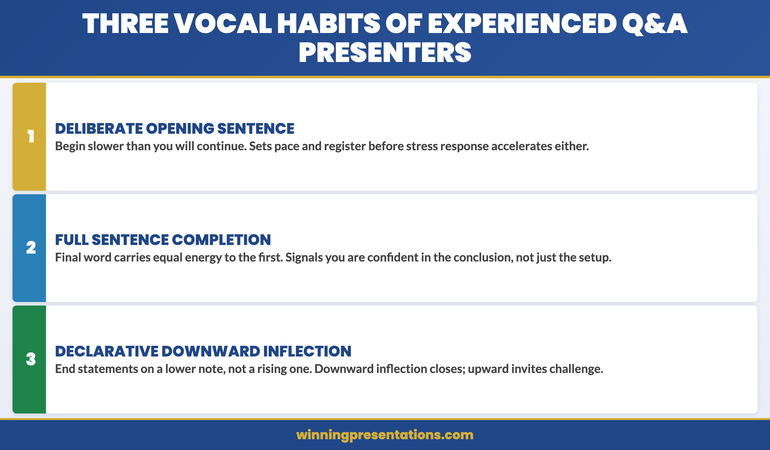
Experienced Q&A presenters share three vocal habits that distinguish their answers from those of less practised colleagues. These habits are not naturally acquired — they are developed through deliberate practice and the sustained attention that comes from treating the Q&A as a performance discipline in its own right, not simply as the portion of the presentation that happens after the prepared content finishes.
The first habit is the deliberate opening. Experienced Q&A presenters begin their answer with a sentence that is slower and more measured than the pace they will settle into once the answer is underway. This first sentence functions as a vocal reset — it establishes the pace and register of the answer before the stress response has had time to accelerate either. The content of that first sentence is often relatively simple: a brief acknowledgement of the question, a restatement of the core point being addressed, or a one-sentence orientation. What matters is the vocal discipline, not the specific words.
The second habit is finishing sentences fully. Anxious answers trail off — the pitch drops, the volume reduces, and the final words of the sentence are swallowed before they have landed. This happens because the speaker’s attention is already moving to the next idea before the current one has been delivered. Deliberate sentence completion — ensuring that the last word of each sentence carries as much vocal energy as the first — is one of the most audible markers of vocal authority in Q&A. It communicates that the speaker is confident in their conclusion, not just their opening.
The third habit is ending on a lower note. Upward inflection at the end of a statement — a vocal pattern common in some regional accents and increasingly prevalent in professional speech — reads as a question or an invitation for the questioner to push back. A declarative answer delivered with downward inflection at the end of the key sentence communicates that the speaker has arrived at a conclusion, not a hypothesis. This single vocal adjustment — conscious in rehearsal, eventually habitual — changes the perceived authority of an answer even when the content is identical.
Physical stillness during the first sentence of an answer supports all three habits. The companion article on movement during presentations covers how physical grounding and deliberate stillness interact with vocal authority — the voice and the body reinforce each other, and managing one makes the other easier.
What to Do When Your Voice Catches Mid-Answer
A voice catch — the brief loss of vocal control that produces a crack, a break in sound, or a sudden increase in pitch mid-sentence — is one of the most disconcerting experiences for a presenter in a high-stakes Q&A. It is involuntary, it is visible to the room, and it produces an immediate self-consciousness that makes the next few seconds of the answer harder to manage than they would otherwise have been.
The most important single thing to know about a voice catch is that the audience’s interpretation of it is shaped almost entirely by what the presenter does immediately afterwards. A voice catch followed by a confident continuation of the answer at the same pace and pitch is read by most audiences as a normal human response to pressure — something that happens, noted briefly, and then forgotten. A voice catch followed by visible distress, a sharp intake of breath, or a halting restart amplifies the moment and makes it the thing the audience remembers.
The practical recovery sequence for a voice catch in Q&A is brief and simple. Pause for one full second — not in the way that signals panic, but in the deliberate way that signals that you are choosing your next words carefully. Take a breath during that pause — not a visible gasp, but a natural breath that replenishes the air support the voice needs. Resume the sentence from the point where the catch occurred, at a slightly slower pace than before, with full sentence completion on the next thought. The pause absorbs the catch; the resumption defines what the room remembers.
For managing the broader Q&A dynamic when questions feel adversarial or when the room has turned against a position, the article on hostile questioner simulation covers how to practise the specific pressure scenarios that make voice catches most likely — and how rehearsed exposure to those scenarios reduces their impact.
For executives who want a systematic approach to managing the full Q&A session, the Executive Q&A Handling System covers the preparation, response structure, and in-the-moment disciplines that experienced Q&A presenters use in board, investor, and senior leadership contexts.
Pre-Q&A Vocal Preparation in Under Five Minutes
The quality of your vocal performance in Q&A is influenced by your physical and vocal state when the Q&A begins — not only by the techniques you apply once questions start arriving. Five minutes of deliberate preparation before the session begins can meaningfully change your baseline vocal state at the point of transition from presentation to questioning.
Breath is the starting point. Three to five slow, extended exhales — longer than feels natural, emptying the lungs more fully than normal breathing — activate the parasympathetic nervous system and reduce the cortisol-driven activation that constricts the throat and raises pitch. This exercise is not meditative — it is physiological. The extended exhale is the most effective single technique for reducing the physical tension that will otherwise manifest as vocal deterioration when the first question arrives. Do this in a private space in the final few minutes before the session begins.
Speaking aloud at your intended vocal register for two to three minutes before the session also helps to warm the vocal mechanism and establish the pace and pitch you intend to use. This does not require a formal warm-up — reading a few paragraphs from any document at the pace and register you intend to use in the Q&A is sufficient. The purpose is to make that vocal setting feel normal before the pressure of the session makes accessing it harder.
One additional preparation that experienced Q&A presenters use is rehearsing the first sentence of several different types of answer out loud. Not the full answer — just the opening sentence for a factual question, a challenge question, and a question requiring a more nuanced response. The purpose is not to script the answers, but to make the physical and vocal experience of beginning an answer feel familiar. When the first question arrives and the stress response activates, having said something similar out loud in the preceding ten minutes makes the opening discipline easier to access.
The Pause That Resets Vocal Authority in Live Q&A
The deliberate pause before answering a question is one of the most consistently underused tools in executive Q&A. Most presenters begin answering before they have fully formed the answer — because the social pressure of a question feels like a demand for an immediate response, and silence in a group setting feels like exposure. Both of these are perceptions rather than realities. Senior audiences do not experience a two-second pause as emptiness. They experience it as the presenter taking the question seriously.
The pause serves two distinct functions. The first is cognitive — it gives you time to hear the question fully, decide what the core point is, and formulate the first sentence of your answer before you begin speaking. Answers that start well tend to continue well; answers that start with an unformed thought often recover but do so less authoritatively than an answer that opened from a clear position. The pause buys the time to start well.
The second function is physiological. A deliberate pause — not an anxious silence, but a conscious and intentional beat — allows for one full breath before the answer begins. That breath changes the vocal output of the answer. It deepens the register slightly, reduces the pace of the opening sentence, and sets a physical baseline that is closer to composed than to reactive. The pause is the single most accessible in-the-moment vocal management tool available to Q&A presenters, and it works every time it is applied deliberately.
The pause works best when the presenter has already established an expectation of thoughtfulness with the room — when the question has been heard fully, acknowledged briefly (“that’s the right question to raise”), and then a one-beat pause taken before the answer begins. In this context, the pause feels like part of the engagement, not like a moment of difficulty. For more on the mechanics and application of the deliberate pause in executive presentations, the article on the pause technique in presentations covers how silence functions as an authority signal and how to use it without it feeling awkward.
For executives who face structured Q&A challenges — where questioners are persistent, where questions are designed to expose gaps in the position, or where the same objection appears in multiple forms — the article on anticipating executive objections before the session covers the preparation framework that makes the in-session vocal management techniques more effective. Vocal control is significantly easier when the answer is already well-formed before the question is asked.
Executive Q&A Handling System — £39, instant access
A Complete Framework for Predicting, Preparing, and Handling Executive Q&A
The Executive Q&A Handling System gives you the preparation framework and response structures experienced executives use to maintain authority through difficult, unexpected, and adversarial questions — including the vocal and physical disciplines that distinguish composed Q&A presenters from those who lose ground under questioning.
Get the Executive Q&A Handling System →
Designed for executives presenting to boards, investors, and senior leadership teams where Q&A is high-stakes.
Frequently Asked Questions
Why does my voice rise in pitch when I answer questions from very senior people?
Pitch rises under pressure because the muscles of the throat and larynx tighten when cortisol and adrenaline are elevated — and senior questioners typically produce a higher activation response than peers or subordinates. The tighter the throat musculature, the higher the pitch. The direct management approach is breath-first: an elongated exhale before beginning the answer reduces the muscle tension that is raising the pitch. This approach works physiologically rather than trying to consciously lower the pitch, which most people cannot do reliably under genuine pressure.
How long should the pause before an answer be in executive Q&A?
One to two seconds is the most effective range for a deliberate pause before beginning a Q&A answer in most executive contexts. Shorter than one second and the pause does not register as intentional — it simply disappears into the rhythm of the conversation. Longer than three seconds in a standard Q&A context begins to feel like difficulty rather than deliberateness, unless the question is genuinely complex and the pause has been framed explicitly (“let me think about that for a moment”). The one-to-two second pause, combined with a brief breath, is long enough to change the physiological state and short enough to read as thoughtful rather than uncertain.
Does practising Q&A out loud actually make a difference to vocal performance in the room?
Yes — and the mechanism is specific. When you practise answering questions out loud at the pace and register you intend to use, you are building a physical and vocal memory of that state. When the pressure of the actual Q&A activates the stress response, your nervous system has a reference point for what the correct vocal state feels like from the inside. Without that reference, you are trying to access a physical state you have not recently inhabited. With it, you are trying to return to somewhere familiar. The difference in accessibility is significant, particularly in the critical first few seconds of the first answer.
The Winning Edge — Weekly Newsletter
One Insight Per Week on Executive Communication
Each week, The Winning Edge delivers one focused insight on executive communication — structure, delivery, influence, and the mechanics of getting senior audiences to yes. Straightforward, applicable, and written for people who present under pressure.
About the Author
Mary Beth Hazeldine — Owner & Managing Director, Winning Presentations
With 25 years of corporate banking experience at JPMorgan Chase, PwC, Royal Bank of Scotland, and Commerzbank, Mary Beth now advises executives across financial services, healthcare, technology, and government on structuring and delivering high-stakes presentations — including the Q&A sessions that determine whether a well-prepared case is accepted or challenged. Winning Presentations is her specialist advisory practice.