

Anticipating Executive Objections: How to Prepare for Every Challenging Question Before It’s Asked
Quick Answer
Anticipating executive objections requires a structured stakeholder analysis completed before you write a single slide. Map each decision-maker’s primary concern, their most likely objection type, and the evidence that would satisfy them. The most damaging Q&A moments are not the questions you couldn’t answer — they are the questions you didn’t think to prepare for.
Tomás had spent four weeks building his case. The investment proposal was rigorous — financial modelling, market analysis, risk assessment, a phased implementation plan. He had rehearsed the presentation. He had anticipated the CFO’s questions about payback period. He had prepared the risk mitigation slides the CEO typically asked for.
What he had not prepared for was the Chief Operating Officer, who asked, twelve minutes into the presentation, whether the implementation plan accounted for the existing system migration that was already scheduled for Q3. It didn’t. Tomás had not known about the Q3 migration — it sat in a different part of the organisation, and no one had thought to brief him.
The question was not hostile. It was not even a challenge to his proposal. But his inability to answer it — combined with the visible uncertainty it produced — undermined the confidence the preceding twelve minutes had built. The board deferred. The Q3 conflict, it turned out, was solvable in a single conversation. But Tomás had not had that conversation before the meeting.
Most Q&A failures at executive level are not failures of knowledge. They are failures of intelligence gathering — the pre-meeting work of understanding what each person in the room is likely to raise, what they need to hear, and what operational context they hold that you may not. This article sets out a systematic approach to that intelligence gathering work.
Preparing for a high-stakes executive Q&A?
The Executive Q&A Handling System gives you a structured approach for predicting and preparing for executive questions — including a framework for mapping stakeholder objections before you walk into the room.
Why Executive Objections Still Catch Presenters Off Guard
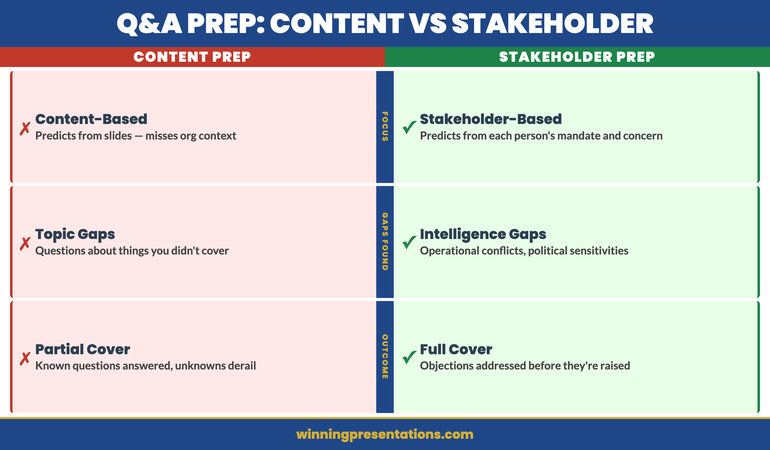
The standard advice for Q&A preparation is to anticipate likely questions and prepare answers. Most presenters do this to some degree — they think through the three or four questions they most expect, and they have responses ready. The problem is that this preparation is usually anchored to the content of the presentation, not to the perspective of the individual decision-makers in the room.
Questions from executive audiences rarely come from the content alone. They come from three other sources that content-focused preparation misses entirely. The first is organisational context — information about operational priorities, competing initiatives, budget constraints, or political dynamics that the presenter does not have access to. The Q3 migration in Tomás’s case was not in his brief. The second is personal priority — each executive in the room has a specific mandate, a specific set of concerns, and a specific lens through which they evaluate proposals. The CFO’s objection will be different from the General Counsel’s, even to the same proposal. The third is relational history — prior decisions, prior relationships with the presenter or the team, prior positions taken on related topics that create a predisposition toward certain objections.
Content-focused Q&A preparation addresses none of these three sources. Stakeholder-focused preparation addresses all of them — and it is the preparation discipline that consistently separates executives who navigate complex Q&A sessions from those who are regularly caught off guard. The approach to building a question map before a presentation provides the foundation that the stakeholder objection framework extends.
The Stakeholder Objection Map: A Pre-Presentation Framework
A stakeholder objection map is a structured document — typically a simple table — that organises your pre-meeting intelligence about each key decision-maker. It is built before you write your slides, not after. The sequence matters: knowing what each person is likely to object to shapes how you structure the presentation, what you address pre-emptively in the body of the talk, and what you prepare in your appendix for Q&A.
The map has five columns for each stakeholder. Their primary mandate — the single most important outcome their role is measured on. Their most likely concern about your proposal — what threatens their mandate, their budget, their operational plan, or their existing position. Their objection type — how they tend to raise concerns (more on this below). The evidence they need to be satisfied — what specific data, commitment, or assurance would move them from concern to support. And the information gap — what you do not know about their position that you need to find out before the meeting.
Building this map requires more than internal analysis. It requires conversations — with the person’s direct reports, with colleagues who have presented to them before, and ideally with the person themselves in a pre-meeting. The intelligence in the map is not available from the organisation chart or the meeting agenda. It comes from the network of people who know how each stakeholder operates and what they are currently focused on.
The map also surfaces the information gaps — the things you do not know — which are as valuable as the things you do know. An information gap is a risk: it is a question you cannot answer, a conflict you have not resolved, or a position you have not aligned before walking into the room. Each information gap in the map generates a pre-meeting action: who do you need to speak to, and what do you need to find out? Addressing information gaps before the meeting is the most reliable way to eliminate the category of objection that surprised Tomás.
The Five Objection Types Executives Use Most
Identifying not just what someone might object to, but how they tend to raise objections, significantly improves preparation quality. Executive objections cluster into five recognisable types, and each type requires a different response approach.
The financial scrutiny objection. “What is the payback period?” “How does this compare to the cost of doing nothing?” “What assumptions sit behind the revenue projection?” This objection type is characteristic of CFOs, finance committee members, and CEOs with a strong financial orientation. It requires precise, conservative financial analysis — and the willingness to acknowledge uncertainty ranges rather than presenting false precision that invites challenge.
The operational feasibility objection. “Do we have the capacity to execute this alongside our existing commitments?” “What happens to current-state operations during the transition?” “Who owns the delivery?” This is the COO’s territory, and it is the objection type that most surprises presenters who have focused on the strategic case. The response requires a credible implementation narrative — not just a plan, but an honest assessment of dependencies, constraints, and risks.
The risk and governance objection. “What is the regulatory position?” “Have legal reviewed this?” “What is the downside scenario?” General Counsels, Chief Risk Officers, and Non-Executive Directors with governance responsibilities raise this type. The response requires a clear risk register and a demonstrated understanding of the regulatory context — not a dismissal of the risk, but a credible mitigation position.
The strategic alignment objection. “How does this fit with the three-year plan?” “Does this conflict with the decision we made in January?” “Is this the right priority given where we are in the cycle?” This objection type tests whether the presenter has done their homework on the organisation’s strategic context. It requires a clear articulation of how the proposal connects to, rather than competes with, existing strategic commitments.
The political or territorial objection. “This affects my team’s remit — has that been discussed?” “I wasn’t aware this was moving at this pace.” “What does the [other division / partner organisation / key client] think about this?” This objection type is the hardest to prepare for from the content alone, because it arises from organisational dynamics rather than analytical concerns. It is addressed almost entirely through pre-meeting stakeholder engagement — by identifying territorial sensitivities before the presentation and addressing them through direct conversation beforehand.
A full Q&A preparation framework covering all five objection types, with structured response approaches for each, is the core of the Q&A preparation briefing document approach — building a written document that maps objections before the meeting is more reliable than keeping this analysis in your head.
A System for Predicting and Handling Executive Q&A
The Executive Q&A Handling System — £39, instant access — gives you a structured approach for predicting the questions executives will ask before you walk into the room, and a proven framework for handling the ones you didn’t predict. Designed specifically for high-stakes Q&A in boardrooms, investment committees, and executive approval settings.
- System for predicting and preparing for executive questions
- Stakeholder analysis frameworks for Q&A preparation
- Response structures for each of the five objection types
- Scenario playbooks for hostile, sceptical, and ambush questions
Get the Executive Q&A Handling System →
Designed for executives who present to boards, investment committees, and senior leadership teams where Q&A shapes the outcome.
Using Pre-Meeting Intelligence to Narrow the Unknown
Pre-meeting intelligence gathering is the most underused tool in executive Q&A preparation. The standard approach is to spend the preparation period building slides and rehearsing content. The more effective approach is to spend a significant portion of the preparation period gathering intelligence about the room — and using that intelligence to shape both the content and the Q&A preparation.
Intelligence gathering has three tiers. The first tier is documented intelligence — board papers, committee minutes, prior presentations on related topics, and any written communications that reveal the current position or concerns of key stakeholders. This is available without any direct outreach and should always be reviewed before stakeholder conversations.
The second tier is network intelligence — conversations with people who know the key decision-makers, have presented to them recently, or operate in the same organisational space as your proposal. These conversations are not about gathering gossip; they are about understanding operational context, recent decisions that bear on your proposal, and the specific lens each person brings to the topic. A thirty-minute conversation with the CFO’s direct report the week before the presentation can eliminate the category of financial scrutiny objection that otherwise catches presenters by surprise.
The third tier — and the most valuable — is direct pre-meeting conversations with the key decision-makers themselves. A brief meeting with the CFO to walk through the financial model, a conversation with the COO to understand the Q3 operational picture, a call with the Non-Executive Director who has the most questions about governance — each of these conversations serves two purposes simultaneously. They provide intelligence about likely objections. And they give each stakeholder the opportunity to raise their concerns in a context where you can address them properly, rather than in a room where the quality of your answer affects the credibility of the entire proposal in front of their peers. This pre-meeting alignment principle is explored in detail in the framework for managing executive objections — the same intelligence-gathering logic applies directly.
People also ask: How do I know what objections executives will raise before a presentation? You cannot know with certainty, but you can narrow the range substantially. Start with their role mandate — what outcome is each person most accountable for? Map your proposal against that mandate and identify where it creates tension, uncertainty, or additional work. Then layer in their known communication style and objection type. Finally, review any recent decisions or positions they have taken that might predispose them to a particular concern. This three-step analysis covers the majority of predictable objections for most executive audiences.
Building Prepared Responses That Hold Under Pressure
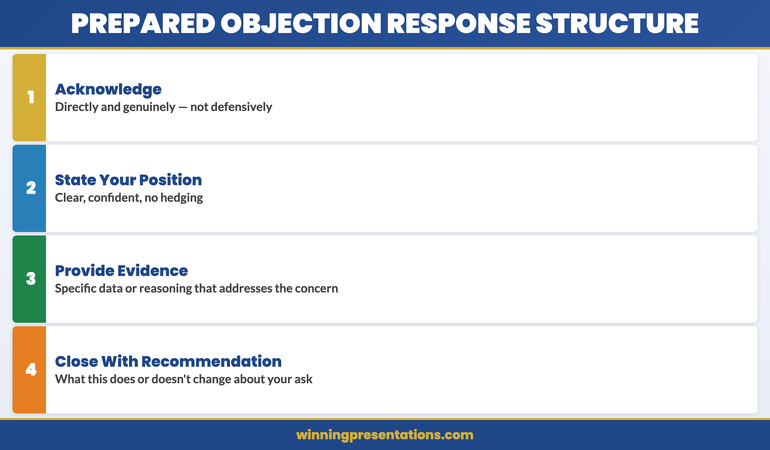
A prepared response to an anticipated objection is not a scripted answer. It is a structured position — a clear statement of your view, supported by the specific evidence or reasoning that addresses the concern, delivered with the confidence that comes from having thought it through rather than constructing it under pressure in real time.
Prepared responses for executive objections should follow the same logical structure regardless of the objection type. Acknowledge the concern directly — not dismissively, but genuinely. State your position clearly. Provide the specific evidence that supports it. Identify any limitations or uncertainties you have not resolved. And close with a clear statement of what the concern does or does not change about your recommendation.
The acknowledgement step is the one most commonly skipped under pressure. When a challenging question is asked in a high-stakes room, the instinct is to move immediately to the defence of your position. But skipping the acknowledgement signals that you are treating the question as an attack rather than a legitimate concern — and it puts the questioner in a position where they feel the need to restate or escalate their objection rather than hear your response. A two-second acknowledgement — “That is an important point, and it is something we looked at carefully” — resets the dynamic before the substantive response begins.
For objections where the honest answer includes genuine uncertainty or an unresolved issue, the prepared response should include a clear statement of what you do not yet know and how you plan to resolve it. “We have not yet confirmed the Q3 implementation timeline with the programme team — I can have that information to you by Thursday” is a stronger response than a hesitant or improvised attempt to address a gap you were not expecting. Acknowledging the gap and providing a specific resolution commitment maintains credibility; appearing to improvise an answer to a question you should have known damages it.
Managing Live Objections When Preparation Meets Reality
Even the most thorough preparation leaves gaps. Every executive Q&A session will include at least one question you did not anticipate — either because you lacked the intelligence to predict it, or because the conversation takes a direction you could not have foreseen. The discipline of live Q&A management is knowing how to handle these moments without losing the forward momentum of the presentation.
The most reliable technique for unexpected objections is the structured pause. Before responding, take a deliberate two to three second pause. This pause serves multiple functions simultaneously: it signals that you are taking the question seriously rather than deflecting, it gives your cognitive processing system time to retrieve relevant information, and it prevents the escalating improvisation that produces unclear or contradictory answers. Most presenters fear the pause because they equate it with appearing unprepared. Experienced executive audiences read a deliberate pause as thoughtfulness, not ignorance.
For questions where you genuinely do not have an answer, the most credible response is a direct acknowledgement combined with a specific commitment. “I don’t have the data on that with me, but I will confirm it in writing by end of week” is a more credible answer than an improvised approximation that may be wrong. Executives at board level make high-stakes decisions regularly — they are practised at working with incomplete information, and they respect presenters who are clear about the boundaries of their knowledge.
The Executive Q&A Handling System covers the full range of live Q&A techniques — including the specific approaches for handling hostile questions, multi-part questions, and questions that are designed to challenge your credibility rather than seek information. If you want a structured approach to the live session as well as the preparation, the system addresses both phases of the Q&A challenge.
Predict the Questions. Control the Room.
The Executive Q&A Handling System — £39 — gives you a complete framework for predicting executive objections before the meeting and handling the ones you didn’t predict when they arise. Stop rebuilding your Q&A preparation from scratch for every presentation.
Get the Executive Q&A Handling System →
Designed for executives whose Q&A performance shapes high-stakes approval decisions.
Frequently Asked Questions
How far in advance should I start preparing for executive Q&A?
For a significant investment approval or board presentation, Q&A preparation should begin at least two weeks before the meeting — with the stakeholder objection map completed in the first week and pre-meeting conversations scheduled for the second week. This timeline allows you to identify and address information gaps before the day of the presentation, rather than discovering them in the room. For smaller presentations to a familiar audience, a structured but compressed version of the same process — a few hours of stakeholder mapping and one or two brief conversations — still adds significant value over content-only preparation.
What do I do if an executive raises an objection I can’t answer?
Acknowledge the question directly, state clearly that you do not have a complete answer, and make a specific written commitment to follow up. “I want to make sure I give you an accurate answer on that — let me confirm the position and come back to you in writing by [specific date].” This response preserves credibility because it demonstrates that you are more interested in giving an accurate answer than in appearing to have one. Follow through on the commitment within the stated timeframe — failing to do so damages trust more than the original gap did.
Should I address anticipated objections in the body of the presentation before Q&A?
Yes, for the most predictable and significant objections — but with care. Pre-empting objections in the presentation body works well when you can address them briefly and confidently as part of the logical flow of your argument. It works less well when the objection requires extensive defence, because you are then allocating significant presentation time to a concern rather than to your positive case. A useful rule of thumb: address objections that, if unaddressed, would prevent a decision-maker from following your argument. Leave objections that are more about detail or verification to the Q&A, where you can give them your full attention in response to a direct question.
Get weekly Q&A and presentation strategy in your inbox
Every Thursday, The Winning Edge delivers one actionable insight for executives who present to boards, investment committees, and senior leadership teams — including practical Q&A preparation techniques drawn from real board-room experience.
About the Author
Mary Beth Hazeldine is Owner & Managing Director of Winning Presentations. With 25 years of corporate banking experience at JPMorgan Chase, PwC, Royal Bank of Scotland, and Commerzbank, she advises executives across financial services, healthcare, technology, and government on Q&A strategy, stakeholder preparation, and structuring high-stakes presentations for board and executive approval.