

Executive Presence Training That Works: Why Posture Courses Miss the Real Signals
Quick answer: Executive presence training works when it teaches the four signals senior audiences actually read — vocabulary precision, pacing discipline, the willingness to pause, and the ability to stay still under questioning. Posture drills, power poses, and “shoulders back, chin up” coaching miss the real point. Senior committees do not consciously evaluate a presenter’s stance. They evaluate whether the language is precise, whether the pace is steady, whether silence is comfortable, and whether the body remains composed when challenged. Those four signals sit upstream of every other “presence” cue. Train them, and the rest follows.
JUMP TO:
- Why posture-based training fails senior presenters
- The four signals senior audiences actually read
- Vocabulary precision as the first presence signal
- Pacing discipline and the willingness to pause
- Composure under questioning — staying still under pressure
- How to train these signals in real meetings
- Frequently asked questions
Astrid had been on the leadership development programme for nine months. The programme had a presence module — a two-day immersion run by an external coach who specialised in executive bearing. By the end of day two she could hold a confident stance, drop her shoulders on cue, and project from the diaphragm. Her line manager attended the closing session and told her she had “transformed”. Two weeks later she walked into a board meeting at the global insurer she worked for, opened a fifteen-slide pitch on a portfolio rationalisation, and was interrupted on slide four by the chair, who asked a direct question about exposure concentration. She had the data. She gave the data. She held her posture.
The chair listened, nodded, and turned to the CFO. The board moved on. After the meeting, the CFO took her aside in the corridor. He told her, gently, that her bearing had been excellent. The problem was something else. Her vocabulary had been imprecise — she had used “broadly” and “in the region of” three times in two minutes. Her pace had been a beat too fast for the room. And when the chair asked the question, she had answered immediately rather than pausing first. Three small things. None of them about posture. All of them invisible to the coach who had certified her two weeks earlier.
Astrid spent the next year working on the three things the CFO had named. Her bearing did not change. Her presence — measured by the rooms she now got invited into, the questions the board now asked her directly rather than through her sponsor, the speed at which proposals she carried got approved — changed substantially. The bearing course had not been wrong. It had been incomplete. Senior audiences do not read presence through posture. They read it through structural signals the body cannot fake.
If you want a structured reference for the delivery mechanics that build presence in real meetings:
Public Speaking Cheat Sheets are one-page references covering body language, vocal pacing, eye contact, and room control — the delivery mechanics you can review in 5 minutes before any meeting.
Why posture-based training fails senior presenters
Posture-based presence training rests on an assumption that a senior audience reads a presenter’s body the way a lay audience reads a TED Talk speaker. That assumption is wrong. Lay audiences are watching the speaker. They scan posture, gesture, facial expression, and they read confidence largely through visible cues. Senior committees are not watching the speaker in the same way. They are watching the request, the data, and the language. The speaker’s body is in the room — they are not staring at it. What they are doing is listening for a small set of signals that tell them whether the presenter actually owns the material.
The second reason posture training fails is that posture is downstream of composure, not upstream. A presenter who is genuinely composed — clear on what they are saying, comfortable with what they do not know, prepared to pause when challenged — has a stable posture as a by-product. A presenter who is internally unsettled but has been drilled to “stand tall” produces an awkward visible mismatch. The body is held but the voice is rushed. The shoulders are back but the language is hedged. Senior audiences read the mismatch instantly. They lose trust in the data because they have lost trust in the presenter.
The third failure pattern is that posture training is generic. The same coach delivers the same module to a room of finance directors, marketing leads, and HR partners. The drills are the same. But what reads as “presence” inside a credit committee is different from what reads as presence inside a creative agency review. Senior audiences in different functions look for different signals. A treasury committee reads vocabulary precision as the highest presence cue. A clinical review reads diagnostic confidence. A board strategy session reads narrative compression. A one-size-fits-all posture course gives every presenter the same answer to a question that is genuinely different in each room.
The four signals senior audiences actually read
Across years of observing senior presentations land or fail, four signals come up consistently as the cues that senior audiences use to evaluate presence. They are not visible cues. They are structural ones. The first is vocabulary precision — whether the presenter uses words that name what they actually mean, or hedges with approximations the room knows to be approximations. The second is pacing discipline — whether the presenter speaks at a pace the room can absorb, or rushes to compress a deck into a slot. The third is the willingness to pause — whether the presenter can sit with three seconds of silence after a hard question, or fills the gap with a half-formed answer. The fourth is composure under question — whether the body, voice, and language stay steady when the request is challenged, or whether one of them visibly destabilises.
These four signals share a common property — they are all observable to the senior audience but invisible to the presenter unless they have been taught to listen for them. Posture is visible to both. Eye contact is visible to both. But the difference between “in the region of” and “between 14 and 17 per cent” is not something the presenter notices about their own speech in real time, even though the room hears it instantly. The same is true of pacing. Most presenters do not know they are speaking too quickly until someone tells them. Most do not know they are answering too fast after a question — they think they are being responsive. Training that builds presence works on these signals at the level the audience reads them, not at the level the presenter feels them.
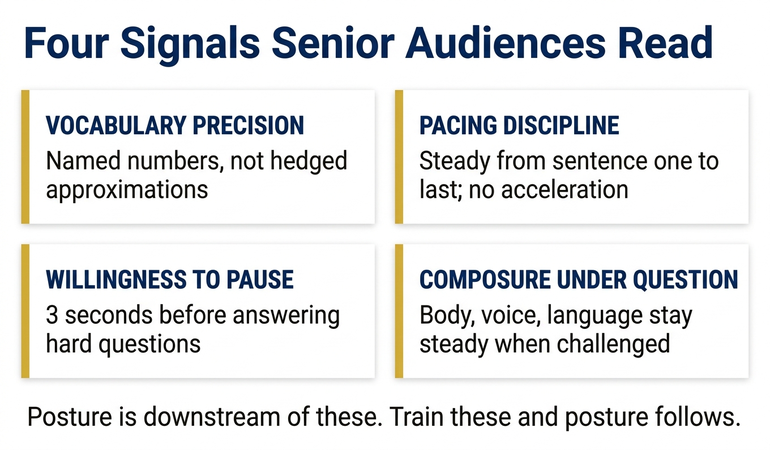
The fourth and slightly counter-intuitive property of the four signals is that they compound. A presenter who is precise with their language naturally paces themselves — they cannot rattle off vague approximations because they have committed to specifics, and specifics need time to land. A presenter with steady pace finds it easier to pause, because they are not racing the clock. A presenter who pauses comfortably also stays composed under question, because the pause is what creates the room to think. The four signals are not four separate skills. They are four expressions of the same underlying competency — comfort with the substance of what is being said. Train any one of them and the others lift. Train all four deliberately and the change in how senior rooms respond is significant. For a closely related delivery cue, see the boardroom pause and why four seconds of silence beats any slide.
Build the delivery mechanics that senior audiences read as presence.
Public Speaking Cheat Sheets are one-page references covering body language, vocal pacing, eye contact, and room control — the delivery mechanics you can review in 5 minutes before any meeting. £14.99, instant access, no subscription.
- One-page references for body language, vocal pacing, eye contact, and room control
- Designed to review in 5 minutes before any senior meeting
- Covers the delivery cues senior audiences read as presence — not generic posture drills
- Instant access on purchase, no subscription, no recurring billing
Vocabulary precision as the first presence signal
Vocabulary precision is the cleanest of the four signals because it can be audited from a transcript. Read back any senior presenter’s last fifteen minutes in a committee meeting and count the hedges. “Broadly”, “in the region of”, “around”, “approximately”, “give or take”, “thereabouts”, “more or less”. A presenter who uses three or more of these in five minutes is signalling that they do not own the numbers. The senior audience does not need to know the exact figure. They need to know that the presenter does. The hedge tells them the presenter does not — or that the presenter is uncertain enough to want a verbal escape route. Either reading is corrosive to presence.
The fix is structural rather than performative. Before a senior presentation, take every approximate phrase in the speaking script and either replace it with a precise figure, or replace it with a single named range. “Roughly 15 per cent” becomes “16.4 per cent” if the precise figure is known, or “between 14 and 17 per cent” if a range is honest. The presenter has not added information to the deck. They have added confidence to the delivery. The audience reads the change in three sentences. Two weeks of preparation can be shifted by an hour spent rewriting the hedge words out of a fifteen-minute script.
Vocabulary precision also extends beyond numbers. “I think” and “I believe” are presence-reducing in senior committee contexts. They are honest in some settings — but in a senior committee where the presenter has been invited to make a recommendation, “I recommend” or “the analysis shows” are stronger framings. “I think we should retire the older platform” reads as opinion. “The analysis recommends retiring the older platform on an 11-month timeline” reads as a position. The room responds differently to a position than to an opinion. For a related discipline of word choice, see executive vocabulary signals — words that say promotable versus replaceable.
Pacing discipline and the willingness to pause
Pacing is the second signal and the one that most posture courses get wrong by accident. The default coaching advice is to “speak slowly and clearly”. That advice produces a stilted artificial pace that senior audiences read as either condescending or anxious. The right discipline is steady pace, not slow pace. Steady means the presenter speaks at the same speed throughout the presentation. Senior audiences are not reacting to absolute speed. They are reacting to acceleration. A presenter who starts at one tempo and gradually speeds up — usually because they are running short on time, or because they are anxious, or both — signals that they have lost control of the room. The audience starts watching the clock too.
The willingness to pause is the close cousin of pacing. Pause comes up most often after a question. The senior audience asks the question. The presenter answers immediately. The instinct is that immediate response signals competence. The opposite is true at the senior level. Immediate response signals that the presenter is more interested in answering than in understanding. A three-second pause before answering signals that the question has been heard, that the presenter is weighing it, and that the answer that follows has been chosen rather than blurted. Senior audiences read the three seconds as a sign of authority. The unpaused presenter reads as anxious or defensive even when the words of the answer are technically correct.
Pacing and pause discipline can be trained without a coach. The exercise is to record fifteen minutes of one’s own speaking — a real meeting, ideally — and listen back specifically for tempo drift and for the gap before answers. The drift is usually in the second half of the recording. The gap is usually zero. Both are correctable in two weeks of deliberate practice. The presenter does not need to slow down. They need to stop accelerating, and they need to learn to wait.
Composure under questioning — staying still under pressure
Composure under question is the fourth signal and the most diagnostic. Most presenters can hold the first three signals during a smooth presentation. The pressure point is when the senior audience challenges the request. A board member pushes back on a number. The chair questions the assumption underlying a model. The CFO disagrees with the conclusion. In that moment, three things can destabilise — the body (visible tension, shifting weight, breaking eye contact), the voice (pitch rises, pace accelerates, volume drops), or the language (hedges multiply, qualifiers stack, “I think” returns). A senior audience reads the destabilisation in under a second. They do not read it as a sign of bad data. They read it as a sign that the presenter does not know how stable the underlying case actually is.
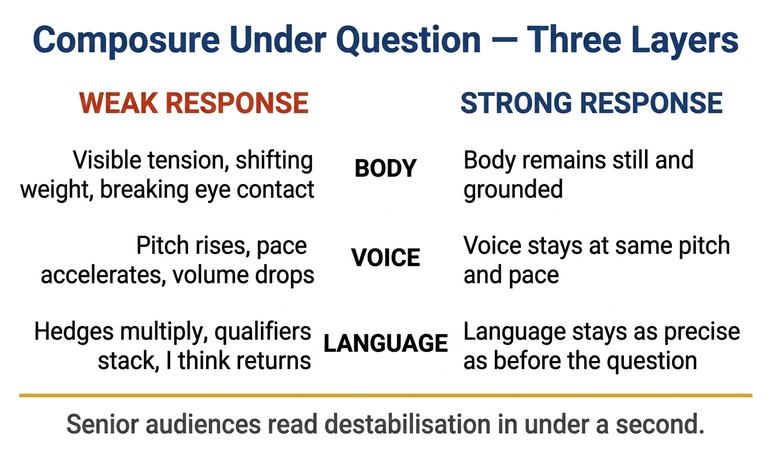
The discipline that holds composure under question is partly preparation and partly internal posture. The preparation side is question-anticipation — running the deck through a hostile-questioner exercise before the meeting, surfacing the hard questions in advance, and preparing answers that the presenter has actually said out loud rather than just thought through. The internal posture is the willingness to acknowledge what is not known. A presenter who answers a hard question with “I do not have that data with me, I will come back to you within the day” stays composed. A presenter who attempts to bluff their way to an answer destabilises within two sentences. The senior audience prefers the first. They read it as someone who knows the boundary of their own analysis. They read the second as someone who does not.
For the closely related delivery question of how physical positioning shapes how authority reads in a senior room, the partner discipline is covered in standing versus sitting during presentations and how position shapes authority. The two articles together cover the room-architecture decisions that interact with the four presence signals.
Want the delivery mechanics in a one-page reference you can review before every meeting?
Public Speaking Cheat Sheets cover body language, vocal pacing, eye contact, and room control on single-page references designed for the five minutes before you walk into a senior meeting. £14.99, instant access.
How to train these signals in real meetings
Training the four signals does not require a course or an external coach. The unit of training is the real meeting — committee, project review, all-hands update, peer briefing — in which the presenter has live audience feedback and a real subject. The deliberate practice loop is short. Before the meeting, write down which one of the four signals to focus on. Most presenters work on one at a time over a one-to-two week window. Vocabulary precision is the easiest first focus because it can be audited from a transcript. Pacing is second because it can be self-recorded. Pause discipline takes longer because it requires another person in the room to ask a question. Composure under question is last because it requires hostile pressure that not every meeting provides.
During the meeting, the focus is not on performing the signal flawlessly. The focus is on noticing when the signal slips and capturing the slip in memory. After the meeting, write down two or three concrete observations within twenty minutes — “used ‘broadly’ twice in the segment about Q3 numbers”, “accelerated pace after the chair’s first interruption”, “answered the second question before fully understanding it”. The act of writing the observations is what produces the change. The senior audience does not need to know the practice is happening. The presenter is the only one who can hear the slip in real time. Two months of this practice produces more measurable presence change than any two-day immersion. The four signals respond to attention, not to drills.
The companion piece to this article — focused specifically on the vocal mechanics that make pacing, pause, and pitch read as authority in senior rooms — is the boardroom voice and the pitch, pace, and pause patterns senior leaders recognise. Together the two articles cover the structural and vocal layers of executive presence; neither replaces the other.
Frequently asked questions
Does this mean posture and body language do not matter at all?
Posture and body language matter as a hygiene factor — visible slouching, fidgeting, or closed body positioning will be read as low presence. But once the presenter is at a baseline of standard professional bearing, additional posture work has diminishing returns. The four structural signals — vocabulary, pacing, pause, composure — explain most of the variation in how senior audiences read presence beyond the hygiene threshold. A presenter who has solved posture but not the four signals will still be read as low-presence. A presenter who has solved the four signals but has merely adequate posture will read as high-presence. The order of training effort should reflect the order of the read.
How long does executive presence training that focuses on these signals actually take?
The four signals respond to attention, not to time. A presenter focusing on one signal at a time can produce visible change in a six-to-eight-week window. Vocabulary precision usually shifts first, within two to three weeks. Pacing follows in another two to three weeks. Pause discipline takes longer because it requires repeated exposure to questioning environments. Composure under question is the deepest signal and the slowest to shift — typically three to six months of deliberate work. A presenter cycling through all four with focused attention will be in a measurably different place by month six. The change is durable because it is structural, not performative.
Is executive presence different in virtual versus in-person meetings?
The four signals are largely the same. Vocabulary precision, pacing, pause, and composure all read on video. Some of them read more sharply on video than in person — pacing in particular, because video calls compress the audience’s ability to read the room and increase reliance on vocal tempo. Composure under question reads slightly differently on video because the visible-tension cues are concentrated in the face rather than spread across the whole body. Posture matters less on video because most of it is below frame. The four-signal model carries to virtual delivery with very minor adjustment.
Should every senior presenter expect to land all four signals?
Most senior presenters under-perform on at least one of the four. The pattern is consistent — strong on two, adequate on one, visibly weak on one. The weakness is often the signal the presenter has never been told about. Vocabulary precision is the most common blind spot among technically deep presenters who have never had it audited. Pause discipline is the most common blind spot among presenters who have been coached to be “energetic” or “engaging”. Composure under question is the most common blind spot among presenters who have been promoted faster than their question-handling exposure has built. The first task is to identify which of the four is the weakest, and to start there.
The Winning Edge — weekly newsletter
The Winning Edge is a weekly newsletter for senior professionals who present at the executive level. One short email a week, focused on the structural moves that separate presenters senior committees back from presenters they politely defer. Subscribe to The Winning Edge →
Not ready for the Public Speaking Cheat Sheets? Start here instead: download the free Executive Presentation Checklist — a one-page reference for the structural moves senior leaders run before every committee deck.
About the author
Mary Beth Hazeldine is Owner & Managing Director of Winning Presentations Ltd. With 24 years of corporate banking experience at JPMorgan Chase, PwC, Royal Bank of Scotland, and Commerzbank, she advises executives across financial services, healthcare, technology, and government on structuring presentations for high-stakes funding rounds, board approvals, and strategic decisions.