Tag: stakeholder analysis presentation

25 May 2026
Featured image for Difficult Stakeholder Map: The 4-Quadrant System That Reveals Blockers

Difficult Stakeholder Map: The 4-Quadrant System That Reveals Blockers

Quick answer: A difficult stakeholder map for presentations sorts the room on two axes — influence over the decision, and current position on your proposal. Four quadrants emerge: blockers, swing votes, supporters, and bystanders. Map the room before the meeting and you stop performing for the wrong people. The presentation then has a single job — move the swing votes, neutralise the blockers, and let the supporters carry the room.

Yusuf had been preparing the presentation for six weeks. Capital request, three-year programme, sixteen million pounds. He had walked the deck through his sponsor twice. He had pre-briefed two members of the executive committee. He had rehearsed the financial section until he could deliver the numbers without notes. The room said no.

Afterwards, the chair pulled him aside. “Your numbers were fine. Your structure was fine. You presented to the wrong room.” Three of the eight people around the table had already decided against the proposal before Yusuf opened his deck. Two more were undecided but reading the body language of the three. The two supporters Yusuf had pre-briefed were sitting quietly, deferring to the more sceptical voices. Yusuf had spent six weeks designing a presentation for a room he had never actually mapped.

A difficult stakeholder map is the work that prevents this. It is not a polite organisational chart. It is a structured assessment of who in the room has influence over the decision, what their current position is, and what shifts each of them. The map is not the presentation. The map is what the presentation is for.

If you are mapping your stakeholders for the first time

The Executive Buy-In Presentation System walks through stakeholder analysis, case construction, and the presentation structures that hold up under board scrutiny. 7 self-paced modules, monthly cohort enrolment, optional recorded Q&A. Designed for senior professionals who need to secure approval from boards, executive sponsors, and reluctant stakeholders.

Explore the system →

Why most presentations fail the room before they start

Most senior presentations are designed for an imagined audience. The presenter pictures a generic boardroom, drafts the deck for that room, and then walks into the actual room and discovers that the actual room is not the imagined one. The chair is sceptical for reasons the presenter never identified. The CFO has been briefed against the proposal by someone who is not in the meeting. The two supporters the presenter expected to carry the discussion are quieter than predicted because the political weather has shifted.

The presentation that gets approved is not the most polished. It is the one designed for the specific people who will say yes or no. That requires knowing, before the meeting, who they are, where they currently sit, and what shifts each of them. The deck follows from the map. The map does not follow from the deck.

The difficult part is that the map is not visible from inside your own role. You are too close to the proposal to see the room dispassionately. You confuse senior titles with senior influence. You confuse polite engagement with actual support. You assume the chair is undecided when in fact the chair has already made a private decision and is testing whether your case is strong enough to override it. A structured mapping exercise is the only reliable way to surface what your instinct is missing.

The four quadrants of the stakeholder map

The map uses two axes. Horizontal: influence over the decision — high or low. Vertical: current position on your proposal — favourable or opposed. Plot every person who will be in the meeting, plus anyone they will speak to before or after. The four quadrants tell you what the presentation has to do.
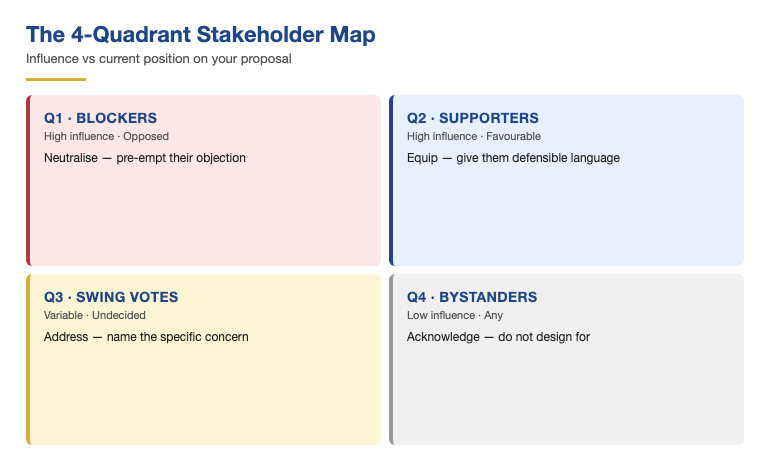
Four-quadrant difficult stakeholder map showing blockers (high influence, opposed), supporters (high influence, favourable), swing votes (uncertain position), and bystanders (low influence) with arrows showing how a presentation moves stakeholders between quadrants

Quadrant 1 — Blockers (high influence, opposed). These are the people who can sink the proposal even if everyone else supports it. The instinct is to argue with them. The instinct is wrong. The presentation cannot convert a hardened blocker in a single meeting. The job is to neutralise — give the blocker a face-saving path to abstain rather than oppose. That usually means addressing their objection so explicitly in the deck that opposing the proposal in the room would require them to dispute a point they have already conceded privately.

Quadrant 2 — Supporters (high influence, favourable). These are the people whose endorsement carries the room. The mistake is to over-cater to them. They are already with you. The presentation needs to give them the language and the evidence to defend the proposal when the conversation gets sceptical. Most decisions are made not by the presenter but by a supporter speaking five minutes after the deck closes. Equip them.

Quadrant 3 — Swing votes (uncertain position). These are the deciders. They have influence, they have not yet committed, and the presentation is largely for them. The deck must surface the specific concern each swing vote is sitting with. A swing vote on financial risk needs the financial risk addressed. A swing vote on operational complexity needs the implementation plan in the room, not in an appendix. Generic pitches do not move swing votes. Specific addresses do.

Quadrant 4 — Bystanders (low influence). These are the people in the room who do not change the outcome. They are not the audience. Many presenters spend half their delivery looking at the bystanders because they are the most engaged. Engagement is not the same as influence. Acknowledge the bystanders, but do not design the deck for them.

Building the map before your next presentation

A working map takes a senior presenter about ninety minutes to build, plus a series of short conversations. The structure is simple. The discipline is what most presenters skip.

Step one — list every name. Not just the people in the meeting. Anyone they will speak to in the seventy-two hours before the meeting, anyone they will brief afterwards, anyone whose private view will be in the room even if their body is not. Boards and executive committees rarely make decisions in the room they meet in. The decision is shaped in conversations that happen before the meeting.

Step two — assess influence honestly. Title is a poor proxy. The most influential person in many decisions is the chair’s chief of staff, the second-most-senior NED, or the finance partner whose private view the CFO will adopt. Influence is about who shapes whose opinion. Map the social structure, not the org chart.

Step three — assess current position before any conversation. Write down what you think each person currently believes. This is the version of the map most presenters never write down — they hold it in their head, and the holes never become visible until the room exposes them. Write it. Test it. Most assumptions break the moment they meet a real conversation.

Step four — have the conversations. Pre-brief two or three people in each high-influence quadrant before the meeting. Listen for the words they use. The exact phrasing of an objection is the phrasing that needs to appear in the deck. If the CFO says “the implementation timeline is what worries me”, the deck needs an implementation slide. If the chair says “I’m not sure this is the right horizon”, the deck needs a horizon slide. The pre-brief gives you the headlines the presentation has to write.

Step five — re-position on the map after each conversation. The map is not static. People shift between quadrants when they hear new information. Re-plot after every pre-brief. By the time you walk into the meeting, the map should reflect the room as it will actually be — not as it was when you started preparation.

For senior professionals who need to secure approval from reluctant stakeholders

The Executive Buy-In Presentation System — turn reluctant stakeholders into active advocates

Build the case your stakeholders cannot dismiss. The Executive Buy-In Presentation System is a self-paced framework — 7 modules walking you through stakeholder analysis, case construction, and the presentation structures that hold up to scrutiny. Monthly cohort enrolment, optional recorded Q&A calls.

  • 7 self-paced modules covering stakeholder analysis, case construction, and the structures that earn senior approval
  • Optional live Q&A / coaching calls — fully recorded, watch back at your own pace
  • No deadlines, no mandatory live attendance, lifetime access to materials
  • Monthly cohort enrolment — enrol any time, start with the next cohort

£499 · Self-paced · Lifetime access to materials · Next cohort enrolment opens monthly

Join the next cohort →

Using the map to design the presentation

Once the map is built, the deck almost writes itself. Each quadrant has a specific design implication, and a presentation that ignores any of them is presenting to the wrong audience.

For blockers — pre-empt the objection. The objection a known blocker holds privately must appear in the deck publicly, addressed before they raise it. This is not aggression. It is courtesy. A blocker who hears their concern named and addressed is far less likely to oppose in the room than one who has to raise it themselves and risk appearing combative. The structural placement matters — pre-empted objections belong in the body of the case, not in an appendix.
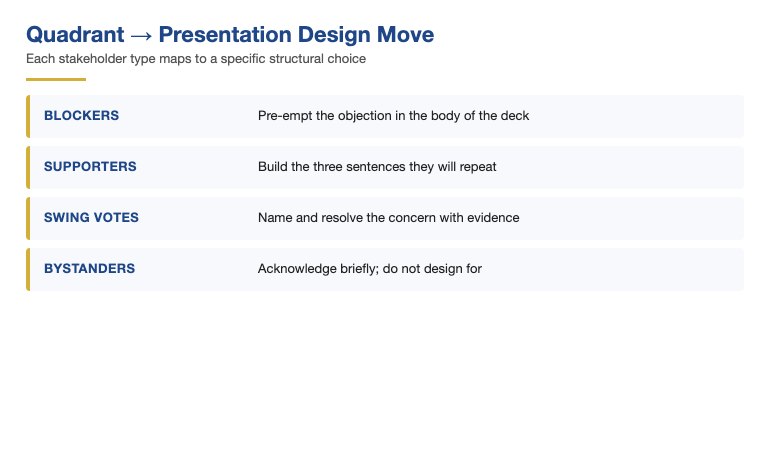
Diagram showing how each stakeholder quadrant maps to a specific presentation design choice — blockers get pre-empted objections, supporters get defensible language, swing votes get specific concern addresses, bystanders get acknowledged but not catered to

For supporters — give them the language. Build the case so that a supporter speaking after the deck has clear, defensible language to use. The two or three sentences a supporter will repeat to the rest of the room are arguably the most important sentences in the deck. Make them findable. Make them memorable. A supporter who can quote you is a supporter who can carry the room.

For swing votes — address the specific concern. Each swing vote has a concern. The pre-brief surfaces it. The deck must address it directly. Generic content does not move swing votes. The slide that converts a swing vote on financial risk is the one that names the financial risk and shows what controls it. Specific language, specific evidence, specific commitment.

For bystanders — acknowledge, do not design for. The presentation is not for the bystanders. They get the same deck, but the structure and emphasis are calibrated to the influential quadrants. The mistake is to spend energy on the people most engaged in the room rather than the people most consequential to the decision. Engagement is not influence.

The same logic applies whether the presentation is internal or external. For investor-facing or board-level proposals, the work is the same — see the related discussion of getting board approval through structured presentation training.

Companion templates for stakeholder-mapped presentations

The Executive Slide System — board-ready slide structures for the case the map demands

Once the map is built, you need slide structures that match it — pre-empt slides for blockers, defensible-language slides for supporters, specific-address slides for swing votes. The Executive Slide System covers 26 templates, 93 AI prompts, and 16 scenario playbooks. £39, instant download. Explore the slide system →

Five mapping mistakes senior presenters make

Mistake one — confusing engagement with influence. The most engaged person in the meeting is rarely the most influential. New NEDs ask the most questions. Long-tenured NEDs decide the outcome. Mapping by who is talking is a quick way to design the wrong deck.

Mistake two — assuming sponsorship equals support. A sponsor’s job is to back the proposal. A sponsor’s actual position in the meeting may be more cautious than the formal sponsorship implies — particularly when other senior figures express doubt. Map the sponsor as a person, not as a role.

Mistake three — leaving the chair off the map. The chair is often plotted as neutral, on the assumption that the chair’s role is procedural. In practice, most chairs have a private position, and the meeting is largely structured to either confirm or test it. Plot the chair explicitly.

Mistake four — relying on the public conversation. What people say in the meeting is rarely what they think. Pre-briefs surface the private view. Without them, the map reflects the polite version of the room, not the real one. The presentation is then designed for a room that does not exist.

Mistake five — building the map once and not updating it. Stakeholders shift. New information arrives. The CFO who was favourable on Monday is sceptical on Wednesday because the head of audit raised a question over coffee on Tuesday. A map that has not been updated in the seventy-two hours before the meeting is usually wrong. Re-plot.

Frequently asked questions

Is a stakeholder map only useful for board presentations?

No. The map applies to any presentation where the audience contains people with different positions and different influence over the decision. It is most visible at board level because the stakes make the politics overt, but the same dynamics shape investment committees, executive teams, partner meetings, and even technical review boards. Wherever the room contains both deciders and observers, the map is useful.

How long should the mapping exercise take?

For a typical board or executive presentation, plan ninety minutes to build the first version of the map and then a series of three to six short pre-brief conversations across the following week. The pre-briefs are where the map gets accurate. The initial sketch is always partial. Senior presenters who skip the pre-briefs are usually presenting to a room they have only imagined.

What if I do not have time for pre-briefs?

Then prioritise. Pre-brief the most influential swing vote and the most credible blocker. The presentation will be substantially better even if you do not pre-brief everyone. The single most valuable conversation is usually with the swing vote whose decision the supporters will follow. Find that person. Have that conversation. The deck will improve dramatically.

Can I share the map with my team?

Sometimes, with care. The map is a working document, not a public artefact. Sharing it with co-presenters and a sponsor is usually appropriate. Sharing it more widely risks the map leaking back to the people on it, which damages the relationships the map exists to navigate. The judgement call is the same as for any sensitive working document — share with the people who need it to do their job, not with the people who would find it interesting.

Maven cohort enrolment — open this month

The structured framework most senior presenters use to secure board-level approval

Walk into your next approval meeting prepared. The Executive Buy-In Presentation System gives you 7 self-paced modules covering stakeholder analysis, case construction, and the presentation structures that hold up to scrutiny. Monthly cohort enrolment — £499, lifetime access.

  • 7 self-paced modules — work through at your own pace, no deadlines
  • Optional live Q&A calls — fully recorded, watch back any time
  • Monthly cohort enrolment — enrol any time, start with the next cohort
  • Lifetime access to all materials, no subscription, no expiry

£499 · Self-paced · Lifetime access · Next cohort enrolment opens monthly

Join the next cohort →

The Winning Edge — weekly

One short note each Thursday on board-level presentation patterns, structural shortcuts, and the behaviours senior presenters use under scrutiny. Written for professionals who do not have time for newsletters that read like newsletters.

Subscribe to The Winning Edge →

Want a starting point first? The free Executive Presentation Checklist covers the structural fundamentals senior presenters use before mapping the room.

For a wider view of how mapping integrates with the psychology of senior approval, see the related piece on stakeholder buy-in psychology — the human dynamics the four-quadrant grid is built to navigate.

Next step: Pick the next presentation on your calendar where the outcome matters. List the eight to twelve people in or around the room. Plot them on the four-quadrant map. Identify the two swing votes. Book a thirty-minute conversation with each before the meeting. The deck you build after that conversation will be a different deck.

Mary Beth Hazeldine is the Owner & Managing Director of Winning Presentations. With 25 years of corporate banking experience at JPMorgan Chase, PwC, Royal Bank of Scotland, and Commerzbank, she advises senior professionals across financial services, healthcare, technology, and government on structuring presentations for high-stakes board meetings, investment committees, and executive sessions. She speaks German and works extensively with the German-speaking financial markets.

11 Apr 2026
Executive presenter fielding a challenging question from a senior panel — composed, prepared expression, boardroom setting, navy tones

Anticipating Executive Objections: How to Prepare for Every Challenging Question Before It’s Asked

Quick Answer

Anticipating executive objections requires a structured stakeholder analysis completed before you write a single slide. Map each decision-maker’s primary concern, their most likely objection type, and the evidence that would satisfy them. The most damaging Q&A moments are not the questions you couldn’t answer — they are the questions you didn’t think to prepare for.

Tomás had spent four weeks building his case. The investment proposal was rigorous — financial modelling, market analysis, risk assessment, a phased implementation plan. He had rehearsed the presentation. He had anticipated the CFO’s questions about payback period. He had prepared the risk mitigation slides the CEO typically asked for.

What he had not prepared for was the Chief Operating Officer, who asked, twelve minutes into the presentation, whether the implementation plan accounted for the existing system migration that was already scheduled for Q3. It didn’t. Tomás had not known about the Q3 migration — it sat in a different part of the organisation, and no one had thought to brief him.

The question was not hostile. It was not even a challenge to his proposal. But his inability to answer it — combined with the visible uncertainty it produced — undermined the confidence the preceding twelve minutes had built. The board deferred. The Q3 conflict, it turned out, was solvable in a single conversation. But Tomás had not had that conversation before the meeting.

Most Q&A failures at executive level are not failures of knowledge. They are failures of intelligence gathering — the pre-meeting work of understanding what each person in the room is likely to raise, what they need to hear, and what operational context they hold that you may not. This article sets out a systematic approach to that intelligence gathering work.

Preparing for a high-stakes executive Q&A?

The Executive Q&A Handling System gives you a structured approach for predicting and preparing for executive questions — including a framework for mapping stakeholder objections before you walk into the room.

Explore the System →

Why Executive Objections Still Catch Presenters Off Guard

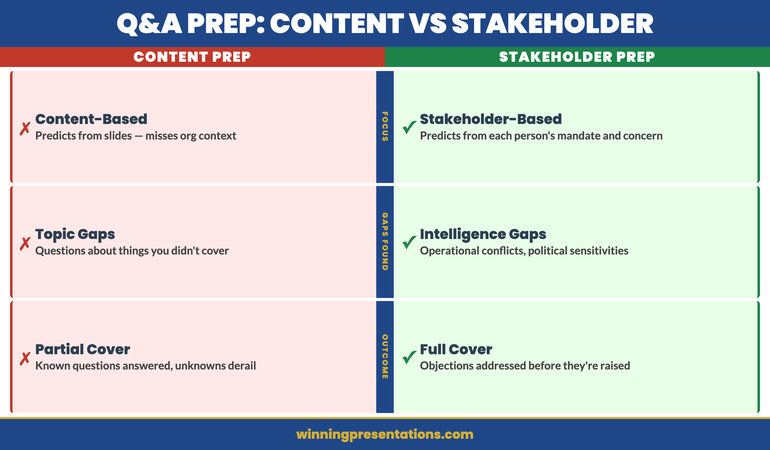
The standard advice for Q&A preparation is to anticipate likely questions and prepare answers. Most presenters do this to some degree — they think through the three or four questions they most expect, and they have responses ready. The problem is that this preparation is usually anchored to the content of the presentation, not to the perspective of the individual decision-makers in the room.

Questions from executive audiences rarely come from the content alone. They come from three other sources that content-focused preparation misses entirely. The first is organisational context — information about operational priorities, competing initiatives, budget constraints, or political dynamics that the presenter does not have access to. The Q3 migration in Tomás’s case was not in his brief. The second is personal priority — each executive in the room has a specific mandate, a specific set of concerns, and a specific lens through which they evaluate proposals. The CFO’s objection will be different from the General Counsel’s, even to the same proposal. The third is relational history — prior decisions, prior relationships with the presenter or the team, prior positions taken on related topics that create a predisposition toward certain objections.

Content-focused Q&A preparation addresses none of these three sources. Stakeholder-focused preparation addresses all of them — and it is the preparation discipline that consistently separates executives who navigate complex Q&A sessions from those who are regularly caught off guard. The approach to building a question map before a presentation provides the foundation that the stakeholder objection framework extends.

The Stakeholder Objection Map: A Pre-Presentation Framework

A stakeholder objection map is a structured document — typically a simple table — that organises your pre-meeting intelligence about each key decision-maker. It is built before you write your slides, not after. The sequence matters: knowing what each person is likely to object to shapes how you structure the presentation, what you address pre-emptively in the body of the talk, and what you prepare in your appendix for Q&A.

The map has five columns for each stakeholder. Their primary mandate — the single most important outcome their role is measured on. Their most likely concern about your proposal — what threatens their mandate, their budget, their operational plan, or their existing position. Their objection type — how they tend to raise concerns (more on this below). The evidence they need to be satisfied — what specific data, commitment, or assurance would move them from concern to support. And the information gap — what you do not know about their position that you need to find out before the meeting.

Building this map requires more than internal analysis. It requires conversations — with the person’s direct reports, with colleagues who have presented to them before, and ideally with the person themselves in a pre-meeting. The intelligence in the map is not available from the organisation chart or the meeting agenda. It comes from the network of people who know how each stakeholder operates and what they are currently focused on.

The map also surfaces the information gaps — the things you do not know — which are as valuable as the things you do know. An information gap is a risk: it is a question you cannot answer, a conflict you have not resolved, or a position you have not aligned before walking into the room. Each information gap in the map generates a pre-meeting action: who do you need to speak to, and what do you need to find out? Addressing information gaps before the meeting is the most reliable way to eliminate the category of objection that surprised Tomás.

Stakeholder objection map structure: five columns covering mandate, concern, objection type, required evidence, and information gaps

The Five Objection Types Executives Use Most

Identifying not just what someone might object to, but how they tend to raise objections, significantly improves preparation quality. Executive objections cluster into five recognisable types, and each type requires a different response approach.

The financial scrutiny objection. “What is the payback period?” “How does this compare to the cost of doing nothing?” “What assumptions sit behind the revenue projection?” This objection type is characteristic of CFOs, finance committee members, and CEOs with a strong financial orientation. It requires precise, conservative financial analysis — and the willingness to acknowledge uncertainty ranges rather than presenting false precision that invites challenge.

The operational feasibility objection. “Do we have the capacity to execute this alongside our existing commitments?” “What happens to current-state operations during the transition?” “Who owns the delivery?” This is the COO’s territory, and it is the objection type that most surprises presenters who have focused on the strategic case. The response requires a credible implementation narrative — not just a plan, but an honest assessment of dependencies, constraints, and risks.

The risk and governance objection. “What is the regulatory position?” “Have legal reviewed this?” “What is the downside scenario?” General Counsels, Chief Risk Officers, and Non-Executive Directors with governance responsibilities raise this type. The response requires a clear risk register and a demonstrated understanding of the regulatory context — not a dismissal of the risk, but a credible mitigation position.

The strategic alignment objection. “How does this fit with the three-year plan?” “Does this conflict with the decision we made in January?” “Is this the right priority given where we are in the cycle?” This objection type tests whether the presenter has done their homework on the organisation’s strategic context. It requires a clear articulation of how the proposal connects to, rather than competes with, existing strategic commitments.

The political or territorial objection. “This affects my team’s remit — has that been discussed?” “I wasn’t aware this was moving at this pace.” “What does the [other division / partner organisation / key client] think about this?” This objection type is the hardest to prepare for from the content alone, because it arises from organisational dynamics rather than analytical concerns. It is addressed almost entirely through pre-meeting stakeholder engagement — by identifying territorial sensitivities before the presentation and addressing them through direct conversation beforehand.

A full Q&A preparation framework covering all five objection types, with structured response approaches for each, is the core of the Q&A preparation briefing document approach — building a written document that maps objections before the meeting is more reliable than keeping this analysis in your head.

A System for Predicting and Handling Executive Q&A

The Executive Q&A Handling System — £39, instant access — gives you a structured approach for predicting the questions executives will ask before you walk into the room, and a proven framework for handling the ones you didn’t predict. Designed specifically for high-stakes Q&A in boardrooms, investment committees, and executive approval settings.

  • System for predicting and preparing for executive questions
  • Stakeholder analysis frameworks for Q&A preparation
  • Response structures for each of the five objection types
  • Scenario playbooks for hostile, sceptical, and ambush questions

Get the Executive Q&A Handling System →

Designed for executives who present to boards, investment committees, and senior leadership teams where Q&A shapes the outcome.

Using Pre-Meeting Intelligence to Narrow the Unknown

Pre-meeting intelligence gathering is the most underused tool in executive Q&A preparation. The standard approach is to spend the preparation period building slides and rehearsing content. The more effective approach is to spend a significant portion of the preparation period gathering intelligence about the room — and using that intelligence to shape both the content and the Q&A preparation.

Intelligence gathering has three tiers. The first tier is documented intelligence — board papers, committee minutes, prior presentations on related topics, and any written communications that reveal the current position or concerns of key stakeholders. This is available without any direct outreach and should always be reviewed before stakeholder conversations.

The second tier is network intelligence — conversations with people who know the key decision-makers, have presented to them recently, or operate in the same organisational space as your proposal. These conversations are not about gathering gossip; they are about understanding operational context, recent decisions that bear on your proposal, and the specific lens each person brings to the topic. A thirty-minute conversation with the CFO’s direct report the week before the presentation can eliminate the category of financial scrutiny objection that otherwise catches presenters by surprise.

The third tier — and the most valuable — is direct pre-meeting conversations with the key decision-makers themselves. A brief meeting with the CFO to walk through the financial model, a conversation with the COO to understand the Q3 operational picture, a call with the Non-Executive Director who has the most questions about governance — each of these conversations serves two purposes simultaneously. They provide intelligence about likely objections. And they give each stakeholder the opportunity to raise their concerns in a context where you can address them properly, rather than in a room where the quality of your answer affects the credibility of the entire proposal in front of their peers. This pre-meeting alignment principle is explored in detail in the framework for managing executive objections — the same intelligence-gathering logic applies directly.

People also ask: How do I know what objections executives will raise before a presentation? You cannot know with certainty, but you can narrow the range substantially. Start with their role mandate — what outcome is each person most accountable for? Map your proposal against that mandate and identify where it creates tension, uncertainty, or additional work. Then layer in their known communication style and objection type. Finally, review any recent decisions or positions they have taken that might predispose them to a particular concern. This three-step analysis covers the majority of predictable objections for most executive audiences.

Building Prepared Responses That Hold Under Pressure

A prepared response to an anticipated objection is not a scripted answer. It is a structured position — a clear statement of your view, supported by the specific evidence or reasoning that addresses the concern, delivered with the confidence that comes from having thought it through rather than constructing it under pressure in real time.

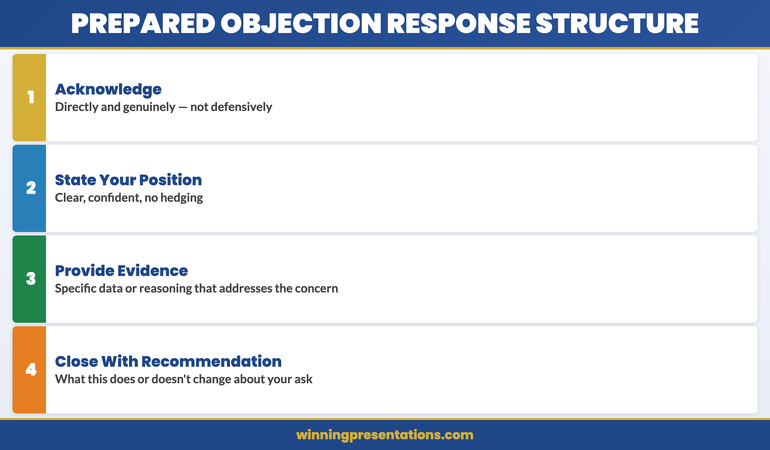
Prepared responses for executive objections should follow the same logical structure regardless of the objection type. Acknowledge the concern directly — not dismissively, but genuinely. State your position clearly. Provide the specific evidence that supports it. Identify any limitations or uncertainties you have not resolved. And close with a clear statement of what the concern does or does not change about your recommendation.

The acknowledgement step is the one most commonly skipped under pressure. When a challenging question is asked in a high-stakes room, the instinct is to move immediately to the defence of your position. But skipping the acknowledgement signals that you are treating the question as an attack rather than a legitimate concern — and it puts the questioner in a position where they feel the need to restate or escalate their objection rather than hear your response. A two-second acknowledgement — “That is an important point, and it is something we looked at carefully” — resets the dynamic before the substantive response begins.

For objections where the honest answer includes genuine uncertainty or an unresolved issue, the prepared response should include a clear statement of what you do not yet know and how you plan to resolve it. “We have not yet confirmed the Q3 implementation timeline with the programme team — I can have that information to you by Thursday” is a stronger response than a hesitant or improvised attempt to address a gap you were not expecting. Acknowledging the gap and providing a specific resolution commitment maintains credibility; appearing to improvise an answer to a question you should have known damages it.

Four-step structure for prepared responses to executive objections: acknowledge, state position, provide evidence, close with recommendation

Managing Live Objections When Preparation Meets Reality

Even the most thorough preparation leaves gaps. Every executive Q&A session will include at least one question you did not anticipate — either because you lacked the intelligence to predict it, or because the conversation takes a direction you could not have foreseen. The discipline of live Q&A management is knowing how to handle these moments without losing the forward momentum of the presentation.

The most reliable technique for unexpected objections is the structured pause. Before responding, take a deliberate two to three second pause. This pause serves multiple functions simultaneously: it signals that you are taking the question seriously rather than deflecting, it gives your cognitive processing system time to retrieve relevant information, and it prevents the escalating improvisation that produces unclear or contradictory answers. Most presenters fear the pause because they equate it with appearing unprepared. Experienced executive audiences read a deliberate pause as thoughtfulness, not ignorance.

For questions where you genuinely do not have an answer, the most credible response is a direct acknowledgement combined with a specific commitment. “I don’t have the data on that with me, but I will confirm it in writing by end of week” is a more credible answer than an improvised approximation that may be wrong. Executives at board level make high-stakes decisions regularly — they are practised at working with incomplete information, and they respect presenters who are clear about the boundaries of their knowledge.

The Executive Q&A Handling System covers the full range of live Q&A techniques — including the specific approaches for handling hostile questions, multi-part questions, and questions that are designed to challenge your credibility rather than seek information. If you want a structured approach to the live session as well as the preparation, the system addresses both phases of the Q&A challenge.

Predict the Questions. Control the Room.

The Executive Q&A Handling System — £39 — gives you a complete framework for predicting executive objections before the meeting and handling the ones you didn’t predict when they arise. Stop rebuilding your Q&A preparation from scratch for every presentation.

Get the Executive Q&A Handling System →

Designed for executives whose Q&A performance shapes high-stakes approval decisions.

Frequently Asked Questions

How far in advance should I start preparing for executive Q&A?

For a significant investment approval or board presentation, Q&A preparation should begin at least two weeks before the meeting — with the stakeholder objection map completed in the first week and pre-meeting conversations scheduled for the second week. This timeline allows you to identify and address information gaps before the day of the presentation, rather than discovering them in the room. For smaller presentations to a familiar audience, a structured but compressed version of the same process — a few hours of stakeholder mapping and one or two brief conversations — still adds significant value over content-only preparation.

What do I do if an executive raises an objection I can’t answer?

Acknowledge the question directly, state clearly that you do not have a complete answer, and make a specific written commitment to follow up. “I want to make sure I give you an accurate answer on that — let me confirm the position and come back to you in writing by [specific date].” This response preserves credibility because it demonstrates that you are more interested in giving an accurate answer than in appearing to have one. Follow through on the commitment within the stated timeframe — failing to do so damages trust more than the original gap did.

Should I address anticipated objections in the body of the presentation before Q&A?

Yes, for the most predictable and significant objections — but with care. Pre-empting objections in the presentation body works well when you can address them briefly and confidently as part of the logical flow of your argument. It works less well when the objection requires extensive defence, because you are then allocating significant presentation time to a concern rather than to your positive case. A useful rule of thumb: address objections that, if unaddressed, would prevent a decision-maker from following your argument. Leave objections that are more about detail or verification to the Q&A, where you can give them your full attention in response to a direct question.

Get weekly Q&A and presentation strategy in your inbox

Every Thursday, The Winning Edge delivers one actionable insight for executives who present to boards, investment committees, and senior leadership teams — including practical Q&A preparation techniques drawn from real board-room experience.

Subscribe to The Winning Edge →

About the Author

Mary Beth Hazeldine is Owner & Managing Director of Winning Presentations. With 25 years of corporate banking experience at JPMorgan Chase, PwC, Royal Bank of Scotland, and Commerzbank, she advises executives across financial services, healthcare, technology, and government on Q&A strategy, stakeholder preparation, and structuring high-stakes presentations for board and executive approval.