Tag: executive Q&A strategy

14 Apr 2026

Repeated Questions in Presentations: How to Respond Without Losing Patience

Quick Answer
When the same question is asked twice in a presentation, it is not a sign of failure — it is information. Repeated questions signal one of three things: your first answer was not clear enough, the questioner is stress-testing your consistency, or this topic is their highest priority and they need more than your initial response gave them. The right approach is a four-step framework: acknowledge the repeat directly, diagnose which of the three signals applies, respond with a different angle rather than the same words, and check for comprehension explicitly. Losing patience — or repeating your original answer verbatim — converts a manageable question into a credibility problem.

Priya had answered the ROI question at the 20-minute mark. She had used a clear structure: the investment figure, the projected return, the payback period, and the confidence interval on the forecast. It was one of the cleaner answers she had given in an executive presentation. Then, twelve minutes later, a senior director on the committee asked it again. Not a follow-up — the same question, almost word for word.

Her instinct was to feel frustrated. She had already answered. She had answered clearly. She looked briefly at her CFO sponsor, who gave nothing back. Then she made a decision that she later described as the moment the presentation turned: she paused, acknowledged the repeat without defensiveness, and responded with an entirely different angle — not the numbers, but the strategic logic behind the numbers, and why that logic held even under the pessimistic scenario. The director nodded. “That’s what I needed,” she said. “Thank you.”

Priya told me afterwards that she had almost said, “As I mentioned earlier…” — the phrase that every senior presenter knows is dangerous, and that she had used in a previous presentation with visibly damaging results. Catching it before it came out was, she said, the most important in-the-moment decision she made that afternoon.

If Q&A is consistently a weak point in your executive presentations — whether from repeated questions, hostile questioners, or questions you haven’t anticipated — the Executive Q&A Handling System gives you a complete framework for predicting, preparing for, and responding to the questions that derail most presentations.

Explore the System →

Why Questions Get Asked Twice

Understanding why a question is being repeated is the diagnostic work that determines the right response. There are three primary drivers, and they require different treatment.

The clarity gap. Your first answer did not fully resolve the questioner’s concern, even if it addressed the literal question they asked. This is the most common driver of repeated questions. It does not mean your answer was wrong — it means there was a gap between what you understood the question to be asking and what the questioner was actually trying to resolve. The question they asked was a proxy for the concern they had; your answer addressed the proxy, not the underlying concern.

The consistency test. Some senior executives deliberately ask the same question twice — sometimes in the same meeting, sometimes framed slightly differently — to test whether your answer holds. This is especially common in high-stakes financial presentations, board settings, and investor Q&A. The questioner has no specific gap to fill; they are checking whether your first answer was a reliable position or a situational response that might shift under pressure. If you answer differently the second time without acknowledging why, you fail the test. If you acknowledge the repeat, confirm your original position, and add a further dimension of reasoning, you pass it.

The priority signal. Repeated questions sometimes indicate that this topic is the questioner’s primary concern — more significant to them than your presentation structure may have reflected. In this case, the repetition is not a critique of your clarity or a test of your consistency; it is the questioner communicating, without saying so directly, that they need this topic to receive more weight and depth than your initial answer provided. The appropriate response is to recognise this and give the topic the space it is asking for.

Diagnosing which driver applies requires reading the room, the questioner’s tone, and the degree to which your initial answer appeared to land. It is not always clear-cut. When in doubt, treat the repeat as a clarity gap — the response to a clarity gap is never damaging, and it addresses all three possible drivers simultaneously.

Four-step framework for responding to repeated questions in presentations: acknowledge, diagnose, respond with new angle, check comprehension

The Wrong Responses and What They Signal

Three responses to repeated questions are consistently damaging to executive credibility, and they are all understandable — which is exactly why they need to be explicitly avoided.

“As I mentioned earlier…” This phrase — and its close relatives, “I covered this in the third slide” or “I already addressed that point” — signals impatience and places the responsibility for the gap on the questioner rather than on the presenter. Even when the questioner did not listen carefully to your first answer, making this visible in a group setting damages the relationship and creates social tension in the room. Other attendees notice. The questioner notices. The response to a repeated question should never, under any circumstances, include a reference to having already answered it — even when it is factually true.

Repeating your original answer verbatim. If your first answer did not resolve the question, repeating it identically cannot resolve it either. The information content is the same; only the volume may change. Verbatim repetition signals that you do not have additional depth on the topic — which is a vulnerability in an executive Q&A setting — or that you have not listened to the fact that your first answer missed what the questioner needed. Either reading reduces confidence in the presenter.

Visible impatience. A pause that runs slightly too long, a tone shift, a glance toward the CFO sponsor, or a subtle change in facial expression are all readable by senior audiences. Executives at board and C-suite level have high social intelligence — it is part of why they are where they are. Any display of impatience when a question is repeated will be noted, will be remembered, and will affect how your credibility is assessed for the remainder of the meeting.

See the related guidance on handling trick questions in presentations — a situation where the same discipline of reading intent before responding is equally critical.

Executive Q&A Handling System — £39, instant access

A System for Predicting and Handling Every Question Type in Executive Q&A

The Executive Q&A Handling System gives you a complete framework for classifying question types, predicting the questions most likely to arise in your specific presentation context, and responding with authority regardless of what is asked. Designed for executives who need to handle Q&A with precision — not improvise under pressure.

  • System for predicting and classifying executive Q&A question types
  • Framework for responding to repeated, hostile, and trap questions with consistency
  • Scenario playbooks for board Q&A, investor Q&A, and all-hands settings
  • Preparation guides for the questions most likely to derail high-stakes presentations

Get the Q&A Handling System →

Designed for executives who present to boards, investors, and senior leadership teams.

The Four-Step Response Framework

The framework below applies regardless of which of the three repeat drivers is at play. It works because it acknowledges the repeat without making the questioner feel they should not have asked, offers a genuinely different dimension of response rather than repetition, and closes with a check that ensures the loop is properly closed.

Step 1: Acknowledge the repeat explicitly and without apology. “You’ve raised this again — let me make sure I address what you’re getting at.” This single sentence does several things: it signals that you have noticed the repetition (which shows attentiveness), it takes responsibility for the gap rather than projecting it onto the questioner, and it sets up a different response rather than a repetition. The phrase “let me make sure I address what you’re getting at” is important — it signals that you are going to listen more carefully this time to what the question is actually seeking, not just respond to its surface form.

Step 2: Diagnose the underlying concern in one sentence. “It sounds like the core question is less about the headline return figure and more about the reliability of the assumptions behind it — is that right?” This diagnostic sentence serves two purposes. It demonstrates that you are trying to understand the concern more precisely than the first time. And it gives the questioner the opportunity to confirm or correct your diagnosis before you invest in a response. If they confirm, proceed. If they correct, update and proceed. Either way, you are now responding to the actual concern rather than its surface expression.

Step 3: Respond with a different angle. Never repeat your original answer with different words. Instead, choose a genuinely different entry point: a different level of analysis (from the number to the methodology), a different scenario (from base case to downside), a different stakeholder perspective (from finance to operations), or a different time horizon (from year one to year three). The Executive Q&A Handling System includes specific frameworks for rotating between these angles when a question is repeated — so you always have a different dimension to offer rather than stalling.

Step 4: Close with an explicit comprehension check. “Does that address your concern, or would it be useful to go deeper on a specific element?” This closing question has a specific function: it converts a potentially open-ended loop into a bounded exchange. You are inviting the questioner to confirm closure or specify exactly what additional depth they need. In most cases, they will confirm closure. Occasionally they will specify a narrow follow-up — which is far easier to answer than a vague repeat of the original question.

For more on managing time during Q&A without losing control of the room, see the article on buying time in Q&A — which covers the related challenge of needing a moment to think before answering a question you were not prepared for.

Four reasons why questions get repeated in presentations: clarity gap, consistency test, priority signal, and context reminder

When the Same Question Comes From Multiple People

When more than one person asks the same question in the same session — or when you notice the same question appearing across multiple separate presentation contexts — it is no longer a management challenge. It is a structural signal. Your presentation has a gap in that area, and the gap is large enough that multiple independent observers have identified it.

The appropriate response in the room is to acknowledge the pattern explicitly: “I notice this concern has come up from several people — that tells me I haven’t addressed it as clearly as I should have in the main presentation. Let me spend five minutes on this directly.” This meta-acknowledgement signals self-awareness, takes collective responsibility for the gap, and gives you a legitimate reason to depart from your planned structure and give the topic the depth it evidently needs.

The follow-up action after the meeting is equally important: revise the presentation so that the next version addresses this area proactively, before the Q&A. A question that the room asks is often a question the presentation should have answered. Adding it to a dedicated slide, or restructuring the narrative flow so the topic arrives at a more natural point, eliminates the repeat question before it occurs.

The technique of bridging between a question and the answer that serves your narrative best is also relevant here — see the article on the bridging technique for difficult questions for a method that allows you to acknowledge and redirect in a single smooth response.

Handling Repeats Mid-Presentation

Some presentations invite questions throughout rather than saving them for a formal Q&A section. In these formats, a question that is asked mid-presentation and then raised again before the session closes is particularly challenging — because you have not yet delivered the section of the presentation that may have resolved it, and you cannot easily refer the questioner forward to content they have not yet seen.

The most effective approach for mid-presentation repeats is the “address and flag” method. Provide a concise direct answer to the immediate concern — the diagnostic and response steps from the four-step framework — and then flag that a later section of the presentation will address a related dimension: “I want to address the reliability of the assumptions now, and I’ll come back to the downside scenario specifically in the section on risk parameters, which is about ten minutes from here.” This closes the immediate loop while signalling that depth is coming, which reduces the probability of further repetition.

When you reach the flagged section, acknowledge the earlier question explicitly: “Ingrid, this is the section I mentioned in relation to your question on the assumptions.” This closes the loop that you opened earlier and demonstrates that you have been tracking the conversation as a whole, not just managing each question in isolation. It is a subtle but significant indicator of Q&A competence.

See today’s companion piece on managing confidence before high-stakes presentations — because the emotional discipline required to handle repeated questions calmly is closely linked to the physiological state you arrive in. And see the article on offsite strategy presentations for the broader challenge of managing sustained Q&A across a multi-day format where repeated questions are particularly common.

Executive Q&A Handling System — £39, instant access

Predict, Prepare For, and Handle Every Question Type With Authority

Repeated questions, hostile questions, trick questions, off-topic questions — the Executive Q&A Handling System gives you the framework to classify and respond to every question type that arises in executive Q&A, without improvising under pressure.

Get the Q&A Handling System →

Designed for executives presenting to boards, investors, and senior leadership teams.

Frequently Asked Questions

What if the questioner genuinely was not listening and missed your first answer?

Even when you are certain the questioner was not listening, the four-step framework applies without modification. This is a governance discipline, not a question of fairness. Senior executive audiences are observing how you manage the Q&A as much as they are evaluating the content of your answers. A presenter who handles a repeated question gracefully — even when the repetition is the questioner’s fault — is a presenter who demonstrates professional composure and audience respect. That impression outlasts the specific exchange. The alternative — making the inattention visible — creates a social tension that the room remembers and that affects how your subsequent answers are received.

How many times can you answer the same question before it becomes a problem?

If the same question is asked three or more times in a single session, the dynamic shifts from a Q&A management issue to a structural conversation about the presentation’s gap. At the third repetition, the appropriate response is direct meta-commentary: “We’ve returned to this question several times — I think it reflects something important that the presentation hasn’t fully resolved. Could I ask: what specific dimension of this would give you the confidence you’re looking for?” This moves from answering to diagnosing, which is what the situation requires. It is also a legitimate way to surface the real concern behind the repeated question, which the questioner may not have articulated directly in any of their three attempts.

What if the second answer needs to contradict or qualify the first?

If the second answer requires correcting or qualifying the first, acknowledge this clearly and without hedging: “Having thought about this more carefully, I want to refine what I said earlier. My initial answer addressed the base case — on reflection, I should have added that the confidence interval widens significantly in the downside scenario, and I didn’t make that clear.” An unprompted correction, delivered directly, preserves significantly more credibility than an inconsistency that the questioner has to draw out of you. Executives respect intellectual honesty. They do not respect evasion. Volunteering a refinement signals analytical rigour; being caught in an inconsistency signals the opposite.

Subscribe to The Winning Edge — Mary Beth’s weekly briefing for executives on Q&A strategy, presentation structure, and high-stakes communication.

Subscribe to The Winning Edge →

About the Author

Mary Beth Hazeldine is Owner & Managing Director of Winning Presentations. With 25 years of corporate banking experience at JPMorgan Chase, PwC, Royal Bank of Scotland, and Commerzbank, she advises executives across financial services, healthcare, technology, and government on Q&A strategy, presentation structure, and high-stakes executive communication.

11 Apr 2026
Executive presenter fielding a challenging question from a senior panel — composed, prepared expression, boardroom setting, navy tones

Anticipating Executive Objections: How to Prepare for Every Challenging Question Before It’s Asked

Quick Answer

Anticipating executive objections requires a structured stakeholder analysis completed before you write a single slide. Map each decision-maker’s primary concern, their most likely objection type, and the evidence that would satisfy them. The most damaging Q&A moments are not the questions you couldn’t answer — they are the questions you didn’t think to prepare for.

Tomás had spent four weeks building his case. The investment proposal was rigorous — financial modelling, market analysis, risk assessment, a phased implementation plan. He had rehearsed the presentation. He had anticipated the CFO’s questions about payback period. He had prepared the risk mitigation slides the CEO typically asked for.

What he had not prepared for was the Chief Operating Officer, who asked, twelve minutes into the presentation, whether the implementation plan accounted for the existing system migration that was already scheduled for Q3. It didn’t. Tomás had not known about the Q3 migration — it sat in a different part of the organisation, and no one had thought to brief him.

The question was not hostile. It was not even a challenge to his proposal. But his inability to answer it — combined with the visible uncertainty it produced — undermined the confidence the preceding twelve minutes had built. The board deferred. The Q3 conflict, it turned out, was solvable in a single conversation. But Tomás had not had that conversation before the meeting.

Most Q&A failures at executive level are not failures of knowledge. They are failures of intelligence gathering — the pre-meeting work of understanding what each person in the room is likely to raise, what they need to hear, and what operational context they hold that you may not. This article sets out a systematic approach to that intelligence gathering work.

Preparing for a high-stakes executive Q&A?

The Executive Q&A Handling System gives you a structured approach for predicting and preparing for executive questions — including a framework for mapping stakeholder objections before you walk into the room.

Explore the System →

Why Executive Objections Still Catch Presenters Off Guard

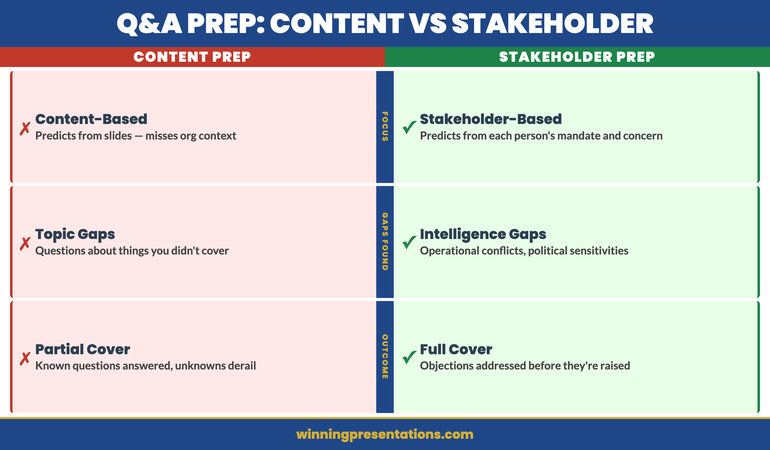
The standard advice for Q&A preparation is to anticipate likely questions and prepare answers. Most presenters do this to some degree — they think through the three or four questions they most expect, and they have responses ready. The problem is that this preparation is usually anchored to the content of the presentation, not to the perspective of the individual decision-makers in the room.

Questions from executive audiences rarely come from the content alone. They come from three other sources that content-focused preparation misses entirely. The first is organisational context — information about operational priorities, competing initiatives, budget constraints, or political dynamics that the presenter does not have access to. The Q3 migration in Tomás’s case was not in his brief. The second is personal priority — each executive in the room has a specific mandate, a specific set of concerns, and a specific lens through which they evaluate proposals. The CFO’s objection will be different from the General Counsel’s, even to the same proposal. The third is relational history — prior decisions, prior relationships with the presenter or the team, prior positions taken on related topics that create a predisposition toward certain objections.

Content-focused Q&A preparation addresses none of these three sources. Stakeholder-focused preparation addresses all of them — and it is the preparation discipline that consistently separates executives who navigate complex Q&A sessions from those who are regularly caught off guard. The approach to building a question map before a presentation provides the foundation that the stakeholder objection framework extends.

The Stakeholder Objection Map: A Pre-Presentation Framework

A stakeholder objection map is a structured document — typically a simple table — that organises your pre-meeting intelligence about each key decision-maker. It is built before you write your slides, not after. The sequence matters: knowing what each person is likely to object to shapes how you structure the presentation, what you address pre-emptively in the body of the talk, and what you prepare in your appendix for Q&A.

The map has five columns for each stakeholder. Their primary mandate — the single most important outcome their role is measured on. Their most likely concern about your proposal — what threatens their mandate, their budget, their operational plan, or their existing position. Their objection type — how they tend to raise concerns (more on this below). The evidence they need to be satisfied — what specific data, commitment, or assurance would move them from concern to support. And the information gap — what you do not know about their position that you need to find out before the meeting.

Building this map requires more than internal analysis. It requires conversations — with the person’s direct reports, with colleagues who have presented to them before, and ideally with the person themselves in a pre-meeting. The intelligence in the map is not available from the organisation chart or the meeting agenda. It comes from the network of people who know how each stakeholder operates and what they are currently focused on.

The map also surfaces the information gaps — the things you do not know — which are as valuable as the things you do know. An information gap is a risk: it is a question you cannot answer, a conflict you have not resolved, or a position you have not aligned before walking into the room. Each information gap in the map generates a pre-meeting action: who do you need to speak to, and what do you need to find out? Addressing information gaps before the meeting is the most reliable way to eliminate the category of objection that surprised Tomás.

Stakeholder objection map structure: five columns covering mandate, concern, objection type, required evidence, and information gaps

The Five Objection Types Executives Use Most

Identifying not just what someone might object to, but how they tend to raise objections, significantly improves preparation quality. Executive objections cluster into five recognisable types, and each type requires a different response approach.

The financial scrutiny objection. “What is the payback period?” “How does this compare to the cost of doing nothing?” “What assumptions sit behind the revenue projection?” This objection type is characteristic of CFOs, finance committee members, and CEOs with a strong financial orientation. It requires precise, conservative financial analysis — and the willingness to acknowledge uncertainty ranges rather than presenting false precision that invites challenge.

The operational feasibility objection. “Do we have the capacity to execute this alongside our existing commitments?” “What happens to current-state operations during the transition?” “Who owns the delivery?” This is the COO’s territory, and it is the objection type that most surprises presenters who have focused on the strategic case. The response requires a credible implementation narrative — not just a plan, but an honest assessment of dependencies, constraints, and risks.

The risk and governance objection. “What is the regulatory position?” “Have legal reviewed this?” “What is the downside scenario?” General Counsels, Chief Risk Officers, and Non-Executive Directors with governance responsibilities raise this type. The response requires a clear risk register and a demonstrated understanding of the regulatory context — not a dismissal of the risk, but a credible mitigation position.

The strategic alignment objection. “How does this fit with the three-year plan?” “Does this conflict with the decision we made in January?” “Is this the right priority given where we are in the cycle?” This objection type tests whether the presenter has done their homework on the organisation’s strategic context. It requires a clear articulation of how the proposal connects to, rather than competes with, existing strategic commitments.

The political or territorial objection. “This affects my team’s remit — has that been discussed?” “I wasn’t aware this was moving at this pace.” “What does the [other division / partner organisation / key client] think about this?” This objection type is the hardest to prepare for from the content alone, because it arises from organisational dynamics rather than analytical concerns. It is addressed almost entirely through pre-meeting stakeholder engagement — by identifying territorial sensitivities before the presentation and addressing them through direct conversation beforehand.

A full Q&A preparation framework covering all five objection types, with structured response approaches for each, is the core of the Q&A preparation briefing document approach — building a written document that maps objections before the meeting is more reliable than keeping this analysis in your head.

A System for Predicting and Handling Executive Q&A

The Executive Q&A Handling System — £39, instant access — gives you a structured approach for predicting the questions executives will ask before you walk into the room, and a proven framework for handling the ones you didn’t predict. Designed specifically for high-stakes Q&A in boardrooms, investment committees, and executive approval settings.

  • System for predicting and preparing for executive questions
  • Stakeholder analysis frameworks for Q&A preparation
  • Response structures for each of the five objection types
  • Scenario playbooks for hostile, sceptical, and ambush questions

Get the Executive Q&A Handling System →

Designed for executives who present to boards, investment committees, and senior leadership teams where Q&A shapes the outcome.

Using Pre-Meeting Intelligence to Narrow the Unknown

Pre-meeting intelligence gathering is the most underused tool in executive Q&A preparation. The standard approach is to spend the preparation period building slides and rehearsing content. The more effective approach is to spend a significant portion of the preparation period gathering intelligence about the room — and using that intelligence to shape both the content and the Q&A preparation.

Intelligence gathering has three tiers. The first tier is documented intelligence — board papers, committee minutes, prior presentations on related topics, and any written communications that reveal the current position or concerns of key stakeholders. This is available without any direct outreach and should always be reviewed before stakeholder conversations.

The second tier is network intelligence — conversations with people who know the key decision-makers, have presented to them recently, or operate in the same organisational space as your proposal. These conversations are not about gathering gossip; they are about understanding operational context, recent decisions that bear on your proposal, and the specific lens each person brings to the topic. A thirty-minute conversation with the CFO’s direct report the week before the presentation can eliminate the category of financial scrutiny objection that otherwise catches presenters by surprise.

The third tier — and the most valuable — is direct pre-meeting conversations with the key decision-makers themselves. A brief meeting with the CFO to walk through the financial model, a conversation with the COO to understand the Q3 operational picture, a call with the Non-Executive Director who has the most questions about governance — each of these conversations serves two purposes simultaneously. They provide intelligence about likely objections. And they give each stakeholder the opportunity to raise their concerns in a context where you can address them properly, rather than in a room where the quality of your answer affects the credibility of the entire proposal in front of their peers. This pre-meeting alignment principle is explored in detail in the framework for managing executive objections — the same intelligence-gathering logic applies directly.

People also ask: How do I know what objections executives will raise before a presentation? You cannot know with certainty, but you can narrow the range substantially. Start with their role mandate — what outcome is each person most accountable for? Map your proposal against that mandate and identify where it creates tension, uncertainty, or additional work. Then layer in their known communication style and objection type. Finally, review any recent decisions or positions they have taken that might predispose them to a particular concern. This three-step analysis covers the majority of predictable objections for most executive audiences.

Building Prepared Responses That Hold Under Pressure

A prepared response to an anticipated objection is not a scripted answer. It is a structured position — a clear statement of your view, supported by the specific evidence or reasoning that addresses the concern, delivered with the confidence that comes from having thought it through rather than constructing it under pressure in real time.

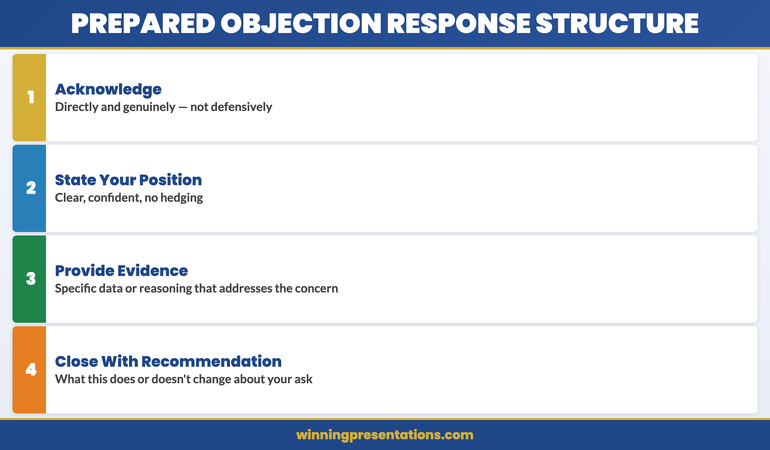
Prepared responses for executive objections should follow the same logical structure regardless of the objection type. Acknowledge the concern directly — not dismissively, but genuinely. State your position clearly. Provide the specific evidence that supports it. Identify any limitations or uncertainties you have not resolved. And close with a clear statement of what the concern does or does not change about your recommendation.

The acknowledgement step is the one most commonly skipped under pressure. When a challenging question is asked in a high-stakes room, the instinct is to move immediately to the defence of your position. But skipping the acknowledgement signals that you are treating the question as an attack rather than a legitimate concern — and it puts the questioner in a position where they feel the need to restate or escalate their objection rather than hear your response. A two-second acknowledgement — “That is an important point, and it is something we looked at carefully” — resets the dynamic before the substantive response begins.

For objections where the honest answer includes genuine uncertainty or an unresolved issue, the prepared response should include a clear statement of what you do not yet know and how you plan to resolve it. “We have not yet confirmed the Q3 implementation timeline with the programme team — I can have that information to you by Thursday” is a stronger response than a hesitant or improvised attempt to address a gap you were not expecting. Acknowledging the gap and providing a specific resolution commitment maintains credibility; appearing to improvise an answer to a question you should have known damages it.

Four-step structure for prepared responses to executive objections: acknowledge, state position, provide evidence, close with recommendation

Managing Live Objections When Preparation Meets Reality

Even the most thorough preparation leaves gaps. Every executive Q&A session will include at least one question you did not anticipate — either because you lacked the intelligence to predict it, or because the conversation takes a direction you could not have foreseen. The discipline of live Q&A management is knowing how to handle these moments without losing the forward momentum of the presentation.

The most reliable technique for unexpected objections is the structured pause. Before responding, take a deliberate two to three second pause. This pause serves multiple functions simultaneously: it signals that you are taking the question seriously rather than deflecting, it gives your cognitive processing system time to retrieve relevant information, and it prevents the escalating improvisation that produces unclear or contradictory answers. Most presenters fear the pause because they equate it with appearing unprepared. Experienced executive audiences read a deliberate pause as thoughtfulness, not ignorance.

For questions where you genuinely do not have an answer, the most credible response is a direct acknowledgement combined with a specific commitment. “I don’t have the data on that with me, but I will confirm it in writing by end of week” is a more credible answer than an improvised approximation that may be wrong. Executives at board level make high-stakes decisions regularly — they are practised at working with incomplete information, and they respect presenters who are clear about the boundaries of their knowledge.

The Executive Q&A Handling System covers the full range of live Q&A techniques — including the specific approaches for handling hostile questions, multi-part questions, and questions that are designed to challenge your credibility rather than seek information. If you want a structured approach to the live session as well as the preparation, the system addresses both phases of the Q&A challenge.

Predict the Questions. Control the Room.

The Executive Q&A Handling System — £39 — gives you a complete framework for predicting executive objections before the meeting and handling the ones you didn’t predict when they arise. Stop rebuilding your Q&A preparation from scratch for every presentation.

Get the Executive Q&A Handling System →

Designed for executives whose Q&A performance shapes high-stakes approval decisions.

Frequently Asked Questions

How far in advance should I start preparing for executive Q&A?

For a significant investment approval or board presentation, Q&A preparation should begin at least two weeks before the meeting — with the stakeholder objection map completed in the first week and pre-meeting conversations scheduled for the second week. This timeline allows you to identify and address information gaps before the day of the presentation, rather than discovering them in the room. For smaller presentations to a familiar audience, a structured but compressed version of the same process — a few hours of stakeholder mapping and one or two brief conversations — still adds significant value over content-only preparation.

What do I do if an executive raises an objection I can’t answer?

Acknowledge the question directly, state clearly that you do not have a complete answer, and make a specific written commitment to follow up. “I want to make sure I give you an accurate answer on that — let me confirm the position and come back to you in writing by [specific date].” This response preserves credibility because it demonstrates that you are more interested in giving an accurate answer than in appearing to have one. Follow through on the commitment within the stated timeframe — failing to do so damages trust more than the original gap did.

Should I address anticipated objections in the body of the presentation before Q&A?

Yes, for the most predictable and significant objections — but with care. Pre-empting objections in the presentation body works well when you can address them briefly and confidently as part of the logical flow of your argument. It works less well when the objection requires extensive defence, because you are then allocating significant presentation time to a concern rather than to your positive case. A useful rule of thumb: address objections that, if unaddressed, would prevent a decision-maker from following your argument. Leave objections that are more about detail or verification to the Q&A, where you can give them your full attention in response to a direct question.

Get weekly Q&A and presentation strategy in your inbox

Every Thursday, The Winning Edge delivers one actionable insight for executives who present to boards, investment committees, and senior leadership teams — including practical Q&A preparation techniques drawn from real board-room experience.

Subscribe to The Winning Edge →

About the Author

Mary Beth Hazeldine is Owner & Managing Director of Winning Presentations. With 25 years of corporate banking experience at JPMorgan Chase, PwC, Royal Bank of Scotland, and Commerzbank, she advises executives across financial services, healthcare, technology, and government on Q&A strategy, stakeholder preparation, and structuring high-stakes presentations for board and executive approval.

16 Mar 2026
Tense steering committee meeting with an executive raising a difficult question while the presenter maintains composure, modern boardroom setting, navy and gold corporate aesthetic

Steering Committee Q&A: Why “We’ll Take That Offline” Is a Red Flag

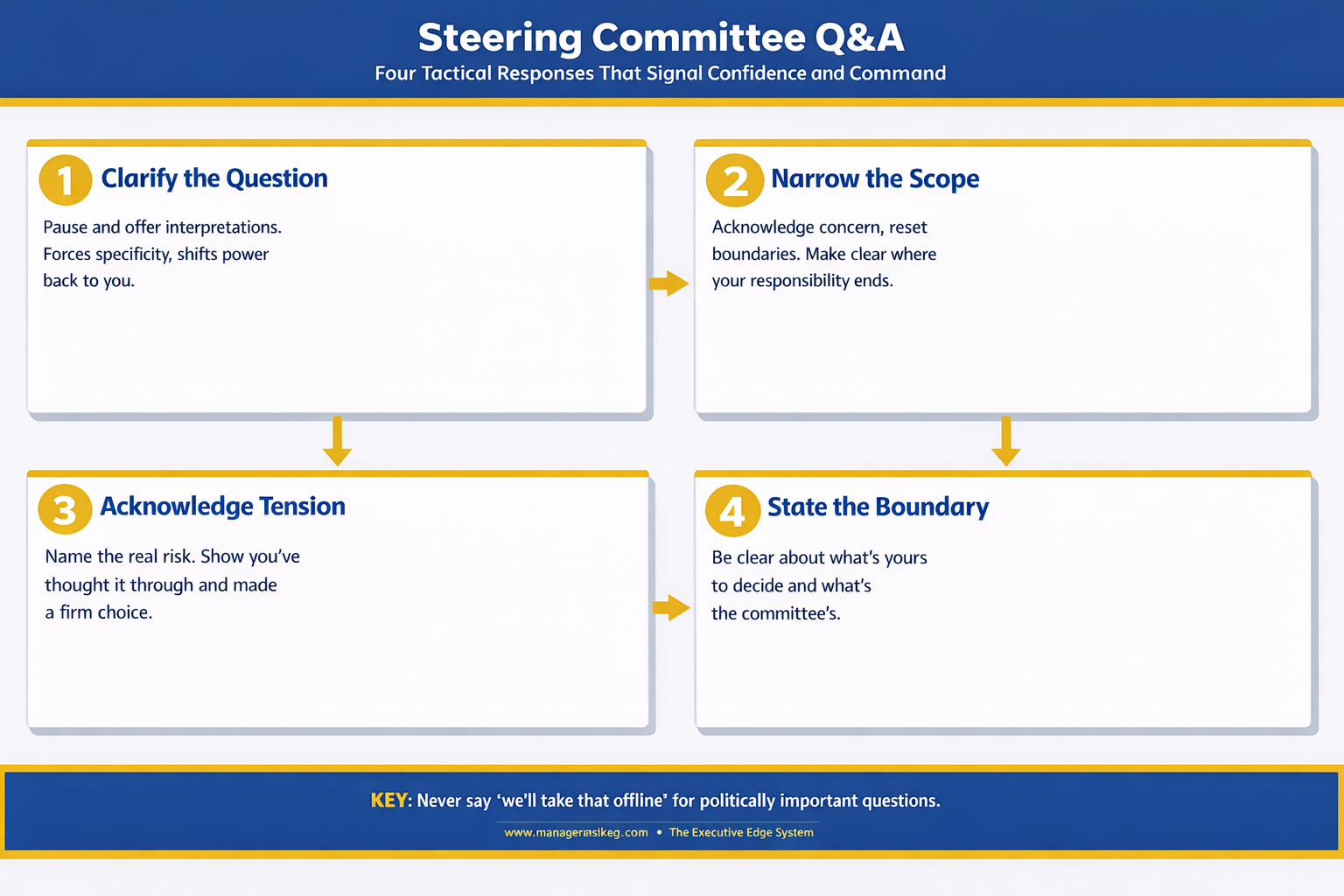
Quick Answer: Steering committees have different political dynamics than boards. When someone asks a tough question and you say “We’ll take that offline,” you’ve just signalled: “I don’t have a clear answer” or “I’m avoiding this in front of the group.” The steering committee reads that as weakness. The answer is to handle the question in the room—specifically, with one of four tactical approaches: clarify the question, narrow the scope, acknowledge the tension, or state the decision boundary. These techniques work because they demonstrate confidence and command.

Rescue Block: The steering committee is asking questions that feel hostile. Budget constraints. Scope questions. Political landmines. Your instinct is to defer: “We’ll take that offline and come back to you.” But the moment those words leave your mouth, the room sees you as avoiding, not confident. Steering committees are politically charged. Questions are tests. The executives want to see if you can think clearly under pressure. The Executive Q&A Handling System teaches you how to answer steering committee questions in the room with clarity and command.

It was Thursday. The steering committee for a major transformation initiative had 12 people in the room. Three were executives from the CFO’s office. Two were operational heads from different business units. The rest were middle managers and programme leads.

Sarah, the programme director, had presented the three-year implementation roadmap. Solid timeline. Clear milestones. Realistic budget.

Then the CFO’s deputy asked: “The timeline assumes we’ll maintain headcount through Year Two. What happens to the budget if the headcount freezes? Which workstreams get cut?”

It was a trap question disguised as a scenario. Behind it: political concern about a possible cost reduction that the CFO hadn’t publicly committed to. Sarah’s answer would signal whether she understood the political risk.

Sarah’s instinct was to defer: “We’ll take that offline and model the scenarios.”

But she’d been trained differently. She paused. She said: “That’s a critical assumption. Let me clarify what you’re asking: are you testing whether we’re exposed to a headcount freeze, or are you asking about the sequencing if a freeze happens?”

The CFO’s deputy leaned back. Slight nod. She’d asked a political test question, and Sarah had recognized it immediately. Sarah wasn’t avoiding. She was clarifying what was really being asked.

Sarah continued: “If it’s the exposure question, the answer is we’re exposed in Year Two onwards. If it’s the sequencing question, we’ve prioritised the client-facing work. But I want to be clear: that’s our view. This committee needs to decide whether that prioritisation aligns with the strategic direction.”

The CFO’s deputy nodded again. The room moved on. Sarah had answered the question not with data, but with political clarity. She’d shown: “I understand what you’re really asking. I’m not avoiding it. I’m making clear decisions about what’s yours to decide and what’s mine.”

That’s steering committee Q&A. It’s not about the answer to the literal question. It’s about reading the political intent and responding with clarity.

Why Steering Committee Q&A Is Different

A board of directors asks questions about governance, risk, and approval.

A steering committee asks questions about survival, territory, and resource competition.

These are different animals. Steering committees include people from multiple business units or functional areas. They all have resource interests. They all have competing priorities. They all have organizational power that overlaps with your project.

A question in a steering committee is never just a question. It’s always a statement of concern, a territory claim, or a political test.

“Does this affect my budget?” = I’m worried you’re taking my headcount or my spend.

“Have we talked to IT about this?” = I need to know if my friends in IT are aligned or if you’re going rogue.

“What happens if the business changes the strategy?” = I want to see if you’ll blow up if your plan changes, or if you’re flexible (and thus less of a threat).

Board questions test governance. Steering committee questions test political savvy and clarity.

Handling questions you don’t know the answer to is one skill. Handling steering committee questions where you DO know the answer but the question is politically loaded is a different skill entirely. You need to read the intent and respond to the intent, not just the words.

The “Offline” Red Flag and What It Signals

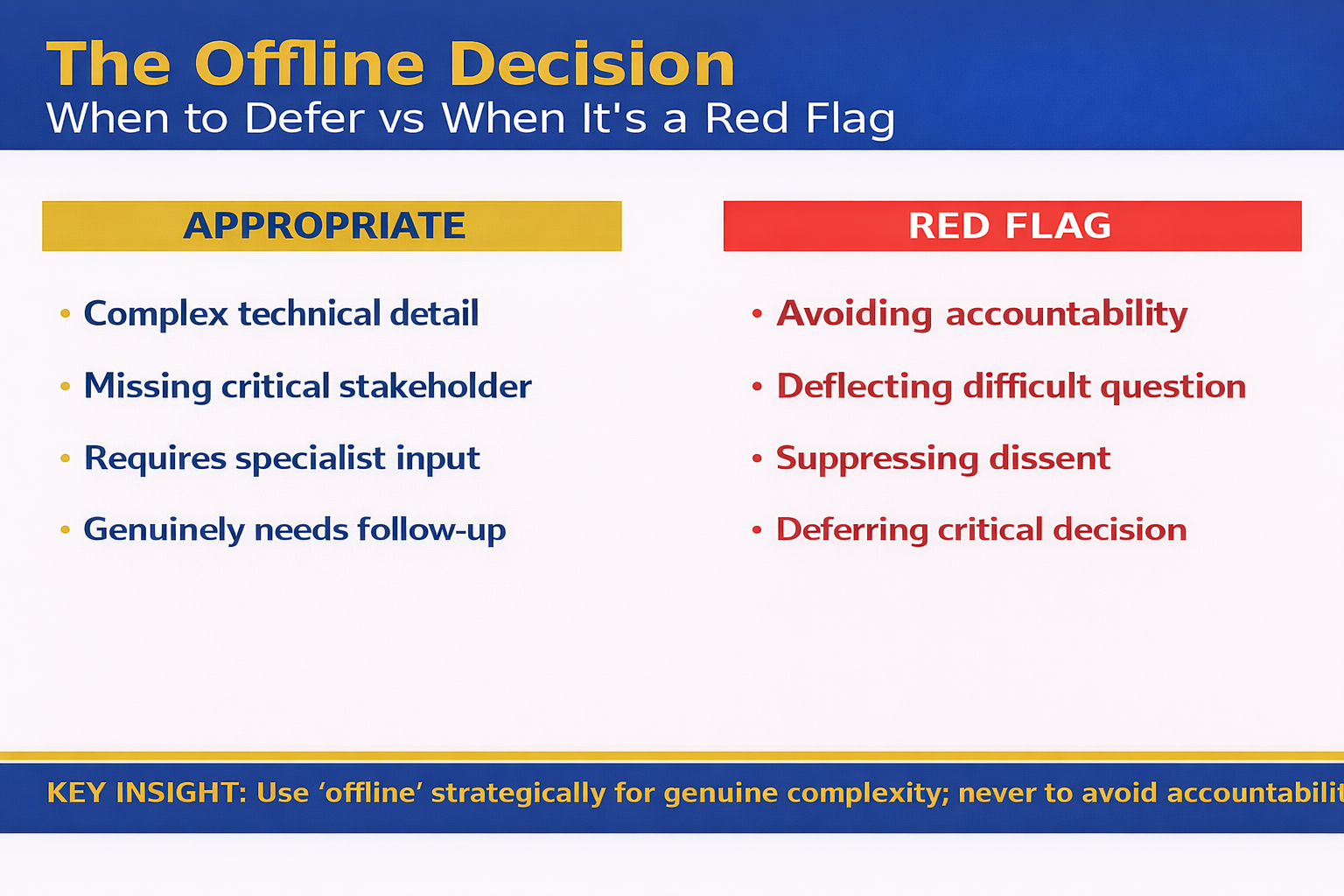
“We’ll take that offline” is a reasonable phrase in some contexts. If someone asks for a specific data point you don’t have at hand, deferring is fine.

But in a steering committee, when someone asks a question that’s politically important (about budget, scope, timeline, resource competition, strategic alignment), saying “We’ll take that offline” signals:

Signal 1: You’re avoiding. You don’t have a clear answer, or you’re uncomfortable giving it in front of the group. The committee reads this as: “You’re not as confident as you appeared.”

Signal 2: You don’t understand the political intent. If you did, you’d know that answering the question in the room matters. The person asking wants the room to hear that you’ve thought through this concern. Deferring suggests you don’t understand the political stakes.

Signal 3: You’re ceding authority. When you defer the answer, you’re saying: “This is something we’ll sort out separately, not something I’m committing to now.” The committee recognizes this as weak leadership.

Signal 4: You’re unreliable. Steering committees see deferred answers as commitments you’re backing away from. Even if you fully intend to follow up, the committee has already registered: “Not ready to commit.”

The best steering committee members never say “We’ll take that offline” in response to a politically important question. They answer the question in the room with clarity—either with a direct answer, or with a clear statement of the decision boundary.

Four Tactical Responses for Steering Committee Questions

Instead of deferring, you have four tactical moves that signal confidence and command.

Not every tactic works for every question. You learn to recognize which situation calls for which tactic. But each one keeps you in authority while addressing the actual concern underneath the question.

Tactic 1: Clarify the Question (Tactical Pause)

Use this when a question feels loaded but you’re not quite sure what’s really being asked.

The move: Pause. Say: “Let me clarify what you’re asking, because I want to make sure I’m answering the right thing.”

Then offer two or three possible interpretations of the question, and ask which one is the real concern.

Example: CFO’s deputy: “What happens to this timeline if we need to implement in two phases instead of three?”

You: “Are you asking whether we could compress the timeline? Or whether we’ve already planned for a phased approach? Or whether the budget changes if we phase it?”

What’s happening: you’re not avoiding the question. You’re showing that you’re thoughtful enough to know that different concerns might be hidden under the same words. You’re also forcing the questioner to be more specific, which shifts the power dynamic back to you.

The steering committee sees this as confidence, not deflection.

When to use: When the question feels politically charged but ambiguous. When you suspect the literal question isn’t the real concern. When you want to demonstrate that you’ve thought through multiple scenarios.

Tactic 2: Narrow the Scope (Reset Boundaries)

Use this when the question is trying to pull you into territory that’s not your responsibility.

The move: Acknowledge the question, but explicitly narrow the scope of what you’re answering for.

Example: Head of another business unit: “How are we going to manage the change impact on my team’s productivity during Year One?”

You: “That’s important. What we’re committing to is the implementation timeline and the resource plan on our side. How your team absorbs the change is something your leadership will need to decide. But we can absolutely provide you with the impact assessment so your team can plan for it.”

What’s happening: you’re not dismissing the concern. You’re making crystal clear where responsibility ends and theirs begins. You’re saying: “I own this part. You own that part. We’ll work together, but I’m not taking accountability for decisions that aren’t mine.”

This is power. The steering committee respects clarity about responsibility.

When to use: When someone is trying to make you responsible for outcomes that aren’t in your control. When the question reveals a territory battle. When you need to establish clear decision boundaries.

Tactic 3: Acknowledge the Tension (Show You’ve Thought It Through)

Use this when the question raises a real tension or risk that you’ve already considered.

The move: Don’t deny or minimize the concern. Acknowledge it directly. Then show that you’ve already thought through the implications and made a deliberate choice.

Example: Operations lead: “We’re taking on a lot of change concurrently. Won’t this distract from the quarterly close process?”

You: “Yes. You’ve identified a real tension. The concurrent timeline means we do have a distraction risk in Q2. We’ve made a deliberate choice to front-load the heavy work in Q1 and sequence the Q2 activities around your peak close period. That’s why the timeline is structured the way it is. We’ve weighed the distraction risk against the timeline pressure, and this is our answer.”

What’s happening: you’re not hand-waving away a legitimate concern. You’re showing: “I’ve thought about this. I’ve considered the risk. I’ve made an intentional choice. This is defensible.”

The steering committee sees this as credibility.

When to use: When the question raises a legitimate risk or tension. When you want to demonstrate that your proposal is thought-through, not naive. When you want to show that you’ve considered trade-offs and made intentional choices.

Tactic 4: State the Decision Boundary (Signal Authority)

Use this when the question is asking you to make a decision or commitment that isn’t yours to make.

The move: Be explicit about what decision is yours and what’s the committee’s. Don’t try to bridge that gap.

Example: CFO’s deputy: “If we get budget pressure, what will you cut?”

You: “That’s not my decision to make unilaterally. If budget pressure comes, we’d recommend to this committee what we’d cut first, based on risk and timeline impact. But the decision about what’s acceptable risk is yours. I can tell you what our recommendation would be, but I’m not going to make that trade-off call without this group.”

What’s happening: you’re not avoiding responsibility. You’re being explicit about where authority sits. You’re saying: “I’m competent in my area. You’re competent in yours. This question belongs to you.”

This is the clearest signal of authority. You’re comfortable not deciding things that aren’t yours to decide.

When to use: When the question is asking you to commit to something that requires board-level or steering committee approval. When you want to demonstrate that you understand governance and decision boundaries. When you want to avoid the trap of making promises that the committee will later challenge.

Decision matrix showing the four tactical responses to steering committee Q&A, with examples for each tactic and when to use them

Master the Political Dynamics of Steering Committee Q&A

Steering committees are different beasts than boards. The questions are political. The answers are leadership signals. The Executive Q&A Handling System teaches you how to read the political intent beneath steering committee questions and respond with four tactical moves that signal confidence and command.

  • Why “We’ll take that offline” signals weakness in steering committee settings
  • Four tactical responses that keep you in authority while addressing the real concern
  • How to read the political intent beneath loaded questions
  • How to clarify ambiguous questions without appearing defensive
  • How to state decision boundaries that respect authority without avoiding responsibility

Get the Executive Q&A System → £39

Used by programme directors, transformation leads, and business case owners facing steering committees. The tactical responses work because they work with committee psychology, not against it.

Stop deferring to “offline.” Answer with authority.

Get the System → £39

How to Predict Steering Committee Questions Before They’re Asked

The best steering committee performers don’t wait for questions. They predict them.

Every person on a steering committee has interests. Budget interests. Scope interests. Territory interests. Timeline interests. Risk concerns. The questions that get asked almost always relate to those interests.

Step 1: Map the committee members. Who are they? What business units do they represent? What would their concerns be if they were evaluating your proposal?

Step 2: List the likely concerns. Not about your proposal’s merit. About their interests. Budget pressure? Timeline risk? Scope creep that affects their area? Dependency on another team? Change management impact?

Step 3: Predict the questions. What question would each committee member ask if they wanted to surface their concern?

Step 4: Prepare your answer using one of the four tactics. Not a robotic answer. A tactical response that acknowledges the concern while maintaining your authority.

Step 5: Listen for the actual question. When someone asks a question you predicted, you’re not surprised. You’re ready with a response that signals confidence.

This preparation doesn’t mean you’re scripting responses. It means you’ve already thought through the political landscape. You know what concerns you’re going to face. You know which tactic fits which concern. When the question comes, you respond with authority because you’re not thinking for the first time in the moment.

The Difference Between Steering Committee Q&A and Board Q&A

A board asks: “Is this governed well? Are risks managed? Can we approve this?”

A steering committee asks: “Does this threaten my interests? Can I influence this? Do I understand what I’m committing to?”

Board Q&A is about reassurance. You’re proving that governance is sound.

Steering committee Q&A is about clarity. You’re proving that you understand the political terrain and you’re making intentional choices.

Board meeting Q&A techniques focus on explaining risk mitigation. Steering committee Q&A techniques focus on demonstrating political awareness.

This is why “We’ll take that offline” fails in steering committees. It signals: “I haven’t thought about the political dynamics of this question.” A board might accept that answer. A steering committee recognizes it as weakness.

Take it offline decision matrix infographic showing when deferring is appropriate versus when it is a red flag with specific scenarios for each category

Never Default to “Offline” Again

Steering committee members are evaluating you as a leader, not just your proposal. Every question is a test of your political awareness and your confidence. The Executive Q&A Handling System teaches you the four tactical moves that keep you in authority while addressing the real concern underneath loaded questions.

  • How to read the political intent beneath steering committee questions
  • The four tactical responses (clarify, narrow, acknowledge, boundary) and when to use each
  • How to predict steering committee questions before they’re asked
  • How to prepare answers that demonstrate confidence and command
  • Real examples from transformation initiatives, business cases, and strategic programmes

Get the Executive Q&A System → £39

Includes a question prediction worksheet and the four-tactic response framework with real boardroom examples.

Your next steering committee is your chance to show you understand the game.

Get the System → £39

Three Critical Questions About Steering Committee Q&A

What if I genuinely don’t know the answer to a steering committee question? Don’t pretend you know. Instead, say: “That’s a fair question. I don’t have that analysis right now, but I can see why it matters. Here’s what I’ll commit to: I’ll get you the answer, and I’ll bring it back to the steering committee so we can decide as a group.” You’re not deferring the question; you’re committing to a specific follow-up and a specific forum for the decision. The committee respects this more than “We’ll take it offline.”

What if my steering committee is very political and adversarial? The four tactics become even more important. Clarifying, narrowing, acknowledging, and stating decision boundaries are your protection against being tripped up. The more political the committee, the more important it is to be explicit about what you’re answering for and what you’re not. This prevents you from being pulled into territory that isn’t yours.

Can I use these tactics on a board, or are they strictly for steering committees? The tactics work on any committee, but the emphasis changes. Boards care more about governance and risk reassurance. Steering committees care more about political clarity and decision boundaries. You’d emphasise different aspects of the response depending on the audience, but the core technique is the same.

Is This Right For You?

✓ This is for you if: You present regularly to steering committees, you’ve noticed that some of your answers don’t land the way you expected, you want to improve your credibility in politically complex meetings, you’re often defending a proposal or a programme, you want to understand the political dynamics beneath the questions being asked.

✗ Not for you if: Your presentations are primarily to non-political audiences, you don’t face challenging Q&A, you’re comfortable with your current steering committee performance, you present only to supportive audiences.

The Signature Q&A System: Used by Steering Committee Leaders and Programme Directors

This is the Q&A architecture that works when the stakes are high and the committee is political. You’ll learn the four tactical responses, how to read political intent, how to predict questions before they’re asked, and how to maintain authority while addressing the real concerns beneath the questions.

  • Why steering committee Q&A is fundamentally different from board Q&A
  • The four tactical responses: clarify, narrow, acknowledge, decide boundary
  • How to read the political intent beneath loaded questions
  • Question prediction framework (map members, list concerns, predict questions)
  • How to prepare answers that signal confidence and command
  • Real examples from transformation initiatives, business cases, and strategic programmes
  • How to handle follow-up questions and maintain your position

Get the Executive Q&A System → £39

Programme directors, transformation leads, and business case owners use this system before every steering committee. The political dynamics get clearer every time you use it.

Frequently Asked Questions

How do I know if a question is really political or just a genuine inquiry?

Ask yourself: does this question reveal an interest or concern that affects the questioner directly? If yes, it’s political. The question might be framed as a general inquiry, but the person asking has something at stake. That stake is what you’re responding to. The four tactics work whether the question is purely political or genuinely interested, so you’re safe using them in either case.

What if I use one of these tactics and the questioner seems offended?

They’re not actually offended. They’re registering that you’ve recognized their political intent. That’s uncomfortable for people who don’t expect to be read so directly. But it’s also respectful—you’re taking their concern seriously enough to address it directly rather than deflecting. The discomfort passes quickly, and the respect remains.

Can I combine multiple tactics in a single answer?

Yes. You might clarify the question, acknowledge the tension, and state a decision boundary all in one response. As you get more comfortable with the tactics, you’ll develop a style that flows naturally and incorporates multiple moves. Start by mastering one tactic. Then combine them as your comfort grows.

Your Steering Committee Needs Your Clarity Now

Steering committees form to provide governance on strategic initiatives, transformation programmes, and business cases that span multiple functional areas. The political dynamics are real. The questions are tests. Your answers are leadership signals.

You have a steering committee coming up. Maybe next week. Maybe next month. When you walk into that room, you’ll either defer difficult questions with “We’ll take that offline,” or you’ll answer them with one of the four tactical moves.

The committee will recognise the difference immediately. And so will your credibility.

About the Author

Mary Beth Hazeldine is the Owner & Managing Director of Winning Presentations. With 24 years of corporate banking experience at JPMorgan Chase, PwC, Royal Bank of Scotland, and Commerzbank, she has delivered high-stakes presentations in boardrooms across three continents.

A qualified clinical hypnotherapist and NLP practitioner, Mary Beth combines executive communication expertise with evidence-based techniques for managing presentation anxiety. She has trained thousands of executives and supported high-stakes funding rounds and approvals.

Book a discovery call | View services

Resources From Winning Presentations

Subscribe to The Winning Edge, our weekly newsletter where we share Q&A strategies, real committee stories, and executive communication frameworks. Delivered every Monday.

Stop deferring questions to offline conversations. Start answering them in the room with clarity and command. Your next steering committee will show you what a difference the right tactical response makes.

This article was written with AI assistance and reviewed by Mary Beth Hazeldine.