

Power Posing Before Presentations: What the Research Actually Shows
Power posing before presentations — standing in an expansive posture for two minutes — does not reliably produce the hormonal changes Amy Cuddy’s original 2010 study claimed. Independent replications have not reproduced the cortisol and testosterone findings. What the research does support is that open, upright posture affects your own psychological state — not through hormone changes, but through proprioceptive feedback. For executive presenters, the most reliable pre-presentation confidence tools are deliberate preparation, controlled breathing, and an explicit intent statement — not a pose. Understanding why power posing became so popular reveals what presenters actually need.
→ What power posing originally claimed
→ What the replication research found
→ What posture actually does to confidence
→ A pre-presentation confidence sequence that works
→ When anxiety is deeper than a posture problem
→ Frequently Asked Questions
Marcus had read the book. He had watched the TED Talk three times. Two minutes before every high-stakes presentation, he disappeared into a bathroom cubicle, stood with his hands on his hips and his feet apart, and held the pose for exactly 120 seconds. He had been doing it for four years. He believed it worked — and he believed it so completely that when his L&D director mentioned the replication research at a team meeting, he felt something close to personal offence.
The L&D director was not wrong. The research Marcus had built his pre-presentation ritual around had not replicated. But the L&D director missed something important too: Marcus’s ritual was not entirely without value. The two minutes of stillness, the deliberate separation from the pre-presentation noise, the act of doing something purposeful rather than scrolling his phone in a corridor — all of that had genuine psychological value. The pose itself was irrelevant. The ritual was not.
This distinction — between a specific technique and the category of behaviour it represents — is where most of the power posing debate loses its usefulness. The question is not really “does power posing work?” The question is: what does an executive presenter actually need in the two minutes before they walk into a high-stakes room, and how do they get it reliably?
If presentation anxiety goes deeper than pre-presentation rituals can reach — if the fear is significant enough to affect your performance, your sleep, or your career decisions — Conquer Speaking Fear is a structured 30-day programme that addresses the underlying anxiety pattern, not just the surface symptoms.
What Power Posing Originally Claimed
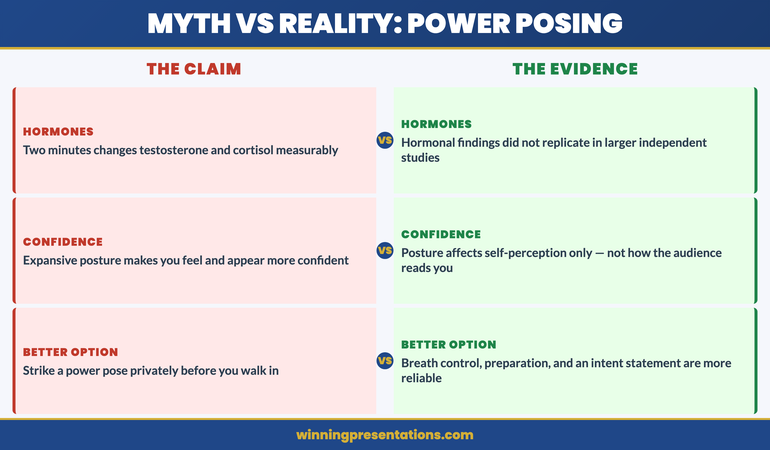
Amy Cuddy and her colleagues published a study in 2010 — later expanded into a widely shared TED Talk and a bestselling book — claiming that standing in an expansive, dominant posture for two minutes produced measurable physiological changes: increased testosterone and decreased cortisol. The conclusion was striking: a brief physical intervention could change your hormonal profile and, consequently, your psychological readiness for a high-stakes situation.
The research attracted enormous popular attention because it offered a simple, accessible, cost-free intervention for one of the most common professional problems: feeling underprepared or inadequate before an important presentation. The idea that two minutes of deliberate posture could level the physiological playing field was intuitively appealing and practically convenient. It required no equipment, no prior training, and no significant time investment.
The TED Talk became one of the most viewed in the platform’s history. It entered corporate learning programmes, coaching curricula, and pre-presentation advice from well-meaning managers worldwide. By the mid-2010s, power posing had achieved the status of established science in most professional training contexts, despite the fact that its scientific foundations were already being actively questioned by researchers in the field.
What the Replication Research Found
Independent attempts to replicate the hormonal findings of the original power posing study have not produced consistent results. A large pre-registered replication by Ranehill and colleagues in 2015 — involving a significantly larger sample than the original study — found that expansive postures did produce self-reported feelings of power, but did not produce the hormone changes that were central to Cuddy’s original claim. The cortisol and testosterone results did not hold.
Subsequent meta-analyses have generally confirmed this pattern: the psychological effects of posture — feeling more confident, more in control, more ready — are real and replicable. The hormonal effects are not. This distinction matters because the original claim was that power posing worked by changing your biology, which would then change your behaviour. The revised understanding is that power posing, if it has any effect at all, works through cognitive and attentional channels — it shifts what you are thinking about and how you are evaluating your own readiness, not what your hormones are doing.
Cuddy herself has refined her position over time, arguing that the self-reported psychological effects are the meaningful outcome, even in the absence of the hormonal findings. This is a legitimate scientific position, but it represents a significant narrowing of the original claim. The mechanism is different. The magnitude of effect may be different. And the implication for practice is different: if power posing produces a modest self-perception shift rather than a physiological transformation, then it competes directly with other cognitive techniques that may produce comparable or larger effects.
Conquer Speaking Fear — £39
Address the Anxiety Pattern That Rituals Can’t Reach
Pre-presentation rituals help. But if your anxiety is significant — if it follows you into the days before a presentation, affects your sleep, or causes you to avoid high-profile opportunities — it needs more than a posture adjustment. Conquer Speaking Fear is a structured 30-day programme that uses nervous system regulation and clinical hypnotherapy techniques to address the underlying anxiety pattern, not just manage its symptoms.
- 30-day structured programme for presentation anxiety and public speaking fear
- Nervous system regulation techniques grounded in clinical practice
- Clinical hypnotherapy methods adapted for professional presenters
- Designed for executives whose anxiety pattern affects their career and performance
Designed for professionals whose presentation anxiety is affecting their performance and opportunities.
What Posture Actually Does to Confidence
The research on embodied cognition — the relationship between physical posture and psychological state — is broader than the power posing debate and considerably more robust. Several consistent findings emerge from this literature that are directly relevant to presenters.
First, contracted, closed posture — shoulders rounded, chest caved, head down — has consistent negative effects on self-perception and cognitive performance. The research on this is more reliable than the research on expansive posture effects, possibly because the contrast between collapsed and upright posture is more physiologically significant than the contrast between neutral and expansive posture. If you are anxious before a presentation and your body has collapsed into itself, deliberately correcting your posture to upright — not superhero stance, just neutral upright — will have a measurable positive effect on how you feel.
Second, the relationship between posture and self-perception runs in both directions. Feeling confident tends to produce upright posture; upright posture tends to increase felt confidence. This is proprioceptive feedback — your body’s own sensory system reporting on its physical state and influencing your psychological state in return. This mechanism is real and supported by a substantial body of research. It is why slumping over your phone in a corridor before a presentation is a worse preparation strategy than standing or walking.
Third, the effect of posture on confidence is almost entirely self-directed, not audience-directed. Your posture in the two minutes before a presentation changes how you feel about yourself — it does not reliably change how your audience perceives you from the moment you walk in. Audience perception is shaped by how you carry yourself in the room, how you speak, and how you engage with questions — not by what you were doing in the corridor beforehand.
This reframes the useful question. Rather than asking whether expansive posture changes your hormones, ask: what physical and cognitive state do you want to be in when you walk through the door, and what is the most reliable way to get there in the time available? For most presenters, Conquer Speaking Fear addresses the systematic anxiety pattern that no pre-presentation ritual can fully manage on its own.
For specific physical techniques that reliably reduce anxiety state before a presentation, see the companion article on box breathing for executive presenters — a method with considerably stronger physiological support than power posing.
A Pre-Presentation Confidence Sequence That Works
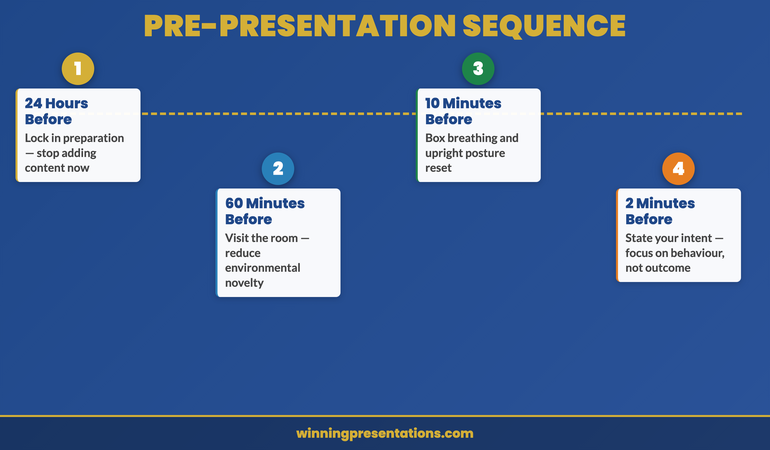
If the goal is to be in the optimal psychological state when the presentation begins, a structured pre-presentation sequence is more reliable than any single technique. The sequence below is designed for the 24 hours preceding a high-stakes presentation and can be adapted based on individual preference and available time.
24 hours before: Preparation lock-in. Make a deliberate decision to stop adding material to your preparation. Late additions to a presentation script or slide deck — made under the time pressure of the night before — consistently increase anxiety without improving presentation quality. The preparation phase should have ended by 24 hours before delivery. If you are still making significant changes at this point, note them as a learning for next time, but stop making them now. What you know is what you will present with.
60 minutes before: Environment scan. If possible, visit the presentation room before the audience arrives. Sit in the chair you will present from or stand at the front of the room. This familiarisation exercise reduces the novelty of the environment, which is one of the primary anxiety triggers for executive presenters. An unfamiliar room activates threat-assessment responses. A familiar room does not. This is why a structured pre-presentation ritual that includes environmental familiarisation is worth the time.
10 minutes before: Breath and posture reset. Find a quiet space and do four to six cycles of box breathing — four counts in, four counts hold, four counts out, four counts hold. Simultaneously check your posture: feet flat, shoulders back and relaxed, spine upright. This is not power posing. It is a deliberate physiological reset that reduces sympathetic nervous system activation and restores a baseline of physical composure. The effect is immediate and measurable.
2 minutes before: Intent statement. State — silently or aloud — your intention for the presentation. Not a prediction (“this will go well”) and not a hope (“I want them to like it”). An intent statement is about process: “I am going to be clear, I am going to be direct, and I am going to listen carefully to their questions.” This cognitive anchor replaces rumination about outcome — the most common source of pre-presentation anxiety escalation — with a focus on behaviour that is entirely within your control.
When Anxiety Is Deeper Than a Posture Problem
Pre-presentation techniques — power posing, box breathing, visualisation, intent statements — address the surface experience of presentation anxiety: the activation, the racing thoughts, the physical symptoms in the moments before walking in. For many executives, these techniques are sufficient. The anxiety is situational, manageable, and does not significantly affect performance or career decisions.
For others, the anxiety pattern is more persistent. It begins days before the presentation. It involves anticipatory catastrophising — elaborate internal narratives about what might go wrong. It affects sleep. It leads to over-preparation as an anxiety-management strategy rather than a quality-improvement strategy. In some cases, it affects which opportunities executives accept: declining high-profile presentations, deferring to colleagues in senior meetings, avoiding situations that would otherwise advance their careers.
This pattern is not addressable through posture. No two-minute ritual touches the underlying anxiety architecture that is generating it. Addressing it requires working at the level of the nervous system’s threat-assessment — the learned associations and conditioned responses that activate the anxiety cycle in the first place. This is the work that clinical approaches, including the nervous system regulation and hypnotherapy techniques in the cognitive restructuring approach covered in a separate article, are specifically designed to do.
For the Q&A dimension of presentation anxiety — particularly the fear of being caught off-guard by difficult questions — see today’s companion piece on handling repeated questions in presentations. Repeated questions are a particularly common anxiety trigger for executives who interpret them as a signal of inadequacy rather than a routine communication dynamic.
Conquer Speaking Fear — £39
A 30-Day Programme for Persistent Presentation Anxiety
When pre-presentation rituals are not enough — because the anxiety starts earlier, runs deeper, or affects your professional decisions — Conquer Speaking Fear gives you a structured 30-day approach to addressing the underlying pattern, not just managing the moment.
Designed for professionals whose presentation anxiety is persistent and affecting their performance.
Frequently Asked Questions
Is power posing harmful?
There is no evidence that power posing is harmful, and some evidence that it produces modest self-perception benefits in specific contexts. The concern is not that the technique is damaging — it is that over-reliance on a ritual whose effects are poorly understood may crowd out more effective interventions. If standing in a bathroom cubicle for two minutes helps you feel more settled before a presentation, there is no reason to stop. But if persistent presentation anxiety is affecting your performance and you are treating power posing as the solution, you may be underestimating the problem and its available remedies.
Does body language matter during the actual presentation?
Yes — but the effect operates differently than most presenters assume. Research on body language in presentations consistently finds that audiences respond primarily to energy and engagement, not to specific posture configurations. An executive who is genuinely engaged with the material and the audience will carry themselves authentically and read as confident. An executive who is performing a posture they believe signals confidence but do not feel will read as incongruent. The best preparation for confident body language during a presentation is thorough preparation that reduces anxiety, not a specific pose adopted beforehand.
What should I actually do in the two minutes before a high-stakes presentation?
Find a quiet space away from the pre-presentation conversation and noise. Stand or sit with upright posture — not expansive, just neutral and open. Do three to four rounds of box breathing to reduce physiological activation. State your intent for the presentation — one sentence about how you intend to show up, not what outcome you want. Then walk in. This sequence takes less than two minutes and draws on techniques with substantially stronger evidence than power posing. The goal is a calm, focused, ready state — not a peak adrenaline state, which is what some presenters are trying to produce and which tends to interfere with measured, authoritative delivery.
Subscribe to The Winning Edge — Mary Beth’s weekly briefing for executives on presentation confidence, anxiety management, and high-stakes communication.
About the Author
Mary Beth Hazeldine is Owner & Managing Director of Winning Presentations. With 25 years of corporate banking experience at JPMorgan Chase, PwC, Royal Bank of Scotland, and Commerzbank, she advises executives across financial services, healthcare, technology, and government on presentation confidence, communication strategy, and high-stakes delivery.