

How to Run a Project Kickoff Presentation That Aligns Teams
A structured kickoff meeting creates alignment from day one by clarifying objectives, roles, timelines, and dependencies. Delivered with clear communication and discipline, it prevents costly misunderstandings and sets the foundation for team cohesion and accountability throughout the project lifecycle.
Jump to:
When Kwame took over a financial systems migration for a mid-sized bank, his team had been handed a vague mandate: “Upgrade the core ledger platform.” No shared timeline. No defined scope. No clarity on how decisions would be made. Three months in, the project fractured. Developers and infrastructure teams were working towards different assumptions. Budget holders were caught off-guard by delays. A single, structured kickoff—delivered in the first week—would have caught these conflicts before they cost time and credibility. Instead, Kwame spent weeks unpicking misalignments that a clear kickoff meeting could have prevented entirely. The lesson stayed with him: the initial alignment session is not an admin formality. It’s the moment leadership either builds alignment or inherits chaos.
Struggling to structure your kickoff? Many leaders treat the kickoff as a procedural checkbox rather than a strategic moment to reset expectations and build shared understanding. If your teams have ever worked at cross-purposes on a project, this initial alignment meeting is where that friction begins—or gets prevented.
Objective Clarity: What Success Looks Like
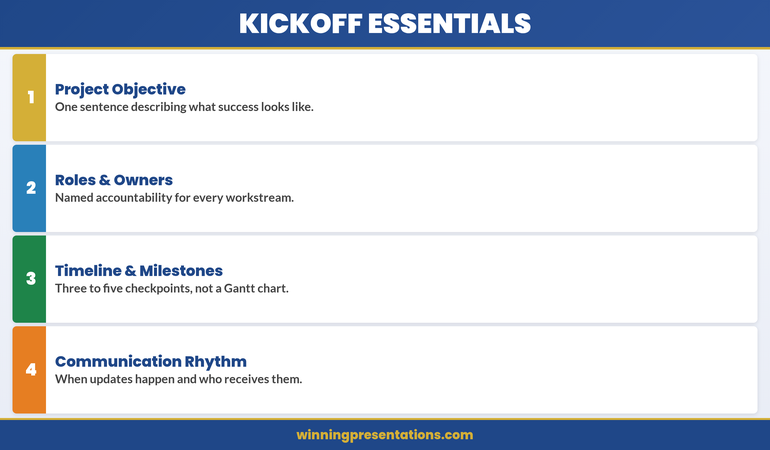
The first responsibility of any kickoff is to articulate what done looks like. Too many projects suffer from scope creep and misaligned priorities because the team never heard a single, unambiguous statement of objectives.
Structure this section in three layers. Start with the business case: why this project exists and what value it creates. Then move to project scope: what is included, what is explicitly out of scope, and the success criteria by which progress will be measured. Finally, address constraints: budget, schedule, resource availability, regulatory requirements, or technical dependencies that will shape execution.
The disciplines that matter most are clarity over brevity. Your team will not be offended by explicitness; they will be relieved by it. A structured kickoff that spends three minutes on this section—with concrete examples and non-negotiable boundaries—prevents weeks of navigating ambiguity later.
Build Kickoff Presentations That Land
Structure your slides to establish clarity, credibility, and shared accountability from the first moment. The Executive Slide System gives you templates and frameworks for every element—from objective clarity to stakeholder alignment to decision rights.
Team Roles and Accountability Structures
The second pillar of any effective kickoff is clarity about who does what. Ambiguity about roles creates both resentment and inefficiency: people either duplicate work or assume someone else is handling a critical task.
Use a RACI matrix or role grid within your presentation. For each major workstream or function, define who is Responsible (does the work), Accountable (makes the final call), Consulted (provides input), and Informed (receives updates). Be explicit about interdependencies: which teams need to coordinate, and what decisions require sign-off from which stakeholders.
Address escalation paths early. If a blocker arises—a dependency fails, a resource becomes unavailable, or priorities shift—who decides how to respond? Naming this in the kickoff removes the friction of figuring it out under pressure later. The discipline is clarity about authority, not the specific person in a role.
Many teams skip this step because it feels administrative. That’s a mistake. The teams that recover fastest from obstacles are the ones that know, in advance, who decides and how escalation works. Your initial meeting should be that reference point.
Timeline, Dependencies, and Constraints
The third pillar must establish the rhythm of the project: key milestones, delivery dates, decision gates, and review points. These are not optional; they are the skeleton that holds the project together.
Map the critical path visibly. What tasks are sequential? Where can work happen in parallel? Which decisions must land before downstream work can begin? Highlight any external dependencies—approvals from regulatory bodies, third-party deliverables, resource constraints—that could affect timing. Be honest about risk: if you are uncertain about a delivery date, say so and explain what would unlock that certainty.
The teams that trust their leaders are the ones whose leaders are honest about constraints and timelines. A kickoff presentation that acknowledges real trade-offs—scope versus speed, quality versus cost—builds credibility far more than optimistic over-promises ever will.
Include a simple visual timeline or Gantt-style chart that every team member can reference. This becomes your single source of truth for scheduling, dependencies, and deliverables.

If you’re building this from scratch, the frameworks inside the Executive Slide System will accelerate your preparation and ensure you don’t miss critical elements.
Communication Cadence and Escalation Paths
Projects live or die by communication discipline. Your kickoff presentation must establish how often teams will synchronise, what gets reported, and where escalation happens. Without this structure, communication either becomes excessive and chaotic, or falls away entirely until problems surface too late to fix.
Define the cadence: weekly stand-ups for core team members, biweekly executive updates, monthly steering committee reviews. Be clear about what each meeting covers. Stand-ups are about blockers and coordination; steering updates are about progress, risks, and business impact. Make this distinction explicit, because conflating them leads to either too much detail at the top or too little coordination at the working level.
Address escalation thresholds. What constitutes a blocker that needs immediate attention? If a delivery date is at risk by more than one week, does that trigger escalation? If budget variance exceeds 10%, who gets informed and when? Being specific here removes guesswork and ensures that problems don’t fester silently until they become crises.
Document how team members provide updates: email, shared spreadsheet, project management tool, or presentation. Consistency in format saves time and reduces the burden on whoever synthesises information for leadership.
Templates That Work
The Executive Slide System includes ready-made frameworks for kickoff presentations, stakeholder alignment slides, and decision-gate templates.
Stakeholder Engagement and Decision Rights
Many kickoff presentations fail because they do not explicitly map stakeholder engagement. Who are the sponsors? The approvers? The influencers whose buy-in matters? And how will each group be involved in decision-making as the project unfolds?
Use a stakeholder mapping framework as part of your kickoff. Segment stakeholders by their level of interest and influence. High-influence, high-interest stakeholders typically need steering-group involvement and regular executive briefings. High-influence but lower-interest stakeholders need selective updates and a clear escalation path. The discipline is acknowledging that different stakeholders need different communication approaches.
Be explicit about decision rights: which decisions can the project team make independently? Which require steering group approval? Which need sign-off from finance, legal, or other functional leaders? Clarifying this at the kickoff prevents two months of work being derailed because someone assumed they had authority they did not actually have.
A kickoff that treats stakeholder engagement as an afterthought is one that will revisit stakeholders repeatedly, creating friction and slowing progress. Front-load this work in your initial alignment meeting, and the project moves faster.
Frequently Asked Questions
How long should a kickoff meeting be?
A focused kickoff typically runs 45 to 90 minutes, depending on project complexity and team size. The rule of thumb: spend 15 minutes on objectives, 15 on roles and accountability, 15 on timeline and dependencies, 10 on communication cadence, and 10 on stakeholder engagement. If you have a large steering group or multiple workstreams, add time accordingly. The discipline is not brevity for its own sake, but clarity: never rush this material to fit a shorter window.
What if the team has already started work before the kickoff?
It is never too late to conduct a structured kickoff, even mid-project. If work has begun before alignment was established, the kickoff becomes a reset: an opportunity to surface misalignments, redefine scope, and rebuild shared understanding. Be honest about why the kickoff is happening now. Many teams will appreciate the clarity, even if the timing is not ideal. The cost of the reset is usually far lower than the cost of continuing in misalignment.
How do I handle disagreement about scope or timeline in the kickoff?
Disagreement in a kickoff is healthy and necessary. It means people care and are thinking critically. The discipline is to address disagreement in the meeting, not to let it fester. Use the kickoff as the forum to work through trade-offs: What happens if we accelerate the timeline? What does that mean for scope or quality? If a key stakeholder disputes the scope, that conversation needs to happen now, with the full team present, so that everyone leaves with the same understanding. A kickoff that surfaces conflict and resolves it is far more valuable than one that papers over disagreement.
Get executive presentation insight in your inbox. Subscribe to The Winning Edge for frameworks, case studies, and strategies to lead with impact.
Download the Executive Presentation Checklist (free) to prepare for your next kickoff.
Related: After you master the kickoff, learn how to structure presentations for other critical moments. Read The Contract Renewal Presentation to apply the same frameworks to stakeholder updates and approval scenarios.
Your next kickoff meeting is an opportunity to either build the foundation for team success or inherit months of misalignment and rework. Choose clarity.
Mary Beth Hazeldine is Owner & Managing Director of Winning Presentations. With 24 years of corporate banking experience at JPMorgan Chase, PwC, Royal Bank of Scotland, and Commerzbank, she advises executives across financial services, healthcare, technology, and government on structuring presentations for high-stakes funding rounds and approvals.