Tag: project management

24 Apr 2026

Budget Overrun Presentation: How to Brief Executives When Projects Exceed Costs

Quick Answer

A budget overrun presentation succeeds when it leads with the size of the problem, explains the cause clearly, and presents a credible recovery path β€” all before anyone asks. The executives in the room do not need surprise minimised. They need enough information to make a decision about what happens next, and they need that information structured so they can act on it quickly.

TomΓ‘s was ninety seconds into his project status update when the CFO held up one hand and said, “Skip to the number.”

The number was Β£1.4 million over the approved budget β€” a 22 per cent overrun on a digital transformation programme that had been running for nine months. TomΓ‘s had prepared twelve slides explaining the circumstances: regulatory changes, vendor delays, scope additions requested by the business. All of it true. All of it irrelevant to what happened next.

The CFO looked at the COO. The COO looked at the programme sponsor. Somebody asked whether the project should be paused. TomΓ‘s spent the next forty minutes defending a project he had originally been asked to update on. By the time the meeting ended, the overrun was no longer the problem. The problem was that nobody in the room trusted the forecast anymore.

That meeting could have gone differently. Not because the numbers were wrong, but because the presentation was built to explain the overrun rather than to manage it.

Presenting a budget overrun to executives this quarter?

The Executive Slide System gives you the templates and frameworks to structure difficult financial briefings β€” so executives get the information they need to make decisions, not a defensive explanation they have to interpret.

Explore the Executive Slide System β†’

Why Budget Overruns Destroy Trust Faster Than Missed Deadlines

A missed deadline is a schedule problem. A budget overrun is a judgement problem. That distinction matters because it changes how executives interpret everything else you say.

When a project runs late, the typical assumption is that something took longer than expected β€” complexity, dependencies, resource availability. Most senior leaders have seen this before and can contextualise it. When a project runs over budget, the assumption is different: somebody either underestimated the costs, failed to control spending, or didn’t flag the issue early enough. All three are judgement failures, and judgement failures erode trust in the person presenting β€” not just the project.

This is why budget overrun presentations require a fundamentally different approach from standard project updates. A project update says “here is what’s happening.” A budget overrun briefing says “here is what went wrong, here is why I didn’t catch it sooner, and here is exactly what I’m going to do about it.” The order of those three elements matters more than most presenters realise.

The second complication is that budget overruns compound. An executive hearing about a Β£1.4 million overrun is not just thinking about Β£1.4 million. They are thinking: “Is this the final number, or is there more coming?” If your presentation doesn’t explicitly address forecast reliability β€” why they should believe the new number β€” you will face that question regardless. Better to answer it before it’s asked.

Understanding how to handle budget variance presentations is useful context here, but a variance and an overrun are not the same conversation. A variance is expected movement. An overrun is a breach of the approved envelope. The stakes are higher, and the presentation needs to reflect that.

The Three-Part Structure for Overrun Briefings

Every effective budget overrun presentation follows the same logic, regardless of the size of the overrun or the industry. It answers three questions in a specific order, and the order is non-negotiable.

Part 1: The current position β€” exactly how much and exactly why

Open with the number. Not the background, not the context, not the history of the project β€” the number. State the approved budget, the current forecast, and the variance in both absolute and percentage terms. Then explain the cause in no more than three clear categories. For example: “The overrun is driven by three factors. Regulatory requirements added to the scope accounted for Β£620,000. Vendor repricing after the contract mid-point accounted for Β£480,000. Internal resource reallocation from a parallel programme accounted for the remaining Β£300,000.”

Notice what this does not include: excuses, qualifications, or phrases like “due to unforeseen circumstances.” Every circumstance was unforeseen until it happened. What executives need is specificity, not apology.

Part 2: Forecast reliability β€” why they should believe this number

This is the part most presenters skip, and it is the part that determines whether the room trusts you or not. After presenting the current variance, explicitly address the question: “Is this the final number?” Explain the methodology behind your revised forecast. Show which cost categories are now fixed (contracted, committed, or delivered) and which still carry variance risk. If you are 85 per cent through the project with 90 per cent of costs committed, say so β€” that is a materially different risk profile from being 60 per cent through with significant uncommitted spend.

The best presenters I have worked with include a simple confidence indicator on their forecast slide: a three-tier assessment showing which cost lines are firm, which are estimated, and which carry identified risk. This gives the CFO what they actually want β€” not certainty, but a clear view of where uncertainty remains.

Budget overrun presentation structure showing three parts: Current Position with variance breakdown, Forecast Reliability with confidence indicators, and Recovery Plan with timeline and cost controls

Part 3: The recovery plan β€” what you are going to do about it

End with a specific, time-bound recovery or completion plan. This is not a list of good intentions. It is a slide that shows: revised completion timeline, remaining cost envelope, specific cost controls you have already implemented, and the decision you need from the room (additional funding approval, scope reduction, or a hybrid approach). If the project can be de-scoped to bring costs back within the original budget, show what that looks like alongside the full-scope option. Let executives choose β€” do not choose for them.

Need to Brief Executives on a Budget Overrun This Month?

Structuring a budget overrun presentation requires a different framework from a standard update. The Executive Slide System β€” Β£39, instant access β€” gives you the templates designed for exactly these high-stakes financial conversations:

  • Slide templates for financial variance and recovery plan briefings
  • AI prompt cards to structure your cost analysis and forecast slides
  • Executive summary frameworks for delivering difficult financial news
  • Stakeholder-ready formats that separate the problem from the plan

Get the Executive Slide System β†’

Designed for executives presenting financial decisions to senior leadership.

The Recovery Slide That Restores Executive Confidence

If the overrun slide breaks trust, the recovery slide rebuilds it. And the difference between a weak recovery slide and a strong one is specificity.

A weak recovery slide says: “We will implement tighter cost controls and review the project plan to identify savings.” This tells executives nothing. It reads like a response drafted by someone who has not yet worked out what to do.

A strong recovery slide shows four things:

1. What has already changed

List the cost controls you have already implemented β€” not the ones you plan to implement. This signals competence and urgency. For example: “Weekly spend reviews introduced from 1 April. Vendor change request approval now requires programme director sign-off. Non-essential scope items paused pending revised business case.”

2. Revised cost forecast with committed versus estimated split

Show the remaining budget in two columns: committed costs (contracted, invoiced, or in progress) and estimated costs (subject to change). This gives the CFO the risk transparency they need without pretending you have perfect information.

3. Completion timeline β€” realistic, not optimistic

An overly optimistic revised timeline after a budget overrun is worse than an honest one. If the project will take three additional months, say so. Executives would rather hear a credible timeline once than an optimistic timeline twice.

4. The decision required

End the recovery slide with a clear ask. “We are requesting approval for an additional Β£1.4 million to complete the full scope, with revised completion in Q4. Alternative: reduce scope to phase one only, completing within the original budget by Q3.” Give the committee options and the information to choose between them. This is what presenting bad news to senior leadership actually looks like when done well β€” not minimising the problem, but framing the decision.

If you need templates for structuring these recovery conversations, the Executive Slide System includes frameworks for financial variance briefings and executive decision slides that separate the problem from the recommendation.

Language That Backfires When Presenting Bad Financial News

The words you use in a budget overrun presentation matter as much as the numbers. Certain phrases β€” often used with good intentions β€” consistently make the conversation harder, not easier.

“Due to unforeseen circumstances”

This phrase raises a question it was intended to answer: if the circumstances were foreseeable, why didn’t you foresee them? And if they genuinely weren’t foreseeable, then what does that say about the original budgeting process? Replace it with specificity. “Regulatory changes published in February added Β£620,000 to the compliance workstream” is a fact. “Due to unforeseen circumstances” is a defence.

“The project is slightly over budget”

Minimising language is the fastest way to lose credibility in these conversations. If the overrun is 22 per cent, it is not “slight.” Executives can read a spreadsheet. When the language doesn’t match the numbers, they stop trusting the language β€” and by extension, everything else in the presentation. State the variance clearly, without qualification. The CFO will form their own view on whether it’s significant.

“We’re confident the revised forecast will hold”

Confidence claims without evidence are meaningless after a budget overrun β€” because the original budget was presumably also presented with confidence. Replace the claim with the basis for it: “Ninety-one per cent of remaining costs are committed or contracted, leaving Β£180,000 of estimated spend still subject to variance.” That is a reason for confidence. The word “confident” on its own is not.

Budget overrun language comparison showing three phrases to avoid and their specific, credible replacements for executive financial briefings

This kind of precise, honest communication is also central to effective cost reduction presentations β€” the same executives who need transparency about overruns also need it when you’re proposing cuts.

Handling the Hardest Questions in a Budget Overrun Q&A

The Q&A after a budget overrun presentation is where trust is either rebuilt or permanently damaged. Preparation is everything.

“Why didn’t we know about this sooner?”

This is the most common question, and the only honest answer addresses the reporting cycle directly. If the overrun materialised gradually and was identified at the most recent forecast review, say so. If the overrun was identifiable earlier but was not escalated, acknowledge that and explain what has changed in the reporting process. The worst response is to imply that the overrun only just happened when the data suggests otherwise. Executives who discover a delayed escalation after the fact will never trust the project team’s reporting again.

“What’s the worst case from here?”

Always have a worst-case number prepared. If the revised forecast is Β£1.4 million over, what is the maximum credible exposure? If the answer is Β£1.8 million under a specific set of adverse conditions, say so, and explain what those conditions would need to be. A presenter who can articulate the worst case calmly and specifically signals that they understand the risk landscape. A presenter who hesitates signals that they haven’t thought about it.

“Should we stop the project?”

This question often sounds more aggressive than it is. In most cases, the person asking wants to hear a clear case for continuation β€” they want to be persuaded. Respond with the sunk cost reality, the cost of stopping versus completing, and the business value that still justifies the investment. If the honest answer is that stopping should be considered, say that too. A recommendation to pause or descope is more credible than a recommendation to continue at all costs.

See also how today’s related articles tackle adjacent challenges: adapting executive presentations for cross-cultural audiences, the career cost of avoiding presentations at work, and building the structured system for boardroom credibility.

Turn a Difficult Briefing Into a Clear Decision

The Executive Slide System β€” Β£39, instant access β€” includes the financial briefing and recovery plan templates that turn a budget overrun conversation into a structured decision meeting. Stop improvising these slides under pressure.

Get the Executive Slide System β†’

Designed for executives delivering financial updates to senior leadership.

Frequently Asked Questions

How do you open a budget overrun presentation?

Open with the number. State the approved budget, the current forecast, and the variance in both absolute and percentage terms. Do not start with background, context, or a project timeline β€” these delay the conversation the room actually needs to have. Once the number is on the table, explain the cause in three clear categories and then move to the recovery plan. Executives facing a budget overrun want to understand the scale of the problem before anything else.

Should you present a budget overrun before the full picture is clear?

Yes, with appropriate caveats. A delayed escalation is always worse than an early one with acknowledged uncertainty. Present what you know, flag what you don’t, and commit to a specific date for the revised forecast. The phrase “the current estimated overrun is Β£X, with a further Β£Y still under review β€” we will have the full picture by [date]” is far more effective than waiting until you have perfect numbers. Executives consistently prefer incomplete but timely information over complete but late information.

What should the recovery plan slide include?

Four elements: actions already taken to control costs, the revised cost forecast split between committed and estimated spend, a realistic completion timeline, and the specific decision you need from the room. The recovery plan is not a list of intentions β€” it is a concrete proposal with options. Always present at least two options (full scope with additional funding, or reduced scope within the original budget) so executives can make a choice rather than simply react to a problem.

The Winning Edge β€” Weekly Presentation Intelligence

Every Thursday, I share one framework, one real-world example, and one practical technique drawn from 24 years of presenting in boardrooms across three continents. Join The Winning Edge newsletter β†’

Not ready for the full system? Start here instead: download the free Executive Presentation Checklist β€” a one-page reference covering the structure, opening, and critical elements every executive financial briefing needs.

About the Author

Mary Beth Hazeldine is the Owner & Managing Director of Winning Presentations. With 24 years of corporate banking experience at JPMorgan Chase, PwC, Royal Bank of Scotland, and Commerzbank, she advises executives across financial services, healthcare, technology, and government on structuring presentations for high-stakes funding rounds and approvals.

Book a discovery call | View services

30 Mar 2026
Project kickoff meeting with team gathered around a presentation screen showing a clear project timeline

How to Run a Project Kickoff Presentation That Aligns Teams

A structured kickoff meeting creates alignment from day one by clarifying objectives, roles, timelines, and dependencies. Delivered with clear communication and discipline, it prevents costly misunderstandings and sets the foundation for team cohesion and accountability throughout the project lifecycle.

When Kwame took over a financial systems migration for a mid-sized bank, his team had been handed a vague mandate: “Upgrade the core ledger platform.” No shared timeline. No defined scope. No clarity on how decisions would be made. Three months in, the project fractured. Developers and infrastructure teams were working towards different assumptions. Budget holders were caught off-guard by delays. A single, structured kickoffβ€”delivered in the first weekβ€”would have caught these conflicts before they cost time and credibility. Instead, Kwame spent weeks unpicking misalignments that a clear kickoff meeting could have prevented entirely. The lesson stayed with him: the initial alignment session is not an admin formality. It’s the moment leadership either builds alignment or inherits chaos.

Struggling to structure your kickoff? Many leaders treat the kickoff as a procedural checkbox rather than a strategic moment to reset expectations and build shared understanding. If your teams have ever worked at cross-purposes on a project, this initial alignment meeting is where that friction beginsβ€”or gets prevented.

Objective Clarity: What Success Looks Like

The first responsibility of any kickoff is to articulate what done looks like. Too many projects suffer from scope creep and misaligned priorities because the team never heard a single, unambiguous statement of objectives.

Structure this section in three layers. Start with the business case: why this project exists and what value it creates. Then move to project scope: what is included, what is explicitly out of scope, and the success criteria by which progress will be measured. Finally, address constraints: budget, schedule, resource availability, regulatory requirements, or technical dependencies that will shape execution.

The disciplines that matter most are clarity over brevity. Your team will not be offended by explicitness; they will be relieved by it. A structured kickoff that spends three minutes on this sectionβ€”with concrete examples and non-negotiable boundariesβ€”prevents weeks of navigating ambiguity later.

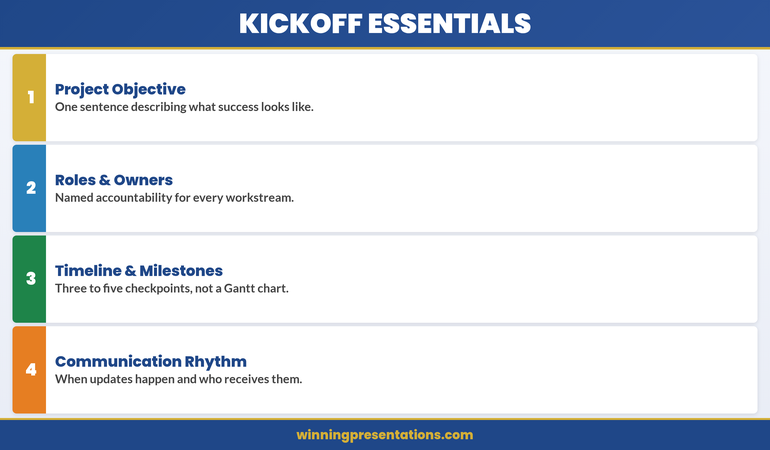
Four essential elements of a project kickoff presentation: project objective, roles and owners, timeline and milestones, and communication rhythm

Build Kickoff Presentations That Land

Structure your slides to establish clarity, credibility, and shared accountability from the first moment. The Executive Slide System gives you templates and frameworks for every elementβ€”from objective clarity to stakeholder alignment to decision rights.

Get the System β€” Β£39

Team Roles and Accountability Structures

The second pillar of any effective kickoff is clarity about who does what. Ambiguity about roles creates both resentment and inefficiency: people either duplicate work or assume someone else is handling a critical task.

Use a RACI matrix or role grid within your presentation. For each major workstream or function, define who is Responsible (does the work), Accountable (makes the final call), Consulted (provides input), and Informed (receives updates). Be explicit about interdependencies: which teams need to coordinate, and what decisions require sign-off from which stakeholders.

Address escalation paths early. If a blocker arisesβ€”a dependency fails, a resource becomes unavailable, or priorities shiftβ€”who decides how to respond? Naming this in the kickoff removes the friction of figuring it out under pressure later. The discipline is clarity about authority, not the specific person in a role.

Many teams skip this step because it feels administrative. That’s a mistake. The teams that recover fastest from obstacles are the ones that know, in advance, who decides and how escalation works. Your initial meeting should be that reference point.

Timeline, Dependencies, and Constraints

The third pillar must establish the rhythm of the project: key milestones, delivery dates, decision gates, and review points. These are not optional; they are the skeleton that holds the project together.

Map the critical path visibly. What tasks are sequential? Where can work happen in parallel? Which decisions must land before downstream work can begin? Highlight any external dependenciesβ€”approvals from regulatory bodies, third-party deliverables, resource constraintsβ€”that could affect timing. Be honest about risk: if you are uncertain about a delivery date, say so and explain what would unlock that certainty.

The teams that trust their leaders are the ones whose leaders are honest about constraints and timelines. A kickoff presentation that acknowledges real trade-offsβ€”scope versus speed, quality versus costβ€”builds credibility far more than optimistic over-promises ever will.

Include a simple visual timeline or Gantt-style chart that every team member can reference. This becomes your single source of truth for scheduling, dependencies, and deliverables.

Comparison of weak versus strong project kickoff presentations across objective clarity, role definition, and closing approach

If you’re building this from scratch, the frameworks inside the Executive Slide System will accelerate your preparation and ensure you don’t miss critical elements.

Communication Cadence and Escalation Paths

Projects live or die by communication discipline. Your kickoff presentation must establish how often teams will synchronise, what gets reported, and where escalation happens. Without this structure, communication either becomes excessive and chaotic, or falls away entirely until problems surface too late to fix.

Define the cadence: weekly stand-ups for core team members, biweekly executive updates, monthly steering committee reviews. Be clear about what each meeting covers. Stand-ups are about blockers and coordination; steering updates are about progress, risks, and business impact. Make this distinction explicit, because conflating them leads to either too much detail at the top or too little coordination at the working level.

Address escalation thresholds. What constitutes a blocker that needs immediate attention? If a delivery date is at risk by more than one week, does that trigger escalation? If budget variance exceeds 10%, who gets informed and when? Being specific here removes guesswork and ensures that problems don’t fester silently until they become crises.

Document how team members provide updates: email, shared spreadsheet, project management tool, or presentation. Consistency in format saves time and reduces the burden on whoever synthesises information for leadership.

Templates That Work

The Executive Slide System includes ready-made frameworks for kickoff presentations, stakeholder alignment slides, and decision-gate templates.

Explore β€” Β£39

Stakeholder Engagement and Decision Rights

Many kickoff presentations fail because they do not explicitly map stakeholder engagement. Who are the sponsors? The approvers? The influencers whose buy-in matters? And how will each group be involved in decision-making as the project unfolds?

Use a stakeholder mapping framework as part of your kickoff. Segment stakeholders by their level of interest and influence. High-influence, high-interest stakeholders typically need steering-group involvement and regular executive briefings. High-influence but lower-interest stakeholders need selective updates and a clear escalation path. The discipline is acknowledging that different stakeholders need different communication approaches.

Be explicit about decision rights: which decisions can the project team make independently? Which require steering group approval? Which need sign-off from finance, legal, or other functional leaders? Clarifying this at the kickoff prevents two months of work being derailed because someone assumed they had authority they did not actually have.

A kickoff that treats stakeholder engagement as an afterthought is one that will revisit stakeholders repeatedly, creating friction and slowing progress. Front-load this work in your initial alignment meeting, and the project moves faster.

Frequently Asked Questions

How long should a kickoff meeting be?

A focused kickoff typically runs 45 to 90 minutes, depending on project complexity and team size. The rule of thumb: spend 15 minutes on objectives, 15 on roles and accountability, 15 on timeline and dependencies, 10 on communication cadence, and 10 on stakeholder engagement. If you have a large steering group or multiple workstreams, add time accordingly. The discipline is not brevity for its own sake, but clarity: never rush this material to fit a shorter window.

What if the team has already started work before the kickoff?

It is never too late to conduct a structured kickoff, even mid-project. If work has begun before alignment was established, the kickoff becomes a reset: an opportunity to surface misalignments, redefine scope, and rebuild shared understanding. Be honest about why the kickoff is happening now. Many teams will appreciate the clarity, even if the timing is not ideal. The cost of the reset is usually far lower than the cost of continuing in misalignment.

How do I handle disagreement about scope or timeline in the kickoff?

Disagreement in a kickoff is healthy and necessary. It means people care and are thinking critically. The discipline is to address disagreement in the meeting, not to let it fester. Use the kickoff as the forum to work through trade-offs: What happens if we accelerate the timeline? What does that mean for scope or quality? If a key stakeholder disputes the scope, that conversation needs to happen now, with the full team present, so that everyone leaves with the same understanding. A kickoff that surfaces conflict and resolves it is far more valuable than one that papers over disagreement.

Get executive presentation insight in your inbox. Subscribe to The Winning Edge for frameworks, case studies, and strategies to lead with impact.

Download the Executive Presentation Checklist (free) to prepare for your next kickoff.

Related: After you master the kickoff, learn how to structure presentations for other critical moments. Read The Contract Renewal Presentation to apply the same frameworks to stakeholder updates and approval scenarios.

Your next kickoff meeting is an opportunity to either build the foundation for team success or inherit months of misalignment and rework. Choose clarity.

Mary Beth Hazeldine is Owner & Managing Director of Winning Presentations. With 24 years of corporate banking experience at JPMorgan Chase, PwC, Royal Bank of Scotland, and Commerzbank, she advises executives across financial services, healthcare, technology, and government on structuring presentations for high-stakes funding rounds and approvals.

20 Mar 2026
Executive at whiteboard or conference table with project timeline on screen in background, calm authoritative demeanour, navy and gold accents, professional corporate setting

Project Delay Presentation: The Slide Structure That Keeps Stakeholder Trust When Timelines Slip

Quick Answer: Delays happen to every large project. The difference between those that maintain stakeholder trust and those that lose it comes down to a single structure: a four-slide β€œdelay briefing” that leads with what happened, explains why, shows concrete recovery action, and requests one clear decision. This approach transforms the conversation from β€œyou failed to deliver” into β€œhere’s how we move forward together.”
Already in a project delay situation? Skip ahead to the β€œThe 4-Slide Delay Briefing Structure” section for the exact format you need to present this week. If you’re managing multiple stakeholders, the β€œStakeholder Mapping for Delay Conversations” section will help you tailor the message to each audience before you walk in the room.

Why Delays Derail Stakeholder Trust (And How to Prevent It)

Marcus arrived at the steering committee meeting with the regular progress update, ready to bury the bad news on slide 14 of 18. He thought if he framed it right—”We’ve experienced some velocity headwinds on the critical path, but we’re still tracking to rebaseline the milestones”—no one would actually notice the Β£12 million rail modernisation project was now running six weeks behind.

The executive sponsor noticed immediately. So did the infrastructure minister’s office representative. Within fifteen minutes, Marcus had lost the confidence of the entire governance board. For the next three months, every decision took twice as long. Every status update was scrutinised. Trust, once lost, becomes the most expensive commodity on any project.

Marcus, a Programme Director at a large UK infrastructure firm, was managing a Β£12 million rail station modernisation project with a baseline deadline of 18 months. At month twelve, the structural survey revealed unexpected foundation work that hadn’t appeared in the preliminary geotechnical study. The project slipped nine weeks. Marcus tried to bury the announcement in a standard progress deck, presenting it on slide 14 of 18 with vague language like β€œvelocity headwinds” and β€œrebaselining milestones.” The executive sponsor spotted it immediately, then in the next meeting, challenged every decision. Marcus’s credibility plummeted for three months until he shifted to a completely different approach: a dedicated four-slide delay briefing presented at the top of the next steering committee agenda. He led with the specific date the delay was discovered, the exact cause (unexpected foundation requirements), named the recovery action owner, and asked for one decision (approve the revised critical path or commission an external validation). The transparency reset trust entirely. His next projectβ€”which also slipped nine weeksβ€”never lost sponsor confidence because the delay was briefed the same way, the first time the governance board heard about it.

The problem is almost never the delay itself. Every large project experiences schedule pressure. Sponsors understand that. What destroys trust is the appearance of hiding, the use of vague language, the inclusion of delay news buried in a thirty-slide deck rather than presented first and directly.

The solution is structural. It is not a better apology. It is not more frequent updates. It is a specific slide structure that does three psychological things at once:

  • It signals respect for your audience’s time. You’re not making them hunt for the news. It’s there, honest and clear, at the top of the agenda.
  • It reframes the conversation from failure to problem-solving. You’re not asking for forgiveness; you’re inviting them to collaborate on next steps.
  • It demonstrates control in the face of uncertainty. You know what happened, why it happened, what you’re doing, and what you need from them. That confidence is contagious.

Large organisationsβ€”especially those managing infrastructure, capital projects, or regulated environmentsβ€”live with delays. What they cannot tolerate is the feeling that the project team is making decisions or hiding information. Transparency, specificity, and a clear path forward are worth more than a miracle recovery plan that no one believes.

The 4-Slide Delay Briefing Structure

The structure is deceptively simple, but the simplicity is the point. When people are stressedβ€”and a project sponsor hearing about a major delay is stressedβ€”they cannot process complexity. They want four things in order:

  1. What is the bad news?
  2. Why did it happen?
  3. What are we doing about it?
  4. What do you need from me?

Each of those gets one slide. No more. The power comes from the restraint.

Side-by-side split comparison infographic showing The Buried Approach (delay hidden on slide 14, vague language, no clear owner, sponsor surprised) versus The Proactive Brief (dedicated slide at top of agenda, specific dates and cause, named owner, sponsors briefed in advance)

Figure 1: The Buried Delay Approach loses sponsor trust within minutes. The Proactive Brief reframes the conversation.

This is not a presentation format you use to convince people the delay isn’t actually a delay. It is a format designed to deliver difficult news in a way that keeps the governance relationship intact. If your organisation uses executive presentation structure frameworks, you already understand that simplicity, specificity, and signal-to-noise ratio matter more than comprehensiveness.

Delay Briefing This Week? Use the Exact Four-Slide Structure

The Executive Slide System Β£39 includes the complete four-slide delay briefing structure used by project and programme leaders in infrastructure, capital, and technology sectors. If you need to rebuild the conversation fast, start with the sequence, not the slides. It includes:

  • Slide templates for the exact four-slide delay structure (ready to adapt to your project)
  • Worked examples from infrastructure, capital, and tech projects
  • The governance conversation frameworkβ€”how to brief stakeholders before the formal meeting
  • Recovery plan slide formats designed for high-scrutiny executive review

Price: Β£39 once. No subscription.

Get the Executive Slide System

Slide 1: What Happened (The Single Honest Statement)

This slide has one job: state the fact. No hedging. No jargon. No minimisation.

Bad examples:

  • β€œWe are experiencing velocity headwinds on the critical path.” (What does that mean?)
  • β€œThe project has encountered some scheduling challenges.” (This could mean anything.)
  • β€œWe’ve had to rebaseline certain milestones.” (Why?)

Good example:

  • β€œOn 14 February, we discovered additional foundation work required for the east wing. The project now runs nine weeks behind the baseline completion date.”

The difference is specificity. Specific date. Specific reason. Specific number of weeks. No interpretation, no softening language, no β€œhowever.” Just fact.

This slide should take up maybe 60 per cent of the slide real estate. The text should be in the sans-serif body font, the colour navy (#1F4788) on white. Add a single icon or accent line in gold if you want visual interest, but do not overcomplicate it. People are anxious. They want clarity.

The psychological effect is paradoxical: the more direct and simple this slide is, the more competent and trustworthy the project team appears. Vagueness makes people nervous. Specificity makes them think you have control.

Slide 2: Why It Happened (One Root Cause, Not a List)

This is where most project leaders go wrong. They list five reasonsβ€”poor requirements, scope creep, resource constraints, third-party delays, weatherβ€”and by the time they finish, the executive has tuned out and lost confidence.

The rule for this slide is absolute: one root cause.

If you cannot distil the delay to one root cause, you do not yet understand the delay well enough to brief it. Go back to your team. Work until you find the single thread that, if pulled, explains everything else.

In Marcus’s case, the root cause was not β€œpoor surveying” or β€œinadequate budget” or β€œbad luck.” It was: β€œThe preliminary geotechnical study did not include excavation analysis of the east wing basement.” Everything else flowed from that one fact.

This slide should be roughly the same size as Slide 1. One sentence or two maximum. The root cause in the largest font. Smaller text (if needed) showing what this root cause led to.

Do not use this slide to explain away the delay. Do not list mitigation measures you should have taken but didn’t. Do not apologise. State the cause, and move to the next slide.

Slide 3: What We’re Doing About It (Concrete Action)

Now the conversation shifts forward. This slide answers: β€œWhat is the concrete action, and who owns it?”

The slide should include:

  • A single recovery action (not a list of ten ideas). For Marcus, it was: β€œCommission specialist foundation engineering firm to design and schedule the additional work.”
  • The named owner (not β€œthe team” or β€œwe”). For Marcus: β€œSarah Chen, Engineering Lead, responsible.”
  • A deadline (when will this action complete). For Marcus: β€œCompleted design and schedule by 28 March.”
  • The outcome that deadline produces (what the sponsor will have on 28 March). For Marcus: β€œRevised critical path and cost impact for sponsor decision.”

This slide is not a wish list. It is not β€œthings we hope to do.” It is a commitment. The owner should know they are being named on this slide before they walk in the room.

The psychological shift here is profound. The sponsor went from hearing bad news to hearing that the project team has a plan and someone accountable for it. That is enough to keep most governance boards confident.

Slide 4: What You Need To Decide (The One Question)

The final slide removes the ambiguity about the sponsor’s role. It is not β€œWhat do you think we should do?” It is a specific decision gate.

This slide should frame a single, clear decision:

  • β€œApprove the revised critical path, or request external validation before approval.”
  • β€œRelease the contingency budget, or commission a value engineering review first.”
  • β€œProceed with the revised schedule, or escalate to the steering committee.”

The decision should be answerable in the meeting or within a short specified window (e.g., β€œwithin 48 hours”).

This slide does something psychologically important: it returns agency to the sponsor. They are not passive recipients of bad news; they are decision-makers. Their role is clear. The path forward is clear. That clarity is worth more than any amount of hope or optimism.

Four-card stacked infographic showing The 4-Slide Delay Briefing Structure: Card 1 "What Happened" (one sentence, specific date, specific weeks), Card 2 "Why It Happened" (single root cause), Card 3 "What We're Doing" (named owner, concrete action, deadline), Card 4 "What You Need To Decide" (one decision gate)

Figure 2: The 4-Slide Delay Briefingβ€”each slide answers one question in order.
Pro tip: Rehearse this four-slide briefing with your executive sponsor or steering committee chair before the formal meeting. The briefing works best when it is not a surprise. If the sponsor already knows the four points, the formal briefing becomes confirmation, not shock. That small gestureβ€”giving them a heads-upβ€”can mean the difference between β€œthe project team hid this from us” and β€œthe project team is being transparent with us.”

Timing, Sequence, and Stakeholder Communication

A four-slide briefing fails if it is presented cold. The real skill is in the pre-briefing communication strategy.

Start the process 48 hours before the formal steering committee or governance meeting. Your approach should be:

  1. Brief the chair or sponsor individually first (1:1 conversation, not email). Share all four slides. Let them ask questions. Answer fully. This is not a surpriseβ€”it is a partnership.
  2. Brief any other key governance members (steering committee chair, finance lead, executive sponsor) before the group meeting. Same four slides. Same transparency. By the time the group meets, there are no surprises.
  3. Present the four-slide briefing to the full governance board as the first agenda item. This is not buried in a 30-slide deck. It is the opening conversation.

Stakeholder mapping for the delay conversation means understanding which stakeholders need to hear the news first, in what sequence, and in what format. For a capital project, the executive sponsor is always first. For a product release, the head of product is first. For a regulatory matter, legal and the regulatory lead are first.

The four-slide briefing then becomes the β€œformal record” that was already discussed, not a shock announcement.

Common Mistakes That Destroy Trust

Mistake 1: Trying to Make the Delay Sound Small

Language like β€œa modest three-week slip in the east wall construction phase” sounds like you are minimising the problem. Call it what it is: β€œthree weeks.” Let the sponsor decide if it is modest or serious.

Mistake 2: Burying the Announcement in a Larger Deck

If the delay briefing is slides 14–17 of a 30-slide progress deck, the sponsor’s first reaction is not β€œOkay, let’s work on this together.” It is β€œWhy is this buried? What else are they hiding?” Present the four slides as a standalone briefing or as the first section of a meeting.

Mistake 3: Listing Multiple Root Causes

If you say β€œThe delay was caused by poor surveying, inadequate budget reserves, and unexpected weather,” the sponsor hears β€œYour project team is disorganised and doesn’t know what actually went wrong.” Find the one thing that, if it hadn’t happened, the project would not be delayed. Everything else is secondary.

Mistake 4: Proposing a Recovery Plan Without a Named Owner

β€œWe will accelerate the east wing work by bringing in additional resources” is vague. β€œSarah Chen will bring in two additional foundation teams by 21 March, with completion targeted for 15 May” is a commitment. The named owner is what gives sponsors confidence.

Mistake 5: Leaving the Sponsor’s Role Ambiguous

Do not end with β€œAny questions?” End with a specific decision gate: β€œWe need you to approve the revised schedule by Friday, or escalate to the steering committee for a broader review.” That clarity is what allows them to move forward instead of worry.

When Sponsor Trust Is at Stake, Structure Is What Protects Your Standing

Sponsors rarely lose confidence because of one delay. They lose confidence when the briefing is vague, evasive, or unprepared. The Executive Slide System gives you the specific slide formats that keep governance relationships intact under pressure β€” the delay briefing, the recovery plan, and the replan presentation. Each format is structured to demonstrate clarity, ownership, and forward motion, so the conversation stays professional rather than defensive.

Get access to: Delay briefings, replan presentations, budget conversations, governance resets, and crisis communication frameworks.

Get the System for Β£39

Building the Recovery Narrative Beyond the Four Slides

Once the four-slide briefing has been delivered and the decision made, the project moves into a different communication phase. This is no longer a crisis brief; it is a recovery narrative.

The recovery narrative should include weekly updates (brief, specific), clear milestones with target dates, and a planned β€œrecovery complete” milestone that the sponsor can anticipate. The tone shifts from β€œhere is bad news” to β€œhere is progress toward resolution.”

In many cases, especially in long-term infrastructure projects, the recovery narrative becomes routine status reporting. The key is that the project team has now established a pattern of transparency and specificity. Future announcementsβ€”whether positive or negativeβ€”will be received with greater credibility because the team has demonstrated they communicate clearly under pressure.

This is where the decision-slide framework for executive conversations becomes invaluable. Every recovery update, every milestone review, and every governance conversation needs the same clarity: here is the situation, here is what we are doing, here is what we need from you.

Adapting the Framework to Your Project Type

The four-slide structure works across all project types because it is psychologically sound, not because it is industry-specific. However, the content adapts slightly depending on what you are managing:

Infrastructure and Capital Projects: Slide 1 focuses on the specific work package delayed and weeks behind. Slide 2 names the physical or contractual cause. Slide 3 names the remediation action and owner. Slide 4 asks for budget or schedule approval.

Technology and Product Launches: Slide 1 names the feature or release delayed and the revised go-live date. Slide 2 focuses on technical or resource constraints (bugs discovered, skills gaps, third-party API delays). Slide 3 names the engineering lead and the specific resolution path. Slide 4 asks for a decision on MVP scope or launch timing.

Regulatory and Compliance Projects: Slide 1 names the deadline or milestone at risk. Slide 2 cites the regulatory or compliance barrier (new interpretation, third-party audit finding, external requirement change). Slide 3 names the compliance lead and the approach to remediation. Slide 4 asks for escalation to legal or regulatory leadership if needed.

The structure is the same. The details change based on your context. The psychological principleβ€”clarity, ownership, and forward motionβ€”is universal.

Is This Approach Right For You?

  • Yes, if: You manage projects with external stakeholders or governance boards who need to approve scope, schedule, or budget changes. You are facing a delay of more than a few days and need to reset the relationship with sponsors.
  • Yes, if: You have experienced a situation where poor communication about a delay led to loss of confidence, and you want a framework to prevent that from happening again.
  • No, if: Your delays are typically resolved without governance approval or sponsor notice. This framework is for situations where the sponsor’s trust and decision-making matter.

Frequently Asked Questions

What if the delay is still being assessed? Do I brief the sponsor before I have all the facts?

Yes. Here is what you say: β€œWe discovered a potential delay on [date]. We do not yet have a full assessment, but here is what we know so far: [specific facts]. We are commissioning [named action] to give us full clarity by [date]. In the interim, here is what the delay could mean: [range]. We will brief you the moment we have the full picture.” This is transparency, not weakness. Sponsors trust teams that know what they don’t know.

Should I present the four-slide briefing in a formal steering committee meeting, or in a 1:1 with the sponsor first?

Do a 1:1 first (48 hours before the formal meeting). Share all four slides. Answer every question. Then brief other key stakeholders individually. Then present to the full group as confirmation, not shock. The four-slide briefing is the same in all contexts, but the audience shape matters for trust.

What if the sponsor asks for more detail or a deeper recovery plan during the four-slide briefing?

Have a follow-up deck ready (separate from the four slides). The four-slide briefing is the governance conversation. The follow-up deck is the detailed plan. Keep them separate. The four-slide briefing should answer the immediate questions (what, why, what now, what do you decide). The follow-up deck goes deeper into risk, cost, resource, and timeline detail. Never mix them or the impact of the four-slide clarity is lost.

πŸ†“ Free resource: Executive Presentation Checklist β€” a free guide to strengthen your presentation preparation.

For more on structuring high-stakes presentations, read our guide to pipeline review presentations for sales leadersβ€”another scenario where clarity and specificity determine whether sponsors lean forward or pull back.

What’s Inside the Executive Slide System

The Executive Slide System gives you slide structures, templates, and decision frameworks for the executive presentation scenarios you face most often β€” including delays, budget briefings, governance resets, crisis communications, and stakeholder recoveries. Each template is ready to adapt to your specific project, timeline, and audience.

What you get:

  • Slide templates for 12 executive scenarios (including the complete four-slide delay briefing)
  • Decision-slide frameworks that make briefings clear and actionable
  • Worked examples from real projects (infrastructure, capital, technology, regulatory)
  • Pre-briefing communication strategy guides
  • One-time price: Β£39

Get the Executive Slide System for Β£39

About the author: Mary Beth Hazeldine is a former investment banker at RBS with over 20 years’ experience in executive communication, stakeholder management, and crisis briefings across infrastructure, capital, and technology sectors. She is based in Edinburgh and specialises in helping leaders master the presentation skills that determine organisational outcomes. Her work has been featured in financial media and executive leadership publications.

Project delays are inevitable in large organisations. What matters is whether your sponsors believe you are hiding something or collaborating with them to move forward. The four-slide briefing structure gives you a way to do the latter.

07 Dec 2025
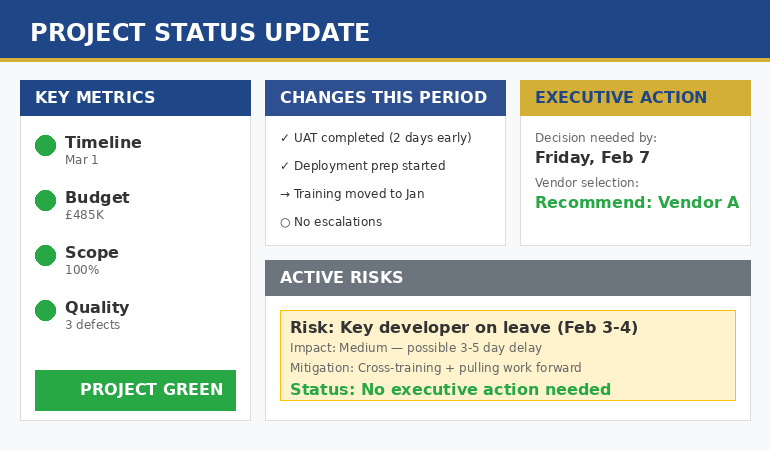
Project status update framework showing traffic light dashboard with green status indicator, key metrics, changes section, and executive action needed panel

Project Status Updates That Don’t Waste Everyone’s Time

The CFO stopped listening at slide 3. By slide 7, she was answering emails. The project manager kept presenting anyway.

I watched this happen at Commerzbank during a Β£12 million programme update. Forty-five minutes of task-level detail. Zero decisions made. The steering committee scheduled another meeting “to actually discuss the issues.”

After 25 years in corporate banking managing complex programmes at JPMorgan Chase, PwC, Royal Bank of Scotland, and Commerzbank, I’ve developed a project status update framework that communicates everything leadership needs in 2 minutes β€” and actually keeps them engaged.

Here’s how to deliver project status updates that respect everyone’s time and establish you as someone who can be trusted with bigger projects.

Quick Answer: Effective project status updates answer three questions in under 2 minutes: Is this on track? Do you need to do anything? What should you be worried about? Lead with a traffic light headline (green/amber/red), show 3-5 key metrics, highlight only what changed since the last update, and state explicitly whether executive action is required.

Why Most Project Status Updates Fail

The fundamental problem with most project status updates: they’re written for the project team, not for executives.

Project managers track dozens of tasks, dependencies, and risks. So their project status update includes all of it. But executives don’t need task-level visibility β€” they need to know three things:

  • Is this project on track?
  • Do I need to do anything?
  • What should I be worried about?

A project status update that answers these three questions in 2 minutes is infinitely more valuable than a 30-minute walkthrough of your Gantt chart.

I learned this the hard way at RBS. I’d spent six hours preparing a comprehensive programme update β€” 18 slides covering every workstream, every milestone, every risk. The Programme Director interrupted me on slide 4: “Just tell me if we’re going to hit the deadline and what you need from me.”

That moment changed how I structure every project status update since.

The Project Status Update Framework: Traffic Light Plus Context

Every effective project status update follows this structure:

Element 1: The Headline Status

Open your project status update with a single line that tells leadership exactly where things stand:

🟒 GREEN: Project on track β€” 2 weeks ahead of schedule, within budget

🟑 AMBER: Project at risk β€” vendor delay may impact launch date; mitigation in progress

πŸ”΄ RED: Project off track β€” need executive decision on scope reduction by Friday

This headline tells executives immediately whether they need to pay close attention or can relax. Most project status updates bury this on slide 8 β€” put it first.

Element 2: The Key Metrics

After the headline, your project status update should show 3-5 metrics that matter:

Metric Target Actual Status
Timeline March 15 March 1 🟒
Budget £500K £485K 🟒
Scope 100% 100% 🟒
Quality <5 defects 3 defects 🟒

This dashboard gives executives the complete picture in seconds. They can see whether you’re ahead, on track, or behind β€” and where specifically.

Element 3: What Changed Since Last Update

Executives don’t want to re-read everything β€” they want to know what’s new. Your project status update should highlight changes:

Changes Since Last Project Status Update:

  • Completed: User acceptance testing (2 days early)
  • Started: Production deployment preparation
  • Changed: Moved training from Feb to Jan based on stakeholder availability
  • Escalated: None this period

This format lets executives skip what they already know and focus on what’s new. It’s the difference between a helpful update and a time-wasting repeat.

Element 4: Risks and Issues

Every project status update must address risks β€” even if there aren’t any significant ones:

Notice the last line: “no executive action needed.” Always tell leadership whether you need them to do something. Most risks you’re managing yourself β€” make that explicit in your project status update.

The traffic light framework I’ve described is exactly what’s built into The Executive Slide System β†’ β€” clients have used these templates to run steering committees for programmes worth over Β£50 million.

Element 5: Decisions or Support Needed

If your project status update requires executive action, state it clearly:

Executive Action Required:

Decision needed by: Friday, February 7

Question: Should we proceed with vendor A (Β£50K higher cost, 2 weeks faster) or vendor B (lower cost, standard timeline)?

Recommendation: Vendor A β€” the timeline benefit outweighs the cost given our Q1 deadline

Status updates are one scenario where a structured presentation skills training programme pays back fastest β€” avoiding the slide-by-slide drift that lost the steering committee above.

If no action is needed, say that explicitly: “No executive decisions required this period.” This tells leadership they can simply note the update without adding it to their action list.

#image_title

⭐ Transform Your Next Status Update in Minutes

Your steering committee is next week. Use the same framework that’s kept executives engaged through Β£50M+ programme reviews.

What you get:

  • Traffic light dashboard template (fill in your metrics)
  • Risk register format executives actually read
  • Decision slide structure that gets clear approvals

Get Instant Access β†’ β†’

Instant download β€’ 30-day money-back guarantee

The 2-Minute Project Status Update Script

Here’s exactly how to deliver your project status update verbally:

First 15 seconds β€” Headline:
“Project Phoenix is green β€” we’re two weeks ahead of schedule and within budget. No executive action needed this week.”

Next 30 seconds β€” Key changes:
“Since our last update, we completed UAT two days early and started deployment prep. We moved training up to January based on stakeholder availability.”

Next 45 seconds β€” Risks:
“One risk I’m monitoring: our lead developer is on leave for two weeks in February. We’re cross-training a backup and pulling critical work forward. I don’t expect this to impact the timeline, but I’ll flag it if that changes.”

Final 30 seconds β€” Look ahead:
“For next period, we’re focused on completing deployment prep and beginning production migration. Next update will confirm go-live readiness.”

Total: under 2 minutes. Executives have everything they need. You’ve demonstrated control of your project without wasting anyone’s time.

This script structure works because it follows the same principles built into The Executive Slide System β€” lead with the conclusion, support with evidence, close with the ask.

Project Status Update Mistakes to Avoid

Mistake 1: Reading every line of your slides.
Executives can read. Summarise the headline, highlight what changed, flag what needs attention. Don’t read word-for-word.

Mistake 2: Task-level detail.
“John completed the database migration scripts” doesn’t belong in an executive project status update. Executives need milestone-level visibility, not task-level.

Mistake 3: Hiding problems.
If the project is amber or red, say so. Finding out later that you knew about problems destroys trust faster than the problems themselves.

Mistake 4: No clear action.
Every project status update should end with either “no action needed” or a specific ask. Don’t leave executives wondering what you need from them.

Mistake 5: Inconsistent format.
Use the same structure every time. Executives shouldn’t have to learn a new format each week β€” consistency lets them find information quickly.

Related: If presenting status updates makes you anxious, see Presentation Anxiety Before Meetings: The Executive Reset That Actually Works β€” the techniques I teach clients who need to stay calm under pressure in steering committees.

FAQ

How often should I send a project status update?

Weekly for active projects, bi-weekly for steady-state. Match your frequency to how fast things change and how closely leadership wants to track. If nothing changes between updates, that’s useful information too β€” it shows stability.

How long should a project status update be?

One slide for verbal updates, maximum two pages for written. If your update is longer, you’re including too much detail. Everything else belongs in an appendix or separate detailed report for the project team.

What if nothing changed since the last update?

Say that explicitly: “No significant changes since last update. All metrics remain green, on track for March delivery.” A brief update confirming stability is valuable β€” it takes 30 seconds and builds confidence that you’re in control.

One More Thing β€” Before You Go

Need a status update framework that gets sign-off the first time? The Executive Slide System gives you the exact templates and structure used by senior leaders to move projects forward without going round in circles.

Explore the System

Should I include good news in my project status update?

Yes β€” briefly. Wins deserve acknowledgment. “Team delivered UAT two days early β€” strong execution” takes 5 seconds and builds confidence. Don’t bury it, but don’t spend five minutes on celebration either.

πŸ“§ Get Weekly Executive Presentation Insights

Join 2,000+ professionals getting frameworks, templates, and real examples every week.

Subscribe Free β†’

🎁 Free Resource: Executive Presentation Checklist

12 things to check before any executive presentation β€” including your next project status update.

Download Free β†’

Your Next Project Status Update

You probably have a project status update due soon. Before you build another 15-slide deck, try this:

  1. Write your headline status in one sentence
  2. List 3-5 metrics with traffic light indicators
  3. Note what changed since your last update
  4. List active risks with mitigations
  5. State clearly whether you need executive action

That’s your project status update. One slide. Two minutes. Everything leadership needs to know.

The project managers who advance are the ones who can run complex projects while keeping leadership informed without overwhelming them. This framework demonstrates exactly that capability.


Related: How to Create Executive Presentations That Get Approved β€” the complete guide covering all 10 executive presentation types, including the project status update framework.

See also: QBR Presentation Template: How to Run Quarterly Business Reviews That Drive Action