

When Your Voice Shakes in Front of the Board: The 10-Second Reset
QUICK ANSWER
When the voice starts to shake mid-board-meeting, the fix has to be fast and invisible. The 10-second reset works by reversing the physiology that causes the tremor — a longer exhale, a small drink of water, a one-word answer that buys time, and a sentence that returns you to the structure of your case. Nobody notices. The voice recovers. The presentation continues.
JUMP TO
What causes the shake ·
The 10-second reset ·
The first sentence after the reset ·
How to make the shake less likely ·
After the meeting ·
FAQ
Ines was twelve minutes into a strategic review with the audit committee when the chair asked the question that broke her. “Could you walk us through what you would do if the regulator decided this was material?” She had not prepared the answer. The first three words came out fine. The fourth word came out an octave higher than the others, and she heard her own voice catch. The committee heard it too.
What happened next mattered. Ines did not push through. She did not try to power-voice over the tremor. She put down the clicker, took a slow drink of water, and said, “Let me make sure I take that question seriously.” She breathed out for longer than usual. Then she gave a structured answer. By the third sentence the voice was back. The committee, asked afterwards, did not remember a vocal moment. They remembered a thoughtful answer to a hard question.
The 10-second reset is the move Ines made — structured, replicable, quiet enough that the room interprets the pause as composure rather than recovery. It is not a confidence trick. It is a physiological one, designed for exactly the kind of moment that causes the voice to shake in the first place.
Build the toolkit before the next high-stakes meeting
Calm Under Pressure is the system designed for these moments — the visible signs of nerves in front of senior audiences, and the structured techniques that work fast in real meetings.
What actually causes the voice to shake mid-meeting
The voice shake is, almost always, a breathing problem before it is anything else. Under acute stress — a hard question, a sudden interruption, a moment where you realise you are over a line you cannot defend — the breath becomes shallower and faster. The exhale becomes too short to support the sound. The vocal cords, which need a steady column of air to vibrate cleanly, start to oscillate slightly. That oscillation is what the room hears as a tremor.
Two other things often happen at the same time. The shoulders rise, which compresses the diaphragm and makes the support shallower still. The throat tightens, which raises the larynx and pushes the voice up into a thinner resonance. Each of these makes the shake more pronounced. None of them is “nerves” in the broad sense. They are very specific physiological reactions, and they respond to very specific physiological fixes.
This matters because the wrong response is to push harder. Most untrained presenters, when they hear their own voice catch, try to use more force on the next syllable to “cover” it. That makes everything worse. More force from a constricted throat with a shallow breath produces more tension, more pitch drift, and a voice that sounds increasingly strained. The reset is not “push.” It is “reverse the physiology that started this.”
The 10-second reset
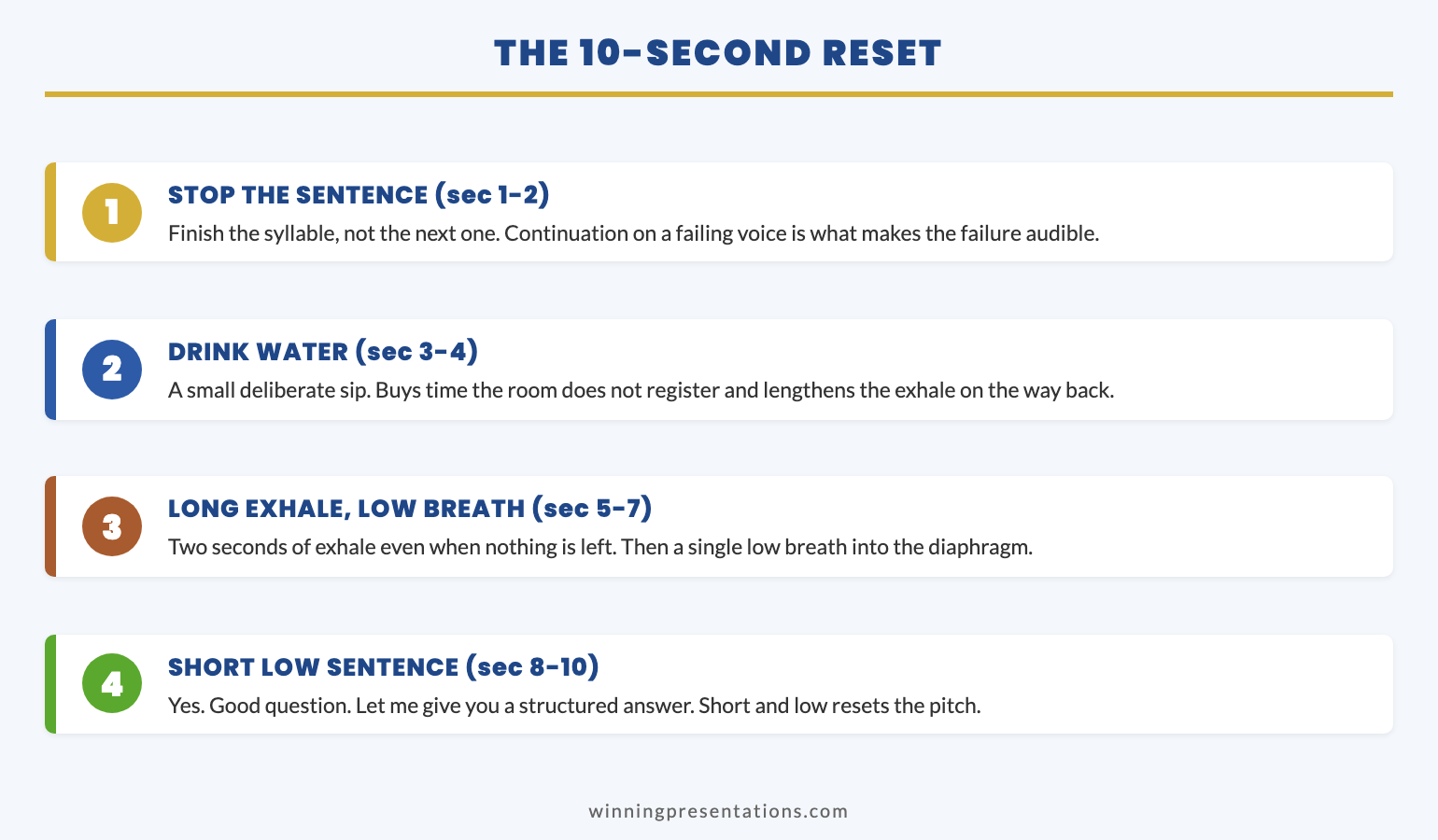
The reset has four moves, and they fit inside ten seconds because that is what the room will tolerate as a pause without it reading as a problem. Anyone watching closely sees a presenter taking a thoughtful drink of water and a small breath before answering. Nobody else notices anything at all.
Second 1 to 2: stop the sentence. If you are mid-sentence when you feel the voice go, finish the syllable you are on but not the next one. Trying to complete the sentence on the failing voice is what makes the failure audible. The break is not the problem. The continuation is.
Second 3 to 4: drink water. A small, deliberate sip of water. This does two things. It buys you time the room does not register as a pause — it reads as natural. And it lengthens the exhale on the way back from swallowing, which is exactly the breath pattern that resets vocal stability. If there is no water, a small swallow does most of the same work.
Second 5 to 7: long exhale, then breath low. Breathe out for longer than usual — aim for two seconds of exhale even though it feels like nothing is left. Then take a single, low breath into the diaphragm rather than the chest. The combination tells the nervous system that the pressure is over, drops the larynx slightly, and gives the next sentence a column of air to ride on.
Second 8 to 10: one-word reply or buying phrase. Speak first with a short, low sentence that buys time and signals composure. “Yes.” “Good question.” “Let me give you a structured answer to that.” Whatever you say, keep it short and keep it pitched low. The first sentence after a vocal failure is the one the room is listening to most closely. Short and low is what tells them the moment is over.
The first sentence after the reset
The technical work of the reset is over by second ten. The strategic work is in the sentence that follows. The room has watched you pause, drink water, and breathe. They are now waiting for the answer. Whatever you say next sets the frame for the rest of the meeting.
The shape that works is structured rather than apologetic. The presenter who says, “Sorry, let me try that again” or “I just need a moment,” signals that the voice failure was a problem worth naming. The presenter who simply gives a clean, slightly slow, structured answer signals that nothing happened. Senior rooms take their cue from the presenter. If you treat it as recovery, they will treat it as recovery. If you treat it as a normal moment of considered thought, they will too.
The pace of the answer matters as much as the content. Speak slightly slower than feels natural. Use a slightly lower pitch than usual. Let the first complete sentence be a clear one with a verb you commit to: “If the regulator considered this material, our response would be…” rather than “I think probably what we would do is…” The contrast between the post-reset sentence and the pre-reset moment should signal command, not compensation.
For a deeper walk-through of the recovery work tied to specific in-the-moment failures, the voice-shakes presentation reset covers a wider library of techniques and the conditions each one fits.
CALM UNDER PRESSURE
A recovery system for the moments where the voice goes
Calm Under Pressure is built for the visible signs of nerves in senior rooms — voice tremor, shallow breath, the rising heart rate before a hard question, the moments mid-meeting where everything you prepared starts to slip. Self-paced techniques you can use the same week.
- In-the-moment recovery techniques for voice and breath
- Pre-meeting calming patterns that hold under interruption
- Q&A-specific resets for the questions that destabilise most
- Instant access on purchase — no waiting
Calm Under Pressure — £19.99, instant access. Designed for senior professionals presenting under live scrutiny.
Designed for in-the-moment recovery in senior rooms.
How to make the shake less likely in the first place
The 10-second reset is for the moment. The work that makes the moment less likely is upstream — in the way you prepare, the way you breathe in the minutes before the meeting, and the way you frame the first questions you expect to be asked.
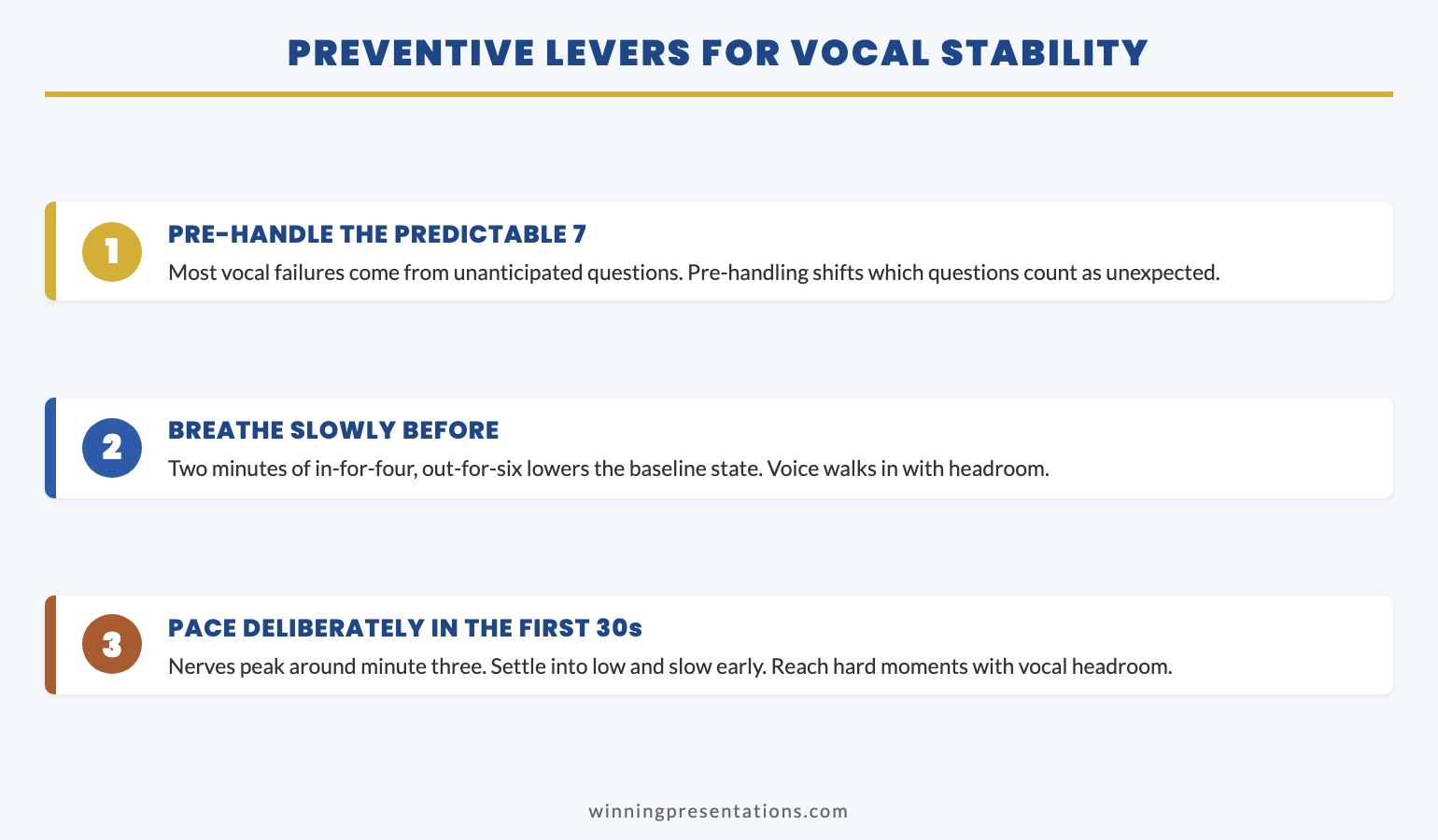
The biggest single preventive lever is preparing the seven to ten objections you most expect, in writing, before the meeting. The vocal failure that broke Ines came from a question she had not prepared for. Most vocal failures in senior rooms come from exactly that — a question the speaker had not anticipated, asked at the moment they had hoped the difficult part was over. Pre-handling shifts which questions count as “unexpected” and how many of them there are.
The second lever is breath work in the minutes before you walk in. Two minutes of slow breathing — in for four, hold briefly, out for six — before the meeting starts will lower the baseline state of activation. The voice that walks in slightly under-aroused is much more resilient to a hard question mid-meeting than the voice that walks in already at the top of its window. Voice tremor presentation recovery covers the longer-form work for executives whose voice has historically shaken under senior pressure.
The third lever is the first thirty seconds of the meeting itself. Most vocal failures happen in the third or fourth minute, not the first. The reason is that nerves rise in the first minute and peak around the time the speaker realises the room is fully engaged. Knowing this lets you pace deliberately in the opening, settle into a low and slow voice early, and reach the difficult moments with vocal headroom rather than vocal exhaustion.
After the meeting: separating the moment from the meaning
One thing senior professionals tend to do badly after a vocal moment is replay it for hours. The replay tends to amplify it. By the third re-run, a one-second tremor that the room barely registered has become “the moment everyone heard my voice fail.” The narrative follows the rumination, not the meeting.
The corrective is to separate the technical event from its meaning. The technical event was a brief vocal tremor and a clean recovery. The meaning the rumination is trying to attach — “I am not cut out for this,” “I cannot present at this level,” “they will remember this for months” — almost never matches what the room actually took away. Most rooms take away the answer, not the audio. The replay is a story about the speaker’s experience, not a story about the meeting’s outcome.
The honest version of post-meeting reflection notices what triggered the shake (a specific question, a specific objection, a specific topic), files it away as “the next time this comes up I will have an answer ready,” and moves on. Voice shaking when speaking covers the longer-arc recovery work for executives who have started to dread the next meeting after a vocal moment, which is the more dangerous downstream effect than the moment itself.
Why the reset is a system, not a trick
The 10-second reset works because it reverses the specific physiology of the failure. Long exhale, low breath, low first sentence, structured continuation. None of these is a magic move on its own. The combination is what holds. Senior professionals who use it the first time tend to be surprised by how well it works — and by how invisible it is to the room.
The deeper move is treating the voice as a downstream effect rather than a cause. The voice shakes because the breath got shallow because the question was a surprise because the case had a gap. Each layer of that chain has its own fix. The reset addresses the bottom layer in real time. The structural and pre-handling work prevents most of the chain from starting in the first place.
CALM UNDER PRESSURE
Recovery techniques for senior rooms, not generic relaxation
Voice work, breath work, and pre-meeting routines designed for the specific conditions of senior decision audiences — interruption, scrutiny, unscripted questions. £19.99, instant access. The system you reach for between now and the next high-stakes meeting.
Designed for senior-level meetings where the moment matters.
Frequently asked questions
Will the room notice the 10-second reset?
Almost never. The reset reads from outside as a presenter taking a thoughtful drink of water and a small breath before answering a hard question. Senior rooms see this every day. What is more visible than the pause is the alternative — trying to push through a shaking voice with more force, which is what untrained presenters do and what the room actually does notice.
What if there is no water on the table?
A small swallow does most of the same work. The water is not the active ingredient. The combination of a longer exhale, a low breath, and a short first sentence is. If you are presenting in a setting where water is unlikely to be available, build a deliberate “let me make sure I think about that” pause into the routine instead. The structure stays the same; the cover for the pause changes.
Why does pushing through make the voice worse?
Pushing recruits more force from an already constricted throat with a shallow breath. That increases tension, raises the larynx further, and produces more pitch drift. The voice sounds more strained, not less. The reset works because it reverses each of those mechanisms in turn — the longer exhale resets the breath, the low breath resets the larynx, and the short low sentence anchors the pitch back where it belongs.
How long does it take to make the reset reliable under pressure?
Most senior professionals can produce the reset cleanly in low-stakes settings within a week of practice. Producing it cleanly under live senior pressure usually takes a small number of real meetings — often two or three — with conscious attention to the routine each time. The first live use feels deliberate. By the third or fourth, it becomes the default response to any moment where the voice goes.
The Winning Edge
A weekly newsletter for senior professionals who present at board level. One specific structural idea per issue, drawn from real boardroom and committee work. No filler.
Not ready for the full system? Start here instead: download the free Executive Presentation Checklist — the pre-flight checks that catch the structural mistakes most senior professionals make in the last 24 hours before a high-stakes meeting.
If this article landed for you, Voice coaching for senior executives is the natural next read. It walks through where standard voice training transfers and where it leaves senior professionals exposed.
Next step: rehearse the 10-second reset out loud, twice, before your next meeting. Once with water, once without. The first live use should feel familiar, not improvised.
Mary Beth Hazeldine is the Owner & Managing Director of Winning Presentations. With 24 years of corporate banking experience at JPMorgan Chase, PwC, Royal Bank of Scotland, and Commerzbank, she advises senior professionals across financial services, healthcare, technology, and government on structuring presentations for high-stakes funding rounds and approvals. She speaks German and works extensively with the German-speaking financial markets.