Tag: calm under pressure

25 Jan 2026
Professional woman presenting confidently to senior leadership in a boardroom, projecting calm authority

Presenting to Senior Leadership: How to Sound Calm and Credible

The CEO leaned back in his chair. I was three sentences into my presentation, and I could already feel my voice starting to shake.

I knew my material. I’d rehearsed for hours. But none of that mattered—because the moment I saw seven senior executives staring at me, my body decided this was a survival situation.

Quick answer: Presenting to senior leadership triggers a specific kind of anxiety—not just fear of public speaking, but fear of being judged by people who control your career. The solution isn’t more preparation or “power poses.” It’s rewiring the automatic responses that make you sound nervous even when you know your content cold. This article shows you the exact techniques that create calm authority under executive scrutiny.

When you can present calmly to senior leadership:

  • Your recommendations get taken seriously (not dismissed as “nervous energy”)
  • You’re trusted with higher-stakes opportunities
  • You stop dreading the meetings that could advance your career

Written by Mary Beth Hazeldine — Owner & Managing Director of Winning Presentations, qualified clinical hypnotherapist, and someone who spent 5 years terrified of presenting before discovering what actually works. Last updated: January 2026.

🚨 Presenting to LEADERSHIP this week? Use this 60-second reset:

  1. Before you enter: 3 slow breaths (4 counts in, 7 counts out)
  2. First sentence: Speak 30% slower than feels natural
  3. Eye contact: Pick ONE friendly face for your first 10 seconds

This won’t eliminate nerves—but it will prevent them from showing.

These techniques have been used by senior professionals presenting to CFOs, MDs, and Executive Committees in high-stakes approval meetings—the same situations where careers are made or stalled.

→ Want the complete system for calm executive presence? Get Conquer Speaking Fear (£39) — includes the pre-meeting protocol and in-the-moment techniques.

📅 Have a leadership presentation in the next 7 days?

The techniques in this article take one focused practice session to internalise. Most professionals report feeling noticeably calmer in their very next executive presentation.

That presentation to the CEO? I got through it. But I could hear how shaky I sounded. I watched my credibility drain away with every rushed sentence and nervous hedge.

Afterward, a colleague took me aside. “You knew your stuff,” she said. “But you didn’t sound like you believed it.”

She was right. And that’s when I realised: presenting to senior leadership isn’t about knowing more. It’s about appearing calm enough for them to trust what you know.

Over the next five years, I studied everything—from nervous system regulation to clinical hypnotherapy—to understand why some people project calm authority while others (like me) fell apart under executive scrutiny. What I discovered changed not just my presentations, but my entire career.

Why Senior Leadership Presentations Feel Different

You might present confidently to your team, your peers, even large audiences. But the moment you’re in front of the C-suite, something shifts.

This isn’t weakness. It’s biology.

The “Evaluation Threat” Response

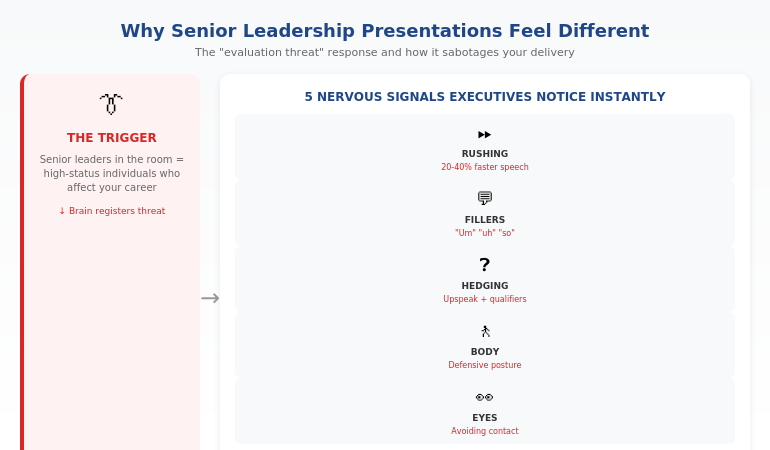
Research on social stress shows that being evaluated by high-status individuals triggers a stronger threat response than almost any other social situation. Your brain registers senior leaders not just as an audience, but as people who can affect your livelihood.

This activates the sympathetic nervous system—the same fight-or-flight response you’d have if facing physical danger. Blood flows away from your prefrontal cortex (where clear thinking happens) and toward your muscles (preparing you to run).

The result: you know your material, but you can’t access it smoothly. Words come out wrong. You rush. You hedge. You sound exactly as nervous as you feel.

📚 Research note: The “social evaluative threat” response is well-documented in stress research. The Trier Social Stress Test—which simulates evaluation by high-status observers—consistently produces stronger cortisol spikes than other stressors. Studies on anxiety and working memory show that threat-state arousal specifically impairs verbal fluency and recall, explaining why you can “know” your material but struggle to access it under scrutiny.

The Stakes Amplifier

When presenting to senior leadership, the stakes feel magnified because they often are:

  • Career advancement decisions get made based on these impressions
  • Budget approvals depend on your perceived competence
  • Your reputation with decision-makers is being established

Your nervous system isn’t overreacting. It’s responding accurately to a high-stakes situation. The problem is that the response—rushing, hedging, avoiding eye contact—undermines the very outcome you’re trying to achieve.

For more on managing nerves, see the 5-minute reset that actually works.

Diagram showing the evaluation threat response when presenting to senior leadership and how it affects your voice, body language, and thinking

The 5 Nervous Signals Executives Notice Instantly

Senior leaders have sat through thousands of presentations. They’ve developed an unconscious radar for nervousness—and when they detect it, they discount what you’re saying.

Here’s what they notice before you’ve finished your first sentence:

Signal 1: Speech Speed

Nervous presenters rush. They speak 20-40% faster than their normal conversational pace, cramming words together as if trying to finish before something bad happens.

Executives interpret this as: “They’re not confident in what they’re saying” or “They’re trying to get through this before I can ask questions.”

The tell: If you finish your opening faster than you did in rehearsal, you’re rushing.

Signal 2: Filler Words

“Um,” “uh,” “so,” “like,” “you know”—these multiply under pressure. One or two are human. A pattern of them signals that you’re searching for words because anxiety is blocking access to your prepared content.

The tell: Filler words cluster at the beginning of sentences and during transitions.

Signal 3: Upspeak and Hedging

Ending statements as questions (“We should invest in this initiative?”) or adding hedges (“I think maybe we could potentially consider…”) signals uncertainty.

Senior leaders want confident recommendations. When you hedge, they hear: “I’m not sure about this, and neither should you be.”

The tell: Your voice rises at the end of declarative statements.

Signal 4: Defensive Body Language

Crossed arms, hands in pockets, weight shifting from foot to foot, avoiding the centre of the room—all signal discomfort.

Executives read this as: “They don’t want to be here” or “They’re hiding something.”

The tell: You’re standing differently than you would in a casual conversation with friends.

Signal 5: Eye Contact Avoidance

Looking at your slides, at the floor, at the back wall—anywhere but at the people you’re presenting to.

This is the most damaging signal because it breaks connection. When you avoid eye contact, it makes trust harder to establish—executives instinctively wonder what you’re uncertain about.

The tell: You’re not sure what colour eyes the most senior person in the room has.

⭐ Stop the Nervous Signals Before They Start

Conquer Speaking Fear gives you the techniques to rewire these automatic responses—so you project calm authority even when your nervous system is screaming.

What’s inside:

  • The pre-presentation protocol that calms your nervous system in 5 minutes
  • In-the-moment techniques for each of the 5 nervous signals
  • The “recovery moves” when nerves spike mid-presentation

Get Conquer Speaking Fear → £39

Developed from clinical hypnotherapy training and 5 years of personal research into presentation anxiety.

How to Project Calm Authority (Even When You’re Not Calm)

The goal isn’t to eliminate nervousness—that’s unrealistic for high-stakes situations. The goal is to prevent nervousness from showing.

The key insight: calm is a behaviour, not a feeling. You can act calm while feeling anxious—and when you act calm, executives perceive you as calm.

Here’s how:

Technique 1: The Deliberate Pause

When you feel the urge to rush, do the opposite: pause.

Before your first sentence, take a breath. Between major points, pause for a full second. When asked a question, pause before answering.

Pauses feel eternal to you but appear confident to your audience. Senior leaders interpret pauses as: “This person is thoughtful and in control.”

Practice: Rehearse with intentional 2-second pauses after every third sentence. It will feel awkward. It will look authoritative.

Technique 2: Lower Your Vocal Register

Anxiety raises your pitch. A higher voice signals stress to listeners at a subconscious level.

Before you speak, hum quietly at the lowest comfortable note in your range. This primes your voice to start lower.

When presenting, imagine you’re speaking from your chest rather than your throat. The difference is subtle but powerful.

Practice: Record yourself presenting. If your pitch rises during key moments, consciously drop it in your next rehearsal.

Technique 3: Strategic Eye Contact

Don’t try to make eye contact with everyone—that’s overwhelming. Instead, use the “triangle technique.”

Identify three people in the room: one friendly face, one neutral, one who seems skeptical. Rotate your eye contact among these three, spending 5-7 seconds with each.

This creates the impression of confident engagement without the cognitive load of tracking everyone.

Practice: In your next meeting (even a low-stakes one), practice the triangle. Notice how it changes your sense of connection.

Technique 4: The “Grounded Stance”

Plant your feet shoulder-width apart. Feel your weight distributed evenly. Keep your hands visible—either at your sides or gesturing naturally.

This physical stability creates psychological stability. When your body feels grounded, your mind follows.

Practice: Stand in the grounded stance for 60 seconds before your presentation. Notice how it changes your breathing.

Technique 5: The First Sentence Anchor

Memorise your first sentence word-for-word. Not your whole opening—just the first sentence.

When anxiety is highest (the first 30 seconds), you need something you can deliver automatically. A memorised first sentence gives you that anchor.

Practice: Say your first sentence 20 times until it requires zero thought. Then trust it in the room.

For more on building lasting confidence, see why “fake it till you make it” doesn’t work.

Want all 5 techniques plus the complete pre-presentation protocol? Conquer Speaking Fear (£39) includes step-by-step implementation guides for each one.

Before, During, and After: The Complete Protocol

Calm authority when presenting to senior leadership requires preparation at three stages:

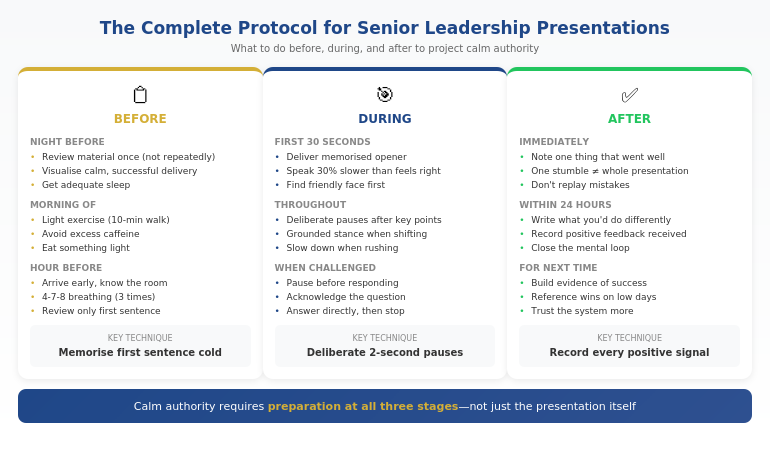
Before: The 24-Hour Protocol

The night before:

  • Review your material once (not repeatedly—that creates anxiety)
  • Visualise a successful presentation: see yourself calm, hear yourself clear
  • Get adequate sleep—anxiety spikes when you’re tired

The morning of:

  • Light exercise (even a 10-minute walk) burns off stress hormones
  • Avoid excessive caffeine—it amplifies anxiety symptoms
  • Eat something light so your blood sugar is stable

The hour before:

  • Arrive early and familiarise yourself with the room
  • Do the 4-7-8 breathing technique (4 counts in, 7 hold, 8 out) three times
  • Review only your first sentence and your key recommendation—nothing else

During: The In-the-Moment Techniques

Remember: the first 30 seconds set the tone for everything that follows.

First 30 seconds:

  • Deliver your memorised first sentence
  • Speak 30% slower than feels natural
  • Find your friendly face and make initial eye contact there

Throughout:

  • Use deliberate pauses after key points
  • Keep returning to the grounded stance when you feel yourself shifting
  • If you feel yourself speeding up, consciously slow down

When challenged:

  • Pause before responding (this looks thoughtful, not slow)
  • Acknowledge the question: “That’s an important point”
  • Answer directly, then stop talking—don’t over-explain

After: The Recovery Protocol

What you do after the presentation affects your confidence in the next one.

Immediately after:

  • Note one thing that went well (your brain will naturally focus on flaws—counteract this)
  • If you stumbled, remind yourself: one moment doesn’t define the presentation

Within 24 hours:

  • Write down what you’d do differently (then close that loop mentally)
  • If you received positive feedback, record it—you’ll need this evidence on low-confidence days

The complete before, during, and after protocol for presenting to senior leadership with calm authority

🎯 If you’re presenting to senior leadership this week, do this in the next 30 minutes:

  1. Write your recommendation in one sentence (if you can’t, you’re not ready)
  2. Memorise your first sentence word-for-word (this is your anchor)
  3. Practice deliberate 2-second pauses after every third sentence (it will feel awkward—that’s the point)
  4. Set a reminder to do the 4-7-8 breathing technique one hour before

This takes 30 minutes. It changes how you show up. The full system in Conquer Speaking Fear builds on these foundations.

⭐ The Complete Protocol — Ready to Implement

Conquer Speaking Fear includes the full before/during/after system, plus the specific techniques for each nervous signal. It’s everything I learned in 5 years of overcoming my own presentation terror—packaged so you can implement it before your next leadership presentation.

You’ll get:

  • The 24-hour preparation protocol
  • In-the-moment recovery techniques
  • The post-presentation confidence builder

Get Conquer Speaking Fear → £39

Developed from clinical hypnotherapy training and tested with hundreds of anxious presenters.

What to Say When Your Mind Goes Blank

It happens to everyone: you’re mid-sentence, and suddenly you have no idea what comes next. In front of senior leadership, this feels catastrophic.

Here’s how to recover:

Recovery Move 1: The Summary Bridge

When you lose your place, summarise what you just said:

“So to summarise that point: [restate the last thing you remember]. Now, moving to [look at your slide or notes for the next topic]…”

This buys you time while appearing organised. Senior leaders appreciate summaries—they’re processing a lot of information.

Recovery Move 2: The Strategic Question

If you’ve made a point and lost your thread, turn to your audience:

“Before I continue—are there questions on this section?”

This pause gives you time to recover while appearing collaborative. If they ask a question, answering it will often reconnect you to your material.

Recovery Move 3: The Honest Reset

If the blank is severe, acknowledge it simply:

“Let me pause and make sure I’m covering this clearly…”

Then glance at your notes, find your place, and continue. Senior leaders respect honesty more than struggling through a confused ramble.

Recovery Move 4: The Transition to Visuals

If you have slides, use them as your anchor:

“Let me walk you through what’s on this slide…”

Reading your slide isn’t ideal, but it’s far better than standing in silence. It keeps the presentation moving while you regain your footing.

For more recovery techniques, see what senior leaders actually do when nerves hit.

Ready to stop dreading leadership presentations? Conquer Speaking Fear (£39) gives you the complete system for calm authority under executive scrutiny.

Frequently Asked Questions

Why do I present fine to my team but fall apart with senior leadership?

It’s the “evaluation threat” response. Your brain perceives senior leaders as high-status individuals who can affect your career—triggering a stronger anxiety response than peer-level presentations. This is normal and biological, not a character flaw.

How much should I rehearse for a leadership presentation?

Rehearse until you know your material, then stop. Over-rehearsing creates a different kind of anxiety—the fear of forgetting your “perfect” version. Know your first sentence cold, know your key points, and trust yourself to fill in the details conversationally.

What if the CEO interrupts me with a tough question?

Pause before responding (this looks thoughtful). Acknowledge the question. Answer directly and concisely. If you don’t know the answer, say “I’ll need to verify that and follow up”—executives respect honesty over fumbled guesses.

Should I use notes when presenting to senior leadership?

Brief notes are fine—better than losing your place. Use a single page with key points only, not a script. Glance at it when needed; don’t read from it. Senior leaders care about your command of the material, not whether you reference notes.

How do I handle a hostile or skeptical executive?

Don’t take it personally—skepticism is their job. Stay calm, stick to facts, and don’t become defensive. If they push back, acknowledge their concern (“I understand that concern—here’s how we’ve addressed it…”) rather than arguing. Calm persistence wins.

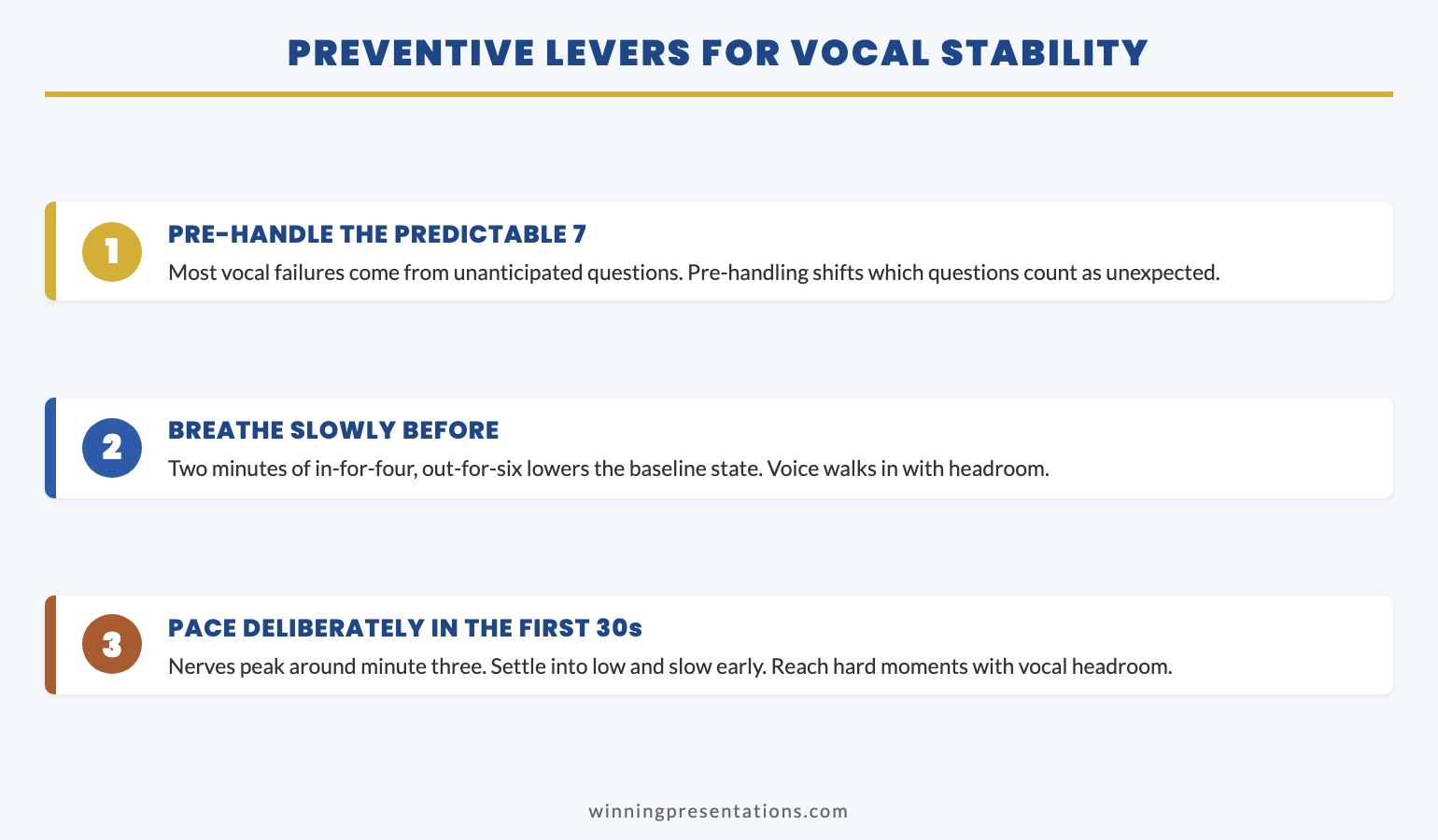
What if I visibly blush, sweat, or shake during the presentation?

Physical symptoms are more noticeable to you than to your audience. If they do notice, projecting calm through your voice and posture matters more than controlling the symptom. The techniques in this article help prevent symptoms from escalating.

How long does it take to get comfortable presenting to senior leadership?

Most people see significant improvement within 3-5 presentations when using these techniques deliberately. You may never be “comfortable,” but you can become confident that you can manage your nerves effectively.

Does this work if you’re naturally anxious?

Yes—in fact, it works better for naturally anxious people than the standard advice (“just relax,” “be confident”). These techniques don’t require you to change your personality or pretend you’re not nervous. They work by giving your anxious energy somewhere productive to go: into deliberate pauses, into grounded posture, into that memorised first sentence. The anxiety is still there—but it’s channelled rather than displayed. Many of the professionals who’ve used these techniques describe themselves as “anxious people who’ve learned to present calmly.” That’s the goal.

Is This Right For You?

✓ This is for you if:

  • You present well to peers but struggle with senior leadership
  • Your nerves undermine your credibility in high-stakes meetings
  • You want techniques that work in the moment, not just theory
  • You’re tired of dreading presentations that could advance your career

✗ This is NOT for you if:

  • You already feel calm presenting to executives
  • Your main issue is slide design, not delivery anxiety
  • You’re looking for medication or therapy referrals
  • You’re not willing to practice techniques before presentations

⭐ I Spent 5 Years Terrified. Then I Found What Works.

That CEO presentation where my voice shook? It was rock bottom. But it started a 5-year journey into nervous system regulation, clinical hypnotherapy, and what actually creates calm authority. Everything I learned is in Conquer Speaking Fear—so you don’t have to spend years figuring it out yourself.

What you’ll get:

  • The complete pre/during/after protocol
  • Techniques for each of the 5 nervous signals
  • Recovery moves when things go wrong

Get Conquer Speaking Fear → £39

Developed from clinical hypnotherapy training and tested with hundreds of professionals who struggled with executive presentations.

📧 Optional: Get weekly confidence strategies in The Winning Edge newsletter (free).

Your Next Step

Your next leadership presentation is the easiest moment to reset how you’re perceived.

Before you present, run through the 60-second reset: three slow breaths, commit to speaking 30% slower, and identify your friendly face for initial eye contact.

These three techniques won’t eliminate nerves—but they’ll prevent nerves from showing. And when you appear calm, executives take you seriously.

The gap between “knowing your material” and “being trusted with bigger opportunities” is often just perceived composure. Close that gap before your next presentation.

For the complete system—including the 24-hour protocol, all 5 signal-blocking techniques, and recovery moves when things go wrong—get Conquer Speaking Fear (£39).

P.S. If your slides aren’t structured for executive decision-making, see how to build decision slides that get “yes” in 60 seconds.

About the Author

Mary Beth Hazeldine is the Owner & Managing Director of Winning Presentations and a qualified clinical hypnotherapist. The CEO presentation that opens this article is real—and the 5 years of terror that followed led to the techniques now in Conquer Speaking Fear.

After 24 years in corporate banking at JPMorgan Chase, PwC, Royal Bank of Scotland, and Commerzbank—where presenting to senior leadership was unavoidable—she’s helped hundreds of professionals transform their relationship with high-stakes presentations.

Book a discovery call | View services

20 Jan 2026
High-stakes presentation nerves - what senior leaders actually do to stay calm and present with confidence

High-Stakes Presentation Nerves: What Senior Leaders Actually Do

Quick answer: Senior leaders don’t eliminate high-stakes presentation nerves—they channel them. The executives who seem effortlessly calm have built preparation rituals that transform anxiety into focused energy. The key shift: they interpret racing heart and heightened alertness as “I’m ready” rather than “I’m afraid.” This reframe, combined with specific preparation habits, is what separates composed presenters from visibly nervous ones.

The techniques below come from watching hundreds of senior executives prepare for board meetings, investor pitches, and career-defining moments over 24 years in corporate banking.

⚡ High-stakes presentation in the next 24 hours? Do this now:

Tonight: Run through your opening 3 times out loud. Know your first sentence cold.

Morning of: 10 minutes of movement (walk, stretch). No new content review.

10 minutes before: Find a private space. Six slow breaths (4 counts in, 6 counts out).

Right before: Drink water. Slow your first two sentences deliberately.

The reframe: When you feel your heart racing, say to yourself: “This is my body getting ready to perform.”

The CFO Who Threw Up Before Every Board Meeting

Early in my banking career, I worked with a CFO who presented quarterly results to a FTSE 250 board. In the room, he was composed, authoritative, unshakeable. The board trusted him completely.

What I didn’t know until years later: he vomited before every single board meeting. Every quarter. For seven years.

He wasn’t fearless. He had a system.

The same ritual every time. The same preparation sequence. The same mental reframe that turned physical terror into focused energy.

When I started coaching executives on presentations, I discovered this wasn’t unusual. The most composed presenters aren’t the ones without nerves. They’re the ones who’ve built systems to channel them.

Here’s what those systems actually look like.


⭐ Calm Your Nervous System Before High-Stakes Moments

A hypnotherapist’s toolkit for stopping the physical symptoms of presentation anxiety.

Includes:

  • The 60-second reset that calms racing heart and shaking hands
  • Breathing techniques that work even when you’re already nervous
  • Pre-presentation routine you can do outside the boardroom

Get Calm Under Pressure → £19.99

Created by a clinical hypnotherapist who’s helped hundreds overcome presentation anxiety.

The Myth of the “Naturally Confident” Executive

Here’s what most people believe: some executives are just naturally confident. They were born with a presentation gene. The stakes don’t affect them the way they affect the rest of us.

After 24 years watching senior leaders prepare for high-stakes moments, I can tell you: this is completely wrong.

The executives who look effortlessly calm are often the most anxious beforehand. What they have isn’t an absence of nerves—it’s a system for managing them that’s become automatic.

What nervous professionals do:

  • Try to suppress or eliminate anxiety (impossible)
  • Over-prepare content until the last minute (increases stress)
  • Interpret physical symptoms as evidence they can’t handle it
  • Wing the opening because “I know this material”

What senior leaders do:

  • Accept that nerves are part of high-stakes performance
  • Stop content preparation 24 hours before
  • Interpret physical symptoms as readiness signals
  • Rehearse their opening until it’s automatic

The difference isn’t confidence. It’s preparation architecture.

If you want to overcome the fear of public speaking long-term, you need to build the same systems. But even for a single high-stakes presentation, these habits make a measurable difference.

The Nerves Reframe: Anxiety as Readiness

This is the single most important technique for managing high-stakes presentation nerves.

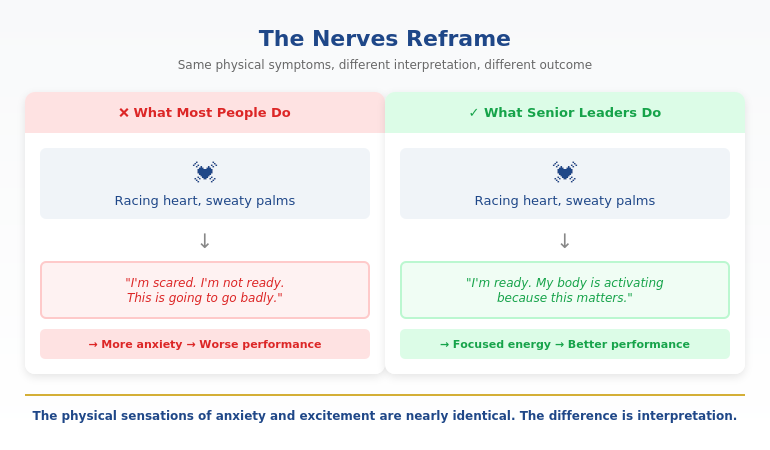
When you feel anxiety—racing heart, sweaty palms, shallow breathing—your brain is making an interpretation. It’s asking: “What does this physical state mean?”

Most people’s default interpretation: “I’m scared. I’m not ready. This is going to go badly.”

That interpretation makes everything worse. It triggers more stress hormones. It creates a feedback loop of escalating anxiety.

The reframe that senior leaders use:

When you feel those physical symptoms, consciously tell yourself: “This is my body getting ready to perform. These are readiness signals, not danger signals. My system is activating because this matters.”

This isn’t positive thinking. It’s physiologically accurate.

The physical sensations of anxiety and excitement are nearly identical: elevated heart rate, heightened alertness, increased blood flow. The difference is entirely in interpretation. Research shows that people who interpret pre-performance arousal as helpful actually perform better than those who try to calm down.


The Nerves Reframe showing how senior leaders interpret anxiety signals as readiness rather than fear

How to practice the reframe:

Next time you feel presentation nerves, say out loud (or silently): “I’m not scared—I’m ready. My body is activating because this matters. This energy is going to help me perform.”

It feels strange the first few times. After a dozen repetitions, it becomes automatic. Senior executives have done this reframe so many times it’s now their default interpretation.

For the complete protocol including the neurological basis and practice exercises, it’s covered in depth in Conquer Speaking Fear.

Want the complete Nerves Reframe Protocol? Conquer Speaking Fear includes step-by-step techniques for rewiring how your brain interprets anxiety—plus emergency protocols for when panic hits. See what’s included →

What Senior Leaders Actually Do (The Preparation Rituals)

Here’s what I’ve observed from watching hundreds of executives prepare for board meetings, investor presentations, and career-defining moments:

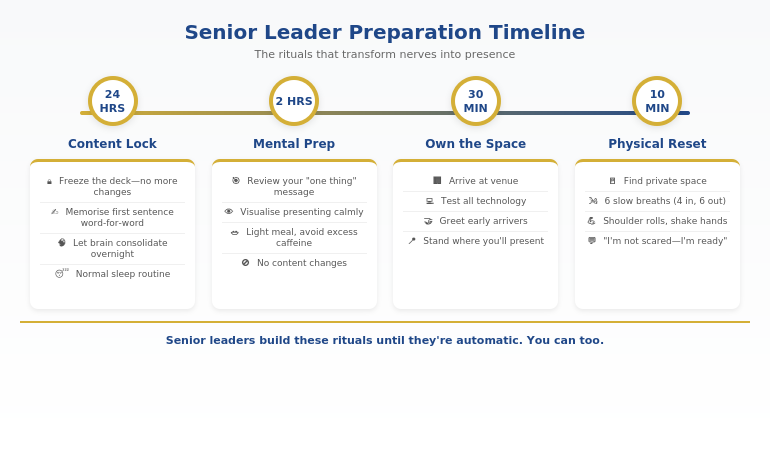
Ritual #1: Content lock 24 hours before

Senior executives stop changing their content a full day before presenting. No more tweaks. No more “one more data point.” The presentation is frozen.

Why this works: last-minute changes increase cognitive load and anxiety. Your brain needs time to consolidate. The executives who seem most natural have stopped thinking about content and started thinking about delivery.

Ritual #2: First sentence memorised word-for-word

Every senior leader I’ve worked with knows their first sentence cold. Not approximately—exactly. They could say it in their sleep.

Why this works: the first 10 seconds are when anxiety peaks. Having an automatic opening eliminates the “what do I say first?” panic. Once you’re past those first words, momentum takes over. Learn more about crafting a powerful executive presentation opening line.

Ritual #3: Physical reset before entering

Before walking into the room, senior leaders find a private space—bathroom, empty office, stairwell—for a 2-minute physical reset. This typically includes: 6 slow breaths, shoulder rolls to release tension, and 30 seconds standing in an expanded posture.

Why this works: physical state drives mental state. You can’t think your way to calm, but you can breathe your way there. For a complete pre-presentation reset routine, see how to calm nerves before a presentation.

Ritual #4: Arrival 15 minutes early

Executives arrive early enough to own the space. They test the technology. They stand where they’ll present. They greet early arrivers casually.

Why this works: arriving rushed puts you in reactive mode. Arriving early puts you in host mode. The psychological shift is significant.


Senior leader preparation timeline showing what executives do 24 hours, 2 hours, and 10 minutes before high-stakes presentations


⭐ High Stakes Trigger Your Nervous System — Here’s the Override

These techniques work at the physiological level, not just “think positive” advice.

Includes:

  • Vagus nerve activation that shifts you out of fight-or-flight
  • The grounding method that stops symptoms mid-presentation
  • Emergency reset when nerves spike unexpectedly

Get Calm Under Pressure → £19.99

Used by executives who present to boards, investors, and leadership teams.

The Day Of: Hour-by-Hour Protocol

Here’s the exact timeline senior leaders follow on presentation day:

Morning (3+ hours before):

  • Normal routine. Don’t disrupt sleep or eating patterns.
  • 10 minutes of physical movement—walk, stretch, light exercise.
  • One run-through of opening and closing only. No full rehearsal.
  • No content changes. The deck is locked.

2 hours before:

  • Review your “one thing”—the single most important message.
  • Visualise the room, the faces, yourself presenting calmly.
  • Light meal or snack. Avoid caffeine if you’re already anxious.

30 minutes before:

  • Arrive at the venue. Test technology. Claim the space.
  • Greet anyone who’s early. Small talk reduces your threat perception.

10 minutes before:

  • Find a private space. Bathroom stall works.
  • 6 slow breaths: 4 counts in, hold 2, 6 counts out.
  • Shoulder rolls. Shake out hands.
  • Say your opening sentence out loud once.
  • Reframe: “I’m not scared—I’m ready.”

1 minute before:

  • Stand tall. Shoulders back. Take up space.
  • Smile briefly—it releases tension.
  • Focus on serving your audience, not on your performance.

This protocol works because it shifts your focus from “how will I perform?” to “how will I serve?” Senior leaders have made this shift so many times it’s automatic. You can build the same pattern.

Want a printable version of this protocol? Conquer Speaking Fear includes the complete day-of timeline plus emergency techniques for unexpected situations. Download now →

Related: Once you’ve managed your nerves, make sure your opening line earns the attention you deserve. Read Executive Presentation Opening Line That Makes Executives Put Down Their Phones.

Common Questions About High-Stakes Presentation Nerves

How do you calm nerves before a high-stakes presentation?

The most effective approach is reframing, not calming. When you feel anxiety symptoms, interpret them as readiness signals rather than fear signals. Tell yourself: “My body is activating because this matters.” Combine this with physical reset techniques—6 slow breaths, shoulder rolls, expanded posture—in the 10 minutes before presenting. Trying to eliminate nerves entirely backfires; channeling them works.

Why do I get so nervous before important presentations?

Your nervous system is doing its job. High-stakes situations trigger a stress response designed to help you perform—increased alertness, faster processing, more energy. The problem isn’t the nerves; it’s interpreting them as “something is wrong.” Senior executives feel the same physical symptoms—they’ve just learned to interpret them as “I’m ready” rather than “I’m afraid.” Build presentation confidence by changing the interpretation, not fighting the sensation.

How do executives stay calm under pressure?

They don’t stay calm—they manage activation. The executives who seem effortlessly composed have built preparation rituals that become automatic: content lock 24 hours before, first sentence memorised, physical reset before entering, early arrival to own the space. They’ve also practiced the anxiety reframe so many times that “I’m ready” is now their default interpretation of nervous symptoms.


⭐ Ready to Eliminate Presentation Fear Permanently?

Go beyond managing symptoms — rewire how your brain responds to high-stakes situations entirely.

Includes:

  • The complete fear-to-confidence transformation system
  • Mental rehearsal techniques that build genuine confidence
  • Cognitive reframing methods from clinical hypnotherapy

Get Conquer Speaking Fear → £39

The complete system for professionals who want to present without fear — not just manage it.

FAQ

What if I’ve tried everything and still get nervous?

You’re not trying to stop being nervous—you’re trying to use the nervousness differently. The reframe technique doesn’t eliminate anxiety; it changes your relationship with it. If deep breathing hasn’t worked, it’s because you were trying to suppress symptoms rather than reinterpret them. The shift from “I need to calm down” to “this activation is helping me” is subtle but transformative.

How far in advance should I start preparing mentally?

Lock your content 24 hours before. Start the mental preparation—visualisation, reframe practice, physical routines—the morning of. Don’t over-prepare the day before; this increases rumination and anxiety. The goal is to arrive at your presentation with fresh energy and automatic habits, not exhausted from mental rehearsal.

Does this work for virtual high-stakes presentations?

Yes—with modifications. For virtual presentations, arrive at your setup 20 minutes early to test technology and settle in. Do your physical reset away from camera, then return with 2 minutes to spare. The reframe technique works identically. Virtual presentations often feel harder because you can’t read the room, so having automatic habits becomes even more important.

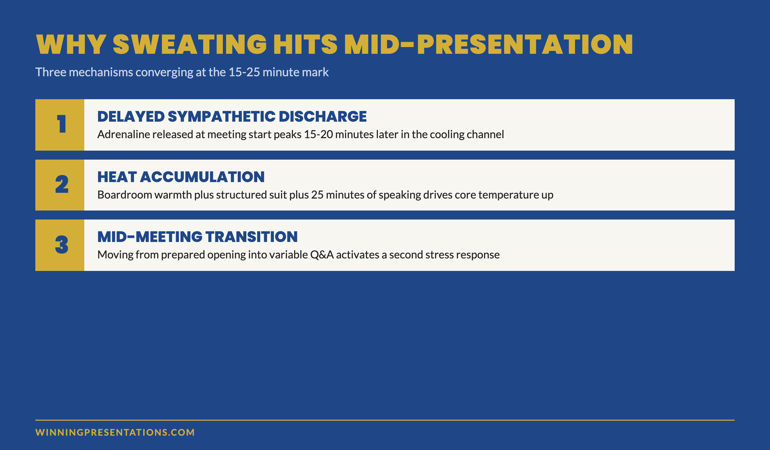
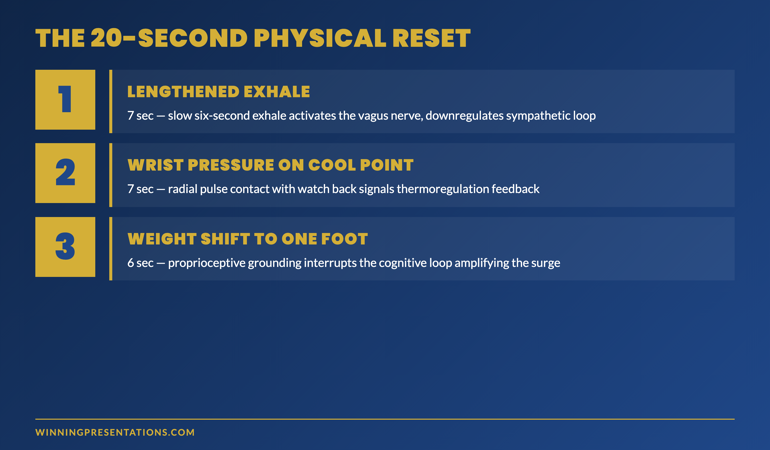
What if the nervousness is visible (shaking, sweating)?

Two approaches: manage the symptoms and reframe the visibility. For physical symptoms, the breathing reset helps (it activates your parasympathetic nervous system). But also know this: audiences notice visible nerves far less than you think. And mild nervousness often reads as “this person cares about this topic.” If symptoms are severe, the Calm Under Pressure guide covers specific techniques for physical symptom management.

📧 The Winning Edge Newsletter

Weekly techniques for confident presenting, managing nerves, and executive communication. Practical methods from a clinical hypnotherapist with 24 years in corporate banking—no generic advice, just what actually works under pressure.

Subscribe Free →

Your Next Step

Senior leaders don’t eliminate high-stakes presentation nerves. They build systems that transform anxiety into focused energy.

For your next important presentation: lock your content 24 hours before, memorise your first sentence, do the physical reset 10 minutes before, and practice the reframe—”I’m not scared, I’m ready.”

These aren’t tricks. They’re the exact preparation rituals I’ve observed from executives who present to boards, investors, and senior leadership regularly.

For the complete system—including the Nerves Reframe Protocol, day-of timeline, and emergency techniques—get Conquer Speaking Fear.

📋 Free Resource: Calm Under Pressure Quick Guide

Techniques for managing physical symptoms of presentation anxiety—shaking, sweating, racing heart. Perfect companion to the mindset techniques above.

Download Calm Under Pressure →

About the Author

Mary Beth Hazeldine is the Owner & Managing Director of Winning Presentations and a former corporate banker with 24 years of experience at JPMorgan Chase, PwC, Royal Bank of Scotland, and Commerzbank. She has trained thousands of executives on high-stakes presentation skills and helped clients secure more than £250 million in funding and budget approvals.

Mary Beth is also a qualified clinical hypnotherapist and NLP practitioner, specialising in helping professionals overcome presentation anxiety and speaking fear. After spending five years battling her own terror of presenting at JPMorgan, she developed the neuroscience-based techniques she now teaches to executives worldwide.

Book a discovery call | View services

17 Jan 2026
Man in a suit giving a presentation in a modern conference room, gesturing toward a projected slide deck behind him.

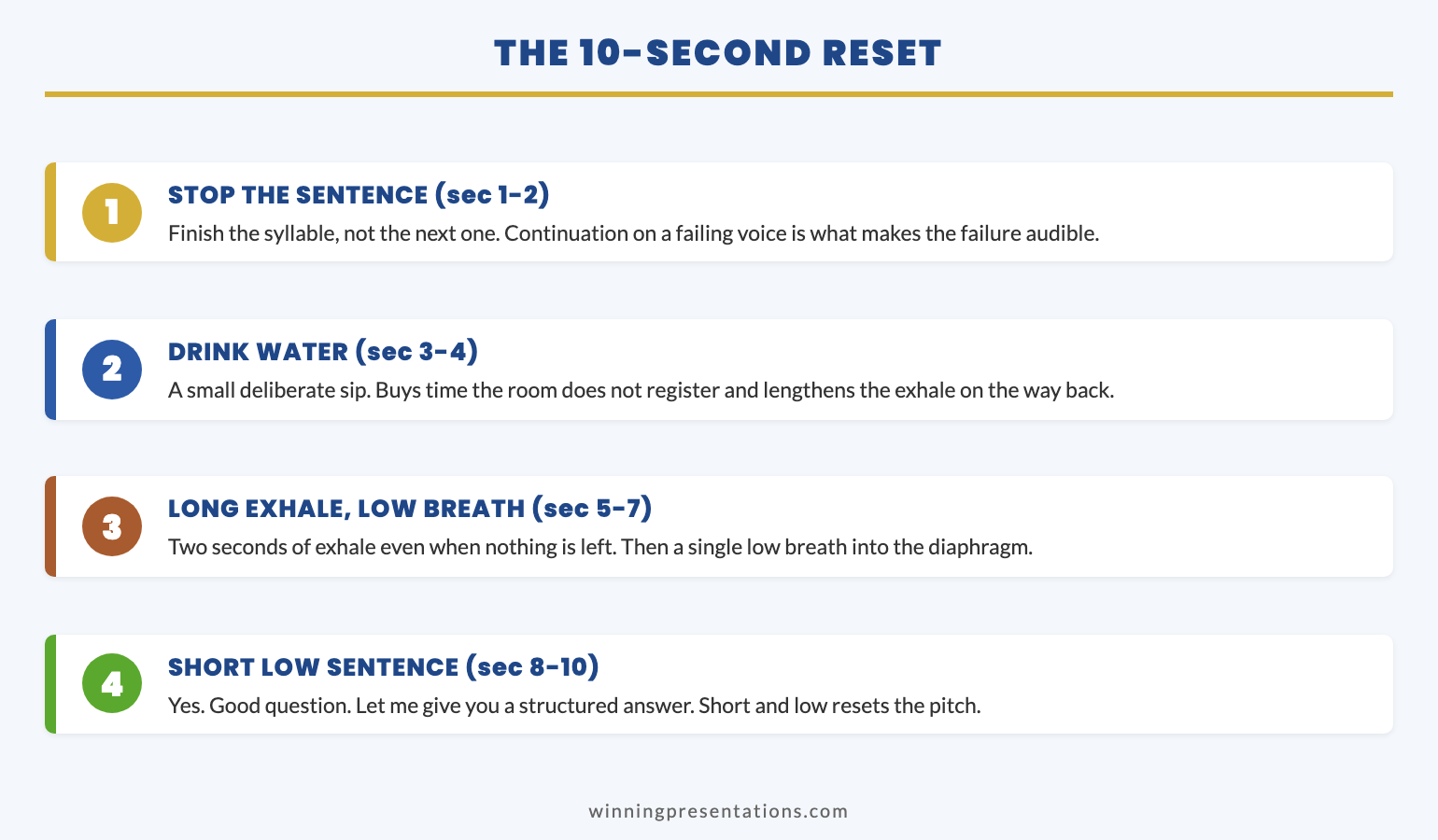
Voice Shaking When Speaking (Fix It in 60 Seconds)

Voice shaking when speaking is a brief loss of vocal stability caused by adrenaline, tight throat muscles, and shallow breath support—which is why a fast body-first reset works better than “confidence tips.”

Quick Answer: If your voice is shaking when speaking, don’t fight it and don’t “power through.”
Do this 60-second reset: exhale first (6–8 seconds), drop your tongue (release jaw tension),
hum low (10 seconds), then start with a calm sentence—not a big greeting. This stabilises breath support and stops the tremor fast.

I’ve seen it happen to people who look completely confident on paper.

Senior leaders. CFOs. Heads of Sales. Brilliant experts.

They walk into a meeting, start speaking… and their voice wobbles.

Not because they’re unprepared. But because the body does something very predictable under pressure: it tries to protect you.

This article gives you a fix you can use in under 60 seconds, and it’s the same approach I use when coaching executives who need their voice to stay steady in high-stakes situations.

If you’re about to speak in the next 5 minutes:

  1. Exhale slowly once (6–8 seconds)
  2. Hum low for 10 seconds
  3. Start with: “Let me frame this clearly.”

Then download Calm Under Pressure so you never have to “hope your nerves behave” again.


Get Calm Under Pressure → £19.99

Why Your Voice Shakes When Speaking (It’s Not Weakness)

A shaky voice is usually a body support problem, not a “confidence problem.”

In high-pressure moments, adrenaline creates a chain reaction:

60-second voice stabiliser steps to stop a shaky voice before speaking

  • Your throat tightens slightly (protective reflex)
  • Your breathing moves higher into the chest
  • You start talking before your breath support is stable
  • Your voice loses steadiness and “tremors”

The fix is simple: stabilise breath + release tension before you speak.

The 60-Second Fix (Do This Before You Speak)

This is the fastest reset I teach because it works even when your nerves are strong.

Why voice shaking happens when speaking showing adrenaline breath and throat tension

⭐ Stop the Shaking Before Your Next Presentation

A hypnotherapist’s toolkit for calming your nervous system when physical symptoms strike.

Includes:

  • The 60-second reset that stops trembling hands and voice
  • Breathing techniques that work in high-stakes moments
  • Pre-presentation calming routine you can do anywhere

Get Calm Under Pressure → £19.99

Created by a clinical hypnotherapist who’s helped hundreds overcome presentation anxiety.

Step 1: Exhale First (6–8 seconds)

Don’t inhale. Exhale slowly. This signals safety to your nervous system and stops the “fight-or-flight” spike.

Step 2: Drop Your Tongue + Jaw

Let the tongue relax off the roof of the mouth. This opens the throat and reduces vocal strain instantly.

Step 3: Low Hum (10 seconds)

Hum softly on a low note. It warms the vocal cords and stabilises vibration.

Step 4: Start Mid-Sentence

Skip the “big greeting.” Start with a calm, grounded sentence like:

  • “Let me frame this clearly.”
  • “Here’s what matters most.”
  • “I’ll take this step-by-step.”

If you want the full system for staying calm in high-stakes moments (voice, breathing, mind, and body), it’s inside Calm Under Pressure.

Emergency Opening Lines (If Your Voice Is Already Shaking)

Sometimes you’re already speaking when the tremor hits. These lines buy you time without sounding nervous.

Emergency opening lines to use when your voice is shaking during a presentation

Use one line, then pause for a full breath. That pause is not awkward. It’s authority.

What NOT to Do (The Mistakes That Make It Worse)

Tip: If you want a full set of executive-safe delivery fixes, this is a good companion read: Public Speaking Tips.

  • Don’t gulp air. It increases instability.
  • Don’t rush. Speed makes tremor louder.
  • Don’t lift pitch. Higher pitch shakes more.
  • Don’t apologise. “Sorry, I’m nervous” amplifies it in your mind.

Your 3-Minute Pre-Meeting Calm Routine

If you want this to stop happening long-term, do this before any important call or presentation:

  1. 30 seconds: long exhale cycles (4–6 breaths)
  2. 60 seconds: low hum + gentle neck release
  3. 30 seconds: first sentence rehearsal (slow, low, grounded)
  4. 60 seconds: decide your “first 3 words” (start strong)

This is exactly how “calm presenters” build stability: they stabilise the body first, then the voice follows.

⭐ Walk Into Your Next Presentation Without Fear of Shaking

The techniques in this toolkit become automatic with practice — so you’re always prepared.

Includes:

  • Step-by-step calming sequences for before, during, and after
  • Physical anchoring techniques from clinical hypnotherapy
  • The confidence reset that works even when you’re already shaking

Get Calm Under Pressure → £19.99

Instant download. Use before your next presentation.

Frequently Asked Questions

Why does my voice shake when I speak in meetings?

Usually it’s adrenaline + tight throat + unstable breath support. The fix is exhale first, release tongue/jaw tension, and speak slightly lower and slower.

How do I stop my voice from trembling in public speaking?

Use the 60-second stabiliser before you speak, and practise the 3-minute calm routine before every high-stakes moment.

Is a shaky voice a sign of anxiety?

Often yes—but it’s a physical expression of pressure, not a character flaw. You can retrain it quickly with the right techniques.

What this really costs you: a shaky voice doesn’t just feel uncomfortable—it can make your message sound uncertain.
If you present, pitch, or lead meetings, you need a calm system you can trigger on demand.

📧 Want calm communication skills every week?
Subscribe to The Winning Edge →

Not ready to buy yet? Start with my free Executive Presentation Checklist (simple fixes that instantly improve your delivery).Download the Executive Presentation Checklist →

Related Resources


About the author: Mary Beth Hazeldine leads Winning Presentations and has trained 5,000+ executives to speak with clarity and confidence. She is also a qualified clinical hypnotherapist and NLP practitioner.