Tag: business communication

20 Apr 2026
Senior executive in a focused one-to-one pre-meeting with a colleague in a glass-walled corporate office, reviewing a proposal document together, navy and gold tones, editorial photography style

Stakeholder Alignment Workshop: The Pre-Meeting That Decides

Quick Answer

Stakeholder alignment is the work that happens before your presentation, not inside it. Identify the two or three people whose silence or resistance could derail your proposal, meet them individually beforehand, and address their concerns directly. Executives who walk into decision meetings with informed support rather than hopeful assumptions achieve faster approvals and fewer unexpected deferrals.

Kwame had every reason to feel confident walking into the committee room. He had spent three weeks building the proposal, modelled three financial scenarios, addressed the likely objections in the appendix, and rehearsed the narrative twice. He believed the room would be receptive.

It wasn’t. Within ten minutes, the Chief Risk Officer had raised a concern about regulatory exposure that Kwame had not prepared for. Two other committee members, who had said nothing before the meeting, aligned themselves with her position. The session ended with a request for a revised paper at the next quarter’s cycle.

Kwame reviewed what had gone wrong. The CRO had spoken informally to a colleague about regulatory risk several weeks earlier. That conversation had shaped her view long before the formal session. Kwame had been building a presentation; his opponent had been building a coalition. He had assumed the formal meeting was where the decision would be made. In practice, it had already been made — against him.

Most presentation preparation focuses on what happens in the room. The executives who consistently secure approvals focus on what happens before it.

Preparing a proposal for a major decision meeting?

The Executive Slide System includes scenario playbooks and slide frameworks designed for executive decision presentations, including pre-meeting structuring and stakeholder-specific slide approaches.

Explore the System →

Why the Decision Is Usually Made Before the Meeting

Formal decision meetings rarely change minds. By the time a proposal reaches a board or committee, the people in that room have already formed a view — either through their own analysis, through conversations with colleagues, or through a prior experience with the presenting team. The formal session is not the moment of decision. It is the moment where existing positions are ratified or challenged.

This is not a criticism of how decisions are made. It reflects how senior leaders actually operate. They gather intelligence informally, form provisional views, and use the formal meeting to test those views against the group. An executive who walks in hoping to persuade a room from a standing start is working against this process rather than with it.

The implication is significant: if stakeholder alignment is not done before the meeting, the presentation itself becomes an uphill argument against positions that were formed without your input. The objections raised in the room are almost always objections that existed before the room convened. They simply were not surfaced earlier because no one asked.

Pre-meeting alignment is not about lobbying or soft manipulation. It is about making sure that the people who will influence the decision have had a genuine opportunity to raise their concerns — with you, directly, in advance — so those concerns can be understood, addressed, and either incorporated into the proposal or prepared for in the room.

Mapping Your Stakeholder Landscape in Advance

Before any alignment conversation takes place, map the landscape. For a typical executive decision meeting, this means identifying three categories of stakeholder: those who are likely to support the proposal, those who are genuinely undecided, and those whose instinct will be sceptical or resistant.

The supporters matter less than you think. They will advocate regardless. The undecided are your primary opportunity: a well-structured pre-meeting conversation with an undecided stakeholder often converts a tentative abstention into active support. The sceptics are your primary intelligence source: understanding their specific concerns before the meeting allows you to address them directly in your presentation or to prepare substantive responses rather than improvised ones.

To map accurately, consider three factors. First: authority weight. Who in the room carries disproportionate influence over others? A single sceptic with high authority is more consequential than three undecided voices. Second: domain expertise. Who will be most credible on the technical or commercial dimensions of the proposal? If the CFO is sceptical about the financial model, that carries more weight than a peer-level concern. Third: prior exposure. Has anyone on the committee heard a version of this proposal before? Prior exposure creates expectations — either positive or negative — that shape how the new version is received.
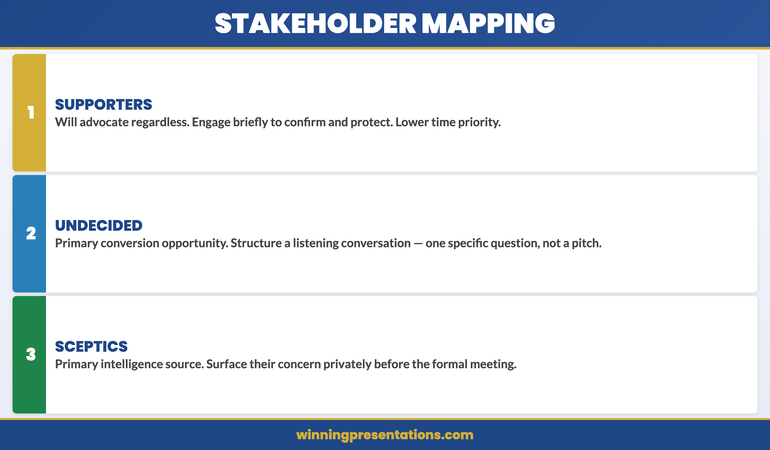
Stakeholder mapping framework showing three categories: Supporters (advocate regardless), Undecided (primary conversion opportunity), Sceptics (primary intelligence source) with engagement priority guidance for each

The Pre-Meeting Formula: What to Cover One-to-One

An alignment conversation is not a pre-sell. It is a structured listening exercise that happens to include a briefing. The distinction matters because the purpose is to learn, not to persuade. Going into a pre-meeting with the goal of converting a sceptic will produce a conversation that feels transactional and may harden their position. Going in with the goal of understanding their concern produces a conversation that often resolves the concern naturally.

A well-structured pre-meeting covers three areas. First, context: give the person a brief overview of what you are proposing and why it is coming to this particular committee at this particular time. Keep this to two minutes. Second, invitation: ask a specific question. Not “what do you think?” but something more targeted, such as “What would you want to understand about the financial model before the session?” or “From your experience with similar projects, what tends to create the most friction in approvals like this?” These questions surface real concerns without feeling interrogative. Third, direct ask: at the end of the conversation, confirm understanding. “Is there anything in what I’ve covered that would give you pause at the meeting?”

That final question is uncomfortable to ask and extremely valuable to hear. It gives sceptics a private, low-stakes forum in which to raise their concern. Most will. And a concern raised privately is significantly easier to address than one launched in a formal committee session in front of peers.

The Executive Slide System

Executive decisions are won through structure, not persuasion. The Executive Slide System — £39, instant access — includes slide frameworks and scenario playbooks designed for high-stakes proposals, including how to structure a presentation for a room where views are already partially formed.

  • Slide templates for executive decision scenarios
  • AI prompt cards to build decks fast
  • Scenario playbooks for board, budget, and approval meetings
  • Framework guides for structuring high-stakes proposals

Get the Executive Slide System →

Designed for executives preparing high-stakes presentations and proposals.

Reading Resistance Versus Polite Uncertainty

Not every sceptic sounds like one in a pre-meeting. Some express genuine enthusiasm but are privately unconvinced. Others raise procedural questions that feel neutral but signal substantive concern. Learning to distinguish between “wait and see” and “fundamentally opposed” is one of the most valuable skills in stakeholder alignment.

Genuine support tends to be specific. A supporter will name what they find compelling, ask about implementation or timing, and use inclusive language (“when this is approved” rather than “if this goes ahead”). Polite uncertainty tends to be general. Someone who is unconvinced but unwilling to say so will offer vague encouragement (“very interesting work”), redirect to process (“has legal reviewed this?”), or ask questions that test your preparation without engaging with your argument.

The most telling signals are the questions that are not asked. If someone who has domain expertise in a critical area of your proposal asks nothing about that area in a pre-meeting, they either have no concern or they have already decided they will raise it formally rather than privately. The latter is more common. A subject-matter expert who asks nothing has usually formed a view they consider settled.

When you encounter this pattern, do not push for their opinion. Instead, name the gap directly: “I noticed I haven’t covered the operational implications — is that an area you’d want more detail on before the session?” This gives them a structured opening. If there is a concern, it will usually surface at this point. If there genuinely isn’t, they will say so clearly.

If you are structuring a follow-up presentation after an inconclusive meeting, pre-meeting alignment becomes even more important: you need to understand what shifted between the previous session and the current one before you can present effectively.

When a Yes in Private Becomes Silence in the Room

One of the most disorienting experiences in executive presenting is walking into a formal meeting with four verbal commitments from individual stakeholders and watching three of them say nothing while a fifth person raises an objection that changes the room’s direction.

This happens for a predictable reason. A private yes is a personal position. A public yes is a social commitment with professional consequences. Senior leaders manage their reputations carefully. If a peer raises a concern in a formal session that another executive did not anticipate, that executive may stay silent to avoid appearing poorly briefed rather than speak up for a position they privately hold.

The lesson is not that pre-meeting commitments are unreliable. It is that they are conditional on what happens in the room. To protect the value of your pre-meeting work, there are two practical steps. First, close each alignment conversation with a specific commitment: “If no new information comes up before Thursday, can I count on your support at the meeting?” That language shifts the implied commitment from unconditional to bounded — and gives you a cleaner read of where each person actually stands. Second, build your formal presentation to pre-empt the concerns you identified in pre-meetings. If you know the CFO is worried about the capital expenditure timeline, address that directly and early in the presentation itself. This signals to the CFO that you listened, and it reduces the likelihood that they will raise it as a public challenge.

Understanding how to close a presentation so executives take action becomes significantly easier when stakeholder alignment has already established the direction of their thinking before the final slides appear.

If you want to strengthen your approach to executive decision presentations, the Executive Slide System includes scenario playbooks specifically designed for multi-stakeholder approval meetings.

How Pre-Alignment Changes Your Formal Presentation

A presentation built without stakeholder alignment intelligence is constructed around what the presenter assumes the room needs to hear. A presentation built after alignment conversations is constructed around what the room has already told you it needs to hear. The difference in persuasive effectiveness is substantial.

Concretely, pre-alignment changes three structural decisions. First, it changes what you emphasise. If your mapping has identified that the CFO is undecided and the CEO is supportive, you structure the proposal so that the financial case is front-loaded and comprehensive. If the operational committee is your swing vote, operational feasibility becomes the centrepiece. You are not changing the proposal; you are calibrating the emphasis to match the decision-making framework of the people who matter most.

Second, it changes how you handle objections. Without alignment intelligence, you respond to objections as they arise. With it, you can pre-empt the most significant ones. “One question that came up in my preparation was the impact on the current capital allocation cycle — I want to address that directly before we move to Q&A.” This signals thoroughness, reduces the dramatic impact of the objection if it still arises, and demonstrates respect for the committee’s specific concerns.

Third, it changes your structure if you have a formal executive presentation outline. Instead of a linear case-building structure, a pre-aligned presentation often leads with the decision itself, addresses the two or three specific concerns identified in pre-meetings early, and reserves the detailed evidence for stakeholders who want it rather than presenting it to everyone as though none of them have a view yet.
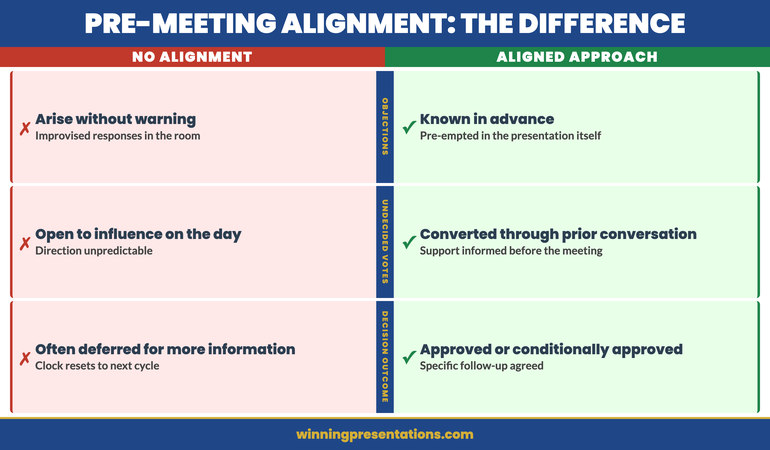
Pre-alignment impact on presentation structure: three changes — emphasis (calibrated to decision-makers), objections (pre-empted not improvised), structure (decision-led not case-building)

Common Alignment Mistakes to Avoid

The most common error is treating alignment as optional rather than structural. Many executives view pre-meetings as a favour to important stakeholders, something done when there is time rather than as a non-negotiable step in the presentation process. When pressed on preparation time, they deprioritise alignment in favour of slide refinement. This trades the thing most likely to improve the outcome (understanding the room) for the thing most visible in preparation (polishing the deck).

The second error is aligning too broadly. Speaking to every member of the committee in advance creates logistical difficulty and can create the impression that you are lobbying rather than consulting. Focus on three to five people: the one with the most authority, the one most likely to be sceptical, and one who has previously expressed interest in similar proposals. These conversations will tell you more than speaking to ten people at a more superficial level.

The third error is seeking endorsement rather than understanding. Going into a pre-meeting with the goal of securing a “yes” creates conversations that feel manipulative and tend to produce hollow agreements. Going in with the goal of understanding genuine concerns produces conversations that are substantively useful. The distinction lies in the questions you ask: “What would you need to see?” is more valuable than “Can you see yourself supporting this?”

The fourth error is not following up. If a stakeholder raises a concern in a pre-meeting and you address it in your revised presentation, send them a brief note before the formal session: “Following our conversation last week, I’ve updated the proposal to reflect your point about the timeline. Section three now covers that directly.” This closes the loop, confirms you listened, and reminds them of their prior engagement with the process in a way that makes it harder to raise the same concern again as though it is new.

The Executive Slide System

Slide frameworks designed for multi-stakeholder executive decisions — including scenario playbooks for proposals where different stakeholders have different priorities. £39, instant access.

Get the Executive Slide System →

Designed for executives preparing structured proposals for senior decision meetings.

Frequently Asked Questions

How much time before a presentation should stakeholder alignment happen?

Alignment conversations should happen at least five to seven working days before the formal meeting. This gives you time to incorporate significant concerns into your proposal and gives stakeholders enough notice that the conversation feels deliberate rather than last-minute. For high-stakes or complex proposals, begin alignment two to three weeks in advance. The earlier you understand the room’s concerns, the more substantive your response can be.

What if a key stakeholder refuses to meet in advance?

If a stakeholder declines a pre-meeting, this is itself useful information. It usually signals one of three things: they are too busy to engage at this stage, they have a strong prior view that they do not want to moderate through private discussion, or they prefer to see how the formal meeting develops before committing. In any of these cases, invest extra effort in understanding their known priorities and likely concerns through other channels — conversations with their direct reports, recent public statements on similar proposals, or the records of previous meetings where they have engaged on related topics. Design your formal presentation to pre-empt the most predictable version of their concern.

Can pre-meeting alignment backfire?

It can if handled badly. Speaking to too many people, sharing sensitive details prematurely, or creating the impression of a coordinated lobbying effort can generate resistance rather than support. Two principles reduce this risk. First, approach each pre-meeting as a listening exercise, not a persuasion exercise. Second, keep the conversations focused on the proposal’s merits and the specific concerns of that individual — do not reference what other stakeholders said or imply that you are building consensus against someone.

The Winning Edge — A Newsletter for Executives Who Present

Every Thursday: one practical technique for structuring, presenting, or defending a high-stakes proposal. Designed for executives who need to communicate with authority, not just confidence.

Subscribe to The Winning Edge →

Also available: the Executive Presentation Checklist — a free pre-presentation checklist for senior decision meetings.

If you are building a proof-of-concept presentation, the same alignment principles apply — with an additional layer of technical credibility to manage.

About the Author

Mary Beth Hazeldine is the Owner and Managing Director of Winning Presentations. With 25 years of corporate banking experience at JPMorgan Chase, PwC, Royal Bank of Scotland, and Commerzbank, she advises executives across financial services, healthcare, technology, and government on structuring presentations for high-stakes funding rounds and approvals.

30 Mar 2026
Project kickoff meeting with team gathered around a presentation screen showing a clear project timeline

How to Run a Project Kickoff Presentation That Aligns Teams

A structured kickoff meeting creates alignment from day one by clarifying objectives, roles, timelines, and dependencies. Delivered with clear communication and discipline, it prevents costly misunderstandings and sets the foundation for team cohesion and accountability throughout the project lifecycle.

When Kwame took over a financial systems migration for a mid-sized bank, his team had been handed a vague mandate: “Upgrade the core ledger platform.” No shared timeline. No defined scope. No clarity on how decisions would be made. Three months in, the project fractured. Developers and infrastructure teams were working towards different assumptions. Budget holders were caught off-guard by delays. A single, structured kickoff—delivered in the first week—would have caught these conflicts before they cost time and credibility. Instead, Kwame spent weeks unpicking misalignments that a clear kickoff meeting could have prevented entirely. The lesson stayed with him: the initial alignment session is not an admin formality. It’s the moment leadership either builds alignment or inherits chaos.

Struggling to structure your kickoff? Many leaders treat the kickoff as a procedural checkbox rather than a strategic moment to reset expectations and build shared understanding. If your teams have ever worked at cross-purposes on a project, this initial alignment meeting is where that friction begins—or gets prevented.

Objective Clarity: What Success Looks Like

The first responsibility of any kickoff is to articulate what done looks like. Too many projects suffer from scope creep and misaligned priorities because the team never heard a single, unambiguous statement of objectives.

Structure this section in three layers. Start with the business case: why this project exists and what value it creates. Then move to project scope: what is included, what is explicitly out of scope, and the success criteria by which progress will be measured. Finally, address constraints: budget, schedule, resource availability, regulatory requirements, or technical dependencies that will shape execution.

The disciplines that matter most are clarity over brevity. Your team will not be offended by explicitness; they will be relieved by it. A structured kickoff that spends three minutes on this section—with concrete examples and non-negotiable boundaries—prevents weeks of navigating ambiguity later.

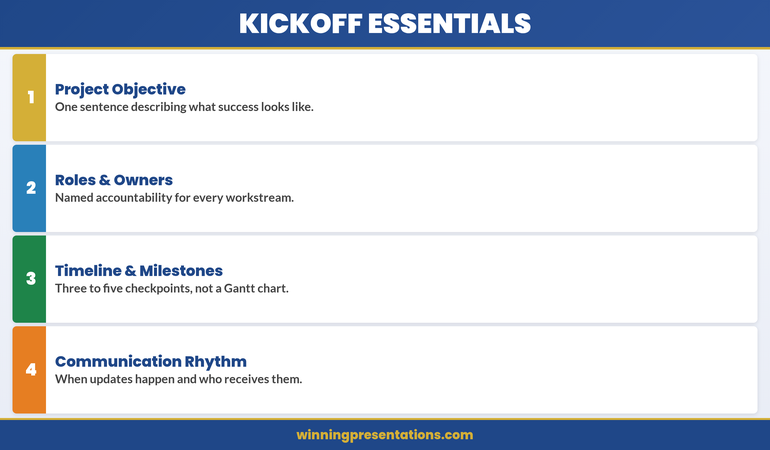
Four essential elements of a project kickoff presentation: project objective, roles and owners, timeline and milestones, and communication rhythm

Build Kickoff Presentations That Land

Structure your slides to establish clarity, credibility, and shared accountability from the first moment. The Executive Slide System gives you templates and frameworks for every element—from objective clarity to stakeholder alignment to decision rights.

Get the System — £39

Team Roles and Accountability Structures

The second pillar of any effective kickoff is clarity about who does what. Ambiguity about roles creates both resentment and inefficiency: people either duplicate work or assume someone else is handling a critical task.

Use a RACI matrix or role grid within your presentation. For each major workstream or function, define who is Responsible (does the work), Accountable (makes the final call), Consulted (provides input), and Informed (receives updates). Be explicit about interdependencies: which teams need to coordinate, and what decisions require sign-off from which stakeholders.

Address escalation paths early. If a blocker arises—a dependency fails, a resource becomes unavailable, or priorities shift—who decides how to respond? Naming this in the kickoff removes the friction of figuring it out under pressure later. The discipline is clarity about authority, not the specific person in a role.

Many teams skip this step because it feels administrative. That’s a mistake. The teams that recover fastest from obstacles are the ones that know, in advance, who decides and how escalation works. Your initial meeting should be that reference point.

Timeline, Dependencies, and Constraints

The third pillar must establish the rhythm of the project: key milestones, delivery dates, decision gates, and review points. These are not optional; they are the skeleton that holds the project together.

Map the critical path visibly. What tasks are sequential? Where can work happen in parallel? Which decisions must land before downstream work can begin? Highlight any external dependencies—approvals from regulatory bodies, third-party deliverables, resource constraints—that could affect timing. Be honest about risk: if you are uncertain about a delivery date, say so and explain what would unlock that certainty.

The teams that trust their leaders are the ones whose leaders are honest about constraints and timelines. A kickoff presentation that acknowledges real trade-offs—scope versus speed, quality versus cost—builds credibility far more than optimistic over-promises ever will.

Include a simple visual timeline or Gantt-style chart that every team member can reference. This becomes your single source of truth for scheduling, dependencies, and deliverables.

Comparison of weak versus strong project kickoff presentations across objective clarity, role definition, and closing approach

If you’re building this from scratch, the frameworks inside the Executive Slide System will accelerate your preparation and ensure you don’t miss critical elements.

Communication Cadence and Escalation Paths

Projects live or die by communication discipline. Your kickoff presentation must establish how often teams will synchronise, what gets reported, and where escalation happens. Without this structure, communication either becomes excessive and chaotic, or falls away entirely until problems surface too late to fix.

Define the cadence: weekly stand-ups for core team members, biweekly executive updates, monthly steering committee reviews. Be clear about what each meeting covers. Stand-ups are about blockers and coordination; steering updates are about progress, risks, and business impact. Make this distinction explicit, because conflating them leads to either too much detail at the top or too little coordination at the working level.

Address escalation thresholds. What constitutes a blocker that needs immediate attention? If a delivery date is at risk by more than one week, does that trigger escalation? If budget variance exceeds 10%, who gets informed and when? Being specific here removes guesswork and ensures that problems don’t fester silently until they become crises.

Document how team members provide updates: email, shared spreadsheet, project management tool, or presentation. Consistency in format saves time and reduces the burden on whoever synthesises information for leadership.

Templates That Work

The Executive Slide System includes ready-made frameworks for kickoff presentations, stakeholder alignment slides, and decision-gate templates.

Explore — £39

Stakeholder Engagement and Decision Rights

Many kickoff presentations fail because they do not explicitly map stakeholder engagement. Who are the sponsors? The approvers? The influencers whose buy-in matters? And how will each group be involved in decision-making as the project unfolds?

Use a stakeholder mapping framework as part of your kickoff. Segment stakeholders by their level of interest and influence. High-influence, high-interest stakeholders typically need steering-group involvement and regular executive briefings. High-influence but lower-interest stakeholders need selective updates and a clear escalation path. The discipline is acknowledging that different stakeholders need different communication approaches.

Be explicit about decision rights: which decisions can the project team make independently? Which require steering group approval? Which need sign-off from finance, legal, or other functional leaders? Clarifying this at the kickoff prevents two months of work being derailed because someone assumed they had authority they did not actually have.

A kickoff that treats stakeholder engagement as an afterthought is one that will revisit stakeholders repeatedly, creating friction and slowing progress. Front-load this work in your initial alignment meeting, and the project moves faster.

Frequently Asked Questions

How long should a kickoff meeting be?

A focused kickoff typically runs 45 to 90 minutes, depending on project complexity and team size. The rule of thumb: spend 15 minutes on objectives, 15 on roles and accountability, 15 on timeline and dependencies, 10 on communication cadence, and 10 on stakeholder engagement. If you have a large steering group or multiple workstreams, add time accordingly. The discipline is not brevity for its own sake, but clarity: never rush this material to fit a shorter window.

What if the team has already started work before the kickoff?

It is never too late to conduct a structured kickoff, even mid-project. If work has begun before alignment was established, the kickoff becomes a reset: an opportunity to surface misalignments, redefine scope, and rebuild shared understanding. Be honest about why the kickoff is happening now. Many teams will appreciate the clarity, even if the timing is not ideal. The cost of the reset is usually far lower than the cost of continuing in misalignment.

How do I handle disagreement about scope or timeline in the kickoff?

Disagreement in a kickoff is healthy and necessary. It means people care and are thinking critically. The discipline is to address disagreement in the meeting, not to let it fester. Use the kickoff as the forum to work through trade-offs: What happens if we accelerate the timeline? What does that mean for scope or quality? If a key stakeholder disputes the scope, that conversation needs to happen now, with the full team present, so that everyone leaves with the same understanding. A kickoff that surfaces conflict and resolves it is far more valuable than one that papers over disagreement.

Get executive presentation insight in your inbox. Subscribe to The Winning Edge for frameworks, case studies, and strategies to lead with impact.

Download the Executive Presentation Checklist (free) to prepare for your next kickoff.

Related: After you master the kickoff, learn how to structure presentations for other critical moments. Read The Contract Renewal Presentation to apply the same frameworks to stakeholder updates and approval scenarios.

Your next kickoff meeting is an opportunity to either build the foundation for team success or inherit months of misalignment and rework. Choose clarity.

Mary Beth Hazeldine is Owner & Managing Director of Winning Presentations. With 24 years of corporate banking experience at JPMorgan Chase, PwC, Royal Bank of Scotland, and Commerzbank, she advises executives across financial services, healthcare, technology, and government on structuring presentations for high-stakes funding rounds and approvals.

23 Mar 2026
Executive VP presenting annual budget to a leadership team in a modern boardroom, CFO visible as key listener, clean financial slide on screen behind them showing outcome-linked figures, confident and prepared demeanour

Annual Budget Presentation: The CFO-Approved Format That Secures Sign-Off Before Year End

Quick Answer

Annual budgets that secure CFO approval open with business outcomes, not financial figures. CFOs reject budget requests because they cannot see what the organisation gains—not because the numbers are wrong. A structured format reorders the presentation to lead with strategy, then moves to financial detail, risk mitigation, and alternatives considered. This structure is designed to give CFOs the information they need in the order they need it to evaluate the request.

Preparing your annual budget presentation now:

The 7-slide outcomes-first structure addresses how CFOs evaluate financial requests. If your budget has been rejected or required revision, the issue is likely structural, not financial.

Diane, VP of Operations at a UK logistics firm with 2,800 employees, had her annual budget request rejected twice. The first year, the CFO said the ask was “too high and not justified.” The second year, after she adjusted the figures downward by 12%, the response was the same: “Revise and resubmit.” Neither rejection was about the numbers. Her 31-slide presentation buried the strategic rationale—why the investment mattered to the organisation—in slide 22. The spreadsheets came first. The CFO couldn’t see what £6.8 million would do for the business.

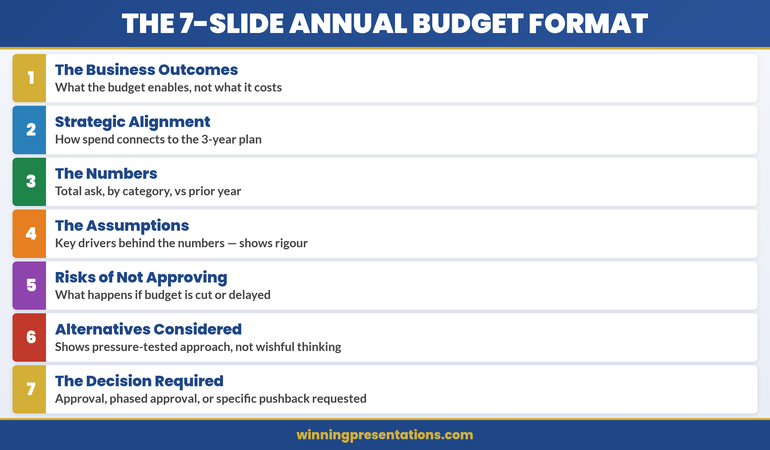
In year three, Diane restructured to 7 slides. Slide 1: what the investment would enable for the supply chain network. Slide 2: how it aligned to the three-year strategic plan. Slide 3: the £6.8M ask and its breakdown. Slide 4: the assumptions behind the numbers. Slide 5: what would be at risk if the budget was cut. Slide 6: two alternatives she’d considered and rejected. Slide 7: the specific approval decision she needed. The CFO approved in the first review meeting. No revision requested. “You’ve done the hard thinking for me,” he said. Diane’s budget moved from year-long paralysis to execution within weeks.

Why Most Annual Budget Requests Get Rejected (Or Trapped in Revision Loops)

The conventional annual budget presentation is built backwards. It opens with financial summary tables, bar charts showing year-on-year growth, and category breakdowns. The logic seems sound: show the totals, show the detail, show the comparison, and the CFO will approve.

But that’s not how decision-makers process budget requests. A CFO who receives a 25-slide presentation opening with spreadsheet data doesn’t know whether you’re asking for £2 million or £20 million—or what the organisation gets in return—until slide 18. By then, they’re already thinking of questions, objections, and alternative scenarios. They loop back, ask for revisions, and the cycle repeats.

The core problem isn’t the budget amount. It’s the mental model. CFOs approve budgets when they understand three things in this order:

1. What does this money enable? Not what it costs. What does the organisation gain? What becomes possible? How does it move the needle on strategic priorities?

2. How does this connect to our stated strategy? Does it support the three-year plan? Does it address a known gap or bottleneck? Is it aligned to what we said we’d prioritise this year?

3. What assumptions underpin the request? CFOs approve confident asks, not uncertain ones. They need to see that you’ve pressure-tested the numbers, thought through the risks, and considered alternatives. That rigour signals competence and reduces their approval risk.

When a budget presentation skips these steps and leads with financial tables, the CFO is forced to work backwards—inferring the outcomes, checking alignment, and guessing at your assumptions. That creates friction, revision requests, and delays.

⭐ Maven Flagship — Executive Buy-In

Learn the structured approach senior professionals use to secure approval for high-stakes decisions

The Executive Buy-In Presentation System — 7 modules, self-paced, with monthly cohort enrolment and optional recorded Q&A.

£499, lifetime access to materials.

Enrol in the Executive Buy-In System →

The 7-Slide Annual Budget Format: Outcomes First, Numbers Second

The framework that secures approvals follows a strict logic: establish outcomes and alignment before introducing financial asks. Each slide serves a specific decision-making purpose.

The 7-Slide Annual Budget Format: Card 1 Business Outcomes, Card 2 Strategic Alignment, Card 3 Numbers, Card 4 Assumptions, Card 5 Risks of Not Approving, Card 6 Alternatives Considered, Card 7 Decision Required

Notice the architecture: the first three slides build a narrative (outcomes → alignment → numbers). Slides 4–7 provide evidence and reduce decision risk. The CFO can now move through your logic without guesswork.

Slide 1: The Business Outcomes (Not the Cost)

Open with one clear statement of what the budget enables. Not what it costs. What becomes possible.

Wrong: “Annual Budget Request: £6.8M (Operations) + £2.3M (IT) + £1.4M (HR)”

Right: “This budget expands our logistics network capacity to process 40% more throughput without adding headcount, reducing per-unit delivery costs by 18% and unlocking the enterprise customer tier we’ve targeted in the three-year plan.”

The right version answers the CFO’s unconscious question: “What does this organisation gain?” Add one visual—a simple outcomes graphic, a network diagram, or a throughput chart—to reinforce the outcome. Then move on. This slide should take 90 seconds to present.

CFOs who see outcomes first are already mentally committed to exploring your ask. They know what they’re evaluating.

Slide 2: Strategic Alignment (Why Now? Why This?)

Now that the CFO knows what you’re asking for, connect it to the strategy. Show how the budget supports the published three-year plan, addresses a known strategic gap, or enables a stated corporate priority.

This slide removes guesswork. It says: “I’ve been paying attention to the organisation’s stated direction, and this budget is not a nice-to-have—it’s how we execute the strategy you’ve already approved.”

Use a simple visual: perhaps a 2×2 matrix showing the three strategic pillars and where your ask aligns, or a timeline showing when this investment is needed to hit strategic milestones. The text should be sparse—one or two sentences explaining the connection.

Alignment is a permission structure. It signals that your ask isn’t surprising or opportunistic; it’s the inevitable next step in executing a plan the board already endorsed.

Slide 3: The Numbers (Total Ask, Breakdown, Year-on-Year)

Now introduce the financial detail. By this point in your presentation, the CFO understands what you’re asking for and why it matters. The numbers are no longer a surprise; they’re the cost of delivering the outcomes you’ve already sold.

Keep this slide visual and simple. Use:

  • Total request at the top in large type. Don’t bury the number.
  • Category breakdown below (3–5 categories max). Operations, IT, People, Risk Mitigation, Innovation—whatever makes sense for your organisation.
  • Year-on-year comparison. Show variance as a percentage of total budget. If you’re asking for a 7% increase, say so explicitly. If this is a flat budget with reallocation, show that clearly.

Never lead with the numbers. Position them as supporting evidence for an already-established case.

Slides 4–7: The Proof (Assumptions, Risks, Alternatives, Decision)

Slide 4: The Assumptions Behind the Numbers

CFOs approve confident budgets. They want to see that you’ve thought through the drivers behind your ask. What labour market conditions underpin your hiring forecast? What supplier contract renegotiations support your savings projection? What customer growth assumptions justify the IT investment?

List 3–5 key assumptions. For each, show one piece of supporting data: a market report, an internal trend, a contract timeline. This isn’t a deep dive—it’s proof that you’ve done rigorous thinking, not guesswork.

Slide 5: What’s at Risk If We Don’t Approve (Or Cut) This Budget

This is perhaps the most important slide after outcomes. It answers: “What happens if we say no?” Spell it out clearly and specifically.

Don’t be vague (“We’ll fall behind competitors”). Be concrete: “If we don’t invest in supply chain automation this year, our order-to-delivery time will remain at 6 days while competitors move to 3. We’ll lose the high-volume enterprise contracts where margins are 40% higher. Estimated impact: £2.1M in forgone revenue over 18 months.”

Risk clarity is a stronger motivator than outcomes for many CFOs. It frames the budget not as optional spending but as necessary defence.

Slide 6: Alternatives You Considered (And Why You Rejected Them)

This signals that you haven’t just asked for one thing. You’ve pressure-tested your approach and chosen the best option. Show two alternative strategies and explain why they don’t work as well as your ask.

Example: “Alternative 1: Outsource logistics to a third party. This would be £200K cheaper but would reduce our network control and make enterprise customers nervous about data security. Rejected.” Or: “Alternative 2: Phase the investment over three years. This costs £800K more in eventual implementation but delays our competitive positioning. Rejected.”

Alternatives show maturity. They signal that your ask is the result of thoughtful analysis, not wishful thinking.

Slide 7: The Decision You’re Requesting

End with absolute clarity about what you need. Are you asking for full approval? Phased approval with specific milestones? Conditional approval pending board sign-off? A specific discussion topic or decision date?

Don’t end vaguely with “Please consider this and get back to me.” End with: “I’m seeking your approval to proceed with Phase 1 implementation (£2.1M) in Q2, with a review checkpoint before Phase 2 commitment in Q3.” Clarity removes friction. It tells the CFO exactly what decision is in front of them.

Budget Presentations Structured for CFO Review

The Executive Slide System provides outcome frameworks, assumption templates, and risk visualisation slides. Each is designed around the 7-slide format that addresses how CFOs evaluate financial requests.

See the Templates

The Confidence Gap: Why This Format Wins

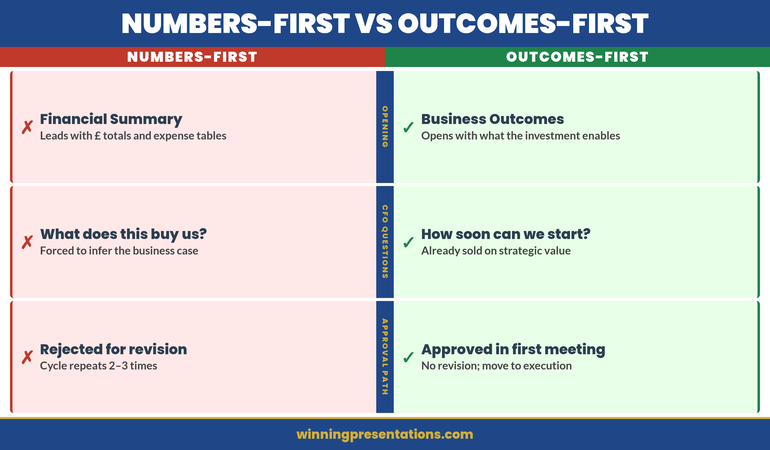
Numbers-first presentations create uncertainty. A CFO sees a list of costs and asks: “Is this enough to solve the problem? What am I missing? Why should I trust these estimates?” These are revision triggers.

Outcomes-first presentations create confidence. The CFO sees your complete thinking: what you’re trying to accomplish, why it matters, what you’ve considered, and what’s at risk if you don’t proceed. Your rigour becomes visible. Your competence is proven by your assumptions, your risk awareness, and your realistic alternatives.

The 7-slide format compresses decision time from weeks to hours. Budget approvals that typically require 3–4 revisions move to single-meeting sign-off. CFOs who use this structure consistently report that it removes the guesswork from capital allocation.

Numbers-First vs Outcomes-First Budget Presentation Comparison: Numbers-First opens with totals, CFO asks what this buys, rejected for revision; Outcomes-First opens with business outcomes, CFO asks how soon can you start, approved in first meeting

Notice the difference: outcomes-first doesn’t just change the order of your slides. It changes how the CFO engages with your ask from the moment you begin.

Is This Approach Right For You?

Yes, if:

  • Your budget request has been rejected or asked for revision before
  • You’re asking for approval from a CFO or finance committee, not a single manager
  • Your ask is material enough that approval takes more than one meeting

Not as critical, if:

  • You’re requesting a routine departmental budget increase under 5% with no strategic change
  • Your CFO has already communicated approval in principle pending formal sign-off
22 Dec 2025
Presentation skills for meetings - how to speak up with confidence without rambling or freezing

Presentation Skills for Meetings: How to Speak Up Without Rambling, Freezing, or Being Ignored

The practical techniques that help you contribute confidently in meetings — from someone who spent 24 years in corporate banking

Most presentation skills advice assumes you’re standing at the front of a room with slides. But that’s not where most professionals struggle.

The real challenge is presentation skills for meetings — speaking up without rambling, contributing when all eyes turn to you unexpectedly, making your point when you haven’t prepared a deck.

I watched this play out hundreds of times during 24 years in banking. Smart people with good ideas who couldn’t land them in meetings. They’d either freeze, ramble, or get talked over — and wonder why they weren’t getting promoted.

The good news: these skills are learnable. Here’s what actually works.

🎁 Free Download: The Executive Presentation Checklist — works for formal presentations and high-stakes meetings.

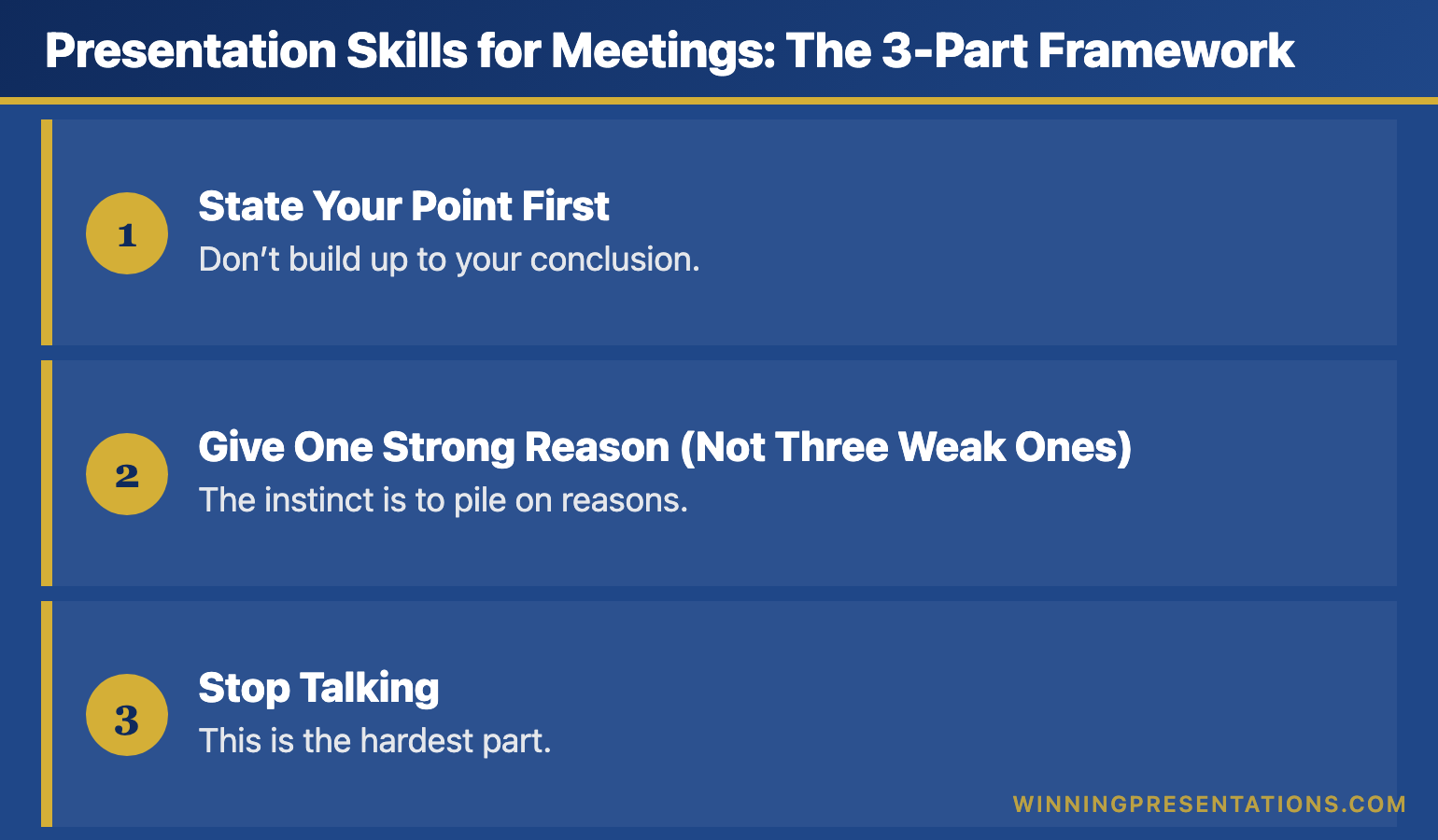
Presentation Skills for Meetings: The 3-Part Framework

When you’re asked to contribute — or when you want to jump in — most people fail because they start talking without knowing where they’re going.

Use this structure instead:

1. State Your Point First

Don’t build up to your conclusion. Start with it.

Instead of: “Well, I’ve been thinking about this, and there are a few factors to consider, and when you look at the data from last quarter…”

Say: “I think we should delay the launch by two weeks. Here’s why.”

This immediately tells everyone what you’re arguing for. They can listen to your reasoning with context instead of wondering where you’re heading.

2. Give One Strong Reason (Not Three Weak Ones)

The instinct is to pile on reasons. Resist it. More reasons often dilute your point rather than strengthen it.

Pick your single strongest reason and state it clearly. If someone asks for more, you can add. But lead with your best shot.

3. Stop Talking

This is the hardest part. When you’ve made your point, stop. Don’t backfill with “but I could be wrong” or “just a thought” or additional caveats that undermine what you just said.

Silence after your point isn’t awkward — it’s confident.

Related: Business Presentation Skills: What Actually Matters in Corporate Environments

Meeting Presentation Skills: Handling Being Put on the Spot

Someone asks you a question you weren’t expecting. All eyes turn to you. Your mind goes blank.

Here’s the recovery:

Step 1: Buy 3 seconds. “That’s a good question — let me think for a moment.” This is completely acceptable and looks thoughtful, not unprepared.

Step 2: Repeat the question back. “So you’re asking whether we should prioritise the US market first?” This confirms you understood and gives you more processing time.

Step 3: Give a partial answer if needed. “I don’t have the full picture, but my initial view is X. I can confirm the details by end of day.”

Saying “I don’t know, but I’ll find out” is infinitely better than rambling through a non-answer.

Related: How to Calm Nerves Before a Presentation

Want to Build These Skills Systematically?

AI-Enhanced Presentation Mastery covers meeting contributions, formal presentations, and handling tough Q&A — with live coaching and feedback.

Presale: £249 (60 seats) — 8 modules Jan–April 2026. See the curriculum →

Three Meeting Presentation Mistakes That Kill Your Credibility

1. Thinking out loud. Processing your thoughts verbally might work with friends. In meetings, it sounds like you don’t know what you think. Do your thinking before you speak, even if it’s just 5 seconds of mental organisation.

2. Over-qualifying everything. “This might be wrong, but…” or “I’m not sure if this is relevant…” These phrases tell people to discount what comes next. If you’re not confident in your point, don’t make it. If you are, don’t undermine it.

3. Repeating what someone else said. Adding “I agree with Sarah” and then restating Sarah’s point adds nothing. Either add a new angle or stay quiet. Agreement without addition is just noise.

Related: How to Present Like a CEO

How to Prepare Your Presentation Skills Before Important Meetings

Most people prepare content. Better approach: prepare contributions.

Before any meeting where you might need to speak:

  • Identify 1-2 points you could make — even if you don’t use them
  • Anticipate 2-3 questions you might be asked — and sketch answers
  • Know your numbers — the specific data points relevant to your area

Five minutes of this preparation transforms your confidence. You’re not scripting — you’re priming your brain so you’re not starting from zero when called upon.

Related: Presentation Structure: 7 Frameworks That Actually Work

Frequently Asked Questions About Presentation Skills for Meetings

How do I interrupt without being rude?

Wait for a breath, then say the person’s name: “Sarah—” and pause. They’ll stop. Then make your point quickly. Don’t apologise for interrupting; just add value.

What if I’m too junior to speak up?

You’re not. The question is whether you have something worth saying. If you have data, a question, or a perspective that hasn’t been raised, your seniority doesn’t matter. Just be concise and factual rather than opinionated.

How do I sound more confident than I feel?

Slow down, lower your pitch slightly, and eliminate filler words (um, like, kind of). These three changes have more impact than any mindset trick. Confidence is performed before it’s felt.


Your Next Step

Presentation skills for meetings improve fastest with a framework and practice. Start here:

📖 Go deeper: Business Presentation Skills: What Actually Matters in Corporate Environments — the complete guide to the skills that get you promoted.

🎁 Get the checklist: Executive Presentation Checklist — free, works for meetings and formal presentations.

🎓 Build the skills: AI-Enhanced Presentation Mastery — 8 modules Jan–April 2026, presale £249, 60 seats.


Mary Beth Hazeldine spent 24 years in corporate banking at JPMorgan, PwC, Royal Bank of Scotland, and Commerzbank. She now trains professionals in the presentation skills that matter for career growth — including the ones you need in meetings, not just on stage.