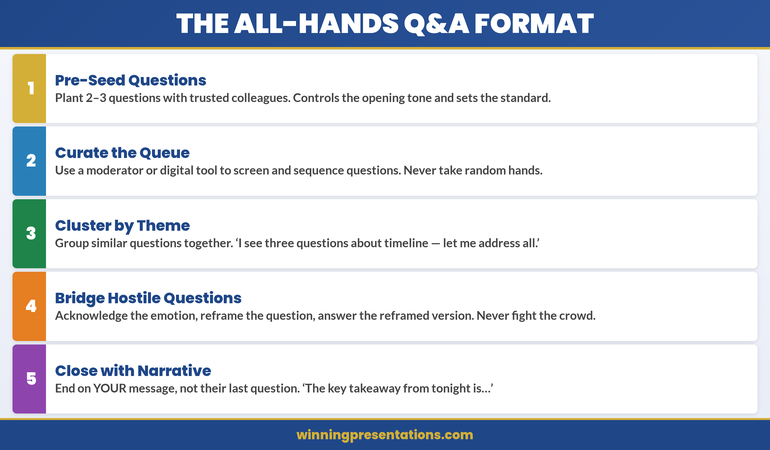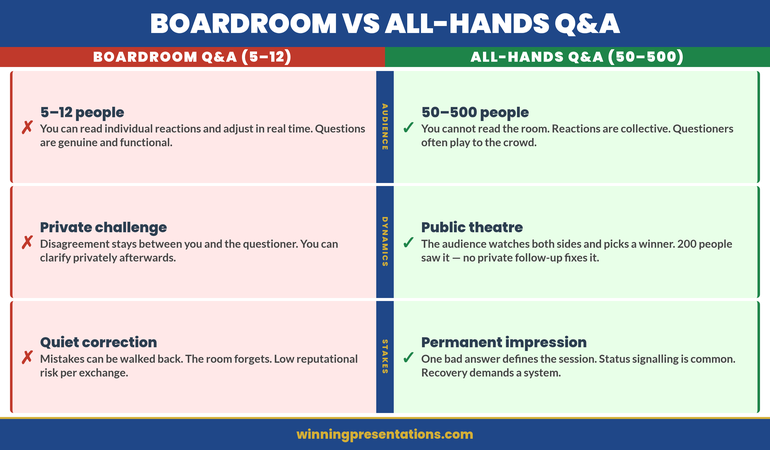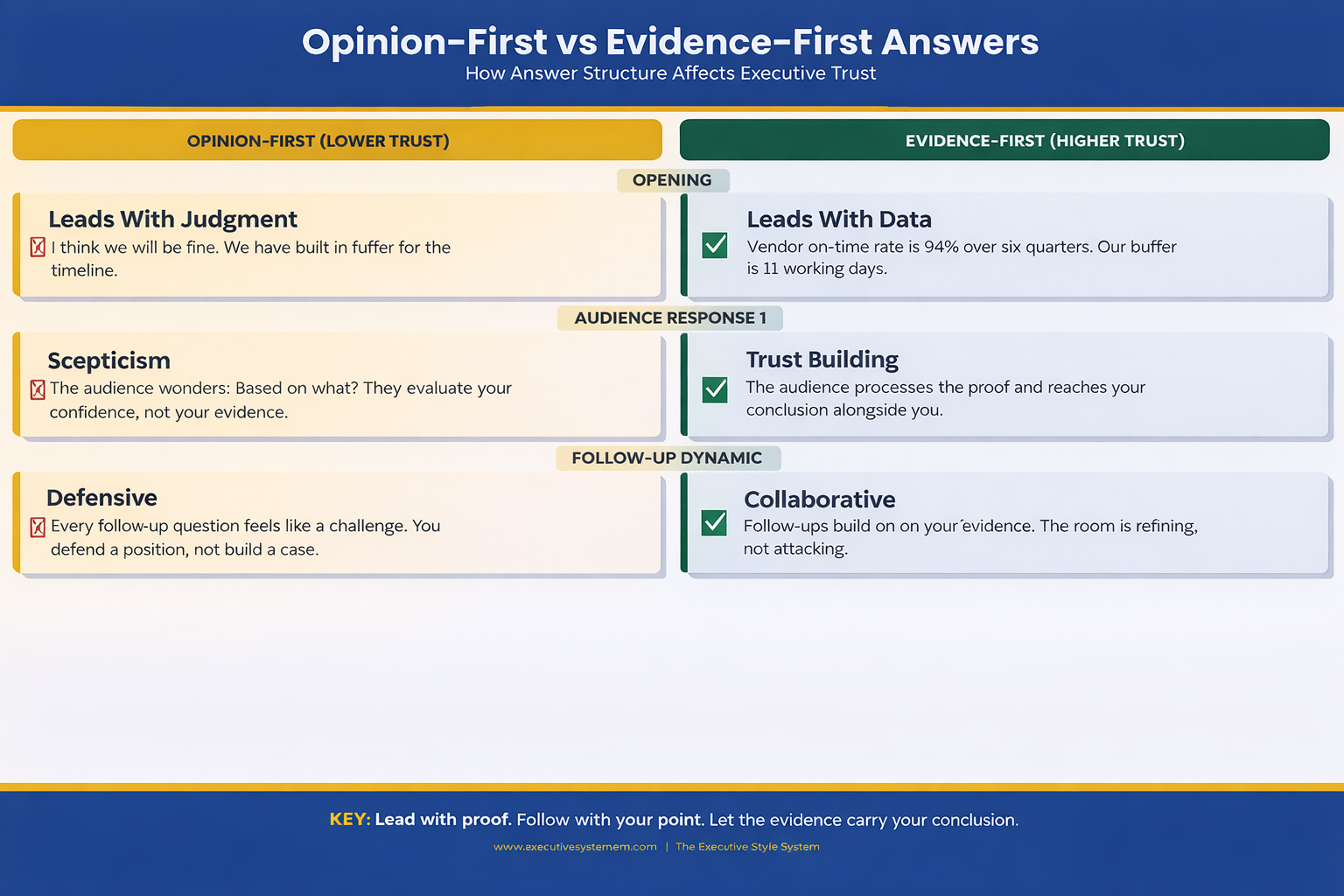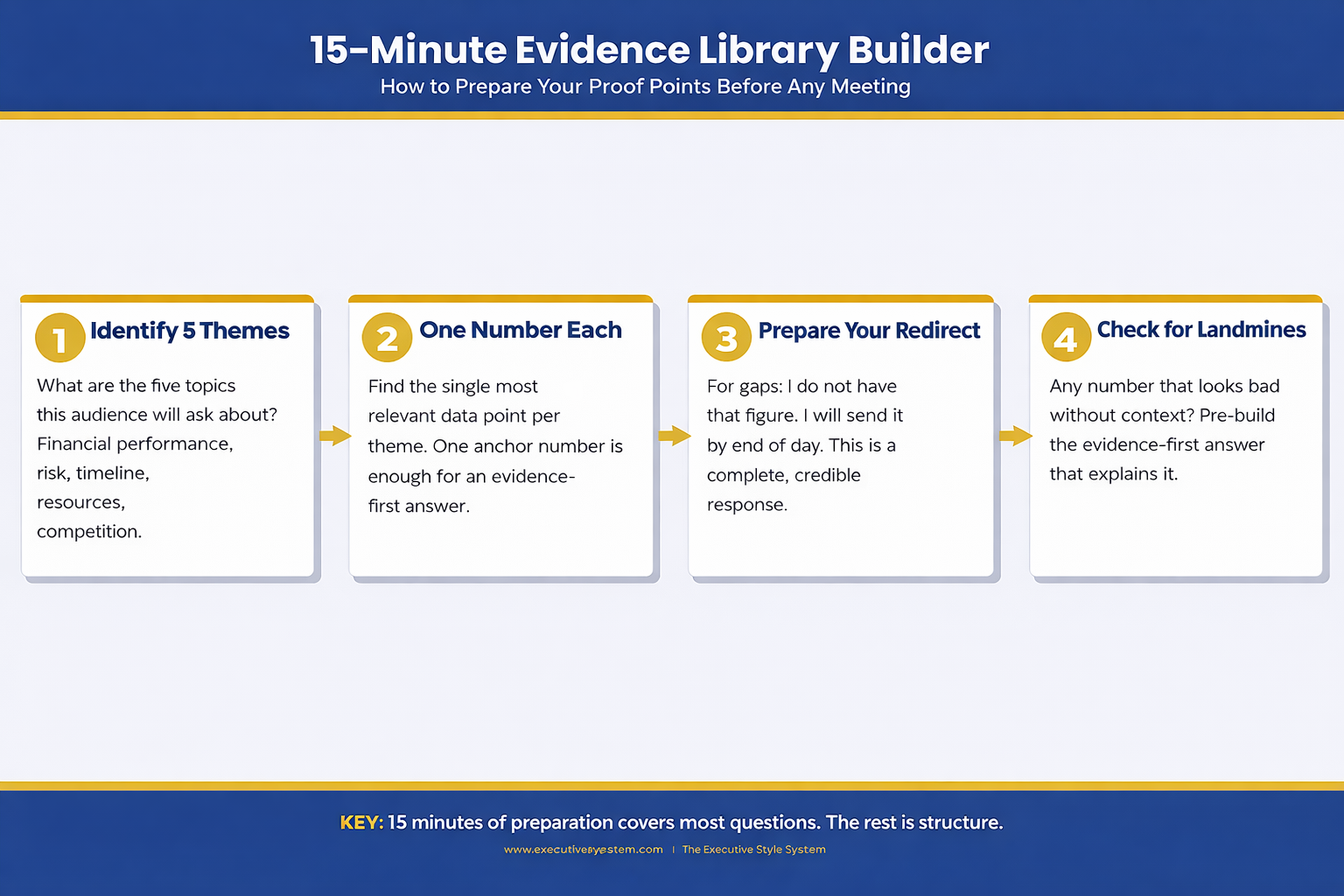
Tag: executive Q&A

22 Feb 2026

How to Predict 80% of Presentation Questions Before You Walk Into the Room

Quick answer: You can predict presentation questions systematically using the Question Map — a 20-minute preparation framework that maps four question types against each slide in your deck. Roughly 80% of Q&A questions fall into four predictable patterns: challenge, clarification, scope creep, and politics. When you map these against your content before presenting, you walk into Q&A knowing what’s coming instead of hoping for the best.

⚡ Presenting tomorrow? Here’s your 20-minute system to predict presentation questions:

Step 1: List each slide’s core claim. Step 2: Map the four question types (challenge, clarification, scope creep, politics) against each one. Step 3: Write two-sentence answers for the top 5 predicted questions. Step 4: Pre-load the two most dangerous questions into your slides so they’re answered before Q&A begins. Full framework below.

Walk Into Q&A Knowing What They’ll Ask — Before They Ask It

The Executive Q&A Handling System gives you the Question Map framework, prepared response structures for all four question types, and the bridging techniques that turn predicted questions into opportunities to reinforce your recommendation.

Get the Executive Q&A Handling System → £39

Built from 24 years of corporate experience in boardrooms, steering committees, and budget approval meetings.

The £2M Budget Lost Because Nobody Predicted the Obvious Question

A programme director I worked with at a major UK bank had spent three weeks preparing a budget approval deck. Twelve slides. Clear structure. Strong recommendation. The CFO was nodding through the presentation.

Then came the first question: “What happens to the Phase 2 timeline if the vendor misses the April milestone?”

It was entirely predictable. Anyone who’d mapped the four question types against his timeline slide would have flagged it in two minutes. But he hadn’t mapped anything. He’d spent three weeks on slides and zero time trying to predict presentation questions.

He stumbled through a vague answer about contingency plans. The CFO’s expression changed. A follow-up about contract protections — another vague answer. Within four minutes, the committee deferred the £2M approval to the next quarter.

After 24 years in corporate environments, this is the pattern I see constantly. Professionals spend days on slides and zero time predicting the questions those slides will trigger. The fix isn’t better answers under pressure — it’s better prediction before you enter the room.

The Four Question Types That Predict 80% of Q&A

After years of sitting in boardrooms, steering committees, and budget approval meetings, I’ve identified four question types that account for roughly 80% of all Q&A questions. Every audience asks some version of these — the only thing that changes is the specific topic. Once you know these patterns, you can predict presentation questions with surprising accuracy.

1. The Challenge Question. “Have you considered…?” / “What about…?” / “What if this fails?” These test your judgement. The questioner isn’t asking for information — they’re testing whether you’ve thought beyond your recommendation. If you’ve predicted it and have a prepared answer, you look thorough. If you haven’t, you look naïve.

2. The Clarification Question. “Can you walk me through the numbers on slide 4?” / “What exactly do you mean by…?” These aren’t hostile — they signal genuine interest. But if you can’t explain your own data clearly and quickly, you lose credibility just as fast as with a challenge question.

3. The Scope Creep Question. “Could this also apply to…?” / “What about the impact on the other project?” / “Have you spoken to [other department]?” These try to expand the decision beyond what you’re asking for. Without prediction and preparation, you get pulled into territory you haven’t analysed and start guessing — which is where “I’ll get back to you” lives.

4. The Politics Question. “Does [senior person] support this?” / “How does this align with the strategy we agreed last quarter?” These aren’t about your content — they’re about organisational alignment. They require preparation that goes beyond your slides into stakeholder mapping and political context.

If you’ve ever been caught off guard in Q&A, it was almost certainly one of these four types. The techniques for handling difficult questions in the moment help — but predicting them in advance is what separates executives who get decisions from those who get deferrals. Executive questions follow predictable patterns — which means they’re predictable before you present.

Question Map framework showing four question types mapped against presentation slides: challenge, clarification, scope creep, and politics questions

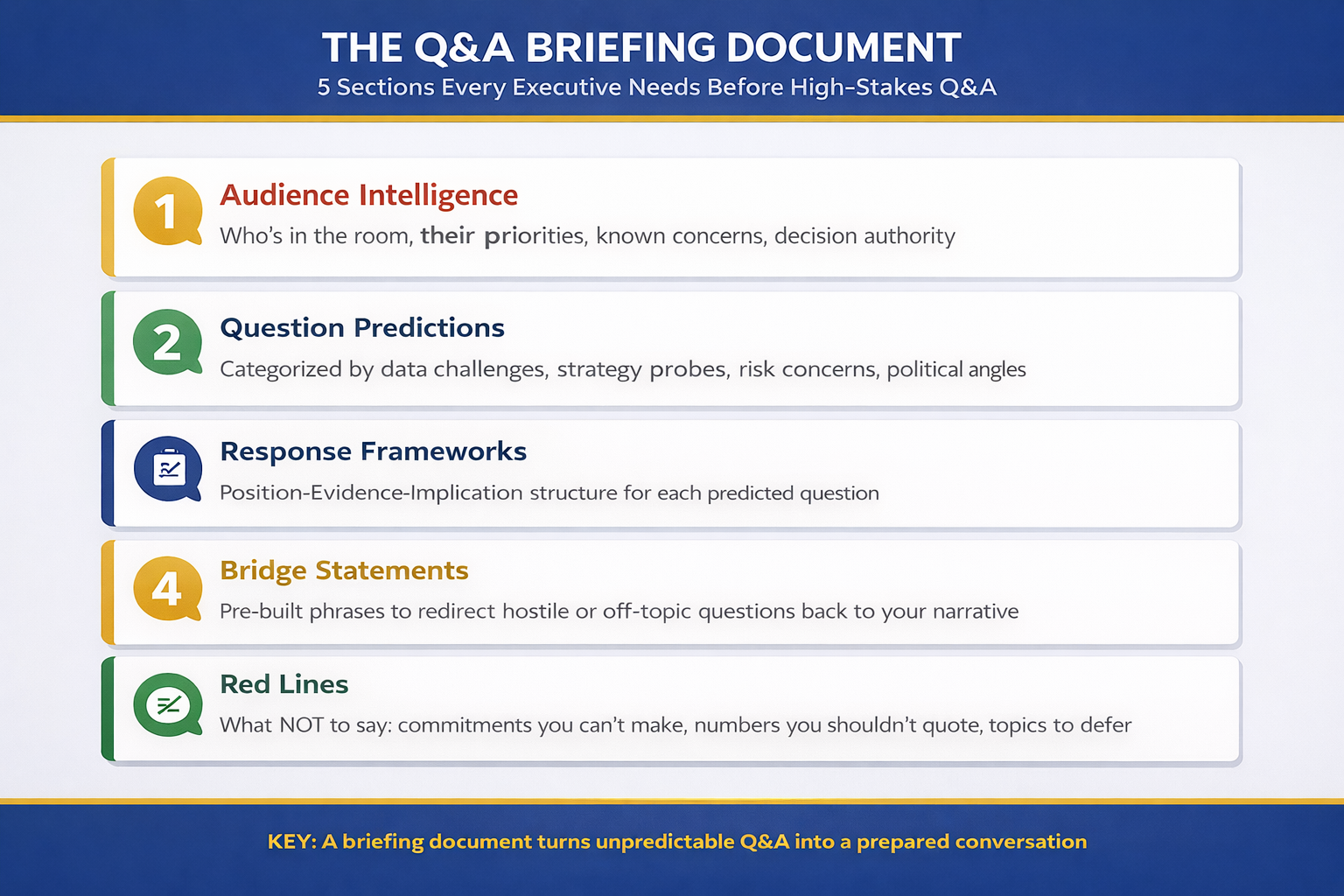
The Executive Q&A Handling System includes the Question Map template, prepared response structures for all four question types, and bridging techniques that turn predicted questions into credibility.

Get the Executive Q&A Handling System → £39

How to Build a Question Map and Predict Presentation Questions in 20 Minutes

The Question Map is a preparation exercise, not a document you present. It takes 20 minutes and predicts the majority of questions your audience will ask.

Step 1: List your slides (5 minutes). Write down each slide’s core claim or recommendation. Not the title — the actual point. “Slide 3: I’m recommending Vendor B over Vendor A.” “Slide 5: Budget is £480K over 18 months.” “Slide 7: Go-live date is September.”

Step 2: Map the four question types against each claim (10 minutes). For each slide’s core claim, ask yourself:

Challenge: “What’s the weakest part of this claim? What would a sceptic attack?” Clarification: “Which number or term might someone ask me to explain?” Scope creep: “What adjacent topic could this pull me into?” Politics: “Who might feel threatened by this, or who should I have consulted?”

You won’t have answers for every cell. That’s fine. The map reveals your blind spots — the three or four questions you don’t have answers for yet.

Step 3: Prepare your top 5 answers (5 minutes). From the map, identify the five most likely questions. Write a two-sentence answer for each. Not a script — just the core response so you don’t have to think on your feet.

The common executive Q&A mistakes almost all come from lack of prediction, not lack of intelligence. The Question Map fixes the prediction gap.

The Executive Q&A Handling System (£39) includes the Question Map template, prepared response structures, and bridging techniques for all four question types.

Pre-Loading: Address Predicted Questions Inside Your Slides

The most effective Q&A technique isn’t a response framework — it’s addressing predicted questions inside your presentation before they’re asked.

Once you’ve built your Question Map, identify the two or three most likely challenge questions. Then add one sentence in your presentation that pre-answers them. Not a full slide — just a line that neutralises the question before it’s raised.

Example: Your Question Map predicts the committee will ask “What if the vendor misses the April deadline?” Instead of waiting for Q&A, add one line to your timeline slide: “If the vendor misses April, we invoke clause 7.2 — the fallback adds three weeks, not three months. I’ve already agreed this with procurement.”

When the committee reaches Q&A, that question is already answered. They either skip it or say “You mentioned the fallback plan — can you expand?” which is a completely different conversation from being blindsided by a question you could have predicted.

Pre-loading looks like confidence. It looks like you’ve anticipated their concerns. It looks like executive-level preparation. In reality, it’s 20 minutes with the Question Map.

Pre-loading technique showing a question predicted in the Question Map being addressed inside the presentation before Q&A begins

The Executive Q&A Handling System (£39) includes the pre-loading technique, the Question Map template, and response structures for challenge, clarification, scope creep, and politics questions.

Common Questions About Predicting Presentation Questions

How do you predict what questions an audience will ask?

Roughly 80% of Q&A questions fall into four types: challenges to your judgement, requests for clarification on your data, attempts to expand scope beyond your recommendation, and political alignment questions. By mapping these four types against each slide in your presentation, you can predict the majority of questions before you walk into the room. The Question Map framework takes 20 minutes and reveals your blind spots before the audience does.

How do you prepare for questions after a presentation?

Build a Question Map: list each slide’s core claim, then map the four question types against each one. This reveals the three to five questions your audience is most likely to ask. Prepare two-sentence answers for each, and pre-load the most critical answers inside your presentation itself so they’re addressed before Q&A begins.

What should you do when you don’t know the answer to a Q&A question?

If a question genuinely falls outside your predictions, say “I don’t have that specific data with me, but I’ll confirm by [specific date] and send it to the group.” Then immediately bridge back to something you do know: “What I can tell you is…” One “I’ll get back to you” is fine. Three in the same Q&A session signals you didn’t predict well enough — which is what the Question Map prevents.

Predict What They’ll Ask. Walk In Prepared. Get the Decision.

The Executive Q&A Handling System gives you the Question Map, pre-loading techniques, response structures for all four question types, and bridging frameworks — so nothing in Q&A catches you off guard again.

Get the Executive Q&A Handling System → £39

Built from 24 years of corporate experience in boardrooms, steering committees, and executive approval meetings.

Frequently Asked Questions

How long does the Question Map take?

Twenty minutes. Five to list your slides’ core claims, ten to map the four question types against each claim, and five to prepare two-sentence answers for the top five predicted questions. Most professionals spend days on slides and zero minutes trying to predict presentation questions — twenty minutes changes the entire dynamic.

What if my audience asks something completely unexpected?

The Question Map predicts roughly 80% of questions. For the remaining 20%, the key is having a response structure rather than a specific answer. Acknowledge the question, bridge to what you do know, and commit to a specific follow-up date. One unexpected question handled well is fine. It’s the pattern of repeatedly being caught off guard that damages credibility — and the Question Map eliminates that pattern.

Should I predict different questions for different audiences?

Yes. The four question types remain the same, but the specific predicted questions change based on who’s in the room. A CFO will challenge your numbers. A COO will challenge your timeline. An HR director will ask about people impact. The Question Map should be rebuilt for each new audience, even if you’re presenting the same content — because different audiences ask different versions of the same four question types.

Get Weekly Presentation Intelligence

Q&A prediction frameworks, slide structures, and the executive communication strategies that work in real boardrooms — delivered every week.

Join the Newsletter

Related: If your slides need the same level of preparation as your Q&A, read I Audited a Real Executive Deck: 15 Slides Became 7 (Here’s What I Cut) — a full before/after deck transformation.

Your next step: Before your next presentation, spend 20 minutes building a Question Map. List your slides’ core claims, map the four question types against each one, and prepare answers for the top five. You’ll walk into Q&A knowing what’s coming — and that changes everything.

Want the complete Question Map template, pre-loading techniques, and response structures for every question type?

Get the Executive Q&A Handling System → £39

About the Author

Mary Beth Hazeldine is the Owner & Managing Director of Winning Presentations. With 24 years of corporate banking experience at JPMorgan Chase, PwC, Royal Bank of Scotland, and Commerzbank, she specialises in executive-level presentation skills and high-stakes Q&A preparation.

A qualified clinical hypnotherapist and NLP practitioner, Mary Beth combines executive communication expertise with evidence-based techniques. She has spent 15 years training executives for board presentations, steering committee approvals, and the Q&A sessions that follow them.

Read more articles at winningpresentations.com

18 Feb 2026
Executive woman standing and gesturing confidently while answering questions from colleagues seated around a boardroom table, demonstrating composed Q&A handling during a high-stakes presentation

5 Executive Q&A Mistakes I See Every Week — With the 15-Second Fixes

The presentation was fine. The five minutes of Q&A afterwards undid all of it.

Quick answer: After 24 years in corporate banking and consulting — and now coaching executives who present for a living — I see the same five Q&A mistakes every single week. Not from junior staff. From directors, VPs, and partners who present beautifully and then lose the room the moment questions start. Each mistake has a specific fix, and every fix follows the same structure: answer in 15 seconds using Headline → Reason → Proof, then stop talking. Below are the five mistakes, the real scenarios where I see them, and the exact rewrites that work.

At Commerzbank, I once watched a managing director lose a syndication deal during Q&A. Not because he didn’t know his numbers — he knew them cold. Because the lead investor asked a straightforward question about covenant flexibility, and instead of giving a 15-second answer, he gave a four-minute masterclass on covenant structures across European credit markets. By the time he finished, the investor had mentally moved on. The deal went to a competitor who answered the same question in two sentences.

I’ve now seen some version of that moment hundreds of times. Different industries, different stakes, same five patterns. The executives who win in Q&A aren’t smarter or better prepared. They’ve learned to answer the question that was asked — in 15 seconds — and then stop.

Mistake #1: The Knowledge Dump

What it looks like: Someone asks a focused question. The presenter answers the question — and then keeps going. They add context. Then caveats. Then the methodology behind the number. Then the alternative they considered. What started as a clear answer becomes a four-minute monologue that buries the actual point under layers of unnecessary detail.

Where I see it: Budget reviews. Quarterly updates. Any situation where the presenter has spent days preparing and unconsciously wants to demonstrate the depth of their preparation. The more homework you’ve done, the more tempting the knowledge dump becomes — which is why it’s disproportionately a problem for the most diligent presenters.

The real scenario: A VP at a technology firm presented a platform migration proposal. The CTO asked: “What’s the downtime risk during cutover?” The VP answered the question correctly in his first sentence (two hours, with a rollback plan). Then he spent three more minutes explaining the technical architecture of the rollback, the testing protocol, the vendor SLA, and two edge cases they’d modelled. The CTO had his answer in the first ten seconds. The next three minutes made him wonder what the VP was overcompensating for.

The 15-second fix:

Headline: “Maximum two hours, with a full rollback plan.”
Reason: “We’ve tested the rollback three times in staging — average recovery is 40 minutes.”
Proof: “The vendor SLA guarantees four-hour resolution, but our internal testing hasn’t exceeded ninety minutes.”
Then stop.

If the CTO wants the technical architecture, the testing protocol, or the edge cases — he’ll ask. And that follow-up question is a buying signal, not a threat. The knowledge dump kills buying signals because it answers questions nobody asked.

Stop Losing the Room After Slide 12

The Executive Q&A Handling System includes the Headline → Reason → Proof response framework, question mapping templates by stakeholder type, and the preparation system that means you walk into Q&A knowing what they’ll ask and exactly how you’ll answer. Built from real boardroom situations where Q&A decided whether budgets got approved and deals got funded.

Get the Executive Q&A Handling System → £39

Instant download. Question mapping + response frameworks + recovery scripts. Built from 24 years in banking and consulting where Q&A decided most major budgets, deals, and approvals.
Mistake #2: The Defensive Deflection

What it looks like: Someone asks a question that implies a weakness in the proposal. Instead of addressing the weakness, the presenter pivots to a strength. “What about the implementation risk?” gets answered with “Well, the ROI projections are very strong.” The question was about risk. The answer was about return. The panel notices.

Where I see it: Investment committees. Client pitches. Promotion panels. Any situation where the presenter feels their competence is being questioned — which activates a defensive instinct to redirect toward what they’re confident about. I’ve written extensively about this dynamic in the context of handling difficult presentation questions.

The real scenario: A programme director presented a change management initiative to the executive committee. A board member asked: “What’s the fallback if adoption rates don’t hit 60% in the first quarter?” The director answered: “Our stakeholder engagement plan is comprehensive — we’ve mapped every business unit and we have champions in each region.” That’s not a fallback plan. That’s a prevention plan. The board member asked what happens if it fails. The director told him why it won’t. Those are different conversations.

The 15-second fix:

Headline: “If adoption is below 60% at the end of Q1, we move to targeted intervention.”
Reason: “That means intensive support for the three lowest-adoption business units rather than broad engagement.”
Proof: “We used this approach on the last programme — pulled two units from 35% to 70% in six weeks.”
Then stop.

The fix answers the question that was asked (what’s the fallback), names it specifically (targeted intervention), and provides evidence it works (last programme). The board member now knows the presenter has thought about failure — which, paradoxically, increases their confidence in the plan succeeding.

PAA: Why do experienced presenters deflect tough questions?
Because the brain processes tough questions as threats before it processes them as requests for information. The amygdala fires before the prefrontal cortex engages, which means the first instinct is defensive — redirect to safe ground. This happens faster and more intensely the higher the stakes and the more senior the audience. The fix isn’t willpower (you can’t override the amygdala with intention). The fix is preparation: if you’ve already written a 15-second answer for the tough questions, your brain retrieves a structure instead of improvising a defence.


Table showing five executive Q&A mistakes — Knowledge Dump, Defensive Deflection, Premature Concession, Good Question Stall, and Unfinished Answer — with what it sounds like and what the room hears for each

Mistake #3: The Premature Concession

What it looks like: Someone challenges the recommendation, and the presenter immediately folds. “Have you considered doing this in two phases instead of three?” gets answered with “Yes, we could definitely do that. We could also look at a four-phase model. We’re flexible on the approach.” The presenter thinks they’re being collaborative. The panel hears: “I’m not committed to my own recommendation.”

Where I see it: Everywhere. This is the most common mistake among presenters who’ve been told to “read the room” and “be flexible.” They’ve overcorrected from rigid to spineless. The result is that the panel doesn’t know what the presenter actually recommends — and a committee that doesn’t know what you recommend will always defer the decision.

The real scenario: A finance director presented a restructuring proposal to the CEO and COO. The COO asked: “Could we achieve the same cost savings with voluntary redundancies only?” The finance director said: “That’s something we could explore. There are definitely scenarios where voluntary approaches work well.” The correct answer was no — the modelling showed voluntary-only achieved 40% of the target savings. But the finance director didn’t want to disagree with the COO directly. The result: the decision was deferred six weeks while they “explored” an option the finance director already knew wouldn’t work.

The 15-second fix:

Headline: “Voluntary-only achieves roughly 40% of the target savings.”
Reason: “The gap is in the operational restructuring, which requires role changes that voluntary programmes can’t address.”
Proof: “We modelled both scenarios — I can share the comparison if that would be helpful.”
Then stop.

This doesn’t dismiss the COO’s suggestion. It respects it by giving a factual answer with evidence. “I can share the comparison” invites further discussion without surrendering the recommendation. The presenter maintains their professional position while remaining genuinely flexible on the method.

📋 The Q&A Handling System includes question mapping templates that help you predict these challenges before the meeting — so you’ve already written the 15-second answer before the question lands.

Get the Executive Q&A Handling System → £39

Walk Into Q&A Knowing What They’ll Ask

The Executive Q&A Handling System gives you the question mapping method (predict 80% of questions before the meeting), the Headline → Reason → Proof response structure, “I don’t know” recovery scripts, and hostile question deflection techniques. Stop improvising. Start preparing the part that actually decides outcomes.

Get the Executive Q&A Handling System → £39

Instant download. Built from real boardroom, investment committee, and client pitch situations across 24 years in banking and consulting.

Mistake #4: The “Good Question” Stall

What it looks like: “That’s a great question.” Pause. Visible thinking. Then an answer that starts slowly and gains momentum — because the presenter was buying time to formulate a response. Everyone in the room knows it. The “good question” opener is the most widely recognised stall tactic in corporate communication, and using it signals exactly one thing: you weren’t prepared for that question.

Where I see it: Panel interviews. Board Q&A. Client discovery sessions. The more senior the audience, the more they notice it — because they’ve all used it themselves, and they know what it means. It’s the executive equivalent of “um.”

The real scenario: A head of strategy presented the annual plan to the investment committee. The chair asked: “What’s the biggest risk you haven’t addressed in this plan?” The head of strategy said: “That’s a really good question. Let me think about that.” Pause. “I think the biggest unaddressed risk is probably market volatility in Q3.” The answer was fine. The delivery — the stall, the visible improvisation, the “probably” — told the room he hadn’t considered unaddressed risks before being asked. For a head of strategy. That’s a credibility problem.

The 15-second fix:

Headline: “The biggest unaddressed risk is regulatory change in the APAC region.”
Reason: “We’ve modelled market volatility — that’s on slide nine. But the regulatory environment in Southeast Asia is moving faster than our planning cycle.”
Proof: “I’ve flagged this with the risk committee and we’re building a scenario analysis for Q2 review.”
Then stop.

No stall. No “good question.” Straight into the headline. The answer is honest (yes, there’s a risk I haven’t fully addressed), specific (regulatory change in APAC), and shows action (flagged with risk committee, scenario analysis in progress). This is what the committee wanted to hear: not perfection, but awareness.

PAA: What should you say instead of “good question” during Q&A?
Nothing. Just answer. If you need a beat to think, use a silent pause — two seconds of silence is less damaging to your credibility than “good question” followed by visible improvisation. If you genuinely need more time, use a bridging phrase that adds value: “The short answer is [headline]. The longer answer involves [one specific factor] — let me walk you through it.” This buys time while already delivering content, rather than advertising that you’re thinking.

Mistake #5: The Unfinished Answer

What it looks like: The presenter gives 80% of an answer and then trails off, ends with “…so yeah,” or gets interrupted before landing the point. The question was answered in substance but not in structure — so the panel isn’t sure whether the answer is complete, whether there’s more coming, or whether the presenter ran out of things to say. The room fills the silence with their own interpretation, which is rarely favourable.

Where I see it: Town halls. All-hands meetings. Any situation with a large audience where the presenter feels the pressure of silence and either rushes the ending or leaves it hanging. It’s also common in executive Q&A sessions where follow-up questions come fast and the presenter abandons their current answer to address the next one.

The real scenario: A regional director presented expansion plans to the group CEO. The CEO asked: “What happens to margin if the exchange rate moves 5% against us?” The director started strong: “A 5% adverse move impacts margin by approximately 1.2 points. We’ve modelled this and the business case remains positive down to a 7% move…” Then someone’s phone buzzed. The director lost focus, said “…so we’ve got some buffer there,” and stopped. “Some buffer” is not a landing. “Remains positive down to 7%” is a landing — but he didn’t get there cleanly.

The 15-second fix:

Headline: “A 5% adverse move impacts margin by 1.2 points.”
Reason: “The business case stays positive down to a 7% move — so we’ve got meaningful buffer.”
Proof: “We’ve stress-tested three scenarios. The breakeven point is an 8.3% move, which hasn’t happened in this corridor in a decade.”
Landing: “The short version: the exchange rate risk is real but manageable.”

The landing matters. It tells the room: “My answer is complete. I’ve finished. You have what you need.” Without it, the panel is left constructing their own conclusion — and under uncertainty, human brains default to the negative interpretation. A clean landing controls the narrative. A trailing answer surrenders it.


The Headline Reason Proof framework for answering executive Q&A questions in 15 seconds showing three steps with timing and example response for each

📋 The Q&A Handling System includes the complete Headline → Reason → Proof framework with practice templates for every question type.

Plus hostile question deflection and “I don’t know” recovery scripts for the questions you can’t predict.

Get the Executive Q&A Handling System → £39

Why All 5 Mistakes Have the Same Root Cause

The knowledge dump, the defensive deflection, the premature concession, the “good question” stall, and the unfinished answer all come from the same place: the presenter is responding to their emotional state, not to the question.

The knowledge dump is driven by the need to prove competence. The deflection is driven by the instinct to avoid vulnerability. The concession is driven by the desire to avoid conflict. The stall is driven by the fear of looking unprepared. The unfinished answer is driven by the anxiety of silence.

All five emotions are normal. All five are present in every high-stakes Q&A. And all five produce answers that are worse than the answer you’d give if you simply followed a structure: Headline → Reason → Proof → Stop.

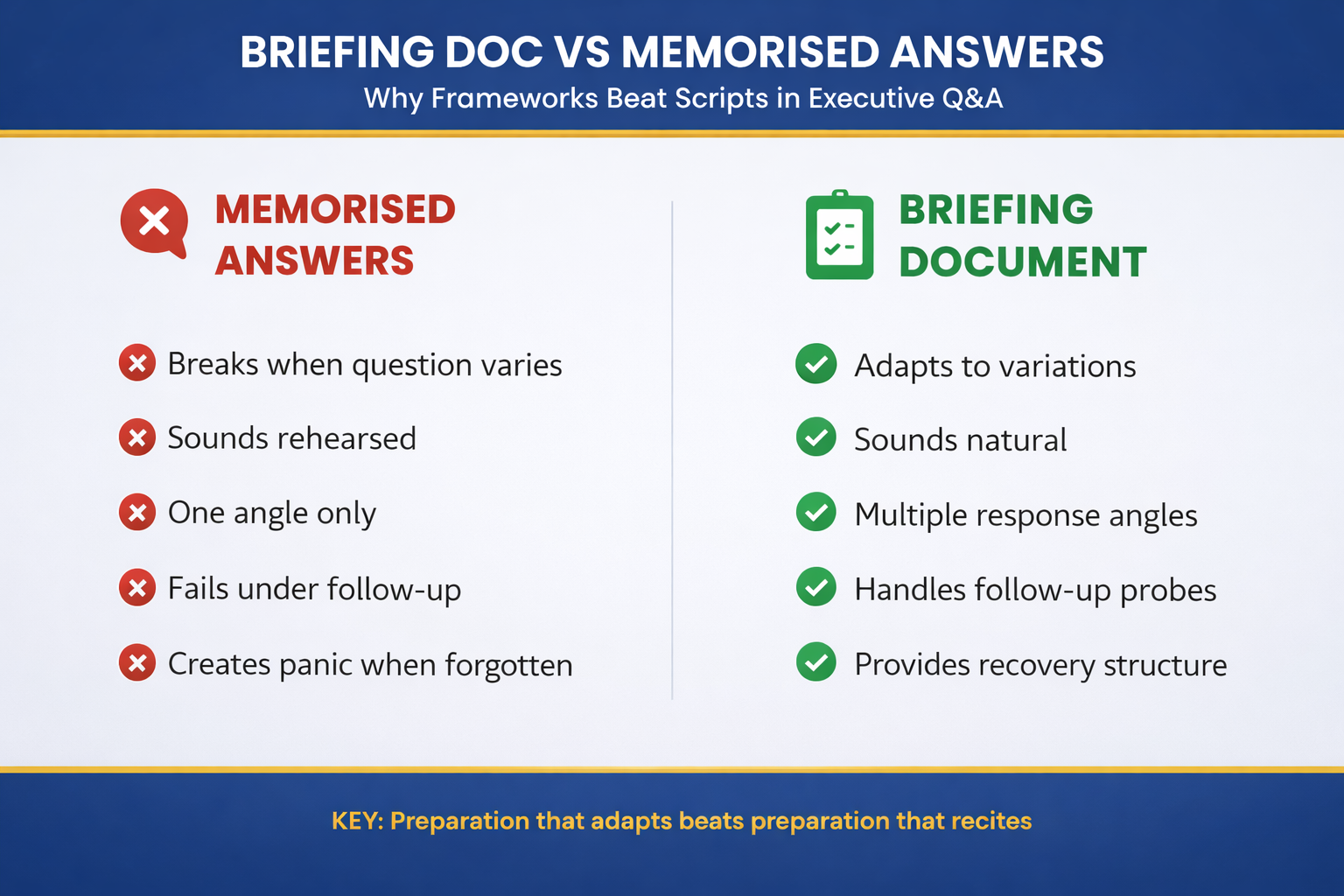
The structure doesn’t eliminate the emotion. It gives you something to do instead of following the emotion. When your brain wants to dump knowledge, the structure says: “Headline first.” When your brain wants to deflect, the structure says: “Answer the actual question.” When your brain wants to concede, the structure says: “State your position with evidence.” When your brain wants to stall, the structure says: “Skip the preamble.” When your brain wants to trail off, the structure says: “Land it.”

That’s why the best Q&A performers aren’t necessarily the smartest people in the room. They’re the ones who’ve practised a structure until it’s automatic. I’ve seen this dynamic in every high-stakes Q&A that went wrong — the content was there, the structure wasn’t.

If the anxiety component of Q&A is the bigger problem for you — if the emotional state is so strong that even a good structure gets overwhelmed — the cognitive and physiological techniques in breaking the audience judgment anxiety loop work alongside the structural approach here.

One Structure. Every Question. Every Time.

The Executive Q&A Handling System gives you question mapping by stakeholder type, the Headline → Reason → Proof framework with practice templates, “I don’t know” recovery scripts, defensive-to-directive answer rewrites, and hostile question deflection techniques. One system for every Q&A scenario — budget reviews, board presentations, client pitches, and the questions you didn’t see coming.

Get the Executive Q&A Handling System → £39

Instant download. Built from 24 years in banking and consulting where most major decisions were shaped during Q&A, not during the slides.

Frequently Asked Questions

How many questions should I prepare for before a high-stakes presentation?

Map 8-12 questions across four categories: cost/budget, risk/contingency, timeline/feasibility, and credibility/capability. For each one, write a 15-second answer using Headline → Reason → Proof. This covers roughly 80% of what you’ll actually be asked. The remaining 20% will be variations — and because you’ve practised the structure, you’ll handle variations more cleanly even without specific preparation. The goal isn’t to predict every question. It’s to build a response muscle that fires automatically under pressure.

What do you do when someone asks a question you genuinely don’t know the answer to?

Never bluff and never say just “I’ll get back to you.” The recovery structure is: acknowledge what you do know, name the specific thing you’d need to verify, and commit to a concrete deadline. For example: “The two-phase model is feasible — I know the dependency structure supports it. What I’d need to confirm is the risk impact on the migration timeline. I can have that analysis to you by Thursday.” This shows competence, honesty, and reliability — which is exactly what a senior audience evaluates during Q&A.

Is the Headline → Reason → Proof structure too formulaic for senior audiences?

Senior audiences don’t notice the structure — they notice the clarity. A formulaic-feeling answer is one where the presenter robotically recites a prepared script. A structured answer is one where the presenter gives a clear headline, supports it with a specific reason, and closes with evidence. The difference is delivery, not framework. Practise the structure until it becomes natural rather than mechanical. Most executives find that after 5-10 practice rounds, the structure disappears into their communication style and what remains is simply clearer, more confident Q&A performance.

📬 The Winning Edge Newsletter

Weekly strategies for executive presentations, Q&A preparation, and career-critical communication. No fluff.

Subscribe free →

Related: These five mistakes become even more damaging in transition scenarios where there’s no follow-up meeting to correct the record — see the full before/after breakdown in how exit presentation Q&A damages careers. And if the anxiety itself is driving these patterns, the cognitive intervention in breaking the audience judgment thought loop works alongside the structural approach here.

Five mistakes. One root cause. One structure that fixes all of them. Headline → Reason → Proof → Stop. Practise it for your next five presentations and notice what changes. The questions won’t get easier. Your answers will get shorter, clearer, and more credible — which, in executive Q&A, is the same thing as getting better.

📋 Get the question mapping templates + response frameworks + recovery scripts.

Get the Executive Q&A Handling System → £39

About the Author

Mary Beth Hazeldine is the Owner & Managing Director of Winning Presentations. With a 24-year career in banking and consulting at JPMorgan Chase, PwC, Royal Bank of Scotland, and Commerzbank, she spent most of those years in rooms where Q&A decided outcomes — budget approvals, deal mandates, strategic pivots, career-defining moments.

She now helps executives prepare for the part of their presentation that actually determines results.

Book a discovery call | View services

Optional: Get Q&A, slides, confidence, storytelling, and delivery in one package — The Complete Presenter (£99). Save over 50%.

17 Feb 2026
Split-screen of executive in boardroom — left side stressed with hand on forehead, right side composed and confident with glasses, warm golden lighting

I Audited a Real Q&A Disaster: 3 Answers That Killed a £2M Budget

The slides were good. The Q&A destroyed everything in four minutes.

Quick answer: A client sent me the recording of a budget approval meeting that went wrong. The presentation was solid — clear structure, clean slides, strong recommendation. Then three questions landed during Q&A, and all three answers made the same fundamental mistake: they defended instead of directing. I’ve broken down each answer below — the exact words used, what the panel heard, and the rewritten version that would have saved the decision. If you’ve ever walked out of a meeting thinking “the presentation went well but something went wrong at the end,” this audit will show you exactly what happened.

Last October, a senior programme manager I’d been coaching sent me a Teams recording with one message: “What happened?”

He’d presented a £2.1M infrastructure modernisation programme to the investment committee. Eight stakeholders. Forty-minute slot. He’d spent three weeks building the deck — and it was genuinely good. Clear problem statement, credible solution, phased implementation, realistic ROI projections. He delivered it with confidence. The room was engaged.

Then Q&A started. Three questions. Three answers. The committee chair said, “Let’s table this and reconvene when the team has had more time to think through the details.” The project was delayed five months. By the time he got back in the room, half the budget had been reallocated to a different initiative. I watched the recording three times. The problem wasn’t what he knew — it was how he answered.

The Setup: What Happened in the Room

Before I break down each answer, here’s what the panel was thinking. They’d just watched a competent 25-minute presentation. They understood the problem. They understood the proposed solution. They were leaning toward approval — I could see it in the body language. Nodding. Eye contact with each other. One member was already looking at the implementation timeline slide.

Then the committee chair asked the first question. And from that point, the energy in the room changed completely in under four minutes.

I’ve anonymised the details, but the question types, the answer structures, and the panel dynamics are exactly as they happened. These are the three most common Q&A failure patterns I see in executive presentation Q&A — and they’re all fixable.

Stop Losing Decisions in Q&A

The Executive Q&A Handling System gives you the preparation framework, response structures, and recovery scripts for the part of your presentation that actually decides outcomes. Question mapping templates, the 3-part executive response structure, and hostile question deflection techniques — built from real boardroom situations.

Get the Executive Q&A Handling System → £39

Instant download. Built from 24 years in corporate banking environments where Q&A was where every decision was actually made.

Answer #1: The Two-Minute Ramble (Cost Question)

The question:

“The implementation costs seem front-loaded. What’s driving that?”

What he said (before):

“Yeah, so the front-loading is because we need to procure the hardware in Q1 before the vendor pricing changes in April. And there’s also the licensing costs which are annual so they hit in year one. Plus we need to bring in two contractors for the migration phase because the internal team doesn’t have the capacity, and we looked at whether we could phase that differently but the dependencies mean the migration has to happen before we can start the optimisation workstream. We did model a scenario where we spread it over two years but the total cost actually increases by about 15% because of the vendor pricing changes and the contractor day rates going up. So it’s actually more cost-effective to front-load even though it looks like a bigger commitment upfront. I can share the detailed cost model if that would help.”

Duration: 1 minute 48 seconds.

What the panel heard:

Noise. They stopped listening after twenty seconds. The chair asked a simple “what’s driving the front-loading?” question — she wanted a headline, not a dissertation. By the time he got to the useful part (15% cheaper to front-load), the panel had already checked out. The “I can share the detailed cost model” at the end sounded like an admission that he hadn’t presented the full picture. It created doubt where none existed before.

What he should have said (after):

“Two things drive the front-loading: hardware procurement before April pricing changes, and annual licensing that hits in year one. We modelled a two-year spread — it costs 15% more. Front-loading is the cheaper option.”

Duration: 12 seconds.

Same information. One-tenth of the time. The panel gets the headline (it’s cheaper this way), the reason (two specific factors), and the proof (we modelled the alternative). No rambling. No defensive over-explaining. No invitation to question the completeness of his analysis.


Before and after comparison of cost question answer showing two-minute ramble versus twelve-second executive response with structure breakdown

PAA: Why do executives give long rambling answers in Q&A?
The instinct when challenged is to prove you know your material — so you give every detail, every caveat, every alternative you considered. This is the opposite of what senior decision-makers want. They asked a question to test whether you can identify what matters, not whether you can recite everything you know. Long answers signal that you can’t prioritise information under pressure — which is exactly the skill the panel is evaluating. The fix: answer the question in 15 seconds or fewer using the Headline → Reason → Proof structure, then stop talking.

Answer #2: The Defensive Pivot (Risk Question)

The question:

“What happens to the business if the migration takes longer than projected?”

What he said (before):

“I don’t think it will take longer than projected because we’ve built in a 20% buffer on each phase. And we’ve already done a proof of concept that validated the timeline. The vendor has also confirmed they can meet the delivery schedule. So I’m fairly confident in the projections we’ve presented.”

Duration: 28 seconds.

What the panel heard:

“I haven’t thought about what happens if I’m wrong.” The committee member asked what happens if — a contingency question. He answered why it won’t happen — a confidence statement. These are two completely different things. The question was testing his risk awareness. His answer demonstrated risk blindness. The panel exchanged a glance. I could see it on the recording. That glance said: “He doesn’t know what he doesn’t know.”

This is the most dangerous Q&A mistake I see in executive settings, and it’s the one I coach most frequently in the difficult questions framework. The question isn’t an attack — it’s an invitation to show you’ve thought about failure scenarios.

What he should have said (after):

“If the migration overruns, the main business impact is a 4-6 week delay to the optimisation phase. We mitigate that with a parallel workstream that keeps the existing system operational until cutover is complete. The 20% buffer on each phase is designed to absorb a typical overrun without triggering the contingency. But if we exceed the buffer, the fallback is to phase the migration by business unit rather than doing a full cutover — slower, but zero business disruption.”

Duration: 22 seconds.

This answer does four things the original didn’t: names the specific business impact (4-6 week delay), shows the primary mitigation (parallel workstream), acknowledges the buffer, and provides a concrete fallback plan. It says: “I’ve thought about what happens when things go wrong, and I have a plan.” That’s what the panel wanted to hear.

📋 The Q&A Handling System includes question mapping templates that help you predict exactly these questions before the meeting.

Plus the 3-part executive response structure so you never default to defensive rambling again.

Get the Executive Q&A Handling System → £39

Prepare the Answers Before the Questions Land

The Executive Q&A Handling System includes question mapping by stakeholder type, the Headline → Reason → Proof response framework, “I don’t know” recovery scripts, and hostile question deflection techniques. Stop improvising under pressure.

Get the Executive Q&A Handling System → £39

Instant download. Question mapping templates + response frameworks + recovery scripts. Built from 24 years in corporate banking environments.

Answer #3: The “I’ll Get Back to You” (Timeline Question)

The question:

“Can this be done in two phases instead of three?”

What he said (before):

“That’s a good question. I’d need to go back and look at the dependencies to see if we could compress the timeline. Let me come back to you on that.”

Duration: 8 seconds.

What the panel heard:

“I haven’t thought about alternative approaches to my own proposal.” This was the answer that killed the decision. Not because the question was hard — it was a perfectly reasonable question about phasing. But “I’ll get back to you” on a question about your own programme’s structure tells the committee you’re presenting a plan you haven’t stress-tested. If you can’t tell them whether your three phases could be compressed to two, you haven’t modelled the alternatives. And if you haven’t modelled the alternatives, how confident should they be in the plan you’re presenting?

The committee chair’s response — “Let’s table this and reconvene” — was the direct consequence. She needed to know the team had thought through the options. This answer told her they hadn’t. I’ve written about this pattern in the context of how Q&A failures lose deals — the “reconvene” is almost always permanent.

Before and after comparison of cost question answer showing two-minute ramble versus twelve-second executive response with structure breakdown

What he should have said (after):

“We looked at a two-phase model. It’s possible, but it compresses the migration and optimisation into a single phase, which increases the operational risk during cutover. Three phases keeps each phase focused on one objective: procure, migrate, optimise. My recommendation is three phases, but if the committee prefers a faster timeline, I can present the two-phase model with the risk trade-offs at our next session.”

Duration: 18 seconds.

This answer shows he considered the alternative, explains why he chose differently, names the specific trade-off (operational risk), maintains his recommendation, AND offers a concrete next step if the committee disagrees. It says: “I’ve thought about this. I have a view. And I’m flexible if you want to go a different direction.” That’s executive-level communication.

PAA: What do you do when you don’t know the answer in a presentation Q&A?
Never bluff, but never say just “I’ll get back to you” either. The recovery structure is: acknowledge what you do know, name the specific thing you need to verify, and commit to a concrete timeframe. For example: “The two-phase model is possible — I know the dependency structure supports it. What I’d need to confirm is the risk impact on the migration window. I can have that analysis to you by Thursday.” This shows competence (you know the landscape), honesty (you’re not guessing), and reliability (you’re committing to a deadline).

📋 The Q&A Handling System includes “I don’t know” recovery scripts for exactly these moments.

Plus hostile question deflection and the question mapping system that prevents most surprises from happening in the first place.

Get the Executive Q&A Handling System → £39

The Pattern: Why All 3 Answers Failed the Same Way

When I watched the recording the third time, the pattern was obvious. All three answers shared the same structural failure: he answered the question he was afraid of, not the question he was asked.

The cost question? He was afraid the panel thought the costs were too high. So he explained everything about costs. But the question was specifically about front-loading — not about the total amount.

The risk question? He was afraid the panel thought the timeline was unrealistic. So he defended the timeline. But the question was about contingency — not about whether the timeline was achievable.

The phasing question? He was afraid he’d look stupid if he didn’t have a perfect answer. So he said “I’ll get back to you.” But the question was about flexibility — not about perfection.

This is the single most common Q&A failure pattern in executive settings: the presenter hears the surface question, but responds to the emotional threat underneath it. And the answer to the emotional threat is always worse than the answer to the actual question — because it’s defensive, unfocused, and reveals anxiety rather than competence.

PAA: How do you prepare for tough questions in an executive presentation?
The most effective preparation method is Question Mapping: before the meeting, list the 5-10 most likely questions by stakeholder type and category (cost, risk, timeline, priorities, capability, credibility). For each question, write a 15-second answer using the Headline → Reason → Proof structure. Practise saying the answers out loud — not reading them, saying them. The goal is to build a mental index so that when the question lands, your brain retrieves a structured response rather than improvising under pressure.


The 15-second answer framework showing three steps: Headline in three seconds, Reason in five seconds, Proof in five seconds, then stop talking

The 15-Second Answer Framework

Every Q&A answer in an executive setting should follow the same structure:

Headline (3 seconds): State your answer in one sentence. “Front-loading is the cheaper option.” “The main business impact is a 4-6 week delay.” “We looked at two phases — three is lower risk.”

Reason (5 seconds): Give one or two specific reasons. Not five. Not a list. One or two concrete factors that support your headline.

Proof (5 seconds): One piece of evidence. A number, a comparison, a modelled scenario. Something concrete that closes the loop.

Then stop talking.

Fifteen seconds. If the panel wants more, they’ll ask a follow-up. If they don’t, you’ve answered cleanly and the meeting moves forward. The biggest mistake presenters make in Q&A isn’t giving wrong answers — it’s giving right answers that take too long to land.

Turn Q&A From Your Biggest Risk Into Your Strongest Asset

The Executive Q&A Handling System includes question mapping templates organised by stakeholder type, the Headline → Reason → Proof response framework, “I don’t know” recovery scripts, defensive-to-directive answer rewrites, and hostile question deflection techniques. Everything you need to walk into Q&A prepared.

Get the Executive Q&A Handling System → £39

Instant download. Built from 24 years in corporate banking and consulting environments where Q&A decided most major budgets, deals, and approvals.

Frequently Asked Questions

How much time should I spend preparing for Q&A versus preparing slides?

For high-stakes executive presentations, aim for a 50/50 split. If you spend three days on slides, spend three days on Q&A preparation. That means: mapping the likely questions by stakeholder, writing 15-second answers for each, and practising them out loud. Most presenters spend 90% on slides and 10% on Q&A — which is why Q&A is where most decisions fall apart. The slides are the easy part. You control the narrative. Q&A is where the panel tests whether your confidence comes from deep understanding or surface preparation.

What if the committee asks a question I genuinely haven’t thought about?

Use the recovery structure: acknowledge what you do know (“The two-phase model is possible — I know the dependency structure supports it”), name the specific gap (“What I’d need to confirm is the risk impact on the migration window”), and commit to a concrete deadline (“I can have that analysis to you by Thursday”). This shows competence, honesty, and reliability. What kills credibility is either bluffing (the panel can always tell) or a vague “I’ll get back to you” with no specifics and no timeframe.

Is it ever appropriate to push back on a question from a senior stakeholder?

Yes — if you do it by redirecting rather than resisting. “That’s an important consideration. The reason we chose three phases over two is [specific reason]. If the committee wants to explore the two-phase option, I can present the trade-offs at our next session.” This acknowledges their authority, restates your position with evidence, and offers a path forward. What doesn’t work: defending your position emotionally, dismissing the question, or capitulating immediately without explaining your reasoning.

📬 The Winning Edge Newsletter

Weekly strategies for executive presentations, Q&A preparation, and career-critical communication. No fluff.

Subscribe free →

Related: Q&A anxiety often has a physical dimension too. If your hands shake, your voice trembles, or your heart races before presenting, the preparation techniques in this article work alongside the physiological management strategies in severe hand shaking during presentations.

Three answers. Four minutes. A £2.1M budget that should have been approved. The slides were never the problem — the Q&A preparation was. Map your questions before the meeting. Write 15-second answers. Practise saying them out loud. And when the question lands, answer the question you were asked — not the one you’re afraid of.

📋 Get the question mapping templates + response frameworks + recovery scripts.

Get the Executive Q&A Handling System → £39

Optional bundle: If you present regularly and want slides, Q&A, confidence, storytelling, and delivery in one package — The Complete Presenter (£99) includes all seven Winning Presentations products plus three bundle-only bonuses.

About the Author

Mary Beth Hazeldine is the Owner & Managing Director of Winning Presentations. With 24 years of corporate banking experience at JPMorgan Chase, PwC, Royal Bank of Scotland, and Commerzbank, she spent most of those years in rooms where Q&A decided whether budgets got approved, deals got funded, and careers advanced.

She now helps executives prepare for the part of their presentation that actually determines outcomes — the questions that come after the slides.

Book a discovery call | View services

13 Feb 2026
Executive facing boardroom questions after presentation with confident composed posture

The Presentation Was Perfect. The Q&A Lost the Deal.

Quick answer: Senior executives rarely make decisions during your slides. They use the presentation to gather context, then use Q&A to test your thinking, probe your assumptions, and decide whether they trust your judgement. Most presenters spend 90% of preparation on slides and 10% on Q&A. The ratio should be closer to 50/50. Below: the strategic Q&A preparation system that turns the most dangerous part of your presentation into the most persuasive.

47 Slides. Standing Ovation. Zero Approval.

A client of mine — a senior director at a financial services firm — spent three weeks building what he called the best presentation of his career. A £3.2M technology investment. Beautiful slides. Compelling narrative. Clear ROI. The kind of deck that makes you think, “This is going to be easy.”

He delivered it flawlessly. Twenty-two minutes, no stumbles, perfect pacing. The CFO nodded throughout. The CTO leaned forward twice. When he finished, there was a pause — the good kind, the kind that feels like the room is absorbing what you’ve said.

Then the CFO asked one question: “What happens to the existing vendor contract if we approve this in Q2 instead of Q1?”

He didn’t know. Not because the answer was complicated — it was a straightforward penalty clause he hadn’t reviewed. He said, “I’ll need to come back to you on that.” The CTO followed with, “And what’s the migration risk if we run both systems in parallel?” He wasn’t sure about that either.

Two questions. Two “I’ll come back to you” answers. The CFO said, “Let’s reconvene when you have the full picture.” The project was delayed four months. By the time he got back in the room, the budget had been reallocated.

His slides were perfect. His Q&A preparation was almost zero. And that’s where the deal died.

In 25 years of banking across JPMorgan Chase, PwC, RBS, and Commerzbank, I’ve watched this pattern repeat in boardroom after boardroom. The presentation goes well. The Q&A collapses. And the presenter walks away confused because they thought the hard part was the slides.

Looking for a structured way to prepare? The Executive Q&A Handling System walks through the question mapping, response architecture, and recovery scripts covered in this article — useful if you’d rather work from a system than build one from scratch.

🎯 Stop Losing Deals in Q&A

The Executive Q&A Handling System gives you the complete preparation framework for the part of your presentation that actually decides outcomes. Question mapping templates, the 3-part executive response structure, “I don’t know” recovery scripts, and hostile question deflection techniques — built from real boardroom situations across banking and consulting.

Designed for senior professionals preparing for board reviews, funding requests, and major proposals where Q&A decides the outcome.

Get the Executive Q&A Handling System → £39

Instant download — use it for your next Q&A this week.

Why Executives Actually Decide During Q&A (Not During Your Slides)

Here’s something most presenters don’t understand about senior audiences: they don’t use your presentation to make a decision. They use it to build a mental model of your proposal. The decision-making happens during Q&A.

There’s a reason for this. Senior executives sit through presentations all day. They’ve learned that slides represent the presenter’s best case — the version where everything works, the risks are manageable, and the ROI is compelling. Of course it looks good. You built it to look good.

What they can’t see in your slides is how you think under pressure. Whether you’ve considered the second-order consequences. Whether you understand the risks you didn’t put on the slide. Whether your confidence comes from deep understanding or surface preparation.

Q&A reveals all of this in minutes.

When a CFO asks “what happens if the timeline slips by six months?” she’s not looking for a perfect answer. She’s looking at how you respond. Do you have the number? Do you have a framework for thinking about it? Do you panic, deflect, or engage? That response tells her more about the viability of your proposal than your entire slide deck.

This is why the same presentation can succeed or fail depending entirely on what happens after “Any questions?” The slides get you to the table. The Q&A decides whether you leave with approval.

The 90/10 Preparation Mistake (And What the Ratio Should Be)

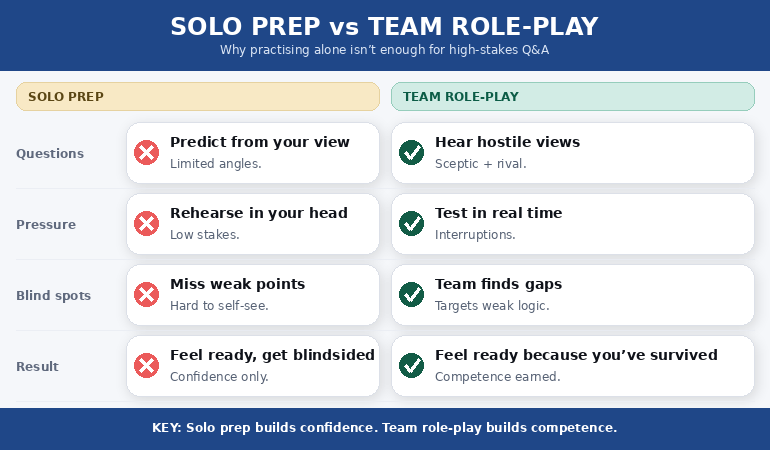
Most presenters spend roughly 90% of their preparation time on slides — designing, refining, rehearsing the narrative — and leave maybe 10% for thinking about questions. Often that 10% happens the night before, when you lie in bed imagining worst-case scenarios without actually preparing responses.

The problem isn’t that slides don’t matter. They do. A poor executive presentation structure will lose your audience before you reach Q&A. But once your slides are solid — clear structure, clear recommendation, clear ask — additional slide refinement produces diminishing returns. The marginal value of your twentieth revision of slide 14 is close to zero.

The marginal value of preparing for the CFO’s top three questions? Enormous.


Diagram showing presentation preparation ratio versus where executive decisions actually happen during Q&A

Here’s the preparation ratio I recommend to my clients: once your slides are structurally sound, split your remaining preparation time 50/50 between rehearsing the presentation and preparing for Q&A. For a high-stakes presentation — a board approval, a funding request, a major proposal — I’d go further: 40% slides, 60% Q&A preparation.

That feels counterintuitive. It felt counterintuitive to the senior director who lost the £3.2M deal too. But after working with hundreds of executives through high-stakes presentations, I can tell you: nobody ever lost a deal because slide 17 wasn’t polished enough. Plenty have lost deals because they couldn’t answer question two.

Don’t want to build the question map from scratch?

The Executive Q&A Handling System gives you the question mapping templates, response structures, and recovery scripts ready to run before any high-stakes presentation. £39, instant download — keep them for every future Q&A.

Get the Q&A Handling System →

The Question Map: Predicting What They’ll Ask

The biggest myth about Q&A is that questions are unpredictable. They’re not. In my experience, you can predict the majority of the questions you’ll receive — if you prepare systematically rather than hoping for the best.

I teach my clients a technique called Question Mapping. Before any high-stakes presentation, you build a map of likely questions organised by stakeholder and by category. Here’s how it works:

Step 1: List every person in the room and their primary concern.

The CFO cares about cost, risk, and return. The CTO cares about technical feasibility and integration. The COO cares about operational disruption. The CEO cares about strategic alignment and timing. Each person will ask questions through their lens. Knowing the lens tells you the question before it’s asked.

Step 2: For each person, write the three questions they’re most likely to ask.

Not the questions you’d like them to ask — the questions they’ll actually ask based on their role, their concerns, and any history you have with them. If the CFO challenged your timeline last time, she’ll challenge your timeline again. Prepare for that specific challenge.

Step 3: For each question, prepare your answer AND your evidence.

The answer is what you’ll say. The evidence is what you’ll show — a backup slide, a data point, a reference to a comparable situation. This is where appendix slides become essential. They’re not afterthoughts; they’re your Q&A arsenal.

Step 4: Identify the two or three questions you can’t answer yet — and prepare honest responses for those too.

Knowing what you don’t know is just as important as knowing what you do. We’ll cover how to handle these in a moment.

When my client lost the £3.2M deal, I asked him afterwards: “Did you do a question map?” He looked at me blankly. He’d spent three weeks on slides and zero minutes mapping the questions his audience was guaranteed to ask. The CFO’s question about the vendor contract penalty wasn’t obscure — it was the most obvious financial question in the room. Ten minutes of question mapping would have caught it.

Answer Architecture: The 3-Part Executive Response

Knowing what they’ll ask is half the battle. The other half is structuring your answer so it lands with a senior audience. Most people answer executive questions the way they’d answer in conversation — they think out loud, circle around the point, add context, and eventually arrive at the answer. For a peer, this is fine. For a CFO with six more meetings after yours, it’s fatal.

I teach a three-part response structure that works for virtually any executive question:

Part 1: Direct Answer (first sentence)

Start with the answer. Not the context, not the caveat, not the background. The answer. “The migration risk is moderate — we estimate two weeks of parallel running with a 15% contingency built in.” The executive now has what they need. Everything after this is supporting detail.

Part 2: One Supporting Point (second sentence)

Give one piece of evidence or reasoning that strengthens your answer. “We’ve based that on the migration timeline from the Singapore rollout last year, which had similar complexity.” One point. Not three. Not a data dump. One credible reference that shows your answer isn’t a guess.

Part 3: The Bridge (optional third sentence)

If it’s useful, connect back to a point from your presentation or redirect to a related strength. “That’s actually why we’ve built the phased approach I showed on slide 8 — it gives us an exit ramp at each stage.” This turns a defensive moment (answering a question) into an offensive one (reinforcing your proposal).

Three sentences. Sometimes two. Never seven. The discipline of brevity in Q&A communicates the same thing it communicates in your slides: you know what matters and you’re not afraid to be direct about it.

📊 Question Maps + Response Frameworks + Recovery Scripts

The Executive Q&A Handling System gives you the complete toolkit: question mapping templates for every stakeholder type, the 3-part response structure with worked examples, “I don’t know” recovery scripts, hostile question techniques, and preparation checklists you can run before any high-stakes presentation.

Get the Executive Q&A Handling System → £39

Instant download. Built from 25 years of real boardroom Q&A across JPMorgan Chase, PwC, RBS, and Commerzbank.

The Most Powerful Answer: “I Don’t Know, But…”

Here’s something that surprises most of my clients: the executives I’ve worked with over 25 years don’t expect you to know everything. What they can’t tolerate is pretending you do when you don’t.

When you bluff in Q&A, senior people can tell. They’ve sat through thousands of presentations. They know the difference between someone who’s genuinely confident in their answer and someone who’s constructing one in real time. Bluffing doesn’t just fail to convince them — it actively undermines every other answer you’ve given, including the ones you were right about.

“I don’t know” — when it’s honest — is a trust-building statement. But it needs a second half.

The formula: “I don’t have that figure yet. Here’s what I do know: [related fact]. I’ll have the specific answer to you by [date].”

Three elements: honest admission, related context that shows you understand the territory, and a specific commitment to follow up. The admission shows integrity. The related context shows competence. The commitment shows accountability. Together, they communicate something more valuable than the actual answer: that you’re someone who can be trusted with a £3.2M decision.

My client who lost the deal said “I’ll need to come back to you on that” — which is close but missing the middle element. He didn’t demonstrate that he understood the territory around the question. Compare that with: “I don’t have the exact penalty clause figure, but I know the contract has a 90-day notice period and we’d be within that window for a Q2 start. I’ll confirm the specific financial impact by Friday.”

Same honesty. Completely different impression. The first version says “I didn’t prepare for this.” The second says “I understand the landscape even though I’m missing one data point.”

For a deeper dive into handling the really difficult questions — the hostile ones, the ambush questions, the ones designed to put you on the spot — this guide covers specific techniques for those situations.

How do you prepare for Q&A after an executive presentation?

Use a Question Map: list every person in the room and their primary concern, write the three most likely questions each will ask, prepare direct answers with supporting evidence, and identify the questions you can’t answer yet. Aim to spend at least 50% of your remaining preparation time on Q&A once your slides are structurally sound.

Why do good presentations still fail to get approval?

Because executives don’t decide during slides — they decide during Q&A. Your slides present your best case. Q&A reveals how deeply you’ve thought about risks, alternatives, and second-order consequences. Two unanswered questions can undo twenty-two minutes of perfect delivery.

What’s the best way to answer questions from senior executives?

Use the 3-part structure: direct answer first (one sentence), one supporting point (evidence or reasoning), then an optional bridge back to your presentation. Keep responses under three sentences. Brevity in Q&A signals confidence and clarity — rambling signals uncertainty.

🎓 25 Years of Boardroom Q&A. One System.

The Executive Q&A Handling System is built from 25 years of corporate banking and 16 years coaching senior professionals across financial services, healthcare, technology, and government. Every framework — the question map, the 3-part response, the “I don’t know” recovery script — comes from real boardroom situations where Q&A decided whether the room said yes.

Designed for senior professionals who present to boards, investment committees, and executive sponsors where Q&A is the deciding moment.

Get the Executive Q&A Handling System → £39

Instant download — lifetime access to every framework and template.

Frequently Asked Questions

How long should I spend preparing for Q&A versus preparing slides?

Once your slide structure is solid, split remaining preparation time at least 50/50 between presentation rehearsal and Q&A preparation. For board-level or funding presentations, consider 40/60 in favour of Q&A. No executive ever rejected a proposal because slide 17 wasn’t polished — but many have rejected proposals because the presenter couldn’t answer question two.

What if I’m asked a question I genuinely haven’t thought of?

Use the “I don’t know, but…” formula: honest admission, one related fact that shows you understand the territory, and a specific commitment to follow up with the answer by a named date. This builds more trust than a bluffed answer that unravels under follow-up questioning.

Should I invite questions during the presentation or only at the end?

For senior audiences, invite questions throughout. Executives don’t wait well — if they have a question on slide 4, they won’t be listening to slides 5 through 20. Saying “I welcome questions at any point” also signals confidence. If the question is answered on a later slide, say so: “Great question — I cover that in two slides. Shall I jump ahead or continue?”

How do I handle it when the Q&A goes completely off-topic?

Acknowledge the question’s value, then redirect: “That’s an important point, and it deserves proper attention. Can I take that offline with you after this meeting so we can give it the time it needs? I want to make sure we cover [the decision you need] in the time we have left.” This respects the questioner while protecting your agenda.

📬 The Winning Edge Newsletter

Weekly executive presentation strategies — Q&A preparation, slide structures, and boardroom techniques that actually work. No filler.

Subscribe Free →

Related reading: The breathing technique that stopped my pre-presentation vomiting — managing the physical side of high-stakes presentations, including Q&A anxiety.

Your next step: Before your next presentation, take fifteen minutes and build a Question Map. List every person in the room, their primary concern, and the three questions they’re most likely to ask. Prepare a direct answer for each one. That fifteen minutes will do more for your outcome than another three hours of slide refinement. And if you want the complete Q&A preparation system — question maps, response frameworks, recovery scripts, and hostile question techniques — the Executive Q&A Handling System (£39) gives you everything you need to turn the most dangerous part of your presentation into the most persuasive.

About the Author

Mary Beth Hazeldine is the Owner & Managing Director of Winning Presentations. With 25 years of corporate banking experience at JPMorgan Chase, PwC, Royal Bank of Scotland, and Commerzbank, she has delivered high-stakes presentations in boardrooms across three continents.

A qualified clinical hypnotherapist and NLP practitioner, Mary Beth combines executive communication expertise with evidence-based techniques for managing presentation anxiety. She has trained senior professionals and executive audiences over many years and supported high-stakes funding and approval presentations throughout her career.

Book a discovery call | View services