Tag: executive approval

17 Apr 2026
A finance director presenting a revised budget proposal to a sceptical finance committee in a corporate boardroom, navy and dark tones, editorial photography style

Budget Resubmission Presentation: What Finance Committees Need to See

Quick Answer: A budget resubmission fails when you present the same deck again. Finance committees rejected your original request for specific reasons — usually around ROI evidence, timing, or lack of alternatives analysis. A successful resubmission acknowledges the rejection, isolates the exact objections raised, addresses each one with new evidence, and presents the project as stronger, not unchanged. The slides are secondary to the diagnostic work that happens before you open PowerPoint.

Henrik had prepared for six weeks. The CapEx request was airtight — or so he thought. When the finance committee rejected his £2.3 million infrastructure upgrade, the feedback was three lines: “ROI timeline unclear. Alternatives not sufficiently explored. Timing not aligned with current priorities.”

He was deflated. His instinct was to go back in three months with the same deck, slightly updated. His CFO stopped him. “They didn’t reject the project,” she said. “They rejected the presentation of it. That’s a different problem.”

That distinction changed everything. Henrik spent two weeks doing the diagnostic work the first submission skipped — mapping the committee’s actual concerns, building a phased ROI model, and including a genuine alternatives analysis. Six weeks later, the resubmission was approved. Not because the project had changed. Because the presentation finally spoke to what the committee needed to hear.

If your budget request has already been rejected

The Executive Slide System includes slide templates designed specifically for finance and approval presentations — including resubmission scenarios where you need to address prior objections and rebuild credibility with the same committee.

Explore the System →

Why Most Budget Resubmissions Fail

The most common mistake in a budget resubmission is treating it as a resubmission. Executives go back with the same slides, the same narrative, and perhaps some updated figures — and are surprised when the committee says no again.

Finance committees have a specific memory of your previous presentation. They remember why they said no. When you return with something that looks largely unchanged, you signal either that you didn’t understand their objections, or that you understood them but couldn’t address them. Neither reading helps your case.

The second common mistake is addressing the wrong objections. Committees rarely tell you their real concerns in the formal feedback. “ROI timeline unclear” might actually mean “we don’t trust the assumptions in your model.” “Timing not aligned with current priorities” might mean “one board member has a competing project and has already lobbied against yours.” Understanding the surface objection and the underlying concern are different tasks.

A budget resubmission is not a second bite of the same apple. It is a new presentation built from a post-mortem of the first one. The executive who approaches it this way consistently outperforms the one who simply tries harder with the same material.

Executive Slide System

Structure the Resubmission So Finance Committees Say Yes

The Executive Slide System — £39, instant access — includes slide templates for finance and approval scenarios, AI prompt cards to rebuild your ROI narrative, and a scenario playbook for executives presenting to hostile or sceptical decision-makers. Designed for budget presentations where the first submission didn’t land and you need a structurally stronger case the second time.

  • Slide templates for CapEx, opex, and budget approval presentations
  • AI prompt cards to pressure-test your financial assumptions before the meeting
  • Framework guides for structuring an objection-response narrative
  • Scenario playbooks for finance committee, board, and investment committee presentations

Get the Executive Slide System →

Designed for executives facing second-attempt approval presentations.


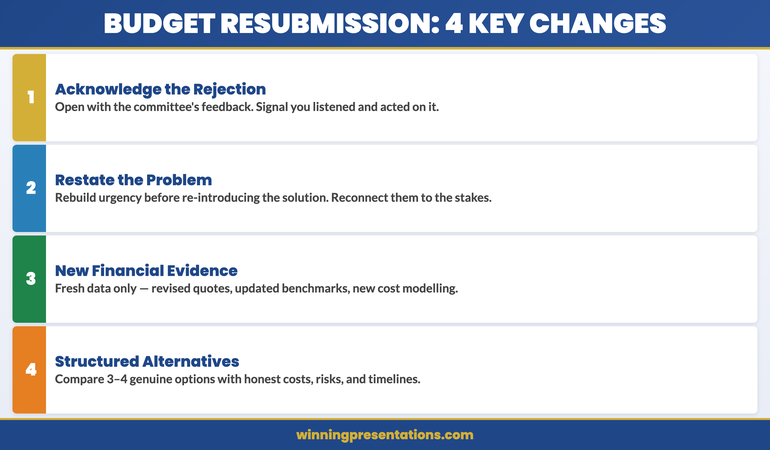
The Four Changes for a Successful Budget Resubmission infographic showing: Diagnose the Real Objection, Address with New Evidence, Reframe the Narrative, and Present the Alternatives

Diagnosing What the Committee Actually Objected To

Before you change a single slide, you need to understand what the committee actually objected to. This requires going beyond the formal written feedback, which is almost always a sanitised version of the real conversation.

Request a debrief with the chair of the finance committee or the most senior sponsor in the room. Frame it as seeking guidance: “I want to ensure I’m addressing the committee’s concerns properly before resubmitting. Would you be willing to give me fifteen minutes to understand what would strengthen the case?” Most chairs will say yes — they want well-constructed proposals coming back, not the same weak ones.

In that conversation, listen for three things. First, which objections were raised by whom — understanding the political landscape inside the committee matters. Second, what the committee would need to see to be confident in the ROI assumptions — this tells you what new evidence to gather. Third, whether the timing objection is real or a proxy for something else. If one committee member is pushing a competing capital project, timing becomes a way to delay your proposal rather than reject it outright.

Once you have this diagnostic information, map each concern to a specific change you will make in the deck. If you cannot identify what change addresses each concern, the resubmission is not ready yet. The internal link between concern and response is what makes the resubmission feel genuinely responsive rather than cosmetically updated. See how this approach connects to the pre-meeting work described in The Follow-Up Deck: Why Most Approvals Die After the Meeting.

The Four Changes That Earn a Second Look

Not every resubmission needs a complete rebuild. Most need four targeted changes, each one designed to address a specific category of concern that finance committees raise when they reject a budget request.

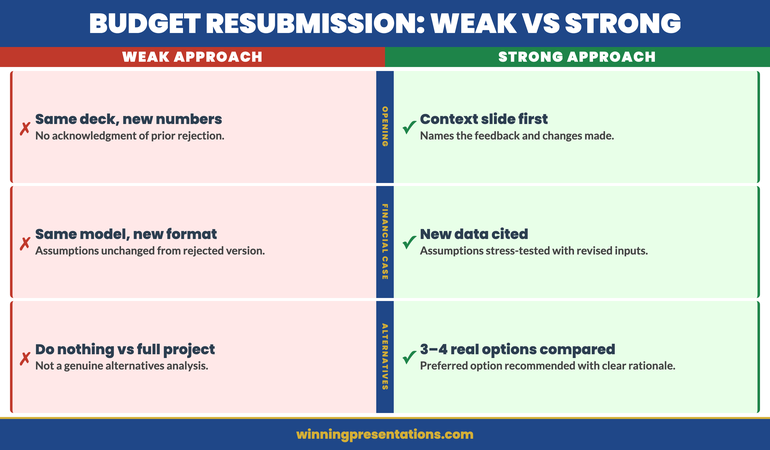
1. Acknowledge the rejection explicitly. Open the resubmission by referencing the previous presentation and what you heard from the committee. “Following the committee’s feedback in February, this revised proposal addresses three specific areas: the ROI timeline, alternatives analysis, and alignment with the current capital priorities.” This signals that you listened, that you did the work, and that this is a genuinely improved version — not the same material with fresh slides.

2. Restate the problem, not the solution. Many rejected budget requests spend the first ten slides describing the solution — the system, the infrastructure, the initiative — before establishing why the problem matters. Committees who weren’t sold the first time need to be reconnected to the urgency of the problem before they can evaluate the solution on its merits. Rebuild the problem slide before you rebuild anything else.

3. Introduce genuinely new financial evidence. If the ROI model was questioned, you need new inputs — not the same model with different formatting. Commission updated cost modelling, gather vendor quotes that support the assumptions, or bring in market benchmarks from a credible external source. The committee will recognise recycled figures dressed in new slides. New evidence signals that the financial case has been properly stress-tested.

4. Include a structured alternatives analysis. “We considered doing nothing, and also doing the project at half-scale” is not an alternatives analysis. A structured alternatives analysis presents three to four genuine options — including the do-nothing scenario — with honest comparative costs, risks, and timelines for each. This demonstrates that your preferred option is the recommended outcome of a rigorous process, not simply the option the team preferred from the start.

For a deeper look at how CapEx presentations are structured from the outset, see Capital Expenditure Presentation: The Slide Structure That Gets CapEx Approved.

If you need to rebuild the financial narrative quickly and ensure the slide structure meets finance committee expectations, the Executive Slide System includes prompt cards specifically designed for restructuring a presentation that didn’t land the first time.


Weak vs Strong Budget Resubmission comparison infographic showing the difference between cosmetic updates and diagnostic restructuring across four dimensions: problem framing, ROI evidence, alternatives analysis, and objection response

Building Your Resubmission Case

A resubmission is not built in PowerPoint. It is built in the weeks of work that happen before you open a presentation tool. The slides are the output of a process — not the process itself.

Start by updating your stakeholder map. Between your first presentation and the resubmission, the political landscape inside the committee may have changed. New members may have joined. The CFO’s priorities may have shifted. A competing project may have been approved or rejected, which changes the available capital headroom. Your pre-meeting conversations should give you an updated picture of where support and opposition sit before you step into the room.

Next, rebuild the financial model with new inputs. If the committee questioned your assumptions, the only credible response is new data. If they challenged your implementation timeline, bring in updated project management assessments. If they were concerned about total cost of ownership, include a five-year cost comparison that previous models omitted. Every financial assumption that was challenged needs a corresponding piece of new evidence that wasn’t in the original submission.

Then update your risk section. Most first submissions understate implementation risk because project teams are optimistic about their own proposals. A resubmission that honestly names the risks — and then explains how each one is mitigated — signals intellectual rigour. Finance committees are more comfortable approving projects where the risk has been honestly assessed than projects where it appears to have been glossed over.

Finally, update your internal cross-references. If the resubmission references savings from a related initiative, or assumes integration with an existing system, those dependencies need to be named and confirmed in writing before the presentation. Assumptions that couldn’t be confirmed in the first submission should be confirmed before the second.

Structuring the Resubmission Deck

The structure of a resubmission deck differs from a first-pass budget request in one important way: the opening acknowledges the history. Committees who have already seen your proposal need to see that history acknowledged before they can engage with the updated case. A deck that opens as though the rejection never happened reads as either oblivious or evasive.

A resubmission deck structured for finance committees typically follows this sequence:

Slide 1 — Context slide: One line on when the original proposal was submitted and a single sentence on what feedback was received. This is not a defensive slide — it is a signalling slide. It says “I heard you, and this version responds to what I heard.”

Slides 2–3 — The problem: Rebuild the urgency of the business problem. Not the solution — the problem. What happens if this doesn’t get funded? What is the cost of delay, in concrete terms? If the committee didn’t feel the urgency the first time, this is where you earn it back.

Slides 4–5 — The updated ROI case: Present the revised financial model with its new inputs highlighted. Don’t bury the changes — surface them. “Since February, we have obtained revised vendor quotes and updated the model based on current market rates. The revised payback period is 3.2 years, compared to 4.1 years in the original submission.” Specificity here signals that the changes are real, not cosmetic.

Slide 6 — Alternatives analysis: Three or four genuine options, compared on cost, risk, and timeline. Recommend your preferred option at the end, with a brief rationale. Keep this slide to a grid — not paragraphs.

Slides 7–8 — Risk and mitigation: Name the top three implementation risks and the corresponding mitigation for each. If a risk was specifically raised by a committee member in the previous session, address it by name in this section.

Slide 9 — Implementation roadmap: Phased milestones, owners, and decision points. If the original timeline was challenged, show how the revised timeline is structured and what would trigger a go/no-go decision at each phase.

Slide 10 — The ask: One slide. The specific amount, the timing, and one sentence on what approval unlocks. For guidance on how this sequence connects to zero-based budget frameworks, see Zero-Based Budget Presentation: Justify Every Line to Finance.

Presenting the Resubmission Without Appearing Defensive

The tone of a resubmission matters as much as the content. Executives who come back into the room carrying resentment about the original rejection — even when that resentment is concealed — communicate it through their body language, their framing, and the way they handle questions.

The framing that works best is genuine curiosity about whether the case is now strong enough, not determination to get approval at all costs. “Following the feedback from February, we’ve done additional work that I’d like to walk you through” is a different energy from “We’ve addressed every concern that was raised.” The first is collaborative. The second is defensive.

When questions come, don’t pre-empt them with elaborate explanations of why the original model was correct. If the committee asks about a changed assumption, answer the question directly, then explain the new basis for that assumption. The order matters: answer first, explain second. Pre-emptive defensiveness reads as if you’re trying to win an argument rather than inform a decision.

Finally, be prepared to accept a partial approval. Finance committees sometimes approve a phased version of a project when they’re not ready to commit the full amount. If you have structured a phased option in your deck, you’re positioned to accept this outcome as a win rather than a compromise. “Yes to Phase 1, conditional review for Phase 2” can be a stronger outcome than a second outright rejection.

Ready to Rebuild the Case?

Slide Templates Designed for Finance Committee Presentations

The Executive Slide System — £39, instant access — gives you templates for CapEx, budget approval, and resubmission scenarios, plus AI prompt cards to restructure the financial narrative before you step back into the room.

Get the Executive Slide System →

Frequently Asked Questions

How long should I wait before resubmitting a rejected budget?

There is no fixed waiting period, but a resubmission submitted fewer than four weeks after rejection usually signals that insufficient diagnostic work has been done. The credibility of the resubmission depends on the quality of the changes, not the speed of the return. Most committees expect to see a resubmission at the next scheduled budget cycle — typically quarterly. If you have a compelling reason to return sooner, the context slide at the start of your deck should explain the timing rationale.

Should I request a pre-meeting with committee members before resubmitting?

Yes. Pre-meeting conversations with the committee chair and key decision-makers are one of the highest-value activities you can do before a resubmission. These conversations let you confirm that your revised case addresses the specific concerns that led to rejection, rather than the concerns you assumed were the issue. They also give you early signals about whether the timing is right and whether there are any political dynamics you need to account for in how you structure the presentation.

What if the rejection was politically motivated rather than financial?

Political rejections — where a committee member blocked the proposal for reasons unrelated to its financial merit — are common and require a different response to financial rejections. In this situation, the priority before resubmission is shoring up political support outside the meeting room. Identify who opposed the proposal and why, then work with your sponsor to either address their underlying concern or build a coalition of support strong enough that opposition becomes untenable. Resubmitting without addressing a political blockage produces the same result.

The Winning Edge — Free Weekly Newsletter

Practical frameworks for executives who present to boards, finance committees, and senior leadership. Every Thursday.

Subscribe to The Winning Edge →

Not ready for the full system? Start here instead: download the free Executive Presentation Checklist — a one-page reference covering the structural elements finance committees look for in budget and approval presentations.

About the Author

Mary Beth Hazeldine is Owner & Managing Director of Winning Presentations. With 25 years of corporate banking experience at JPMorgan Chase, PwC, Royal Bank of Scotland, and Commerzbank, she advises executives across financial services, healthcare, technology, and government on structuring presentations for high-stakes funding rounds and approvals.

17 Apr 2026
A senior female executive in a one-to-one conversation with a male board member in a glass-walled office, building alignment before a formal meeting, confident and collaborative tone, editorial photography style

Stakeholder Alignment Presentation: The Pre-Meeting That Wins Approvals

Quick Answer: Most approvals are decided before the formal presentation begins. A stakeholder alignment session — a structured pre-meeting with key decision-makers — lets you surface objections privately, refine your narrative based on what you hear, and arrive in the room with commitments already secured. The formal presentation then becomes a ratification exercise rather than a persuasion exercise. This approach works for board approvals, finance committee requests, and any high-stakes executive decision.

Astrid had thirty minutes in front of the investment committee. She had rehearsed the deck twenty times. Her financial model was solid, her slides were clear, and her executive sponsor believed in the project. When the committee chair asked a single question — “What does the operations director think about the implementation timeline?” — the presentation stalled.

The operations director hadn’t been consulted. He sat in the room, visibly uncomfortable. The committee read the room, delayed the decision, and asked for a revised proposal that incorporated operational input.

Three weeks later, Astrid submitted the same project with one structural difference: she had spent the preceding fortnight meeting individually with every committee member and the operations director. By the time she walked into the formal presentation, every objection had already been heard, addressed, and in most cases resolved. The formal presentation took nineteen minutes. The approval was unanimous.

If you’re preparing for a high-stakes approval

The Executive Slide System includes scenario playbooks and slide templates for executive approval presentations — including the alignment and pre-meeting frameworks that help you structure what you learn before the formal session.

Explore the System →

Why the Decision Is Made Before You Present

Senior decision-makers rarely change their minds in a committee room. By the time the formal meeting convenes, most members have already formed a view — based on conversations in corridors, emails exchanged with colleagues, and assumptions built from prior context. The formal presentation is where those views are tested, not formed.

This is not cynicism about the process. It reflects how experienced executives make high-stakes decisions: they gather information in advance, test their instincts with trusted colleagues, and arrive in the meeting with a working hypothesis. Your presentation either confirms or challenges that hypothesis. If you’ve done no work to shape it in advance, you’re working against a position that was set before you entered the room.

The most effective executives understand this dynamic and work with it rather than against it. They treat the formal presentation as the final step in a longer engagement process, not the first and only opportunity to make their case.

The pre-presentation alignment session is the mechanism that makes this possible. It is not manipulation — it is thorough preparation. Every concern that surfaces in a private conversation is one that won’t derail the formal meeting. Every commitment secured informally is one that reinforces the approval in the room. And every stakeholder who feels heard in advance is one who arrives in the meeting inclined to support rather than question.

Executive Slide System

Structure Your Approval Presentation to Match the Work Done Before the Room

The Executive Slide System — £39, instant access — gives you slide templates for board, finance committee, and investment committee presentations, plus scenario playbooks for navigating stakeholder alignment before high-stakes approvals. Designed for executives who want to arrive in the formal meeting with the decision already moving in their direction.

  • Slide templates for approval and board presentations across executive scenarios
  • AI prompt cards to map stakeholder concerns before the alignment session
  • Framework guides for structuring the narrative around what you hear pre-meeting
  • Scenario playbooks for investment committee, board, and finance committee contexts

Get the Executive Slide System →

Designed for high-stakes approval presentations where preparation matters more than performance.


Stakeholder Alignment Dashboard infographic showing four metric categories: Decision-Makers to Brief, Concerns to Surface, Commitments Secured, and Objections Outstanding — a pre-presentation tracking framework

Who to Meet and What to Ask Them

Not every stakeholder needs a dedicated pre-meeting. The goal is to meet the people whose support is essential and whose concerns, if left unaddressed, could derail the formal presentation. For most approval presentations, that list is shorter than it appears.

Start with the decision-makers — the people who will vote, recommend, or formally approve. Understand their current view on the topic before you attempt to inform it. Have they been involved in similar decisions before? Do they have a prior position on this type of investment or initiative? Is there a competing proposal that complicates their thinking?

Next, identify the influencers — the people whose opinion the decision-makers trust. In a finance committee context, this is often the CFO’s direct advisers or the head of internal audit. In a board context, it may be the senior independent director or a non-executive with a strong view on capital allocation. These people may not have a vote, but their informal influence on the final outcome can be decisive.

Finally, identify the potential blockers — the people whose opposition, if expressed in the formal meeting, could damage the proposal even if they are in the minority. Understanding a blocker’s concern before the meeting gives you the opportunity to address it privately, which is almost always more productive than managing it in public.

In each pre-meeting, ask three questions. What do they already know about the proposal? What concerns do they have about it? And what would they need to see to be comfortable supporting it? These questions are not a sales pitch — they are information-gathering. The goal is to understand, not to convince. Convincing comes later, in how you update the presentation.

For the framework behind pre-decision conversations, see The Pre-Decision Conversation: How Executives Secure Approval Before the Meeting.

Running the Alignment Session Effectively

An alignment session is a conversation, not a presentation. Executives who use the pre-meeting to walk through their slides — treating it as a rehearsal — miss the point. The slide deck is not what you bring to this meeting. What you bring is curiosity and good questions.

Keep the meeting short: thirty minutes is usually sufficient. Open by explaining your purpose directly — you are seeking input before the formal session to ensure the presentation addresses the right questions. Most decision-makers respect this directness. It signals that you are thorough, not that you are uncertain.

Listen more than you speak. When a concern surfaces, resist the instinct to immediately counter it. Instead, explore it: “That’s useful to know — can you say more about what’s driving that concern?” Understanding the root of an objection is more valuable than overcoming its surface expression. An objection that sounds financial may actually be about trust. An objection about timing may actually be about resource competition.

Take notes, and be transparent about doing so. “I want to make sure I capture this accurately before I revise the presentation” signals that the conversation will have a real impact on what the committee sees. This is important: if decision-makers sense that the pre-meeting is performative rather than genuinely informative, they stop sharing real concerns.

Close each session by confirming what you’ve heard and what changes you plan to make. “Based on what you’ve shared, I’ll strengthen the implementation timeline and add more detail on the alternatives we considered. Does that address the main concerns you raised?” This gives the stakeholder the opportunity to confirm or correct your understanding before you do the work.

If you’re rebuilding a formal approval presentation around what you’ve heard in pre-meeting conversations, the Executive Slide System includes slide templates and AI prompt cards designed to help you translate stakeholder concerns into a presentation narrative that addresses them structurally, not just rhetorically.


Stakeholder Alignment Roadmap infographic showing five stages: Map the Stakeholders, Schedule Pre-Meetings, Surface Concerns, Update the Narrative, and Enter the Room with Commitments Secured

What to Do With What You Hear

The alignment session has value only if it changes something. If you leave every pre-meeting with the same deck and the same narrative, you’ve gathered information that you didn’t act on — which is worse than not gathering it, because it signals to stakeholders that the consultation was cosmetic.

After each pre-meeting, categorise what you’ve heard. Some concerns will be addressed by adding or clarifying information — a new slide, an updated data source, a clearer explanation of a financial assumption. These are structural changes, and they make the presentation more complete. Make them before the formal session.

Other concerns will reflect a disagreement about the underlying business case — a stakeholder who genuinely believes the investment is premature, or that a different approach should be considered. These cannot be resolved with a slide change. They require a direct conversation about the merits, and in some cases, the involvement of a more senior sponsor to navigate the impasse. Identify these early, because they need more time than a slide revision.

Some concerns will be about perception rather than substance — a stakeholder who hasn’t been involved in previous discussions and feels left out, or one who is concerned about credit and visibility when the project succeeds. These are relationship issues, and they are resolved through the pre-meeting process itself: the act of consulting them is the resolution. Make sure they know their input shaped the final presentation.

Keep a simple log of what you heard, what you changed, and what remains unresolved. This is useful for two reasons. It ensures that nothing gets lost between conversations. And if the decision is contested in the formal meeting, your log gives you the basis to say with confidence: “I discussed this with [stakeholder] two weeks ago, and here is how I addressed that concern in the revised presentation.” For related thinking on managing structural change presentations, see Restructuring Presentation: Rebuilding Trust Through Transparent Communication.

Aligning Across Competing Interests

The most challenging stakeholder alignment situations are those where key decision-makers have competing interests — where what one stakeholder needs to hear directly contradicts what another needs to hear. A proposal that involves resource reallocation is a classic example: the function gaining resources welcomes it, while the function losing resources opposes it.

The response here is not to tell different stakeholders different things — that collapses the moment the formal meeting convenes. The response is to find the common ground between competing interests and build the presentation narrative around it.

What both stakeholders share, despite competing interests, is typically a concern about the broader organisational outcome. The function losing resources still cares about the company’s performance. The disagreement is about means, not ends. A presentation that frames the proposal in terms of the shared goal — rather than the redistribution of resources — gives both stakeholders something they can support.

Where interests are genuinely irreconcilable, the alignment session’s value is in surfacing the conflict before the formal meeting rather than discovering it in public. A committee where two factions are in open disagreement is difficult to present to. A committee where the chair knows the disagreement exists and has managed it in advance is a different environment. Use the pre-meeting process to give the chair the information they need to manage the room, as well as to manage your own presentation.

Using the Formal Presentation to Confirm, Not Persuade

When the alignment process has been done well, the formal presentation shifts in character. It becomes a confirmation exercise — a structured walk through the proposal that gives the committee confidence that everything has been considered, rather than a persuasion exercise where the outcome is uncertain.

This changes the tone and the pacing. A confirmation presentation can afford to be shorter, because most of the information has already been shared in pre-meetings. It can acknowledge concerns explicitly — “I know some of you have raised questions about the implementation timeline, so I’ve added a new slide that addresses this directly” — because the concerns are already known. And it can invite a more collaborative discussion, because the presenter isn’t guarding against ambushes.

The questions that arise in a confirmation presentation are also different in character. They tend to be sharper and more specific — looking for the final detail that will complete the picture — rather than broad and exploratory. This is a good sign. It means the committee is doing the final check before committing, not starting the analysis from scratch.

The goal is to make the formal presentation feel inevitable in the best sense: the logical outcome of a rigorous process rather than a surprise outcome from a single event. For guidance on how executive presence supports this dynamic in the room, see Executive Presence in Presentations: The Quality That Closes the Room.

Need the Templates, Not Another Framework?

Slide Templates for Executives Who Present to Senior Decision-Makers

The Executive Slide System — £39, instant access — includes ready-to-use templates for board, finance committee, and investment approval presentations, plus AI prompt cards to structure your narrative around what stakeholders actually need to hear.

Get the Executive Slide System →

Frequently Asked Questions

How many pre-meetings is too many before a formal presentation?

There is no fixed upper limit, but the quality of pre-meetings matters more than the number. Five shallow conversations that don’t surface real concerns are less valuable than two deep ones that reveal the actual objections. As a working guide, prioritise the three to five people whose support is essential and whose concerns are most likely to surface in the formal meeting. Beyond that core group, judge based on the political complexity of the specific approval and the time available.

What if a key stakeholder refuses to meet before the formal session?

A refusal to meet is itself useful information. It may signal opposition, disengagement, or a prior commitment to a competing proposal. If a critical decision-maker declines a pre-meeting, work through your executive sponsor to understand their position and whether there is a backstory that you need to account for. It may also be worth adjusting the formal presentation to explicitly invite that stakeholder’s input — framing their engagement as essential to the process rather than assuming their alignment.

Is it appropriate to share draft slides in a pre-meeting?

In most cases, no. Sharing draft slides in a pre-meeting shifts the conversation from concerns to critique — stakeholders start commenting on slide design rather than sharing their underlying concerns about the proposal. The exception is when a specific stakeholder is a subject-matter expert whose input on a particular section of the deck would meaningfully improve it. In that case, share only the relevant section and frame it as a request for input rather than a preview of the full presentation.

The Winning Edge — Free Weekly Newsletter

Practical frameworks for executives who present to boards, finance committees, and senior leadership. Every Thursday.

Subscribe to The Winning Edge →

Not ready for the full system? Start here instead: download the free Executive Presentation Checklist — a one-page reference covering the structural elements decision-makers look for in board and approval presentations.

About the Author

Mary Beth Hazeldine is Owner & Managing Director of Winning Presentations. With 25 years of corporate banking experience at JPMorgan Chase, PwC, Royal Bank of Scotland, and Commerzbank, she advises executives across financial services, healthcare, technology, and government on structuring presentations for high-stakes funding rounds and approvals.

15 Mar 2026
Professional executive having a one-to-one pre-meeting conversation with a colleague in a modern glass office, navy and gold corporate aesthetic, high-stakes approval setting

The Pre-Decision Conversation: Where Approvals Actually Happen

Quick Answer: Most executives make their decision in an informal conversation hours or days before the formal meeting. The formal meeting is a confirmation ritual, not the decision moment. The pre-decision conversation — a single phone call, a corridor chat, or a brief coffee meeting — is where approvals actually happen. Getting this conversation right means your presentation delivers confirmation, not persuasion. That changes everything about how you prepare.

🚨 Pitching for approval this month? Quick diagnostic: Have you had a pre-decision conversation with the decision-maker yet, or are you relying entirely on the formal presentation? If it’s the latter, you’re walking in without the framework that determines whether you win. → Get the Executive Slide System (£39), which includes the exact pre-conversation positioning strategy and decision-meeting follow-up.

A CFO told me she approved a £2 million budget in a five-minute corridor conversation two days before the formal approval meeting.

The executive who was presenting sent her a single-page executive summary in advance. They had a brief phone call the morning before that one-pager arrived. She asked three questions. He answered them with precision.

By the time the formal meeting happened, the decision was already made. Everyone in the room knew it. The presentation became a confirmation ritual — addressing questions that had already been resolved, walking through slides that she had already mentally approved.

This is the norm at executive level, not the exception. Most senior decision-makers make their decision outside the formal meeting. The formal meeting is theatre.

But most presenters still approach it as if the meeting itself determines the outcome. They prepare slides for persuasion. They build arguments for a room that has already decided. They walk in hoping to land a decision they should have secured days before.

What Is a Pre-Decision Conversation?

A pre-decision conversation is an informal discussion — usually a phone call, a corridor chat, or a brief in-person meeting — between you and a decision-maker or key influencer before the formal approval meeting takes place.

Its purpose is not to present your case. You’re not pitching. You’re clarifying what the decision-maker actually cares about, answering the questions that would otherwise sit unanswered in the formal meeting, and creating space for them to voice concerns that they wouldn’t raise in front of a full committee.

This is fundamentally different from a “pre-meeting brief” or a presentation rehearsal. Those are preparation activities. A pre-decision conversation is a sales conversation. It happens one-on-one or in a very small group. It is designed to move someone from uncertainty toward a yes before they enter the formal decision space.

The stakes are high because this conversation often determines whether the formal meeting is a smooth confirmation or an ambush. A decision-maker who has already agreed in principle will defend your proposal in the room. A decision-maker who is hearing your argument for the first time in front of peers is far more likely to defer, object, or propose conditions.

Why the Informal Conversation Determines the Outcome

Executives avoid surprise decisions in public. They prefer to know where they stand before they commit in front of peers or their own leadership team.

When you lead with a formal presentation without a pre-decision conversation, you’re asking the decision-maker to commit in an unfamiliar environment, in front of an audience, without private space to raise concerns or renegotiate terms. They are more likely to defer, ask for more time, or propose modifications rather than give a clean yes.

A pre-decision conversation removes the risk of public commitment. It allows the decision-maker to ask difficult questions privately. It gives you space to adapt your position based on what you learn. It lets them feel heard before they have to perform a decision in front of others.

This is why informal influence often outweighs formal persuasion. The best slide deck in the world cannot compete with a decision-maker who has already made up their mind — and pre-decision conversations are where minds actually get made up.

Many executives don’t even attend their own approval meetings. They send a delegate with instructions: approve if certain conditions are met, or defer if X happens. The pre-conversation with the actual decision-maker is what determined their position. The formal meeting is just execution.

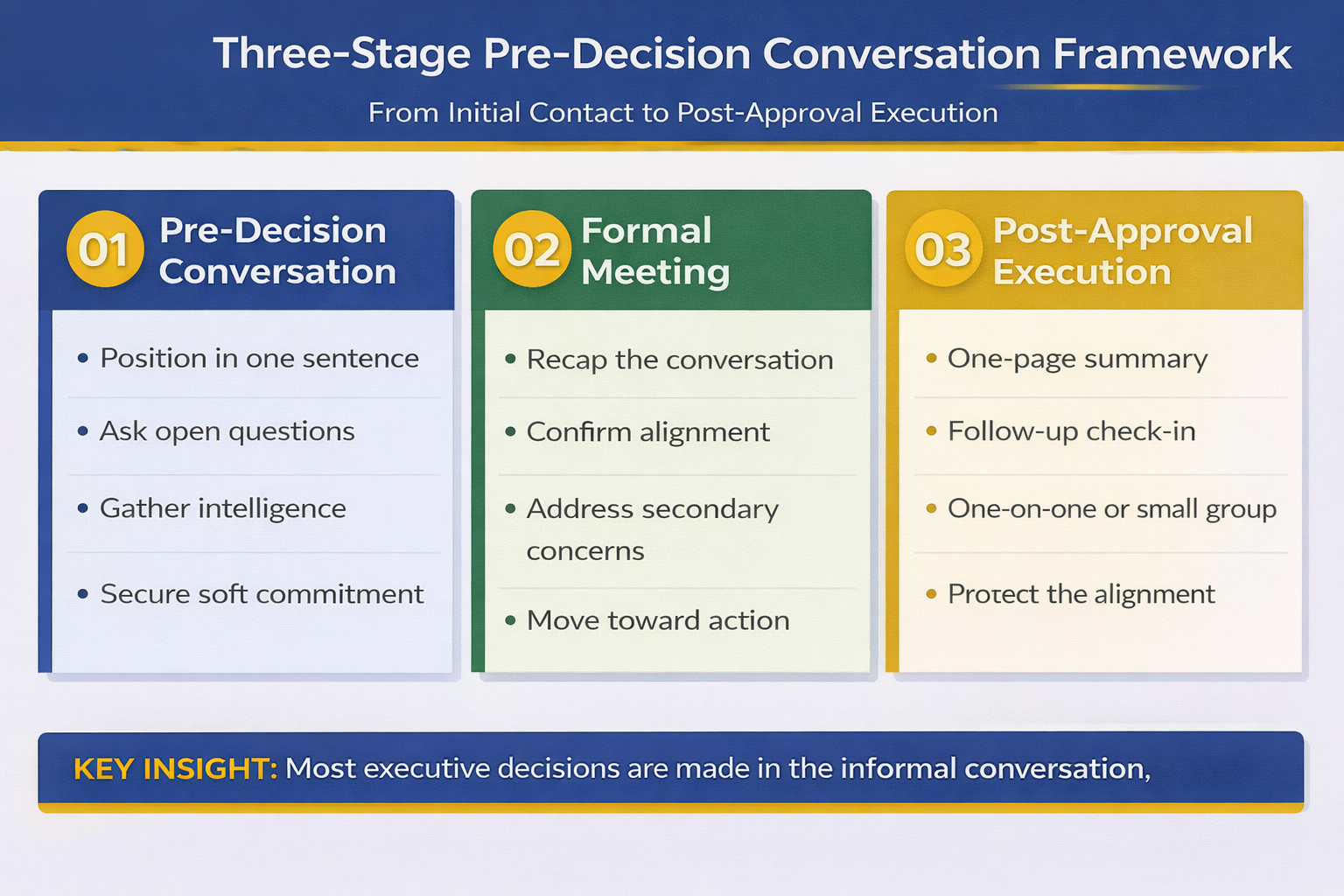
Three-stage pre-decision conversation framework infographic showing Pre-Decision Conversation, Formal Meeting, and Post-Approval Execution phases with key actions for each stage including positioning, intelligence gathering, recap and confirmation

When to Initiate the Pre-Decision Conversation

Timing determines whether a pre-decision conversation feels natural or manipulative. Get it wrong and you risk appearing to lobby behind the scenes. Get it right and you’re simply being thoughtful.

The ideal window is 5–10 days before the formal meeting. This gives you enough time to gather intelligence, adapt your approach, and ensure your formal presentation reflects any insights you gained. It’s recent enough that momentum hasn’t shifted, but distant enough that reaching out doesn’t feel like a last-minute panic.

You should initiate the conversation with the person most likely to become your champion or the person most likely to block you — often both are the same person. If there is a steering committee, start with the chair. If there is a finance committee, start with the CFO or budget-holder. If there is a project governance board, start with the executive sponsor.

The conversation should feel organic to your relationship. If you have never spoken to this person one-on-one before, a sudden pre-meeting call can read as suspect. Build it into existing touchpoints: “I know you’re reviewing this next Tuesday. Would you have 20 minutes this week for a quick call? I’d like to make sure I’m addressing your specific concerns rather than presenting a generic case.”

Never frame it as “getting approval early” or “lobbying support.” Frame it as preparation, intelligence-gathering, or relationship-building. “I’d like to understand what you’re looking for” is very different from “I’d like to get you to approve this.”

Secure Buy-In Before the Room Through Strategic Pre-Decision Conversations

The difference between executives who consistently win approvals and those who don’t isn’t the quality of their presentations. It’s whether they have already secured the decision before the formal meeting begins.

  • The exact timing, framing, and positioning strategy for pre-decision conversations that feel natural, not manipulative
  • Word-for-word scripts for three common pre-conversation scenarios: finance approval, programme governance, and stakeholder alignment
  • The questions to ask that reveal what the decision-maker actually cares about — before you build your formal presentation
  • The follow-up framework that converts informal agreement into formal approval without re-negotiation

Get the Executive Slide System → £39

Includes the pre-conversation positioning strategy from 24 years of corporate banking approvals at JPMorgan Chase, RBS, and Commerzbank — where executive alignment is the difference between a decision and a deferral.

How to Structure the Conversation for Maximum Impact

A pre-decision conversation that works has three distinct phases. They must happen in order, and each must be brief.

Phase 1: The Positioning Statement (30 seconds)
Lead with your core positioning in a single sentence. Not your company. Not your features. The one thing that makes this decision matter to them right now. “We’re proposing a shift in how we structure our approval workflow, and I wanted to understand whether this aligns with your priority of reducing sign-off delays.”

Phase 2: Intelligence Gathering (5–10 minutes)
Ask questions. Shut up and listen. The goal is to discover what the decision-maker is actually worried about, what they care about most, and what would make them feel confident saying yes. Most presenters skip this entirely and launch into their pitch. Don’t. The conversation should be 70% them talking and 30% you talking. Ask open questions: “What does success look like for you here?” “What are your main concerns about moving forward?” “What would need to be true for you to feel confident saying yes?”

Phase 3: The Soft Commitment (2–3 minutes)
Once you understand where they stand, you can adapt. But you also need to move toward alignment. “Based on what you’ve told me, I want to make sure next Tuesday’s presentation addresses what actually matters to you. It sounds like the cost impact is your main concern and the implementation timeline is secondary. Is that right?” This does two things: it shows you listened, and it creates space for them to confirm or correct you. Either way, you’re getting closer to agreement.

Close with something like: “I appreciate your time. I’ll make sure the presentation reflects this conversation. If anything shifts before Tuesday, just let me know.”

Get the Pre-Decision Conversation Script Template

The exact words to use when you initiate the conversation, how to transition into intelligence-gathering, and how to secure the soft commitment without sounding like you’re lobbying. Included in the Executive Slide System.

View Inside → £39

What to Do When You Encounter Resistance

Sometimes you initiate a pre-decision conversation and the response is not enthusiasm. The decision-maker is busy. They say they’ll wait for the formal meeting. They raise a concern that wasn’t on your radar.

If they defer the conversation: accept it gracefully. “No problem. I know you’re busy. I’ll make sure the presentation covers your main priorities. If you have a few minutes the day before, I’d still appreciate your input. Either way, we’re good.” Don’t push. Pushiness signals desperation and erodes trust.

If they raise a concern in that moment: this is the most valuable intelligence you can get. Don’t dismiss it or defend. Clarify it. “Tell me more about that.” “What specifically worries you?” “What would need to change for that not to be a concern?” If it is a genuine blocker, knowing about it now gives you time to address it before the formal meeting. If it is a smoke screen, the conversation will reveal that too.

If they seem aligned but non-committal: don’t interpret silence as agreement. Test it gently. “So it sounds like you see the value, but you want to see how the team responds in the meeting before you fully commit? Is that fair?” This forces clarity. They either confirm they’re waiting for the room’s input, or they reveal that they’re actually more convinced than they sounded.

Stop Walking Into Approval Meetings Cold

The anxiety of an approval meeting without a pre-decision conversation is the anxiety of genuine uncertainty. You don’t know where the decision-maker actually stands. The formal meeting becomes a high-stakes gamble.

  • The pre-conversation checklist that ensures you ask the right questions in the right order
  • How to read signals: what it means when they go quiet, when they challenge, when they agree too quickly

Get the Executive Slide System → £39

Essential preparation framework for anyone securing budget approval, board-level agreement, or stakeholder alignment.

Common Questions About Pre-Decision Conversations

Isn’t having a pre-decision conversation before the formal meeting just lobbying?
No. Lobbying is trying to build a coalition against someone else’s position. A pre-decision conversation is one-on-one, transparent, and focused on understanding the decision-maker’s position so you can address it. It is how senior executives do their jobs. When a CFO has concerns about a budget request, the finance director talks to them one-on-one before the formal budget meeting. That is not lobbying. That is due diligence. The same applies to you.

What if I have multiple decision-makers? Who do I talk to first?
Start with the person who can say no most definitively — usually the person who controls the budget or who has formal authority over the approval. Get them comfortable. Then work down the influence chain. Each conversation should be brief and should focus on understanding where that person stands, not on trying to turn them into your advocate. If the primary decision-maker is already aligned, the secondary influencers are usually not a problem.

What if the decision-maker says yes in the pre-conversation but then doesn’t defend the proposal in the formal meeting?
This happens when they said yes to move the conversation forward but were never genuinely convinced. That is why testing for real commitment matters. If you sense soft agreement, push slightly: “So you’re comfortable moving forward if [specific condition]?” If they waffle, you have discovered that you don’t actually have alignment yet. Now you know what to do: address the real concern before the formal meeting, or adjust your ask.

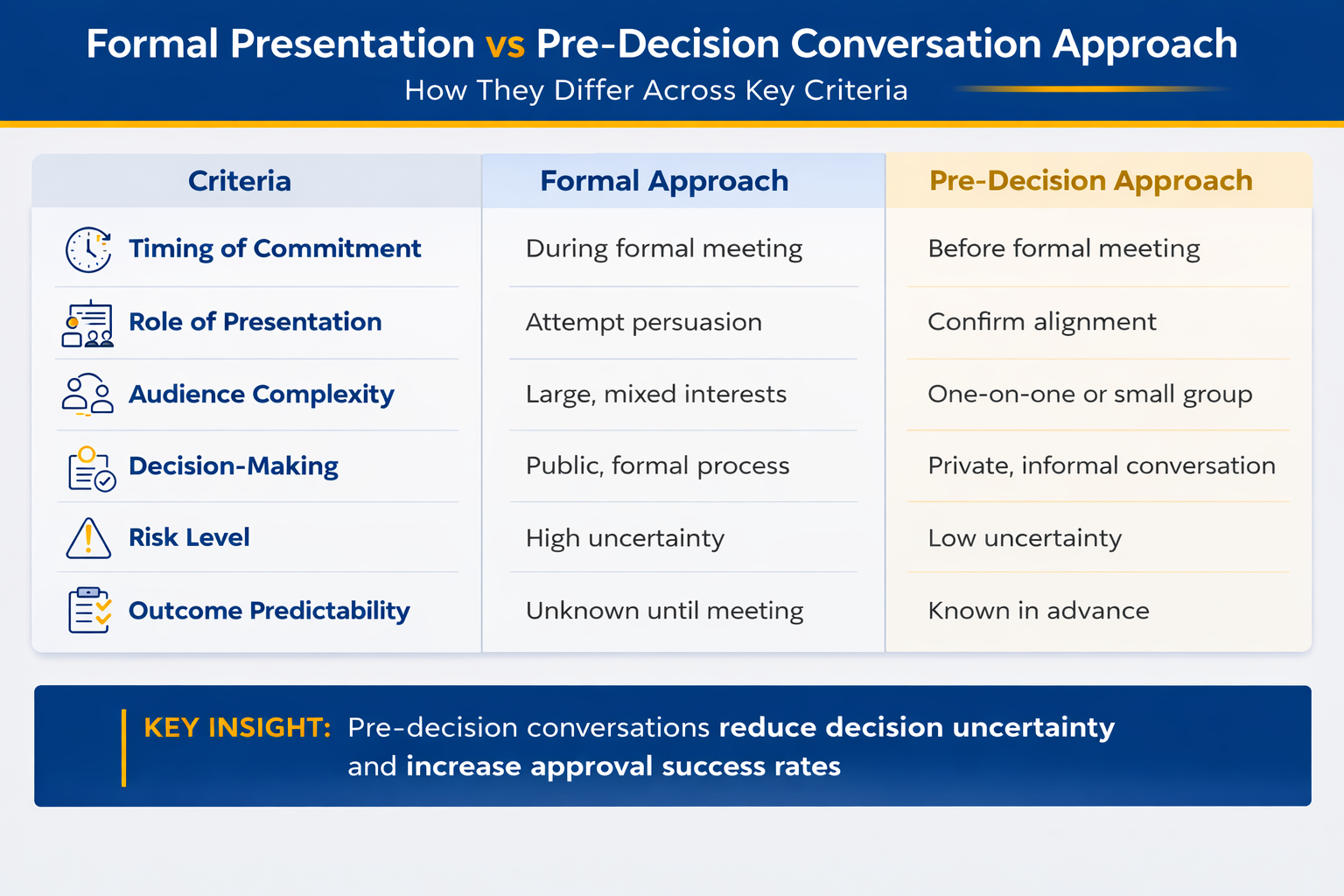
Comparison matrix infographic contrasting formal presentation approach versus pre-decision conversation approach across six criteria including timing, format, objective, decision dynamics, success rate, and risk level

The Formal Meeting: Converting Pre-Decision Alignment Into Action

Once you have had a pre-decision conversation and secured at least soft alignment, the formal meeting becomes a different exercise. You are no longer pitching for a decision. You are confirming one and addressing secondary concerns.

This changes everything about how you present. Your opening is no longer a pitch. It is a recap of the conversation: “In our discussions this week, it became clear that your main priority is implementing this with minimal disruption to current operations. The proposal I’m presenting has that as its core structure. Here’s how.” You are reminding them of the conversation they had with you and showing them that you listened.

Your presentation is shorter. You have already covered the main questions and objections. The formal meeting can focus on addressing the secondary concerns and handling questions from the broader audience that weren’t present in the pre-conversation.

Your close is not a call to action. It is a recap and next step: “Based on what we’ve discussed, the next step is [specific action]. Are there any questions before we move forward?” This is not a question. It is a transition into action.

Executives who have already committed in the pre-conversation will support your presentation. They will fill in gaps, answer peer questions, and smooth the path to final approval. You have made them your champion because you listened to them before anyone else did.

The Formal Meeting Playbook

Once you have secured pre-decision alignment, the formal meeting structure is fundamentally different. Get the exact template for opening, body, and close that converts confirmed decisions into final approvals.

Get the Templates → £39

Is This Right for You?

This is for you if:

  • You’re seeking formal approval from a decision-maker or committee for something that matters (budget, programme, initiative, hire)
  • You have identified the key decision-maker but haven’t had a one-on-one conversation with them about your proposal
  • You’ve had approval meetings that went sideways despite strong slides, or that resulted in unexpected objections you could have addressed
  • You want to shift from hoping your presentation persuades them to knowing you have alignment before you walk in the room

This is NOT for you if:

  • You’re presenting to a wide, unfamiliar audience where one-on-one conversations aren’t practical (company town hall, public conference)
  • The decision is genuinely distributed across a large committee with no clear champion
  • The decision-maker has explicitly asked not to be contacted before the formal meeting (respect that boundary)
  • You haven’t yet built enough relationship credibility for a pre-meeting conversation to feel natural

After the Green Light: Managing the Handover

A pre-decision conversation secures alignment. The formal meeting confirms it. But many approvals still fail at the handover — the moment between formal approval and actual implementation.

This is where discipline matters. After the formal meeting, send a one-page summary within 24 hours. Not a full recap. A single page covering: the approval, the next step, the timeline, and who is responsible for what. This document serves two purposes: it confirms what was actually agreed (no room for interpretation later), and it signals professionalism and follow-through.

Then schedule a brief follow-up conversation with the key decision-maker — not another formal meeting, just a check-in. “I wanted to confirm we’re aligned on the timeline. Implementation starts [date]. Is there anything you want to flag or discuss before we move into execution?” This catches scope creep or shifting priorities before they become problems.

Finally, keep them informed as implementation begins. Monthly updates, not because they asked for them, but because it shows respect for their decision and their time. Executives who feel kept informed are executives who continue to support the approval even when implementation gets messy.

Built From 24 Years of High-Stakes Approval Conversations in Banking. Now a Framework You Can Use.

I spent two decades in corporate banking securing approvals for multi-million-pound initiatives, vendor switches, and programme expansions. The difference between approvals that sailed through and those that got blocked was almost never the slides. It was whether the key decision-maker had already made up their mind before the formal meeting. The pre-decision conversation is where that happens. The Executive Slide System gives you the exact framework.

  • 22 executive templates including budget request, programme approval, and stakeholder alignment formats
  • Word-for-word scripts for three pre-decision conversation scenarios — finance approval, governance, and executive alignment
  • The post-approval handover checklist that ensures agreement doesn’t slip during implementation
  • 51 AI prompts to prepare for your pre-conversation, including research, objection-handling, and follow-up frameworks

Your approval meeting has a date. The decision-maker’s mind may already be made, or it may still be open. Find out before you present.

Get the Executive Slide System → £39

Trained thousands of executives in high-stakes presentations across banking, consulting, and technology. Immediate digital download. Used in budget approvals, board presentations, and governance meetings.

Frequently Asked Questions

How do you initiate a pre-decision conversation without appearing to lobby or influence the decision before the formal process?

Frame it as clarification, not persuasion. The language matters enormously. Use: “I’d like to understand your specific priorities before I present,” not “I want to get your buy-in early.” Use: “I’m making sure I address your concerns rather than guess at them,” not “I want to align with you before the meeting.” The intent is genuine — you are seeking to understand, not to manipulate. If your language matches that genuine intent, the conversation feels natural and professional. Senior executives talk one-on-one with peers and stakeholders all the time. This is exactly that.

What if a decision-maker agrees in the pre-conversation but the broader committee challenges them in the formal meeting?

This is one of the reasons the pre-conversation is so valuable. The person who has already committed to you will tend to defend your proposal in the room because they’ve already staked their credibility on it. If they face unexpected objections, they have usually had time to think through counterarguments. If they were only softly aligned, the committee pushback will reveal that you don’t actually have agreement yet — which is far better to learn in a pre-conversation than in a public meeting. If this happens, treat it as intelligence: you need to address a real concern before the formal meeting.

Is a pre-decision conversation different for budget approvals versus programme approvals versus stakeholder alignment?

The framework is the same (positioning, intelligence-gathering, soft commitment), but the questions change. For budget approvals, focus on cost impact, ROI, and trade-offs. For programme approvals, focus on risk, resourcing, and timeline. For stakeholder alignment, focus on their specific department’s impact and dependencies. The structure stays consistent; the content adapts to what that person actually cares about.

What happens if you don’t have a direct relationship with the decision-maker? How do you initiate the conversation then?

Use a warm introduction. Ask your sponsor or the person who invited you to the formal meeting to facilitate an introduction: “I’d appreciate if you could introduce me to [decision-maker]. I’d like a 20-minute call to understand what they’re most focused on before I present.” This makes the conversation feel less like cold outreach and more like a natural part of the process. If a warm introduction isn’t possible, reach out briefly and directly: “I’m presenting a proposal in your area next Tuesday. Would you have 20 minutes this week for a quick call? I’d like to make sure I’m addressing your specific priorities.” Be honest about why you’re reaching out. Honesty builds trust.

The Winning Edge — Executive Presentation Insights

Weekly strategies for executives who present at board level, secure approvals, and navigate high-stakes decisions. Practical frameworks from 24 years in the room, not theory.

Subscribe Free →

🎁 Free resource: Executive Presentation Checklist — the pre-meeting audit framework for approval presentations. Free download, no email required.

Also published today:

Your next approval meeting is already on the calendar. You will walk into that room with either the advantage of having already secured alignment, or the disadvantage of hoping your presentation convinces them.

The difference is a single 20-minute conversation that happens days before the formal meeting. Use the Executive Slide System (£39) to structure that conversation. It includes the exact scripts for initiating the call, the questions that reveal what they actually care about, and the follow-up approach that converts informal alignment into formal approval.

For further reading on executive alignment and approval strategy: Pre-Meeting Executive Alignment: The Strategy That Determines Outcomes, The Decision Slide: The One Slide That Matters in Executive Presentations, and Building Executive Buy-In: From First Contact to Final Approval.

About the Author

Mary Beth Hazeldine is the Owner & Managing Director of Winning Presentations. With 24 years of corporate banking experience at JPMorgan Chase, PwC, Royal Bank of Scotland, and Commerzbank, she has delivered high-stakes presentations in boardrooms across three continents.

A qualified clinical hypnotherapist and NLP practitioner, Mary Beth combines executive communication expertise with evidence-based techniques for managing presentation anxiety. She has trained thousands of executives and supported presentations that have secured high-stakes funding rounds and approvals.

Book a discovery call | View services

24 Feb 2026
Executive sitting alone in empty boardroom after meeting ended without a decision, presentation screen still visible behind him, empty chairs on both sides

They Didn’t Say No. They Just Didn’t Say Yes. Here’s How to Re-Present So They Can’t Defer Again.

Quick Answer: A non-decision — “let’s revisit this,” “we need more detail,” “interesting, let’s circle back” — is worse than a rejection. Rejections give you feedback. Non-decisions give you nothing. Re-presenting after a non-decision requires diagnosing why the room deferred (unclear ask, missing urgency, or political uncertainty), then restructuring specifically to close that gap. The key structural change: remove the comfortable middle ground where “defer” lives. Give the room a binary choice with a real-world deadline.

A colleague at Commerzbank presented a technology investment to the executive committee. The proposal was sound: £180K spend, September delivery, clear ROI. He’d prepared for weeks.

The room listened. Nobody objected. The CFO said “interesting approach.” The COO said “let’s make sure we’ve considered all the angles.” The meeting ended.

No decision. No follow-up. No calendar invite for a next discussion.

He presented the same proposal again six weeks later with minor cosmetic changes — updated timeline, refreshed data, slightly different formatting. Same result. “Good work. Let’s revisit when we have the Q3 numbers.”

The third time, I helped him restructure. We changed one fundamental thing: we removed the option to defer. Instead of “we recommend Option A,” we presented “Option A costs £180K and delivers in September. Option B is doing nothing, which costs £45K per month in manual processing and delays the regulatory deadline by four months.”

The room decided in five minutes.

The data hadn’t changed. The analysis was identical. What changed was the structure — specifically, the elimination of the comfortable middle ground where non-decisions live.

🚨 Re-presenting a deferred proposal this fortnight? Quick check: Does your deck include a slide quantifying the cost of NOT deciding? If the room can defer without consequence, they will. → Need the exact re-presentation structure? Get the Executive Slide System → £39

Why a Non-Decision Is Worse Than ‘No’

When someone says “no” to your proposal, you get three valuable things: a clear outcome, a reason (even if vague), and permission to either move on or address the objection.

When someone says “let’s revisit,” you get nothing. You don’t know what was wrong. You don’t know what would make it right. You don’t know whether the problem is your proposal, your structure, the timing, or the politics. And you can’t move on — because the proposal is technically still alive. It’s in a kind of organisational purgatory where it’s not approved, not rejected, just… suspended.

In 24 years of corporate banking, I watched non-decisions kill more careers than bad decisions. Because bad decisions are visible — you can learn from them, you can recover, you can point to what you’d do differently. Non-decisions are invisible. Your proposal sits in limbo. Your credibility slowly erodes as people associate you with the thing that never happened. And the opportunity cost compounds — every week of deferral is a week the problem you identified goes unsolved.

This is why re-presenting after a non-decision requires a fundamentally different approach than presenting the first time. You’re not starting from zero. You’re starting from worse than zero — because the room has already demonstrated they can defer your proposal without consequence.

The 3 Reasons Presentations End Without a Decision

What do you do when executives won’t make a decision?

Before you restructure anything, you need to diagnose why the first presentation was deferred. In my experience, non-decisions happen for exactly three reasons — and the fix is different for each.

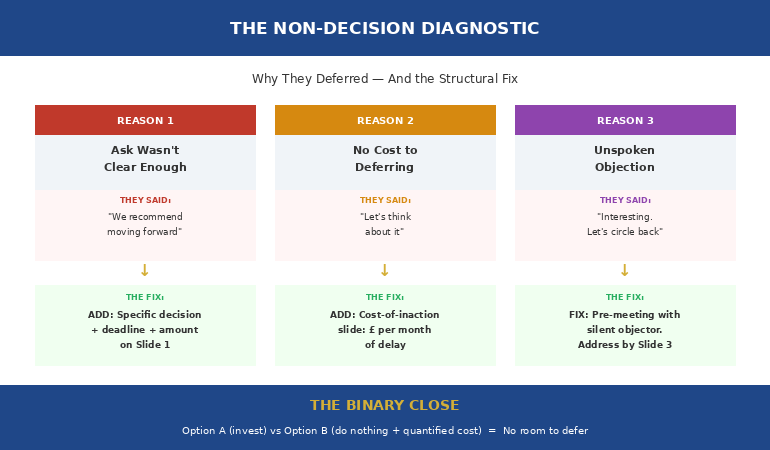
Reason 1: The ask wasn’t clear enough. This is the most common and the most fixable. If your final slide said something like “We recommend moving forward with the proposed solution,” you didn’t make an ask — you made a suggestion. Suggestions are easy to defer. Asks are harder. “I need this committee to approve £180K by March 7th” is an ask. The difference between the two is the difference between a decision and a deferral.

Reason 2: There was no cost to deferring. If the room can say “let’s think about it” without any consequence, they will — because deferral is the lowest-risk option for everyone in the room. Nobody gets blamed for a decision that was never made. Your re-presentation needs to make deferral expensive: “Every month we delay costs £45K in manual processing.” Now the room can’t defer without accepting that cost.

Reason 3: Someone in the room had an unspoken objection. This is the political one. The CFO who said “interesting approach” actually meant “I’m not sure about this but I’m not going to say so in a room of twelve people.” You need to find this person before the re-presentation and have a one-on-one conversation. Not to persuade them — to understand their objection so you can address it in the deck.

The best presenters — the ones who present like CEOs — diagnose the non-decision before they restructure anything. Because cosmetic changes to a structurally flawed presentation produce structurally identical results.

The Non-Decision Diagnostic showing three reasons presentations end without approval — unclear ask, no cost to deferring, unspoken objection — with the structural fix for each

⭐ Re-Present and Get the Decision This Time — Not Another Deferral

The Executive Slide System includes Scenario 14: “Re-presenting After a Non-Decision” — a step-by-step playbook that diagnoses why your first attempt was deferred and gives you the exact structure to close the gap.

Your re-presentation toolkit:

  • Strategic Recommendation template (Card 04) — decision architecture that forces yes-or-no outcomes
  • Executive Summary template (Card 01) — restructured for re-presentation with “what changed” framing
  • AI prompt: “I presented this and received no decision. The room said [exact words]. Restructure to force a yes-or-no outcome”
  • The 15-minute version for when the re-presentation is tomorrow

Get the Executive Slide System → £39

Built from 24 years in corporate banking. The same structure that turned a 3-time deferral into a 5-minute decision at Commerzbank.

The Non-Decision Diagnostic: What Went Wrong in Your First Attempt

Before you change a single slide, answer these four questions. They’ll tell you exactly what to fix.

1. “What were the exact words used when the meeting ended?” Write them down. “Let’s revisit” is different from “we need more detail,” which is different from “interesting, let’s circle back.” Each phrase signals a different problem. “Need more detail” means your evidence was thin. “Let’s revisit” often means the timing or urgency wasn’t established. “Interesting” with no follow-up usually means an unspoken political objection.

2. “Was the specific decision clear on the final slide?” Pull up your original deck. Look at your last content slide. Does it say “Recommendation” (vague) or “Decision Required: Approve £180K by March 7” (specific)? If the decision wasn’t explicit, the room had nothing concrete to approve. This is the single most common cause of non-decisions.

3. “Was there a cost of deferral on any slide?” If not, you gave the room permission to wait. Every re-presentation needs a “cost of inaction” slide — quantified, specific, and time-bound. Not “we risk falling behind.” That’s a warning. “£45K per month in manual processing, starting immediately” — that’s a cost.

4. “Who in the room was silent?” Silence in an executive meeting almost never means agreement. It means someone has a concern they didn’t voice. Before you re-present, have a one-on-one with that person. Ask: “What would need to be different for you to support this?” Their answer is the single most important input for your restructure.

How to Restructure for the Re-Presentation

How do you re-present a proposal that was deferred?

Don’t present the same deck with updated data. That tells the room “nothing has changed” — which means their non-decision was the right call. Instead, restructure around the specific gap the diagnostic revealed.

If the ask wasn’t clear: Rebuild the decision slide from scratch. State the decision required in one sentence on your first slide. Include the date by which you need the decision and the reason for that date. “I’m requesting approval for £180K by March 7 because the vendor contract expires March 14.” The room can’t defer when there’s a hard deadline attached to a specific financial consequence.

If there was no cost to deferring: Add a “cost of inaction” slide immediately after your recommendation. This slide has one job: make deferral expensive. “Each month of delay costs £45K in manual workarounds. Since the first presentation 6 weeks ago, the cost of inaction has been £67.5K.” That number — the cost that accumulated while they deferred — is your most powerful slide.

If someone had an unspoken objection: Address their specific concern by slide 3 — before they raise it. If the CFO was worried about ROI assumptions, build a sensitivity analysis showing the proposal works even under pessimistic assumptions. If the COO had concerns about implementation risk, add a risk mitigation slide with specific contingencies. The goal is to resolve the objection in the presentation rather than in the room.

Important: don’t acknowledge the first presentation failed. Never open with “As you’ll recall, we discussed this previously and…” That frames the re-presentation as a retry. Instead, open with what’s changed since the last discussion — even if what’s changed is your structure, not your data. “Since our last discussion, I’ve quantified the cost of the current approach and identified the implementation risks. Here’s the updated recommendation.”

The Executive Slide System’s Scenario 14 walks you through this exact diagnosis-and-restructure process. It tells you which template to open, which AI prompt to run, and includes a specific prompt for non-decision recovery: “I presented this and received no decision. Restructure to force a yes-or-no outcome.” Get the Executive Slide System → £39.

The Binary Close: Removing the ‘Defer’ Option

This is the structural change that turned my Commerzbank colleague’s three-time deferral into a five-minute decision. I call it the Binary Close — and it’s the single most effective technique for re-presenting after a non-decision.

Most presentations end with a recommendation: “We recommend Option A.” This feels decisive. It isn’t. Because the room has three responses available: yes, no, or defer. And defer is always the easiest choice.

The Binary Close eliminates the middle option by presenting exactly two paths with fully quantified consequences:

Path A (your recommendation): “Invest £180K. Delivered September. Regulatory deadline met. Annual savings of £540K starting Year 2.”

Path B (doing nothing): “Zero investment. Current manual process continues at £45K/month. Regulatory deadline missed by 4 months. Estimated non-compliance cost: £320K.”

There’s no Path C. No “let’s think about it” option. No “defer for more information.” The room is choosing between two specific, quantified futures — and one of them is clearly worse than the other.

This works because it reframes the decision. Instead of “should we invest?” (which can always be deferred), it becomes “which cost do we accept?” — and accepting the cost of inaction feels increasingly irrational when it’s quantified on the slide in front of them.

Why do executives say ‘let’s revisit’ instead of deciding?

Because deferral is the safest option for every individual in the room. Nobody gets blamed for a decision that wasn’t made. The Binary Close makes deferral unsafe by quantifying its cost. When “let’s revisit” comes with a price tag — “every month we defer costs £45K” — the room’s calculus changes. Deciding becomes less risky than not deciding. That’s the structural shift you need.

⭐ Stop Getting ‘Let’s Revisit’ and Start Getting Decisions

Non-decisions are the silent killer of proposals, projects, and careers. The Executive Slide System gives you the decision architecture that eliminates the comfortable middle ground where deferrals live.

Your non-decision recovery deliverables:

  • Non-decision recovery slide — “what changed since last time” framing that avoids looking like a retry
  • Binary options slide template — costed consequences of approval vs delay, side by side
  • Decision wording prompts that force a yes-or-no outcome (no room for “let’s revisit”)
  • Cost-of-inaction slide — quantified per-month delay cost that makes deferral expensive

Get the Executive Slide System → £39

Built from executive committee meetings where proposals stalled — the same decision architecture that turned a 3-month deferral into a 5-minute approval at Commerzbank.

The Pre-Meeting That Makes the Re-Presentation a Formality

The most effective re-presentations are decided before the meeting starts.

After the diagnostic — once you know why the first presentation was deferred — have individual conversations with two people: the decision-maker and the silent objector (if you’ve identified one).

The decision-maker conversation: “I’m re-presenting the technology investment on Thursday. Since our last discussion, I’ve quantified the cost of the current approach — it’s £45K per month. I want to make sure I’m addressing your priorities. Is there anything specific you’d want to see before making a decision?”

This conversation does three things. It signals you’ve done additional work (not just re-presenting the same deck). It anchors the cost of inaction before the meeting. And it gives them a preview, which means they arrive at the meeting having already mentally processed the decision.

The silent objector conversation: “I noticed we didn’t hear from everyone last time. I’m planning to address implementation risk and the ROI assumptions in the updated proposal. Would you be willing to take a look beforehand?” This is harder but more important. You’re giving them a way to raise their objection privately — which means they don’t need to raise it publicly in the meeting.

If both conversations go well, the re-presentation becomes a formality. The decision-maker already knows the answer. The objector’s concern is already addressed. The meeting exists to formalise what’s been agreed, not to deliberate.

The Executive Slide System includes the Strategic Recommendation template (Card 04) — the same decision architecture that turned a 3-time deferral into a 5-minute approval. The matched AI prompt helps you restructure specifically for binary-choice framing.

If the anxiety of re-presenting — of walking back into a room that already deferred you once — is a concern, the structural approach helps. When you’ve diagnosed the gap, had the pre-meetings, and built the Binary Close, you walk in knowing the decision is largely made. Uncertainty drives most presentation anxiety. Structure eliminates uncertainty.

Is This Right For You?

✓ This is for you if:

  • You presented a proposal and it was deferred — “let’s revisit,” “need more detail,” “interesting”
  • You need to re-present and can’t afford another deferral
  • You want a structure that forces a binary yes/no decision, not another discussion

✗ This is NOT for you if:

  • Your proposal was explicitly rejected with clear feedback (see how to present after a rejection)
  • You’re presenting a new proposal for the first time (the standard decision slide structure is sufficient)

⭐ The Same Structure That Ended 3 Months of Deferral in 5 Minutes

Non-decisions killed more proposals in my 24 years of banking than bad data ever did. The Executive Slide System is the structural fix — decision architecture, binary-close framing, and scenario-specific playbooks that eliminate the “defer” option from the room.

Inside:

  • 22 executive slide templates — including Strategic Recommendation and Executive Summary
  • 51 AI prompts — including the non-decision recovery prompt: “Restructure to force a yes-or-no outcome”
  • 15 scenario playbooks — Scenario 14 covers re-presenting after a non-decision step by step
  • 6 checklists covering structure, decision readiness, and the Binary Close

Get the Executive Slide System → £39

Instant download. 30-day money-back guarantee. Used by directors, programme leads, and consultants who can’t afford another deferral.

Frequently Asked Questions

How long should I wait before re-presenting?

As short as possible — but only after you’ve done the diagnostic and had the pre-meetings. Waiting weeks or months doesn’t improve your proposal. It increases the cost of inaction and lets momentum die. The ideal timeline: complete the Non-Decision Diagnostic within 48 hours, have pre-meeting conversations within a week, and re-present within two weeks of the original meeting. If you wait longer than a month, the proposal loses urgency and you’ll need to rebuild the business case from scratch.

Should I change the content or just the structure?

Structure first. In most non-decision cases, the data is fine — the room understood your analysis. What they didn’t have was a clear decision mechanism: a specific ask, a deadline, and a quantified cost of deferral. Start by restructuring around the Binary Close (two paths, fully quantified). Only change the content if the diagnostic reveals the evidence was genuinely thin or an objection needs new data to address.

What if the non-decision was political, not structural?

Then the fix is the pre-meeting, not the deck. If the deferral happened because someone in the room had an unspoken objection, no amount of slide restructuring will fix it. You need to identify that person, understand their concern, and address it before you re-present. The deck change is secondary: add their specific concern to your risk or trade-off analysis so it’s visibly addressed. But the real work happens in the corridor conversation, not in PowerPoint.

How do I prevent deferrals in future presentations?

Three structural habits. First, always include a specific decision with a deadline on your final slide — “I need this committee to approve X by Y date.” Second, always include a cost-of-inaction slide — quantify what happens if the room doesn’t decide. Third, always have a pre-meeting with the decision-maker before any high-stakes presentation. If they know the ask before the meeting, the meeting becomes a formality, not a debate. These three habits eliminate most non-decisions before they happen.

📬 The Winning Edge — Weekly Newsletter

One executive presentation insight per week. Real boardroom scenarios, structural fixes, and the decision-first frameworks that get approvals — not deferrals.

Subscribe Free →

Related: The decision slide is where most non-decisions originate. Read The Decision Slide That Gets ‘Yes’ in 60 Seconds — the structure that prevents deferrals from happening in the first place.

Your deferred proposal is still sitting in someone’s inbox. The cost of inaction is compounding. Get the structure that makes “let’s revisit” impossible — and walk out with the decision this time.

About the Author

Mary Beth Hazeldine is the Owner & Managing Director of Winning Presentations. With 24 years of corporate banking experience at JPMorgan Chase, PwC, Royal Bank of Scotland, and Commerzbank, she has delivered high-stakes presentations in boardrooms across three continents.

A qualified clinical hypnotherapist and NLP practitioner, Mary Beth combines executive communication expertise with evidence-based techniques for managing presentation anxiety. She has trained thousands of executives and supported presentations for high-stakes funding rounds and approvals.

Read more articles at winningpresentations.com

12 Feb 2026
Executive presenting headcount request to leadership team with approval indicators

The Headcount Request That Got Yes When Everyone Said No

“We’re in a hiring freeze. The answer is no.”

That’s what my client heard when she mentioned her headcount request to her CFO in the corridor. The company had just announced a 15% budget reduction. Every department was being told to do more with less. And Sarah needed 12 new engineers to deliver a project the CEO had personally championed.

Two weeks later, she got all 12 approved.

Not because she had special connections. Not because the freeze was lifted. But because her presentation made it impossible to say no — by making the cost of “no” crystal clear.

I’m sharing this now because headcount requests in 2026 face unprecedented scrutiny. AI is reshaping workforce planning, budgets are tight, and executives are asking harder questions about every hire. The old approach — “we need more people because we’re busy” — doesn’t work anymore. What works is a business case so compelling that approval becomes the obvious choice.

Quick answer: Successful headcount requests don’t ask for people — they present a business case for outcomes. The structure that works: lead with the business problem (not the resource gap), quantify the cost of inaction, present headcount as the solution to a problem leadership already cares about, and pre-answer the objections before they’re raised. This approach gets approval even during hiring freezes because it reframes the request from “cost” to “investment with measurable return.”

I’ve helped executives request headcount in every economic condition — boom times when money flowed freely, and downturns when every hire required CEO approval. The pattern is consistent: the requests that get approved aren’t the ones with the best justification. They’re the ones with the best presentation.

Sarah’s situation was typical. She had a genuine need — her team was working 60-hour weeks, attrition was climbing, and the CEO’s pet project was at risk. But her first draft presentation was also typical: a list of reasons why she needed more people, supported by workload data and burnout statistics.

It would have failed. Here’s why — and what we changed.

Why Most Headcount Requests Fail

The fundamental mistake in headcount presentations is starting with the resource gap. “We need 12 more engineers because…” immediately puts leadership in defence mode. They hear “cost” before they hear “value.”

The Psychology of No

When executives hear a headcount request, three mental processes activate simultaneously:

Budget protection: “Where will this money come from? What else won’t get funded?”

Precedent fear: “If I approve this, what other requests will follow?”

Accountability anxiety: “If this hire doesn’t work out, it’s my signature on the approval.”

Your presentation has to address all three — before they become objections.

The “Busy” Trap

The most common headcount justification is also the weakest: “We’re too busy.” Every department is busy. Every manager feels understaffed. “Busy” doesn’t differentiate your request — it makes you sound like everyone else who’s asking.

What executives actually need to hear: not that you’re busy, but that specific business outcomes are at risk without additional resources. That’s a completely different conversation.

🎯 Executive Slide System — Headcount Request Templates Included

Stop building headcount presentations from scratch. The Executive Slide System includes ready-to-use templates for resource requests, budget approvals, and business cases — all structured to get executive buy-in.

  • Business case structure that leads with outcomes
  • ROI calculation frameworks executives trust
  • Objection pre-answer templates
  • Decision slide formats that drive approval

Get the Executive Slide System → £39

Instant download. Used in headcount requests that have secured hundreds of new hires across banking and consulting environments.

The 5-Slide Structure That Gets Yes

Here’s the exact structure Sarah used to get 12 engineers approved during a hiring freeze:

Slide 1: The Business Problem (Not the Resource Gap)

Don’t open with “We need more people.” Open with the business problem that leadership already cares about.

Sarah’s opening: “Project Phoenix — the CEO’s priority initiative — is at risk of missing its Q3 deadline. Current trajectory shows a 67% probability of 8-week delay, which would push launch past the competitor window.”

Notice what’s not mentioned: headcount, engineers, workload, burnout. The first slide is entirely about business impact. Leadership is now thinking about Project Phoenix, not about budget.

Slide 2: The Cost of Inaction

Before you present your solution, make the cost of doing nothing undeniable.

Sarah’s slide: “An 8-week delay costs £2.4M in delayed revenue, puts the Series B timeline at risk, and allows CompetitorX to establish market position. Additionally, current team attrition trajectory suggests we lose 3 senior engineers in the next 90 days — each representing £180K in replacement and ramp-up costs.”

This slide does the heavy lifting. When the cost of inaction is £2.4M+, the cost of 12 engineers looks like a bargain.

Slide 3: The Solution (Now You Can Mention Headcount)

Only after establishing the problem and the cost of inaction do you present headcount as the solution.

Sarah’s framing: “To deliver Phoenix on schedule and protect the £2.4M revenue, we need to add 12 engineers over the next 6 weeks. This represents a £840K annual investment that protects £2.4M in near-term revenue and establishes the team capacity for the 2027 roadmap.”

The headcount request is now positioned as a solution to a problem leadership wants solved — not as a cost to be minimised.

Slide 4: The Risk Mitigation

Address the “what if it doesn’t work” fear before it’s voiced.

Sarah included:

  • Hiring timeline: Specific milestones with contingency plans
  • Ramp-up plan: How new hires become productive (with timeline)
  • Success metrics: How leadership will know the investment is working
  • Exit ramp: What happens if business conditions change

This slide removes the “what if” anxiety that kills approvals.

Slide 5: The Decision

End with a clear, specific ask — not a vague request for “support.”

Sarah’s close: “I’m requesting approval to open 12 engineering requisitions immediately, with a £840K annual budget allocation. This protects £2.4M in Phoenix revenue and positions us for the 2027 roadmap. I need your decision by Friday to maintain the hiring timeline.”

Clear ask. Clear timeline. Clear next step.


5-slide headcount request structure showing business case framework for approval

Want this structure as a ready-to-use template? The Executive Slide System includes the complete headcount request framework — plus decision slides, ROI calculators, and objection pre-answers.

Get the Templates → £39

Making the Numbers Undeniable

The difference between headcount requests that get approved and those that get “let’s revisit next quarter” often comes down to how the numbers are presented.

The ROI Frame

Never present headcount as a cost. Always present it as an investment with measurable return.

Weak: “12 engineers will cost £840K annually.”

Strong: “A £840K investment protects £2.4M in revenue and enables £4.2M in 2027 roadmap delivery. ROI: 7.9x in year one.”

The numbers are the same. The frame is completely different.

The Comparison Anchor

Give leadership a reference point that makes your request seem reasonable.

Sarah’s anchor: “The cost of 12 engineers (£840K) is less than the cost of the 8-week delay (£2.4M), less than the cost of losing 3 senior engineers to attrition (£540K in replacement costs), and less than the consulting alternative (£1.2M for equivalent capacity).”

When you anchor against worse alternatives, your request becomes the sensible middle ground.

The Staged Approach

If your full request feels too large, offer a staged alternative that gets you started.

Sarah’s backup: “If 12 immediate hires isn’t possible, a phased approach of 6 now and 6 in Q2 still protects the Phoenix timeline, though with reduced margin for error.”

This shows flexibility while maintaining the business case. Leadership often approves the full request when they see you’ve thought through alternatives.

📊 Build Business Cases That Get Approved

The Executive Slide System gives you the frameworks for any approval presentation — headcount, budget, project investment, or strategic initiative. Stop guessing what executives want to see.

  • Cost-of-inaction calculation templates
  • ROI presentation frameworks
  • Risk mitigation slide structures
  • Decision slide formats that drive action

Get the Executive Slide System → £39

Instant download. Developed from 24 years of corporate banking presentations where every resource request faced intense scrutiny.

Pre-Answering the Objections

The best headcount presentations answer objections before they’re raised. Here are the five you’ll face — and how to address them in your slides:

Objection 1: “Can’t you do more with AI/automation?”

Pre-answer: Include a slide on what you’ve already automated and why the remaining work requires human judgment. “We’ve automated 40% of routine tasks. The remaining work — architecture decisions, client relationships, complex problem-solving — requires experienced engineers.”

Objection 2: “What about contractors instead of FTEs?”

Pre-answer: Show the total cost comparison including ramp-up time, knowledge retention, and long-term flexibility. Contractors often cost more when you factor in everything.

Objection 3: “Can you reprioritise instead?”

Pre-answer: Show what gets cut if you don’t add headcount — and the business impact of those cuts. Make leadership choose between options, not between “yes” and “no.”

Objection 4: “What if the project gets cancelled?”

Pre-answer: Show how the roles support multiple initiatives, not just one project. “These 12 engineers support Phoenix, but also provide capacity for the 2027 roadmap and reduce our single-point-of-failure risk on critical systems.”

Objection 5: “Why now? Can’t it wait?”

Pre-answer: Show the cost of delay. “Every month we wait adds £300K to the eventual cost (higher salaries in a tighter market, extended project timeline, continued attrition of current team).”

Handling the Tough Q&A

Even with perfect slides, headcount requests face intense questioning. Here’s how to handle the moments that determine approval:

When They Challenge Your Numbers

Don’t get defensive. Show your work.

“The £2.4M delay cost comes from three factors: £1.8M in delayed subscription revenue based on current pipeline, £400K in additional contractor costs to extend the bridge period, and £200K in opportunity cost from the sales team’s reduced confidence in our delivery timeline. I can walk through each calculation.”

When They Ask for Less

Don’t immediately agree. Show the trade-offs.

“I can work with 8 instead of 12, but I want to be transparent about what that means: we move from 95% confidence on the Q3 deadline to about 70%, and we lose the buffer for the inevitable surprises. If 8 is the decision, I’ll make it work — but I want leadership to understand the risk we’re accepting.”

When They Want to Delay the Decision

Make the cost of delay concrete.

“I understand the desire for more time. But every week we delay the hiring process adds roughly 2 weeks to the project timeline, because good candidates don’t stay on the market. If we decide Friday, we can still hit Q3. If we wait until end of month, Q3 becomes unlikely.”

Facing tough Q&A on your headcount request? The Executive Q&A Handling System gives you frameworks for handling challenges, pushback, and curveball questions with confidence.

Get the Q&A System → £39

What Happened to Sarah

Sarah presented to the CFO, COO, and CEO on a Thursday morning. The same CFO who had said “the answer is no” in the corridor.

The presentation took 12 minutes. The Q&A took 20. Most of the questions were about implementation details — a sign that approval was likely.

By Friday afternoon, she had written approval for all 12 positions.

The CFO told her afterwards: “I’ve seen a hundred headcount requests this year. Yours was the only one that made me feel like saying no would cost us money.”

That’s the reframe that changes everything. Not “please give me resources” but “here’s what you lose if you don’t.”

🎯 Get Your Headcount Approved

The Executive Slide System includes everything you need to build a headcount presentation that gets yes:

  • Business case templates: Lead with outcomes, not resource gaps
  • Cost-of-inaction frameworks: Make “no” more expensive than “yes”
  • ROI calculators: Present investment, not cost
  • Objection pre-answers: Address concerns before they’re raised
  • Decision slides: Clear asks that drive approval

Get the Executive Slide System → £39

Instant download. The same frameworks used in headcount requests that have secured hundreds of new hires — even during hiring freezes.

📬 PS: Weekly strategies for executive presentations and getting buy-in. Subscribe to The Winning Edge — practical techniques from 24 years in corporate boardrooms.

Frequently Asked Questions

What if my company has a strict hiring freeze with no exceptions?

Even “no exceptions” freezes have exceptions — they just require CEO-level approval and an exceptional business case. Use the cost-of-inaction framework to show that the freeze is costing more than the hire. If the numbers are compelling enough, freezes get unfrozen. If they’re not, at least you’ve positioned yourself for first approval when the freeze lifts.

How do I request headcount when I can’t quantify the revenue impact?

Focus on risk and cost avoidance instead of revenue. “Without this hire, we have single-point-of-failure risk on a critical system” or “Current overtime costs are £X per month and climbing” or “Attrition risk in the current team represents £Y in replacement costs.” Not everything ties to revenue, but everything ties to something leadership cares about.

Should I ask for more than I need, expecting to be negotiated down?

No. Ask for exactly what you need with clear justification. Padding your request damages credibility and invites the “let’s cut this by 30%” response. If you need 12, ask for 12 and show why 12 is the right number. You can offer a phased alternative, but don’t inflate the initial ask.

How long should a headcount presentation be?

Five to seven slides maximum for the core presentation. You can have backup slides for detailed questions, but the main narrative should be completable in 10-15 minutes. Executives make headcount decisions quickly when the business case is clear — long presentations signal unclear thinking.

Related: If past presentation failures are affecting your confidence in high-stakes requests like headcount approvals, read Presentation PTSD Is Real: Signs You’re Still Carrying an Old Failure for techniques to break the pattern.

Sarah’s CFO was right about one thing: during a hiring freeze, the default answer is no.

But defaults can be overridden — when the cost of “no” is higher than the cost of “yes.”

Your headcount request isn’t about getting resources. It’s about presenting a business case so compelling that approval becomes the obvious choice.

Lead with the problem. Quantify the cost of inaction. Position headcount as the solution. Pre-answer the objections. Ask for a clear decision.

That’s how you get yes when everyone else is hearing no.

About the Author

Mary Beth Hazeldine is the Owner & Managing Director of Winning Presentations. With 24 years in corporate banking at JPMorgan Chase, PwC, Royal Bank of Scotland, and Commerzbank, she has supported hundreds of resource requests, budget approvals, and headcount presentations in high-scrutiny environments.

A certified hypnotherapist and NLP practitioner, Mary Beth combines executive communication expertise with an understanding of the psychology behind approval decisions. She helps professionals build business cases that get yes — even when the default answer is no.

Book a discovery call | View services

02 Feb 2026
Two executives in private one-on-one meeting discussing presentation champion strategy and stakeholder buy-in

The Champion Strategy: How to Get Someone Fighting FOR Your Proposal

I watched a brilliant proposal die in 47 minutes.

The presenter had done everything right. Clear recommendation. Solid data. Compelling ROI. She’d rehearsed until her delivery was flawless. The CFO asked two questions, nodded thoughtfully, and said, “Let’s table this for now.”

Afterwards, I asked her: “Who in that room was already fighting for this before you walked in?”

She looked confused. “What do you mean? I was presenting it. I was fighting for it.”

That was the problem.

The most important person for your proposal’s success isn’t you. It’s your champion—the person who fights for your idea when you’re not in the room. Without one, even perfect presentations fail. With one, even mediocre presentations often succeed.

Quick answer: A presentation champion is someone with influence in the decision-making group who advocates for your proposal before, during, and after your presentation. The champion strategy involves identifying the right person, enrolling them in your idea through one-on-one conversations (never in the group meeting), and equipping them to defend your proposal when you’re not present. This approach works because executive decisions rarely happen in presentations—they happen in hallway conversations, pre-meetings, and informal discussions where your champion speaks for you. This article explains how to identify, approach, and activate your champion.

⚡ Presenting This Week? The 15-Minute Champion Check

If you have a presentation coming up and haven’t thought about champions, ask yourself:

  1. Who in the room already wants this to succeed? (Not who should—who actually does?)
  2. Have you talked to them one-on-one? If not, schedule 15 minutes today.
  3. Do they know what objections to expect? Brief them on likely pushback and how to respond.
  4. Can they speak first or second? Champions are most effective when they establish momentum early.

This won’t replace proper champion development, but it dramatically improves your odds. For the complete system, keep reading.

Why Champions Matter More Than Presentation Skills

Here’s an uncomfortable truth I learned after 24 years in corporate banking: executive decisions rarely happen in presentations.

By the time you stand up to present, most decision-makers have already formed opinions. They’ve talked to colleagues. They’ve heard informal assessments. They’ve developed positions based on conversations you weren’t part of.

Your presentation doesn’t create the decision. It confirms or challenges decisions that were already forming.

This is why brilliant presenters with weak proposals sometimes win, while mediocre presenters with strong proposals sometimes lose. The presentation is visible. The pre-work is invisible. And the pre-work usually matters more.

A champion changes this dynamic. When you have someone in the room who’s already committed to your success, they do things you can’t:

  • They advocate for your idea in conversations you’re not invited to
  • They counter objections before they solidify into opposition
  • They lend their credibility to your proposal
  • They signal to others that supporting this idea is safe
  • They follow up after the meeting to keep momentum

Without a champion, you’re alone. With a champion, you have an ally inside the decision-making system.

For more on why good presentations still fail, see my article on how to get executive buy-in.

What Makes Someone a Champion

Not everyone can be your champion. The right champion has three characteristics:

1. Influence in the Decision

Your champion needs to matter in this specific decision. That might mean formal authority (they’re a decision-maker) or informal influence (decision-makers respect their judgment). Often, the most effective champions aren’t the most senior people—they’re the people whose opinions carry weight with the actual decision-makers.

2. Genuine Interest in Your Success

Champions work best when they have authentic reasons to support your proposal. Maybe it aligns with their goals. Maybe it solves a problem they care about. Maybe they believe in you personally. The motivation matters because champions often need to spend political capital defending your idea—they won’t do that for something they don’t actually believe in.

3. Willingness to Advocate

Some people might want your proposal to succeed but won’t actively fight for it. A true champion is willing to speak up, push back on objections, and put their reputation behind your idea. This requires a certain personality type—not everyone is comfortable in that role.

The intersection of these three qualities is rare. You might find someone influential who doesn’t care about your proposal. Or someone who cares deeply but lacks influence. Or someone with both but who avoids advocacy. Your job is to find the person who has all three—or to develop those qualities in a potential champion.

Venn diagram showing the three qualities of an effective presentation champion: influence, genuine interest, and willingness to advocate

🎯 Master the Buy-In System

The Executive Buy-In Presentation System teaches the complete internal advocate approach—plus stakeholder mapping, objection handling, and the pre-meeting tactics that determine whether your proposal succeeds or fails.

What you’ll learn:

  • The Champion Identification Framework
  • The Enrollment Conversation script
  • Stakeholder mapping for complex decisions
  • How to neutralise blockers before they block
  • The Follow-Through System for post-presentation momentum

Join the Executive Buy-In System → £199

Self-study programme with modules + templates + live Q&A calls. Study at your own pace.

How to Identify Your Champion

Finding your champion requires honest assessment of the decision-making landscape. Here’s the process I teach:

Step 1: Map the Decision-Makers

List everyone who will influence this decision. Include formal decision-makers (those who sign off) and informal influencers (those whose opinions matter). For each person, note:

  • Their likely position on your proposal (supportive, neutral, opposed, unknown)
  • Their level of influence in this specific decision
  • Their relationship with you (strong, moderate, weak, none)

Step 2: Identify Potential Champions

From your map, look for people who are:

  • Already supportive or leaning supportive (you need genuine interest)
  • Influential enough to matter (their voice carries weight)
  • Accessible to you (you can actually have conversations with them)

The best champions often aren’t obvious. They might be one level below the top decision-maker but highly trusted. They might be from a different department but respected for their judgment. They might be a peer who happens to have the CEO’s ear.

Step 3: Assess Willingness

Before approaching a potential champion, consider: Would this person actually advocate for a proposal? Some people avoid taking positions. Others speak up but only for their own initiatives. Look for people with a track record of supporting good ideas—even when they weren’t the originator.

Step 4: Choose Wisely

Having multiple champions can be powerful, but start with one. Choose the person who best combines influence, genuine interest, and willingness. You can expand later—but a strong single champion often outperforms multiple weak ones.

For more on stakeholder analysis, see my guide on stakeholder buy-in psychology.

📋 Note: The complete stakeholder mapping system—including templates for identifying champions and planning your approach—is covered in the Executive Buy-In System programme.

The Enrollment Conversation

You cannot create an internal advocate in a group meeting. This is perhaps the most important thing I can tell you about the sponsor approach.

Group meetings are the worst place to build support. People are cautious. They’re watching others. They’re protecting themselves. No one wants to be the first to champion an idea that might fail publicly.

Champions are created in one-on-one conversations—ideally before the formal presentation is even scheduled.

Here’s the enrollment conversation structure I teach:

1. Open with Genuine Curiosity

Don’t pitch. Ask questions. “I’m working on a proposal for [X] and I’d value your perspective. What would you need to see for something like this to work?”

This does two things: it shows respect for their judgment, and it reveals what they actually care about—information you can use to shape your proposal.

2. Listen More Than You Talk

Let them share concerns, questions, and suggestions. Take notes. Ask follow-up questions. The more they talk, the more invested they become—and the more you learn about how to position your proposal for success.

3. Incorporate Their Input

After the conversation, actually use their feedback. When people see their ideas reflected in your proposal, they feel ownership. Ownership drives advocacy.

4. Make the Ask

Once you’ve had substantive conversations and incorporated input, you can make the explicit ask: “This is going to the steering committee next month. Would you be willing to support it? I think your perspective on [their area of expertise] could really help.”

Notice the ask is specific. You’re not asking them to “help” vaguely—you’re asking for explicit support in a specific context.

5. Equip Them

Champions can only advocate effectively if they have the right information. Share your key points, anticipated objections, and responses. Make it easy for them to defend your proposal without needing you present.

💡 The Enrollment Conversation Is Where Champions Are Made

The scripts and practice scenarios for these conversations are detailed in the Executive Buy-In System. But even without formal training, the principles above will dramatically improve your approach: genuine curiosity, active listening, incorporation of feedback, specific asks, and proper equipping.

Activating Your Champion

Having a champion isn’t enough. You need to activate them effectively. Here’s how:

Before the Presentation

Brief them on the landscape. Who else will be in the room? What positions have people already taken? What objections are likely? Your champion should walk in informed, not surprised.

Agree on their role. Will they speak early to establish momentum? Will they address specific objections? Will they stay quiet unless needed? Different situations call for different approaches. Discuss and agree.

Share your materials in advance. Your champion should see your presentation before the meeting. They might catch issues, suggest improvements, or simply feel more confident advocating for something they’ve reviewed.

During the Presentation

Don’t look to them for rescue. Your champion shouldn’t be your safety net for a poorly prepared presentation. Do your job well; let them amplify your success rather than compensate for your failures.

Create openings. When appropriate, you can create natural moments for your champion to contribute: “Sarah has been thinking about the operational implications—Sarah, what’s your view?” This gives them a platform without making their support seem staged.

After the Presentation

Debrief immediately. What worked? What didn’t? What follow-up is needed? Your champion often has insights into room dynamics that you missed while presenting.

Keep them informed. As the decision progresses, keep your champion updated. They may have opportunities to advocate in conversations you’re not part of—but only if they know what’s happening.

Thank them genuinely. Champions spend political capital on your behalf. Acknowledge that investment, regardless of the outcome.

For more on the pre-meeting strategy, see my guide on pre-meeting executive alignment.

🎯 The Complete Buy-In System

Stop leaving buy-in to chance. The Executive Buy-In Presentation System teaches everything in this article—plus stakeholder mapping, objection handling, political navigation, and follow-through tactics—in a structured programme with templates, scripts, and live support.

The programme includes:

  • The Champion Identification Framework
  • Enrollment Conversation scripts
  • Stakeholder mapping templates
  • Objection pre-emption strategies
  • The Follow-Through System
  • Live Q&A calls for your specific situations

Join the Executive Buy-In System → £199

Self-study programme with live Q&A support. Study at your own pace.

Frequently Asked Questions

What is a champion in business presentations?

A presentation champion is someone with influence in the decision-making group who actively advocates for your proposal. Unlike a passive supporter who might vote yes if asked, a champion proactively speaks up for your idea, counters objections, and uses their credibility to build support—both in formal meetings and in informal conversations where decisions often really happen.

How do you get executive buy-in for a proposal?

Executive buy-in requires working outside the presentation itself. Identify stakeholders before you present, have one-on-one conversations to understand concerns and incorporate feedback, cultivate a champion who will advocate for you, and address objections before they surface publicly. The presentation confirms momentum you’ve already built—it rarely creates new support from scratch.

Why do good presentations get rejected?

Most rejected presentations fail for political reasons, not content reasons. The presenter had no champion advocating for them. Key stakeholders had concerns that weren’t addressed beforehand. Opposition formed in private conversations. Decision-makers had already decided before the presentation started. Strong content matters, but it can’t overcome weak stakeholder groundwork.

What if I don’t know anyone senior enough to be my champion?

You don’t necessarily need someone senior—you need someone influential in this specific decision. That might be a peer who’s highly respected, someone from a related department whose opinion carries weight, or your direct manager who can advocate upward. Start building relationships before you need them. The best time to develop potential champions is when you don’t have an immediate ask.

How do I approach a potential champion without seeming political?

Lead with genuine curiosity rather than asking for support. “I’d value your perspective on this challenge” is authentic relationship-building. “Will you support my proposal?” feels transactional. Build the relationship through substantive conversations about the work. The ask for support comes later, naturally, after you’ve demonstrated respect for their judgment and incorporated their thinking.

What if my champion can’t attend the actual presentation?

Champions are often more valuable outside the presentation than inside it. They can advocate in pre-meetings, informal conversations, and follow-up discussions. If your champion can’t attend, ask them to speak with key decision-makers beforehand, and keep them informed so they can continue advocating as the decision progresses through other forums.

How far in advance should I start building champion relationships?

Ideally, you’re building relationships continuously—not just when you need something. For a specific proposal, start cultivating your champion at least 2-4 weeks before the formal presentation. This gives time for multiple conversations, incorporating feedback, and allowing your champion to do their own informal advocacy. Last-minute champion recruitment rarely works.

📧 The Winning Edge Newsletter

Weekly insights on executive presentations, stakeholder management, and what actually works in corporate decision-making.

Subscribe Free →

📋 Free: Executive Presentation Checklist

A pre-presentation checklist that includes the champion check, stakeholder assessment, and objection preparation. Use it before every important presentation.

Download Free Checklist →

About the Author

Mary Beth Hazeldine is the Owner & Managing Director of Winning Presentations. With 24 years of corporate banking experience at JPMorgan Chase, PwC, Royal Bank of Scotland, and Commerzbank, she has navigated complex stakeholder environments and delivered high-stakes presentations in boardrooms across three continents.

A qualified clinical hypnotherapist and NLP practitioner, Mary Beth combines executive communication expertise with evidence-based techniques for managing presentation anxiety. She works with senior teams on high-stakes funding rounds and executive approvals.

Book a discovery call | View services

Your Next Step

Before your next important presentation, ask yourself: Who is my champion?

If you can’t name someone specific—someone who will actively advocate for your proposal in conversations you’re not part of—you have work to do before you work on your slides.

The internal advocate approach isn’t about politics or manipulation. It’s about recognising how decisions actually get made in organisations, and working with that reality rather than against it.

Strong proposals deserve strong advocates. Find yours.

Related: If your preparation process needs work too, see today’s companion article on the preparation order that doubles approval rates—because even with a champion, your content still needs to be right.

25 Jan 2026
Professional executive receiving instant approval after presenting a decision slide to senior leadership

The Decision Slide That Gets “Yes” in 60 Seconds

The CFO looked at the slide for exactly 8 seconds. Then she said: “Approved. Next item.”

The presenter—a VP who’d spent three weeks preparing—was stunned. She’d expected pushback, questions, a debate. Instead, she got the fastest approval of her career.

The difference wasn’t her data. It was her decision slide.

Quick answer: A decision slide executive format puts the recommendation first, the ask second, and the support third—in that exact order. Most presenters reverse this, burying their ask under context and data. Executives don’t have time to hunt for your point. The decision slide structure gives them everything they need to say yes in 60 seconds or less.

When your decision slide works:

  • Executives approve faster (often without questions)
  • You’re seen as someone who “thinks like leadership”
  • Your recommendations stop getting stuck in review cycles

Written by Mary Beth Hazeldine — Owner & Managing Director of Winning Presentations, 25 years corporate banking at JPMorgan Chase, PwC, RBS, and Commerzbank. I’ve written decision slides that unlocked senior funding decisions across global banking; today she helps senior professionals build the same. Last updated: April 2026.

🚨 Presenting a DECISION this week? Use this 60-second check:

  1. Line 1: Does your recommendation appear in the first sentence? (Not background—the actual ask)
  2. Line 2: Is the specific decision clear? (“Approve £500K” not “Consider investment options”)
  3. Line 3: Can they say yes without flipping to another slide?

If you can’t answer yes to all three, restructure before you present.

📌 If you’d rather see the structures than build them from scratch:

The decision slide formats in this article are exactly what’s inside the Executive Slide System — designed for senior professionals presenting decisions to boards, investment committees, and exec sponsors.

I learned this structure the hard way. Early in my banking career, I built what I thought was a bulletproof business case. Fifteen slides of analysis. Comprehensive risk assessment. Three alternative scenarios.

The executive stopped me on slide two.

“What do you want me to do?”

I fumbled. The recommendation was on slide twelve. By the time I got there, he’d lost interest. The proposal went into “further review”—which meant it died.

That afternoon, a colleague showed me her approach. One slide. Recommendation first. Clear ask. Supporting data underneath. She got approvals in meetings that took me months of follow-up.

The difference wasn’t seniority or politics. It was slide structure. And once I understood why it worked, I never built a decision presentation any other way.

Why Most Decision Slides Fail

The typical decision slide looks like this:

Title: “Investment Recommendation”
Content: Background on the project. Market analysis. Three options with pros and cons. Risk factors. Financial projections. And somewhere near the bottom: “Recommendation: Proceed with Option B.”

This structure fails because it forces executives to do your job.

They have to read through everything, piece together the logic, and figure out what you want them to decide. Most won’t. They’ll ask clarifying questions, request a follow-up meeting, or defer the decision entirely.

The 60-second decision slide format flips this completely:

First: What you recommend (the answer)
Second: What you need them to do (the ask)
Third: Why this is the right choice (the support)

This isn’t just about saving time. It’s about how senior leaders actually process information.

How Executives Actually Make Decisions

Research on executive decision-making shows that senior leaders use a “satisficing” approach—they look for the first option that meets their criteria, rather than exhaustively evaluating all possibilities.

When you lead with your recommendation, you give them something to react to immediately. They can say yes, ask a clarifying question, or explain why they disagree. All of these move the decision forward.

When you bury your recommendation, you force them into analysis mode. They’re not deciding—they’re processing. And processing doesn’t lead to approval.

For more on executive summary best practices, see how to write the only slide that matters.

Diagram comparing traditional decision slide structure versus the 60-second decision slide format that gets faster executive approval

The Anatomy of a 60-Second Decision Slide

Every effective decision slide has four components in this exact order:

Component 1: The Headline Recommendation

The slide title itself should state your recommendation—not describe the topic.

Wrong: “Q4 Marketing Investment Options”
Right: “Approve £200K for Q4 Digital Campaign (2.3x Projected ROI)”

The headline tells them what you want before they’ve read a single line of body text. If they read nothing else, they know your position.

Component 2: The Specific Ask

Immediately below the headline, state exactly what decision you need:

“Decision required: Approve £200,000 marketing budget for Q4 digital campaign, effective November 1.”

Notice the specificity: exact amount, exact purpose, exact timing. Vague asks get vague responses. Specific asks get decisions.

Component 3: The 3-Point Support

Below your ask, provide exactly three supporting points. Not five. Not seven. Three.

Why three? It’s the maximum number of reasons executives can hold in working memory while making a decision. More than three, and you’re diluting your argument.

Each point should be one line:

  • Q3 pilot achieved 2.3x ROI (£46K spend → £106K revenue)
  • Competitor digital spend increased 40% YoY—we’re losing share
  • Campaign ready to launch; delay costs £15K/week in lost momentum

Component 4: The Next Step

End with the immediate next action if they approve:

“If approved today: Campaign launches November 1. First results report: November 15.”

This removes friction. They don’t have to wonder what happens after they say yes—you’ve already told them.


STOP REBUILDING DECKS FROM SCRATCH

Build executive slides that get past slide 3

The Executive Slide System gives you 26 templates, 93 AI prompts, and 16 scenario playbooks designed for senior presenters. Drop your content into a structure that already works — finance committees, board approvals, steering meetings, capital reviews. £39, instant access, lifetime updates.

Get the Executive Slide System →

£39, instant access. 26 templates, 93 AI prompts, 16 scenario playbooks. Designed for executive presenters.

3 Decision Slide Formats That Work

Not every decision is the same. Here are three formats for different situations:

Format 1: The Single Recommendation

Use when: You have one clear recommendation and need approval.

Structure:

  • Headline: [Recommendation + Key Benefit]
  • Ask: One sentence stating the specific decision needed
  • Support: Three bullet points with evidence
  • Next step: What happens if approved

Example headline: “Hire 3 Senior Engineers by March (Reduces Delivery Risk by 60%)”

Format 2: The Either/Or Choice

Use when: You need them to choose between two options (both acceptable to you).

Structure:

  • Headline: [Decision Required + Stakes]
  • Option A: [Description + Key tradeoff]
  • Option B: [Description + Key tradeoff]
  • Recommendation: Which option you prefer and why (one line)

Example headline: “Platform Migration Decision Required by Jan 31 (£2M Cost Differential)”

Note: Never present three or more options. If you have three options, you haven’t done enough analysis to narrow it down.

Format 3: The Approval + Escalation

Use when: You need approval AND need to flag a related risk or dependency.

Structure:

  • Headline: [Primary Recommendation]
  • Primary ask: The main decision needed
  • Support: Three points
  • Escalation: One related issue requiring their awareness or separate decision

Example: “Approve Q1 Launch Schedule (Note: Requires CFO Sign-off on £150K Contingency)”

This format prevents the “yes, but what about…” derailment by acknowledging the dependency upfront.

For the complete decision framework, see the 3-slide system that gets faster decisions.

Want all three decision slide templates ready to use? The Executive Slide System (£39) includes these formats plus 9 more executive presentation templates.

Common Mistakes That Kill Approvals

Even with the right structure, these mistakes can sink your decision slide:

Mistake 1: The Hedge

What it looks like: “We recommend considering Option B, pending further analysis…”

Why it fails: If you’re not confident enough to make a clear recommendation, why should they be confident enough to approve it?

The fix: “We recommend Option B.” Full stop. If there’s genuinely more analysis needed, don’t bring it to a decision meeting.

Mistake 2: The Data Dump

What it looks like: Seven supporting points, three charts, and a footnote about methodology.

Why it fails: More evidence doesn’t equal more persuasion. It signals you’re not sure which evidence matters most.

The fix: Three points maximum. If they want more detail, they’ll ask. (Put the rest in an appendix.)

Mistake 3: The Missing Ask

What it looks like: A slide that explains your recommendation but never explicitly states what you need them to do.

Why it fails: Executives can agree with your analysis and still not approve anything—because you never asked them to.

The fix: Include the literal words “Decision required:” followed by the specific action you need.

Mistake 4: The Unclear Timeline

What it looks like: “We recommend proceeding with this initiative soon.”

Why it fails: “Soon” isn’t actionable. Without a deadline, the decision gets deprioritized.

The fix: Specific date or trigger. “Approval needed by January 31 to meet Q2 launch window.”

Mistake 5: The Missing Stakes

What it looks like: A recommendation with no context about what happens if they don’t approve.

Why it fails: If there’s no cost to inaction, there’s no urgency to act.

The fix: Include the cost of delay or the missed opportunity. “Each week of delay costs £15K in lost market share.”

The 5 common mistakes that kill executive approvals and how to fix each one for faster decision slides

⭐ Run the 60-Second Decision Slide Check Before You Present

The Executive Slide System (£39, instant access) includes the Decision Slide Checklist — the same quality gate that catches the approval-killing mistakes above before you walk in.

Get the Executive Slide System →

Designed for senior presenters who need decisions, not deferrals.

Before and After: Real Decision Slide Transformations

Here’s what the 60-second decision slide format looks like in practice:

Transformation 1: Budget Request

Before (buried ask):

Title: “Q4 Marketing Analysis”
Content: Market trends, competitor analysis, three budget scenarios, risk assessment… recommendation on page 8.

Result: “Good analysis. Let’s discuss at next month’s planning meeting.”

After (decision slide format):

Title: “Approve £200K Q4 Digital Campaign (2.3x Projected ROI)”
Decision required: Approve £200K budget, effective November 1.
Support: Q3 pilot ROI (2.3x), competitor gap (40% more spend), launch-ready status.
Next step: Campaign launches November 1 if approved today.

Result: “Approved. Keep me updated on November 15.”

Transformation 2: Project Approval

Before (missing stakes):

Title: “Platform Migration Options”
Content: Three options with detailed comparison. No recommendation. No timeline. No cost of inaction.

Result: “Good work. Let’s get the tech team’s input and reconvene.”

After (decision slide format):

Title: “Approve Platform Migration by Jan 31 (£2M Cost Difference)”
Decision required: Select Option B (cloud migration) with Feb 1 start.
Support: 60% lower TCO, vendor contract expires March 1 (penalty if delayed), team capacity available now.
Next step: Contracts signed by Feb 1, migration complete by June 30.

Result: “Option B approved. Send me the contracts.”

Transformation 3: Strategic Recommendation

Before (the hedge):

Title: “Market Entry Considerations”
Content: “We recommend potentially considering APAC expansion, subject to further due diligence…”

Result: “Come back when you have a clearer recommendation.”

After (decision slide format):

Title: “Enter Singapore Market by Q3 (£4M Revenue Opportunity)”
Decision required: Approve Singapore market entry with £500K initial investment.
Support: £4M addressable market, 3 enterprise prospects already engaged, competitor entering Q4.
Next step: Local entity setup begins February 1 if approved today.

Result: “Singapore approved. Let’s discuss the prospect pipeline in our next 1:1.”

For proven executive presentation structures, see the 12-slide template that commands the room.

Ready to transform your decision slides? The Executive Slide System (£39) includes all three decision formats plus the 60-Second Test checklist.

Frequently Asked Questions

What if executives want to see the analysis before the recommendation?

They don’t—even if they say they do. What they actually want is confidence that you’ve done the analysis. Lead with your recommendation, and when they ask “how did you get there?”, walk them through the logic. This is more engaging than front-loading the analysis.

How do I handle complex decisions that can’t fit on one slide?

The decision slide should still lead. Put your recommendation and ask on slide one. Use slides 2-3 for supporting analysis if needed. But structure the deck so they could approve from slide one alone—the rest is backup.

What if I genuinely have three good options?

You don’t. If you can’t narrow to two, you haven’t done enough analysis to determine what matters most. Do that work before the meeting. Presenting three options signals uncertainty and invites “let’s discuss further” instead of decisions.

How specific should the ask be?

As specific as possible. “Approve investment” is vague. “Approve £500,000 for Q2 expansion, releasing funds by February 15” is specific. Specific asks get specific answers. Vague asks get deferred.

What if they say no?

A clear “no” is better than endless deferral. At least you know their objection and can address it. The executive decision slide format is designed to get decisions—yes or no—not to guarantee approval. But in my experience, clear asks get approved far more often than buried ones.

Should I share the decision slide in advance?

Yes, if the decision is significant. Send the slide 24-48 hours before the meeting with a note: “Here’s what I’ll be recommending. Happy to discuss before the meeting if you have questions.” This pre-wires the approval and surfaces objections before you’re in the room.

How is this different from an executive summary?

An executive summary provides an overview of your entire presentation. A decision slide focuses specifically on the choice you need them to make. You might have an executive summary AND a decision slide in the same deck—summary first, decision slide when you’re ready for the ask.

Is This Right For You?

✓ This is for you if:

  • You present budget requests, project approvals, or strategic recommendations
  • You’re tired of getting “let me think about it” instead of decisions
  • You want templates that get faster executive buy-in
  • You’re willing to restructure how you present decisions

✗ This is NOT for you if:

  • You mainly give informational updates (no decision needed)
  • Your presentations are primarily training or education
  • You’re not the one making recommendations
  • You prefer to let executives “discover” the conclusion themselves

⭐ The Decision Slide Structures That Changed How I Present

After watching the CFO approve my colleague’s proposal in seconds while mine languished for months, I rebuilt everything. The decision slide formats inside the Executive Slide System (£39, instant access) are exactly what I learned and what I still use today.

What you’ll get:

  • 3 decision slide formats (single recommendation, either/or, approval + escalation)
  • The 60-Second Decision Slide Check
  • 26 executive slide templates, 93 AI prompts, and 16 scenario playbooks

Get the Executive Slide System →

Designed for senior professionals presenting funding, strategy, or organisational decisions.

Ready for the deeper buy-in framework?

The Executive Buy-In Presentation System

A self-paced programme on Maven covering the structure, psychology, and stakeholder analysis behind senior approvals. 7 modules with optional recorded Q&A sessions — no deadlines, no mandatory attendance. £499, lifetime access to materials.

Explore the programme →

📧 Optional: Get weekly executive presentation strategies in The Winning Edge newsletter (free).

Your Next Step

Your next decision presentation is an opportunity to get a faster “yes.”

Before you present, run the 60-second check: Is your recommendation in the headline? Is the specific ask crystal clear? Can they approve without flipping to another slide?

If you can answer yes to all three, you’ve built a decision slide executive format that respects their time and earns their approval.

For the complete system with all three decision slide templates and the 60-Second Test checklist, get the Executive Slide System (£39).

P.S. If nerves are undermining your delivery when you present to senior leadership, see how to sound calm and credible when presenting to executives.

About the Author

Mary Beth Hazeldine is the Owner & Managing Director of Winning Presentations. The 8-second approval that opens this article is real—and that colleague’s approach became the foundation for how she now teaches decision slide structure.

With 25 years at JPMorgan Chase, PwC, Royal Bank of Scotland, and Commerzbank—where decision slides determined funding, strategy, and careers—she’s written hundreds of decision presentations and taught the format to senior professionals across financial services, consulting, and technology.

Book a discovery call | View services