Quick answer: A high-stakes presentation course online needs to do four things most courses do not: address structure (how to build the deck a senior audience will actually approve), psychology (the nervous-system response that destabilises competent presenters in big rooms), Q&A handling (the questions that decide approvals), and stakeholder pre-work (the alignment that happens before the meeting starts). Courses that focus only on delivery skills — voice, posture, slides — leave senior presenters under-prepared for the moments that decide outcomes.
JUMP TO:
A senior commercial director at a UK-headquartered insurance group emailed Mary Beth in February. She had completed three online presentation courses in the previous 18 months. The first was a Coursera-style university programme. The second was a series on pitch decks via a major learning platform. The third was a self-paced video course bought from a US-based business influencer. None of them, she wrote, prepared her for the specific situation she now faced: presenting a £40m investment recommendation to her group’s investment committee in eight weeks. The courses had taught her to “engage the audience” and “tell a story”. The investment committee was not interested in being engaged. They were interested in deciding.
This is the fundamental gap in most online presentation training. The dominant courses are built for general business audiences — middle managers, sales professionals, public-speaking enthusiasts. They are useful for those audiences. They are not built for senior people facing high-stakes decision presentations where the room is silent, the audience is more senior than the presenter, and the outcome materially affects strategy, capital, or career trajectory.
What follows is what to look for in a course that does address that scenario, what questions to ask before enrolling, and how to evaluate format honestly. We will also describe the programme Mary Beth runs, but the framework below applies regardless of which course you choose.
Already know what you need? Start here:
The Executive Buy-In Presentation System is a self-paced programme covering the structure, psychology, and preparation that senior professionals use to secure approval at board level.
What senior presenters actually need from a course
The presentation skills taught in a typical online course are useful at the wrong level for high-stakes work. Storytelling, audience engagement, slide aesthetics — all of these matter, but none of them are the load-bearing element when the audience is a board, an investment committee, or a senior executive sponsor with the authority to approve or reject the recommendation.
Four areas matter at this level. A high-stakes presentation course online should address all four substantively, not just one.
Structure. What is on the deck and what is off. How decisions get framed. The recommendation slide. The option set. The risk profile. Where evidence lives. How the deck flows when read in 90 seconds during a pre-read in the back of a car. Most courses skip this and go straight to delivery technique. For senior settings, structure is the first half of the work.
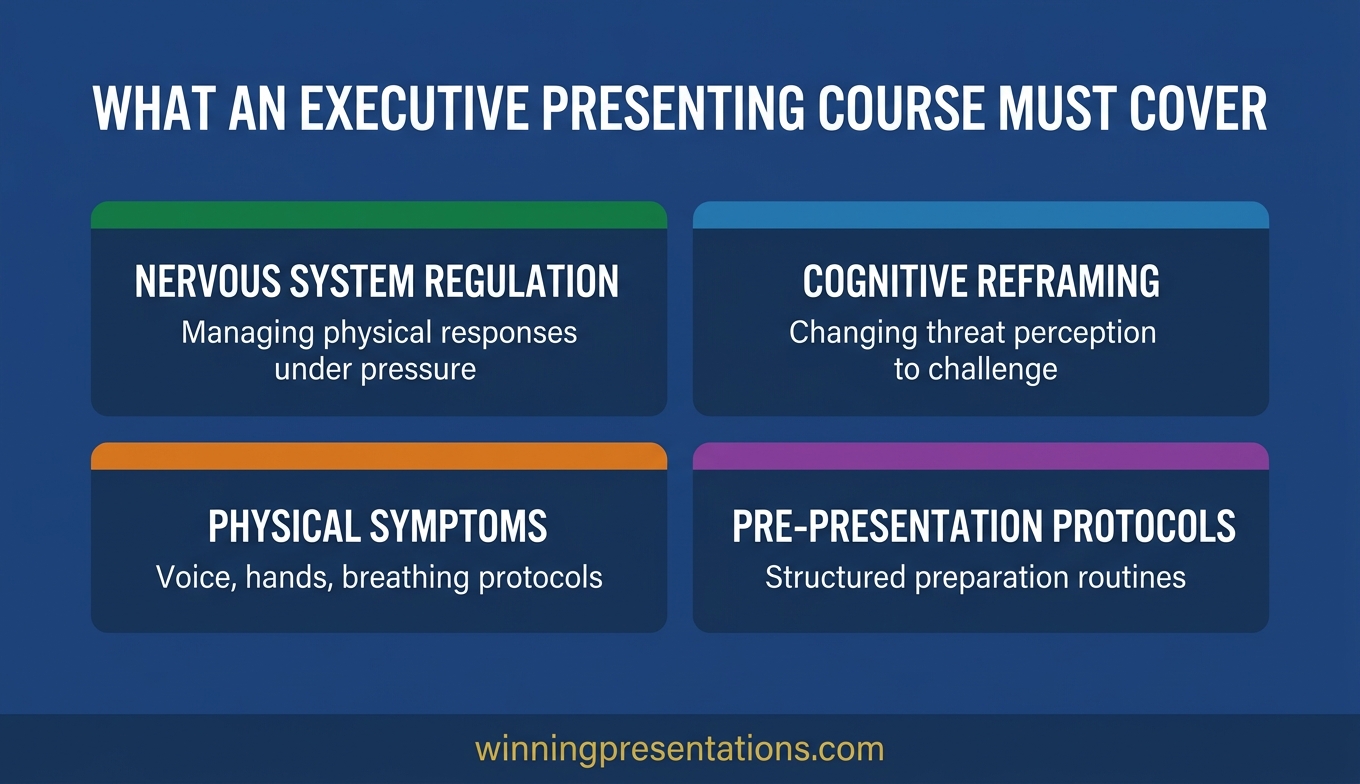
Psychology. The nervous-system response that destabilises competent presenters when stakes are highest. Why “just relax” is not a strategy. The protocol that actually settles a presenter in the 30 minutes before walking into the room. The specific techniques for shaking voice, racing heart, and dry mouth in the moment. Courses that ignore this leave the most experienced presenters vulnerable to the one room they cannot afford to lose.
Q&A handling. Senior audiences make decisions in Q&A, not during the prepared content. The hostile question patterns. The career-risk question. The pile-on dynamic when three or four committee members challenge in succession. The 45-second decision-safe answer structure. Bridging and blocking. This is usually treated as an afterthought in general courses. It is the most consequential element of a high-stakes presentation.
Stakeholder pre-work. The alignment that happens before the meeting starts. Pre-read distribution. One-to-one conversations with sceptics. Decision-readiness mapping. The work that determines whether the approval has effectively been won before the presentation even begins. General courses rarely address this. For high-stakes work, it is often the difference between a meeting that approves and one that defers.
For more on the structural side specifically — what an executive deck needs to contain at board level — see the 15-minute board presentation template and the 8-slide CFO presentation template.
Format questions to ask before enrolling
Before paying for any online presentation course aimed at senior-level presenting, four format questions matter more than the marketing copy.
Who teaches it? Has the instructor delivered high-stakes presentations themselves at senior level, or have they only taught presentation skills as a generalist? The signal you are looking for is named experience — companies, sectors, the actual scenarios they have presented in. A course taught by someone who has never sat across from an investment committee will struggle to address what happens in that specific room.
Walk into your next high-stakes presentation prepared.
The Executive Buy-In Presentation System is a self-paced programme — 7 modules covering the structure, psychology, and preparation that senior professionals use to secure approval at board level. Monthly cohort enrolment, optional recorded Q&A calls, lifetime access. £499.
- Structure: the deck framework that earns senior approval
- Stakeholder analysis and pre-meeting alignment protocols
- The psychology of high-stakes presentation pressure
- Q&A handling for the questions that decide approvals
- Optional bonus Q&A calls with Mary Beth (recorded — watch back anytime)
Explore The Executive Buy-In Presentation System →
Designed for senior professionals across financial services, healthcare, technology, and government.
Who is it designed for? If the course’s target audience is “professionals who want to improve their presentation skills”, it is built for a generalist audience. Senior-level presenting is a narrower problem. Look for courses that specify the audience: senior leaders, executives presenting to boards, investment committees, regulators, or executive sponsors. The framing tells you whether the content was built for your scenario.
What is the format actually? Self-paced video, live cohort, hybrid, 1:1 coaching? Each has trade-offs. Live cohorts impose a schedule that may not match your meeting timeline. Self-paced gives you flexibility but requires you to drive your own pacing. 1:1 coaching is high-cost but tailored. The format question matters more than most enrolees realise.
What does “live” actually mean? Many programmes marketed as “live cohorts” or “live coaching” are in fact self-paced courses with optional live calls. There is nothing wrong with that format — it is often the right one for senior professionals with unpredictable calendars. But you need to know which it is before you enrol. Ask whether attendance is mandatory, whether calls are recorded, and whether the core content is delivered live or pre-recorded.
Self-paced versus live: which suits high-stakes presenting
The dominant assumption in adult learning is that “live is better than self-paced” — that real-time interaction improves outcomes, that synchronous beats asynchronous. For senior professionals working on high-stakes presentations, this is not always true.
Self-paced courses suit senior presenters for three reasons. First, the meeting that drives the learning need is not on a fixed schedule. A board presentation in eight weeks needs different work than a presentation in two weeks. Self-paced learning lets you compress or expand the timeline to fit the actual meeting. Second, the content needs to be revisited. The structure module you watched in week one becomes much more useful when you are actively building a deck in week six. Self-paced courses make that re-visit straightforward. Third, senior calendars do not respect synchronous schedules. A live cohort meeting at 6pm on a Tuesday is likely to be missed three times in any twelve-week programme.
Live cohorts suit some learners — those who need the social accountability of a fixed schedule, those who learn best from real-time discussion, those whose work calendars are predictable enough to commit to weekly sessions. For most senior professionals juggling unpredictable demands, the self-paced format with optional live touchpoints is the more honest fit.
The risk with self-paced is starting and not finishing. The mitigation is twofold: pick a course where the modules are short enough to complete in a single sitting (under 45 minutes each), and pick a course with a structure that maps to a real upcoming meeting rather than to an abstract “skills development” goal. Learning anchored to a real deadline gets completed. Learning anchored to “someday I’ll get better at this” does not.
What to avoid in a high-stakes course
Three patterns appear in courses that under-deliver for senior presenters. Recognise them before you pay.
Heavy emphasis on stage technique. Voice projection, gesture training, stage choreography — these belong in courses for keynote speakers and TED-style stage presentations. They are largely irrelevant in a board room where you are seated, the audience is six metres away, and the entire presentation is delivered from a chair with a remote in your hand. Courses that lead with stage technique are signalling their target audience, and it is not yours.
Outcome guarantees. “You will close every deal.” “Your board will say yes.” “You will eliminate presentation anxiety.” Outcomes depend on factors well outside any course’s control — the strength of your underlying case, the politics of the room, the timing relative to other organisational priorities, the audience’s existing biases. Courses that make outcome guarantees are signalling that they prioritise marketing over honest framing. Look for courses that promise process — “build a stronger case”, “structure the conversation”, “prepare for the questions that decide” — not outcomes.
Generic “engagement” content. Courses heavy on “how to capture attention”, “how to make slides memorable”, “how to use storytelling to engage your audience” — these are aimed at presenters whose challenge is keeping a passive audience interested. The challenge in a high-stakes presentation is the opposite: a hyper-attentive audience that is forming sharp judgements every minute. The skills required are different. Look for courses that name the specific skills required for your scenario, not the generalist skills shared across all presentation contexts.
For more on the structural side of preparation specifically, see the 31-point first board presentation review and the partner article on the 72-hour protocol senior leaders use.
The Executive Buy-In Presentation System
Since you are reading this on the Winning Presentations site, it is fair to be transparent about the programme Mary Beth runs and where it fits.
The Executive Buy-In Presentation System is a self-paced programme on Maven covering 7 modules. It is designed for senior professionals who present decisions to boards, executive sponsors, investment committees, and regulators. The modules cover stakeholder analysis, case construction, the slide structures that hold up under board scrutiny, the psychology of high-stakes presenting, Q&A handling for the questions that decide approvals, and the rehearsal protocols senior presenters use in the final 72 hours before the meeting.
Format: self-paced. New cohort enrolment opens monthly — you join the next cohort whenever timing suits, then work through at your own pace. Optional bonus Q&A calls with Mary Beth are fully recorded so you can watch back anytime. No deadlines. No mandatory attendance. Lifetime access to all course materials. Price: £499.
It is not the right course for every audience. If your work is primarily client-facing sales presentations or external pitches to general audiences, other formats may suit better. If your work is presenting decisions internally to senior stakeholders — board approvals, capital requests, strategic recommendations, structural change proposals — the programme is built specifically for that scenario.
Want the slide structure that goes with the framework?
The Executive Slide System gives you 26 templates including the recommendation, options, and risk slides used in real C-suite decks. £39, instant access — pairs naturally with the Buy-In programme when you want both strategic framework and tactical templates.
Frequently asked questions
How long does a high-stakes presentation course take to complete?
Self-paced programmes vary. Most senior professionals complete the core content of a focused course in 6-10 hours of work, spread over two to six weeks depending on calendar pressure. Anchoring the work to a real upcoming meeting compresses the timeline naturally — most learners drive harder when the pre-meeting deadline is real than when learning is abstract. Live cohort programmes typically run 4-8 weeks on a fixed schedule.
Is an online course as effective as in-person coaching for high-stakes work?
For different things. In-person 1:1 coaching is the highest-touch format and remains the standard when the budget supports it — typically £3,000-£15,000 for a focused engagement around a specific high-stakes presentation. Online courses give you the structural and psychological framework at a lower price point and on your timeline. For most senior professionals, the right answer is online course as the foundation, with selective 1:1 coaching for the specific high-stakes meetings where the stakes justify the investment.
Should I take a course before my next high-stakes presentation, or after?
Before, if there is time. The structural and psychological work is most useful when you are actively building a real deck and rehearsing for a real audience. Taking a course “after” — to learn from the meeting that just happened — is also valuable but slower-burning. The compression effect of an upcoming meeting drives most of the learning.
What is the price range for high-stakes presentation courses online?
£20-£100 for self-paced courses on general platforms (Coursera, Udemy, LinkedIn Learning) — useful as foundational content but rarely deep on senior-level scenarios. £200-£800 for specialist self-paced programmes built for executive audiences. £1,000-£3,000 for live cohort programmes with named instructors. £3,000-£15,000 for 1:1 executive coaching engagements. The Executive Buy-In Presentation System sits in the £499 specialist self-paced category.
The structured framework for senior approval — at your pace.
The Executive Buy-In Presentation System — 7 self-paced modules, monthly cohort enrolment, optional recorded Q&A calls. Designed for senior professionals presenting decisions at board level. £499, lifetime access to materials.
Get The Winning Edge newsletter
A weekly note from Mary Beth on the structure, psychology, and preparation that earns senior approval. One idea, one application, one specific scenario — every Thursday morning.
Not ready for the full programme? Start here instead: download the free Executive Presentation Checklist — a single-page reference for what every high-stakes presentation needs before it leaves your desk.
Next step: Identify your next high-stakes presentation date. Work backwards. Pick a course that fits the timeline and addresses the four areas — structure, psychology, Q&A, stakeholder pre-work. Enrol in time to use the work, not just to complete it.
About the author
Mary Beth Hazeldine is Owner & Managing Director of Winning Presentations Ltd, founded in London in 1990. With 24 years of corporate banking experience at JPMorgan Chase, PwC, Royal Bank of Scotland, and Commerzbank, she advises executives across financial services, healthcare, technology, and government on high-stakes presentation structure, psychology, and Q&A composure.