Tag: speaking anxiety

15 Feb 2026
Professional sitting alone in quiet reflection before a high-stakes presentation — imposter syndrome moment in modern office

The Imposter Syndrome That Hits Hardest When You’re the Most Qualified Person in the Room

Quick answer: Imposter syndrome doesn’t fade as you get promoted — it often intensifies. The higher the stakes, the louder the voice that says “they’re about to find out.” This isn’t a confidence problem you can think your way out of. It’s a nervous system pattern that requires a nervous system intervention. This article explains why seniority makes imposter syndrome worse, why common advice fails, and the evidence-based reset that actually stops it before you present.

She was the most qualified person in the room and she knew it.

Twenty-two years of experience. Two promotions ahead of schedule. A track record that included the largest restructuring her division had ever completed. She’d been invited to present to the executive committee specifically because she was the acknowledged expert.

And forty-five minutes before the meeting, she was in a bathroom stall, hands shaking, rehearsing her opening sentence for the fourteenth time, absolutely certain they were about to discover she didn’t belong there.

She told me afterwards: “The bizarre thing is, I know I’m qualified. I can see it objectively. But the moment I stand up to present to senior people, something switches off the rational part of my brain and this voice starts saying: you got lucky, you’re not as good as they think, today’s the day they figure it out.

I’ve heard versions of this story repeatedly over the years — in 24 years of corporate banking at JPMorgan Chase, PwC, Royal Bank of Scotland, and Commerzbank, and then across 15 years as a clinical hypnotherapist specialising in presentation anxiety. Imposter syndrome doesn’t discriminate by competence. If anything, it targets the competent more relentlessly than anyone else.

Why Seniority Makes Imposter Syndrome Worse

Most people assume imposter syndrome fades with experience. The logic seems obvious: the more you achieve, the more evidence you accumulate that you’re competent. The voice should get quieter.

It doesn’t. For many senior professionals, it gets louder. Here’s why.

The stakes keep rising. When you were junior, a bad presentation meant embarrassment. Now it means losing a client, stalling a programme, or undermining your credibility with the board. Imposter syndrome feeds on consequence. The higher the stakes, the more ammunition it has.

The audience keeps getting more senior. You’ve mastered presenting to your peers. But every promotion puts you in front of a new audience — people who are more experienced, more powerful than the last group you got comfortable with. Imposter syndrome resets every time the room changes.

The breadth of expectation widens. As a subject matter expert, you understood your content deeply. As a senior leader, you’re expected to speak credibly about strategy, finance, operations, people — areas where you may feel less certain. The breadth of expectation at senior levels creates more surface area for doubt.

You have more to lose. Early in your career, failure is a learning experience. At VP level and above, failure feels existential. Your identity is more tightly bound to your professional role. The thought “what if they find out?” carries a weight at 45 that it didn’t carry at 28.

PAA: Why does imposter syndrome get worse with seniority?
Because the stakes, audience, and expectations all escalate with promotion. Each new level puts you in front of more senior people, across broader topics, with higher consequences. Imposter syndrome isn’t driven by incompetence — it’s driven by the gap between what you feel and what the situation demands. That gap widens as you climb.

Your Brain Is Lying to You. Here’s How to Stop It.

Conquer Speaking Fear is built for experienced professionals whose anxiety doesn’t match their ability. It combines clinical hypnotherapy techniques with NLP-based cognitive resets — a structured system for interrupting imposter syndrome before it hijacks your next presentation.

Get Conquer Speaking Fear → £39

Created by a clinical hypnotherapist who spent 5 years battling presentation terror in corporate banking — and 15 years teaching others how to overcome it.

The Three Triggers Before High-Stakes Presentations

Imposter syndrome before a presentation isn’t a single feeling. It’s a cascade — and understanding the sequence is the first step to interrupting it.

Trigger 1: The Comparison Spiral. This starts hours or days before the presentation. You think about who’s in the room. You compare yourself to them. You calculate all the ways they’re more experienced, more credible, more articulate. The comparison is always unfair — you’re measuring your internal doubt against their external composure. But the feeling is real: I don’t belong in this room.

Trigger 2: The Credibility Audit. As the meeting approaches, your brain starts questioning every piece of content. Is this data strong enough? Will they challenge this assumption? What if someone asks something I can’t answer? This isn’t constructive preparation — it’s your nervous system scanning for threats. The content hasn’t changed since you prepared it. Your perception of it has.

Trigger 3: The Physical Takeover. In the final minutes before presenting, the cognitive symptoms become physical. Racing heart. Shallow breathing. Tight throat. Shaking hands. At this point, rational self-talk is largely useless — your prefrontal cortex (the rational brain) has been overridden by your amygdala (the threat-detection system). This is why “just remember you’re qualified” doesn’t help when you’re already in fight-or-flight.

If you’ve experienced the physical takeover before high-stakes presentations, you know that the problem isn’t just in your head. It’s in your body. And the solution has to start there.


The 4-minute pre-presentation reset framework for imposter syndrome showing physiological sigh, peripheral vision, anchor state, and first-sentence rehearsal

🧠 Recognise this cascade? Conquer Speaking Fear (£39) includes specific techniques for interrupting each stage — before the physical symptoms take over.

Why “Just Remember Your Achievements” Doesn’t Work

The most common advice for imposter syndrome is some version of: make a list of your achievements, remind yourself of your qualifications, look at the evidence that you’re competent.

This advice is well-intentioned and almost completely ineffective — for a specific neurological reason.

When imposter syndrome activates before a presentation, your amygdala has already classified the situation as a threat. Once that happens, your prefrontal cortex — the part of your brain that processes rational evidence — is suppressed. Blood flow literally shifts away from the rational brain toward the survival brain.

Telling someone in an amygdala hijack to “remember their achievements” is like telling someone having a panic attack to “just calm down.” The instruction requires the exact cognitive function that the anxiety has disabled.

This is why so many intelligent, accomplished professionals feel stuck. They know they’re qualified. They can see the evidence. And it makes absolutely no difference when the nervous system takes over.

Other common advice that fails for the same reason:

“Fake it till you make it.” This adds a second layer of imposter syndrome. Now you’re not only feeling like a fraud — you’re deliberately acting like one. For people who value authenticity (which describes most senior professionals), this advice actively increases anxiety.

“Power posing.” The original research has been heavily contested in replication studies. Even if holding a pose for two minutes slightly shifts hormonal markers, it doesn’t address the underlying nervous system activation that drives imposter feelings. It’s a surface intervention for a deep-pattern problem.

“Visualise success.” Visualisation works well — when you’re already calm. When your nervous system is activated, trying to visualise a positive outcome while your body is signalling danger creates cognitive dissonance that can make anxiety worse.

The approaches that actually work target the nervous system first, the cognitive patterns second. That’s exactly how clinical hypnotherapy and NLP approach the problem — and it’s why I retrained in both disciplines after watching rational confidence-building approaches fail the presentation confidence needs of my clients for years.

Rational Self-Talk Can’t Fix a Nervous System Problem

Conquer Speaking Fear uses clinical hypnotherapy and NLP techniques to reset the nervous system pattern that drives imposter syndrome — not just manage the symptoms. Designed for senior professionals whose anxiety hasn’t responded to conventional advice.

Get Conquer Speaking Fear → £39

Created by a clinical hypnotherapist and NLP practitioner with 24 years of corporate banking experience. Evidence-based techniques designed for busy professionals — not therapy-style time commitments.

The Nervous System Approach That Actually Helps

The clinical approach to imposter syndrome works in the opposite direction from conventional advice. Instead of starting with thoughts (“remind yourself you’re qualified”), it starts with the body (“regulate your nervous system so your rational brain comes back online”).

This sequence matters. Once the nervous system is regulated, rational thinking returns naturally — and then the evidence of your competence actually lands.

Three evidence-based techniques that work at the nervous system level:

1. Physiological sigh (immediate reset). A double inhale through the nose followed by a long exhale through the mouth. Stanford neuroscientist Andrew Huberman’s research shows this is the fastest known way to downregulate the sympathetic nervous system in real time. One cycle takes about 8 seconds. Three cycles can shift your nervous system state measurably. Do this in the corridor before you walk into the room.

2. Peripheral vision activation (anxiety disruptor). Imposter syndrome narrows your visual focus — you literally get tunnel vision, focused on the threat. Deliberately softening your gaze to take in your peripheral vision activates the parasympathetic nervous system. This is an NLP technique I teach every executive I work with. Soften your eyes while looking straight ahead so you can see the edges of the room without moving your head. Hold for 30 seconds. The anxiety drops perceptibly.

3. Anchor state (conditioned confidence). This is a clinical hypnotherapy technique. Before the high-stakes presentation, you deliberately recall a specific moment when you felt genuinely competent and in control — not a vague memory, but a precise one. Where were you standing? What could you see? What did your body feel like? By associating a physical gesture (pressing thumb and forefinger together, for example) with that state, you create an anchor you can fire in the moments before presenting. With practice, the anchor activates the confident state in seconds.

These three techniques address the three triggers in reverse order: the physiological sigh stops the physical takeover, peripheral vision interrupts the credibility audit, and anchor state breaks the comparison spiral. Together, they take about 4 minutes.

PAA: How do you overcome imposter syndrome before a presentation?
Start with the body, not the mind. Use a physiological sigh (double inhale, long exhale) to downregulate the nervous system. Activate peripheral vision to disrupt the tunnel-focus of anxiety. Then fire an anchor state — a conditioned association between a physical gesture and a genuine memory of competence. This 4-minute sequence brings the rational brain back online so your actual qualifications can override the imposter voice.

PAA: Can imposter syndrome affect your presentation performance?
Yes — but not the way most people assume. Imposter syndrome rarely makes senior professionals incompetent. It makes them over-prepare, over-qualify every statement, speak faster, avoid eye contact, and hedge their recommendations. The audience sees someone who lacks conviction — not because they lack knowledge, but because their nervous system is overriding their confidence. Addressing the nervous system pattern restores the delivery that matches the expertise.

The 4-Minute Pre-Presentation Reset

Here’s the exact sequence I teach executives who experience imposter syndrome before high-stakes presentations. Do this in the 5 minutes before you enter the room.

Minutes 0-1: Three physiological sighs. Double inhale through the nose (two quick sniffs), then a long slow exhale through the mouth. Repeat three times. Your heart rate will start to slow by the second cycle.

Minutes 1-2: Peripheral vision hold. Stand still. Look straight ahead at a fixed point. Without moving your eyes, expand your awareness to include your full peripheral vision — the edges of the corridor, the ceiling, the floor. Hold this soft gaze for 60 seconds. You’ll feel the tension in your shoulders start to release.

Minutes 2-3: Anchor state activation. Press your thumb and forefinger together (or whatever physical anchor you’ve conditioned). Recall your specific competence memory — the boardroom where you nailed it, the client who said “that’s exactly what we needed,” the moment you knew your expertise made the difference. Stay in the memory for 30-45 seconds. Let the feeling settle into your body.

Minutes 3-4: First-sentence rehearsal. Say your opening sentence out loud, once, at the pace you want to deliver it. Not the whole presentation. Just the first sentence. This gives your voice a “warm start” and confirms to your nervous system that speaking is safe. The confidence from the first sentence carries into the second, and the second into the third.

Presenting this week and feeling the imposter voice already?

Try this tonight: practise the 4-minute reset sequence once, using a real presentation memory as your anchor. Tomorrow, do it again before your morning meeting — even if it’s low-stakes. By the time your high-stakes presentation arrives, the sequence will be familiar enough that your body responds automatically.

If you want the full system — including the conditioning protocol for building a permanent anchor state — Conquer Speaking Fear (£39) walks you through it step by step.

The reason this works when rational self-talk doesn’t: you’re resetting the nervous system before you ask the cognitive brain to do anything. By the time you reach the anchor state, your prefrontal cortex is back online. The evidence of your competence — the 22 years, the track record, the expertise — can finally be heard over the imposter voice.

If the fear of being judged has been running your presentation experience, this sequence changes the starting point. You walk in regulated, not reactive.

🧠 Want the full conditioning protocol? Conquer Speaking Fear (£39) includes the step-by-step anchor-building process, the pre-presentation reset sequence, and the long-term pattern interrupt that reduces imposter activation over time.

You’re Not a Fraud. Your Nervous System Is Just Louder Than Your CV.

Conquer Speaking Fear gives you the clinical techniques to reset imposter syndrome at the source — the nervous system patterns that rational self-talk can’t reach. Includes the anchor conditioning protocol, the pre-presentation reset sequence, and long-term pattern interrupts for professionals who are done letting anxiety override their expertise.

Get Conquer Speaking Fear → £39

Created by a clinical hypnotherapist and NLP practitioner. 24 years in corporate banking. 15 years helping executives present without the imposter voice running the show.

Frequently Asked Questions

Is imposter syndrome a sign that I’m not ready to present at this level?

No — it’s often a sign of the opposite. Research by psychologists Pauline Clance and Suzanne Imes, who first identified imposter syndrome, found it disproportionately affects high-achieving professionals. The pattern tends to intensify with competence, not incompetence. If you’re experiencing it before a senior presentation, it usually means you care about performing well and you’re self-aware enough to recognise the gap between how you feel and what the situation requires.

Can imposter syndrome actually be “cured,” or do I just learn to manage it?

Both are realistic outcomes. Many professionals find that nervous system techniques (like the 4-minute reset) reduce the intensity significantly — sometimes to the point where it no longer interferes with performance. Others find the voice never fully disappears but becomes quieter and easier to override. The goal isn’t to eliminate self-doubt entirely — some degree of it keeps you prepared. The goal is to stop it from controlling your delivery.

Does imposter syndrome affect men and women differently in presentations?

The original research focused on women, but subsequent studies have found imposter syndrome across all genders at similar rates in professional settings. What often differs is how it manifests: some professionals overcompensate by over-preparing (14-hour deck builds), while others withdraw by avoiding presentations entirely. Both are imposter-driven responses. The nervous system techniques work regardless of how the pattern presents itself.

What if I’ve tried therapy and it didn’t help with my presentation anxiety?

Traditional talk therapy is excellent for many things, but it primarily works at the cognitive level — exploring beliefs, reframing thoughts, building insight. If your imposter syndrome is a nervous system pattern (which presentation-specific anxiety usually is), you may need interventions that target the body first. Clinical hypnotherapy and NLP work at the subconscious and somatic level, which is why they’re often effective when talk therapy alone hasn’t resolved presentation-specific fear.

📬 The Winning Edge Newsletter

Weekly strategies for executive presentations, speaking confidence, and the psychology behind high-stakes communication. No fluff.

Subscribe free →

🎯 Free: Executive Presentation Checklist

The pre-presentation checklist I give every executive before a high-stakes meeting. Covers structure, messaging, and the confidence preparation steps that reduce anxiety before you walk in.

Download free →

Optional: Preparation reduces anxiety. If you also want executive slide templates, the Executive Slide System (£39) includes confident-presenter formats designed to minimise preparation stress.

Related: Imposter syndrome often spikes when you’re presenting results that could lead to a big decision. If you’re about to present pilot programme results to executives, the 8-slide pilot-to-rollout structure gives you a framework that reduces the “am I doing this right?” uncertainty — which is one of imposter syndrome’s favourite triggers.

Imposter syndrome isn’t a character flaw. It’s a nervous system pattern. And like any pattern, it can be interrupted, reconditioned, and eventually quietened — if you use the right techniques.

Start with the 4-minute pre-presentation reset. And if you want the full system for building a permanent anchor state and long-term pattern interrupt, Conquer Speaking Fear (£39) has everything you need.

About the Author

Mary Beth Hazeldine is the Owner & Managing Director of Winning Presentations. With 24 years of corporate banking experience at JPMorgan Chase, PwC, Royal Bank of Scotland, and Commerzbank, she spent five of those years battling severe presentation anxiety before retraining as a clinical hypnotherapist and NLP practitioner to understand — and overcome — the problem at its source.

Mary Beth now combines executive communication expertise with evidence-based anxiety techniques, helping senior professionals present with confidence in boardrooms, client meetings, and high-stakes pitches across three continents.

Book a discovery call | View services

13 Feb 2026
Professional person practising calm breathing before a high-stakes presentation with composed expression

The Breathing Technique That Stopped My Pre-Presentation Vomiting

Quick answer: Pre-presentation nausea is a vagus nerve response to perceived threat — not weakness, not “just nerves,” and not something you can think your way out of. The vagal breathing reset (extended exhale pattern: 4 counts in, 2 hold, 8 counts out) can help calm the nerve that influences your stomach. Many people notice relief within 60–90 seconds. Below: exactly how to do it, why it often works when other breathing techniques don’t, and what to do if you’re already in the bathroom.

⚕️ This article is educational, not medical advice. If nausea or vomiting is frequent, occurs outside presentation situations, or is accompanied by pain, blood, or weight loss, please consult a medical professional.

I Was on My Knees in a Bathroom Stall Fifteen Minutes Before the Biggest Presentation of My Career.

It was 2008. I was presenting to the executive committee at one of the largest banks in Europe. Twelve people. One recommendation. A decision worth millions. I’d prepared for weeks. I knew the material cold.

And I was throwing up in the third-floor bathroom while my colleagues assumed I was doing a final review of my notes.

This wasn’t new. The nausea had started about three years into my banking career. Not every presentation — just the ones that mattered. Board meetings. Client pitches. Anything where the stakes felt personal. It would begin the night before, a low churning that I’d try to ignore. By morning it was a wave I couldn’t control. By the time I arrived at the office, I was running straight for the bathroom.

I tried everything. Ginger tablets. Eating nothing beforehand. Eating something bland beforehand. Deep breathing — the standard “breathe in for four, out for four” that every article recommends. None of it worked. The deep breathing actually made it worse sometimes, because focusing on my breathing made me more aware of my stomach.

What finally stopped it was something I learned during my clinical hypnotherapy training, years after that bathroom floor moment. It wasn’t a relaxation technique. It was a nervous system reset — a specific breathing pattern that targets the exact nerve responsible for the nausea. It took 90 seconds. And the first time I used it before a presentation, I walked into the room feeling something I hadn’t felt in years: normal.

I’ve since taught this technique to many executives who experience the same thing. Some had been dealing with it for years. Some had never told anyone. Nearly all of them had the same reaction when it worked: “Why didn’t anyone teach me this sooner?”

🚨 The Nausea Protocol Above Is 1 of 13 in This Toolkit

Calm Under Pressure is the complete physical symptom toolkit — 13 timed emergency protocols for racing heart, nausea, shaking hands, voice tremor, sweating, freezing, hyperventilation, blushing, dry mouth, chest tightness, dizziness, crying, and talking too fast. Plus anticipatory anxiety protocols (night-before, 3am wake-ups, can’t eat), pre-presentation resets, NLP techniques including the Confidence Anchor and self-hypnosis script, and a 14-day rewiring protocol.

Built by a qualified clinical hypnotherapist who experienced every symptom on this list.

Get Calm Under Pressure → £19.99

Instant download — 21 pages, 13 protocols, 7 situation playbooks, printable quick reference card.

Why Your Stomach Reacts to Presentation Fear (It’s Not “Just Nerves”)

If you’ve ever been told to “just relax” when you’re nauseous before a presentation, you already know how unhelpful that is. You can’t relax your way out of nausea any more than you can relax your way out of a sunburn. It’s a physiological response, not a mindset problem.

Here’s what’s actually happening. Your vagus nerve — the longest nerve in your body, running from your brainstem to your abdomen — is your body’s communication superhighway between brain and gut. When your brain perceives a threat (and for many people, a high-stakes presentation registers as a genuine threat), it activates your sympathetic nervous system: the fight-or-flight response.

That activation disrupts your vagus nerve signalling. Your digestion slows or stops. Your stomach muscles contract. Acid production increases. Blood diverts away from your digestive system toward your muscles. The result is nausea — and in severe cases, vomiting. Your body is literally preparing to fight or run, and it’s shutting down non-essential systems (like digestion) to do it.

This is why willpower doesn’t work. You’re not choosing to feel nauseous. Your autonomic nervous system is making that decision for you, based on a threat assessment that happens below conscious awareness. Standard advice like “think positive thoughts” or “visualise success” doesn’t reach the autonomic system. It’s like trying to lower your heart rate by thinking about it — the wrong tool for the job.

What you need is something that talks directly to the vagus nerve. And the fastest way to do that is through your breath — but not just any breathing pattern.

The Vagal Breathing Reset: Step by Step

This technique works because it specifically activates your parasympathetic nervous system — the “rest and digest” mode — through extended exhalation. When your exhale is significantly longer than your inhale, it stimulates the vagus nerve and signals your body to stand down from threat mode. Your stomach calms. The nausea subsides.

Here’s the exact pattern:

Step 1: Find a position where your abdomen isn’t compressed.

Standing or sitting upright. Not hunched over (which is your instinct when nauseous, but it makes things worse by compressing your diaphragm). If you’re in a bathroom stall, stand up and lean your back against the wall.

Step 2: Place one hand on your stomach, just below your ribs.

This isn’t decorative — it gives your brain proprioceptive feedback about your breathing depth. You’ll feel your hand move if you’re breathing into your diaphragm rather than your chest.

Step 3: Inhale through your nose for 4 counts.

Slow counts, about one second each. Breathe into your stomach, not your chest. Your hand should move outward. If your shoulders rise, you’re breathing too shallow — try again.

Step 4: Hold for 2 counts.

Gentle hold. Not straining. This brief pause creates the transition between the sympathetic (inhale) and parasympathetic (exhale) phases.

Step 5: Exhale through your mouth for 8 counts.

This is the critical part. The exhale must be roughly double the inhale. Slow, controlled, through slightly pursed lips — as if you’re breathing through a straw. Your hand should move inward. This extended exhale is what activates the vagus nerve.

Step 6: Repeat for 4–6 cycles.

Many people notice the nausea begin to ease by cycle 3. By cycle 5 or 6, the acute wave has often passed. Total time: roughly 60–90 seconds.


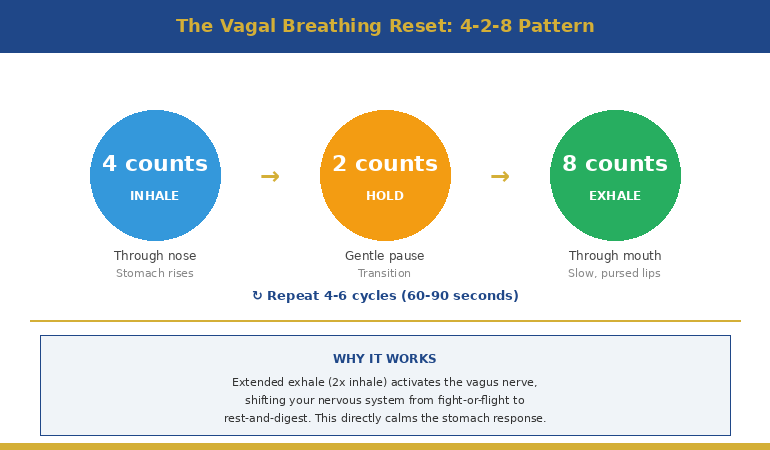
Diagram showing the vagal breathing reset technique with inhale exhale and hold timing for presentation nausea

The pattern is 4-2-8. Inhale 4. Hold 2. Exhale 8. That’s it. No apps, no special equipment, no one needs to know you’re doing it. You can do it standing in a corridor, sitting in a bathroom, or even at the table before a meeting starts.

📋 Nausea isn’t your only symptom, is it?

Calm Under Pressure covers 13 physical symptoms — shaking hands, racing heart, voice tremor, blushing, dry mouth, chest tightness, and 7 more. Each one has a timed, sequenced emergency protocol. Plus anticipatory anxiety systems for the night before, 3am wake-ups, and the morning of. Get the complete toolkit → £19.99

Why This Works When Other Breathing Techniques Don’t

If you’ve tried “deep breathing” before and it didn’t help — or made things worse — you’re not alone. There’s a specific reason standard breathing advice fails for nausea.

Most breathing exercises use equal ratios: breathe in for four, out for four. Or they emphasise the inhale — “take a deep breath.” The problem is that inhalation activates your sympathetic nervous system. When you take a big, deliberate inhale, you’re actually stimulating the fight-or-flight response slightly. For someone who’s already in sympathetic overdrive (which is what’s causing the nausea), emphasising the inhale is like throwing petrol on a fire.

The vagal reset reverses the ratio. By making the exhale twice as long as the inhale, you’re spending more time in parasympathetic activation than sympathetic. Each cycle tips the balance further toward “rest and digest.” After several cycles, you’ve shifted your autonomic state enough that the nausea signal diminishes.

This is also why the 4-7-8 technique works well for some people — it follows the same principle of extended exhalation. The 4-2-8 pattern I teach is a simplified version that’s easier to remember under stress. When you’re nauseous and panicking, you need a pattern you can recall without thinking.

The other critical difference is the hand placement. Putting your hand on your stomach does two things: it ensures you’re breathing diaphragmatically (which maximises vagal stimulation), and it gives your anxious brain something concrete to focus on. Instead of spiralling through “I’m going to be sick, everyone will notice, this is a disaster,” your attention anchors to the physical sensation of your hand moving. It’s a grounding technique disguised as a breathing exercise.

The Emergency Protocol: When You’re Already in the Bathroom

Sometimes the technique above isn’t enough to prevent an episode. Sometimes you’re already in crisis when you remember to try it. Here’s the protocol for when you’re past the prevention stage:

First: Don’t fight it.

If you’re going to be sick, let it happen. Fighting nausea increases tension in your abdomen, which makes everything worse. The physical act itself isn’t the problem — the anxiety about it is what keeps the cycle going.

Second: Cold water on your wrists.

Run cold water over the inside of your wrists for 15–20 seconds. This is a mammalian dive reflex trigger — cold on your pulse points activates your parasympathetic nervous system through a different pathway than breathing. It’s a backup route to the same destination.

Third: Start the 4-2-8 pattern immediately after.

Once the acute moment has passed, begin the vagal reset. Your body is actually more receptive to it after the release — your system is already trying to return to baseline, and the breathing pattern accelerates that process.

Fourth: Give yourself five minutes.

You don’t need to rush into the room. Five minutes of vagal breathing after an episode is enough for your system to stabilise. Your colour will return. The shaking will stop. You’ll walk in looking normal — and nobody will know what happened five minutes earlier.

I’ve used this exact protocol myself. The presentation I mentioned at the start of this article? I used an earlier version of this emergency sequence. I walked into that boardroom six minutes late, apologised for a “phone call that ran over,” and delivered the presentation. It went well. Nobody knew.

⏱️ 20-Minute Reset. 5-Minute Reset. 2-Minute Emergency Reset.

Calm Under Pressure includes three structured pre-presentation warm-up sequences — physical discharge, breathing reset, voice warm-up, mental preparation, and NLP anchor activation — timed to the minute. Plus 7 situation-specific playbooks for board presentations, virtual calls, all-hands, client pitches, job interviews, impromptu requests, and hostile Q&A. Each one adapted to the unique pressure of that context.

Get Calm Under Pressure → £19.99

Instant download. Built by a qualified clinical hypnotherapist and NLP practitioner.

Breaking the Pattern Long-Term

The vagal breathing reset is an intervention — it works in the moment. But if you’re someone who experiences nausea before every significant presentation, you’ll also want to address the pattern itself. Not just managing the symptom, but reducing the trigger.

The nausea pattern gets worse over time because of something called anticipatory conditioning. Your brain learns: presentation → nausea. Once that association is established, the nausea starts earlier and earlier. First it’s the morning of. Then it’s the night before. Eventually, some people feel it days in advance.

Breaking this cycle requires working at the nervous system level — not the cognitive level. Positive self-talk doesn’t reach the part of your brain that’s creating the association. What does work is gradually retraining your nervous system’s threat response through techniques like the fight-or-flight reset from hypnotherapy, systematic desensitisation, and building a pre-presentation routine that consistently signals safety to your nervous system.

The vagal breathing reset can actually become part of this long-term retraining. When you use it consistently before presentations — even presentations where the nausea isn’t severe — you’re building a competing association: presentation → breathing → calm. Over time, the calm pathway gets stronger and the nausea pathway gets weaker.

For a broader approach to calming nerves before presentations, combining the vagal reset with a structured pre-presentation routine produces the most reliable results.

🔍 Ready to reduce symptom intensity over time?

The 14-Day Rewiring Protocol in Calm Under Pressure combines vagal activation exercises with NLP techniques — the Confidence Anchor, Circle of Excellence, and Inner Coach reframe. Most people see a 2–4 point drop on a 10-point symptom scale by Day 14. Get the complete toolkit → £19.99

Why do I feel sick before presentations?

Pre-presentation nausea is caused by your vagus nerve responding to a perceived threat. When your brain registers a high-stakes presentation as dangerous, it activates fight-or-flight mode, which disrupts digestion, increases stomach acid, and contracts abdominal muscles. It’s an autonomic nervous system response — not weakness or poor preparation.

Can breathing exercises stop nausea?

Yes — but only specific patterns. Standard “deep breathing” with equal inhale/exhale ratios can actually make nausea worse by stimulating the sympathetic nervous system. Extended exhale patterns (like the 4-2-8 vagal reset) can help calm the vagus nerve, which influences the stomach response. Many people notice relief within 3–5 cycles.

How do I stop throwing up before a presentation?

Use the emergency protocol: don’t fight the nausea, run cold water on the inside of your wrists for 15–20 seconds (triggers the mammalian dive reflex), then immediately begin the 4-2-8 vagal breathing reset. Give yourself five minutes to stabilise before entering the room. This sequence works because it targets the nervous system through multiple pathways.

🏆 Calm Under Pressure: The Complete Physical Symptom Toolkit

The breathing technique in this article is one protocol. The toolkit has 13 — plus everything you need before, during, and after any presentation.

  • 13 Emergency Protocols: Racing heart, nausea, shaking, voice tremor, sweating, freeze, hyperventilation, blushing, dry mouth, chest tightness, dizziness, crying, talking too fast — each timed and sequenced
  • Anticipatory Anxiety: Night-before protocol, 3am wake-up protocol, morning-of protocol, can’t eat protocol, catastrophizing interrupt
  • Pre-Presentation Resets: 20-minute, 5-minute, and 2-minute emergency versions
  • NLP Toolkit: Confidence Anchor, Circle of Excellence, Inner Coach reframe, 10 cognitive reframe cards, 5-minute self-hypnosis script
  • 14-Day Rewiring Protocol: Daily exercises that reduce symptom intensity over time
  • 7 Situation Playbooks: Board, virtual, all-hands, client pitch, interview, impromptu, hostile Q&A
  • Post-Presentation Recovery: Shame spiral interrupt, 24-hour debrief protocol
  • Quick Reference Card: 13 symptoms, one-page, printable

21 pages. Built by a qualified clinical hypnotherapist who spent 5 years experiencing every symptom on this list.

Get Calm Under Pressure → £19.99

Instant download. Less than one therapy session — and you keep it forever.

📊 Want the slides too? Preparation reduces anxiety. The Executive Slide System (£39) includes confident-presenter templates designed to minimise preparation stress.

Frequently Asked Questions

Is it normal to throw up before a presentation?

It’s more common than most people realise. Severe pre-presentation nausea affects professionals at every level, including senior executives. It’s a physiological response — your vagus nerve reacting to perceived threat — not a sign of weakness or inadequacy. Many of the executives I’ve worked with experienced this for years before learning techniques that helped.

Should I eat before a presentation if I get nauseous?

Eat something small and plain about 90 minutes beforehand — a piece of toast, a banana, or crackers. An empty stomach makes nausea worse because there’s nothing to absorb the excess acid your stress response produces. Avoid caffeine, dairy, and heavy foods. Don’t eat within 30 minutes of presenting.

How long does the vagal breathing reset take to work?

Many people notice the nausea begin to ease by the third cycle (about 45 seconds). By 5–6 cycles (60–90 seconds), the acute wave has often passed. With regular practice, you may find it works faster — your nervous system can learn the “stand down” signal and respond more quickly over time.

What if the breathing technique doesn’t work for me?

If the 4-2-8 pattern doesn’t provide relief, try extending the exhale further (4-2-10) or adding the cold water wrist technique simultaneously. If nausea is persistent and severe despite these interventions, it’s worth exploring the deeper pattern with a professional who understands the nervous system — a clinical hypnotherapist or a therapist trained in somatic approaches. The symptom is treatable.

📬 The Winning Edge Newsletter

Weekly strategies for confident presentations — physical symptom management, slide structures, and executive communication techniques. No filler.

Subscribe Free →

🧠 P.S. Want to address the root cause, not just the symptom? Conquer Speaking Fear (£39) retrains the nervous system pattern that creates the anxiety in the first place.

Related reading: The presentation was perfect — the Q&A lost the deal — once the nausea is managed, preparing for the decision-making moment that follows your slides.

Your next step: The next time you feel nausea building before a presentation, stand up, place your hand on your stomach, and run through the 4-2-8 pattern. Four counts in through your nose. Two counts hold. Eight counts out through pursed lips. Five cycles. Ninety seconds. That’s all it takes to shift from “I can’t do this” to “I’ve got this.” And if nausea isn’t your only symptom — if your hands shake, your voice cracks, your heart races, or you lie awake at 3am — Calm Under Pressure (£19.99) has a timed protocol for all 13 physical symptoms, plus anticipatory anxiety systems, NLP techniques, and a 14-day rewiring protocol.

About the Author

Mary Beth Hazeldine is the Owner & Managing Director of Winning Presentations. With 24 years of corporate banking experience at JPMorgan Chase, PwC, Royal Bank of Scotland, and Commerzbank, she has delivered high-stakes presentations in boardrooms across three continents.

A qualified clinical hypnotherapist and NLP practitioner, Mary Beth combines executive communication expertise with evidence-based techniques for managing presentation anxiety. She spent five years experiencing severe presentation anxiety herself before training in the clinical approaches that resolved it — and now teaches those same techniques to senior professionals.

Book a discovery call | View services

24 Jan 2026
Professional woman taking a calming breath as panic subsides before a presentation, showing the moment of regaining control

Panic Attack Before Presentation: What to Do in the Moment

My hands were shaking so badly I couldn’t hold my notes. My heart was pounding so hard I was certain everyone in the corridor could hear it. I had seven minutes until I was supposed to present to the board—and I was hiding in a bathroom stall, convinced I was dying.

Quick answer: A panic attack before presentation is your nervous system’s false alarm—it feels life-threatening but it isn’t. The 90-second protocol that stops it: (1) Cold water on wrists and neck, (2) 4-7-8 breathing (inhale 4, hold 7, exhale 8), (3) Name 5 things you can see out loud. This interrupts the panic cycle and gives your prefrontal cortex time to regain control from your hijacked amygdala.

In practice, panic attacks before presenting are far more common than most professionals admit—and they’re completely manageable once you understand what’s happening in your body and have a reliable protocol to interrupt the cycle.

When you have a protocol that works:

  • Panic becomes manageable instead of terrifying
  • You present anyway—and no one knows what happened
  • The fear of panic itself starts to fade

Written by Mary Beth Hazeldine — executive presentation coach and qualified clinical hypnotherapist. I spent 5 years having panic attacks before presentations until I learned what actually works. I’ve since helped hundreds of executives who thought they’d have to live with this forever. Last updated: January 2026.

🚨 Panic attack happening RIGHT NOW? Do this:

  1. Cold water — Run cold water on your wrists and splash your face/neck (activates dive reflex, slows heart)
  2. 4-7-8 breath — Inhale 4 counts, hold 7 counts, exhale 8 counts. Repeat 3 times.
  3. 5-4-3-2-1 grounding — Name 5 things you see, 4 you touch, 3 you hear, 2 you smell, 1 you taste
  4. Move — Shake your hands, roll your shoulders, walk. Movement discharges adrenaline.

This takes 90 seconds. The panic will peak and pass. You will be able to present.

→ Want this protocol in audio form you can use in the moment? Get Calm Under Pressure →

📅 Presenting in the next 7 days?

The protocol above handles acute panic. But if you want to prevent panic attacks from escalating—or stop them before they fully activate—you need to train your nervous system in advance. That’s what this article teaches.

That board presentation I mentioned? I made it through. Delivered the full 20 minutes. Got the budget approved. No one knew what had happened in that bathroom seven minutes earlier.

I learned something crucial that day: panic attacks feel unsurvivable, but they’re not. And once you have a reliable protocol, you stop fearing the fear itself—which is often worse than the panic.

After 5 years of suffering through this alone—and then training as a clinical hypnotherapist specifically to understand why it happens—I now teach these techniques to executives who thought presentation panic was just something they had to endure. It isn’t.

What’s Actually Happening During a Panic Attack

Understanding what’s happening in your body removes some of the terror. A panic attack before presentation is your nervous system misfiring—your brain has incorrectly flagged “presentation” as “life-threatening danger.”

The Amygdala Hijack

Your amygdala (the brain’s threat detector) triggers fight-or-flight. It doesn’t consult your rational brain first. By the time you think “this is just a presentation,” your body is already flooded with adrenaline and cortisol.

This is why telling yourself to “just relax” doesn’t work. Your rational brain isn’t driving anymore.

The Physical Symptoms (And Why They Happen)

Every panic symptom has a survival purpose that’s now misfiring:

  • Racing heart — Pumping blood to muscles for fighting or fleeing
  • Shallow breathing — Quick oxygen intake for action
  • Sweating — Cooling the body for exertion
  • Trembling — Muscles primed for explosive movement
  • Tunnel vision — Focusing on the “threat”
  • Nausea/stomach drop — Digestion shutting down to redirect energy
  • Feeling of unreality — Dissociation to protect from trauma

None of these will hurt you. They feel terrible, but they’re your body trying to protect you from a threat that doesn’t exist.

The Critical Fact Most People Don’t Know

Panic attacks peak within 10 minutes and pass within 20-30 minutes—even if you do nothing. Your body cannot sustain that level of activation indefinitely. The adrenaline gets metabolised. The cortisol clears.

The 90-second protocol below speeds this process dramatically by directly interrupting the nervous system cascade.

Diagram showing the panic attack cycle and how the 90-second protocol interrupts it at each stage

The 90-Second Protocol (Step-by-Step)

This protocol works because it targets your nervous system directly—not through thoughts, but through physical interventions that trigger automatic calming responses.

Step 1: Cold Water (15 seconds)

Run cold water over your wrists. If possible, splash cold water on your face and the back of your neck.

Why it works: This activates the “mammalian dive reflex”—an automatic response that slows your heart rate. Your body thinks you’re diving into water and immediately begins calming your cardiovascular system. It’s not psychological; it’s physiological.

If you can’t get to water: Press something cold against your wrists or neck—a cold drink can, ice from a water glass, a cold window, your phone screen.

Step 2: 4-7-8 Breathing (45 seconds)

Inhale through your nose for 4 counts. Hold for 7 counts. Exhale through your mouth for 8 counts. Repeat 3 times.

Why it works: The extended exhale activates your parasympathetic nervous system (the “rest and digest” system). You’re manually flipping the switch from fight-or-flight to calm. The hold interrupts the hyperventilation pattern that makes panic worse.

Can’t remember the counts? Just make the exhale longer than the inhale. That’s the key mechanism.

Step 3: 5-4-3-2-1 Grounding (20 seconds)

Name out loud (or silently if you’re not alone):

  • 5 things you can see
  • 4 things you can touch
  • 3 things you can hear
  • 2 things you can smell
  • 1 thing you can taste

Why it works: This engages your prefrontal cortex (rational brain) and pulls attention away from the amygdala (panic brain). You cannot fully panic while actively cataloguing your environment. It anchors you in the present moment rather than the catastrophic future.

Step 4: Move (10 seconds)

Shake your hands vigorously. Roll your shoulders. Walk a few steps. Do wall push-ups if you’re somewhere private.

Why it works: Your body has been flooded with adrenaline meant for physical action. Movement discharges it. This is why animals shake after a threat passes—they’re completing the stress cycle. Humans often skip this step, which is why the chemicals linger.

For more breathing techniques, see the complete guide to presentation breathing.

⭐ Never Face Presentation Panic Unprepared Again

Calm Under Pressure is the complete system for managing physical anxiety symptoms before and during presentations—including the 90-second protocol in audio form you can use in the moment.

What’s inside:

  • The Emergency Protocol audio (what you just learned, guided so you don’t have to remember)
  • The 7-Day Nervous System Reset (reduces baseline anxiety before big presentations)
  • The Pre-Presentation Ritual (prevents panic from fully activating)

Get Calm Under Pressure → £19.99

Created by a clinical hypnotherapist who spent 5 years managing her own presentation panic.

How to Stop Panic Before It Starts

The 90-second protocol handles acute panic. But ideally, you prevent presentation panic from fully activating in the first place.

The Pre-Presentation Ritual (30 minutes before)

1. Physiological sigh (5 minutes before leaving for the room)

Double inhale through your nose (one breath, then a second shorter breath on top), then long exhale through mouth. Repeat 3-5 times. Stanford research shows this is the fastest way to reduce real-time stress.

2. Cold exposure (10 minutes before)

Hold something cold, splash cold water on your wrists, or step outside briefly if it’s cold. Pre-activates the calming dive reflex before you need it.

3. Movement (15-20 minutes before)

Take a brisk walk. Climb stairs. Light stretching. Burns off anticipatory adrenaline before it accumulates to panic levels.

4. Arrival ritual (5 minutes before)

Arrive early. Claim your space. Touch the podium or table. Greet one person. This reduces the “entering hostile territory” feeling that triggers panic.

The Morning-Of Protocol

On presentation days:

  • Limit caffeine — It amplifies anxiety symptoms. Half your normal amount, or skip it.
  • Eat protein — Stabilises blood sugar. Blood sugar crashes trigger anxiety responses.
  • Exercise early — Even 20 minutes of movement reduces anxiety for hours afterward.
  • Avoid news/social media — Your nervous system doesn’t need additional activation.

Want the complete pre-presentation ritual with guided audio?

Includes the full 30-minute protocol you can follow the morning of any high-stakes presentation.

Get Calm Under Pressure → £19.99

Long-Term: Training Your Nervous System

If you experience panic attacks regularly before presentations, your nervous system has learned to associate “presentation” with “danger.” The long-term solution is retraining that association.

Gradual Exposure

Your nervous system learns safety through repeated exposure without catastrophe:

  • Speak up in small meetings first
  • Volunteer for low-stakes presentations
  • Record yourself presenting and watch it back
  • Present to friends or family

Each time you present and survive, your amygdala gets evidence that presentations aren’t actually life-threatening. The threat association weakens.

Daily Nervous System Training

Daily practice—not just on presentation days—builds your capacity to regulate:

  • Daily breathwork — 5 minutes of 4-7-8 breathing trains your body to access calm states quickly
  • Cold exposure — Cold showers or ice on wrists builds stress tolerance
  • Vagal toning — Humming, singing, gargling stimulate the vagus nerve that controls the calm response

Cognitive Reframing

Physical interventions work faster, but shifting how you think about panic also helps:

  • “This is excitement” — Anxiety and excitement have identical symptoms. Relabelling helps.
  • “My body is preparing me” — Reframe symptoms as preparation for performance, not danger signals.
  • “I’ve survived this before” — You have a 100% survival rate for panic attacks so far.

For more on the psychology of speaking fear, see the hypnotherapist’s guide to lasting change.

The three-level approach to managing presentation panic: emergency protocol, prevention ritual, and long-term nervous system training

⭐ Stop Dreading Every Presentation

The techniques in this article work. But implementing them when you’re already anxious is hard. Calm Under Pressure gives you the complete system with audio guides so you don’t have to think—just press play.

You’ll get:

  • Emergency audio protocol (use during active panic)
  • 7-day nervous system reset program
  • Pre-presentation morning ritual
  • Long-term training guide

Get Calm Under Pressure → £19.99

Used by executives who present in high-stakes boardrooms and client meetings.

When to Seek Professional Help

The techniques here help most people manage presentation panic. But some situations warrant professional support:

Consider seeing a professional if:

  • Panic attacks happen frequently outside of presentations
  • You’re avoiding career opportunities because of fear
  • Anxiety is affecting sleep, relationships, or daily life
  • You’re using alcohol or substances to cope
  • These techniques aren’t helping after consistent 4-week practice

Effective professional approaches for presentation panic:

  • Cognitive Behavioural Therapy (CBT) — Evidence-based treatment for anxiety disorders
  • Clinical Hypnotherapy — Works with subconscious associations driving panic
  • EMDR — Particularly helpful if there’s a traumatic presentation experience in your history
  • Medication — Beta-blockers block physical symptoms; SSRIs address underlying anxiety. Discuss with your doctor.

Seeking help isn’t weakness—it’s strategic. Many successful executives work with professionals to optimise their performance.

For more on building lasting confidence, see the 5-minute reset that actually works.

Ready to take control of presentation panic?

Get the complete toolkit—emergency protocols, prevention rituals, and the training system.

Get Calm Under Pressure → £19.99

Frequently Asked Questions

Can a panic attack actually hurt me?

No. A panic attack before presentation feels dangerous but isn’t. The symptoms are uncomfortable—sometimes terrifying—but they won’t cause heart attacks, fainting (blood pressure rises during panic, making fainting nearly impossible), or permanent harm. Understanding this reduces the fear of panic itself.

What if panic happens DURING my presentation?

Pause. Take a drink of water (buys time, activates swallowing reflex which calms). Take one breath with a long exhale. Continue. Most audiences assume you’re collecting your thoughts. If needed, say “Let me take a moment to make sure I’m explaining this clearly.”

Will people know I’m having a panic attack?

Almost certainly not. Internal symptoms (racing heart, nausea, doom feeling) are invisible. External symptoms (trembling, sweating) are far less obvious than you think. Others are focused on their own concerns, not analysing your physiology.

Should I tell my audience I’m nervous?

Generally, no. It draws attention to something they haven’t noticed and reduces your perceived authority. Exception: if you’re visibly struggling, a brief “Bear with me for a moment” is better than pretending nothing is wrong.

Why do panic attacks seem to come out of nowhere?

They don’t. There’s usually a buildup of anticipatory anxiety that crosses a threshold—hours or days of rumination, sleep disruption, and physical tension accumulating until the system tips. Prevention techniques address this buildup.

Can I take medication for presentation panic?

Beta-blockers (propranolol) are commonly prescribed for performance anxiety—they block physical symptoms without affecting mental clarity. Safe for occasional use, but they don’t address the underlying cause. Discuss with your doctor.

How long until these techniques work?

The 90-second protocol works immediately—relief within minutes. Prevention techniques show results within 1-2 weeks of consistent use. Long-term nervous system retraining takes 4-8 weeks to produce lasting change.

Is This Right For You?

✓ This is for you if:

  • You experience physical panic symptoms before presenting
  • You’ve tried “just relax” and it doesn’t work
  • You want techniques that work with your nervous system
  • You’re willing to practice before the high-stakes moment

✗ This is NOT for you if:

  • Panic attacks happen frequently in daily life (see a professional)
  • You want a magic fix without practice
  • Your main issue is content preparation, not anxiety
  • You’re unwilling to try physical techniques

⭐ I Hid in Bathroom Stalls for 5 Years. Then I Found What Works.

The techniques in Calm Under Pressure are what finally ended my own presentation panic—and what I now teach executives who thought they’d suffer through this forever. You don’t have to.

The complete system:

  • 90-second emergency protocol (audio)
  • Pre-presentation ritual (30-minute preparation)
  • 7-day nervous system reset
  • Long-term training guide

Get Calm Under Pressure → £19.99

From someone who’s been in that bathroom stall—and found her way out.

📧 Optional: Get weekly techniques for presentation confidence in The Winning Edge newsletter (free).

Your Next Step

A panic attack before presentation doesn’t have to derail your career or your confidence. The 90-second protocol works. The prevention rituals work. The long-term training works.

Start with the emergency protocol. Practice it when you’re calm so it’s automatic when you need it. Then build in the prevention rituals. Then commit to the nervous system training.

You can present without panic. I did—after 5 years of hiding in bathroom stalls. Hundreds of my clients have. You will too.

For the complete system with audio guides, get Calm Under Pressure (£19.99).

P.S. If anxiety about your slides is making panic worse, see what your slides actually communicate about you—sometimes fixing the deck reduces the anxiety.

About the Author

Mary Beth Hazeldine is the Owner & Managing Director of Winning Presentations and a qualified clinical hypnotherapist. The bathroom stall story that opened this article is real—she spent 5 years experiencing panic attacks before presentations before training as a hypnotherapist specifically to understand and overcome them.

With 24 years at JPMorgan Chase, PwC, Royal Bank of Scotland, and Commerzbank—environments where one presentation could change funding, strategy, or careers—she’s helped hundreds of executives who thought panic was something they just had to endure.

Book a discovery call | View services

19 Jan 2026
How to stop saying um - the pause and breathe technique for eliminating filler words

How to Stop Saying Um (Without Sounding Robotic)

Quick answer: Learning how to stop saying um isn’t about willpower—it’s about replacing the filler with a deliberate pause. When you feel “um” coming, close your mouth, take one breath, then continue. This 3-second reset interrupts the nervous system pattern that causes filler words. Within two weeks of practice, most professionals reduce their ums by 70% or more.

⚡ Presenting or speaking in a meeting soon? Try this now:

Step 1: When you feel “um” rising, close your mouth completely

Step 2: Take one silent breath through your nose

Step 3: Continue speaking only when you know your next word

The pause feels longer to you than to your audience. What they see is confidence.

The Meeting That Made Me Finally Fix This

A client once sent me a recording of her team presentation. She wanted feedback on her content. Instead, I counted 47 “ums” in 12 minutes.

She was mortified. “I had no idea I did that.”

Most people don’t. Filler words operate below conscious awareness—until someone points them out, or worse, until you notice colleagues checking their phones while you speak.

The good news: as a clinical hypnotherapist and presentation coach, I’ve helped hundreds of professionals eliminate this habit. Not by trying harder. Not by recording themselves obsessively. But by understanding why “um” happens in the first place—and interrupting the pattern at its source.

Here’s what actually works.

⭐ Eliminate Filler Words at the Source

Stop fighting symptoms. Address the nervous system patterns that cause “um,” “uh,” and rambling in the first place.

Includes:

  • The Pause-and-Breathe Protocol (rewires your default response)
  • Pre-presentation nervous system reset techniques
  • Scripts for high-pressure Q&A without filler words

Get Conquer Speaking Fear → £39

Developed by a clinical hypnotherapist with 24 years of corporate experience. Techniques drawn from neuroscience, NLP, and real boardroom testing.

Why You Say Um (It’s Not What You Think)

“Um” isn’t a vocabulary problem. It’s a nervous system problem.

When you speak under pressure—whether it’s a presentation, a meeting, or even a casual conversation where you feel judged—your brain enters a mild stress state. In this state, two things happen simultaneously:

1. Your thoughts speed up. Stress hormones accelerate mental processing. Ideas come faster than you can articulate them.

2. Your mouth tries to keep up. Rather than pause (which feels vulnerable), your brain fills the gap with sound. “Um” is that sound. It’s your nervous system saying “don’t stop talking or they’ll think you’re incompetent.”

This is why willpower doesn’t work. You can’t think your way out of a stress response. Telling yourself “don’t say um” actually makes it worse—you’re adding cognitive load to an already overloaded system.

The solution isn’t to try harder. It’s to give your nervous system a different option.

The Pause-and-Breathe Technique

Here’s how to stop saying um using a method that works with your neurology, not against it:

Step 1: Recognise the “um impulse.”

There’s a micro-moment before every “um” where you feel the urge to fill silence. It might feel like pressure in your throat, a slight panic, or just the sense that you need to keep making sound. Learn to notice this moment.

Step 2: Close your mouth.

Physically close your lips. This is critical. You cannot say “um” with your mouth closed. It sounds obvious, but this physical interruption breaks the automatic pattern.

Step 3: Take one breath.

Breathe in through your nose. This does two things: it gives your brain oxygen (improving clarity) and it activates your parasympathetic nervous system (reducing the stress response that caused the filler word).

Step 4: Speak only when you have your next word.

Don’t open your mouth until you know exactly what you’re going to say. The pause might feel like three seconds to you. To your audience, it looks like confidence.

This technique works because it replaces the filler behaviour with a different behaviour. You’re not eliminating anything—you’re substituting.

Want the complete system for calm, confident speaking? Conquer Speaking Fear includes the full Pause-and-Breathe Protocol plus techniques for managing nerves before you even start speaking. Get instant access →

How to Practice Without Feeling Awkward

The technique is simple. The challenge is making it automatic. Here’s how to practice without driving yourself crazy:

Low-stakes conversation practice (Week 1):

Practice the pause-and-breathe in conversations that don’t matter—ordering coffee, chatting with a neighbour, calling customer service. The goal isn’t perfection. It’s building the muscle memory of pausing instead of filling.

Recording review (Week 2):

Record yourself for 2 minutes talking about your weekend. Watch it back. Don’t count your ums—notice where they happen. Are they at the start of sentences? During transitions? When you’re searching for a specific word? This tells you when to deploy the pause.

Meeting integration (Week 3+):

Start using the technique in real meetings. Pick one meeting per day where you consciously practice. Don’t try to eliminate every filler word—focus on the first one. Catch that first “um impulse” and pause instead. Success builds on itself.

Most people see significant improvement within 2-3 weeks. The filler words don’t disappear entirely (and they don’t need to), but they reduce by 60-80%.


The Pause-and-Breathe Technique: 4 steps to stop saying um - recognize the impulse, close your mouth, take one breath, speak when ready

⭐ Speak Without the Mental Scramble

Filler words are a symptom. The real problem is the anxiety underneath. Address both with techniques that actually stick.

You’ll learn:

  • How to reset your nervous system before high-stakes conversations
  • The “clarity pause” technique for Q&A sessions
  • Why traditional advice (“just relax”) makes anxiety worse

Get the Complete System → £39

Instant download. Start applying these techniques to your next meeting.

Advanced Techniques for High-Stakes Situations

The pause-and-breathe technique handles everyday speaking. But what about high-pressure moments—board presentations, job interviews, client pitches?

The pre-meeting reset:

Five minutes before any high-stakes conversation, find a private space. Take six slow breaths (4 counts in, 6 counts out). This activates your parasympathetic nervous system and reduces the stress hormones that cause filler words. Learn more about pre-presentation calming techniques here.

The “first sentence” anchor:

Memorise your first sentence word-for-word. Not your whole opening—just the first sentence. When you know exactly how you’ll start, you eliminate the uncertainty that triggers early filler words. A clean start builds momentum.

The Q&A pause protocol:

Questions trigger more “ums” than any other speaking situation. Here’s why: you’re processing and speaking simultaneously. Solution: after someone asks a question, pause for a full 2 seconds before answering. Say “That’s a good question” if you need a bridge. Then answer. This tiny delay gives your brain time to formulate a complete thought.

If you tend to ramble when nervous, these techniques work together. Pausing naturally creates shorter, more structured responses.

Ready to eliminate speaking anxiety entirely? Conquer Speaking Fear goes beyond filler words to address the root cause: the nervous system patterns that create anxiety in the first place. See what’s included →

Related: Once you’ve eliminated filler words, make sure your slides don’t undermine your newfound confidence. Read Executive Presentation Structure: The Format That Gets Instant Buy-In.

Common Questions About Filler Words

Why do I say um so much?

“Um” is a stress response, not a speech habit. When your brain processes faster than your mouth can speak (which happens under pressure), it fills the gap with sound rather than silence. This is an automatic nervous system behaviour—which is why trying to “just stop” doesn’t work. The solution is replacing the filler with a deliberate pause, which gives your brain time to catch up.

How do I train myself to stop saying um?

Train the pause-and-breathe technique: when you feel the “um impulse,” close your mouth, take one breath, then speak only when you know your next word. Practice in low-stakes conversations first (ordering coffee, casual chats), then gradually apply it in meetings. Most people see 60-80% reduction within 2-3 weeks of consistent practice.

Is saying um unprofessional?

Occasional filler words are normal and human. Excessive filler words (more than 3-4 per minute) can signal nervousness and reduce perceived confidence. The goal isn’t to eliminate every “um”—it’s to reduce them enough that they don’t distract from your message. Research suggests audiences stop noticing filler words below a certain threshold.

⭐ Speak With Confidence—Not Filler Words

Stop the mental scramble that causes “um.” Get techniques that work with your nervous system, not against it.

What’s inside:

  • The Pause-and-Breathe Protocol (step-by-step)
  • Pre-meeting nervous system reset
  • Q&A confidence techniques
  • Scripts for high-stakes situations

Get Instant Access → £39

Developed by a qualified clinical hypnotherapist. Techniques tested in real boardrooms, client pitches, and high-stakes presentations.

FAQ

How long does it take to reduce filler words?

Most people see noticeable improvement within 2-3 weeks of consistent practice. The first week focuses on awareness and low-stakes practice. By week three, the pause-and-breathe technique starts becoming automatic. Complete elimination isn’t the goal—reducing filler words by 60-80% is realistic and sufficient for professional impact.

What if I can’t pause—my mind races too fast?

Racing thoughts are a sign of elevated stress hormones, not a personality trait. The pre-meeting breathing reset (6 slow breaths before speaking) reduces this significantly. If your mind still races during speaking, shorten your sentences. Aim for one idea per sentence. Racing thoughts can’t outpace short, complete statements.

Does this work for virtual meetings too?

Yes—and pauses are actually more powerful on video. On camera, filler words stand out more because there’s less visual information to distract from them. The pause-and-breathe technique works identically in virtual settings. Bonus: you can keep a sticky note with “PAUSE” written on it near your camera as a reminder.

Should I ask someone to count my ums?

This usually backfires. Having someone count your filler words increases self-consciousness, which increases stress, which increases filler words. Instead, record yourself occasionally and review privately. Notice patterns without judgement. The goal is awareness, not punishment.

📧 The Winning Edge Newsletter

Weekly techniques for confident speaking, presentation skills, and career communication. No fluff—just actionable methods from a clinical hypnotherapist with 24 years in corporate banking.

Subscribe Free →

Your Next Step

Learning how to stop saying um isn’t about willpower or self-criticism. It’s about giving your nervous system a better option than filling silence with sound.

Try the pause-and-breathe technique in your next conversation. Close your mouth when you feel the filler word coming. Take one breath. Speak when you’re ready. It will feel awkward at first—and your audience won’t notice anything except that you sound more confident.

If you want the complete system for eliminating speaking anxiety—not just filler words, but the underlying nervousness that causes them—get Conquer Speaking Fear.

📋 Free Resource: Public Speaking Cheat Sheets

Quick-reference cards covering body language, vocal techniques, and confidence signals. Perfect companion to the pause-and-breathe technique.

Download Free Cheat Sheets →

About the Author

Mary Beth Hazeldine is the Owner & Managing Director of Winning Presentations and a former corporate banker with 24 years of experience at JPMorgan Chase, PwC, Royal Bank of Scotland, and Commerzbank. She has trained thousands of professionals on high-stakes presentation skills and helped clients secure more than £250 million in funding and budget approvals.

Mary Beth is also a qualified clinical hypnotherapist and NLP practitioner, specialising in helping professionals overcome presentation anxiety and speaking fear. After spending five years battling her own terror of presenting at JPMorgan, she developed the neuroscience-based techniques she now teaches to executives worldwide.

Book a discovery call | View services

28 Dec 2025
How to build confidence in public speaking - 5 stage progressive framework for lasting confidence

How to Build Confidence in Public Speaking: A Step-by-Step Guide

Quick Answer

Building confidence in public speaking takes longer than most advice suggests — not because you lack ability, but because the standard techniques only address behaviour, not the nervous system fear response beneath it. A staged approach combining real exposure, physiological regulation, and cognitive reframing produces lasting results in 6–12 weeks.

⚡ If You Have a Presentation in the Next 48 Hours

Before anything else: slow your exhale to twice the length of your inhale (4 counts in, 8 counts out) for 60 seconds. This directly activates your parasympathetic system and reduces the cortisol spike that triggers voice shake and mind-blank. Do it in the bathroom, in your car, anywhere. It works in under two minutes — and it is what executive coaches teach before high-stakes presentations.

Last updated: December 28, 2025 · 6 minute read

Here’s what nobody tells you about building confidence in public speaking: it doesn’t happen in a single breakthrough moment.

I spent years looking for that magic technique — the one thing that would suddenly make me confident. I read books, watched TED talks, even tried hypnotherapy recordings. Nothing stuck.

Then I realised why. Confidence isn’t something you find. It’s something you build. Layer by layer, presentation by presentation, until one day you notice you’re not terrified anymore.

After 19 years of training professionals (and overcoming my own five-year battle with presentation anxiety), I’ve developed a step-by-step framework for how to build confidence in public speaking that actually works.

⚡ Key Takeaways

  • Confidence is built progressively, not found in a single breakthrough
  • Start with low-stakes situations and gradually increase difficulty
  • Collect evidence of competence — your brain needs proof
  • Focus on one skill at a time rather than trying to fix everything
  • Recovery from mistakes builds more confidence than flawless performances

📥 FREE DOWNLOAD: 7 Presentation Frameworks

The exact structures I use for every presentation — from team updates to board meetings.

Download Free →

Why Quick Fixes Don’t Build Confidence in Public Speaking

Most advice on public speaking confidence focuses on what to do in the moment. Breathe deeply. Power pose. Visualise success.

These techniques help manage anxiety — I cover 10 of them in my complete guide on how to speak confidently in public — but they don’t build lasting confidence.

Real confidence comes from evidence. Your brain needs proof that you can handle presentations before it stops treating them as threats.

This is based on the same principle as exposure therapy, which psychologists have used for decades to treat anxiety. Gradual, repeated exposure to the feared situation — with successful outcomes — rewires your brain’s threat response.

That’s why the framework below focuses on systematically building that evidence — starting small and progressively increasing the challenge.

When Practice Alone Stops Working, This Does

Conquer Speaking Fear is a four-session hypnotherapy and NLP programme built specifically for executives whose fear of speaking hasn’t responded to the usual routes — practice, preparation, or positive thinking. It works at the level of the nervous system response, not just the behaviour on top of it.

  • Hypnotherapy and NLP techniques for the fear response itself
  • Protocols for voice shake, mind-blank, and pre-presentation dread
  • Strategies for high-stakes situations: board rooms, all-hands, panels

£39, immediate access.

Get Conquer Speaking Fear → £39

Used by executives in financial services, consulting, and senior leadership who needed the fear gone — not just managed.

If the stage-by-stage approach resonates, Conquer Speaking Fear gives you the clinical framework behind it — structured for executives who have already tried the standard routes.

For Executives Who Can’t Afford a Shaky Moment

Whether it’s a board presentation, a funding round, or a company-wide all-hands — when the stakes are high enough that nerves are not an option, Conquer Speaking Fear (£39) gives you a systematic approach that holds under pressure.

Get Conquer Speaking Fear → £39

Immediate access. Work at your own pace.

The timeline above is an honest guide, but the nervous system component is what determines your ceiling. A structured clinical approach shortens that timeline considerably for executives who have hit a plateau with standard practice.

The 5-Stage Framework to Build Confidence in Public Speaking

How to build confidence in public speaking - 5 stage progressive framework

Stage 1: Safe Practice (Week 1-2)

Start where there’s zero risk of judgement.

What to do:

  • Record yourself presenting to your phone (don’t watch it yet — just get comfortable being recorded)
  • Present to your pet, plant, or empty room
  • Practice your opening 30 seconds until it’s automatic

This feels silly. Do it anyway. You’re training your nervous system to associate presenting with safety, not threat.

I did this in my bathroom mirror for three weeks before a major client pitch at JPMorgan. By the time I walked into the meeting, my opening was muscle memory.

Stage 2: Friendly Audiences (Week 3-4)

Now add humans — but only supportive ones.

What to do:

  • Present to a trusted friend or family member
  • Ask a supportive colleague to listen to a 2-minute summary of your project
  • Join a Toastmasters group or practice session

The goal isn’t feedback. It’s experiencing presenting to real humans without disaster. Your brain files this as evidence: “We presented. We survived. Maybe it’s not so dangerous.”

If you struggle with pre-presentation nerves at this stage, my guide on how to calm nerves before a presentation covers the 4-7-8 breathing technique that works in 60 seconds.

Stage 3: Low-Stakes Real Situations (Week 5-8)

Time for real presentations — but choose low-stakes ones first.

What to do:

  • Volunteer to give a brief update in a team meeting
  • Offer to present one section of a group presentation
  • Ask a question in a larger meeting (this counts as public speaking)

Each small success deposits evidence into your confidence bank. Don’t skip to high-stakes presentations yet — you’re still building your foundation.

I remember my first “win” at this stage. I volunteered to present a 3-minute project update at Royal Bank of Scotland. My voice shook, but I got through it. Three people said “good summary” afterward. That tiny validation mattered more than any technique I’d learned.

💡 Struggling with Presentation Anxiety?

Calm Under Pressure gives you the complete system for managing nerves — including the emergency techniques I use with clients before high-stakes presentations.

Audio exercises, breathing protocols, and the exact pre-presentation ritual I developed over 20 years as a clinical hypnotherapist.

Get Calm Under Pressure — £19.99 →

Stage 4: Deliberate Skill Building (Ongoing)

Now that basic presenting feels manageable, focus on one skill at a time.

Pick ONE per month:

  • Month 1: Pausing deliberately (count to 2 after key points)
  • Month 2: Eye contact (hold for a full sentence per person)
  • Month 3: Opening strong (nail your first 30 seconds)
  • Month 4: Handling questions (pause before answering)

Trying to improve everything at once overwhelms your working memory. One skill at a time compounds into massive improvement over six months.

For 25 specific skills to work on, see my complete public speaking tips guide.

Stage 5: Recovery Confidence (The Real Goal)

Here’s the counterintuitive truth: flawless presentations don’t build confidence. Recoveries do.

The moment you lose your place, recover, and keep going — that’s when your brain learns “we can handle anything.”

What to do:

  • After every presentation, note one thing that went wrong and how you recovered
  • Deliberately practice recovery phrases: “Let me come back to that” or “Actually, let me rephrase”
  • Reframe mistakes as confidence-building opportunities, not failures

I’ve frozen in front of 200 people at a PwC conference. I took a breath, smiled, said “Give me a moment,” checked my notes, and continued. Several people said afterward they hadn’t noticed anything wrong. That moment built more confidence than dozens of smooth presentations combined.

For more recovery techniques and the complete anxiety elimination system, see my guide on how to overcome fear of public speaking.

🎓 Want Guided Confidence Training?

AI-Enhanced Presentation Mastery includes a complete module on building unshakeable confidence, a self-paced programme you work through at your own pace.

8 modules. Immediate access. Lifetime updates.

Learn More — £499 →

How Long Does It Take to Build Confidence in Public Speaking?

Most people following this framework notice significant improvement within 8-12 weeks.

But here’s what matters more than timeline: you’re building a permanent skill, not a temporary fix.

The confidence you build through progressive practice doesn’t disappear when you’re tired or stressed. It’s encoded in your nervous system as evidence that you can handle presentations.

For the specific techniques to use within this framework — breathing, anchoring, power positions, and more — read my complete guide on how to speak confidently in public.

Your Next Step to Build Confidence in Public Speaking

Start Stage 1 today. Record yourself presenting for 60 seconds — to no one, about anything. Don’t watch it. Just do it.

Tomorrow, do it again. By next week, it’ll feel normal. That’s confidence being built.

Resources to Build Your Confidence

📖 FREE: 7 Presentation Frameworks
Structure your presentations so you always know what comes next.
Download Free →

💡 QUICK WIN: Calm Under Pressure — £19.99
The complete anxiety elimination system with audio exercises and emergency techniques.
Get Instant Access →

🎓 COMPLETE SYSTEM: AI-Enhanced Presentation Mastery — £499
8-module self-paced course covering confidence, structure, delivery, and AI tools. Immediate access.
Learn More →

If this pattern sounds familiar

You are not alone in this — and it is not a willpower problem. When preparation and practice have not been enough on their own, a structured approach that works at the nervous system level can make the difference. Conquer Speaking Fear was designed for exactly this situation.

FAQs About Building Public Speaking Confidence

Can introverts build confidence in public speaking?

Absolutely. Introversion is about where you get energy, not whether you can present well. Many excellent speakers are introverts — they just need recovery time afterward. The progressive framework above works especially well for introverts because it builds confidence gradually without overwhelming your system.

What if I’ve been presenting for years and still lack confidence?

Years of anxious presenting can actually reinforce the fear. The key is breaking the pattern with deliberate practice focused on evidence collection. Start tracking your recoveries and small wins. Your brain has years of “danger” evidence — you need to consciously build “safety” evidence to counteract it.

How is building confidence different from “fake it till you make it”?

Faking confidence creates a gap between how you feel and how you act — which often increases anxiety. This framework builds real confidence through progressive evidence. You’re not pretending to be confident; you’re systematically proving to your nervous system that presentations are safe.

What’s the fastest way to build public speaking confidence?

There’s no overnight fix, but you can accelerate the process by increasing your presentation frequency during Stage 3. Instead of one presentation per week, aim for three. More repetitions mean faster evidence accumulation. Combine this with the breathing and anchoring techniques from my complete guide for maximum speed.


Mary Beth Hazeldine is the Owner & Managing Director of Winning Presentations and a Microsoft Copilot PowerPoint specialist. A qualified clinical hypnotherapist, she has helped clients across financial services, consulting, and senior leadership overcome presentation anxiety, drawing on 25 years of corporate experience at JPMorgan Chase, PwC, Royal Bank of Scotland, and Commerzbank.

Get Weekly Presentation Insights

The Winning Edge — Weekly Insights for Executives

Every week I share one presentation technique, one mindset shift, and one real-world scenario from 25 years of executive coaching. No fluff. Read in under three minutes.

Join The Winning Edge — Free

28 Dec 2025
How to build confidence in public speaking - 5 stage progressive framework for lasting confidence

How to Speak Confidently in Public: 10 Techniques From a Hypnotherapist

Already know the problem? Jump to the 10 techniques →

Yes — speaking confidence is buildable. But the sequence matters.

The techniques work best in the right order, applied at the physiological level. Conquer Speaking Fear uses clinical NLP to build the internal state that makes these techniques stick — not just something you try before a big meeting.

Get it now — £39 →

Last updated: December 28, 2025 · 14 minute read

You know that moment when your mouth goes dry, your heart pounds, and your brain empties itself of every intelligent thought you’ve ever had?

I lived in that moment for five years.

As a junior banker at one of the world’s largest investment banks, I spent every credit committee meeting praying nobody would ask me a question. I’d prepare obsessively, rehearse my points until 2am, then sit in the meeting unable to speak. When I did manage to say something, my voice would shake so badly that senior colleagues would look away in second-hand embarrassment.

If you want to know how to speak confidently in public, you’re probably not looking for the generic advice that fills most articles on this topic. “Just breathe” and “picture the audience in their underwear” doesn’t cut it when your career depends on commanding a room.

What I’m about to share comes from both sides of this problem. I spent five years as the terrified presenter. Then I learned techniques that transformed me so completely that I spent the next 19 years training others — including qualifying as a clinical hypnotherapist where I helped hundreds of clients overcome the exact same fear.

These aren’t tips. They’re the techniques that actually work when you’re genuinely terrified.

⚡ Key Takeaways

  • Public speaking anxiety is a nervous system problem, not a knowledge problem — you can’t think your way out of it
  • The 4-7-8 breathing technique activates your calm-down system in 60 seconds
  • Anxiety and excitement feel identical — reframe “I’m nervous” to “I’m excited”
  • Script your first 30 seconds word-for-word — muscle memory works when your brain freezes
  • Create a consistent pre-performance ritual to train your brain for confident performance

📥 FREE DOWNLOAD: 7 Presentation Frameworks

The exact structures I use for every presentation — from team updates to board meetings. No fluff, just frameworks that work.

Why Most “Speak Confidently in Public” Advice Fails

Before I share what does work, let me tell you what doesn’t — because you’ve probably tried all of it.

“Practice more” — I practised until I could recite presentations in my sleep. Still shook like a leaf in the actual meeting.

“Fake it till you make it” — Tried that for three years. The gap between my fake confidence and my internal terror just made the anxiety worse.

“Visualise success” — Lovely idea. Completely useless when your nervous system is in full fight-or-flight mode.

The reason this advice fails is because public speaking anxiety isn’t a knowledge problem. It’s a nervous system problem. Your brain has learned to treat presentations as threats, and no amount of positive thinking overrides millions of years of survival programming.

What actually works is retraining your nervous system’s response. That’s what these ten techniques do.

How to Speak Confidently in Public: 10 Techniques That Actually Work

Infographic showing 10 techniques to speak confidently in public including breathing exercises, anchoring, and pre-performance rituals

1. The 4-7-8 Pattern Interrupt

This is the single most effective technique I know for acute presentation anxiety and stage fright, and it comes directly from my clinical hypnotherapy training.

Here’s what happens when you’re anxious: your breathing becomes shallow and fast, which triggers more anxiety, which makes your breathing worse. It’s a feedback loop that escalates until you’re in full panic mode.

The 4-7-8 technique breaks this loop by activating your parasympathetic nervous system — the “rest and digest” system that counteracts fight-or-flight.

How to do it:

  • Breathe in through your nose for 4 seconds
  • Hold for 7 seconds
  • Exhale through your mouth for 8 seconds
  • Repeat 3-4 times

The 4-7-8 breathing pattern for presentation anxiety - breathe in 4 seconds, hold 7 seconds, exhale 8 seconds

Do this in the bathroom before your presentation, in your car, or even at your desk with your eyes closed. Within 60 seconds, your heart rate will drop and your thinking will clear.

I used this before every major presentation for years. Now it’s automatic — my body knows the signal means “we’re safe, calm down.”

For more techniques on managing pre-presentation nerves, see my guide on how to calm nerves before a presentation.

2. Reframe the Physical Symptoms

Here’s something that changed everything for me: the physical symptoms of anxiety and excitement are identical.

Racing heart. Sweaty palms. Butterflies in your stomach. Heightened alertness.

Your body doesn’t know if you’re terrified or thrilled — it just knows something important is happening and it’s preparing you to perform.

Elite athletes experience these exact same symptoms before competition. The difference is they interpret them as “I’m ready” rather than “I’m dying.”

The technique: When you notice anxiety symptoms, say to yourself (out loud if possible): “I’m excited. My body is getting ready to perform.”

This isn’t positive thinking nonsense. Research from Harvard Business School shows that people who reframe anxiety as excitement perform measurably better than those who try to calm down.

I remember the first time I tried this before a client pitch. Instead of fighting the racing heart, I thought “Good — I care about this. My body knows it matters.” The presentation was the best I’d given in months.

3. The First 30 Seconds Script

The most terrifying part of any presentation is the beginning. Once you’re flowing, it gets easier. But those first moments? Brutal.

Here’s what I learned from bombing dozens of openings: script your first 30 seconds word-for-word.

Not bullet points. Not a rough idea. Exact words, memorised until you could say them in your sleep.

Why? Because when anxiety peaks, your working memory crashes. You can’t think creatively or adapt on the fly. But you can execute something you’ve drilled into muscle memory.

My first 30 seconds always follows this structure:

  1. Hook — A question, statistic, or statement that captures attention
  2. Relevance — Why this matters to the audience
  3. Roadmap — What I’ll cover (3 points maximum)

By the time I’ve delivered those 30 seconds, my nervous system has realised we’re not dying and I can think clearly again.

For 15 specific opening structures you can use, see my guide on how to start a presentation.

4. The Power Position Reset

Amy Cuddy’s “power pose” research has been debated, but here’s what I know from 25 years in corporate environments: how you hold your body affects how you feel.

When we’re anxious, we collapse inward. Shoulders hunch. Arms cross. We make ourselves small. This protective posture signals to your brain that there’s a threat — which increases anxiety.

The technique: Two minutes before you present, find a private space and stand like this:

  • Feet shoulder-width apart
  • Shoulders back and down
  • Hands on hips or arms slightly extended
  • Chin parallel to the floor
  • Take up space

Hold this for two minutes while doing the 4-7-8 breathing.

I used to do this in the bathroom stall before board presentations at Royal Bank of Scotland. Felt ridiculous. Worked brilliantly.

When you walk into the room, maintain an open posture. Don’t grip the podium. Don’t cross your arms. Keep your hands visible and your chest open. Your body will tell your brain “we’re confident” and your brain will start to believe it.

5. Anchor Your Confidence

This is an NLP technique I’ve used with clients across financial services, consulting, and senior leadership, and it’s one of the most powerful tools for building lasting presentation confidence.

An “anchor” is a physical trigger that you associate with a specific emotional state. You probably have negative anchors already — maybe a certain meeting room that makes you anxious, or a particular colleague whose presence makes you tense.

We’re going to create a positive anchor.

How to do it:

  1. Think of a time you felt genuinely confident. Could be anything — a conversation, an achievement, a moment when you knew you were good at something.
  2. Close your eyes and relive that moment. See what you saw, hear what you heard, feel what you felt. Make it vivid.
  3. As the confident feeling peaks, make a specific physical gesture — press your thumb and forefinger together, touch your wrist, make a fist. Something subtle you can do in public.
  4. Hold the gesture for 10-15 seconds while the feeling is strong.
  5. Release and shake it off.
  6. Repeat 5-10 times with different confident memories, always using the same gesture.

After enough repetition, the gesture becomes linked to the confident state. Before a presentation, you can fire the anchor and access that confidence on demand.

This isn’t magic — it’s classical conditioning. The same principle that makes your mouth water when you smell your favourite food.

Use the Clinical Framework Behind These Techniques — Not Just the Tips

The 10 techniques in this article work because they target the nervous system, not just thinking. Conquer Speaking Fear is the complete 2-hour self-paced programme that takes you through the clinical NLP sequence behind them — so you install them at depth, not just apply them one at a time.

Immediate access. Built by a clinical hypnotherapist with 20+ years of anxiety practice.

Get Conquer Speaking Fear — £39 →

How to Speak Confidently in Public: Techniques 6-10

6. The Audience Ally Technique

When I was at my most anxious, I’d scan the room looking for threats. The person frowning. The one checking their phone. The senior executive with the intimidating reputation.

This is exactly backwards.

The technique: Before you start, identify 2-3 friendly faces in the room. People who are smiling, nodding, or simply look approachable. These are your “allies.”

As you present, direct your attention primarily to these allies. Not exclusively — you’ll rotate through the room — but return to them regularly.

Why this works: Friendly faces activate your social engagement system, which counteracts the threat response. Your brain thinks “we’re among friends” rather than “we’re being evaluated by predators.”

I remember a particularly hostile credit committee at Commerzbank where the CFO was clearly determined to tear my proposal apart. Instead of fixating on him (my instinct), I focused on the two supportive colleagues I’d identified beforehand. It let me stay calm enough to handle his tough questions without falling apart.

7. The Pause Power Move

Anxious speakers rush. We talk fast, skip transitions, and barrel through to the end like we’re trying to escape a burning building.

This makes everything worse. Fast speech signals anxiety to the audience, which makes them uncomfortable, which we sense, which increases our anxiety. Another feedback loop.

The technique: Deliberately insert pauses at key moments:

  • After your opening hook — let it land
  • Before each major point — signals importance
  • After asking a question — even rhetorical ones
  • When you lose your place — take a breath, consult your notes, no apology needed

Here’s the counterintuitive truth: pauses make you look more confident, not less. Confident speakers aren’t afraid of silence. They own the room enough to let moments breathe.

The first time I forced myself to pause for a full three seconds after my opening line, it felt like an eternity. The audience leaned in. They thought I was being deliberately dramatic. It worked.

8. The Recovery Protocol

You’re going to make mistakes. Lose your train of thought. Say something that doesn’t land. Maybe even freeze completely.

What separates confident speakers from anxious ones isn’t the absence of mistakes — it’s how they recover.

My recovery protocol:

For losing your train of thought: Pause, take a breath, glance at your notes, and say “Let me come back to that point” or simply continue from where you are. No apology. No explanation. The audience rarely notices what you’ve skipped.

For saying something wrong: Correct it simply: “Actually, let me rephrase that” and continue. Don’t dwell. Don’t apologise profusely. One correction, move on.

For a complete freeze: This happened to me once in front of 200 people at a PwC conference. I took a breath, smiled, said “Give me a moment to check my notes,” looked down for five seconds, and continued. Several people came up afterward and said they hadn’t noticed anything wrong.

The key insight: your internal experience of mistakes is about 10x more dramatic than what the audience perceives. They’re not tracking your internal state. They’re following your content. Small hiccups barely register.

9. The Pre-Performance Ritual

Elite performers in every field have pre-performance rituals. Athletes, musicians, surgeons — anyone who needs to perform under pressure has a consistent routine that signals to their brain “it’s time to focus.”

You need one too.

My pre-presentation ritual (30 minutes before):

  1. Review my first 30 seconds (5 minutes)
  2. 4-7-8 breathing (2 minutes)
  3. Power position in private (2 minutes)
  4. Fire my confidence anchor (30 seconds)
  5. Reframe: “I’m excited, my body is ready to perform”
  6. Identify my allies in the room
  7. Begin

Pre-presentation ritual checklist - 7 step confidence routine to complete 30 minutes before presenting

The specific elements matter less than the consistency. Your brain learns that this sequence precedes confident performance, and it starts preparing automatically.

Board and investor presentations carry their own set of confidence pressures — the guide for first board presentations covers the specific dynamics that make those rooms feel different.

The Winning Edge — Weekly for Executives Who Present

Want all 10 in sequence with clinical depth? Conquer Speaking Fear (£39) takes you through the complete framework in 2 hours.

Practical presentation strategy in under 5 minutes. No fluff.

Subscribe Free →

After six months of using the same ritual, I found I could enter a calm, focused state within minutes. My body knew what was coming.

10. The Post-Presentation Debrief

Most anxious speakers do something destructive after presentations: they replay every mistake on a loop, catastrophising about how badly it went and what everyone must think of them.

This trains your brain to associate presentations with negative outcomes, making the next one even harder.

The technique: Immediately after presenting, do a structured debrief:

Three things that went well. Find them. Even if the presentation was rough, something worked. Maybe your opening landed. Maybe you recovered from a stumble smoothly. Maybe you simply got through it without fleeing.

One thing to improve. Just one. Make it specific and actionable. Not “be more confident” but “pause for two seconds after the opening question.”

Then stop. No more analysis. No rumination. You’ve extracted the learning. The rest is self-torture that makes future presentations harder.

I keep a simple note on my phone where I jot these down after every significant presentation. Over time, you build evidence of your competence. The “things that went well” list grows. The anxious voice in your head has less ammunition.

For the five highest-leverage areas to focus on, see my guide on how to improve public speaking skills.

Can You Really Learn How to Speak Confidently in Public?

Here’s what I wish someone had told me during those five miserable years as an anxious presenter:

Confidence isn’t the absence of fear. It’s having fear and presenting anyway.

Even now, after two decades of presenting and 19 years of training others, I still feel nervous before big moments. The difference is I know how to work with that nervous energy instead of being overwhelmed by it.

The techniques in this article aren’t about eliminating anxiety — that’s not realistic for most people. They’re about managing your nervous system well enough to let your competence shine through.

Because here’s what I discovered: underneath my anxiety was someone who actually had valuable things to say. Underneath yours is too.

The anxiety was never about lacking ability. It was about a nervous system that had learned the wrong response. These techniques teach it a new one.

Not because I gave them confidence they didn’t have — but because I helped them access the confidence that was already there, buried under years of anxiety and bad experiences.

🎓 Ready for Complete Transformation?

If you’re serious about becoming a confident, compelling presenter, AI-Enhanced Presentation Mastery is my comprehensive 8-module course covering:

  • Confidence and anxiety elimination (everything in this article, plus advanced techniques)
  • Presentation structure and storytelling
  • Delivery and executive presence
  • AI tools to create presentations 10x faster

Self-paced. Immediate access.

Learn More About the Course — £499 →

How to Speak Confidently in Public: Your Next Steps

Learning how to speak confidently in public isn’t something that happens overnight. But it also doesn’t take the five years of suffering I went through.

Start with technique #1 (the 4-7-8 breathing) and #3 (scripting your first 30 seconds). Use them for your next presentation and notice what shifts.

Then gradually add the others. Build your pre-performance ritual. Create your confidence anchor. Train your nervous system to respond differently.

If you want to accelerate the process, here are your options:

If this pattern sounds familiar

You are not alone in this — and it is not a willpower problem. When preparation and practice have not been enough on their own, a structured approach that works at the nervous system level can make the difference. Conquer Speaking Fear was designed for exactly this situation.

Speaking Confidence Isn’t About Willpower — It’s About Rewiring Your Response

Conquer Your Fear of Public Speaking gives you neuroscience-based protocols for nervous system regulation, cognitive reframing, and physical symptom management — £39, instant access.

Get the Programme →

Designed for executives who want to stop dreading presentations

Frequently Asked Questions About Speaking Confidently in Public

How long does it take to become confident at public speaking?

Most people notice significant improvement within 4-6 presentations if they’re consistently applying the right techniques. The nervous system can learn new responses relatively quickly when given consistent signals. I’ve seen clients go from paralysing anxiety to genuine confidence in 8-12 weeks of focused practice.

What if I still feel nervous even after using these techniques?

That’s normal and expected. The goal isn’t to eliminate nervousness — it’s to manage it well enough that you can still perform. Many confident speakers feel nervous before every presentation. The difference is they’ve learned to channel that energy productively rather than being overwhelmed by it. For a deeper dive into managing nerves, see my guide on how to overcome fear of public speaking.

Do these techniques work for virtual presentations too?

Yes, all of these techniques apply to virtual presentations. In some ways, virtual is easier — you can have notes visible, do breathing exercises with your camera off, and use your confidence anchor without anyone seeing. The main adaptation is for the Audience Ally technique: on Zoom, pick people whose video is on and who tend to nod or react positively.

What’s the most important technique to start with if I want to speak confidently in public?

Start with the 4-7-8 breathing technique. It’s the fastest way to interrupt the anxiety response and it works immediately. Combine it with scripting your first 30 seconds, and you’ve addressed the two biggest challenges: the physical anxiety symptoms and the terrifying opening moments.

Can I overcome public speaking anxiety without professional help?

Many people do. The techniques in this article are the same ones I use with private clients who pay £500+ for coaching sessions. The main value of professional help is accountability, personalisation, and having someone identify blind spots you can’t see yourself. But consistent application of these techniques will produce results for most people.

Why do I freeze up when speaking in public even though I know my material?

Because public speaking anxiety isn’t about knowledge — it’s about your nervous system’s threat response. When your brain perceives danger (and it’s been trained to see presentations as dangerous), it triggers fight-or-flight mode. This floods your body with stress hormones that actually impair the parts of your brain responsible for language and memory. That’s why you can know your material cold and still go blank. The techniques in this article work by retraining that automatic threat response.


Mary Beth Hazeldine is the Owner & Managing Director of Winning Presentations and a Microsoft Copilot PowerPoint specialist. She’s a qualified clinical hypnotherapist who has helped clients across financial services, consulting, and senior leadership overcome presentation anxiety, drawing on 25 years of corporate experience at JPMorgan Chase, PwC, Royal Bank of Scotland, and Commerzbank. She works with executives across financial services, consulting, and senior leadership preparing for high-stakes presentations.

Get Weekly Presentation Insights

Practical presentation strategy in under 5 minutes every week. No fluff, no spam — just techniques that work.

Subscribe to The Winning Edge →