

What a Board Member Means When They Open With “I’d Like to Challenge That”
Quick answer: When a board member opens a question with “I’d like to challenge that,” they are not delivering a verdict. They are signalling a specific, well-recognised shape of pushback — an invitation for you to defend the position cleanly in front of the rest of the room, not a refusal of it. The twelve seconds after their opening line are what decide whether the rest of the table reads you as steady or rattled, and the response that works is almost never the one that meets the challenge head-on with force. It is a response that begins by accepting that the challenge is legitimate, names the part of your case it is testing, and answers that part squarely. The leaders who get pushed back hardest in board meetings are not the ones who get challenged most often. They are the ones who treat the challenge as a fight rather than as the structured invitation it usually is.
JUMP TO:
In October 2017, I watched a senior executive present a transformation case to a group board where one non-executive director was known for opening with that exact phrase, almost ritualistically, on every paper he wanted to interrogate. The executive had been briefed. He knew the phrase was coming. The non-executive said “I’d like to challenge that” within ninety seconds of the recommendation slide, and the room turned to the executive. The executive, who was experienced, made what I have come to think of as the standard error: he braced. His shoulders moved up about an inch, his pace quickened, and the first sentence of his response started with “respectfully, the case here is…” The room read the brace before they heard the answer. The case got approved with three caveats and a follow-up paper, where it could have been approved clean. The brace, not the case, had cost him the cleaner outcome.
Two months later, I watched the same non-executive open with the same phrase in front of a different presenter. This second presenter, a divisional finance director with about fifteen years of board exposure, did not brace. She nodded once, paused for what I afterwards timed as just over three seconds, and opened her response with “that’s worth pushing on — the part I think you’re testing is the assumption on volume in year two.” The non-executive said “yes, that one.” She answered it in about forty seconds. The case was approved with no caveats. Same phrase, same non-executive, same kind of paper. The two outcomes were determined entirely by the twelve seconds that followed his opener.
(This article was created with AI assistance; all stories and insights are based on 35 years of real client work.)
The phrase “I’d like to challenge that” is, in most board cultures, a well-known signal. It announces that what follows is a structured challenge, not a freelance attack — the kind of pushback the non-executive role exists to deliver. Most non-executives who use the opener regularly use it precisely because they want to flag that what follows is a legitimate stress test rather than a personal disagreement, and they want the presenter to engage with it on those terms. The phrase is, in that sense, a small kindness. It is also a test of whether the presenter has the composure to read it that way, or whether she will hear it as a threat and respond from a defensive crouch. Most senior board members can tell within twelve seconds which it is going to be.
If “I’d like to challenge that” is a phrase you brace at when it appears in a board meeting:
The Executive Q&A Handling System gives you the response repertoire for the eight predictable shapes of board challenge — so you stop bracing and start recognising. Calm authority, decision-safe answers in 45 seconds.
What the opener actually signals (and what it does not)
The first thing it is worth being clear about is what “I’d like to challenge that” is not. It is not a verdict. It is not a refusal. It is not, in almost every case, an opening to a hostile exchange. Inexperienced presenters — even senior ones — sometimes hear the opener as the start of a fight, because the word “challenge” carries combat connotations in general usage. In a board meeting, the word has been domesticated. It signals a structured stress test, often initiated by a board member whose role explicitly includes stress-testing management’s positions. The clue is that the phrase is usually said calmly and slowly, not loudly. The pace is the giveaway.
The second thing it signals is the type of question that is about to land. A board member who opens with “I’d like to challenge that” is almost never asking a verification question (those start with a direct query about a source) or a timing question (those start with “why now”). The opener almost always precedes one of three challenge types: a scope challenge (“why this option and not the obvious alternative”), an assumption challenge (“the case rests on X, and I want to see how robust X is”), or a risk challenge (“you have not shown me the downside”). Knowing which of those three is coming, in advance of the rest of the sentence, lets the presenter prepare the right response stance in roughly the first second of the pause. It is a free piece of information.
The third thing it signals is that the room is now watching the presenter’s response specifically, rather than the slide. The other board members will not interject during the challenge exchange; that is the unwritten rule. They will reserve their reading of the case for what the presenter does in the next thirty to ninety seconds. So the challenge moment is also a credibility moment. The presenter who responds well to the challenge often comes out of the exchange with more standing than she walked in with, because the room has now seen her handle pressure cleanly. The presenter who responds badly comes out with less.
The twelve seconds: what the room is reading while you respond
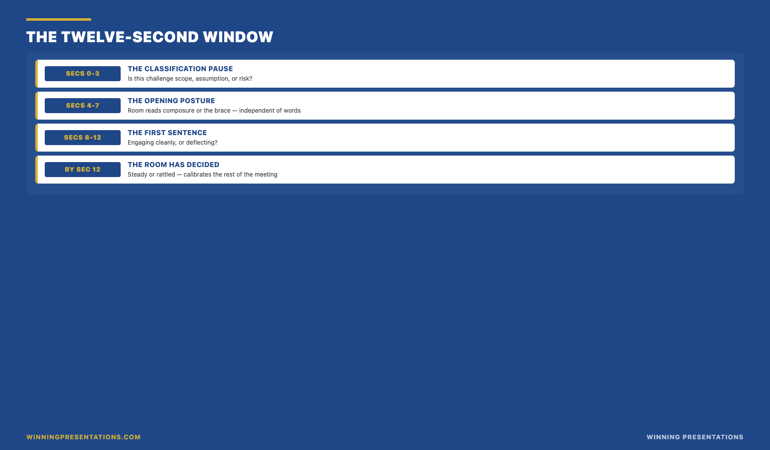
The window I have come to call the twelve seconds begins the moment the opener lands and runs through the end of the presenter’s first sentence of response. It is shorter than people think. By second twelve, the rest of the board has formed a quiet assessment of whether the presenter is steady or rattled, and that assessment will colour the entire subsequent exchange. The twelve seconds break, roughly, into three parts. The first three seconds are the pause — the deliberate gap in which the trained presenter classifies the challenge type and selects a response stance. The next four or five seconds are the opening posture — the small physical adjustments the room reads as composure or as bracing. The remaining seconds carry the first sentence of the substantive response, and that sentence is what tells the room whether the presenter is going to engage the challenge cleanly or deflect it.
The room reads each of those three parts independently. A presenter can deliver a perfectly substantive first sentence while still telegraphing brace in the opening posture, and the room will register both signals separately — “the answer was fine, but she was rattled.” That split can survive the rest of the meeting. The board members who have seen the brace will be slightly more alert to other signs of pressure for the rest of the session, even if she handles every subsequent question well. This is why the twelve seconds carry disproportionate weight. They calibrate the room’s reading of everything that follows, not just the answer to this one question.
The opposite is also true. A presenter who handles the twelve seconds well buys herself goodwill that lasts the rest of the meeting. A board that has seen a senior leader take a hard challenge with visible steadiness will give her the benefit of the doubt on softer ones for the next thirty minutes. The investment in those twelve seconds, in other words, pays off well beyond the question itself. This is one of the reasons board veterans rate Q&A handling as the highest-leverage presentation skill at senior levels — the work earns interest across the entire meeting, not just the moment.
The response that works — and the three that do not
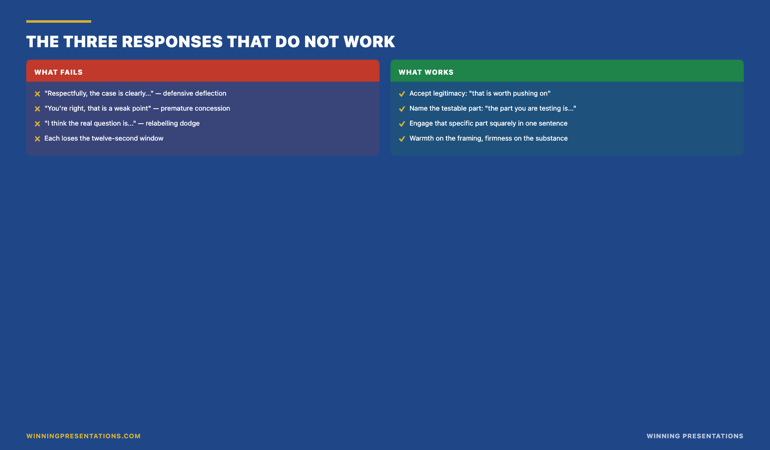
The response that works has a recognisable shape, and it is almost never the one that defensive instincts produce. The shape, in order, is: accept that the challenge is worth making (“that’s worth pushing on” or “that’s the right question”); name the specific part of the case the challenge is testing (“the part I think you are testing is the volume assumption in year two”); and then engage that specific part squarely, ideally in a sentence or two before opening into more detail. The first move — accepting that the challenge is worth making — is the one inexperienced presenters most often skip, because under pressure it feels like a concession. It is not. It is a signal to the room that you read the challenge as legitimate rather than as an attack, and it changes the temperature of the next sixty seconds.
Three responses do not work, and it is worth naming them because senior presenters fall into them often. The defensive deflection — “respectfully, the case is clearly…” — tells the room you read the challenge as an attack, and the rest of the board will mentally shift slightly toward the challenger. The premature concession — “you’re right, that is a weak point” — gives away the case before you have heard what the challenge is actually testing, and is often worse than the deflection because it confirms the implicit critique without the chance to clarify. The relabelling dodge — “I think the real question is…” — reads as an attempt to redirect away from the challenge, and the room registers that as evasion. Each of the three is a normal instinct under pressure. Each of the three loses the twelve-second window.
The reason the working response is harder than it looks is that it requires the presenter to do two cognitively different things at once: to accept the legitimacy of the challenge while not yet conceding the substance. That combination — warmth on the framing, firmness on the substance — is what produces the steady-looking response the room reads as authority. Most presenters can do one of the two halves naturally; doing both at once is the trained move. It is what the drill in Q&A handling training for executives is largely aimed at producing, and what the prepared opening lines for each pattern are designed to support. The pause that precedes the opening line is described in more detail in the pre-answer pause in executive Q&A.
The presenter who treats the challenge as a structured invitation gets the cleaner outcome.
The Executive Q&A Handling System gives you the response repertoire for the three common shapes “I’d like to challenge that” introduces — scope, assumption, and risk — alongside the other five patterns that account for almost every difficult board question. The taxonomy, the prepared opening lines, and the drill protocol that turns recognition into reflex. £39, lifetime access, the same system used by senior leaders who walk out of board meetings with cleaner approvals.
- Recognising the three challenge shapes within the first three seconds of the opener
- The prepared opening line for each — the warmth-on-framing, firmness-on-substance move
- The three responses that do not work, and how to drill out of them
- The 45-second response structure for decision-safe answers
What happens after the answer lands
The exchange does not end with your response. What the challenger does next is a second signal — and one most presenters miss because they are still mentally finishing their own answer when it arrives. Three reactions are common, and each one tells you something specific about how the room read the response. Reaction one: the challenger nods once and says something like “thank you” or “fair enough” and the conversation moves on. This means the response landed cleanly and the rest of the board has settled. The presenter who is paying attention notices the nod and lets the next question come from somewhere else, rather than over-explaining and stretching the moment.
Reaction two: the challenger comes back with a refinement — “yes, but specifically on year three, I would have thought…” This is good news, not bad. It means the response was good enough that the challenge has narrowed, and the refinement is a smaller, more answerable question than the original. The presenter who treats the refinement as an escalation usually overcooks the response. The presenter who treats it as evidence of progress — the challenge surface is shrinking — handles it briefly and closes the exchange. Reaction three: the challenger reformulates the original challenge, with slightly different language. This is the one to pay attention to. It usually means the response addressed the surface of the challenge but missed the underlying one, and the challenger is giving you a second chance to spot it. The presenter who pauses again before answering the reformulation, and uses that pause to ask herself what the underlying concern might be, usually catches it. The presenter who answers the reformulation as if it were a new question often does not.
The closing of the exchange matters as much as the opening. A clean close — the challenger nods, the chair moves on, the room settles — is partly produced by the presenter not over-extending the answer. Most senior leaders, when relieved that the challenge has gone well, add one more sentence. That sentence almost always weakens the answer. The discipline of stopping at the natural close is harder than it sounds, because the relief makes you want to confirm that the answer worked. The room does not need the confirmation. They have already moved on.
The challenge is not a fight. It is a test of whether you can hear it as the invitation it is.
The senior leaders who handle “I’d like to challenge that” well are not the ones who push back hardest. They are the ones who heard it as a structured invitation, accepted the legitimacy, named what was being tested, and answered that one cleanly — in under twelve seconds before they opened their mouth. The Executive Q&A Handling System is the work that trains you for the welcome, not just the fight. £39, lifetime access, no live calls, no deadlines.
Frequently asked questions
What if the challenger really is being hostile and not just stress-testing?
It happens, but it is much rarer than presenters under pressure assume. Most “I’d like to challenge that” openers are structured stress tests delivered by a board member doing the role they are paid to do. Genuinely hostile challenges have a different signature — they tend to skip the formal opener and use sharper, more personal language. If you are in the rare case where the challenge is actually hostile, the response that works is still the same in shape: accept the legitimacy, name what is being tested, and answer it squarely. The difference is that the chair will usually step in faster on a hostile exchange, and your job is to handle the substance cleanly until they do.
Should I prepare a response to “I’d like to challenge that” specifically?
You should prepare to recognise it and to land the three-move shape that works for it, yes. What you cannot usefully prepare is the substance of the answer, because that depends on which part of your case is being tested, and you do not know that yet. What you can prepare are the opening words — “that’s worth pushing on” or equivalents that signal acceptance without conceding — and the discipline to follow them with a sentence that names the specific testable part of the case. Those two pieces of preparation are reusable across every “I’d like to challenge that” exchange you will ever have, and they sit underneath whatever substance follows.
What is the most common mistake senior presenters make in the first sentence of response?
Beginning with “respectfully” or “with respect.” Both phrases telegraph that the presenter has read the challenge as adversarial, and both invite the room to read what follows as a defence rather than as engagement. The phrasing is also slightly condescending in board contexts, even when it is not meant to be, because it implies that the questioner needs to be reassured that the presenter is not being rude — a reassurance no senior board member required. The fix is to replace “respectfully, the case is…” with “that’s worth pushing on — the part you’re testing is…” The first move changes the temperature of the exchange before the substantive answer arrives.
Does it matter whether I am right about which part of the case is being tested?
Yes, but less than people fear. If you name the wrong part of the case, the challenger will simply correct you — “no, it is more about the cost assumption than the volume one” — and you respond to the corrected version. The act of naming a specific part of the case is what signals to the room that you are engaging the challenge structurally rather than defensively, and the room reads that signal regardless of whether your first guess was the right one. Being precise is better than being vague; being slightly wrong on the precise version is much better than being right but vague.
The Winning Edge — weekly newsletter
The Winning Edge is a weekly newsletter for senior professionals who present at the executive level. One short email a week on the structural moves that separate decks committees back from decks they defer. Subscribe to The Winning Edge →
For the wider set of presentation assets that pair with the Q&A repertoire — the slide system, the storytelling primer, and the delivery references — the Complete Presenter bundle (£99) collects them in one place.
About the author
Mary Beth Hazeldine is Owner & Managing Director of Winning Presentations Ltd. With 24 years of corporate banking experience at JPMorgan Chase, PwC, Royal Bank of Scotland, and Commerzbank, she advises executives across financial services, healthcare, technology, and government on structuring presentations for high-stakes funding rounds, board approvals, and strategic decisions.
The presenter who hears “I’d like to challenge that” and accepts the legitimacy of the challenge in the first sentence gets the clean approval. The presenter who hears it as a fight and starts with “respectfully” gets the deferral with three caveats. Same paper, same challenger, same room — different twelve seconds.