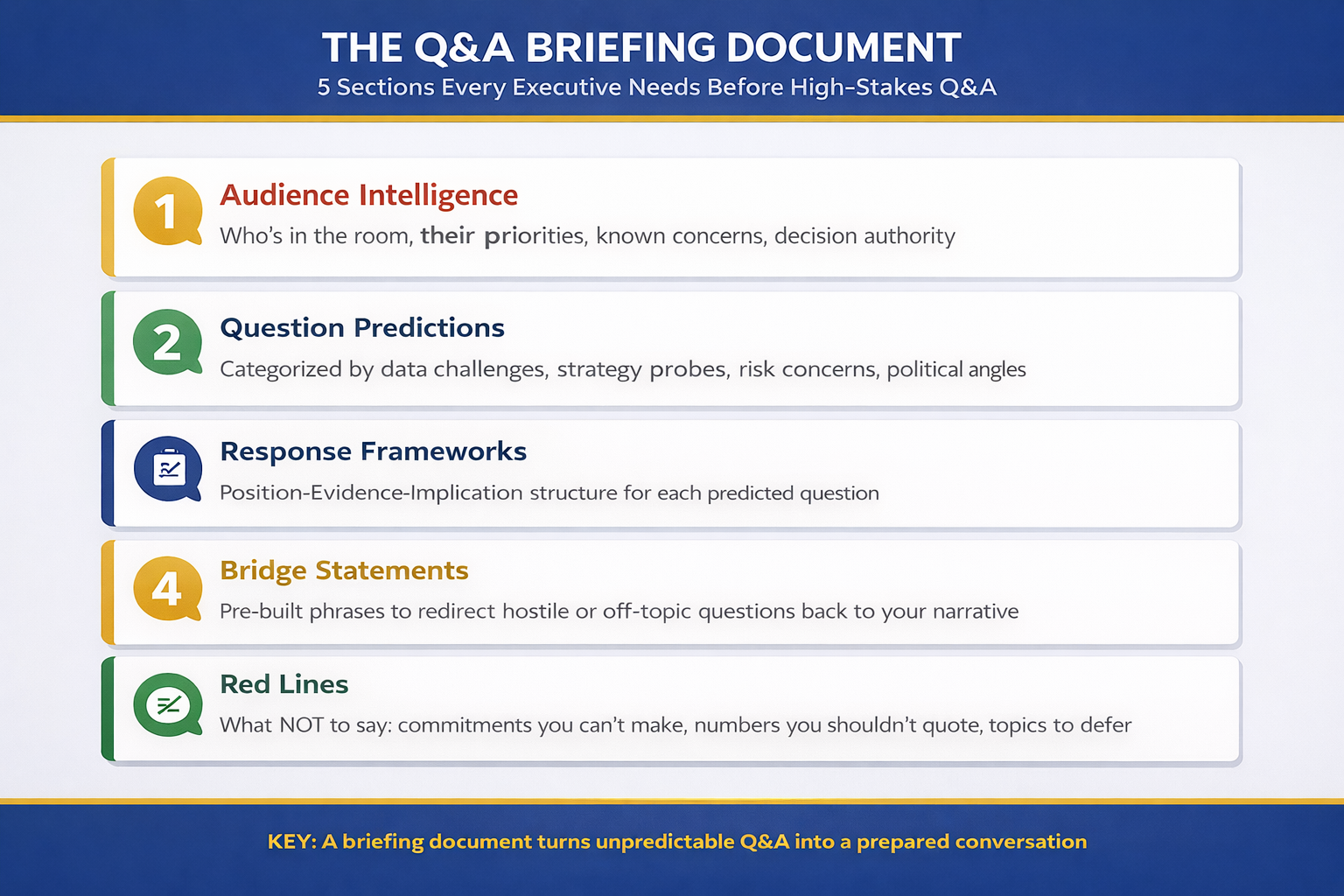
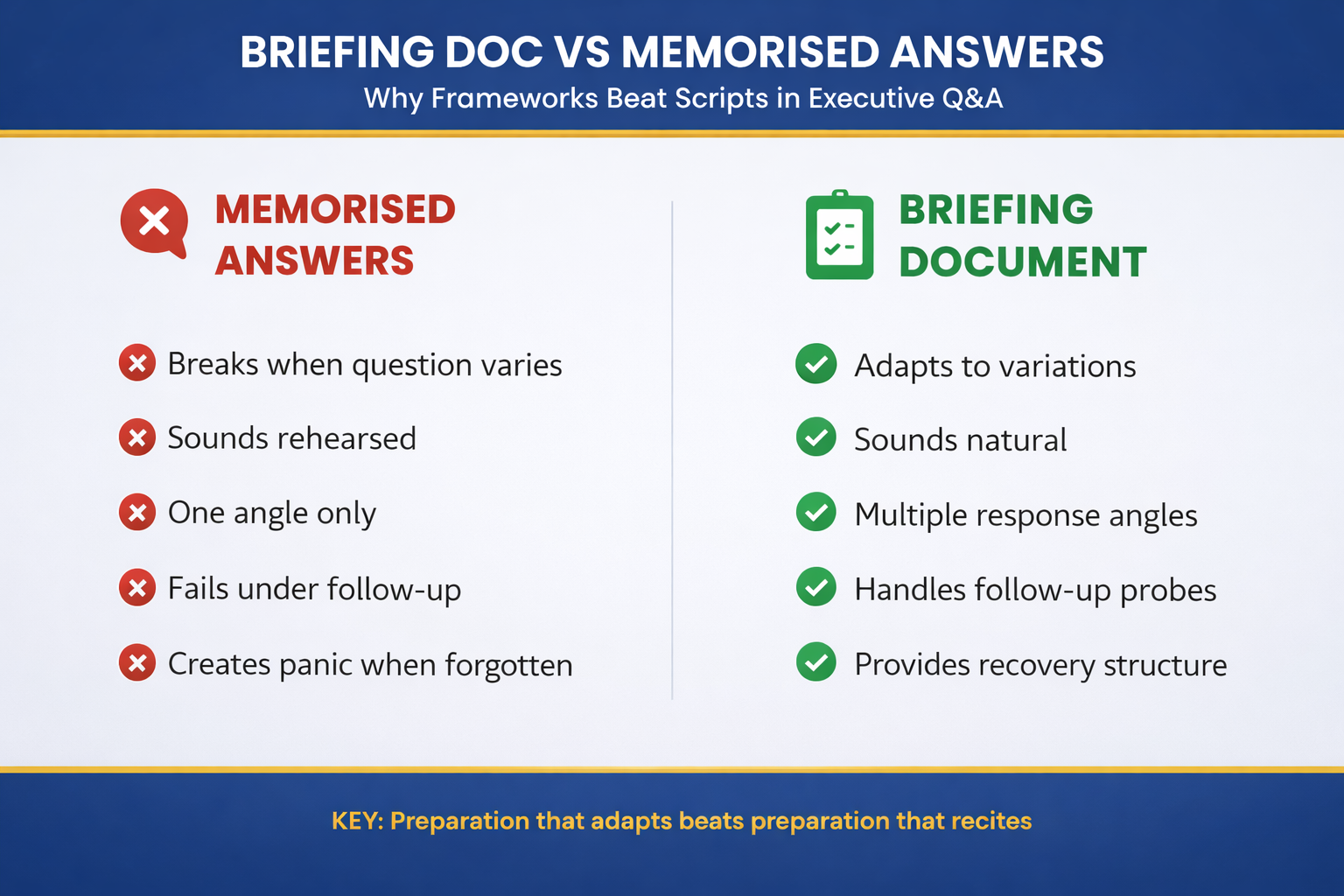
Tag: presentation Q&A

27 Feb 2026
A professional woman standing alone at the end of an empty corporate boardroom after her presentation, surrounded by vacant leather chairs, capturing the silence and isolation when no one asks questions

No Questions After Your Presentation? That Silence Isn’t Approval

When nobody asks questions after your presentation, it rarely means unanimous agreement. It almost always means your audience disengaged before you finished. The silence feels comfortable in the moment — but the decision that follows is usually “deferred,” “let’s revisit,” or a quiet no. This article gives you three techniques to prevent post-presentation silence and one recovery protocol for when it’s already happened.

Eight executives. Forty-five minutes. Zero questions.

I was 18 months into my role at JPMorgan Chase, presenting a credit facility to the investment committee. I’d prepared for weeks. The analysis was tight. The recommendation was clear. When I finished and said “any questions?” — silence. Complete, polite, devastating silence.

I walked out thinking it went well. No pushback meant agreement, right?

The decision came back “deferred” — which in investment banking means nobody cared enough to engage. My presentation hadn’t failed on content. It had failed on engagement. The committee hadn’t disagreed with me. They’d stopped listening to me somewhere around slide 11.

The second time I presented to that committee, I planted three decision hooks throughout the deck — specific moments designed to make them lean in. Five questions in Q&A. Approved same meeting.

That was the day I learned: silence after a presentation isn’t the absence of objections. It’s the absence of interest. And interest is something you have to engineer deliberately.

Committee or leadership presentation this week?

Quick diagnostic: count the moments in your deck where you deliberately invite the audience to react — not at the end, but during the presentation. If the answer is zero, silence in Q&A is almost guaranteed. A structured engagement protocol fixes this before you walk in. See the Executive Q&A Handling System →

Why Silence Is Worse Than Tough Questions

Most professionals fear hostile questions. They shouldn’t. The most dangerous Q&A outcome isn’t a difficult question — it’s no questions at all.

Here’s why. When someone asks a tough question, they’re telling you three things: they listened, they care about the outcome, and they’re mentally engaged with your recommendation. Even a hostile question is a form of investment. That person is spending cognitive energy on your proposal.

Silence means none of those things happened.

In 25 years of corporate banking — across JPMorgan Chase, PwC, Royal Bank of Scotland, and Commerzbank — I’ve sat in hundreds of committee meetings. The presentations that got approved almost always generated questions. The ones that got deferred or quietly rejected? Silence.

Why does nobody ask questions after my presentation?

There are three common reasons: your content was too dense for the audience to process in real time, your structure didn’t create natural engagement points, or your conclusion didn’t require a decision. In all three cases, the fix is structural — not about your delivery or confidence. You need to build question-generating moments into your deck, not hope they emerge after it.

The pattern across executive presentations is consistent: silence is almost never about content quality. It’s about structural engagement. A brilliant 35-slide analysis that doesn’t create tension, choice points, or moments of surprise will get silence every time — regardless of how good the data is.

This is exactly what kills engagement in most corporate presentations — the assumption that good content automatically produces good discussion.

The Silence Protocol: 3 Prevention Techniques

After that JPMorgan experience, I spent years studying what separated presentations that generated rich Q&A from those that got polite silence. The difference was never the presenter’s confidence or charisma. It was always structural.

The presentations that generated questions had something built into them — deliberate engagement architecture. I call these the three prevention techniques.

Each one works by creating what psychologists call “knowledge gaps” — moments where the audience’s brain recognises it needs more information. When you create enough of these gaps during your presentation, questions become inevitable. The audience isn’t choosing to engage. They can’t help it.


Diagram showing The Silence Protocol with three prevention techniques: decision hooks, open loops, and planted controversy, plus one recovery method for post-presentation silence

Technique 1: Decision Hooks

A decision hook is a moment in your presentation where you explicitly frame a choice — and then move on without resolving it completely.

Here’s what this looks like in practice. Instead of presenting your recommendation as a conclusion, you present it as one of two possible paths: “There are two ways we could approach this implementation — a phased rollout over 12 months, or a full deployment in Q3. I’m recommending the phased approach, and I’ll show you why in the next three slides.”

The audience now has something to evaluate. They’re not passively receiving information. They’re mentally testing your recommendation against the alternative you just planted. By the time you reach Q&A, at least one person will ask about the path you didn’t recommend.

Where to place decision hooks: Slide 3 (after your executive summary), at the midpoint of your presentation, and one slide before your recommendation. Three hooks is the minimum. I plant them at the same points where I’d forecast likely questions using a question map — because the same structural moments that generate questions are the ones where hooks land hardest.

The formula: “There are [two/three] ways to approach [specific decision]. I’m recommending [option] because [one-sentence reason]. Let me show you the evidence.”

Diagram showing where to place decision hooks in a presentation: after the executive summary at slide 3, at the midpoint, and before the recommendation, with the decision hook formula and three reasons why it works

Turn Post-Presentation Silence Into Engaged, Productive Questions

The Executive Q&A Handling System (£39, instant access) gives you the complete framework for engineering audience engagement — including the question forecasting method, decision hook templates, and the Headline → Reason → Proof → Close structure that creates natural question points throughout any presentation.

  • The Question Forecasting method — predict and plant the exact questions your audience will ask
  • Engagement trigger templates that create knowledge gaps your audience can’t ignore
  • Recovery scripts for when silence has already happened (the “redirect and re-engage” protocol)
  • The 4-part answer structure that turns every question into a credibility-building moment

Get the Executive Q&A Handling System → £39

Built from 25 years of investment committee presentations. £39, instant access — no subscription.

Technique 2: Open Loops

An open loop is a piece of information you introduce but don’t complete. Your audience’s brain will hold that loop open until it gets resolved — and if you don’t resolve it fully during the presentation, they’ll ask about it in Q&A.

This isn’t manipulation. It’s how the brain processes incomplete information. Psychologists call it the Zeigarnik effect: unfinished tasks create cognitive tension that demands resolution.

Here’s an example from a real client presentation. A director was presenting a restructuring plan to the board. Instead of laying out every detail sequentially, she opened with: “This restructuring will affect three departments — but the impact on each is very different. I’ll walk you through engineering and operations today. The third department is where the real decision sits, and I’ve saved it for the end.”

The board was leaning forward by slide 4. By the time she reached the third department, two members had already prepared questions. The Q&A ran 20 minutes — exactly what she wanted.

How to create open loops:

  • The preview loop: “I’ll share the data that changed our recommendation — but first, let me show you what we originally assumed.”
  • The exception loop: “This approach works in every scenario except one. I’ll get to that exception in a moment.”
  • The contrast loop: “Our competitor took the opposite approach. The results are striking — and I’ll show you why our path is different.”

Each of these creates a gap your audience needs filled. And if you leave even one loop partially open, someone will ask about it. That’s not a risk — that’s the entire point.

Don’t want to write engagement triggers from scratch?

The Executive Q&A Handling System gives you the engagement trigger templates, decision hooks, and open-loop frameworks ready to use in any high-stakes presentation. £39, instant download — lifetime access.

Get the Q&A Handling System →

Is silence after a presentation good or bad?

In almost every corporate context, silence after a presentation is a negative signal. It typically indicates one of three things: the audience didn’t understand enough to form questions, the content didn’t create enough engagement to provoke curiosity, or the decision-makers have already mentally checked out. The rare exception is when the recommendation is so clear and well-supported that immediate approval follows — but in 25 years, I’ve seen that happen perhaps five times. If silence is followed by “we’ll come back to you” rather than an immediate decision, it wasn’t agreement. It was disengagement.

Technique 3: Planted Controversy

This is the technique most executives resist — and the one that works most reliably.

A planted controversy is a moment where you deliberately present a counterargument to your own recommendation. Not to undermine yourself — to create intellectual tension that demands discussion.

Here’s why it works. When you present a recommendation with no counterpoint, the audience has nothing to push against. Agreement is passive. But when you say “The strongest argument against this approach is X — and here’s why I still recommend it,” you’ve given the audience something to evaluate. You’ve shown intellectual honesty. And you’ve created a natural question point.

At Commerzbank, I watched a risk director use this brilliantly. He was recommending a credit line extension that the committee was likely to reject. Instead of pretending the risk didn’t exist, he opened his recommendation slide with: “The obvious concern with this extension is the sector’s volatility over the past two quarters. If I were sitting where you are, I’d ask why we’re recommending increased exposure.”

He then answered his own planted question with three data points. The committee didn’t need to voice the objection — he’d already addressed it. But the technique had a secondary effect: it opened the door for more nuanced questions. Instead of “isn’t this too risky?” they asked “what’s the exit strategy if volatility continues?” — a far more productive conversation.

How to plant controversy effectively:

  • Identify the strongest objection to your recommendation before you present
  • State it directly: “The biggest risk with this approach is…”
  • Answer it with evidence — but leave 10% of ambiguity
  • That 10% becomes a Q&A question you’ve already prepared for

This technique connects directly to question forecasting — if you can predict what the audience will object to, you can plant that controversy deliberately and control the conversation.

Stop Hearing Silence After Every Presentation You Give

The silence problem isn’t about your delivery or your data. It’s about structure — and structure is fixable. The Executive Q&A Handling System (£39, instant access) gives you the complete engagement architecture so you never face dead silence again.

  • Decision hook templates you can drop into any presentation in 10 minutes
  • The open loop formula that makes your audience need to ask questions
  • Planted controversy scripts for high-stakes committee presentations
  • The complete recovery protocol for when silence has already happened

Get the Executive Q&A Handling System → £39

Designed for executives presenting to investment committees, boards, and senior leadership — where silence means a deferred decision. £39, instant access.

The Recovery: When Silence Has Already Happened

Prevention is ideal. But sometimes you’re standing at the front of a room and it’s already happened. You’ve said “any questions?” and you’re staring at eight faces that aren’t going to speak.

First: do not fill the silence yourself. The instinct is to keep talking — to summarise, to add caveats, to ramble into your own recommendation. Every word you say in that moment reduces the pressure on the audience to engage. The silence is uncomfortable for them too. Let it work.

Wait a full five seconds. It will feel like thirty. Then use one of these recovery lines:

he Silence Recovery Protocol showing Step 0 wait 5 seconds followed by three recovery options: The Redirect, The Specific Question, and The Stakeholder Call, each with the exact script to use and why it works

The redirect: “Let me ask this a different way — if you were going to push back on one part of this recommendation, which part would it be?”

This works because it reframes the question from “do you have anything to say?” (which allows passivity) to “which specific thing would you challenge?” (which assumes engagement).

The specific question: “The implementation timeline is where I expect the most debate. What’s your reaction to the Q3 target?”

This works because it removes the paradox of choice. Instead of asking the audience to generate a question from nothing, you’re giving them a specific anchor to respond to.

The stakeholder call: “[Name], I know this affects your division directly — what’s your initial reaction?”

This works because it shifts from an open-room question (where diffusion of responsibility means nobody speaks) to a direct, personal invitation. One person speaking breaks the silence for everyone.

How do you encourage questions after a presentation?

The most effective way to encourage questions isn’t to ask for them differently at the end — it’s to build question-generating moments throughout the presentation itself. Decision hooks, open loops, and planted controversies all create cognitive gaps that the audience needs resolved. By the time you reach Q&A, the questions already exist in their minds. You don’t need to encourage them. You just need to create the space for them to emerge. If you’re already at the “any questions?” moment and facing silence, redirect with a specific prompt: “If you were going to challenge one part of this, which part would it be?” This reframes from passive to active and almost always breaks the silence.

Is This Right For You?

The Executive Q&A Handling System is built for you if:

  • You present to committees, boards, or senior leadership where Q&A determines the outcome
  • You’ve experienced post-presentation silence and the “deferred” decisions that follow
  • You want to engineer engagement into your presentation structure rather than hope it happens
  • You need recovery scripts for when silence has already occurred

It’s probably not right if you already get strong audience engagement and your Q&A sessions run long. In that case, you might benefit more from handling the difficult questions that do come up.

🎓 25 Years of Boardroom Q&A. One System.

The Executive Q&A Handling System is built from 25 years of corporate banking and 16 years coaching senior professionals across financial services, healthcare, technology, and government. Every framework — the engagement triggers, the silence prevention protocol, the recovery scripts — comes from real boardroom situations where the room’s response decided whether the proposal moved forward.

Designed for senior professionals who present to boards, investment committees, and executive sponsors where engagement signals decisions.

Get the Executive Q&A Handling System → £39

Instant download — lifetime access to every framework and template.

Frequently Asked Questions

What if the silence genuinely means they agree?

It’s possible but rare. In my experience, genuine agreement after a presentation is followed by an immediate decision — “approved,” “let’s proceed,” or a direct next-step conversation. If the silence is followed by “we’ll come back to you,” “let’s take this offline,” or “deferred for further review,” it wasn’t agreement. It was disengagement. The safest approach is to build engagement architecture into every presentation. If they genuinely agree, the techniques in this article won’t harm your outcome. If they don’t agree, the techniques will surface the real objections before the meeting ends.

Won’t planting controversy make me look uncertain about my own recommendation?

The opposite. Addressing the strongest counterargument to your own recommendation demonstrates intellectual honesty and thoroughness. Investment committees and senior leadership teams respect presenters who acknowledge risk rather than pretend it doesn’t exist. The key is in the execution: state the counterargument clearly, then answer it with evidence. You’re not expressing doubt — you’re showing you’ve already considered and resolved the most likely objection.

How many decision hooks is too many?

Three is the sweet spot for a 20–30 minute presentation. One after your executive summary, one at the midpoint, and one before your final recommendation. More than five and the audience feels manipulated — each hook creates cognitive work, and too many will exhaust rather than engage. Fewer than two and you’re relying on the content alone to generate questions, which rarely works in committee settings.

📬 The Winning Edge — Weekly Newsletter

One executive presentation insight per week. Real scenarios, real scripts, zero filler. Written for professionals who present to decision-makers.

Subscribe Free →

📊 Presenting a budget defence this quarter? When finance wants to cut your team’s funding, the wrong slide structure guarantees you lose. Read: The Budget Defence Presentation: When Finance Wants to Cut Your Team’s Funding

Your next step: Before your next committee or leadership presentation, count the engagement moments in your deck. If you have fewer than three decision hooks, open loops, or planted controversies, add them now. The difference between silence and five productive questions isn’t talent or confidence — it’s structure.

About the Author

Mary Beth Hazeldine is the Owner & Managing Director of Winning Presentations. With 25 years in corporate banking — including roles at JPMorgan Chase, PwC, Royal Bank of Scotland, and Commerzbank — she advises executives across financial services, healthcare, technology, and government on high-stakes presentations and committee-level Q&A. A qualified clinical hypnotherapist and NLP practitioner, Mary Beth combines boardroom experience with evidence-based psychology to help professionals present with authority and close with confidence.

20 Feb 2026
Why Executives Ask Questions They Already Know the Answer To (And What They're Really Testing)

Why Executives Ask Questions They Already Know the Answer To (And What They’re Really Testing)

Quick answer: When executives ask questions during your presentation, they usually aren’t looking for information — they’re running a trust test. They want to know whether you understand the real issue, whether you’ve thought beyond your slides, and whether you stay composed under pressure. Once you learn to decode what’s actually being tested, handling executive questions becomes a completely different skill.

The Question That Wasn’t Really a Question

The CFO already knew the answer. I could see it on his face.

We were in a quarterly review at Royal Bank of Scotland. I’d just presented the client retention numbers — solid figures, well-structured slide. Then the CFO leaned forward and asked: “What’s driving the 3% attrition in the Northern portfolio?”

I knew the answer. He knew I knew the answer. He already had the regional breakdown on his desk — I’d seen it there when I walked in.

But I panicked. I started over-explaining. I gave him the complete history of the Northern portfolio, the market conditions, the competitive dynamics. By the time I finished, two minutes had passed and the room had glazed over.

A colleague presented after me. The CFO asked her a similar question. She said: “Two factors. The repricing in March caught three mid-tier clients off guard, and our response time on renewals was too slow. We’ve already addressed both — I can share the specifics if useful.”

Twelve seconds. She was done. The CFO nodded and moved on.

That’s when I understood something that took me years to fully appreciate across 24 years in corporate banking: executive questions during presentations are almost never about getting information. They’re about testing whether you understand the information well enough to be trusted with what comes next.

Once I learned to decode what executives are actually testing — rather than just answering what they’re literally asking — handling questions in board presentations and senior leadership meetings became the strongest part of my presentations, not the most feared.

Stop Guessing What Executives Actually Want to Hear

The Executive Q&A Handling System gives you frameworks for decoding questions, structuring 15-second answers, and recovering when you don’t know — without losing credibility.

Get the Q&A Handling System → £39

Built from 24 years of boardroom experience across banking and consulting environments.

Why Executive Questions Are Never Really About the Question

Here’s what most presenters get wrong: they hear a question and immediately try to answer it. They treat executive Q&A like an exam — as if the goal is to prove they know the material.

But executives rarely ask questions to learn basic facts. They have analysts, reports, and dashboards for that. They ask questions to evaluate you. Specifically, they’re evaluating three things: your depth of understanding, your judgement, and your composure. This is why getting executive buy-in depends as much on how you handle questions as on what’s in your slides.

I saw this dynamic play out hundreds of times across my banking career. A managing director at JPMorgan once told me something I never forgot: “I already know 80% of what’s in your presentation before you start. The questions are how I figure out the 20% that matters — and whether you know which 20% that is.”

That single insight changes everything about how you prepare for executive Q&A. You stop memorising facts and start thinking about what the questioner is actually evaluating.

The Trust-Test Framework showing three types of executive questions: Knowledge Test, Alignment Test, and Pressure Test with what each is really evaluating

The Trust-Test Framework: 3 Types of Executive Questions

Every question an executive asks during your presentation falls into one of three categories. Once you can identify which type you’re facing, the correct response becomes obvious.

Type 1: The Knowledge Test. This is the question from my CFO story. They already know the answer — they’re testing whether you do. The trap is over-explaining. When you give a two-minute answer to something that requires ten seconds, you signal insecurity. You’re telling the room: “I’m not confident enough to be brief.”

❌ Wrong response to a Knowledge Test: “Well, there are several factors at play here. If you look at the Northern portfolio historically, we’ve seen a trend since Q3 of last year where the mid-tier segment has been under pressure from competitor repricing, and additionally our internal response times on renewal processing have been impacted by the system migration…”

✅ Right response: “Two factors: competitive repricing in March and slow renewal response times. Both addressed — happy to go into specifics.”

The right response does three things: it proves you know the answer, it shows you can prioritise, and it hands control back to the executive. If they want more detail, they’ll ask. If they don’t, you’ve just demonstrated exactly the kind of judgement they were testing for.

Type 2: The Alignment Test. This is the question that sounds like a challenge but is actually a check on whether you’ve thought about the issue from their perspective. At PwC, I watched a partner ask a senior consultant: “How does this recommendation affect the timeline for the regulatory submission?” The consultant’s recommendation was sound. But the partner wasn’t questioning the recommendation — he was checking whether the consultant had considered the one thing keeping him up at night.

❌ Wrong response to an Alignment Test: “The timeline shouldn’t be affected. Our analysis shows that the current approach is the most efficient option based on the data.”

✅ Right response: “It adds approximately two weeks to the regulatory timeline. I’ve mapped out how to absorb that within the existing buffer — slide 8 has the detail if you’d like to see it.”

The Q&A Handling System teaches you to decode what’s really being asked — and respond in 15 seconds or less, every time.

Get the Q&A Handling System → £39

The wrong response defends your work. The right response acknowledges the executive’s concern, shows you’ve already thought about it, and offers proof. That’s the difference between someone who presents information and someone who demonstrates judgement.

Type 3: The Pressure Test. This is the question designed to see how you react when challenged. It might sound aggressive: “Why should we believe this forecast when the last one was 15% off?” It might sound sceptical: “Isn’t this just what we tried in 2023?” At Commerzbank, I watched a board member deliberately challenge a strong proposal just to see if the presenter would fold or hold.

❌ Wrong response to a Pressure Test: “Well, the circumstances were different then, and I think if you look at the methodology we’ve used this time, you’ll see that we’ve improved our approach significantly, and the margin of error is much lower now…”

✅ Right response: “Fair challenge. The 2023 forecast used a single-scenario model. This one stress-tests three scenarios — worst case still delivers 8% above breakeven. The methodology comparison is on slide 14 if that’s useful.”

Notice what the right response does: it doesn’t get defensive, it doesn’t apologise, and it doesn’t over-explain. It acknowledges the challenge (“Fair challenge”), gives the key differentiator in one sentence, provides proof, and offers more detail only if the executive wants it.

The Wrong vs. Right Pattern That Applies to Every Executive Question

Across all three trust-test types, the pattern is the same. Here’s the formula that works in every executive-level presentation:

❌ Wrong pattern: Hear question → feel threatened → start explaining → add context → add more context → hope the executive stops you → realise you’ve been talking for 90 seconds → trail off weakly.

✅ Right pattern: Hear question → identify the trust test → give the headline answer (one sentence) → offer proof or a slide reference → hand control back.

The entire right pattern takes 10-15 seconds. That’s not a guess — I’ve timed hundreds of executive Q&A sessions across my career. The answers that build the most trust are almost always under 20 seconds. The answers that destroy trust are almost always over 60 seconds.

Here’s one more wrong/right comparison that captures the principle perfectly:

❌ What most people do when a board member asks “What’s the risk here?”: They list every risk they can think of, show they’ve done thorough analysis, and end up making the proposal sound dangerous. Two minutes later, the room is more worried than when the question was asked.

✅ What experienced presenters do: “The primary risk is execution timing — specifically the Q3 integration window. We’ve built in a two-week buffer and a fallback option. The risk register is in the appendix.” Fifteen seconds. The board member nods. The proposal still has momentum.

Wrong versus right response pattern showing the long rambling answer compared to the Trust-Test response of headline answer plus proof plus control handback

Turn Q&A Into the Strongest Part of Your Presentation

The Executive Q&A Handling System includes frameworks for predicting questions, structuring 15-second answers, and handling “I don’t know” moments — all built for boardroom-level conversations.

Get the Q&A Handling System → £39

Built from 24 years in banking and consulting environments. Used in board meetings, steering committees, and investor presentations.

What to Say When You Genuinely Don’t Know the Answer

Not every question is a trust test you can decode and pass. Sometimes you genuinely don’t know the answer. And this is where most presenters make the worst mistake of all: they bluff.

I watched a VP at Commerzbank try to answer a technical question about derivatives exposure that he clearly didn’t have the numbers for. He improvised for about 45 seconds. The CFO let him finish, then said: “That’s not what I asked.” The room went silent. His credibility for the rest of the meeting was gone.

The correct response when you don’t know is the simplest one — and the one that actually builds trust:

❌ Wrong: “That’s a great question. I believe the figure is somewhere around… let me think… I want to say it’s approximately 12%, but I’d need to verify that. The general trend has been…”

✅ Right: “I don’t have that specific figure to hand. I’ll confirm it by end of day and send it through. What I can tell you now is that the overall trend supports the recommendation — the exact number won’t change the direction.”

That response does four things: it’s honest, it commits to a specific follow-up action, it gives the executive something useful right now, and it reframes the gap as non-critical to the decision. Executives respect all four of those things far more than a guess.

If you struggle with the pressure of these high-stakes moments — where your career credibility is on the line — you’re not alone. Many of the executives I work with find that having a reliable presentation structure for career-defining conversations reduces the anxiety of Q&A significantly.

Knowing what to say — and what NOT to say — when you don’t have the answer is one of the most valuable executive communication skills. The Q&A Handling System covers exactly this.

Get the Q&A Handling System → £39

Common Questions About Handling Executive Questions in Presentations

Why do executives ask questions they already know the answer to?

Executives use questions as trust tests — not information requests. They’re evaluating whether you understand the material deeply enough to be brief, whether you’ve considered their priorities, and whether you stay composed under challenge. The question itself is rarely the point. Your response reveals your judgement, your preparation, and your confidence — all of which influence whether the executive trusts you with bigger responsibilities and decisions.

How do you handle tough questions from senior leadership in a presentation?

Identify which type of trust test you’re facing: a Knowledge Test (they know the answer — be brief), an Alignment Test (they want to know you’ve considered their concern — acknowledge and show you’ve planned for it), or a Pressure Test (they’re challenging to see your composure — acknowledge the challenge, give one differentiator, offer proof). In all three cases, keep your answer under 20 seconds and hand control back to the questioner.

What do board members want to hear during presentation Q&A?

Board members want brevity, honesty, and evidence of judgement. They want to hear that you understand the core issue (not just the surface question), that you’ve considered the risks and trade-offs, and that you can distinguish between what matters and what doesn’t. The fastest way to build trust in board Q&A is to answer in one sentence, offer a proof point, and let the board member decide if they want more detail.

The Q&A Is Where Decisions Actually Get Made

Your slides set up the case. The Q&A is where the executive decides whether to trust it. The Executive Q&A Handling System gives you the frameworks to pass every trust test — whether you know the answer or not.

Get the Q&A Handling System → £39

Built from 24 years in banking and consulting. Used in board meetings, steering committees, and investor presentations.

Optional: The Q&A Handling System is also available as part of The Complete Presenter (£99) — seven products covering slides, storytelling, confidence, and delivery.

Frequently Asked Questions

What if the executive question is genuinely hostile — not a trust test?

Genuine hostility is rarer than people think, but it happens. The response is the same: acknowledge, answer briefly, and don’t get defensive. “I hear your concern. Here’s what the data shows…” works in hostile environments because it refuses to escalate. The executive either accepts your response or pushes further — but either way, the room sees you as composed. That composure is itself a trust signal, and it often matters more than the content of your answer.

Can I prepare for trust-test questions in advance?

Yes — and you should. Before any executive presentation, identify the three questions the most senior person in the room is most likely to ask. For each one, prepare a headline answer (one sentence), a proof point, and a slide reference. This takes ten minutes and eliminates 80% of Q&A anxiety. The remaining 20% is unpredictable, but the framework still applies: identify the trust test, give the headline, offer proof, hand back control.

Does this work in virtual presentations where you can’t read body language?

The Trust-Test Framework works regardless of format because it’s about the structure of your answer, not the visual cues you’re reading. In virtual settings, the framework actually matters more because you have fewer signals to work with. The 15-second answer discipline is especially critical on video calls where attention spans are shorter and rambling is more noticeable. One practical adjustment: pause for a beat before answering. On video, this reads as thoughtful rather than slow.

What if my boss is in the room and the executive’s question reveals something my boss didn’t want raised?

This is one of the most politically sensitive Q&A scenarios — and one of the most common. The framework still applies: answer honestly but briefly, and don’t volunteer additional context that expands the issue. “That’s something we’ve identified and are addressing — I can share the plan after this meeting” buys you time without lying, deflecting, or putting your boss in a difficult position. The key is to never throw anyone under the bus and never make up an answer to cover for a gap. Executives can spot both instantly.

📬 Get Weekly Presentation Intelligence

Q&A frameworks, executive communication strategies, and the techniques that work in real boardrooms — delivered every week. No fluff. No spam.

Join the Newsletter

Related: If you’re preparing to present to the person who controls your pay, the Q&A portion is often where the real conversation happens. Read Presenting to the Person Who Will Decide Your Bonus — the 6-slide structure that reframes the entire conversation.

Your next step: Before your next executive presentation, identify the three most likely questions from the most senior person in the room. For each one, write a headline answer in one sentence. That’s it. That ten-minute exercise will change how you experience Q&A — permanently.

Want the complete framework for handling any executive question — including the ones you can’t predict?

Get the Q&A Handling System → £39

About the Author

Mary Beth Hazeldine is the Owner & Managing Director of Winning Presentations. With 24 years of corporate banking experience at JPMorgan Chase, PwC, Royal Bank of Scotland, and Commerzbank, she specialises in executive-level presentation skills and Q&A preparation.

A qualified clinical hypnotherapist and NLP practitioner, Mary Beth combines executive communication expertise with evidence-based techniques for managing presentation anxiety. She has spent 15 years training executives and supporting high-stakes board presentations, steering committee updates, and decision meetings.

Book a discovery call | View services

10 Feb 2026
Executive confidently answering difficult question in boardroom presentation

How to Handle Difficult Questions in a Presentation: The 4-Part Executive System

The CFO leaned forward. “What’s the ROI, and how confident are you in that number?”

I knew the answer. I’d calculated it myself. But in that moment — with twelve executives watching — my mind went blank. I started talking. And talking. Sixty seconds of rambling later, I could see the energy draining from the room.

We lost the deal. Not because of the presentation. The deck was solid. The strategy was sound. We lost it in Q&A, in the space between a reasonable question and an answer that never quite landed.

That was fifteen years ago. Since then, I’ve helped hundreds of executives prepare for exactly these moments — the high-stakes questions that can make or break a decision. What I’ve learned: handling difficult questions is a skill, not a talent. And it’s entirely learnable.

Quick answer: Handle difficult presentation questions using the 4-part system: Forecast the questions before the meeting, Build executive-ready answers using the Headline → Reason → Proof → Close framework, Control the room with bridging phrases and deliberate pacing, and Protect the decision by capturing open loops. Most presenters fail in Q&A because they prepare their slides but not their answers.

Here’s what nobody tells you about executive presentations: the deck is the easy part. You control the narrative. You choose the sequence. You decide what to emphasise and what to minimise.

Q&A is different. Someone asks a question you didn’t anticipate. The room shifts. Suddenly you’re not presenting — you’re defending. And if you don’t have a system for handling that moment, even the best presentation can unravel in sixty seconds.

I’ve watched it happen to brilliant people. Subject matter experts who know their content cold but freeze when challenged. Senior leaders who’ve delivered the same presentation a dozen times but still dread the questions at the end.

The good news: there’s a system that works. I’ve used it myself and taught it to executives facing boards, investors, regulators, and hostile stakeholders. It doesn’t require you to predict every question. It requires you to be ready for any question.

Prefer a ready-made system? The Executive Q&A Handling System gives you the full 4-part framework — forecasting templates, response structures, and bridging phrases — so you don’t have to build it from scratch.

Why Q&A Derails Good Presentations

Most presentation training focuses on delivery. Slide design. Story structure. Eye contact. Voice modulation. All important — but all useless if you lose the room in the last ten minutes.

Q&A derails presentations for predictable reasons:

You answer the question you heard, not the question they asked. Executive questions often have subtext. “What’s the timeline?” might really mean “I’m worried this will slip.” If you answer only the surface question, you miss the real concern.

You go too detailed. When challenged, the instinct is to prove you know your stuff. So you dive into methodology, caveats, edge cases. The executive wanted a 20-second answer. You gave them two minutes. Their eyes glaze over. Your credibility drops.

You get defensive. A sharp question feels like an attack. Your body language shifts. Your tone hardens. Now you’re in a confrontation instead of a conversation. Even if you “win” the exchange, you’ve lost the room.

You ramble while thinking. You don’t know the answer immediately, so you start talking to fill the silence. The longer you talk without landing somewhere, the less confident you appear.

You let one question derail the agenda. Someone asks about a tangent. You engage fully. Twenty minutes later, you’ve never returned to your core message, and the decision you needed hasn’t been made.

Every one of these failures is preventable. Not with more subject matter expertise — with a system.

The 4-Part System That Keeps You in Control

After years of coaching executives through high-stakes Q&A, I’ve distilled the approach into four parts. Each takes 10-20 minutes of preparation. Together, they transform how you handle difficult questions.

Part 1: Forecast the Questions (10 minutes)

Before every high-stakes presentation, spend 10 minutes forecasting the questions that could kill your decision.

Not every possible question — the dangerous ones. The questions that, if answered badly, will derail the meeting.

These cluster into six categories:

  • Money: “What’s the ROI?” / “Why is this the best use of budget?” / “What happens if costs overrun?”
  • Risk: “What could go wrong?” / “What’s your contingency?” / “Why should we believe this will work?”
  • Priorities: “Why this over other initiatives?” / “What are we saying no to?”
  • Time: “Why now?” / “What if we wait six months?” / “Can this be done faster?”
  • People: “Do we have the capability?” / “Who’s accountable?” / “What about the team impact?”
  • Credibility: “How do you know?” / “What’s this based on?” / “Who else has done this?”

Write down the 5-10 questions most likely to come from your specific audience. If you’re presenting to a CFO, weight toward Money and Risk. If you’re presenting to a board, weight toward Credibility and Priorities.

🎯 Get the Complete Q&A Preparation System

The Executive Q&A Handling System — £39, instant access — includes a question forecasting framework, a library of executive challenge questions organised by category (Money, Risk, Trade-offs, Timing, Capability, Evidence, Politics), and a one-page prep sheet you can use before every high-stakes meeting. Stop dreading Q&A — start controlling it.

Get the Executive Q&A Handling System → £39

Instant download. Use it for your next presentation.

Part 2: Build Executive Answers (20 minutes)

For each forecasted question, write a headline answer using this framework:

Headline → Reason → Proof → Close

This structure keeps your answers between 20-45 seconds — long enough to be substantive, short enough to maintain attention.

Example question: “What’s the ROI and how confident are you?”

Headline: “We project 3.2x return within 18 months.”

Reason: “That’s based on conservative estimates of cost reduction in three areas.”

Proof: “We’ve validated these numbers with Finance and they align with what we saw in the pilot.”

Close: “I’m confident in the methodology. Happy to walk through the assumptions if helpful.”

Total time: 30 seconds. The executive got a clear answer, understood the basis, and has an option to go deeper if they want.

Write these out. Don’t just think them through — write them. The act of writing forces clarity. When the question comes live, you won’t remember the exact words, but you’ll remember the structure.

Part 3: Control the Room (Live)

When you’re in the room, three techniques keep you in control:

Pause before answering. A 2-3 second pause signals confidence, not uncertainty. It shows you’re considering the question rather than reacting to it. This is counterintuitive — most people rush to fill silence — but it transforms how you’re perceived.

Use bridging phrases. When a question is hostile or off-topic, bridge back to your message:

  • “That’s an important consideration. The way we’ve addressed it is…”
  • “I understand the concern. What I’d focus on is…”
  • “That’s worth exploring. Before we do, let me make sure we’ve covered…”

These phrases acknowledge the question without letting it hijack the conversation.

Park questions safely. Not every question needs an immediate answer. “I want to give that the attention it deserves. Can I come back to you with a fuller answer by Friday?” This is not weakness — it’s professionalism.

Don’t want to build the bridging library from scratch?

The Executive Q&A Handling System gives you the bridging phrases, parking techniques, and control language ready to use in any live Q&A. £39, instant download — lifetime access.

Get the Q&A Handling System →

Part 4: Protect the Decision (After Q&A)

Q&A doesn’t end when the meeting ends. Questions create open loops — concerns raised, information promised, follow-ups needed. If these aren’t captured, decisions drift.

Within 24 hours of every high-stakes presentation, send a brief follow-up:

  • Questions raised and answers provided
  • Open items with owners and deadlines
  • Clear next steps toward the decision

This isn’t administrative busywork. It’s decision protection. It shows you’re organised, reliable, and driving toward action — exactly the qualities that make executives say yes.


4-part Q&A handling system showing Forecast, Build, Control, Protect framework

The 7 Question Types Executives Ask

Once you recognise the patterns, executive questions become predictable. Here are the seven types you’ll encounter most often:

1. The ROI Challenge: “What’s the return?” / “Justify this investment.” / “Why is this worth the money?”

2. The Risk Probe: “What could go wrong?” / “What’s your contingency?” / “What if this fails?”

3. The Trade-off Question: “Why this over X?” / “What are we not doing if we do this?” / “Is this the best option?”

4. The Timing Question: “Why now?” / “Can we wait?” / “Is this urgent?”

5. The Capability Question: “Can we actually do this?” / “Do we have the skills?” / “Who’s going to deliver?”

6. The Evidence Question: “How do you know?” / “What’s this based on?” / “Where’s the data?”

7. The Political Question: “Who else supports this?” / “What does [stakeholder] think?” / “Is this aligned with [initiative]?”

Before any high-stakes presentation, scan your content through these seven lenses. Where are you weakest? That’s where the tough questions will come.

📋 50+ Executive Challenge Questions — Ready to Use

The Executive Q&A Handling System (£39, instant access) includes a curated library of tough questions organised by category — Money, Risk, Trade-offs, Timing, Capability, Evidence, and Politics. Use it to stress-test every presentation before you deliver it.

Get the Executive Q&A Handling System → £39

Instant download. Includes response frameworks for each question type.

The Response Framework That Works Every Time

The Headline → Reason → Proof → Close framework works for most questions. But some situations need variations:

For Hostile Questions

When the tone is sharp or the question feels like an attack:

Acknowledge → Reframe → Answer → Bridge

“I understand why that’s a concern [acknowledge]. The way I’d frame it is [reframe]. Here’s what we’re doing [answer]. What matters most for this decision is [bridge].”

This defuses tension without being defensive. You’re not fighting the questioner — you’re redirecting the conversation.

For Complex Questions

When a question has multiple parts or requires nuance:

Clarify → Chunk → Answer → Check

“Let me make sure I understand — you’re asking about X and Y? [clarify] I’ll take those separately [chunk]. On X… On Y… [answer] Does that address what you were looking for? [check]”

Breaking complex questions into parts prevents rambling and ensures you actually answer what was asked.

For Questions You Weren’t Expecting

When something comes from left field:

Pause → Acknowledge → Partial Answer → Commit

“[Pause] That’s not something I’d considered from that angle [acknowledge]. My initial thought is [partial answer]. Let me give that more thought and come back to you with a fuller response by [date] [commit].”

This is far better than making something up or rambling while you think.

How to Handle “I Don’t Know” Moments

The question every presenter dreads: what if you genuinely don’t know the answer?

First, recognise that this isn’t failure. No one knows everything. The executives asking questions don’t expect omniscience. What they do expect is honesty, competence, and follow-through.

Here’s how to handle it:

Don’t bluff. Executives detect BS instantly. A made-up answer destroys credibility far more than admitting uncertainty. If you don’t know, don’t pretend you do.

Don’t over-apologise. “I don’t know” is fine. “I’m so sorry, I really should know this, I can’t believe I don’t have that information” is weak. State it simply and move on.

Offer what you do know. “I don’t have the exact figure, but I know it’s in the range of X to Y based on [source]. I’ll confirm the precise number and send it by end of day.”

Commit to a specific follow-up. “Let me find out and get back to you by [specific time].” Then actually do it. Reliable follow-through builds more credibility than knowing everything on the spot.

Use the room. Sometimes the answer is in the room. “I don’t have that detail — Sarah, do you know?” This shows collaboration, not weakness.

The magic phrase: “I want to give you an accurate answer rather than a quick one. Let me confirm and get back to you.”

What Changes When You Have a System

I recently worked with a VP preparing for a board presentation. She’d delivered the same content twice before — and both times, Q&A had gone sideways. The board had concerns she couldn’t address cleanly, and the decision kept getting deferred.

We spent 90 minutes applying this system. We forecasted the likely questions (six of them, mostly in the Risk and Capability categories). We wrote headline answers for each. We practised bridging phrases for the one board member who always went off-topic.

The third presentation took 25 minutes. Q&A took 15 minutes. She answered every question in 30-45 seconds, using the frameworks. The decision was approved that day.

Same presenter. Same content. Same board. Different result — because she had a system.

🎓 25 Years of Boardroom Q&A. One System.

The Executive Q&A Handling System is built from 25 years of corporate banking and 16 years coaching senior professionals across financial services, healthcare, technology, and government. Every framework — the 4-part system, the bridging phrases, the parking techniques, and the post-Q&A capture process — comes from real boardroom situations where Q&A decided whether the room said yes.

Designed for senior professionals who present to boards, investment committees, and executive sponsors where Q&A is the deciding moment.

Get the Executive Q&A Handling System → £39

Instant download — lifetime access to every framework and template.

Frequently Asked Questions

How much time should I spend preparing for Q&A?

For a high-stakes presentation, spend 30-45 minutes on Q&A preparation: 10 minutes forecasting questions, 20 minutes writing headline answers, and 5-10 minutes reviewing bridging phrases. This investment pays off dramatically. Most presenters spend hours on slides and zero time on Q&A — then wonder why they lose momentum at the end.

What if someone asks a question I haven’t prepared for?

Use the Pause → Acknowledge → Partial Answer → Commit framework. A 2-3 second pause buys thinking time. Acknowledge the question is valid. Give the best partial answer you can. Commit to a specific follow-up if needed. This handles 90% of unexpected questions professionally.

How do I handle a questioner who’s clearly hostile?

Use Acknowledge → Reframe → Answer → Bridge. Don’t get defensive — it never helps. Acknowledge their concern as valid, reframe to the substance of the issue, give a clear answer, then bridge back to your core message. Stay calm, maintain eye contact, and keep your voice steady. Hostility often dissolves when met with professionalism.

Should I take questions during the presentation or save them for the end?

For executive audiences, it’s usually better to take questions as they arise — executives don’t like waiting. But set a boundary: “I’m happy to take questions as we go. If something requires a longer discussion, I’ll note it and we’ll come back to it at the end.” This keeps you in control while respecting their time.

📬 The Winning Edge Newsletter

Weekly frameworks for executive presentations and high-stakes communication. Join senior professionals who receive actionable techniques every week.

Subscribe free →

Related: If difficult questions trigger physical anxiety — racing heart, shallow breathing, mind going blank — the techniques in The Fight or Flight Hack I Learned From Hypnotherapy can help you stay calm under pressure.

You can have a perfect deck and still lose the room in Q&A. The difference between presenters who maintain control and those who don’t isn’t subject matter expertise — it’s preparation and system.

Forecast the questions. Build executive answers. Control the room with deliberate technique. Protect the decision with clear follow-through.

The next tough question doesn’t have to derail you. You just need a system.

About the Author

Mary Beth Hazeldine is the Owner & Managing Director of Winning Presentations. With 25 years of corporate banking experience, she has faced — and helped clients prepare for — high-stakes Q&A sessions with boards, investors, regulators, and senior leadership teams.

A qualified clinical hypnotherapist and NLP practitioner, Mary Beth combines executive communication expertise with evidence-based techniques for staying calm under pressure. She advises executives across financial services, healthcare, technology, and government on high-stakes presentation structure and Q&A preparation.