

Promotion Panel Presentation: How to Make Your Case Without Overselling
Quick Answer
A promotion panel presentation should demonstrate how you already operate at the next level rather than listing your achievements at the current one. The strongest candidates frame their case around future organisational impact — what they will do with the role — and let their track record serve as evidence of capability, not the centrepiece of the argument.
In this article
Nadine had spent three weeks preparing for her panel presentation. She had metrics for every quarter, endorsements from two managing directors, and a slide deck that documented her contribution to the firm’s largest client migration in five years. By any objective measure, she was the strongest internal candidate.
She did not get the role.
The feedback, delivered carefully by her line manager, was that the panel found her presentation “impressive but backward-looking.” They described another candidate — someone with a shorter tenure and a less distinguished record — as having “a clearer vision for the function.” Nadine had spent twenty minutes proving she deserved the promotion. The other candidate had spent fifteen minutes showing what she would do with it.
The difference was not talent or track record. It was framing. Nadine presented a case for recognition. The other candidate presented a case for investment. Promotion panels do not reward past performance — they invest in future leadership. That distinction changes how you build every slide in the deck.
Preparing for a promotion panel this quarter?
Before you finalise your deck, pressure-test it against these three questions — the ones panel members rarely say aloud but always evaluate:
- Does your opening slide describe the role’s future impact or your past achievements?
- Could a panel member summarise your case in one sentence to a colleague who was not in the room?
- Are you showing how you already operate at the next level, or asking to be given the chance?
The Overselling Trap That Undermines Strong Candidates
The instinct in a promotion panel presentation is to demonstrate as much as possible. More achievements, more metrics, more examples of impact. The logic feels sound: the panel needs evidence, so give them evidence in volume. But volume works against you in this setting because it shifts the tone from leadership to audition.
Panel members are typically senior leaders who have been through this process themselves. They recognise overselling instantly — not because the claims are false, but because the framing feels effortful. A candidate who needs twelve slides to justify a promotion signals that the case requires extensive explanation. A candidate who presents a clear forward vision and supports it with two or three well-chosen examples signals that their readiness is self-evident.
The overselling trap also creates a structural problem. When your deck is dense with achievements, you leave no space for the panel to explore your thinking. The questions you receive become administrative — “Tell me more about the Q3 migration timeline” — rather than strategic. You want the panel asking questions about your vision, your priorities, and your leadership approach. Those conversations are where promotion decisions are made, not during your slide presentation.
The antidote is restraint. Select three examples of impact that are directly relevant to the role you are seeking, and let them do the heavy lifting. Everything else belongs in a brief appendix that demonstrates depth without consuming presentation time. If you have also been thinking about how to build a promotion business case presentation, this principle of selective evidence applies equally there.
Presenting Your Case to a Promotion Panel?
The difference between candidates who get promoted and candidates who get praised is almost always in the slide structure. The Executive Slide System — £39, instant access — gives you frameworks built from 24 years of corporate banking experience:
- 22 slide templates for high-stakes executive scenarios
- 51 AI prompt cards to structure persuasive arguments fast
- 15 scenario playbooks for board, panel, and leadership presentations
Get the Executive Slide System →
Designed for senior professionals preparing career-defining presentations.
What Promotion Panels Are Actually Evaluating
Promotion panels assess four things, and only one of them is past performance. Understanding all four changes how you allocate your presentation time.
Leadership readiness. Can this person operate effectively at the next level? Panel members look for evidence that you already think and act like someone in the target role. They are not asking whether you could grow into it eventually — they are assessing whether the gap is small enough that the transition will be smooth. Your presentation should demonstrate that you have already been operating at this level informally, and the promotion formalises what is already happening.
Organisational awareness. Does this person understand the broader context? A strong candidate connects their role to the organisation’s strategic priorities. A weak candidate talks about their function in isolation. If you are presenting for a director-level role, your deck should reference how your function interacts with other parts of the business, where the friction points are, and what you would do to address them.
Stakeholder judgement. Can this person navigate complexity? Panel members listen for how you talk about difficult situations — budget constraints, underperforming teams, competing priorities, political dynamics. They are less interested in what happened and more interested in how you thought about it. Your micro-stories should reveal your reasoning process, not just the outcome.
Communication clarity. Can this person influence a room? The panel presentation itself is a test of this capability. If you cannot structure a clear, persuasive ten-minute presentation about a subject you know intimately — your own career — then the panel will question whether you can do it on subjects that are less familiar and higher stakes.
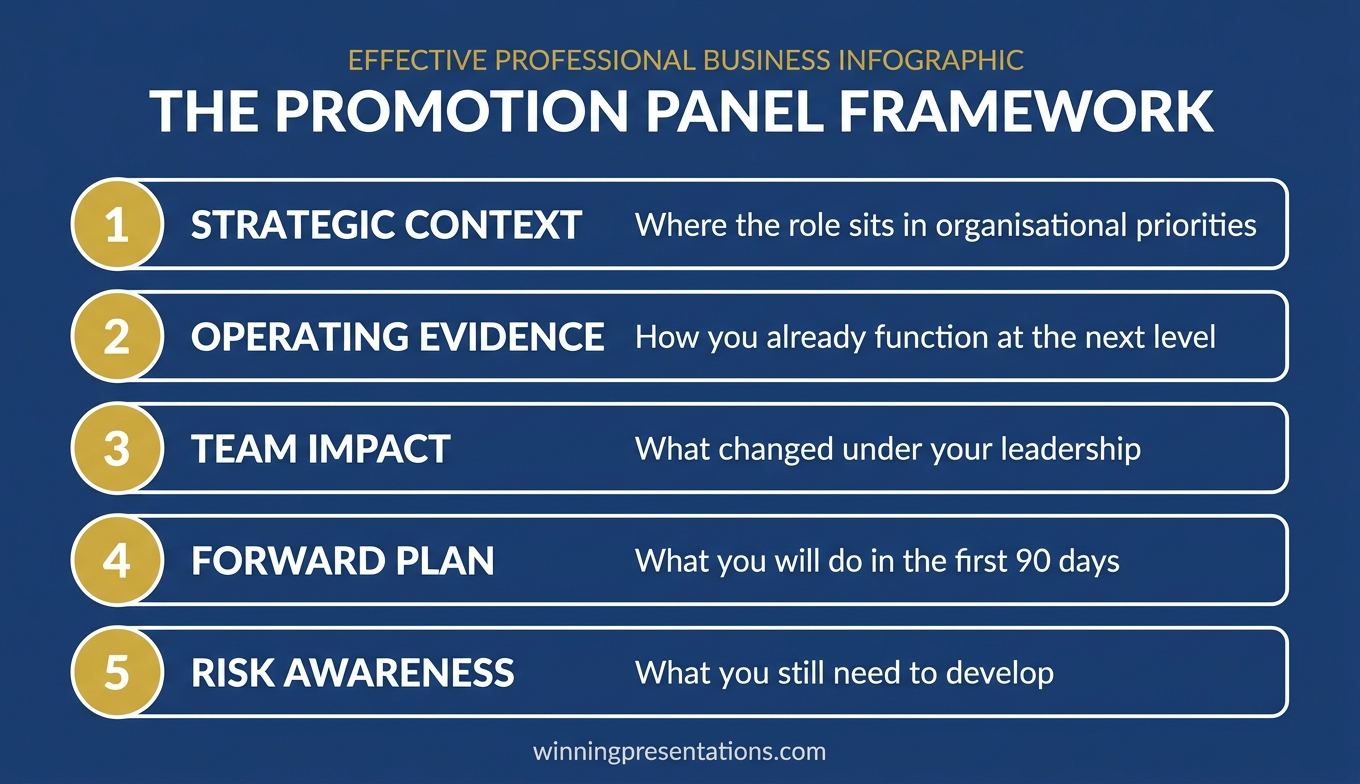
How to Structure Your Promotion Panel Presentation
The most effective structure for presenting to a promotion panel follows a three-part architecture: context, capability, and commitment. Each part serves a different purpose and answers a different unspoken question from the panel.
Part 1: Context (2 slides, 2-3 minutes). Start by demonstrating that you understand the strategic landscape of the role you are seeking. What are the three most important priorities for this function over the next twelve to eighteen months? What external pressures or internal changes will shape the role? This is not about impressing the panel with research — it is about proving that you have already started thinking like someone in the role. Open with the organisation’s context, not yours.
Part 2: Capability (3-4 slides, 5-6 minutes). This is where your evidence lives, but it must be framed as capability for the future role, not recognition for past work. For each priority you identified in Part 1, present one example from your career that demonstrates relevant capability. The structure for each example: “Here is what I did, here is why it is relevant to this role, and here is how I would apply that experience to [specific future priority].” This three-part framing turns every achievement into a forward-looking proposition.
Part 3: Commitment (1-2 slides, 2-3 minutes). Close with your vision for the first ninety days and beyond. What would you prioritise? What would you change? What would you protect? This section reveals your leadership instincts. Panel members listen carefully to what you would keep as well as what you would change — both signals are informative. A candidate who plans to change everything signals inexperience. A candidate who plans to change nothing signals complacency. The right answer is selective, strategic, and grounded in the context you established in Part 1.
If you are also preparing for the transition after a successful panel, you may find useful frameworks in this guide on delivering your first presentation after promotion.
Presenting Evidence Without Sounding Like You Are Bragging
This is the tension at the centre of every panel presentation for promotion: you need to demonstrate impact, but you cannot sound self-promotional. The candidates who navigate this well use three techniques consistently.
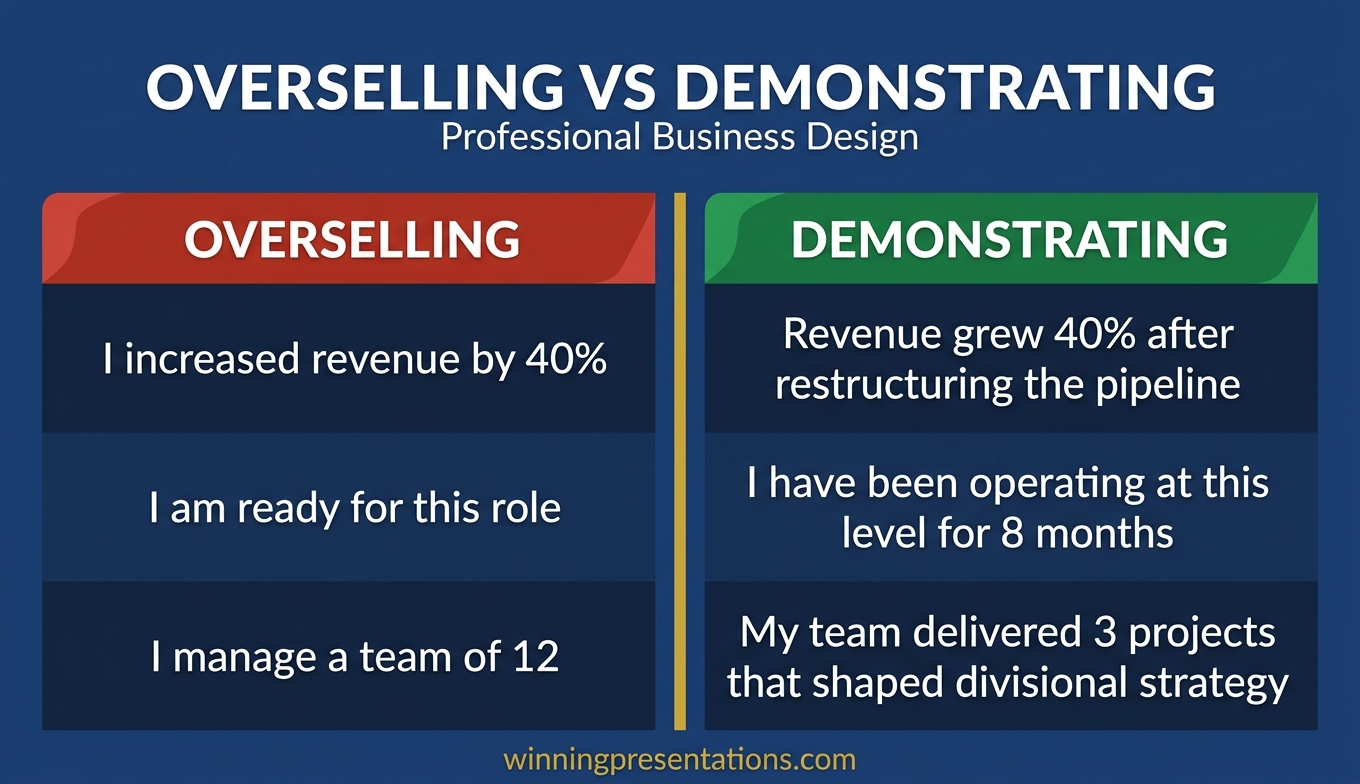
Frame achievements as team outcomes. Instead of “I led the restructuring of the compliance function,” try “The compliance restructuring — which I was asked to lead — reduced processing time by 35 per cent and is now the model being adopted across European operations.” The first version centres you. The second version centres the outcome and lets the panel draw their own conclusion about your role in it.
Let the scale speak for itself. When the numbers are significant, they do not need amplification. “The portfolio grew from £120 million to £340 million during my tenure” is more powerful than “I personally drove unprecedented growth across the portfolio.” Understated delivery of substantial results signals confidence. Overstated delivery of any results signals insecurity.
Attribute credit generously. Panel members know that senior outcomes are never solo achievements. A candidate who acknowledges the contributions of their team, their sponsors, and their peers demonstrates the kind of leadership maturity that promotion panels are specifically looking for. “I built the team that delivered this, and I was fortunate to have a sponsor in the COO who removed barriers at the executive level” tells the panel three things: you build teams, you leverage sponsors, and you are secure enough to share credit.
The Executive Slide System includes frameworks for structuring evidence slides that let results speak without requiring self-promotion.
Handling Panel Questions That Test Leadership Maturity
The questions after your panel presentation are not an afterthought — they are often the deciding factor. Panel members use questions to test three things: how you think under pressure, whether your self-awareness is genuine, and whether your vision can survive scrutiny.
“What would you do differently if you could go back?” This question tests self-awareness. The worst answer is “nothing.” The best answer names a specific decision, explains what you learned, and connects that learning to how you would approach a similar situation in the new role. Avoid rehearsed corporate language like “I would communicate more proactively” — be specific enough that the panel believes you have actually reflected on the question before today.
“Where do you see the biggest risk in this function?” This question tests strategic judgement. Panel members are looking for evidence that you can identify threats that are not yet obvious to everyone. A good answer demonstrates that you understand the external environment, the internal dependencies, and the second-order effects of decisions being made elsewhere in the organisation.
“How would you handle a situation where your team disagrees with a senior leader’s direction?” This question tests leadership courage and political skill simultaneously. The panel wants to know that you can push back constructively without damaging relationships. The best answers describe a process — how you would gather evidence, frame the alternative, choose the right moment, and protect your team from reputational risk regardless of the outcome.
“Why this role, and why now?” This deceptively simple question is where many candidates stumble. The answer should connect your personal trajectory to the organisation’s timing. “The function is entering a period of transformation, and my experience in [specific area] is particularly relevant to the challenges ahead” is stronger than “I feel ready for the next step in my career.” The first answer is about the organisation. The second is about you.
For broader guidance on building the skills that underpin strong panel performances, this article on presentation skills for promotion covers the fundamentals.
Build Your Promotion Panel Deck With Confidence
Stop guessing what promotion panels want to see. The Executive Slide System (£39, instant access) gives you 22 templates, 51 AI prompts, and 15 scenario playbooks — built from real executive presentation experience.
Get the Executive Slide System →
Designed for executives preparing for career-defining moments.
Frequently Asked Questions
How long should a presentation to a promotion panel be?
Most promotion panels allocate ten to fifteen minutes for the presentation and ten to fifteen minutes for questions. Aim for the shorter end of the presentation window — a ten-minute presentation that leaves ample time for discussion signals confidence and creates space for the strategic conversation that panels value most. Never exceed your allotted time. A candidate who cannot manage a clock is unlikely to manage a department.
Should I include slides about my current role’s performance metrics?
Include metrics only when they directly demonstrate capability for the target role. A slide showing revenue growth is relevant if the new role involves commercial responsibility. A slide showing project delivery timelines is relevant if the new role involves operational leadership. Avoid metrics that demonstrate competence at your current level without connecting to the next level’s requirements. Two or three well-chosen metrics are more persuasive than a comprehensive performance dashboard.
What is the biggest mistake candidates make when presenting to a promotion panel?
Treating the presentation as a performance review rather than a leadership proposition. The most common structural error is spending 80 per cent of the time on past achievements and 20 per cent on future plans. Reverse that ratio. Panel members already have your performance record — they invited you to present because the record is strong. What they need from the presentation is evidence that you can think and act at the next level.
How do I handle presenting to a promotion panel when I am competing against an external candidate?
Your advantage as an internal candidate is institutional knowledge, established relationships, and a shorter ramp-up period. Lean into these without being defensive about the external threat. Frame your first-ninety-day plan around actions that only an insider could execute quickly — leveraging existing relationships, building on current momentum, addressing known friction points. The external candidate can only promise generic plans; you can offer specific, grounded commitments.
If you are also preparing for a committee-level presentation, this guide on remuneration committee presentations covers the structural principles that apply when the audience holds decision-making authority.
The Winning Edge
A weekly newsletter for executives who present at senior level. Frameworks, slide structures, and panel preparation strategies — delivered every Thursday.
Free resource: Executive Presentation Checklist — a quick pre-panel checklist to pressure-test your deck before the day.
About the Author
Mary Beth Hazeldine is the Owner & Managing Director of Winning Presentations. With 25 years of corporate banking experience at JPMorgan Chase, PwC, Royal Bank of Scotland, and Commerzbank, she advises executives across financial services, healthcare, technology, and government on structuring presentations for high-stakes funding rounds, board briefings, and leadership decisions.