Tag: career progression

29 May 2026
Promotion Business Case Presentation: The 5-Slide Structure That Wins

Promotion Business Case Presentation: The 5-Slide Structure That Wins

Quick answer: A promotion business case presentation that wins committee approval uses five slides, in this order: (1) the role and the gap it fills, (2) the specific scope you have already been carrying, (3) the business outcomes attributable to your work, (4) the operating model after promotion (what changes for the team and the work), and (5) a clean ask with a defined start date. The slides committees reject are the ones that argue for the person rather than the role. The slides committees approve describe a structural decision that happens to involve you.

Aigerim, a senior marketing manager at a regional bank in Almaty, walked into her promotion committee meeting with twenty-two slides. She had spent two weekends building it. The deck opened with a personal narrative — how she had grown into the role, what she had learned, the moments she was proud of. Slide 8 was an organisation chart with her current reports highlighted. Slide 14 listed every campaign she had run in the previous eighteen months. The committee scrolled politely through the first six slides, asked one question at slide 11, and broke for coffee at slide 14. The decision the next week was deferred. Six weeks later, the role was opened to external candidates.

The deck did not lose Aigerim the promotion. The framing did. Twenty-two slides argued, implicitly, that the committee should be persuaded that she deserved it. Five slides — the right five — would have framed the same decision differently: as a structural question the committee needed to answer for the business, where the obvious answer happened to be her. That distinction is the difference between a deferred decision and an approved one.

This article walks through the five slides. Each slide has a job. Each slide has things that must be on it and things that must be off. The structure is deliberately constrained — committees approving senior promotions cannot give a long deck the attention it asks for. Five slides forces the discipline that wins.

If you want the slide structure for the case, not just the framework:

The Executive Slide System gives you 26 templates and 93 AI prompts designed for senior decision presentations — including the structural patterns that work for promotion committees, board approvals, and executive sponsors.

Explore the Executive Slide System →

Why five slides, not fifteen

Promotion committees are usually small — three to seven senior people, often from outside your direct reporting line. They sit through several promotion cases in a single session. By the third case of the morning, attention is fraying. Decks that ran past ten slides on case one are skimmed; decks that run past ten slides on case three are barely read.

This is structural, not personal. The committee is not less interested in your case than in the first one — they are just operating under cognitive load that compounds across the morning. A long deck punishes them for taking your case last on the agenda. A five-slide deck reads the same in slot one or slot four.

Five slides also forces a different kind of writing. You cannot pad. You cannot list every project. You cannot include the organisation chart, the personal journey, the testimonials, the culture-fit narrative. You have to compress the case to its load-bearing claims and let the slides carry only those. That compression is what makes the case land.

Slide 1: The role and the gap

Slide 1 does not introduce you. It introduces the role you are asking the committee to approve. Title at the top: the role title. Two lines underneath: what the role is responsible for in the business and why the business needs it filled now.

The structural insight here is critical. Most promotion decks open with the candidate’s narrative — “I joined the company in 2019 and have grown through three roles…” This framing makes the committee evaluate you as a person. The role-first framing makes them evaluate a structural decision. Those are different conversations. The structural one is much easier to approve.

Underneath the role definition, name the gap. What is currently happening in the business that this role would solve, that is not happening today? Is it scope a current senior leader is overloaded with? A function that does not currently have an owner? A coordination problem between two teams that needs a single accountable person? Be specific. The gap is the business case, not your readiness.
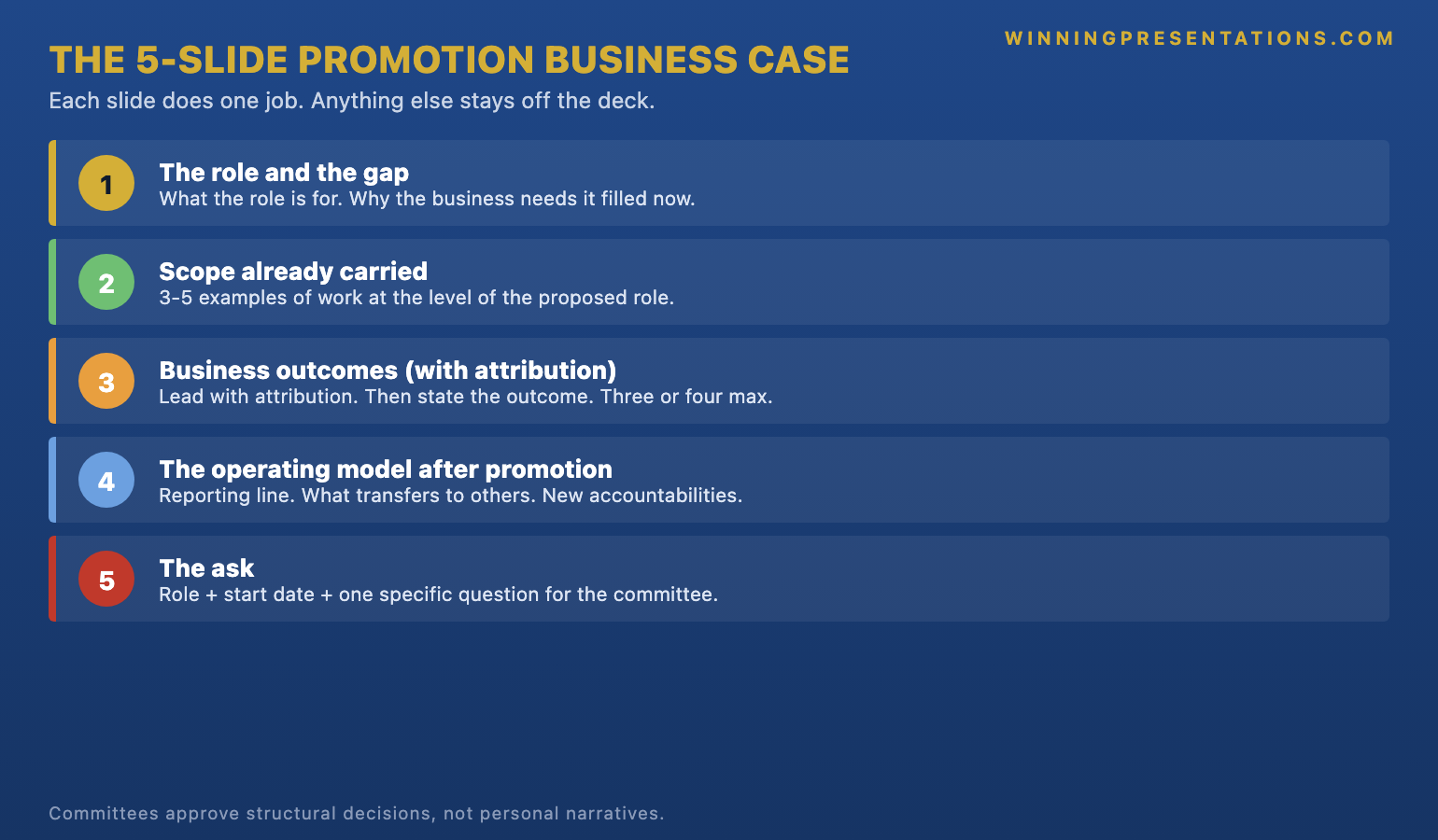
The 5-slide promotion business case structure infographic showing each slide's job: Slide 1 the role and the gap, Slide 2 scope already carried, Slide 3 business outcomes, Slide 4 the operating model after promotion, Slide 5 the ask — with the core principle that committees approve structural decisions, not personal narratives.

Slide 2: Scope already carried

Slide 2 is the bridge between the role and you. Its job is to demonstrate that the role already exists, informally, in the work you have been doing — and that promotion is the formalisation of that scope, not its expansion.

The pattern is deliberate. Promotions that look like rewards for past work are easier to defer than promotions that look like recognition of current scope. A committee can always argue that past work is already paid for. They cannot argue, with the same ease, that scope you are visibly carrying today should remain unrecognised.

List three to five concrete examples of work you are doing that sits at the level of the proposed role. For each, name the work, the stakeholders involved, and the level of decision-making you are exercising. “Led the Q1 strategic review for the regional team” is informative. “Owned the strategic prioritisation that determined the Q1 investment allocation across three product lines, including the recommendations the regional MD took to the executive committee” is structural. The second framing makes the committee see the role you are already in.

For more on how to position scope and decision authority on a slide that holds up to senior scrutiny, see the 8-slide CFO presentation template.

Slide 3: Business outcomes

Slide 3 is the only slide in the deck that should contain numbers. It is also the slide most commonly built badly.

The mistake is to list outcomes you contributed to and let the committee work out attribution. “Revenue growth of 12% in the regional segment” sits on the slide; the committee, generous and time-pressed, mentally allocates some fraction of that to your work. This is dangerous because the fraction the committee allocates is almost always smaller than the fraction you intended to claim.

The disciplined approach is to lead with attribution, then state the outcome. “Led the pricing review that recovered £4.2m in margin across the affinity portfolio in 2025.” “Designed and delivered the customer-segmentation framework adopted by the executive team in March 2026, now in use across four product lines.” Three to four outcomes of this shape, each with attribution, scope, and a verifiable business consequence.

If you cannot write outcomes in this shape, you have a different problem than slide design. Either the work has not been visible enough at the right level, or the outcomes are softer than the case requires. That is a real-world signal, not a slide problem. Promotion business cases are won on visible outcomes attributable to the candidate. If those do not exist yet, the case is not ready.

Build the deck with structure, not from a blank canvas.

The Executive Slide System gives you 26 templates designed for senior decision presentations — promotion cases, board recommendations, investment requests, and executive committee proposals. 93 AI prompts to build slides faster, 16 scenario playbooks for the situations that come up most often. £39, instant access, no subscription.

  • 26 slide templates for board, committee, and executive decisions
  • 93 AI prompts to draft and refine slide copy
  • 16 scenario playbooks for the high-stakes presentation situations
  • 7 checklists covering deck audit, rehearsal, and Q&A preparation
  • Designed for senior professionals across financial services, healthcare, technology, and government

Get the Executive Slide System — £39 →

Instant download. No subscription.

Slide 4: The operating model after promotion

Slide 4 answers the question committees worry about most but rarely ask out loud: what changes for the team and the work if this promotion is approved?

This is the slide that separates first-time promotion presenters from senior ones. First-timers describe what changes for them — new title, new pay band, new responsibilities. Senior presenters describe what changes for the organisation: who picks up the work they currently do, how the new accountabilities sit relative to existing ones, what the team structure looks like in three months. Committees approve the second framing because it is the framing they need to make the decision.

Three things must be on this slide: the proposed reporting line into and out of the role, the work you currently do that needs to transfer to someone else (and the rough plan for that), and the new accountabilities the role will own that are currently sitting elsewhere or going unowned. Keep it crisp. Bullet form is fine. The committee is not looking for a detailed transition plan — they are looking for evidence that you have thought through the operational change, not just the personal one.

The unspoken question this slide answers is whether you are ready to own the next role or whether the promotion is largely a recognition of past work. The first framing wins; the second framing defers.
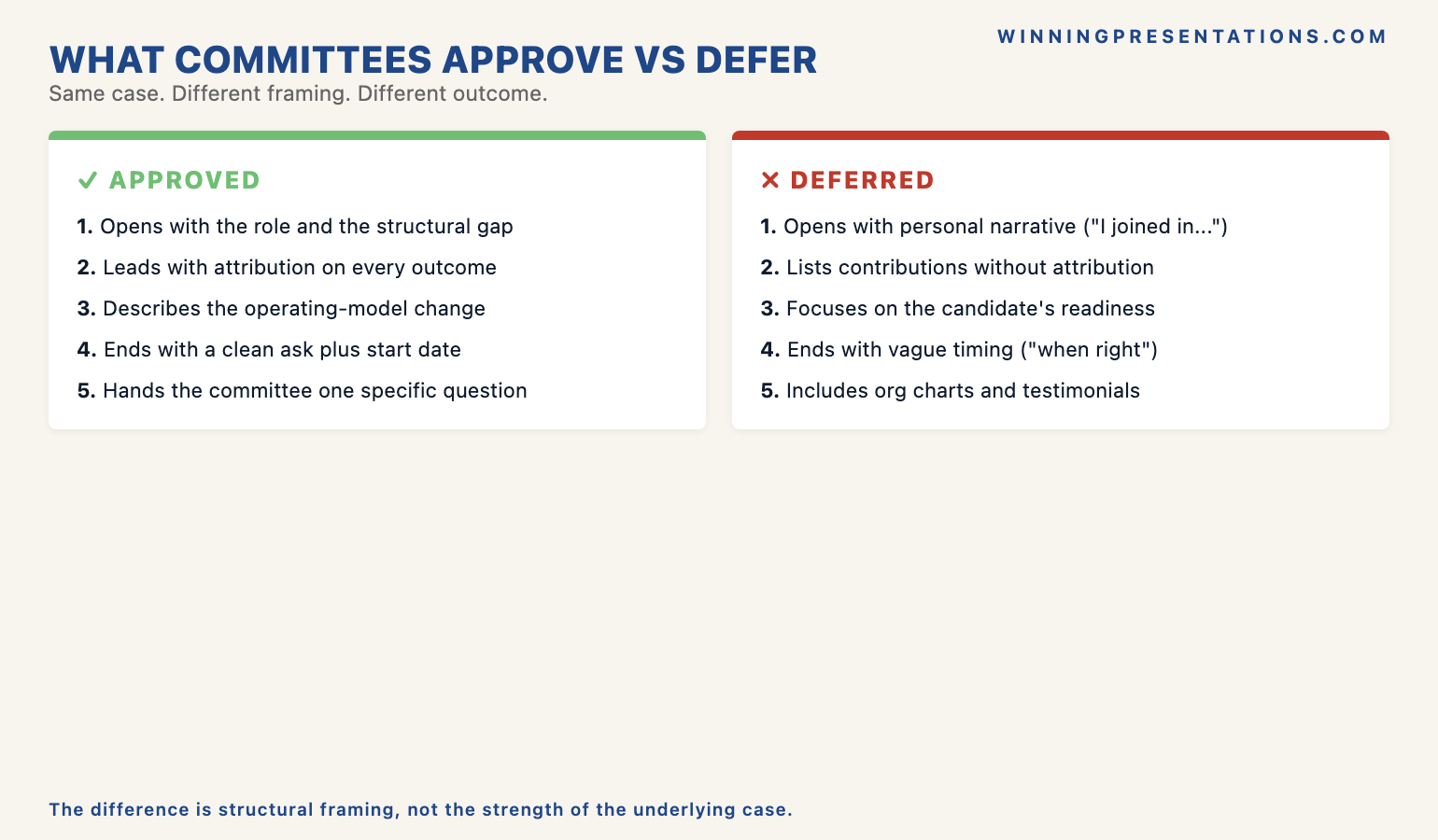
What committees approve versus what they defer comparison: approved promotion cases lead with the role and structural gap, lead with attribution on outcomes, describe the operating model change, and end with a clean ask — deferred cases open with personal narrative, list contributions without attribution, focus on the candidate's readiness, and end with vague timing.

For senior leaders preparing the broader case for a structural change — including the kind of stakeholder buy-in that promotion committees often involve — the structural approach in the 15-minute board presentation template applies directly.

Slide 5: The ask

Slide 5 is the cleanest slide in the deck. Title: “The ask.” Three lines of body content:

  1. The role title and band you are asking to be promoted to.
  2. The proposed start date of the new role.
  3. The single open question you would like the committee to discuss in the room.

The third item is the move most candidates miss. By offering the committee a specific question to discuss — “Should the role report into the regional MD or directly into the executive committee?” — you take control of the conversation. Without it, the committee discusses you. With it, they discuss the question you have framed. The decision they reach on your question is also, structurally, the decision they reach on the promotion.

The ask slide should not include “and here is why I am ready” or any kind of closing personal statement. The case has been made on slides 1–4. Slide 5 closes the loop and hands the room back to the committee for a focused discussion. A clean close, with one specific question, is what disciplined senior decisions look like.

For the structural psychology behind the ask:

When the audience is being asked to approve a senior decision (promotion, budget, board approval), the framework that earns serious approval is the same. The Executive Buy-In Presentation System covers the structure, psychology, and preparation behind those decisions — self-paced programme, £499, optional recorded Q&A calls.

Explore The Executive Buy-In Presentation System →

What to leave off the deck

Five slides means four categories of content stay off the deck entirely. These are the four most commonly included items that weaken promotion cases.

Personal narrative. The story of how you joined the organisation, what motivated you, what you have learned. Committees do not approve narratives — they approve roles. Save the narrative for the conversation if it comes up in Q&A; keep it off the slides.

Organisation charts. A current-state org chart with your name highlighted is the single most common space-waster in promotion decks. Committees know the structure. The information they need on structure belongs on slide 4 (operating model after promotion), in compressed form.

Testimonials and quotes. “X said I was the most reliable person on the team.” Testimonials are below the level of seriousness a promotion committee operates at. They feel like advocacy rather than business case. Leave them off.

Comprehensive project lists. A list of every project you have run in the last two years signals “I have been busy” rather than “I have been operating at the next level.” Slide 3 picks the four outcomes that demonstrate level. The other twenty stay off the deck.

For the broader story of presenting after the promotion is approved, see the first presentation after promotion — the structural patterns that work in the case for the role also apply to the work in the role.

Frequently asked questions

Is five slides really enough for a promotion business case?

Yes — for the formal committee presentation. The five slides do the load-bearing work: role and gap, scope already carried, business outcomes, operating model after promotion, the ask. Supporting evidence — detailed project documentation, peer feedback, performance reviews — sits in an appendix or a separate document the committee can reference if asked. The presentation itself stays at five slides.

What if the committee asks for more detail than five slides allow?

That is the right outcome. A focused five-slide deck triggers the conversation; the appendix or supporting documents answer the questions raised in discussion. A sprawling twenty-slide deck pre-empts the conversation and leaves the committee with no questions to engage on, which often translates into a deferred decision rather than an approved one.

Should I rehearse this presentation, or is the slide structure enough?

Rehearse it. The structure does most of the work, but how you handle the discussion after slide 5 is what most committees actually weight. Rehearse the opening of each slide so you do not over-narrate, and rehearse three or four likely committee questions out loud. Twenty minutes of rehearsal the day before is more useful than twenty hours of slide refinement.

What if my company does not have a formal promotion committee?

The same five-slide structure works for promotion conversations with a single decision-maker — your manager, your manager’s manager, an HR partner. The framing changes slightly (less formal, more conversational), but the load-bearing slides stay the same: role and gap, scope carried, outcomes, operating model, ask. A clean five-slide document is also a useful artefact for the decision-maker to reference internally when they take the case to anyone else.

Stop building the deck from scratch.

The Executive Slide System gives you the templates that work for promotion committees, board approvals, and executive sponsors. 26 templates, 93 AI prompts, 16 scenario playbooks. £39, instant access.

Get the System — £39 →

Get The Winning Edge newsletter

A weekly note from Mary Beth on the structure, psychology, and preparation that earns senior approval. One idea, one application, one specific scenario — every Thursday morning.

Subscribe to The Winning Edge →

Not ready for the full system? Start here instead: download the free Executive Presentation Checklist — a single-page reference for what every senior presentation needs before it leaves your desk.

Next step: Open a blank document and write the five slide titles before you build a single slide. Role and gap. Scope carried. Outcomes. Operating model. The ask. If you cannot write a tight one-line summary for each, the case is not ready for the committee — work on the case before you touch the deck.

About the author

Mary Beth Hazeldine is Owner & Managing Director of Winning Presentations Ltd, founded in London in 1990. With 24 years of corporate banking experience at JPMorgan Chase, PwC, Royal Bank of Scotland, and Commerzbank, she advises executives across financial services, healthcare, technology, and government on structuring presentations for high-stakes funding rounds and board approvals.

29 May 2026
Internal Interview Presentation: The 15-Minute Format That Works

Internal Interview Presentation: The 15-Minute Format That Works

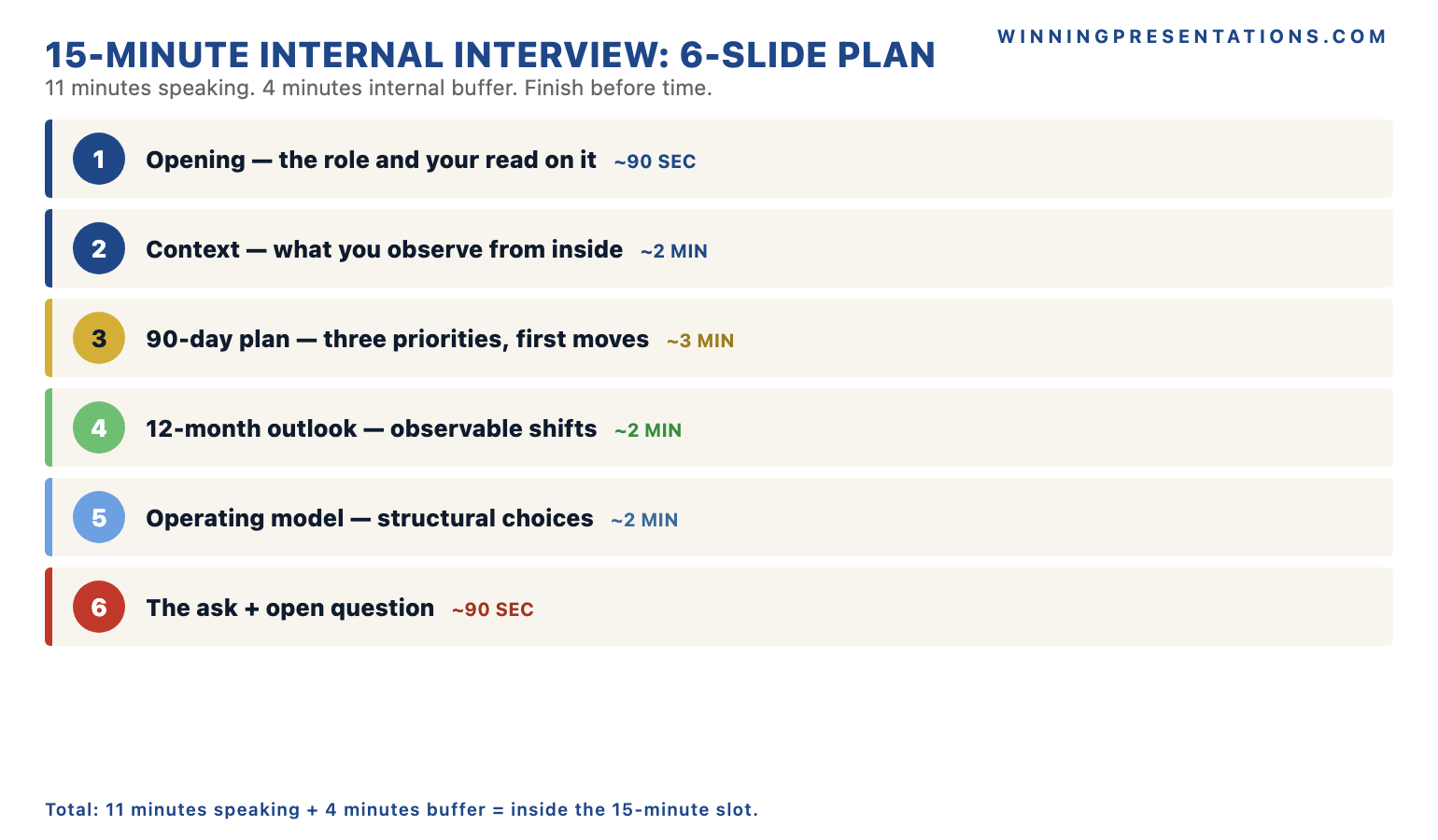
Quick answer: A 15-minute internal interview presentation should land on six slides: opening (the role and your read on it), context (what you have observed about the team or function from inside the organisation), a 90-day plan, a 12-month outlook, the operating model you would propose, and a clean ask plus open question. Aim for 11 minutes of speaking and 4 minutes of buffer for questions inside the slot. The mistake internal candidates make is treating the time as a presentation about themselves; the candidates who win treat it as a working session about the role.

Tomás had been with a Lisbon-based logistics technology company for nine years when the regional director role opened. He was one of two internal candidates being considered alongside three external ones. He had 15 minutes to present and 10 for Q&A. He spent two weeks preparing. He built 19 slides. He covered his career history, his understanding of the company strategy, his relationships across the business units, his proposed go-to-market plan, his 18-month vision, and a final slide thanking the panel for their time.

He ran 22 minutes. The panel cut him off mid-slide 16. The role went to one of the external candidates. The feedback he received afterwards was not that he lacked the experience or the knowledge — it was that “he treated it like an internal review, not an interview.” That is the trap internal candidates fall into more often than any other. They know too much, and they let that knowledge sprawl across the time slot.

The format that works is tight, structurally different from a typical promotion business case, and built around the discipline of saying less than you know. Six slides. Eleven minutes of speaking. Four minutes of internal buffer. The structure below is what experienced internal candidates use to win against external competition.

If you want a structural template, not just a framework:

The Executive Slide System gives you 26 templates and 93 AI prompts for senior decision presentations — including the structural patterns that work for 15-minute slots in front of a panel.

Explore the Executive Slide System →

Why 15 minutes is the hardest slot

Fifteen minutes is the slot most internal candidates underestimate. It feels generous compared with the seven-minute pitch slot or the five-minute lightning round. In practice it is the most punishing length on the calendar.

The problem is calibration. Five-minute slots force absolute discipline; everyone overruns by ten seconds and the panel forgives. Thirty-minute slots have natural breathing room; pace can fluctuate. Fifteen minutes is precisely the window where candidates think they have time to be thorough — and then run over by three or four minutes, which feels intolerable to a panel running to schedule and signals, structurally, a lack of senior-level discipline.

The format below assumes you will speak for 11 minutes, leave 4 minutes of internal buffer, and finish before time. Finishing early in a 15-minute slot is rare enough to be remarkable, and it leaves the panel with more headspace for the Q&A — which is where most internal interview decisions are actually made.

The six-slide structure

Six slides, in this order:

Slide 1 — Opening: the role and your read on it (~90 seconds). Title the slide with the role, not your name. Two short paragraphs underneath: what the role is for in the business, and what you read as the two or three most important things the new person in seat will have to do in the first six months. This frames you immediately as someone who has thought about the role from the seat, not from outside it. Internal candidates who open with “I have been with the company for nine years…” waste the slot’s most valuable real estate.

Slide 2 — Context (~2 minutes). What you observe about the team, function, or business unit the role sits in. This is where internal knowledge becomes a structural advantage if used carefully. Two or three observations, each with the framing “what I see from inside that an external candidate would not see for six months.” Examples: a coordination problem between two teams that is not visible from the org chart, a specific commercial dynamic in the customer base, a capability gap inside the team that affects delivery. The point is not to demonstrate that you know things; it is to demonstrate that you have already done the diagnostic work the new person in seat would otherwise spend their first quarter doing.

Slide 3 — 90-day plan (~3 minutes). The most concrete slide in the deck. Three priorities for the first 90 days, each with a specific first move. Not “I would assess the team” — “In the first two weeks I would run individual sessions with each of the regional leads to confirm the picture I have from outside the seat.” The 90-day plan is what the panel uses to compare you against external candidates. Externals can present a polished generic 90-day plan; you can present one calibrated to the actual situation. Lean into that.

The 6-slide internal interview presentation structure infographic showing each slide with target time: Slide 1 opening 90 seconds, Slide 2 context 2 minutes, Slide 3 90-day plan 3 minutes, Slide 4 12-month outlook 2 minutes, Slide 5 operating model 2 minutes, Slide 6 ask and open question 90 seconds — total 11 minutes speaking with 4 minutes buffer.

Slide 4 — 12-month outlook (~2 minutes). What you would expect the function to look like in 12 months — the two or three measurable shifts that would indicate the role is being executed well. Not vague aspirations (“a more aligned team”) — observable shifts (“decisions on cross-regional pricing taking under 10 working days, down from current 4–6 weeks”, or “a single source of truth on customer profitability across the three product lines”). The 12-month outlook is what convinces the panel you have a sense of where the role goes; the 90-day plan convinces them you can start.

Slide 5 — Operating model (~2 minutes). How you would propose to run the function. Not your management style — the structural choices: where the role spends its time, what gets delegated, how decisions get made, where the role interfaces with adjacent functions. This is the slide that separates senior candidates from middle-management ones. Senior candidates think structurally about how they spend their week; middle managers think about how busy they will be. Show the structural thinking.

Slide 6 — The ask and the open question (~90 seconds). Title: “What I am asking for, and the open question I would like to discuss.” Two lines: the role and the start date you would propose. Then one specific question you would like the panel to engage on — typically about the operating model or the 90-day plan. Just like a promotion business case (see the 5-slide promotion business case structure), giving the panel a specific question to discuss takes control of the Q&A and replaces evaluation of you with evaluation of the question you have framed.

Timing discipline: 11 minutes, not 14

Internal candidates who come in at 11 minutes signal something specific to the panel: that they understand executive discipline around time. Internal candidates who come in at 14 or 15 minutes signal the opposite, regardless of how good the content is.

The four-minute internal buffer matters because nobody, in practice, presents at exactly the pace they rehearsed. Nerves push pace up. Panel reactions slow it down. Technical glitches eat 30 seconds. A slide that needs an extra sentence of explanation eats another 30. If you have built a 15-minute deck, you will run 17. If you have built an 11-minute deck, you will run 13 — and finish, calmly, with two minutes still on the clock.

Build the deck with structure, not from a blank canvas.

The Executive Slide System gives you 26 templates designed for senior decision presentations — interview slots, board recommendations, executive committee proposals. 93 AI prompts to draft slide copy faster, 16 scenario playbooks for the situations that come up most often. £39, instant access, no subscription.

  • 26 slide templates for senior decision presentations
  • 93 AI prompts to build slides faster
  • 16 scenario playbooks for high-stakes situations
  • 7 checklists covering deck audit, rehearsal, and preparation
  • Designed for senior professionals across financial services, healthcare, technology, and government

Get the Executive Slide System — £39 →

Instant download. No subscription.

Rehearsal is the only thing that produces 11 minutes. Two run-throughs the day before, both timed, both out loud. If your first run lands at 13, cut 90 seconds before the second run rather than tightening pace. Cutting content always works; speeding up never does.

The internal-knowledge trap

Internal candidates know too much. That sounds like an advantage and is, structurally, a liability if not managed carefully.

The trap looks like this. You know the regional commercial dynamics. You know the personalities on the executive team. You know the systems issues. You know the political tensions between two of the senior leaders. You know the budget context for the next financial year. The temptation is to demonstrate that knowledge across the slot — to signal to the panel that you bring all of it into the role on day one.

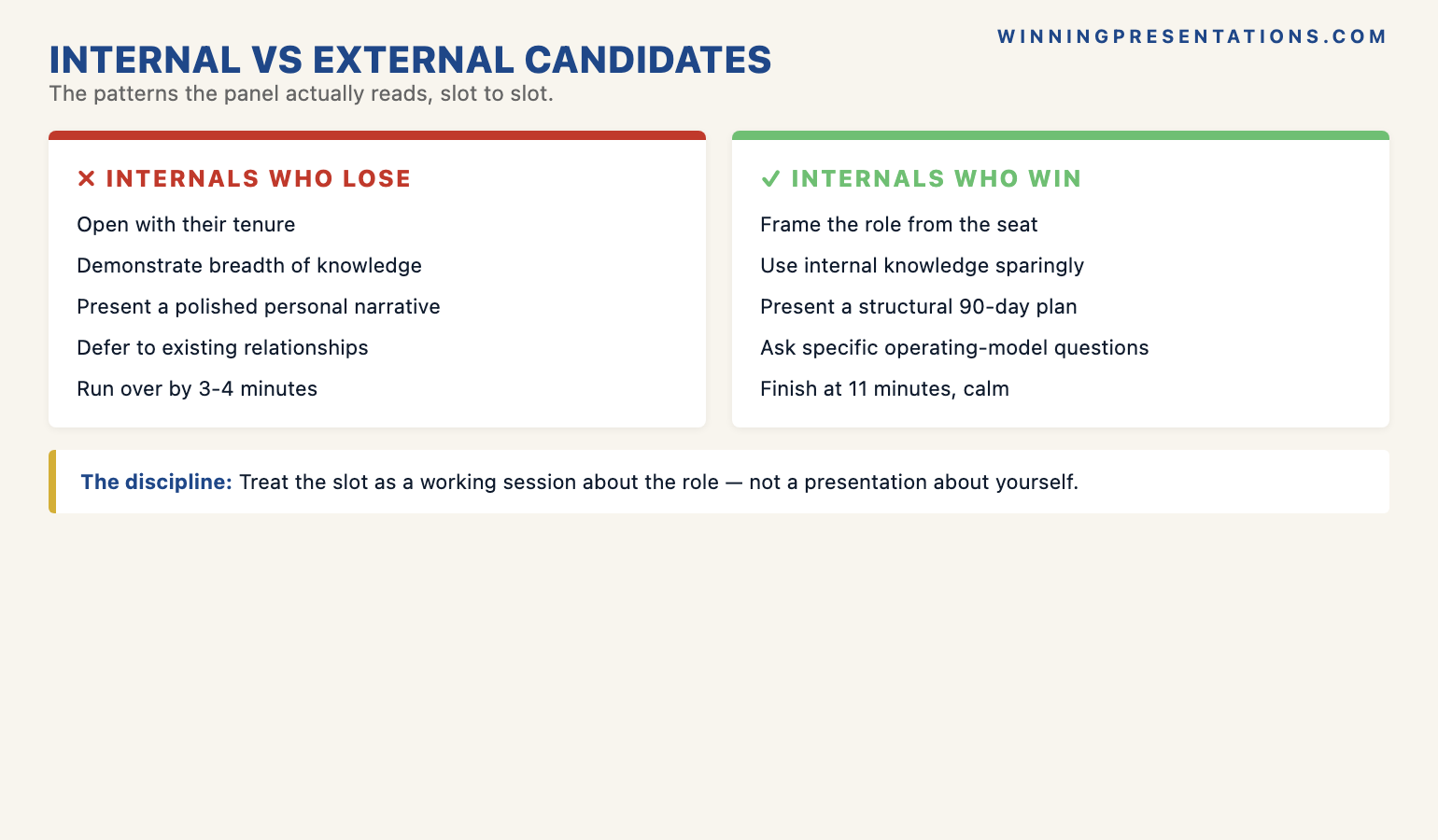
The problem is that demonstrating knowledge fragments the slot. Each piece of internal context invites a follow-up question; each follow-up eats time you needed for the 90-day plan. By the end, you have signalled that you know a lot and shown nothing about how you would operate at the next level. External candidates, who cannot signal the same knowledge, are forced into structural answers — and structural answers are what the panel actually weights.

The discipline is to use internal knowledge sparingly and structurally. Two specific observations on slide 2. One reference in the 90-day plan. One reference in the operating model. The rest of your internal knowledge stays in reserve for Q&A, where it is far more powerful because it answers a specific question rather than filling speaking time.

What internal candidates do versus what external candidates do comparison: internals talk about their tenure, demonstrate breadth of knowledge, present a polished narrative, defer to existing relationships — externals frame the role from the seat, present a structural 90-day plan, ask specific operating-model questions, treat the slot as a working session.

For senior leaders thinking about how they handle the room they will be presenting in if they win, the structural patterns in the 15-minute board presentation template apply directly — interview rooms and board rooms operate on the same constraints.

Handling the Q&A as an internal candidate

The Q&A is where internal interview decisions are usually made. The panel has spent 15 minutes hearing your structured pitch; the next 10 minutes are where they probe what is underneath it.

Three Q&A patterns are specific to internal candidates:

The “what would you change about the current approach?” question. This is the most dangerous question internal candidates face. Answer too sharply and you sound disloyal to the people you currently work with — including, often, the people on the panel. Answer too softly and you signal that you would not change anything, which contradicts the case for promoting you. The structural answer is to name a structural change (“the way decisions on cross-regional pricing currently flow”) rather than a personal critique (“the way X currently runs the team”), and to frame the change as evolution rather than correction.

The “how would you handle [a specific person] differently?” question. Panels ask this to test whether you have thought about the relational shifts the role would require. The temptation is to be diplomatic and vague. The better answer is specific and grounded: “I would expect to spend more time on [specific topic] with [role/function] in the first 90 days, because the picture I have from inside is that this is one of the under-engaged interfaces.” Stay structural; do not be drawn into personal critique.

The “why now?” question. Internal candidates are sometimes asked, gently, why they have not pushed for this role earlier. The honest answer is usually fine — timing, scope, organisational moment. The structural answer is better: “The role as it exists now requires [X] in a way that the previous version did not, and the case I am presenting today is built around that change.” Frame it as the role having grown into something you can take on, not as you having grown ready.

For the Q&A side specifically:

The Executive Q&A Handling System covers tough questions, calm authority, and decision-safe answers in 45 seconds — the structural framework for senior Q&A under pressure. £39, instant access. Pairs naturally with the 15-minute interview format when the Q&A slot is where the real decision happens.

Get the Executive Q&A Handling System — £39 →

Frequently asked questions

How many slides should I have for a 15-minute internal interview presentation?

Six. Each slide carries one job: opening, context, 90-day plan, 12-month outlook, operating model, and the ask. More than six and you fragment the slot. Fewer than six and you lose the structure that separates senior thinking from middle-management thinking. Six is the number that consistently lands the time, the message, and the discipline signal.

Should I show that I know more than the external candidates?

No. Use internal knowledge sparingly and structurally. Two observations on slide 2, one reference in the 90-day plan, one reference in the operating model. The rest stays in reserve for Q&A, where it answers specific questions far more powerfully than it would as part of your structured pitch.

What if the panel asks me about something not on my slides?

Answer it directly, then bridge back to the structural points the role requires. “That is a real question, and the way I would think about it is X. The reason I did not put it on the slides is that the more important shift in the first 90 days is Y, which is what slide 3 covers.” This handles the question and reinforces your structural priorities at the same time.

Should my opening slide thank the panel for the opportunity?

No. Opening with thanks is the most common space-waster in internal interview decks. It uses 30 seconds of your most attention-rich window to say something the panel already knows you feel. Open with the role and your read on it — that is what the slot is for. You can thank the panel briefly at the end if you want; not at the start.

Build the deck that wins the internal slot.

The Executive Slide System gives you 26 templates and 93 AI prompts designed for senior decision presentations — including the structural patterns for internal interviews. £39, instant access.

Get the System — £39 →

Get The Winning Edge newsletter

A weekly note from Mary Beth on the structure, psychology, and preparation that earns senior approval. One idea, one application, one specific scenario — every Thursday morning.

Subscribe to The Winning Edge →

Not ready for the full system? Start here instead: download the free Executive Presentation Checklist — a single-page reference for what every senior presentation needs before it leaves your desk.

Next step: Block 90 minutes in your calendar this week. Open a blank document. Write the six slide titles. Write three sentences under each. If you can do that in 90 minutes, the slot is yours to lose; if you cannot, the case needs more thinking before any slide-building begins.

About the author

Mary Beth Hazeldine is Owner & Managing Director of Winning Presentations Ltd, founded in London in 1990. With 24 years of corporate banking experience at JPMorgan Chase, PwC, Royal Bank of Scotland, and Commerzbank, she advises executives across financial services, healthcare, technology, and government on structuring presentations for high-stakes funding rounds and board approvals.
26 Apr 2026
Featured image for Promotion Panel Presentation: How to Make Your Case Without Overselling

Promotion Panel Presentation: How to Make Your Case Without Overselling

Quick Answer

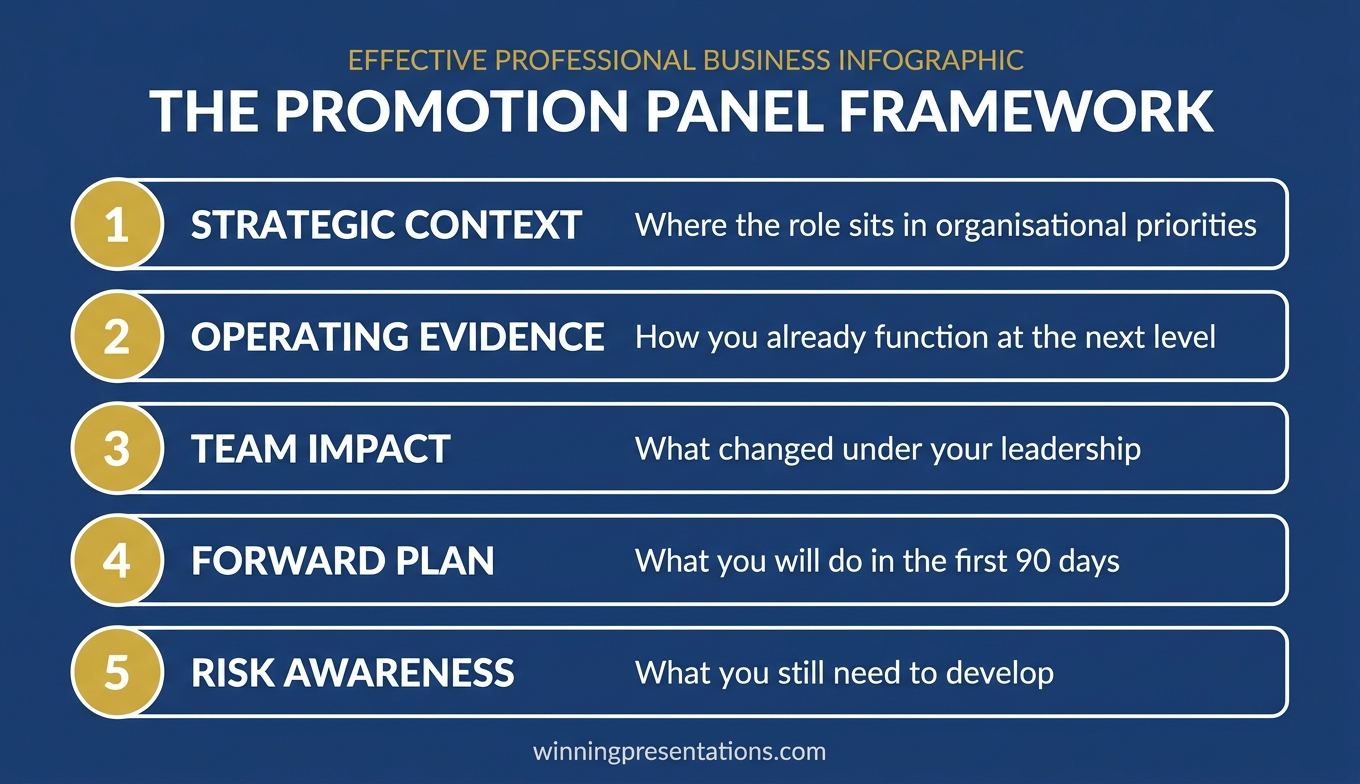
A promotion panel presentation should demonstrate how you already operate at the next level rather than listing your achievements at the current one. The strongest candidates frame their case around future organisational impact — what they will do with the role — and let their track record serve as evidence of capability, not the centrepiece of the argument.

Nadine had spent three weeks preparing for her panel presentation. She had metrics for every quarter, endorsements from two managing directors, and a slide deck that documented her contribution to the firm’s largest client migration in five years. By any objective measure, she was the strongest internal candidate.

She did not get the role.

The feedback, delivered carefully by her line manager, was that the panel found her presentation “impressive but backward-looking.” They described another candidate — someone with a shorter tenure and a less distinguished record — as having “a clearer vision for the function.” Nadine had spent twenty minutes proving she deserved the promotion. The other candidate had spent fifteen minutes showing what she would do with it.

The difference was not talent or track record. It was framing. Nadine presented a case for recognition. The other candidate presented a case for investment. Promotion panels do not reward past performance — they invest in future leadership. That distinction changes how you build every slide in the deck.

Preparing for a promotion panel this quarter?

Before you finalise your deck, pressure-test it against these three questions — the ones panel members rarely say aloud but always evaluate:

  • Does your opening slide describe the role’s future impact or your past achievements?
  • Could a panel member summarise your case in one sentence to a colleague who was not in the room?
  • Are you showing how you already operate at the next level, or asking to be given the chance?

Explore the Executive Slide System →

The Overselling Trap That Undermines Strong Candidates

The instinct in a promotion panel presentation is to demonstrate as much as possible. More achievements, more metrics, more examples of impact. The logic feels sound: the panel needs evidence, so give them evidence in volume. But volume works against you in this setting because it shifts the tone from leadership to audition.

Panel members are typically senior leaders who have been through this process themselves. They recognise overselling instantly — not because the claims are false, but because the framing feels effortful. A candidate who needs twelve slides to justify a promotion signals that the case requires extensive explanation. A candidate who presents a clear forward vision and supports it with two or three well-chosen examples signals that their readiness is self-evident.

The overselling trap also creates a structural problem. When your deck is dense with achievements, you leave no space for the panel to explore your thinking. The questions you receive become administrative — “Tell me more about the Q3 migration timeline” — rather than strategic. You want the panel asking questions about your vision, your priorities, and your leadership approach. Those conversations are where promotion decisions are made, not during your slide presentation.

The antidote is restraint. Select three examples of impact that are directly relevant to the role you are seeking, and let them do the heavy lifting. Everything else belongs in a brief appendix that demonstrates depth without consuming presentation time. If you have also been thinking about how to build a promotion business case presentation, this principle of selective evidence applies equally there.

Presenting Your Case to a Promotion Panel?

The difference between candidates who get promoted and candidates who get praised is almost always in the slide structure. The Executive Slide System — £39, instant access — gives you frameworks built from 24 years of corporate banking experience:

  • 22 slide templates for high-stakes executive scenarios
  • 51 AI prompt cards to structure persuasive arguments fast
  • 15 scenario playbooks for board, panel, and leadership presentations

Get the Executive Slide System →

Designed for senior professionals preparing career-defining presentations.

What Promotion Panels Are Actually Evaluating

Promotion panels assess four things, and only one of them is past performance. Understanding all four changes how you allocate your presentation time.

Leadership readiness. Can this person operate effectively at the next level? Panel members look for evidence that you already think and act like someone in the target role. They are not asking whether you could grow into it eventually — they are assessing whether the gap is small enough that the transition will be smooth. Your presentation should demonstrate that you have already been operating at this level informally, and the promotion formalises what is already happening.

Organisational awareness. Does this person understand the broader context? A strong candidate connects their role to the organisation’s strategic priorities. A weak candidate talks about their function in isolation. If you are presenting for a director-level role, your deck should reference how your function interacts with other parts of the business, where the friction points are, and what you would do to address them.

Stakeholder judgement. Can this person navigate complexity? Panel members listen for how you talk about difficult situations — budget constraints, underperforming teams, competing priorities, political dynamics. They are less interested in what happened and more interested in how you thought about it. Your micro-stories should reveal your reasoning process, not just the outcome.

Communication clarity. Can this person influence a room? The panel presentation itself is a test of this capability. If you cannot structure a clear, persuasive ten-minute presentation about a subject you know intimately — your own career — then the panel will question whether you can do it on subjects that are less familiar and higher stakes.


Infographic showing the four dimensions promotion panels evaluate: leadership readiness, organisational awareness, stakeholder judgement, and communication clarity

How to Structure Your Promotion Panel Presentation

The most effective structure for presenting to a promotion panel follows a three-part architecture: context, capability, and commitment. Each part serves a different purpose and answers a different unspoken question from the panel.

Part 1: Context (2 slides, 2-3 minutes). Start by demonstrating that you understand the strategic landscape of the role you are seeking. What are the three most important priorities for this function over the next twelve to eighteen months? What external pressures or internal changes will shape the role? This is not about impressing the panel with research — it is about proving that you have already started thinking like someone in the role. Open with the organisation’s context, not yours.

Part 2: Capability (3-4 slides, 5-6 minutes). This is where your evidence lives, but it must be framed as capability for the future role, not recognition for past work. For each priority you identified in Part 1, present one example from your career that demonstrates relevant capability. The structure for each example: “Here is what I did, here is why it is relevant to this role, and here is how I would apply that experience to [specific future priority].” This three-part framing turns every achievement into a forward-looking proposition.

Part 3: Commitment (1-2 slides, 2-3 minutes). Close with your vision for the first ninety days and beyond. What would you prioritise? What would you change? What would you protect? This section reveals your leadership instincts. Panel members listen carefully to what you would keep as well as what you would change — both signals are informative. A candidate who plans to change everything signals inexperience. A candidate who plans to change nothing signals complacency. The right answer is selective, strategic, and grounded in the context you established in Part 1.

If you are also preparing for the transition after a successful panel, you may find useful frameworks in this guide on delivering your first presentation after promotion.

Presenting Evidence Without Sounding Like You Are Bragging

This is the tension at the centre of every panel presentation for promotion: you need to demonstrate impact, but you cannot sound self-promotional. The candidates who navigate this well use three techniques consistently.

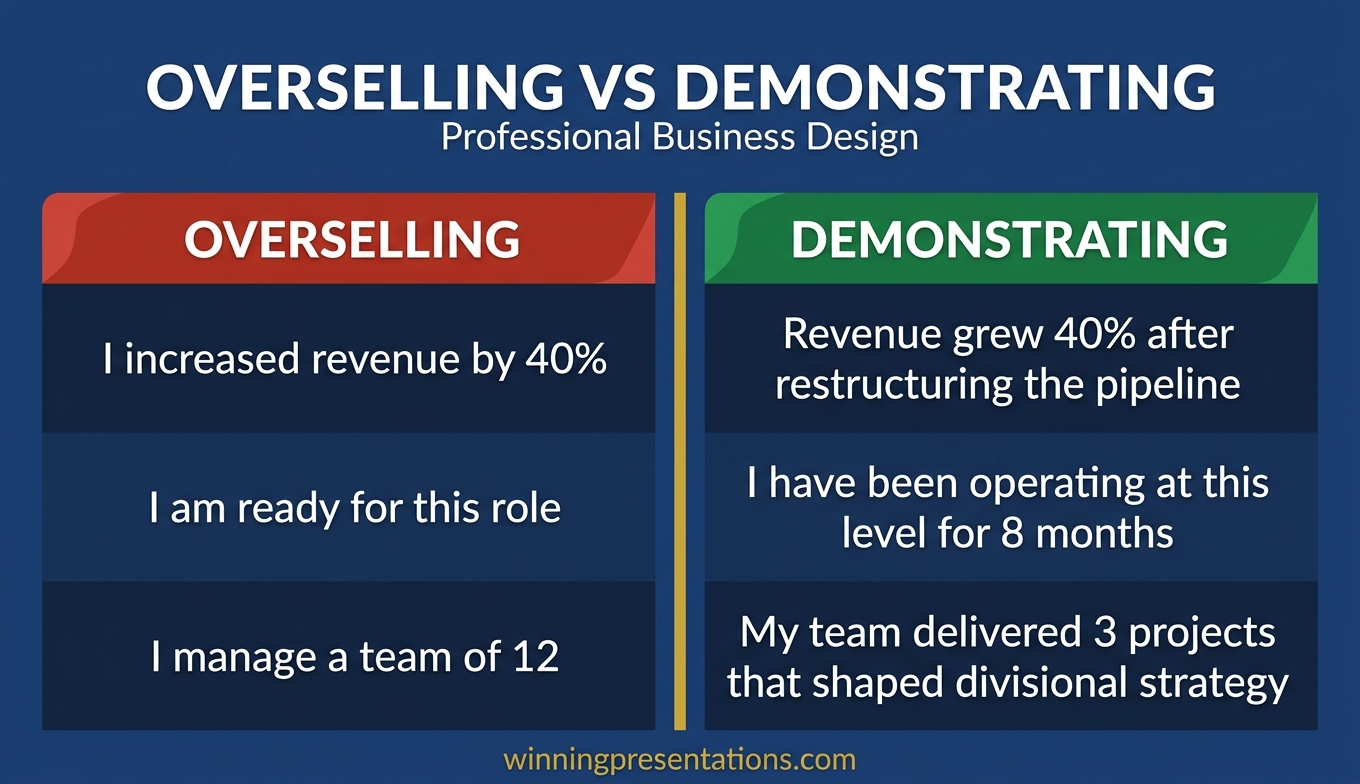
Frame achievements as team outcomes. Instead of “I led the restructuring of the compliance function,” try “The compliance restructuring — which I was asked to lead — reduced processing time by 35 per cent and is now the model being adopted across European operations.” The first version centres you. The second version centres the outcome and lets the panel draw their own conclusion about your role in it.

Let the scale speak for itself. When the numbers are significant, they do not need amplification. “The portfolio grew from £120 million to £340 million during my tenure” is more powerful than “I personally drove unprecedented growth across the portfolio.” Understated delivery of substantial results signals confidence. Overstated delivery of any results signals insecurity.

Attribute credit generously. Panel members know that senior outcomes are never solo achievements. A candidate who acknowledges the contributions of their team, their sponsors, and their peers demonstrates the kind of leadership maturity that promotion panels are specifically looking for. “I built the team that delivered this, and I was fortunate to have a sponsor in the COO who removed barriers at the executive level” tells the panel three things: you build teams, you leverage sponsors, and you are secure enough to share credit.

The Executive Slide System includes frameworks for structuring evidence slides that let results speak without requiring self-promotion.


Comparison infographic showing self-promotional framing versus leadership framing when presenting to a promotion panel

Handling Panel Questions That Test Leadership Maturity

The questions after your panel presentation are not an afterthought — they are often the deciding factor. Panel members use questions to test three things: how you think under pressure, whether your self-awareness is genuine, and whether your vision can survive scrutiny.

“What would you do differently if you could go back?” This question tests self-awareness. The worst answer is “nothing.” The best answer names a specific decision, explains what you learned, and connects that learning to how you would approach a similar situation in the new role. Avoid rehearsed corporate language like “I would communicate more proactively” — be specific enough that the panel believes you have actually reflected on the question before today.

“Where do you see the biggest risk in this function?” This question tests strategic judgement. Panel members are looking for evidence that you can identify threats that are not yet obvious to everyone. A good answer demonstrates that you understand the external environment, the internal dependencies, and the second-order effects of decisions being made elsewhere in the organisation.

“How would you handle a situation where your team disagrees with a senior leader’s direction?” This question tests leadership courage and political skill simultaneously. The panel wants to know that you can push back constructively without damaging relationships. The best answers describe a process — how you would gather evidence, frame the alternative, choose the right moment, and protect your team from reputational risk regardless of the outcome.

“Why this role, and why now?” This deceptively simple question is where many candidates stumble. The answer should connect your personal trajectory to the organisation’s timing. “The function is entering a period of transformation, and my experience in [specific area] is particularly relevant to the challenges ahead” is stronger than “I feel ready for the next step in my career.” The first answer is about the organisation. The second is about you.

For broader guidance on building the skills that underpin strong panel performances, this article on presentation skills for promotion covers the fundamentals.

Build Your Promotion Panel Deck With Confidence

Stop guessing what promotion panels want to see. The Executive Slide System (£39, instant access) gives you 22 templates, 51 AI prompts, and 15 scenario playbooks — built from real executive presentation experience.

Get the Executive Slide System →

Designed for executives preparing for career-defining moments.

Frequently Asked Questions

How long should a presentation to a promotion panel be?

Most promotion panels allocate ten to fifteen minutes for the presentation and ten to fifteen minutes for questions. Aim for the shorter end of the presentation window — a ten-minute presentation that leaves ample time for discussion signals confidence and creates space for the strategic conversation that panels value most. Never exceed your allotted time. A candidate who cannot manage a clock is unlikely to manage a department.

Should I include slides about my current role’s performance metrics?

Include metrics only when they directly demonstrate capability for the target role. A slide showing revenue growth is relevant if the new role involves commercial responsibility. A slide showing project delivery timelines is relevant if the new role involves operational leadership. Avoid metrics that demonstrate competence at your current level without connecting to the next level’s requirements. Two or three well-chosen metrics are more persuasive than a comprehensive performance dashboard.

What is the biggest mistake candidates make when presenting to a promotion panel?

Treating the presentation as a performance review rather than a leadership proposition. The most common structural error is spending 80 per cent of the time on past achievements and 20 per cent on future plans. Reverse that ratio. Panel members already have your performance record — they invited you to present because the record is strong. What they need from the presentation is evidence that you can think and act at the next level.

How do I handle presenting to a promotion panel when I am competing against an external candidate?

Your advantage as an internal candidate is institutional knowledge, established relationships, and a shorter ramp-up period. Lean into these without being defensive about the external threat. Frame your first-ninety-day plan around actions that only an insider could execute quickly — leveraging existing relationships, building on current momentum, addressing known friction points. The external candidate can only promise generic plans; you can offer specific, grounded commitments.

If you are also preparing for a committee-level presentation, this guide on remuneration committee presentations covers the structural principles that apply when the audience holds decision-making authority.

The Winning Edge

A weekly newsletter for executives who present at senior level. Frameworks, slide structures, and panel preparation strategies — delivered every Thursday.

Subscribe to The Winning Edge →

Free resource: Executive Presentation Checklist — a quick pre-panel checklist to pressure-test your deck before the day.

About the Author

Mary Beth Hazeldine is the Owner & Managing Director of Winning Presentations. With 25 years of corporate banking experience at JPMorgan Chase, PwC, Royal Bank of Scotland, and Commerzbank, she advises executives across financial services, healthcare, technology, and government on structuring presentations for high-stakes funding rounds, board briefings, and leadership decisions.