

Promotion Business Case Presentation: The 5-Slide Structure That Wins
Quick answer: A promotion business case presentation that wins committee approval uses five slides, in this order: (1) the role and the gap it fills, (2) the specific scope you have already been carrying, (3) the business outcomes attributable to your work, (4) the operating model after promotion (what changes for the team and the work), and (5) a clean ask with a defined start date. The slides committees reject are the ones that argue for the person rather than the role. The slides committees approve describe a structural decision that happens to involve you.
JUMP TO:
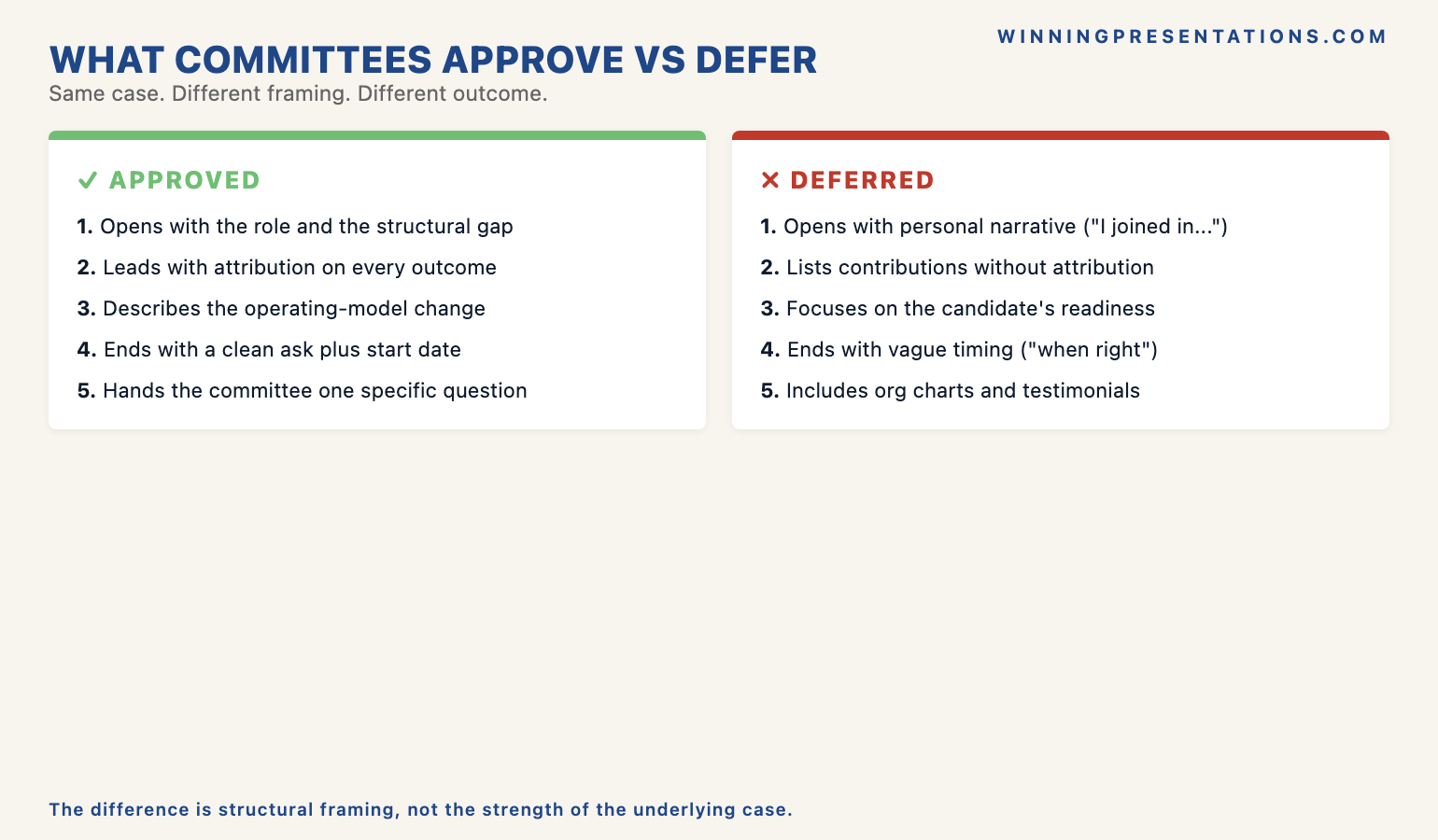
Aigerim, a senior marketing manager at a regional bank in Almaty, walked into her promotion committee meeting with twenty-two slides. She had spent two weekends building it. The deck opened with a personal narrative — how she had grown into the role, what she had learned, the moments she was proud of. Slide 8 was an organisation chart with her current reports highlighted. Slide 14 listed every campaign she had run in the previous eighteen months. The committee scrolled politely through the first six slides, asked one question at slide 11, and broke for coffee at slide 14. The decision the next week was deferred. Six weeks later, the role was opened to external candidates.
The deck did not lose Aigerim the promotion. The framing did. Twenty-two slides argued, implicitly, that the committee should be persuaded that she deserved it. Five slides — the right five — would have framed the same decision differently: as a structural question the committee needed to answer for the business, where the obvious answer happened to be her. That distinction is the difference between a deferred decision and an approved one.
This article walks through the five slides. Each slide has a job. Each slide has things that must be on it and things that must be off. The structure is deliberately constrained — committees approving senior promotions cannot give a long deck the attention it asks for. Five slides forces the discipline that wins.
If you want the slide structure for the case, not just the framework:
The Executive Slide System gives you 26 templates and 93 AI prompts designed for senior decision presentations — including the structural patterns that work for promotion committees, board approvals, and executive sponsors.
Why five slides, not fifteen
Promotion committees are usually small — three to seven senior people, often from outside your direct reporting line. They sit through several promotion cases in a single session. By the third case of the morning, attention is fraying. Decks that ran past ten slides on case one are skimmed; decks that run past ten slides on case three are barely read.
This is structural, not personal. The committee is not less interested in your case than in the first one — they are just operating under cognitive load that compounds across the morning. A long deck punishes them for taking your case last on the agenda. A five-slide deck reads the same in slot one or slot four.
Five slides also forces a different kind of writing. You cannot pad. You cannot list every project. You cannot include the organisation chart, the personal journey, the testimonials, the culture-fit narrative. You have to compress the case to its load-bearing claims and let the slides carry only those. That compression is what makes the case land.
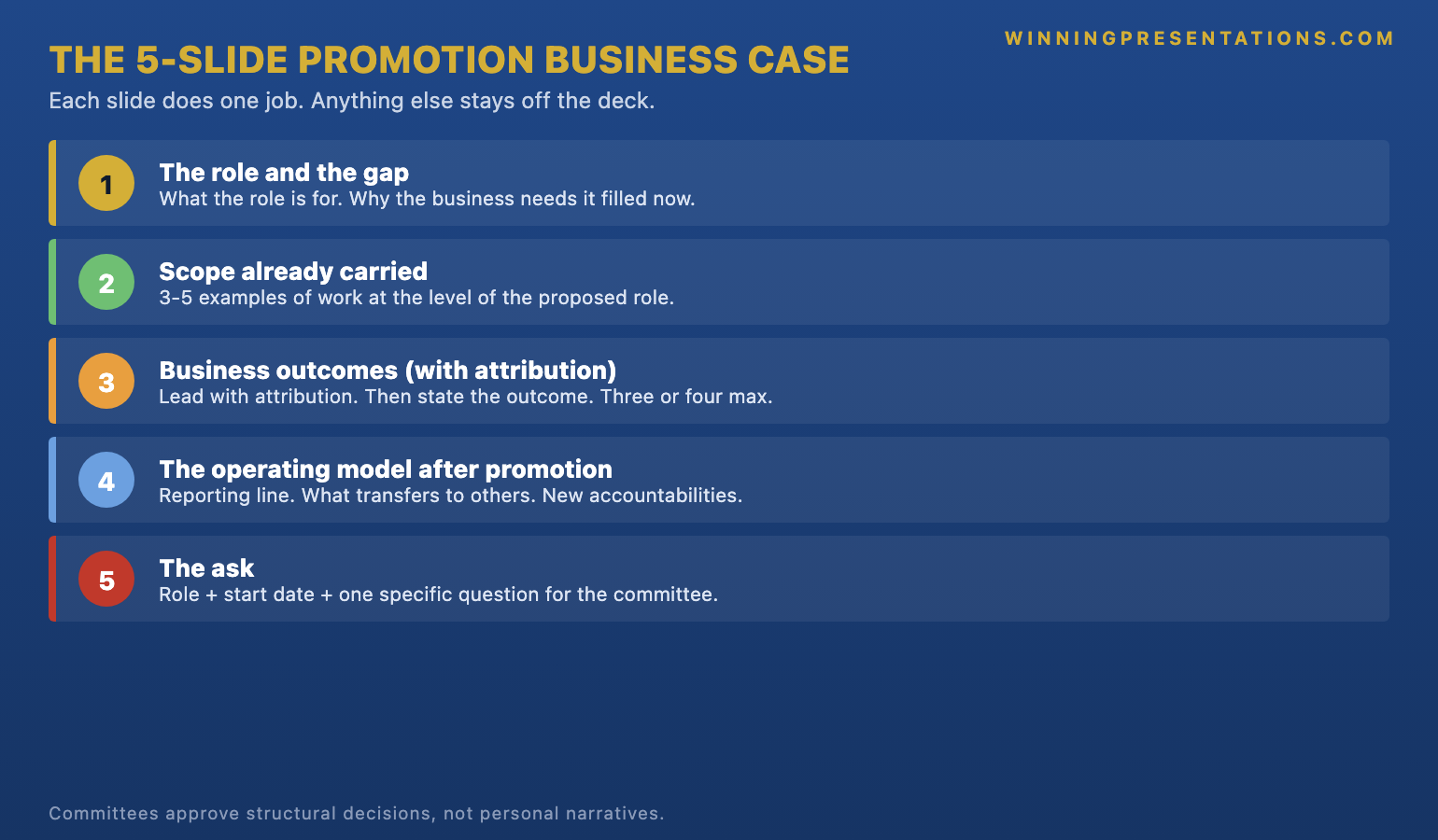
Slide 1: The role and the gap
Slide 1 does not introduce you. It introduces the role you are asking the committee to approve. Title at the top: the role title. Two lines underneath: what the role is responsible for in the business and why the business needs it filled now.
The structural insight here is critical. Most promotion decks open with the candidate’s narrative — “I joined the company in 2019 and have grown through three roles…” This framing makes the committee evaluate you as a person. The role-first framing makes them evaluate a structural decision. Those are different conversations. The structural one is much easier to approve.
Underneath the role definition, name the gap. What is currently happening in the business that this role would solve, that is not happening today? Is it scope a current senior leader is overloaded with? A function that does not currently have an owner? A coordination problem between two teams that needs a single accountable person? Be specific. The gap is the business case, not your readiness.
Slide 2: Scope already carried
Slide 2 is the bridge between the role and you. Its job is to demonstrate that the role already exists, informally, in the work you have been doing — and that promotion is the formalisation of that scope, not its expansion.
The pattern is deliberate. Promotions that look like rewards for past work are easier to defer than promotions that look like recognition of current scope. A committee can always argue that past work is already paid for. They cannot argue, with the same ease, that scope you are visibly carrying today should remain unrecognised.
List three to five concrete examples of work you are doing that sits at the level of the proposed role. For each, name the work, the stakeholders involved, and the level of decision-making you are exercising. “Led the Q1 strategic review for the regional team” is informative. “Owned the strategic prioritisation that determined the Q1 investment allocation across three product lines, including the recommendations the regional MD took to the executive committee” is structural. The second framing makes the committee see the role you are already in.
For more on how to position scope and decision authority on a slide that holds up to senior scrutiny, see the 8-slide CFO presentation template.
Slide 3: Business outcomes
Slide 3 is the only slide in the deck that should contain numbers. It is also the slide most commonly built badly.
The mistake is to list outcomes you contributed to and let the committee work out attribution. “Revenue growth of 12% in the regional segment” sits on the slide; the committee, generous and time-pressed, mentally allocates some fraction of that to your work. This is dangerous because the fraction the committee allocates is almost always smaller than the fraction you intended to claim.
The disciplined approach is to lead with attribution, then state the outcome. “Led the pricing review that recovered £4.2m in margin across the affinity portfolio in 2025.” “Designed and delivered the customer-segmentation framework adopted by the executive team in March 2026, now in use across four product lines.” Three to four outcomes of this shape, each with attribution, scope, and a verifiable business consequence.
If you cannot write outcomes in this shape, you have a different problem than slide design. Either the work has not been visible enough at the right level, or the outcomes are softer than the case requires. That is a real-world signal, not a slide problem. Promotion business cases are won on visible outcomes attributable to the candidate. If those do not exist yet, the case is not ready.
Build the deck with structure, not from a blank canvas.
The Executive Slide System gives you 26 templates designed for senior decision presentations — promotion cases, board recommendations, investment requests, and executive committee proposals. 93 AI prompts to build slides faster, 16 scenario playbooks for the situations that come up most often. £39, instant access, no subscription.
- 26 slide templates for board, committee, and executive decisions
- 93 AI prompts to draft and refine slide copy
- 16 scenario playbooks for the high-stakes presentation situations
- 7 checklists covering deck audit, rehearsal, and Q&A preparation
- Designed for senior professionals across financial services, healthcare, technology, and government
Get the Executive Slide System — £39 →
Instant download. No subscription.
Slide 4: The operating model after promotion
Slide 4 answers the question committees worry about most but rarely ask out loud: what changes for the team and the work if this promotion is approved?
This is the slide that separates first-time promotion presenters from senior ones. First-timers describe what changes for them — new title, new pay band, new responsibilities. Senior presenters describe what changes for the organisation: who picks up the work they currently do, how the new accountabilities sit relative to existing ones, what the team structure looks like in three months. Committees approve the second framing because it is the framing they need to make the decision.
Three things must be on this slide: the proposed reporting line into and out of the role, the work you currently do that needs to transfer to someone else (and the rough plan for that), and the new accountabilities the role will own that are currently sitting elsewhere or going unowned. Keep it crisp. Bullet form is fine. The committee is not looking for a detailed transition plan — they are looking for evidence that you have thought through the operational change, not just the personal one.
The unspoken question this slide answers is whether you are ready to own the next role or whether the promotion is largely a recognition of past work. The first framing wins; the second framing defers.
For senior leaders preparing the broader case for a structural change — including the kind of stakeholder buy-in that promotion committees often involve — the structural approach in the 15-minute board presentation template applies directly.
Slide 5: The ask
Slide 5 is the cleanest slide in the deck. Title: “The ask.” Three lines of body content:
- The role title and band you are asking to be promoted to.
- The proposed start date of the new role.
- The single open question you would like the committee to discuss in the room.
The third item is the move most candidates miss. By offering the committee a specific question to discuss — “Should the role report into the regional MD or directly into the executive committee?” — you take control of the conversation. Without it, the committee discusses you. With it, they discuss the question you have framed. The decision they reach on your question is also, structurally, the decision they reach on the promotion.
The ask slide should not include “and here is why I am ready” or any kind of closing personal statement. The case has been made on slides 1–4. Slide 5 closes the loop and hands the room back to the committee for a focused discussion. A clean close, with one specific question, is what disciplined senior decisions look like.
For the structural psychology behind the ask:
When the audience is being asked to approve a senior decision (promotion, budget, board approval), the framework that earns serious approval is the same. The Executive Buy-In Presentation System covers the structure, psychology, and preparation behind those decisions — self-paced programme, £499, optional recorded Q&A calls.
What to leave off the deck
Five slides means four categories of content stay off the deck entirely. These are the four most commonly included items that weaken promotion cases.
Personal narrative. The story of how you joined the organisation, what motivated you, what you have learned. Committees do not approve narratives — they approve roles. Save the narrative for the conversation if it comes up in Q&A; keep it off the slides.
Organisation charts. A current-state org chart with your name highlighted is the single most common space-waster in promotion decks. Committees know the structure. The information they need on structure belongs on slide 4 (operating model after promotion), in compressed form.
Testimonials and quotes. “X said I was the most reliable person on the team.” Testimonials are below the level of seriousness a promotion committee operates at. They feel like advocacy rather than business case. Leave them off.
Comprehensive project lists. A list of every project you have run in the last two years signals “I have been busy” rather than “I have been operating at the next level.” Slide 3 picks the four outcomes that demonstrate level. The other twenty stay off the deck.
For the broader story of presenting after the promotion is approved, see the first presentation after promotion — the structural patterns that work in the case for the role also apply to the work in the role.
Frequently asked questions
Is five slides really enough for a promotion business case?
Yes — for the formal committee presentation. The five slides do the load-bearing work: role and gap, scope already carried, business outcomes, operating model after promotion, the ask. Supporting evidence — detailed project documentation, peer feedback, performance reviews — sits in an appendix or a separate document the committee can reference if asked. The presentation itself stays at five slides.
What if the committee asks for more detail than five slides allow?
That is the right outcome. A focused five-slide deck triggers the conversation; the appendix or supporting documents answer the questions raised in discussion. A sprawling twenty-slide deck pre-empts the conversation and leaves the committee with no questions to engage on, which often translates into a deferred decision rather than an approved one.
Should I rehearse this presentation, or is the slide structure enough?
Rehearse it. The structure does most of the work, but how you handle the discussion after slide 5 is what most committees actually weight. Rehearse the opening of each slide so you do not over-narrate, and rehearse three or four likely committee questions out loud. Twenty minutes of rehearsal the day before is more useful than twenty hours of slide refinement.
What if my company does not have a formal promotion committee?
The same five-slide structure works for promotion conversations with a single decision-maker — your manager, your manager’s manager, an HR partner. The framing changes slightly (less formal, more conversational), but the load-bearing slides stay the same: role and gap, scope carried, outcomes, operating model, ask. A clean five-slide document is also a useful artefact for the decision-maker to reference internally when they take the case to anyone else.
Stop building the deck from scratch.
The Executive Slide System gives you the templates that work for promotion committees, board approvals, and executive sponsors. 26 templates, 93 AI prompts, 16 scenario playbooks. £39, instant access.
Get The Winning Edge newsletter
A weekly note from Mary Beth on the structure, psychology, and preparation that earns senior approval. One idea, one application, one specific scenario — every Thursday morning.
Not ready for the full system? Start here instead: download the free Executive Presentation Checklist — a single-page reference for what every senior presentation needs before it leaves your desk.
Next step: Open a blank document and write the five slide titles before you build a single slide. Role and gap. Scope carried. Outcomes. Operating model. The ask. If you cannot write a tight one-line summary for each, the case is not ready for the committee — work on the case before you touch the deck.
About the author
Mary Beth Hazeldine is Owner & Managing Director of Winning Presentations Ltd, founded in London in 1990. With 24 years of corporate banking experience at JPMorgan Chase, PwC, Royal Bank of Scotland, and Commerzbank, she advises executives across financial services, healthcare, technology, and government on structuring presentations for high-stakes funding rounds and board approvals.