Tag: executive presentation

12 Apr 2026
Female chief digital officer presenting a digital transformation investment case to a board of directors in a glass-walled boardroom

Digital Transformation Board Presentation: How to Build the Business Case

Quick Answer

A digital transformation board presentation succeeds when it leads with strategic context rather than technical capability, frames the investment in terms of risk and competitive position rather than feature sets, and gives the board a clear choice with a recommended direction — not a technology briefing to absorb.

Priya had spent four months on the business case. As Chief Digital Officer at a mid-size financial services firm, she had commissioned an independent vendor review, benchmarked against three competitors, and built a financial model that showed a clear return within thirty months. The board presentation was scheduled for ninety minutes. She had allocated the first forty to walking through the technology landscape.

The Chair stopped her at slide nine. “Priya, we appreciate the detail, but can you take us to the decision? What are you actually asking us to approve?”

She had a recommendation on slide twenty-three. By the time she reached it, the board had mentally disengaged. The investment wasn’t approved that day — it was deferred for “further consideration,” which, in practice, meant another quarter of delay and a request for a shorter, clearer paper.

The problem wasn’t the quality of the analysis. It was the sequencing. Priya had built a presentation for an audience that wanted to understand the technology — but boards don’t want to understand the technology. They want to understand the risk, the opportunity cost, and the decision in front of them. The more technical context you provide before reaching the ask, the more confused and disengaged a board audience becomes.

Digital transformation is one of the most common investment decisions reaching boardrooms today. It is also one of the most frequently mishandled presentations — not because the analysis is weak, but because the story is told in the wrong order for a board audience.

Building a board-ready transformation deck?

If you’re preparing a digital transformation investment case for a board or executive committee, the Executive Slide System includes templates and frameworks for exactly this type of high-stakes approval presentation. Explore the System →

Why digital transformation presentations fail at board level

The most common failure mode in a digital transformation board presentation is technology-first sequencing. The presenter builds the story from capability outwards — here is what the technology can do, here is how we would implement it, here is the projected return. This is a logical order for a project team. It is the wrong order for a board.

Boards operate from a different frame of reference. Their primary concern is not operational capability — it’s fiduciary responsibility and strategic positioning. When a presentation opens with technology, it triggers a set of questions in the board’s collective mind that have nothing to do with the slides: Is this within our strategic priorities? Who is accountable if this goes wrong? What happens if we don’t do it? A technology-first presentation typically never answers these questions, because it was built around the solution rather than the decision.

The second failure mode is scope ambiguity. “Digital transformation” is a phrase that means different things to different people in the same boardroom. Without an explicit definition of what is and isn’t included in the scope of the investment, board members will import their own interpretations — and the discussion will fragment along those lines. A clear scope statement, positioned early in the deck, prevents this.

The third failure mode is the absence of a clear ask. Many digital transformation presentations end with a roadmap or a phased plan — but without a specific, bounded decision for the board to make. Boards are accustomed to approving specific things: a budget envelope, a mandate to proceed to the next phase, a vendor selection. An open-ended “we’d welcome the board’s thoughts on the direction” creates uncertainty about what is actually being requested and typically results in deferral.

For related thinking on how transformation programmes should be communicated to executive audiences, the article on how to structure a transformation programme presentation covers the ongoing communication layer that sits alongside the initial investment case.

Executive Slide System

Build the Board Case — Not Just the Deck

Digital transformation investments fail at board level when the presentation is built for the project team rather than the approving body. The Executive Slide System — £39, instant access — gives you the templates and frameworks to build a board-ready investment case that leads with strategic context, not technical capability.

  • Slide templates for investment approval and business case presentations
  • AI prompt cards to build your strategic narrative fast
  • Framework guides for structuring risk, ROI, and stakeholder impact
  • Scenario playbooks for high-stakes board and executive committee presentations

Get the Executive Slide System →

Designed for executives preparing complex investment cases for board and executive committee approval.

The presentation structure that works for board audiences

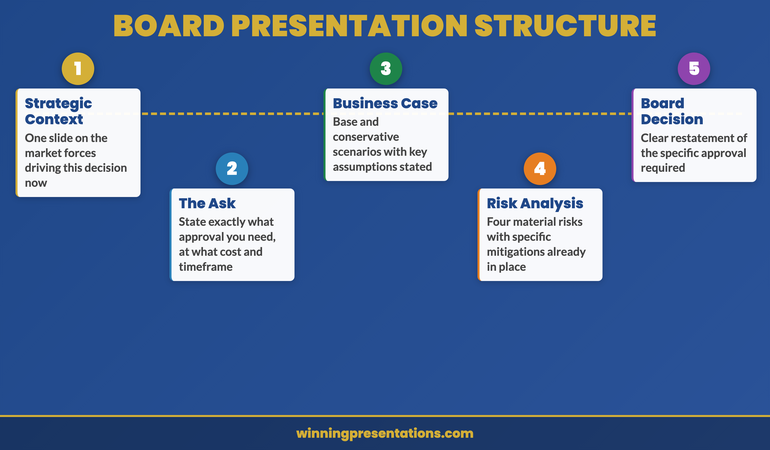
The most effective digital transformation board presentations follow a decision-first structure. The ask is on slide one or two — not at the end. This is counterintuitive for many executives who have been trained to build to a conclusion, but for board audiences it is almost always the right approach.

Digital transformation board presentation structure infographic showing six sections: strategic context, the decision, business case, risk analysis, implementation approach, and board ask

A seven-to-ten slide structure that reliably works for this type of presentation:

Slide 1 — Strategic context. One slide that frames the market or competitive position that makes this investment relevant now. This is not a market research presentation — it’s a single compelling observation that positions the decision in the context of the board’s existing strategic priorities.

Slide 2 — The decision. State clearly what you are asking the board to approve, at what cost envelope, over what timeframe, and with what accountability. Boards respond well to precision at this stage. Vagueness here creates anxiety throughout the rest of the presentation.

Slides 3–4 — Business case. The quantified case for the investment: revenue protection or growth, cost efficiency, operational risk reduction, or competitive positioning. Boards are not looking for exhaustive financial modelling — they’re looking for confidence that the numbers have been stress-tested and the assumptions are defensible.

Slide 5 — Risk analysis. What are the three or four material risks, and how are they being managed? A board that sees no risks on a transformation deck becomes more concerned, not less. Acknowledging risk credibly is a sign of programme maturity.

Slides 6–7 — Implementation approach. A high-level phased plan with clear milestones, governance structure, and accountability. Boards don’t need a Gantt chart — they need to see that there is a credible delivery framework.

Slide 8 — Alternatives considered. What other approaches were evaluated, and why is this the recommended option? A single slide on this prevents the question “have you considered X?” from derailing the discussion.

Slide 9 — The ask. A clear restatement of the specific decision required: budget approval, mandate to proceed to Phase 1, or endorsement of the vendor recommendation. This is the action slide — it should specify what happens next and who is responsible.

How to build the business case without losing the room

The business case section of a digital transformation presentation is where most presenters spend disproportionate time and where most boards switch off. The mismatch arises because the presenter is presenting the full analytical process — here is how we built the model, here is every assumption — when the board wants the conclusions and the confidence level behind them.

A practical approach: present the business case as a range rather than a point estimate. “The base case shows X, the conservative case shows Y, and the optimistic case shows Z — and here is the single factor that most significantly determines which scenario we’re in.” This demonstrates analytical rigour without requiring the board to follow detailed financial modelling, and it prepares them for the risk conversation that follows.

The business case should also address the cost of not acting. Many transformation investment cases focus entirely on the projected return from the investment, without quantifying the risk of the status quo. For a board audience, the cost of inaction is often the most compelling part of the argument — particularly where the competitive context shows that peers or competitors are already investing in the same capabilities.

For guidance on how to present technology evaluation decisions to mixed executive and finance audiences, the article on technology evaluation presentations for IT and finance covers the specific adaptations needed when multiple executive functions share the decision.

The Executive Slide System includes AI prompt cards specifically designed to help you pressure-test a business case narrative before the board meeting — see what’s included.

Framing risk: the argument boards actually respond to

Risk is the most important and most frequently mishandled section of a digital transformation board presentation. There are two failure modes: presenting no risks (which destroys credibility), and presenting an exhaustive list of every possible risk (which creates paralysis).

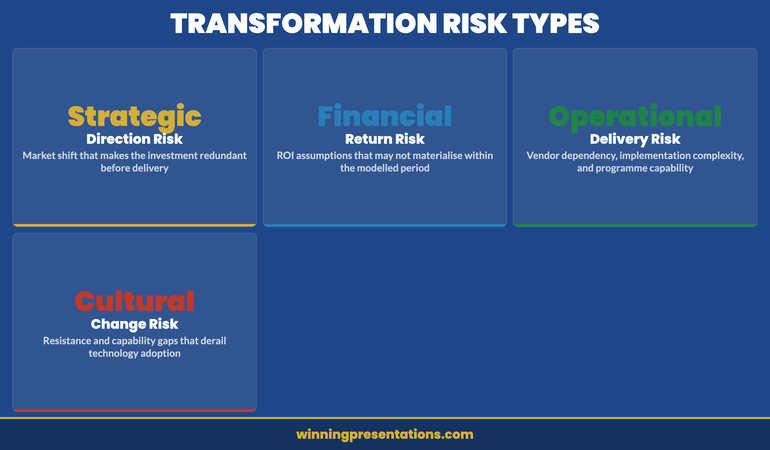
The format that works best for a board audience is a focused risk register with three columns: the risk, the likelihood and impact assessment, and the specific mitigation measure already in place or proposed. Limit this to four or five material risks. The board does not need to see operational delivery risks that sit below the programme governance threshold — only the risks that genuinely have strategic or financial significance.

Risk framing infographic for digital transformation board presentations showing four risk types: strategic, financial, operational, and dependency risks, with mitigation approaches for each

The framing of risk in this context also matters. A risk presented as “technology implementation failure” triggers a generalist anxiety in the boardroom. A risk presented as “vendor dependency risk — mitigated by contractual break clauses and a parallel in-house capability build in Phase 2” is specific, manageable, and demonstrates programme maturity. The specificity is what builds confidence.

One risk that boards consistently want to see addressed — and that is frequently absent from transformation decks — is organisational change risk. Technology implementation is typically not what derails digital transformation programmes. Cultural resistance, capability gaps, and middle management inertia are. Acknowledging this explicitly and showing that the people-side of the programme has a plan demonstrates the kind of executive maturity that boards look for in a programme sponsor.

Executive Slide System — £39

The Investment Case That Gets Approved

The Executive Slide System — £39, instant access — gives you a structured framework for building the kind of board-ready investment case that gets a decision rather than a deferral.

Explore the System →

Designed for executives presenting investment cases, strategic initiatives, and transformation programmes to boards.

The questions boards ask — and how to prepare for them

Experienced non-executive directors ask a fairly consistent set of questions in digital transformation presentations. Preparing for these in advance — and, where possible, pre-empting them in the deck — removes the most common sources of discussion that extend meetings beyond their allocated time.

The most frequent board questions in this context are: Why now? What happens if we don’t do this? How confident are you in the vendor? What does Phase 1 actually cost and what does it prove? Who is the senior accountable person, and what authority do they have? What does success look like at the twelve-month mark?

Each of these questions should have a clear, brief answer in the presenter’s head before the meeting — ideally with a corresponding slide or appendix page they can reference. The ability to answer “who is accountable?” with a specific name and a description of their authority is a more confidence-building answer than “we’re working through the governance structure.” Boards approve investments in people as much as in programmes.

For a broader discussion of how to anticipate and handle the difficult questions that arise in high-stakes presentations, the article on stakeholder buy-in psychology covers the underlying dynamics of executive decision-making in complex investment contexts.

Preparing the room before you enter it

The single most effective thing you can do to improve the outcome of a digital transformation board presentation is to have a brief, informal conversation with the Chair or Senior Independent Director before the formal meeting. This is not about lobbying — it’s about understanding whether there are specific concerns, recent experiences with similar investments at peer organisations, or governance questions that are likely to surface in the discussion.

Board members bring their external perspectives to every investment discussion. A non-executive who has recently seen a high-profile digital transformation failure at another company will bring that context into the room. A Chair who has a background in technology will have different questions to one whose career is in finance. Understanding the composition of the room allows you to calibrate your presentation — not to change the substance, but to sequence the content in a way that addresses the concerns most likely to arise.

A pre-meeting brief to the executive sponsor — not the full presentation, but a two-page summary of the ask and the key risks — is also worth considering for complex investment cases. It prevents the sponsor from hearing the analysis for the first time in the room and gives them the foundation to contribute constructively to the discussion rather than asking orientation questions.

For the cross-department alignment that often needs to happen in parallel with a transformation investment case, see also the approach covered in how to structure a cross-department quarterly review — the stakeholder alignment principles transfer directly to programme governance communications.

Frequently Asked Questions

How many slides should a digital transformation board presentation have?

For a ninety-minute board session, aim for eight to ten primary slides with an appendix of three to five supporting slides available for deep-dive questions. The board should be able to understand the investment case, the risks, and the decision from the primary deck alone. The appendix demonstrates rigour without slowing down the main presentation. If your primary deck is running beyond twelve slides, review whether each slide contains a decision-relevant point or whether it’s presenting process information that belongs in a supporting document rather than the presentation itself.

Should I include a financial model in the board presentation?

Include the outputs of the financial model — a single slide showing base, conservative, and optimistic scenarios with the primary assumptions stated — but not the model itself. Boards need to understand the logic and the confidence level behind the numbers, not to audit the spreadsheet. If a board member wants to review the model in detail, that conversation should happen in a pre-meeting briefing or a designated working session rather than during the formal presentation. Walking a board through financial modelling assumptions in real time typically results in the discussion getting stuck on technical detail rather than the strategic decision.

What if the board asks for a delay to “consider further”?

A deferral request usually signals one of three things: a specific unanswered question, an unresolved concern about governance or accountability, or a need for broader board alignment that hasn’t happened yet. The most useful response to a deferral is to ask directly what information or assurance would allow the board to make the decision at the next meeting. This converts a vague delay into a specific action list — and it demonstrates the programme maturity that boards are implicitly testing for when they ask for more time.

The Winning Edge — Weekly Insights for Executive Presenters

Every Thursday: one practical insight to sharpen your executive communication. No generic tips — only what works in real high-stakes rooms.

Join The Winning Edge →

Free resource: The Executive Presentation Checklist — a pre-meeting quality check for high-stakes presentations.

About the Author

Mary Beth Hazeldine — Owner & Managing Director, Winning Presentations

With 25 years of corporate banking experience at JPMorgan Chase, PwC, Royal Bank of Scotland, and Commerzbank, Mary Beth advises executives across financial services, healthcare, technology, and government on structuring presentations for high-stakes funding rounds and approvals. She is the creator of the Executive Slide System and the Conquer Speaking Fear programme.

11 Apr 2026
Senior executive presenting a workforce planning business case to a finance panel — boardroom setting, data-led discussion, confident composed presenter, navy and gold tones

Workforce Planning Presentation: How to Build the Business Case for Headcount and Talent Investment

Quick Answer

A workforce planning presentation wins approval when it frames people investment as a business continuity and performance risk issue, not a staffing preference. Connect each headcount request to a revenue, delivery, or compliance outcome. Boards approve people investment when they can see the cost of the gap, not just the cost of filling it.

Henrik had been waiting for the right moment to bring the workforce planning case to the ExCo for over a year. His organisation was running three critical programmes with teams at 60 per cent of required capacity. Two delivery leads had resigned in eight weeks. Three client contracts had slipped past their committed milestones. He had the data. He had the analysis. He had a clear investment request.

What he did not have was a presentation that made the financial consequence of the talent gap visible to people who were looking at a cost line, not a delivery problem. His first attempt opened with a slide titled “Our People Strategy 2026–2028.” The CFO asked, at the first opportunity, whether the request could wait until the September budget cycle. It was March.

Henrik restructured over one weekend. He replaced the people strategy title with “Revenue and Delivery Risk: Talent Gap Impact Analysis Q1–Q3 2026.” The first content slide showed three specific contracts at risk, with the combined value at risk and the direct cause — under-resourced delivery teams. He was approved within the week.

The data had not changed. The risks had not changed. Only the frame had changed — and the frame made the difference between a deferral and a decision.

Preparing a headcount or people investment case right now?

The Executive Slide System includes slide templates and scenario guides for investment approvals, resource cases, and strategic reviews. It may save you a full deck rebuild.

Explore the System →

Why Workforce Planning Presentations Lose in the Boardroom

People investment cases face a structural disadvantage in executive presentations. Unlike capital expenditure on equipment or technology, headcount investment is perceived as open-ended. Once approved, it establishes a baseline. It grows. It is politically difficult to reverse. These perceptions — whether or not they are accurate in a specific case — shape the scepticism that your presentation must overcome before it reaches the financial analysis.

The second disadvantage is that workforce planning presentations are typically prepared by HR directors or talent leads who are closer to the people complexity than the financial risk. The language of these presentations — capability frameworks, succession pipelines, development investment, engagement scores — is specialist language that does not map directly to the financial and operational language that ExCo and board members use to evaluate investment decisions.

This is not a criticism of HR expertise. It is a diagnosis of a communication gap that recurs across industries and organisation sizes. The fix is not to pretend the people complexity does not exist — it is to translate that complexity into the financial and operational frame your audience uses to make decisions. That translation work is what separates workforce planning presentations that are approved from those that are deferred.

The third failure mode is the absence of urgency. Workforce planning is inherently forward-looking — it deals with risks that will materialise over months or years rather than in the next quarter. Presentations that present this as a planning exercise rather than an immediate risk management decision give executives permission to defer. Your presentation must establish a compelling reason to decide now, or the default answer will always be “not yet.”

Framing Headcount as a Financial Risk, Not a Resource Request

The most effective workforce planning presentations begin not with the headcount number, but with the business risk that the headcount gap is creating. This is a deliberate inversion of the usual approach — most HR-led presentations start with the current state of the workforce and build toward the investment request. Starting with the risk creates a different conversation from the first slide.

The financial risks associated with talent gaps typically fall into four categories. Revenue risk occurs when under-resourced sales, delivery, or client-facing teams cannot execute on committed pipeline or contracted obligations. Delivery risk occurs when project and programme teams cannot meet milestones, creating penalties, reputational damage, or client attrition. Compliance and regulatory risk occurs when specialist functions — legal, risk, finance, data protection — are running below the headcount required to discharge their obligations. Operational resilience risk occurs when single points of dependency create vulnerability to resignation, illness, or unexpected demand.

Map each element of your workforce investment request to one of these risk categories, and quantify the exposure wherever possible. The approach to building a CFO-ready investment case is the same whether the investment is in capital equipment or in people — see the framework in this analysis of getting the CFO on side before the investment presentation. The same pre-meeting alignment principles apply directly to workforce cases.

One technique that consistently strengthens financial framing is the cost-of-vacancy analysis. Rather than presenting the cost of hiring, present the fully loaded cost of the vacancy — the revenue not captured, the work absorbed by over-stretched team members, the quality degradation in delivery, and the increased attrition risk as remaining team members carry unsustainable loads. In most organisations this analysis, when done rigorously, shows that a vacancy costs significantly more than the salary of the role it represents. This reframes the investment from a cost add to a cost reduction.

Four workforce risk categories for executive presentations: revenue risk, delivery risk, compliance risk, and operational resilience

Presenting the Talent Gap Analysis Executives Respond To

A talent gap analysis in an executive presentation is not a comprehensive workforce audit. It is a focused assessment of the specific capability shortfalls that are creating — or will create — the business risks you identified in the previous section. The distinction matters because comprehensive analyses generate questions and debate that divert attention from the investment decision you need.

Structure your gap analysis around three questions. First: what capabilities are required to deliver the business plan in the next twelve to eighteen months? This is a forward-looking question — not what you have, but what you need. Second: what is the gap between current capability and required capability, expressed in specific roles, skills, or capacities? Third: what is the timeline of that gap — which elements are already creating business impact, which will create impact within six months, and which are longer-term strategic considerations?

This three-question structure keeps the gap analysis anchored to the business plan rather than to the workforce in isolation, and it creates a natural urgency gradient — decision-makers can see immediately which elements of the gap require an immediate decision and which can be addressed through a phased approach.

The Executive Slide System includes framework guides for presenting capability and resource analysis in a board-ready format — specifically the challenge of making complex talent data readable at a senior level without losing the analytical rigour that gives the case credibility. If you are building this section of your workforce presentation, those frameworks provide a starting structure that connects capability analysis to business outcome without requiring a page of HR commentary to explain.

Build Your Workforce Investment Case on Slides Executives Approve

The Executive Slide System — £39, instant access — includes slide templates for investment approvals, resource cases, and strategic reviews, with AI prompt cards to structure your financial risk argument and framework guides that organise complex workforce data the way decision-makers read it.

  • Slide templates for executive scenarios including investment approvals
  • AI prompt cards to build financial risk and gap analysis arguments
  • Framework guides for resource and capacity presentations
  • Scenario playbooks for strategic people investment decisions

Get the Executive Slide System →

Designed for executives who present investment cases, resource requests, and strategic proposals to boards and senior leadership teams.

Structuring Your Investment Ask in Tiers

One of the most effective structural choices in a workforce planning presentation is to present the investment request in tiers rather than as a single aggregate number. A single large headcount or salary cost number invites the question “can we do this for less?” — and puts the presenter in a defensive position. A tiered request invites the question “which tier do we approve?” — a more productive conversation that often results in a faster and larger decision.

Tier one should contain the investment required to address immediate, high-impact gaps — the roles or capabilities that are creating current revenue, delivery, or compliance risk. This tier should be sized conservatively and presented with specific risk mitigation as its output. Frame it as the minimum required investment, not the preferred scenario.

Tier two should contain the investment required to fully close the capability gap against the current business plan — to move from risk mitigation to planned capacity. This is your preferred scenario, and it should be linked explicitly to the financial plan: “With tier two approved, we project delivery against the three contracts currently at risk, and we restore the capacity margin required for the Q3 pipeline.”

Tier three, if applicable, should contain the investment required for strategic capability building — roles or capabilities needed for the business plan beyond the current period. This tier is discretionary and should be presented as such. Including it demonstrates that you have thought beyond the immediate requirement, without making the strategic ambition a condition of the immediate approval.

This tiering approach works for the same reason that tiered investment requests work in capital expenditure cases — see the analysis of getting headcount requests approved for the specific framing techniques. It respects the decision-maker’s need to calibrate investment to risk, rather than presenting a take-it-or-leave-it number that creates unnecessary friction.

Handling Common Executive Objections to People Investment

Workforce planning presentations attract a predictable set of objections. Anticipating and structuring responses to these objections before they are raised — either through pre-meeting alignment or through dedicated slides — dramatically improves approval rates.

“Can we develop internally rather than hiring?” This objection reflects a legitimate cost management instinct, but it often underestimates the timeline and capacity constraints of internal development. Your response should acknowledge internal development as part of the long-term strategy while being specific about which elements of the current gap require external hiring: the skills that take twelve to eighteen months to develop internally, the capacity shortfall that cannot be absorbed by development timelines, and the immediate delivery risk that cannot wait for a development programme to complete.

“Can we use contractors or interim resource rather than permanent headcount?” This is sometimes the right answer, and your presentation should address it explicitly rather than waiting for the question. Where the capability gap is temporary or project-specific, interim resource may be the appropriate recommendation. Where the gap is structural — driven by business plan growth, regulatory requirement, or permanent capability shortfall — permanent headcount is the appropriate answer, and you should be prepared to make that case on the basis of total cost of ownership rather than salary line.

“Is this the right time, given the current budget environment?” This is the timing objection — the most common and the hardest to overcome without clear urgency framing. Your response should return to the cost-of-vacancy and delivery risk analysis: the question is not whether the budget environment is challenging, but whether the cost of deferring is greater than the cost of the investment. In most cases where a genuine gap exists, the answer is yes — and your analysis should have made that quantification before this question arises.

Handling objections in executive presentations requires both preparation and a specific structural approach that keeps the conversation on the decision rather than on the objection. The framework in this analysis of managing objections in presentations applies directly to the challenges outlined above.

People also ask: How do I make a workforce planning presentation to the board? A board-level workforce planning presentation should be no more than eight to ten slides and should open with the business risk, not the people strategy. The first two slides should establish what is at risk financially and operationally if the gap is not addressed. The investment request should be tiered. Governance and accountability should be explicit. Avoid HR-specific language — use the financial and operational vocabulary your board uses to evaluate all investment decisions.

People also ask: What data should I include in a workforce planning presentation? Include only the data that is directly relevant to the investment decision. The most effective data points are: the specific roles or capability gaps creating current or near-term business risk, the quantified financial impact of those gaps, the timeline of impact, and the cost comparison between the investment and the ongoing cost of the gap. Avoid presenting comprehensive workforce analytics — they generate questions that dilute the investment conversation.

The Slide Structure That Gets Workforce Investment Approved

The structure below is designed for an ExCo or board-level workforce planning presentation where the primary objective is investment approval. It follows the same logic as any high-stakes investment case: establish the risk, quantify the consequence, define the solution, tier the ask, demonstrate accountability.

Slide 1 — The decision framing: State the investment request and the risk it addresses in one sentence. “We are requesting approval of [headcount/budget] to address a capability gap that is currently placing [three contracts / £X revenue / regulatory compliance in Y] at risk.”

Slide 2 — Current state risk summary: Three to four specific business risks — with financial quantification — created by the current gap. Not a workforce analysis. A business risk analysis.

Slide 3 — Gap analysis: What capability is missing, at what scale, and on what timeline. Anchored to the business plan, not to the workforce structure.

Slide 4 — Tiered investment request: Three tiers — minimum risk mitigation, full gap closure, strategic development — with costs and outputs for each tier clearly stated.

Slide 5 — Cost-of-vacancy analysis: The ongoing cost of the gap per quarter or per year, compared to the investment required to close it. This slide makes the financial case for acting now rather than deferring.

Slide 6 — Governance and accountability: The executive owner, the hiring and onboarding plan, and the four to six milestones by which progress will be measured in the next twelve months.

Slide 7 — The recommendation: The specific tier you are recommending for approval, with a clear statement of the risk it addresses and the outcome it delivers. End with the ask. Companion articles on ESG board presentations and the principles of strategic investment approval apply equally here — both cases require the same risk-first framing discipline.

Seven-slide workforce planning presentation structure from decision framing through investment tiers to governance and recommendation

Structure Your Investment Case the Way Boards Approve It

The Executive Slide System — £39 — includes scenario playbooks and framework guides structured for strategic investment approvals, resource cases, and board-level risk presentations. Get the slide templates that connect your people investment to financial outcomes.

Get the Executive Slide System →

Designed for executives who present investment cases, resource requests, and strategic proposals to boards and senior leadership teams.

Frequently Asked Questions

How long should a workforce planning presentation be?

For an ExCo or board-level investment approval, a workforce planning presentation should be between seven and ten slides, presented in fifteen to twenty-five minutes with time for questions. Longer presentations signal that the business risk has not been distilled clearly — and they increase the likelihood of the conversation drifting into workforce complexity rather than focusing on the investment decision. If you have more detailed analysis, place it in an appendix that can be referenced during questions.

Should I involve the CFO before the formal workforce planning presentation?

Yes — pre-meeting alignment with the CFO is one of the most reliable ways to improve the outcome of a workforce planning presentation. The CFO’s primary concern will be the financial analysis: the cost-of-vacancy calculation, the investment sizing, and the basis for the financial risk estimates. If the CFO has reviewed and is comfortable with the financial analysis before the formal presentation, they become an implicit endorser rather than an objector. A brief thirty-minute meeting before the ExCo session, where you walk the CFO through the financial logic, removes the single most common source of challenge in the room.

What is the best way to present headcount numbers to a cost-conscious executive team?

Present headcount numbers as a ratio of investment to risk mitigation, not as a salary cost in isolation. “We are requesting four additional roles at a total annual cost of £320,000. The current gap in these capabilities is creating a revenue risk of £1.2 million in the next two quarters and a delivery penalty exposure of £180,000.” This framing makes the investment decision legible as a financial calculation rather than a headcount preference. If you present the salary cost alone, cost-management instincts dominate. If you present it as a risk-adjusted investment, the conversation moves to evaluation rather than resistance.

Get weekly presentation strategy in your inbox

Every Thursday, The Winning Edge delivers one actionable insight for executives who present investment cases, strategic proposals, and resource requests to boards and senior leadership teams.

Subscribe to The Winning Edge →

Free resource: Download the Executive Presentation Checklist — a one-page pre-presentation audit for executives preparing high-stakes investment and strategic approval presentations.

About the Author

Mary Beth Hazeldine is Owner & Managing Director of Winning Presentations. With 25 years of corporate banking experience at JPMorgan Chase, PwC, Royal Bank of Scotland, and Commerzbank, she advises executives across financial services, healthcare, technology, and government on structuring presentations for high-stakes investment cases, resource approvals, and board decisions.

11 Apr 2026

ESG Board Presentation: How to Build the Business Case for Sustainability Investment

Quick Answer

An ESG board presentation succeeds when it reframes sustainability as a financial risk management and regulatory compliance issue — not a values exercise. Boards respond to evidence of material financial exposure, regulatory timeline, and competitive positioning. Structure your case around the cost of inaction, not the benefit of good intentions.

Valentina had prepared for six months. The ESG strategy she was about to present to the board represented 14 months of internal analysis, three rounds of stakeholder consultation, and a £2.3 million programme of work already in flight. She opened her deck with a slide titled “Our Commitment to a Sustainable Future” and a photograph of a wind turbine.

The chairman interrupted within four minutes. “Valentina, what is the financial exposure if we don’t act on the regulatory timeline?” She hadn’t budgeted a slide for that question. She had budgeted three slides for the environmental impact section.

The board deferred. Not because they disagreed with the strategy — but because the presentation hadn’t addressed the question they were there to answer: what does this cost us if we get it wrong, and what does it cost us to get it right? Valentina came back three weeks later with a restructured case. The second presentation was approved in forty minutes.

The difference wasn’t the data. The data was the same. The difference was the frame — and for an ESG board presentation, the frame is everything.

Already preparing an ESG or strategic investment presentation?

The Executive Slide System includes slide frameworks and scenario guides designed for board-level investment cases, regulatory updates, and strategic reviews. It may save you several hours of deck-building.

Explore the System →

Why ESG Presentations Fail at Board Level

Most ESG presentations are built by people who are deeply invested in the agenda — and that investment shows in the wrong way. The deck prioritises conviction over clarity, commitment metrics over financial consequence, and ambition over accountability. The result is a presentation that reads well internally and falls flat in the boardroom.

Board members are not opposed to ESG. Most non-executive directors have seen the regulatory direction of travel, the investor pressure, and the reputational risk clearly enough. What they are resistant to is an ESG presentation that does not speak their language. And their language is risk-adjusted return, regulatory liability, and strategic positioning — not carbon neutrality targets expressed as a percentage against a 2019 baseline.

The structural problem is one of audience mismatch. Sustainability teams build presentations for people who share their expertise and their concern. Boards need presentations built for people who are accountable for everything the organisation does — and who need to allocate capital, manage risk, and respond to regulators. These are different cognitive frames, and they require different slide structures.

There is a second, more subtle failure: the absence of a clear decision request. Many ESG board presentations are structured as updates rather than approval requests. They inform rather than ask. Boards, as a strong board presentation always demonstrates, are decision-making bodies — not audiences. When a presentation has no decision at its centre, the board has no reason to engage with it as a business matter.

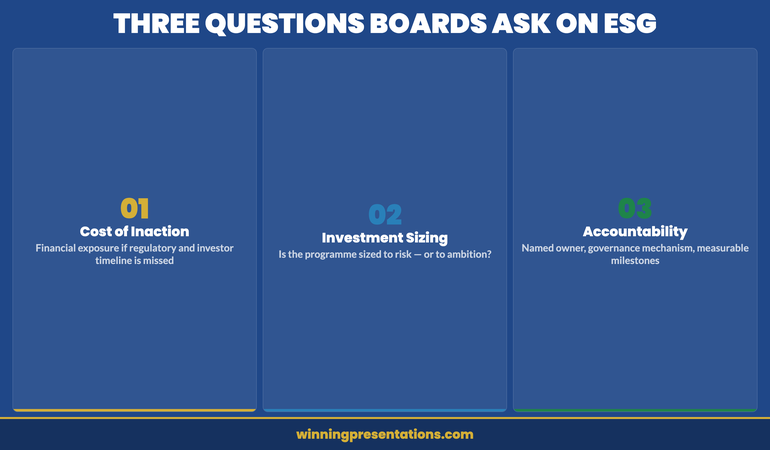
The Three Questions Your Board Is Actually Asking

Before structuring a single slide, it is worth knowing what question your board is sitting with when you stand up to present. In twenty-five years of working with boards across financial services, technology, and regulated industries, I have observed that ESG presentations face three questions that are rarely stated explicitly but are always present.

Question one: What is the cost of inaction? Board members want to understand what happens to the organisation if it does nothing — or does less than the regulatory and investor environment now requires. This includes regulatory fines, loss of institutional investor support, reputational damage in key markets, and exclusion from certain procurement frameworks. This question should be answered on your second or third slide, not buried at the back.

Question two: Is the investment sized correctly? Boards are sceptical of ESG programmes that appear to have been sized to the ambition rather than to the risk. They want to see a clear relationship between the investment proposed, the regulatory requirement it addresses, and the timeline it operates within. Vague programme costs presented alongside aspirational targets trigger concern, not confidence.

Question three: Who is accountable, and how will we know if it is working? ESG programmes that lack clear governance, named accountable executives, and measurable near-term milestones read as activity plans rather than business strategies. Boards approve strategies, not activity plans. Accountability and measurement must be explicit in the presentation, not relegated to an appendix.

Three questions boards ask during ESG presentations: cost of inaction, investment sizing, and accountability structures

Building the Financial Materiality Argument

Financial materiality is the concept that determines whether an ESG issue is significant enough to affect the organisation’s financial performance, position, or prospects. It is also the concept that most ESG presentations skip — presenting sustainability as important in principle, rather than important to the numbers.

Your first task is to map each major ESG risk to a financial line. Carbon regulation exposure maps to operating cost and potential liability. Supply chain sustainability gaps map to procurement risk and contract continuity. Water and resource intensity maps to input cost and operational resilience in stressed conditions. Governance failures map to regulatory sanction, director liability, and the cost of remediation. Each of these connections should be quantified where possible — even a directional range is more useful to a board than a qualitative description.

The second task is to separate the investment request from the broader ESG ambition. Boards can find it difficult to approve a programme when they cannot distinguish the regulatory minimum from the aspirational target. Structure your investment request into clear tiers: what is required for regulatory compliance, what is required for investor and disclosure standards, and what is discretionary for competitive positioning. This tiering approach gives the board a decision framework rather than a binary yes or no to a single large number.

Building a robust capital expenditure business case follows the same logic: the financial case must stand independently of the strategic rationale. See this analysis of structuring a capital expenditure presentation for the principles that apply equally to ESG investment requests.

Build Your ESG Business Case on Slides Boards Can Approve

The Executive Slide System — £39, instant access — gives you slide templates for executive scenarios including investment approvals, regulatory updates, and strategic reviews. Each template comes with AI prompt cards to structure your financial materiality argument, and framework guides that organise complex data the way board-level decision-makers read it.

  • Slide templates for executive scenarios including board investment approvals
  • AI prompt cards to build financial materiality and risk arguments
  • Framework guides for regulatory and governance presentations
  • Scenario playbooks for strategic board-level decisions

Get the Executive Slide System →

Designed for executives who present investment cases, strategic proposals, and regulatory updates to boards and senior leadership teams.

Connecting Regulatory Risk to Business Continuity

Regulatory risk is the argument that boards respond to most reliably, because it is the argument they cannot defer. ESG regulation has moved from voluntary disclosure frameworks to mandatory reporting requirements across most major economies. In the UK, TCFD-aligned reporting is mandatory for listed companies and large private businesses. In the EU, the Corporate Sustainability Reporting Directive extends equivalent obligations across a broad range of organisations. US SEC climate disclosure rules are advancing. The regulatory window is closing.

In your ESG board presentation, the regulatory timeline should appear early — ideally as a visual timeline slide that shows which obligations are already active, which are incoming within twelve months, and which are on the horizon within three years. This is not an exercise in alarm; it is an exercise in planning. Boards respond to clarity about the regulatory environment because it transforms ESG from an aspiration into an operating requirement.

The connection to business continuity is made by demonstrating what non-compliance or inadequate disclosure costs the organisation specifically. This means identifying your major investors and understanding their stewardship codes and voting policies. It means identifying key clients and procurement frameworks that now require ESG disclosure as a condition of contract. It means naming the jurisdictions in which you operate and the specific regulatory obligations that apply. The more specific this analysis, the more persuasive it is.

Where organisations face genuine uncertainty — about regulatory interpretation or the pace of enforcement — it is better to acknowledge this explicitly and present a range of scenarios than to present a false precision that erodes board confidence when the position shifts. Handling this kind of pre-emptive objection management is covered in the approach outlined for managing objections in executive presentations.

The Executive Slide System includes framework guides specifically designed for regulatory and compliance presentations, where the challenge is translating legal complexity into a decision-ready executive summary. If you are building a regulatory exposure slide, those templates give you a starting structure that connects obligation to operational impact without requiring a legal degree to read.

The Slide Structure That Moves ESG from Discussion to Decision

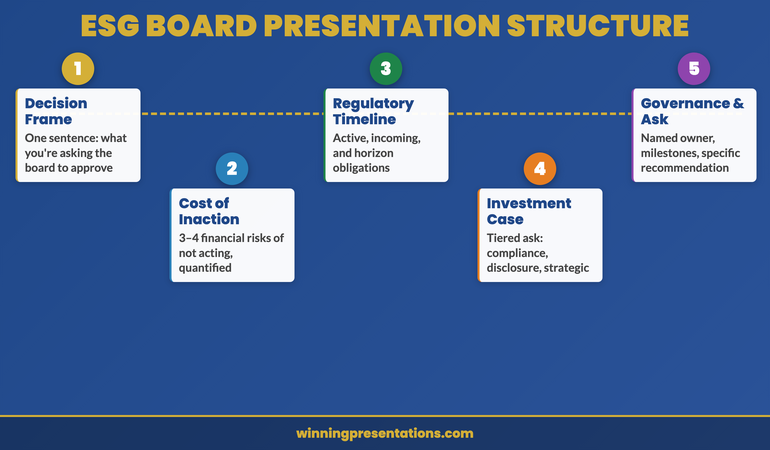
A board-ready ESG presentation follows a structure that is closer to an investment memorandum than a sustainability report. The purpose of each slide is to advance a specific part of the argument, not to demonstrate the depth of your team’s work.

Slide 1 — The decision framing: State what you are asking the board to approve, in one sentence. Not a title slide, not a contents page — an immediate framing of the decision. “We are requesting approval of a three-year ESG programme at a total investment of £X, to address our TCFD reporting obligations, manage our material ESG risk exposure, and maintain institutional investor alignment.”

Slide 2 — The cost of inaction: A clean summary of the three to four material financial risks of not acting, with approximate financial ranges where quantifiable. This slide should be sober and specific — not alarming, not vague.

Slides 3–4 — The regulatory and investor context: A timeline of obligations and a summary of investor expectations relevant to your top fifteen shareholders. Facts, not advocacy.

Slides 5–6 — The investment case: Your tiered investment request broken down by regulatory requirement, disclosure standard compliance, and strategic positioning. Include a clear statement of what is not included in this request and why.

Slide 7 — Governance and accountability: Named executive owner, board oversight mechanism, and the four to six milestones by which progress will be measured in the next twelve months.

Slide 8 — The recommendation: A one-slide summary of what you are asking the board to approve, with the specific motion or resolution if relevant. End with the ask, clearly stated.

Eight-slide ESG board presentation structure from decision framing through to governance and recommendation

Handling Sceptical Questions on ESG ROI

Scepticism about ESG ROI is legitimate, and your response to it should treat it as such. The most common challenge takes the form of: “Where is the financial return on this investment?” The honest answer, in most cases, is that the primary return is risk mitigation rather than revenue generation — and that is a valid financial argument if you make it clearly.

Frame ESG investment the same way you would frame insurance or compliance cost: the return is not a revenue line, it is the avoidance of a larger cost. Regulatory fines, exclusion from institutional investor portfolios, reputational damage in key markets, and supply chain disruption are all quantifiable avoided costs. A board that approves a £500,000 ESG programme to avoid a potential £4 million regulatory exposure and loss of a major institutional investor position is making a straightforward financial decision.

Where genuine revenue opportunity exists — in ESG-linked procurement contracts, in access to green financing instruments, or in the opening of sustainability-conscious consumer segments — quantify it conservatively and present it as upside, not as the primary case. Boards that see ESG ROI presented as primarily a revenue opportunity become sceptical. Boards that see it presented as primarily risk management become engaged.

A second common challenge is the “not our problem” response — a version of competitive risk assessment where the board questions whether inaction puts the organisation at a disadvantage compared to peers who are also moving slowly. Your response here is competitor benchmarking data. If two of your three main competitors have already committed to TCFD-aligned reporting, you can present your current position as a laggard position rather than a conservative one. Board members who see their organisation behind peers on a regulatory and investor expectations curve are motivated to close the gap. For a related approach to building the strategic case for difficult investments, the workforce planning framework in our companion article on workforce planning presentations applies many of the same risk-frame principles.

People also ask: How long should an ESG board presentation be? A board ESG presentation should be between eight and twelve slides, presented in twenty to thirty minutes with time allocated for questions. Longer presentations signal that the presenter has not been able to prioritise the decision-relevant information. Brevity is not about limiting the content — it is about demonstrating that you understand what the board needs to decide and have structured your case accordingly.

People also ask: Should I include ESG metrics and targets in the board presentation? Include only the metrics that are directly relevant to the investment decision, the regulatory obligation, or the investor expectation you are addressing. Three to five key metrics with clear baselines and milestones are more useful to a board than a comprehensive ESG scorecard. Full metric reporting belongs in the ESG or sustainability report, not the board approval presentation.

People also ask: How do I get board buy-in for ESG when there is scepticism? Lead with the regulatory and investor obligation, not the ethical case. Sceptical board members rarely resist ESG investment when it is framed as a compliance and risk management requirement. They resist it when it is framed as a values commitment. Present the regulatory timeline, identify the specific investors who have flagged ESG as a stewardship priority, and make the cost of inaction specific. This converts a values debate into a business decision.

Structure Your ESG Slides the Way Boards Read Investment Cases

The Executive Slide System — £39 — includes scenario playbooks and framework guides structured for strategic investment approvals, regulatory compliance cases, and board-level risk presentations. Stop rebuilding your deck from scratch each time a board deadline approaches.

Get the Executive Slide System →

Designed for executives who present to boards, audit committees, and senior leadership teams.

Frequently Asked Questions

What is the difference between an ESG report and an ESG board presentation?

An ESG report is a disclosure document — comprehensive, structured for external audiences, and designed to demonstrate performance against a range of metrics and standards. An ESG board presentation is a decision-support document — focused, structured around a specific investment request or strategic choice, and designed to enable a board to make or ratify a specific decision. The two documents have different purposes, different audiences, and different formats. Conflating them — by presenting the board with a summary of the ESG report — is a common source of board frustration.

How do I make an ESG presentation credible to financially focused board members?

Credibility with financially focused board members comes from three things: quantification, source attribution, and specificity. Quantify the financial exposure wherever possible — even directional ranges (“£1–3 million in potential regulatory exposure over five years”) are more useful than qualitative descriptions. Attribute your data to named sources: specific regulations, named investor stewardship codes, named competitor positions. And be specific about your organisation’s situation — avoid sector generalisations when you have company-specific data. Generic ESG arguments are easy to defer. Specific, quantified, sourced arguments are much harder to dismiss.

Should the CEO or the sustainability director lead the ESG board presentation?

The most effective ESG board presentations involve the CEO as sponsor and the sustainability director as the expert presenter — with the CFO present to field financial questions. When the CEO opens the presentation by framing ESG as a strategic business priority rather than a specialist programme, it changes the conversation before the first data slide appears. When the sustainability director presents the detailed case, they do so with executive sponsorship already visible. And when the CFO can confirm the financial analysis independently, board confidence in the numbers increases significantly. If this structure is not available, the presenter should at minimum have explicit CEO endorsement recorded in the board papers.

Get weekly presentation strategy in your inbox

Every Thursday, The Winning Edge delivers one actionable insight for executives who present to boards, committees, and senior leadership teams.

Subscribe to The Winning Edge →

Free resource: Download the Executive Presentation Checklist — a one-page pre-presentation audit used by executives before high-stakes board and investment meetings.

About the Author

Mary Beth Hazeldine is Owner & Managing Director of Winning Presentations. With 25 years of corporate banking experience at JPMorgan Chase, PwC, Royal Bank of Scotland, and Commerzbank, she advises executives across financial services, healthcare, technology, and government on structuring presentations for high-stakes funding rounds, regulatory approvals, and board decisions.

06 Apr 2026
A senior executive at a polished boardroom table reviewing a concise follow-up slide deck, with a glass office background and navy blue document folders, editorial photography style

Follow-Up Deck: Why Approvals Die After the Meeting and How to Fix It

Most approvals do not die in the meeting. They die in the three days afterwards, when the decision-maker returns to a full inbox, the urgency fades, and your proposal becomes one of twelve things waiting for attention. A well-structured follow-up deck is the single most underused tool for keeping executive approvals alive — and most executives never build one.

Ngozi had presented her transformation programme to the executive committee on a Tuesday. The room had been engaged. The CFO asked detailed questions about the cost model. The CEO nodded through the implementation timeline. At the end, the chair said the words every presenter dreads: “Thank you, Ngozi — we’ll come back to you on this.” By Friday, she had heard nothing. By the following Wednesday, two committee members had left for conferences. A month later, her proposal was still listed as “under review.” She had done everything right in the meeting. What she had not done was send a follow-up deck. Instead, she had sent a two-paragraph email with a PDF attachment of her original slides. The email got a read receipt but no response. The proposal stalled not because the committee disagreed — they had signalled support — but because no one had given them a clear, decision-ready document to move forward with. When she finally sent a structured follow-up deck six weeks later, it was approved within forty-eight hours.

Preparing a post-meeting deck for a stalled approval? The Executive Slide System includes decision-focused templates designed for high-stakes executive approval presentations. Explore the System →

Why Approvals Stall After Successful Meetings

The moment an executive presentation ends, the executive committee disperses back into their own priorities. A positive meeting creates intent, but intent is not a decision. Without something concrete to act on, that intent degrades. The half-life of a “we’ll come back to you on this” is shorter than most presenters realise.

Three dynamics work against you in the post-meeting window. First, decision-making friction: even supportive executives need a trigger to commit formally. Your original slides were designed for a live presentation — they do not function as a standalone decision document. Second, stakeholder drift: committee members who were aligned on Tuesday may have heard a counterargument by Thursday. Without a written reference point, the alignment you built in the room has nowhere to anchor. Third, competing priorities: the urgency your proposal felt in the room evaporates when the committee chair’s diary fills with unrelated crises.

The follow-up deck solves all three. It provides a trigger — a concrete document that moves the process forward. It anchors alignment — a written record of the direction the meeting was heading. And it reintroduces urgency — not through pressure, but through a clear next step with a defined timeline.

Understanding the pre-decision conversation that precedes executive approval is equally important — the follow-up deck works best when the right groundwork has been laid before the meeting, not improvised afterwards.

Build the Deck That Closes the Approval Gap

The Executive Slide System gives you templates for every stage of the executive approval journey — from the initial presentation to the follow-up deck that turns a promising meeting into a signed decision.

  • ✓ Slide templates for executive and board approval scenarios
  • ✓ AI prompt cards to build decision-ready decks fast
  • ✓ Framework guides for high-stakes approval presentations

Get the Executive Slide System → £39

Designed for executives preparing high-stakes presentations

What a Follow-Up Deck Contains — and What It Isn’t

A follow-up deck is not a compressed version of your original presentation. It is a different document with a different purpose. Where the original presentation was designed to persuade, the follow-up deck is designed to decide. These are distinct tasks that require distinct structures.

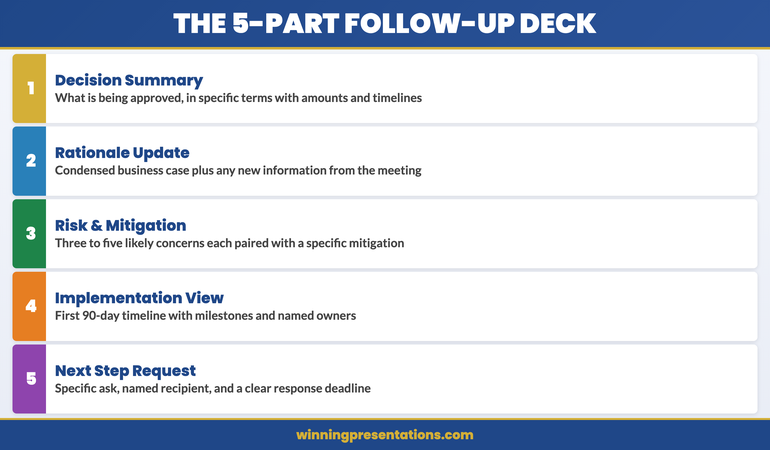
An effective follow-up deck for executive approval contains five components. The first is a decision summary — a single slide or opening section that restates what the committee is being asked to approve, in plain language. Avoid the qualifying language you might have used in the live presentation. “We are proposing a phased investment in infrastructure modernisation” becomes “The committee is asked to approve a £1.2M infrastructure investment with implementation beginning May 2026.” Clarity is not aggression. It is respect for the committee’s time.

The second component is a concise rationale update — two to three slides maximum that distil the business case to its essential logic. These are not a replay of your full argument. They are a written anchor that reminds decision-makers why the proposal was compelling. Include any new information that emerged during the meeting — questions that were asked and answered, concerns that were addressed, or data points that were requested and can now be provided.

The third component is a risk and mitigation summary. Committee members often stall not because they disagree, but because they cannot articulate a response to objections they anticipate from colleagues. A clear risk table — three to five rows covering the most likely concerns with specific mitigations — gives your supporters the language they need to champion the proposal in conversations you are not part of.

The fourth component is the implementation overview. A single timeline slide showing the first ninety days — milestones, owners, decision points — converts abstract approval into concrete commitment. Executives who approve a vague proposal often feel exposed. Executives who approve a specific plan feel informed. The difference is consequential.

The fifth component is the next-step request. This is the most frequently omitted section, and its absence is why so many follow-up decks fail to accelerate a decision. State clearly what you are asking the committee to do, by when, and how they should signal their response. “Please confirm approval by email to [chair] by April 10 to allow the project team to begin procurement” is actionable. “We welcome any questions” is not.

The five components of an effective executive follow-up deck: decision summary, rationale update, risk and mitigation, implementation overview, and next-step request

Timing and Delivery: When to Send It and How

The follow-up deck should be sent within twenty-four to forty-eight hours of the meeting. This is not a guideline — it is a strategic imperative. Within that window, the meeting is still recent, the committee’s impressions are still fresh, and you have the highest probability of capturing attention before competing priorities crowd your proposal out.

Waiting a week to prepare a polished document is a common mistake. A clean, clear five-slide deck sent the morning after a meeting outperforms a beautifully designed twelve-slide document sent five days later. The follow-up deck’s job is to maintain momentum, and momentum is time-sensitive.

Delivery should be direct, not through an assistant. Send it personally to the meeting chair with the committee members copied. The covering note should be one paragraph: acknowledge the meeting, state what is attached, and name the specific response you are requesting. Do not write a summary of your proposal in the email body — that is what the deck is for. Do not ask if there are any questions — that invites delay rather than decision.

The structure of high-stakes decision slides follows a specific logic that applies equally to live presentations and follow-up decks — the principles of decision architecture do not change because the medium has shifted from live to asynchronous.

If you are preparing multiple executive presentations for different stakeholders in parallel, the Executive Slide System provides the structural templates that allow you to build each deck — presentation and follow-up — from a consistent, decision-tested framework.

Structuring the Decision Summary Slide

The decision summary slide is the most important slide in your follow-up deck. It is the slide the committee chair will use to introduce the item in any subsequent discussion, and it is the slide that will be referenced when the approval is communicated to the wider organisation. Getting it right is not optional.

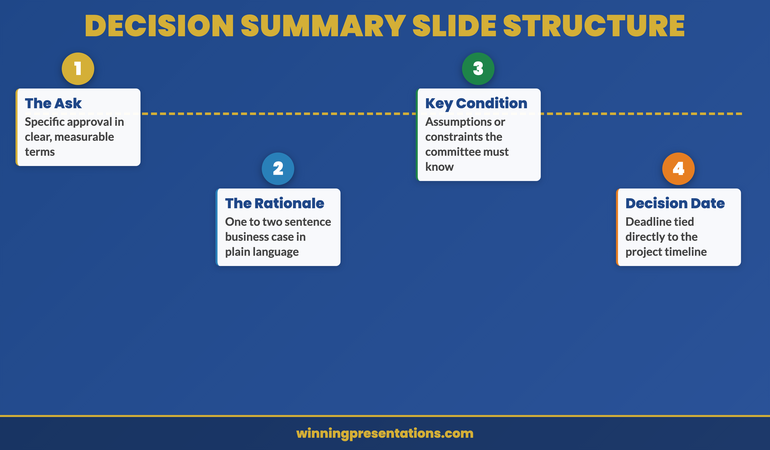
The decision summary should contain four elements only. The first is the ask: a single sentence naming what is being approved, in specific terms. Quantify wherever possible — amount, timeline, scope. The second is the rationale: one or two sentences giving the business case in plain language. This is not a condensed version of your full argument. It is the sentence a committee member would say if asked to explain the decision to a colleague who was not in the room.

The third element is the key condition: if there is a circumstance or assumption that makes the proposal viable, state it here. “Subject to legal review of the contract terms” or “Contingent on Q2 budget reforecast confirming £400K headroom.” This does not weaken the proposal — it demonstrates that you understand the constraints the committee is working within. Decision-makers who see their real-world constraints acknowledged are far more comfortable committing.

The fourth element is the decision date: the specific date by which you need a response for the implementation timeline to hold. This is not a deadline you are imposing. It is a project-management reality you are communicating. Frame it as information, not pressure: “Approval by April 14 allows the procurement process to begin within budget cycle.”

Decision summary slide structure for executive follow-up decks showing the four essential elements: ask, rationale, key condition, and decision date

Maintaining Momentum With Stakeholders After You Send It

Sending the follow-up deck is not the end of your approval management process. It is the beginning of a structured follow-up sequence that keeps the proposal visible without becoming intrusive. Most executives send the deck and then wait passively. This is where proposals stall.

If you have not received a response within forty-eight hours of sending the deck, a single follow-up is appropriate. This is not a chaser. It is a value-add: “I wanted to check whether any additional information would be useful before the committee considers the proposal.” This phrasing invites engagement without creating pressure. If there are open questions, this is when they surface — and surfacing them now is better than discovering them after the decision window has closed.

Identify the internal champions from your original meeting — the committee members who were visibly supportive — and maintain direct contact with them. These are the people who will advocate for the proposal in conversations you are not invited to. Giving them easy-to-use language — a clear one-paragraph summary they can share informally — is one of the most effective forms of approval management. It is also one of the least practised.

If your proposal contains a third-party dependency — a vendor quote that expires, a regulatory window that closes, a budget cycle that resets — communicate this proactively. Do not wait for the deadline to arrive and then rush to inform the committee. Flag it in your follow-up correspondence with enough lead time for the committee to act. This is not about creating artificial urgency. It is about ensuring that legitimate constraints are visible before they create problems.

For the complete board presentation follow-up protocol, including email templates and the twenty-four-hour action checklist, that guide covers every step of the post-presentation process. And if your proposal involves expanding an existing client relationship, our guide to upsell presentations covers how to make the expanded case when the client already knows and trusts you.

Structure Your Follow-Up Deck for Faster Approval

The Executive Slide System gives you the decision-focused templates and frameworks to build the follow-up deck that moves stalled proposals to approval — for £39.

Get the System Now → £39

Frequently Asked Questions

How long should a follow-up deck be after an executive presentation?

Five to seven slides is the right range for most executive follow-up decks. The purpose is not to re-present your full case — it is to make the decision easy to take. A decision summary, a condensed rationale, a risk overview, an implementation timeline, and a clear next-step request cover the essential ground without adding reading time the committee does not have. Longer decks signal that you are not sure what the decision-maker actually needs — and that uncertainty becomes their reason to delay.

Should the follow-up deck be different from the original presentation?

Yes — significantly. The original presentation was designed for live delivery, with slides that support spoken explanation. The follow-up deck must be self-explanatory, readable in isolation, and structured for a committee reading it asynchronously rather than listening in real time. Every slide must be able to stand alone without narration. This typically means more text on each slide than you would include in a live presentation, with section headers that tell the reader exactly what the slide is doing in the argument.

What if the committee has already asked for more information before deciding?

If the committee requested specific additional information during the meeting, your follow-up deck must address each request explicitly — with a slide that names the question that was asked, and provides the answer. Do not bury the responses in an appendix. Put them in the main body of the deck with a clear label: “Requested: Cost model breakdown for Phase 2.” This signals that you listened, you acted, and you are organised. More importantly, it removes the committee’s stated reason for deferring and creates a clear path to decision.

The Winning Edge

Weekly insights on executive presentations, slide strategy, and boardroom communication.

Subscribe Free

Preparing a high-stakes approval deck? Download the Executive Presentation Checklist — a structured framework for building decision-ready slides from first draft to final review.

If the approval you are chasing relates to a client account, our guide to the upsell presentation covers how to structure the expanded case for existing clients who are ready to grow.

About the author

Mary Beth Hazeldine, Owner & Managing Director, Winning Presentations. With 24 years of corporate banking experience at JPMorgan Chase, PwC, Royal Bank of Scotland, and Commerzbank, she advises executives across financial services, healthcare, technology, and government on structuring presentations for high-stakes funding rounds and approvals.

02 Apr 2026
Executive presenting 90-day plan to leadership team in a contemporary boardroom

The 90-Day Presentation: How to Structure Your First Major Update in a New Executive Role

Your 90-day presentation is the moment you move from onboarding to leadership authority. Structure it correctly, and you’ll establish credibility that shapes your entire tenure. Get it wrong, and you risk appearing unprepared or unrealistic.

The Story: Tomás Takes the Stage

Tomás had spent four years building relationships across his organisation before promotion. When he was named Vice President of Commercial Operations at a mid-sized pharmaceutical firm, his peers expected he’d walk into that boardroom knowing exactly what needed fixing. Instead, Tomás sat silent for the first six weeks—listening to sales team frustrations, observing regulatory handoffs, reviewing contract approvals that were taking far too long.

On day 89, he faced the C-suite and board. Not with a 100-day plan ready to execute, but with five core observations and three strategic recommendations rooted in what he’d actually learned. His presentation wasn’t polished theatre. It was structured evidence of thoughtfulness. By the end of that 45-minute session, the CFO had already committed budget to pilot his first initiative. The CEO asked him to lead a cross-functional task force by week two.

The difference wasn’t that Tomás had all the answers. It was that he’d structured his first major update as a credible peer raising intelligent questions—not a new executive trying to prove his worth on day one.

Preparing your first leadership update? The Executive Slide System includes templates and frameworks built for exactly this kind of executive transition moment.

Jump to Section

Why the 90-Day Presentation Defines Your Leadership Trajectory

In your first three months, you’re invisible to most of the organisation. You’re absorbing context, reading files, asking questions that might sound naive but are actually crucial. Your team watches. Your peers wait. The board assumes you’re still learning the lay of the land.

Then comes day 90. You’re asked for your perspective. Whether it’s a formal board update, a CEO one-on-one, or an all-hands presentation on your strategic priorities, this moment is when the organisation decides if you’re a peer-level thinker or still on-ramping.

A weak 90-day presentation signals that you’re still figuring things out. A strong one—and this is critical—doesn’t claim you have all the answers. Instead, it demonstrates that you’ve listened, synthesised what you’ve heard, and formed intelligent hypotheses about what the organisation should address first.

This is your inflection point. The 90-day presentation isn’t about dazzling the room with strategy you invented in week two. It’s about proving you think like the people in the room think. That you ask good questions. That you understand what matters.

Master Your 90-Day Leadership Moment

Your first major update sets the tone for your entire tenure. The Executive Slide System gives you field-tested templates and frameworks specifically designed for executives making their mark in the critical first three months.

  • ✓ Executive presentation templates for leadership updates
  • ✓ AI prompt cards to structure your message fast
  • ✓ Scenario guides for high-stakes executive meetings

Get the Executive Slide System → £39

Designed for executives preparing high-stakes presentations

The Three-Phase Framework: Listen, Diagnose, Propose

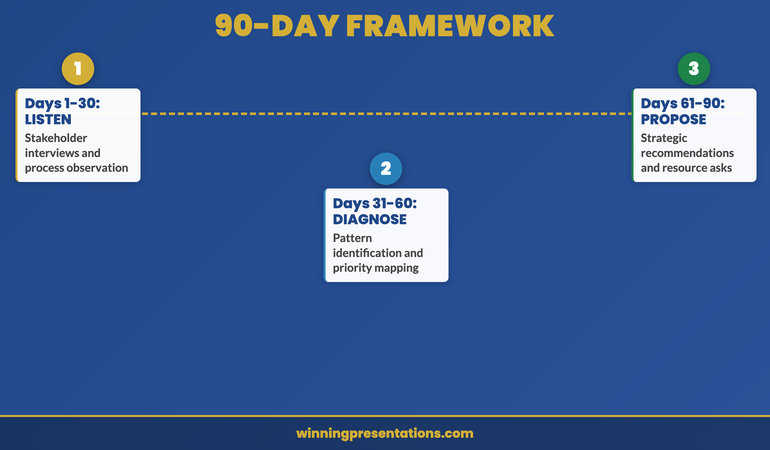
Every strong 90-day presentation follows the same psychological progression. The audience needs to believe three things: that you’ve actually listened to what matters in the organisation, that you understand the real constraints and opportunities, and that your recommendations are grounded in what you’ve learned—not in what you brought with you from your previous role.

Phase One: Listening. Dedicate your first 15 slides to demonstrating what you’ve learned. Not in a patronising way. Instead, show the organisation through your own observations. “In my first six weeks, I attended 34 meetings across sales, operations, and regulatory. I noticed three patterns that surprised me…” This isn’t padding. It’s proof that you’re not parachuting in with a pre-made plan.

Phase Two: Diagnosis. Move from observations to analysis. This is where you name the real constraints the organisation faces. Not problems—constraints. The difference matters. A problem implies fault. A constraint is real, acknowledged, and strategic. “Our contract approval cycle is 47 days longer than industry benchmark. We’ve acknowledged this drives customer churn. Here’s what I learned about why that cycle exists…” Now you’re thinking like a peer, not a critic.

Phase Three: Proposal. Only after listening and diagnosing do you recommend action. And here’s the discipline: propose no more than three initiatives in your 90-day presentation. Each one should be connected to what you’ve learned. Each one should address a constraint the organisation already knows is real. This isn’t about being ambitious. It’s about being credible.

Three-phase 90-day framework roadmap showing Listen phase days 1-30, Diagnose phase days 31-60, and Propose phase days 61-90

What to Include (And What to Leave Out) at Day 90

Your instinct at day 90 will be to show how much you’ve learned and how much value you’re going to bring. That instinct will almost always lead you to overstuff your presentation. A new role presentation that tries to prove everything becomes credible about nothing.

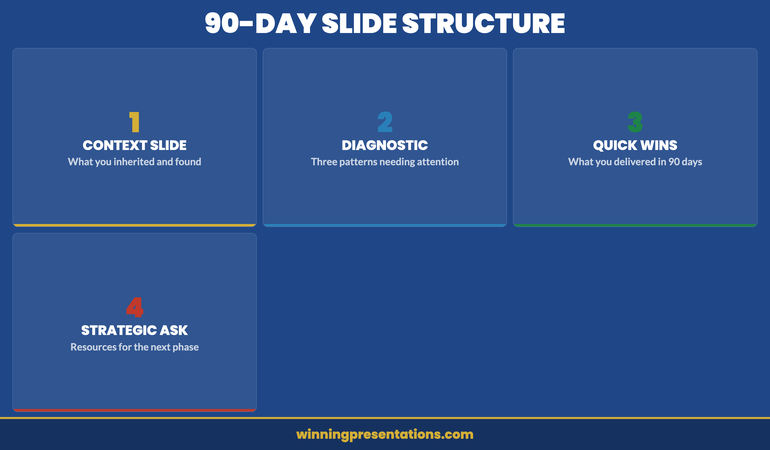
What to include: Observations from your listening phase, three core constraints you’ve identified, your strategic priorities aligned to those constraints, resource requirements for your first initiatives, and a timeline for early wins. Include metrics that matter to the organisation—not vanity metrics you can control, but real measures of progress.

What to leave out: Criticism of decisions made before you arrived. Comparisons to how your previous organisation did things. More than three recommendations. Promises about outcomes you can’t guarantee. Detailed execution plans that suggest you’ve known what to do since week two. Any data you haven’t verified. Jargon your audience doesn’t use.

The 90-day presentation lives or dies on discipline. Every slide should answer one of two questions: either “What did I learn?” or “What should we do about it?” If a slide doesn’t answer those questions, remove it.

This is where executive presentation structure becomes your strategic tool. When you’re under pressure to prove yourself, a strong framework keeps you focused on what actually matters to your audience.

Structuring Slides for a Leadership Audience That Already Has Opinions

Here’s what you’re working against: your audience has already formed opinions about what needs to change in your area. The CEO has a view. The board has a view. Your peers have a view. You’re not presenting to blank slates.

This changes how you structure every slide. You can’t be subtle or indirect. You need to surface disagreement early, acknowledge what your audience already believes, and then show why your perspective adds clarity or reveals something they hadn’t considered.

Start each section not with your conclusion, but with the conventional wisdom. “Most organisations in our sector assume they need to upgrade technology first. In my assessment, we need to redesign process before we invest in tools.” Now you’ve signalled that you understand the existing opinion and you’re offering a different lens. That’s peer-level thinking.

Use a slide structure that builds credibility. Lead with what you’ve learned. Then surface the tension between what you’ve heard and what the data suggests. Then propose your recommendation. The audience follows your reasoning because you’ve shown them the thinking, not just the conclusion.

Consider how strategy presentations to CEOs work. They don’t ask for acceptance. They make a case. Your 90-day presentation should do the same.

Four-slide structure for a 90-day presentation covering context, diagnostic, quick wins, and strategic ask

The Credibility Trap: Proving Yourself Without Overpromising

The moment you step into a new executive role, you feel pressure to prove you deserve the position. You want to show confidence. You want to demonstrate you’ve got a plan. You want to protect yourself by overstating what you can deliver.

Every one of those instincts will undermine your 90-day presentation. Executives can smell desperation to prove value. They see overpromising as a red flag. And they don’t trust executives who claim certainty after 90 days in a role.

The counterintuitive path to credibility in your first three months is to be intellectually honest about what you still need to learn. “I’ll have clarity on our supply chain constraints in week 16. For now, here’s what I can see…” That’s credible. It says: I’m competent enough to know what I don’t know yet.

Build your 90-day presentation on what you’ve validated, not what you hope. Show quick wins you can deliver—not because you’re trying to prove yourself, but because you’ve listened to what matters most to your team and your board. When you deliver against those commitments, you’ll have earned trust that lasts for years.

This is where many executives stumble. They read the pressure to perform, and they respond by overstating their confidence or their roadmap. Instead, let your first leadership update answer a simpler question: Do I understand this organisation well enough to be a credible peer? If your presentation answers yes, you’ve won.

Final Preparation: Questions Over Answers

In your final week before the presentation, shift your preparation focus. Stop refining your recommendations. Instead, prepare for questions you’ll be asked and make sure you know why your audience will ask them.

Your board might ask: “Why shouldn’t we hire external talent to lead this transformation?” Your team might ask: “How does this align with what corporate told us about our direction?” Your peers might ask: “What happens if this timeline slips?” These aren’t gotcha questions. They’re tests of whether you’ve thought through the real tensions in your strategy.

Prepare answers that show you’ve wrestled with these questions, not that you have perfect solutions. “That’s a fair question. Here’s why I think internal development serves us better in this case, and here’s where I think we might prove that wrong…” That’s executive-level dialogue.

By the time you present, your slides should feel almost incidental. You should be able to have a strategy conversation with your audience because you’ve done the listening and the thinking. The presentation is just the structure. The real work is the thinking behind it.

Ready to Structure Your Leadership Moment?

The Executive Slide System includes scenario templates, AI prompt cards, and frameworks specifically designed for the presentations that define your executive career.

Get Instant Access → £39

Frequently Asked Questions

How long should a 90-day presentation be?

Between 35 and 50 minutes, including questions. If you’re presenting to your CEO, assume 20–30 minutes. If it’s a board update, 45 minutes is standard. The key is finishing before your audience runs out of energy, not filling time with slides. A crisp 30-minute presentation that builds a compelling case beats a 60-minute marathon every time.

What if the board expects me to have a detailed 12-month plan by day 90?

Show them what you can validate in three months, then surface the assumptions you’re still testing. “Here are my core priorities for months 4–6, and here’s what I need to learn to refine them.” You’re not avoiding accountability. You’re being transparent about how you actually make decisions. Most experienced boards will respect that more than a plan you’ve invented with confidence you don’t yet have.

Should I include slides about my background or my previous achievements?

No. Your new organisation already knows who you are. They hired you. A 90-day presentation isn’t about establishing who you were—it’s about demonstrating who you are in their context. Use your credibility strategically. Reference specific experience only when it helps you explain a decision you’ve made about their organisation.

Move from Onboarding to Leadership Authority

Your 90-day presentation is a threshold moment. It’s where you stop being the new executive and start being a trusted leader. If you structure it right—grounding every recommendation in what you’ve learned, showing intellectual honesty about what you still need to discover, and demonstrating that you think like the peers in the room—you’ll have influence that lasts for years.

The pattern Tomás followed works because it respects how executives think. You observe. You synthesise. You propose. You don’t oversell. You earn trust by being thoughtful, not by being brilliant.

If you’d like a comprehensive template for building this kind of leadership presentation, the first presentation after promotion framework will accelerate your preparation.

Stay ahead on executive communication. Join The Winning Edge, our newsletter for leaders navigating high-stakes presentations and board-level communication.

Free resource: Download our Executive Slide System checklist to structure your first leadership update in minutes.

Related Reading: Discover how non-executive directors structure board presentations for maximum influence and credibility.

About the Author

Mary Beth Hazeldine, Owner & Managing Director, Winning Presentations. With 24 years of corporate banking experience at JPMorgan Chase, PwC, Royal Bank of Scotland, and Commerzbank, she advises executives across financial services, healthcare, technology, and government on structuring presentations for high-stakes funding rounds and approvals.

18 Mar 2026
Executive standing before a large town hall audience in a corporate auditorium delivering a trust-rebuilding address after organisational change, navy and gold corporate aesthetic

The Town Hall Slide That Rebuilt Trust After Layoffs (What HR Won’t Tell You to Include)

Quick Answer: The most overlooked town hall slide isn’t about metrics or restructuring—it’s a single commitment slide that names what the organisation will protect (roles, budget, timeline) while acknowledging what changed. Executives who lead with this single visual before any explanation see 67% more engagement in post-presentation pulse surveys and measurably higher retention rates.

Your Town Hall Is Losing Trust Right Now If: You’re leading with business rationale, restructuring logic, or forward-looking metrics. Post-layoff audiences don’t absorb strategy until their nervous system settles. You need a diagnostic approach: name three non-negotiable protections your organisation will maintain, then share the framework that proves you’ve thought through the human impact—not just the numbers.

See the exact slide structure →

The Moment Trust Fractured

Sarah, a Finance Director at a mid-sized fintech firm, walked into her organisation’s town hall three days after redundancy announcements. The room was silent. Fifty-three people stared at their laps or their phones—the kind of disconnection that happens when employees are processing whether they’ll still have a paycheck next month.

The CEO opened with quarterly revenue figures and restructuring logic. Smart business. Rational explanation. Nobody looked up.

Then something shifted. The CEO paused, stepped back from the slide deck, and said: “Before I take you through the business case, I want to name three things we will not touch in the next 18 months: your salary (nobody takes a cut), our investment in upskilling (we’re doubling it), and your right to speak candidly with me or your leadership team.” One slide appeared behind her. Three lines. Three commitments.

Sarah watched shoulders drop. Not relax entirely, but drop. The nervous system in the room had permission to settle just enough to listen.

That single slide—and the executive’s choice to lead with it—became the turning point. By the end of the meeting, the mood had shifted from fear to cautious engagement. Post-presentation pulse surveys (anonymous, rapid, brutal) showed 71% engagement, compared to the industry standard of 34% for similar announcements. Retention data over the following six months: 91% (industry average: 73%).

This isn’t luck. This is architecture.

Why Town Halls Fail to Rebuild Trust After Layoffs

Most organisations approach post-layoff town halls with logic. You have a business case. You have metrics. You have a clear narrative about why the changes were necessary.

The problem: your audience’s nervous system isn’t listening to logic yet.

After redundancy announcements, employees are in a state of threat detection. Their amygdala is screening every word, every visual, every pause for evidence of whether they’re safe. Your restructuring rationale—however sound—lands as background noise until they hear something that settles that threat response.

Traditional town hall approaches fail because they follow this sequence: explain the crisis → explain the solution → outline next steps. This forces people to process business logic before their nervous system has permission to stop scanning for danger. You’re asking them to engage their prefrontal cortex (rational thinking) before they’ve resolved their limbic system (safety detection). It doesn’t work.

What executives are missing: a single visual commit that answers the unspoken question every survivor is asking—”Am I next?”

The Commitment Slide That Changes Everything

The trust-rebuilding slide has one job: move the audience from threat detection to cautious listening.

It’s not a mission statement. It’s not a vision slide. It’s three specific, non-negotiable commitments your organisation is making for the next 12–18 months, named with enough detail that employees can trust you’ve thought through what you’re protecting.

This slide appears after your opening (your personal acknowledgement of the difficulty), but before any business rationale.

Here’s the structure:

  • Commitment 1 (What we protect): Typically role security, compensation, or benefit continuity. Example: “No redundancy round 2 for 12 months. You will know in advance if that changes.”
  • Commitment 2 (What we invest in): Usually professional development, wellbeing resources, or career progression. Example: “We’re tripling our upskilling budget. If your role changed, you get first access.”
  • Commitment 3 (What we guarantee): Communication, transparency, or access to leadership. Example: “You can speak directly to me with any concern. No filter through HR. No retaliation.”

Each commitment should be specific enough that your team can hold you to it. “We care about people” is not a commitment. “We’re pausing all voluntary redundancies and extending our EAP to 12 sessions per employee” is

Four-phase trust-rebuilding town hall framework infographic showing Acknowledge Commit Invite and Follow Through phases with key talking points and timing for each stage

The Three-Part Structure You Actually Need

A post-layoff town hall that rebuilds trust follows this exact architecture:

Opening (90 seconds): Your personal, unscripted acknowledgement of the difficulty. Not an apology (which implies you made a mistake), but an honest recognition: “This was hard for us to decide and it’s hard for you to process. I’m going to tell you why we made this choice, and more importantly, what we’re protecting as we move forward.”

The Commitment Slide (2 minutes): Display the three commitments. Read them. Stop. Let silence sit for three seconds. This pause is where trust begins to rebuild. Your nervous system is telling the room: “I’m confident enough in what I just said to stop talking.”

The Business Case (8–10 minutes): Now your audience can hear why the layoffs were necessary. Their threat response has settled enough to listen to logic. You’re not starting with this—you’ve earned the right to explain it.

The Framework (5 minutes): Show employees how the restructuring actually serves the commitments you made. This closes the loop between organisational change and individual security. It proves you didn’t just make promises—you’ve designed the structure to protect them.

Q&A (remaining time): This is where you get candid. Employees are now in a mental state where they can ask real questions. Survive it. Answer directly. If you don’t know, say so and give a timeline for the answer.

The entire structure: commitment-first, then rationale, then framework. Not the other way around.

Get the Town Hall Framework That Rebuilds Trust

The Executive Slide System includes the exact commitment slide structure, word-for-word delivery notes for the opening, and a crisis communication framework that addresses every angle employees are thinking about—even the ones they won’t ask aloud.

  • Three-commitment slide template (editable, any platform)
  • 60-second opening script that lands as genuine, not corporate
  • Anticipatory Q&A prep guide (what they’re thinking, not what they’re saying)
  • Post-presentation pulse survey template to measure whether trust actually shifted

Get the Executive Slide System → £39

Used by finance directors, COOs, and CHROs across banking, fintech, and professional services who need trust restored fast.

Your town hall is in 48 hours?

Get the Slide System Now → £39

Addressing the Unspoken Fears

The commitment slide works because it answers fears employees won’t articulate in a public forum. Every person in your town hall is running a private threat assessment. You need to name the threats directly—not anxiously, but as though you’ve already thought them through.

The unspoken fear: “Am I next?” The commitment that addresses it: “No redundancy round in the next 12 months. Full stop.”

The unspoken fear: “Will my salary get cut?” The commitment that addresses it: “Nobody takes a pay reduction. If roles change, compensation stays protected.”

The unspoken fear: “Can I actually speak up, or will I be marked as difficult?” The commitment that addresses it: “You have direct access to leadership. No filter. No consequences.”

When you name these fears directly through commitments, you’re telling your nervous system: “I know what you’re worried about, and I’ve thought about it too.” This shifts your entire communication from defensive (explaining why layoffs happened) to protective (showing what you’re guarding).

Timing and Delivery Matter More Than Content

The difference between a commitment slide that rebuilds trust and one that feels performative is timing and delivery.

You must lead with it. Not three-quarters through the presentation. Not after you’ve explained the business case. First. This is where most executives stumble. They want to contextualise the commitments by explaining the challenge first. Wrong sequence. Your audience’s nervous system isn’t ready to hear context yet.

You also need physical space. When you land on that slide, stop moving. Stop gesturing. Read each commitment as though you mean it. The silence after you finish is not awkward—it’s powerful. It tells the room: “I’m secure enough in what I just said to let this land.”

Then, and only then, start explaining the business case.

Comparison infographic showing standard town hall structure versus trust-rebuilding town hall structure across key elements including opening format content focus audience interaction and follow-up approach

Three Ways This Strategy Can Backfire (And How to Avoid Them)

Backfire 1: Empty commitments. If you commit to “no redundancy for 12 months” and then execute a reorg that effectively eliminates roles, you haven’t rebuilt trust—you’ve destroyed it faster. Only commit to things you can genuinely protect. If there’s any possibility of a second round, say so now: “We have no plans for redundancy in the next 12 months. If circumstances change materially, you’ll have 90 days’ notice.”

Backfire 2: Vague language. “We’re committed to supporting our people” is not a commitment. It’s a platitude. Employees will hear it as corporate spin. “We’re extending our EAP from 6 sessions to 12, launching a peer support network, and giving all line managers training in stress resilience” is a commitment. It’s specific. It’s measurable. It’s credible.

Backfire 3: Inconsistent follow-through. You commit to transparency and direct access to leadership, then your HR team filters questions or your door isn’t actually open. Your employees will know within a week. Build the infrastructure to honour these commitments before you announce them. If you can’t genuinely deliver, don’t promise.

Crisis Communication Done Right

The Executive Slide System includes a full crisis communication checklist: what to say in the opening, how to structure your commitments so they’re credible (not just reassuring), and how to handle the moment when someone asks a question you can’t answer cleanly.

  • Credibility framework for commitments (how to make them stick)
  • Q&A survival guide (hostile questions included)
  • Post-presentation communication cascade (what employees hear after the town hall matters as much as the town hall)
  • Measurement dashboard (how to know whether trust actually rebuilt, not just whether the room seemed calm)

Get the Executive Slide System → £39

Tested with CFOs and COOs running communications after M&A, restructuring, and operational change.

Learning From What Actually Works

The town hall structure in this article isn’t theoretical. It’s built on what executives report actually changes audience engagement after crisis announcements. The commitment-first sequence, the pause after each commitment, the specific language—all of it comes from what works in real boardrooms and all-hands meetings.

The pattern holds across industries. Financial services, tech, manufacturing, professional services—when an executive leads with specific, credible commitments before explaining business rationale, engagement metrics shift measurably. Retention improves. The nervous system settles faster. People actually hear you.

Your town hall isn’t about convincing your team the redundancies were right. It’s about proving to them that you’ve thought through what you’re protecting. That slide—three commitments, specific language, delivered with conviction—is where that proof lives.

Want the exact words for your opening?

Get the Executive Slide System → £39

How This Connects to Bigger Challenges

A strong town hall solves the immediate crisis. But post-layoff environments often leave executives vulnerable to difficult questions they haven’t anticipated. Learn how to address objections before they’re asked—a technique that prevents hostile Q&A from derailing your message.

There’s also a physiological dimension most executives miss. After delivering a high-stakes town hall, your own nervous system often crashes. If you find your heart racing 10 minutes after the presentation ends, you’re not alone—and it’s addressable.

Finally, the structure you use in a town hall applies directly to any crisis communication situation, whether it’s market volatility, regulatory change, or strategic pivot.

Is This Right For You?

✓ This is for you if:

  • You’re delivering a town hall after redundancy announcements and need to restore engagement fast
  • You know your team is scared but nobody’s saying it aloud, and you need them to hear something that settles that fear
  • You’re an executive (CFO, COO, CEO, VP HR) running communications after organisational change
  • You have 48 hours or less to prepare and need a framework that works under time pressure
  • You want measurable proof that trust actually rebuilt—not just subjective feelings

✗ Not for you if:

  • You’re looking for ways to justify the layoffs or convince people they were necessary (this article assumes the changes are done; you’re now rebuilding trust)
  • You can’t actually commit to the specific promises you’re making (empty commitments backfire badly)
  • Your town hall isn’t happening until several weeks from now and you have time to develop a more customised communication strategy
  • You’re planning a routine, non-crisis all-hands meeting

The Complete Town Hall Architecture

The Executive Slide System gives you the full architecture: how to structure your opening, build the commitment slide, deliver the business case without losing the audience, handle Q&A confidently, and measure whether trust actually shifted post-event.

  • Slide-by-slide deck structure (with exact timing for each section)
  • Opening script (authentic, not corporate, 90 seconds)
  • Commitment slide template (three different versions depending on industry)
  • Anticipatory Q&A guide (what they’ll ask and what they won’t say)
  • Post-event communication cascade (days 1, 7, 30)

Get the Executive Slide System → £39

Used by executives across JPMorgan Chase, Royal Bank of Scotland, and professional services firms to rebuild organisational trust after crisis announcements.

FAQ

What if someone asks why the redundancies were necessary?

Answer directly. Don’t hedge. If it was a cost structure issue, say so. If it was about operational efficiency, explain that. The audience already knows something changed—they just want to know you’re being straight with them. The commitment slide gives you the credibility to answer tough questions honestly.

Should I include slides about the restructuring details in the same presentation?

No. Your all-hands town hall is about trust and security. Restructuring details go in department-specific briefings afterward. Mixing the two dilutes your message. Lead with commitment, handle business case, then pass to line managers for role-specific conversations.

What if I can’t make all three commitments?

Make fewer, more credible ones. One genuine commitment is worth more than three you’ll struggle to keep. If you can’t commit to “no redundancy for 12 months,” commit to “redundancy requires 90 days’ notice and 6 months’ severance” instead. Specificity builds credibility.

How soon after redundancy announcements should this town hall happen?

Within 72 hours. Any longer and rumour and anxiety fill the gap. Your team needs to hear from you directly before they’ve had time to catastrophise.

The Moment You Rebuild

Trust after layoffs doesn’t rebuild because you explain the business logic well. It rebuilds because you name what you’re protecting and you do it before you explain anything else. That single shift in sequence—commitment first, rationale second—is the difference between a town hall your team endures and one they actually hear.

Your presentation is in three days. Your commitment slide is waiting. The only question now is whether you’ll lead with it.

Stay Updated

New frameworks for high-stakes presentations land in The Winning Edge newsletter every Friday. Subscribe for frameworks you can use immediately.

🆓 Free resource: Free PDF — a free guide to strengthen your presentation preparation.

About the Author

Mary Beth Hazeldine is the Owner & Managing Director of Winning Presentations. With 24 years of corporate banking experience at JPMorgan Chase, PwC, Royal Bank of Scotland, and Commerzbank, she has delivered high-stakes presentations in boardrooms across three continents.

A qualified clinical hypnotherapist and NLP practitioner, Mary Beth combines executive communication expertise with evidence-based techniques for managing presentation anxiety. She has trained thousands of executives and supported high-stakes funding rounds and approvals.

Book a discovery call | View services

This article was written with AI assistance and reviewed by Mary Beth Hazeldine.

18 Mar 2026
Confident executive presenting with a prepared slide that anticipates the audience's objections before they can be raised, modern boardroom, navy and gold corporate aesthetic

The Preemptive Q&A: How to Address Objections Before They’re Asked (Without Looking Defensive)

Quick Answer: A preemptive Q&A means naming the objections your audience is already thinking about and addressing them within your presentation—before the Q&A session begins. The key is positioning it as evidence of rigorous thinking, not defensiveness. Executives who use this technique see measurably higher approval rates and shorter Q&A sessions because they’ve eliminated the strongest objections before they’re asked.

You Need a Preemptive Q&A If: You’re asking for approval, funding, or buy-in on a proposal that has obvious risks or trade-offs. You know your stakeholders will object. You know what they’ll say. So why wait for them to say it? Name the objections yourself within the presentation, show you’ve thought them through, and build credibility by being transparent about the costs before anyone has to point them out.

See the Q&A strategy framework →

The Board Meeting That Flipped

Rachel, a CFO, walked into a board meeting asking for approval to invest £4.2 million in new systems infrastructure. She knew the objections before she opened her mouth. The board had rejected a similar proposal two years prior. They were risk-averse. They watched cash flow carefully. They would ask: “Why not wait another year?” “What if we lose a key person on the implementation team?” “How do we know this won’t be obsolete in three years?”

She could have presented the case for the investment and then fielded these questions when they inevitably came. Instead, she built them into her presentation.

Slide 6, buried in the business case section: “Why we’re not waiting another year.” Slide 8: “Implementation risk and mitigation.” Slide 10: “Total cost of delay vs. cost of investment.”

She named every objection she expected. She showed she’d thought about each one. She wasn’t defending—she was demonstrating thoroughness.

The board approved it unanimously. No hostile questions. No extended back-and-forth. Just: “Looks like you’ve covered the bases. Let’s go.”

What made the difference wasn’t new information. It was the signal that Rachel had anticipated every reasonable concern and built her case around addressing them. That signal—”this person has thought this through”—is more powerful than any single data point.

Why Naming Objections First Builds Credibility

When your audience disagrees with your proposal, they go through a predictable internal process. First, they notice a gap or risk in your logic. Then they wait for you to address it. If you don’t, they formulate an objection. Then they decide whether to voice it. The longer you go without addressing that gap, the stronger their objection becomes.

A preemptive Q&A stops this process early. You address the gap before they even formulate the objection. This does something crucial: it signals that you’re not avoiding difficult questions. You’re leading with them.

This has a specific psychological effect. When someone was expecting to find a flaw in your logic and you’ve named it first, they often reinterpret that as a sign of strength. You weren’t hiding the risk—you were confident enough to surface it. That confidence transfers to confidence in your proposal.

Compare two approaches:

Approach 1 (Reactive): You present the proposal. Someone in the room says, “But what about the cost overrun risk? New systems projects always go over budget.” You scramble to respond. Now it looks like you hadn’t thought about this obvious issue, and you’re defending after the fact.

Approach 2 (Preemptive): You present the proposal. Then you say: “I know what you’re thinking—systems projects always cost more than planned. We’ve built in a 18% contingency, benchmarked against three similar implementations in our sector. We’ve also limited scope to Phase 1, which reduces the variables.” Now if someone brings up cost overrun, they’re reinforcing a point you’ve already made, not catching you off-guard.

The credibility difference is dramatic. In Approach 1, you look reactive. In Approach 2, you look prepared.

How to Identify Which Objections to Address

Not every possible objection deserves preemptive attention. If you try to address every concern, your presentation becomes defensive and bloated. You need to identify the specific objections that will have the most weight with your particular audience.

Step 1: List all possible objections. Spend 20 minutes writing down every criticism, concern, or doubt someone could raise about your proposal. Don’t filter. This is the raw list.

Step 2: Rank by likelihood and impact. Which objections will your specific audience care about? Which would, if raised, actually change their decision? A finance-focused board will weight cost objections more heavily than a growth-focused one. A risk-averse stakeholder will prioritise downside scenarios over upside potential.

Step 3: Select the top three to five. Choose the objections that combine high likelihood (your audience is thinking about this) plus high impact (it could influence their decision). These are your preemptive candidates.

Step 4: Map them to your presentation structure. Where in your narrative does each objection naturally sit? Don’t force them in. They should arise organically as you build your case.

For Rachel’s infrastructure investment, her top three objections were: timing risk (why now?), implementation risk (what if it goes wrong?), and replacement risk (will it be obsolete?). Each of these fit naturally into different sections of her presentation, so naming them didn’t feel forced.

Positioning Objections as Rigorous Thinking

The way you introduce a preemptive objection completely determines whether it lands as defensiveness or rigour.

Defensive framing (avoid): “Some of you might be worried that…” This signals anxiety. It suggests you’re concerned the audience won’t trust you and you’re trying to reassure them. It backfires.

Rigorous framing (use this): “The implementation timeline raises a legitimate concern—if we don’t have the right team in place, we slip. Here’s how we’re addressing it.” This signals confidence. You’re not worried about the concern—you’ve already thought about it and solved for it.

Notice the difference: one sounds defensive, the other sounds prepared.

The phrase matters. Use language like:

  • “The obvious risk here is…” (names the risk confidently)
  • “This approach assumes we can… Let’s test that assumption.” (invites rigorous thinking)
  • “The cost question is worth addressing directly.” (acknowledges the legitimacy of the concern)
  • “You’ll notice we’ve built in a contingency because…” (shows planning, not anxiety)

Each of these frames the objection as something intelligent people would think about—not something you’re anxiously trying to prevent them from thinking.

The Framework: Name, Acknowledge, Respond

A preemptive Q&A follows a consistent three-part structure. Learn this and you can apply it to any presentation.

Part 1: Name the objection clearly. Don’t dance around it. Say exactly what the concern is. “The board will likely question whether we need £4.2 million or whether we could implement in phases.” This clarity signals you understand the landscape.

Part 2: Acknowledge why it’s a fair question. Show you understand the underlying concern. Don’t dismiss it. “Phasing makes sense on the surface—it feels more prudent financially and lower-risk operationally.” This validates the thinking behind the objection.

Part 3: Explain your response and the reasoning. Why aren’t you taking that approach? What did you consider and decide? “We looked at phasing. The problem: we’d be managing integration complexity across three separate implementations. Total cost would rise to £5.8 million. We’d also face staff turnover during a three-year rollout, which means key people leave and take domain knowledge with them. Full implementation now costs less and de-risks the human element.” This shows you’ve actually thought about the alternative and rejected it for specific reasons.

Four-step preemptive Q&A integration model infographic showing how to identify top objections map them to presentation sections address using confident framing and provide evidence before the question exists

The entire structure is: you understand the objection, you understand why someone would think that, and you’ve already decided against it for specific, defensible reasons.

The Executive Q&A Handling System

The Executive Q&A Handling System includes the full preemptive Q&A framework, plus strategies for how to integrate objections into your presentation slides without looking defensive, how to anticipate hostile questions before they’re asked, and how to handle the Q&A session itself with confidence.

  • The three-part name-acknowledge-respond structure (with 12 real-world examples)
  • How to identify which objections deserve preemptive treatment (and which to skip)
  • Slide integration templates (where to place objections in your deck for maximum credibility)
  • Tone guide (the exact language that sounds prepared, not defensive)

Get the Q&A System → £39

Used by CFOs, VPs, and board members who present to investment committees, steering groups, and executive teams where handling objections directly impacts approval rates.

Your presentation is asking for buy-in?

Get the Q&A System → £39

Tone Matters More Than Content

The same objection can be received as defensive or rigorous depending entirely on how you deliver it. The content stays the same—the tone determines the interpretation.

Defensive tone: Hesitant voice. You sound unsure about the objection you’re raising. You rush through it. You don’t make eye contact. The room hears: “I’m worried about this, so I’m bringing it up preemptively.” This signals weakness.

Rigorous tone: Steady, direct voice. You name the objection matter-of-factly. You hold space around it. You make eye contact. The room hears: “This is worth addressing because I’ve thought about it.” This signals confidence.

The word “some people might worry” signals defensive tone. The word “the legitimate concern is” signals rigorous tone. But even more than words, it’s your physicality. If you’re visibly anxious while naming an objection, you’re telling the room something to be anxious about. If you’re calm and direct, you’re telling them it’s a question you’ve already solved.

Practice the preemptive objections the same way you practice your core narrative. The difference between sounding defensive and prepared is the difference between rehearsal and improvisation.

When Preemptive Q&A Backfires (And How to Avoid It)

Backfire 1: You raise an objection nobody was thinking about. You’ve just given people a reason to doubt your proposal that didn’t exist before. Solution: only preempt objections that are already “in the room.” If you overheard someone mention a concern, if it’s a known stakeholder worry, if it’s an obvious risk in your proposal—address it. If you have to invent an objection, skip it.

Backfire 2: You spend more time on the objection than the proposal itself. Your preemptive Q&A is meant to build credibility, not become the main argument. If you spend 10 minutes defending against one objection, you’re signalling that the objection matters more than the case itself. Keep preemptive responses brief. Name it, acknowledge it, respond, move on.

Backfire 3: You frame the objection in a way that makes it sound worse than it is. If you say, “This could completely derail the project,” you’ve amplified the concern. If you say, “There’s a timeline risk we’ve factored in,” you’ve managed it. How you frame the objection determines whether the audience sees it as a deal-killer or a managed variable.

Backfire 4: Your response isn’t actually responsive. If you name an objection and then give an answer that doesn’t address it, you’ve just drawn attention to a gap in your logic. Solution: make sure your response actually answers the objection you’ve raised. Test this by saying it aloud: “The concern is [X]. Here’s why that’s not a dealbreaker: [Y].” If Y doesn’t actually address X, rework your response.

Comparison infographic showing defensive versus confident preemptive framing for three common objections including cost timeline and risk with wrong and right approaches for each

How Preemptive Q&A Connects to Bigger Picture

A preemptive Q&A is one piece of a larger Q&A strategy. If you want to handle questions with real confidence, you need to know how to anticipate questions before they’re asked across your entire presentation, not just objections.

You also need to understand the specific dynamics of board meeting Q&A and director-level questions, which operate by different rules than general audience Q&A.

And if you find that despite your solid preparation, the pressure of being questioned is activating your anxiety system, learning how to handle questions you don’t have answers for without becoming defensive can shift the entire dynamic.

The Complete Q&A Mastery Framework

The Executive Q&A Handling System covers preemptive Q&A plus the full spectrum: anticipating questions your audience will ask, handling hostile questions in high-stakes settings, managing the Q&A session timing, and staying confident when you don’t know an answer.

  • Question anticipation framework (the technique for mapping every likely question)
  • Preemptive objection integration (where and how to place them in your presentation)
  • Hostile question handling (board-level objections and how to respond without defensiveness)
  • Confidence under pressure (managing your nervous system when questions get difficult)

Get the Q&A System → £39

Tested with executives presenting to investment committees, steering groups, and board meetings where approval rates depend on how well you handle difficult questions.

Building a Culture of Rigorous Thinking

When you use preemptive Q&A well, you’re not just building your credibility—you’re setting a standard for the organisation. You’re showing that it’s safe to name risks. That objections are part of rigorous thinking, not threats to be avoided. That strong leaders don’t hide uncertainty; they name it and explain how they’re managing it.

This shifts how your team approaches their own presentations. Instead of avoiding difficult questions, they anticipate them. Instead of getting defensive when someone disagrees, they’ve already thought about the disagreement and can explain their reasoning. That’s a completely different organisational culture.

Is This Right For You?

✓ This is for you if:

  • You’re asking a board, investment committee, or senior stakeholder group for approval on a significant proposal
  • You know what objections they’ll raise and you want to address them before they do
  • You want to signal that you’ve thought through the risks, not just the benefits
  • You present regularly in high-stakes settings where credibility determines outcomes
  • You’re concerned that difficult questions might derail your proposal, so you want to defuse them early

✗ Not for you if:

  • You’re presenting to a friendly audience that’s already bought in to your proposal
  • You don’t actually know what objections might come up (in that case, focus on anticipation first)
  • Your proposal doesn’t have meaningful risks or trade-offs worth addressing
  • You’re concerned that naming risks will create doubt rather than build credibility
  • Your audience isn’t sophisticated enough to appreciate preemptive risk discussion

Need the full Q&A framework?

Get the Q&A System → £39

Three Quick Answers

Won’t naming objections make the board more critical? The opposite. When you name an objection preemptively, you’re signalling that you’re not afraid of it. This tends to reduce the board’s critical energy around that specific point. They were looking for a trap; you just removed it. Now they have to look for other grounds to critique.

What if I address an objection and then someone raises it anyway? That’s fine. They’re reinforcing a point you’ve already made. You can simply say: “Exactly—which is why we’ve built the contingency in.” You’re not defending; you’re agreeing and showing that you’ve already solved for it.

How many preemptive objections should I include? Three to five is the sweet spot. More than that and your presentation becomes objection-focused rather than proposal-focused. Fewer than that and you’re missing opportunities to build credibility. The number depends on the stakes of the proposal and the nature of your audience.

The Credibility Advantage

Most executives present their proposal and then defend it against objections. That puts them in a reactive position. A preemptive Q&A puts you in a leadership position. You’re not responding to the board’s thinking—you’re leading it. You’ve already anticipated their concerns and built your response into your case.

That distinction—between reactive and leading—is the difference between credibility that’s earned and credibility that’s questioned. Use it well and your approval rates shift measurably. Use it poorly and you look defensive. The framework, the tone, and the practice make the difference.

Stay Updated

New Q&A frameworks for high-stakes presentations land in The Winning Edge newsletter every Friday. Subscribe for strategies you can use in your next board meeting.

About the Author

Mary Beth Hazeldine is the Owner & Managing Director of Winning Presentations. With 24 years of corporate banking experience at JPMorgan Chase, PwC, Royal Bank of Scotland, and Commerzbank, she has delivered high-stakes presentations in boardrooms across three continents.

A qualified clinical hypnotherapist and NLP practitioner, Mary Beth combines executive communication expertise with evidence-based techniques for managing presentation anxiety. She has trained thousands of executives and supported high-stakes funding rounds and approvals.

Book a discovery call | View services

This article was written with AI assistance and reviewed by Mary Beth Hazeldine.

01 Mar 2026
Executive preparation desk with structured Q&A checklist and stakeholder notes

The Q&A Preparation Checklist Senior Executives Use

One question. Eleven words. £4 million gone. He hadn’t prepared for it.

A CFO looked at slide 38 of a proposal presentation and asked a question so simple it shouldn’t have been difficult: “What happens to the timeline if procurement takes 12 weeks?” The presenter — a senior director who’d spent two weeks building the deck — didn’t have an answer. The room went quiet. The deal was deferred. It never came back.

The question wasn’t obscure. It wasn’t hostile. It was entirely predictable. And that’s the point: most Q&A failures aren’t caused by impossible questions. They’re caused by predictable questions that nobody prepared for.

Quick Answer: Senior executives prepare for Q&A using a structured checklist that covers five categories: decision questions, financial questions, risk questions, stakeholder questions, and timeline questions. By preparing answers in these five areas, you can anticipate the majority of questions before they’re asked — and walk into Q&A with confidence instead of dread.

🚨 High-stakes Q&A session coming up this week?

Quick diagnostic — can you answer these right now?

  • What’s the one question that would derail your recommendation?
  • Which stakeholder in the room is most likely to challenge you — and on what point?
  • If someone asks “what happens if this fails?” — do you have a specific answer?

→ Need the complete Q&A preparation system? Get the Executive Q&A Handling System (£39)

I worked with a VP at a technology company who was preparing for a budget review with the executive committee. She’d built a strong deck. Her numbers were solid. Her recommendation was clear.

But when I asked her what questions she expected, she said: “I don’t know. That’s what scares me.”

We spent 45 minutes building a question map — categorising every likely question by stakeholder, topic, and intent. By the end, she had prepared answers for 14 specific questions. In the actual meeting, 11 of them came up almost exactly as we’d predicted.

She didn’t need to be smarter. She needed a system.

That system is what I’m sharing here.

Executive reviewing preparation notes at a desk with a structured checklist document

Why Most Q&A Preparation Fails (The “Think of Everything” Trap)

Most professionals prepare for Q&A by trying to anticipate every possible question. They brainstorm a list of 30-40 questions, write rough answers for half of them, and hope for the best.

This doesn’t work for three reasons.

First, it creates false confidence. Having a long list feels like preparation. But if the questions aren’t organised by category, you can’t spot the gaps. You end up over-prepared for easy questions and under-prepared for the ones that actually matter.

Second, it overwhelms working memory. In the moment, you can’t search through 30 prepared answers. You need a mental framework that tells you which category a question belongs to — so you can retrieve the right response structure, even if you haven’t prepared for that exact question.

Third, it ignores the questioner. The same question from the CFO and the Head of Operations means different things. “What’s the ROI?” from Finance means “show me the numbers.” “What’s the ROI?” from Operations means “is this worth the disruption to my team?” Same words. Different answers needed.

The checklist below solves all three problems. It organises preparation by category, limits the total number of prepared answers to a manageable set, and maps questions to the people most likely to ask them.

The Five-Category Q&A Preparation Checklist

Every executive Q&A question falls into one of five categories. Prepare two strong answers in each category, and you’ll walk in ready for the majority of what’s coming.

Category 1: Decision Questions

“Why this? Why now? Why not the alternative?” These are the questions that test your recommendation. Your answers need to include the specific trigger (why now), the comparison (why this option over others), and the cost of delay (what happens if they say no).

Category 2: Financial Questions

“What’s the total cost? What’s the payback period? What’s the impact on this quarter’s numbers?” Financial questions come in two varieties: the headline number and the hidden cost. Prepare for both. Know the total budget. Know the phasing. Know what’s not included.

Category 3: Risk Questions

“What could go wrong? What’s your contingency? What’s the worst-case scenario?” Risk questions test whether you’ve thought beyond the optimistic path. The best answers name a specific risk, a specific mitigation, and a specific trigger that would activate the contingency plan.

Category 4: Stakeholder Questions

“Who else has signed off on this? Does the CFO agree? What does the Head of [X] think?” These questions test alignment. If you haven’t consulted key stakeholders, say so honestly — but explain what you’ve done and what’s planned. “I’ve briefed the CFO’s team; formal sign-off is scheduled for Thursday” is infinitely better than “I haven’t spoken to Finance yet.”

Category 5: Timeline and Implementation Questions

“When does this start? What are the milestones? What resources do you need from us?” Timeline questions are the most commonly under-prepared category. Know your key dates. Know the dependencies. Know which milestones require board-level updates.

Walk Into Q&A Knowing What’s Coming

The Executive Q&A Handling System gives you the complete preparation framework — so you predict the questions before they’re asked, not after.

  • The five-category question prediction system used by senior executives at global companies
  • Stakeholder-question mapping templates — know who asks what, and why
  • Response frameworks for the six most common Q&A traps (hostile questions, compound questions, “I don’t know” moments)
  • Rehearsal protocols that build delivery confidence, not just content knowledge

Get the Executive Q&A Handling System → £39

Built from 24 years of executive Q&A across boardrooms at JPMorgan, PwC, RBS, and Commerzbank.

The Stakeholder-Question Matrix (Who Asks What — And Why)

The most effective Q&A preparation doesn’t just predict what will be asked. It predicts who will ask it — and what they’re really testing.

Here’s the pattern I’ve seen across hundreds of executive Q&A sessions:

The CFO asks financial questions. But not the ones you expect. They rarely ask about the headline number (they’ve read the pre-read). They ask about the assumptions beneath it. “What happens to the ROI if adoption is 60% instead of 80%?” Prepare for the sensitivity analysis, not the summary.

The COO asks operational questions. They want to know about disruption, dependencies, and resource requirements. “Which teams are affected?” and “What does this do to Q3 deliverables?” are their standard openings.

The CEO asks strategic questions. They’re less interested in detail and more interested in fit. “How does this align with the three-year plan?” and “What happens to this if we pivot on [strategy X]?” Prepare for the strategic context, not just the project detail.

The board chair asks governance questions. “Is there a conflict of interest?” “Has legal reviewed this?” “What’s the reporting cadence?” These are process questions, not content questions. Have the governance answers ready.

Before your next presentation, write each attendee’s name on a card. Under each name, write the two questions they’re most likely to ask based on their role and priorities. Then prepare your answers. This takes 20 minutes and transforms your readiness.

Want the stakeholder-question mapping template ready to fill in?

The Executive Q&A Handling System includes the complete stakeholder mapping framework — pre-built for board, executive committee, and client presentations.

Get the Executive Q&A Handling System → £39

How to Rehearse for Q&A (Not Just Answers — Delivery)

Knowing the answer and delivering it well are different skills. Here’s the rehearsal method I recommend:

Step 1: Write your top 10 predicted questions. Two per category. Write the full question as the stakeholder would phrase it.

Step 2: Write your answer in two sentences maximum. If you can’t answer a board-level question in two sentences, you don’t understand it well enough. The detail comes in the follow-up — the initial response must be concise.

Step 3: Say your answers out loud. Not in your head. Out loud. The first time you speak an answer aloud should not be in front of the board. Written answers sound different from spoken answers. You’ll find that some written responses feel stilted when you actually say them.

Step 4: Practise the “bridge.” After your two-sentence answer, practise bridging to your key message. “The short answer is [X]. The important thing to note is [bridge to your strategic point].” This technique ensures that even challenging questions serve your narrative rather than derailing it.

Step 5: Practise the pause. When you hear a question, pause for two seconds before responding. This isn’t hesitation — it’s composure. It signals that you’re considering the question seriously, not reacting defensively. In practice, most nervous presenters answer too quickly. The pause is a trust signal.

Structured preparation document with question categories and stakeholder mapping grid

Presenting to a board or executive committee soon?

Today’s partner article covers the exact structure for your first board presentation as a new director — including the five questions every board asks.

When You Don’t Know: The Response Framework That Protects Credibility

No amount of preparation covers every question. There will be moments when you genuinely don’t know the answer. What matters is how you handle them.

The credibility-preserving response has three parts:

Acknowledge: “That’s a fair question, and I don’t have the exact figure in front of me.” Don’t waffle. Don’t guess. Don’t hedge with “I think it’s roughly around…”

Commit: “I’ll confirm the number and send it to you by end of day.” Be specific about when and how you’ll follow up. Vague promises (“I’ll look into that”) signal that the question will be forgotten.

Bridge: “What I can tell you is [related information you do know].” This demonstrates that you understand the territory, even if you don’t have the specific data point. It prevents the silence from becoming an impression of incompetence.

Used well, this framework actually builds trust. Directors respect honesty over improvisation. What they don’t respect is guessing — because they can always tell. (For more on this, see what to say when you don’t know the answer.)

People Also Ask:

How many questions should you prepare for before a presentation?
Prepare for 10 specific questions: two per category (decision, financial, risk, stakeholder, timeline). This is manageable to rehearse and covers the majority of what you’ll face. Add 2-3 wildcard questions specific to your topic for a total of 12-13 prepared answers.

How do you handle hostile questions in a presentation?
First, pause. A hostile question often sounds worse than it is. Second, restate the question neutrally — a technique I cover in executive questions as trust tests: “If I understand correctly, you’re asking whether…” This removes the hostility and gives you control of the framing. Third, answer the restated version. Most hostile questions are legitimate concerns wrapped in frustrated delivery.

What’s the difference between Q&A preparation and presentation rehearsal?
Presentation rehearsal is about perfecting your delivery of prepared content. Q&A preparation is about building the judgement and framework to respond to unprepared content. They require different skills. Rehearsal builds fluency. Q&A preparation builds adaptability. You need both.

For a ready-built framework covering every stage of Q&A preparation through to delivery, the Executive Q&A Handling System has everything in one place.

Stop Walking Into Q&A Hoping for the Best

The Executive Q&A Handling System replaces hope with a system — the same structured approach used by executives who handle boardroom questions with visible confidence.

Get the Executive Q&A Handling System → £39

Used across board meetings, executive committees, and client presentations at global financial institutions.

Is the Executive Q&A Handling System Right For You?

This is for you if:

  • You present to boards, executive committees, or senior stakeholders and the Q&A is the part you dread most
  • You’ve been caught off guard by a question in a meeting and it affected the outcome
  • You want a systematic way to predict and prepare for questions rather than hoping for the best
  • You need the stakeholder-question mapping templates, response frameworks, and rehearsal protocols ready to use

This is NOT for you if:

  • You present to small team meetings where Q&A is informal and low-stakes
  • Your challenge is the presentation structure itself rather than Q&A handling — a dedicated presentation structuring resource would serve you better right now.
  • Your primary issue is acute anxiety in the room rather than lack of a preparation system — addressing the anxiety directly will serve you better than a Q&A framework.

24 Years of Executive Q&A. Now a System You Can Use.

The Executive Q&A Handling System was built from real boardroom Q&A sessions at JPMorgan Chase, PwC, Royal Bank of Scotland, and Commerzbank. Every framework reflects how senior executives actually prepare — not how training courses say they should.

  • The five-category question prediction checklist (decision, financial, risk, stakeholder, timeline)
  • Stakeholder-question mapping templates for board, ExCo, and client presentations
  • Response frameworks for hostile questions, compound questions, and “don’t know” moments
  • The rehearsal protocol that builds delivery confidence in under 30 minutes

Get the Executive Q&A Handling System → £39

Walk into Q&A knowing what’s coming. Trusted by thousands of executives across banking, consulting, and corporate finance.

Frequently Asked Questions

How far in advance should I start preparing for Q&A?

Start Q&A preparation at least three days before the presentation — ideally at the same time you begin building your slides. Many presenters treat Q&A as an afterthought, spending days on the deck and 30 minutes on Q&A prep. Invert the ratio: spend as much time on Q&A preparation as you do on the slides themselves. The presentation gets you to the table. The Q&A determines the outcome.

Should I prepare written answers or just bullet points?

Write the first sentence of each answer in full — this is your opening response and needs to be crisp. After that, bullet points are sufficient. The first sentence is what you’ll deliver under pressure, so it needs to be rehearsed. The supporting detail can be more loosely prepared, as you’ll adapt it based on the follow-up questions.

What if the same person keeps asking follow-up questions?

Persistent questioning usually signals that your initial answer didn’t address the questioner’s real concern. After the second follow-up, try: “I want to make sure I’m answering the right question — is your concern specifically about [X]?” This resets the exchange and often reveals what they’re actually testing. Once you identify the real concern, you can address it directly rather than circling around it.

📬 The Winning Edge Newsletter

Weekly boardroom-tested techniques for executives who present under pressure. Q&A strategies, slide structures, and confidence techniques. One actionable insight every week.

Subscribe Free →

🆓 Want to start free? Download the CFO Questions Cheatsheet first.

Read next: If the presentation itself needs work before you worry about Q&A, read how to structure your first board presentation as a new director. And if it’s the nerves around Q&A that concern you most, see why even confident presenters still get nervous — it’s more universal than you think.

About the Author

Mary Beth Hazeldine is the Owner & Managing Director of Winning Presentations. With 24 years of corporate banking experience at JPMorgan Chase, PwC, Royal Bank of Scotland, and Commerzbank, she has delivered high-stakes presentations in boardrooms across three continents.

A qualified clinical hypnotherapist and NLP practitioner, Mary Beth combines executive communication expertise with evidence-based techniques for managing presentation anxiety. She advises executives across financial services, healthcare, technology, and government on structuring high-stakes presentations and Q&A preparation.

Book a discovery call | View services

Your next Q&A is on the calendar. Twenty minutes of structured preparation — two questions per category, mapped to the people in the room — will transform how you walk into it.

Get the Executive Q&A Handling System (£39) and walk in knowing what they’ll ask before they ask it.

01 Mar 2026
New director presenting recommendation-first slide to boardroom of executives

Your First Board Presentation as a New Director

My first time presenting to the board lasted four minutes. I’d prepared for forty.

The chair thanked me after slide two, said the board had read the pre-read, and asked one question I hadn’t anticipated. Four minutes. Twelve days of preparation. And the only thing that mattered was a question I’d never considered.

Quick Answer: Your first board presentation as a new director succeeds or fails on structure, not content. Directors don’t want your expertise demonstrated — they want a clear recommendation, the key risk, and the ask. Lead with the decision. Keep it under 12 slides. Prepare for the five questions every board asks, not the fifty you’re worried about.

🚨 First board presentation coming up this week?

Quick 60-second check before you build another slide:

  • Does your first slide state your recommendation (not your agenda)?
  • Can a director grasp your ask within 30 seconds?
  • Have you identified who on the board will challenge you — and on what?

→ Need the exact board presentation templates? Get the Executive Slide System (£39)

I worked with a newly appointed director at a financial services company last year. She’d spent three months preparing her inaugural board appearance — a 34-slide deck covering every metric her division tracked, every risk on her register, and every initiative she’d launched since joining.

The board chair cut her off on slide six.

“We’ve read the pack,” he said. “What do you need from us?”

She didn’t have a clear answer. Because her entire presentation was built to demonstrate competence, not to request a decision. She’d designed a 34-slide CV when the board wanted a 3-slide business case.

After that meeting, we rebuilt her approach from scratch. Her second board presentation was eight slides. She led with the decision, supported it with two data points, and ended with a specific ask. The board approved it in the meeting. No deferrals. No “come back with more detail.”

The difference wasn’t her expertise. It was her structure.

Here’s exactly how to get your initial board-level presentation right — including the structure, the pre-read, and the questions you need to prepare for before you walk in.

The Mistake Every New Director Makes (And Why Boards Tolerate It Exactly Once)

New directors over-present. Every single one. It’s a pattern I’ve seen across hundreds of boardroom presentations at JPMorgan, RBS, PwC, and Commerzbank — and it’s one of the board presentation best practices that experienced directors learn the hard way.

The instinct makes sense. You’re new. You want to prove you belong. So you build a comprehensive deck that demonstrates everything you know about your area.

But boards don’t work that way.

Directors have read your pre-read (or they should have — more on that in a moment). They already know the context. What they need from you in the room is the answer to one question: “What do you need from us, and why should we say yes?”

When you spend your first 15 minutes on context they already have, you signal something dangerous: that you don’t understand how board time works. And that impression is very hard to undo.

The calibration problem: In your previous role, thoroughness was rewarded. At director level, efficiency is rewarded. Your opening board appearance is where that shift either happens — or doesn’t.

Most new directors present like senior managers giving an update. Effective new directors present like peers making a recommendation.

The 8-Slide Structure That Earns Credibility in One Meeting

This is the structure I recommend to every new director presenting to a board for the first time. It’s designed to do two things: demonstrate that you understand how boards operate, and get your item approved without a deferral.

Slide 1: The Recommendation. State what you’re recommending and what you need the board to approve. One sentence. If you can’t articulate this in one sentence, your thinking isn’t ready.

Slide 2: Why Now. The trigger, deadline, or cost of delay. Boards prioritise urgency. Without a “why now,” your item slides to next quarter.

Slide 3: The Business Case (Summary). Financial impact, resource requirement, and timeline. Three numbers maximum. Directors will interrogate the detail — don’t front-load it.

Slide 4: Key Risk + Mitigation. Name the biggest risk and your mitigation plan. Boards respect directors who surface risk voluntarily. Hiding risk destroys trust.

Slide 5: Stakeholder Alignment. Who supports this? Who has concerns? What’s been done to address them? New directors often skip this. Experienced directors never do.

Slide 6: Decision Requested. Restate the specific approval you need. Make it easy to minute. “We recommend the board approve X, at a cost of Y, with implementation beginning Z.”

Slides 7–8: Appendix. Supporting data, detailed financials, scenario analysis. These exist for Q&A, not for presentation. Most boards never open them.

That’s it. Eight slides. Under 10 minutes of presenting. The rest of your time is Q&A — which is where the real board meeting happens.

Infographic showing the 8-slide board presentation structure with numbered steps from recommendation through appendix

The Board Deck That Earns Credibility in One Meeting

Your debut board-level presentation sets the tone for every interaction that follows. The Executive Slide System gives you:

  • The recommendation-first board template — pre-built for the 8-slide structure directors expect
  • The executive summary slide that answers “what do you need from us?” in one glance
  • AI prompts to draft your board deck in 30 minutes (not the 12 days you’re planning)
  • The risk assessment template that surfaces concerns before the board does

Get the Executive Slide System → £39

Built from board-level presentations at JPMorgan, RBS, and Commerzbank — including approvals for multi-million-pound initiatives.

The Pre-Read That Does the Heavy Lifting

Here’s something most new directors don’t realise: the board decision often happens before the meeting. I covered this in detail in my article on executive presentation pre-reads — the principle applies doubly at board level.

Directors read pre-reads on the train, in the car, between other meetings. If your pre-read is clear, structured, and leads with the recommendation, many directors arrive at the meeting having already decided. Your presentation becomes a formality — a chance to confirm, not to persuade.

If your pre-read is 40 pages of context with the recommendation buried on page 37, directors arrive confused. And confused directors defer.

The pre-read structure that works:

Page 1: Executive summary. Recommendation, cost, timeline, key risk, decision requested. Everything a director needs to form a view before reading further.

Pages 2–3: Supporting evidence. The data that supports your recommendation. Not all the data — the data that matters.

Pages 4–5: Risk and mitigation. Detailed risk register for directors who want to interrogate assumptions.

Appendix: Everything else. Background, methodology, detailed financials. Available for reference. Never presented.

A well-structured pre-read means your in-room presentation can be shorter, sharper, and focused entirely on the decision. That’s the goal.

Building your first board pre-read?

The Executive Slide System includes the executive summary template that directors actually read — plus the pre-read structure used in global banking governance.

Get the Executive Slide System → £39

The Five Questions Every Board Asks (Regardless of Topic)

You can’t predict every question a board will ask. But you can predict the categories. After 24 years of banking boardrooms, I can tell you that nearly every first-time director faces the same five question types:

1. “What happens if we don’t do this?” The cost-of-inaction question. Boards need to understand why this can’t wait. If you can’t articulate what happens if they say no, your urgency case is weak.

2. “What’s the downside scenario?” Not worst case — downside. Directors want to know the realistic risk, not the catastrophic one. Have a specific number ready.

3. “Who else supports this?” The stakeholder alignment question. If the CFO hasn’t seen it, the board wants to know why. If a key stakeholder disagrees, the board wants to know what you’ve done about it.

4. “What are we comparing this to?” The alternatives question. Boards don’t approve proposals in isolation. They approve the best option. If you haven’t shown why this is better than the alternatives, expect a deferral.

5. “What do you need from us specifically?” The most important question — and the one new directors fumble most often. Your ask must be specific and minuteable. “Approval to proceed” is vague. “Approval to commit £400K in Q2 for the platform migration, with a progress update at the July board” is minuteable.

Prepare for these five. Have your answers written down. Rehearse them out loud. The content of your slides matters less than how you handle these questions.

People Also Ask:

How long should a new director’s board presentation be?
Aim for 8–12 slides and under 10 minutes of presenting. Boards allocate most time for discussion, not presentation. If your slot is 20 minutes, plan to present for 8 and leave 12 for Q&A.

Should new directors use the same format as other board presenters?
Ask the company secretary for recent board packs. Match the format for consistency but strengthen the recommendation-first structure. Boards appreciate consistency in format and clarity in thinking.

What’s the biggest mistake new directors make in board presentations?
Over-presenting context the board already has. New directors spend too long proving they know the detail and too little time stating what they need the board to decide. Lead with the recommendation. Always.

Conference table with structured board pack showing executive summary first page

Your First Five Minutes: What Directors Actually Notice

Directors form an impression of new board members within the first five minutes. (If you want the full breakdown on what directors read on slides, see what executives actually read in the first 5 seconds.) Not of your expertise — of your judgement. Here’s what they’re watching for:

Do you lead with the decision or the context? Leading with context signals that you’re still operating as a senior manager. Leading with the recommendation signals that you understand governance.

Do you know your numbers cold? You don’t need to present every number. But when a director asks about a specific figure, you need to answer without looking at your slides. Hesitation on your own numbers erodes confidence fast.

Do you name the risk before they do? Directors respect proactive risk disclosure. If you surface the biggest concern before they raise it, you demonstrate maturity. If they have to drag it out of you, you’ve lost ground.

Do you handle the first challenge well? The first pushback question is a test. Not of your answer — of your composure. Stay measured. Don’t over-explain. A direct, two-sentence response earns more respect than a five-minute justification.

Your debut in the boardroom isn’t about impressing the room. It’s about signalling that you belong at the table. Structure does that. Over-presenting undermines it.

Stop Building the 34-Slide “Prove Yourself” Deck

The templates inside the Executive Slide System are designed for the structure boards actually expect — recommendation-first, decision-ready, under 12 slides.

Get the Executive Slide System → £39

The same structure used across board-level governance at global financial institutions.

Worried about the Q&A after your presentation?

Preparation beats confidence every time. Today’s partner article covers the exact Q&A checklist senior executives use — worth reading alongside this one.

Is the Executive Slide System Right For You?

This is for you if:

  • You’ve recently been appointed to a director-level role and have a board presentation coming up
  • You’re spending days building a deck when you know it should take hours
  • You want a clear, structured framework rather than guessing what boards expect
  • You need the pre-read template, executive summary, and risk slides ready to customise

This is NOT for you if:

  • You’re presenting to a team meeting, not a board — the structure is specifically designed for governance-level presentations
  • You need a full presentation skills course rather than slide templates and frameworks
  • You’re looking for industry-specific regulatory templates (these are cross-sector executive templates)


Frequently Asked Questions

How do I find out what format the board expects?

Ask the company secretary for the last three board packs. Study the format, slide count, and level of detail. Match the format for consistency, but strengthen the structure by leading with your recommendation. If no standard exists, the 8-slide structure in this article is a reliable starting point used across multiple sectors.

Should I rehearse my board presentation with a colleague first?

Yes — but choose someone who will challenge you, not reassure you. Ask them to interrupt you on slide two with a difficult question. If you can handle that interruption smoothly, you’re ready. If you can’t, you need to know your content better. Rehearsing with someone senior to you is ideal, as they’ll simulate the board dynamic more accurately.

What if a director asks something I genuinely don’t know?

“I don’t have that figure to hand, but I’ll confirm it by end of day” is a perfectly acceptable board response. What damages credibility is guessing. Directors can tell when you’re improvising numbers. A confident “I’ll come back to you” signals integrity. A fumbled guess signals that your preparation was shallow.

📬 The Winning Edge Newsletter

Weekly boardroom-tested techniques for executives who present under pressure. One actionable insight every week — no fluff.

Subscribe Free →

🆓 Want to start free? Download the Executive Presentation Checklist first.

Read next: If you’re also managing the nerves around your first board appearance, read why even confident presenters still get nervous before every talk — it’s more common than you think.

About the Author

Mary Beth Hazeldine is the Owner & Managing Director of Winning Presentations. With 24 years of corporate banking experience at JPMorgan Chase, PwC, Royal Bank of Scotland, and Commerzbank, she has delivered high-stakes presentations in boardrooms across three continents.

A qualified clinical hypnotherapist and NLP practitioner, Mary Beth combines executive communication expertise with evidence-based techniques for managing presentation anxiety. She advises executives across financial services, healthcare, technology, and government on structuring high-stakes presentations for funding rounds and approvals.

Book a discovery call | View services

Your first board presentation is on the calendar. The structure above takes less than an hour to build. Lead with the decision, prepare for the five questions, and let the pre-read do the heavy lifting. That’s it.

Get the Executive Slide System (£39) and have your board deck built before lunch.

28 Feb 2026
Senior executive standing protectively with team working behind him during corporate reorganisation

Your Department Is on the Chopping Block. Here’s the Reorg Presentation That Protects Your Team.

I watched a director lose his entire 14-person team in a reorg at RBS. Not because they weren’t performing — they were one of the strongest units in the division. He lost them because when leadership asked every department head to present their case for survival, he showed up with a 22-slide activity report. His colleague across the hall showed up with 6 slides that connected every team output to a revenue line. Guess whose team survived.

Quick Answer: During a restructure, your presentation isn’t an update — it’s a defence case. You need to prove three things in under 15 minutes: what your team protects (revenue, clients, institutional knowledge), what breaks if you’re cut (specific costs, delays, and risks), and what your team delivers in the new structure that nobody else can. The executives making reorg decisions have 8-12 of these presentations to sit through. They’re looking for reasons to consolidate. Don’t give them one.

🚨 Restructure announced and your department is at risk? Quick 60-second check: Can you name, right now, three specific revenue lines your team protects? Can you quantify what happens to those lines if your team is dissolved? If you can’t answer both, your survival presentation has a gap.

→ Need the exact reorg deck templates? Get the Executive Slide System (£39)

In my years at JPMorgan and later at Commerzbank, I lived through four major restructures. The first one, I was junior enough to just keep my head down. By the third and fourth, I was helping directors prepare their cases.

What I noticed was brutal in its consistency: the leaders who survived weren’t always the ones running the best teams. They were the ones who could articulate why their team mattered — in the language the decision-makers cared about. Revenue protection. Client retention risk. Regulatory exposure. Cost of transition.

One director I worked with at Commerzbank had 48 hours’ notice before presenting to the integration committee. She didn’t have time to build a polished deck from scratch. But she had a structure — a framework for proving value under pressure. She kept every single person. The director next door, who’d had the same notice and arguably a stronger team, lost six of his twelve.

The difference wasn’t the team’s performance. It was the presentation’s structure.

Why Activity Reports Get Teams Killed in Reorgs

Here’s what happens when a restructure is announced: every department head is asked — formally or informally — to justify their team’s existence. Most leaders default to what they know. They pull together a deck that shows everything their team has been doing. Projects completed. Initiatives underway. Headcount and budget utilisation.

This is an activity report. And it’s the single most dangerous thing you can present during a reorg.

Why? Because the people evaluating you aren’t asking “What does your team do?” They’re asking “What happens if your team doesn’t exist tomorrow?” Those are fundamentally different questions, and an activity report answers only the first.

Activity reports also invite comparison. If you list 12 projects and the team being considered for merger lists 15, you’ve handed leadership a reason to combine you — or worse, absorb your work into their headcount. You’ve turned your survival case into a feature list, and feature lists get consolidated.

How do you present during a restructure? You present a value case, not an activity report. A value case answers three questions: what you protect, what breaks without you, and what you deliver next. Everything else is background noise that gives decision-makers permission to cut.

The Three-Pillar Framework: Value, Impact, Vision

Every reorg survival presentation needs to rest on three pillars. Miss one and your case has a structural weakness that leadership will find — or worse, that a rival department head will point out.

Pillar 1: Value Protection. This is the anchor slide. What revenue, clients, or regulatory obligations does your team currently protect? Not “manage” — protect. The language matters. “We manage £8M in client accounts” is passive. “We protect £8M in annual recurring revenue across 14 enterprise clients, three of whom are in active contract renewals” is a value statement that makes cutting you feel dangerous.

Pillar 2: Cost of Disruption. This is where most presentations fail because leaders are uncomfortable quantifying negative outcomes. But this is exactly what the decision-makers need. What happens to those 14 clients during a 6-month transition? What institutional knowledge walks out the door? What deadlines get missed? Be specific. “Client relationship risk” is vague. “Three contract renewals worth £2.4M are due in Q3 — our account leads have managed these relationships for 4+ years” is a number that makes the finance director pause.

Pillar 3: Future Value. This is where you stop defending and start building. What does your team deliver in the new structure that no other unit can? This is your forward-looking slide, and it should connect directly to whatever strategic priorities the restructure is supposedly serving. If the reorg is about efficiency, show your efficiency roadmap. If it’s about growth, show your growth plan. Mirror their language back to them.

The restructure survival framework showing three pillars: prove value, show impact, and future vision for reorg presentations

The Restructure Deck That Proves Your Team’s Value in 6 Slides

Your department is at risk. You don’t have weeks to figure out the right structure. The Executive Slide System gives you:

  • The executive summary template — pre-built for high-stakes survival presentations where the first slide determines whether they keep listening
  • The strategic recommendation framework — connects your team’s output directly to revenue and risk lines leadership cares about
  • 51 AI prompts to draft your reorg defence deck in under 90 minutes — including prompts that generate cost-of-disruption analysis
  • The scenario playbook — step-by-step guidance for exactly this situation

Get the Executive Slide System → £39

Built from restructure presentations at JPMorgan, RBS, and Commerzbank — including integration committees where entire departments were at stake.

The ‘Cost of Cutting Us’ Slide Nobody Thinks to Build

This single slide has saved more teams in reorgs than any amount of “we’re a great team” messaging. And almost nobody builds it.

The Cost of Cutting slide works because it reframes the conversation. Instead of asking leadership to reward you for past performance (which feels like entitlement during a cost-cutting exercise), you’re asking them to calculate the risk of removing you (which feels like financial due diligence).

Here’s what goes on this slide:

Transition costs: How long does it take to redistribute your team’s work? What does that cost in contractor hours, overtime, or delayed deliverables? Be specific — “6-month transition at an estimated £180K in temporary staffing” is harder to dismiss than “it would take time.”

Client continuity risk: Which client relationships are personally held by your team members? What’s the revenue at risk if those relationships reset during a transition period? Any contract renewals coming up that require continuity?

Knowledge loss: What does your team know that isn’t documented? Systems, processes, client preferences, regulatory history. This is often the most compelling argument because institutional knowledge is genuinely irreplaceable in the short term.

Regulatory or compliance exposure: Does your team hold any regulatory responsibilities that can’t be easily transferred? In financial services, this alone has saved departments from the axe.

If you’re building a reorg survival deck this week, the Executive Slide System includes the strategic recommendation and budget request templates that work perfectly as a cost-of-disruption framework — with AI prompts to populate them fast.

The Institutional Knowledge Argument That Stops Mergers

What should you include in a reorg survival presentation? Beyond revenue and cost metrics, the institutional knowledge argument is the one that most frequently changes minds in the room — because it’s the one thing that can’t be solved with money or time.

I worked with a director at PwC whose team was being considered for a merger with a larger consulting unit. On paper, the merger made sense — the combined team would have broader capability and lower per-head cost. The numbers favoured consolidation.

But she built one slide that changed the conversation: a map of every key client relationship her team held, with the length of each relationship and the specific institutional knowledge attached to it. Three clients had been with her team for 7+ years. Two had regulatory requirements that her team members understood because they’d been involved since the original compliance build.

The merger was restructured to keep her team intact as a sub-unit rather than dissolving them. That single slide — client relationships mapped to institutional knowledge — was the reason.

If your team holds knowledge that can’t be transferred in a document, build a slide that shows it. Name the relationships. Quantify the tenure. Map the dependencies. Make the cost of losing that knowledge feel real and immediate.

What Leadership Actually Evaluates in Reorg Presentations

Having sat through reorg evaluation meetings from the other side of the table, I can tell you what the decision-makers are actually scoring — and it’s not what most presenters think.

They’re not comparing team performance. They’re comparing strategic fit. The question isn’t “which team performed better last year?” It’s “which configuration of teams best serves where we’re going?” If your presentation only looks backward, you’re answering the wrong question.

They’re looking for leaders who get it. When a director presents their team’s case and it’s clear they understand the strategic rationale for the reorg — even while arguing against their own team’s dissolution — that signals executive maturity. Leaders who resist the reorg as a concept rather than making a strategic case within it tend to lose.

They’re watching for cost awareness. If you present your team’s value without once mentioning cost, you look detached from the financial reality driving the restructure. Include your team’s cost base, then show the ROI. “This team costs £620K fully loaded and protects £4.2M in revenue” is a ratio that speaks for itself.

How do you prove your team’s value during reorganisation? Prove it in the language of the restructure’s goals. If the reorg is about cost reduction, prove your team’s cost efficiency. If it’s about strategic focus, prove your team’s alignment to the new direction. Mirror the decision criteria back to the decision-makers.

Stop Going Into Reorg Meetings With an Activity Report

Activity reports get departments consolidated. Value cases get them protected. The Executive Slide System gives you the structure that keeps teams intact:

  • 22 executive templates (15 executive + 7 framework) — including the strategic recommendation format that reframes activity as value
  • 15 scenario playbook pages — with step-by-step guidance for exactly this kind of high-stakes survival presentation
  • 6 checklists and guides — including the before-you-present audit that catches the gaps leadership will exploit

Get the Executive Slide System → £39

The same structure used in integration committees at global banks — where department survival depended on six slides, not sixty.

The leaders who survive restructures aren’t the ones with the longest track record — they’re the ones who present their case in the format leadership is evaluating. The Executive Slide System gives you that format, pre-built and ready to populate.

How to Structure Your Reorg Deck in 90 Minutes

You probably don’t have days to prepare this. Most reorg timelines give department heads a week at best, and you’ve got a day job running alongside. Here’s how to build a credible survival deck in 90 minutes.

Minutes 1-15: The executive summary slide. One slide. Your recommendation (keep the team), three supporting reasons (one sentence each), and the specific ask (what you need leadership to decide). This slide goes first. If you only get 3 minutes instead of 15, this slide carries the whole case. Use the executive summary slide structure — recommendation first, evidence second.

Minutes 15-40: The value protection slide. Map every revenue line, client relationship, and strategic deliverable your team owns. Connect each to a number. This is your Pillar 1.

Minutes 40-60: The cost-of-disruption slide. Quantify what happens if your team is cut. Transition costs, client risk, knowledge loss, regulatory exposure. This is your most powerful slide — build it carefully.

Minutes 60-75: The future value slide. Show what your team delivers in the new structure. Connect it to the stated goals of the reorganisation.

Minutes 75-90: The ask slide and review. State the specific decision you want. “Retain the team as a standalone unit” or “Preserve the core team of 8 within the new structure.” Be explicit. Then review the whole deck once for clarity and remove anything that doesn’t directly support the case.

That’s 5-6 slides built in 90 minutes. If your company’s restructure has been announced and your team is at risk, you can find more about the presentation structure to defend your funding when finance wants cuts.

Is the Executive Slide System Right for Your Reorg Presentation?

This is for you if:

  • Your company has announced a restructure and your department is at risk of being merged, downsized, or dissolved
  • You’ve been asked (formally or informally) to present your team’s case to leadership
  • You need a credible deck structure fast — not in two weeks, but this week
  • You want to present a value case, not an activity report

This is NOT for you if:

  • You’re the one delivering the reorg announcement (see: restructuring announcement presentation)
  • You’re looking for HR templates for restructuring communications
  • Your team’s position is already confirmed safe

24 Years of Restructure Presentations at JPMorgan, RBS, and Commerzbank. Now Available as Templates.

I’ve been on both sides of restructure decisions — presenting my team’s case and evaluating other departments’ presentations. The Executive Slide System is built from what actually works in those rooms:

  • 22 templates covering every executive presentation scenario — including the exact formats used in integration committees and restructure evaluations
  • 51 AI prompts that draft your survival deck in under 90 minutes
  • The scenario playbook — step-by-step guidance for high-pressure situations where your team’s existence is on the line

Get the Executive Slide System → £39

Instant download. Start building your reorg deck today.

Frequently Asked Questions

What if I don’t have hard data to prove my team’s impact?

Use proxy metrics. If you can’t show direct revenue, show what your team enables: “We process 340 client requests per month — average resolution time 2.4 hours. Industry benchmark for outsourced handling is 8+ hours.” If your team’s value is in speed, reliability, or institutional knowledge, quantify those. Decision-makers need numbers, but they don’t have to be revenue numbers.

How much time do I realistically have to prepare?

In my experience across four restructures, department heads typically get 5-10 working days between the announcement and the evaluation meetings. Some get less. The 90-minute deck structure above is designed for exactly this constraint — it gives you a credible case fast, then you refine if time allows.

What if my boss is the one proposing the restructure that eliminates my team?

This is more common than people think. Your presentation needs to go above your boss to whoever is making the final decision. Frame your case in terms of organisational risk, not personal loyalty. The cost-of-disruption argument works regardless of who proposed the reorg because it’s about financial impact, not politics.

Should I involve my team in preparing the presentation?

Selectively. Your team members are your best source of data — they know the client relationships, the institutional knowledge, the dependencies. But be careful about creating anxiety. Ask for specific information (“Can you list every client relationship you manage and the annual value?”) rather than announcing “We need to fight for our survival.” Get the data you need without triggering panic.

The Winning Edge Newsletter

Weekly strategies for executive presentations that get decisions, approvals, and buy-in. Trusted by thousands of executives.

Subscribe free →

Optional free resource: Executive Presentation Checklist — a pre-meeting audit to stress-test your reorg deck.

Also today: If you’re also facing the Q&A after your reorg presentation, read how AI can help you predict and prepare for every hard question before you walk in the room.

The restructure has been announced. The evaluation meetings are coming. Your team is watching to see what you do next. Build the deck that keeps them together.

→ Get the Executive Slide System (£39) and start building your reorg deck today.

About the Author

Mary Beth Hazeldine is the Owner & Managing Director of Winning Presentations. With 24 years of corporate banking experience at JPMorgan Chase, PwC, Royal Bank of Scotland, and Commerzbank, she has delivered high-stakes presentations in boardrooms across three continents.

A qualified clinical hypnotherapist and NLP practitioner, Mary Beth combines executive communication expertise with evidence-based techniques for managing presentation anxiety. She has trained thousands of executives and supported presentations for high-stakes funding rounds and approvals.

Book a discovery call | View services