Tag: presentation confidence

26 Apr 2026
Featured image for Confident Presenting Course for Executives: What Actually Delivers Results

Confident Presenting Course for Executives: What Actually Delivers Results

Quick Answer

A confident presenting course worth investing in should address nervous system regulation, cognitive reframing under pressure, and physical symptom management — not just delivery technique. Most generic courses treat confidence as a mindset problem. For executives, it is a performance problem with neurological roots. This guide covers the criteria that separate programmes that deliver lasting results from those that produce a temporary lift.

Linnea had delivered quarterly updates to her bank’s risk committee for three years without incident. Then she was promoted to Head of Regulatory Affairs, and the audience changed.

The same material. The same preparation ritual. But now the room included three board members and the group CFO. Within two presentations, she noticed her hands trembling visibly when advancing slides. Her voice thinned. She started rushing through her summary to escape the room faster.

She tried a one-day presentation skills course her company offered. It covered body language, vocal projection, and positive visualisation. None of it addressed what was actually happening: her nervous system was interpreting senior scrutiny as threat, and no amount of positive thinking was going to override that neurological response. She needed something designed for the specific problem she had.

Struggling with presentation anxiety despite being experienced?

Conquer Your Fear of Public Speaking is a neuroscience-based programme that addresses the root causes of presentation anxiety — nervous system regulation, cognitive reframing, and physical symptom management — rather than surface-level confidence techniques.

Explore Conquer Your Fear of Public Speaking →

Why Generic Confidence Courses Fail Executives

Most presentation confidence programmes are built for a general audience. They assume the participant lacks basic experience, needs foundational speaking technique, and will benefit from group exercises that build comfort through repetition. For a graduate or early-career professional, this model works reasonably well.

For an executive who has been presenting for fifteen or twenty years, this model fails — and not because the content is wrong. It fails because it addresses the wrong problem. An experienced executive does not lack presentation knowledge. They lack the ability to access their competence under specific high-pressure conditions.

This distinction matters when evaluating any presenting confidence programme. The question is not “Will I learn something new about presenting?” The question is “Will this programme change how my body and mind respond when I stand up in front of a room that matters?”

Generic courses typically cover vocal projection, body language, storytelling frameworks, and slide design. These are useful topics. But they do not address the trembling hands, the voice constriction, the cognitive fog, or the post-presentation shame spiral that characterises executive-level presentation anxiety. Those symptoms have neurological roots, and they require a neurological intervention.

What an Effective Presenting Programme Must Include

A programme that produces lasting confidence — not just a temporary lift after a motivational workshop — needs to address four interconnected systems. If any one is missing, the results will be partial.

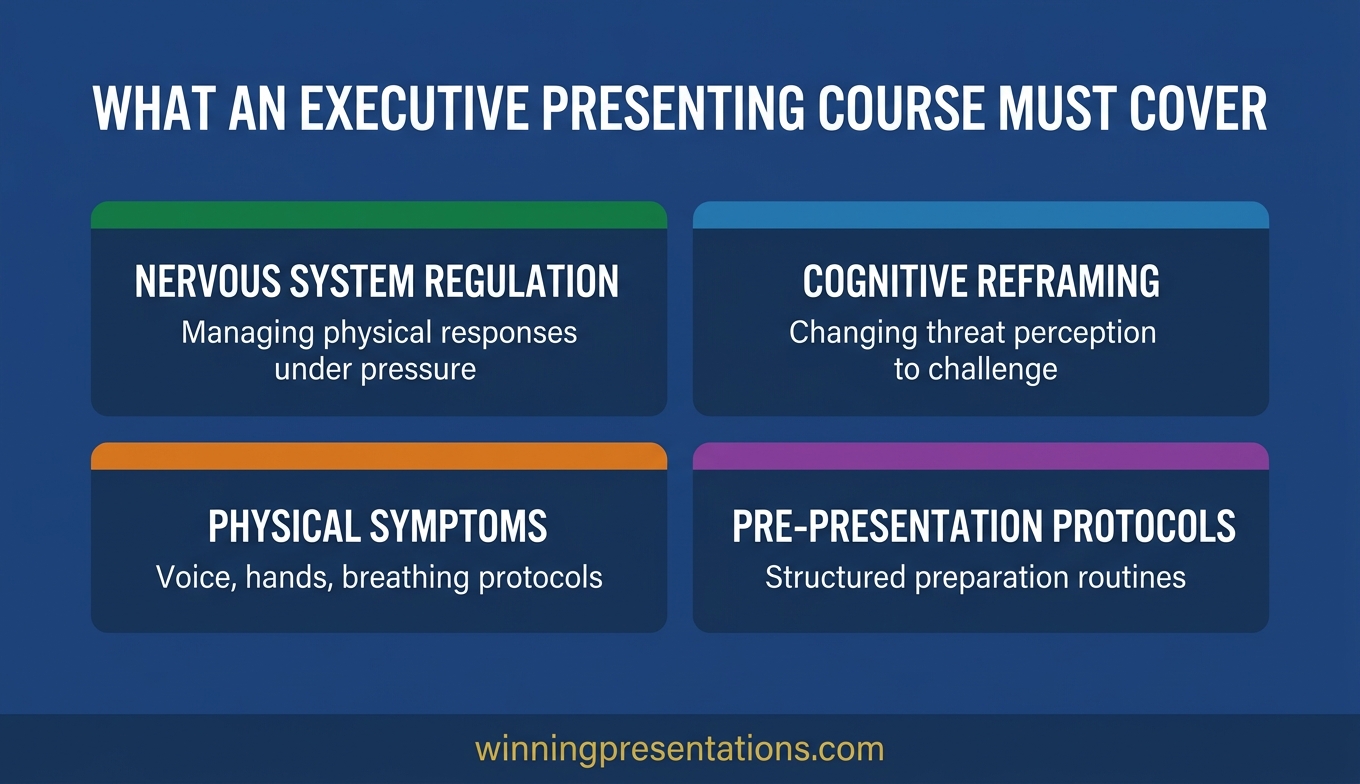
1. Nervous system regulation. Presentation anxiety is not a thinking problem. It is a nervous system activation problem. Your sympathetic nervous system interprets the high-stakes presentation as a threat, triggering the same fight-or-flight cascade that would activate if you were in physical danger. Heart rate increases. Hands tremble. Breathing becomes shallow. Peripheral vision narrows. A presenting confidence programme that does not teach you to regulate this activation — to bring your nervous system back into a functional range before and during the presentation — is missing the most critical component.

2. Cognitive reframing under pressure. Anxiety produces distorted thinking patterns: catastrophising (“This will end my career”), mind-reading (“They can all see I’m nervous”), and all-or-nothing evaluation (“If I stumble once, the whole thing is ruined”). These thought patterns are not rational, but they feel completely real under pressure. Effective programmes teach you to identify and interrupt these patterns in the moment — not as a general self-help exercise, but as a specific protocol you deploy before and during presentations.

3. Physical symptom management. Executives need practical techniques for managing the visible symptoms that undermine their credibility: voice tremor, shaking hands, dry mouth, flushing, and the urge to rush. These symptoms are not character flaws — they are physiological responses that can be managed with the right preparation. Any programme that dismisses physical symptoms as “just nerves” is not addressing what the executive actually needs.

4. Pre-presentation protocols. The thirty minutes before a high-stakes presentation determine more of the outcome than most people realise. What you do with your body, your breathing, your mental rehearsal, and your environment in that window can either prime your nervous system for performance or accelerate the anxiety cascade. A complete programme includes specific, timed protocols for this pre-presentation period.


Infographic showing the four components an executive presenting course must include: nervous system regulation, cognitive reframing, physical symptom management, and pre-presentation protocols

Address the Root Cause, Not Just the Symptoms

Conquer Your Fear of Public Speaking — £39, instant access — is a neuroscience-based programme designed for experienced professionals whose presentation anxiety has neurological roots, not knowledge gaps:

  • Nervous system regulation techniques to manage the fight-or-flight response before it takes hold
  • Cognitive reframing protocols for the distorted thinking patterns that intensify under pressure
  • Physical symptom management for trembling, voice constriction, and visible anxiety signs
  • Pre-presentation preparation sequences you can deploy in the thirty minutes before any high-stakes presentation

Get Conquer Your Fear of Public Speaking →

Designed for executives and senior professionals who present at board, committee, and leadership level.

How Executive Presenting Is Different

Executive presentations carry specific pressures that general-audience programmes do not account for. Understanding these differences is essential when evaluating whether a presenting confidence programme will actually help at your level.

The audience has authority over your career. When you present to a board, a senior leadership team, or an investment committee, the people in the room have direct influence on your promotion, your budget, or your project’s survival. This is not the same as presenting to peers. The stakes are not hypothetical — they are career-defining, and your nervous system knows it.

The tolerance for visible anxiety is lower. At executive level, visible nervousness signals something different than it does in a training room. In a workshop, nerves are expected and sympathised with. In a boardroom, visible anxiety can be interpreted as a lack of conviction in your own recommendation — which undermines the entire purpose of the presentation.

Q&A is unpredictable and consequential. Senior audiences ask questions that go beyond the prepared material. They challenge assumptions. They probe for weaknesses. They ask questions designed to test your thinking, not just your content. If your anxiety management strategy only covers the prepared portion of the presentation, you are vulnerable in the exact moment that matters most.

Repetition is not an option. In most presentation skills courses, you practise in front of the group, receive feedback, and try again. In executive presenting, there is no second attempt. The board meeting happens once. The funding review happens once. The promotion panel happens once. Any programme that relies on gradual desensitisation through repeated exposure misses the reality of executive presenting: you need to perform in a context where the first attempt is the only one.

This is why the right presentation anxiety course for executives focuses on equipping you to manage a single high-stakes event, not building comfort through volume.

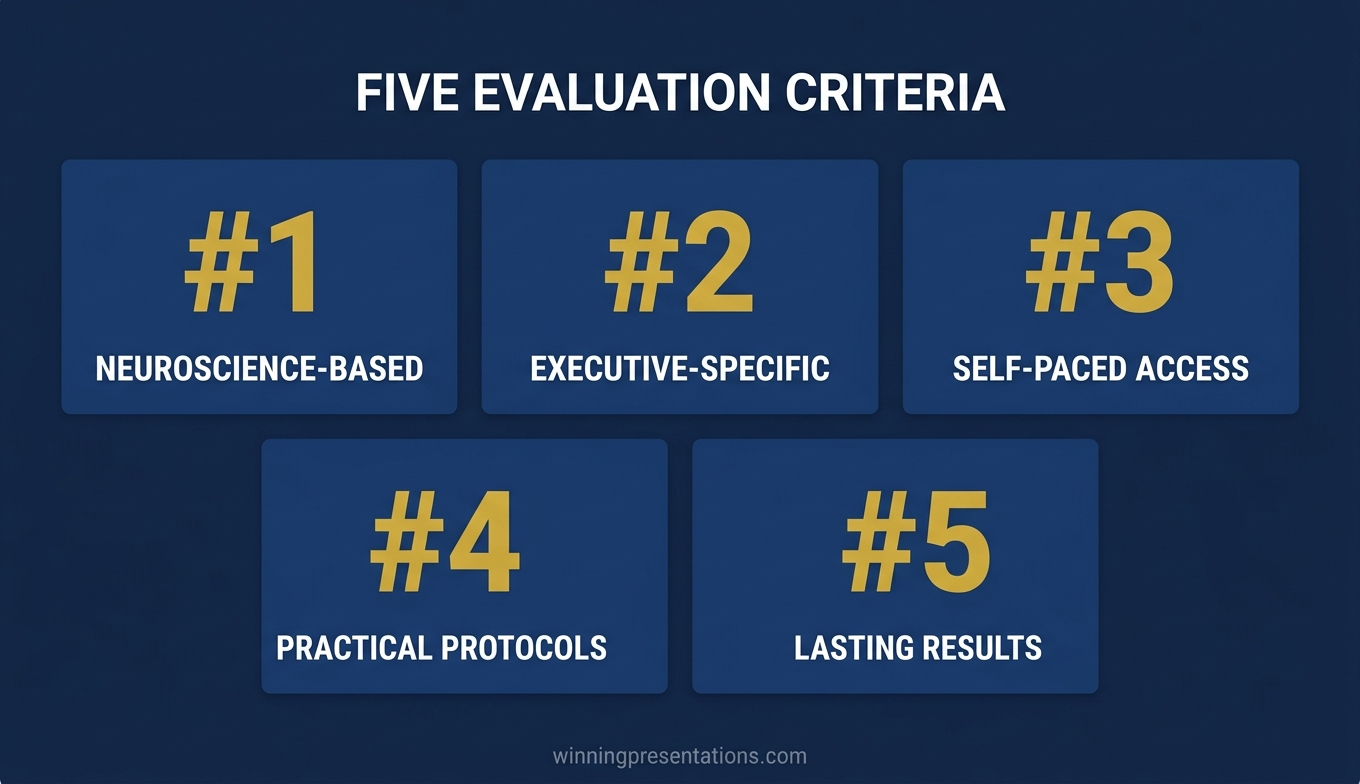
Five Criteria for Evaluating Any Programme

If you are comparing options and trying to determine which executive presenting programme will actually deliver results at your level, apply these five criteria. They separate programmes designed for real-world executive conditions from those that sound good in a brochure.

1. Does it address the nervous system, or just mindset? If the programme’s primary approach to anxiety is “think positively” or “visualise success,” it is not addressing the physiological activation that drives presentation anxiety. Look for content that explicitly covers nervous system regulation, breathing techniques designed for pre-presentation deployment, and somatic approaches that work with the body rather than trying to override it with willpower.

2. Is it designed for self-paced application, or does it require group attendance? Senior executives have unpredictable schedules. A programme that requires you to attend fixed sessions on specific dates may be impractical. Self-paced programmes that you can work through around your actual schedule — and return to when a specific high-stakes presentation is approaching — tend to produce better long-term results because you use them when you need them.

3. Does it include protocols you can deploy immediately? Theory without application is an academic exercise. Effective programmes give you specific, step-by-step sequences you can use before your next presentation. Not principles to reflect on — actions to take in the thirty minutes before you walk into the room.

Conquer Your Fear of Public Speaking includes exactly these kinds of deployable protocols — nervous system regulation, cognitive reframing, and pre-presentation preparation sequences you can use before any high-stakes event.

4. Does it acknowledge that confidence is context-dependent? You may be confident presenting to your team but anxious presenting to the board. A programme that treats confidence as a single quality — “build your confidence and it will transfer everywhere” — is oversimplifying. Look for content that addresses the specific contexts where your confidence breaks down: seniority of audience, formality of setting, unpredictability of Q&A, personal career stakes.

5. Does it address what happens after the presentation? Many executives experience a post-presentation shame spiral — replaying every stumble, every question they handled imperfectly, every moment where their anxiety was visible. This post-event rumination reinforces the anxiety for next time. Programmes that address this cycle, not just the presentation itself, produce more durable improvement.


Infographic showing five evaluation criteria for executive presenting courses: nervous system focus, self-paced format, deployable protocols, context-specific confidence, and post-presentation support

Common Objections — and What the Evidence Shows

“I should be able to handle this without a course.” This is the most common objection, and it reflects a misunderstanding of how presentation anxiety works. You cannot think your way out of a nervous system activation any more than you can think your way out of a racing heart during a sprint. The neurological response is not a character weakness — it is a predictable physiological pattern that responds to specific interventions, not to willpower. Executives who struggle with this are typically high-performers in every other dimension. The anxiety is a system problem, not a competence problem.

“I’ve tried courses before and they didn’t help.” If the courses you tried focused on delivery technique, body language, and motivational exercises, they were not addressing presentation anxiety. They were addressing presentation skill — a related but different challenge. A programme designed for anxiety-driven performance issues works at the neurological level: regulating the nervous system, interrupting catastrophic thinking patterns, and managing the physical symptoms that undermine delivery. If your previous courses did not include these components, you have not yet tried the approach most likely to help.

“At my level, people will judge me for needing help with this.” The reality is precisely the opposite. Senior professionals who invest in managing their presentation performance are making a strategic career decision. The executives who struggle most are the ones who avoid addressing the problem and instead develop elaborate avoidance strategies — delegating presentations, reading from scripts, or limiting their visibility. These strategies cap career progression far more visibly than seeking professional development.

See also: how your physical position affects presentation confidence and delivery.

Ready to Address the Real Problem?

Conquer Your Fear of Public Speaking — £39, instant access — gives you the neuroscience-based protocols to manage presentation anxiety at its source. Nervous system regulation. Cognitive reframing. Physical symptom management. Pre-presentation preparation. Work through it at your own pace, and return to it before any high-stakes event.

Get Conquer Your Fear of Public Speaking →

Designed for executives and senior professionals who need to present with authority under pressure.

Frequently Asked Questions

Is a confident presenting course worth it for someone who already presents regularly?

Yes — if the course addresses the specific gap you are experiencing. Presenting regularly without addressing underlying anxiety or performance issues simply reinforces the patterns you already have. A programme that targets nervous system regulation, cognitive reframing, and physical symptom management gives you tools your experience alone will not provide. The investment pays for itself the first time you walk into a board presentation and manage your physiological response rather than being managed by it.

How long does it take to see results from a presentation confidence programme?

The nervous system regulation and pre-presentation protocols can produce a noticeable difference in your very next presentation — these are techniques you deploy immediately, not skills that require months of practice. The cognitive reframing component typically takes longer to become automatic, usually two to four high-stakes presentations before the new thinking patterns begin to override the old ones. Full integration — where the techniques become your default response rather than something you consciously deploy — generally occurs over eight to twelve weeks of regular use.

Does this work for virtual presentations as well as in-person ones?

The underlying neuroscience is identical regardless of format. Your nervous system activates in response to perceived threat — and a virtual presentation to a senior audience triggers the same fight-or-flight response as an in-person one. The regulation techniques, cognitive reframing protocols, and pre-presentation preparation sequences work in both contexts. Some executives find virtual presentations more anxiety-inducing because they cannot read the room as easily, which creates additional uncertainty. The programme addresses this through the cognitive reframing component, which targets the specific thought patterns that escalate anxiety when feedback cues are limited.

What if my anxiety is specific to Q&A rather than the presentation itself?

Q&A anxiety is one of the most common patterns at executive level, because Q&A is the least controllable part of any presentation. The nervous system regulation techniques in Conquer Your Fear of Public Speaking are designed to be deployed in real time — including during transitions from prepared content to unscripted Q&A. The cognitive reframing component specifically addresses the catastrophic thinking that Q&A triggers: “What if I don’t know the answer?”, “What if they think my analysis is weak?”, “What if they ask about the one thing I’m not prepared for?” These thought patterns are predictable and interruptible with the right protocol.

The Winning Edge — Weekly Presentation Intelligence

Every Thursday, one framework or technique for presenting with authority at executive level — drawn from 25 years of boardroom experience and 16 years training senior professionals. Join The Winning Edge →

Mary Beth Hazeldine is the Owner & Managing Director of Winning Presentations. With 25 years of corporate banking experience at JPMorgan Chase, PwC, Royal Bank of Scotland, and Commerzbank, she advises executives across financial services, healthcare, technology, and government on structuring presentations for high-stakes funding rounds, board briefings, and leadership decisions.

24 Apr 2026

Avoiding Presentations at Work: The Career Cost of Saying No

Quick Answer

Avoiding presentations at work protects you from short-term discomfort but creates long-term career damage that is difficult to reverse. Every declined opportunity narrows the roles, projects, and promotions available to you — and the pattern is visible to colleagues and managers even when you believe it’s hidden. The way out is not forcing yourself into a high-stakes presentation. It is building a structured, graduated approach that rebuilds your capacity in controlled conditions first.

Nadia had been a senior analyst at a consulting firm for four years when she realised she had turned down every presentation opportunity that came her way.

Not obviously. She never said “I’m too frightened to present.” She said things that sounded reasonable: “Ravi knows the client better — he should lead.” “I think it’s stronger if we keep it to one presenter.” “I’m deep in the modelling this week, can someone else take the Friday slot?” Each excuse was plausible. Each one was believed. And over four years, each one quietly moved her name off the list of people considered for client-facing roles.

Nadia found out about the career cost during her annual review. Her manager said she was “technically outstanding” but lacked “executive presence.” She hadn’t been considered for the principal promotion because, in the words of her skip-level manager, “we’ve never seen her present.” They hadn’t. Because she had made sure of it.

I hear some version of this story at least once a month. The details change — the industry, the level, the specific excuse. The pattern is always the same.

Recognise this pattern in yourself?

Conquer Speaking Fear is a structured 30-day programme that breaks the avoidance cycle using nervous system regulation — not willpower. It works with your biology, not against it.

Explore the Conquer Speaking Fear programme →

What Presentation Avoidance Actually Looks Like

Presentation avoidance rarely looks like refusal. It looks like delegation, strategic timing, and reasonable explanations that happen to keep you away from the front of the room every time.

The most common patterns are surprisingly consistent across industries and seniority levels:

Volunteering for the preparation instead of the delivery. You do all the analytical work, build all the slides, write the speaking notes — and then hand the finished deck to a colleague “because they’re the relationship lead” or “because they know the audience.” The work gets done. The credit goes to the person who presented it.

Engineering scheduling conflicts. You book a call, a client meeting, or a site visit that overlaps with the presentation you were asked to do. The conflict is real — you created it deliberately, but nobody else knows that.

Suggesting a different format. “Could we do this as a written briefing instead?” “Would a pre-read with a Q&A be more efficient?” Both suggestions sound like process improvement. Both remove the need for you to stand up and present.

The invisible ceiling. Over time, the avoidance becomes self-reinforcing. You turn down opportunities. Colleagues stop asking. Your manager learns that you prefer “behind the scenes” work and starts assigning you accordingly. You have effectively told the organisation that you are not a presenter — without ever saying the words. The opportunities narrow. And because it happened gradually, it doesn’t feel like a decision. It feels like the way things are.

If any of these patterns feel familiar, you are not alone. The fear of presenting to authority figures drives many of these behaviours — even when the presenter is technically more senior than they realise.

The Career Cost Nobody Warns You About

The damage from presentation avoidance is not dramatic. It is cumulative, quiet, and often invisible until it’s too late to reverse easily.

You lose visibility with decision-makers. In most organisations, the people who decide promotions, project assignments, and leadership appointments are not the people who read your reports. They are the people who see you present. If they never see you present, you do not exist in the context that matters for advancement. No amount of technical excellence compensates for this.

Your expertise becomes invisible. A senior analyst who never presents their own findings is perceived differently from one who does — even if the findings are identical. Presenting your work is not showing off. It is how knowledge becomes influence. Without it, your analysis goes into someone else’s presentation and carries their name, their framing, and their career benefit.

You get typed as “not ready.” Managers use shorthand for who is ready for the next level, and “hasn’t presented” is one of the most common disqualifiers. It is rarely stated explicitly because it sounds harsh. Instead, it surfaces as vague feedback: “needs more executive presence,” “not quite ready for client-facing work,” “strong contributor but needs to develop leadership skills.” All of these can mean: “We haven’t seen them present, and we need to before we can promote them.”

The cost compounds over time. A missed presentation in year one is recoverable. A pattern of avoidance over three to five years changes how the organisation sees you permanently. Colleagues who started at the same level and accepted the presentation opportunities are now two levels ahead — not because they were smarter, but because they were visible. That gap widens every year, and closing it becomes progressively harder.

Career cost of avoiding presentations roadmap showing progressive impact over five stages: Lost Visibility, Invisible Expertise, Typed as Not Ready, Compounding Gap, and Narrowed Options

Break the Avoidance Pattern — On Your Own Terms

Conquer Speaking Fear — £39, instant access — is a structured 30-day programme built on nervous system regulation techniques from clinical hypnotherapy. It is designed specifically for professionals who have tried willpower and found it doesn’t hold:

  • A graduated exposure framework that rebuilds confidence without the deep end
  • Nervous system regulation techniques for the physical symptoms that drive avoidance
  • Daily exercises designed for professionals with limited time
  • Techniques drawn from clinical hypnotherapy and NLP practice

Get the Conquer Speaking Fear Programme →

Designed for executives and professionals who know avoidance is limiting their careers.

Why Avoidance Works in the Short Term and Fails in the Long Term

Avoidance persists because it works — immediately and reliably. The moment you successfully avoid a presentation, the anxiety drops. The relief is real, and your nervous system learns to associate avoidance with safety. This is not a character flaw. It is how the threat response works.

The problem is that avoidance doesn’t just remove the anxiety temporarily. It strengthens the belief that the anxiety was justified. Every time you avoid a presentation and feel relief, your brain records: “The thing I feared was real, and escaping it was the right decision.” Over time, this makes the next presentation opportunity feel even more threatening — because the pattern has been reinforced, not challenged.

This is what psychologists call the avoidance-anxiety cycle. The anxiety creates the avoidance. The avoidance validates the anxiety. Each repetition makes the cycle harder to break. A presentation that would have felt manageable three years ago now feels impossible — not because you’ve become less capable, but because the avoidance has trained your nervous system to treat presenting as a genuine threat.

The critical insight is that willpower does not break this cycle. Telling yourself to “just do it” doesn’t address the nervous system response that made you avoid it in the first place. What breaks the cycle is graduated exposure in controlled conditions — starting with presentations that are low-stakes enough that your nervous system can complete them without triggering the full threat response, and building from there.

The experience of rebuilding presentation confidence after a period of avoidance is different from building it for the first time. You are not learning a new skill. You are unwinding a learned response.

Breaking the Avoidance Pattern Without the Deep End

The worst advice someone avoiding presentations can receive is “just sign up for a big one and push through.” This approach has a dismal success rate, because a single overwhelming experience typically reinforces the avoidance rather than breaking it. The nervous system doesn’t learn “I survived” — it learns “that was as bad as I feared, and I should avoid it even harder next time.”

The approach that works is graduated, structured, and deliberately boring at the start. Here is a practical framework:

Week 1–2: Speak without presenting. Contribute verbally in meetings where you are already comfortable. Ask a question. Offer a data point. Make a comment that requires the room to look at you for ten to fifteen seconds. This is not a presentation. It is practice being visible, and it starts to challenge the association between attention and threat.

Week 3–4: Present informally to a safe audience. Walk a trusted colleague through a piece of analysis at your desk. Talk a small group through a process you know well. Choose an audience where the stakes are genuinely zero — no evaluation, no judgement, no career implications. The goal is to complete a verbal delivery without your nervous system escalating. If it does escalate, that is information, not failure.

Week 5–6: Take a low-visibility speaking slot. A five-minute update in a team meeting. A short walkthrough of a project status. Something where you are presenting, but the content is routine and the audience is familiar. This is the stage where most people discover that the anticipated anxiety is worse than the actual experience — but only because the stakes are genuinely low.

Week 7–8: Accept a real presentation with preparation support. This is the first genuinely public presentation, and it should be one where you have time to prepare and where the audience does not include anyone who intimidates you significantly. Run through it once with a colleague beforehand. The goal is not a perfect presentation. The goal is a completed one.

This graduated approach works because it gives the nervous system time to learn that presenting is not the threat it has been coded as. Each step builds evidence against the fear — but only if the steps are small enough that the fear doesn’t overwhelm the experience. The imposter syndrome that drives presentation avoidance responds to the same logic: small, repeated evidence that you can do this is more powerful than one dramatic success.

If you want a structured version of this progression, the Conquer Speaking Fear programme walks you through a 30-day graduated exposure framework with daily nervous system regulation exercises designed to break the avoidance cycle at its root.

Breaking the avoidance pattern: comparison of avoidance cycle (anxiety, avoidance, relief, reinforced fear) versus recovery path (graduated exposure, controlled success, reduced threat response)

What to Do When You Can No Longer Say No

Sometimes the avoidance runway runs out. You are assigned a presentation that you cannot delegate, defer, or restructure into a written format. This happens more often at career transition points — promotions, new roles, client-facing assignments — where presenting is no longer optional.

If you are in this position, here is what to prioritise in the days before the presentation:

Over-prepare the opening two minutes. The first two minutes are when the physical symptoms peak — the heart rate, the dry mouth, the voice catching. If you know the opening so well that you can deliver it on autopilot, you give your nervous system time to settle without the cognitive load of trying to remember what comes next. Script the first three to four sentences word for word. After that, you can shift to notes or a natural flow.

Practise the physical, not just the content. Stand up. Speak out loud. Walk through the room where you will present, if possible. The nervous system responds to environmental cues, and rehearsing in the actual space reduces the novelty signal that triggers the threat response. If you can’t access the room, practise standing in a similar configuration. The body needs to rehearse, not just the mind.

Tell one person. This is counterintuitive, but telling a trusted colleague “I find this difficult” often reduces the intensity of the anxiety. The avoidance pattern thrives on secrecy — the belief that nobody can know. Sharing it with one person breaks that isolation and, in most cases, the response is supportive rather than judgmental. You may also find that the colleague has a similar experience they have never shared either.

See also how today’s related articles tackle adjacent challenges: delivering difficult financial news under pressure, adapting presentations for unfamiliar audiences, and building structured boardroom presentation skills.

Ready to Stop the Pattern?

Conquer Speaking Fear — £39, instant access — is a 30-day programme that uses nervous system regulation techniques from clinical hypnotherapy to break the avoidance cycle at its source. It is designed for professionals who have tried willpower and need a different approach.

Get the Conquer Speaking Fear Programme →

Designed for professionals who know avoidance is holding their career back.

Frequently Asked Questions

Is it normal to avoid presentations at work?

It is extremely common. Research consistently shows that public speaking is one of the most widely reported workplace anxieties, and avoidance is the most common coping strategy. The challenge is that avoidance is also the strategy that causes the most long-term career damage, because it is invisible — neither the person avoiding nor their colleagues typically recognise the cumulative cost until it has already shaped career trajectory significantly.

Can you have a successful career without presenting?

In some specialist roles, yes — but the ceiling is significantly lower. Almost every leadership role, client-facing role, and cross-functional role requires the ability to present. If you cannot or will not present, you limit yourself to roles where someone else presents your work for you. This is viable early in a career but becomes increasingly restrictive as seniority increases. Most professionals who avoid presentations do not choose a different career path — they simply stop advancing at the point where presenting becomes required.

How long does it take to overcome presentation avoidance?

With a structured approach, most professionals see meaningful progress within four to six weeks. This does not mean the anxiety disappears entirely — it means the avoidance behaviour stops, and the anxiety becomes manageable enough that you can present despite it. A graduated exposure framework typically starts to produce results within the first two weeks, as the nervous system begins to recalibrate its threat assessment. Full confidence rebuilding takes longer — typically three to six months of regular, positive presentation experiences.

The Winning Edge — Weekly Presentation Intelligence

Every Thursday, I share one framework, one real-world example, and one practical technique drawn from 25 years of banking and 16 years of training executives to present with confidence. Join The Winning Edge newsletter →

About the Author

Mary Beth Hazeldine is the Owner & Managing Director of Winning Presentations. A qualified clinical hypnotherapist and NLP practitioner, she spent five years struggling with severe presentation anxiety before developing the nervous system regulation techniques she now teaches. With 25 years of banking experience at JPMorgan Chase, PwC, Royal Bank of Scotland, and Commerzbank, she advises executives across financial services, healthcare, technology, and government on overcoming presentation fear and building lasting confidence.

Book a discovery call | View services

23 Apr 2026
Female executive speaking confidently at a corporate conference with microphone, deliberate and authoritative delivery, editorial photography style

Filler Words in Presentations: The Hidden Habits Destroying Your Executive Credibility

Quick Answer

Filler words in presentations signal cognitive overload to your audience — even when you know your material cold. The fix is not “just slow down.” It’s replacing the nervous system habit that reaches for “um” or “you know” with a trained behaviour: the deliberate pause. Once you understand why filler words happen and practise the pause as a replacement, the habit shifts within two to three weeks of focused work.

I once watched a senior director lose a room in six minutes.

She was presenting a restructuring proposal to a group of eight executives — a high-stakes conversation she had prepared thoroughly for. Her analysis was rigorous. Her recommendation was sound. But within the first ninety seconds, something shifted in the room. Eyes moved to phones. The CFO started annotating his copy of the paper. The energy dropped.

I counted afterwards, from the recording: forty-one filler words in the first six minutes. Not just “um” and “uh” — though there were plenty of those. “Sort of.” “You know what I mean.” “Basically.” “Obviously.” “If that makes sense.” Each one a tiny signal of uncertainty, stacking up into a pattern the room had registered at a level below conscious awareness.

She knew her material. She had rehearsed. The filler words weren’t coming from unpreparedness — they were coming from a nervous system habit she had never been shown how to address. The content was excellent. The delivery was quietly dismantling her credibility one word at a time.

Struggling with verbal habits that undermine your delivery?

Conquer Speaking Fear gives you the evidence-based techniques to retrain the nervous system habits behind filler words, hesitation, and vocal uncertainty — so your delivery matches the quality of your thinking.

Explore Conquer Speaking Fear →

Why Filler Words Happen — Even When You Know Your Material

The conventional explanation for filler words is that they’re a sign of not knowing what to say next. This explanation is wrong often enough to be unhelpful. Many of the executives I work with who use the most filler words are the most knowledgeable people in the room. Their filler words are not a symptom of ignorance — they’re a symptom of a nervous system under mild stress.

When we speak in high-stakes situations, the prefrontal cortex — the part of the brain responsible for word retrieval, sequencing, and articulation — is competing with the threat-response system for processing resources. Even when there is no genuine threat, the social pressure of presenting to a senior audience activates a low-level arousal response that slightly degrades the fluency of speech production.

The brain, faced with a brief processing delay, reaches for a learned verbal placeholder to maintain the impression of continuity. “Um.” “Uh.” “Sort of.” These are not random sounds — they are trained habits that developed over years of speaking in classrooms, meetings, and conversations where silence felt uncomfortable. The placeholder fills the silence. Over time, the behaviour becomes automatic.

This matters because it means the fix is not intellectual. You cannot think your way out of a nervous system habit. You have to replace it with a different trained behaviour — and the most effective replacement for a filler word is a deliberate pause. The techniques for eliminating “um” from your speech all work through this mechanism: replacing an automatic avoidance behaviour with a controlled alternative.

The Filler Words Beyond “Um” That Damage Credibility

Most advice about filler words focuses on “um” and “uh.” These are the most obvious and the easiest to hear, but they are not always the most damaging. The filler words that cause more subtle but persistent credibility erosion are the ones that sound like content but function like noise.

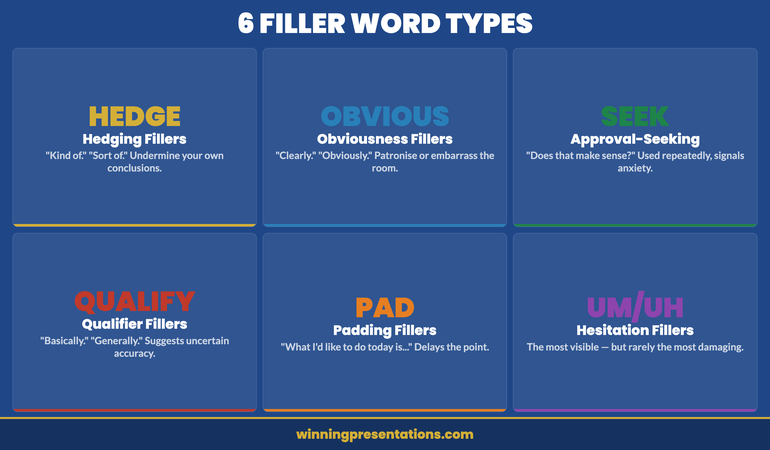
Six categories of filler words in presentations that damage executive credibility: Hesitation fillers, Hedging fillers, Obviousness fillers, Approval-seeking fillers, Qualifier fillers, and Padding fillers with examples of each

Hedging fillers are phrases that undermine the confidence of your own statements. “Kind of.” “Sort of.” “In a way.” “I suppose.” When you say “The data kind of suggests we should proceed,” you are communicating uncertainty about a statement you may be entirely certain about. Hedging fillers are particularly damaging in executive contexts because they signal that you don’t fully trust your own analysis.

Obviousness fillers are phrases that imply the audience should already know what you’re telling them. “Obviously.” “Clearly.” “Of course.” “As you’ll all be aware.” These carry a dual risk: they can patronise an audience that does know the thing, and they can embarrass an audience member who doesn’t. Neither serves you. They also signal that you haven’t thought carefully about the audience’s actual knowledge level — which itself reads as poor preparation.

Approval-seeking fillers are question tags and checking phrases that seek validation mid-sentence. “Does that make sense?” “You know what I mean?” “Right?” “If that makes sense.” Used once, these are fine — they can be genuine invitations for questions. Used repeatedly, they signal anxiety about whether the audience is following you, which amplifies rather than resolves the tension in the room.

Qualifier fillers are words that technically modify a statement but function as verbal hedges. “Basically.” “Generally speaking.” “In most cases.” “Typically.” These are sometimes genuinely necessary — you may be making a statement that genuinely has exceptions. But when they appear on statements that don’t require qualification, they suggest you’re not quite sure whether what you’re saying is accurate.

Padding fillers are extended phrases that don’t add information. “What I’d like to do today is take you through…” “So what we’re going to look at is…” “The thing about this is that…” These typically appear at the beginnings of sentences, before the actual information starts. They delay the moment of value and create a rhythm that makes the speaker seem less direct than the content deserves.

From Verbal Habits to Vocal Authority

Filler words are one symptom of a broader pattern: a nervous system that hasn’t learned to feel safe in high-stakes speaking situations. Conquer Speaking Fear — £39, instant access — addresses the root cause, not just the surface habit:

  • Nervous system regulation techniques drawn from clinical hypnotherapy
  • Evidence-based methods for retraining habitual speech patterns under pressure
  • A 30-day programme that builds lasting vocal confidence, not just temporary fixes
  • In-the-moment techniques you can use before and during high-stakes presentations

Get Conquer Speaking Fear →

Designed for executives whose delivery doesn’t yet match the quality of their thinking.

What Filler Words Signal to Your Audience

Audiences process filler words at a level below conscious analysis. They rarely think “this speaker uses too many filler words” — they experience a vague sense of uncertainty, a slight reduction in confidence in what they’re hearing. The effect is cumulative and largely invisible to the speaker.

In executive settings, the cost is specific. Filler words signal four things that are particularly damaging in high-stakes presentations.

They signal cognitive overload — the impression that you are working harder than expected to retrieve the information you’re presenting, which raises the question of whether you have truly mastered the material.

They signal uncertainty about your own conclusions. Hedging fillers in particular create the impression that you are not fully convinced by your own analysis. An executive who hedges their recommendations is less persuasive than one who states them directly.

They signal anxiety — which, in a room of senior executives, activates a subtle assessment of whether you are ready for the level of responsibility the presentation implies. This is rarely fair. But it is real.

And they signal lack of preparation — even when the opposite is true. Because filler words are associated with thinking out loud, an audience that hears many of them will often conclude the speaker hasn’t fully prepared, regardless of the quality of the underlying content.

The relationship between presentation confidence and credibility perception is well documented in professional contexts: the way you sound when you present your ideas affects how those ideas are received, independently of the ideas themselves. This is worth taking seriously.

If the pattern you recognise in yourself goes beyond filler words to broader delivery anxiety, Conquer Speaking Fear is built specifically for executives dealing with the gap between their knowledge and their delivery.

The Technique That Replaces Filler Words Permanently

The single most effective technique for eliminating filler words is the deliberate pause. Not a hesitation pause — that’s what produces the filler word in the first place. A deliberate pause: a conscious, controlled moment of silence that you use in place of the filler word.

The deliberate pause works because it replaces the nervous system habit at the point of activation. When the brain reaches for a verbal placeholder, you train it to reach for silence instead. Silence, unlike “um,” signals confidence. It gives the impression that you are choosing your words carefully — which you are. It creates emphasis. It gives the audience a moment to absorb what you’ve just said before you continue.

The primary obstacle to using the deliberate pause is that silence feels much longer to the speaker than it does to the audience. What feels like an uncomfortable three-second pause to you typically registers as a natural one-second beat to your listeners. This mismatch is the reason most people default to filler words — they are filling a silence that doesn’t actually exist in the audience’s experience.

The technique requires practice to internalise. You need to experience the pause in low-stakes situations until your nervous system registers that silence does not create the negative reaction you are expecting. Once that recalibration happens, the pause becomes available to you under pressure.

The presentation pause technique in detail: at the moment you feel the impulse to say “um,” close your mouth, breathe once, and allow the pause to exist. Make eye contact with one person in the room during the pause — this transforms what might feel like a gap into a moment of connection. Then continue.

The four-step process for replacing filler words with deliberate pauses: Recognise the impulse, Close your mouth, Breathe and make eye contact, Continue speaking

How to Practise This So It Holds Under Pressure

Knowing the technique is the easy part. Making it available when you are presenting under real pressure requires a specific practice approach. Here is the method that produces reliable results.

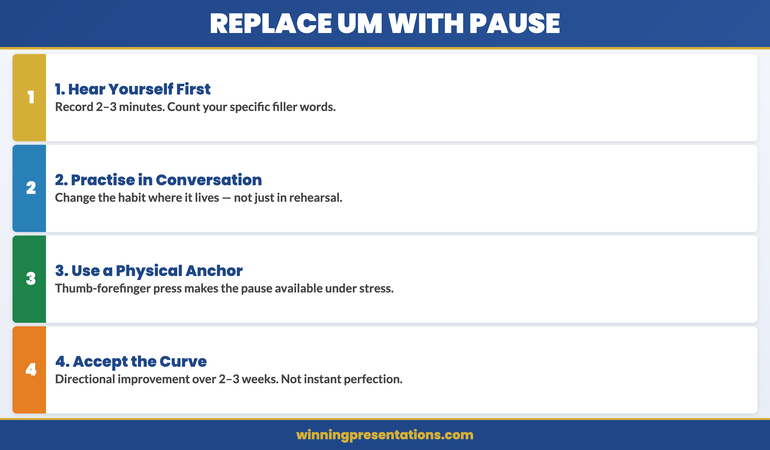
Step 1: Hear yourself first

Record two to three minutes of yourself speaking — on any topic — without trying to control filler words. Listen back and note the specific words and phrases you use most frequently. Most people are surprised by both the frequency and the variety of their own filler words. You cannot change a habit you haven’t clearly identified.

Step 2: Practise in conversation, not just rehearsal

Catching filler words in a rehearsed speech is relatively straightforward because the script gives you structure. The harder and more valuable work is practising the pause in conversation — in meetings, phone calls, and informal exchanges — where you don’t have a prepared script to fall back on. This is where the habit is actually formed and where it needs to be changed.

Step 3: Use a physical anchor

During early practice, pair the deliberate pause with a physical sensation — pressing your thumb and forefinger together, or feeling your feet on the floor. This creates a proprioceptive anchor for the behaviour, which makes it more accessible under stress. The physical anchor gives the nervous system something concrete to reach for when the usual verbal placeholder habit activates.

Step 4: Accept the learning curve

In the early stages of changing this habit, you will sometimes produce filler words in situations where you are actively trying not to. This is normal. Habit change is not linear. The goal is directional improvement over two to three weeks of consistent practice — not immediate perfection from the first session. Tracking your frequency over time (via recording) will show you the trend even when individual sessions feel inconsistent.

See today’s related articles for context on the broader picture: how to present a pilot as a commercial case, how to take a technology roadmap to the board, and the structured approach to building lasting presentation skills at work.

Stop Letting Delivery Habits Undermine Your Ideas

Conquer Speaking Fear — £39, instant access — is a 30-day programme that addresses the nervous system patterns behind filler words and verbal uncertainty, so your delivery reflects the quality of your thinking rather than working against it.

Get Conquer Speaking Fear →

Designed for executives whose delivery doesn’t yet match the quality of their thinking.

Frequently Asked Questions

How long does it take to stop using filler words in presentations?

With consistent daily practice — recording yourself, catching the habit in conversation, and using the deliberate pause technique — most people notice a measurable reduction within two to three weeks. Eliminating filler words in scripted presentations typically happens faster than in spontaneous conversation, because the script provides structure that reduces the cognitive load that triggers filler words. The more challenging work is sustaining the change under the pressure of high-stakes presentations, which is where nervous system training becomes important alongside habit change.

Is it bad to use any filler words at all in a presentation?

Occasional filler words are unremarkable and entirely human. The problem is frequency and pattern — a speaker who uses one “um” in ten minutes barely registers with an audience; a speaker who uses forty registers as uncertain and underprepared. The goal is not complete elimination but deliberate control. A well-placed pause is consistently more effective than a filler word in any situation, but the occasional “um” in an otherwise authoritative delivery is not a credibility issue.

Why do I use more filler words with senior audiences than with peers?

Because the perceived stakes are higher, which activates a stronger stress response, which degrades speech fluency more significantly. This is a normal neurological response, not a sign that you’re particularly anxious or underprepared. The mitigation is nervous system regulation before and during high-stakes presentations — bringing your baseline arousal level down before you speak so that the prefrontal cortex has more processing resource available for articulation. The deliberate pause also helps in the moment: it creates a brief circuit break from the stress response that allows fluency to return.

The Winning Edge — Weekly Presentation Intelligence

Every Thursday, one framework or technique for high-stakes speaking — drawn from 24 years in boardrooms and 16 years training executives. Join The Winning Edge →

About the Author

Mary Beth Hazeldine is the Owner & Managing Director of Winning Presentations. With 25 years of corporate banking experience at JPMorgan Chase, PwC, Royal Bank of Scotland, and Commerzbank, and 16 years training executives in high-stakes presentation delivery, she advises senior leaders across financial services, healthcare, technology, and government on the full range of presentation performance — from structure to delivery to anxiety management.

Book a discovery call | View services

23 Apr 2026
Professional preparing a polished board presentation on a laptop in a modern office, focused and confident, editorial photography style

How to Improve Presentation Skills for Work: The Structured Approach That Actually Works

Quick Answer

To improve presentation skills for work you need three things working in parallel: a reliable structure so you stop rebuilding every deck from scratch, a system for managing delivery under pressure, and deliberate practice in conditions that match the real stakes of the presentations you need to give. Courses that only address one of these three typically produce temporary improvement. This guide covers all three.

Kwame had been told to “work on his presentation skills” three times in four years.

Once by a line manager after a client pitch that didn’t land. Once in a 360-degree feedback report after a town hall that received mixed responses. And once — most directly — by the head of his division, who told him in a performance review that he was “technically exceptional but needed to develop his executive presence in front of senior stakeholders.”

Each time, Kwame tried to act on the feedback. He watched YouTube videos. He read books. He took a one-day communication course his company funded. He rehearsed more. None of it moved the dial in the ways that mattered. He still rebuilt every presentation from scratch. He still felt exposed in Q&A. His delivery still tightened when the room was senior enough to matter.

The problem wasn’t effort. It was that the advice he was following addressed surface symptoms — delivery tips, confidence mantras, filler-word elimination — without addressing the underlying structural deficits that were producing them. When your presentations don’t have a reliable skeleton, you will always be improvising. And improvisation under pressure produces exactly the symptoms he was trying to fix.

Told to improve your presentation skills but not sure where to start?

The Executive Slide System gives you the structural foundation that removes the rebuilding problem — so you walk into every presentation with a proven framework rather than starting from a blank slide.

Explore the Executive Slide System →

Why Most Presentation Tips Don’t Stick

The internet contains thousands of presentation tips. Most of them are accurate. Almost none of them produce lasting change when applied in isolation, because they address individual behaviours without building the system those behaviours need to operate within.

“Make eye contact” is a useful tip. But if you’re using working memory to track your place in a poorly structured deck, your attention is on the slides — not your audience. The eye contact tip won’t help until the structural problem is resolved.

“Speak more slowly” is a useful tip. But if you’re anxious because you don’t know how to handle the Q&A that’s coming, you’ll speed up again as soon as a challenging question arrives. The delivery tip won’t help until the Q&A preparation problem is resolved.

“Use pauses instead of filler words” is a useful tip. But if your nervous system hasn’t been recalibrated to tolerate the silence, the pause will feel unbearable and you’ll default to “um” within seconds. The filler word tip won’t help until the nervous system regulation problem is resolved.

This is why presentation improvement initiatives that focus on tips — however accurate — tend to produce temporary results. You leave the workshop feeling equipped. You apply the tips in the next few presentations. Then the high-stakes presentation arrives, and you revert to baseline. Because tips are not a system. Presentation skills training that actually sticks has to address the underlying components, not just the surface behaviours.

The Three Components of Lasting Improvement

To improve presentation skills for work in a way that holds under pressure, you need to work on three components simultaneously. Each one reinforces the others. Fixing only one or two will produce partial improvement at best.

Component 1: Structure — a repeatable framework for building presentations that you don’t have to reinvent for every new context. Most professionals spend the majority of their preparation time trying to figure out what to put on each slide and in what order. A reliable structure eliminates this problem. You know the architecture; the work becomes filling it with the specific content for this presentation.

Component 2: Delivery under pressure — the ability to maintain composure, clarity, and authority when the stakes are high, the room is difficult, or the Q&A goes somewhere unexpected. This is a nervous system and rehearsal challenge, not a knowledge challenge. You can know your material completely and still feel exposed when a senior executive asks a question you hadn’t anticipated.

Component 3: Deliberate practice — a method of building skill that goes beyond simply giving more presentations and hoping improvement happens. Most people’s presentation skills plateau because they keep practising the same behaviours in the same conditions. Deliberate practice targets the specific gaps that matter and creates conditions that are challenging enough to produce genuine improvement.

The Structural Foundation Every Executive Presenter Needs

If you are rebuilding every presentation from scratch, you are solving the wrong problem before every meeting. The Executive Slide System — £39, instant access — gives you the structural framework that removes that problem permanently:

  • 22 PowerPoint templates covering the executive scenarios you actually encounter
  • 51 AI prompt cards to build content into any template fast
  • Scenario playbooks for board presentations, budget cases, client pitches, and more
  • Checklists that catch the structural errors that lose rooms before Q&A begins

Get the Executive Slide System →

Designed for professionals who need to present with confidence at executive and board level.

Structure: The Fastest Lever to Pull

Of the three components, structure produces the fastest visible improvement because it addresses the most common root cause of weak presentations: the absence of a clear decision logic.

Most professionals build presentations by gathering all the relevant information and then arranging it in a logical sequence. The problem with this approach is that “logical sequence” usually means chronological — how the situation developed, how the analysis was done, what was found, and then what is recommended. This is the right order for a research paper. It is the wrong order for an executive presentation.

Executive audiences want to know the recommendation first, the supporting evidence second, and the analysis third — if at all. This is the pyramid principle applied to presentations, and it runs counter to how most professionals were trained to present information at school and university. The result is that competent, well-prepared professionals produce presentations that bury the point, overwhelm the audience with context before the recommendation, and leave senior stakeholders frustrated even when the underlying thinking is excellent.

The executive presentation structure that works consistently follows this pattern: start with the conclusion, support it with three to four reasons or evidence points, and provide the detail as supporting material rather than the main event. This structure is learnable and replicable. Once you have internalised it, every presentation becomes easier to build — because you always know what goes where.

The templates in the Executive Slide System are built around this structure — so you don’t have to reinvent the architecture for each new presentation, you just load your content into a proven framework.

Delivery: What Changes When the Stakes Are Real

Good delivery in a low-stakes environment does not automatically transfer to good delivery in a high-stakes one. This surprises many professionals who feel confident in informal presentations but notice their delivery deteriorating when the room is more senior or the decision more significant.

What changes under pressure is the availability of cognitive resources. When the stakes feel high, part of your working memory is occupied by threat-monitoring — tracking how the room is responding, anticipating questions, managing any anxiety symptoms. This leaves less resource available for fluency, word retrieval, and the deliberate choices that constitute good delivery: eye contact, pacing, pausing.

Improving delivery under pressure therefore requires two parallel approaches. First, reduce the cognitive load of the presentation itself — a reliable structure and well-rehearsed content means less working memory is needed for the material, leaving more available for delivery choices. Second, reduce the baseline activation level of the threat response — through preparation, rehearsal in conditions that mimic the real stakes, and where necessary, nervous system regulation techniques that bring down arousal before you begin.

The specific presentation skills development work that addresses delivery under pressure includes: practising in front of people whose opinion you care about (not just in front of a mirror), recording yourself in full-dress rehearsals and watching it back, and simulating the most challenging Q&A scenarios you are likely to face. Each of these creates the conditions for genuine improvement rather than improvement in controlled practice environments that don’t translate.

Deliberate Practice: How to Improve Without More Presentations

Most professionals improve their presentation skills by giving presentations and hoping the experience produces improvement. This works to a point — you do get more comfortable with the mechanics of presenting — but it stops working once your skills plateau, because you are practising the same strengths in the same conditions.

Deliberate practice is different. It targets the specific gap, creates challenge that is slightly beyond your current capability, and builds in feedback so you can see whether you improved. Here is what deliberate practice looks like for the three most common development areas.

For structure: Take a presentation you have already given and rebuild it using a different structural logic — starting with the conclusion rather than the context, or organising by stakeholder concern rather than analytical sequence. Compare the two versions and assess which one a senior audience would find easier to act on. Repeat with three to five different past presentations until the new structure becomes your default approach.

For delivery under pressure: Ask a trusted colleague or manager to play the role of a challenging committee member during a rehearsal — specifically tasked with asking questions you won’t have prepared for, expressing scepticism, or cutting across your slides mid-sentence. This is uncomfortable. It is also the only way to build the skills you need for those conditions. Rehearsal against a supportive audience does not prepare you for a difficult one.

For verbal habits and fluency: Record two minutes of yourself explaining your current project — without notes — and watch it back with the sound off, then again with sound only. The visual and audio separation often reveals habits that are invisible when you’re watching both together. Identify the single most distracting habit and target it explicitly in the following week’s practice sessions, rather than trying to fix everything at once.

See today’s related articles: the specific verbal habits that damage executive credibility, how to present a pilot as a commercial case, and how to take a technology roadmap to the board.

Stop Rebuilding Presentations From Scratch

The Executive Slide System — £39, instant access — gives you the structural foundation, templates, and AI prompt cards that remove the biggest time drain in presentation preparation. Build better presentations faster, and walk in with a structure you trust.

Get the Executive Slide System →

Designed for professionals who need to present with confidence at executive and board level.

Frequently Asked Questions

What is the fastest way to improve presentation skills for work?

Fix your structure first. Most presentation problems — unclear delivery, loss of confidence in Q&A, audiences that seem disengaged — trace back to a structural problem: the presentation doesn’t make the recommendation early enough, or doesn’t organise information in the way a senior audience expects to receive it. Once the structure is reliable, delivery and confidence tend to follow because you’re spending less cognitive resource on figuring out where you are in the deck and more on connecting with the room.

Is it worth taking a presentation skills course for work?

It depends entirely on what the course addresses. A one-day communication workshop that covers tips and techniques without addressing structure, Q&A handling, or delivery under pressure will produce limited lasting improvement. Look for resources that provide a replicable structural framework — one you can use in your actual work presentations rather than a course-specific exercise — and that address the specific challenges you face: whether that is senior audience management, anxiety, Q&A, or deck construction. The most effective development work is targeted, not generic.

How do I improve presentation skills when I don’t present very often?

Treat every meeting where you speak as a presentation opportunity. The informal explanation you give in a team meeting, the project update you provide on a call, the recommendation you make in a one-to-one — these are all opportunities to practise structuring your thinking, leading with the conclusion, and managing the question that follows. Frequency of formal presentations is less important than the quality of practice. Deliberate work on structure and delivery in everyday professional communication builds the same capabilities you need in formal presentations.

Why do my presentation skills seem to get worse when I’m presenting to senior people?

Because senior audiences activate a stronger threat response, which takes cognitive resource away from fluency and delivery. This is a normal neurological pattern, not a sign of inadequate preparation. The mitigation is twofold: reduce the cognitive load of the presentation itself through structure and rehearsal, and reduce your baseline arousal level before you present through preparation rituals and, where needed, nervous system regulation techniques. Most professionals find that the combination of better structure and targeted rehearsal in high-stakes conditions produces measurable improvement within four to six presentations.

The Winning Edge — Weekly Presentation Intelligence

Every Thursday, one framework or technique for high-stakes presenting at work — drawn from 25 years of boardroom experience and 16 years training executives. Join The Winning Edge →

Not ready for the full system? Start here: download the free Executive Presentation Checklist — a one-page reference covering the structure and slides every work presentation needs before it goes to a senior audience.

About the Author

Mary Beth Hazeldine is the Owner & Managing Director of Winning Presentations. With 25 years of corporate banking experience at JPMorgan Chase, PwC, Royal Bank of Scotland, and Commerzbank, she advises executives across financial services, healthcare, technology, and government on structuring presentations for high-stakes funding rounds and approvals.

Book a discovery call | View services

22 Apr 2026
A professional woman presenting on a video call with camera on, well-lit home office setup, laptop with ring light visible, attentive expression, navy background, editorial photography style

Camera On or Off in Virtual Presentations

Quick Answer

Camera on is the default for any presentation where you are presenting, seeking a decision, or building trust. Camera off is appropriate when you are part of a large passive audience or when technical constraints make a poor image worse than no image. The question isn’t whether cameras help — they do. The question is when the discomfort around cameras is worth working through, and when the decision to turn off is covering something that needs addressing.

Nadia had been on camera in every client meeting for three years. Then she got a new manager who ran every call with his camera off. Within two months, half the team had stopped using cameras too.

She noticed something shift in the quality of those meetings. Decisions took longer. Follow-up questions went unanswered until email. People multitasked in ways they didn’t before.

Nobody said anything. Camera-off had become the culture. And the culture was costing them something real — not in visibility, exactly, but in attention, trust, and the subtle accountability that comes from being seen.

The debate about cameras in virtual presentations is often framed as a comfort issue. It is sometimes that. But more often it’s a signal issue — and understanding what your camera choice signals to others is more useful than any general rule about when to turn it on or off.

If virtual presentations trigger more anxiety than in-person ones, you’re not alone — and it’s fixable.

Conquer Speaking Fear addresses the patterns that make virtual presentations feel harder than they should — including camera anxiety, self-consciousness on screen, and the specific challenge of reading an invisible audience.

Explore Conquer Speaking Fear →

What turning your camera off actually signals

Most people think of camera use in terms of what it does for them — whether they feel comfortable on screen, whether their background is presentable, whether the lighting is good enough. That’s the wrong frame.

Camera use is a signal to others. And the signal it sends when you turn it off depends heavily on the context and your role in the meeting.

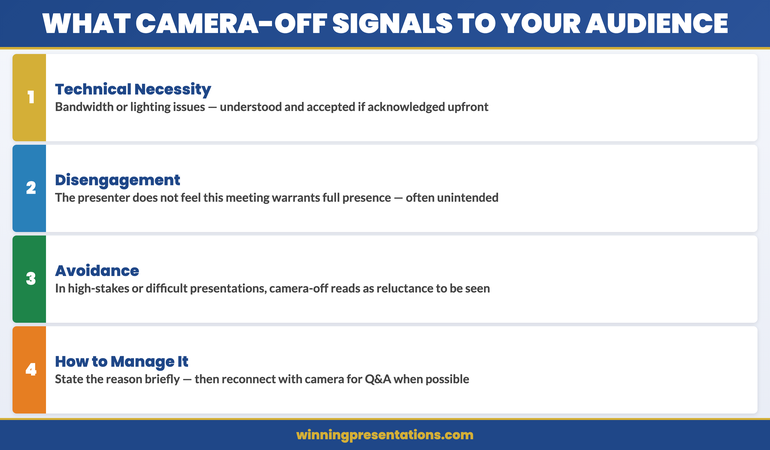
When a presenter turns their camera off, the audience receives one of three messages:

  • Technical necessity: bandwidth issues, poor lighting, technical failure. This is understood and accepted if acknowledged briefly.
  • Disengagement: the presenter doesn’t feel this interaction warrants full presence. This is not always the intended message, but it’s frequently the received one.
  • Avoidance: in presentations where the topic is difficult, or where the presenter is anxious, a switched-off camera can read as reluctance to be seen. Senior stakeholders notice this.

None of these perceptions is entirely fair. The person behind the camera-off screen may be intensely focused, technically constrained, or simply following what’s become their team’s default. But perception matters in presentations — and managing the signal you’re sending is part of the job.

Research into video call behaviour consistently shows that camera presence correlates with perceived engagement, trust, and commitment. This doesn’t mean camera-off makes you appear untrustworthy. It means that in high-stakes presentations — the ones where credibility is being assessed — the camera is doing more work than most people realise.

Stacked cards infographic showing the three signals sent by camera-off in presentations: technical necessity, disengagement, and avoidance — with guidance on each

When camera-on is non-negotiable

There are situations where presenting without camera is not a neutral choice. In these contexts, turning your camera off changes the nature of the interaction in ways that work against you.

When you are the primary presenter seeking a decision. If you’re presenting a proposal, requesting a budget, pitching a strategy, or asking for approval, your camera is part of your persuasive presence. The audience is not just evaluating your slides — they’re evaluating your confidence, your conviction, and your ability to respond to questions live. A camera-off presenter in this context appears either unprepared or evasive.

When you are managing a crisis or delivering difficult news. Camera presence in difficult conversations signals that you’re taking responsibility and engaging fully. A camera-off difficult conversation feels like a phone call with slides. It removes the human accountability that makes hard news easier to receive.

When you’re presenting to someone you haven’t met before. Trust is built through face-to-face interaction, even on a screen. The first impression you make to a new stakeholder, senior leader, or client group is shaped heavily by whether you’re visible. A first meeting with camera off creates a relationship deficit that takes subsequent meetings to recover.

When you’re in a small group presentation. In a meeting of three to six people, camera-off is conspicuous. In a large webinar of 100 people, camera-off is standard. The size of the audience changes what camera-off means.

Legitimate reasons to turn your camera off

There are contexts where camera-off is the right call — not because of anxiety or avoidance, but because it genuinely serves the interaction better.

When screen-sharing is the primary communication medium. If you’re conducting a technical walkthrough, demonstrating a product, or presenting a detailed document where the audience needs to focus on the screen content, your face in the corner can be a distraction rather than an aid. Some presenters prefer to turn camera off during the demonstration and on during the Q&A.

When bandwidth is genuinely degrading your image quality. A pixelated, freezing image is worse than no image. A face that breaks up every 30 seconds signals technical incompetence rather than presence. If your connection is poor, announce it clearly at the start — “I’m going to turn camera off to preserve audio quality, I’ll switch back on for Q&A” — and the choice becomes professional rather than evasive.

When you are a passive participant in a large meeting. In an all-hands presentation or a town hall where you’re not presenting, camera-off is standard. The etiquette scales with audience size. Above roughly 20 people, camera-off for non-presenters is normal and expected.

When team culture explicitly permits it and the stakes are low. Internal team catch-ups with an established team where camera-off is normalised carry different weight than a client presentation. Know the difference.

Virtual Presentations Feel Different Because They Are Different — Here’s How to Close the Gap

Conquer Speaking Fear — £39, instant access — addresses the specific patterns that make virtual presentations harder: camera anxiety, self-consciousness on screen, the absence of non-verbal feedback, and the feeling of presenting into a void. Built on clinical hypnotherapy and NLP, designed for professionals presenting under real pressure.

  • Techniques for managing camera anxiety and self-consciousness
  • Frameworks for reading virtual audiences without visible cues
  • Tools for building presence through a screen rather than despite it
  • Nervous system regulation approaches for high-stakes virtual presentations

Get Conquer Speaking Fear →

Designed for professionals who want to present with confidence in any format.

When camera anxiety is the real issue

There’s a pattern I see regularly: people who find every credible-sounding reason to turn their camera off — poor lighting, bandwidth, the meeting is too large, “I’m just listening today” — when the actual driver is anxiety about being seen on screen.

Camera anxiety is real. The experience of seeing yourself on screen while simultaneously trying to present is genuinely uncomfortable. You’re monitoring your own expression, your hair, whether your background looks acceptable, whether you look engaged or blank or nervous. It’s a cognitive load that doesn’t exist in in-person presentations.

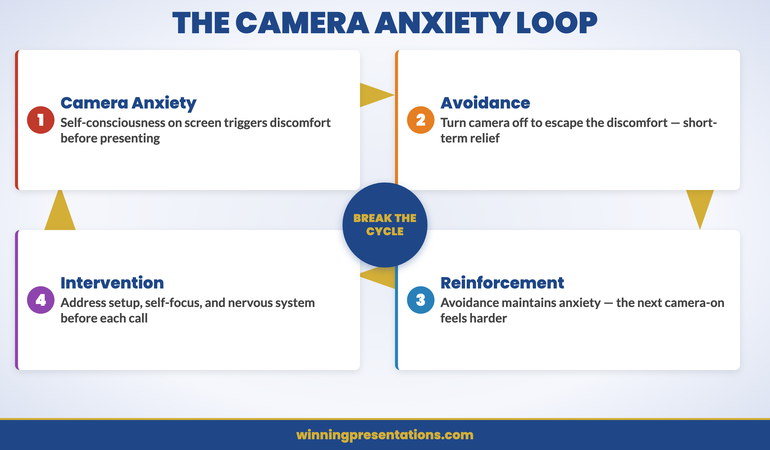
The problem with using camera-off as a permanent solution to camera anxiety is that it removes the anxiety without resolving it. The anxiety remains — it just gets smaller, because you’re avoiding the trigger. And avoidance maintains anxiety rather than reduces it. Each time you turn the camera off to escape the discomfort, the next camera-on experience feels harder.

The more productive path is to address what’s driving the discomfort directly. For many people, camera anxiety is a form of self-consciousness — an intense self-focus on how you appear rather than what you’re communicating. This is the same pattern that underlies general presentation anxiety, and it responds to the same approaches: structured techniques for redirecting attention, nervous system regulation before presenting, and gradual exposure to the trigger under controlled conditions.

If you recognise this pattern in yourself, the article on presentation anxiety and remote cameras addresses this specifically.

Cycle infographic showing the camera anxiety avoidance loop: camera anxiety, avoidance, short-term relief, reinforced anxiety, and the intervention point

The setup changes everything

Many camera decisions are driven by practical problems that are actually fixable. Before defaulting to camera-off, it’s worth considering whether the issue is technical rather than personal.

Lighting. The most common cause of a poor on-screen image is bad lighting, not poor equipment. If the primary light source is behind you (a window, a lamp), your face will be dark and your background will be washed out. A simple ring light or a repositioned desk lamp in front of you changes the image quality dramatically. This is a £30 fix that removes one of the most cited reasons for camera-off.

Camera angle. A laptop camera positioned below eye level produces an unflattering upward angle. Raising the laptop — even with a stack of books — brings the camera to eye level. At eye level, the image is more natural and the eye contact with the camera feels more direct. This is a two-minute adjustment that changes how you appear on screen.

Background. You don’t need a perfectly decorated office. You need a wall. A plain wall behind you with nothing distracting in frame creates a neutral, professional background. Virtual backgrounds work, but they introduce rendering artefacts that experienced viewers notice. A real background, even a simple one, is usually better.

When these three elements — lighting, angle, background — are addressed, most people find that camera-on feels significantly less uncomfortable. The discomfort was partly aesthetic, and the aesthetics are fixable.

For a complete guide to virtual presentation setup and how to maintain presence through a screen, the article on virtual presentation energy covers the physical and environmental factors in detail. And for managing the specific anxiety that comes from presenting content on screen, the article on screen sharing presentations addresses the moment-by-moment challenges.

If camera anxiety is part of a broader pattern of presentation fear, the structured approaches in Conquer Speaking Fear are designed to address the underlying patterns rather than just the surface symptoms.

Build Genuine Confidence in Virtual Presentations — Not Just Coping Strategies

Conquer Speaking Fear — £39, instant access — moves beyond tips and into the actual patterns that make presentations feel threatening. If virtual presenting feels harder than it should, this is the resource that addresses why — and what to do about it.

Get Conquer Speaking Fear →

Designed for professionals presenting under real pressure in any format.

Frequently Asked Questions

Is it rude to turn your camera off in a work meeting?

It depends on the meeting type and your role in it. If you’re presenting, leading, or actively participating in a small group, camera-off registers as disengagement to most colleagues. If you’re a passive participant in a large meeting, camera-off is standard. The social norm scales with meeting size and your role. When in doubt, camera on is the lower-risk default — it’s easier to turn off than to reverse the impression created by starting off screen.

Does camera-off affect how you’re perceived in virtual interviews or presentations to senior stakeholders?

Yes, meaningfully. Senior stakeholders in assessment contexts are evaluating your presence, confidence, and communication style — not just your content. Camera-off removes most of those signals. If technical issues prevent you from presenting with camera, acknowledge it directly at the start and offer to follow up with an in-person meeting or a call where you can be seen. Never leave camera-off unexplained in a high-stakes presentation.

What if my whole team has camera-off as the default — should I still turn mine on?

When you’re presenting, yes. When you’re participating as a listener in a team where camera-off is cultural, that’s a different consideration — you’re not going against convention in a meaningful way. But in any meeting where you are presenting, leading, or seeking something, camera-on is worth the discomfort. You will stand out — and standing out in those moments works in your favour.

The Winning Edge

Weekly insights on presenting with confidence and clarity — for professionals in every format. Every Thursday.

Subscribe Free →

Not ready for the full programme? Start here instead: download the free Virtual Presentation Checklist — a practical reference for setup, delivery, and follow-through in virtual presentations.

For the executive skill of opening virtual and in-person presentations with authority, see the guide on board presentation opening lines — the structures that establish credibility from your first sentence.

The camera question is, in the end, a question about presence. Turn yours on. Work on the setup until it feels comfortable. And if the discomfort is about more than lighting and angles, address that directly — because your virtual presence is now as important as your in-person one.

About the Author

Mary Beth Hazeldine is Owner & Managing Director of Winning Presentations. With 24 years of corporate banking experience at JPMorgan Chase, PwC, Royal Bank of Scotland, and Commerzbank, she advises executives across financial services, healthcare, technology, and government on structuring and delivering high-stakes presentations. She is a qualified clinical hypnotherapist and NLP practitioner, and draws on both disciplines in her approach to presentation confidence and anxiety.

21 Apr 2026
Female executive presenting confidently on a large conference stage holding a handheld microphone, professional lighting, large audience visible, editorial photography style

Microphone Technique for Executives: Handheld, Lapel and Podium

Quick Answer

Poor microphone technique is one of the fastest ways to lose an audience before you have said anything worth hearing. The three types of microphone used in executive presentations — handheld, lapel, and podium — each require different habits. Get the technique right and the microphone disappears from the room’s awareness. Get it wrong and it becomes the only thing anyone notices. This is a mechanical skill, not a talent. It takes twenty minutes to learn and applies immediately.

I watched a divisional director lose the room in the first forty-five seconds of a company-wide address. He had prepared well. The content was clear. The slide structure was sound. But he walked to the front holding the handheld microphone at chin level and turned his head away from it every time he looked at his slides. The words reached the front rows and evaporated. The back third of the room heard a sequence of half-sentences and ambient noise.

The people in those back rows did not know why they could not follow him. They simply stopped trying. They checked their phones, leaned to whisper to colleagues, and disconnected from a presentation that deserved better. The director did not recover, not because the content failed, but because the physical credibility gap opened in the first minute became the frame through which everything else was read.

Microphone technique is one of those skills that is invisible when done correctly and catastrophic when done badly. Most executives are never taught it. It is assumed that someone who can present to a boardroom can also handle an amplification system. The assumption is wrong, and the consequences are measurable in audience engagement from the first sentence.

Presenting to a large audience and managing your nerves at the same time?

Conquer Speaking Fear is a 30-day programme using nervous system regulation techniques from clinical hypnotherapy. Designed for executives who have tried other approaches and still struggle with the physical and psychological experience of high-stakes presenting.

Find Out More →

Why Microphone Technique Matters More Than Most Executives Realise

In a small meeting room, voice projection is managed by the speaker. In a larger venue — a conference hall, a company-wide townhall, an awards ceremony, an industry event — amplification takes over that function. The microphone becomes the primary instrument of your voice, and if you do not know how to use it, you have handed control of your first impression to a piece of equipment you have not practised with.

The problem is compounded because microphone issues are almost always invisible to the speaker. When you turn your head and your voice drops out of the microphone’s pickup range, you feel nothing different. You have no signal that fifty per cent of the room just missed your opening statement. The feedback loop that would normally alert you — a restless audience, a confused expression, a question that reveals they did not follow — is delayed by several minutes, by which time the connection has already been severed.

The deeper issue is what poor amplification signals to an experienced audience. Senior professionals who attend many large presentations have a calibrated sense of what confident, prepared speakers look like on stage. Fumbling with a microphone, holding it inconsistently, or having feedback spikes from a lapel badly clipped suggests either inexperience with large formats or poor preparation. Neither is the impression you want to create in the first sixty seconds.

The solution is not complex. It requires understanding the three microphone types, the specific error patterns of each, and a pre-presentation soundcheck protocol that takes under five minutes. None of this is performance coaching. It is mechanical knowledge that anyone can apply immediately.

Handheld Microphone: The Positioning Errors That Destroy Clarity

The handheld microphone is the most common in corporate presentations and the one most frequently misused. The fundamental rule is consistent distance: the microphone should be held approximately five to seven centimetres from your mouth, angled slightly upward, and maintained at that distance regardless of what your head does.

The most common error is letting the microphone drift downward as the presentation progresses. Speakers start with correct positioning and, as they relax into their content or begin referencing slides, the hand holding the microphone drops toward chin level, then toward the chest. At this point the microphone is capturing significantly less of the voice and more of the room’s ambient noise. The audience hears a reduction in clarity and volume that feels like disengagement, even if the speaker is fully present.

The second error is head-turning. When speakers turn to reference slides or look across the room, they often rotate their head while keeping the microphone stationary. The microphone stays pointing at where the voice was rather than following where it is. The fix is to move the microphone with your head, or to train yourself to keep your head forward when speaking and only glance at slides briefly rather than addressing them.

The third error is inconsistent grip. Nervous speakers often transfer the microphone between hands, hold it loosely, or grip it tightly and then adjust mid-sentence. Each adjustment creates a brief movement that disrupts pickup distance. Hold the microphone with a firm, consistent grip — treating it as a static object, not a prop — from the moment you take it to the moment you hand it back.

A practical test before any presentation with a handheld microphone: stand in front of a mirror, hold the microphone at the correct distance, and then do what you plan to do on stage — turn your head, gesture, reference notes. Watch what happens to the microphone position. The errors that appear in a mirror will also appear on stage.

Handheld microphone technique errors: drift downward, head-turning without moving mic, inconsistent grip — correct position shown at 5-7cm, angled upward, consistent throughout

Lapel Microphone: Placement, Clothing and Movement Rules

The lapel microphone, also called a lavalier, clips to clothing near the collar and provides hands-free amplification. It is common at conferences and company-wide events where the speaker needs freedom of movement. The three variables that determine whether it works are placement, clothing choice, and movement habits.

Placement is the most frequently mismanaged element. The clip should sit approximately fifteen to twenty centimetres below the chin, close to the centreline of the chest. Too low and the pickup weakens significantly; too high and the microphone is visible in camera shots and more susceptible to clothing noise. The exact placement depends on the sensitivity of the specific device, which is why a soundcheck matters — the technician will advise on positioning for that particular room and system.

Clothing creates the most unpredictable problems. Fabrics that rustle — certain synthetics, stiff cotton, structured jackets with internal lining — generate constant friction noise that the lapel microphone amplifies. This is not volume that the speaker can hear, but it is clearly audible to the audience and to anyone watching a recording. If you are presenting at a large event and wearing a lapel microphone, test your outfit with movement before you go on. Run your hand across the lapel area and listen for any fabric sound. Jackets with lapels are generally better than soft knitwear, which can move against the clip and generate intermittent noise.

Movement habits matter because turning your head sharply to one side — particularly if wearing a collar microphone near the jawline — can bring the jaw or shoulder into proximity with the pickup capsule, causing brief distortion. The fix is to turn from the body rather than leading with the chin: rotate your whole torso to address different parts of the room rather than swinging your head while your shoulders stay square.

Podium Microphone: How to Work It Without Being Trapped by It

The podium microphone is fixed in position, which creates a specific constraint that many speakers handle badly: they become physically anchored to the podium. They stand directly behind it, keep their movement minimal, and lose the stage presence that comes from occupying space freely. The microphone that was supposed to amplify their authority ends up containing it.

The key to working a podium microphone without being trapped by it is understanding its pickup angle. Most podium microphones have a cardioid pattern that captures a cone of sound roughly thirty to forty-five degrees wide directly in front of the capsule. You do not need to lean into the microphone. You need to speak across it from a consistent distance — typically twenty to thirty centimetres — and maintain that relationship even when you move your weight, gesture, or shift your stance.

The error most speakers make is leaning forward when they want to emphasise a point. The instinct is to move toward the audience when you want to make something land. But leaning into a podium microphone creates a volume spike that is jarring for the audience and uncomfortable in a large hall. Emphasis is better delivered through vocal variation — a slower pace, a deliberate pause, a lower register — rather than through physical proximity to the pickup.

If you want the freedom to move away from the podium briefly, discuss this with the AV team before the session. Many podium setups can be paired with a lapel backup that allows you to step out from behind the stand for a section of the presentation and then return. Planning this in advance is far more effective than improvising it on stage.

Understanding how to use eye contact effectively in executive presentations becomes significantly more powerful when your microphone technique is already handled — you can direct full attention to the room rather than managing the equipment at the same time.

Conquer Speaking Fear

Microphone technique handles the mechanics. Conquer Speaking Fear — £39, instant access — addresses the anxiety that makes the mechanics harder to manage in the moment. A 30-day programme built from clinical hypnotherapy techniques for executives who need a systematic approach to high-stakes presenting.

  • Nervous system regulation techniques from clinical hypnotherapy
  • 30-day structured programme for lasting anxiety reduction
  • In-the-moment techniques for the day of a high-stakes presentation
  • Designed for executives who have tried other approaches

Get Conquer Speaking Fear →

The anxiety management system built from clinical hypnotherapy, not just presentation tips.

When Anxiety Meets a Microphone: Managing Amplified Nerves

For speakers who experience presentation anxiety, a microphone adds a specific layer of difficulty. The physical symptoms of anxiety — a slight tremor in the voice, an increase in breathing rate, a dry mouth — become more apparent under amplification. Sounds that would be imperceptible to an audience of twenty become audible to an audience of two hundred. This knowledge itself increases the anxiety, which worsens the physical symptoms, which increases the awareness of the microphone. It is a reliable loop that catches many capable executives off guard the first time they present at scale.

The most effective counter is preparation that is specific to the amplified format, not just to presenting in general. Practise with a microphone, or at least with your hand held in the position a microphone would occupy, so that the physical habit of holding it becomes automatic. Automatic behaviours are not disrupted by anxiety in the same way that novel behaviours are. When the mechanics of microphone use are fully habitual, they no longer compete with the cognitive and physical demands of managing nerves.

Breathing is more important under amplification than in smaller formats. The microphone will pick up an audible breath if it is sharp or gasped. Practise deliberate, controlled breathing before you go on stage: slow exhale, then a natural inhale, not the other way around. This is the breathing pattern associated with the parasympathetic nervous system rather than the stress response, and it reduces the visible and audible signs of anxiety more effectively than deep inhalation does.

The morning before a large presentation is also a significant factor. What you do in the two hours before you go on stage has a measurable effect on how well your nervous system manages the amplified format. A structured morning presentation protocol specifically for high-stakes events gives the nervous system the conditions to perform, rather than asking it to recover from a disordered start to the day.

If anxiety in large-format presentations is a consistent pattern for you rather than an occasional occurrence, that is not a microphone technique problem. The technique helps, but the root cause requires a different kind of work. Conquer Speaking Fear is designed specifically for executives dealing with persistent presentation anxiety — a 30-day programme built from clinical hypnotherapy, not generic confidence advice.

Microphone anxiety management: four steps — habituate the mechanics, controlled breathing technique, morning protocol, address root cause if pattern is persistent

The Soundcheck Protocol Most Speakers Skip

Most speakers arrive at a large event, accept the microphone from an AV technician, and walk to the stage. This skips the single most effective preparation available to them: a working soundcheck in the actual space, at the actual volume level, before the audience arrives.

A soundcheck takes four minutes. What it gives you is worth far more. First, you get to hear your own voice as the audience will hear it — amplified, in that specific room, at that specific volume. For most people this is a surprising experience: the voice sounds different, often deeper and more resonant, and getting comfortable with that difference before you are in front of five hundred people means you are not distracted by it when it matters.

Second, the soundcheck is where you discover problems. The lapel clip that causes friction against your jacket. The podium microphone positioned too far to the left of centre. The feedback frequency that kicks in when you turn toward the screen. These are all fixable before the presentation and difficult to manage during it.

Third, the soundcheck is where you establish rapport with the AV team. These are the people who control your volume, your slide progression, and the lighting. Treating them as professionals who are invested in your success — which they are — rather than as technicians to be given brief instructions creates a collaborative dynamic that consistently produces better outcomes on the day.

Request a soundcheck as a formal part of your arrival process for any event that uses amplification. If the organisers say there is no time, arrive thirty minutes earlier than they suggest and ask the AV team directly. Almost always, they will make time. They want the audio to work as much as you do.

The same principle of deliberate physical preparation applies to movement and stage positioning: professionals who walk the stage before the audience arrives always look more comfortable when the audience is there.

Frequently Asked Questions

What should you do if the microphone cuts out mid-presentation?

Pause briefly, signal to the AV team with a clear look or a raised hand, and project your voice naturally until the system is restored. Do not apologise repeatedly or call attention to the technical problem beyond acknowledging it once. Audiences are forgiving of equipment failures that are managed calmly and unforgettable when a speaker appears thrown by them. The ability to project without amplification for thirty seconds, if necessary, is worth practising specifically: speak from the diaphragm, not the throat, and maintain the same pace and authority your amplified voice would carry.

Is it acceptable to hold a handheld microphone with two hands?

Not typically. Two-handed microphone holding limits gesture, signals physical tension, and looks uncertain on stage. The exception is if the venue is very large and the microphone is heavy — some broadcast-quality handheld microphones have significant weight, and a two-handed hold can be appropriate for extended periods. In most corporate presentation contexts, one hand with a firm, relaxed grip is correct. The other hand should be free to gesture naturally or rest at your side.

How do you handle a microphone when you want to pause dramatically?

A deliberate pause is one of the most powerful tools in executive presenting, and the microphone changes how you manage it. If you lower the microphone during a pause, you signal that you are about to speak again when you raise it — which can reduce the impact of the silence. Keeping the microphone in position during a pause maintains the tension of the silence rather than breaking it. The audience reads the raised microphone and the silence simultaneously, which creates a more powerful expectation of what comes next.

The Winning Edge — A Newsletter for Executives Who Present

Every Thursday: one practical technique for structuring, presenting, or defending a high-stakes proposal. Designed for executives who need to communicate with authority, not just confidence.

Subscribe to The Winning Edge →

Conquer Speaking Fear

The 30-day programme for executives dealing with persistent presentation anxiety — built from clinical hypnotherapy techniques that address the nervous system root cause, not just the surface symptoms. £39, instant access.

Get Conquer Speaking Fear →

The anxiety management system built from clinical hypnotherapy, not just presentation tips.

When you are ready to address the Q&A session that follows a large-format presentation, the same discipline applies: preparation and habit formation reduce the unpredictability. See the companion article on handling Q&A in team settings for a structured approach to managing questions under pressure.

About the Author

Mary Beth Hazeldine is the Owner and Managing Director of Winning Presentations. With 25 years of corporate banking experience at JPMorgan Chase, PwC, Royal Bank of Scotland, and Commerzbank, she advises executives across financial services, healthcare, technology, and government on structuring presentations for high-stakes funding rounds and approvals.

17 Apr 2026
A female executive standing confidently at a whiteboard presenting to a small team in a bright corporate meeting room, composed and authoritative, editorial photography style

Rebuilding Presentation Confidence After Maternity Leave

Quick Answer: Presentation anxiety after maternity leave is extremely common and follows a recognisable pattern: you step back into professional life expecting to feel capable, and instead feel like a stranger in your own expertise. The anxiety is rarely about forgetting how to present — it’s about re-establishing a relationship with your professional identity after an extended break in a different role. Rebuilding happens through graduated exposure, specific pre-presentation preparation, and learning to distinguish the nervousness of re-entry from the fear of incompetence.

Priya had been in senior leadership for nine years. She had presented to boards, managed investor calls, and delivered difficult news to large teams with composure. None of that prepared her for how she felt standing up to present six months after returning from maternity leave.

“I knew the material perfectly,” she told me. “I’d been the person who taught this framework to the rest of the team. But when I stood up, I couldn’t find my authority. I kept thinking: do they still see me the way they saw me before? Have I lost something I can’t get back?”

She hadn’t lost anything. But she had stepped out of a professional identity for fourteen months and found that re-entering it was not automatic. The confidence she had before her leave was not gone — it was temporarily inaccessible, buried under a layer of self-consciousness about her return. What she needed was not new skills. She needed a structured path back to the professional self she had temporarily vacated.

If presentation anxiety has intensified since returning to work

Conquer Speaking Fear is a structured 30-day programme that addresses the nervous system patterns behind presentation anxiety — including the type that re-emerges or intensifies after major life transitions. It is not about performing confidence. It is about rebuilding the underlying regulation that makes confidence possible.

Explore the Programme →

Why Maternity Leave Changes Your Relationship With Presenting

Presentation confidence is not a fixed trait. It is a skill that is maintained through regular use, and it is grounded in a sense of professional identity — the clear internal sense of who you are at work, what you know, and what standing you have in the room.

Maternity leave temporarily suspends all three of these. You stop presenting regularly. Your professional identity shifts dramatically — you become a parent in a way that is all-encompassing, and the professional version of yourself recedes. And your sense of standing in the organisation becomes uncertain: Has the team dynamics changed? Has your profile with senior leadership faded? Has someone else filled the space you left?

These are not signs of weakness. They are predictable consequences of a major life transition that involves stepping out of a professional role for an extended period. The challenge on return is that colleagues don’t see the internal recalibration. They see the same capable person they knew before. This mismatch between external expectation and internal experience is what makes presenting feel so exposing in the first months back.

The anxiety is rarely about incompetence. It is about visibility at a moment when you feel uncertain about who you are in the professional context again. That distinction matters enormously, because the response to incompetence (learn new skills) is completely different from the response to identity re-entry (graduated re-engagement with professional roles).

Conquer Speaking Fear

A Structured Programme for Presentation Anxiety That Returns After a Break

Conquer Speaking Fear — £39, instant access — is a 30-day programme that works on the nervous system patterns underlying presentation anxiety. It includes clinical hypnotherapy techniques, nervous system regulation exercises, and a structured exposure sequence — designed for people whose anxiety has intensified after a significant life transition, not just everyday nerves.

  • 30-day structured programme for sustained anxiety reduction
  • Nervous system regulation techniques for use before and during presentations
  • Clinical hypnotherapy audio sessions for deep-rooted fear patterns
  • Graduated exposure framework for rebuilding confidence through low-stakes practice

Get Conquer Speaking Fear →

Designed for presenters whose anxiety has deepened after a major life transition.


Myth vs Reality infographic comparing common beliefs about maternity leave and presentation confidence: Myth — confidence is lost; Reality — it is temporarily inaccessible. Myth — anxiety means incompetence; Reality — it signals identity re-entry. Myth — you need new skills; Reality — you need structured re-engagement.

The Imposter Shift: What’s Actually Happening

Many women describe their post-maternity-leave presentation anxiety using imposter syndrome language: “I feel like I don’t belong here anymore,” or “I’m waiting for someone to notice that I’ve lost my edge.” This framing is understandable but not quite accurate — and the distinction has practical implications.

Classic imposter syndrome is the belief that you are not as competent as others perceive you to be, despite evidence of competence. Post-maternity return anxiety is something slightly different: the sense that your competence is real but your connection to your professional identity has weakened. You know you can do the job. You’re not sure that you still embody it the way you did before.

This distinction matters because it changes the response. Imposter syndrome responds to evidence of past performance — reviewing your achievements, recalling specific successes. Post-maternity confidence rebuilding responds to present performance — small recent wins that re-anchor your professional identity in the current context. Looking backward at what you did before your leave can sometimes reinforce the gap rather than closing it.

The most effective early step is to seek out low-stakes presenting opportunities in the first weeks back. Team meetings, internal briefings, small-group updates — contexts where the stakes are low enough that a less-than-perfect performance doesn’t feel catastrophic. These early presentations are not about impressing anyone. They are about re-establishing the neural pathways of professional presenting and beginning to rebuild your working identity. See also The Imposter Syndrome Paradox: Why Promotion Makes Presentation Anxiety Worse for related patterns.

Preparation Techniques That Rebuild Confidence Quickly

When confidence is fragile, thorough preparation is not a crutch — it is a legitimate strategy. Knowing your material in more depth than you need to, and having thought through likely questions in advance, reduces the cognitive load during the presentation itself. This frees up mental bandwidth for the self-regulation that anxious presenters need to manage their physical response.

Begin your preparation earlier than you normally would. If your previous standard was preparing the day before, extend this to two or three days. Not to over-rehearse — rehearsing the same material to the point of rigidity creates a different problem — but to give yourself time to let the material settle, add depth to the sections you feel least sure about, and simulate questions that might come up.

Identify the two or three moments in the presentation that feel most exposed. These are usually transitions — moving from one section to another — or moments where you anticipate being challenged. Prepare these moments with extra care. Know exactly what you will say and how you will manage the transition. Uncertainty at transitions is what causes the nervous system spike that triggers visible anxiety.

Before the presentation, use a brief pre-presentation routine to settle your nervous system. This does not have to be elaborate: two minutes of slow breathing (four counts in, six counts out) before entering the room has a measurable effect on the physiological response. Combined with a brief mental rehearsal of the opening — not the whole presentation, just the first ninety seconds — this gives your nervous system a clear signal that this is a manageable event.

If pre-presentation anxiety has become a pattern since returning from maternity leave, Conquer Speaking Fear provides a structured 30-day approach to nervous system regulation that addresses the deeper patterns, not just the surface symptoms.


Confidence Rebuilding Cycle infographic showing four stages: Low-Stakes Practice, Nervous System Regulation, Preparation Depth, and Identity Re-Anchoring — a cyclical process for regaining presentation confidence after maternity leave

Graduated Exposure: The Fastest Path Back

Avoidance is the most reliable way to make presentation anxiety worse. Every time you decline a presenting opportunity because the anxiety feels too high, you confirm to your nervous system that presenting is dangerous — and the threshold for triggering anxiety lowers slightly. This is why executives who avoid presenting for six months find that the anxiety on return is higher than it was before the avoidance began.

Graduated exposure — deliberately seeking out presenting situations in order from lower to higher stakes — is the most effective strategy for reversing this pattern. The principle is to present in conditions where the stakes are low enough that you can tolerate the discomfort, complete the presentation, and demonstrate to your nervous system that presenting is survivable. Over repeated exposures, the nervous system recalibrates its threat assessment.

A practical graduated exposure sequence for returning executives might look like this: Start with internal team meetings where you know everyone in the room well. Move to cross-functional updates with a slightly wider audience. Then to briefings for senior colleagues where some relationship exists. Then to formal presentations to a small leadership group. And eventually to the high-stakes board or committee presentations that were routine before your leave.

The progression should be gradual enough that each step is uncomfortable but manageable — not so gradual that you spend six months only presenting to people who already know you well. The goal is to rebuild tolerance for the discomfort of exposure, which requires actually being exposed. For more on this approach, see Presentation Anxiety Relapse: What to Do When Fear Comes Back.

On the Day: Managing the Physical Response

Presentation anxiety has a physical signature: elevated heart rate, shallow breathing, tension in the chest and throat, and for some people, a noticeable tremor in the hands or voice. These physical symptoms are caused by the activation of your sympathetic nervous system — the same system that produces the fight-or-flight response. They are involuntary, and they are not a sign that something has gone wrong. They are a sign that your body is preparing for something it perceives as high-stakes.

Managing the physical response on the day means working with the nervous system rather than against it. Trying to eliminate the physical response through willpower usually increases it — the effort of suppression adds an additional layer of self-consciousness. The more effective approach is to accept the physical response as information, regulate the breathing to signal safety to the nervous system, and redirect attention outward toward the audience and the material.

Before walking in, stand in a quiet space and take six slow, deliberate breaths — making the exhale slightly longer than the inhale. This activates the parasympathetic nervous system and begins to slow the physical arousal response. It does not eliminate the nerves, but it reduces their intensity enough to make the first thirty seconds of the presentation manageable. The first thirty seconds are the highest-risk moment. Once you are in the material, the presenting instincts that pre-date your maternity leave typically reassert themselves.

What Not to Do When Confidence Is Fragile

Several approaches that feel like they should help actually slow the rebuilding process. Understanding these is as important as knowing the techniques that work.

Don’t compare your current performance to your pre-leave performance. The executive you were before your leave was at the end of a long period of accumulated confidence. You are at the beginning of a rebuilding process. Comparing the two is like comparing a marathon runner at mile one to themselves at mile twenty-six — the comparison has no useful information in it. Measure progress against your current baseline, not your historical best.

Don’t over-explain your return. Some executives feel compelled to acknowledge their leave in every early presentation — to pre-empt any sense that they are rusty or less sharp. This draws attention to the uncertainty rather than projecting stability. Audiences take their cue from the presenter. If you behave as though you are fully returned, most colleagues will respond accordingly.

Don’t mistake thorough preparation for over-rehearsal. Rehearsing a presentation to the point where it is completely scripted removes the spontaneity that makes presenting feel natural. The goal of preparation is fluency with the material, not word-for-word memorisation. Over-rehearsed presentations sound mechanical and are harder to recover from when a question takes you off-script.

Don’t avoid asking for feedback. Trusted colleagues who can give you an honest read after a presentation are an important resource during the rebuilding period. Asking someone you respect for one or two specific observations is not a sign of insecurity — it is how experienced professionals continue to develop. The self-assessment of an anxious presenter is almost always harsher than the assessment of a neutral observer.

Ready for a Structured Approach?

30 Days to Calm Your Nervous System and Rebuild Presentation Confidence

Conquer Speaking Fear — £39, instant access — is a 30-day programme that works on the physiological and psychological roots of presentation anxiety. Includes nervous system regulation techniques, clinical hypnotherapy sessions, and a graduated exposure framework for presenters rebuilding confidence after a significant break.

Get Conquer Speaking Fear →

Frequently Asked Questions

How long does it take to rebuild presentation confidence after maternity leave?

There is no universal timeline, but most executives find that with a structured graduated exposure approach, the gap between their current confidence and their pre-leave confidence closes meaningfully within three to four months of return. The key variable is the frequency and variety of presenting opportunities. Executives who actively seek out low-stakes presenting situations in their first weeks back rebuild significantly faster than those who wait for the confidence to return on its own. Confidence is built through action, not through readiness.

Is it normal for presentation anxiety to be worse after maternity leave than before?

Yes, and it is more common than most people discuss in professional settings. The combination of an extended break from presenting, a major identity transition, and heightened self-consciousness about returning to a senior role creates conditions where anxiety often intensifies rather than picking up where it left off. This does not reflect a permanent change in capability. It reflects the temporary disruption of a confidence that was built through sustained professional engagement — and that can be rebuilt through the same kind of sustained engagement.

My anxiety is affecting my willingness to take on visible projects. Should I be worried?

Avoidance of visibility is the most significant long-term risk of post-maternity presentation anxiety, because career progression at senior levels is closely tied to visibility with decision-makers. If the anxiety is leading you to systematically decline presenting opportunities, it is worth addressing directly rather than waiting for it to resolve on its own. A structured approach — either a programme like Conquer Speaking Fear or work with a coach experienced in presentation anxiety — addresses the underlying pattern more efficiently than time alone.

The Winning Edge — Free Weekly Newsletter

Practical frameworks for managing presentation anxiety and building executive confidence. Every Thursday.

Subscribe to The Winning Edge →

About the Author

Mary Beth Hazeldine is Owner & Managing Director of Winning Presentations. With 25 years of corporate banking experience at JPMorgan Chase, PwC, Royal Bank of Scotland, and Commerzbank, she advises executives across financial services, healthcare, technology, and government on structuring presentations for high-stakes funding rounds and approvals.

16 Apr 2026
Female manager presenting a business case to senior leadership team, composed and authoritative, navy blazer, corporate boardroom

Presentation Skills Training for Managers

Presenting to your own team and presenting upward to senior leadership are different disciplines. Most managers discover this the hard way — they prepare thoroughly, they know their material, and then something goes wrong in the room. The director asks a question they were not expecting. The CFO challenges the numbers before slide five. A non-executive cuts across the argument with a concern that derails the structure. Generic presentation skills training does not prepare managers for any of this. It teaches confidence and delivery. It does not teach the structural decisions that determine whether a senior audience accepts or defers your recommendation.

Priya had been presenting internally for six years by the time she was asked to bring a business case to the executive leadership team. She was confident in front of groups. She had done presentation training as a new manager and had put it into practice. She could hold a room, manage nerves, and take questions. What she had not done was present to people whose job is to interrogate recommendations, not receive them. Her slide deck covered the case logically, building from context through evidence to conclusion over fourteen slides. Forty seconds into slide three, the Operations Director interrupted: “Just tell me what you’re asking for and why it’s better than doing nothing.” The room fell silent. Priya had prepared thoroughly for a presentation. She had not prepared for that question — because she had placed the recommendation on slide twelve, and no executive committee has ever waited that long. She found the slide, gave the ask, and recovered well. But she had lost the room’s confidence in the architecture of her thinking before the case was made. What she needed was not more confidence. She needed a different structure.

Preparing to present to senior leadership? The Executive Slide System gives managers the slide templates, AI prompt cards, and structure guides for presenting upward with authority. Explore the System →

Why Generic Presentation Training Does Not Prepare Managers for Senior Audiences

Most presentation skills training for managers focuses on delivery: voice projection, eye contact, posture, managing nerves, using pauses effectively. These are useful skills. They are not the skills that determine whether a senior leadership presentation succeeds or fails.

Senior leaders do not typically evaluate presentations on delivery quality. They evaluate them on the quality of the thinking. Is the recommendation clear? Is the evidence logically structured? Has the presenter anticipated the objections? Is there a credible path forward? A manager who delivers with polished confidence but buries the recommendation on slide nine will lose a senior audience before the middle of the deck. A manager who presents with visible nerves but opens with a clear recommendation, supports it with organised evidence, and closes with a specific next step will hold that audience’s attention and respect.

The other thing generic presentation training does not cover is the dynamics specific to presenting upward. In a standard presentation, the presenter controls the floor. In a senior leadership presentation, the audience frequently interrupts — not to be difficult, but because that is how executive committees work. They identify their priority question early and ask it, often before the presenter has reached the slide that addresses it. A manager who has not prepared for this dynamic — who experiences the interruption as a derailment rather than as a normal feature of senior stakeholder engagement — can lose composure at exactly the moment when composure matters most.

Effective presentation skills training for managers must therefore cover three things that generic training omits: presentation architecture for senior decision-makers, objection anticipation and pre-emption, and composure strategies for live challenge. Without these, even a well-delivered presentation may fail to secure the outcome the manager needs.

The Structure Managers Need for Senior Presentations

The Executive Slide System gives managers scenario-specific slide templates, AI prompt cards, and framework guides — built for presenting upward to senior leadership, not for general team communication. £39, instant download.

  • ✓ Slide templates for high-stakes upward presentations
  • ✓ AI prompt cards to build decision-ready decks faster
  • ✓ Framework guides covering structure, evidence, and risk
  • ✓ Instant download — use immediately for your next presentation

Get the Executive Slide System → £39

Designed for managers and executives preparing high-stakes upward presentations

The Structure Gap: How Managers Need to Present Differently Upward

The most consequential structural difference between presenting to peers and presenting to senior leadership is the position of the recommendation. When presenting to a team or a peer group, building context before the conclusion is natural — you establish shared understanding before making the ask. When presenting upward, this approach works against you.

Senior leaders are time-constrained and operate under high cognitive load. They process information more efficiently when they know the conclusion first and evaluate the evidence in light of it, rather than receiving the evidence and forming a view independently. A presentation that opens with context and builds toward a recommendation asks the senior audience to hold all the evidence in working memory until the conclusion arrives — which is not how executive committees read or listen.

The recommendation-first structure that works for senior audiences looks like this: a brief context statement (one to two slides establishing why this is being presented now), the recommendation itself (stated plainly — what you are asking for, or what you recommend doing), the evidence that supports it (organised logically, not chronologically), a risk acknowledgement (the two or three most likely objections, each with a specific response), and a clear next step. This is the structure that allows a senior leader to engage with your recommendation from slide two, rather than suspending judgement for twelve slides.

For new managers presenting upward for the first time, the hardest part of this structural shift is placing the recommendation before they feel they have earned the right to make it. The impulse is to build the case first. But senior audiences are not waiting to be persuaded before hearing the ask — they want the ask upfront so they can evaluate the case with the recommendation in mind. The structure that feels presumptuous in practice is the one that works.

The five-part executive presentation outline maps this structure in full — covering the exact sequencing decisions that allow a manager’s recommendation to land before the room has had time to form a counter-position.

Handling Scrutiny: When Senior Leaders Challenge Your Case

The moment that separates managers who build a reputation in senior presentations from those who do not is usually not the quality of their slides. It is how they respond when a director challenges their numbers, their logic, or their assumptions.

Senior leaders challenge presentations not primarily to undermine them but to test them. A challenge is, in most cases, a signal of interest: the director is engaging with the proposal seriously enough to probe it. A manager who receives a challenge as an attack and becomes defensive has misread the dynamic. A manager who receives a challenge as a question and responds with specific, calm, well-organised information has demonstrated exactly the credibility that senior presentations are designed to establish.

Preparing for scrutiny requires identifying the three to five objections most likely to be raised before you present, and building your response to each into the deck. Not buried in an appendix — in the main body, as a risk acknowledgement section that addresses the objection before it is raised. This has two effects: it pre-empts the objection, which removes one source of challenge from the room, and it demonstrates that you have engaged with the downside, which builds credibility for the recommendation.

When challenges come in real time during the presentation, three composure practices matter most. First, pause before responding — two or three seconds is not a long silence, but it signals that you are considering the question rather than reacting to it. Second, name the question before answering it: “That’s a question about the timeline — let me address that directly.” This gives you a moment to organise your response and signals to the questioner that you have understood what they are asking. Third, answer specifically and move on — do not over-explain or qualify excessively. A direct, specific response followed by a return to the structure of your presentation is more authoritative than a detailed elaboration that leads the room further from the decision.

For managers whose primary concern about senior presentations is the challenge dynamic rather than the structural one, the framework for presenting to resistant or hostile audiences covers the specific techniques for managing a room where the challenge level is sustained rather than occasional.

The Executive Slide System includes framework guides covering how to structure the risk acknowledgement section that pre-empts the objections most likely to arise in management presentations to senior leadership.

Presenting Resource Requests and Business Cases to Senior Leadership

The presentation type that causes managers the most difficulty is the resource request: a budget ask, a headcount case, a capital investment proposal. These are presentations where the manager needs something from the senior audience and the senior audience is simultaneously under pressure to limit or reduce what it gives. The structural and psychological challenge is significant.

The most common failure mode in resource request presentations is what might be called the apologist structure: the manager spends the first half of the deck establishing how much they have achieved with existing resources, implying that they should not need more before eventually making the ask. This structure undermines the request before it is made. It signals awareness that the ask may not be welcome and pre-emptively hedges against it. Senior leaders read this defensiveness and it reduces their confidence in the manager’s conviction about the proposal.

An effective resource request presentation starts from a different premise: the ask is not a favour, it is an investment decision. Framing the request as an investment decision shifts the conversation from “please give us more” to “here is what the organisation gets if it commits this resource.” The financial logic is the same either way, but the framing is entirely different — and framing is what determines whether a senior audience evaluates a resource request as a cost or as an opportunity.

The evidence section of a resource request also needs specific elements that general business presentations omit. The cost of not approving the request — the operational impact, the missed opportunity, the accumulated risk of deferral — is as important as the case for approval. Senior leaders who are undecided between approving and deferring a resource request will often make their decision based on their assessment of what happens if they do nothing. Making that case explicitly, rather than leaving the senior audience to infer it, is one of the structural choices that separates resource requests that are approved from those that are deferred for further consideration.

The framework for presenting difficult information to senior leadership is directly relevant here — resource requests where the current situation is unsustainable require the same credibility-preserving structure as formal difficult-results presentations.

Building Credibility Through Repeated Senior Presentations

Credibility with senior leadership is built presentation by presentation, over time. Each presentation is an opportunity to demonstrate a specific set of qualities: clear thinking, organised evidence, sound judgement about risk, and a realistic understanding of what the organisation can and cannot do. Managers who consistently demonstrate these qualities in their presentations build reputations that precede them — which changes how senior leaders engage with their proposals.

The most important credibility signal in any senior presentation is specificity. Vague language — “we need more resource,” “the timeline might be challenging,” “there are some risks to consider” — signals that the presenter has not done the analytical work to support a recommendation. Specific language — “we need two additional analysts by the end of Q2,” “the implementation timeline has a four-week dependency on the vendor contract review,” “the primary risk is budget overrun in the infrastructure phase, which we have mitigated by capping the vendor commitment until Phase 1 completion” — signals that the presenter has thought the problem through. Senior leaders recognise the difference immediately.

The second credibility signal is the ability to stay on structure when the room becomes difficult. A manager who loses their thread under challenge or who abandons their prepared structure and begins improvising will leave senior leaders with a residual impression of unpreparedness, regardless of how strong the content was. Managers who can acknowledge a challenge, address it specifically, and return cleanly to the structure of their argument demonstrate exactly the composure under pressure that senior leadership values.

Over time, the managers who build the strongest track records in senior presentations are those who treat each presentation as a structured communication exercise, not a performance. The goal is not to impress the room with delivery quality. The goal is to make the decision the room needs to take as easy as possible to take — by providing the right information, in the right order, with the right level of specificity. Managers who do this consistently find that their presentations become shorter, more direct, and more effective with each iteration, because they have learned what senior audiences actually need from them.

Slide Templates and Frameworks for Presenting Upward

The Executive Slide System gives managers scenario-specific slide templates, AI prompt cards, and framework guides for business cases, resource requests, and senior leadership presentations. £39, instant download.

Get the System Now → £39

Frequently Asked Questions

What presentation training do managers actually need?

Managers presenting upward need training in three specific areas that generic public speaking courses do not cover: structuring a recommendation for senior decision-makers, handling the scrutiny that comes with resource requests and business cases, and managing composure when a director challenges their numbers or their logic. Generic presentation skills training teaches eye contact and vocal variety. Effective management presentation training teaches how to structure a case, anticipate objections, and hold your position under pressure.

How do I improve my presentation skills for presenting to senior leadership?

The most important improvement for managers presenting upward is structural — moving the recommendation to the beginning of the presentation rather than building to it at the end. Senior leaders evaluate evidence more effectively when they know what they are being asked to approve. Beyond structure, the specific skills that make the most difference are: concise evidence sequencing (supporting the recommendation without overwhelming it), a risk acknowledgement that shows you have thought through the downside, and a clear next step that defines what you are asking the senior audience to do.

Is there presentation skills training for managers in the UK?

Yes. Winning Presentations offers the Executive Slide System — a self-paced resource covering slide structure, AI prompt cards, and framework guides for managers presenting to senior leadership in UK organisations. It is designed for managers who are preparing a specific high-stakes presentation and need structured guidance rather than a generic training course. It covers the structural and language decisions that matter most when presenting upward in a UK business environment.

How long does it take to improve presentation skills for senior-level presentations?

Structural improvements — particularly recommendation-first framing, concise evidence sequencing, and risk acknowledgement — can be applied to any presentation within a single preparation session once you understand the principles. The Executive Slide System is designed for this: it provides the framework and templates to apply immediately to your next presentation, not a multi-week course before you see results. Sustained improvement in composure under scrutiny takes longer, but the structural improvements that make the biggest difference to senior audience reception can be implemented straight away.

The Winning Edge

Weekly insights on executive presentations, slide strategy, and boardroom communication.

Subscribe Free

About the author

Mary Beth Hazeldine, Owner & Managing Director, Winning Presentations. With 25 years of corporate banking experience at JPMorgan Chase, PwC, Royal Bank of Scotland, and Commerzbank, and 16 years training managers and executives across financial services, healthcare, technology, and government, she works with leaders preparing high-stakes presentations to senior decision-makers.

16 Apr 2026
Female executive presenting to a senior team in a large open meeting room, standing with composed grounded posture, audience visible and engaged, professional corporate setting

Movement During Presentations: How to Use Physical Space Without Losing Authority

Quick answer: Movement during presentations affects how authority is perceived — but the nature of that movement determines whether it increases or undermines credibility. Purposeful movement that connects to a specific point, transitions between content sections, or closes the physical distance with a key audience member builds presence. Anxious movement — pacing, rocking, shifting weight repeatedly — signals discomfort and draws the audience’s attention away from what is being said. Managing movement under pressure is a physical discipline, not simply a matter of awareness.

Valentina knew her material. She had spent three evenings preparing the numbers and had rehearsed the key points twice the night before. Walking into the steering committee room, she felt reasonably prepared — until she reached the front of the room and realised there was no lectern, no table to stand behind, and sixteen people seated in a horseshoe facing her directly.

She started well. But by the third slide, she noticed she had moved to the left side of the room and was unconsciously pacing — small, repetitive steps that she could feel herself making but could not seem to stop. The movement was not covering any ground purposefully. It was simply the physical expression of the discomfort she was managing internally. A colleague told her afterwards that one of the committee members had whispered something to the person beside him around slide four. She spent the drive home convinced it was about her movement.

What Valentina experienced was not unusual. The physical symptoms of presentation anxiety — the activated nervous system, the heightened muscle tension, the excess energy that has no natural outlet in a formal presentation setting — often manifest as movement. The movement feels like it is helping, because it is releasing physical tension. But to the audience watching, particularly a senior one, it reads as something else entirely.

If physical symptoms — including nervous movement, tension, and restlessness — are affecting how you come across in high-stakes presentations, Calm Under Pressure provides a structured approach to managing those physical responses in the room.

Explore the Approach →

Why Nervous Movement Signals Uncertainty to Senior Audiences

Senior audiences read physical signals faster than most presenters realise. Before the first sentence has been completed, the room has already formed an impression based on how the presenter entered the space, where they stood, and what their body was communicating before they spoke. Nervous movement is one of the clearest physical signals that an audience receives and interprets — often without consciously registering that they are doing so.

The reason nervous movement reads as uncertainty is grounded in how people interpret physical behaviour in high-stakes contexts. A presenter who is comfortable with the material and comfortable in the room typically uses their body deliberately — they move to make a point, to shift the audience’s attention, or to manage the physical space of the room. When movement is random, repetitive, and disconnected from the content, it signals that the body is reacting to internal discomfort rather than engaging with the external environment.

For senior audiences — particularly boards, investment committees, and executive leadership teams who have spent years assessing presentations — this interpretation happens quickly and often with limited generosity. They are not wrong to notice it. Movement under pressure is genuinely informative about a presenter’s internal state. The question is not whether the audience will read it, but what you are giving them to read.

Understanding the relationship between movement and perceived authority is part of the broader discipline of executive physical presence. For related reading on how hand and arm positioning affects credibility, the article on presentation gestures and executive authority covers how deliberate gesture use reinforces rather than contradicts what is being said.

Calm Under Pressure — £19.99, instant access

Manage the Physical Symptoms of Presentation Anxiety — In the Room, in Real Time

Calm Under Pressure is a practical resource for executives who experience physical symptoms of anxiety in high-stakes presentations — shaking, sweating, voice changes, restlessness, and the kind of nervous energy that shows up in your body before the room has had a chance to form an opinion. It provides in-the-moment physical management techniques designed for professional settings where you cannot pause and regroup.

  • In-the-moment techniques for managing physical symptoms under pressure
  • Methods for grounding restless movement and nervous energy before you speak
  • Physical reset protocols for use between slides and during Q&A
  • Frameworks for maintaining composed physical presence through challenging moments

Get Calm Under Pressure →

Designed for executives and professionals who present under pressure and need practical in-the-moment physical management.

The Difference Between Purposeful Movement and Anxious Pacing

Not all movement during a presentation signals anxiety. Skilled presenters move deliberately and purposefully — and that movement enhances rather than undermines their authority. The distinction between purposeful movement and anxious pacing is not primarily a matter of how much you move, but whether the movement has an intentional relationship to the content and the audience.

Purposeful movement serves a communicative function. Walking toward a specific audience member while making a key point closes the physical distance and increases the sense of direct communication. Moving to a different part of the room when transitioning between sections of content signals to the audience that something has shifted — it provides a physical marker for a structural change in the presentation. Pausing in stillness to allow a significant point to land is a form of deliberate non-movement that communicates confidence and control.

Anxious pacing is characterised by repetitiveness and disconnection from the content. The pacing presenter moves because the internal discomfort demands a physical outlet — not because the movement serves any communicative purpose. The steps are often small, often rhythmic, and often cover the same patch of floor. The audience recognises this pattern not because they have analysed it consciously, but because it lacks the intentionality that deliberate movement carries.

A useful internal test during rehearsal: if you ask yourself why you moved just then and the honest answer is “I don’t know” or “I needed to,” the movement was anxious. If the answer is “I moved to emphasise that point” or “I moved to shift the audience’s attention to the screen,” the movement was purposeful. This distinction, practised in low-stakes rehearsals, builds the habit of intentional physical communication before you enter a room where the stakes are high.


Contrast showing purposeful movement versus anxious pacing in presentations: deliberate movement toward audience, transitional movement between sections, versus repetitive pacing disconnected from content

How Anxiety Produces Unhelpful Physical Patterns

Presentation anxiety produces two distinct physical responses that affect how you occupy space in a room. The first is excess activation — the kind of nervous energy that manifests as pacing, hand movements, weight shifting, and restlessness. The second is physical freezing — a paradoxical stiffness that can set in when the anxiety is high enough that the nervous system pulls the body into a contracted, protective posture.

Both patterns — the overactive and the frozen — communicate anxiety to observers, but they do so in different ways. The overactive presenter reads as unsettled, unfocused, or uncertain about whether they should be in the room. The frozen presenter reads as stiff, disconnected, or under-prepared. Neither pattern is neutral in the way that a presenter might hope when they are simply trying to manage an internal physical state that they cannot directly control.

The anxiety-movement link is physiological. When the body perceives a threat — and a high-stakes presentation to a senior audience is interpreted by many nervous systems as a form of threat — it activates the sympathetic nervous system. Adrenaline and cortisol are released. Muscles are tensed in preparation for physical action that never comes. The body’s physical tension has nowhere to go in a boardroom, so it emerges as movement or as rigidity.

Understanding this mechanism is the first step toward managing it. You are not choosing to pace or to freeze — you are experiencing a physiological response to a perceived threat. The management strategies that work address the physiological state directly, not just the surface behaviour. Telling yourself to stop moving is rarely effective because the underlying activation has not changed. Physical grounding — through breath, through intentional muscle tension and release, through deliberate postural choices — works at the level of the nervous system, not just the conscious instruction.

For executives who experience the pre-presentation activation period as particularly difficult to manage, the article on morning presentation protocols covers how to structure the hours before a high-stakes presentation to reduce the peak of that activation before you enter the room. Managing your physical state ahead of time is more effective than trying to manage it in the moment.

Three Movement Patterns That Undermine Your Credibility

Most presenters have one or two default physical habits that they cannot easily observe in themselves during a presentation. These habits tend to be more visible in video recordings than in live self-assessment — which is one reason that rehearsing on camera, even informally, is such a reliable diagnostic tool. Three patterns appear most commonly in senior executive presentations where movement is unmanaged.

The first is the retreat pattern — moving backwards or sideways away from the audience when making a significant point. This pattern appears when the presenter is unconsciously protecting themselves from the perceived exposure of making a strong claim. The body retreats even as the words advance. The audience reads this as ambivalence — a presenter who is not fully behind what they are saying. Moving forward, toward the audience, on significant points is the correction.

The second is the weight-shift pattern — rhythmically transferring weight from foot to foot while standing in place. This is one of the most common physical habits in presentations and one of the most distracting to observe. It creates a visual rhythm that draws the eye and that reads as restlessness even when the presenter feels relatively calm. The corrective posture is feet shoulder-width apart with weight distributed evenly — a stance that feels slightly over-deliberate in rehearsal but reads as grounded to the audience.

The third is the back-turn pattern — consistently turning toward the screen or slide deck rather than maintaining eye contact with the audience. This pattern often emerges when a presenter is anxious about their content and uses the slides as a prompt. The act of turning away from the audience reduces the physical engagement with the room and signals that the presenter is not fully present with the people in front of them. Managing slides from a position that maintains forward facing — whether through memorisation, a presenter view on a laptop, or deliberate practice — removes the need for the back-turn entirely.

For practical techniques for maintaining eye contact and physical engagement with senior audiences, the article on eye contact techniques in executive presentations covers the specific disciplines for distributing attention across a room of senior decision-makers without triggering the anxiety response that makes sustained eye contact difficult.

If physical symptoms — including these movement patterns — are a persistent challenge in high-pressure presentations, Calm Under Pressure provides in-the-moment physical management techniques designed specifically for professional presentation contexts where the standard approach of taking a break or regrouping is not available.


Three movement patterns that undermine presentation credibility: the retreat pattern, the weight-shift pattern, and the back-turn pattern — with corrections for each

Building Physical Confidence for High-Stakes Presentations

Physical confidence in presentations is not a personality trait — it is a practised competence. Presenters who appear naturally composed in high-stakes rooms have typically developed that composure through deliberate rehearsal, feedback, and the accumulated experience of managing their physical state under pressure. The composure looks natural because it has become habitual; it was not natural at the start.

Building physical confidence begins with establishing a default physical position that feels stable under pressure. For most presenters, this means a grounded stance — feet approximately shoulder-width apart, weight evenly distributed, hands in a neutral position either clasped lightly in front or resting at the sides. This position may feel unnatural at first, particularly if the body’s default response to pressure is to contract or to move. Practising it in low-stakes contexts until it feels comfortable is the only way to make it available when the stakes are genuinely high.

Physical confidence also develops through deliberate movement practice. Rather than waiting for high-stakes presentations to discover your physical habits, rehearsing in a space that mimics the presentation environment — a similar-sized room, a similar physical arrangement — allows you to map out your movement choices before they become reactive. Where will you stand for the opening? Where will you move to on the first key point? Where will you position yourself for the Q&A? Making these decisions in rehearsal means you are not making them for the first time in the room.

The link between physical confidence and voice quality is also worth noting here. When the body is tense and movement is anxious, breath becomes shallow, and the voice loses both depth and steadiness. A grounded physical position supports fuller breathing, which in turn supports a more controlled and authoritative vocal delivery. Physical confidence and vocal confidence are not independent qualities — they reinforce each other in both directions. For related reading on this connection, the companion article on voice control during executive Q&A covers how physical grounding and breath management combine to maintain vocal authority under questioning.

Practising Movement Control Before You Enter the Room

The most effective physical preparation for a high-stakes presentation happens in the minutes immediately before the session, not only in the days of rehearsal leading up to it. The body’s activation state in those final minutes — the cortisol and adrenaline already circulating, the muscles already tensed — will shape how you move and stand once you enter the room. Working with that state deliberately, rather than hoping it will settle on its own, makes a measurable difference to how you present.

One of the most reliable pre-entry practices is deliberate physical grounding. Before entering the presentation room, find a private space — a corridor, an empty office, a bathroom — and spend ninety seconds in the default grounded stance described earlier. Feel the weight distributed evenly through both feet. Relax the muscle tension in the shoulders and jaw, which are typically the first places anxiety concentrates. Take three slow, extended exhales. The purpose is not to eliminate the activation — that would be neither possible nor desirable. It is to establish a physical baseline that is closer to composed than to reactive.

Entering the room early, when it is still empty or occupied only by support staff, also allows you to establish your physical relationship with the space before the audience arrives. Stand where you plan to stand. Walk the movement path you have rehearsed. Make the space familiar to your body before it is occupied by the people whose judgement you are managing your anxiety about. Familiarity with the physical environment reduces the additional activation that comes from encountering an unfamiliar space while simultaneously managing the presentation itself.

The pre-room preparation window is also the right time to set your physical intention. Not your content objective — your physical one. A simple internal instruction — “I will stand still unless I am moving with a purpose” — functions as a behavioural anchor that can interrupt habitual anxious movement patterns before they take hold. The instruction does not need to be complex. It needs to be specific enough that you will remember it in the room when the activation is high and the habits are pulling in a familiar direction.

Calm Under Pressure — £19.99, instant access

Manage Physical Symptoms and Nervous Energy in High-Stakes Presentations

Calm Under Pressure provides in-the-moment physical management techniques for executives who experience shaking, nervous movement, voice changes, or physical tension during presentations. It is designed for professional settings where you cannot pause, retreat, or visibly manage your anxiety.

Get Calm Under Pressure →

Designed for executives and senior professionals who need to present with composure under genuine pressure.

Frequently Asked Questions

Is it better to move around the room or stay in one place during a presentation?

Neither is inherently better — the quality of the movement determines whether it helps or hinders. Purposeful movement that connects to specific moments in the content — walking toward an audience member when making a key point, shifting position to signal a transition between sections — enhances presence. Staying in one place with genuine composure and intentional stillness also communicates authority. What undermines credibility is not the presence or absence of movement, but the repetitive, disconnected movement that signals physical restlessness rather than deliberate engagement with the room.

What should I do with my hands if I am not gesturing?

The two most neutral hand positions for a standing presentation are a light clasp in front of the body — hands lightly held at roughly waist height — or hands resting naturally at your sides. Both feel more self-conscious than they look to the audience. Hands in pockets, arms crossed, or hands gripping a lectern all carry stronger negative signals than either neutral position. If you tend to fidget with rings, pens, or clothing during high-stress moments, removing the prop before entering the room removes the fidgeting opportunity.

How do I stop pacing when I cannot tell I am doing it in the moment?

The most reliable method is to use a physical anchor — a specific spot in the room that you return to as your default position after any deliberate movement. If you have established this anchor in rehearsal, returning to it becomes a habit that interrupts the pacing pattern without requiring you to consciously monitor your movement during the presentation itself. Video review of rehearsal recordings is also valuable: most people are surprised by their movement habits when they see them on screen, and that visual feedback is more effective at building awareness than verbal feedback from observers.

The Winning Edge — Weekly Newsletter

One Insight Per Week on Executive Communication

Each week, The Winning Edge delivers one focused insight on executive communication — structure, delivery, influence, and the mechanics of getting senior audiences to yes. Straightforward, applicable, and written for people who present under pressure.

Subscribe to The Winning Edge →

About the Author

Mary Beth Hazeldine — Owner & Managing Director, Winning Presentations

With 25 years of corporate banking experience at JPMorgan Chase, PwC, Royal Bank of Scotland, and Commerzbank, and 16 years training executives in high-stakes communication, Mary Beth advises professionals across financial services, healthcare, technology, and government on presenting with authority and composure under genuine pressure. Winning Presentations is her specialist advisory practice.

13 Apr 2026
Senior female director in online coaching session, laptop open on video call, composed expression, home office with navy bookshelf

Executive Presentation Coaching Online: What to Look For

Quick answer: Executive presentation coaching online ranges from solo video courses to live 1:1 sessions to structured group cohort programmes. Each serves a different need. If you are a senior professional who presents to boards, committees, or investors — and you want to improve the strategic architecture of your presentations as well as your delivery — a structured cohort programme typically offers more than unstructured 1:1 coaching alone: peer challenge, a repeatable framework, and guided practice with real-world scenarios. The Executive Buy-In Presentation System is a self-paced programme designed for exactly that context — building and delivering presentations that move decision-makers to a clear yes.

Valentina had been presenting to boards for six years. She was competent — she knew her brief, handled questions reasonably well, and had never had a presentation go badly wrong. But she had also never had one go memorably right. Her proposals were approved, often after a second meeting. Her updates were noted, then forgotten. When she finally asked for feedback from a non-exec she trusted, his answer surprised her: “Your content is sound. But I never feel like you believe your own case.” She had not thought of it that way. She booked onto a coaching programme and, three sessions in, realised she had been presenting information when her audience needed a decision-path. The coaching did not change her knowledge. It changed her architecture — how she built the case, where she placed the key ask, and how she handled the silence after she had said what she needed to say. Her next board presentation resulted in same-meeting approval. Not because she had become a different presenter. Because she had become a clearer one.

Looking for executive presentation coaching online? The Executive Buy-In Presentation System is a self-paced programme for senior professionals presenting at board and committee level. New cohorts open monthly. Explore the programme →

Coaching vs Training: A Useful Distinction

The words “coaching” and “training” are often used interchangeably in the context of executive presentations, but they describe meaningfully different things. Understanding the distinction helps you choose the right type of support for where you are now.

Training is typically structured around a curriculum. It delivers a set of frameworks, principles, or techniques that the participant learns and applies. The content is consistent — the same frameworks are taught to every participant. Training works well when you need to build capability from a defined starting point: you do not know how to structure an executive summary slide, so you learn the principles. You have not thought about Q&A strategy, so you acquire the method.

Coaching is more contextual. A coach works with what you are already doing and helps you understand why it is or is not working — and what to change. The content is personal rather than curriculum-led. Coaching works well when the gap is not knowledge but application: you know what an executive summary should contain, but your current version does not land. You have a framework, but you are not using it fluently.

In practice, the most effective executive presentation coaching online programmes combine both: a structured framework (so every participant learns a rigorous method) with personalised application (so you work on your actual presentations, not hypothetical scenarios). This is what distinguishes a good cohort programme from a self-study course on one hand and unstructured 1:1 sessions on the other.

Comparison infographic showing three executive presentation coaching formats: 1-to-1 coaching, cohort programmes, and self-study — with price tiers, best use cases, and what each delivers

What Executive Presentation Coaching Online Actually Delivers

The quality of online executive presentation coaching varies considerably. At one end, you have pre-recorded video courses with no live interaction: these are training products, not coaching, regardless of what the sales page says. At the other end, you have bespoke 1:1 sessions with a coach who watches you present live and gives feedback — these are closer to genuine coaching but depend heavily on the individual coach’s methodology.

Between those extremes sits a category that has become more viable as remote collaboration tools have matured: live cohort programmes with a structured curriculum and expert facilitation. These combine the repeatability of training (everyone works through the same framework) with the personalisation of coaching (sessions involve live practice, peer feedback, and real-scenario work).

What you should expect from a credible online executive presentation coaching programme, regardless of format:

  • A clear structural framework for building executive presentations — not just delivery advice but the logic of how to sequence information for a board or committee audience
  • Live practice with real feedback — you should be presenting, not just watching or reading about presenting
  • Q&A handling — how to respond to challenging, politically motivated, or technically complex questions without losing authority
  • Confidence and composure — managing nerves and reading the room are as important as slide structure at senior level
  • Tangible outputs — at the end, you should have improved a real presentation, not just understood a theory

Understanding the pre-decision conversations that shape executive approval is one component that separates genuinely senior-level coaching from generic public speaking advice. Coaching that stops at slide design misses the political and interpersonal layer that determines whether a board presentation moves to a decision or defers for another cycle.

Build the Case. Win the Room. Secure the Decision.

The Executive Buy-In Presentation System teaches senior professionals how to structure and deliver presentations that move boards and committees to a clear yes. Self-paced, £499, new cohorts open monthly.

Explore the Programme →

1:1 Coaching vs Cohort Programmes: Which Serves You Better?

This is not a binary choice — both formats have genuine value — but understanding what each does well helps you make a more informed decision about where to invest your time.

One-to-one coaching offers maximum personalisation. Every session is built around your specific situation: your upcoming presentation, your particular board, your current gap. If you have a specific high-stakes moment coming up in the next two weeks and need focused help, 1:1 coaching is often the right call. It is also the right format when the issue is highly individual — a specific pattern of anxiety, a particular stakeholder dynamic, a communication style mismatch with a specific audience.

The limitation of 1:1 coaching is that it is entirely dependent on the coach’s methodology. If the coach has a strong structural framework, you will get one. If they operate more intuitively, you may get excellent feedback on individual presentations without ever building a transferable method. You are also working in isolation — there is no peer dimension, no exposure to how other senior professionals structure their presentations or handle challenge.

A structured cohort programme changes that. In a small group, you see how your peers approach the same challenges — and their approaches reveal assumptions in your own thinking that you would not notice in 1:1 work. Peer challenge, when the group is appropriately senior, is often more penetrating than coach feedback. Your cohort peers know what your audience sounds like because they are the same kind of audience.

The principles behind high-stakes executive slide decisions apply in both formats — but a cohort programme allows you to stress-test your application of those principles against the perspectives of other senior professionals in real time.

The Executive Buy-In Presentation System is a self-paced programme with a defined curriculum — so you get the framework discipline of training with the structured approach and feedback of a cohort format. It is designed for the senior professional who wants a systematic method, not a one-off coaching session.

What to Look For When Choosing Executive Presentation Coaching Online

Not all executive presentation coaching online is designed for the same level of seniority. Much of what is marketed as “executive” coaching is, in practice, content aimed at early-career professionals or people presenting in lower-stakes internal meetings. Before committing time or budget, look for these indicators that a programme is genuinely built for senior-level work.

Board-and-above specificity. Does the curriculum address the particular dynamics of presenting to non-executive directors, investment committees, or senior leadership teams? These audiences behave differently from internal management audiences — they are time-constrained, politically aware, and evaluation-focused. A programme that does not address this specifically is not designed for your context.

Q&A and challenge handling. At director level and above, the Q&A session is often more consequential than the presentation itself. A coaching programme that does not include substantive work on how to handle hostile, loaded, or politically motivated questions is missing a significant portion of what actually determines whether a board presentation succeeds.

Structural framework, not just delivery tips. Delivery coaching — eye contact, pace, gesture — is available everywhere. What is harder to find is coaching on the logic of how to sequence an executive argument: how to build a case that moves from data to recommendation to decision without losing a board that has fifteen other agenda items. Look for programmes that address structure explicitly.

Facilitator credibility. The person running the programme should have direct experience of the environments they are coaching for. This does not mean they must have been a board director themselves — but they should have substantive exposure to the contexts their participants navigate. It is worth asking specifically about the facilitator’s background before booking.

Four criteria for evaluating executive presentation coaching online: board-level specificity, Q&A handling, structural framework, and facilitator credibility — shown as stacked criteria cards in navy and gold

Who Benefits Most From Executive Presentation Coaching Online

The professionals who get the most from executive presentation coaching online tend to share a common profile: they are technically credible, they know their brief, and they have been presenting for several years. They are not new to presenting. What they are encountering is a ceiling — a level of seniority where the rules of what makes a presentation effective have changed, and their existing approach is no longer adequate.

This ceiling shows up in predictable ways. Proposals go to a second meeting instead of being approved in the first. Boards ask for more information when the information was already in the deck. Key messages are misunderstood or not remembered. The presenter leaves a meeting unsure whether the audience was persuaded or merely polite.

These are structural problems, not delivery problems. They tend to improve with coaching that addresses the architecture of the presentation — the sequencing, the ask, the handling of likely objections — rather than with delivery coaching focused on vocal projection or slide aesthetics.

The profile of a participant who is likely to find the Executive Buy-In Presentation System genuinely useful: a director, head of function, or senior leader who presents to board or committee audiences at least several times a year, and who wants a systematic approach to building and delivering presentations that move decision-makers to a clear yes.

Related: if you are working on how to manage the approval process after your board presentation, that post addresses what happens once you leave the room — the follow-through that turns a promising presentation into a confirmed decision.

The Executive Buy-In Presentation System

A self-paced programme for senior professionals who present to boards, committees, and decision-making groups. Stop informing. Start deciding. £499 — new cohorts open monthly.

Explore the Programme →

Frequently Asked Questions

What is an executive presentation coach online?

An executive presentation coach online is a specialist who works with senior professionals — typically directors, heads of function, or C-suite executives — to improve the structure, delivery, and strategic effectiveness of their presentations to high-stakes audiences. Online delivery means sessions happen via video call rather than in person; the work itself is the same. Quality varies significantly: the best coaches and cohort facilitators have substantive direct experience of the environments their clients present in, and they work on structure and strategy as well as delivery technique.

What does online coaching for executive presentations cover?

Good executive presentation coaching online covers both strategy and delivery. Strategy includes: how to sequence information for a board or committee audience, how to build a case that moves a room towards a decision, and how to anticipate and prepare for likely objections. Delivery includes: composure under pressure, handling Q&A, managing the room when the conversation goes off-script, and the physical signals (pace, pause, gesture) that communicate confidence or uncertainty. A programme that addresses only delivery — without the structural and strategic layer — will not move the needle at board level.

What is presentation coaching for directors specifically?

Presentation coaching for directors addresses the specific challenges that arise when presenting to board-level or near-board audiences: non-executive directors with scrutiny responsibilities, investment committees evaluating capital allocation decisions, or executive leadership teams with authority to approve or reject major proposals. These audiences are time-constrained, politically aware, and experienced at identifying gaps in reasoning. Coaching for this context goes beyond general presentation skills — it works on how to build a case that earns decision, how to handle politically motivated questions, and how to maintain authority when challenged.

Is a presentation coach worth it at director level?

For senior professionals who present regularly to high-stakes audiences, good presentation coaching typically delivers a return that is difficult to achieve through self-study alone. The value is not in the information — most directors know the theory of executive communication. The value is in the external perspective: someone who can see the gaps in your current approach that you cannot see because you are inside it, and who can give you a structured method for closing those gaps. Whether 1:1 coaching or a cohort programme is the right format depends on your specific needs, timeline, and how much you would benefit from peer challenge alongside expert facilitation.

The Winning Edge

Weekly insights on executive presentations, board communication, and high-stakes delivery — for senior professionals.

Subscribe Free

About the author

Mary Beth Hazeldine, Owner & Managing Director, Winning Presentations. With 25 years of corporate banking experience at JPMorgan Chase, PwC, Royal Bank of Scotland, and Commerzbank, she has spent 16 years training senior professionals to present with greater clarity and confidence at board and executive committee level.