Tag: presentation confidence

08 Apr 2026

Screen Sharing Presentation: How to Present Online Without Losing the Room

Quick Answer

Screen sharing presentations create a distinct anxiety profile because you are simultaneously managing your slides, your camera presence, the technical environment, and an audience you largely cannot see β€” while knowing that any technical failure is immediately visible to everyone. The most effective way to manage this is through a structured pre-call setup routine that removes as many variables as possible before you start, combined with a clear protocol for handling the two most common disruptions: notification pop-ups and accidental tab-switching. Preparation reduces the cognitive load during the presentation and frees mental capacity for the actual content.

Marcus had presented to this group four times before β€” all in person, all fine. He knew the material. He knew the audience. The Teams call was a formality.

He started sharing his screen. The presentation loaded. He was halfway through slide three when a notification banner appeared across the top of his screen: a message from his manager asking about an unrelated project, visible to the entire call. He minimised it. Then a second notification. He tried to close it. His cursor moved to the wrong window. For seven seconds, everyone on the call watched him navigate his desktop while his presentation sat frozen on slide three.

He recovered. He made a brief, light acknowledgement and moved on. But the disruption broke his concentration, and the remaining twelve minutes felt fragmented. He left the call certain the presentation had not landed the way the in-person version always did.

The problem was not his nerves. It was his setup. He had prepared the content and not the environment. Those are two different preparation tasks β€” and in a screen sharing presentation, the second matters as much as the first.

Presenting via Teams, Zoom, or Google Meet this week?

Run through this quick check before you share your screen:

  • Have you enabled Do Not Disturb and closed every non-presentation window?
  • Do you have a clear protocol for what to say if a technical problem occurs?
  • Have you practised your recovery sentence for unexpected disruptions?

If virtual presenting still produces anxiety that preparation alone doesn’t resolve, Conquer Speaking Fear includes techniques for managing the specific anxiety patterns that online presenting triggers. Explore the programme β†’

Why Screen Sharing Creates a Different Kind of Anxiety

Presentation anxiety in general has a well-understood profile: fear of judgement, fear of blanking, fear of physical symptoms being visible to an audience. Virtual presentations share all of these triggers β€” and add several that are specific to the online environment.

In an in-person presentation, the slides are on a screen behind you. You turn to them occasionally but you are the focal point. Your face, your body language, and your voice carry the presentation. The slides are supporting material.

In a screen sharing presentation, your slides and your camera feed share the visual field simultaneously β€” or in some layouts, your camera is a small thumbnail while your slides dominate the screen. The audience is watching both you and your desktop environment in parallel. Any mistake on your desktop is as visible as any verbal stumble. This creates a second layer of performance anxiety that most in-person presenters have never experienced: the awareness that your entire digital workspace is on display.

There is also the absence of the audience’s visual feedback. In a room, you can see faces. You can tell, in real time, whether people are following you, whether they are confused, whether they are engaged or distracted. On a call where twelve cameras are off, you are presenting into a void. This absence of feedback activates the brain’s threat detection system in a way that in-person presenting does not. Without the reassuring signals of nodding, eye contact, or attentive posture, the mind fills the gap with its own narrative β€” which is rarely a positive one.

For the broader anxiety landscape of remote presentations, see presentation anxiety and the remote camera: why online presenting feels different β€” and what to do about it.

The Visibility Problem: Why Camera and Screen Together Make Anxiety Worse
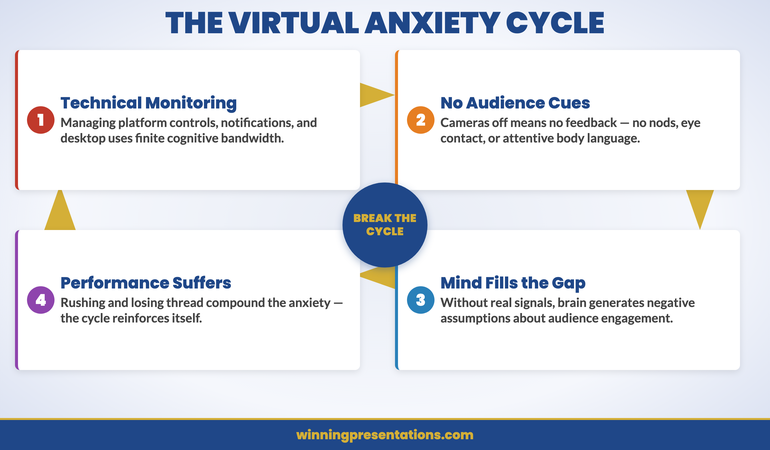
Diagram showing the dual attention split in screen sharing presentations: managing slides, camera, technical environment, and invisible audience simultaneously

The cognitive load of a screen sharing presentation is structurally higher than an in-person presentation, and understanding this is the first step to managing the anxiety it produces.

In an in-person presentation, your cognitive attention is split between: the content you’re delivering, your audience’s reactions, and your own physical state. Three streams.

In a screen sharing presentation, the streams multiply: the content you’re delivering, your camera appearance, your desktop environment, the platform controls (mute, camera, screen share), the chat window, your audience’s reactions (limited, mostly invisible), your own physical state, and the ongoing monitoring for technical problems. Seven or eight streams, many of which require active monitoring rather than passive awareness.

This cognitive overload is why experienced, confident in-person presenters sometimes find virtual presentations more anxiety-provoking, not less. They are not less skilled. They are managing a genuinely more complex environment with the same finite cognitive resources.

The solution is not to try harder to manage all the streams simultaneously β€” it is to reduce the number of streams that require active attention. Pre-call setup does this by eliminating the desktop and platform variables before the presentation begins. When your notifications are off, your non-presentation windows are closed, and your platform settings are confirmed, the number of streams requiring active monitoring during the presentation drops back towards the in-person baseline.

Present Online Without the Adrenaline Hijack

If preparation alone isn’t enough β€” if the anxiety about screen sharing presentations persists even when the setup is right β€” the root cause is usually nervous system dysregulation, not a skills gap. Conquer Speaking Fear addresses this directly.

  • 30-day programme using nervous system regulation techniques drawn from clinical hypnotherapy
  • Specific module on virtual and remote presentation anxiety β€” the cognitive patterns that online presenting triggers
  • In-the-moment reset techniques for managing anxiety when technical disruptions occur mid-presentation
  • Tools for rebuilding confidence after a difficult virtual presentation experience

Get Conquer Speaking Fear β†’ Β£39

Designed for executives and senior professionals whose virtual presentation anxiety is affecting performance, preparation time, or willingness to present.

Pre-Call Setup That Reduces Presentation Anxiety

The most effective anxiety-reduction strategy for screen sharing presentations is environmental preparation β€” completing a systematic pre-call setup routine that removes the variables most likely to disrupt you. This is not the same as rehearsing the content. It is a separate preparation task that takes 10 minutes and pays disproportionate dividends during the call.

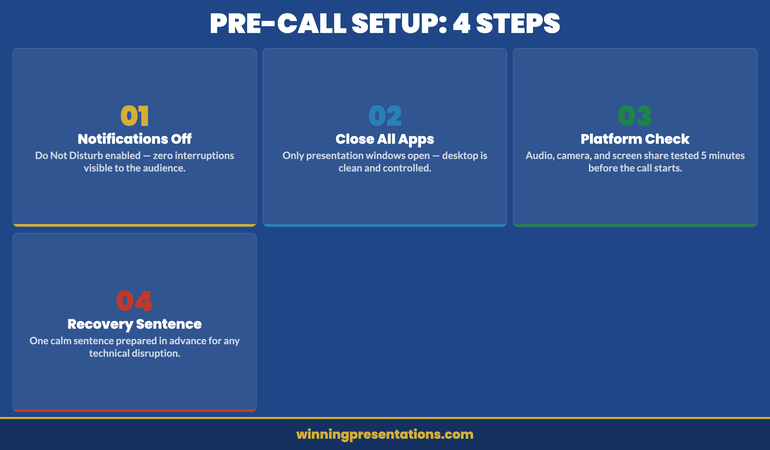
Notifications and distractions. Enable Do Not Disturb on your operating system before sharing your screen. On macOS this is in the menu bar; on Windows it is in the notification settings. Close every application that is not directly involved in the presentation: email, messaging apps, browser tabs unrelated to the presentation, and any background applications that generate notifications. This is the single most impactful preparation step, and the one most frequently skipped.

Browser and application organisation. If your presentation involves a browser or external applications, open only the tabs and windows you will need β€” in the order you will need them. Close everything else. If you need to switch between your slides and a live demonstration, practise the switch before the call so you know exactly which keyboard shortcut or window arrangement you’ll use.

Platform rehearsal. Know which screen you will share before the call begins. If you’re sharing a specific window rather than your full desktop, test that the window is the correct size and that the content is visible at the resolution your audience will see. Test your camera angle and lighting. Confirm your audio is working. Check that the mute and camera controls are where you expect them to be. Do this at least five minutes before the call starts β€” not as the call is beginning.

The recovery sentence. Prepare one sentence for technical disruptions that is calm, specific, and brief. “Bear with me one moment β€” I just need to re-share my screen.” Not an apology, not an explanation. One calm sentence, said with the same tone you’d use for any other transition. Knowing this sentence exists before you need it removes the cognitive burden of having to improvise it under stress.

For breathing and physical techniques to use in the minutes before any high-stakes presentation, see box breathing for executives: the 90-second technique for managing pre-presentation adrenaline.

If virtual presentation anxiety runs deeper than technical preparation can address β€” if it follows you from call to call regardless of how well you’ve set up β€” the Conquer Speaking Fear programme works at the nervous system level, not just the skills level.

Keeping Your Audience Engaged When You Can’t See Their Faces
Four audience engagement techniques for screen sharing presentations: verbal check-ins, structured questions, deliberate pausing, and explicit transitions

One of the most disorienting aspects of presenting to cameras-off audiences is the complete absence of the visual feedback signals that regulate a presenter’s confidence in the room. In person, a nodding head tells you the point has landed. A furrowed brow tells you to pause and clarify. Stillness tells you the audience is processing. None of these signals are available on a screen sharing call where the audience has turned their cameras off.

The adaptation is to build explicit verbal check-ins into the presentation structure β€” moments where you actively invite a signal from the audience rather than waiting for one to emerge organically. These are not interruptions to the flow. They are designed pauses that serve two purposes: they give the audience a moment to engage, and they give you a moment of feedback that helps regulate your own presentation state.

Structured questions. Build one or two specific questions into your presentation that invite a brief, typed response in the chat. “Before I move to the financial case β€” any questions on the scope so far? Drop them in the chat and I’ll address them as we go.” This creates a micro-interaction that activates the audience’s attention and gives you visible evidence that they are present and engaged.

Deliberate pacing. Without visual cues, it is easy to rush. The absence of feedback activates anxiety, and anxiety accelerates speech. Build deliberate pauses β€” three to five seconds β€” after key points. These feel long to you and natural to the audience. They create emphasis and give the audience time to process before you move to the next point.

Explicit transitions. In person, a physical movement β€” turning to the screen, stepping forward, picking up a marker β€” signals a transition. In a screen sharing presentation, these physical cues are invisible or reduced. Compensate with verbal transitions that are slightly more explicit than they would be in person: “I’m moving to the financial case now β€” this is the section where I’ll need your input.” Explicit transitions keep the audience oriented when the visual cues are absent.

What to Do When Technical Problems Strike Mid-Presentation

Technical failures during screen sharing presentations are common enough that they should be treated as an expected event rather than an emergency. The anxiety they produce is disproportionate to their actual impact β€” audiences are generally understanding about technology problems, and a calm, practised response to a disruption frequently enhances rather than damages credibility.

The key insight is that how you respond to a technical problem tells the audience something about how you handle pressure generally. An executive presenter who says “bear with me” calmly and resolves the issue within 30 seconds demonstrates composure. An executive presenter who apologises extensively, explains the technical details of what went wrong, and visibly flusters demonstrates the opposite.

Have a clear mental protocol in advance. If your screen share drops: say your recovery sentence, stop sharing, close any unnecessary applications, and restart the share from the specific window you need. If your audio drops: unmute and repeat the last sentence as if the interruption hadn’t happened. If you accidentally switch to the wrong window: name it briefly and navigate back without commentary. In all cases, the goal is to return to the presentation content as quickly as possible with minimal disruption to the audience’s attention.

What you should not do: laugh nervously for an extended period, explain the technical problem in detail, apologise more than once, or let the disruption change your pace or register for the remainder of the call. The audience’s anxiety about the disruption mirrors yours. Calm behaviour from you produces calm in the room.

For the cognitive patterns that amplify anxiety after disruptions β€” the mental replaying and self-criticism that follows a difficult virtual presentation β€” see cognitive restructuring for presentation anxiety: the technique that breaks the self-critical loop.

The Mental Reset for Virtual Presentations

The anxiety that virtual presentations produce often has a specific character: it is anticipatory rather than in-the-moment. The most intense anxiety tends to occur in the minutes before the call begins β€” while setting up, waiting for participants to join, and managing the technical environment. Once the presentation is actually underway, many presenters find the anxiety reduces significantly.

This pattern has a practical implication. The most productive use of the minutes before a screen sharing presentation is not additional rehearsal of the content β€” it is a deliberate physical and mental transition from setup mode to presentation mode.

A simple three-step reset: complete your technical setup at least five minutes before the call starts so you are not still managing the environment when participants begin to arrive. Take two or three slow, deliberate breaths β€” not as an anxiety management technique, but as a physical signal to your nervous system that the preparation phase is over and the performance phase has begun. Say your opening sentence aloud once, at the pace you intend to deliver it. This is not rehearsal. It is calibration β€” resetting your pace, your register, and your focus to the presentation rather than the environment.

The virtual presentation environment is genuinely more challenging than in-person, and the anxiety it produces is a rational response to that complexity β€” not a sign of weakness or inexperience. The most effective mindset is one of practical problem-solving: identify what specifically about virtual presenting triggers your anxiety, and address each element systematically. Some of those elements respond to preparation. Some of them β€” particularly the deeply embedded nervous system responses β€” require a different kind of work.

Today’s companion article on resource allocation presentations: structuring the case when budgets are contested covers the executive presentation skills that underpin strong virtual business case delivery.

Stop Dreading Every Virtual Presentation on Your Calendar

When anxiety about screen sharing presentations follows you regardless of preparation, the nervous system is the issue β€” not the setup. Conquer Speaking Fear addresses the root cause with clinical techniques adapted for executive settings.

Get Conquer Speaking Fear β†’ Β£39

A 30-day programme using nervous system regulation from clinical hypnotherapy β€” structured for executives who cannot afford to keep dreading the next call.

Frequently Asked Questions

Should I ask the audience to turn their cameras on during a screen sharing presentation?

It depends on the meeting culture and the level of formality. In a smaller group where camera-on is the norm, a brief, non-pressuring invitation at the start of the call is reasonable: “Feel free to have your cameras on if you’re set up for it β€” it helps me gauge the room.” In a larger meeting or where camera-off is the established norm, asking audiences to turn cameras on can create friction that outweighs the benefit. The more productive adaptation is to build explicit verbal check-ins into the presentation structure so you are generating feedback signals regardless of camera status.

How do I manage the anxiety of not knowing whether my audience is paying attention?

The absence of visual feedback is one of the most specifically anxiety-provoking aspects of virtual presenting, and it activates a particular mental pattern: filling the silence with negative assumptions about the audience’s engagement. The most practical response is to create explicit feedback moments β€” questions in the chat, brief check-ins, or direct invitations to signal understanding β€” rather than waiting for organic feedback that may not come. This gives you real data to replace the assumptions your anxiety is generating.

What’s the best way to handle a technical failure during a screen sharing presentation?

Prepare one calm, specific recovery sentence before the call starts: “Bear with me β€” I just need to re-share my screen” or “Audio issue β€” give me a moment.” Deliver it at the same pace and register as the rest of your presentation. Resolve the issue as quickly as possible. Return to the content without commentary on what went wrong. Do not apologise more than once. The audience’s response to a technical failure mirrors your own β€” calm handling from you produces a calm response from them.

Why do I feel more anxious presenting virtually than in person, even though I’m more experienced now?

Virtual presentations create a genuinely higher cognitive load than in-person presentations β€” you are managing more simultaneous streams of information and doing so without the visual feedback signals that regulate confidence in a room. Many experienced presenters find virtual formats more anxiety-provoking precisely because they are competent enough in-person to notice the difference. If the anxiety is persistent and affecting your performance or willingness to take on virtual presenting opportunities, it is worth addressing at the nervous system level rather than through additional technical preparation alone.

The Winning Edge β€” Weekly Insights for Executive Presenters

Practical techniques for managing presentation anxiety, building confidence in virtual settings, and presenting at your best when it counts most. Delivered every Thursday.

Join The Winning Edge β†’

About the Author

Mary Beth Hazeldine is the Owner & Managing Director of Winning Presentations. With 24 years of corporate banking experience at JPMorgan Chase, PwC, Royal Bank of Scotland, and Commerzbank, she has delivered high-stakes presentations in boardrooms across three continents.

A qualified clinical hypnotherapist and NLP practitioner, Mary Beth advises executives across financial services, healthcare, technology, and government on managing presentation anxiety and building confidence for high-stakes speaking situations.

Book a discovery call | View services

07 Apr 2026

How to Use Your Voice to Command a Room Without Shouting

Quick answer: Vocal authority in presentations is not about volume β€” it is about control of five specific variables: pace, pitch, pause, projection, and resonance. Under pressure, most executives lose control of all five simultaneously, which creates the impression of uncertainty even when the content is strong. Each variable can be trained individually, and the combination creates the quality that audiences describe as a speaker who “commands the room.”

Astrid had spent eleven years in investment banking before moving into a strategy director role at a European infrastructure fund. She was technically exceptional β€” her analytical rigour was well-regarded across the firm, and her written work was consistently cited as a reference by colleagues. But in rooms with more than six people, something changed. Her voice rose slightly. Her pace quickened. Her sentences β€” clear and authoritative on paper β€” became hedged and breathless in delivery.

A senior partner raised it with her directly: “Your content is excellent. But when you present it, you sound like you’re asking for permission.” Astrid was startled. She had not been aware of the shift. She had been focused entirely on the content β€” on the accuracy of her numbers, the logic of her argument, the completeness of her analysis. She had given almost no attention to the instrument she was using to deliver it.

What followed was six months of deliberate work on her vocal delivery β€” not elocution lessons or theatrical coaching, but specific, functional adjustments to the way she managed pace, pitch, and pause under conditions that mirrored the presentations she gave at work. The partner who had flagged the issue told her, nine months later, that something fundamental had shifted. “You walk in and people assume you know what you’re talking about before you’ve said a word.”

That is the effect of vocal authority. It operates as a pre-content signal β€” shaping how the audience receives the words before they have processed what those words mean.

Does your voice give you away under pressure?

Conquer Speaking Fear is a structured programme that addresses the physical and psychological dimensions of presentation anxiety β€” including the vocal changes that happen when your nervous system interprets the room as a threat.

Explore the Programme β†’

Why Your Voice Changes Under Pressure

The voice is directly controlled by the body’s stress response. When the nervous system perceives a high-stakes situation β€” a large audience, a sceptical board, a question you weren’t expecting β€” it releases adrenaline and cortisol. These hormones prepare the body for rapid action, and the changes they produce are useful in a physical emergency. In a presentation, they are largely unhelpful.

The laryngeal muscles β€” which control the tension and position of the vocal cords β€” respond to stress by tightening. This raises pitch. The diaphragm, which controls breath support for the voice, becomes less effective as shallow chest breathing replaces the deep diaphragmatic breathing that supports full vocal resonance. The result is a voice that is higher, thinner, faster, and quieter β€” regardless of the speaker’s intention to sound confident.

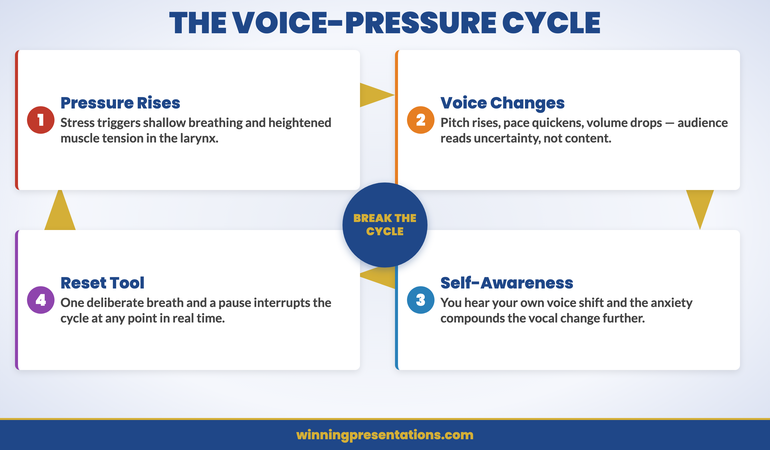
The problem is compounded by self-awareness. Many experienced presenters can hear the change happening in real time β€” the slightly higher note, the quickening pace β€” and their awareness of it creates a secondary layer of anxiety that reinforces the vocal change. This is the voice-pressure cycle: stress changes the voice, awareness of the change creates more stress, which changes the voice further.

Understanding this mechanism is important because it clarifies what training can and cannot achieve. You cannot eliminate the stress response entirely, and attempting to do so is counterproductive. What you can do is build the technical habits β€” breath control, pace awareness, physical positioning β€” that allow you to maintain vocal quality even when the stress response is active. For broader context on managing physical presentation symptoms, see this guide on why your voice goes higher when you’re nervous and how to fix it.

The Mechanics of Vocal Authority

Vocal authority is not a single quality β€” it is the auditory impression created by the combination of several technical elements working in alignment. When these elements are in alignment, audiences describe the speaker as authoritative, confident, or commanding. When they are out of alignment, the same content β€” presented with the same intention β€” reads as uncertain, apologetic, or unconvincing.

Breath is the foundation. Everything else in vocal delivery depends on the quality of the breath support beneath it. Diaphragmatic breathing β€” drawing air into the lower lungs rather than the upper chest β€” produces a fuller, more resonant sound and allows the speaker to maintain a steady pace without running out of breath mid-sentence. Most people breathe diaphragmatically when at rest. Under pressure, they revert to chest breathing without noticing. Retraining this default is the single most impactful investment in vocal quality.

Resonance amplifies authority. Resonance refers to where in the body sound vibrates before it leaves the mouth. A voice that resonates in the chest cavity produces a fuller, lower, more substantial sound than a voice that resonates primarily in the head or nasal cavity. Chest resonance reads as authority. Head resonance reads as uncertainty or youth. Physical relaxation β€” particularly in the jaw, neck, and shoulders β€” is prerequisite for chest resonance; tension collapses it.

Pace is the clearest signal of confidence. Research in communication consistently shows that slower delivery is associated with higher perceived credibility and authority. The optimal pace for high-stakes executive presentations is slower than most people’s natural conversational rate β€” and significantly slower than their pressurised presenting rate. A pause of two to three seconds between major points feels uncomfortably long to the speaker and authoritative to the audience. For broader context on pacing and executive attention, see this analysis of how pacing affects executive engagement in presentations.

The Five Voice Variables Executives Must Master

Each of the five variables below can be worked on independently. The sequence moves from the most foundational (breath) to the most contextual (reading the room), because changes to earlier variables often resolve problems in later ones.

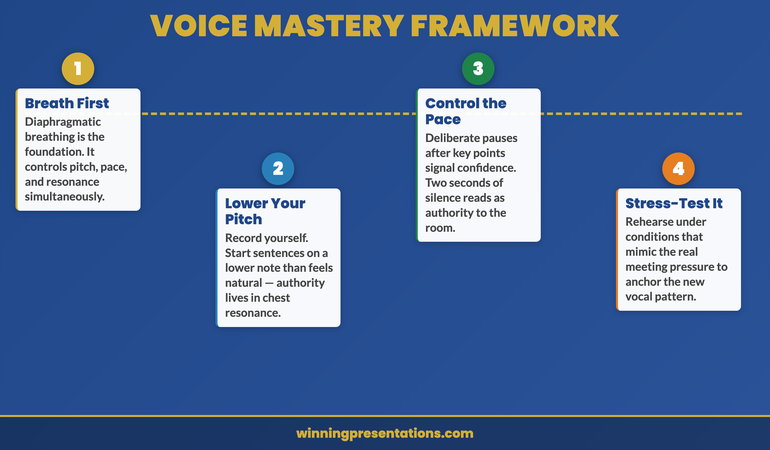
Five-stage roadmap for developing vocal authority in executive presentations

Variable one β€” Breath control. Practise diaphragmatic breathing as a deliberate routine before every presentation. Place one hand on your chest and one on your abdomen. A correct breath expands the abdomen without moving the chest. Three deep diaphragmatic breaths immediately before speaking β€” particularly before a high-stakes moment β€” activate the parasympathetic nervous system and provide the breath support the voice needs to function at its best.

Variable two β€” Pitch management. Record yourself presenting and listen back specifically for pitch. Most people are surprised by how much higher their pitch is under pressure than in ordinary conversation. To lower pitch deliberately, begin sentences on a lower note than feels natural, and resist the upward inflection at the end of statements that makes assertions sound like questions. The latter β€” sometimes called “uptalk” β€” is one of the most common authority-eroding vocal habits in executive presentations.

Variable three β€” Pace and pause. Mark deliberate pauses into your presentation notes or slides β€” not as reminders to pause, but as specific positions in the content where a pause creates meaning. After a key statistic. After a critical recommendation. After a question to the room. These pauses do triple duty: they give the audience time to process, they give you time to breathe, and they signal confidence in the material.

Variable four β€” Volume and projection. Projection is not shouting β€” it is directing the voice toward the back of the room while maintaining full resonance and control. The most common projection problem in executive presentations is not insufficient volume but insufficient direction: the speaker addresses the person nearest to them rather than projecting to the room as a whole. Speaking slightly past the audience β€” imagining an audience member a metre behind the furthest row β€” naturally increases both volume and clarity.

Variable five β€” Resonance and release. Physical tension is the primary enemy of resonance. Jaw tension, shoulder elevation, and neck stiffness all reduce the space available for vocal resonance and produce a thinner, tighter sound. A physical warm-up that includes jaw release, shoulder rolls, and neck mobilisation β€” done privately before the presentation β€” removes much of this tension before you enter the room.

Conquer Speaking Fear

A structured 30-day programme that addresses presentation anxiety at the physiological and psychological level β€” including the nervous system patterns that change your voice under pressure.

  • 30-day structured programme for systematic anxiety reduction
  • Nervous system regulation techniques for high-stakes presentations
  • Clinical hypnotherapy methods for rewiring the threat response
  • Practical drills designed for corporate presentation contexts

Get Conquer Speaking Fear β€” Β£39

Designed for executives whose anxiety affects their delivery under pressure.

Practical Drills You Can Do Before Any Presentation

The most effective vocal preparation combines physiological preparation β€” activating the breath and releasing tension β€” with cognitive familiarisation β€” running through the opening material until the initial sentences feel automatic. The following sequence takes approximately eight minutes and can be done in a private space immediately before the presentation.

Two minutes β€” physical release. Standing, roll both shoulders back slowly five times. Gently rotate the neck in each direction. Release the jaw by opening the mouth wide and then allowing it to close naturally β€” without pressing the teeth together. These movements address the primary tension sites that restrict vocal resonance.

Two minutes β€” breath activation. Three full diaphragmatic breaths: four counts in through the nose, hold for two, eight counts out through the mouth. On the exhalation, allow the abdomen to fully deflate. This activates the diaphragm and signals to the nervous system that the situation is manageable rather than threatening. For a full pre-presentation routine, see this framework for the pre-presentation ritual used by high-performance presenters.

Two minutes β€” vocal warm-up. Hum quietly at a comfortable pitch, feeling the vibration in the chest. Then speak your opening sentence aloud β€” at the pace you intend to use in the room, not faster. Repeat the opening sentence three times, focusing specifically on the pitch of the first word. Starting a sentence on a lower note than feels natural is one of the fastest ways to drop perceived register.

Two minutes β€” intention setting. Speak your opening two minutes aloud in full, as if you were in the room. Not as a rehearsal focused on accuracy β€” as a familiarisation run focused on physical delivery. The goal is to have the first two minutes feel familiar in the body before you enter the room, so that the nervous system has a prior reference for this specific act of speaking in this specific context.

For executives whose anxiety has a deeper physiological component, Conquer Speaking Fear provides a structured 30-day programme for rewiring the nervous system’s response to high-stakes speaking situations.

The Most Common Voice Mistakes Under Pressure

The following patterns appear consistently across executives who self-report difficulty with vocal authority. Each is a response to pressure rather than an intentional choice β€” which is why awareness alone is rarely sufficient to change them. Each requires a specific corrective practice.

The voice-pressure cycle showing how stress affects vocal quality and how to break the pattern

Rising inflection on statements. When the voice rises at the end of a declarative sentence, the sentence reads as a question β€” as if the speaker is seeking validation rather than making an assertion. This pattern is particularly damaging in recommendation and conclusion slides, where the executive needs to project certainty. The corrective is deliberate: end every statement with a downward inflection, even if it feels unnatural in practice sessions.

Filler vocalisations between sentences. “Um,” “er,” “so,” and “you know” are auditory signals of cognitive searching β€” they indicate to the listener that the speaker is uncertain about what comes next. The corrective is not silence; it is the pause. A two-second pause while the speaker transitions to the next point reads as deliberation and authority. The same transition filled with “um” reads as uncertainty. The distinction is almost entirely in the intention to pause rather than fill.

Trailing volume at the end of sentences. Many pressurised speakers begin a sentence at an appropriate volume and then allow the final clause to drop β€” both in pitch and in volume β€” as they run out of breath. The last few words of a sentence often carry its most important information: the verb, the number, the specific recommendation. Allowing them to trail off undermines the clarity of the message and signals to the audience that the speaker is uncertain about those specific words.

Pace acceleration through transitions. The space between slides β€” the moment of transition from one topic to the next β€” is where pace most commonly accelerates. The speaker feels exposed in the gap and rushes to fill it. This is precisely where a deliberate pause is most effective: it signals to the audience that the transition is intentional, creates anticipation for what follows, and gives the speaker a moment to breathe before beginning the next section.

Reading the Room Through Your Voice

Experienced presenters use their voice not only to deliver content but to read and manage the room. This is an advanced skill β€” one that requires the foundational vocal habits to be sufficiently automated that the speaker has cognitive bandwidth to observe audience response and adjust in real time.

Volume as a tool for re-engagement. When an audience becomes distracted β€” when people begin checking phones or having side conversations β€” the instinctive response is to speak louder. The counterintuitive but more effective response is to drop volume significantly. A dramatic reduction in volume forces the audience to lean in and focus, in a way that increased volume does not. This technique requires confidence, because it feels risky in the moment β€” but it is remarkably effective for recapturing attention.

Pace as a signal of complexity. When you reach the section of the presentation that contains the most complex or consequential information, slow down further than you think necessary. The additional slowness is a signal to the audience: this matters, pay attention. It also ensures that the audience has time to process before you move on β€” which reduces the likelihood of questions that reveal they missed a critical point.

Pitch variation to sustain engagement. Monotone delivery β€” a voice that remains at a constant pitch throughout the presentation β€” is fatiguing to listen to. Deliberate pitch variation β€” slightly higher for questions or provocations, slightly lower for conclusions or recommendations β€” maintains audience engagement over the duration of the presentation. This variation needs to be intentional; under pressure, most people’s pitch variation collapses toward monotone.

How Voice Training Connects to Confidence

There is a bidirectional relationship between vocal quality and confidence. Most people experience this unidirectionally: they believe that if they felt more confident, their voice would improve. This is true β€” but the reverse is also true, and often more actionable. When the voice functions well under pressure, the speaker receives immediate positive feedback from their own perception of the room’s response β€” and confidence builds in real time.

This feedback loop is why vocal training has a disproportionate impact on overall presentation confidence relative to the narrowness of its focus. Working specifically on breath control, pitch, and pace produces not only better vocal delivery but also a reduction in the anxiety symptoms that interfere with delivery β€” because the speaker has a reliable tool they can use to manage the physiological pressure response in the room.

The most effective vocal training for executive presenters combines technical practice β€” deliberate work on each of the five variables β€” with exposure to increasingly challenging contexts. Recording practice presentations and listening back with specific focus on one variable at a time accelerates the feedback cycle. Working with a Q&A simulation exercise β€” where a colleague challenges your answers under conditions that mirror the real room β€” builds the specific resilience that Q&A situations demand. See the companion piece on building hostile questioner resilience through simulation for a structured method for the Q&A context.

Address the Anxiety Behind the Voice

Conquer Speaking Fear is a structured 30-day programme that works at the nervous system level β€” addressing the physiological patterns that change your voice, your pace, and your presence under pressure.

View Conquer Speaking Fear β€” Β£39

Designed for executives whose anxiety affects their delivery under pressure.

Frequently Asked Questions

Can vocal authority be learned, or is it something you either have or don’t?

Vocal authority is a technical skill with a strong learned component. While some individuals have a naturally resonant voice or a slower default pace, the specific combination of habits that creates the impression of authority β€” controlled breath, deliberate pace, downward inflection on statements, intentional pausing β€” can be developed through specific practice. The timeframe varies: most executives who work consistently on these five variables report noticeable change within four to six weeks of deliberate practice.

Is it worth recording yourself to improve your voice?

Yes β€” with one important caveat. The first time most people hear a recording of themselves presenting, they experience a strong negative reaction to the sound of their own voice. This is normal and does not indicate that the voice is objectively poor. After one or two exposures, the initial aversion subsides and you can listen analytically β€” focusing on specific variables rather than on the global impression. A useful practice is to record a two-minute section of a presentation, then listen back twice: once for pace, once for inflection. Focusing on one variable at a time produces more actionable feedback than a general impression.

What should I do if my voice visibly shakes during a presentation?

A shaking voice is a physiological stress response β€” it is caused by tension in the laryngeal muscles, which are activated by adrenaline. The single most effective in-the-moment intervention is a deep diaphragmatic breath before continuing. This does not eliminate the adrenaline, but it provides the breath support that compensates for some of the tension. Slowing your pace simultaneously reduces the load on the vocal system and gives the muscles more time to recover between words. Over time, systematic desensitisation β€” deliberate exposure to high-stress presenting contexts β€” reduces the severity of the physiological response in familiar contexts.

The Winning Edge β€” Weekly Newsletter

Executive presentation strategy, delivered every Thursday. Practical frameworks for delivery, confidence, and high-stakes communication.

Subscribe to The Winning Edge

About the Author

Mary Beth Hazeldine is Owner & Managing Director of Winning Presentations. With 24 years of corporate banking experience at JPMorgan Chase, PwC, Royal Bank of Scotland, and Commerzbank, she advises executives across financial services, healthcare, technology, and government on structuring presentations for high-stakes funding rounds and approvals. Connect at winningpresentations.com.

04 Apr 2026
Professional woman standing at a podium looking composed but internally conflicted, corporate presentation setting, editorial photography

Imposter Syndrome in Presentations: Why High Performers Feel Like Frauds at the Podium

Imposter syndrome in presentations does not target the unprepared. It targets the competentβ€”the executives who know enough to recognise the gap between what they understand and what the audience expects. The paradox is that the more you know, the more exposed you feel. Here is why imposter syndrome intensifies at the podium and what to do when it arrives.

Beatriz had been promoted to Head of Strategy at a consumer goods company six months earlier, following a decade in management consulting. She was presenting the annual strategic review to the executive committeeβ€”twelve people she’d worked alongside for half a year. She knew the material. She’d built the analysis herself. But standing at the front of the room, she felt a familiar constriction in her chest: the conviction that someone was about to ask a question that would reveal she didn’t belong here. That the consulting background was a costume, and the strategy role was borrowed. She delivered the presentation competentlyβ€”steady voice, clear slides, controlled pace. Afterwards, the CEO told her it was one of the strongest strategy reviews he’d seen. She nodded, smiled, and spent the following weekend replaying every answer she’d given in Q&A, searching for the moment she’d been exposed. She never found it, because it didn’t happen. But the search itself was exhausting. Beatriz didn’t need better slides. She needed to understand why her brain was running an audit she’d never pass.

Does presentation anxiety feel out of proportion to your preparation? The Conquer Speaking Fear programme addresses the psychological patterns that drive presentation anxiety for experienced professionals.

Why Presentations Trigger Imposter Syndrome More Than Other Work

In written work, you can edit. In meetings, you can defer. In one-to-one conversations, you can redirect. A presentation offers none of these escape routes. You are standing in front of an audience, delivering content you cannot take back, being evaluated in real time by people whose opinions affect your career. For someone whose internal narrative already questions their legitimacy, a presentation is the highest-stakes version of the test they’ve been dreading.

Imposter syndrome in presentations is amplified by a specific cognitive distortion: the belief that the audience knows more than you do. In a boardroom presentation, you’re often speaking to people with decades of experience. Your brain interprets their seniority as superior knowledgeβ€”forgetting that you were asked to present precisely because you have expertise they lack. The finance director isn’t presenting the strategic review because strategy isn’t their domain. You are presenting it because it is yours. But imposter syndrome flattens that distinction and tells you that everyone in the room could do what you’re doing, only better.

The second amplifier is visibility. Imposter syndrome thrives in privateβ€”the quiet conviction that you’re somehow less capable than your role implies. In daily work, this stays manageable because there’s no single moment of exposure. A presentation creates exactly that moment. Every eye is on you. Every hesitation is observed. Every answer is assessed. The internal experience is of a spotlight focused on the gap between who you are and who the audience expects you to be. This is why competent professionals who manage perfectly well in meetings, workshops, and negotiations can feel genuinely terrified when asked to present.

Understanding this mechanism matters because it changes the intervention. The solution is not more preparationβ€”you’re already well-prepared. The solution is recognising that the fear signal is being generated by a threat-detection system that has misidentified the situation. You are not being exposed. You are being consulted. The physiological response is identical, but the interpretation changes everything.

Present With Authority When Your Inner Voice Says You Can’t

Conquer Speaking Fear addresses the psychological patterns that drive presentation anxiety for experienced professionalsβ€”including the imposter cycle that preparation alone can’t fix.

  • βœ“ Evidence-based anxiety reduction frameworks
  • βœ“ Cognitive reframing techniques for high achievers
  • βœ“ Practical pre-presentation routines that build confidence

Get Conquer Speaking Fear β†’ Β£39

For professionals whose anxiety is out of proportion to their preparation

The Competence Gap Illusion: What Your Brain Gets Wrong

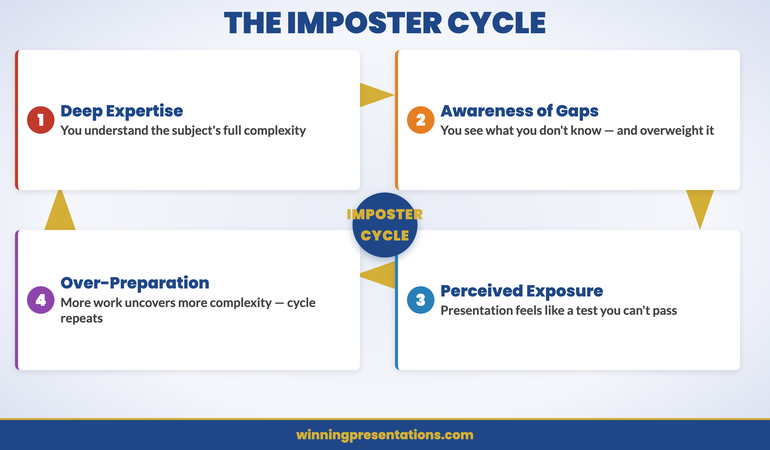
The Dunning-Kruger effect is usually cited to explain why incompetent people overestimate their abilities. The less-discussed corollary is equally important: competent people systematically underestimate theirs. When you know a subject deeply, you become acutely aware of its complexity, its ambiguities, and the limits of your understanding. This awarenessβ€”which is actually a sign of expertiseβ€”feels like evidence of inadequacy.

In a presentation context, this manifests as the conviction that someone in the audience will ask a question you can’t answer, and that this single moment will invalidate everything you’ve said. What your brain fails to calculate is the probability. You’ve prepared extensively. You know the subject. The chance of a genuinely unanswerable question is lowβ€”and the appropriate response to one is not shame but honest acknowledgement. β€œI don’t have that specific data to handβ€”I’ll follow up with you this afternoon” is a perfectly professional answer that no reasonable audience member would interpret as incompetence.

The competence gap illusion also distorts your assessment of the audience. You assume they process information the way you doβ€”noticing every nuance, every simplification, every point where you chose to summarise rather than elaborate. They don’t. Your audience is processing at a much higher level: Does this person seem credible? Is the recommendation clear? Do I trust this analysis? They’re evaluating your authority, not auditing your footnotes.

The practical intervention is a pre-presentation reality check. Before you stand up to speak, write down three things you know about this topic that nobody else in the room knows in as much depth. Not impressive thingsβ€”just specific things. The regulatory change you researched last week. The client conversation that shaped your recommendation. The data point that surprised even you. These are your anchors. When imposter syndrome whispers β€œyou don’t belong here,” these anchors remind you that you were invited for a reason. For more on the perfectionism and anxiety cycle that feeds imposter syndrome in presentations, that guide examines why the pursuit of a flawless delivery often intensifies the anxiety it’s trying to prevent.

The competence gap illusion showing how expertise creates awareness of complexity that feels like inadequacy

Reframing Authority: You Were Invited to Speak for a Reason

Imposter syndrome tells you that you’re at the front of the room by accidentβ€”that circumstances conspired to put you here, and discovery is imminent. The structural reality is different. Someone decided this meeting needed a presentation. Someone decided you were the person to deliver it. Someone scheduled the room, invited the attendees, and allocated time on the agenda for your content. None of these decisions were accidental.

This reframe is not positive thinking. It is factual analysis. The question is not β€œAm I good enough to present this?” The question is β€œWhy did a rational group of professionals decide I should present this?” The answer is always some version of: because you have knowledge, access, analysis, or perspective that the room needs. Your role is not to prove you belong. Your role is to deliver the content they asked for.

A useful cognitive shift is to move from β€œI am the expert” to β€œI am the messenger.” The first framing invites scrutiny of your credentials. The second invites scrutiny of your messageβ€”which is where you want the attention. You are not standing at the front of the room to demonstrate your intelligence. You are standing there to communicate findings, recommendations, or analysis that the audience needs to make a decision. This repositioning reduces the personal stakes dramatically. If the audience challenges your recommendation, they’re challenging the analysisβ€”not your right to be there.

The Over-Preparation Trap: When More Work Makes It Worse

Imposter syndrome creates a paradoxical relationship with preparation. The more anxious you feel, the more you prepare. The more you prepare, the more complexity you uncover. The more complexity you uncover, the more exposed you feel. And the more exposed you feel, the more you prepare. This cycle can consume entire weekends before a Monday presentation.

The trap is that over-preparation reinforces the underlying belief. Each additional hour of work sends a signal to your brain: β€œThis is so important and so precarious that I need to keep working.” Your nervous system interprets excessive preparation as confirmation that the threat is real. A presentation you’ve prepared for ten hours feels more dangerous than one you’ve prepared for threeβ€”not because the content is riskier, but because your behaviour has told your brain the stakes are higher.

The intervention is a preparation boundary. Set a fixed number of hours for preparation and stop when you reach it. If the content isn’t ready in that time, the issue is scopeβ€”you’re trying to cover too muchβ€”not effort. Reduce the scope rather than extending the hours. A presentation that covers three points thoroughly is more authoritative than one that covers seven points superficially. Your audience will remember your clarity, not your comprehensiveness.

The most effective preparation for imposter-syndrome-driven anxiety is rehearsal, not research. Rehearse the opening sixty seconds until it feels automatic. Rehearse transitions between sections. Rehearse the close. When you stand up to present, the first words should come without thoughtβ€”because those first sixty seconds set the tone for how your brain processes the rest of the presentation. If the opening is smooth, your nervous system recalibrates: β€œThis is going well. Reduce the alert level.” The cognitive restructuring approach offers additional techniques for interrupting the thought patterns that drive this cycle.

If your anxiety pattern includes physical symptoms alongside the imposter narrative, Conquer Speaking Fear addresses both the cognitive and physiological dimensions of presentation anxiety.

The over-preparation trap cycle showing how excessive preparation reinforces imposter syndrome in presentations

Practical Anchors for the Ten Minutes Before You Present

Imposter syndrome peaks in the ten minutes before you speak. The gap between sitting in the audience and standing at the front is where the anxiety compounds. These practical anchors are not about eliminating the feelingβ€”they’re about preventing it from controlling your delivery.

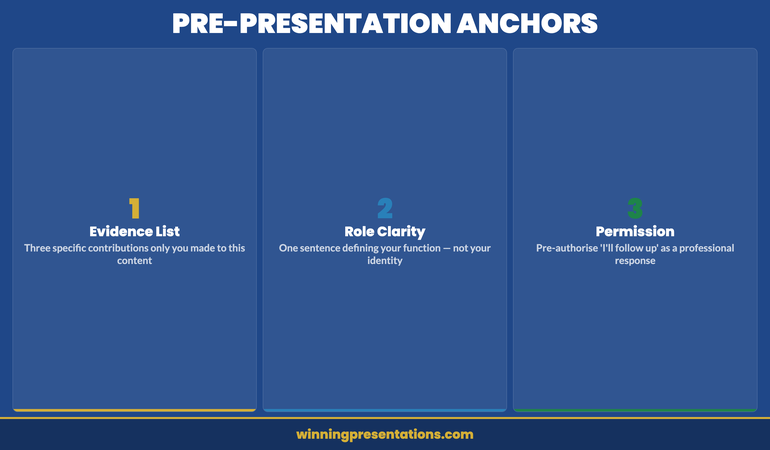
Anchor 1: The Evidence List. Before the meeting, write three specific contributions you’ve made to the content you’re presenting. Not β€œI worked hard on this”—specific, verifiable contributions. β€œI identified the supplier risk that saved the project Β£180K.” β€œI conducted the twelve stakeholder interviews that shaped this recommendation.” β€œI built the financial model from the raw data.” Read the list silently. These are facts, not affirmations.

Anchor 2: The Role Clarity Statement. Remind yourself of your role in one sentence: β€œI am here to present the findings from the strategic review so the committee can make a decision.” This strips away the identity threat. You’re not being evaluated as a person. You’re performing a function. The function has a clear purpose. Your job is to serve that purpose, not to prove yourself.

Anchor 3: The Permission to Be Imperfect. Give yourself explicit permission to not know everything. Before you walk to the front, say internally: β€œIf someone asks a question I can’t answer, I will say β€˜I’ll follow up on that’ and the meeting will continue.” This pre-authorises the response that imposter syndrome tells you is forbidden. In practice, β€œI’ll follow up on that” is one of the most professional responses in any executive meetingβ€”it signals honesty and discipline. For more on the self-compassion approach to presentation anxiety, that guide covers how reducing self-criticism before a presentation produces a measurably calmer delivery.

Break the Imposter Cycle Before Your Next Presentation

Conquer Speaking Fear gives you the cognitive and physiological frameworks to present with authorityβ€”even when your inner voice is running a different script. For Β£39.

Get Conquer Speaking Fear β†’ Β£39

Frequently Asked Questions

Does imposter syndrome ever go away completely?

For most professionals, it doesn’t disappearβ€”it becomes manageable. The goal isn’t to eliminate the feeling but to change your relationship with it. Experienced presenters who experience imposter syndrome learn to notice it arriving, acknowledge it as a familiar pattern rather than a truthful assessment, and proceed with the presentation regardless. Over time, the intensity diminishes because your brain accumulates evidence that the feared outcomeβ€”being exposed as a fraudβ€”never actually materialises. Each successful presentation is a data point against the narrative.

Why does imposter syndrome seem worse in senior roles?

Seniority increases both visibility and accountability. In a junior role, a weak presentation is forgotten quickly. In a senior role, it becomes part of how colleagues assess your leadership capability. The stakes feel genuinely higherβ€”and they are, to some degree. But imposter syndrome exaggerates the risk dramatically. A mediocre strategy review won’t end your career. An honest answer of β€œI’ll look into that” won’t undermine your authority. Your brain is conflating β€œthis matters” with β€œthis could destroy me,” and the distinction between those two is where the work lies.

Should I tell my audience that I’m nervous?

Generally, no. Your audience processes your nervousness differently than you do. What feels to you like visible anxiety often reads to the audience as focused energy. Announcing nervousness redirects the audience’s attention from your content to your emotional stateβ€”which is the opposite of what you want. The exception is if you’re in a context where vulnerability is expected and valued, such as a personal development workshop or a leadership team offsite focused on authenticity. In a standard executive presentation, keep the focus on the message and let your delivery speak for itself.

The Winning Edge

Weekly insights on executive presentations, confidence building, and boardroom communication.

Subscribe Free

If your imposter syndrome also triggers anxiety about handling questions after the presentation, our guide to defending your data in presentations covers the Q&A strategies that maintain authority under scrutiny.

About the author

Mary Beth Hazeldine, Owner & Managing Director, Winning Presentations. With 24 years of corporate banking experience at JPMorgan Chase, PwC, Royal Bank of Scotland, and Commerzbank, she advises executives across financial services, healthcare, technology, and government on structuring presentations for high-stakes funding rounds and approvals.

28 Mar 2026
Abstract representation of anticipatory anxiety before a high-stakes presentation showing a lone figure in a dimly lit corridor

The Anticipatory Anxiety Loop: Why Dreading the Presentation Is Worse Than Giving It

Most executives don’t fear the presentation itself. They fear the days leading up to it. The dread starts on Monday when the presentation is Friday. It builds through the weekβ€”rehearsal feedback loops in your mind, worst-case scenarios feel plausible, sleep becomes difficult. Then Thursday night arrives and you’re exhausted before you’ve even stepped in front of the room. The paradox is that the actual presentation, once it starts, rarely feels as bad as the week of anticipating it.

Amara had scheduled a board presentation for March 15th. It was importantβ€”a funding case for a new product line, the kind of thing that could accelerate her career if she landed it. When she put it on her calendar on February 28th, it felt manageable.

By March 10th, five days before, her stomach started tightening every morning. She rehearsed in her head while commuting. She woke at 3 a.m. replaying questions she imagined the board might ask. She changed slides twiceβ€”not because they were broken, but because she was searching for safety that no slide could provide.

On March 14th, exhausted, she called a colleague. “I’m not sleeping. I’m stressed about this. I don’t know if I’m ready.” The colleague asked: “Do you know your material?” “Yes,” she said. “Could you explain the investment case to me right now?” “Yes, easily.” “Then the presentation will be fine. The dread you’re feeling isn’t about readinessβ€”it’s just dread.”

It was the most useful thing anyone said to her that week. Not “You’ll be great,” which felt hollow. Not “Don’t be nervous,” which is impossible. Just: “That feeling isn’t information. It’s just the anticipatory loop running.”

If presentation anxiety is making the week before your big talk harder than the talk itself, you might explore Conquer Speaking Fear. It’s structured specifically for acute presentation anxietyβ€”with nervous system techniques, reframing exercises, and practical tools designed for the hours leading up to high-stakes presentations.

Explore Conquer Speaking Fear β†’

What is anticipatory anxiety?

Anticipatory anxiety is the worry you experience before an eventβ€”in this case, a presentation. It’s not the nervousness you feel when the presentation actually starts. It’s the dread that builds in the days (or hours) leading up to it.

The distinction matters because the two anxieties serve different purposes. Nervousness during the event is your nervous system preparing you to perform. Adrenaline, focus, heightened awarenessβ€”these are useful. Your mind narrows, your perception sharpens, you adapt to the room’s energy.

Anticipatory anxiety is different. It’s abstract worry about something that hasn’t happened yet. Your mind runs through scenarios. You imagine questions you can’t answer. You rehearse failed moments. You lose sleep. You check the slides one more time looking for problems. You might feel physically unwellβ€”nausea, chest tightness, difficulty concentrating.

And here’s the cruel part: anticipatory anxiety doesn’t improve your performance. It just makes the waiting harder. By the time the presentation arrives, you’re already depleted.

Why it intensifies the longer you wait

Anticipatory anxiety follows a predictable pattern. The further away the presentation, the more abstract your fear. “I have a board presentation in six weeks.” Manageable. “I have a board presentation next Friday.” Now it’s concrete. “I have a board presentation tomorrow.” Now your nervous system is engaged.

Each day that passes without the event happening allows your mind to generate new “what if” scenarios. What if the projector fails? What if I forget my key points? What if they ask me something I can’t answer? What if I panic?

Most executives, particularly those who care about performance, respond to anticipatory anxiety by preparing harder. You run the presentation again. You revise the slides. You rehearse answers to tougher questions. This is rationalβ€”if I’m more prepared, I’ll be less anxious.

But the research is clear: beyond a certain point, additional preparation doesn’t reduce anticipatory anxiety. It reinforces it. Each rehearsal is another opportunity to find something “wrong” or to imagine the audience’s judgment. You’re feeding the anxiety loop, not breaking it.

The anticipatory anxiety cycle showing four stages: trigger, catastrophise, avoid, and escalate

Techniques Designed for Presentation Anxiety

Conquer Speaking Fear gives you nervous system techniques, reframing exercises, and decision-making frameworks designed for acute presentation anxietyβ€”the kind that starts days before and peaks the morning of.

  • Nervous system reset techniques for anxiety spirals
  • Reframing exercises that separate dread from actual risk
  • Pre-presentation routines that build confidence
  • Tools to manage the anxious mind without ignoring it

Explore Conquer Speaking Fear β€” Β£39

Designed for executives managing acute presentation anxiety

The neuroscience of dread

Your brain doesn’t distinguish between anticipating something bad and experiencing it. When you imagine the board asking a question you can’t answer, your amygdala (your brain’s threat detector) activates as if it’s happening right now. Your nervous system releases cortisol and adrenaline. Your heart rate rises. You feel the physical symptoms of anxiety even though the threat is imagined.

This is useful when you’re genuinely in danger. Your body prepares you to fight or flee. But when the threat is abstractβ€””What if I mess this up?”β€”the physical response becomes a problem. You can’t fight or flee from a presentation. You can only sit with the activation.

The longer the time between now and the presentation, the more time your mind has to rehearse worst-case scenarios. Each rehearsal deepens the neural pathway, making the anxiety feel more real, more inevitable. By Thursday night, your brain has convinced you that failure is probable, even though nothing has actually happened.

Add sleep disruption to this equation, and your emotional regulation gets worse. You’re more irritable, more prone to catastrophic thinking, less able to distinguish between real risk and imagined risk. The presentation itself hasn’t changed. Your mental state has deteriorated.

How to break the loop

The first step is recognising that anticipatory anxiety is not information about your readiness. It’s a feeling that your nervous system is generating based on threat-perception, not on actual risk assessment.

This seems obvious when you read it. But in practice, when you’re exhausted and anxious, your mind treats dread as evidence. “I’m this anxious, so something must be genuinely wrong.” In fact, you can be completely prepared and still experience intense anticipatory anxiety. The two are independent.

The second step is stopping the preparation loop. Once you reach a threshold of readinessβ€”you know your material, you’ve done one solid rehearsal, you have answers to likely questionsβ€”additional rehearsal is counterproductive. It gives your anxious mind more material to worry about.

Instead of rehearsing more, you need to:

  1. Name the loop: “This is anticipatory anxiety, not actual danger. It will pass.”
  2. Interrupt the rehearsal: When you notice yourself running through scenarios, consciously stop. Physical activity (a walk, a gym session) interrupts the mental loop more effectively than trying to think your way out of it.
  3. Reset your nervous system: Breathing techniques, cold water, grounding exercisesβ€”these activate your parasympathetic nervous system and counteract the threat activation.
  4. Establish a boundary: “I will prepare until Wednesday. After that, no more slides, no more rehearsal.” This protects you from the preparation loop extending into the presentation day.
  5. Redirect attention: The night before, shift focus away from the presentation. Read something unrelated. Spend time with people you care about. Let your mind rest from the threat narrative.

If your anticipatory anxiety is severe enough to disrupt your sleep or work in the days before a presentation, Conquer Speaking Fear includes specific nervous system techniques designed for those hours when the dread feels most intense.

Four-step roadmap for breaking the anticipatory anxiety loop before presentations

In practice, breaking the anticipatory anxiety loop follows four moves. The first is to acknowledge β€” name the dread without judging yourself for feeling it. “I’m anxious about Thursday’s presentation” is a statement of fact, not a confession of weakness. The moment you name it, you create distance between yourself and the feeling. You’re observing the anxiety rather than being consumed by it.

The second move is to prepare early β€” start with one slide to break the avoidance pattern. Anticipatory anxiety often creates a paradox: the dread makes you avoid the very preparation that would reduce it. Opening the presentation file and writing a single slide title β€” even a bad one β€” interrupts avoidance. Action, however small, breaks the freeze.

The third is to rehearse aloud β€” speak the opening three times to build familiarity. Not a full run-through. Just the first sixty seconds. Your voice forming the words builds a physical memory that your body can fall back on when anxiety spikes. The opening is where panic is strongest. If your mouth already knows the first two sentences, your nervous system calms faster.

The fourth move is to reframe β€” shift your focus from performance to contribution. Instead of “Will I do well?”, ask “What does the room need from me?” When you reframe the presentation as a contribution rather than a test, the threat perception drops. You’re not being judged; you’re providing something valuable. That distinction changes how your nervous system responds to the approaching event.

Practical strategies that shift anxiety to readiness

Beyond interrupting the anxiety loop, there are specific practices that help executives convert anticipatory dread into something more useful: focused readiness.

Compartmentalise the presentation time. Instead of thinking about “the presentation” as this amorphous future threat, break it into concrete actions: What do you do 10 minutes before you start? What’s your opening line? Where do you stand? What do you do if you forget a point? When you focus on specific micro-actions rather than “Will I perform well?”, your brain shifts from threat-assessment to task-execution.

Create a pre-presentation routine. The night before, the morning of, the hour beforeβ€”develop a specific sequence of actions that signal to your nervous system, “This is expected. This is manageable.” For some people it’s a specific breakfast, a particular walk, a few minutes of breathing. The content matters less than the consistency. Routines reduce the novelty and uncertainty that feed anticipatory anxiety.

Identify your specific “what if” fears and reality-test them. Not generallyβ€”specifically. If your fear is “What if they ask me something I don’t know?”, the reality is: “If they ask something I don’t know, I’ll say, ‘That’s a great questionβ€”let me follow up with you separately.’ And the presentation continues.” You’re not avoiding the fear; you’re proving to yourself that you can handle it.

Separate the days before from the day of. What you do Monday through Thursday should be different from what you do Friday morning. Early in the week, preparation and rehearsal are valuable. As you approach presentation day, shift to rest, routine, and nervous system regulation. This signals a boundary between “get ready” and “be ready.”

Managing the evening before

The evening before a high-stakes presentation is often the worst moment for anticipatory anxiety. You’ve done all the prep you can. The event is real and imminent. Your mind is searching for something to control.

Here’s what actually helps:

Do not rehearse the presentation. You’ve already rehearsed. One more run-through will not make you more confident. It will only give your anxious mind more material to second-guess. Close the laptop. Put the slides away.

Engage in something that requires focus. Cook a meal. Watch a film that demands your attention. Play a game that requires strategy. Anything that pulls your conscious mind away from the anticipatory narrative. You’re not ignoring the anxiety; you’re not giving it the spotlight.

Manage the physical symptoms directly. If you can’t sleep, don’t lie in bed fighting the insomnia. Get up. Read. Stretch. The pressure to “get good sleep before the big day” can itself generate anxiety. Sleep matters, but obsessing about sleep is counterproductive. A mediocre night’s sleep followed by a good presentation is far better than an anxious night spent worrying about sleep.

Remember that the nervousness you feel the morning of is not a problem to solveβ€”it’s your nervous system preparing you. Some anxiety on presentation day is actually useful. It sharpens focus. It elevates your energy. The goal is not to eliminate it. The goal is to interpret it correctly: “This is not danger. This is readiness.”

Nervous System Tools for Presentation Anxiety

Conquer Speaking Fear includes breathing techniques, reframing exercises, and pre-presentation routines designed for the hours when anxiety is most intense.

Get the Tools β€” Β£39

Frequently asked questions

Is it normal to feel this anxious about a presentation?

Yes. High-stakes presentations trigger real physiological responses. Your nervous system perceives public performance as a potential threat. This is true across cultures and industries. The executives who manage it best aren’t those who don’t feel anxietyβ€”they’re those who understand what anticipatory anxiety is and have tools to work with it.

Does better preparation reduce anticipatory anxiety?

To a point, yes. But after you’ve reached competenceβ€”you know your material, you can answer likely questions, you’ve done a full rehearsalβ€”additional preparation doesn’t reduce anxiety. It often increases it because each rehearsal creates new opportunities for self-criticism. The threshold is usually after one to two solid rehearsals, not five or ten.

What if my anxiety is so severe that I’m considering cancelling the presentation?

Severe anticipatory anxiety (where you’re genuinely considering avoidance) is a signal to get support. This might be a coach, a therapist, or someone trained in anxiety management. Avoidance reinforces anxietyβ€”it tells your nervous system, “This is genuinely dangerous.” But with structured support and targeted techniques, even severe anticipatory anxiety can be managed. You do not have to cancel.

Get practical frameworks for high-stakes presentations. Join The Winning Edge, a weekly newsletter for executives who lead with confidence. Presentation techniques, communication frameworks, anxiety managementβ€”sent to your inbox every Thursday.

Subscribe to The Winning Edge β†’

Related: If you’re presenting quarterly results or a strategic plan, read The Q2 Planning Presentation: Setting Your Team Up for the Next 90 Days for a structural framework that reduces the pressure on delivery.

Anticipatory anxiety is not a sign of weakness or lack of readiness. It’s how your nervous system responds to stakes. The executives who manage it best don’t ignore the dreadβ€”they work with it. They understand what it is, they interrupt the rehearsal loop, they protect their sleep, they develop routines, and they remember that the anxiety before the presentation is almost always worse than the presentation itself. You don’t need it to disappear. You need to understand it, and then move forward anyway.

Mary Beth Hazeldine is Owner & Managing Director of Winning Presentations. With 24 years of corporate banking experience at JPMorgan Chase, PwC, Royal Bank of Scotland, and Commerzbank, she advises executives across financial services, healthcare, technology, and government on structuring presentations for high-stakes funding rounds and approvals.

21 Mar 2026
Executive watching a presentation from the audience with visible tension while a confident speaker presents on stage in a corporate conference setting

The Comparison Trap: Why Watching Great Speakers Makes Your Anxiety Worse (Not Better)

You watch a TED talk to calm your nerves before your board presentation. Instead of feeling inspired, you feel crushing inadequacy. That’s not weaknessβ€”it’s a predictable anxiety pattern. And it gets worse the more β€œgreat speakers” you study.

Quick Answer

Watching skilled speakers when you’re already anxious doesn’t motivateβ€”it triggers comparison and reinforces the belief that you’re not good enough. Your nervous system reads it as evidence you can’t measure up, not inspiration to improve. Breaking the pattern requires understanding what anxiety actually does to your brain, then rewiring how you relate to your own speaking challenges.

Does This Sound Like You?

  • You watch a polished TED talk and feel worse about your own presentation skills
  • You study β€œgreat speakers” hoping to feel more confidentβ€”but feel more anxious instead
  • You compare every moment of your delivery to speakers who have years of practice (but you only notice their polish, not their process)
  • The more β€œspeaker content” you consume, the more self-doubt creeps in
  • You spiral into β€œI could never do that” thinking before major presentations
The CFO Who Couldn’t Breathe During Board AnnouncementsTomΓ‘s had been with the company for seven years. By every measure, he was a competent financial leader. But the moment he stepped into the boardroom to present quarterly results, something shifted. His chest would tighten. His breathing would shallow. His mind would race to every way his analysis might be incomplete, every question the board might ask, every error he might have missed.

He’d started watching YouTube videos of confident CFOs presenting. Financial analysts at Ted talks. Executives delivering flawless earnings calls. The more he watched, the worse the anxiety got. He wasn’t learning confidence. He was collecting evidence that he didn’t measure up. He didn’t need better financial analysis. He needed his body to feel safe in that boardroom.

Stop Measuring Yourself Against Speaker Highlight Reels

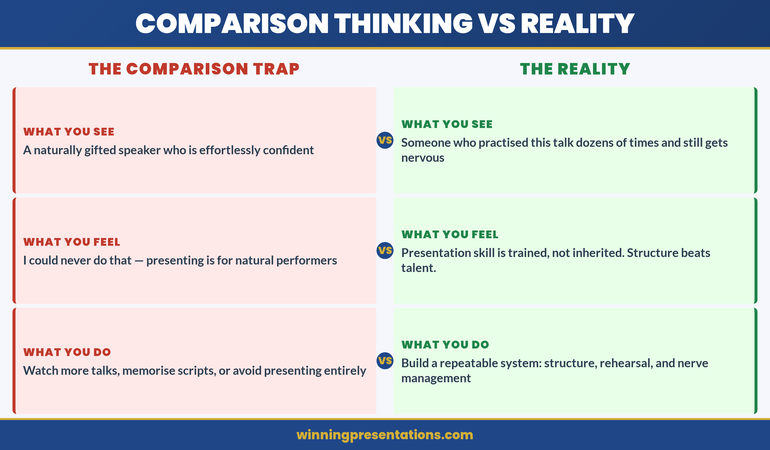
The primary problem with using other speakers’ performances as your learning benchmark is that you’re comparing your full, unfiltered realityβ€”including anxiety, self-doubt, and visible struggleβ€”to someone else’s highlight reel.

What you see: A polished delivery, perfect pacing, no visible nerves.

What you don’t see:

  • Their first 50 presentations (where they were terrible)
  • The speaking situations where they failed and learned
  • How they actually feel in their body during presentations
  • The years of practice hidden behind 18 minutes of TED talk
  • Their current anxiety triggers and vulnerabilities

When your nervous system is already primed for threat (which it is when you’re presentation-anxious), watching someone else’s polished performance reads as evidence that you’re deficient. Your brain doesn’t think, β€œThat looks learnable.” It thinks, β€œI could never do that.”

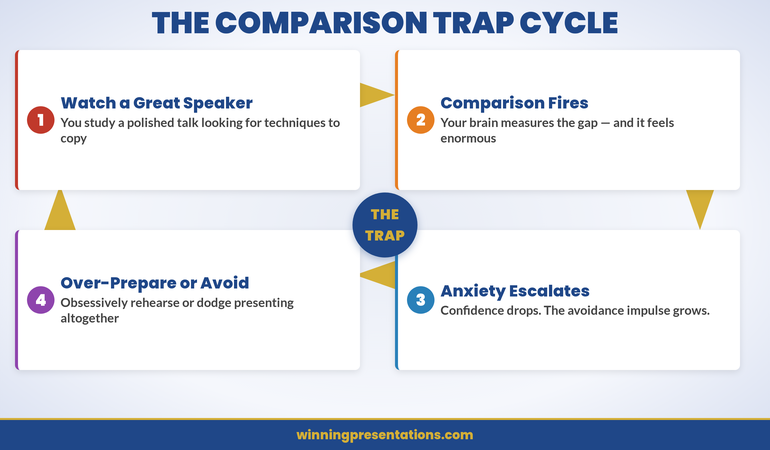
The pattern that keeps you stuck: Watch skilled speaker β†’ Feel inadequate β†’ Try harder β†’ Rehearse obsessively β†’ Anxiety increases anyway β†’ Watch more speakers to feel better β†’ Repeat.

The Conquer Speaking Fear programme (Β£39) breaks this cycle by teaching you how your nervous system actually works during presentationsβ€”using clinical hypnotherapy and NLP techniques to regulate anxiety at the source, rather than trying to out-skill your fear.

Explore the Anxiety-Based Approach

You’re Watching Highlight Reels, Not Real Practice

Here’s what gets hidden when you study great speakers: their learning curve. The neurobiologist who delivers a brilliant TED talk has probably given that talk a thousand times. The executive coach who looks totally composed has probably felt exactly as anxious as you do.

But you don’t see that journey. You only see the highlight.

This creates a dangerous assumption in your brain: They’re naturally good at this. I’m naturally anxious. We’re different.

That difference isn’t skill. It’s practice. It’s repetition. It’s nervous system regulation they learned (usually by trial and error, not by watching other people).

When you’re already battling presentation anxiety, consuming more β€œgreat speaker” content doesn’t close the gap. It widens it. Because every polished performance feels like evidence that the gap is wider than you thought.

The Comparison Trap Cycle infographic showing four stages: Watch a Great Speaker, Internal Comparison Fires, Anxiety Escalates, and Avoidance or Over-Preparation

How the Comparison Trap Hijacks Your Nervous System

Your nervous system has a job: keep you safe. When you’re presentation-anxious, it’s already in a heightened state of alert. Your body is primed to notice threat.

Then you watch a skilled speaker deliver flawlessly. In that moment, your nervous system interprets the signal as: That’s the standard you need to meet. You’re not meeting it. You are unsafe/failing.

This isn’t a logic problem. It’s a nervous system problem. The more speakers you watch, the more evidence your system collects that you don’t measure up.

The comparison trap doesn’t just affect your confidence. It actually heightens physiological anxiety: increased heart rate, shallow breathing, cortisol release. It’s not just negative thinking. Your body is responding to what feels like a threat assessment.

This is why β€œjust practice more” or β€œstudy great speakers” advice often backfires. You’re adding pressure on top of an already dysregulated nervous system.

The Faulty Logic of Anxiety-Driven Learning

Anxiety has a particular way of β€œteaching” you. It shows you problems, not solutions. When you’re anxious about presentations, your brain highlights:

  • Everything that could go wrong
  • Every way you might fail
  • Every person watching who might judge you
  • Every flaw in your delivery compared to β€œbetter” speakers

Then you try to solve this by consuming more speaker contentβ€”thinking you’ll find the β€œright” way to do it. But you’re not learning the right way. You’re reinforcing the belief that there’s a standard you’re failing to meet.

This is learning through threat, not learning through mastery. And it doesn’t stick. It just creates more anxiety.

What actually works is learning how to regulate your nervous system first, then practicing presentation skills from a calmer, more resourced state. That’s when learning actually happens. That’s when confidence buildsβ€”not from watching someone else do it perfectly, but from your own body learning that you can manage the situation.

Feeling the comparison spiral right now? This is exactly what Conquer Speaking Fear addresses: how to interrupt the anxiety pattern before it becomes your default response.

What Actually Reduces Speaking Anxiety (It’s Not Speaker Videos)

The research on anxiety reduction is clear: exposure to threat (like watching skilled speakers when you’re anxious) doesn’t reduce fear. What reduces fear is regulated exposure to manageable challenge, combined with nervous system techniques that help your body learn the situation is safe.

That’s the gap most presentation advice misses. You don’t need:

  • More tips on body language
  • More examples of β€œperfect” presentations
  • More pressure to match someone else’s standard

You need your nervous system to feel safe while you practice. You need techniques that actually work at the physiological level. You need to build confidence through your own success, not through comparison to others.

Reframing: From Comparison to Nervous System Regulation

The shift from β€œI need to watch better speakers to learn” to β€œI need to regulate my nervous system to perform” changes everything.

Instead of:

  • Watching great speakers β†’ feeling worse
  • Rehearsing obsessively β†’ staying anxious
  • Comparing yourself β†’ spiralling into self-doubt

You’d be:

  • Learning how your body responds under pressure
  • Practising techniques that actually calm your nervous system
  • Building confidence through managing your anxiety, not copying someone else’s skill
  • Developing a genuine sense of readiness, not just borrowed confidence from studying others

Comparison Thinking vs Reality infographic contrasting what you see, what you feel, and what you do when caught in the speaker comparison trap versus the reality of learnable skills

Stop Rehearsing What They’re Thinking About You

Here’s what happens in the comparison trap: you’re not just watching speakers. You’re imagining what the audience will think of you compared to them. You’re rehearsing judgment in your head.

This creates a secondary anxiety layer. Now you’re anxious about the presentation and anxious about being judged as β€œnot good enough.”

That’s where nervous system regulation techniques become essential. Not to pump yourself up with false confidence. But to actually interrupt the fear response at the source.

The Conquer Speaking Fear programme uses evidence-based techniques from clinical hypnotherapy and NLP to help your nervous system feel safe during presentationsβ€”not just think positive thoughts about them.

Learn the Regulation Techniques

Is This Right For You?

This approach is for you if:

  • You’ve studied great speakers and it hasn’t reduced your anxiety (it may have increased it)
  • You’re rehearsing presentations obsessively but still feel nervous before delivering
  • Comparison is part of your anxiety patternβ€”you measure yourself against others
  • You want to feel genuinely confident, not just β€œget through” presentations
  • You’re ready to work on the nervous system level, not just the skills level

From Speaking Terror to Teaching Others

That CFO who couldn’t breathe in the boardroom? He didn’t stop being anxious by watching more successful financial leaders or studying presentation techniques. He stopped by learning how his nervous system actually worked during high-pressure situations. Once he understood that, he could regulate it.

Within 18 months, he went from dreading board announcements to volunteering to lead quarterly presentations to the full board. He didn’t become naturally good at presenting. He learned to manage his nervous system well enough that anxiety stopped controlling his performance.

Three years later, he’s mentoring other finance leaders through their presentation anxiety. Not because he became a β€œnatural presenter.” But because he learned the one thing most presentation advice skips: how to work with your nervous system instead of against it.

The Conquer Speaking Fear programme (Β£39) condenses that learning curve into a structured programme using clinical hypnotherapy and NLP to create lasting change. You get the nervous system techniques that actually work. Not tips. Not tricks. Tools that work at the physiological level.

Join the Programme

πŸ“Š Want to improve your slides?

Preparation reduces anxiety. The Executive Slide System (Β£39) includes confident-presenter templates designed to minimise preparation stress.

People Also Ask

Does watching great speakers actually help with presentation anxiety?

For some people, watching skilled speakers can be motivating. But if you’re already anxious about presenting, it often increases comparison and self-doubt. The key difference is your nervous system state when you watch. If you’re primed for threat, you’ll interpret polished performances as evidence you’re not good enough. Nervous system regulation should come first; learning through observation should come later.

How long does it take to get over presentation anxiety?

It depends on your approach. If you’re trying to β€œthink positive” or β€œrehearse more,” it often takes months or yearsβ€”and can actually worsen anxiety. If you’re working directly with nervous system regulation techniques, most people notice significant shifts within 2-4 weeks. The foundation changes quickly; building full confidence takes longer, but you’re working from a much more resourced place.

Can I stop being anxious about presentations if I’m naturally an anxious person?

Yes. β€œNaturally anxious” usually means your nervous system is sensitised to threat more readily than others’—not that you’re broken or incapable. With the right nervous system tools, you can learn to regulate that sensitivity in specific situations (like presentations). You don’t become a different person. You become someone whose anxiety no longer controls their performance.

FAQ

Should I completely stop watching other speakers?

Not necessarily. The issue isn’t watching speakers; it’s when you watch them and why. If you’re watching them to learn a specific technique and you’re in a calm, resourced state, that can be valuable. If you’re watching them because you’re anxious and hoping to feel better, that usually backfires. Focus first on nervous system regulation. Then, from a calmer place, you can observe and learn without the comparison trap activating.

Is presentation anxiety the same as general anxiety disorder?

Not exactly. Presentation anxiety is specific to the performance situation. You might be calm in most areas of life but dysregulated when presenting. This specificity is actually an advantageβ€”you can work directly with the nervous system triggers in that context. If you have generalised anxiety, presentation anxiety might be one manifestation of that larger pattern, and you’d want support for both.

If I fix my nervous system, will I need less practice?

No, but your practice will be more effective. Right now, if you’re anxious, you might be rehearsing obsessively and still not feeling confidentβ€”because anxiety is hijacking your learning. Once your nervous system is regulated, your practice time creates actual skill development and real confidence. You’ll likely need smarter practice, not necessarily more practice.

Ready to Stop the Comparison Cycle?

Join The Winning Edge newsletter for weekly strategies on nervous system regulation, presentation confidence, and the counter-intuitive approaches that actually reduce anxiety.

Subscribe (It’s Free)

πŸ†“ Free resource: Get the Checklist β€” a free guide to strengthen your presentation preparation.

About the Author

Mary Beth Hazeldine is a presentation coach and nervous system specialist working with senior leaders and executives. She’s trained over 3,000 professionals to move from presentation anxiety to genuine confidenceβ€”by working at the nervous system level, not just the skills level. She’s the creator of the Conquer Speaking Fear programme and the Executive Slide System.

19 Mar 2026
Executive sitting alone at a conference table after a presentation replaying the moment in their mind with head slightly bowed and hand on forehead, empty boardroom with presentation screen dark behind them, navy and gold corporate aesthetic

The Shame Spiral After a Bad Presentation (And How to Stop It Before It Rewires Your Brain)

Quick Answer: The shame after a bad presentation isn’t just embarrassment β€” it’s a neurological loop where your brain replays the worst moments to “protect” you from future threat. Left unchecked, this spiral rewires your threat response and makes every future presentation feel more dangerous. The interruption: a structured cognitive debrief within 24 hours that separates what actually happened from what your shame is telling you happened.

You’re in the Shame Spiral Right Now If: You can replay the exact moment it went wrong. You keep hearing your own voice stumbling. You’re already dreading your next presentation and it’s not even scheduled. This is your threat detection system working overtime β€” and it’s solvable. The first step is understanding that your brain is lying about how bad it actually was.

See the cognitive interruption system β†’

I Was Terrified for Five Years

I know the shame spiral because I lived inside it for five years.

Early in my banking career, I froze during a quarterly review at JPMorgan Chase. Mid-sentence, my mind went blank. Not “lost my train of thought” blank β€” completely, devastatingly empty. I stood in front of 14 people and said nothing for what felt like a full minute. It was probably eight seconds. It felt like eight years.

I recovered. I got through the presentation. Nobody mentioned it afterwards. But that night, I replayed those eight seconds on a loop. I could hear the silence. I could see the faces. I could feel the heat rising in my chest. For the next five years, every time I stood up to present, my brain played that footage first β€” like a warning reel before the main feature.

That’s the shame spiral. It’s not embarrassment. It’s your nervous system encoding a single bad moment as evidence that presenting is dangerous. And unless you interrupt it, it gets louder every time.

What the Shame Spiral Actually Is (Neurologically)

Shame after a bad presentation isn’t a character flaw. It’s a neurological process with a specific mechanism β€” and once you understand the mechanism, you can interrupt it.

When something goes wrong during a presentation β€” you freeze, you stumble, you lose your place, someone asks a question you can’t answer β€” your amygdala tags that moment as a threat. Not an inconvenience. Not a learning opportunity. A threat. The same system that would tag a near-miss car accident or a predator in the wild.

Your brain then does something remarkably unhelpful: it replays the moment repeatedly to “consolidate the threat memory.” This is adaptive if you’re remembering where the predator was hiding. It’s catastrophic if you’re remembering the look on the CFO’s face when you lost your place on slide 7.

Each replay strengthens the neural pathway. The memory becomes more vivid, more emotionally charged, and β€” crucially β€” more distorted. Your brain doesn’t replay what actually happened. It replays an edited version with the contrast turned up: the silence was longer, the faces were more disapproving, the recovery was worse than it was. This is why people describe shame memories as feeling “more real than reality.” The replays are neurologically enhanced versions of the original event.

Left unchecked, this process consolidates into a conditioned response. Your brain learns: “presenting = danger.” The next time you stand up to speak, the threat detection fires before you’ve said a word. That’s where the nervous system’s memory of past presentations starts to dictate your future performance.

Four-stage shame spiral cycle infographic showing how a single bad presentation moment triggers threat encoding replay distortion and conditioned avoidance with intervention points at each stage

Why Your Brain Is Lying About How Bad It Was

Here’s the finding that changes everything: your memory of the presentation is almost certainly worse than what actually happened.

Research in cognitive psychology consistently shows that people overestimate how noticeable their mistakes were to others. It’s called the spotlight effect β€” the tendency to believe that others noticed your error far more than they actually did. In presentation contexts, this is amplified because the emotional intensity of the moment makes the memory feel more significant.

When I work with executives who are stuck in a shame spiral, I ask them to do one thing: check. Ask a colleague who was in the room. Not “how did I do?” (too vague) but “did you notice when I paused on the third section?” In nearly every case, the answer is some variation of: “I noticed a pause but I assumed you were gathering your thoughts. It didn’t seem like a problem.”

The gap between what you experienced internally and what the audience perceived externally is enormous. Your internal experience: racing heart, blank mind, hot face, certainty of failure. Their external observation: a brief pause, a professional recovery, a presenter who seemed thoughtful. The shame spiral is built on your internal experience, not the external reality.

This doesn’t mean your feelings aren’t valid. The distress is real. The shame is real. But the narrative your brain has constructed about the event β€” “everyone noticed, it was terrible, my credibility is destroyed” β€” is almost always factually wrong. Understanding this distinction is the first step in breaking the loop.

Break the Shame Loop Before It Becomes Permanent

Conquer Speaking Fear is a 30-day programme built from clinical hypnotherapy β€” the same techniques I used to break my own five-year shame spiral. It targets the neurological loop directly: threat encoding, replay distortion, and conditioned avoidance.

  • The cognitive interruption technique that stops shame replays within 24 hours
  • Nervous system regulation exercises that lower threat detection before presentations
  • The reality-check framework: separating what happened from what your brain says happened
  • Progressive exposure protocols that rebuild your relationship with presenting

Get Conquer Speaking Fear β†’ Β£39

Built from clinical hypnotherapy and 24 years of presenting in high-stakes boardrooms where shame spirals were a professional hazard β€” not a theoretical concept.

The 24-Hour Debrief That Breaks the Loop

The shame spiral consolidates most aggressively in the first 24 hours after the event. This is your intervention window. After 24 hours, the distorted memory starts to feel like fact. Before 24 hours, you can still rewrite the narrative.

Here’s the structured debrief. Do it on paper, not in your head. Writing forces precision. Rumination thrives on vagueness.

Step 1: Write exactly what happened. Not what it felt like. Not what you think people thought. What actually, observably happened. “I paused for approximately five seconds after the third point. I then continued with the next section. I completed the presentation.” Facts only. No interpretation. No emotional language.

Step 2: Write the shame version. Now write what your brain has been telling you happened. “I froze for ages. Everyone stared. They thought I was incompetent. My career is over.” Get it all out. Seeing the shame narrative written down beside the factual account immediately reveals the distortion.

Step 3: Identify the gap. Where does the shame version diverge from reality? Usually at the interpretation: “everyone stared” (you don’t know what they were thinking), “they thought I was incompetent” (projection, not fact), “my career is over” (catastrophising, not reality).

Step 4: Write one thing that went well. Not a fake positive. One specific moment that was competent. “My opening data was clearly presented.” “I handled the Q&A well.” “I recovered and completed the presentation.” This anchors your memory in something true that counterbalances the shame distortion.

This debrief works because it engages your prefrontal cortex (rational processing) before the amygdala (threat processing) has time to fully consolidate the distorted version. You’re essentially writing a corrected record that your brain can reference instead of the shame-enhanced replay.

Stuck in the replay? Break it now.

Get the Full Interruption System β†’ Β£39

How to Stop It Rewiring Your Future Presentations

The shame debrief handles the immediate crisis. But the deeper risk is what happens over weeks and months if the spiral isn’t fully resolved: avoidance behaviour.

Avoidance looks different for executives than it does for everyone else. You probably won’t stop presenting β€” your career won’t let you. Instead, you’ll compensate. You’ll over-prepare. You’ll add more slides than necessary. You’ll rehearse until the words feel robotic. You’ll arrive 30 minutes early and sit in your car feeling sick. The presentation will go fine β€” and you’ll credit the over-preparation, not your actual competence. The anxiety stays. It just gets managed more elaborately.

This is where the link between anxiety and over-preparing becomes dangerous. The over-preparation isn’t solving the problem. It’s teaching your brain that presenting requires extraordinary effort to survive β€” which reinforces the threat encoding.

Breaking this pattern requires graduated re-exposure. Not “just do more presentations” β€” that’s like telling someone with a fear of water to jump in the deep end. It means presenting in low-stakes situations where the outcome genuinely doesn’t matter, and then slowly increasing the stakes while your nervous system relearns that presenting isn’t dangerous.

Start with a two-minute update in a team meeting where you’re among peers. No judgment. No career stakes. Then a five-minute briefing to your manager. Then a 10-minute presentation to a slightly larger group. Each successful experience writes a new neural pathway that competes with the shame memory. Over time, the new pathways become stronger than the old one.

People Also Ask: How long does it take to recover from a bad presentation?

The acute shame typically peaks within 24–48 hours and fades over one to two weeks if you don’t reinforce it with rumination. The longer-term impact β€” avoidance behaviour, heightened anxiety before presenting β€” can last months or years without intervention. A structured debrief within 24 hours significantly accelerates recovery by preventing the distorted memory from consolidating.

People Also Ask: Why do I keep replaying my presentation mistakes?

Your amygdala tagged the moment as a threat and is replaying it to consolidate the “danger” memory. This is an adaptive survival mechanism that works well for physical threats but poorly for social situations. The replays feel involuntary because they are β€” your threat detection system runs below conscious control. Engaging your prefrontal cortex through a written debrief interrupts the automatic replay cycle.

People Also Ask: Is it normal to feel shame after presenting?

Extremely normal. Many of the most effective presenters experience it. The difference between those who recover quickly and those who develop avoidance is whether they interrupt the shame loop early. Executive-level presenters aren’t shame-free β€” they’ve developed systems for processing shame quickly so it doesn’t accumulate.

The System That Stops Shame From Becoming Permanent

Conquer Speaking Fear gives you the complete toolkit: the 24-hour debrief, the graduated re-exposure protocol, and the nervous system regulation techniques that prevent a single bad moment from becoming a career-long limitation.

  • 30-day progressive programme designed for working executives

Get Conquer Speaking Fear β†’ Β£39

Designed for executives who present regularly and can’t afford to let one bad experience compound into chronic avoidance.

When Shame Is Actually Useful (And When It’s Destructive)

Not all post-presentation shame is destructive. There’s a distinction between productive discomfort and toxic rumination β€” and knowing which you’re experiencing changes your response entirely.

Productive discomfort sounds like: “I wasn’t prepared enough for that Q&A section. Next time I’ll anticipate three questions in advance.” It’s specific. It’s actionable. It leads to a concrete change in behaviour. This kind of discomfort is valuable β€” it’s how professionals improve.

Toxic rumination sounds like: “I’m terrible at presenting. Everyone saw me fail. I’ll never be credible in that room again.” It’s global (applies to all presenting, not this specific presentation). It’s identity-based (about who you are, not what you did). And it’s catastrophic (extrapolates from one moment to permanent conclusions).

The debrief helps you convert toxic rumination into productive discomfort. By writing down what specifically went wrong, you transform a vague cloud of shame into a specific, actionable note. “I lost my place” becomes “I need a clearer structure for my third section.” The shame dissolves because it has nowhere to hide once the problem is named precisely.

And when you are ready to step back into the room β€” whether that’s with slides or without β€” your format choice matters more than you might think. Knowing when to present without slides and when to use them can be the difference between feeling exposed and feeling in control.

The same principle applies to handling unexpected questions. When the Q&A catches you off guard, having a reliable answer structure prevents the moment from becoming a new shame trigger. An evidence-first answer framework gives you a recovery structure that works even when your brain is trying to shut down.

Comparison infographic showing productive discomfort versus toxic rumination with characteristics triggers and outcomes for each pattern after a difficult presentation

Reconnecting With Your Next Presentation

The shame spiral after a bad presentation is one of the most common experiences in professional life β€” and one of the least discussed. Executives don’t talk about it because admitting to shame feels like admitting to weakness. So the spiral continues privately, compounding with each presentation, building an invisible barrier between you and the confident communicator you know you can be.

The interruption is straightforward: debrief within 24 hours, separate facts from interpretation, identify one competent moment, and begin graduated re-exposure. The neuroscience supports it. The clinical techniques behind it work. And the executives I’ve watched use this approach consistently report that the shame fades faster each time until it barely registers.

Your brain encoded one bad moment as a permanent threat. You can re-encode it as a single data point in a career full of successful presentations. The first step happens on paper, within 24 hours, with four written steps. The Conquer Speaking Fear programme (Β£39) gives you the full system β€” the debrief, the re-exposure protocol, and the nervous system regulation that makes it stick.

If you’ve ever felt like imposter syndrome during presentations was related to your shame spiral β€” it is. The two feed each other. Breaking one often breaks both.

Ready to stop the replay?

Get Conquer Speaking Fear β†’ Β£39

Is This Right For You?

βœ“ This is for you if:

  • You can’t stop replaying a specific presentation moment and it’s been more than 48 hours
  • You notice yourself over-preparing for presentations or finding reasons to avoid them
  • You’re a competent professional who presents regularly but one bad experience has shaken your confidence
  • You want a structured, evidence-based approach β€” not motivational platitudes

βœ— Not for you if:

  • You’re experiencing acute distress that extends beyond presentations into other areas of your life β€” please speak with a mental health professional
  • The shame you’re experiencing is from constructive feedback that’s genuinely pointing to skill gaps β€” that’s productive discomfort, not a shame spiral
  • You’ve never actually had a bad presentation experience and you’re anticipating one β€” this article addresses post-event shame, not anticipatory anxiety

The Programme Built From the Shame Spiral I Lived In

Conquer Speaking Fear isn’t theoretical. It’s the system I built from five years of presentation terror, clinical hypnotherapy training, and working with thousands of executives who carried the same invisible weight. The shame spiral is solvable β€” not with willpower, but with the right neurological tools.

  • The 24-hour debrief template (structured, paper-based, clinically informed)
  • Nervous system regulation techniques from clinical hypnotherapy β€” not breathing exercises from a blog
  • Graduated re-exposure protocol designed for executives who can’t stop presenting while they recover
  • The reality-check framework that separates threat encoding from actual performance data

Get Conquer Speaking Fear β†’ Β£39

Developed from clinical hypnotherapy and five years of personal presentation anxiety β€” then refined through working with executives across banking, consulting, and professional services who needed the shame to stop.

Want the slides too?

Preparation reduces anxiety. The Executive Slide System (Β£39) includes confident-presenter templates designed to minimise preparation stress.

Frequently Asked Questions

What if the presentation genuinely was bad β€” not just my perception?

Even objectively poor presentations rarely warrant the shame response your brain generates. If the presentation had genuine problems (wrong data, unprepared content, missed deadline), the appropriate response is a corrective action plan β€” not rumination. Write down what specifically went wrong, create a concrete plan to prevent it next time, and move forward. Shame doesn’t improve future performance. Specific plans do.

Should I apologise to the audience or pretend it didn’t happen?

Neither. Don’t bring it up unprompted β€” most audience members noticed far less than you think. If someone mentions it directly, acknowledge it briefly: “Yes, I lost my thread for a moment. The content in the second half covered the key points.” Then move on. Over-apologising reinforces the shame and makes the audience uncomfortable. Brief acknowledgement and forward movement signals confidence.

Can one bad presentation really affect my career?

Almost never in isolation. Careers are built on patterns, not single moments. The danger isn’t the bad presentation β€” it’s the avoidance behaviour that follows. If shame causes you to decline speaking opportunities, volunteer less in meetings, or over-prepare to the point of rigidity, the cumulative impact of those behaviours will affect your career far more than the original moment ever could.

How do I stop the physical symptoms (racing heart, nausea) that come with the shame replay?

The physical symptoms are your sympathetic nervous system responding to the threat memory. A structured breathing technique (inhale 4 counts, hold 4, exhale 6) engages your parasympathetic system and interrupts the physical escalation. Do this the moment you notice a replay starting β€” not after it’s been running for 20 minutes. Early intervention is far more effective than late-stage management.

Your Next Presentation Doesn’t Have to Carry This Weight

The shame spiral is telling you that you’re broken. You’re not. You’re a professional who had a difficult moment and whose brain is doing exactly what brains do β€” overprotecting you from a threat that no longer exists.

Paper. Pen. Four steps. Within 24 hours. That’s where the spiral breaks. Your next presentation is waiting β€” and it doesn’t have to carry the weight of the last one.

The Conquer Speaking Fear programme (Β£39) gives you the complete system to break the loop, rebuild your confidence, and present without the ghost of past mistakes following you into the room.

Stay Updated

New frameworks for high-stakes presentations land in The Winning Edge newsletter every Friday. Subscribe for frameworks you can use immediately.

πŸ†“ Free resource: Free PDF β€” a free guide to strengthen your presentation preparation.

About the Author

Mary Beth Hazeldine is the Owner & Managing Director of Winning Presentations. With 24 years of corporate banking experience at JPMorgan Chase, PwC, Royal Bank of Scotland, and Commerzbank, she has delivered high-stakes presentations in boardrooms across three continents.

A qualified clinical hypnotherapist and NLP practitioner, Mary Beth combines executive communication expertise with evidence-based techniques for managing presentation anxiety. She has trained thousands of executives and supported high-stakes funding rounds and approvals.

Book a discovery call | View services

13 Mar 2026
Professional woman in a boardroom setting looking directly at the viewer with confident composure β€” executive presenter commanding the room"

The Fear That’s Worse Than Stage Fright: Being Forgettable

She delivered the presentation perfectly. Clear structure, confident delivery, sharp answers in Q&A. The senior leadership team thanked her warmly. Three weeks later, when the project was being discussed at board level, her name didn’t come up. Someone else’s did.

She wasn’t passed over because she failed. She was passed over because she hadn’t registered. The presentation had been technically correct and entirely unmemorable β€” and in the room where careers advance, those two things are not the same as doing well.

Stage fright gets diagnosed. It gets talked about, treated, trained away. The fear of being forgettable is quieter β€” but for the executives I work with, it is often the more accurate description of what they are actually afraid of. Not that it will go wrong. That it will go fine, and nobody will notice.

Quick answer: The fear of being forgettable is not a performance problem β€” it is a distinctiveness problem. Technically correct presentations fail to register because they are built to avoid failure rather than to create impression. The fix is the one decision point that every presentation needs and most executives skip: what single thing do you want the room to remember when everyone has left? That question, answered before the deck is built, changes the structure, the language, and the moment in the room that makes you memorable.

🎯 Worried your presentations land and then disappear? Conquer Speaking Fear (Β£39) includes the memorability framework β€” the single structural change that makes executive presentations stick rather than slide off the room.

I spent 24 years in corporate banking at JPMorgan Chase, PwC, Royal Bank of Scotland, and Commerzbank. I sat in hundreds of presentations β€” some of which I still think about today, and most of which I cannot recall a single detail of. The ones I remember were not always the most technically accomplished. They were the ones where the presenter had made a decision about what to leave behind.

The fear of being forgettable is almost never named as a fear. It presents as something else: a vague dissatisfaction with your own presentations, a frustration that you prepare thoroughly and deliver competently but don’t seem to build momentum, a nagging sense that you’re getting positive feedback but not advancement. What sits underneath all of that is the knowledge β€” accurate, if unarticulated β€” that the room is processing your presentation in real time and discarding most of it within 48 hours.

This is not a confidence problem. Many of the executives I work with are entirely confident in front of a room. They are confident and forgettable, and the combination is more frustrating than stage fright, because stage fright at least has a diagnosis.


Executive presenter at boardroom table showing the contrast between technically correct delivery and memorable impression-creating presentation technique

What the Fear of Being Forgettable Actually Is

The fear of being forgettable is not anxiety about the presentation itself. It is anxiety about what happens after the presentation β€” specifically, about whether the work you put into the room will translate into anything that changes how people think about you, your ideas, or your capability.

It is existential in a way that stage fright is not. Stage fright is about a visible, acute failure β€” the stumble, the blank, the meltdown. The fear of being forgettable is about an invisible, chronic failure β€” the presentation that goes smoothly from start to finish and changes nothing. It is possible to manage stage fright and still live with the fear of being forgettable. They are different problems.

The fear is rational. Most executive presentations are, in fact, forgettable. Not because the presenters are weak β€” because they are built to survive the room rather than to shape it. Built to avoid objections rather than to create impressions. Built for correctness rather than distinctiveness, and correctness, as a standard, produces adequate presentations at best.

The presentation confidence that most people work to build is about managing their own state in front of a room. That matters. But it does not solve the fear of being forgettable β€” because forgettable presentations are delivered by confident people every day. Confidence is necessary. It is not sufficient.

🎯 From Technically Correct to Genuinely Memorable: The Framework Inside Conquer Speaking Fear

Conquer Speaking Fear addresses both the anxiety that makes you hold back and the structural problem that makes you forgettable β€” because they are connected. The memorability framework inside includes:

  • The single decision that changes how your presentation is built β€” the one question most executives skip that determines whether the room retains anything
  • The structural change that creates impression without changing your delivery style or requiring you to be more extroverted
  • The moment-in-the-room technique β€” how to create one point of genuine distinctiveness that travels out of the room after you’ve left
  • Why technically correct presentations fail to register β€” and the three specific elements that create retention
  • Scripts and frameworks for building distinctiveness into any presentation, including updates and committee briefings

Get Conquer Speaking Fear β†’ Β£39

Built from 24 years of reviewing what makes executives memorable β€” from performance coaching, but in banking boardrooms where careers advance on the quality of the impression you leave behind.

Why GettingIt Right Isn’t the Same as Being Remembered

There is a common assumption that technical competence in presentation leads to memorability. That if you structure your content well, deliver it clearly, and handle Q&A professionally, the impression will follow. It does not work this way.

Technically correct presentations are processed by the audience as expected. Expected things are not memorable. The brain’s memory systems are optimised for novelty, significance, and pattern disruption β€” not for competent execution of a familiar format. When a presentation ticks every box and surprises no one, the audience experiences it as confirmation of baseline. That confirmation does not generate lasting impression.

There are three specific elements that create memorability in executive presentations. The first is a distinctive frame: a way of seeing the topic that the audience has not encountered before, and cannot easily dismiss. The second is a moment of genuine specificity β€” a number, a story, a piece of evidence so precise that it does not generalise. The third is a closing that creates tension rather than resolution: something the audience leaves with that has not yet been answered, or a commitment so specific that it follows them out of the room.

Most presentations have none of these. They are built on the assumption that clarity is sufficient for impact. Clarity is necessary for impact. It is not impact.

Preparing a presentation where being remembered genuinely matters? Conquer Speaking Fear (Β£39) includes the three-element memorability checklist and the templates to build each element into any presentation format.

The One Decision That Makes You Memorable

Before building any presentation, answer this question: what is the single thing you want the room to remember when everyone has left, the coffee cups have been cleared, and two other presentations have happened since yours?

Not the key messages β€” there are always three or five of those. Not the overall objective. The single thing. The one sentence that you would consider the presentation successful if it was still in someone’s head three days later.

Most executives cannot answer this question without several attempts. Not because they haven’t thought about the presentation β€” they have thought about it extensively β€” but because they have been building toward comprehensive communication rather than toward a single retained point. The question forces a prioritisation that comprehensive communication never requires, and that prioritisation is what makes the difference.

Once the single point is identified, it changes the structure, the language, the evidence selection, and the closing. Every section of the deck can be evaluated against one criterion: does this section serve the single point, or is it here because it belongs in a complete treatment of the topic? A complete treatment of the topic is for a report. A presentation that leaves one point behind is for a room.

This is not the same as simplifying your content. The evidence, the depth, the rigour β€” all of that remains. What changes is the architecture: everything is built to deposit one thing in the room’s memory, and everything that does not serve that deposit is moved to an appendix or removed entirely.


Presentation structure diagram showing the single retained point architecture β€” how to build every section toward one memorable conclusion rather than comprehensive topic coverage

⚠️ Stop Presenting Well and Being Forgotten

Technical competence is not the problem. The problem is building presentations that aim for correctness rather than impression. Conquer Speaking Fear (Β£39) gives you the framework to identify your single retained point and build the rest of the deck to serve it β€” so you leave something behind when you leave the room.

Get Conquer Speaking Fear β†’ Β£39

Used by executives who present confidently and want to know why they’re not advancing as fast as their performance warrants.

The Structural Change That Creates Impression

Once you have identified your single retained point, there is one structural change that consistently makes it land: give it three times more space than you think it needs.

Most executives identify the central point of their presentation and give it a slide. They present it in the same format as every other slide β€” the same visual weight, the same amount of speaking time, the same level of evidence. The audience processes it as one of many points and does not distinguish it as the point they are meant to carry with them.

A presentation built for memorability gives the central point a different kind of attention. It arrives at the point from two directions β€” an evidence approach and a case study approach. It lingers there rather than moving on. It uses language that is slightly more precise, slightly more surprising, than the surrounding sections. And it returns to the point at the close β€” not as a summary, but as a reframing that shows the audience something they have just been made to see that they could not see before the presentation began.

The fear of being judged when speaking often produces exactly the opposite structure: executives rush through the material to minimise exposure to judgment, and the rushed pace means no single section gets enough space to register. Slowing down at the central point β€” deliberately, visibly, without apology β€” is both a confidence signal and a memorability technique.

The Moment in the Room That People Carry With Them

There is a specific type of moment in executive presentations that travels out of the room with the audience. It is not the best slide. It is not the sharpest Q&A answer. It is the moment where the presenter says something that the audience had not heard formulated that way before β€” and that formulation makes something they already knew suddenly more useful.

This moment is not spontaneous. It is engineered. The best presenters I observed over 24 years in financial services had prepared two or three formulations that they delivered as if they were occurring to them in real time. The sentences were precise, unexpected, and impossible to improve. They stuck because they had been sharpened in advance to a point that could not be blunted by the audience’s existing vocabulary.

The technique is to write one sentence that your audience will want to use themselves. Not a quotable headline β€” a usable thought. Something that gives them language for a problem they already have. When an executive leaves a presentation and says to someone in the corridor, “she said something interesting β€” she said that…” the sentence they complete is the one the presenter put there deliberately.

This is not manipulation. It is the same precision that good writing requires β€” the sentence that could not have been written differently and still meant the same thing. Presentations that are remembered tend to contain at least one of these sentences. Presentations that are forgotten contain none.

The process of overcoming public speaking fear often focuses on managing internal state in front of a room. That work is valuable. But the executive who has resolved their anxiety and still presents forgettably needs a different intervention: not less fear, but more considered preparation of the specific moment that will travel.

Also published today: International Presentations: The Cultural Mistakes That Kill Deals Before Slide One β€” the structural adjustments that make you read as credible rather than problematic in cross-cultural rooms.

Common Questions About the Fear of Being Forgettable in Presentations

Is the fear of being forgettable the same as imposter syndrome?
They are related but different. Imposter syndrome is the belief that you are not as capable as others perceive you to be. The fear of being forgettable is the belief that even if you perform well, you will not make an impact. Many executives experience both β€” but the fear of being forgettable is often the more accurate fear, because it is a response to real feedback: presentations that go well and produce no change. Imposter syndrome is a distortion of self-perception. The fear of being forgettable is often an accurate assessment of a structural problem in how presentations are being built.

How do I become more memorable without changing my personality or presentation style?
The memorability techniques in this article and in Conquer Speaking Fear are structural, not stylistic. You do not need to become more energetic, more performative, or more extroverted. You need to identify your single retained point, give it disproportionate space in the presentation, and engineer one sentence that your audience will want to use themselves. These changes live in the preparation, not in the delivery. Your personality, your voice, your style β€” none of that changes. What changes is the architecture of the deck and the precision of one or two key sentences.

What if the content I’m presenting doesn’t lend itself to being memorable β€” like a budget update or a quarterly review?
Every presentation can contain one memorable moment, regardless of topic. A budget update can contain one framing that changes how the audience thinks about a number they have seen before. A quarterly review can contain one sentence that gives the audience language for a pattern they have been observing but haven’t been able to articulate. The technique works across presentation types because it does not depend on the subject matter being inherently interesting β€” it depends on the presenter doing the preparation work to find the single formulation that makes the familiar suddenly more useful.

Is This Right For You?

This article and Conquer Speaking Fear are for executives who present competently and know it, but who are not seeing the career impact that their presentation performance should generate. If you are getting consistent positive feedback and not advancing, if you are being told your presentations are good but not being remembered after them, or if you sense that you are technically doing everything right and still not registering β€” the memorability framework is the relevant intervention.

If your primary challenge is managing anxiety or fear in front of a room, Conquer Speaking Fear addresses that too. The memorability work and the anxiety management work are covered together because they connect: the executives who are most afraid of being forgettable tend to rush through their material to reduce exposure, and that rushed pace is exactly what prevents the central point from landing with enough weight to be retained.

Frequently Asked Questions

Does being memorable require being controversial or provocative?
No, and in many executive contexts, controversy is actively counterproductive. Memorability in executive presentations comes from precision and distinctiveness, not from provocation. The formulation that makes you memorable is more likely to be a precisely articulated insight that your audience already half-knows than a deliberately provocative claim. Controversial presentations are remembered, but often for the wrong reasons. The goal is to be remembered for the quality of your thinking, not for having caused friction in the room.

How long does the memorability preparation take?
The critical question β€” what is the single thing I want the room to remember? β€” takes 15–30 minutes to answer well if you have not done it before. The first answers are usually too broad. The useful answer is specific enough that you could repeat it to someone who wasn’t in the room and they would understand both the point and why it matters. Once you have that answer, the structural adjustments to the deck take 30–60 minutes for a presentation you have already built. The one engineered sentence takes longer β€” sometimes a day of writing and revision β€” because it needs to be precise enough to survive a room full of people who will immediately try to improve it.

πŸ“Š Want the slides too?

Preparation reduces anxiety. The Executive Slide System (Β£39) includes templates designed for executives who want their deck to carry the weight of the memorable moment β€” so your delivery can focus on the room rather than on the slides.

About the Author

Mary Beth Hazeldine is the founder of Winning Presentations and has spent over two decades advising executives on high-stakes communication. Her background includes roles at JPMorgan Chase, PwC, Royal Bank of Scotland, and Commerzbank. She has observed hundreds of executive presentations across board and leadership contexts and developed Conquer Speaking Fear from the patterns that separated the presentations people still talk about from the presentations nobody remembers. She works with senior leaders on both performance anxiety and the structural problem that lies beneath it.

Free resource: Executive Presentation Checklist β€” includes the memorability check for every presentation: the five signals that indicate your central point has enough structural weight to be retained.

The Winning Edge Newsletter

Practical executive presentation guidance, once a week. No padding, no noise β€” just the techniques that matter when the room is full of people whose time is expensive.

Subscribe Free β†’

12 Mar 2026
Why 'be yourself' is the worst presentation advice β€” and what actually builds genuine confidence when presenting

Why ‘Just Be Yourself’ Is the Worst Presentation Advice Ever Given

I have heard this advice given in every variation imaginable. “Just relax and be yourself.” “Be authentic β€” they’ll respond to that.” “Don’t overthink it, just be natural.” It is delivered by coaches, managers, colleagues, and well-meaning friends. It is almost completely useless.

Here is the problem. The person asking for help with their presentation anxiety is anxious because, in that specific context, they don’t know how to be themselves. The presentation setting activates a version of them they don’t recognise β€” the one with the dry mouth and the racing thoughts and the sudden inability to remember what they were about to say. Telling them to “just be yourself” in that state is like telling someone who is lost to “just know where you are.”

The advice is not wrong because authenticity doesn’t matter. It matters enormously. It’s wrong because it mistakes the destination for the route.

Quick answer: “Just be yourself” fails as presentation advice because it assumes you already have access to a confident, composed version of yourself in a high-pressure context β€” and for many people, you don’t yet. Authenticity in presentations isn’t a starting position; it’s a result of having a reliable structure, having prepared the right way, and having repeated the experience enough times for the nervous system to stop treating it as a threat. The route to authentic presenting runs through skill, not sentiment.

🧠 Struggling with presentation anxiety despite trying every tip you’ve been given? Conquer Speaking Fear (Β£39) addresses the root cause β€” not the symptoms β€” with a four-step approach built on clinical hypnotherapy and NLP.

I spent 24 years in corporate banking before I became a presentation coach and clinical hypnotherapist. In my banking career I gave many presentations that went well and several that didn’t β€” and I received “just be yourself” advice before most of them. I know what it feels like to walk into a room where the stakes are high, where the audience is senior, and where your nervous system is telling you that you are not safe.

In that state, “yourself” is not a useful concept. “Yourself” is simultaneously the person who knows this material better than anyone in the room, and the person whose heart rate has just doubled and who has forgotten how to breathe properly. Telling that person to “be themselves” doesn’t help them access the first version β€” it just leaves them alone with the second.

What actually builds presenting confidence is not more permission to be authentic. It’s removing the obstacles that prevent authenticity from being accessible. That’s a different problem with a different solution.


Presentation humiliation recovery process showing the 3 mechanisms: interrupt replay loop, separate shame from identity, rebuild nervous system baselineWhy ‘Be Yourself’ Fails in High-Pressure Contexts
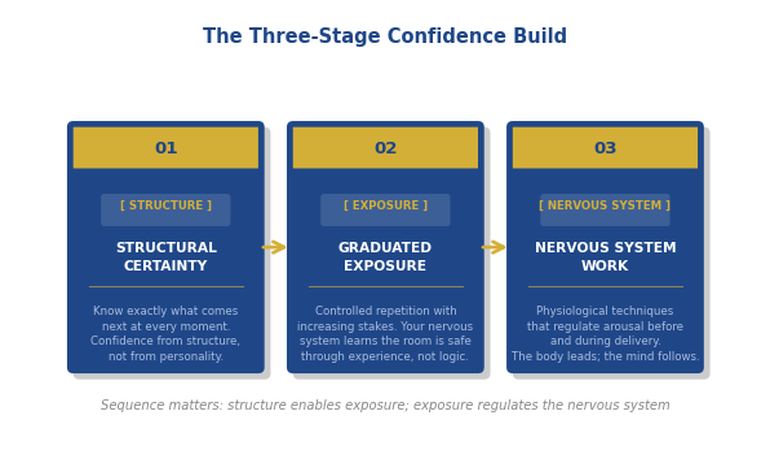
The advice “just be yourself” contains a hidden assumption: that the self you normally inhabit is readily available in high-stakes situations. For most people, it isn’t β€” and this isn’t a character flaw, it’s a neurological response.

When your nervous system perceives threat β€” and many brains are wired to classify a large audience, an important meeting, or a high-stakes pitch as a threat β€” it triggers physiological responses designed to help you survive, not to help you present well. Elevated heart rate. Shallow breathing. Reduced access to higher-order thinking. A narrowed attentional focus. These responses are not evidence that you’re not good enough. They’re evidence that your brain is doing exactly what evolution designed it to do.

The problem is that “be yourself” offers no pathway through this response. It doesn’t tell you how to work with your nervous system rather than against it. It doesn’t provide structure that reduces the cognitive load of an unfamiliar or threatening situation. It doesn’t address the root pattern that makes presenting feel dangerous in the first place.

What’s more, the advice can actually increase anxiety. When someone tries to “be themselves” and still feels anxious, the natural conclusion is that there’s something wrong with them β€” that even their authentic self isn’t good enough for this situation. The advice doesn’t just fail to help; it creates a new layer of self-criticism on top of the existing anxiety. The research on why even confident presenters still get nervous confirms this: the problem isn’t authenticity, it’s the model people hold about what anxiety means.

🧠 The Approach That Actually Works When ‘Just Be Yourself’ Hasn’t

Conquer Speaking Fear addresses presentation anxiety at the level where it actually lives β€” the nervous system pattern that activates in high-pressure contexts β€” not the surface symptoms that generic advice tries to manage:

  • The four-step framework for retraining the nervous system response that makes presenting feel threatening
  • Clinical hypnotherapy and NLP techniques applied specifically to presentation anxiety
  • The pre-presentation physical routine that creates genuine calm rather than performed confidence
  • Evidence-building practices that change how your brain classifies the presenting situation over time
  • The distinction between managing anxiety (which keeps the pattern in place) and resolving it

Get Conquer Speaking Fear β†’ Β£39

Built from clinical hypnotherapy, NLP practice, and 24 years of high-stakes presenting at JPMorgan Chase, PwC, and RBS. Used by executives who’ve tried every other approach.

What Authenticity in Presenting Actually Is

Authentic presenting is not performing naturalness. It’s not trying to replicate how you feel in a low-stakes conversation and importing it into a high-stakes one. Authenticity in the context of presentations means that your words, delivery, and presence are congruent β€” that there isn’t a visible gap between what you’re saying and how you appear to be experiencing saying it.

That congruence is available to most people in some contexts and not in others. In a conversation with a trusted colleague about a subject you know well, it’s probably effortless. In a room with senior stakeholders, cameras, or an audience that includes people who can affect your career, it’s not β€” because your nervous system has added a layer of self-monitoring and threat assessment that didn’t exist in the smaller conversation.

Removing that layer is not a matter of trying harder to be authentic. It’s a matter of reducing what your nervous system needs to monitor. Structure does part of that work β€” when you know exactly where your presentation is going, you’re not simultaneously navigating and performing. Preparation does another part β€” when you’ve rehearsed the opening enough times, it stops requiring conscious attention and frees up cognitive resource for presence. And nervous system work β€” the kind that changes the underlying response pattern β€” does the part that structure and preparation alone can’t reach.

The result is what people experience as authenticity: the sense that the presenter is genuinely present, not performing presence. But that result is downstream of a specific set of inputs. It doesn’t arrive just because someone gave you permission.

Why Structure Comes Before Authenticity

This is the idea that most presentation advice gets backwards. The conventional model says: first be yourself, then communicate your content confidently. The actual sequence is: first build a reliable structure, then reduce the cognitive load of delivering it, then the self that was always there becomes accessible.

Structure reduces threat. When you walk into a presentation knowing exactly what your first sentence is, what your three main points are, and what you’re going to say in your closing β€” the brain has far less to manage. The threat response that generates the symptoms most presenters try to hide has less reason to activate. Not because you’ve suppressed it, but because the situation is now more predictable.

This is why some of the best presenter frameworks begin with slide structure rather than mindset. Building presentation confidence starts with giving yourself a reliable architecture to stand inside β€” not with trying to think your way into a more relaxed emotional state.

It’s also why the “just be yourself” advice works for experienced presenters and fails for anxious ones. Experienced presenters have already developed structure and reduced the cognitive load through repetition. Their brain genuinely has less to monitor in the presenting situation. When someone tells them to “be themselves,” they have reliable access to that self because the threat response has already been downgraded. They’re not natural because they’re naturally relaxed. They’re relaxed because they’ve done the work that structure and repetition require.


Presentation humiliation recovery: Event versus Identity comparison showing how to separate a single bad presentation from your self-narrative

🚫 If Generic Advice Hasn’t Worked, the Route Is Different β€” Not Longer

Most presentation anxiety programmes manage symptoms. Conquer Speaking Fear (Β£39) addresses the nervous system pattern underneath β€” the one that ‘just be yourself’ never reaches.

Get Conquer Speaking Fear β†’ Β£39

Built on clinical hypnotherapy and NLP β€” for executives who’ve already tried practice, positive thinking, and being told to relax.

What Actually Builds Genuine Presenting Confidence

The route to confident, authentic presenting has three components. They work in sequence, not simultaneously.

The first is structural certainty. Know exactly where your presentation starts, what it covers, and how it ends. This isn’t about scripting every word β€” it’s about having a reliable architecture that your brain trusts. When the structure is solid, the self-monitoring that activates in ambiguous situations has less to do.

The second is graduated exposure. Presenting in low-stakes contexts β€” team meetings, small groups, recorded practice β€” builds the evidence base that your nervous system needs to downgrade the threat assessment of the presenting situation. Each successful experience registers as data: I presented and the outcome was acceptable. Over time, the brain reclassifies presenting from threat to familiar challenge. This is the mechanism behind why experienced presenters appear naturally confident. It’s not that they were born different β€” it’s that they’ve created a different data set.

The third, and the one that matters most when the first two haven’t been enough, is addressing the underlying pattern directly. Clinical hypnotherapy and NLP work at the level of the nervous system response itself β€” not by convincing you to think differently about presenting, but by changing the subconscious association between the presenting context and the threat signal. This is the component that ‘just be yourself’ and most generic presentation advice never reaches.

When all three are in place, authenticity stops being something you have to try to produce. It becomes, as it should always have been, the natural state of a person who is not being overwhelmed by anxiety. Looking confident when presenting is not a performance you layer over anxiety β€” it’s what emerges when the anxiety has been genuinely addressed.

The Nervous System Problem the Advice Ignores

Presentation anxiety isn’t a mindset problem. It’s a nervous system response that was calibrated in situations where social threat was genuinely dangerous β€” where being judged by the group could result in exclusion β€” and which now activates in professional presenting contexts even though the actual consequences are rarely catastrophic.

Telling someone with this response to “be themselves” is asking them to perform naturalness while a part of their brain is running a threat protocol. The physiological symptoms β€” the racing heart, the shallow breathing, the dry mouth, the trembling hands β€” are not the result of insufficient authenticity. They’re the result of an overactive threat response in a context where threat has been overestimated.

The work that changes this isn’t in the advice given before presentations. It’s in the pattern-interruption that happens underneath the conscious, rational mind β€” through techniques that access the subconscious associations between presenting and danger that maintain the response. That work is specific, it takes a particular set of tools, and it is available. But “just be yourself” isn’t it.

Also published today: The Investor Relations Update Format That Prevents Awkward Questions β€” the four-part slide structure for IR updates that keeps executives in control of the narrative.

Recognise that pattern in yourself? Conquer Speaking Fear addresses the nervous system response that β€˜just be yourself’ never reaches β€” with a four-step clinical approach built on hypnotherapy and NLP.

Get Conquer Speaking Fear β†’ Β£39

Common Questions About Presentation Advice and Authenticity

Is ‘be yourself’ ever good advice for presenting?
Yes β€” for people who already have a confident, accessible version of themselves in presenting contexts. For them, the advice is a useful reminder not to over-perform or adopt a stylised ‘presenter voice.’ But for anyone whose nervous system still treats presenting as a threat, “be yourself” describes a destination they can’t reach from where they currently are. It’s good advice for the wrong people, given at the wrong stage.

What’s the difference between authentic presenting and faking confidence?
Faking confidence means performing a state you don’t have access to β€” and audiences can usually detect the gap, even if they can’t name it. Authentic presenting means the external and internal are congruent: you don’t appear more composed than you feel because you’ve done the work to reduce the gap. The goal isn’t to act calm while feeling panicked. The goal is to reach a state where calm is genuinely available. That’s a different project from ‘just be yourself,’ but it’s an achievable one.

Why do confident colleagues seem to naturally ‘be themselves’ in presentations?
Because their nervous system has already downgraded the threat assessment for presenting β€” usually through repetition, through a history of acceptable outcomes, or occasionally through a fundamentally different anxiety profile. They’re not naturally more authentic. They’re operating in a context their brain has reclassified as safe, so they have access to the full range of who they are. The route to that state is available to most people, but it runs through the work, not through the advice.

Is This Right For You?

βœ… This is for you if:

  • You’ve received ‘just be yourself’ advice and found it doesn’t help β€” or makes things worse
  • You present competently but never feel genuinely present or relaxed in front of an audience
  • You want to understand why standard presentation tips don’t address what you’re actually experiencing

❌ This is NOT for you if:

  • You already feel calm and confident when presenting and are looking for delivery technique improvements
  • You want a quick list of tips to apply before tomorrow’s presentation (that’s a different article)

πŸ›οΈ Built by a Clinical Hypnotherapist Who Spent 24 Years Presenting in High-Stakes Corporate Environments

Conquer Speaking Fear wasn’t built from academic theory about presentation confidence. It was built from the inside β€” by someone who experienced severe presentation anxiety in a professional context where generic advice consistently failed, and who spent years developing a clinical approach to what that experience actually required:

  • The four-step nervous system retraining framework β€” not symptom management, root cause resolution
  • Clinical hypnotherapy techniques for changing the subconscious associations that maintain the anxiety response
  • NLP approaches for interrupting the thought patterns that escalate anticipatory anxiety in the days before a presentation
  • The pre-presentation physical routine that creates genuine calm β€” not performed composure
  • Evidence-building practices that change the data your nervous system holds about presenting over time

Get Conquer Speaking Fear β†’ Β£39

From a qualified clinical hypnotherapist and NLP practitioner with 24 years of corporate presenting experience at JPMorgan Chase, PwC, Royal Bank of Scotland, and Commerzbank.

πŸ“Š Want the slides too?

Preparation reduces anxiety. The Executive Slide System (Β£39) includes confident-presenter templates designed to reduce preparation stress β€” because knowing your structure is solid before you walk in genuinely changes how your nervous system responds to the situation.

Related reading: Why Confident Presenters Still Get Nervous Before Every Talk β€” why the goal isn’t to eliminate nerves and what to do with them instead.

Frequently Asked Questions

How do I get comfortable presenting without having to ‘perform’ confidence I don’t feel?

The route is to stop trying to perform confidence and instead do the work that makes genuine confidence available. That means building a reliable structure so your brain has less to manage in the presenting context, using graduated exposure to give your nervous system new evidence, and β€” if those two haven’t been enough β€” working directly on the underlying anxiety pattern through approaches like clinical hypnotherapy or NLP. Performed confidence is exhausting and detectable. Genuine confidence is the result of the brain no longer classifying the presenting situation as a significant threat.

Is presentation anxiety something you can actually resolve, or is it just something you manage forever?

For most people, it’s resolvable β€” not just manageable. The distinction matters because ‘managing’ anxiety keeps the underlying pattern in place and requires ongoing effort. Resolving it means changing the nervous system response that generates the anxiety in the first place, so that presenting becomes a familiar challenge rather than an activating threat. That resolution isn’t guaranteed, and it requires specific approaches rather than generic tips. But the clinical tools exist, and for the majority of people who haven’t tried them, they produce significantly different outcomes than anything that’s been attempted before.

Why does the advice to ‘just relax’ also not work for presentation anxiety?

Because “just relax” is a request to consciously override a subconscious response β€” and the conscious mind doesn’t have access to the systems that generate the anxiety symptoms. You can’t decide your way out of an elevated heart rate in the same way you can decide to answer a question differently. The symptoms are produced by the autonomic nervous system responding to a perceived threat signal. The work that changes those symptoms has to operate at the level where that signal originates, not at the level of conscious intention.

What’s the difference between introversion and presentation anxiety?

Introversion is a preference for lower-stimulation environments and a tendency to recharge through solitude rather than social interaction. Presentation anxiety is a fear response to a perceived threat in a social performance context. They often co-occur, but they’re not the same thing and they don’t have the same solution. Many introverts present extremely well because they’ve addressed the anxiety component β€” introversion doesn’t cause anxiety, it just means the social aspects of presenting require more recovery time afterwards. The work of building presenting confidence is available to introverts as much as to anyone else.

The Winning Edge β€” weekly insight on presentation confidence, anxiety, and executive communication. Subscribe free β†’

Want everything in one place? The Complete Presenter Bundle (Β£99) includes Conquer Speaking Fear, the Executive Slide System, the Executive Q&A Handling System, and four additional products.

Free resource: Executive Presentation Checklist β€” the pre-presentation checklist for structure, content, and delivery, free to download.

About the Author

Mary Beth Hazeldine is the Owner & Managing Director of Winning Presentations. With 24 years of corporate banking experience at JPMorgan Chase, PwC, Royal Bank of Scotland, and Commerzbank, she has delivered high-stakes presentations in boardrooms across three continents.

A qualified clinical hypnotherapist and NLP practitioner, Mary Beth combines executive communication expertise with evidence-based techniques for managing presentation anxiety. She has trained thousands of executives and supported high-stakes funding rounds and approvals.

Book a discovery call | View services

05 Mar 2026
Confident executive woman presenting with structured slide deck visible on screen behind her in modern boardroom

Why a Proven Slide Structure Makes You 10x More Confident Than Practice Alone

The most confident executive presenter I’ve ever worked with rehearsed less than anyone else in her organisation. She simply had a better structure.

Most people try to fix presentation anxiety with more practice. More rehearsal. More hours in front of the mirror. And it helps, to a point. But if you’ve ever over-rehearsed a presentation and still felt shaky walking into the room, you already know: practice has a ceiling. After 24 years coaching executives, I can tell you what actually removes the nerves. It’s not confidence. It’s not charisma. It’s structure. A proven, tested system that tells you exactly what goes on each slide, in what order, and why.

Quick answer: Presentation confidence doesn’t come from rehearsal aloneβ€”it comes from structural certainty. When you know your slide architecture is proven, your opening is designed to land, your evidence sequence is tested, and your close drives a decision, your nervous system stops treating the presentation as a threat. Structure replaces uncertainty. And uncertainty is what your body reads as danger. Executives who use a proven presentation system report feeling fundamentally calmerβ€”not because they’ve practised more, but because they’ve eliminated the guesswork.

Tired of rehearsing endlessly and still feeling underprepared?

The problem isn’t practiceβ€”it’s that you’re building every presentation from scratch. The Executive Slide System gives you a tested architecture for every slide, every transition, and every close. When the structure is proven, the confidence follows.

Explore the Executive Slide System β†’ Β£39

The Two Directors Who Presented to the Same Board

Last year I coached two directors at the same FTSE-listed company. Both were presenting strategic proposals to the board on the same afternoon. Both had strong ideas. Both were intelligent, articulate leaders. One spent three weeks rehearsing. She practised in the car, at her desk, in the shower. She could recite her presentation by heart. The other spent two days building her deck using a structured system I’d given herβ€”a tested slide architecture with a decision-first format, an evidence sequence, and a pre-built close.

The first director walked in looking polished but tense. You could see it in how she held her clicker, in the micro-pauses where she was searching for memorised phrasing. When a board member interrupted with a question, she lost her thread for ten seconds. That ten seconds cost her momentum. She recovered, but the room’s energy had shifted.

The second director walked in calm. Not rehearsed-calm. Actually calm. She knew what her first slide would accomplish. She knew the evidence sequence was proven. She knew the close would drive a decision because she’d seen it work before. When a board member interrupted, she handled it easilyβ€”because she wasn’t holding a memorised script in her head. She was following a structure she trusted.

Both proposals were approved. But the second director was asked to present the combined strategy at the annual investor meeting. The board didn’t choose her because she was more senior or more experienced. They chose her because she looked like someone who could handle a room. That composure came from structure, not talent.

After 24 years of coaching, I’ve watched this pattern repeat hundreds of times. The executives who look most confident aren’t the ones who practise most. They’re the ones who trust their structure.

Stop Building Presentations From Scratch

Every time you start with a blank slide deck, your nervous system registers one thing: uncertainty. The Executive Slide System eliminates that uncertainty entirely.

  • A decision-first slide architecture tested across 1,200+ executive presentations
  • Evidence sequence framework that answers “Why this?”, “Why now?”, and “Why us?” in the order boards actually process information
  • Stakeholder-specific templates: CFO version, Operations version, Board-level version
  • Objection-handling slides for the eight most common executive concernsβ€”built in, not bolted on
  • Closing framework that drives decisions, not just applause

Get the Executive Slide System β†’ Β£39

Used by 1,200+ executives. Average approval rate: 72% on first presentation.

Why Practice Has a Confidence Ceiling

Rehearsal does build familiarity. It smooths your delivery, tightens your timing, helps you internalise key points. Nobody is arguing against practice. The problem is that practice alone doesn’t eliminate the uncertainty that causes anxiety.

When you rehearse a presentation you’ve built from scratch, you’re practising deliveryβ€”but you’re still carrying a deeper question: Is this the right structure? Will the board engage with this opening? Will they follow my logic? Will the close land? Am I presenting the evidence in the right order?

Those structural doubts don’t disappear with rehearsal. You can practise a badly structured presentation a hundred times and still feel uneasy about it, because your subconscious knows the architecture is uncertain. You haven’t tested whether this sequence of ideas actually works on this type of audience. You’re hoping it does.

Hope is not confidence. Confidence comes from knowing.

When executives tell me they “just don’t feel confident presenting,” I almost always find the same root cause: they’ve been working without a tested structure. They’re assembling slides from instinct, convention, or whatever worked last time, and then trying to rehearse away the underlying uncertainty. That’s like memorising a route through an unfamiliar city instead of using a map. You might get there, but you’ll be anxious the entire way.

The Structure Effect: What Certainty Does to Your Nervous System

Your nervous system is constantly scanning for threat. In a presentation context, the primary threat it detects isn’t the audienceβ€”it’s unpredictability. Will this work? Will they follow? Am I going to lose the room?

When you use a proven structureβ€”a slide architecture that’s been tested with hundreds of similar audiencesβ€”your nervous system registers something entirely different: certainty. You’re not wondering whether the opening will land, because you’ve seen this opening work. You’re not anxious about the evidence sequence, because it follows a tested logic. You’re not worried about the close, because the framework is designed to drive a decision.

This is why I say structure makes people 10x more confident. It’s not a motivational claim. It’s a nervous system observation. When your brain doesn’t have to solve the “will this work?” problem during the presentation, it frees up an enormous amount of cognitive resource. That resource becomes presence, composure, and the ability to respond to the room rather than cling to a memorised script.

Think about the difference between driving a familiar route and navigating somewhere new. On the familiar route, you can have a conversation, notice the scenery, react to other drivers easily. On an unfamiliar route, your attention narrows, your grip tightens, and you can barely hold a conversation. Same skillβ€”driving. Completely different experience, because one involves structural certainty and the other doesn’t.

Presenting works exactly the same way. A proven structure is your familiar route. It frees you to be present instead of panicking about what comes next.


The Structure-Confidence Effect infographic comparing how presenting without a proven structure triggers nervous system threat response versus how a proven template activates confidence response

Five Ways a Proven System Eliminates Presentation Anxiety

1. It removes the blank-slide problem

The moment of highest anxiety in presentation preparation isn’t the rehearsalβ€”it’s the blank first slide. That’s when your brain confronts the full weight of “I have to figure out what to say, in what order, with what evidence, for this specific audience.” A proven system eliminates this entirely. You open the template, and each slide already has a purpose, a position in the sequence, and a tested rationale. Preparation becomes assembly, not invention.

2. It answers the “will this work?” question in advance

When you’ve built a presentation from scratch, you carry a low-level doubt through every rehearsal and into the room itself. A tested system removes that doubt because the structure has already worked. You’re not the first person to use this evidence sequence or this decision-first opening. It’s been tested with boards, investors, executive committees, and sceptical audiences. Knowing that shifts your internal state from “I hope this works” to “I know this works.”

3. It handles interruptions for you

One of the biggest anxiety triggers in executive presentations is the fear of interruption. What if someone asks a question mid-slide? What if you lose your place? When your confidence depends on a memorised sequence, any interruption is a threat. But when your confidence comes from a proven structure, interruptions become manageable because you always know where you are in the architecture. You can address the question and return to your position without panic, because the structure holds whether or not you deliver it in perfect sequence.

4. It makes your preparation faster (and calmer)

Executives who work without a system often spend days or weeks building a presentationβ€”and then need additional time to rehearse it. The preparation itself generates anxiety because it consumes so much time and mental energy. A proven system cuts preparation time dramatically. When the structure is settled, all you’re doing is populating it with your specific content. This means less time in preparation mode and more time feeling readyβ€”which is itself a confidence multiplier.

5. It gives you permission to stop rehearsing

Over-rehearsal is a real problem. When you’ve practised too much, your delivery becomes wooden, your responses to questions feel scripted, and you start second-guessing phrasing mid-sentence. A proven structure gives you permission to stop rehearsing earlier because you trust the architecture. You don’t need to practise the presentation fifteen times when the system has already been tested by hundreds of other executives. You familiarise yourself with it, personalise the content, and walk in.

Still assembling presentations from scratch?

The Executive Slide System gives you the architecture so you can focus on the content. Templates for every slide type, a proven evidence sequence, and objection-handling built in. Stop building from blankβ€”start building from proven.

Get the Executive Slide System β†’ Β£39

What a Confidence-Building Structure Actually Looks Like

Not all structures are equal. A confidence-building presentation structure has specific characteristics that differentiate it from a basic template or outline.

It leads with the decision, not the background. Most presentations start with context, history, and data before arriving at the ask. This creates anxiety because you’re spending the first ten minutes wondering whether the audience is following your logic. A decision-first architecture puts your recommendation on the first slide. The audience knows immediately what you’re proposing, and every subsequent slide exists to support that decision. You’re not building toward a revealβ€”you’re providing evidence for a position you’ve already stated.

It sequences evidence in the order audiences process it. Executives process information in a specific sequence: What’s the risk? What’s the return? What’s the timeline? A proven structure mirrors that processing order. You’re not guessing which evidence to present firstβ€”you’re following the cognitive sequence that board members naturally use to evaluate proposals. This makes your presentation feel logical and inevitable, which in turn makes you feel confident delivering it.

It pre-builds objection responses. Half of presentation anxiety comes from fear of challenge. What if they push back on the budget? What if they question the timeline? A confidence-building structure includes objection-handling slides built directly into the flow. You don’t need to improvise under pressure because the most common objections are already addressed in your architecture.

It closes with a specific action, not a vague summary. “Any questions?” is the weakest ending in executive presentationsβ€”and it’s the one that generates the most post-presentation anxiety. A proven structure closes with a clear decision framework: what you’re asking for, by when, and what happens next. You walk out knowing exactly what you asked for and what the next step is. That eliminates the lingering anxiety of “Did I get through to them?”

Your Next Presentation, Without the Guesswork

  • Decision-first architecture: stop burying your ask on slide 15
  • Evidence framework that follows how executives actually process proposals
  • Pre-built objection-handling slides for the questions that keep you up at night
  • Closing framework that drives a decision instead of trailing off into “Any questions?”

Get the Executive Slide System β†’ Β£39

The same system used by board presenters, strategy directors, and CEOs at FTSE companies


Structure vs More Practice comparison infographic showing six categories where a proven slide architecture outperforms rehearsal: starting point, core question, preparation time, interruptions, and confidence source

Structure vs. More Practice: Where Executives Get This Wrong

The instinct when presentations feel shaky is always the same: practise more. Run through it again. Rehearse in the car. Record yourself. This instinct is understandable and not entirely wrongβ€”but it usually addresses the symptom rather than the cause.

Here’s what I’ve observed over two decades of coaching: when an executive feels underprepared, the issue is almost never delivery. They can speak clearly, they know their material, they’re intelligent professionals. The issue is structural uncertainty. They’re not sure the deck is in the right order. They’re not sure the opening will connect. They’re not sure the close will land. And no amount of rehearsal resolves structural uncertainty, because you can’t practise your way to a better architectureβ€”you can only practise the architecture you have.

This is where the 10x confidence factor comes from. When the structure is settled, rehearsal becomes productive instead of anxious. You’re no longer practising to discover whether the presentation works. You’re practising to refine your delivery of a presentation you already know works. That is a completely different psychological experience.

Think of it as the difference between rehearsing a play with a finished script and rehearsing while the writer is still changing the plot. One is productive. The other just compounds anxiety.

The same principle applies to hybrid presentations, where structural certainty is even more important because you’re managing in-room and remote audiences simultaneously. Without a clear architecture, the cognitive load doubles and confidence drops.

Structure first, rehearsal second.

The Executive Slide System gives you the proven architecture. Once you’ve populated it with your content, you’ll find you need far less rehearsalβ€”because the structural confidence is already there.

Get the Executive Slide System β†’ Β£39

Is This the Right Approach for You?

A structure-based approach to presentation confidence works when the underlying issue is uncertainty about your material’s architectureβ€”not a clinical anxiety condition. If you’re an executive who knows your subject, can speak competently, but still feels unsettled walking into the room, structural certainty is very likely the missing piece.

This applies to you if: you spend more time worrying about your slide order than your content. If you rearrange your deck three times before every presentation. If you feel confident about what you know but anxious about how you’re presenting it. If you’ve ever looked at another executive and thought “how are they so calm?”β€”the answer is usually that they have a system.

If your anxiety is more pervasiveβ€”if it extends well beyond presentations into other areas of professional life, or if it involves severe physical symptoms that don’t respond to preparation changesβ€”then you may benefit from a more clinical approach. For the majority of executives, though, structural confidence is the transformation they didn’t know they needed.

24 Years of Boardroom Presentations, Distilled Into One System

  • Complete decision-first architecture with real-world examples from every major executive scenario
  • 10+ pitch templates: strategy, budget, operational change, technology adoption, innovationβ€”all with proven slide sequences
  • Stakeholder-specific decks for CFOs, Operations directors, and board-level audiences
  • Objection-handling templates for the 8 most common executive concerns
  • Language guide with 50+ proven phrases and framings for executive contexts

Get the Executive Slide System β†’ Β£39

Trusted by 1,200+ executives. Average approval rate: 72% on first presentation.

Frequently Asked Questions About Presentation Structure and Confidence

Does using a template make my presentations feel generic?

The opposite. A proven structure frees you to focus on your specific content, data, and storytellingβ€”because you’re not spending cognitive energy on architecture. Templates provide the skeleton; your expertise provides the substance. Nobody in the boardroom thinks about your slide order. They think about whether your argument is compelling. Structure makes your argument more compelling, not less personal.

I’m already a strong speaker. Do I still need a system?

Strong speakers benefit the most from structure, because the system eliminates the one thing that still creates anxiety: uncertainty about the material’s architecture. You may be brilliant at delivery, but if your slide order isn’t optimised for how executives process information, you’re working harder than you need to. A system lets your speaking ability shine by removing the structural friction underneath it.

How is this different from just following a standard presentation format?

Standard formats (introduction, body, conclusion) tell you what to include but not how to sequence it for decision-making audiences. A decision-first architecture is fundamentally different from a conventional presentation flow. It leads with the recommendation, structures evidence in the order executives process it, and closes with a specific ask. Standard formats leave the most important decisions to youβ€”a tested system has already made them.

How quickly will I notice a confidence difference?

Most executives report feeling different during preparationβ€”not just during delivery. The moment you open a template and see a clear architecture waiting for your content, the “where do I start?” anxiety disappears. By the time you’ve populated the structure with your specific data and arguments, you’ll feel a level of preparedness that would normally take three times the preparation hours to achieve. The confidence shift is immediate because it’s based on structural certainty, not accumulated rehearsal.

Get executive presentation insights every week.

The Winning Edge newsletter delivers real strategies for the presentation moments that matter. Techniques, frameworks, psychology. Once a week, practical. No fluff.

Subscribe to The Winning Edge

πŸ†“ Free resource: Executive Presentation Checklist β€” a free guide to strengthen your presentation preparation.

Explore related articles:

About the Author

Mary Beth Hazeldine has spent 24 years coaching executives, board members, and senior leaders through high-stakes presentations. She created the Executive Slide System after observing that the most confident presenters weren’t the most practisedβ€”they were the most structured. The system distils the architecture of successful executive presentations into a reusable framework that removes guesswork and builds genuine confidence from the first slide.

Next step: If you have a presentation coming up and you’re already dreading the preparation, try this: before you open PowerPoint, write down the decision you want from the audience. Then write the three strongest pieces of evidence for that decision. Then write your close. If you can do that in 15 minutes, you’ve already built a skeleton that’s more effective than most executive presentations. If you want the complete architectureβ€”tested, templated, and ready to populateβ€”the Executive Slide System gives you exactly that.


01 Mar 2026
Professional standing composed at podium moments before a high-stakes presentation

Why Confident Presenters Still Get Nervous Before Every Talk

She was voted the best presenter in her division. She’d vomited in the toilets ten minutes earlier.

For three years, a C-suite executive I worked with had a secret ritual: arrive early, find a private bathroom, be sick, rinse her mouth, walk into the boardroom, and deliver a presentation so composed that colleagues asked her how she stayed so calm.

Quick Answer: Confident presenters still get nervous because the nervous system doesn’t distinguish between “good stress” and “bad stress.” Nervousness isn’t a sign that you’re not ready β€” it’s a sign that your body recognises the stakes. The difference between confident and anxious presenters isn’t the absence of nerves. It’s their relationship with them.

🚨 Presentation this week and the nerves are already building?

Quick check β€” which of these describes you right now?

  • You’ve presented dozens of times but the dread hasn’t reduced
  • You know you’re good at this β€” but your body disagrees
  • You’ve tried breathing exercises and they help for about 30 seconds

β†’ Need the system that changes your nervous system response (not just your mindset)? Get Conquer Speaking Fear (Β£39)

I was terrified of presenting for five years. Not mildly uncomfortable β€” physically terrified. Nausea, shaking hands, voice cracking, face flushing. I was a senior professional at a global bank, and I couldn’t stand up in a meeting without my body betraying me.

I assumed confident presenters didn’t feel this way. That one day, the nerves would simply stop.

They didn’t. What changed was my understanding of what nervousness actually is. As a trained clinical hypnotherapist, I eventually learned that trying to eliminate nerves was the problem β€” not the solution. And that insight changed everything about how I present and how I train others.

Here’s what I wish someone had told me during those five years.

Professional standing composed at podium moments before a high-stakes presentation

The “Confident = Calm” Myth (And Why It Makes Anxiety Worse)

The biggest lie in presentation advice is this: that confident presenters feel calm before they speak.

They don’t.

Nearly every experienced presenter I’ve worked with β€” CEOs, managing directors, people who present weekly β€” reports some form of nervousness before significant presentations. I’ve written about this pattern in the context of presentation anxiety before meetings, and the data is consistent. Not stage fright. Not panic. But a heightened state that looks, from the inside, remarkably like anxiety.

The problem with the “confident = calm” myth is that it creates a second layer of distress. You’re not just nervous β€” you’re nervous about being nervous. “If I were really good at this, I wouldn’t feel this way.”

That thought loop is more damaging than the original nerves.

It makes you interpret a normal physiological response as evidence that something is wrong with you. And every time you step into a meeting room and feel that familiar stomach drop, the loop reinforces itself: Here it is again. I’ll never get past this.

But there’s nothing to “get past.” The response is doing exactly what it’s designed to do.

What’s Actually Happening in Your Nervous System

When you’re about to present something that matters β€” a board update, a budget request, a pitch to a client β€” your brain registers the situation as high-stakes. Not dangerous, necessarily. But consequential.

Your sympathetic nervous system activates. Adrenaline releases. Heart rate increases. Muscles tense. Blood flow redirects from your digestive system to your limbs. Your body is preparing you to perform.

This is not malfunction. This is your nervous system doing its job.

The difference between the executive who presents with visible confidence and the one who freezes isn’t the presence or absence of this response. It’s how each person interprets it.

Interpretation A (anxiety spiral): “My heart is racing. I’m going to lose my words. They’ll see I’m nervous. This is going to go badly.”

Interpretation B (performance readiness): “My heart is racing. My body is getting ready. I’ve done this before. The energy will help once I start.”

Same physiology. Completely different experience. And here’s the critical part: Interpretation B isn’t just positive thinking. It’s neurologically accurate. The adrenaline response genuinely improves focus, recall, and vocal projection β€” if you let it.

When you fight it, the energy turns inward. When you channel it, the energy sharpens your delivery.

Infographic showing the nervous system response flow from trigger through adrenaline to interpretation and performance

Present Without the Adrenaline Hijack

Conquer Speaking Fear is a 30-day programme built from clinical hypnotherapy and NLP β€” not another “just breathe” course. It’s designed for experienced professionals who present regularly but still dread it.

  • Nervous system regulation techniques that work before, during, and after presentations
  • The reframing protocol that stops the anxiety spiral before it starts
  • Evidence-based approaches from clinical practice, adapted for executive environments
  • Designed for people who’ve tried breathing exercises, CBT, and coaching β€” and still struggle

Get Conquer Speaking Fear β†’ Β£39

Created by a clinical hypnotherapist who spent 5 years terrified of presenting β€” and now trains executives to present with confidence.

The Reframe That Changes Everything

Here’s the single most useful thing I can tell you: stop trying to eliminate the nerves. Start working with them.

Most presentation anxiety advice focuses on suppression. Deep breathing to slow your heart rate. Visualisation to “calm yourself down.” Power poses to “trick your body” into confidence.

These approaches share a common assumption: that nervousness is the problem and calmness is the goal.

But that assumption is wrong.

The real shift happens when you reframe the physiological response from threat to readiness. This isn’t a semantic trick. It’s a genuine change in how your brain processes the signals from your body.

In clinical hypnotherapy, we call this “reappraisal.” Instead of interpreting the racing heart as “I’m panicking,” you practise interpreting it as “I’m activating.” The sensation is identical. The meaning is different. And meaning drives experience.

Once you’ve made this shift β€” and it takes practice, not just understanding β€” the pre-presentation nerves become fuel rather than friction. You still feel them. But they stop controlling you.

This is why experienced speakers still feel anxious. They haven’t eliminated the response. They’ve changed what it means.

Tired of the anxiety loop before every presentation?

Conquer Speaking Fear teaches the reappraisal technique in a structured 30-day format β€” so it becomes automatic, not something you have to remember mid-panic.

Get Conquer Speaking Fear β†’ Β£39

Three Techniques Experienced Presenters Use (That Nobody Talks About)

These aren’t from a textbook. They’re from working with thousands of executives who present under pressure.

1. The pre-presentation anchor. Experienced presenters create a physical association with their “presenting self.” It might be adjusting their watch, touching their pen, or standing in a specific posture. This isn’t superstition β€” it’s a conditioned response. Over time, the physical action triggers the mental state. It’s the same principle behind any well-rehearsed routine.

2. The 90-second rule. Nearly every presenter I’ve trained reports that the worst anxiety lasts approximately 90 seconds after they start speaking. Once they’re past the first few sentences, the nervous system recalibrates. Experienced presenters know this. They design their opening to be so well-rehearsed that they can deliver it on autopilot while the adrenaline settles. The first 90 seconds are a bridge, not a performance.

3. The post-presentation debrief. Anxious presenters replay what went wrong. Confident presenters run a structured debrief: What worked? What would I change? What question caught me off guard? This isn’t about positivity. It’s about replacing the emotional replay with a factual review. Over time, it trains the brain to process presentations as learning events, not threat events.

Infographic showing three techniques experienced presenters use with comparison of anxious versus experienced approaches

The Danger of Chasing “No Nerves”

Let me be direct about something: if your goal is to feel nothing before you present, you’re chasing the wrong outcome.

Presenters who feel nothing aren’t calm β€” they’re disengaged. (This is related to what I call the confidence slipping pattern β€” where suppression creates a different problem.) The flatness that comes from emotional suppression shows in delivery: monotone voice, low energy, disconnected eye contact. Audiences can feel it, even if they can’t name it.

The executives I work with who present most effectively describe their pre-presentation state as “alert.” Not panicked. Not calm. Alert. Their system is activated, their focus is sharp, and their energy is slightly elevated. That state produces better delivery, better Q&A handling, and more persuasive communication than artificial calmness ever could.

So the question isn’t “how do I stop being nervous?” The question is “how do I use this energy instead of fighting it?”

That shift β€” from elimination to utilisation β€” is the difference between someone who dreads every presentation and someone who walks in nervous but ready.

People Also Ask:

Do professional speakers get nervous?
Yes. Most professional speakers report some level of activation before they speak, even after years of experience. The difference is that they’ve learned to interpret the sensation as performance readiness rather than anxiety. The nerves don’t disappear β€” the relationship with them changes.

Is it normal to feel sick before a presentation?
Physical symptoms like nausea, shaking, and increased heart rate are common nervous system responses to high-stakes situations. They don’t indicate a disorder or weakness. They indicate that your brain has correctly identified the situation as important. If physical symptoms are severe or debilitating, techniques from clinical hypnotherapy can help regulate the response. (See also: beta blockers for public speaking β€” why medication alone rarely solves it.)

Why do I still get anxious even though I’ve presented many times?
Experience reduces the intensity of the response for most people, but it rarely eliminates it entirely. This is because the nervous system responds to perceived stakes, not to familiarity. A high-stakes board presentation will trigger activation regardless of how many low-stakes team meetings you’ve done. The key is learning to work with the activation rather than against it.

Stop Dreading Every Presentation on Your Calendar

The 30-day programme inside Conquer Speaking Fear rewires how your nervous system responds to presenting β€” so you walk in ready, not wrecked.

Get Conquer Speaking Fear β†’ Β£39

Evidence-based techniques from clinical hypnotherapy and NLP, adapted for high-pressure executive environments.

Is Conquer Speaking Fear Right For You?

βœ“ This is for you if:

  • You present regularly but still experience significant anxiety before each presentation
  • You’ve tried breathing techniques, coaching, or CBT and the anxiety keeps returning
  • You’re a competent professional whose nervousness doesn’t match your actual ability
  • You want to change your relationship with nerves, not just suppress the symptoms

βœ— This is NOT for you if:

  • You present rarely and the nervousness is situational rather than persistent
  • Your anxiety is mild and settles quickly once you begin speaking β€” this article is sufficient.
  • Your primary challenge is slide structure and content β€” a presentation skills course focused on anxiety is not what you need right now.

If the anxiety is recurring and does not improve with experience, Conquer Speaking Fear is the structured system for breaking that cycle.

πŸ“Š Want the slides too?

Preparation reduces anxiety. The Executive Slide System (Β£39) includes confident-presenter templates designed to minimise preparation stress.

Frequently Asked Questions

Can you be confident and still have presentation anxiety?

Absolutely. Confidence and anxiety are not opposites. Confidence is a belief in your ability to perform. Anxiety is a nervous system response to perceived stakes. Many highly confident professionals experience significant anxiety before presentations β€” and perform excellently despite it. The two can coexist, and in many cases, the anxiety actually sharpens performance.

How long does it take for presentation nerves to go away?

For most people, the most intense nerves subside within the first 90 seconds of speaking. The pre-presentation anxiety may never fully disappear β€” and that’s normal. What changes with experience and proper technique is the intensity and duration. With nervous system regulation techniques, most professionals notice a significant shift within 2-4 weeks of consistent practice.

Should I tell my audience I’m nervous?

Generally, no. Audiences rarely notice nervousness as much as you feel it. Announcing your nerves shifts the audience’s attention from your message to your state, which increases self-consciousness. The exception is if vulnerability serves your message β€” for example, if you’re speaking about overcoming fear. Otherwise, channel the energy into your delivery and let the audience experience your content, not your anxiety.

πŸ“¬ The Winning Edge Newsletter

Weekly techniques for executives who present under pressure. Evidence-based, not motivational. One actionable insight every week.

Subscribe Free β†’

πŸ†“ Want to start free? Download the Executive Presentation Checklist first.

Read next: If your board presentation is the source of the nerves, read how to structure your first board presentation as a new director β€” the structure alone will reduce the anxiety. And if the Q&A is what you’re dreading, see the Q&A preparation checklist senior executives use.

About the Author

Mary Beth Hazeldine is the Owner & Managing Director of Winning Presentations. With 24 years of corporate banking experience at JPMorgan Chase, PwC, Royal Bank of Scotland, and Commerzbank, she has delivered high-stakes presentations in boardrooms across three continents.

A qualified clinical hypnotherapist and NLP practitioner, Mary Beth combines executive communication expertise with evidence-based techniques for managing presentation anxiety. She advises executives across financial services, healthcare, technology, and government on building the composure that holds under sustained pressure.

Book a discovery call | View services

Your next presentation is on the calendar. The nerves will come. They always do. But now you know what they actually are β€” and that changes everything.