Tag: presentation confidence

14 Feb 2026
Executive woman with quiet confidence standing in boardroom — introvert presentation advantage

Why Introverted Executives Present Better Than Extroverts

Quick answer: Introverted executives often have an advantage in high-stakes presentations because they prepare more thoroughly, listen more carefully, and let their content — not their charisma — carry the room. The traits that make you feel like a weaker presenter are often the traits that make audiences trust you more.

The best board presentation I ever witnessed was delivered by a woman who described herself as “painfully introverted.”

She was a CFO at a mid-cap financial services firm. Before the meeting, I watched her sit quietly in the corridor while her colleagues rehearsed loudly in the breakout room next door. She didn’t pace. She didn’t run through her slides one more time. She just sat with her notes and breathed.

When she stood up, she spoke for nine minutes. Nine. No jokes. No theatrics. No “let me tell you a story about my first day in finance.” Just a clear recommendation, three supporting data points, and a direct ask for approval.

The board approved her proposal without a single challenge. The extroverted VP who presented after her — louder, funnier, more animated — got seventeen follow-up questions and was asked to come back next quarter.

That moment changed how I think about presentation coaching. For years, I’d been helping introverted clients become more like the extroverts they admired. I had it backwards. The introverts didn’t need to become louder. The extroverts needed to become more disciplined. And the data, it turns out, agrees.

If anxiety is the thing getting in the way — not your introversion — Conquer Speaking Fear walks through a clinical-hypnotherapy-based approach to reducing the fear response so your natural preparation and precision can do their job. A structured alternative to “just breathe” advice.

Your Quiet Wiring Isn’t the Problem. The Anxiety Around It Is.

Conquer Speaking Fear gives you a structured system built from clinical hypnotherapy and NLP to reduce presentation anxiety — so your natural preparation, precision, and calm can do what they’ve always been capable of.

Get Conquer Speaking Fear → £39

Built from clinical hypnotherapy + NLP techniques — designed specifically for high-performing professionals who over-prepare but still feel anxious.

The Misconception That Holds Introverts Back

Most presentation advice is written for extroverts by extroverts. “Command the room.” “Own the stage.” “Project energy.” The implicit message is that presenting well means performing well — and that the louder, more animated version of you is the better presenter.

That’s not what the evidence suggests.

Multiple studies and reviews on audience perception suggest that listeners tend to rate speakers higher on credibility and trustworthiness when those speakers are calm, measured, and content-focused — traits that come naturally to introverts. Extroverted speakers tend to score higher on entertainment value. But in a boardroom, nobody is looking to be entertained. They’re looking to be informed.

PAA: Are introverts better at public speaking?
In high-stakes professional settings, introverts often outperform extroverts because they prepare more thoroughly, speak more concisely, and let their content carry the message rather than relying on charisma. The traits introverts consider weaknesses — deliberateness, quietness, careful word choice — are exactly what senior audiences value.

The misconception runs deep because most of us learned what “good presenting” looks like from TED Talks, keynotes, and all-hands meetings — contexts where performance matters. But executive presentations aren’t performances. They’re decision-making conversations. And in those rooms, quiet confidence outperforms theatrical energy almost every time.

What the research tends to show (in plain English):

In professional and academic settings, audiences tend to associate calm, structured delivery with competence and credibility, while highly energetic delivery can read as “performance” rather than “decision support.” Introverted speakers also tend to prepare more thoroughly, which correlates with higher audience confidence in the content.

Sources: Susan Cain, Quiet: The Power of Introverts in a World That Can’t Stop Talking (2012) • Ames & Flynn, “What Breaks a Leader” (Journal of Personality and Social Psychology, 2007) — found that assertiveness has diminishing returns and can reduce perceived leadership effectiveness • Pentland, Honest Signals (MIT Press, 2008) — research on communication patterns showing that consistent, measured delivery signals increase trust ratings


Comparison of introvert versus extrovert presentation styles showing why introverted executives have a strategic advantage

If your introversion isn’t the problem but the anxiety around it is, Conquer Speaking Fear (£39) uses hypnotherapy and NLP techniques to reduce the fear response — so your natural strengths can work uninterrupted.

The 5 Advantages Introverted Presenters Have

These aren’t consolation prizes. These are genuine competitive advantages in the rooms where decisions get made.

1. You prepare more thoroughly. Introverts don’t wing it. That instinct to rehearse, to anticipate questions, to have backup data ready — it’s not over-preparation. It’s the reason you rarely get caught without an answer. Executives notice who’s prepared and who’s improvising. Preparation signals respect for their time.

2. You use silence naturally. Most extroverted presenters fill every pause with words. Introverts are comfortable with silence — and silence is one of the most powerful tools in a boardroom. A deliberate pause after a key recommendation gives the room time to absorb it. Rushed delivery signals anxiety. Paced delivery signals authority.

3. You distil before you deliver. Introverts process internally before speaking. That means your first draft is already tighter than most people’s third. In a world where executive attention spans are shrinking, the ability to say more with fewer words is a genuine strategic advantage.

4. You listen during Q&A. This is where introverts shine most. Extroverts often start formulating their response before the question is finished. Introverts wait, process, and then respond to what was actually asked — not what they assumed was coming. Senior leaders notice the difference, and they remember who actually answered their question.

5. Your credibility is content-driven. When an extrovert delivers a strong presentation, the audience sometimes attributes it to personality. When an introvert delivers a strong presentation, the audience attributes it to the quality of the thinking. That distinction matters when the goal is approval, not applause.

Presenting in the next 7 days? Do these 3 things in 4 minutes:

1. Write your recommendation as a one-sentence decision ask.
2. Cut your deck until your top 3 proof points are unmissable.
3. Rehearse only the opening + the ask (not the whole talk).

If anxiety still hijacks you before you speak, the Rescue Block earlier in this article points to the same approach — a structured reset method plus the longer-term system to remove the fear response altogether.

If preparation is the missing piece

Introverted presenters often work harder on the content than anyone else in the room. The Executive Slide System (£39) gives you 26 templates, 93 AI prompts, and 16 scenario playbooks — so the structure is already decided before the anxiety has anything to grip onto.

See the Executive Slide System → £39


When Over-Preparation Stops Carrying You Through

If you over-prepare and still freeze, the problem isn’t your preparation — it’s the anxiety response running underneath it. Conquer Speaking Fear targets that response directly.

Get Conquer Speaking Fear → £39

£39, instant access. For senior professionals whose preparation isn’t the bottleneck.

What Senior Audiences Actually Value

I spent 25 years in corporate banking at JPMorgan Chase, PwC, Royal Bank of Scotland, and Commerzbank. In that time, I sat through hundreds of executive presentations. The ones I remember aren’t the entertaining ones. They’re the clear ones.

Senior audiences — board members, C-suite executives, steering committees — evaluate presenters on a very specific set of criteria, and none of them favour extroversion:

“Did they respect my time?” Shorter, tighter presentations win. Introverts naturally create shorter decks because they edit before they build. The 10-slide presenter who finishes in 12 minutes earns more respect than the 35-slide presenter who runs over by 15.

“Did they answer my actual question?” In Q&A, introverts listen before responding. That sounds obvious, but it’s remarkably rare. Most presenters hear the first three words of a question and start composing an answer. The executive who pauses, absorbs the full question, and then responds precisely — that’s the one who gets invited back.

“Did they know what they were recommending?” Confidence in content matters more than confidence in delivery. An introvert who says “My recommendation is X, and here are three reasons” with calm certainty will outperform an extrovert who says the same thing with more energy but less precision.

PAA: How can introverts be better at presentations?
Introverts improve most not by becoming louder, but by removing the anxiety that blocks their natural strengths. Focus on structure (clear recommendation, supporting evidence, specific ask), preparation (anticipate the top five questions), and pacing (use silence deliberately instead of filling it).

If you’re preparing for a first presentation after a promotion, your introvert instinct to listen before leading is exactly what your new team needs to see. The listening-led approach works because it signals respect — and that’s harder to fake than charisma.

How to Use Your Quiet Wiring as an Edge

The shift isn’t about becoming a different kind of presenter. It’s about recognising that your existing instincts are already the right ones — and structuring your preparation around them.

Lean into preparation, not rehearsal. There’s a difference. Rehearsal is practising your lines. Preparation is anticipating every question, every objection, every “what about…” that could come up. Introverts are extraordinary at this. Build your confidence on the depth of your preparation, not on how many times you’ve run through the slides.

Use written structure as your anchor. Extroverts can improvise from bullet points. You shouldn’t try. Write out your opening sentence, your recommendation, and your closing ask in full. Not to memorise — to internalise. Knowing exactly how you’ll start and finish eliminates the two moments that create the most anxiety.

Design your slides to carry the argument. When your slides are clear enough to stand alone, you don’t need to perform. You narrate. That’s a completely different energy — and it’s one introverts are naturally suited to. Think of yourself as a guide walking someone through evidence, not a performer trying to hold attention.

Claim the pause. When you pause, the room interprets it as thoughtfulness. When an extrovert pauses, the room often interprets it as losing their place. Your silence reads as authority. Use it deliberately after key points, after tough questions, and before your recommendation.

Arrive early, alone. This is practical, not symbolic. Introverts perform better when they’ve had time to acclimate to the physical space. Walk the room. Stand where you’ll present. Adjust the screen. By the time people arrive, you’ve already reduced the novelty — and novelty is what triggers the anxiety response.

What Introverted Executives Should Stop Doing

If you’re an introverted professional who’s been trying to present more like the extroverts around you, here’s what to cut immediately:

Stop opening with humour. Unless it comes naturally, forced humour signals discomfort, not warmth. Open with your recommendation or with a clear, calm statement of what you’ll cover. That’s not boring — that’s confident.

Stop apologising for being concise. “I’ll keep this brief” sounds like you’re apologising for not having enough content. You’re not. You’re respecting the room’s time. Say nothing — just be brief. They’ll notice, and they’ll be grateful.

Stop copying the charismatic presenter in your organisation. Their style works for them because it’s authentic. Borrowing it makes you look like you’re performing. Your style works for you because it’s authentic too — you just haven’t given it permission yet.

Stop treating Q&A as a threat. Q&A is actually where introverts have the biggest advantage. Your instinct to listen fully, process, and respond precisely is exactly what the room wants. The anxiety around Q&A comes from imagining questions you can’t answer. Preparation — which you’re already excellent at — eliminates that fear. Read more on managing high-stakes nerves before your next big moment.

PAA: Why do introverts struggle with presentations?
Introverts don’t struggle because they lack presentation skill — they struggle because most presentation training is built for extroverts. When introverts try to “project energy” or “command the stage,” they feel inauthentic, which increases anxiety. The fix isn’t to become louder. It’s to build a presentation approach that works with your natural tendencies: thorough preparation, clear structure, deliberate pacing, and content-driven credibility.

Frequently Asked Questions

Can introverts really be effective presenters at the executive level?

Yes — and they often outperform extroverts in executive settings. Board members and C-suite leaders value clarity, preparation, and precision over energy and charisma. Introverts naturally produce all three. The challenge isn’t ability; it’s managing the anxiety that masks those abilities.

Should I tell my audience I’m an introvert?

No. There’s no upside to labelling yourself, and it can unintentionally lower expectations. Instead, let your preparation and clarity speak for you. If you’re well-structured and concise, the audience won’t be thinking about your personality type — they’ll be thinking about your recommendation.

How do I handle networking events and informal presentations as an introvert?

Informal settings are harder for introverts than formal presentations because there’s no structure to lean on. Create your own: arrive with two or three conversation starters, set a time limit for yourself, and give yourself permission to leave early. For informal presentations, prepare a 60-second version of your key point — having that rehearsed anchor reduces the cognitive load significantly.

Is presentation anxiety worse for introverts?

Not necessarily — available research suggests anxiety levels are similar across personality types. But introverts experience anxiety differently. They tend to internalise it (racing thoughts, overthinking) rather than externalise it (fidgeting, talking fast). That internal experience can feel more intense even when the external signs are minimal. The good news for quiet leadership communication: because your anxiety is less visible, audiences typically perceive you as calmer than you feel.

📬 The Winning Edge Newsletter

Weekly executive presentation strategies, confidence techniques, and career-critical communication insights. No fluff.

Subscribe free →

Related: If you’ve recently been promoted and your first presentation is approaching, read The Presentation You Give After Getting Promoted (Most Get It Wrong) — your introvert instinct to listen before leading is exactly the right approach for that moment.

You don’t need to become louder. You don’t need to become more animated. You need to remove the anxiety that’s been masking the presentation skills you already have — the preparation, the precision, the calm authority that senior audiences value above everything else.

Built From 25 Years of Watching Quiet People Get It Right

Conquer Speaking Fear was designed for senior professionals whose anxiety masks a presentation skill set the room actually wants to hear. Clinical hypnotherapy foundation, NLP-based anchoring sequences, and the complete reprogramming protocol — instant access, work at your own pace.

  • Nervous-system regulation protocols (clinical hypnotherapy foundation)
  • Pre-presentation anchoring sequences (NLP-based)
  • Cognitive reframing for the over-preparation loop
  • Complete programme, instant access, lifetime updates

Get Conquer Speaking Fear → £39

Designed for senior professionals in banking, biotech, and SaaS. £39, instant access.

About the Author

Mary Beth Hazeldine is the Owner & Managing Director of Winning Presentations. With 25 years of corporate banking experience at JPMorgan Chase, PwC, Royal Bank of Scotland, and Commerzbank, she spent over a decade delivering high-stakes presentations before training others to do the same.

A qualified clinical hypnotherapist and NLP practitioner, Mary Beth combines executive communication expertise with evidence-based techniques for managing presentation anxiety. She advises senior professionals across financial services, healthcare, technology, and government on managing presentation anxiety and structuring decision-focused decks that earn trust quickly.

Book a discovery call | View services

13 Feb 2026
Professional person practising calm breathing before a high-stakes presentation with composed expression

The Breathing Technique That Stopped My Pre-Presentation Vomiting

Quick answer: Pre-presentation nausea is a vagus nerve response to perceived threat — not weakness, not “just nerves,” and not something you can think your way out of. The vagal breathing reset (extended exhale pattern: 4 counts in, 2 hold, 8 counts out) can help calm the nerve that influences your stomach. Many people notice relief within 60–90 seconds. Below: exactly how to do it, why it often works when other breathing techniques don’t, and what to do if you’re already in the bathroom.

⚕️ This article is educational, not medical advice. If nausea or vomiting is frequent, occurs outside presentation situations, or is accompanied by pain, blood, or weight loss, please consult a medical professional.

I Was on My Knees in a Bathroom Stall Fifteen Minutes Before the Biggest Presentation of My Career.

It was 2008. I was presenting to the executive committee at one of the largest banks in Europe. Twelve people. One recommendation. A decision worth millions. I’d prepared for weeks. I knew the material cold.

And I was throwing up in the third-floor bathroom while my colleagues assumed I was doing a final review of my notes.

This wasn’t new. The nausea had started about three years into my banking career. Not every presentation — just the ones that mattered. Board meetings. Client pitches. Anything where the stakes felt personal. It would begin the night before, a low churning that I’d try to ignore. By morning it was a wave I couldn’t control. By the time I arrived at the office, I was running straight for the bathroom.

I tried everything. Ginger tablets. Eating nothing beforehand. Eating something bland beforehand. Deep breathing — the standard “breathe in for four, out for four” that every article recommends. None of it worked. The deep breathing actually made it worse sometimes, because focusing on my breathing made me more aware of my stomach.

What finally stopped it was something I learned during my clinical hypnotherapy training, years after that bathroom floor moment. It wasn’t a relaxation technique. It was a nervous system reset — a specific breathing pattern that targets the exact nerve responsible for the nausea. It took 90 seconds. And the first time I used it before a presentation, I walked into the room feeling something I hadn’t felt in years: normal.

I’ve since taught this technique to many executives who experience the same thing. Some had been dealing with it for years. Some had never told anyone. Nearly all of them had the same reaction when it worked: “Why didn’t anyone teach me this sooner?”

🚨 The Nausea Protocol Above Is 1 of 13 in This Toolkit

Calm Under Pressure is the complete physical symptom toolkit — 13 timed emergency protocols for racing heart, nausea, shaking hands, voice tremor, sweating, freezing, hyperventilation, blushing, dry mouth, chest tightness, dizziness, crying, and talking too fast. Plus anticipatory anxiety protocols (night-before, 3am wake-ups, can’t eat), pre-presentation resets, NLP techniques including the Confidence Anchor and self-hypnosis script, and a 14-day rewiring protocol.

Built by a qualified clinical hypnotherapist who experienced every symptom on this list.

Get Calm Under Pressure → £19.99

Instant download — 21 pages, 13 protocols, 7 situation playbooks, printable quick reference card.

Why Your Stomach Reacts to Presentation Fear (It’s Not “Just Nerves”)

If you’ve ever been told to “just relax” when you’re nauseous before a presentation, you already know how unhelpful that is. You can’t relax your way out of nausea any more than you can relax your way out of a sunburn. It’s a physiological response, not a mindset problem.

Here’s what’s actually happening. Your vagus nerve — the longest nerve in your body, running from your brainstem to your abdomen — is your body’s communication superhighway between brain and gut. When your brain perceives a threat (and for many people, a high-stakes presentation registers as a genuine threat), it activates your sympathetic nervous system: the fight-or-flight response.

That activation disrupts your vagus nerve signalling. Your digestion slows or stops. Your stomach muscles contract. Acid production increases. Blood diverts away from your digestive system toward your muscles. The result is nausea — and in severe cases, vomiting. Your body is literally preparing to fight or run, and it’s shutting down non-essential systems (like digestion) to do it.

This is why willpower doesn’t work. You’re not choosing to feel nauseous. Your autonomic nervous system is making that decision for you, based on a threat assessment that happens below conscious awareness. Standard advice like “think positive thoughts” or “visualise success” doesn’t reach the autonomic system. It’s like trying to lower your heart rate by thinking about it — the wrong tool for the job.

What you need is something that talks directly to the vagus nerve. And the fastest way to do that is through your breath — but not just any breathing pattern.

The Vagal Breathing Reset: Step by Step

This technique works because it specifically activates your parasympathetic nervous system — the “rest and digest” mode — through extended exhalation. When your exhale is significantly longer than your inhale, it stimulates the vagus nerve and signals your body to stand down from threat mode. Your stomach calms. The nausea subsides.

Here’s the exact pattern:

Step 1: Find a position where your abdomen isn’t compressed.

Standing or sitting upright. Not hunched over (which is your instinct when nauseous, but it makes things worse by compressing your diaphragm). If you’re in a bathroom stall, stand up and lean your back against the wall.

Step 2: Place one hand on your stomach, just below your ribs.

This isn’t decorative — it gives your brain proprioceptive feedback about your breathing depth. You’ll feel your hand move if you’re breathing into your diaphragm rather than your chest.

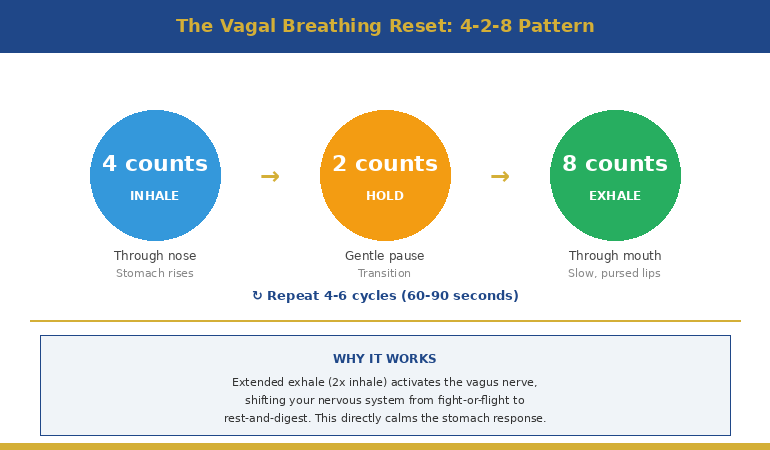
Step 3: Inhale through your nose for 4 counts.

Slow counts, about one second each. Breathe into your stomach, not your chest. Your hand should move outward. If your shoulders rise, you’re breathing too shallow — try again.

Step 4: Hold for 2 counts.

Gentle hold. Not straining. This brief pause creates the transition between the sympathetic (inhale) and parasympathetic (exhale) phases.

Step 5: Exhale through your mouth for 8 counts.

This is the critical part. The exhale must be roughly double the inhale. Slow, controlled, through slightly pursed lips — as if you’re breathing through a straw. Your hand should move inward. This extended exhale is what activates the vagus nerve.

Step 6: Repeat for 4–6 cycles.

Many people notice the nausea begin to ease by cycle 3. By cycle 5 or 6, the acute wave has often passed. Total time: roughly 60–90 seconds.


Diagram showing the vagal breathing reset technique with inhale exhale and hold timing for presentation nausea

The pattern is 4-2-8. Inhale 4. Hold 2. Exhale 8. That’s it. No apps, no special equipment, no one needs to know you’re doing it. You can do it standing in a corridor, sitting in a bathroom, or even at the table before a meeting starts.

📋 Nausea isn’t your only symptom, is it?

Calm Under Pressure covers 13 physical symptoms — shaking hands, racing heart, voice tremor, blushing, dry mouth, chest tightness, and 7 more. Each one has a timed, sequenced emergency protocol. Plus anticipatory anxiety systems for the night before, 3am wake-ups, and the morning of. Get the complete toolkit → £19.99

Why This Works When Other Breathing Techniques Don’t

If you’ve tried “deep breathing” before and it didn’t help — or made things worse — you’re not alone. There’s a specific reason standard breathing advice fails for nausea.

Most breathing exercises use equal ratios: breathe in for four, out for four. Or they emphasise the inhale — “take a deep breath.” The problem is that inhalation activates your sympathetic nervous system. When you take a big, deliberate inhale, you’re actually stimulating the fight-or-flight response slightly. For someone who’s already in sympathetic overdrive (which is what’s causing the nausea), emphasising the inhale is like throwing petrol on a fire.

The vagal reset reverses the ratio. By making the exhale twice as long as the inhale, you’re spending more time in parasympathetic activation than sympathetic. Each cycle tips the balance further toward “rest and digest.” After several cycles, you’ve shifted your autonomic state enough that the nausea signal diminishes.

This is also why the 4-7-8 technique works well for some people — it follows the same principle of extended exhalation. The 4-2-8 pattern I teach is a simplified version that’s easier to remember under stress. When you’re nauseous and panicking, you need a pattern you can recall without thinking.

The other critical difference is the hand placement. Putting your hand on your stomach does two things: it ensures you’re breathing diaphragmatically (which maximises vagal stimulation), and it gives your anxious brain something concrete to focus on. Instead of spiralling through “I’m going to be sick, everyone will notice, this is a disaster,” your attention anchors to the physical sensation of your hand moving. It’s a grounding technique disguised as a breathing exercise.

The Emergency Protocol: When You’re Already in the Bathroom

Sometimes the technique above isn’t enough to prevent an episode. Sometimes you’re already in crisis when you remember to try it. Here’s the protocol for when you’re past the prevention stage:

First: Don’t fight it.

If you’re going to be sick, let it happen. Fighting nausea increases tension in your abdomen, which makes everything worse. The physical act itself isn’t the problem — the anxiety about it is what keeps the cycle going.

Second: Cold water on your wrists.

Run cold water over the inside of your wrists for 15–20 seconds. This is a mammalian dive reflex trigger — cold on your pulse points activates your parasympathetic nervous system through a different pathway than breathing. It’s a backup route to the same destination.

Third: Start the 4-2-8 pattern immediately after.

Once the acute moment has passed, begin the vagal reset. Your body is actually more receptive to it after the release — your system is already trying to return to baseline, and the breathing pattern accelerates that process.

Fourth: Give yourself five minutes.

You don’t need to rush into the room. Five minutes of vagal breathing after an episode is enough for your system to stabilise. Your colour will return. The shaking will stop. You’ll walk in looking normal — and nobody will know what happened five minutes earlier.

I’ve used this exact protocol myself. The presentation I mentioned at the start of this article? I used an earlier version of this emergency sequence. I walked into that boardroom six minutes late, apologised for a “phone call that ran over,” and delivered the presentation. It went well. Nobody knew.

⏱️ 20-Minute Reset. 5-Minute Reset. 2-Minute Emergency Reset.

Calm Under Pressure includes three structured pre-presentation warm-up sequences — physical discharge, breathing reset, voice warm-up, mental preparation, and NLP anchor activation — timed to the minute. Plus 7 situation-specific playbooks for board presentations, virtual calls, all-hands, client pitches, job interviews, impromptu requests, and hostile Q&A. Each one adapted to the unique pressure of that context.

Get Calm Under Pressure → £19.99

Instant download. Built by a qualified clinical hypnotherapist and NLP practitioner.

Breaking the Pattern Long-Term

The vagal breathing reset is an intervention — it works in the moment. But if you’re someone who experiences nausea before every significant presentation, you’ll also want to address the pattern itself. Not just managing the symptom, but reducing the trigger.

The nausea pattern gets worse over time because of something called anticipatory conditioning. Your brain learns: presentation → nausea. Once that association is established, the nausea starts earlier and earlier. First it’s the morning of. Then it’s the night before. Eventually, some people feel it days in advance.

Breaking this cycle requires working at the nervous system level — not the cognitive level. Positive self-talk doesn’t reach the part of your brain that’s creating the association. What does work is gradually retraining your nervous system’s threat response through techniques like the fight-or-flight reset from hypnotherapy, systematic desensitisation, and building a pre-presentation routine that consistently signals safety to your nervous system.

The vagal breathing reset can actually become part of this long-term retraining. When you use it consistently before presentations — even presentations where the nausea isn’t severe — you’re building a competing association: presentation → breathing → calm. Over time, the calm pathway gets stronger and the nausea pathway gets weaker.

For a broader approach to calming nerves before presentations, combining the vagal reset with a structured pre-presentation routine produces the most reliable results.

🔍 Ready to reduce symptom intensity over time?

The 14-Day Rewiring Protocol in Calm Under Pressure combines vagal activation exercises with NLP techniques — the Confidence Anchor, Circle of Excellence, and Inner Coach reframe. Most people see a 2–4 point drop on a 10-point symptom scale by Day 14. Get the complete toolkit → £19.99

Why do I feel sick before presentations?

Pre-presentation nausea is caused by your vagus nerve responding to a perceived threat. When your brain registers a high-stakes presentation as dangerous, it activates fight-or-flight mode, which disrupts digestion, increases stomach acid, and contracts abdominal muscles. It’s an autonomic nervous system response — not weakness or poor preparation.

Can breathing exercises stop nausea?

Yes — but only specific patterns. Standard “deep breathing” with equal inhale/exhale ratios can actually make nausea worse by stimulating the sympathetic nervous system. Extended exhale patterns (like the 4-2-8 vagal reset) can help calm the vagus nerve, which influences the stomach response. Many people notice relief within 3–5 cycles.

How do I stop throwing up before a presentation?

Use the emergency protocol: don’t fight the nausea, run cold water on the inside of your wrists for 15–20 seconds (triggers the mammalian dive reflex), then immediately begin the 4-2-8 vagal breathing reset. Give yourself five minutes to stabilise before entering the room. This sequence works because it targets the nervous system through multiple pathways.

🏆 Calm Under Pressure: The Complete Physical Symptom Toolkit

The breathing technique in this article is one protocol. The toolkit has 13 — plus everything you need before, during, and after any presentation.

  • 13 Emergency Protocols: Racing heart, nausea, shaking, voice tremor, sweating, freeze, hyperventilation, blushing, dry mouth, chest tightness, dizziness, crying, talking too fast — each timed and sequenced
  • Anticipatory Anxiety: Night-before protocol, 3am wake-up protocol, morning-of protocol, can’t eat protocol, catastrophizing interrupt
  • Pre-Presentation Resets: 20-minute, 5-minute, and 2-minute emergency versions
  • NLP Toolkit: Confidence Anchor, Circle of Excellence, Inner Coach reframe, 10 cognitive reframe cards, 5-minute self-hypnosis script
  • 14-Day Rewiring Protocol: Daily exercises that reduce symptom intensity over time
  • 7 Situation Playbooks: Board, virtual, all-hands, client pitch, interview, impromptu, hostile Q&A
  • Post-Presentation Recovery: Shame spiral interrupt, 24-hour debrief protocol
  • Quick Reference Card: 13 symptoms, one-page, printable

21 pages. Built by a qualified clinical hypnotherapist who spent 5 years experiencing every symptom on this list.

Get Calm Under Pressure → £19.99

Instant download. Less than one therapy session — and you keep it forever.

📊 Want the slides too? Preparation reduces anxiety. The Executive Slide System (£39) includes confident-presenter templates designed to minimise preparation stress.

Frequently Asked Questions

Is it normal to throw up before a presentation?

It’s more common than most people realise. Severe pre-presentation nausea affects professionals at every level, including senior executives. It’s a physiological response — your vagus nerve reacting to perceived threat — not a sign of weakness or inadequacy. Many of the executives I’ve worked with experienced this for years before learning techniques that helped.

Should I eat before a presentation if I get nauseous?

Eat something small and plain about 90 minutes beforehand — a piece of toast, a banana, or crackers. An empty stomach makes nausea worse because there’s nothing to absorb the excess acid your stress response produces. Avoid caffeine, dairy, and heavy foods. Don’t eat within 30 minutes of presenting.

How long does the vagal breathing reset take to work?

Many people notice the nausea begin to ease by the third cycle (about 45 seconds). By 5–6 cycles (60–90 seconds), the acute wave has often passed. With regular practice, you may find it works faster — your nervous system can learn the “stand down” signal and respond more quickly over time.

What if the breathing technique doesn’t work for me?

If the 4-2-8 pattern doesn’t provide relief, try extending the exhale further (4-2-10) or adding the cold water wrist technique simultaneously. If nausea is persistent and severe despite these interventions, it’s worth exploring the deeper pattern with a professional who understands the nervous system — a clinical hypnotherapist or a therapist trained in somatic approaches. The symptom is treatable.

📬 The Winning Edge Newsletter

Weekly strategies for confident presentations — physical symptom management, slide structures, and executive communication techniques. No filler.

Subscribe Free →

🧠 P.S. Want to address the root cause, not just the symptom? Conquer Speaking Fear (£39) retrains the nervous system pattern that creates the anxiety in the first place.

Related reading: The presentation was perfect — the Q&A lost the deal — once the nausea is managed, preparing for the decision-making moment that follows your slides.

Your next step: The next time you feel nausea building before a presentation, stand up, place your hand on your stomach, and run through the 4-2-8 pattern. Four counts in through your nose. Two counts hold. Eight counts out through pursed lips. Five cycles. Ninety seconds. That’s all it takes to shift from “I can’t do this” to “I’ve got this.” And if nausea isn’t your only symptom — if your hands shake, your voice cracks, your heart races, or you lie awake at 3am — Calm Under Pressure (£19.99) has a timed protocol for all 13 physical symptoms, plus anticipatory anxiety systems, NLP techniques, and a 14-day rewiring protocol.

About the Author

Mary Beth Hazeldine is the Owner & Managing Director of Winning Presentations. With 24 years of corporate banking experience at JPMorgan Chase, PwC, Royal Bank of Scotland, and Commerzbank, she has delivered high-stakes presentations in boardrooms across three continents.

A qualified clinical hypnotherapist and NLP practitioner, Mary Beth combines executive communication expertise with evidence-based techniques for managing presentation anxiety. She spent five years experiencing severe presentation anxiety herself before training in the clinical approaches that resolved it — and now teaches those same techniques to senior professionals.

Book a discovery call | View services

10 Feb 2026
Professional taking a calming breath before high-stakes presentation, moment of composure

The Fight or Flight Hack I Learned From Hypnotherapy (It Works in 90 Seconds)

My heart was pounding so hard I could hear it in my ears.

I was standing outside a boardroom at JPMorgan, about to present a restructuring proposal to twelve senior executives. I’d done this a hundred times. I knew the content cold. But my body didn’t care about my experience. It had decided I was about to be eaten by a predator.

My hands were shaking. My mouth was dry. My brain was screaming at me to run — literally run — out of the building and never come back.

That was the day I realised something had to change. Not my preparation. Not my slides. Not my “mindset.” Something deeper. Something neurological.

I spent the next three years training as a clinical hypnotherapist, specifically to understand why intelligent, experienced professionals lose control of their bodies before presentations — and what actually works to stop it.

Here’s what I learned.

Quick answer: Presentation panic is an amygdala hijack — your brain’s threat detection system firing when there’s no actual threat. You can’t think your way out of it because the amygdala bypasses your rational brain. But you can interrupt it with a 90-second nervous system reset: ground your feet, slow your exhale, activate a physical anchor, and engage your peripheral vision. This shifts you from sympathetic (fight/flight) to parasympathetic (calm/focused) dominance before you enter the room.

For five years, I had a secret. I was a senior banking executive who delivered high-stakes presentations regularly — and I was terrified every single time.

Not nervous. Not “a bit anxious.” Terrified. The kind of fear where your vision narrows, your thoughts scatter, and your body feels like it belongs to someone else.

I tried everything the corporate world suggests: more preparation, more practice, more positive thinking. I visualised success. I told myself I was “excited, not nervous.” I did power poses in the bathroom.

None of it worked. Because none of it addressed the actual problem.

The problem wasn’t psychological. It was physiological. My nervous system was hijacking my body, and no amount of positive thinking could override 200,000 years of human evolution.

When I trained as a hypnotherapist, I finally understood why — and more importantly, what to do about it. (If you want the full story of how I overcame my fear of public speaking, I’ve written about that separately.)

Why Your Body Betrays You (The Neuroscience)

Here’s what’s actually happening when you feel presentation panic:

Your amygdala — the brain’s threat detection centre — has identified a potential danger: you’re about to be evaluated by a group of people. For our ancestors, group rejection meant death. Being cast out of the tribe was a survival threat.

Your amygdala doesn’t know the difference between a boardroom and a savannah. It just knows: evaluation by group = potential rejection = danger.

So it does what it’s designed to do: trigger the sympathetic nervous system. Flood your body with adrenaline and cortisol. Prepare you to fight or run.

This is the amygdala hijack. And here’s the crucial part: it happens before your rational brain gets involved.

The threat signal reaches your amygdala faster than it reaches your prefrontal cortex — the thinking brain. By the time you’re consciously aware of the fear, your body is already in full fight-or-flight mode. (This “low road” threat response was first described by neuroscientist Joseph LeDoux in his research on fear processing.)

This is why you can’t think your way out of it. By the time you’re thinking, the hijack has already happened.

You need to interrupt the nervous system directly.

The 90-Second Nervous System Reset

This technique works because it targets the vagus nerve — the main communication line between your body and your parasympathetic nervous system (the “rest and digest” system that calms you down).

Do this 2-3 minutes before you need to present:

Step 1: Ground (15 seconds)

Stand with both feet flat on the floor, hip-width apart. Press your feet down firmly — feel the floor pushing back up against you.

This isn’t metaphorical “grounding.” It’s neurological. Pressure receptors in your feet send signals to your brain that say “stable, safe, solid ground.” This interrupts the “run away” signal.

Mentally scan from the soles of your feet up through your ankles. Notice the connection to the earth. Your body is supported.

Step 2: Breathe (30 seconds)

Here’s the key most people get wrong: it’s not about breathing deeply. It’s about breathing out slowly.

Your exhale activates the parasympathetic nervous system. Your inhale activates the sympathetic (stress) system. Most anxious breathing is short inhale, short exhale — which keeps you stuck in stress mode.

The 4-7-8 pattern:

  • Inhale through your nose for 4 counts
  • Hold for 7 counts
  • Exhale slowly through your mouth for 8 counts

The extended exhale is what shifts your nervous system. Do this 3-4 times.

⚡ Presenting in the next 24 hours? Do this now (2 minutes):

  • Run the 90-second reset once (Ground → Breathe → Anchor → Peripheral)
  • Write the first sentence you’ll say when you start — just 9 words
  • Fire your anchor the moment you stand up tomorrow

If you want the guided audio version + the full calm protocol for tonight and tomorrow morning:

🎧 Emergency Relief: Guided Audio You Can Use Tonight

Conquer Speaking Fear includes a guided audio walkthrough of the 90-second reset — so you can practise with my voice in your ears instead of trying to remember each step. Use it tonight, use it tomorrow morning, use it 5 minutes before you present.

Get Conquer Speaking Fear → £39

Instant download. 30-day money-back guarantee. Printable protocol card included.

Step 3: Anchor (30 seconds)

This is the technique that changed everything for me. It’s called “anchoring” in NLP, and it gives you a physical switch to access calm on demand.

While you’re in that calm state from the breathing:

  • Press your thumb and middle finger together firmly
  • Hold for 10 seconds
  • Associate this pressure with the feeling of calm

The more you practise this (outside of stressful situations), the stronger the anchor becomes. Eventually, pressing those fingers together triggers the calm state automatically.

I’ve used this anchor in boardrooms, on stages, in TV interviews. It works because you’re not trying to create calm in the moment — you’re accessing calm you’ve already stored.

Step 4: Engage Peripheral Vision (15 seconds)

When we’re anxious, our vision narrows — literally. This is called “tunnel vision” and it’s part of the fight-or-flight response. Your brain focuses on the threat and ignores everything else.

You can reverse this deliberately:

  • Pick a spot on the wall in front of you
  • While keeping your eyes on that spot, expand your awareness to include what’s in your peripheral vision
  • Notice objects on the far left and far right without moving your eyes

This simple technique shifts your brain from “focused threat detection” to “relaxed awareness.” It’s impossible to maintain full fight-or-flight while in peripheral vision mode.

The Conquer Speaking Fear programme includes guided audio for each step of this protocol, plus advanced techniques for building permanent calm anchors.

90-second nervous system reset technique showing 4 steps: Ground, Breathe, Anchor, Engage

Why “Just Breathe” Doesn’t Work Alone

You’ve probably been told to “just breathe” before presentations. And you’ve probably found it doesn’t help much.

Here’s why: breathing alone, without the other elements, often makes anxiety worse.

When you focus intensely on your breathing while anxious, you’re focusing on a body that feels out of control. You notice how fast your heart is beating. You notice how shallow your breath is. You notice how uncomfortable you feel.

This increases anxiety, not decreases it.

The 90-second reset works because it combines multiple interventions:

  • Grounding interrupts the “run” signal
  • Extended exhale activates the parasympathetic system
  • Anchoring accesses pre-stored calm
  • Peripheral vision shifts brain state

Each element alone has some effect. Together, they’re transformative.

Physical Anchors: The Technique Nobody Teaches

Anchoring is the most powerful technique I learned in hypnotherapy training, and it’s almost never taught in corporate presentation skills courses.

The concept is simple: your brain naturally associates physical sensations with emotional states. Think of a song that instantly transports you to a specific memory and feeling. That’s an anchor — the song triggers the emotional state.

You can create these deliberately.

How to Install a Calm Anchor

Step 1: Create a genuine calm state

Do this when you’re actually relaxed — after a bath, during meditation, while listening to calming music. Don’t try to do it when you’re already anxious.

Step 2: Intensify the calm

Once you feel relaxed, focus on the feeling. Notice where you feel it in your body. Make it stronger in your imagination. Give it a colour if that helps.

Step 3: Set the anchor

At the peak of the calm feeling, press your thumb and middle finger together (or any unique physical gesture you can do discreetly). Hold for 10-15 seconds while maintaining the calm feeling.

Step 4: Release and repeat

Release the fingers, break the state (stand up, shake it off), then repeat 3-5 times in the same session.

Step 5: Test and strengthen

Later, in a neutral state, fire the anchor (press the fingers). Notice if you feel a shift toward calm. The more you repeat steps 1-4 over days and weeks, the stronger the anchor becomes.

This isn’t magic. It’s classical conditioning — the same mechanism Pavlov discovered with his dogs. You’re conditioning your nervous system to produce calm on demand.

🎯 Build a Permanent Calm Switch

The anchor installation protocol in Conquer Speaking Fear goes deeper than what I can cover here — including how to “stack” multiple calm memories into one anchor, how to test anchor strength, and how to rebuild an anchor if it weakens over time. This is the skill that transforms occasional relief into permanent confidence.

Get Conquer Speaking Fear → £39

Includes guided audio for anchor installation + stacking technique.

Before, During, and After: A Complete Protocol

The 90-second reset is for immediate pre-presentation use. But if you’re dealing with significant presentation anxiety, you need a complete protocol.

The Night Before

Do NOT review your slides obsessively. This increases anxiety by keeping the presentation front-of-mind.

Instead:

  • Do one final review in the early evening, then stop
  • Spend 10 minutes with your calm anchor (install or strengthen it)
  • Avoid alcohol (it disrupts sleep and increases next-day anxiety)
  • Go to bed at your normal time

The Morning Of

Your nervous system is most suggestible in the first 20 minutes after waking.

  • Don’t check email or news immediately — this triggers stress hormones
  • Do 5 minutes of the breathing protocol while still in bed
  • Visualise yourself calm and in control (not the presentation content — just the feeling of confidence)
  • Move your body — even a 10-minute walk shifts your nervous system state

The full morning protocol in Conquer Speaking Fear includes a specific sequence designed to set your nervous system baseline before high-stakes days.

2-3 Minutes Before

This is when you use the 90-second reset: Ground → Breathe → Anchor → Peripheral Vision.

Do this in a private space if possible — a bathroom, an empty corridor, even a stairwell. You need 90 seconds where no one will interrupt you. (For more techniques to calm your nerves before a presentation, see my dedicated guide.)

During the Presentation

If you feel anxiety rising mid-presentation:

  • Fire your anchor discreetly (press thumb and finger under the table or behind your back)
  • Slow your speaking pace deliberately — anxiety makes us rush
  • Engage peripheral vision while speaking — it’s easier than you think
  • Ground through your feet if you’re standing

Nobody will notice you doing these things. They’re invisible interventions.

After

Your nervous system doesn’t know the “threat” is over just because the presentation ended. You may feel residual anxiety for hours.

  • Don’t immediately debrief or replay what happened
  • Take 5 minutes for physical movement — walk around, stretch
  • Do 3-4 extended exhales to signal safety to your nervous system
  • Later that day, acknowledge what went well (your brain needs positive data to update its threat assessment)

What Changed for Me

That day at JPMorgan, standing outside the boardroom with my heart pounding, I didn’t have these techniques. I went in anxious, stayed anxious throughout, and delivered a presentation that was technically acceptable but emotionally flat.

Now, fifteen years and hundreds of presentations later, I still get the initial spike of adrenaline. That’s normal — it’s your body preparing for a performance. The difference is I know exactly how to channel it.

The 90-second reset isn’t about eliminating all nervousness. It’s about moving from panic (sympathetic dominance) to focused energy (balanced nervous system). The goal isn’t to feel nothing. It’s to feel ready.

You can learn to do this too. Your nervous system isn’t broken — it’s just running outdated threat detection software. You can update it.

🧠 The Complete Nervous System Control System

Everything in Conquer Speaking Fear:

  • The 90-second reset (guided audio + printable card)
  • Anchor installation protocol with memory stacking
  • Night-before and morning-of routines
  • Mid-presentation recovery techniques
  • Post-presentation nervous system reset

Get Conquer Speaking Fear → £39

Instant download. 30-day money-back guarantee. Used by hundreds of executives.

For physical symptoms specifically (shaking hands, racing heart, sweating): Calm Under Pressure (£19.99) provides targeted techniques for the body-level symptoms of presentation anxiety.

Frequently Asked Questions

How long does it take for anchoring to work?

Most people notice some effect after 3-5 installation sessions spread over a week or two. The anchor strengthens with repetition — the more you install it during genuinely calm states, the more reliable it becomes. Some of my clients have anchors they’ve been using for years that fire instantly.

What if I don’t have 90 seconds before the presentation?

If you only have 30 seconds, prioritise the extended exhale (3-4 breaths with long exhale) and fire your anchor. These two elements give you the most nervous system shift in the least time. Even one proper exhale helps.

Can this work for people with severe presentation anxiety?

Yes, but severe anxiety may need additional support. These techniques are the foundation I use with all my clients, including those with diagnosed anxiety disorders. For severe cases, I recommend combining these techniques with professional support from a therapist who understands performance anxiety specifically.

Note: These techniques are performance tools, not medical treatment. If you experience panic attacks, severe anxiety symptoms, or symptoms that significantly impact your daily life, please consult a qualified healthcare professional alongside using performance techniques.

Why does peripheral vision help with anxiety?

Tunnel vision is part of the fight-or-flight response — your brain narrows focus to the perceived threat. By deliberately engaging peripheral vision, you signal to your brain that you’re not in immediate danger (you wouldn’t be scanning the horizon if a predator were attacking). This shifts you out of the high-alert stress state.

📬 The Winning Edge Newsletter

Weekly techniques for presentation confidence and executive communication. Evidence-based strategies from a clinical hypnotherapist who’s been in the boardroom.

Subscribe free →

Related: Once your nervous system is under control, you need a presentation that’s worth delivering. Read The M&A Integration Update That Stops Panic for a framework that keeps 500 people calm when the stakes are high.

Your body’s fear response isn’t your enemy. It’s an ancient protection system that kept your ancestors alive. The problem is it can’t distinguish between a sabre-toothed tiger and a quarterly business review.

You don’t need to eliminate fear. You need to regulate it. Ground your feet. Extend your exhale. Fire your anchor. Engage your peripheral vision.

Ninety seconds. That’s all it takes to shift from panic to ready.

About the Author

Mary Beth Hazeldine is the Owner & Managing Director of Winning Presentations. A qualified clinical hypnotherapist and NLP practitioner, she spent 24 years in corporate banking at JPMorgan Chase, PwC, Royal Bank of Scotland, and Commerzbank before specialising in presentation anxiety.

Mary Beth combines evidence-based nervous system techniques with real-world executive experience. She has trained thousands of professionals in managing presentation fear and high-stakes communication pressure.

04 Feb 2026
Executive holding a pill before a presentation, deciding whether to take beta blockers for public speaking anxiety

I Kept Beta Blockers in My Desk for 3 Years. Here’s Why I Never Took One.

Quick answer: Yes, executives take beta blockers before presentations. More than you think. But medication manages the symptoms without touching the fear underneath — and after 25 years in corporate banking and training as a clinical hypnotherapist, I can tell you there is a faster, more permanent path. Here is the honest breakdown of what works, what doesn’t, and what nobody in the boardroom will admit to.

I kept a box of propranolol in my desk drawer for three years.

Not prescribed. Borrowed from a colleague who “got them for migraines.” Every Monday morning, I would open the drawer, look at the box, and wonder if today was the day I would finally take one.

I never did. Not because I was brave, but because I was more afraid of the pill than the presentation. What if it made me drowsy? What if my boss noticed? What if I became dependent and couldn’t present without it?

Those three years taught me something that changed the direction of my career entirely. Working at JPMorgan Chase, then PwC, then Royal Bank of Scotland, I discovered that the medication question isn’t really about medication at all. It is about whether you want to manage the fear — or actually resolve it.

After training as a clinical hypnotherapist, I now understand exactly why I was right to hesitate. And why so many executives don’t.

Reaching for medication before your next presentation?

There is a structured, clinical programme that addresses the fear pattern directly — no pills, no white-knuckling. It retrains the nervous system response at the subconscious level. See Conquer Speaking Fear →

Comparison chart showing beta blockers versus nervous system retraining for presentation anxiety, with pros and cons of each approach

The Pill in the Boardroom Bathroom

Let me paint you a picture you will recognise.

It is 8:47am. You are presenting the quarterly update to the leadership team at 9:00. You are sitting in the bathroom stall. Your heart is hammering so loudly you can feel it in your ears. Your hands are cold and damp. Your mouth has gone completely dry.

And you are Googling “can I take a beta blocker 15 minutes before a presentation.”

I have been that person. Many of the executives I have worked with have been that person. The medication question is the most common thing I am asked in private — and the thing nobody will raise in a group setting.

Here is the reality: beta blockers for public speaking are extraordinarily common among senior professionals. Concert musicians have used propranolol for decades. Surgeons use them. Barristers use them. And yes — your colleagues on the executive floor use them too.

The question is not whether they work. They do, for certain symptoms. The question is whether they are the right solution for you.

What Beta Blockers Actually Do (And What They Don’t)

⚕️ Not medical advice. Beta blockers are prescription medication. Talk to your GP before taking them — they are not suitable for everyone, particularly those with asthma, low blood pressure, or certain heart conditions. This article discusses their use for presentation anxiety from a practical and psychological perspective, not a clinical one.

Beta blockers — typically propranolol — work by blocking adrenaline receptors. When your fight-or-flight response fires before a presentation, adrenaline floods your body. Propranolol stops that adrenaline from reaching your heart and muscles.

What beta blockers DO:

They slow your heart rate. They reduce hand tremor. They stop the visible shaking. They prevent that “thumping chest” sensation that makes you feel like everyone can see your fear. For purely physical symptoms, they can be remarkably effective within 30–60 minutes.

What beta blockers DON’T do:

They do not touch the fear itself. They do not stop the negative thought loop (“they’re judging me,” “I’m going to forget my words,” “they can tell I’m nervous”). They do not build confidence. They do not improve your presentation skills. And critically — they do not help you the day you forget to take one.

This is the distinction most people miss. Beta blockers manage the physical expression of anxiety. They do not address the neurological pattern that creates it.

I have worked with executives who took propranolol before every presentation for five, ten, even fifteen years. When they finally forgot the pill or couldn’t get a refill in time, the panic returned at full force — sometimes worse than before, because now they had an additional fear layered on top: “I can’t present without my medication.”

Do executives take beta blockers before presentations?

Yes — far more commonly than most people realise. Beta blockers like propranolol are widely used by senior professionals to manage the physical symptoms of presentation anxiety, including racing heart and hand tremor. However, they only address symptoms and do not resolve the underlying fear. Many executives use them as a temporary bridge while developing longer-term anxiety management skills.

Your Fear Has a Pattern. You Can Break It.

Conquer Speaking Fear (£39, instant access) uses clinical hypnotherapy and NLP techniques to retrain the neurological pattern that creates presentation anxiety — not just mask the symptoms. No medication. No willpower. A different nervous system response.

Get Conquer Speaking Fear → £39

Designed by a clinical hypnotherapist with 25 years of corporate banking experience. £39, instant access.

The Executive Anxiety Secret Nobody Discusses

When I started training executives after leaving banking, the most surprising discovery was not how many professionals struggled with presentation anxiety. It was how many senior professionals struggled with it — and how completely they hid it.

Managing Directors. Partners. C-suite leaders. People who looked utterly composed at the front of the room.

Behind closed doors, here is what they told me:

“I’ve been taking propranolol before every board meeting for eight years. My wife doesn’t even know.”

“I rearranged my entire schedule last quarter to avoid presenting at the all-hands. I told my team I had a conflict.”

“I drink two glasses of wine before evening events where I might have to speak. I’ve done it for so long I don’t even think about it anymore.”

These are not weak people. These are accomplished professionals with decades of experience, running teams of hundreds, making decisions worth millions. And they are quietly medicating, drinking, or avoiding their way around a neurological pattern that nobody taught them how to change.

The shame keeps the problem invisible. And the invisibility keeps people reaching for the quick fix — because they do not know a permanent solution exists.

The Dependency Trap: When Medication Becomes a Crutch

I want to be clear: I am not anti-medication. Beta blockers are safe when prescribed appropriately, they have genuine medical applications, and for some people they serve as a valuable bridge while doing deeper work.

But here is the pattern I see repeatedly in my practice:

Stage 1: The relief. You take propranolol before a big presentation. Your heart doesn’t race. Your hands don’t shake. You think: “This is the answer.”

Stage 2: The habit. You take it before the next presentation. And the one after. You start carrying it “just in case.” The box moves from your desk drawer to your briefcase.

Stage 3: The dependency belief. You begin to believe you cannot present without it. This is not a physical dependency — beta blockers are not addictive. It is a psychological dependency. Your brain has created a new rule: “Safe presentations require medication.”

Stage 4: The expanded fear. Now you have two fears. The original presentation anxiety, plus a new one: “What happens if I can’t get my pills?” Travel, forgotten prescriptions, running out of refills — all become sources of anxiety that didn’t exist before.

This is not a theoretical risk. I have worked with three executives in the past year alone who came to me specifically because their propranolol dependency had escalated their presentation nerves rather than reduced them.

The beta blocker dependency cycle: four stages from initial relief to expanded fear, showing how medication can reinforce presentation anxiety

Is propranolol safe for public speaking?

Propranolol is generally considered safe for occasional use before presentations when prescribed by a doctor. It effectively reduces physical symptoms like rapid heartbeat and trembling. However, it can cause lightheadedness, fatigue, and a feeling of emotional disconnection. The larger concern is not physical safety but psychological dependency — the belief that you cannot present without it — which reinforces the anxiety pattern rather than resolving it.

Stop Managing the Symptom. Resolve the Cause.

Conquer Speaking Fear (£39, instant access) is built on the same clinical hypnotherapy and NLP techniques that resolved my own 5-year presentation phobia — without medication, without white-knuckling it, without “just pushing through.” The nervous system pattern changes permanently.

Get Conquer Speaking Fear → £39

25 years of corporate banking experience. Qualified clinical hypnotherapist and NLP practitioner. £39 — a fraction of the cost of one therapy session.

What Actually Works Long-Term (From a Hypnotherapist Who Lived It)

I was terrified of presenting for five years. Not mildly nervous — terrified. Racing heart, dry mouth, shallow breathing, the full physiological cascade that makes you want to cancel, call in sick, or find any excuse to let someone else present.

Beta blockers would have masked the symptoms. But here is what actually resolved the fear permanently:

1. Understand the pattern. Presentation anxiety is not a character flaw. It is a learned neurological response — your amygdala firing a threat signal based on a past experience (or series of experiences) where speaking in front of others felt dangerous. Once you see it as a pattern, you can change it.

2. Work at the subconscious level. This is where medication falls short. The fear response is generated below conscious awareness. Talking about it (traditional therapy) and thinking about it (willpower) operate at the wrong level. Clinical hypnotherapy and NLP techniques access the subconscious pattern directly.

3. Replace the response — don’t suppress it. Beta blockers suppress adrenaline. Hypnotherapy replaces the fear trigger with a calm, resourceful state. The difference: suppression requires ongoing medication. Replacement is permanent.

4. Build evidence. Every successful presentation without medication builds genuine neural evidence that you can do this. Medication-assisted presentations don’t build this evidence — your brain attributes the calm to the pill, not to you.

This is exactly the approach I built into Conquer Speaking Fear — the same techniques that got me from vomiting in the corridor to confidently presenting to boardrooms across three continents.

Retrain Your Nervous System — Not Just Your Symptoms

Here is the simplest way to think about the choice:

Beta blockers = turn down the volume on the alarm. The alarm still fires. You just don’t hear it as loudly. Remove the volume control, and the alarm is still there.

Nervous system retraining = change what triggers the alarm. When the presenting situation no longer registers as a threat, the alarm doesn’t fire. Nothing to suppress. Nothing to medicate. Nothing to remember to pack in your briefcase.

I have worked with executives who spent years — and thousands of pounds — on therapy, coaching, and medication. When they finally addressed the subconscious pattern, the shift happened in weeks, not years.

If you are currently using beta blockers and they are helping you function, I am not suggesting you stop immediately. But I am suggesting you start building the permanent solution alongside them. Use the medication as a bridge, not a destination. Work on calming your nerves at the source, and you will find you need the bridge less and less — until one day you leave the pill in the drawer and present anyway.

That is the day everything changes.

What are natural alternatives to beta blockers for presentations?

The most effective natural alternatives address the root neurological pattern rather than just symptoms. Clinical hypnotherapy and NLP retraining can permanently change the fear response. For immediate physical relief, diaphragmatic breathing (4-7-8 technique), peripheral vision activation, and bilateral stimulation can reduce the fight-or-flight response within 60–90 seconds. These techniques build genuine confidence because your brain learns it can manage the situation without external support.

🎓 25 Years Coaching Senior Professionals Without Beta Blockers

Conquer Your Fear of Public Speaking is built from 16 years coaching senior professionals across financial services, consulting, healthcare, and technology — alongside 25 years of corporate banking experience. Every technique — the nervous system regulation work, the breathing protocols, the cognitive reframing scripts — comes from real client work with executives who chose to build genuine confidence rather than mask symptoms.

Designed for senior professionals who want to manage acute presentation anxiety without medication — and build the regulation skills that last.

Get Conquer Your Fear of Public Speaking → £39

Instant download — lifetime access to every framework and technique.

Frequently Asked Questions

Can I take beta blockers and do nervous system retraining at the same time?

Absolutely — and this is often the smartest approach. Use beta blockers as a bridge while actively retraining your fear response through hypnotherapy or NLP techniques. As the retraining takes effect, you will naturally find you need the medication less. Many of my clients follow this exact path: medication provides immediate relief while the deeper work creates permanent change. The key is treating the medication as temporary support, not a long-term solution.

My presentation anxiety is only physical — surely medication is the right answer?

This is one of the most common misconceptions. What feels “only physical” — racing heart, trembling, sweating — is actually the physical expression of a subconscious fear pattern. Your amygdala detects a perceived threat and triggers the adrenaline cascade. Beta blockers block the adrenaline from reaching your muscles and heart, but your amygdala still fires the threat signal every single time. Address the signal itself, and the physical symptoms resolve naturally without medication.

How long does nervous system retraining take compared to medication?

Medication works in 30–60 minutes but stops working when you stop taking it. Nervous system retraining through clinical hypnotherapy and NLP typically shows significant improvement within 2–4 weeks of consistent practice, with permanent results. Most executives I work with notice a measurable reduction in their presentation anxiety after the first week. The trade-off is clear: immediate but temporary symptom relief versus slightly longer but permanent resolution.

Will my doctor judge me for asking about beta blockers for presentations?

No. GPs prescribe propranolol for performance anxiety regularly — it is one of the most common off-label uses. If you want to discuss it with your doctor, be direct: “I experience significant physical anxiety symptoms before work presentations and I would like to discuss whether propranolol might help as a short-term bridge while I work on longer-term solutions.” Most doctors will appreciate the thoughtful approach and the fact that you are not looking for a permanent prescription.

📧 The Winning Edge Newsletter

Weekly insights on presentation confidence, evidence-based anxiety techniques, and what actually works for professionals who need to present at a senior level.

Subscribe Free →

Not ready for the full programme? Start here instead — download the free 7 Presentation Frameworks guide, which gives you a structured foundation so your nervous system has one less unknown to panic about.

📌 Related: Even when the anxiety is managed, most executives receive feedback that sounds positive but means nothing. Read Why “Great Presentation” Is the Worst Feedback You Can Get — and learn how to get the actionable input that actually improves your next performance.

Your next step: If you have been reaching for medication before presentations — or thinking about it — recognise that as a signal, not a solution. The fear has a pattern. The pattern can be changed. Start with understanding why the fear exists, then use Conquer Speaking Fear to retrain the response permanently.

Leave the pill in the drawer. Build the skill instead.

About the Author

Mary Beth Hazeldine is the Owner & Managing Director of Winning Presentations. With 25 years of corporate banking experience at JPMorgan Chase, PwC, Royal Bank of Scotland, and Commerzbank, she has delivered high-stakes presentations in boardrooms across three continents.

A qualified clinical hypnotherapist and NLP practitioner, Mary Beth combines executive communication expertise with evidence-based techniques for managing presentation anxiety. She advises executives across financial services, healthcare, technology, and government on managing presentation anxiety and high-stakes speaking situations.

Book a discovery call | View services

23 Jan 2026
Woman with a slight smile and eyes closed thinking "I found what works."

Sweating During Presentations? The 60-Second Reset That Stopped Mine Cold

I watched the dark patches spread across my shirt in real-time. Thirty executives were watching me present—and watching me visibly fall apart.

Quick answer: Sweating during presentations is your sympathetic nervous system responding to perceived threat. The harder you try to stop it, the worse it gets—because fighting the response adds more stress to an already activated system. The technique that works: a 60-second parasympathetic reset that calms your nervous system from the inside out, stopping the sweat response before it becomes visible.

In practice, stopping presentation sweating means working WITH your nervous system rather than against it—using specific breathing patterns, grounding techniques, and pre-presentation protocols that prevent the cascade before it starts.

Written by Mary Beth Hazeldine — executive presentation coach, trained clinical hypnotherapist, 24 years corporate banking experience. Last updated: January 2026.

🚨 Presenting TODAY? The 2-minute emergency protocol:

  1. Bathroom reset: Run cold water on your wrists for 30 seconds + 3 slow exhales
  2. Temperature drop: Remove jacket until right before you present; stay in cooler areas
  3. First 30 seconds script: Memorize your opening line so you don’t have to think while nervous
  4. Anchor object: Hold a pen or clicker—gives your hands something to do and hides any trembling

This won’t eliminate the response, but it will reduce visible symptoms enough to get through. For lasting change, use the full protocol below.

📅 Presenting in the next 7 days? Do this now:

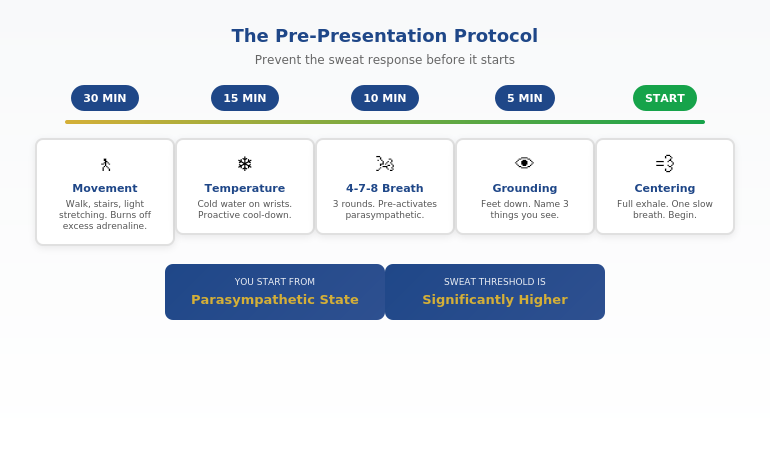
  1. 10 minutes before: Find a private space and do the 4-7-8 breath (inhale 4, hold 7, exhale 8) three times
  2. 5 minutes before: Press your feet firmly into the floor and notice 3 things you can see
  3. Right before you stand: Exhale completely, then take one slow breath
  4. If sweating starts: Slow your speech, press your feet down, and let the wave pass (60 seconds)

This works because it activates your parasympathetic nervous system—the “rest and digest” mode that naturally reduces sweating.

After my shirt incident, I spent three years learning everything I could about the nervous system and presentation anxiety. What I discovered changed everything—and it had nothing to do with “confidence tips” or “just relaxing.”

The executives who don’t visibly sweat aren’t less nervous. They’ve learned to work with their nervous system instead of against it.

If sweating during presentations has ever made you dread speaking up, this article gives you the exact technique that finally worked for me—and the hundreds of executives I’ve taught since.

Why You Sweat During Presentations (It’s Not What You Think)

Here’s what’s actually happening when you start sweating during presentations:

Your brain detects a threat. Not a physical threat—a social one. The possibility of judgement, embarrassment, or failure. To your ancient nervous system, social rejection was genuinely dangerous. So it responds the same way it would to a predator.

Your sympathetic nervous system activates. Adrenaline floods your system. Your heart rate increases. Blood flow shifts to your muscles (preparing you to run). And your body starts cooling itself down—because it thinks you’re about to need to sprint.

That’s why you sweat. Your body is preparing for physical exertion that never comes.

I see this pattern constantly: high-performing executives who are calm in genuinely high-stakes situations—negotiations, crises, difficult conversations—but who visibly sweat the moment they have to present to a group. It’s not about competence or confidence. It’s about how your nervous system has learned to respond to this specific trigger.

A finance director named Sarah told me: “I can face a hostile CFO in a one-on-one meeting without breaking a sweat. But put me in front of a group with a PowerPoint, and I’m drenched within five minutes. It makes no sense.”

It makes perfect sense—once you understand it’s not a character flaw. It’s a nervous system pattern. And patterns can be changed.

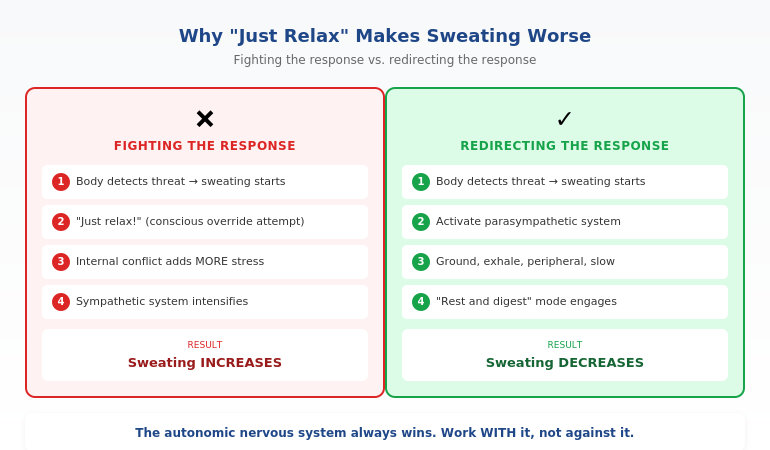
Why “Just Relax” Makes Sweating Worse

The worst advice anyone can give someone who sweats during presentations: “Just relax.”

Here’s why this backfires: trying to relax when your sympathetic nervous system is activated creates internal conflict. Part of you is saying “danger!” while another part is saying “stop reacting to danger!” This conflict adds more stress to an already stressed system.

The result? You sweat more.

A client named James described it perfectly: “I’d be standing there telling myself to calm down, and I could feel myself getting hotter. The harder I tried to relax, the worse it got. It was like my body was fighting itself.”

That’s exactly what was happening. His conscious mind was trying to override his autonomic nervous system—and the autonomic system always wins that fight.

The solution isn’t to fight the response. It’s to redirect it.

Diagram showing why fighting the sweat response makes it worse - the sympathetic vs parasympathetic nervous system during presentations

⭐ Stop the Sweat Response Before It Starts

Calm Under Pressure gives you the complete nervous system toolkit—the exact techniques that stop visible sweating by working WITH your biology, not against it.

What’s inside:

  • The 60-second parasympathetic reset (works mid-presentation)
  • Pre-presentation protocol (prevents activation entirely)
  • Emergency recovery techniques (when sweating has already started)

Get Calm Under Pressure → £19.99

Built from clinical hypnotherapy training + 24 years coaching executives through high-stakes moments.

Instant download • Use it today • Keep forever

📦 What You Get (Specifically):

  • The complete 60-second reset — step-by-step technique you can use invisibly during presentations
  • Pre-presentation protocol — the 10-minute sequence that prevents nervous system activation
  • Emergency recovery guide — what to do when sweating has already started
  • The science explained simply — understand why these techniques work (so you trust them)
  • Quick-reference cards — pocket-sized reminders for before you present

📌 What Calm Under Pressure gives you that this article can’t:

  • The complete guided walkthrough — not just what to do, but exactly how to do it with timing cues
  • The layered protocol — techniques that build on each other for cumulative nervous system retraining
  • The emergency recovery scripts — word-for-word phrases for when sweating starts mid-presentation

This article gives you the method. The product gives you the repeatable system you can use in 7 minutes.

The 60-Second Parasympathetic Reset

This is the technique that finally stopped my visible sweating during presentations. It works because it activates your parasympathetic nervous system—the “rest and digest” mode that naturally opposes the stress response.

You can do this invisibly, even while presenting.

Step 1: Ground Your Feet (5 seconds)

Press your feet firmly into the floor. Feel the pressure. This activates sensory pathways that signal “safety” to your nervous system. You’re not running. You’re grounded.

Step 2: Extended Exhale (15 seconds)

Take a breath in through your nose (4 counts). Then exhale slowly through your mouth (8 counts). The extended exhale is the key—it directly stimulates the vagus nerve, which activates parasympathetic response.

One breath with this ratio can begin shifting your nervous system state.

Step 3: Peripheral Vision (20 seconds)

Without moving your head, expand your awareness to the edges of your vision. Notice what’s in your peripheral field. This is counterintuitive, but it works: peripheral vision activates a different neural pathway than focused vision—one associated with calm alertness rather than threat detection.

Step 4: Slow Your Speech (20 seconds)

Deliberately slow down your words. Pause between sentences. This creates a feedback loop: slow speech signals to your nervous system that there’s no emergency, which reduces activation, which makes it easier to speak slowly.

A product director named Michael told me this was the breakthrough: “I always rushed when I was nervous, which made me more nervous. When I forced myself to slow down—even though it felt uncomfortable—my body actually calmed down. It was like I was telling my nervous system ‘we’re safe’ through my behavior.”

The entire sequence takes 60 seconds. And the sweat response begins to subside.

For more on breathing techniques, see the complete guide to presentation breathing.

Want the complete 60-second reset with guided walkthrough? Calm Under Pressure includes the full technique plus audio guidance you can use before any presentation. Get the Full Technique → £19.99

Instant download • Use it today • Keep forever

The Pre-Presentation Protocol (Prevent Before It Starts)

The best way to stop sweating during presentations is to prevent the nervous system cascade from starting in the first place. This requires a specific pre-presentation protocol—not “psych yourself up” motivation, but deliberate nervous system preparation.

Here’s the protocol I use with executives:

30 Minutes Before: Movement

Get your body moving. Walk briskly. Take stairs. Do some light stretching in a private space. This burns off excess adrenaline before you need to stand still and present.

A VP of sales named Rebecca told me: “I used to sit and review my notes obsessively before presenting. Now I walk the hallway. It sounds too simple, but the difference is dramatic.”

15 Minutes Before: Temperature Management

Cool down proactively. Splash cold water on your wrists. If possible, stand somewhere cooler than the presentation room. Your body sweats to cool down—if you’re already cool, the threshold is higher.

10 Minutes Before: The 4-7-8 Sequence

Find a private space. Do three rounds of 4-7-8 breathing: inhale for 4 counts, hold for 7, exhale for 8. This pre-activates your parasympathetic system so you start from a calmer baseline.

5 Minutes Before: Grounding + Observation

Press your feet into the floor. Look around the room and name (silently) three things you can see. This anchors you in the present moment rather than future catastrophizing.

Right Before You Start: The Centering Breath

Exhale completely. Then take one slow, full breath. Begin speaking on the exhale of that breath. This ensures you start from a parasympathetic state rather than a sympathetic one.

Related: See how to calm nerves before a presentation for additional pre-presentation techniques.

The pre-presentation protocol timeline showing when to do each nervous system technique before presenting

⭐ If You Sweat Even When You’re Fully Prepared

That’s the most frustrating part—you know your content, but your body doesn’t get the memo. Calm Under Pressure works on the nervous system level, not the “confidence” level.

Specifically designed for:

  • Executives who sweat despite thorough preparation
  • Presenters whose sweating is paired with racing heart or shaky voice
  • Professionals who’ve tried “just relaxing” and made it worse

Get Calm Under Pressure → £19.99

Works because it targets the autonomic nervous system—not your mindset.

Instant download • Use it today • Keep forever

What to Do If Sweating Starts Mid-Presentation

Sometimes, despite preparation, the sweat starts. Here’s how to handle it without making things worse.

Don’t Acknowledge It

The instinct is to apologize or call attention to it. “Sorry, it’s warm in here.” Resist this. Drawing attention to sweating increases your self-consciousness, which increases sympathetic activation, which increases sweating.

Most people notice sweating far less than you think. And if they do notice, they’ll forget within minutes—unless you make it memorable by talking about it.

Use the 60-Second Reset (Invisibly)

Press your feet down. Take a slow breath with an extended exhale. Expand your peripheral vision. Slow your speech. You can do all of this while continuing to present—no one will notice.

Take a Strategic Pause

Ask a question. “Before I continue, does anyone have questions about what I’ve covered so far?” This gives you 30-60 seconds where attention is on the audience, not you. Use that time to do the reset.

A marketing director named David told me this saved him in a board presentation: “I could feel the sweat starting. Instead of powering through, I asked a question. While they were thinking, I did the grounding and breathing. By the time I continued, the wave had passed.”

Let the Wave Pass

Here’s the most important thing to understand: the acute sweat response lasts about 60-90 seconds. If you can ride through that window without adding more stress (by fighting it or catastrophizing), the intensity naturally decreases.

Your job isn’t to stop the wave. It’s to not make the wave bigger. The techniques above help you do that.

If you’re also dealing with other physical symptoms during high-stakes presentations, see what senior leaders actually do about high-stakes nerves.

Want the complete emergency recovery guide? Calm Under Pressure includes exactly what to do when sweating starts mid-presentation—plus techniques for other physical symptoms. Get Emergency Recovery Guide → £19.99

Instant download • Use it today • Keep forever

Frequently Asked Questions

Why do I sweat so much when presenting?

Sweating during presentations happens because your sympathetic nervous system detects social evaluation as a threat and triggers the stress response. Your body prepares for physical exertion (fight or flight) by cooling itself down—hence the sweating. This is a normal nervous system response, not a character flaw. The solution is learning to activate your parasympathetic system (the “rest and digest” mode) through specific techniques like grounding, extended exhales, and peripheral vision.

How do I stop nervous sweating when presenting?

To stop nervous sweating when presenting, use the 60-second parasympathetic reset: press your feet firmly into the floor (grounding), take a breath with an extended exhale (4 counts in, 8 counts out), expand your peripheral vision, and deliberately slow your speech. This activates your parasympathetic nervous system, which naturally opposes the sweat response. Prevention is even more effective—use the pre-presentation protocol starting 30 minutes before you speak.

Can you train yourself not to sweat when nervous?

Yes. Sweating when nervous is a learned nervous system pattern, and patterns can be retrained. With consistent practice of parasympathetic activation techniques—before, during, and after presentations—your nervous system learns that presenting isn’t actually dangerous. Most executives I work with see significant improvement within 4-6 presentations using the pre-presentation protocol and 60-second reset consistently.

Does everyone notice when I’m sweating during a presentation?

Far less than you think. When you’re sweating, your attention is hyperfocused on the sensation—which makes it feel enormous. But audiences are focused on your content, not your forehead. Unless you draw attention to it (“Sorry, it’s so hot in here”), most people won’t notice or remember. And even if they notice, they’ll attribute it to the room being warm, not to you being nervous.

What if I start sweating before I even begin speaking?

This is anticipatory anxiety, and the pre-presentation protocol is specifically designed for it. Start the protocol 30 minutes before: movement, temperature management, 4-7-8 breathing, grounding. If sweating starts despite this, use the 60-second reset before you begin. You can do this while waiting to be introduced—press feet down, extended exhale, peripheral vision. Start speaking only after one centering breath.

Are there clothes that help hide presentation sweating?

Yes—but this should be backup, not primary strategy. Dark colors (navy, black, charcoal) hide sweat marks better than light colors. Natural fabrics (cotton, wool) breathe better than synthetics. Layering with a jacket gives you coverage. But more important than clothing is the nervous system work—the techniques in this article will reduce sweating at the source, not just hide it.

Should I tell the audience I’m nervous?

Generally, no. While vulnerability can build connection, drawing attention to sweating often backfires—it increases your self-consciousness and primes the audience to watch for signs of nervousness. A better approach: acknowledge nothing, use the 60-second reset, and let the wave pass. If someone directly asks if you’re okay, a simple “I’m good, thanks” is sufficient.

Is This Right For You?

✓ This is for you if:

  • You experience visible sweating when presenting (even when prepared)
  • You’ve tried “just relaxing” and it made things worse
  • You want techniques that work WITH your nervous system
  • You’re willing to practice the protocol consistently

✗ This is NOT for you if:

  • You have a medical condition causing excessive sweating (see a doctor first)
  • You’re looking for a pill or quick fix
  • You’re not willing to practice techniques before presentations
  • You want generic “confidence tips”

⭐ The Technique That Finally Stopped My Visible Sweating

After my shirt incident in front of 30 executives, I spent three years learning the nervous system. Calm Under Pressure is everything that actually worked—distilled into techniques you can use before your next presentation.

What you’ll use immediately:

  • 60-second parasympathetic reset
  • Pre-presentation protocol (30-minute countdown)
  • Emergency recovery techniques

Get Calm Under Pressure → £19.99

Built from clinical hypnotherapy training + 24 years coaching executives through visible anxiety.

Instant download • Use it today • Keep forever

📧 The Winning Edge Newsletter

Weekly techniques for presentation confidence, nervous system management, and the psychology of high-stakes speaking. For professionals who want to present without visible anxiety.

Subscribe Free →

Your Next Step

If sweating during presentations has made you dread speaking up, you now understand why—and more importantly, what to do about it.

The executives who present without visible sweating aren’t less nervous. They’ve learned to work with their nervous system instead of against it. Grounding. Extended exhales. Peripheral vision. Slowing down. These aren’t “tips”—they’re direct interventions in your autonomic response.

Start with the 60-second reset in your next presentation. Practice the pre-presentation protocol. Let the wave pass without fighting it.

For the complete system with guided techniques, get Calm Under Pressure → £19.99.

If you’re also facing a high-stakes presentation where the content itself is difficult (like presenting after a project failure), see how to present after failure without destroying your credibility—today’s partner article on the structure that rebuilds trust.

About the Author

Mary Beth Hazeldine is the founder of Winning Presentations and creator of Calm Under Pressure. The “shirt incident” that opened this article happened to her—and it launched a three-year deep dive into nervous system science that changed how she approaches presentation anxiety.

With 24 years of corporate experience at JPMorgan Chase, PwC, Royal Bank of Scotland, and Commerzbank, plus training as a clinical hypnotherapist, she brings a unique perspective on the physiological reality of presentation nerves—and how to actually change it.

Book a discovery call | View services

19 Jan 2026
How to stop saying um - the pause and breathe technique for eliminating filler words

How to Stop Saying Um (Without Sounding Robotic)

Quick answer: Learning how to stop saying um isn’t about willpower—it’s about replacing the filler with a deliberate pause. When you feel “um” coming, close your mouth, take one breath, then continue. This 3-second reset interrupts the nervous system pattern that causes filler words. Within two weeks of practice, most professionals reduce their ums by 70% or more.

⚡ Presenting or speaking in a meeting soon? Try this now:

Step 1: When you feel “um” rising, close your mouth completely

Step 2: Take one silent breath through your nose

Step 3: Continue speaking only when you know your next word

The pause feels longer to you than to your audience. What they see is confidence.

The Meeting That Made Me Finally Fix This

A client once sent me a recording of her team presentation. She wanted feedback on her content. Instead, I counted 47 “ums” in 12 minutes.

She was mortified. “I had no idea I did that.”

Most people don’t. Filler words operate below conscious awareness—until someone points them out, or worse, until you notice colleagues checking their phones while you speak.

The good news: as a clinical hypnotherapist and presentation coach, I’ve helped hundreds of professionals eliminate this habit. Not by trying harder. Not by recording themselves obsessively. But by understanding why “um” happens in the first place—and interrupting the pattern at its source.

Here’s what actually works.

⭐ Eliminate Filler Words at the Source

Stop fighting symptoms. Address the nervous system patterns that cause “um,” “uh,” and rambling in the first place.

Includes:

  • The Pause-and-Breathe Protocol (rewires your default response)
  • Pre-presentation nervous system reset techniques
  • Scripts for high-pressure Q&A without filler words

Get Conquer Speaking Fear → £39

Developed by a clinical hypnotherapist with 24 years of corporate experience. Techniques drawn from neuroscience, NLP, and real boardroom testing.

Why You Say Um (It’s Not What You Think)

“Um” isn’t a vocabulary problem. It’s a nervous system problem.

When you speak under pressure—whether it’s a presentation, a meeting, or even a casual conversation where you feel judged—your brain enters a mild stress state. In this state, two things happen simultaneously:

1. Your thoughts speed up. Stress hormones accelerate mental processing. Ideas come faster than you can articulate them.

2. Your mouth tries to keep up. Rather than pause (which feels vulnerable), your brain fills the gap with sound. “Um” is that sound. It’s your nervous system saying “don’t stop talking or they’ll think you’re incompetent.”

This is why willpower doesn’t work. You can’t think your way out of a stress response. Telling yourself “don’t say um” actually makes it worse—you’re adding cognitive load to an already overloaded system.

The solution isn’t to try harder. It’s to give your nervous system a different option.

The Pause-and-Breathe Technique

Here’s how to stop saying um using a method that works with your neurology, not against it:

Step 1: Recognise the “um impulse.”

There’s a micro-moment before every “um” where you feel the urge to fill silence. It might feel like pressure in your throat, a slight panic, or just the sense that you need to keep making sound. Learn to notice this moment.

Step 2: Close your mouth.

Physically close your lips. This is critical. You cannot say “um” with your mouth closed. It sounds obvious, but this physical interruption breaks the automatic pattern.

Step 3: Take one breath.

Breathe in through your nose. This does two things: it gives your brain oxygen (improving clarity) and it activates your parasympathetic nervous system (reducing the stress response that caused the filler word).

Step 4: Speak only when you have your next word.

Don’t open your mouth until you know exactly what you’re going to say. The pause might feel like three seconds to you. To your audience, it looks like confidence.

This technique works because it replaces the filler behaviour with a different behaviour. You’re not eliminating anything—you’re substituting.

Want the complete system for calm, confident speaking? Conquer Speaking Fear includes the full Pause-and-Breathe Protocol plus techniques for managing nerves before you even start speaking. Get instant access →

How to Practice Without Feeling Awkward

The technique is simple. The challenge is making it automatic. Here’s how to practice without driving yourself crazy:

Low-stakes conversation practice (Week 1):

Practice the pause-and-breathe in conversations that don’t matter—ordering coffee, chatting with a neighbour, calling customer service. The goal isn’t perfection. It’s building the muscle memory of pausing instead of filling.

Recording review (Week 2):

Record yourself for 2 minutes talking about your weekend. Watch it back. Don’t count your ums—notice where they happen. Are they at the start of sentences? During transitions? When you’re searching for a specific word? This tells you when to deploy the pause.

Meeting integration (Week 3+):

Start using the technique in real meetings. Pick one meeting per day where you consciously practice. Don’t try to eliminate every filler word—focus on the first one. Catch that first “um impulse” and pause instead. Success builds on itself.

Most people see significant improvement within 2-3 weeks. The filler words don’t disappear entirely (and they don’t need to), but they reduce by 60-80%.


The Pause-and-Breathe Technique: 4 steps to stop saying um - recognize the impulse, close your mouth, take one breath, speak when ready

⭐ Speak Without the Mental Scramble

Filler words are a symptom. The real problem is the anxiety underneath. Address both with techniques that actually stick.

You’ll learn:

  • How to reset your nervous system before high-stakes conversations
  • The “clarity pause” technique for Q&A sessions
  • Why traditional advice (“just relax”) makes anxiety worse

Get the Complete System → £39

Instant download. Start applying these techniques to your next meeting.

Advanced Techniques for High-Stakes Situations

The pause-and-breathe technique handles everyday speaking. But what about high-pressure moments—board presentations, job interviews, client pitches?

The pre-meeting reset:

Five minutes before any high-stakes conversation, find a private space. Take six slow breaths (4 counts in, 6 counts out). This activates your parasympathetic nervous system and reduces the stress hormones that cause filler words. Learn more about pre-presentation calming techniques here.

The “first sentence” anchor:

Memorise your first sentence word-for-word. Not your whole opening—just the first sentence. When you know exactly how you’ll start, you eliminate the uncertainty that triggers early filler words. A clean start builds momentum.

The Q&A pause protocol:

Questions trigger more “ums” than any other speaking situation. Here’s why: you’re processing and speaking simultaneously. Solution: after someone asks a question, pause for a full 2 seconds before answering. Say “That’s a good question” if you need a bridge. Then answer. This tiny delay gives your brain time to formulate a complete thought.

If you tend to ramble when nervous, these techniques work together. Pausing naturally creates shorter, more structured responses.

Ready to eliminate speaking anxiety entirely? Conquer Speaking Fear goes beyond filler words to address the root cause: the nervous system patterns that create anxiety in the first place. See what’s included →

Related: Once you’ve eliminated filler words, make sure your slides don’t undermine your newfound confidence. Read Executive Presentation Structure: The Format That Gets Instant Buy-In.

Common Questions About Filler Words

Why do I say um so much?

“Um” is a stress response, not a speech habit. When your brain processes faster than your mouth can speak (which happens under pressure), it fills the gap with sound rather than silence. This is an automatic nervous system behaviour—which is why trying to “just stop” doesn’t work. The solution is replacing the filler with a deliberate pause, which gives your brain time to catch up.

How do I train myself to stop saying um?

Train the pause-and-breathe technique: when you feel the “um impulse,” close your mouth, take one breath, then speak only when you know your next word. Practice in low-stakes conversations first (ordering coffee, casual chats), then gradually apply it in meetings. Most people see 60-80% reduction within 2-3 weeks of consistent practice.

Is saying um unprofessional?

Occasional filler words are normal and human. Excessive filler words (more than 3-4 per minute) can signal nervousness and reduce perceived confidence. The goal isn’t to eliminate every “um”—it’s to reduce them enough that they don’t distract from your message. Research suggests audiences stop noticing filler words below a certain threshold.

⭐ Speak With Confidence—Not Filler Words

Stop the mental scramble that causes “um.” Get techniques that work with your nervous system, not against it.

What’s inside:

  • The Pause-and-Breathe Protocol (step-by-step)
  • Pre-meeting nervous system reset
  • Q&A confidence techniques
  • Scripts for high-stakes situations

Get Instant Access → £39

Developed by a qualified clinical hypnotherapist. Techniques tested in real boardrooms, client pitches, and high-stakes presentations.

FAQ

How long does it take to reduce filler words?

Most people see noticeable improvement within 2-3 weeks of consistent practice. The first week focuses on awareness and low-stakes practice. By week three, the pause-and-breathe technique starts becoming automatic. Complete elimination isn’t the goal—reducing filler words by 60-80% is realistic and sufficient for professional impact.

What if I can’t pause—my mind races too fast?

Racing thoughts are a sign of elevated stress hormones, not a personality trait. The pre-meeting breathing reset (6 slow breaths before speaking) reduces this significantly. If your mind still races during speaking, shorten your sentences. Aim for one idea per sentence. Racing thoughts can’t outpace short, complete statements.

Does this work for virtual meetings too?

Yes—and pauses are actually more powerful on video. On camera, filler words stand out more because there’s less visual information to distract from them. The pause-and-breathe technique works identically in virtual settings. Bonus: you can keep a sticky note with “PAUSE” written on it near your camera as a reminder.

Should I ask someone to count my ums?

This usually backfires. Having someone count your filler words increases self-consciousness, which increases stress, which increases filler words. Instead, record yourself occasionally and review privately. Notice patterns without judgement. The goal is awareness, not punishment.

📧 The Winning Edge Newsletter

Weekly techniques for confident speaking, presentation skills, and career communication. No fluff—just actionable methods from a clinical hypnotherapist with 24 years in corporate banking.

Subscribe Free →

Your Next Step

Learning how to stop saying um isn’t about willpower or self-criticism. It’s about giving your nervous system a better option than filling silence with sound.

Try the pause-and-breathe technique in your next conversation. Close your mouth when you feel the filler word coming. Take one breath. Speak when you’re ready. It will feel awkward at first—and your audience won’t notice anything except that you sound more confident.

If you want the complete system for eliminating speaking anxiety—not just filler words, but the underlying nervousness that causes them—get Conquer Speaking Fear.

📋 Free Resource: Public Speaking Cheat Sheets

Quick-reference cards covering body language, vocal techniques, and confidence signals. Perfect companion to the pause-and-breathe technique.

Download Free Cheat Sheets →

About the Author

Mary Beth Hazeldine is the Owner & Managing Director of Winning Presentations and a former corporate banker with 24 years of experience at JPMorgan Chase, PwC, Royal Bank of Scotland, and Commerzbank. She has trained thousands of professionals on high-stakes presentation skills and helped clients secure more than £250 million in funding and budget approvals.

Mary Beth is also a qualified clinical hypnotherapist and NLP practitioner, specialising in helping professionals overcome presentation anxiety and speaking fear. After spending five years battling her own terror of presenting at JPMorgan, she developed the neuroscience-based techniques she now teaches to executives worldwide.

Book a discovery call | View services

15 Jan 2026
Professional woman with hand on chest, eyes closed, showing relief and calm after using presentation breathing techniques

My Heart Was Racing So Fast I Could Hear It. Then I Learned This.

I was hyperventilating in the corridor outside the boardroom.

“Just take deep breaths,” my colleague said. So I did. Big, gulping breaths. My heart raced faster. My hands tingled. I felt dizzy. The “calming” advice was making everything worse.

That was 2003, during my second year at JPMorgan. I had three minutes until I had to present quarterly results to 40 people. And I genuinely thought I might pass out.

What I didn’t know then—what took me five more years of presentation terror and eventually training as a clinical hypnotherapist to understand—is that “deep breathing” is dangerously incomplete advice. It’s not the depth of your breath that calms your nervous system. It’s the ratio.

The technique I’m about to share takes 60 seconds. I’ve been teaching it to executives across financial services, healthcare, technology, and government ever since. It works every single time—because it’s based on how your nervous system actually functions, not on wishful thinking.Last updated:

January 2026 — with the latest Navy SEALs breathing technique..

If you want a structured approach to managing presentation nerves: Explore Conquer Your Fear of Public Speaking →

A neuroscience-based programme for professionals who want to present with genuine confidence.

In This Article

⭐ Stop the Physical Symptoms Before They Start

Calm Under Pressure (£19.99, instant access) gives you the complete nervous system reset toolkit—so you walk into presentations with steady hands, clear voice, and controlled heart rate.

Includes:

  • The 60-Second Reset Protocol (audio + written)
  • Pre-presentation body scan technique
  • Emergency “in the moment” recovery methods
  • Long-term nervous system training exercises

Get Calm Under Pressure → £19.99

Used by executives at JPMorgan, PwC, and RBS. Based on clinical hypnotherapy techniques.

Why “Just Breathe Deeply” Makes Anxiety Worse

Here’s what happens when you’re anxious: your breathing becomes shallow and rapid. Your body floods with adrenaline. Your heart pounds. Every instinct screams take a big breath.

So you do. You gulp air. Big, deep breaths.

And you feel worse.

This isn’t a failure of willpower. It’s physiology. When you take rapid deep breaths—even if they feel “deep”—you’re hyperventilating. You’re flooding your system with oxygen and depleting carbon dioxide. This triggers more anxiety symptoms: tingling hands, dizziness, racing heart, tight chest.

The exact opposite of what you need.

I spent five years making this mistake before every presentation. Standing in corridors, gulping air, wondering why the “calming technique” everyone recommended was making me feel like I was dying.

The breakthrough came when I trained as a clinical hypnotherapist and learned about the vagus nerve—the master switch for your nervous system’s calm response. The vagus nerve isn’t activated by deep breaths. It’s activated by slow exhales.

That’s the key most breathing advice misses entirely.

The 4-7-8 Technique: Exactly How to Do It

This technique was developed by Dr. Andrew Weil, based on ancient pranayama breathing. Navy SEALs use a variation called “box breathing.” I’ve adapted it specifically for presentation scenarios over 15 years of teaching executives.

Here’s the exact protocol:

Step 1: Empty completely. Exhale through your mouth with a whoosh sound. Push every bit of air out. This is important—you need to start from empty.

Step 2: Inhale quietly through your nose for 4 counts. Don’t rush. Count “one-one-thousand, two-one-thousand” in your head.

Step 3: Hold your breath for 7 counts. This feels long at first. That’s normal. Your body is absorbing oxygen properly instead of cycling it too fast.

Step 4: Exhale completely through your mouth for 8 counts. Make the whoosh sound. This extended exhale is where the magic happens—it directly activates your vagus nerve and forces your heart rate down.

Repeat for 3-4 cycles. Total time: less than 90 seconds.

The ratio is 1:1.75:2. The exhale is twice as long as the inhale. This isn’t arbitrary—it’s the ratio that shifts your nervous system from sympathetic (fight-or-flight) to parasympathetic (rest-and-digest).

For more techniques on managing the mental side of pre-presentation nerves, see my guide on what senior leaders actually do for high-stakes presentation nerves.

The 4-7-8 breathing technique diagram showing inhale for 4 counts, hold for 7 counts, exhale for 8 counts

The Science: Why This Ratio Works

Your autonomic nervous system has two modes:

Sympathetic: Fight-or-flight. Heart races, breathing quickens, blood flows to muscles. Useful if you’re running from a predator. Terrible if you’re about to present quarterly results.

Parasympathetic: Rest-and-digest. Heart slows, breathing deepens, mind clears. This is where confident presenting happens.

The vagus nerve is the switch between these modes. And here’s the critical insight: exhaling stimulates the vagus nerve more than inhaling. That’s why the 4-7-8 ratio works—the exhale is twice as long as the inhale, giving your vagus nerve maximum activation.

The 7-count hold serves a different purpose. When anxious, you’re cycling air too fast. The hold forces your body to actually absorb the oxygen you’ve taken in, rather than immediately expelling it and gulping more.

This isn’t meditation. It’s not “mindfulness.” It’s a direct physiological intervention that works whether you believe in it or not.

If you want the complete nervous system reset toolkit—including audio guides you can use in the moment—Calm Under Pressure gives you everything I’ve learned in 25 years of managing presentation anxiety.

When to Use It: A Timing Guide

Timing matters more than most people realise. Here’s exactly when to use the 4-7-8 technique for maximum effect:

The night before (if you’re already anxious): Do 4 cycles before bed. This isn’t about the presentation—it’s about training your nervous system to respond to the technique. The more you practice in calm moments, the faster it works in crisis moments.

Morning of the presentation: Do 4 cycles when you wake up, before the anticipatory anxiety has time to build. Another 4 cycles before you leave for work.

5 minutes before: Find a quiet space. Bathroom, empty office, stairwell, your car. Do 4 complete cycles. This is your primary reset.

2 minutes before: Do 2 cycles while walking to the room. Nobody will notice—you’re just walking and breathing.

Seated at the table, waiting to start: Do 1 subtle cycle as others settle in. (See the subtle version below.)

During Q&A: While someone else asks a question, you have 15-20 seconds. One complete cycle. This is especially useful if you’ve just been asked something difficult and need to compose yourself before answering.

⭐ Master Your Physical Response to Pressure

Breathing is just the start. Calm Under Pressure (£19.99, instant access) covers the complete physical anxiety toolkit: voice control, hand steadiness, posture resets, and the “anchor” technique that stops panic in 10 seconds.

What’s inside:

  • 5 breathing protocols for different scenarios
  • The “grounding” technique for shaky legs
  • Voice warm-up that prevents trembling
  • Emergency reset for mid-presentation panic

Get the Complete Toolkit → £19.99

The Subtle Version for During Presentations

You can’t do full 4-7-8 breathing while you’re actively presenting. But there’s a subtle version that works without anyone noticing.

The “Question Pause” technique:

When someone asks you a question—or when you’re transitioning between slides—pause as if you’re considering your response thoughtfully. During this pause:

  1. Take a slow breath in (2-3 counts, not 4)
  2. Brief hold (1-2 counts)
  3. Slow exhale through your nose (4-5 counts)

Total time: 8-10 seconds. To observers, you look thoughtful and measured. Inside, you’re resetting your nervous system.

This is particularly powerful because most anxious presenters rush to fill silences. The pause actually makes you look more confident while giving you the physiological reset you need.

If your voice tends to shake when presenting, I’ve written a detailed guide on how to stop voice shaking when speaking that pairs well with these breathing techniques.

What If 4-7-8 Feels Too Long?

Some people find the 7-count hold uncomfortable, especially when they’re already anxious. That’s fine—there’s a shorter version that still works.

The 4-4-6 variation:

  • Inhale for 4 counts
  • Hold for 4 counts
  • Exhale for 6 counts

The key principle remains: exhale longer than you inhale. As long as you maintain that ratio, you’ll activate the vagus nerve response.

Start with 4-4-6 if you’re new to breathwork. Once it feels natural, progress to 4-7-8 for stronger effect.

For Video Calls and Virtual Presentations

Virtual presentations have one advantage: nobody can see you from the waist down. Use this.

Before your camera turns on, do your full 4-7-8 cycles. During the call, you can do subtle breathing without anyone noticing—especially when your microphone is muted.

One technique I teach executives: keep your hand resting on your stomach (below camera frame). This lets you feel your breath moving correctly—expanding on inhale, contracting on exhale—while looking completely natural on camera.

For comprehensive virtual presentation strategies, see my guide on how to calm nerves before a presentation.

FAQs

How do you breathe to calm nerves before a presentation?

Use the 4-7-8 technique: inhale quietly through your nose for 4 counts, hold for 7 counts, exhale completely through your mouth for 8 counts. The extended exhale activates your vagus nerve, which directly slows your heart rate and shifts your nervous system from fight-or-flight to calm. Do 3-4 cycles five minutes before presenting for maximum effect.

Why does deep breathing sometimes make presentation anxiety worse?

When anxious, people take rapid deep breaths, which causes hyperventilation—too much oxygen, depleted carbon dioxide. This increases symptoms like tingling, dizziness, and racing heart. The solution isn’t breathing deeply; it’s breathing slowly with an exhale longer than your inhale. That’s why the 4-7-8 ratio works when generic “deep breathing” fails.

What is the 4-7-8 breathing technique?

The 4-7-8 technique involves inhaling for 4 counts, holding for 7 counts, and exhaling for 8 counts. Developed by Dr. Andrew Weil based on yogic breathing, the ratio (1:1.75:2) is specifically designed to activate the parasympathetic nervous system. The extended exhale stimulates the vagus nerve, which controls your body’s calm response.

Can I use breathing techniques during a presentation without anyone noticing?

Yes. Use the “Question Pause” technique: when asked a question, pause as if considering your response, then take a slow breath in (2-3 counts), brief hold (1-2 counts), and slow exhale through your nose (4-5 counts). Total time: 8-10 seconds. To observers, you look thoughtful and measured. This works especially well during Q&A sections.

📧 The Winning Edge Newsletter

Weekly techniques for presenting with confidence. Weekly techniques for executives who present under pressure. Evidence-based, practical, no fluff.

Subscribe Free →

📥 Free Download: 7 Presentation Frameworks

When your structure is solid, anxiety drops. Get the frameworks that give you confidence before you even need breathing exercises.

Download Free Frameworks →

Related: High-Stakes Presentation Nerves: What Senior Leaders Actually Do


Mary Beth Hazeldine spent 25 years in corporate banking at JPMorgan Chase, PwC, Royal Bank of Scotland, and Commerzbank. She’s a qualified clinical hypnotherapist and NLP practitioner, and MD of Winning Presentations. She overcame five years of severe presentation anxiety using the techniques she now teaches.

15 Jan 2026
Should you memorize presentations word-for-word - why it backfires

Should You Memorize Presentations? Why Word-for-Word Is the Worst Strategy

Quick Answer: Don’t memorize presentations word-for-word—it creates a false sense of security that collapses under pressure. When you forget one sentence, you lose the thread entirely. The better approach: memorize your framework and key transitions, then speak naturally from each slide. This gives you flexibility to recover from interruptions while maintaining your core message.


In This Article:

The VP of Strategy at RBS had memorized every word of her board presentation. Three weeks of practice. 47 slides. Perfectly scripted.

Twelve minutes in, a director interrupted with a question. She answered it. Then froze.

She couldn’t find her place in the script. The next 20 minutes were painful—fumbling through slides, apologizing repeatedly, reading directly from the screen. A presentation she knew backwards fell apart because one interruption broke the chain.

I’ve seen this happen dozens of times in my 25 years at JPMorgan, PwC, RBS, and Commerzbank. The executives who memorize word-for-word are actually the most vulnerable when things go off-script. And things always go off-script.

⭐ Want a Structured Framework Instead?

If you want ready-made slide structures that guide your delivery — so you can present confidently from any slide without memorising a script — the Executive Slide System gives you exactly that.

Explore the Executive Slide System →

Stop Memorizing Scripts. Start Using Frameworks.

The Executive Slide System gives you pre-built structures that let you present confidently from any slide—without memorizing a single script. When your slides guide you naturally, you never lose your place.

Get the Executive Slide System → £39

Should you memorize presentations word-for-word - why it backfires

Why Word-for-Word Memorizing Backfires

When you memorize a presentation word-for-word, you’re creating a chain. Each sentence depends on the previous one to trigger the next. This works perfectly in practice—and catastrophically in reality.

Here’s what breaks the chain:

  • A question from the audience
  • A technical glitch that skips slides
  • Running short on time
  • An executive who asks you to “jump to the recommendation”
  • Your own mind blanking on one word

Any of these—and they happen in nearly every business presentation—leaves you stranded. You know the material, but you can’t access it because the retrieval system (your memorized sequence) is broken.

For more on why over-rehearsing creates this vulnerability, see my full guide on presentation rehearsal and the diminishing returns of practice.

The Framework Approach That Actually Works

Instead of memorizing words, memorize structures. Here’s the difference:

Word-for-word memorization: “In Q3, we achieved 127% of our revenue target, driven primarily by expansion in the EMEA region, which contributed 43% of new bookings…”

Framework memorization: “Q3 results → what drove them → EMEA specifics → next steps”

With the framework approach, you know what each section covers and how it connects to the next. The exact words come naturally because you understand the flow, not because you’ve rehearsed a script.

This is why executives who present frequently rarely memorize—they’re too busy to rehearse scripts. Instead, they internalize the story arc and speak from knowledge.

How to memorize a presentation - what to memorize vs what to speak naturally

What You SHOULD Memorize (Only These Four Things)

1. Your opening line. The first 10 seconds set your confidence. Have it locked.

2. Your transitions. Know exactly how you’ll move from section to section. “That’s the problem. Here’s what we’re proposing…” These bridges keep you flowing.

3. Your closing call to action. End strong with a clear ask. Don’t fumble the landing.

4. Your story arc/framework. Know the general framework/story arc of your presentation.

Everything in between? Speak from your slides, your expertise, and your framework. That’s where authentic confidence comes from.

🏆 PREMIUM TRAINING

Master Executive Presentations Without Scripts

The Executive Buy-In System teaches you to present with authority—even when interrupted, challenged, or thrown off-script. Learn the same frameworks I’ve taught to 5,000+ executives at JPMorgan, PwC, and Commerzbank.

Learn More About Executive Buy-In → £199

📧 Join 2,000+ professionals getting weekly presentation insights—frameworks, not scripts. Subscribe to The Winning Edge →

FAQs

Should I memorize my presentation word-for-word?

No. Word-for-word memorization creates vulnerability—one interruption or forgotten word breaks your entire flow. Instead, memorize your framework (the structure and key transitions) and speak naturally from your expertise. This gives you flexibility to handle questions and still deliver your core message.

How do I remember my presentation without memorizing it?

Focus on the story arc, not the script. Know your opening line, your section transitions, and your closing call to action. Let your slides serve as visual prompts for the content in between. Practice talking through your framework rather than reciting words.

What if I forget what to say during a presentation?

With framework-based preparation, forgetting a word doesn’t derail you—you simply continue with the next point in your structure. If you do lose your place, glance at your current slide, take a breath, and state the main point of that slide. Your audience won’t know you skipped anything.

📥 Free Download: 7 Presentation Frameworks

Get the exact structures executives use to present without scripts—including the PREP method mentioned above.

Download Free Frameworks →

Related: Presentation Rehearsal: Why 3 Hours of Practice Makes You Worse


Mary Beth Hazeldine spent 25 years at JPMorgan, PwC, RBS, and Commerzbank. She’s a clinical hypnotherapist and MD of Winning Presentations.

15 Jan 2026
Man in a dark blazer typing on a laptop at a modern office desk with a city skyline in the background.

Presentation Rehearsal: Why 3 Hours of Practice Makes You Worse

Quick Answer: More rehearsal doesn’t mean better delivery. Over-practice creates robotic speakers who’ve memorised words but lost connection. Effective presentation rehearsal is distributed (spread across days), varied (different conditions), and focused (specific goals per session). Three 20-minute focused sessions beat one 3-hour marathon every time.

I watched an executive destroy her presentation by rehearsing too much.

Sarah was presenting to the PwC leadership team—a career-defining moment. She’d spent 14 hours over three days grinding through her slides. By presentation day, she could recite every word perfectly.

And that was the problem.

Her delivery was flawless but lifeless. Every sentence sounded scripted. When a director asked a question mid-presentation, she froze—the interruption shattered the mental track she’d memorised. She stumbled through the rest, visibly rattled.

Afterward, she asked me what went wrong. “I prepared more than I’ve ever prepared for anything.”

“That’s exactly what went wrong,” I told her. “You didn’t rehearse. You memorised. There’s a difference.”

This pattern repeats constantly. Executives prepare for important presentations by rehearsing until they can recite their content word-for-word. Then they deliver those words like robots, without the flexibility to adapt, engage, or recover from interruptions.

Over my 25 years at JPMorgan, PwC, RBS, and Commerzbank, I’ve seen brilliant professionals undermine themselves through over-rehearsal more often than under-preparation. The instinct to practice more feels responsible. But past a certain point, more practice makes you worse.

What follows is the rehearsal method I teach executives who need to sound prepared but present—not scripted but confident.

⭐ Want a Structured Framework Instead?

If you want ready-made slide structures that guide your delivery — so you spend less time rehearsing and more time connecting — the Executive Slide System gives you exactly that.

Explore the Executive Slide System →

⭐ Rehearsal Gets Easier When Slides Guide You

The Executive Slide System gives you frameworks that let you present from any slide without memorising a script. When your slides follow clear logic, rehearsal becomes about delivery—not desperately trying to remember what comes next.

Structure that works with you, not against you.

Get the Executive Slide System → £39

Why More Practice Often Makes You Worse

Over-rehearsal creates three distinct problems:

1. Robotic Delivery

When you’ve rehearsed the same words fifty times, you stop thinking about meaning and start reciting sounds. Your brain shifts from “communicating ideas” to “reproducing a recording.” Audiences feel the difference instantly—you’re present in body but absent in mind.

2. Brittleness

Memorised presentations are fragile. Skip one word and your brain panics, searching for the exact phrase it memorised. Interruptions become disasters because you’ve created one rigid path through your content with no alternative routes.

This is why executives who “know their material perfectly” sometimes fall apart when asked a question mid-presentation. Their rehearsal didn’t prepare them for flexibility—it trained them for one specific performance that no longer exists once disrupted.

3. Lost Connection

The first time you run through a presentation, you’re engaged with the ideas. By the twentieth time, you’re bored with content you’ve heard yourself say repeatedly. That boredom transmits to the audience. You’ve rehearsed the meaning out of your own words.

For more on building authentic confidence rather than scripted performance, see our guide to presentation confidence.

[IMAGE: presentation-rehearsal-over-practice-curve.png]

Alt text: The over-rehearsal curve showing how presentation quality improves then declines with excessive practice

Dimensions: 770 × 450px

The Three-Pass Rehearsal Method

Effective presentation rehearsal isn’t about grinding through slides repeatedly. It’s about focused practice with specific objectives. I teach the Three-Pass Method:

Pass 1: Structure (Can You Navigate Without Notes?)

First rehearsal focuses purely on structure. Can you move through your presentation hitting every key point without reading from notes or slides?

Don’t worry about exact wording. Focus on:

  • Do you know what comes next at every transition?
  • Can you state the main point of each section in one sentence?
  • If someone interrupted you, could you find your place again?

If you can’t pass the structure test, more rehearsal won’t help—you need better presentation structure before practicing delivery.

Pass 2: Transitions (Do Sections Flow Naturally?)

Second rehearsal focuses on the bridges between sections. Transitions are where most presentations stumble—the awkward pause while you figure out what comes next.

For each transition, develop a “bridge phrase”—a sentence that connects one section to the next:

  • “That’s the problem. Here’s what we’re proposing…”
  • “So we know what’s happening. The question is why…”
  • “Those are the risks. Now let’s look at mitigation…”

Bridge phrases are worth memorising exactly. They’re your guardrails between sections.

Pass 3: Delivery (Presence, Pace, Emphasis)

Only after structure and transitions are solid do you focus on delivery—how you’ll actually present.

This pass addresses:

  • Where will you pause for emphasis?
  • Which phrases need to land with impact?
  • Where’s your pace too fast or too slow?
  • How will you open with impact and close with clarity?

Record this pass. Watch it later—not during practice—to identify delivery issues without splitting your attention.

The Three-Pass Method for presentation rehearsal - structure, transitions, delivery

Distributed Practice: The Science of Retention

Cognitive science is clear: distributed practice beats massed practice for retention and performance.

Massed practice: 3 hours of rehearsal the night before.

Distributed practice: Three 20-minute sessions across three days.

Same total time. Dramatically different results.

Here’s why distributed practice works:

Sleep Consolidates Learning

Your brain processes and strengthens memories during sleep. When you rehearse, sleep, then rehearse again, each session builds on consolidated learning. Marathon rehearsal the night before gives your brain no time to process.

Retrieval Strengthens Memory

Each time you retrieve information after a gap, you strengthen the neural pathway. Coming back to your presentation after a day away forces active retrieval—much more powerful than continuous repetition where content never leaves short-term memory.

Fresh Eyes Catch Problems

Rehearsing in one long session creates tunnel vision. You stop hearing what’s confusing because you’ve heard it twenty times. Coming back fresh, you notice where transitions are weak or points are unclear.

For an important presentation, spread rehearsal across at least three days:

  • Day 1: Structure pass (20-30 minutes)
  • Day 2: Transitions pass (20-30 minutes)
  • Day 3: Delivery pass + one complete run-through (30-40 minutes)

This approach is part of comprehensive presentation skills training that actually changes behaviour.

What to Memorize (And What to Leave Flexible)

The goal isn’t zero memorisation—it’s strategic memorisation. Some elements benefit from exact preparation; others need flexibility.

Memorize Exactly:

  • Your opening line. The first 10 seconds set the tone. Know exactly how you’ll begin. For techniques, see how to start a presentation.
  • Your closing line. End with intention, not awkward trailing off. See how to end a presentation.
  • Bridge phrases. The transitions between sections.
  • Key statistics. Numbers you’ll cite should be precise.
  • Your ask. If you’re requesting action, know exactly what you’re requesting.

Leave Flexible:

  • Explanations. You know the concepts—explain them conversationally, not from script.
  • Examples. Have several ready so you can choose based on audience reaction.
  • Supporting details. Hit the main points; let details flow naturally.
  • Stories. Know the beats of your stories, but tell them fresh each time.

This balance—memorised anchors with flexible content—creates presentations that sound prepared but present. You know where you’re going but you’re actually communicating, not performing.

For handling moments when things go wrong despite preparation, see what to do when your mind goes blank.

What to memorize vs keep flexible in presentation rehearsal - strategic preparation approach

Rehearsing in Varied Conditions

One of the biggest rehearsal mistakes: practicing only in ideal conditions.

You rehearse alone, in silence, sitting at your desk, reading from your screen. Then you present standing, in a conference room, with twelve people watching and side conversations happening.

The gap between practice conditions and performance conditions undermines your preparation.

Vary Your Physical Position

If you’ll present standing, rehearse standing. If you’ll be at a podium, practice with something in front of you. If you’ll be walking, practice while moving. Your body needs to rehearse, not just your voice.

Vary Your Environment

Rehearse in different rooms. Practice with background noise. Run through while someone else is in the room. Building adaptability requires varied conditions.

Practice With Interruptions

Have someone interrupt you mid-sentence with a question. Practice recovering gracefully. This builds the flexibility that over-rehearsal destroys.

For handling Q&A with confidence, see our guide to presentation Q&A.

Rehearse Worst-Case Scenarios

What if the projector fails? Practice delivering key points without slides. What if you only get half your time? Know which sections to cut. What if you’re asked something you can’t answer? Practice saying “I don’t have that data, but I’ll follow up.”

Varied condition rehearsal doesn’t take more time—it makes the same time more valuable.

🏆 Master High-Stakes Presentation Preparation

The Executive Buy-In Presentation System includes complete preparation frameworks for board meetings, investor pitches, and career-defining presentations—where rehearsal strategy can make or break your outcome.

Learn More About the Programme → £199

Case Study: From 6 Hours to 90 Minutes

James was a finance director who came to me before a critical board presentation. His preparation pattern: marathon rehearsal sessions that left him exhausted and robotic.

“I rehearse for six hours the day before any important presentation,” he told me. “I run through it at least fifteen times. By the end, I know every word.”

“And how do those presentations go?” I asked.

He paused. “Fine. But somehow… flat. People tell me I seem scripted.”

We restructured his preparation entirely:

Monday (Day 1): 30 minutes. Structure pass only. Could he hit every key point from memory? We found two transitions where he consistently stumbled. We fixed the structure, not the rehearsal.

Wednesday (Day 2): 30 minutes. Transitions pass. He developed specific bridge phrases for each section change. We also identified his opening line and closing line—memorised exactly.

Thursday (Day 3): 30 minutes. Delivery pass with recording. He watched the recording that evening and noted two pacing issues.

Friday morning (Presentation day): One 20-minute run-through focusing on the pacing adjustments. Then he stopped rehearsing completely.

Total rehearsal time: 110 minutes across four days.

His previous approach: 6+ hours in one day.

The board presentation was his best ever. His CEO mentioned afterward: “That was different. You seemed actually engaged, not just reciting.”

James’s feedback: “I felt less prepared going in—which scared me. But during the presentation, I felt more present. I was actually thinking about what I was saying instead of trying to remember what came next.”

That’s the difference between effective rehearsal and over-practice.

📧 Join 2,000+ professionals getting weekly presentation insights. Subscribe to The Winning Edge →

Frequently Asked Questions

How long should I rehearse a presentation?

Quality beats quantity. Three focused 20-minute sessions spread across days works better than one 3-hour marathon. Each session should have a specific focus: structure, transitions, or delivery. Rehearsing past the point of diminishing returns creates robotic delivery and actually undermines presentation confidence.

Should I memorize my presentation word-for-word?

No. Memorisation creates brittleness—one forgotten word and your brain panics. Instead, memorise your structure (the flow of ideas) and your anchor phrases (key sentences that trigger the next section). This gives you flexibility while maintaining confidence.

Why do I feel worse after rehearsing more?

Over-rehearsal creates three problems: robotic delivery (you sound scripted), brittleness (any deviation causes panic), and boredom (you’ve lost connection to your own content). The solution is distributed practice with varied conditions, not grinding through the same script repeatedly.

What’s the best way to rehearse a presentation?

Use the Three-Pass Method: First pass focuses on structure (can you hit every point without notes?), second pass on transitions (do sections flow naturally?), third pass on delivery (presence, pace, emphasis). Rehearse in varied conditions—standing, sitting, different rooms—to build adaptability. See also our public speaking tips for delivery techniques.

Should I rehearse in front of a mirror?

Occasionally, but not primarily. Mirror rehearsal splits your attention between delivering and watching, which isn’t how you’ll present. Better: record yourself on video, then watch separately. This gives you feedback without the cognitive split during practice.

How do I know when I’ve rehearsed enough?

You’ve rehearsed enough when you can deliver from any starting point, handle an interruption without losing your place, and feel engaged with your content rather than reciting it. If you feel bored or robotic, you’ve over-rehearsed. Build adaptability through impromptu speaking practice as well.

📥 Free Download: 7 Presentation Frameworks

When your presentation follows a clear framework, rehearsal becomes about delivery—not desperately trying to remember structure. Get seven structured frameworks that make preparation easier.

Download Free →

Related Resources

Continue building your presentation preparation skills:

The Paradox of Preparation

Here’s the paradox that transformed how I think about rehearsal: the goal isn’t to prepare until you’re perfect. It’s to prepare until you’re adaptable.

Perfectly rehearsed presenters are fragile. They’ve optimised for one specific performance that rarely survives contact with reality. Adaptable presenters have built flexibility into their preparation—they can navigate interruptions, adjust to audience reactions, and recover from mistakes without losing their thread.

Sarah, the executive from my opening story, eventually learned this. Her next major presentation used distributed practice, focused passes, and strategic memorisation. She rehearsed less than half the time but performed twice as well.

“The difference,” she told me afterward, “is that I was actually present. I wasn’t trying to reproduce a recording in my head. I was communicating with people in the room.”

That’s the goal of effective rehearsal: not word-perfect delivery, but confident presence. Not memorisation, but mastery. Not robotic performance, but genuine communication.

Three hours of grinding practice won’t get you there. Ninety minutes of strategic rehearsal will.


Mary Beth Hazeldine is a qualified clinical hypnotherapist, NLP practitioner, and Managing Director of Winning Presentations. After 5 years terrified of presenting, she built a 25-year banking career at JPMorgan Chase, PwC, RBS, and Commerzbank. She has treated hundreds of anxiety clients and trained over 5,000 executives.

12 Jan 2026
Male presenter in a suit giving a presentation while pointing to a data dashboard on a tall screen in a glass-walled conference room, with attendees seated around the table

Presentation Eye Contact: Why Looking at Everyone Means Connecting with No One

Quick Answer: Scanning the room isn’t eye contact—it’s surveillance. When you try to look at everyone, you connect with no one. Effective presentation eye contact means focusing on one person for a complete thought (3-5 seconds), creating genuine connection, then moving to someone else. This builds trust and authority far more than nervous room-scanning ever could.

A director at RBS once asked me to watch her present and tell her why audiences seemed “disconnected.”

Within thirty seconds, I spotted the problem. Her eyes were everywhere—sweeping left to right, front to back, like a lighthouse beam. She was technically looking at everyone. She was connecting with no one.

“I was told to make eye contact with the whole room,” she explained. “So I keep my eyes moving.”

That advice had backfired completely. Her constant scanning read as nervous, evasive, even untrustworthy. Audiences sensed something was off, even if they couldn’t articulate what.

I taught her a different approach—one that transformed her presence within a single session. The technique is simple, but it contradicts what most people have been taught about presentation body language.

🎯 Master Every Aspect of Presentation Delivery

The Public Speaking Cheat Sheets include eye contact patterns, body language techniques, and voice control methods—everything you need to command a room with confidence.

Get the Cheat Sheets → £14.99

The “One Thought, One Person” Technique

Here’s the approach that actually works:

Pick one person. Make genuine eye contact with them—not a glance, but real connection. Hold it for one complete thought or sentence (typically 3-5 seconds).

Complete your thought. Finish what you’re saying while still connected to that person. They should feel like you’re speaking directly to them.

Move to a different section. Find someone in another part of the room. Repeat the process. Front, back, left, right—work the whole space, but through genuine individual connections.

This creates an entirely different effect than scanning. Each person you connect with feels seen. Others in that section feel included by proximity. And you project calm confidence rather than nervous energy.

For more on mastering your physical presence, see our complete guide to presentation body language.

One thought one person eye contact technique - diagram showing how to connect with individual audience members across different room sections

Why Scanning Backfires

When your eyes are constantly moving, several problems emerge:

  • You look nervous. Darting eyes are a universal signal of anxiety or evasiveness. Your audience reads this subconsciously.
  • No one feels connected. A glance isn’t connection. When you never settle on anyone, everyone feels like part of an anonymous crowd.
  • You can’t read the room. You need to hold eye contact long enough to register reactions. Scanning means you miss the signals that tell you how your message is landing.
  • You lose your train of thought. Constant visual movement is cognitively demanding. Your brain is processing new faces instead of focusing on your content.

The irony is that scanning is often taught as a confidence technique. In practice, it undermines confidence—both yours and your audience’s confidence in you.

What If Eye Contact Makes You Nervous?

If direct eye contact feels uncomfortable, use these adaptations:

Start with friendly faces. Identify people who are nodding, smiling, or visibly engaged. Begin your eye contact practice with them. Their positive feedback builds your confidence for tougher audience members.

Use the forehead trick. Look at the bridge of someone’s nose or their forehead. From presentation distance, this reads as eye contact. It’s less intense for you while appearing connected to them.

Section the room mentally. Divide the space into four to six sections. Make sure you connect with at least one person in each section during your presentation. This ensures coverage without requiring you to think about individual faces constantly.

These techniques work together with your overall body language to create a presence that feels authoritative and trustworthy.

⭐ Slides That Let You Focus on Connection

The Executive Slide System gives you slide structures you can present without memorising scripts. When you’re not worried about what comes next, you can focus on genuine eye contact with your audience.

Get the Executive Slide System → £39

📧 Join 2,000+ professionals getting weekly presentation insights. Subscribe to The Winning Edge →

Frequently Asked Questions

Where should I look when giving a presentation?

Focus on one person for a complete thought (3-5 seconds), then move to someone in a different section. This creates genuine connection rather than the ‘scanning’ effect that makes you look nervous. See our full guide to presentation body language for more techniques.

How long should I maintain eye contact during a presentation?

Hold eye contact with one person for one complete thought—typically 3-5 seconds. Shorter feels nervous and darting; longer can feel intense or uncomfortable. Complete your thought, then move on.

What if eye contact makes me nervous when presenting?

Start with friendly faces—people who are nodding or engaged. Build confidence there before including neutral or challenging audience members. You can also look at foreheads or the bridge of the nose; from presentation distance, it reads as eye contact.

📥 Free Download: 7 Presentation Frameworks

Get structures that support confident delivery—so you can focus on connection instead of content.

Download Free →

Related: Presentation Body Language: Look Confident Even When You’re Not


Mary Beth Hazeldine spent 24 years at JPMorgan, PwC, RBS, and Commerzbank. She’s a clinical hypnotherapist and MD of Winning Presentations.