

Morning Protocol for Presentation Day: The 90-Minute Routine That Replaces All-Night Anxiety
Quick Answer
A structured morning presentation routine replaces the frantic hours before a high-stakes talk with a deliberate 90-minute protocol that regulates your nervous system, grounds your thinking, and builds genuine confidence. The routine works because it addresses physiology first and content second. Most executives who struggle on presentation mornings are not under-prepared. They are over-activated — and that is a solvable problem.
In this article
Nadira had been awake since 3:14 a.m.
She knew the time exactly because she had checked her phone three times in the first ten minutes. The board presentation was at 9:00 a.m. — a capital allocation review for a healthcare company expanding into two new markets. She had rehearsed the deck eleven times. She could recite the financial projections from memory. None of that mattered at 3:14 a.m., when her chest was tight and her thoughts were circling the same catastrophic loop: what if I freeze, what if they challenge the assumptions, what if my voice shakes.
By the time her alarm went off at 6:30, Nadira had been awake for over three hours. She showered, skipped breakfast because her stomach was knotted, drank two espressos, and spent forty-five minutes re-reading her notes — which only confirmed that she knew the content and did nothing for the anxiety.
The presentation went adequately. Not well. Adequately. She delivered the numbers but never found her rhythm. Her CFO mentioned afterwards that she seemed “tense.” Nadira knew the problem was not preparation. It was the morning. She had arrived at the boardroom already depleted — three hours of anxiety had burned through her reserves before she opened the deck.
Six weeks later, Nadira tried something different. A structured morning protocol. Ninety minutes, five stages, every step deliberate. The difference was not subtle.
If managing presentation-day nerves feels like guesswork
Conquer Your Fear of Public Speaking provides a structured approach to nervous system regulation and pre-presentation preparation — designed for executives who need a reliable protocol, not motivational platitudes.
Why Unstructured Mornings Amplify Presentation Anxiety
The morning of a presentation is when anxiety peaks — not because the threat is greatest, but because the gap between waking and presenting is unstructured time that the anxious mind fills with rehearsal, rumination, and worst-case simulation.
An unstructured morning gives your nervous system exactly what it needs to escalate: time, ambiguity, and no clear task. When you wake without a protocol, the first conscious thought is usually the presentation. From that moment, the sympathetic nervous system begins ramping up cortisol and adrenaline — chemicals that would be useful five minutes before you speak, but are destructive three hours before.
The physiological cost is significant. Extended cortisol exposure impairs working memory, reduces cognitive flexibility, and constricts the vocal cords. By the time you reach the meeting room, your body has already consumed the energy reserves that would normally sustain a focused, confident delivery. This is why so many executives report feeling “flat” despite being thoroughly prepared. The content was ready. The body was not.
The pattern is compounding. Anticipatory anxiety before presentations does not resolve itself by waiting. It amplifies. Every minute of unstructured time between waking and presenting is a minute the anxiety fills with threat-scanning — replaying past failures, imagining future ones, and monitoring the body for signs that the anxiety is getting worse.
A structured morning presentation routine interrupts this cycle at the physiological level. It replaces the anxious void with deliberate action — and deliberate action is one of the most effective regulators of the sympathetic nervous system.
The First Thirty Minutes: Physiological Regulation
The single most important thing you do on presentation morning happens before you look at a single slide. The first thirty minutes are exclusively for your nervous system — not your content.
Minutes 0–5: Cold water and movement. Within two minutes of waking, drink a full glass of cold water. Dehydration intensifies the physical symptoms of anxiety — dry mouth, tight throat, the sensation that your voice will not work. Then move. Not a full workout — five minutes of deliberate physical movement: stretching, walking, light bodyweight exercises. The goal is to signal to the nervous system that the body is functional and not under threat. Movement metabolises the cortisol that accumulated during restless sleep.
Minutes 5–15: Breathing protocol. This is not a suggestion. This is the most physiologically effective tool for downregulating the stress response before a presentation. Box breathing for presentations works because it directly activates the parasympathetic nervous system — the branch responsible for calm, focused attention. Inhale for four counts, hold for four, exhale for four, hold for four. Ten minutes of this pattern reduces heart rate, lowers cortisol, and restores the cognitive flexibility that anxiety impairs.
Minutes 15–30: Grounding sequence. After the breathing protocol, spend ten to fifteen minutes on a grounding technique for presentation anxiety. The most effective version for executives is the sensory grounding method: identify five things you can see, four you can hear, three you can touch, two you can smell, and one you can taste. This forces the brain out of future-focused threat-scanning and into present-moment processing. The shift is not subtle — most people report a noticeable drop in anxiety within minutes.
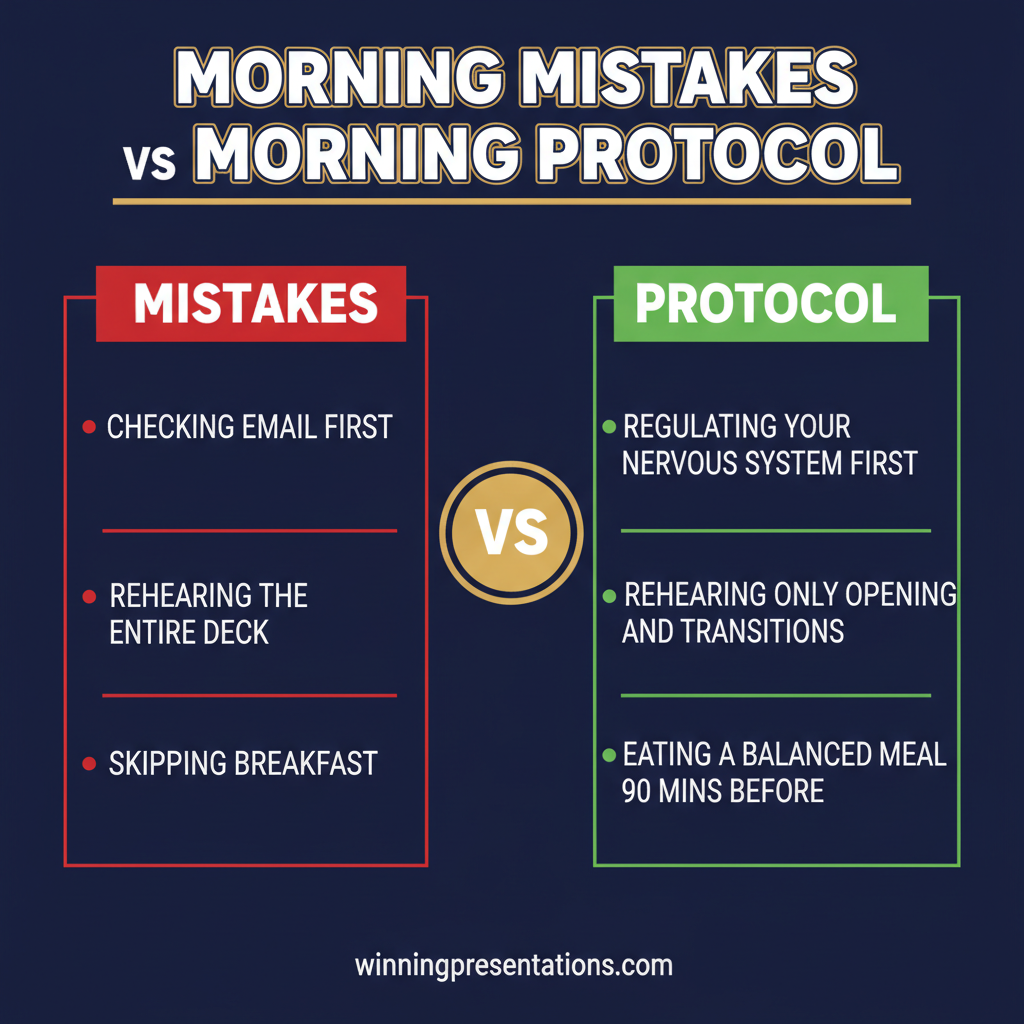
Eat something during this phase. Not a heavy meal — toast, fruit, yoghurt. The nervous system interprets an empty stomach as confirmation that something is wrong. Eating sends a safety signal: if you are eating, you are not fleeing. The vagus nerve does not process nuance. It processes signals.
A Structured Approach to Presentation-Day Nerves
Conquer Your Fear of Public Speaking — £39, instant access — is a neuroscience-based programme that gives you a reliable system for regulating your nervous system before, during, and after high-stakes presentations:
- Nervous system regulation techniques for managing the physical symptoms of anxiety
- Cognitive reframing methods that interrupt catastrophic thinking patterns
- Pre-presentation protocols designed for executive schedules
- Physical symptom management for voice, breathing, and composure
Get Conquer Your Fear of Public Speaking →
Designed for executives who need a reliable protocol for high-stakes presentation days.
Cognitive Preparation: What to Rehearse and What to Leave Alone
After thirty minutes of physiological regulation, your nervous system is in a different state. Heart rate is lower. Breathing is slower. The catastrophic loop has been interrupted. This is the window for cognitive preparation — but it must be the right kind.
Rehearse the opening two minutes only. The opening is where the physical symptoms peak: the voice wavers, the hands shake, the pacing falters. If the first two minutes are locked in — scripted, practised, and automatic — the rest of the presentation can flow from confidence rather than survival. Script the first three to four sentences word for word. Know exactly how you will begin, what your first visual will be, and where you will stand or sit. After those opening minutes, shift to bullet points and natural delivery.
Rehearse transitions, not content. On presentation morning, you already know the material. Reviewing every slide creates the illusion of preparation while actually feeding the anxiety — each slide becomes another thing that could go wrong. Instead, rehearse only the transitions between sections. “After the financial overview, I move to market analysis by saying…” Transitions are where presenters lose their thread. Locking them in gives the entire presentation structural integrity without over-rehearsing the content.
Do not rehearse answers to hypothetical questions. This is the single most counterproductive activity on presentation morning. Trying to anticipate every possible question activates exactly the threat-scanning mode that the breathing protocol just calmed. You cannot predict what will be asked. Trust that you know the subject well enough to respond in the moment — and that trust is built by physiological calm, not by mental simulation of worst-case scenarios.
Visualise the room, not the audience. If you are going to visualise, picture the physical space — the table, the screen, the position you will present from. This activates spatial memory and familiarity. Visualising faces or audience judgements activates the social threat system.
The Full 90-Minute Timeline
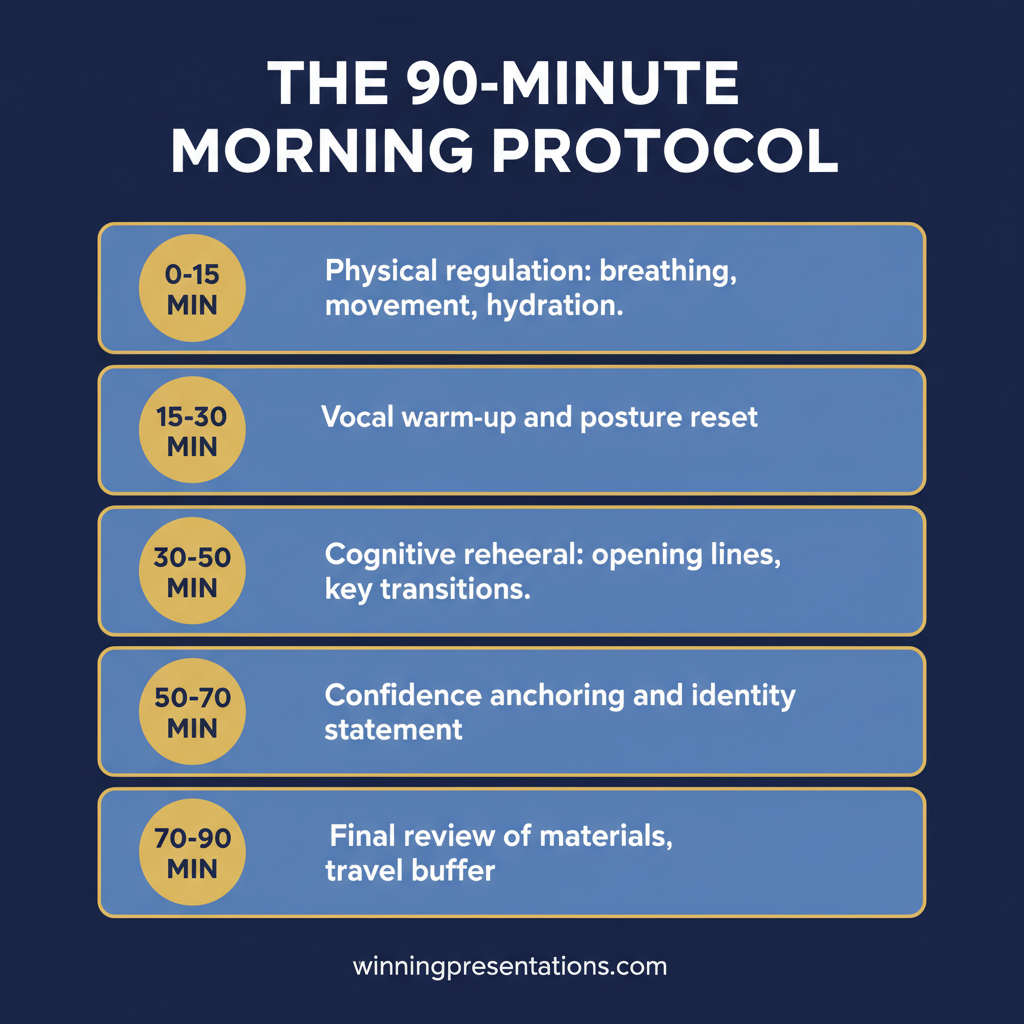
Here is the complete morning presentation routine, structured so that each stage builds on the previous one. The times assume your presentation is at 9:00 a.m. Adjust the start time accordingly for earlier or later slots.
7:30 — Wake and regulate (Minutes 0–30). Cold water. Five minutes of physical movement. Ten minutes of box breathing. Fifteen minutes of sensory grounding. Eat something light. No phone, no email, no slides. The only task is bringing your nervous system from a state of activation to a state of readiness.
8:00 — Cognitive preparation (Minutes 30–50). Review your opening two minutes. Run through your section transitions. Close the deck. If you do not know the material by now, twenty minutes of last-minute cramming will not fix it. What it will do is re-activate the anxiety you just spent thirty minutes calming.
8:20 — Tactical rehearsal (Minutes 50–65). Stand up. Deliver your opening out loud — not in your head. Speak at the volume you will use in the room. Walk through the physical motions: where you will stand, how you will gesture, where you will look. This is about teaching the body that presenting is familiar, not novel. Novelty triggers the threat response. Familiarity dampens it.
8:35 — Transition ritual (Minutes 65–80). Get dressed (if not already). Make a warm drink. Do a final two-minute breathing reset. This phase is deliberately calm and routine — it buffers the gap between preparation and arrival, preventing the anxiety from rushing back in during the commute or the walk to the meeting room.
8:50 — Arrival protocol (Minutes 80–90). Arrive ten minutes early. Walk the room if possible. Set up your materials. Greet the first person who arrives with a brief conversation — this activates the social engagement system and shifts the nervous system out of threat mode. By the time the room fills, you are occupying the space as a host rather than a performer.
For executives who want a complete, structured approach to managing presentation anxiety, the Conquer Your Fear of Public Speaking programme provides neuroscience-based nervous system regulation techniques and pre-presentation protocols designed for high-stakes environments.
What to Avoid on Presentation Morning
A morning routine is as much about what you exclude as what you include. Several common habits actively undermine presentation readiness, and most executives do at least two of them without realising the cost.
Avoid checking email before you present. Email introduces unpredictable emotional content into a morning that needs to be controlled. A difficult message from a colleague, a challenging client request, or even an unrelated piece of bad news can hijack your emotional state and derail the regulation work you have done. If the presentation is at 9:00, email can wait until 10:00.
Avoid excessive caffeine. One cup of coffee is fine. Two or three cups on an anxious stomach accelerates the heart rate, amplifies the jittery physical sensations that anxious presenters already struggle with, and can make the voice sound tighter and more strained. If you normally drink two cups, have one.
Avoid last-minute slide changes. The temptation to “just fix one more thing” on presentation morning is strong and almost always counterproductive. Last-minute edits introduce uncertainty — you are now presenting material you have not rehearsed in its final form. They also signal to your nervous system that the preparation is incomplete, which feeds the anxiety. The deck was finished yesterday. Leave it.
Avoid seeking reassurance. Asking a colleague “does this look okay?” transfers your anxiety to them and creates a dependency on external validation. The morning protocol builds internal confidence through physiological regulation and deliberate preparation. Reassurance-seeking undermines that by outsourcing confidence to someone else’s opinion.
Today’s companion article on executive PowerPoint training online covers the structural side of presentation preparation — useful context for the content phase of this morning routine. You may also find value in this related piece on competitive win-back presentations, which addresses a different high-stakes scenario where morning preparation matters significantly.
Stop the Anxiety Cycle Before Presentation Day
Conquer Your Fear of Public Speaking — £39, instant access — addresses the root cause of presentation-day anxiety with cognitive reframing and nervous system regulation techniques. It is designed for professionals who are tired of managing symptoms and want to change the underlying pattern.
Get Conquer Your Fear of Public Speaking →
Designed for executives who want a structured, reliable approach to pre-presentation confidence.
Frequently Asked Questions
How early should I wake up on presentation day?
Allow at least ninety minutes between waking and the start of your presentation. If your presentation is at 9:00 a.m. and you need thirty minutes for commuting, wake at 7:00. The protocol requires a minimum of sixty minutes of uninterrupted preparation time, but ninety allows for a natural pace without rushing — and rushing reactivates the stress response. If you consistently wake at 3:00 or 4:00 a.m. before presentations, begin the protocol when you naturally wake and use the breathing and grounding phases to prevent escalation.
What if I only have thirty minutes before my presentation?
Prioritise the physiological regulation phase. Five minutes of movement, ten minutes of box breathing, and a glass of water will do more for your presentation than thirty minutes of slide review. Content preparation is a diminishing return on presentation morning — you either know the material or you do not. Nervous system regulation produces immediate effects on voice quality, cognitive clarity, and composure. If time is very short, do the breathing protocol and nothing else.
Does this morning protocol help with virtual presentations too?
Yes. The physiological response to virtual presentations is often identical to in-person ones — elevated heart rate, cortisol release, shallow breathing, and cognitive narrowing. The protocol works the same way in both contexts because it targets the nervous system, not the delivery format. For virtual presentations, adapt the arrival protocol: log in ten minutes early, check your camera angle and lighting, and speak a few sentences out loud to warm your voice.
The Winning Edge — Weekly Presentation Intelligence
Every Thursday, I share one framework, one real-world example, and one practical technique drawn from 25 years of banking and 16 years of training executives to present with confidence. Join The Winning Edge newsletter →
About the Author
Mary Beth Hazeldine is the Owner & Managing Director of Winning Presentations. A qualified clinical hypnotherapist and NLP practitioner, she spent five years struggling with severe presentation anxiety before developing the nervous system regulation techniques she now teaches. With 25 years of banking experience at JPMorgan Chase, PwC, Royal Bank of Scotland, and Commerzbank, she advises executives across financial services, healthcare, technology, and government on overcoming presentation fear and building lasting confidence.