Tag: nervous system regulation

27 Apr 2026
Featured image for Morning Protocol for Presentation Day: The 90-Minute Routine That Replaces All-Night Anxiety

Morning Protocol for Presentation Day: The 90-Minute Routine That Replaces All-Night Anxiety

Quick Answer

A structured morning presentation routine replaces the frantic hours before a high-stakes talk with a deliberate 90-minute protocol that regulates your nervous system, grounds your thinking, and builds genuine confidence. The routine works because it addresses physiology first and content second. Most executives who struggle on presentation mornings are not under-prepared. They are over-activated — and that is a solvable problem.

Nadira had been awake since 3:14 a.m.

She knew the time exactly because she had checked her phone three times in the first ten minutes. The board presentation was at 9:00 a.m. — a capital allocation review for a healthcare company expanding into two new markets. She had rehearsed the deck eleven times. She could recite the financial projections from memory. None of that mattered at 3:14 a.m., when her chest was tight and her thoughts were circling the same catastrophic loop: what if I freeze, what if they challenge the assumptions, what if my voice shakes.

By the time her alarm went off at 6:30, Nadira had been awake for over three hours. She showered, skipped breakfast because her stomach was knotted, drank two espressos, and spent forty-five minutes re-reading her notes — which only confirmed that she knew the content and did nothing for the anxiety.

The presentation went adequately. Not well. Adequately. She delivered the numbers but never found her rhythm. Her CFO mentioned afterwards that she seemed “tense.” Nadira knew the problem was not preparation. It was the morning. She had arrived at the boardroom already depleted — three hours of anxiety had burned through her reserves before she opened the deck.

Six weeks later, Nadira tried something different. A structured morning protocol. Ninety minutes, five stages, every step deliberate. The difference was not subtle.

If managing presentation-day nerves feels like guesswork

Conquer Your Fear of Public Speaking provides a structured approach to nervous system regulation and pre-presentation preparation — designed for executives who need a reliable protocol, not motivational platitudes.

Explore the Programme →

Why Unstructured Mornings Amplify Presentation Anxiety

The morning of a presentation is when anxiety peaks — not because the threat is greatest, but because the gap between waking and presenting is unstructured time that the anxious mind fills with rehearsal, rumination, and worst-case simulation.

An unstructured morning gives your nervous system exactly what it needs to escalate: time, ambiguity, and no clear task. When you wake without a protocol, the first conscious thought is usually the presentation. From that moment, the sympathetic nervous system begins ramping up cortisol and adrenaline — chemicals that would be useful five minutes before you speak, but are destructive three hours before.

The physiological cost is significant. Extended cortisol exposure impairs working memory, reduces cognitive flexibility, and constricts the vocal cords. By the time you reach the meeting room, your body has already consumed the energy reserves that would normally sustain a focused, confident delivery. This is why so many executives report feeling “flat” despite being thoroughly prepared. The content was ready. The body was not.

The pattern is compounding. Anticipatory anxiety before presentations does not resolve itself by waiting. It amplifies. Every minute of unstructured time between waking and presenting is a minute the anxiety fills with threat-scanning — replaying past failures, imagining future ones, and monitoring the body for signs that the anxiety is getting worse.

A structured morning presentation routine interrupts this cycle at the physiological level. It replaces the anxious void with deliberate action — and deliberate action is one of the most effective regulators of the sympathetic nervous system.

The First Thirty Minutes: Physiological Regulation

The single most important thing you do on presentation morning happens before you look at a single slide. The first thirty minutes are exclusively for your nervous system — not your content.

Minutes 0–5: Cold water and movement. Within two minutes of waking, drink a full glass of cold water. Dehydration intensifies the physical symptoms of anxiety — dry mouth, tight throat, the sensation that your voice will not work. Then move. Not a full workout — five minutes of deliberate physical movement: stretching, walking, light bodyweight exercises. The goal is to signal to the nervous system that the body is functional and not under threat. Movement metabolises the cortisol that accumulated during restless sleep.

Minutes 5–15: Breathing protocol. This is not a suggestion. This is the most physiologically effective tool for downregulating the stress response before a presentation. Box breathing for presentations works because it directly activates the parasympathetic nervous system — the branch responsible for calm, focused attention. Inhale for four counts, hold for four, exhale for four, hold for four. Ten minutes of this pattern reduces heart rate, lowers cortisol, and restores the cognitive flexibility that anxiety impairs.

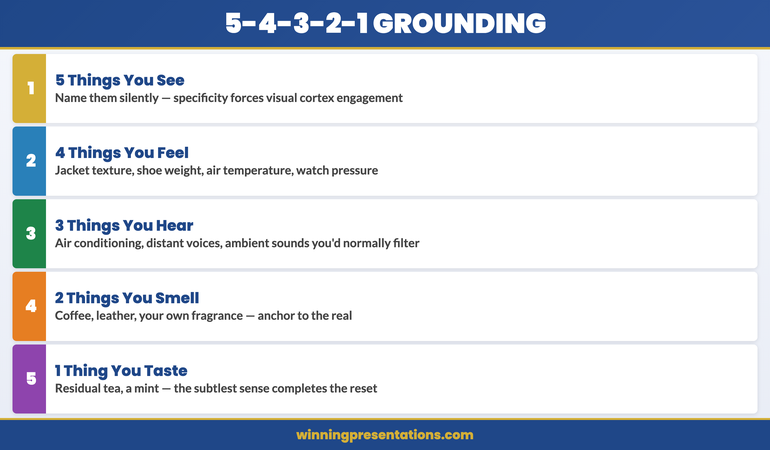
Minutes 15–30: Grounding sequence. After the breathing protocol, spend ten to fifteen minutes on a grounding technique for presentation anxiety. The most effective version for executives is the sensory grounding method: identify five things you can see, four you can hear, three you can touch, two you can smell, and one you can taste. This forces the brain out of future-focused threat-scanning and into present-moment processing. The shift is not subtle — most people report a noticeable drop in anxiety within minutes.

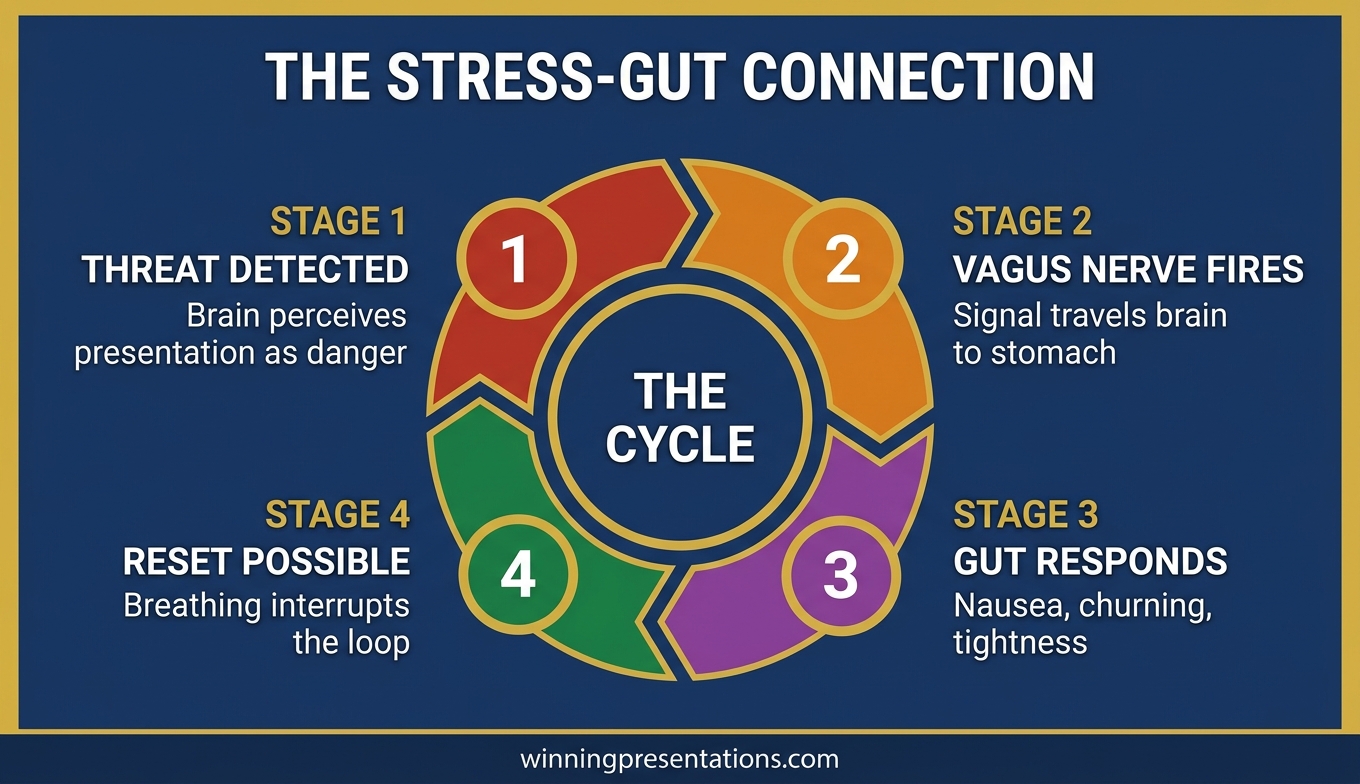
Eat something during this phase. Not a heavy meal — toast, fruit, yoghurt. The nervous system interprets an empty stomach as confirmation that something is wrong. Eating sends a safety signal: if you are eating, you are not fleeing. The vagus nerve does not process nuance. It processes signals.


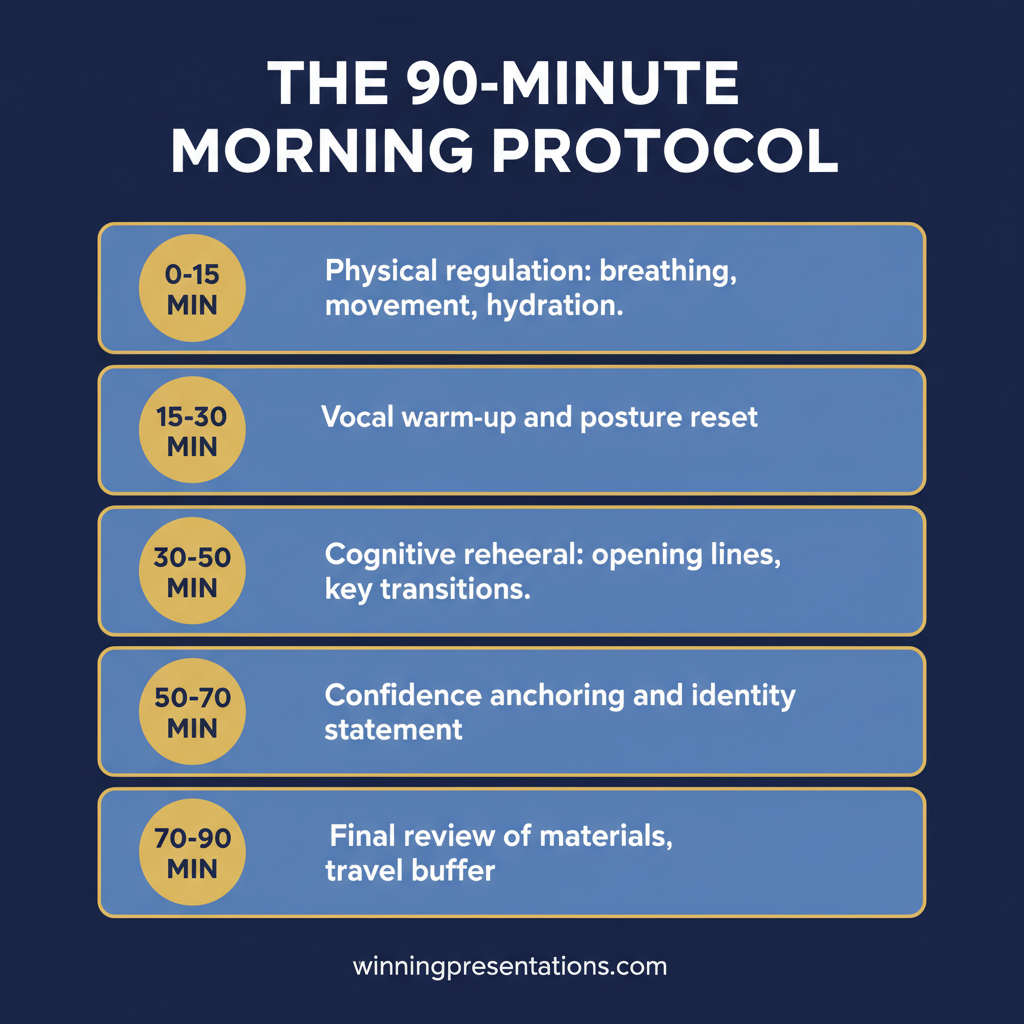
The 90-minute pre-presentation morning protocol timeline showing five stages: physiological regulation (minutes 0-30), cognitive preparation (minutes 30-50), tactical rehearsal (minutes 50-65), transition ritual (minutes 65-80), and arrival protocol (minutes 80-90)

A Structured Approach to Presentation-Day Nerves

Conquer Your Fear of Public Speaking — £39, instant access — is a neuroscience-based programme that gives you a reliable system for regulating your nervous system before, during, and after high-stakes presentations:

  • Nervous system regulation techniques for managing the physical symptoms of anxiety
  • Cognitive reframing methods that interrupt catastrophic thinking patterns
  • Pre-presentation protocols designed for executive schedules
  • Physical symptom management for voice, breathing, and composure

Get Conquer Your Fear of Public Speaking →

Designed for executives who need a reliable protocol for high-stakes presentation days.

Cognitive Preparation: What to Rehearse and What to Leave Alone

After thirty minutes of physiological regulation, your nervous system is in a different state. Heart rate is lower. Breathing is slower. The catastrophic loop has been interrupted. This is the window for cognitive preparation — but it must be the right kind.

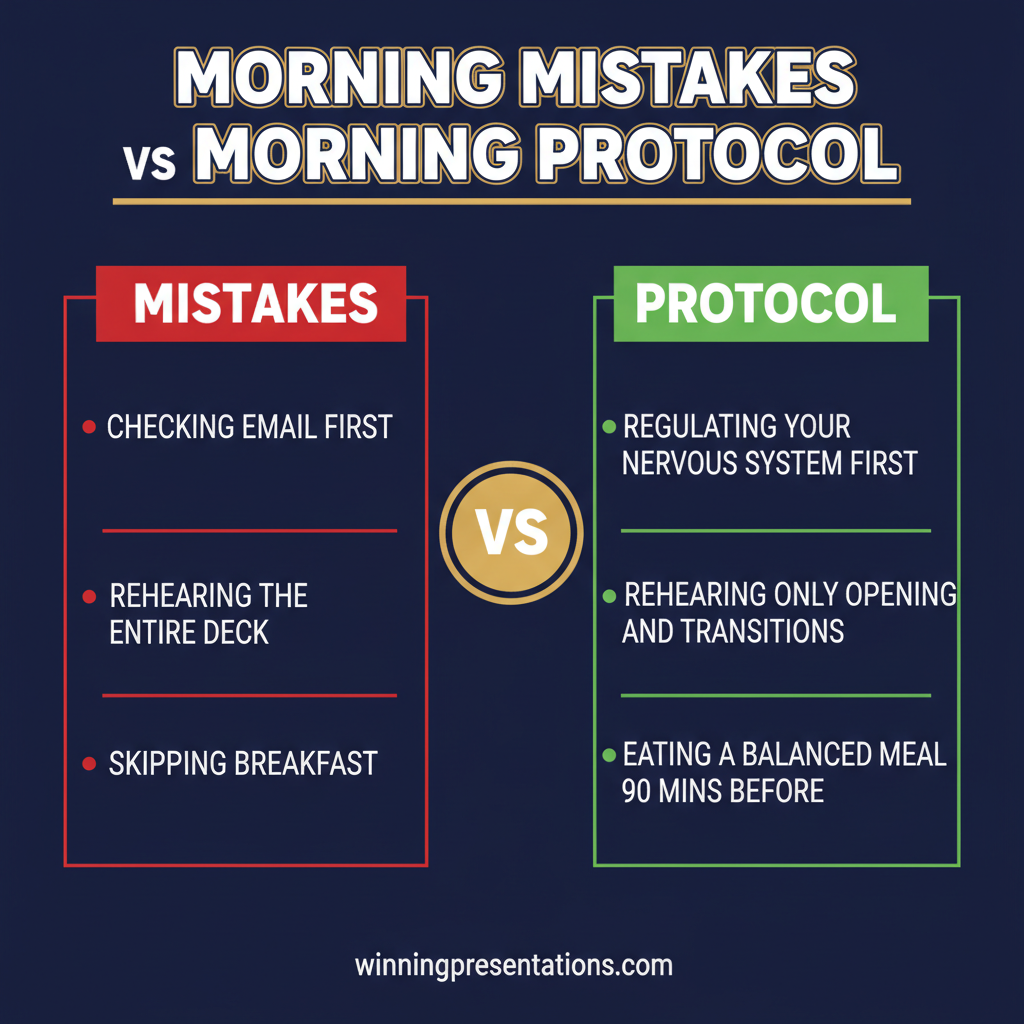
Rehearse the opening two minutes only. The opening is where the physical symptoms peak: the voice wavers, the hands shake, the pacing falters. If the first two minutes are locked in — scripted, practised, and automatic — the rest of the presentation can flow from confidence rather than survival. Script the first three to four sentences word for word. Know exactly how you will begin, what your first visual will be, and where you will stand or sit. After those opening minutes, shift to bullet points and natural delivery.

Rehearse transitions, not content. On presentation morning, you already know the material. Reviewing every slide creates the illusion of preparation while actually feeding the anxiety — each slide becomes another thing that could go wrong. Instead, rehearse only the transitions between sections. “After the financial overview, I move to market analysis by saying…” Transitions are where presenters lose their thread. Locking them in gives the entire presentation structural integrity without over-rehearsing the content.

Do not rehearse answers to hypothetical questions. This is the single most counterproductive activity on presentation morning. Trying to anticipate every possible question activates exactly the threat-scanning mode that the breathing protocol just calmed. You cannot predict what will be asked. Trust that you know the subject well enough to respond in the moment — and that trust is built by physiological calm, not by mental simulation of worst-case scenarios.

Visualise the room, not the audience. If you are going to visualise, picture the physical space — the table, the screen, the position you will present from. This activates spatial memory and familiarity. Visualising faces or audience judgements activates the social threat system.

The Full 90-Minute Timeline

Here is the complete morning presentation routine, structured so that each stage builds on the previous one. The times assume your presentation is at 9:00 a.m. Adjust the start time accordingly for earlier or later slots.

7:30 — Wake and regulate (Minutes 0–30). Cold water. Five minutes of physical movement. Ten minutes of box breathing. Fifteen minutes of sensory grounding. Eat something light. No phone, no email, no slides. The only task is bringing your nervous system from a state of activation to a state of readiness.

8:00 — Cognitive preparation (Minutes 30–50). Review your opening two minutes. Run through your section transitions. Close the deck. If you do not know the material by now, twenty minutes of last-minute cramming will not fix it. What it will do is re-activate the anxiety you just spent thirty minutes calming.

8:20 — Tactical rehearsal (Minutes 50–65). Stand up. Deliver your opening out loud — not in your head. Speak at the volume you will use in the room. Walk through the physical motions: where you will stand, how you will gesture, where you will look. This is about teaching the body that presenting is familiar, not novel. Novelty triggers the threat response. Familiarity dampens it.

8:35 — Transition ritual (Minutes 65–80). Get dressed (if not already). Make a warm drink. Do a final two-minute breathing reset. This phase is deliberately calm and routine — it buffers the gap between preparation and arrival, preventing the anxiety from rushing back in during the commute or the walk to the meeting room.

8:50 — Arrival protocol (Minutes 80–90). Arrive ten minutes early. Walk the room if possible. Set up your materials. Greet the first person who arrives with a brief conversation — this activates the social engagement system and shifts the nervous system out of threat mode. By the time the room fills, you are occupying the space as a host rather than a performer.

For executives who want a complete, structured approach to managing presentation anxiety, the Conquer Your Fear of Public Speaking programme provides neuroscience-based nervous system regulation techniques and pre-presentation protocols designed for high-stakes environments.

What to Avoid on Presentation Morning

A morning routine is as much about what you exclude as what you include. Several common habits actively undermine presentation readiness, and most executives do at least two of them without realising the cost.

Avoid checking email before you present. Email introduces unpredictable emotional content into a morning that needs to be controlled. A difficult message from a colleague, a challenging client request, or even an unrelated piece of bad news can hijack your emotional state and derail the regulation work you have done. If the presentation is at 9:00, email can wait until 10:00.

Avoid excessive caffeine. One cup of coffee is fine. Two or three cups on an anxious stomach accelerates the heart rate, amplifies the jittery physical sensations that anxious presenters already struggle with, and can make the voice sound tighter and more strained. If you normally drink two cups, have one.

Avoid last-minute slide changes. The temptation to “just fix one more thing” on presentation morning is strong and almost always counterproductive. Last-minute edits introduce uncertainty — you are now presenting material you have not rehearsed in its final form. They also signal to your nervous system that the preparation is incomplete, which feeds the anxiety. The deck was finished yesterday. Leave it.

Avoid seeking reassurance. Asking a colleague “does this look okay?” transfers your anxiety to them and creates a dependency on external validation. The morning protocol builds internal confidence through physiological regulation and deliberate preparation. Reassurance-seeking undermines that by outsourcing confidence to someone else’s opinion.

Today’s companion article on executive PowerPoint training online covers the structural side of presentation preparation — useful context for the content phase of this morning routine. You may also find value in this related piece on competitive win-back presentations, which addresses a different high-stakes scenario where morning preparation matters significantly.


What to avoid on presentation morning: four common mistakes shown as warning cards — checking email, excessive caffeine, last-minute slide edits, and reassurance-seeking — each with the physiological impact on presentation performance

Stop the Anxiety Cycle Before Presentation Day

Conquer Your Fear of Public Speaking — £39, instant access — addresses the root cause of presentation-day anxiety with cognitive reframing and nervous system regulation techniques. It is designed for professionals who are tired of managing symptoms and want to change the underlying pattern.

Get Conquer Your Fear of Public Speaking →

Designed for executives who want a structured, reliable approach to pre-presentation confidence.

Frequently Asked Questions

How early should I wake up on presentation day?

Allow at least ninety minutes between waking and the start of your presentation. If your presentation is at 9:00 a.m. and you need thirty minutes for commuting, wake at 7:00. The protocol requires a minimum of sixty minutes of uninterrupted preparation time, but ninety allows for a natural pace without rushing — and rushing reactivates the stress response. If you consistently wake at 3:00 or 4:00 a.m. before presentations, begin the protocol when you naturally wake and use the breathing and grounding phases to prevent escalation.

What if I only have thirty minutes before my presentation?

Prioritise the physiological regulation phase. Five minutes of movement, ten minutes of box breathing, and a glass of water will do more for your presentation than thirty minutes of slide review. Content preparation is a diminishing return on presentation morning — you either know the material or you do not. Nervous system regulation produces immediate effects on voice quality, cognitive clarity, and composure. If time is very short, do the breathing protocol and nothing else.

Does this morning protocol help with virtual presentations too?

Yes. The physiological response to virtual presentations is often identical to in-person ones — elevated heart rate, cortisol release, shallow breathing, and cognitive narrowing. The protocol works the same way in both contexts because it targets the nervous system, not the delivery format. For virtual presentations, adapt the arrival protocol: log in ten minutes early, check your camera angle and lighting, and speak a few sentences out loud to warm your voice.

The Winning Edge — Weekly Presentation Intelligence

Every Thursday, I share one framework, one real-world example, and one practical technique drawn from 25 years of banking and 16 years of training executives to present with confidence. Join The Winning Edge newsletter →

About the Author

Mary Beth Hazeldine is the Owner & Managing Director of Winning Presentations. A qualified clinical hypnotherapist and NLP practitioner, she spent five years struggling with severe presentation anxiety before developing the nervous system regulation techniques she now teaches. With 25 years of banking experience at JPMorgan Chase, PwC, Royal Bank of Scotland, and Commerzbank, she advises executives across financial services, healthcare, technology, and government on overcoming presentation fear and building lasting confidence.

Book a discovery call | View services

25 Apr 2026
Presentation Warm-Up Routine: The 10-Minute Protocol That Stops Nerves Before They Start — featured image

Presentation Warm-Up Routine: The 10-Minute Protocol That Stops Nerves Before They Start

Quick Answer

A presentation warm-up routine works in three phases: body activation to discharge excess adrenaline, vocal preparation to stabilise pitch and volume, and mental grounding to shift your focus from threat detection to task execution. The entire protocol takes ten minutes and can be done in a bathroom, stairwell, or empty office. It does not eliminate nerves — it regulates them so your body supports your message rather than undermining it.

Elena arrived at the conference centre forty-five minutes early. She had rehearsed her presentation six times. She knew the content. She had anticipated the likely questions. Her slides were clean, structured, and on-message.

None of that mattered when her body decided it was under threat.

By the time she walked to the front of the room, her hands were trembling visibly, her voice had risen half an octave, and her jaw was so tight she could feel her back teeth pressing together. The first three minutes of her presentation sounded nothing like the version she had rehearsed. The words were the same. The delivery was not. The audience noticed.

Afterwards, a colleague who had presented immediately before her mentioned something Elena had not considered: “I always warm up in the stairwell. Ten minutes. Voice, body, breathing. By the time I walk in, the adrenaline is working for me, not against me.” Elena had spent forty-five minutes reviewing her slides. She had spent zero minutes preparing her body to deliver them.

Presenting to senior leadership this week?

If your body hijacks your delivery despite thorough content preparation, the issue is not your slides — it is your nervous system. Quick self-check before your next presentation:

  • Does your voice change pitch or pace in the first two minutes?
  • Do your hands shake, your jaw clench, or your shoulders rise toward your ears?
  • Do you feel a disconnect between what you planned to say and what actually comes out?

Explore Conquer Your Fear of Public Speaking →

Why Walking Into a Presentation Cold Makes Anxiety Worse

Athletes warm up before competition. Musicians tune and run scales before performance. Actors do vocal and physical exercises before stepping on stage. Executives walk into board presentations having done none of these things — and then wonder why their body does not cooperate when they need it most.

The reason cold starts amplify anxiety is physiological, not psychological. When you are nervous, your sympathetic nervous system prepares your body for threat: heart rate increases, muscles tense, breathing becomes shallow, digestion slows, and blood diverts from your extremities to your core. This is the fight-or-flight response, and it operates below conscious control.

If you walk into a presentation without warming up, the fight-or-flight response has nowhere to go. The adrenaline surging through your system has no physical outlet, so it manifests as trembling hands, a shaking voice, visible sweating, and mental blankness. Your body is screaming “run” while your brain is trying to explain a quarterly forecast.

A warm-up routine gives the adrenaline somewhere to go before you step into the room. Physical movement discharges the excess energy. Vocal exercises engage the muscles that control pitch and volume. Mental grounding techniques redirect your attention from internal threat signals to external task focus. Together, these three elements regulate the nervous system so it supports performance rather than sabotaging it.

This is not about eliminating nerves — a certain amount of arousal improves performance. The goal is to bring your activation level into the zone where adrenaline sharpens your focus rather than overwhelming your capacity to think clearly. For a deeper exploration of how to manage the physical symptoms of presentation anxiety, see our guide to breathing techniques for presentations.


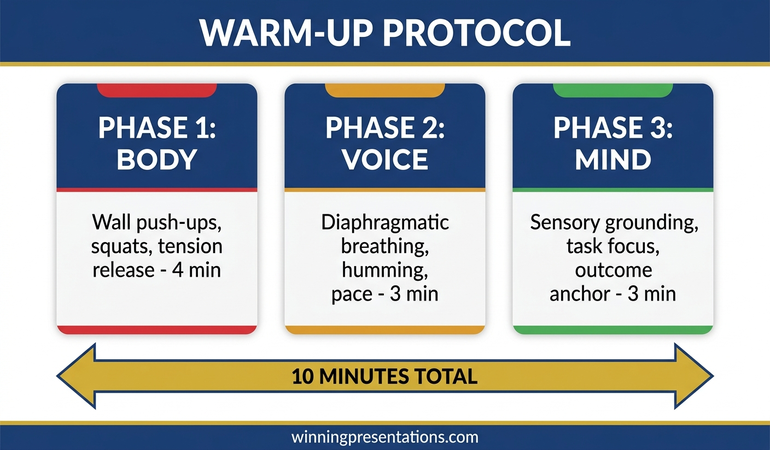
Three-phase presentation warm-up routine showing body activation, vocal preparation, and mental grounding with time allocations

Phase 1: Body Activation — Discharging Adrenaline Before It Controls You

The body activation phase takes three to four minutes and serves one purpose: burning off the excess adrenaline that would otherwise make your hands shake and your voice tremble. This is not a fitness routine — it is a physiological reset that prepares your body to be still and composed when you need it to be.

Large muscle engagement (90 seconds). Find a private space — a stairwell, an empty office, a bathroom stall — and do thirty seconds of wall push-ups, thirty seconds of standing squats, and thirty seconds of shoulder rolls. The goal is to engage your largest muscle groups so they absorb the adrenaline instead of your hands and voice. Keep the movements controlled and rhythmic. You are discharging energy, not exhausting yourself.

Isometric tension release (60 seconds). Clench both fists as tightly as possible for five seconds, then release. Repeat with your shoulders — press them up toward your ears, hold for five seconds, release. Then press your palms together at chest level, push hard for five seconds, and release. This progressive tension-release cycle activates and then relaxes the muscle groups most likely to carry visible tension during your presentation.

Jaw and face release (60 seconds). Open your mouth as wide as you can, stretch your face, and then release into a neutral expression. Repeat three times. Your jaw carries more tension than any other facial muscle, and a clenched jaw restricts your vocal range, makes you look rigid, and can trigger headaches during a long presentation. A loose jaw is the foundation of natural-sounding speech.

After the body activation phase, you should feel physically lighter — less coiled, less restless, less like your body is preparing for a threat. The adrenaline is still present, but it is distributed across your muscles rather than concentrated in your extremities.

Phase 2: Vocal Preparation — Stabilising Pitch, Pace, and Projection

The vocal preparation phase takes three minutes and addresses the most visible symptom of presentation anxiety: a voice that does not sound like yours. When you are nervous, your vocal cords tighten, your breathing becomes shallow, and your pitch rises. These changes happen automatically, and they are immediately noticeable to an audience — even if they cannot articulate what sounds different.

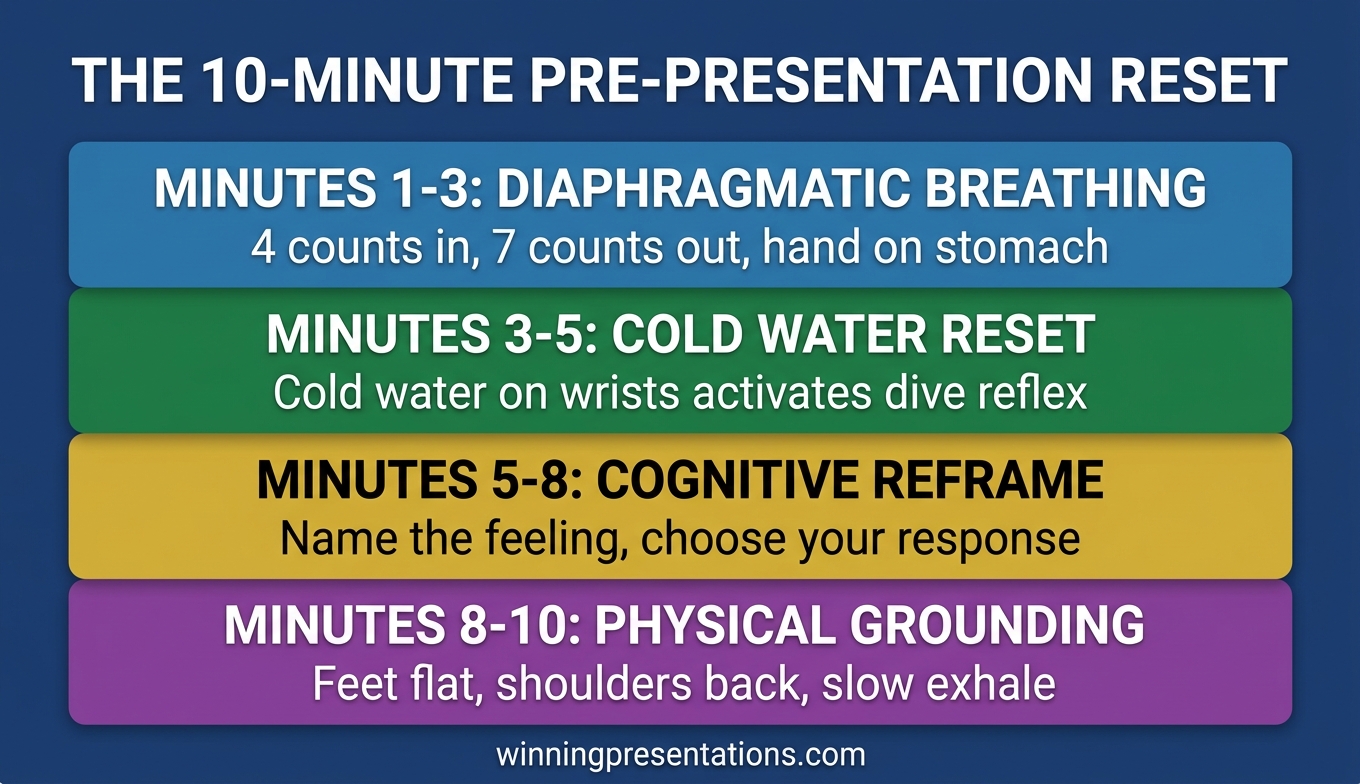
Diaphragmatic breathing (60 seconds). Place one hand on your stomach and breathe so your hand moves outward on the inhale and inward on the exhale. Take four slow breaths: inhale for four counts, hold for two, exhale for six. This pattern activates the parasympathetic nervous system, which counteracts the fight-or-flight response. It also shifts your breathing from chest-level (shallow, anxious) to diaphragm-level (deep, controlled) — which gives your voice its natural depth and resonance.

Vocal range warm-up (60 seconds). Hum at a comfortable pitch, then slide your hum from low to high and back down. Repeat three times. This warms the vocal cords and establishes your full range before you speak. Then say “one-two-three-four-five” at your normal speaking volume, followed by the same sequence projected as if speaking to someone across a large room. This calibrates your volume and ensures you do not start your presentation too quietly — a common anxiety response that signals uncertainty to the audience.

Pace calibration (60 seconds). Speak the first three sentences of your presentation out loud, deliberately slower than feels natural. Anxiety accelerates speech. What feels slow to you sounds measured and authoritative to the audience. Time yourself: your opening sentence should take at least five seconds. If it takes less than three, you are rushing. Practise the opening at the slow pace until it feels comfortable — this becomes your anchor tempo for the real presentation.

Still Dreading the Walk to the Front of the Room?

A warm-up routine manages the symptoms. Conquer Your Fear of Public Speaking — £39, instant access — addresses the underlying patterns that cause presentation anxiety in the first place:

  • Neuroscience-based techniques for regulating your nervous system before, during, and after presenting
  • Cognitive reframing protocols that change how your brain interprets the presentation situation
  • Physical symptom management for trembling, voice changes, and visible anxiety
  • Pre-presentation routines designed specifically for executive environments

Get Conquer Your Fear of Public Speaking → £39

Designed for executives who know their content but cannot control their body’s response to presenting it.

Phase 3: Mental Grounding — Shifting From Threat to Task

The mental grounding phase takes three minutes and addresses the cognitive dimension of presentation anxiety: the running internal commentary that tells you something is about to go wrong. This commentary — “they’ll think I’m not prepared,” “what if I forget the numbers,” “the last time I presented this badly…” — is your brain’s threat detection system scanning for danger. It is not helpful, and it is not accurate, but it feels urgent and true.

Mental grounding redirects your attention from internal threat signals to external task focus. Instead of monitoring how you feel, you begin monitoring what you need to do. This shift does not require positive thinking or affirmations — it requires structured attention redirection.

Sensory grounding (60 seconds). Name five things you can see, four you can hear, three you can touch. This technique, borrowed from clinical anxiety management, forces your brain out of future-oriented threat detection and into present-moment awareness. When your brain is busy cataloguing sensory input, it has less capacity for catastrophic prediction. Do this standing in the room where you will present, if possible — it also familiarises you with the environment, which reduces novelty-related anxiety.

Task-focus rehearsal (60 seconds). Instead of rehearsing content, rehearse actions. Say to yourself: “I will walk to the front, place my notes on the lectern, make eye contact with three people, and begin with my opening sentence.” This converts the presentation from an abstract threat (“I have to present to the board”) into a concrete sequence of manageable physical actions. Anxiety thrives on abstraction. Specificity neutralises it.

Outcome anchoring (60 seconds). Identify one specific outcome you want from this presentation — not “I want it to go well,” but “I want the CFO to approve the next phase.” Hold that outcome in mind as you take three final diaphragmatic breaths. This anchors your attention to purpose rather than performance. You are not going in to be judged. You are going in to achieve something specific. That reframe changes how your nervous system treats the situation.

If you want to build on this pre-presentation preparation with a structured morning protocol, see our guide to the morning presentation protocol that sets up your entire day for confident delivery.

For executives who want a complete system for managing presentation anxiety — not just a warm-up routine — the Conquer Your Fear of Public Speaking programme (£39) provides the full neuroscience-based framework for rewiring your response to high-stakes speaking situations.

The Complete 10-Minute Protocol

Here is the full warm-up sequence, designed to be done in any private space ten minutes before you present. The order matters — body first, then voice, then mind — because physical regulation creates the foundation for vocal and cognitive control.

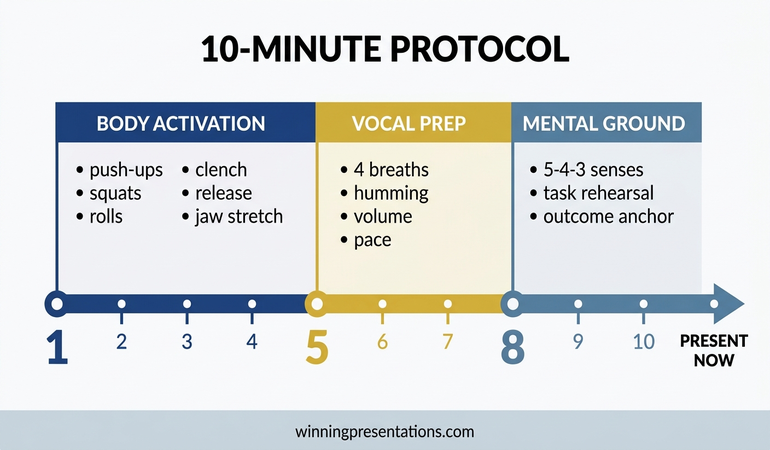
Minutes 1-4: Body activation. Wall push-ups (30 seconds), standing squats (30 seconds), shoulder rolls (30 seconds), fist clench and release (30 seconds), shoulder press and release (30 seconds), palm press and release (30 seconds), jaw stretches (60 seconds).

Minutes 5-7: Vocal preparation. Four diaphragmatic breaths at 4-2-6 count (60 seconds). Humming slides low to high (30 seconds). Volume calibration at two levels (30 seconds). Opening sentences at slow pace (60 seconds).

Minutes 8-10: Mental grounding. Sensory grounding — 5 see, 4 hear, 3 touch (60 seconds). Task-focus rehearsal — physical action sequence (60 seconds). Outcome anchoring with three final breaths (60 seconds).

This protocol is sequential, not optional. Skipping the body phase and jumping to breathing exercises leaves the adrenaline unaddressed. Skipping the vocal phase means your voice will betray your nerves in the first sentence. Skipping the mental phase means your attention will be split between your content and your internal threat commentary. All three phases work together.

After the protocol, walk directly into the room and begin. Do not sit down and wait — waiting allows the anxiety to rebuild. The transition from warm-up to presentation should be immediate, while the regulation is still active.


Complete 10-minute presentation warm-up protocol timeline showing body activation, vocal preparation, and mental grounding phases with specific exercises

Ready to Address the Root Cause, Not Just the Symptoms?

This warm-up routine regulates your nervous system in the moment. Conquer Your Fear of Public Speaking — £39, instant access — gives you the complete programme to change how your brain responds to presenting, so the anxiety diminishes over time rather than requiring management before every meeting.

Get Conquer Your Fear of Public Speaking → £39

Designed for executives who want to present with composure, not just survive the experience.

Want the slides too?

Preparation reduces anxiety. The Executive Slide System (£39) includes confident-presenter templates designed to minimise preparation stress — so your warm-up routine starts from a position of structure, not uncertainty.

Frequently Asked Questions

Can I do a presentation warm-up routine in a suit without getting sweaty?

Yes. The body activation exercises are controlled, low-impact movements — wall push-ups, standing squats, shoulder rolls, and isometric holds. They engage large muscle groups without raising your heart rate to the point of visible sweating. Keep the movements slow and deliberate. You are discharging adrenaline, not doing a workout. If you are concerned about overheating, focus on the isometric tension-release exercises (fist clenches, shoulder presses, palm presses) which are invisible to anyone who might walk past.

What if I only have two minutes before my presentation?

If time is limited, prioritise in this order: four diaphragmatic breaths (30 seconds), jaw release and facial stretch (15 seconds), opening sentence at slow pace (15 seconds), and sensory grounding — five things you can see (30 seconds). This compressed sequence hits the most critical elements: breathing calms the nervous system, jaw release frees your voice, pace calibration prevents rushing, and sensory grounding redirects your attention. It is not as effective as the full ten-minute protocol, but it is significantly better than walking in cold.

Should I use this routine before virtual presentations too?

Absolutely. Virtual presentations trigger the same fight-or-flight response as in-person ones — sometimes worse, because you cannot read the room and the silence between your words feels amplified. Do the full warm-up routine before joining the call. If you are presenting from home, you have the advantage of complete privacy for the body activation phase. The vocal preparation is especially important for virtual settings, where microphone compression can make a nervous, high-pitched voice sound even more strained than it would in person.

The Winning Edge — Weekly Presentation Intelligence

Every Thursday, I share one framework, one real-world example, and one practical technique drawn from 24 years of presenting in boardrooms across three continents. Join The Winning Edge newsletter →

Not ready for the full programme? Start here instead: download the free Executive Presentation Checklist — a one-page reference covering the structure and preparation elements every confident presentation needs.

Once your warm-up routine is in place, make sure your slides support your confidence — see our guide to executive slide design for the visual structures that reduce cognitive load and let you present from a position of clarity.

About the Author

Mary Beth Hazeldine is the Owner & Managing Director of Winning Presentations. With 24 years of corporate banking experience at JPMorgan Chase, PwC, Royal Bank of Scotland, and Commerzbank, she advises executives across financial services, healthcare, technology, and government on structuring presentations for high-stakes funding rounds and approvals. A qualified clinical hypnotherapist and NLP practitioner, she combines executive communication expertise with evidence-based techniques for managing presentation anxiety.

Book a discovery call | View services

03 Apr 2026
Professional woman standing calmly in a corporate corridor, eyes closed, practising grounding before a presentation with a conference room visible in the background

Grounding Techniques for Presentation Anxiety: How to Anchor Yourself Before You Speak

Grounding techniques work for presentation anxiety because they interrupt the physiological cascade that makes speaking feel dangerous. Your nervous system cannot simultaneously process a threat response and a deliberate sensory focus. That neurological fact is what makes grounding practical, not theoretical—and why it works in the final minutes before you step up to present.

Nalini was standing in the corridor outside the executive conference room, waiting for her slot in the quarterly review. She’d presented to this group before—twelve times, in fact—and each time the anxiety arrived with identical precision: racing heartbeat at the fifteen-minute mark, shallow breathing at ten minutes, and a dissociative fog at five minutes that made her notes look like a foreign language. She’d tried deep breathing. She’d tried positive self-talk. Neither penetrated the fog. That morning, before leaving home, she’d read about a sensory grounding technique: name five things you can see, four you can touch, three you can hear. Standing in that corridor, she tried it. Blue carpet. Fire extinguisher. Her colleague’s navy jacket. The exit sign. A crack in the ceiling tile. She pressed her fingertips against the cool wall. Rubbed the edge of her notebook. Touched the fabric of her jacket sleeve. Felt the weight of her shoes on the floor. She heard the air conditioning. A door closing down the hall. Someone’s phone vibrating. By the time the door opened, the fog had lifted. Her heart was still beating fast, but she could read her notes. She walked in and delivered the presentation—not perfectly, but clearly. The difference was that she’d given her nervous system something to do other than panic.

Struggling with pre-presentation anxiety? Conquer Speaking Fear includes a structured anxiety management framework with grounding, breathing, and cognitive techniques designed specifically for executives who present under pressure.

Why Grounding Works When Deep Breathing Alone Doesn’t

Deep breathing is the default advice for presentation anxiety, and it helps many people—but not everyone. The reason is neurological. When the sympathetic nervous system is fully activated—the fight-or-flight response that makes your heart race and your palms sweat—the prefrontal cortex (responsible for rational thought and voluntary breath control) has reduced influence. Telling someone in acute anxiety to “breathe deeply” is like telling someone mid-panic to “calm down.” The instruction requires the very cognitive control that anxiety has compromised.

Grounding techniques take a different route. Instead of trying to override the nervous system through conscious breath control, they engage the sensory cortex—the brain regions that process what you see, hear, touch, and smell. These regions remain active even during acute anxiety because they process incoming sensory data automatically. By deliberately directing attention to sensory input, you’re using a neurological pathway that anxiety hasn’t shut down. The effect is a reduction in the intensity of the threat response, not through willpower, but through sensory competition.

This is why grounding techniques for presentation anxiety are particularly effective in the acute phase—the last ten to fifteen minutes before you speak, when anxiety typically peaks. At this point, cognitive strategies (positive affirmations, logical reframing, content review) often fail because the cognitive system is overwhelmed. Sensory grounding bypasses the overwhelmed system entirely.

It’s also worth noting that grounding doesn’t eliminate anxiety. It reduces it to a manageable level—from the paralysing fog Nalini described to the elevated alertness that actually improves performance. The goal is not calm. The goal is functional arousal: enough activation to be sharp and present, without enough to impair speech, memory, or cognitive flexibility.

Take Control of Presentation Anxiety Before It Controls You

Conquer Speaking Fear gives you a structured anxiety management framework—grounding protocols, breathing techniques, and cognitive reframing tools designed specifically for executives who present under pressure.

  • ✓ Pre-presentation anxiety management protocols
  • ✓ Nervous system regulation techniques for speakers
  • ✓ Cognitive reframing frameworks for high-stakes situations

Get Conquer Speaking Fear → £39

Designed for professionals who present under pressure

The Five-Senses Method: A Complete Pre-Presentation Protocol

The 5-4-3-2-1 technique is the most widely used grounding method in clinical anxiety management, and it translates directly to the pre-presentation context. The protocol takes three to five minutes and can be done silently, standing in a corridor, sitting at a conference table, or waiting in a virtual meeting lobby.

Five things you can see. Name them silently and specifically. Not “the room” but “the silver pen on the table.” Specificity forces the visual cortex to engage actively rather than passively. Four things you can physically feel. The texture of your jacket. The pressure of your feet on the floor. The temperature of the air on your skin. The weight of your watch. Three things you can hear. Background noise you’d normally filter out—air conditioning, a distant conversation, traffic. Two things you can smell. Coffee. The leather of your notebook. Your own perfume or aftershave. One thing you can taste. The mint you had earlier. The residual flavour of your morning tea.

The sequence matters because it progresses from the easiest sensory channel (vision, which requires no physical action) to the hardest (taste, which requires deliberate attention to a subtle sensation). By the time you reach the final sense, your attention has been fully redirected from internal anxiety to external reality. The fog lifts—not because the anxiety is gone, but because your sensory cortex is now processing real data instead of imagined threats.

If you’re interested in complementary techniques, our guide on the body scan technique for presentation reset covers a longer protocol that works well when you have fifteen to twenty minutes before presenting. The five-senses method is the rapid-deployment version for when you have five minutes or less.

The 5-4-3-2-1 grounding technique protocol for pre-presentation anxiety showing sensory countdown

Physical Anchors You Can Use in the Room Without Anyone Noticing

The five-senses method works best in private—standing in a corridor, sitting alone before others arrive. But anxiety doesn’t always cooperate with your schedule. Sometimes it spikes mid-meeting, during the presenter before you, or whilst you’re being introduced. You need grounding techniques that work invisibly, in full view of your audience.

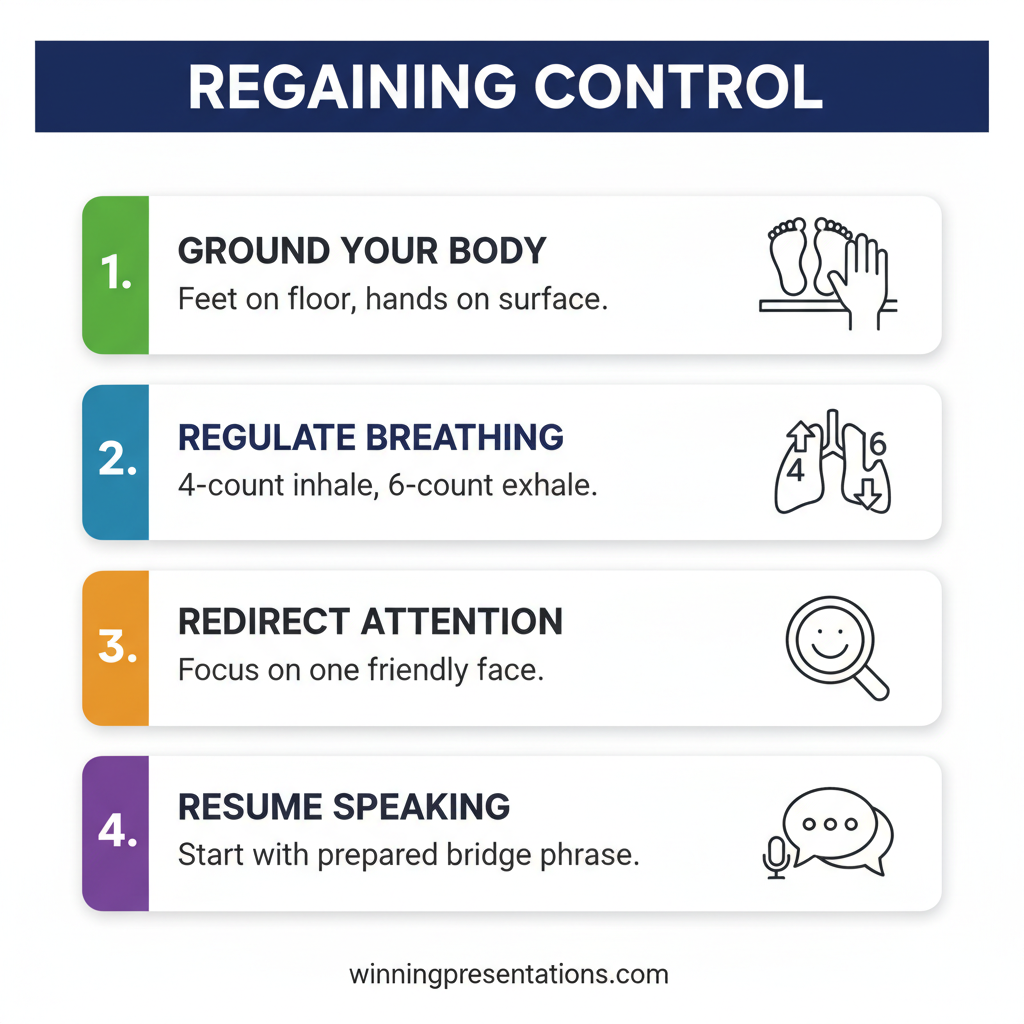
Feet on the floor. Press both feet flat against the floor with deliberate pressure. Feel the weight of your body transferring through your legs into the ground. This activates proprioceptive feedback—your body’s awareness of its own position in space—which counteracts the dissociative “floating” sensation that anxiety produces. Nobody can see you doing this. It works whether you’re standing at a lectern or sitting at a table.

Fingertip contact. Press your thumb firmly against your index finger, or press all five fingertips against the table surface. The tactile feedback creates a physical anchor point that your attention can return to whenever anxiety pulls you towards catastrophic thinking. Some executives use a small object—a smooth stone, a pen cap, a ring they rotate—as a consistent physical anchor across multiple presentations.

Temperature shift. Hold a glass of cold water in both hands for ten to fifteen seconds. The temperature change activates the vagus nerve—the primary pathway between your brain and your gut—which triggers a parasympathetic response (the “rest and digest” system that counteracts fight-or-flight). This is why a sip of water before speaking helps more than hydration alone would explain. The cold sensation is doing neurological work.

These micro-techniques can be combined. Press your feet into the floor whilst holding cold water. Touch a physical anchor object whilst listening to the ambient sounds in the room. The more sensory channels you engage simultaneously, the stronger the grounding effect. The research on box breathing for executive presentations shows how breathing and physical grounding work together to regulate the nervous system more effectively than either technique alone.

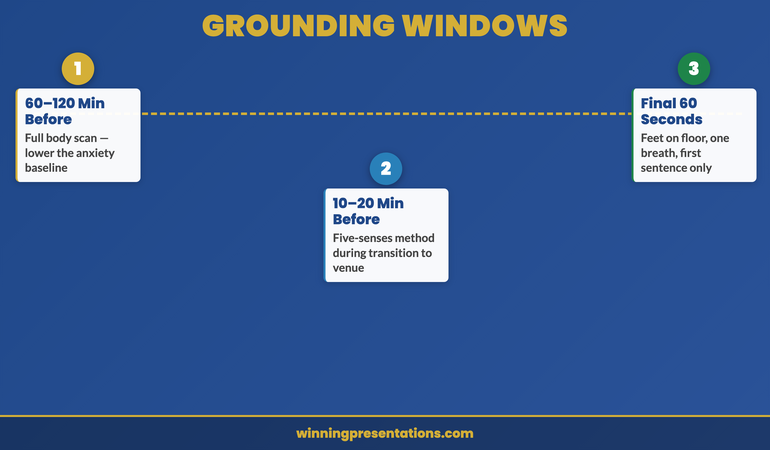
When to Ground: The Three Critical Windows Before You Present

Timing matters. Grounding at the wrong moment is less effective than grounding at the right one. Presentation anxiety follows a predictable curve, and there are three windows where intervention has the greatest impact.

Window 1: The morning of the presentation (60–120 minutes before). This is when anticipatory anxiety begins—the “I have to present today” awareness that colours your entire morning. A full body scan or extended grounding session (ten to fifteen minutes) during this window reduces the baseline anxiety level, so the peak is lower when it arrives. Think of this as lowering the starting point of the anxiety curve.

Window 2: The transition period (10–20 minutes before). This is when you’re physically moving towards the presentation space—walking to the meeting room, logging into the virtual platform, arriving at the venue. Anxiety accelerates during transitions because your body is moving towards the perceived threat. The five-senses method works powerfully here because you’re in a transitional environment with abundant sensory input to anchor to.

Window 3: The final sixty seconds. This is the acute peak. You’re about to be introduced, or you’re about to unmute your microphone, or you’re about to stand up. At this point, complex techniques fail. You need a single-move anchor: feet pressed into the floor, one deep breath through the nose, and a deliberate focus on the first sentence of your presentation. Not the whole presentation—just the first sentence. Narrowing your cognitive focus to one sentence prevents the overwhelm that comes from contemplating the entire performance ahead.

Nalini’s breakthrough came from using all three windows. She did a body scan before leaving home (Window 1), used the five-senses method in the corridor (Window 2), and pressed her feet into the floor as the door opened (Window 3). No single technique was transformative. The combination across three windows was.

For executives who want a complete anxiety management protocol they can practise and refine, Conquer Speaking Fear provides the full framework—grounding, breathing, cognitive reframing, and in-the-moment recovery techniques—in a structured programme designed for professionals who present regularly.

Three critical grounding windows before a presentation showing timing and techniques

Combining Grounding With Breathing and Cognitive Reframing

Grounding is most powerful when combined with two complementary techniques: controlled breathing and cognitive reframing. Think of these as three systems working together. Grounding manages the sensory system. Breathing manages the autonomic nervous system. Cognitive reframing manages the narrative system—the story your mind tells about what’s about to happen.

A practical combined protocol for the ten minutes before a presentation: Begin with two minutes of sensory grounding (the five-senses method). Then shift to two minutes of controlled breathing—inhale for four counts, hold for four, exhale for six (the extended exhale activates the parasympathetic response). Then spend one minute on a single cognitive reframe: replace “I’m about to be judged” with “I’m about to share information that helps these people make a decision.” This reframe shifts the narrative from performance evaluation to professional service, which reduces the perceived social threat.

The sequence matters. Grounding first, because it reduces the physiological intensity enough for breathing to work. Breathing second, because it further calms the autonomic system and restores prefrontal cortex function. Cognitive reframing last, because it requires the prefrontal cortex to be online—which the first two steps have enabled. Attempting cognitive reframing when the nervous system is fully activated is why positive affirmations often feel hollow during acute anxiety. The brain knows you’re lying to it. After grounding and breathing, the reframe feels plausible because the threat level has genuinely decreased.

Self-compassion is also a useful complement to grounding. Our guide on self-compassion and presentation anxiety covers the research showing that treating yourself with kindness during anxious moments reduces cortisol more effectively than self-criticism or forced confidence. Combined with grounding, it creates an internal environment where your nervous system can settle rather than escalate.

Stop Fighting Your Anxiety. Start Managing It.

Grounding, breathing, and cognitive reframing work best as a structured system. Conquer Speaking Fear gives you the complete framework—practised by executives who present under pressure every week—for £39.

Get the Programme Now → £39

FAQ: Grounding Techniques for Presentation Anxiety

How long do grounding techniques take to work?

The five-senses method typically reduces acute anxiety intensity within three to five minutes. Physical anchoring techniques (feet on the floor, fingertip pressure) can produce a noticeable shift within thirty to sixty seconds. The speed depends on how activated your nervous system is when you begin—the earlier you start, the faster the response. Grounding doesn’t need to eliminate anxiety completely; even a partial reduction is enough to restore functional cognitive capacity for presenting.

Can grounding help during a presentation, not just before it?

Yes. Physical anchoring techniques—pressing feet into the floor, touching a pen or table edge, feeling the weight of your body in the chair—work during the presentation itself. The key is that they require no visible action. You can ground silently whilst maintaining eye contact and speaking. If you feel anxiety spiking mid-presentation, take a deliberate sip of water (activating temperature-based grounding) and press your feet into the floor. These two actions together take three seconds and can reset your nervous system enough to continue.

Do grounding techniques work for virtual presentations too?

They work equally well, though the sensory inputs differ. For virtual presentations, ground to your physical environment: the texture of your desk, the temperature of the room, the feel of your keyboard, the sounds in your home. You can also use the additional advantage of having your lower body completely invisible—press both feet flat, grip the edge of your desk, or hold a cold glass of water. The dissociative fog that anxiety produces is actually more common in virtual settings because the screen creates an artificial distance from the audience. Grounding to your physical space counteracts this by anchoring you in your body rather than in the screen.

The Winning Edge

Weekly insights on executive presentations, confidence building, and managing speaking anxiety.

Subscribe Free

If you’re also navigating the challenge of maintaining composure when unexpected questions arise, our guide to handling off-topic questions in presentations covers the techniques for redirecting without losing your anchor.

About the author

Mary Beth Hazeldine, Owner & Managing Director, Winning Presentations. With 24 years of corporate banking experience at JPMorgan Chase, PwC, Royal Bank of Scotland, and Commerzbank, she advises executives across financial services, healthcare, technology, and government on structuring presentations for high-stakes funding rounds and approvals.

21 Mar 2026
Executive watching a presentation from the audience with visible tension while a confident speaker presents on stage in a corporate conference setting

The Comparison Trap: Why Watching Great Speakers Makes Your Anxiety Worse (Not Better)

You watch a TED talk to calm your nerves before your board presentation. Instead of feeling inspired, you feel crushing inadequacy. That’s not weakness—it’s a predictable anxiety pattern. And it gets worse the more “great speakers” you study.

Quick Answer

Watching skilled speakers when you’re already anxious doesn’t motivate—it triggers comparison and reinforces the belief that you’re not good enough. Your nervous system reads it as evidence you can’t measure up, not inspiration to improve. Breaking the pattern requires understanding what anxiety actually does to your brain, then rewiring how you relate to your own speaking challenges.

Does This Sound Like You?

  • You watch a polished TED talk and feel worse about your own presentation skills
  • You study “great speakers” hoping to feel more confident—but feel more anxious instead
  • You compare every moment of your delivery to speakers who have years of practice (but you only notice their polish, not their process)
  • The more “speaker content” you consume, the more self-doubt creeps in
  • You spiral into “I could never do that” thinking before major presentations
The CFO Who Couldn’t Breathe During Board AnnouncementsTomás had been with the company for seven years. By every measure, he was a competent financial leader. But the moment he stepped into the boardroom to present quarterly results, something shifted. His chest would tighten. His breathing would shallow. His mind would race to every way his analysis might be incomplete, every question the board might ask, every error he might have missed.

He’d started watching YouTube videos of confident CFOs presenting. Financial analysts at Ted talks. Executives delivering flawless earnings calls. The more he watched, the worse the anxiety got. He wasn’t learning confidence. He was collecting evidence that he didn’t measure up. He didn’t need better financial analysis. He needed his body to feel safe in that boardroom.

Stop Measuring Yourself Against Speaker Highlight Reels

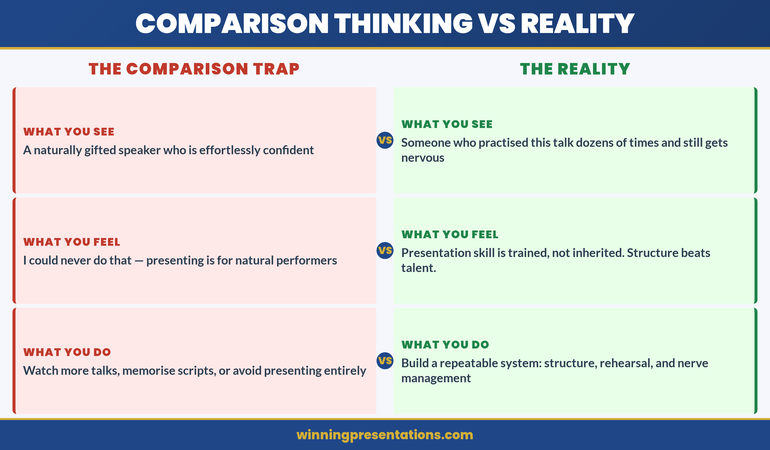
The primary problem with using other speakers’ performances as your learning benchmark is that you’re comparing your full, unfiltered reality—including anxiety, self-doubt, and visible struggle—to someone else’s highlight reel.

What you see: A polished delivery, perfect pacing, no visible nerves.

What you don’t see:

  • Their first 50 presentations (where they were terrible)
  • The speaking situations where they failed and learned
  • How they actually feel in their body during presentations
  • The years of practice hidden behind 18 minutes of TED talk
  • Their current anxiety triggers and vulnerabilities

When your nervous system is already primed for threat (which it is when you’re presentation-anxious), watching someone else’s polished performance reads as evidence that you’re deficient. Your brain doesn’t think, “That looks learnable.” It thinks, “I could never do that.”

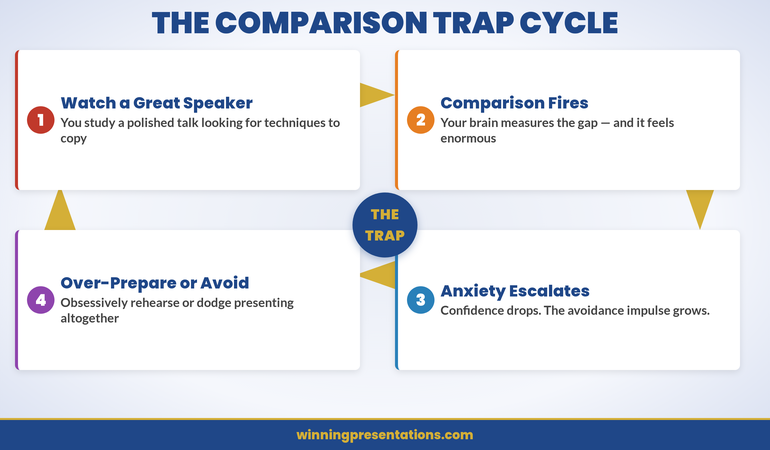
The pattern that keeps you stuck: Watch skilled speaker → Feel inadequate → Try harder → Rehearse obsessively → Anxiety increases anyway → Watch more speakers to feel better → Repeat.

The Conquer Speaking Fear programme (£39) breaks this cycle by teaching you how your nervous system actually works during presentations—using clinical hypnotherapy and NLP techniques to regulate anxiety at the source, rather than trying to out-skill your fear.

Explore the Anxiety-Based Approach

You’re Watching Highlight Reels, Not Real Practice

Here’s what gets hidden when you study great speakers: their learning curve. The neurobiologist who delivers a brilliant TED talk has probably given that talk a thousand times. The executive coach who looks totally composed has probably felt exactly as anxious as you do.

But you don’t see that journey. You only see the highlight.

This creates a dangerous assumption in your brain: They’re naturally good at this. I’m naturally anxious. We’re different.

That difference isn’t skill. It’s practice. It’s repetition. It’s nervous system regulation they learned (usually by trial and error, not by watching other people).

When you’re already battling presentation anxiety, consuming more “great speaker” content doesn’t close the gap. It widens it. Because every polished performance feels like evidence that the gap is wider than you thought.

The Comparison Trap Cycle infographic showing four stages: Watch a Great Speaker, Internal Comparison Fires, Anxiety Escalates, and Avoidance or Over-Preparation

How the Comparison Trap Hijacks Your Nervous System

Your nervous system has a job: keep you safe. When you’re presentation-anxious, it’s already in a heightened state of alert. Your body is primed to notice threat.

Then you watch a skilled speaker deliver flawlessly. In that moment, your nervous system interprets the signal as: That’s the standard you need to meet. You’re not meeting it. You are unsafe/failing.

This isn’t a logic problem. It’s a nervous system problem. The more speakers you watch, the more evidence your system collects that you don’t measure up.

The comparison trap doesn’t just affect your confidence. It actually heightens physiological anxiety: increased heart rate, shallow breathing, cortisol release. It’s not just negative thinking. Your body is responding to what feels like a threat assessment.

This is why “just practice more” or “study great speakers” advice often backfires. You’re adding pressure on top of an already dysregulated nervous system.

The Faulty Logic of Anxiety-Driven Learning

Anxiety has a particular way of “teaching” you. It shows you problems, not solutions. When you’re anxious about presentations, your brain highlights:

  • Everything that could go wrong
  • Every way you might fail
  • Every person watching who might judge you
  • Every flaw in your delivery compared to “better” speakers

Then you try to solve this by consuming more speaker content—thinking you’ll find the “right” way to do it. But you’re not learning the right way. You’re reinforcing the belief that there’s a standard you’re failing to meet.

This is learning through threat, not learning through mastery. And it doesn’t stick. It just creates more anxiety.

What actually works is learning how to regulate your nervous system first, then practicing presentation skills from a calmer, more resourced state. That’s when learning actually happens. That’s when confidence builds—not from watching someone else do it perfectly, but from your own body learning that you can manage the situation.

Feeling the comparison spiral right now? This is exactly what Conquer Speaking Fear addresses: how to interrupt the anxiety pattern before it becomes your default response.

What Actually Reduces Speaking Anxiety (It’s Not Speaker Videos)

The research on anxiety reduction is clear: exposure to threat (like watching skilled speakers when you’re anxious) doesn’t reduce fear. What reduces fear is regulated exposure to manageable challenge, combined with nervous system techniques that help your body learn the situation is safe.

That’s the gap most presentation advice misses. You don’t need:

  • More tips on body language
  • More examples of “perfect” presentations
  • More pressure to match someone else’s standard

You need your nervous system to feel safe while you practice. You need techniques that actually work at the physiological level. You need to build confidence through your own success, not through comparison to others.

Reframing: From Comparison to Nervous System Regulation

The shift from “I need to watch better speakers to learn” to “I need to regulate my nervous system to perform” changes everything.

Instead of:

  • Watching great speakers → feeling worse
  • Rehearsing obsessively → staying anxious
  • Comparing yourself → spiralling into self-doubt

You’d be:

  • Learning how your body responds under pressure
  • Practising techniques that actually calm your nervous system
  • Building confidence through managing your anxiety, not copying someone else’s skill
  • Developing a genuine sense of readiness, not just borrowed confidence from studying others

Comparison Thinking vs Reality infographic contrasting what you see, what you feel, and what you do when caught in the speaker comparison trap versus the reality of learnable skills

Stop Rehearsing What They’re Thinking About You

Here’s what happens in the comparison trap: you’re not just watching speakers. You’re imagining what the audience will think of you compared to them. You’re rehearsing judgment in your head.

This creates a secondary anxiety layer. Now you’re anxious about the presentation and anxious about being judged as “not good enough.”

That’s where nervous system regulation techniques become essential. Not to pump yourself up with false confidence. But to actually interrupt the fear response at the source.

The Conquer Speaking Fear programme uses evidence-based techniques from clinical hypnotherapy and NLP to help your nervous system feel safe during presentations—not just think positive thoughts about them.

Learn the Regulation Techniques

Is This Right For You?

This approach is for you if:

  • You’ve studied great speakers and it hasn’t reduced your anxiety (it may have increased it)
  • You’re rehearsing presentations obsessively but still feel nervous before delivering
  • Comparison is part of your anxiety pattern—you measure yourself against others
  • You want to feel genuinely confident, not just “get through” presentations
  • You’re ready to work on the nervous system level, not just the skills level

From Speaking Terror to Teaching Others

That CFO who couldn’t breathe in the boardroom? He didn’t stop being anxious by watching more successful financial leaders or studying presentation techniques. He stopped by learning how his nervous system actually worked during high-pressure situations. Once he understood that, he could regulate it.

Within 18 months, he went from dreading board announcements to volunteering to lead quarterly presentations to the full board. He didn’t become naturally good at presenting. He learned to manage his nervous system well enough that anxiety stopped controlling his performance.

Three years later, he’s mentoring other finance leaders through their presentation anxiety. Not because he became a “natural presenter.” But because he learned the one thing most presentation advice skips: how to work with your nervous system instead of against it.

The Conquer Speaking Fear programme (£39) condenses that learning curve into a structured programme using clinical hypnotherapy and NLP to create lasting change. You get the nervous system techniques that actually work. Not tips. Not tricks. Tools that work at the physiological level.

Join the Programme

📊 Want to improve your slides?

Preparation reduces anxiety. The Executive Slide System (£39) includes confident-presenter templates designed to minimise preparation stress.

People Also Ask

Does watching great speakers actually help with presentation anxiety?

For some people, watching skilled speakers can be motivating. But if you’re already anxious about presenting, it often increases comparison and self-doubt. The key difference is your nervous system state when you watch. If you’re primed for threat, you’ll interpret polished performances as evidence you’re not good enough. Nervous system regulation should come first; learning through observation should come later.

How long does it take to get over presentation anxiety?

It depends on your approach. If you’re trying to “think positive” or “rehearse more,” it often takes months or years—and can actually worsen anxiety. If you’re working directly with nervous system regulation techniques, most people notice significant shifts within 2-4 weeks. The foundation changes quickly; building full confidence takes longer, but you’re working from a much more resourced place.

Can I stop being anxious about presentations if I’m naturally an anxious person?

Yes. “Naturally anxious” usually means your nervous system is sensitised to threat more readily than others’—not that you’re broken or incapable. With the right nervous system tools, you can learn to regulate that sensitivity in specific situations (like presentations). You don’t become a different person. You become someone whose anxiety no longer controls their performance.

FAQ

Should I completely stop watching other speakers?

Not necessarily. The issue isn’t watching speakers; it’s when you watch them and why. If you’re watching them to learn a specific technique and you’re in a calm, resourced state, that can be valuable. If you’re watching them because you’re anxious and hoping to feel better, that usually backfires. Focus first on nervous system regulation. Then, from a calmer place, you can observe and learn without the comparison trap activating.

Is presentation anxiety the same as general anxiety disorder?

Not exactly. Presentation anxiety is specific to the performance situation. You might be calm in most areas of life but dysregulated when presenting. This specificity is actually an advantage—you can work directly with the nervous system triggers in that context. If you have generalised anxiety, presentation anxiety might be one manifestation of that larger pattern, and you’d want support for both.

If I fix my nervous system, will I need less practice?

No, but your practice will be more effective. Right now, if you’re anxious, you might be rehearsing obsessively and still not feeling confident—because anxiety is hijacking your learning. Once your nervous system is regulated, your practice time creates actual skill development and real confidence. You’ll likely need smarter practice, not necessarily more practice.

Ready to Stop the Comparison Cycle?

Join The Winning Edge newsletter for weekly strategies on nervous system regulation, presentation confidence, and the counter-intuitive approaches that actually reduce anxiety.

Subscribe (It’s Free)

🆓 Free resource: Get the Checklist — a free guide to strengthen your presentation preparation.

About the Author

Mary Beth Hazeldine is a presentation coach and nervous system specialist working with senior leaders and executives. She’s trained over 3,000 professionals to move from presentation anxiety to genuine confidence—by working at the nervous system level, not just the skills level. She’s the creator of the Conquer Speaking Fear programme and the Executive Slide System.

20 Mar 2026
Split corporate scene showing confident executive at podium on one side and anxious professional in meeting room on other side representing stage fright versus social anxiety

Stage Fright vs Social Anxiety: Different Causes, Different Fixes (Why This Matters for Your Recovery)

Quick Answer: Stage fright is situational fear tied to public performance itself. Social anxiety is pervasive fear of judgment that bleeds into all social contexts. They require different diagnostic approaches and different recovery strategies. Misidentifying which one you have is why many executives feel stuck—applying the wrong fix to the wrong problem.

Diagnosis Matters More Than You Think

Thousands of executives spend months or years working on confidence-building tips when their real issue is nervous system regulation. Or they focus on breathing techniques when their problem is an identity-based anxiety spiral. The Conquer Speaking Fear programme uses clinical hypnotherapy and nervous system science—not generic presentation tips—to address the actual root cause of your anxiety.

Learn how nervous system regulation differs from confidence coaching →

The Audience Judgement Loop (11 Years)
An executive spent 11 years trapped in a thought loop: “They’re judging me. I’m not ready. I’ll embarrass myself.” He’d rehearse presentations obsessively, avoid eye contact, speak in a monotone—all the classic presentation anxiety patterns. Then he took a confidence-building course. More techniques. More rules. More ways to feel like he was doing it wrong. Nothing stuck. Six months later, nothing had changed. But when he finally reframed his problem, everything shifted. It wasn’t stage fright at all—it was social anxiety wearing a presentation mask. His real fear wasn’t the performance moment itself. It was the belief that people were evaluating his character, his intelligence, his worth. One reframing technique broke the 11-year cycle. But only after he correctly identified what he was actually fighting.

Stage Fright: The Performance Response

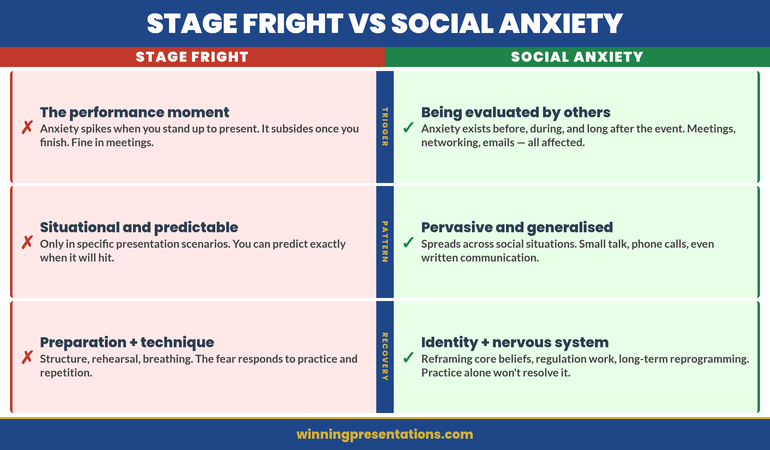
Stage fright is situational. It’s specific to the moment you’re in front of people to perform. The moment ends, the fear largely ends with it. An executive with stage fright might feel completely calm in a one-on-one conversation with the same person they’re nervous about presenting to. They feel fine in small team meetings but anxious at the quarterly town hall. They rehearse obsessively because they believe preparation will reduce the performance risk.

Stage fright is fundamentally a threat response. Your nervous system recognises a real, temporary situation where judgment is possible and reacts accordingly. Heart rate rises. Adrenaline flows. Your body is preparing to either perform at high stakes or escape the situation. This is not a broken response—it’s an ancient survival mechanism that happens to activate in modern performance contexts.

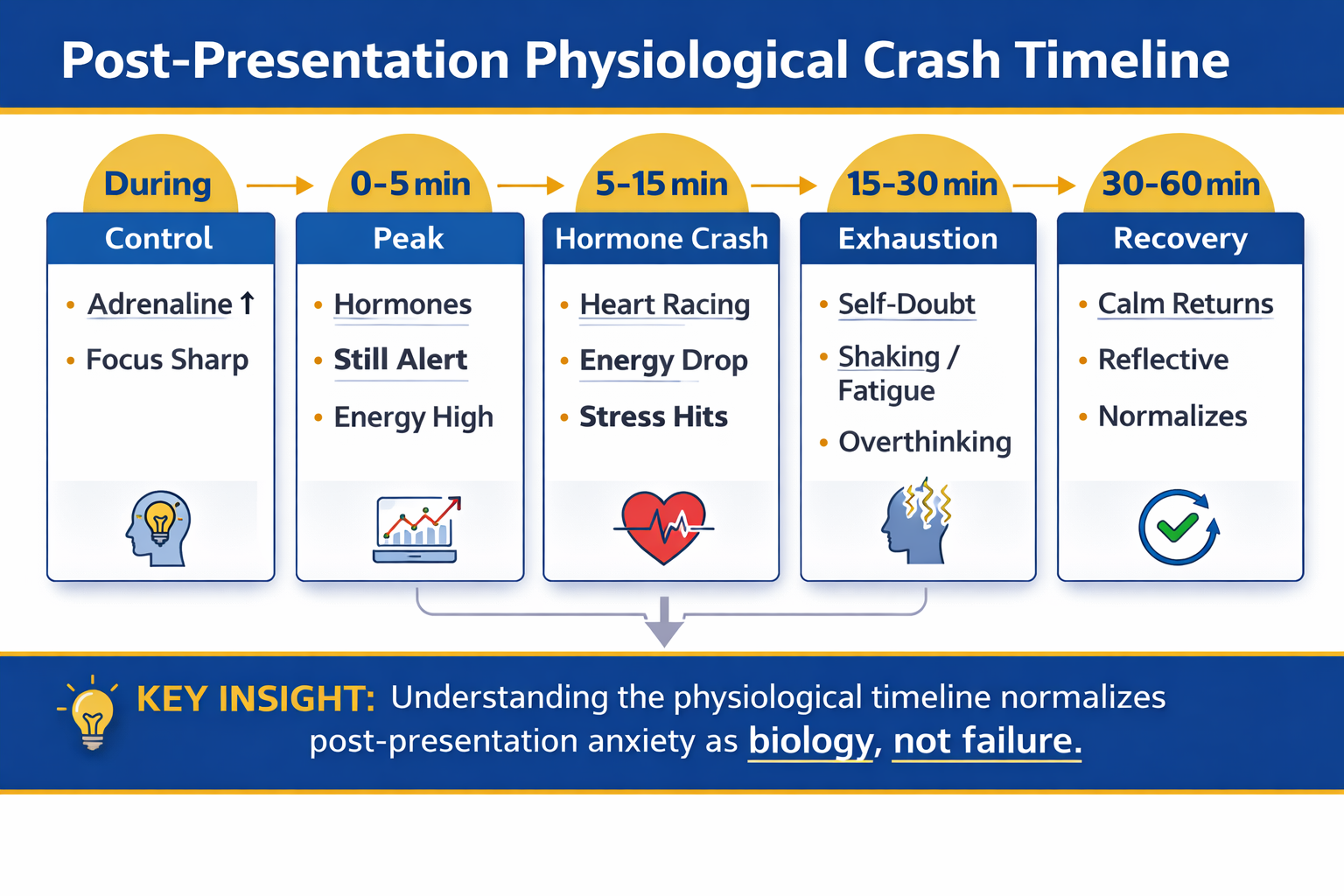
The physical symptoms are unmistakable: trembling hands, a dry mouth, butterflies in the stomach, a tight chest, racing thoughts. These symptoms typically spike 15 minutes before performance and subside within 10 minutes of finishing. An executive with pure stage fright might feel completely confident 30 minutes after a presentation ends.

Social Anxiety: The Identity Problem

Social anxiety is pervasive. It’s not about the specific performance moment—it’s about the belief that people are judging your character. An executive with social anxiety doesn’t feel calm in one-on-one conversations with colleagues they worry about. They don’t relax after the presentation ends because the anxiety isn’t tied to the performance—it’s tied to the interaction itself.

Social anxiety is fundamentally about evaluation of self. The fear isn’t “Will I mess up my words?” It’s “Do they think I’m competent?” or “Are they judging my character?” This creates a loop where the person interprets neutral social cues as criticism, avoids interactions that trigger anxiety, and then feels ashamed for avoiding them. The anxiety spreads across contexts—presentations, meetings, networking, even emails.

The physical symptoms of social anxiety are similar to stage fright on the surface, but the duration and trigger patterns differ completely. Someone with social anxiety might feel anxious hours before a presentation, during it, and for hours or days after—replaying every word, every moment, looking for evidence they were judged. The anxiety doesn’t turn off when the situation ends because the situation was never what the anxiety was really about.

Comparison infographic showing stage fright versus social anxiety across four dimensions: trigger, pattern, core fear, and recovery path with cross and check icons

The Diagnostic Framework: How to Tell the Difference

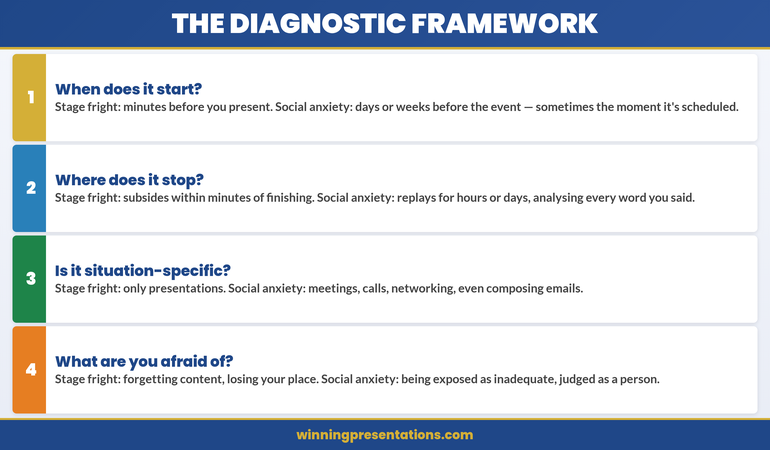
Here’s the clearest diagnostic tool. Imagine this scenario: You’re delivering a major presentation to your board. Afterwards, someone you respect pulls you aside and says, “That was great. Really clear.” How do you respond?

Stage fright response: “Thank you. I was so nervous. My hands were shaking.” Relief. The moment is over. By tomorrow, the anxiety has dissolved.

Social anxiety response: “Really? But I was rambling in the second section. I could tell they weren’t engaged. I probably sounded unprepared.” Doubt. Rumination. The anxiety shifts into self-criticism and evidence-gathering about your competence or likeability.

Stage fright is about the moment. Social anxiety is about your interpretation of what the moment says about you as a person. This distinction is critical because it changes everything about recovery.

Aspect Stage Fright Social Anxiety
Trigger Specific performance moment; high-stakes audience present Belief about judgment or social evaluation; present even in low-stakes social situations
Duration Minutes to an hour before and during; subsides quickly after Hours or days before; rumination after; context-independent
Core Fear “I will make a mistake or forget my words” “They are judging my character or competence”
Avoidance Pattern Avoids presentations; seeks small audiences or written formats Avoids social situations broadly; withdraws from colleagues; struggles in group settings
What Helps Preparation, practice, nervous system regulation in the moment Identity work, reframing beliefs about judgment, nervous system regulation + cognitive shifts

Why Your Recovery Path Depends on Which One You Have

This is where most executives get stuck. If you have stage fright and you spend your time building confidence and self-esteem, you’re missing the real problem: your nervous system is reacting to genuine stakes. You don’t need to think differently about yourself. You need your body to regulate more effectively in the moment.

If you have social anxiety and you spend your time practising presentation techniques and rehearsing, you’re treating a symptom, not a cause. You can memorise your whole deck word-for-word and still feel like a fraud in the moment because the anxiety isn’t about your preparation—it’s about whether people are judging you. More preparation actually feeds the anxiety because it’s rooted in the belief that you have to be perfect to deserve positive judgment.

Stage fright recovery focuses on nervous system regulation: breathing techniques that actually work, body awareness in high-stress moments, strategic visualisation tied to your actual nervous system state, and graduated exposure to the feared situation (presenting to larger audiences, higher stakes).

Social anxiety recovery focuses on reframing: examining the belief that judgment is dangerous, creating evidence that contradicts your anxiety narrative, building tolerance for being evaluated without needing to control the outcome, and regulating the nervous system as part of a larger identity shift.

Which one resonates? Get the specific framework.

Get Conquer Speaking Fear → £39

The Nervous System Component

Both conditions involve nervous system dysregulation, but in different patterns. Understanding this is essential because the fix depends on the pattern.

In stage fright, your nervous system is in a sympathetic (fight/flight) state during the performance. Your body has mobilised resources for threat response. This is actually functional—it’s giving you energy and alertness. The problem is that this activation feels terrible and makes it harder to access your executive function (clear thinking, smooth speech, memory access). The solution is to downregulate without losing the activation. You want calm focus, not panic or shutdown.

In social anxiety, your nervous system is in a dysregulated state before, during, and after social interaction because your mind is interpreting social evaluation as a threat to your identity. You might feel activated (anxiety, racing thoughts) or shut down (numbness, dissociation, inability to speak). The underlying problem is that your threat-detection system is misfiring—it’s treating social judgment as equivalent to physical danger. Breathing techniques help in the moment, but the real recovery happens when you rebuild the belief that judgment is survivable.

This is why clinical hypnotherapy and nervous system regulation techniques work so effectively for both conditions — they bypass the thinking mind (where social anxiety feeds itself with rumination) and work directly with the body’s threat response system. You’re not trying to think your way out of the problem. You’re teaching your nervous system a different pattern. Conquer Speaking Fear (£39) uses exactly this approach — clinical hypnotherapy techniques designed for executives, not generic relaxation exercises.

Four-step diagnostic framework infographic with questions to identify whether you have stage fright or social anxiety: when does it start, where does it stop, is it situation-specific, what are you afraid of

The Right Diagnosis Changes Everything

You can’t fix the wrong problem with the right techniques. Thousands of executives have spent years in generic confidence-building programmes, toastmasters clubs, and presentation-skills courses without lasting improvement. Why? Because they were never addressing the root nervous system pattern driving their anxiety. Conquer Speaking Fear uses clinical hypnotherapy and nervous system science—not presentation tips—to rewire how your body responds to high-stakes social situations. Different tools for stage fright. Different tools for social anxiety. Same outcome: calm, confident performance.

  • 30-day programme using clinical hypnotherapy techniques
  • Nervous system regulation specific to your anxiety pattern
  • Built for high-stakes executives and funding-round presentations

Get Conquer Speaking Fear → £39
Used by executives preparing for board presentations, funding pitches, and high-stakes approvals.

The Identity Loop: Why Social Anxiety Feels Inescapable

When an executive has social anxiety, they often don’t realise it—they think everyone experiences what they’re experiencing. In reality, their nervous system is caught in a loop where social situations activate the same threat response as physical danger. This creates a predictable pattern:

  1. Before a social/performance situation: Anticipatory anxiety (hours or days ahead)
  2. During: Heightened vigilance for signs of negative judgment
  3. After: Rumination and replaying of the interaction, looking for evidence they were judged poorly
  4. Conclusion: Self-blame and withdrawal, which temporarily reduces anxiety but reinforces the belief that judgment is dangerous
  5. Next situation: Baseline anxiety increases because avoidance has “confirmed” that the threat is real

This loop is why social anxiety often looks like a character flaw from the inside. It feels like you’re not confident enough, not prepared enough, not smart enough. It’s actually a nervous system pattern that’s running automatically, outside your conscious control. The more you try to think your way out of it, the worse it gets.

Stage fright doesn’t have this loop. You’re nervous in the moment. You perform. The anxiety stops. You don’t ruminate about it for days because your nervous system recognises the threat has passed. You might think about ways to improve your performance next time, but you’re not questioning your worth or competence based on the audience’s reaction.

Ready to break your pattern, whichever one it is?

Get Conquer Speaking Fear → £39

What Actually Changes in Recovery

For stage fright, what changes is your body’s response in the moment. Your heart rate might still rise—that’s fine. But you’re able to stay present, think clearly, and access your expertise despite the activation. You’re not fighting the anxiety. You’re regulating it enough to function at your best.

For social anxiety, what changes is the belief underneath the anxiety. You begin to understand that judgment is inevitable, survivable, and not a referendum on your worth. You build evidence that contradicts your anxiety narrative. You develop tolerance for being evaluated without needing to control the outcome or escape the situation. The nervous system follows the mind when the mind stops fighting the reality of social evaluation.

Both paths require specific techniques tied to your actual problem. Both lead to executives who can present to board rooms, lead all-hands meetings, and navigate high-stakes funding conversations without the anxiety controlling their performance.

Three Quick Questions to Clarify Your Pattern

  1. Do you feel anxious only in performance moments, or do you feel anxious about social evaluation in general? (Stage fright vs. social anxiety)
  2. Does your anxiety end when the presentation ends, or does it continue in rumination afterwards? (Stage fright vs. social anxiety)
  3. Are you avoiding presentations specifically, or are you withdrawing from social situations broadly? (Stage fright vs. social anxiety)

If your answers cluster toward performance-specific, moment-based anxiety, you likely have stage fright. If they cluster toward evaluation-based, pervasive anxiety, you likely have social anxiety. Many executives experience both, but one is usually dominant and driving the avoidance pattern.

Your Nervous System Doesn’t Care About Presentation Technique

Neither does recovery. The Conquer Speaking Fear programme bypasses the thinking mind and works directly with your nervous system using clinical hypnotherapy. You’ll learn the exact regulation techniques used by executives preparing for board presentations, funding rounds, and high-stakes approvals. Not generic confidence tips. Specific nervous system science. Different approach for different anxiety patterns. Same result.

  • Clinical hypnotherapy-based nervous system training
  • 30-day structured programme
  • Built for executives in high-stakes environments

Get Conquer Speaking Fear → £39
Thousands of executives have replaced anxiety with calm focus using these techniques.

The Real Cost of Misdiagnosis

An executive with social anxiety who spends a year perfecting their presentation skills without addressing the underlying belief about judgment will still feel like a fraud. An executive with stage fright who spends time in therapy exploring their childhood attachment style might feel better understood but no less anxious in the boardroom. The mismatch between the problem and the solution is why so many executives feel stuck after months or years of trying to fix themselves.

The diagnostic clarity matters more than you think. It’s not just about naming your problem correctly — it’s about directing your energy toward the actual fix. Your time is valuable. Your attention is limited. Applying the right solution to the right problem is how you move from stuck to free in weeks instead of years. Conquer Speaking Fear (£39) addresses both patterns with clinical hypnotherapy techniques matched to your specific nervous system response.

People Also Ask: Is stage fright the same as performance anxiety?

Stage fright is a form of performance anxiety, but they’re not identical. Performance anxiety is the broader category — it can apply to athletes, musicians, test-takers, and presenters. Stage fright is specifically the anxiety response triggered by presenting or speaking in front of an audience. The distinction matters because performance anxiety in other domains (sports, music) has different recovery paths than presentation-specific stage fright, which is tied to social evaluation in professional contexts.

People Also Ask: Can social anxiety develop later in life?

Yes. Many executives develop social anxiety in their 30s or 40s, often triggered by a promotion, a public failure, or increased visibility. The pattern can appear suddenly — you were fine presenting for years, and then a single bad experience rewired your threat response. This late-onset pattern is common in high-achieving professionals because their careers have placed them in increasingly high-stakes social situations. The nervous system reaches a tipping point.

People Also Ask: Should I see a therapist or use a self-guided programme?

It depends on severity. If your anxiety is significantly impairing your work (you’re avoiding meetings, turning down promotions, or experiencing physical symptoms daily), start with a qualified professional. If your anxiety is present but manageable — you can still present but it’s painful, or you ruminate after but can function — a structured programme like Conquer Speaking Fear can provide the specific nervous system techniques you need without the time commitment of weekly therapy.

Frequently Asked Questions

Can I have both stage fright and social anxiety at the same time?

Yes. Many executives have both. However, one is usually dominant and drives the avoidance pattern. Your recovery strategy should target the dominant pattern first. Often, when you address the dominant pattern with the right nervous system techniques, the secondary pattern naturally improves because you’ve rebuilt your confidence in social situations more broadly.

If I have stage fright, will breathing exercises actually help?

Breathing exercises help if they’re taught correctly and practised in advance. Most people learn a breathing technique once and then try to use it in a high-stress moment for the first time—which doesn’t work because your nervous system doesn’t recognise it as a safety signal. The techniques in Conquer Speaking Fear are designed to build nervous system recognition through repetition so they work when you need them.

How long does recovery actually take?

For stage fright, noticeable improvements often emerge within 2-3 weeks with consistent nervous system regulation practice. For social anxiety, the initial shift happens around the 3-week mark, with deeper integration and belief change building over 6-8 weeks. The Conquer Speaking Fear programme is structured as a 30-day intensive, which aligns with how nervous systems actually rewire.

Will I ever feel completely calm before a high-stakes presentation?

Possibly, but that’s not the goal. The goal is calm focus—where your nervous system is activated enough to perform at your best, but not so dysregulated that anxiety is controlling the experience. Most executives report that they still feel some activation before high-stakes situations, but it feels like energy rather than fear. The activation is working for them instead of against them.

Want the slides too?

Preparation reduces anxiety. The Executive Slide System (£39) includes confident-presenter templates designed to minimise preparation stress.

Stop Fighting the Wrong Problem

You’ve identified it. Now fix it. Conquer Speaking Fear uses clinical hypnotherapy and nervous system science to address the actual root of your anxiety—not generic confidence-building tips. Whether your issue is situational stage fright or pervasive social anxiety, this programme provides the specific framework and techniques for your pattern. Built for executives. Proven across thousands of high-stakes presentations.

  • Correct diagnosis leads to correct recovery path
  • 30-day programme with clinical hypnotherapy techniques
  • Nervous system regulation that actually works in real moments

Get Conquer Speaking Fear → £39
From board presentations to funding rounds: thousands of executives trust this approach.

Is This Right For You?

Conquer Speaking Fear is designed for executives who’ve tried the standard solutions—presentation skills courses, toastmasters, confidence-building workshops—and found that the anxiety either didn’t shift or came roaring back the moment stakes got real. It’s for anyone who recognises that their problem isn’t technique. It’s nervous system regulation and belief change. It’s for professionals in high-stakes environments: funding pitches, board presentations, all-hands meetings, investor calls, quarterly reviews where you’re being evaluated.

If your anxiety has started limiting your career opportunities, if you’re withdrawing from visibility, or if you’re spending hours ruminating after presentations, this programme will be valuable. The clinical hypnotherapy component accesses the parts of your nervous system that presentation skills training never touches.

Free resource: Download the Executive Presentation Checklist — a free PDF guide to preparing high-stakes presentations without the anxiety spiral.

About the Author

Mary Beth Hazeldine is the Owner & Managing Director of Winning Presentations. With 24 years of corporate banking experience at JPMorgan Chase, PwC, Royal Bank of Scotland, and Commerzbank, she has delivered high-stakes presentations in boardrooms across three continents.

A qualified clinical hypnotherapist and NLP practitioner, Mary Beth combines executive communication expertise with evidence-based techniques for managing presentation anxiety. She has trained thousands of executives and supported high-stakes funding rounds and approvals.

Book a discovery call | View services

18 Mar 2026

Why Your Heart Races 10 Minutes AFTER the Presentation (The Post-Presentation Crash Nobody Discusses)

Quick Answer: Your heart races after the presentation because your nervous system has just spent 30 minutes in fight-or-flight activation, and when the threat (presenting) ends, adrenaline floods your bloodstream without an outlet. Your body expected physical action; instead you got applause. This causes a physiological crash that manifests as trembling, racing heart, numbness, and emotional volatility—all completely normal, but entirely manageable with the right technique.

You’re Experiencing Post-Presentation Anxiety If: You delivered a solid presentation, the audience responded well, and then 10 minutes later you felt shaky, your heart was racing, or you went numb. Most executive training addresses presentation nerves. Nothing teaches you how to regulate your nervous system after it’s been flooded with adrenaline and the presenting is done. That gap is where post-presentation crashes happen—and where you can intervene.

See the somatic techniques that stop the crash →

The Moment You Realise Something’s Wrong

James, a Director at a major investment bank, walked off stage after a 40-minute investor presentation. The room had been engaged. Questions were sharp, positive. He’d answered well. His team caught him afterward, saying the content landed perfectly.

Then he sat down in his office. His heart was hammering. Not nervously—but forcefully, irregularly. His hands were trembling. He felt cold despite the warm room. He tried to make a call and heard his voice shaking. The internal voice started: What’s happening? Did I have a panic attack? Am I having a heart attack?

He wasn’t. His nervous system was.

For 40 minutes, his body had been in fight-or-flight. Adrenaline, cortisol, heightened blood pressure, accelerated heart rate—all of it was doing what it’s designed to do. It was preparing him to survive a threat. The threat (delivering under pressure) ended. His mind knew he was safe. His nervous system hadn’t caught up yet.

This is the post-presentation crash. And it’s the one thing nobody teaches executives to manage.

The Physiology Behind the Crash

Your nervous system doesn’t distinguish between “real” threats and “perceived” threats. When you stand in front of an audience, your amygdala registers threat. Your sympathetic nervous system activates. Adrenaline floods your bloodstream. Your heart rate increases. Blood is diverted from your digestive system to your muscles, preparing for action.

This state is designed for physical response. Fight. Flight. Physical action that discharges the adrenaline.

Presenting doesn’t offer that outlet. You stand still. You speak. Your body is chemically primed for action it doesn’t take. The presentation ends. The cognitive threat is gone. But neurochemically, you’re not done.

Adrenaline has a half-life of 2–3 minutes. But it doesn’t evaporate—it rebounds. Your body needs physical action to metabolise it. If you don’t move, if you don’t discharge that activation, you get the crash: racing heart, trembling, sudden fatigue, numbness, or emotional intensity.

This isn’t weakness. This isn’t anxiety disorder. This is physiology.

Why Nobody Warns You About This

Every presentation skills course teaches you how to manage nervousness before and during the presentation. Breathing techniques. Posture work. Vocal delivery. All of it is designed to keep you regulated while you’re in the room.

What they don’t teach: how to help your nervous system transition back to baseline after you’re done.

Most executives experience post-presentation anxiety at least once. They interpret it as proof that they’re “anxious people” or that presenting is “too stressful for them.” They don’t realise it’s a normal neurophysiological response to adrenaline discharge without physical outlet.

The gap in training exists because post-presentation crashes happen after the presentation—when the coaching is done. But that’s precisely when you need a protocol.

What Happens in Your Body After You Leave the Stage

The moment you finish presenting and step off the stage, your brain registers the threat as resolved. Your amygdala should tell your sympathetic nervous system to stand down. The parasympathetic nervous system (your rest-and-digest system) should activate to bring you back to baseline.

That transition is supposed to happen automatically. Often it does. But if you’ve been in a heightened state for a sustained period, the rebound can be messy.

0–5 minutes after presentation: You feel relief, maybe a rush of positive energy. Adrenaline is still high but you’re no longer under threat. Your body is still in sympathetic activation.

5–15 minutes after: This is where the crash often happens. Your cognitive threat is resolved, but your neurochemical state hasn’t caught up. Adrenaline is rebounding. Your heart rate is still elevated. Some people experience sudden drops in blood sugar. Others feel numbness or dissociation. Some feel emotionally intense or tearful.

15–30 minutes after: Your parasympathetic system is working to bring you back to baseline, but if you’ve had no physical outlet, the process is slower and more uncomfortable. You might feel exhausted suddenly. Or you might experience the “second wind”—a final surge of adrenaline.

The key: you need to help this transition happen faster and more smoothly. That’s where somatic intervention comes in.

The Shutdown Response (And Why It’s Different From the Crash)

Some executives don’t experience post-presentation crashes. They experience post-presentation shutdown. This is your nervous system moving too far in the opposite direction—from sympathetic activation straight into parasympathetic collapse.

You finish the presentation feeling numb, disconnected, or emotionally flatlined. You can’t access your usual emotions. You might feel foggy or depersonalised. Some people describe it as feeling like they’re watching themselves from outside their body.

This is your nervous system overcorrecting. After sustained threat activation, it swings too far into rest mode. Your body has essentially frozen.

The intervention is different from the crash protocol. You need to gently activate your nervous system back up from the shutdown state, rather than bringing it down from hyperactivation. But the principle is the same: help your body transition back to baseline on your timeline, not on automatic.

The Post-Presentation Recovery Protocol

Calm Under Pressure gives you a somatic toolkit specifically for the post-presentation window. This is the exact 7-minute sequence that helps your nervous system transition from threat activation to baseline without the crash.

  • The four somatic techniques that stop the racing heart (no breathing—these are body-based)
  • How to discharge adrenaline safely even when you can’t physically exercise
  • The shutdown recovery sequence (if you freeze rather than spike)
  • Integration techniques for the 12 hours after (so the crash doesn’t come back)

Get Calm Under Pressure → £19.99

Used by executives who present weekly and need a protocol that works regardless of presentation length, audience size, or how the room responded.

Your heart is racing right now?

Get the Recovery Toolkit → £19.99

Immediate Interventions That Work

If you’re experiencing a post-presentation crash right now, here are four immediate interventions you can use without special equipment or privacy:

Intervention 1: The Cold Water Reflex. Splash cold water on your face or hold your wrists under cold water for 20–30 seconds. This triggers your mammalian dive reflex—an ancient response that immediately lowers your heart rate and activates your parasympathetic nervous system. It’s not pleasant, but it works within seconds.

Intervention 2: Grounding Through Sensation. Place your feet firmly on the floor. Feel the full contact. Press your feet down hard for 10 seconds. Release. Repeat three times. This activates your proprioceptive sense, which signals to your nervous system that you’re safe and stationary. It’s more subtle than cold water, but it interrupts the racing cycle.

Intervention 3: Deliberate Physical Action. Your body expected to discharge adrenaline through physical action during the presentation. Give it that outlet now. Walk briskly. Do 20 jumping jacks. Shake your arms and legs vigorously. Your nervous system will metabolise the adrenaline faster when you give it the action it was primed for.

Intervention 4: Bilateral Stimulation. Tap your knees alternately—left, right, left, right—in a steady rhythm for two minutes. This engages both hemispheres of your brain and interrupts the racing cycle. It’s discreet enough to do under a table during a client dinner.

The key: pick one that feels authentic to you and use it immediately. Don’t wait for the crash to settle on its own. Your nervous system is primed for action—give it what it needs.

Preventing This From Becoming a Pattern

A single post-presentation crash isn’t a problem. It’s a signal that your nervous system needs support transitioning after high-stakes delivery. The problem is when it becomes a pattern. You start anticipating the crash. Your nervous system learns to expect it. What started as a physiological response becomes an anxiety pattern.

To prevent this:

Build a post-presentation protocol into your routine. Don’t wait until the crash happens. After every significant presentation, spend 10 minutes doing deliberate nervous system work. It might be a walk, stretching, cold water, or grounding exercises. Whatever it is, make it consistent. Your nervous system learns through pattern. A consistent post-presentation protocol teaches your body that after presenting comes a specific regulated transition—not a crash.

Address the deeper pattern. If post-presentation anxiety is happening regularly, it’s worth exploring what your nervous system is learning about presentations. Are you interpreting every presentation as genuinely threatening? Are you not fully believing you’re safe once it’s over? These are patterns that shift with the right approach, but they require more than just physical interventions.

Deeper Than Somatic Tools

Immediate interventions work. But if post-presentation anxiety is a regular pattern, something deeper needs to shift. Calm Under Pressure includes the somatic toolkit, plus the framework for understanding what your nervous system is learning about presentations—and how to change that pattern at the root.

  • The nervous system patterns that fuel post-presentation crashes (and how they formed)
  • Reframing work that changes your nervous system’s relationship to threat
  • Seven-day integration protocol (somatic work + cognitive shifts + lifestyle anchors)
  • How to know when you’re genuinely “fixed” vs. just managing symptoms

Get Calm Under Pressure → £19.99

Used by senior executives at FTSE firms, investment banks, and multinationals who present weekly but didn’t realise the crashes were addressable.

The Bigger Picture

Post-presentation crashes are a symptom. They tell you your nervous system is treating presentations as threats. That’s not always wrong—some presentations are genuinely high-stakes. But if your body is responding to routine client updates or team presentations with full fight-or-flight activation, something in your threat detection system needs recalibration.

This connects to larger patterns. If you’re experiencing post-presentation anxiety, you might also notice presentation anxiety before client meetings, or you might have a history where a past presentation experience left a mark on your nervous system. These are all connected to the same system. Fixing one piece shifts the whole pattern.

You might also benefit from understanding the neurobiology of fight-or-flight and how to interrupt it—not just in the post-presentation window, but as a foundational shift.

Is This Right For You?

✓ This is for you if:

  • You experience a racing heart, trembling, or numbness 10–20 minutes after presenting
  • You deliver presentations confidently but then feel crashed or numb afterward
  • You’re not sure if what you’re experiencing is “normal” or a sign of a deeper anxiety issue
  • You present regularly (weekly or more) and the post-presentation crash is becoming a pattern
  • You want practical tools you can use immediately, not just cognitive reframing

✗ Not for you if:

  • You experience anxiety during the presentation itself (that requires a different intervention)
  • You’re looking for general stress management rather than post-presentation-specific support
  • Your post-presentation symptoms are severe (chest pain, severe shortness of breath) and you haven’t consulted a medical professional
  • You present very rarely (once or twice a year) and the crash doesn’t significantly impact your performance or wellbeing

The Real Cost of Not Addressing This

A single post-presentation crash is uncomfortable. But when it becomes a pattern, it shapes your behaviour. You start avoiding presentations. You over-prepare as a way to manage anxiety. You rehearse obsessively. You negotiate to get out of presenting. Or you deliver presentations but spend the next hours in a state of dysregulation.

The psychological cost: you begin to believe presentations are too stressful for you. The physiological cost: your nervous system learns that presenting = threat, so each subsequent presentation triggers a stronger response. The professional cost: you might miss opportunities to lead, present findings, or influence decision-making because you’re working around the anxiety pattern.

The intervention is straightforward. But it requires intention. You need to understand what’s happening in your nervous system and give it what it needs to transition back to baseline.

Want the exact somatic protocol?

Get Calm Under Pressure → £19.99

Three Quick Answers

Is a racing heart after presenting a sign I have anxiety disorder? Not necessarily. Adrenaline is a physical substance. When your body releases it during a presentation and then doesn’t have a physical outlet to metabolise it, your heart will race. This is physiology, not pathology. If the racing heart is happening regularly and you’re concerned, consult a medical professional. But in most cases, this is a signal that your nervous system needs a transition protocol, not that something is wrong with you.

Should I be taking medication for this? That’s a question for your doctor. What I can tell you: somatic interventions often work faster and more effectively than medication for post-presentation crashes because they address the physiological process directly. But everyone’s situation is different. If you’re on medication, work with your prescriber. If you’re not and you’re considering it, try somatic interventions first.

How long does it take to stop having post-presentation crashes? With consistent use of a post-presentation protocol, most people notice a shift within 2–3 weeks. The crash intensity decreases. The recovery time shortens. Your nervous system learns that there’s a regulation protocol after presenting, so it anticipates the intervention and activates it. Within 6–8 weeks, the pattern usually shifts significantly.

The Slide System Works for This Too

If post-presentation anxiety is a pattern for you, it’s often because you’re spending mental energy managing the presentation content when what you actually need is a slide structure that works effortlessly. The Executive Slide System includes frameworks that reduce cognitive load during delivery—which means less adrenaline activation during the presentation and less crash afterward. Fewer mental resources spent on managing the deck means your nervous system doesn’t need to work as hard.

Explore the Executive Slide System → £39

FAQ

Is it normal to feel emotionally intense or tearful after a presentation?

Yes. Adrenaline and cortisol can create emotional volatility as they metabolise. You might feel tearful, angry, or intensely joyful after a presentation even if you didn’t feel that way during it. This is your nervous system processing the activation. Use your post-presentation protocol and let the emotions move through. They usually pass within 10–30 minutes.

What if the crash happens hours after the presentation, not immediately?

Sometimes your nervous system is still in activation mode hours later and doesn’t “crash” until you’re in a safer environment (home, car, after the meeting ends). The protocol is the same—immediate intervention using somatic techniques. The delayed crash can actually indicate that you were working very hard to stay regulated during the presentation and the effort caught up with you once you could relax.

Can I prevent the crash by not thinking about it?

No. The crash is a physiological response, not a cognitive one. Ignoring it or trying to think your way out of it usually extends it. Your nervous system responds to physical interventions—movement, cold, grounding, bilateral stimulation. Use those rather than trying to manage the crash mentally.

Should I tell my team if I’m experiencing this?

You don’t have to. It’s your nervous system’s process. But some executives find it helpful to have a brief exit plan (“I’m going for a walk to decompress”) so they’re not caught off-guard by the need to step away. You don’t need to explain the crash—just the need for a few minutes of space.

The Path Forward

Your heart is racing after presentations because your body is doing exactly what it’s designed to do. You needed activation to manage the threat of presenting. Now you need help transitioning that activation back to baseline. The somatic tools in this article work. Use one immediately the next time you feel the crash. Then build a protocol you use consistently after every presentation—before the pattern solidifies into an anxiety disorder.

This is addressable. But it requires intention in the 10 minutes after you leave the stage—not weeks of therapy afterward.

Stay Updated

New frameworks for managing presentation stress land in The Winning Edge newsletter every Friday. Subscribe for approaches you can use immediately.

🆓 Free resource: Free PDF — a free guide to strengthen your presentation preparation.

About the Author

Mary Beth Hazeldine is the Owner & Managing Director of Winning Presentations. With 24 years of corporate banking experience at JPMorgan Chase, PwC, Royal Bank of Scotland, and Commerzbank, she has delivered high-stakes presentations in boardrooms across three continents.

A qualified clinical hypnotherapist and NLP practitioner, Mary Beth combines executive communication expertise with evidence-based techniques for managing presentation anxiety. She has trained thousands of executives and supported high-stakes funding rounds and approvals.

Book a discovery call | View services

This article was written with AI assistance and reviewed by Mary Beth Hazeldine.

06 Mar 2026
Executive preparing to present in corporate corridor using calming techniques before high-stakes boardroom presentation

The Physical Symptom Hierarchy: What to Fix First When Everything Hits at Once

She vomited before every board meeting for three years. Nobody in her company knew.

When multiple physical symptoms hit before a presentation—shaking hands, racing heart, nausea, sweating, voice cracking—trying to fix everything at once makes every symptom worse. The presentation physical symptoms priority framework uses a clinical triage approach: stabilise breathing first (it controls the nervous system), then address the most visible symptom second (it reduces the shame spiral), then manage remaining symptoms with targeted techniques. This hierarchy works because physical presentation symptoms are cascading—they share a common root in the fight-or-flight response, and treating them in the right order creates a chain reaction of relief.

🚨 Presentation this week and symptoms already building?

Quick self-check: Can you identify your dominant symptom right now? (The one you notice first, not the one that bothers you most.) That’s your starting point.

  • Breathing disrupted → Start with the 4-7-8 pattern (60 seconds)
  • Hands shaking → Isometric press technique (press palms together under the table, 10 seconds)
  • Nausea → Cold water on wrists + controlled exhale (90 seconds)

→ Need the complete symptom-by-symptom toolkit? Get Calm Under Pressure (£19.99)

The Executive Who Vomited Before Every Board Meeting

A C-suite executive I worked with had a secret she kept from her entire organisation for three years. Before every major presentation—board meetings, investor updates, all-hands announcements—she would excuse herself to the bathroom and vomit.

Nobody knew. She was considered one of the most composed presenters in the company. Her team described her as “calm under pressure.” Her board colleagues said she was “naturally confident.”

The nausea was just the beginning. Her hands would shake so badly she couldn’t hold notes. Her heart rate would spike above 140 bpm—she knew because she tracked it on her watch. She’d sweat through her jacket. Her voice would catch on the first few words.

She’d tried everything. Breathing exercises. Visualisation. Beta blockers (prescribed, never taken—she was afraid of feeling “medicated” in front of the board). The problem wasn’t lack of techniques. The problem was that every technique she’d found addressed one symptom. When all five hit at once, she didn’t know where to start.

That’s when we developed the triage approach. Not a single technique for a single symptom. A priority system for when your body throws everything at you simultaneously.

Within six weeks, she went from vomiting before every board meeting to managing her symptoms in under 90 seconds. The nausea didn’t disappear entirely. But it dropped from debilitating to manageable. And the cascade—the shaking, the sweating, the voice cracking—reduced dramatically once she stopped trying to fight everything at once.

The 60-Second Resets That Stop Physical Symptoms Before They Cascade

  • Symptom-Specific Techniques: Targeted 60-second resets for shaking, sweating, nausea, racing heart, voice cracking, and facial flushing—each with a different physiological mechanism
  • The Triage Sequence: The exact order to address symptoms when multiple hit at once, based on clinical nervous system regulation
  • Pre-Presentation Protocol: A 90-second routine to run before walking into any high-stakes meeting—works in a bathroom, a corridor, or your car
  • In-the-Moment Recovery: What to do when symptoms spike mid-presentation without the audience noticing
  • Evidence-Based Techniques: From clinical hypnotherapy and NLP, adapted specifically for executive presentation environments

Download Calm Under Pressure → £19.99

Evidence-based techniques from clinical hypnotherapy and NLP, adapted for high-pressure executive environments

Why Fixing Everything at Once Makes Every Symptom Worse

When your body goes into fight-or-flight before a presentation, the symptoms feel simultaneous and overwhelming. Your hands shake. Your stomach churns. Your heart races. Your palms sweat. Your throat tightens.

The natural response is to try to fight all of it. You grip the lectern to stop the shaking. You swallow hard to settle the nausea. You try to slow your breathing. You wipe your palms. You clear your throat.

But here’s what’s actually happening physiologically: all of these symptoms share a single root cause. Your sympathetic nervous system has activated the fight-or-flight response, flooding your body with adrenaline and cortisol. Every symptom is a downstream effect of that one activation.

When you try to address each symptom individually and simultaneously, you’re fighting five fires with five separate hoses—while ignoring the gas main that’s feeding all of them. Worse, the act of frantically trying to control everything creates additional stress, which intensifies the original fight-or-flight response. You’re adding fuel to the fire you’re trying to extinguish.

The triage approach works because it addresses symptoms in the order that creates the maximum cascade of relief. Fix the right symptom first, and the others reduce on their own.

The Physical Symptom Triage Framework

The triage framework prioritises presentation physical symptoms into three tiers, each building on the previous one:

Tier 1: Breathing (always first). Breathing is the only part of the fight-or-flight response you can consciously override. It’s the master switch for the entire nervous system. Address this first, regardless of which symptom feels most urgent.

Tier 2: Most visible symptom (second). After breathing is stabilised, address whichever symptom is most visible to the audience. Not the most uncomfortable—the most visible. Because visible symptoms create a shame feedback loop that re-triggers the fight-or-flight response. Breaking that loop prevents the cascade from restarting.

Tier 3: Remaining symptoms (last). Once breathing and the visible symptom are managed, the remaining symptoms typically reduce on their own. If they don’t, apply targeted techniques for each one. But many presenters find that Tiers 1 and 2 handle most of the cascade.

This hierarchy is based on how the nervous system actually works, not on which symptom feels worst. The symptom that feels most urgent (nausea, for many people) is often not the symptom to address first. Breathing controls the nervous system. Visibility controls the psychological spiral. Everything else is downstream.

The Physical Symptom Triage Framework infographic showing three tiers: Tier 1 Breathing (the master switch), Tier 2 Most Visible Symptom (breaking the shame loop), and Tier 3 Remaining Symptoms (targeted techniques)

Need the complete technique for each symptom tier?

Calm Under Pressure includes the full triage protocol with 60-second resets for every symptom—designed for executives who need results in the corridor before the boardroom.

Download Calm Under Pressure → £19.99

Tier 1: Breathing (The Master Switch)

Breathing is the only autonomic function you can consciously control. When you deliberately slow your exhale, you activate the parasympathetic nervous system—the body’s braking system. This directly reduces heart rate, lowers cortisol, and begins to calm every downstream symptom.

The key isn’t deep breathing. It’s slow exhale breathing. Many people take deep inhales when anxious, which actually increases the oxygen-carbon dioxide imbalance and can make dizziness and tingling worse.

The 4-7-8 Pattern (60 Seconds)

Inhale through your nose for 4 counts. Hold for 7 counts. Exhale through your mouth for 8 counts. The extended exhale is the critical element—it’s what triggers the parasympathetic response. Two cycles of this pattern (about 60 seconds) measurably reduces heart rate and begins to calm the cascade.

You can do this in a bathroom stall, in a corridor, sitting at the table before the meeting starts, or even during someone else’s presentation. It’s invisible to others and it works within 60 seconds. For a deeper dive into this approach, see our guide on managing a panic attack before a presentation.

Why Breathing Must Always Come First

If you try to address shaking before breathing, the adrenaline keeps the shaking going. If you try to settle nausea before breathing, the cortisol keeps the stomach churning. Every other technique works better once the nervous system is partially deactivated. Breathing is the prerequisite, not one option among many.

I’ve watched executives try every symptom-specific technique without addressing breathing first. It’s like trying to mop a floor while the tap is still running. The 60-second breathing pattern doesn’t eliminate symptoms entirely—but it reduces the intensity enough that Tier 2 techniques become effective.

Tier 2: Your Most Visible Symptom

After breathing is stabilised, address whichever symptom the audience can see. This is counterintuitive—most people want to fix the symptom that feels worst. But visible symptoms create a psychological feedback loop that invisible symptoms don’t.

Here’s the loop: you notice your hands are shaking. You think “They can see my hands shaking.” That thought triggers shame and self-consciousness, which re-activates the fight-or-flight response, which makes everything worse. The visible symptom isn’t just a physical problem—it’s a psychological re-trigger.

By addressing the most visible symptom second, you break the shame loop before it can restart the cascade. Here are the targeted techniques for the most common visible symptoms:

Shaking Hands

The isometric press technique: press your palms firmly together under the table for 10 seconds. This engages the large muscle groups in your arms and shoulders, which burns off excess adrenaline and temporarily stops the fine-motor tremor. You can also press your fingertips firmly into the table surface or grip a pen tightly for 5 seconds, then release. The release is what creates the calming effect. If you need more techniques for shaking hands during presentations, we’ve covered the full range of approaches.

Voice Cracking or Shaking

The vocal warm-up: hum quietly before speaking (even silently, just vibrating your throat). This relaxes the vocal cords, which tighten under adrenaline. Take a sip of room-temperature water (cold water tightens the throat). Start your first sentence with a low, slow delivery—then let your natural pace return. The first 10 seconds set the tone for the rest.

Facial Flushing

The cold-point technique: before entering the room, press cold water (or a cold object) against your wrists and the back of your neck. These are pulse points where blood vessels are close to the skin surface. Cooling these areas reduces peripheral vasodilation—the mechanism that causes blushing. It won’t eliminate flushing entirely, but it reduces the intensity enough that most people won’t notice.

Visible Sweating

Sweating is partially managed by Tier 1 breathing (reduced cortisol = reduced sweating). For visible sweating, preparation is your best tool: wear fabrics that don’t show moisture, keep a handkerchief in your pocket, and use clinical-strength antiperspirant on your palms 30 minutes before the meeting. Our full guide to managing sweating during presentations covers additional strategies for different environments.

Stop Fighting Five Symptoms With Five Separate Techniques

  • The Complete Triage Protocol: The exact sequence for when everything hits at once—breathing, visible symptom, then targeted recovery
  • 60-Second Resets: One technique per symptom, each designed to work in the corridor before the boardroom

Download Calm Under Pressure → £19.99

Created by a clinical hypnotherapist who spent 5 years terrified of presenting

Tier 3: Managing What Remains

After Tiers 1 and 2, most presenters find that remaining symptoms have dropped from debilitating to manageable. The nervous system activation has reduced (Tier 1), and the psychological shame loop has been broken (Tier 2). What remains is residual adrenaline—which actually has benefits if it’s at a low enough level.

A mild level of arousal improves focus, sharpens thinking, and adds energy to your delivery. The goal isn’t to eliminate all physical sensations—it’s to bring them below the threshold where they interfere with performance.

Residual Nausea

If nausea persists after breathing stabilisation, try the ginger technique: a small piece of crystallised ginger or a ginger sweet 20 minutes before the presentation. Ginger has established anti-nausea properties. Combine with sipping room-temperature water (not cold—cold can tighten the stomach).

Residual Racing Heart

If your heart rate remains elevated after the 4-7-8 breathing, try the dive reflex: splash cold water on your face or press a cold, damp cloth against your cheeks and forehead. This triggers the mammalian dive reflex, which naturally slows heart rate. It’s remarkably effective and works within seconds.

Residual Tension and Restlessness

Excess adrenaline creates a feeling of restless energy. The progressive muscle release works well: tense every muscle in your body for 5 seconds (clench fists, tighten shoulders, squeeze legs together), then release everything at once. The contrast between maximum tension and complete release activates the parasympathetic response. This works standing, sitting, or even mid-presentation (subtly tensing and releasing your leg muscles under the table).

Symptom-by-Symptom Quick Reference infographic showing targeted techniques for six presentation symptoms: shaking (isometric press), voice cracking (vocal warm-up), flushing (cold-point technique), sweating (preparation strategy), nausea (ginger technique), and racing heart (dive reflex)

Want the full technique guide for each physical symptom?

Calm Under Pressure covers every symptom with step-by-step instructions, timing guidance, and the clinical evidence behind each technique.

Download Calm Under Pressure → £19.99

Why do I get multiple physical symptoms before presentations?

Multiple physical symptoms happen because they all share one root cause: the fight-or-flight response. When your nervous system perceives the presentation as a threat, it floods your body with adrenaline and cortisol. This single activation causes shaking (muscle tension), sweating (thermoregulation), nausea (blood diverted from digestion), racing heart (increased blood flow), and voice changes (throat muscle tension). They feel like separate problems, but they’re one response with multiple symptoms.

Should I take beta blockers for presentation anxiety?

Beta blockers reduce physical symptoms (especially racing heart and tremor) by blocking adrenaline’s effect on the body. They’re prescribed by doctors for performance anxiety and can be effective for some people. However, they don’t address the root cause—the nervous system’s threat response. Many executives prefer behavioural techniques because they build long-term resilience rather than masking symptoms. This is a conversation to have with your GP, who can advise based on your specific situation.

Can physical presentation symptoms get worse with age?

They can, particularly if untreated. Each difficult presentation experience strengthens the neural pathway between “presentation” and “threat.” Over years, the fight-or-flight response can become faster and more intense—what started as mild nerves at 30 becomes debilitating symptoms at 45. The good news is that this sensitisation is reversible with targeted nervous system regulation techniques, regardless of how long the pattern has been established.

Is Calm Under Pressure Right For You?

✓ This is for you if:

  • You experience physical symptoms (shaking, sweating, nausea, racing heart, voice cracking) before or during presentations
  • You’ve tried breathing exercises or relaxation techniques but find they don’t work when multiple symptoms hit at once
  • You need techniques that work quickly—in the corridor, at the table, during the meeting
  • You want evidence-based approaches, not generic “just relax” advice

✗ This is NOT for you if:

  • Your challenge is psychological (imposter syndrome, fear of judgement) rather than physical symptoms—Conquer Speaking Fear addresses the root cause
  • You rarely experience physical symptoms and your anxiety is primarily cognitive

Created by a Clinical Hypnotherapist Who Spent 5 Years Terrified of Presenting

  • The Complete Symptom Triage: The exact priority order for addressing multiple physical symptoms simultaneously—breathing first, visible symptoms second, targeted techniques third
  • Six Symptom-Specific Resets: Individual 60-second techniques for shaking, sweating, nausea, racing heart, voice cracking, and facial flushing
  • Pre-Presentation Protocol: The 90-second routine to run before any high-stakes meeting—designed for executives who present in boardrooms, not therapists’ offices
  • In-Meeting Recovery: Techniques for when symptoms spike mid-presentation—invisible to the audience, effective within seconds
  • The Science Behind Each Technique: Clinical evidence from hypnotherapy and NLP so you understand why each technique works and can trust it under pressure

Download Calm Under Pressure → £19.99

I kept beta blockers in my desk for 3 years. I found something better. — Mary Beth Hazeldine

📊 Want the slides too?

Preparation reduces anxiety. The Executive Slide System (£39) includes confident-presenter templates designed to minimise preparation stress.

Frequently Asked Questions

Q: What if breathing exercises don’t work for me?

A: Most people who say breathing exercises don’t work are doing them incorrectly—usually taking deep inhales without the extended exhale. The critical element is the exhale length: it must be longer than the inhale. The 4-7-8 pattern works because the 8-count exhale directly activates the vagus nerve and parasympathetic response. If you’ve tried this and still struggle, the issue may be timing—you need to start earlier, ideally 15-20 minutes before the presentation, not in the final moments before speaking.

Q: My symptoms are getting worse over the years. Is that normal?

A: Unfortunately, yes. Without intervention, the neural pathway between presentations and the threat response strengthens over time. Each negative experience reinforces the pattern, making symptoms faster and more intense. This is called sensitisation. The triage framework works to interrupt this pattern by creating new neural associations between presentations and successful regulation. With consistent practice, the sensitisation can reverse—even after decades of worsening symptoms.

Q: Can I use these techniques during a live presentation or only beforehand?

A: Both. The pre-presentation protocol (90 seconds, run beforehand) handles the anticipatory spike. But symptoms can also surge mid-presentation—especially during Q&A or when something unexpected happens. The in-meeting techniques (subtle isometric presses, controlled exhales between sentences, grounding through foot pressure) are designed to be invisible to the audience. Nobody will know you’re doing them.

Get Evidence-Based Presentation Insights Every Week

The Winning Edge newsletter shares clinical techniques, executive strategies, and real recovery stories for professionals who present under pressure. Subscribe for free.

Subscribe to The Winning Edge

🆓 Free resource: Executive Presentation Checklist — a free guide to strengthen your presentation preparation.

About the Author

Mary Beth Hazeldine is the Owner & Managing Director of Winning Presentations. With 24 years of corporate banking experience at JPMorgan Chase, PwC, Royal Bank of Scotland, and Commerzbank, she has delivered high-stakes presentations in boardrooms across three continents.

A qualified clinical hypnotherapist and NLP practitioner, Mary Beth combines executive communication expertise with evidence-based techniques for managing presentation anxiety. She has trained thousands of executives and supported presentations for high-stakes funding rounds and approvals.

Book a discovery call | View services

Your next presentation is on your calendar. The symptoms are coming. But now you know the order: breathing first, visible symptom second, everything else follows. Download Calm Under Pressure and have the complete triage protocol ready before the adrenaline starts. Ninety seconds. That’s all you need.

04 Mar 2026
Clinical hypnotherapy approach to treatment-resistant presentation anxiety in corporate setting

When Therapy, Coaching, AND Practice Haven’t Fixed Your Presentation Fear

You’ve done everything right. You’ve sat in therapy, talking through your childhood fears and perfectionism. You’ve invested in coaching programmes that promised to rewire your confidence. You’ve rehearsed your presentations until you could deliver them in your sleep. Yet when you stand up to speak, your body hijacks you anyway. Your heart races. Your voice trembles. The fear is still there—just as visceral as it was five years ago.

This isn’t a reflection on your intelligence, your preparation, or your commitment to change. It means you’re experiencing treatment-resistant presentation anxiety, and you need a different approach.

When traditional therapy, coaching, and practice haven’t resolved your presentation fear, the issue isn’t your willpower—it’s your nervous system’s regulation. Clinical hypnotherapy and nervous system-focused techniques work differently than talk therapy because they address the body’s threat response directly, not just the thoughts about the threat. If you’ve exhausted conventional approaches, a clinical framework designed specifically for treatment-resistant speaking anxiety may be the missing piece.

Tried therapy, coaching, and practice—still dreading your next presentation?

The pattern repeats: preparation feels thorough, yet your nervous system floods with adrenaline the moment you step on stage. This is treatment-resistant presentation anxiety, and it requires a nervous system approach—not more talking.

  • Recognise why traditional anxiety treatment sometimes fails for public speaking
  • Understand the specific mechanism your nervous system is stuck in
  • Access a clinical protocol designed for people who’ve tried everything

Ready for the clinical approach?

Get Conquer Speaking Fear → £39

The Story That Changed How I Understand Presentation Fear

I spent five years terrified of presenting. Not anxious. Terrified. When I was asked to present, my body responded as though I were facing physical danger: nausea, shaking, voice that cracked mid-sentence, hands that wouldn’t stay still. I tried talking therapy, which helped me understand my perfectionism but didn’t stop the physical response. I tried techniques: breathing exercises, positive affirmations, exposure practice. They helped slightly, but not enough.

The breakthrough came when I began my clinical hypnotherapy training and learned that my nervous system didn’t believe I was safe, no matter what my conscious mind knew. Cognitive work alone wasn’t addressing the subcortical threat response. Once I applied nervous system regulation techniques—the ones I now teach in Conquer Speaking Fear—the physical symptoms resolved within weeks, not years. That experience shaped everything I now teach about treatment-resistant presentation anxiety.

Why Traditional Approaches Fall Short for Treatment-Resistant Presentation Anxiety

When your presentation fear persists despite years of therapy, coaching, and practice, it’s not because these approaches are ineffective in general. They work brilliantly for many people. But for a subset of individuals—those with treatment-resistant presentation anxiety—the conventional toolbox hits a ceiling.

Therapy, particularly talk-based approaches, excels at helping you understand the origins of your fear: the critical parent, the early experience of public failure, the perfectionism that became armour. This understanding is valuable. But understanding doesn’t always change the nervous system’s threat response. Your amygdala—the brain’s threat detector—doesn’t operate primarily through language. It operates through subcortical pathways that bypass conscious reasoning. You can intellectually know you’re safe, and your body still floods with adrenaline.

Coaching and presentation skills training work on competence: more preparation, more rehearsal, more exposure. The assumption is sound—confidence builds through mastery. But when your nervous system interprets the presentation context as a threat, more exposure can actually reinforce the association. You practise, you feel afraid, your nervous system learns: “This environment is dangerous.” The loop tightens.

This is where treatment-resistant presentation anxiety differs from garden-variety nervousness. It’s not that you lack confidence in your content or your ability to deliver. It’s that your threat-detection system has become miscalibrated. It fires even when the evidence for danger is absent.

What Your Nervous System Is Actually Doing

To understand why traditional approaches sometimes fail, you need a precise picture of what’s happening in your body when you present.

Your nervous system has three core states: sympathetic (fight-or-flight), parasympathetic (rest-and-digest), and social-engagement (calm-but-alert). Most people move fluidly between these states depending on context. In low-threat situations, you’re parasympathetic. When you step up to present, your sympathetic system activates appropriately—your heart rate increases, blood flows to your muscles, your awareness sharpens. This is useful. It’s supposed to happen.

But in treatment-resistant presentation anxiety, your sympathetic system doesn’t calibrate. It floods. Your nervous system assigns the same threat level to a boardroom presentation as it would to a physical attack. This is what produces the nausea, shaking, voice disruption, and mental fog you experience. Your body is preparing you to flee or fight—and neither option is available in the presentation context, so you freeze instead.

The critical insight: this isn’t a thinking problem. It’s a nervous system regulation problem. Your conscious mind may be telling you, “This is safe, you’re prepared, you know this content,” but your nervous system isn’t listening because it operates according to patterns encoded much deeper than conscious thought. These patterns live in procedural memory, emotional conditioning, and somatic (body-based) imprints. Talk therapy reaches the cortex. Treatment-resistant presentation anxiety needs subcortical intervention.

Why CBT, Coaching, and Exposure Sometimes Aren’t Enough

Cognitive-behavioural therapy is genuinely effective for many anxiety conditions. It works by challenging distorted thoughts and gradually exposing yourself to the feared situation until your nervous system learns it’s safe. The theory is sound. The mechanism is this: repeated exposure without catastrophe should extinguish the fear response.

But exposure therapy has a known limitation for treatment-resistant cases: it can flatten the fear response temporarily without changing the underlying nervous system calibration. You give a presentation, nothing terrible happens, yet three weeks later, the anxiety is back at full intensity. Why? Because your nervous system never actually re-encoded safety. The fear was merely suppressed or you white-knuckled through it using willpower. The subcortical threat pattern remains intact.

Rehearsal and practice, taken to extremes, can even worsen treatment-resistant presentation anxiety. More hours at the podium sometimes means more opportunities for your nervous system to practice the threat response. You condition yourself deeper into the pattern.

Coaching works well when the barrier is skill or confidence. But when the barrier is nervous system dysregulation, coaching is asking the wrong system to change. You can have a coach point out every strength you possess, and your amygdala still won’t care. It’s operating from a different information set: procedural memory and somatic patterns, not rational evaluation.

The pattern is this: traditional approaches assume the nervous system will self-correct once the thinking changes or the experience repeats. For treatment-resistant anxiety, this assumption breaks. The nervous system needs direct intervention—techniques that speak its language.

How Hypnotherapy and Nervous System Approaches Work Differently

Clinical hypnotherapy isn’t stage hypnosis or entertainment. In a clinical context, hypnotherapy is a method for achieving focused attention and accessing the parts of the nervous system that aren’t reachable through conscious discussion.

When you’re in hypnotic trance (which feels like a relaxed, concentrated state—not sleep, not loss of control), your critical conscious mind becomes less dominant, and your nervous system becomes more accessible. This is where the reframing happens, not in your thoughts, but in how your body interprets threat and safety.

A clinical hypnotherapist working with treatment-resistant presentation anxiety isn’t trying to convince you that presentations are safe. You already know that intellectually. Instead, the work is subcortical: recalibrating your nervous system’s threat-detection threshold. Through techniques like nervous system anchoring and somatic resourcing, your body learns a new physiological response to the presentation context.

Neuro-Linguistic Programming (NLP) operates from a similar principle: it works with the structure of your experience—how you’re internally representing the threat—rather than trying to think your way out of it. An NLP practitioner helps you interrupt the automatic pattern and install a resourced response in its place.

Both approaches share a critical difference from talk therapy and coaching: they work with the nervous system directly. They don’t ask your thinking to change your physiology; they change your physiology and allow your thinking to follow.

The Clinical Mechanism: From Theory to Regulation

Here’s the specific mechanism that makes clinical approaches effective for treatment-resistant presentation anxiety:

Pattern interruption. Your presentation anxiety has become automatic. You think of presenting, and your body responds with threat activation before you’ve consciously processed what you’re afraid of. A clinical approach interrupts this automatic sequence. It breaks the conditioned link between “presentation context” and “threat activation.”

Subcortical re-encoding. Once the automatic pattern is interrupted, your nervous system can be guided into a new encoding. Not through logic, but through direct nervous system work. You’re literally teaching your amygdala that presentations are safe—not by telling it, but by activating a genuinely resourced physiological state while simultaneously encountering the presentation context. This is how nervous system learning occurs.

Resource anchoring. Clinical protocols typically establish what’s called a “resourced state”—a physiological condition of genuine safety, calm alertness, and confidence. This state is anchored (associated) with specific triggers or contexts. When you subsequently encounter a presentation opportunity, those anchors activate the resourced state rather than the threat response. Your body remembers a different pattern.

Somatic integration. The goal isn’t intellectual acceptance. It’s bodily integration. You should be able to stand in front of an audience and feel genuinely calm—not managing anxiety, not white-knuckling through it, but physiologically present and regulated. This is what becomes possible when you work at the nervous system level.

What a Clinical Approach Actually Looks Like

If you’ve decided that treatment-resistant presentation anxiety requires a clinical intervention, here’s what that process actually involves:

Assessment of your nervous system patterns. A clinical approach begins by understanding precisely how your nervous system is triggering. Is it a full sympathetic flood from the moment you think about presenting? Does it spike only when you’re in front of people? Does it manifest as a freeze response rather than fight-or-flight? The specifics matter because they determine the intervention.

Guided nervous system regulation. You’ll learn techniques to access and activate your parasympathetic (calm) system and your social-engagement system (the nervous system state of safe connection). These aren’t breathing exercises in the traditional sense. They’re precise physiological interventions that shift your nervous system state measurably.

Reprocessing in context. Once you can reliably access a resourced nervous system state, the clinical work involves reprocessing the presentation context while you’re in that state. The goal is to decouple “presenting” from “threat.” Your nervous system learns: “This is a context where I’m calm, capable, and connected.”

Rehearsal with regulation. Unlike traditional practice, which can reinforce anxiety patterns, clinical rehearsal is done while maintaining nervous system regulation. You’re practising presentations from a resourced state, which teaches your nervous system a completely different pattern.

Maintenance and integration. The final phase ensures the changes are durable. You learn to maintain nervous system regulation under increasing pressure, and you develop ways to access resourced states independently, without relying on a practitioner.

Present Without the Adrenaline Hijack

When traditional methods haven’t worked, the clinical nervous system approach delivers what they couldn’t: genuine physiological calm during presentations.

  • Learn the specific nervous system techniques used by clinical hypnotherapists to decouple threat responses from presentation contexts
  • Regain access to your resourced nervous system state on demand, even under pressure
  • Move beyond anxiety management to actual resolution—no more white-knuckling, no more suppression
  • Integrate new nervous system patterns through guided practice that rewires, rather than reinforces, old fear responses
  • Develop lasting capacity to present with genuine calm and executive presence

Get Conquer Speaking Fear → £39

Created by a clinical hypnotherapist who spent 5 years terrified of presenting and developed these techniques to resolve her own treatment-resistant anxiety.

Not sure if this is for you? If you’ve exhausted therapy, coaching, and practice and your presentation fear persists, a nervous system approach is specifically designed for your situation. You can explore Conquer Speaking Fear risk-free and see if it resolves what traditional methods couldn’t.

Comparison of traditional anxiety treatment approaches versus nervous system-focused clinical approach for presentation fear

Stop Dreading Every Presentation on Your Calendar

You shouldn’t have to spend weeks in advance worrying about a 30-minute talk. You shouldn’t wake up the morning of a presentation with your stomach in knots.

  • Replace the dread-preparation-adrenaline cycle with genuine nervous system calm
  • Show up to presentations feeling resourced, not just competent

Get Conquer Speaking Fear → £39

A 30-day programme using nervous system regulation techniques from clinical hypnotherapy—designed specifically for people who’ve tried everything.

The turning point: When you realise your presentation fear isn’t a personal failing or a thinking problem, but a nervous system that needs re-education, everything shifts. That turning point is available to you.

Timeline showing nervous system regulation progression through clinical hypnotherapy treatment for presentation anxiety

Questions People Ask About Treatment-Resistant Presentation Anxiety

What if I’ve already tried hypnotherapy and it didn’t work?

Clinical hypnotherapy for presentation anxiety is highly specific. If you’ve had a session with a general hypnotherapist, that’s quite different from working with someone trained specifically in nervous system regulation for presentation fear. The depth, duration, and focus matter enormously. A single session is unlikely to resolve treatment-resistant anxiety; a structured programme with nervous system-specific techniques is what creates lasting change.

How is this different from just learning to manage anxiety?

Management and resolution are fundamentally different. Anxiety management is about learning to tolerate or suppress the fear while you present—breathing techniques, grounding strategies, cognitive reframes. Resolution is about actually changing your nervous system so that the fear doesn’t activate in the first place. You’re not managing a response; you’re creating a different physiological response.

How long does it take to see results?

With a properly designed clinical protocol and consistent practice, most people report significant shifts within 2-4 weeks and substantial resolution within 30 days. This is faster than traditional therapy because you’re working directly with the nervous system rather than waiting for cognitive shifts to produce physiological changes. However, durability requires integration—continuing the practices that maintain your nervous system regulation.

Is This Right For You?

A clinical nervous system approach is specifically for people in this situation:

  • You’ve invested in talk therapy or coaching and made progress intellectually, but your body still responds to presentations with fear
  • Your presentation anxiety is treatment-resistant—it hasn’t resolved despite your best efforts
  • You experience physical symptoms (nausea, shaking, voice disruption, mental fog) that appear automatic and beyond your control
  • You’re willing to work directly with nervous system techniques, not just more thinking or more practice
  • You want resolution, not just management

If this describes you, then exploring why therapy alone didn’t resolve your presentation fear is the next logical step toward finding what will.

From 5 Years of Terror to Teaching Thousands

My own treatment-resistant presentation anxiety shaped everything I teach about nervous system regulation for public speaking.

  • Learn the exact nervous system techniques I developed to move from terror to teaching
  • Access a 30-day structured programme that combines clinical hypnotherapy, nervous system regulation, and presentation rehearsal
  • Get guided audio sessions for nervous system anchoring and resourced practice
  • Work through a framework designed by someone who has lived treatment-resistant presentation anxiety and resolved it
  • Join hundreds of professionals who’ve moved from dread to genuine executive presence using these techniques

Get Conquer Speaking Fear → £39

30-day clinical programme using nervous system regulation from hypnotherapy. Designed for people who’ve tried everything else.

Want the slides too?

Preparation reduces anxiety. The Executive Slide System (£39) includes confident-presenter templates designed to minimise preparation stress.

Frequently Asked Questions About Treatment-Resistant Presentation Anxiety

Is this a self-help course or a clinical intervention?

Conquer Speaking Fear is a structured self-guided programme built on clinical nervous system principles. It’s not a substitute for working with a licensed therapist if you have diagnosed mental health conditions, but it’s specifically designed for people who want to apply clinical techniques independently to resolve treatment-resistant presentation anxiety. You’ll have access to guided sessions, frameworks, and integration practices—everything needed to work at the nervous system level yourself.

Will this work if my anxiety is rooted in trauma?

If your presentation anxiety is connected to past trauma, a clinical programme is a useful tool, but you may benefit from working with a trauma-trained therapist in parallel. The nervous system regulation techniques in Conquer Speaking Fear are safe and supportive, but trauma resolution typically requires additional guidance. The programme is designed to work alongside professional support if you’re currently engaged with a therapist.

What if I’m taking medication for anxiety?

Medication and nervous system regulation work beautifully together. If you’re on medication prescribed by your doctor, continue taking it as directed. The nervous system techniques in Conquer Speaking Fear complement pharmaceutical support—they’re not in conflict. You’re still addressing the root nervous system regulation, and medication helps stabilise your baseline while you do that work.

Ready for deeper insights?

Join our weekly newsletter for practitioner-level articles on nervous system regulation, presentation psychology, and the clinical approaches that actually work for treatment-resistant anxiety.

Subscribe to The Winning Edge

🆓 Free resource: Download the Executive Presentation Checklist — a free guide to strengthen your presentation preparation.

The Path Forward

Treatment-resistant presentation anxiety tells you something important: the approaches that work for others aren’t working for you, which means you need a different system. That system exists. It’s clinical, it’s evidence-based, and it works at the level where your anxiety actually lives—your nervous system.

You’ve already proven you’re capable of change. You’ve done the work. The question now is whether you’re willing to try a method that speaks directly to the part of your nervous system that has been stuck. If you are, everything that follows is possible.

Mary Beth Hazeldine, clinical hypnotherapist and presentation coach

Mary Beth Hazeldine is a clinical hypnotherapist and presentation coach who specialises in treatment-resistant presentation anxiety. She spent 5 years terrified of presenting before developing the nervous system regulation techniques now taught in Conquer Speaking Fear. Her work combines clinical hypnotherapy, NLP, and executive coaching for professionals who’ve exhausted conventional approaches.

Explore Conquer Speaking Fear →