Tag: public speaking

01 Jan 2026
Older man in a navy suit speaks and gestures to a meeting group around a conference table.

How to Give a Presentation: The Complete Step-by-Step Guide [2026]

I once watched a senior analyst give the worst presentation of his career. The data was perfect. His slides were beautiful. And nobody cared.

Fourteen slides. Forty-five minutes. A recommendation that could have transformed the company’s European strategy.

When he finished, the Managing Director nodded politely and said: “Interesting. Let’s revisit this next quarter.”

That was 2008. I was sitting in a JPMorgan conference room in London, watching someone with brilliant ideas fail to land them — not because of what he said, but because of how he said it.

I’ve sat through thousands of presentations over 24 years at JPMorgan Chase, PwC, Royal Bank of Scotland, and Commerzbank. The pattern is painfully consistent: smart people, good ideas, and audiences who walk away unsure what they just heard or what they’re supposed to do about it.

If you want to learn how to give a presentation that actually lands, you need more than tips. You need a framework.

A presentation isn’t a data transfer. It’s a performance that moves people from where they are to where you need them to be. The best presenters don’t just share information — they shape decisions.

Here’s the complete guide to giving presentations that get results.

How to give a presentation - 7-step framework showing preparation to delivery

Why Most People Don’t Know How to Give a Presentation That Works

The typical presentation is built backwards.

Most people start with: “What do I want to say?”

The result? Slide after slide of information the presenter finds interesting — but the audience didn’t ask for.

The best presentations start with: “What does my audience need to understand, believe, or do by the end?”

That single shift — from presenter-centric to audience-centric — changes everything about how to give a presentation. Your structure becomes clearer. Your slides become simpler. Your delivery becomes more confident.

An effective presentation answers three questions before it begins:

  1. What does my audience already know? (So you don’t waste time on basics)
  2. What do they need to know? (So you don’t overwhelm with irrelevant detail)
  3. What do I need them to do? (So you end with clear direction)

If you can’t answer these questions, you’re not ready to build slides.

How to Give a Presentation: The 7-Step Framework

Every effective presentation follows a structure. Not rigidly — but as a foundation that ensures your message lands. Here’s the framework I’ve refined over 35 years of training executives:

Step 1: Start With the Destination

Before you open PowerPoint, write one sentence: “By the end of this presentation, my audience will _______________.”

Examples:

  • “…approve the Q2 budget request”
  • “…understand why we’re recommending the new vendor”
  • “…know exactly what to do in their first 30 days”

This isn’t your opening line. It’s your compass. Every slide you build should move your audience closer to that destination.

Weak destination: “I’ll present the project status.”

Strong destination: “By the end, leadership will understand why we’re two weeks behind and approve the resource request to get back on track.”

See the difference? The first is about you sharing information. The second is about what your audience will do with it.

Step 2: Know Your Audience (Specifically)

“Know your audience” is advice everyone gives and nobody explains.

Here’s what it actually means when learning how to give a presentation:

Question Why It Matters
Who are the decision-makers? Focus your content on their concerns
What do they already know? Avoid explaining the obvious
What are their objections likely to be? Address them before they raise them
What format do they prefer? Some want detail; some want headlines
How much time do they really have? Plan for half of what you’re given

A presentation to your CEO should look different from a presentation to your team. Not just in content — in structure, depth, and delivery.

Pro tip: If you’re presenting to someone senior, ask their assistant: “What makes a presentation land well with [name]?” You’ll get gold.

Step 3: Structure for Clarity

The best structure depends on your purpose. Here are three frameworks that cover 90% of business presentations:

Framework 1: Problem → Solution → Action
Use when: Proposing something new or requesting approval

  1. Here’s the problem we’re facing
  2. Here’s the solution I recommend
  3. Here’s what I need you to approve/do

Framework 2: What → So What → Now What
Use when: Presenting data, updates, or findings

  1. Here’s what happened / what the data shows
  2. Here’s what it means / why it matters
  3. Here’s what we should do about it

Framework 3: Context → Options → Recommendation
Use when: Complex decisions with multiple paths

  1. Here’s the situation and constraints
  2. Here are the options we considered
  3. Here’s what I recommend (and why)

Don’t reinvent the structure for every presentation. Pick a framework and let it do the heavy lifting.

Related: Presentation Structure: 7 Frameworks That Actually Work

📖 FREE DOWNLOAD: 7 Presentation Frameworks

The same structures I teach executives — ready to use for your next presentation.

Download Free →

Step 4: Build Slides That Support (Not Compete)

Your slides should be visual evidence for what you’re saying — not a script you read aloud.

The biggest mistake? Putting everything on the slide.

When slides are dense with text, your audience faces a choice: read the slide or listen to you. They can’t do both. Most will read — and you become background noise to your own presentation.

Rules for cleaner slides:

  • One idea per slide. If you have two points, use two slides.
  • Headlines, not titles. “Revenue Increased 23% YoY” beats “Q3 Revenue Data”
  • Less text, more white space. If it doesn’t add meaning, delete it.
  • Visuals with purpose. Charts should make a point obvious, not require interpretation.

How to give a presentation - before and after slide comparison showing busy and clean design

The same information: one confuses, one converts

Your slide should take 3 seconds to understand. If it takes longer, simplify.

Step 5: Open Strong

You have 30 seconds to capture attention. Waste them on “Thank you for having me” and “Today I’ll be covering…” and you’ve already lost momentum.

Openings that work:

  • Start with a story: “Last Tuesday, a client called me in a panic…”
  • Start with a question: “What if I told you we could cut costs by 40%?”
  • Start with a bold statement: “The strategy we approved six months ago isn’t working.”
  • Start with a statistic: “73% of executive presentations fail to get a decision.”

What all these have in common: they create curiosity. They make your audience lean in rather than check their phones.

Openings to avoid:

  • “Let me introduce myself…” (they know who you are — or they can read it)
  • “I’ll be covering three topics today…” (a preview isn’t a hook)
  • “Sorry, I know this is a lot of slides…” (never apologise for your deck)

Related: How to Start a Presentation: 15 Opening Lines That Capture Attention

🎯 Presenting This Week?

The Presentation Openers & Closers Swipe File (£9.99) gives you 50+ tested scripts for starting strong and ending memorably. Skip the blank-page panic.

Get the Swipe File → £9.99

Step 6: Deliver With Confidence

Delivery is where good presentations become great ones — or where great content dies.

The truth: your audience will remember how you made them feel more than what you said.

The fundamentals of how to give a presentation with confidence:

  • Eye contact: Pick three spots in the room and rotate between them. Don’t stare at your slides or notes.
  • Pace: Slow down. Nervous presenters rush. Pauses feel awkward to you but confident to your audience.
  • Voice: Vary your tone. Monotone = boring. Emphasis = engagement.
  • Posture: Stand balanced, shoulders back. Grounded posture projects confidence.
  • Hands: Use gestures naturally. If you don’t know what to do, rest them at your sides.

What to do when nerves hit:

Nervousness is physical — so the solution is physical too.

Before your presentation:

  • Take 5 slow breaths (4 counts in, 6 counts out)
  • Stand in a power pose for 2 minutes (sounds ridiculous, works)
  • Clench and release your fists to release tension

During your presentation:

  • Plant your feet (stops pacing)
  • Slow your first sentence (fights the urge to rush)
  • Find a friendly face and deliver your first point to them

Related: How to Calm Nerves Before a Presentation: The 5-Minute Reset

😰 Struggling With Presentation Nerves?

Calm Under Pressure (£19.99) combines proven NLP techniques with practical exercises to build lasting confidence — not just cope with symptoms. Created by a clinical hypnotherapist who spent 5 years terrified of presenting.

Build Real Confidence → £19.99

Step 7: End With a Clear Ask

The end of your presentation is the most important moment — and the most often wasted.

Most presenters end with: “Any questions?” or “That’s it from me.”

Both are weak. The first invites silence. The second fades to nothing.

Strong endings:

  • Summarise and ask: “To summarise: we’re recommending Option B because of X, Y, Z. I’m asking for your approval to proceed.”
  • Call back to your opening: “Remember the story I started with? This is how we fix it.”
  • Leave them with one thought: “If you take one thing from today, let it be this: [key message].”

Your final words should make clear what happens next. Does the audience need to make a decision? Take an action? Simply remember something?

Tell them explicitly. “Any questions?” is not a call to action.

Related: How to End a Presentation: 7 Closings That Drive Action

5 Presentation Mistakes That Kill Your Credibility

Now that you know how to give a presentation properly, here are the mistakes that undo all your preparation:

How to give a presentation 5 mistakes

Mistake 1: Reading your slides word-for-word.
Nothing signals “I’m not prepared” like reading aloud what everyone can see. Your slides are signposts, not scripts. Know your content well enough to speak to it — not from it.

Mistake 2: Starting with an apology.
“Sorry, this is a lot of data…” or “I know you’re all busy…” undermines your message before you deliver it. If something isn’t worth presenting without apology, it isn’t worth presenting.

Mistake 3: Burying the lead.
Don’t make your audience wait 15 slides to understand why this matters. Lead with your recommendation or main point — then support it with evidence.

Mistake 4: No clear structure.
A presentation without structure forces your audience to do the organisation work. They won’t. They’ll zone out. Use a framework. Make the logic obvious.

Mistake 5: Weak ending.
“That’s all I have” or trailing off into “…so yeah” kills all the momentum you built. Plan your closing words. Make them count.

The One-Page Checklist: How to Give a Presentation

Before any presentation, run through this:

Element Check
Destination I can state my goal in one sentence
Audience I know who decides and what they care about
Structure My logic flow is clear (Problem → Solution → Action or equivalent)
Slides Each slide makes one point clearly
Opening My first 30 seconds create curiosity
Closing I end with a clear ask or action
Delivery I’ve practiced aloud at least twice

If any of these are weak, fix them before you present.

How to Give a Presentation: Frequently Asked Questions

How long should my presentation be?

Shorter than you think. Audiences have limited attention. Plan for 50% of the time you’re given — then you have room for questions and won’t feel rushed. A 30-minute slot means a 15-minute presentation.

Should I memorise my presentation?

Never memorise word-for-word. Memorise your structure — the flow from one point to the next. Know your opening and closing by heart. Let the middle be conversational.

What if I’m presenting someone else’s slides?

Request them early. Understand the story they’re trying to tell. Prepare your own notes. If you can, suggest edits — most slide owners welcome improvements.

How do I handle tough questions?

Don’t panic. Repeat the question (buys time). Acknowledge it (“Good question”). If you know the answer, give it concisely. If you don’t, say “I don’t have that figure, but I’ll follow up by end of day.” Never bluff.

What if I blank in the middle of my presentation?

Pause. Take a breath. Look at your slide — it should remind you of the point. If truly stuck, say “Let me come back to that” and move on. Your audience won’t notice as much as you think.

Your Next Step: From Knowledge to Mastery

Knowing how to give a presentation is one thing. Mastering it — so you can walk into any room and secure buy-in — takes structured practice.

If you’re serious about transforming your presentation skills in 2026, I’ve created something specifically for professionals who need to win executive decisions.

🎓 The Executive Buy-In Presentation System

A complete system for professionals who present to decision-makers. Learn how to structure for buy-in, deliver with confidence, and turn presentations into approved decisions.

  • 7 modules of video training
  • The Decision Definition Canvas
  • Executive-ready templates
  • AI prompt sequences that actually work
  • Live Q&A sessions

Learn More About the Course →

Get the Tools That Make It Easier

Whether you’re presenting tomorrow or building skills for the long term, these resources will help:

📖 FREE: 7 Presentation Frameworks Download
The same structures I teach executives — ready to use.


📋 QUICK WIN (£9.99): Presentation Openers & Closers Swipe File
50+ tested scripts for starting strong and ending memorably.


🎯 COMPLETE SYSTEM (£39): The Executive Slide System
17 templates + 51 AI prompts + video training. The same frameworks clients have used to secure approvals totalling over £250 million.


Related Articles:

📧 Get The Winning Edge

Weekly presentation tips, AI prompts that actually work, and insights from 24 years in corporate boardrooms. No fluff. No spam.

Subscribe Free →


Mary Beth Hazeldine spent 24 years in corporate banking at JPMorgan Chase, PwC, Royal Bank of Scotland, and Commerzbank. As a qualified clinical hypnotherapist and NLP practitioner, she now trains executives on high-stakes presentations through Winning Presentations.

29 Dec 2025
How to improve public speaking skills - the 5 things that actually matter

How to Improve Public Speaking Skills: The 5 Things That Actually Matter

Last updated: December 29, 2025 · 5 minute read

Most advice on how to improve public speaking skills focuses on the wrong things.

“Make better slides.” “Use more hand gestures.” “Work on your vocal variety.”

These aren’t wrong — they’re just not where the leverage is. After 24 years of corporate presenting and 19 years of training professionals at Winning Presentations, I’ve identified the five areas that create 80% of the improvement.

Focus on these first. Everything else is polish.

⚡ Key Takeaways

  • Structure is the foundation — a clear framework makes everything else easier
  • Your opening determines engagement — nail the first 30 seconds
  • Pacing separates amateurs from pros — slow down for key points
  • Presence comes from stillness — stop fidgeting, start commanding
  • Recovery skills build real confidence — know how to handle mistakes

📋 In This Guide

⭐ The Missing Piece Most People Skip

You can master all 5 areas below—but if nerves hijack your delivery, none of it matters. Conquer Your Fear of Public Speaking addresses the root cause that derails most presenters.

Includes:

  • The psychology of why fear shows up (even when you’re prepared)
  • The Calm-First Method to reset your nervous system
  • In-the-moment recovery techniques when things go wrong

Get the Complete System → £39

Based on clinical hypnotherapy practice + 24 years of corporate presenting at JPMorgan, PwC, RBS, and Commerzbank.

The 5 Things That Actually Improve Public Speaking Skills

I’ve watched hundreds of presenters improve over the years. The ones who progress fastest focus obsessively on these five areas — often ignoring everything else until they’ve mastered them.

5 high-leverage areas to improve public speaking skills - structure, opening, pacing, presence, recovery

1. Structure: The Foundation Everything Else Builds On

A clear structure makes every other aspect of presenting easier. When you know exactly where you’re going, you don’t get lost. When you don’t get lost, you don’t panic. When you don’t panic, you look confident.

Research from Harvard Business Review confirms that audiences remember structured presentations far better than unstructured ones.

The quick fix: Use a simple framework for every presentation. Problem → Solution → Proof → Action. Or Situation → Complication → Resolution. Pick one and stick with it until it becomes automatic.

Most of my clients at JPMorgan and PwC used the same three structures for 90% of their presentations. Simplicity beats creativity when you’re still improving public speaking skills.

2. Opening: The First 30 Seconds Determine Everything

Your audience decides within 30 seconds whether to pay attention or check their phones. This isn’t opinion — it’s how human attention works.

What doesn’t work: “Good morning, my name is… and today I’ll be talking about…”

What does work: Opening with a question, a surprising fact, a brief story, or a bold statement. Something that creates curiosity.

I coach clients to script their first 30 seconds word-for-word and rehearse until it’s automatic. This eliminates the “blank mind” problem that derails so many presentations. For 15 specific opening techniques, see my guide on how to start a presentation.

3. Pacing: The Difference Between Amateur and Professional

Nervous speakers rush. They talk fast, skip transitions, and barrel through to the end. This signals anxiety and makes content harder to absorb.

The fix: Deliberately vary your pace.

  • Speed up slightly for background information
  • Slow down dramatically for key points
  • Pause completely before important conclusions

The contrast signals importance. When you slow down, people lean in. When you pause, they anticipate. Master this and you’ll seem more polished than 90% of presenters.

For more on delivery techniques, see my complete guide on how to speak confidently in public.

Of course, pacing falls apart when nerves take over. That’s why managing your physiological state matters just as much as technique. Conquer Your Fear of Public Speaking covers exactly how to stay calm enough to control your delivery.

⭐ Why Technique Fails Under Pressure

You know what to do. But when the moment arrives, your nervous system takes over. Structure disappears. Pacing goes out the window. This isn’t a knowledge problem — it’s a physiology problem.

Conquer Your Fear of Public Speaking teaches you:

  • How to interrupt the fear response before it peaks
  • The 60-second pre-presentation reset
  • Recovery techniques when you lose your place

Master Your Nerves → £39

4. Presence: Stillness Commands Attention

Presence isn’t about charisma or natural talent. It’s about what you don’t do.

Stop swaying. Stop fidgeting. Stop touching your face. Stop pacing randomly.

The technique: Plant your feet. Keep your hands in a neutral “home position” (loosely at your sides or resting on the podium). Move deliberately when you choose to, then return to stillness.

Stillness signals confidence. Movement signals nerves. It’s that simple.

Watch any great speaker and you’ll notice: they’re remarkably still when making key points. The movement comes between points, not during them.

5. Recovery: The Skill Nobody Practices (But Everyone Needs)

Here’s a secret: confident speakers aren’t people who never make mistakes. They’re people who recover smoothly when they do.

Losing your place, stumbling over words, having technology fail — these happen to everyone. The difference is having a plan.

Recovery phrases to memorise:

  • “Let me come back to that point.”
  • “Give me a moment to check my notes.”
  • “Actually, let me rephrase that.”

Practice these until they’re automatic. Then, when something goes wrong, you have an immediate response ready — no panic required.

I’ve frozen in front of 200 people at a conference. Took a breath, said “Give me a moment,” checked my notes, continued. Several people told me afterward they hadn’t noticed. Recovery is a skill, and it’s learnable.

For more on building lasting confidence, see my guide on how to build confidence in public speaking.

The complete recovery system—including what to do when your mind goes completely blank—is covered in Conquer Your Fear of Public Speaking.

Quick Wins vs. Long-Term Development to Improve Public Speaking Skills

If you’re presenting next week, focus on areas 1 and 2: get your structure tight and nail your opening.

For long-term improvement, work on one area per month:

  • Month 1: Structure (use the same framework for every presentation)
  • Month 2: Opening (script and drill your first 30 seconds)
  • Month 3: Pacing (record yourself and watch for rushing)
  • Month 4: Presence (eliminate one fidget habit)
  • Month 5: Recovery (memorise three recovery phrases)

This compounds. After five months, you’ll be unrecognisable from where you started.

For a detailed improvement framework, see my guide on how to get better at public speaking.

Your Next Step to Improve Public Speaking Skills

Pick one area from this list. Just one. Focus on it for the next 2-4 weeks.

That’s how real improvement happens — not by trying to fix everything at once, but by systematic focus on high-leverage skills.

⭐ Ready to Address the Root Cause?

Technique matters. But if anxiety undermines your delivery, all the structure and pacing tips in the world won’t help. Conquer Your Fear of Public Speaking gives you the complete system to present with confidence.

What’s Inside:

  • The Psychology of Speaking Fear (why it happens even when you’re prepared)
  • How Fear Gets Conditioned—and how to break the cycle
  • The Calm-First Method with full theory explained
  • Pre-Speaking Reset + In-the-Moment Recovery strategies

Get Complete Access → £39

FAQs About Improving Public Speaking Skills

What’s the fastest way to improve public speaking skills?

Focus on structure and your opening. A clear framework eliminates most anxiety, and a strong opening buys you audience goodwill. These two areas give you the most improvement in the shortest time — you can meaningfully improve both in a single week.

How long does it take to become a good public speaker?

With focused practice on one area at a time, most people see significant improvement in 3-6 months. The key is consistent practice with real presentations — not endless rehearsal in isolation. Aim for at least one real presentation every two weeks while you’re actively improving.

Can you improve public speaking skills without a coach?

Yes, but it takes longer. A coach provides the feedback loop that accelerates improvement. Without one, record yourself and watch it back — this reveals habits you can’t see while presenting. Finding a skilled presenter willing to give honest feedback is the next best option.

What’s the most common mistake when trying to improve public speaking skills?

Trying to fix everything at once. People read a list of 20 tips and try to implement all of them in their next presentation. This overwhelms working memory and usually makes things worse. Focus on one skill at a time, master it, then move to the next.

📬 Get Weekly Presentation Insights

Join 2,000+ professionals getting practical presentation tips every Tuesday. No fluff—just techniques that work.

Subscribe to The Winning Edge →

📥 Free Download: 7 Presentation Frameworks

Structure your presentations so you always know what comes next. The same frameworks I taught executives at JPMorgan and PwC.

Download Free →


Mary Beth Hazeldine is the Owner & Managing Director of Winning Presentations and a qualified clinical hypnotherapist. She draws on 24 years of corporate experience at JPMorgan Chase, PwC, Royal Bank of Scotland, and Commerzbank. Her clients have collectively raised over £250 million using her presentation techniques.

28 Dec 2025
How to get better at public speaking - what works vs what doesn't after 24 years of presenting

How to Get Better at Public Speaking: What Actually Works

Last updated: December 28, 2025 · 5 minute read

I wasted three years trying to get better at public speaking using advice that doesn’t work.

I read every book. Watched every TED talk about TED talks. Practised in front of mirrors until I felt ridiculous. Visualised success until I could picture standing ovations in my sleep.

Still terrified. Still mediocre.

Then I discovered what actually moves the needle — and it’s not what most articles tell you. After 24 years of corporate presenting and 19 years of training others, I’ve learned that most popular advice on how to get better at public speaking is either wrong or incomplete.

Here’s what actually works.

⚡ Key Takeaways

  • “Practice more” is incomplete advice — deliberate practice on specific skills beats repetition
  • Feedback from the right people matters more than hours of solo practice
  • Recording yourself is uncomfortable but essential — you can’t fix what you can’t see
  • Focus on one skill at a time for 2-4 weeks before moving to the next
  • Real presentations beat rehearsals — there’s no substitute for actual stakes

📥 FREE DOWNLOAD: 7 Presentation Frameworks

Stop winging your structure. These frameworks give you a proven path from opening to close.

Download Free →

What Doesn’t Work to Get Better at Public Speaking

Let me save you some time. These popular techniques either don’t work or work far less than people claim:

❌ “Just practice more”

This is the most common advice and the most misleading. Research on deliberate practice shows that repetition without feedback doesn’t improve performance — it just reinforces existing habits, including bad ones.

I practised my presentations obsessively for years. All I did was get really good at being mediocre in a consistent way.

❌ Picturing the audience in their underwear

I genuinely don’t know who invented this advice, but it’s absurd. Trying to visualise something ridiculous while also delivering complex information just splits your attention and makes everything worse.

❌ Memorising your entire presentation

This backfires spectacularly. Memorised presentations sound robotic, and the moment you lose your place, you’re in freefall with no recovery path.

I memorised a 20-minute presentation for a Commerzbank client pitch. Forgot one line. Couldn’t recover because I’d memorised a script, not understood a structure. Disaster.

❌ Generic “be confident” advice

Confidence is a result, not a technique. Telling someone to “be confident” is like telling someone to “be taller.” For actual confidence-building techniques, see my guide on how to build confidence in public speaking.

What Actually Works to Get Better at Public Speaking

How to get better at public speaking - what works vs what doesn't comparison

✅ Record yourself and actually watch it

This is uncomfortable. Do it anyway.

You think you’re pausing for effect — the video shows you’re racing through without breathing. You think you’re making eye contact — the video shows you’re staring at your slides. You think your “ums” aren’t that bad — the video counts 47 in ten minutes.

I resisted recording myself for years. When I finally did, I discovered I had a habit of looking at the ceiling when thinking. No one had ever told me. I’d been doing it for a decade.

Record your next presentation. Watch it once. Pick ONE thing to fix.

✅ Get feedback from someone who presents well

Not your spouse. Not your friend who “thinks you did great.” Someone who actually presents at a high level and will tell you the truth.

At JPMorgan, I finally asked a senior MD who was known for brilliant client presentations to watch me and give honest feedback. His comment: “You start strong but lose energy in the middle. Your voice drops and you speed up like you want it to be over.”

That single piece of feedback improved my presentations more than three years of solo practice.

💡 Want a Shortcut?

Public Speaking Cheat Sheets distil everything I’ve learned about effective presenting into quick-reference guides you can review before any presentation.

Openings that hook. Structures that flow. Techniques for energy, pacing, and presence.

Get the Cheat Sheets — £14.99 →

✅ Focus on one skill for 2-4 weeks

Don’t try to improve everything at once. Your working memory can’t handle it.

A focused improvement plan:

  • Weeks 1-2: Pausing (count to 2 after key points)
  • Weeks 3-4: Opening strong (see my guide on how to start a presentation)
  • Weeks 5-6: Eliminating filler words
  • Weeks 7-8: Eye contact (one thought per person)

This compounds. After two months, you’ve made four significant improvements. After six months, you’re unrecognisable.

✅ Present more often — with real stakes

There’s no substitute for actual presentations to actual audiences where something actually matters.

Rehearsing alone builds familiarity. Presenting to real humans builds skill. The nervous system activation, the need to read the room, the pressure to recover from mistakes — none of this happens in practice.

Volunteer for presentations. Take the meeting slot no one wants. Every real presentation is a rep that counts.

For more on managing the nerves that come with real stakes, see my complete guide on how to speak confidently in public.

🎓 Want Structured Improvement?

AI-Enhanced Presentation Mastery gives you an 8-module system covering every aspect of presenting — with live coaching sessions where I give you the direct feedback that accelerates improvement.

Stop guessing what to work on. Get a proven curriculum.

Learn More — £249 →

The Fastest Path to Get Better at Public Speaking

If I had to start over, here’s exactly what I’d do:

  1. Week 1: Record my next presentation and identify my biggest weakness
  2. Weeks 2-3: Focus exclusively on fixing that one weakness
  3. Week 4: Get feedback from a strong presenter on my progress
  4. Repeat with the next weakness

This cycle — record, focus, feedback, repeat — is how professionals improve at any skill. Public speaking is no different.

For more specific techniques, see my complete public speaking tips guide.

Your Next Step

Record your next presentation. Watch it once. Identify ONE thing to fix. Work on that for two weeks.

That’s it. That’s how you actually get better at public speaking.

Resources to Improve Your Speaking

📖 FREE: 7 Presentation Frameworks
Structure your presentations so you always know what comes next.
Download Free →

💡 QUICK WIN: Public Speaking Cheat Sheets — £14.99
Quick-reference guides for openings, structure, delivery, and presence.
Get Instant Access →

🎓 COMPLETE SYSTEM: AI-Enhanced Presentation Mastery — £249
8-module course with live coaching sessions. Stop guessing — get direct feedback.
Learn More →

Frequently Asked Questions About Getting Better at Public Speaking

How long does it take to get better at public speaking?

With focused practice on one skill at a time plus regular real presentations, most people see noticeable improvement in 4-6 weeks. Significant transformation typically takes 3-6 months. The key is consistency and feedback — not just hours logged.

Can you get better at public speaking without a coach?

Yes, but it takes longer. A coach provides the feedback loop that accelerates improvement. Without one, you can substitute by recording yourself and finding a skilled presenter willing to give honest feedback. The improvement cycle still works — it’s just slower.

What’s the single most effective way to get better at public speaking?

Recording yourself and watching it back. It’s uncomfortable, but nothing else gives you accurate information about what you actually do (versus what you think you do). Most people are shocked by what they discover — and that shock is the starting point for real improvement.

Is public speaking a natural talent or a learned skill?

It’s overwhelmingly a learned skill. Some people start with advantages — comfortable with attention, naturally expressive — but the techniques that make someone genuinely excellent are all learnable. I was terrible for five years before becoming good enough to train others.


Mary Beth Hazeldine is the Owner & Managing Director of Winning Presentations and a Microsoft Copilot PowerPoint specialist. She draws on 24 years of corporate experience at JPMorgan Chase, PwC, Royal Bank of Scotland, and Commerzbank, plus qualifications as a clinical hypnotherapist. Her clients have collectively raised over £250 million using her presentation techniques.

Get Weekly Presentation Insights

Join 2,000+ professionals getting practical presentation tips every Tuesday.

Subscribe to The Winning Edge →

28 Dec 2025
How to build confidence in public speaking - 5 stage progressive framework for lasting confidence

How to Build Confidence in Public Speaking: A Step-by-Step Guide

Quick Answer

Building confidence in public speaking takes longer than most advice suggests — not because you lack ability, but because the standard techniques only address behaviour, not the nervous system fear response beneath it. A staged approach combining real exposure, physiological regulation, and cognitive reframing produces lasting results in 6–12 weeks.

⚡ If You Have a Presentation in the Next 48 Hours

Before anything else: slow your exhale to twice the length of your inhale (4 counts in, 8 counts out) for 60 seconds. This directly activates your parasympathetic system and reduces the cortisol spike that triggers voice shake and mind-blank. Do it in the bathroom, in your car, anywhere. It works in under two minutes — and it is what executive coaches teach before high-stakes presentations.

Last updated: December 28, 2025 · 6 minute read

Here’s what nobody tells you about building confidence in public speaking: it doesn’t happen in a single breakthrough moment.

I spent years looking for that magic technique — the one thing that would suddenly make me confident. I read books, watched TED talks, even tried hypnotherapy recordings. Nothing stuck.

Then I realised why. Confidence isn’t something you find. It’s something you build. Layer by layer, presentation by presentation, until one day you notice you’re not terrified anymore.

After 19 years of training professionals (and overcoming my own five-year battle with presentation anxiety), I’ve developed a step-by-step framework for how to build confidence in public speaking that actually works.

⚡ Key Takeaways

  • Confidence is built progressively, not found in a single breakthrough
  • Start with low-stakes situations and gradually increase difficulty
  • Collect evidence of competence — your brain needs proof
  • Focus on one skill at a time rather than trying to fix everything
  • Recovery from mistakes builds more confidence than flawless performances

📥 FREE DOWNLOAD: 7 Presentation Frameworks

The exact structures I use for every presentation — from team updates to board meetings.

Download Free →

Why Quick Fixes Don’t Build Confidence in Public Speaking

Most advice on public speaking confidence focuses on what to do in the moment. Breathe deeply. Power pose. Visualise success.

These techniques help manage anxiety — I cover 10 of them in my complete guide on how to speak confidently in public — but they don’t build lasting confidence.

Real confidence comes from evidence. Your brain needs proof that you can handle presentations before it stops treating them as threats.

This is based on the same principle as exposure therapy, which psychologists have used for decades to treat anxiety. Gradual, repeated exposure to the feared situation — with successful outcomes — rewires your brain’s threat response.

That’s why the framework below focuses on systematically building that evidence — starting small and progressively increasing the challenge.

When Practice Alone Stops Working, This Does

Conquer Speaking Fear is a four-session hypnotherapy and NLP programme built specifically for executives whose fear of speaking hasn’t responded to the usual routes — practice, preparation, or positive thinking. It works at the level of the nervous system response, not just the behaviour on top of it.

  • Hypnotherapy and NLP techniques for the fear response itself
  • Protocols for voice shake, mind-blank, and pre-presentation dread
  • Strategies for high-stakes situations: board rooms, all-hands, panels

£39, immediate access.

Get Conquer Speaking Fear → £39

Used by executives in financial services, consulting, and senior leadership who needed the fear gone — not just managed.

If the stage-by-stage approach resonates, Conquer Speaking Fear gives you the clinical framework behind it — structured for executives who have already tried the standard routes.

For Executives Who Can’t Afford a Shaky Moment

Whether it’s a board presentation, a funding round, or a company-wide all-hands — when the stakes are high enough that nerves are not an option, Conquer Speaking Fear (£39) gives you a systematic approach that holds under pressure.

Get Conquer Speaking Fear → £39

Immediate access. Work at your own pace.

The timeline above is an honest guide, but the nervous system component is what determines your ceiling. A structured clinical approach shortens that timeline considerably for executives who have hit a plateau with standard practice.

The 5-Stage Framework to Build Confidence in Public Speaking

How to build confidence in public speaking - 5 stage progressive framework

Stage 1: Safe Practice (Week 1-2)

Start where there’s zero risk of judgement.

What to do:

  • Record yourself presenting to your phone (don’t watch it yet — just get comfortable being recorded)
  • Present to your pet, plant, or empty room
  • Practice your opening 30 seconds until it’s automatic

This feels silly. Do it anyway. You’re training your nervous system to associate presenting with safety, not threat.

I did this in my bathroom mirror for three weeks before a major client pitch at JPMorgan. By the time I walked into the meeting, my opening was muscle memory.

Stage 2: Friendly Audiences (Week 3-4)

Now add humans — but only supportive ones.

What to do:

  • Present to a trusted friend or family member
  • Ask a supportive colleague to listen to a 2-minute summary of your project
  • Join a Toastmasters group or practice session

The goal isn’t feedback. It’s experiencing presenting to real humans without disaster. Your brain files this as evidence: “We presented. We survived. Maybe it’s not so dangerous.”

If you struggle with pre-presentation nerves at this stage, my guide on how to calm nerves before a presentation covers the 4-7-8 breathing technique that works in 60 seconds.

Stage 3: Low-Stakes Real Situations (Week 5-8)

Time for real presentations — but choose low-stakes ones first.

What to do:

  • Volunteer to give a brief update in a team meeting
  • Offer to present one section of a group presentation
  • Ask a question in a larger meeting (this counts as public speaking)

Each small success deposits evidence into your confidence bank. Don’t skip to high-stakes presentations yet — you’re still building your foundation.

I remember my first “win” at this stage. I volunteered to present a 3-minute project update at Royal Bank of Scotland. My voice shook, but I got through it. Three people said “good summary” afterward. That tiny validation mattered more than any technique I’d learned.

💡 Struggling with Presentation Anxiety?

Calm Under Pressure gives you the complete system for managing nerves — including the emergency techniques I use with clients before high-stakes presentations.

Audio exercises, breathing protocols, and the exact pre-presentation ritual I developed over 20 years as a clinical hypnotherapist.

Get Calm Under Pressure — £19.99 →

Stage 4: Deliberate Skill Building (Ongoing)

Now that basic presenting feels manageable, focus on one skill at a time.

Pick ONE per month:

  • Month 1: Pausing deliberately (count to 2 after key points)
  • Month 2: Eye contact (hold for a full sentence per person)
  • Month 3: Opening strong (nail your first 30 seconds)
  • Month 4: Handling questions (pause before answering)

Trying to improve everything at once overwhelms your working memory. One skill at a time compounds into massive improvement over six months.

For 25 specific skills to work on, see my complete public speaking tips guide.

Stage 5: Recovery Confidence (The Real Goal)

Here’s the counterintuitive truth: flawless presentations don’t build confidence. Recoveries do.

The moment you lose your place, recover, and keep going — that’s when your brain learns “we can handle anything.”

What to do:

  • After every presentation, note one thing that went wrong and how you recovered
  • Deliberately practice recovery phrases: “Let me come back to that” or “Actually, let me rephrase”
  • Reframe mistakes as confidence-building opportunities, not failures

I’ve frozen in front of 200 people at a PwC conference. I took a breath, smiled, said “Give me a moment,” checked my notes, and continued. Several people said afterward they hadn’t noticed anything wrong. That moment built more confidence than dozens of smooth presentations combined.

For more recovery techniques and the complete anxiety elimination system, see my guide on how to overcome fear of public speaking.

🎓 Want Guided Confidence Training?

AI-Enhanced Presentation Mastery includes a complete module on building unshakeable confidence, a self-paced programme you work through at your own pace.

8 modules. Immediate access. Lifetime updates.

Learn More — £499 →

How Long Does It Take to Build Confidence in Public Speaking?

Most people following this framework notice significant improvement within 8-12 weeks.

But here’s what matters more than timeline: you’re building a permanent skill, not a temporary fix.

The confidence you build through progressive practice doesn’t disappear when you’re tired or stressed. It’s encoded in your nervous system as evidence that you can handle presentations.

For the specific techniques to use within this framework — breathing, anchoring, power positions, and more — read my complete guide on how to speak confidently in public.

Your Next Step to Build Confidence in Public Speaking

Start Stage 1 today. Record yourself presenting for 60 seconds — to no one, about anything. Don’t watch it. Just do it.

Tomorrow, do it again. By next week, it’ll feel normal. That’s confidence being built.

Resources to Build Your Confidence

📖 FREE: 7 Presentation Frameworks
Structure your presentations so you always know what comes next.
Download Free →

💡 QUICK WIN: Calm Under Pressure — £19.99
The complete anxiety elimination system with audio exercises and emergency techniques.
Get Instant Access →

🎓 COMPLETE SYSTEM: AI-Enhanced Presentation Mastery — £499
8-module self-paced course covering confidence, structure, delivery, and AI tools. Immediate access.
Learn More →

If this pattern sounds familiar

You are not alone in this — and it is not a willpower problem. When preparation and practice have not been enough on their own, a structured approach that works at the nervous system level can make the difference. Conquer Speaking Fear was designed for exactly this situation.

FAQs About Building Public Speaking Confidence

Can introverts build confidence in public speaking?

Absolutely. Introversion is about where you get energy, not whether you can present well. Many excellent speakers are introverts — they just need recovery time afterward. The progressive framework above works especially well for introverts because it builds confidence gradually without overwhelming your system.

What if I’ve been presenting for years and still lack confidence?

Years of anxious presenting can actually reinforce the fear. The key is breaking the pattern with deliberate practice focused on evidence collection. Start tracking your recoveries and small wins. Your brain has years of “danger” evidence — you need to consciously build “safety” evidence to counteract it.

How is building confidence different from “fake it till you make it”?

Faking confidence creates a gap between how you feel and how you act — which often increases anxiety. This framework builds real confidence through progressive evidence. You’re not pretending to be confident; you’re systematically proving to your nervous system that presentations are safe.

What’s the fastest way to build public speaking confidence?

There’s no overnight fix, but you can accelerate the process by increasing your presentation frequency during Stage 3. Instead of one presentation per week, aim for three. More repetitions mean faster evidence accumulation. Combine this with the breathing and anchoring techniques from my complete guide for maximum speed.


Mary Beth Hazeldine is the Owner & Managing Director of Winning Presentations and a Microsoft Copilot PowerPoint specialist. A qualified clinical hypnotherapist, she has helped clients across financial services, consulting, and senior leadership overcome presentation anxiety, drawing on 25 years of corporate experience at JPMorgan Chase, PwC, Royal Bank of Scotland, and Commerzbank.

Get Weekly Presentation Insights

The Winning Edge — Weekly Insights for Executives

Every week I share one presentation technique, one mindset shift, and one real-world scenario from 25 years of executive coaching. No fluff. Read in under three minutes.

Join The Winning Edge — Free

28 Dec 2025
How to build confidence in public speaking - 5 stage progressive framework for lasting confidence

How to Speak Confidently in Public: 10 Techniques From a Hypnotherapist

Already know the problem? Jump to the 10 techniques →

Yes — speaking confidence is buildable. But the sequence matters.

The techniques work best in the right order, applied at the physiological level. Conquer Speaking Fear uses clinical NLP to build the internal state that makes these techniques stick — not just something you try before a big meeting.

Get it now — £39 →

Last updated: December 28, 2025 · 14 minute read

You know that moment when your mouth goes dry, your heart pounds, and your brain empties itself of every intelligent thought you’ve ever had?

I lived in that moment for five years.

As a junior banker at one of the world’s largest investment banks, I spent every credit committee meeting praying nobody would ask me a question. I’d prepare obsessively, rehearse my points until 2am, then sit in the meeting unable to speak. When I did manage to say something, my voice would shake so badly that senior colleagues would look away in second-hand embarrassment.

If you want to know how to speak confidently in public, you’re probably not looking for the generic advice that fills most articles on this topic. “Just breathe” and “picture the audience in their underwear” doesn’t cut it when your career depends on commanding a room.

What I’m about to share comes from both sides of this problem. I spent five years as the terrified presenter. Then I learned techniques that transformed me so completely that I spent the next 19 years training others — including qualifying as a clinical hypnotherapist where I helped hundreds of clients overcome the exact same fear.

These aren’t tips. They’re the techniques that actually work when you’re genuinely terrified.

⚡ Key Takeaways

  • Public speaking anxiety is a nervous system problem, not a knowledge problem — you can’t think your way out of it
  • The 4-7-8 breathing technique activates your calm-down system in 60 seconds
  • Anxiety and excitement feel identical — reframe “I’m nervous” to “I’m excited”
  • Script your first 30 seconds word-for-word — muscle memory works when your brain freezes
  • Create a consistent pre-performance ritual to train your brain for confident performance

📥 FREE DOWNLOAD: 7 Presentation Frameworks

The exact structures I use for every presentation — from team updates to board meetings. No fluff, just frameworks that work.

Why Most “Speak Confidently in Public” Advice Fails

Before I share what does work, let me tell you what doesn’t — because you’ve probably tried all of it.

“Practice more” — I practised until I could recite presentations in my sleep. Still shook like a leaf in the actual meeting.

“Fake it till you make it” — Tried that for three years. The gap between my fake confidence and my internal terror just made the anxiety worse.

“Visualise success” — Lovely idea. Completely useless when your nervous system is in full fight-or-flight mode.

The reason this advice fails is because public speaking anxiety isn’t a knowledge problem. It’s a nervous system problem. Your brain has learned to treat presentations as threats, and no amount of positive thinking overrides millions of years of survival programming.

What actually works is retraining your nervous system’s response. That’s what these ten techniques do.

How to Speak Confidently in Public: 10 Techniques That Actually Work

Infographic showing 10 techniques to speak confidently in public including breathing exercises, anchoring, and pre-performance rituals

1. The 4-7-8 Pattern Interrupt

This is the single most effective technique I know for acute presentation anxiety and stage fright, and it comes directly from my clinical hypnotherapy training.

Here’s what happens when you’re anxious: your breathing becomes shallow and fast, which triggers more anxiety, which makes your breathing worse. It’s a feedback loop that escalates until you’re in full panic mode.

The 4-7-8 technique breaks this loop by activating your parasympathetic nervous system — the “rest and digest” system that counteracts fight-or-flight.

How to do it:

  • Breathe in through your nose for 4 seconds
  • Hold for 7 seconds
  • Exhale through your mouth for 8 seconds
  • Repeat 3-4 times

The 4-7-8 breathing pattern for presentation anxiety - breathe in 4 seconds, hold 7 seconds, exhale 8 seconds

Do this in the bathroom before your presentation, in your car, or even at your desk with your eyes closed. Within 60 seconds, your heart rate will drop and your thinking will clear.

I used this before every major presentation for years. Now it’s automatic — my body knows the signal means “we’re safe, calm down.”

For more techniques on managing pre-presentation nerves, see my guide on how to calm nerves before a presentation.

2. Reframe the Physical Symptoms

Here’s something that changed everything for me: the physical symptoms of anxiety and excitement are identical.

Racing heart. Sweaty palms. Butterflies in your stomach. Heightened alertness.

Your body doesn’t know if you’re terrified or thrilled — it just knows something important is happening and it’s preparing you to perform.

Elite athletes experience these exact same symptoms before competition. The difference is they interpret them as “I’m ready” rather than “I’m dying.”

The technique: When you notice anxiety symptoms, say to yourself (out loud if possible): “I’m excited. My body is getting ready to perform.”

This isn’t positive thinking nonsense. Research from Harvard Business School shows that people who reframe anxiety as excitement perform measurably better than those who try to calm down.

I remember the first time I tried this before a client pitch. Instead of fighting the racing heart, I thought “Good — I care about this. My body knows it matters.” The presentation was the best I’d given in months.

3. The First 30 Seconds Script

The most terrifying part of any presentation is the beginning. Once you’re flowing, it gets easier. But those first moments? Brutal.

Here’s what I learned from bombing dozens of openings: script your first 30 seconds word-for-word.

Not bullet points. Not a rough idea. Exact words, memorised until you could say them in your sleep.

Why? Because when anxiety peaks, your working memory crashes. You can’t think creatively or adapt on the fly. But you can execute something you’ve drilled into muscle memory.

My first 30 seconds always follows this structure:

  1. Hook — A question, statistic, or statement that captures attention
  2. Relevance — Why this matters to the audience
  3. Roadmap — What I’ll cover (3 points maximum)

By the time I’ve delivered those 30 seconds, my nervous system has realised we’re not dying and I can think clearly again.

For 15 specific opening structures you can use, see my guide on how to start a presentation.

4. The Power Position Reset

Amy Cuddy’s “power pose” research has been debated, but here’s what I know from 25 years in corporate environments: how you hold your body affects how you feel.

When we’re anxious, we collapse inward. Shoulders hunch. Arms cross. We make ourselves small. This protective posture signals to your brain that there’s a threat — which increases anxiety.

The technique: Two minutes before you present, find a private space and stand like this:

  • Feet shoulder-width apart
  • Shoulders back and down
  • Hands on hips or arms slightly extended
  • Chin parallel to the floor
  • Take up space

Hold this for two minutes while doing the 4-7-8 breathing.

I used to do this in the bathroom stall before board presentations at Royal Bank of Scotland. Felt ridiculous. Worked brilliantly.

When you walk into the room, maintain an open posture. Don’t grip the podium. Don’t cross your arms. Keep your hands visible and your chest open. Your body will tell your brain “we’re confident” and your brain will start to believe it.

5. Anchor Your Confidence

This is an NLP technique I’ve used with clients across financial services, consulting, and senior leadership, and it’s one of the most powerful tools for building lasting presentation confidence.

An “anchor” is a physical trigger that you associate with a specific emotional state. You probably have negative anchors already — maybe a certain meeting room that makes you anxious, or a particular colleague whose presence makes you tense.

We’re going to create a positive anchor.

How to do it:

  1. Think of a time you felt genuinely confident. Could be anything — a conversation, an achievement, a moment when you knew you were good at something.
  2. Close your eyes and relive that moment. See what you saw, hear what you heard, feel what you felt. Make it vivid.
  3. As the confident feeling peaks, make a specific physical gesture — press your thumb and forefinger together, touch your wrist, make a fist. Something subtle you can do in public.
  4. Hold the gesture for 10-15 seconds while the feeling is strong.
  5. Release and shake it off.
  6. Repeat 5-10 times with different confident memories, always using the same gesture.

After enough repetition, the gesture becomes linked to the confident state. Before a presentation, you can fire the anchor and access that confidence on demand.

This isn’t magic — it’s classical conditioning. The same principle that makes your mouth water when you smell your favourite food.

Use the Clinical Framework Behind These Techniques — Not Just the Tips

The 10 techniques in this article work because they target the nervous system, not just thinking. Conquer Speaking Fear is the complete 2-hour self-paced programme that takes you through the clinical NLP sequence behind them — so you install them at depth, not just apply them one at a time.

Immediate access. Built by a clinical hypnotherapist with 20+ years of anxiety practice.

Get Conquer Speaking Fear — £39 →

How to Speak Confidently in Public: Techniques 6-10

6. The Audience Ally Technique

When I was at my most anxious, I’d scan the room looking for threats. The person frowning. The one checking their phone. The senior executive with the intimidating reputation.

This is exactly backwards.

The technique: Before you start, identify 2-3 friendly faces in the room. People who are smiling, nodding, or simply look approachable. These are your “allies.”

As you present, direct your attention primarily to these allies. Not exclusively — you’ll rotate through the room — but return to them regularly.

Why this works: Friendly faces activate your social engagement system, which counteracts the threat response. Your brain thinks “we’re among friends” rather than “we’re being evaluated by predators.”

I remember a particularly hostile credit committee at Commerzbank where the CFO was clearly determined to tear my proposal apart. Instead of fixating on him (my instinct), I focused on the two supportive colleagues I’d identified beforehand. It let me stay calm enough to handle his tough questions without falling apart.

7. The Pause Power Move

Anxious speakers rush. We talk fast, skip transitions, and barrel through to the end like we’re trying to escape a burning building.

This makes everything worse. Fast speech signals anxiety to the audience, which makes them uncomfortable, which we sense, which increases our anxiety. Another feedback loop.

The technique: Deliberately insert pauses at key moments:

  • After your opening hook — let it land
  • Before each major point — signals importance
  • After asking a question — even rhetorical ones
  • When you lose your place — take a breath, consult your notes, no apology needed

Here’s the counterintuitive truth: pauses make you look more confident, not less. Confident speakers aren’t afraid of silence. They own the room enough to let moments breathe.

The first time I forced myself to pause for a full three seconds after my opening line, it felt like an eternity. The audience leaned in. They thought I was being deliberately dramatic. It worked.

8. The Recovery Protocol

You’re going to make mistakes. Lose your train of thought. Say something that doesn’t land. Maybe even freeze completely.

What separates confident speakers from anxious ones isn’t the absence of mistakes — it’s how they recover.

My recovery protocol:

For losing your train of thought: Pause, take a breath, glance at your notes, and say “Let me come back to that point” or simply continue from where you are. No apology. No explanation. The audience rarely notices what you’ve skipped.

For saying something wrong: Correct it simply: “Actually, let me rephrase that” and continue. Don’t dwell. Don’t apologise profusely. One correction, move on.

For a complete freeze: This happened to me once in front of 200 people at a PwC conference. I took a breath, smiled, said “Give me a moment to check my notes,” looked down for five seconds, and continued. Several people came up afterward and said they hadn’t noticed anything wrong.

The key insight: your internal experience of mistakes is about 10x more dramatic than what the audience perceives. They’re not tracking your internal state. They’re following your content. Small hiccups barely register.

9. The Pre-Performance Ritual

Elite performers in every field have pre-performance rituals. Athletes, musicians, surgeons — anyone who needs to perform under pressure has a consistent routine that signals to their brain “it’s time to focus.”

You need one too.

My pre-presentation ritual (30 minutes before):

  1. Review my first 30 seconds (5 minutes)
  2. 4-7-8 breathing (2 minutes)
  3. Power position in private (2 minutes)
  4. Fire my confidence anchor (30 seconds)
  5. Reframe: “I’m excited, my body is ready to perform”
  6. Identify my allies in the room
  7. Begin

Pre-presentation ritual checklist - 7 step confidence routine to complete 30 minutes before presenting

The specific elements matter less than the consistency. Your brain learns that this sequence precedes confident performance, and it starts preparing automatically.

Board and investor presentations carry their own set of confidence pressures — the guide for first board presentations covers the specific dynamics that make those rooms feel different.

The Winning Edge — Weekly for Executives Who Present

Want all 10 in sequence with clinical depth? Conquer Speaking Fear (£39) takes you through the complete framework in 2 hours.

Practical presentation strategy in under 5 minutes. No fluff.

Subscribe Free →

After six months of using the same ritual, I found I could enter a calm, focused state within minutes. My body knew what was coming.

10. The Post-Presentation Debrief

Most anxious speakers do something destructive after presentations: they replay every mistake on a loop, catastrophising about how badly it went and what everyone must think of them.

This trains your brain to associate presentations with negative outcomes, making the next one even harder.

The technique: Immediately after presenting, do a structured debrief:

Three things that went well. Find them. Even if the presentation was rough, something worked. Maybe your opening landed. Maybe you recovered from a stumble smoothly. Maybe you simply got through it without fleeing.

One thing to improve. Just one. Make it specific and actionable. Not “be more confident” but “pause for two seconds after the opening question.”

Then stop. No more analysis. No rumination. You’ve extracted the learning. The rest is self-torture that makes future presentations harder.

I keep a simple note on my phone where I jot these down after every significant presentation. Over time, you build evidence of your competence. The “things that went well” list grows. The anxious voice in your head has less ammunition.

For the five highest-leverage areas to focus on, see my guide on how to improve public speaking skills.

Can You Really Learn How to Speak Confidently in Public?

Here’s what I wish someone had told me during those five miserable years as an anxious presenter:

Confidence isn’t the absence of fear. It’s having fear and presenting anyway.

Even now, after two decades of presenting and 19 years of training others, I still feel nervous before big moments. The difference is I know how to work with that nervous energy instead of being overwhelmed by it.

The techniques in this article aren’t about eliminating anxiety — that’s not realistic for most people. They’re about managing your nervous system well enough to let your competence shine through.

Because here’s what I discovered: underneath my anxiety was someone who actually had valuable things to say. Underneath yours is too.

The anxiety was never about lacking ability. It was about a nervous system that had learned the wrong response. These techniques teach it a new one.

Not because I gave them confidence they didn’t have — but because I helped them access the confidence that was already there, buried under years of anxiety and bad experiences.

🎓 Ready for Complete Transformation?

If you’re serious about becoming a confident, compelling presenter, AI-Enhanced Presentation Mastery is my comprehensive 8-module course covering:

  • Confidence and anxiety elimination (everything in this article, plus advanced techniques)
  • Presentation structure and storytelling
  • Delivery and executive presence
  • AI tools to create presentations 10x faster

Self-paced. Immediate access.

Learn More About the Course — £499 →

How to Speak Confidently in Public: Your Next Steps

Learning how to speak confidently in public isn’t something that happens overnight. But it also doesn’t take the five years of suffering I went through.

Start with technique #1 (the 4-7-8 breathing) and #3 (scripting your first 30 seconds). Use them for your next presentation and notice what shifts.

Then gradually add the others. Build your pre-performance ritual. Create your confidence anchor. Train your nervous system to respond differently.

If you want to accelerate the process, here are your options:

If this pattern sounds familiar

You are not alone in this — and it is not a willpower problem. When preparation and practice have not been enough on their own, a structured approach that works at the nervous system level can make the difference. Conquer Speaking Fear was designed for exactly this situation.

Speaking Confidence Isn’t About Willpower — It’s About Rewiring Your Response

Conquer Your Fear of Public Speaking gives you neuroscience-based protocols for nervous system regulation, cognitive reframing, and physical symptom management — £39, instant access.

Get the Programme →

Designed for executives who want to stop dreading presentations

Frequently Asked Questions About Speaking Confidently in Public

How long does it take to become confident at public speaking?

Most people notice significant improvement within 4-6 presentations if they’re consistently applying the right techniques. The nervous system can learn new responses relatively quickly when given consistent signals. I’ve seen clients go from paralysing anxiety to genuine confidence in 8-12 weeks of focused practice.

What if I still feel nervous even after using these techniques?

That’s normal and expected. The goal isn’t to eliminate nervousness — it’s to manage it well enough that you can still perform. Many confident speakers feel nervous before every presentation. The difference is they’ve learned to channel that energy productively rather than being overwhelmed by it. For a deeper dive into managing nerves, see my guide on how to overcome fear of public speaking.

Do these techniques work for virtual presentations too?

Yes, all of these techniques apply to virtual presentations. In some ways, virtual is easier — you can have notes visible, do breathing exercises with your camera off, and use your confidence anchor without anyone seeing. The main adaptation is for the Audience Ally technique: on Zoom, pick people whose video is on and who tend to nod or react positively.

What’s the most important technique to start with if I want to speak confidently in public?

Start with the 4-7-8 breathing technique. It’s the fastest way to interrupt the anxiety response and it works immediately. Combine it with scripting your first 30 seconds, and you’ve addressed the two biggest challenges: the physical anxiety symptoms and the terrifying opening moments.

Can I overcome public speaking anxiety without professional help?

Many people do. The techniques in this article are the same ones I use with private clients who pay £500+ for coaching sessions. The main value of professional help is accountability, personalisation, and having someone identify blind spots you can’t see yourself. But consistent application of these techniques will produce results for most people.

Why do I freeze up when speaking in public even though I know my material?

Because public speaking anxiety isn’t about knowledge — it’s about your nervous system’s threat response. When your brain perceives danger (and it’s been trained to see presentations as dangerous), it triggers fight-or-flight mode. This floods your body with stress hormones that actually impair the parts of your brain responsible for language and memory. That’s why you can know your material cold and still go blank. The techniques in this article work by retraining that automatic threat response.


Mary Beth Hazeldine is the Owner & Managing Director of Winning Presentations and a Microsoft Copilot PowerPoint specialist. She’s a qualified clinical hypnotherapist who has helped clients across financial services, consulting, and senior leadership overcome presentation anxiety, drawing on 25 years of corporate experience at JPMorgan Chase, PwC, Royal Bank of Scotland, and Commerzbank. She works with executives across financial services, consulting, and senior leadership preparing for high-stakes presentations.

Get Weekly Presentation Insights

Practical presentation strategy in under 5 minutes every week. No fluff, no spam — just techniques that work.

Subscribe to The Winning Edge →

17 Dec 2025
How to End a Presentation: 7 Closing Techniques I Teach C-Suite Executives

How to End a Presentation: 7 Closing Techniques I Teach C-Suite Executives

The difference between polite nods and signed approvals

I’ve trained executives at JPMorgan, PwC, and Royal Bank of Scotland. I’ve helped biotech founders raise £250M+ in funding. And after 24 years in corporate banking and thousands of presentations coached, I can tell you this:

Most presentations die in the last 60 seconds.

Everything else can be perfect — compelling data, clean slides, confident delivery — but a weak close kills the deal. The audience leaves nodding politely and then… nothing happens.

Here are 7 closing techniques I teach senior executives. I’m sharing 3 in full today. The other 4? Those are part of the deep-dive in my AI-Enhanced Presentation Mastery course launching in January.

Why Presentation Closings Fail

Before the techniques, let’s diagnose the problem.

Bad closings usually fall into three traps:

The Fizzle: “So… that’s it. Any questions?” You just handed control to the room and signalled uncertainty.

The Repeat: Summarising every slide again. Your audience isn’t stupid. They were there.

The Vague Ask: “Let me know what you think.” Think about what? Do what? By when?

Great presentation endings do the opposite. They create momentum, clarity, and commitment.

Technique 1: The Single Ask

This is the most important closing technique, and the one executives resist most.

The rule: End with ONE specific request. Not three options. Not “a few things to consider.” One thing.

Here’s why it works: Decision fatigue is real. When you give people multiple options at the end of a presentation, you’re asking them to do more cognitive work. Most will default to “I’ll think about it” — which means nothing happens.

Weak close: “So we could either proceed with the pilot, or do more research, or schedule a follow-up discussion to align stakeholders.”

Strong close: “I’m asking for approval to start the pilot on January 15th. That requires your sign-off today.”

One ask. Specific. Time-bound.

When I coach executives on investor pitches, this is often where we spend the most time. They want to hedge, offer alternatives, seem flexible. But flexibility at the close reads as uncertainty.

Your call to action should answer: What do you want them to do, and by when?

Technique 2: The Forward Story

This technique works brilliantly for strategic presentations, board meetings, and any situation where you’re proposing change.

Instead of ending with what you’ve covered, end with what happens next — told as a story.

Structure:

  • “Imagine it’s [specific future date]…”
  • Describe the outcome as if it’s already happened
  • Make the audience the hero of that story

Example:

“Imagine it’s July 2026. We’ve completed the integration, and your team is running both systems from a single dashboard. The CFO just told you the efficiency savings hit £2.3 million — £800K more than we projected. That’s the future we’re building. The first step is approving the Phase 1 budget today.”

This works because it:

  • Creates emotional connection to the outcome
  • Makes the decision feel smaller (it’s just “the first step”)
  • Positions the audience as the one who made it happen

I use this technique constantly with biotech founders pitching investors. Investors aren’t buying your science — they’re buying a future where your science changed something. Show them that future.

Technique 3: The Silence Close

This one takes nerve. Most people can’t do it without practice.

After you make your ask, stop talking.

Don’t fill the silence. Don’t add qualifiers. Don’t say “so yeah” or “if that makes sense” or “let me know what you think.”

Just ask, then wait.

Example:

“I’m recommending we proceed with Vendor A. The cost is £340,000, and I need your approval today to meet the Q2 deadline.”

[Silence]

Here’s what happens in that silence: the other person has to respond. They can’t just let your words hang there. And whatever they say next tells you exactly where you stand.

If they object, you’ve surfaced the real issue. If they agree, you’ve closed. If they ask a question, you’ve identified what’s actually blocking the decision.

Most presenters panic in silence and start backpedaling: “Of course, we could also look at other options…” You just undermined your own recommendation.

The silence close requires confidence. It requires believing your recommendation is sound. That’s why we practice it extensively in my course — it’s a skill, not a personality trait.

→ Learn all 7 techniques in the January course (early bird: £249)

The Other 4 Techniques

I’ve shared three. Here’s what’s in the full system:

Technique 4: The Callback Close — Referencing your opening to create narrative closure

Technique 5: The Objection Preempt — Addressing the unspoken concern before they raise it

Technique 6: The Social Proof Stack — Using specific evidence at the close to overcome last-second doubt

Technique 7: The Next Yes — For situations where you can’t get the final decision today

Each of these has specific language patterns, practice exercises, and real examples from executive presentations I’ve coached.

Where to Learn the Full System

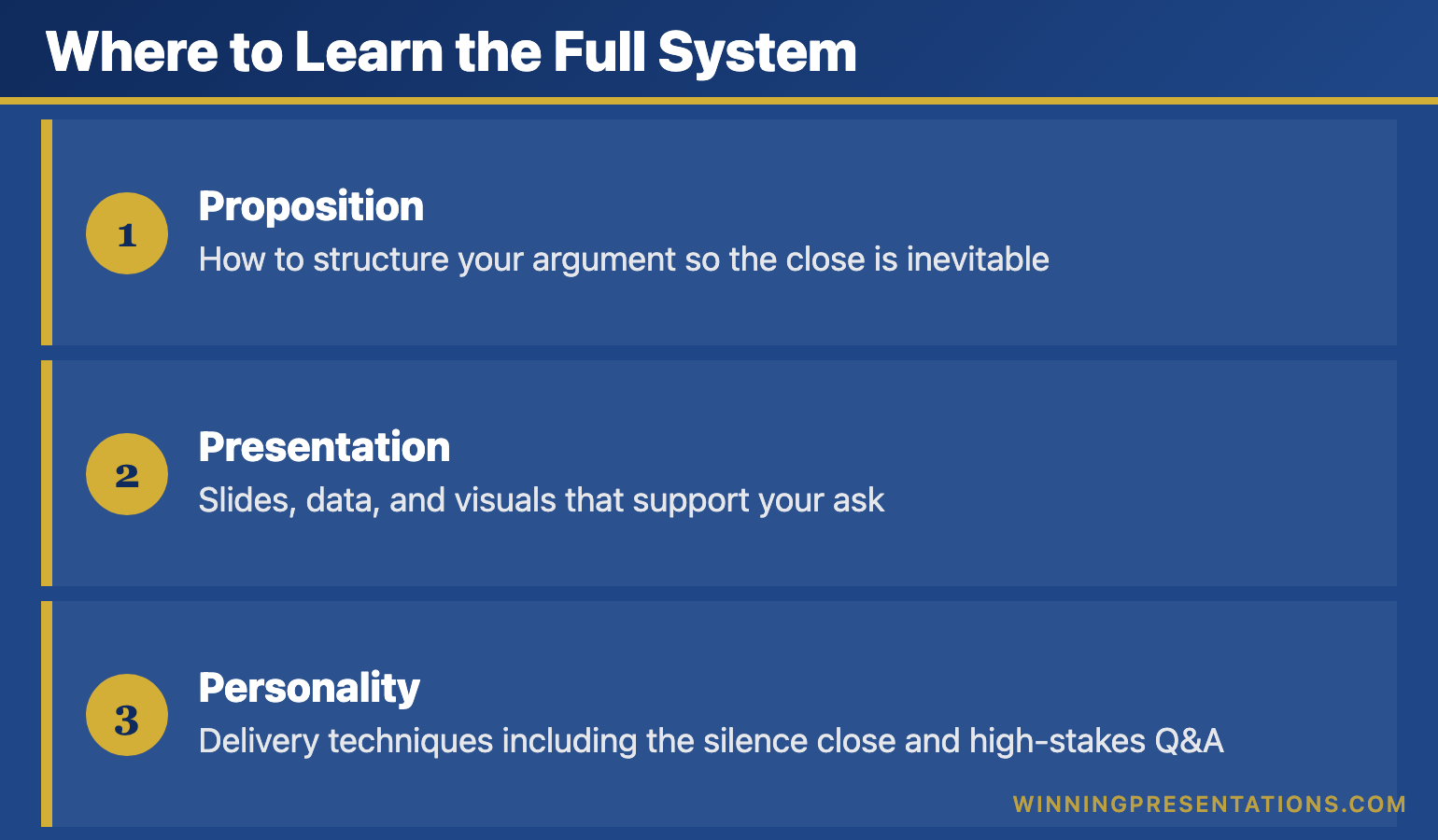
I’m running AI-Enhanced Presentation Mastery on Maven starting January 2026.

It’s not just closing techniques. It’s the complete system:

Infographic for: how to end a presentation (image 1)

  • Proposition: How to structure your argument so the close is inevitable
  • Presentation: Slides, data, and visuals that support your ask
  • Personality: Delivery techniques including the silence close and high-stakes Q&A

This is the same methodology that’s helped my clients raise over £250 million in funding and get budgets approved at Fortune 500 companies.

Early bird pricing closes December 31st.

→ Join the January cohort for £249 (save £50)

Try This Today

You probably have a presentation coming up. Before you finalise your final slide, ask yourself:

  1. What is my ONE ask?
  2. Can I paint a forward story of what success looks like?
  3. Am I prepared to stop talking after I make the ask?

If you can answer yes to all three, your presentation ending is already stronger than 90% of presenters.

Frequently Asked Questions

How long should a presentation closing be?

60-90 seconds maximum. Your close should be the most focused part of your presentation — not a second summary. State your ask, paint the forward story if appropriate, then stop.

What’s the best way to end a presentation to executives?

Lead with your recommendation, not your reasoning. Executives want the answer first, then the supporting evidence. Use the Single Ask technique: one specific request with a deadline.

How do I end a presentation without saying “any questions?”

Replace it with a specific call to action. Instead of “Any questions?” try “I’m asking for your approval on the pilot budget. What concerns would you need addressed before signing off today?”


Mary Beth Hazeldine is the Managing Director of Winning Presentations, where she trains executives at investment banks, biotech companies, and SaaS firms to present with impact. Her clients have raised over £250M using her methodology.

Her AI-Enhanced Presentation Mastery course launches January 2026. Early bird enrollment (£249) closes December 31st.

16 Dec 2025
How to Start a Presentation: 15 Powerful Openers That Grab Attention

How to Start a Presentation: 15 Powerful Openers That Grab Attention

Quick Answer: The best way to start a presentation is to grab attention in the first 10 seconds with a surprising statistic, a bold statement, a relevant story, or a thought-provoking question. Avoid starting with “Today I’m going to talk about…” — you’ll lose your audience before you begin.

I’ve watched over 500 executive presentations in my career. Investment bankers pitching billion-pound deals. Biotech founders presenting to skeptical investors. Senior leaders defending budgets to hostile boards.

And I can tell you exactly when most of them lost their audience: the first 30 seconds.

The opening of your presentation isn’t just important — it’s everything. Get it wrong, and you’re fighting an uphill battle for the next 20 minutes. Get it right, and your audience leans in, ready to hear what you have to say.

After 25 years in investment banking at JPMorgan, PwC, RBS, and Commerzbank — plus 16 years coaching executives on high-stakes presentations — I’ve identified exactly what works. Here are 15 powerful openers that grab attention and set you up for success.

Want 50 ready-to-use opening lines?

My Presentation Openers & Closers Swipe File gives you structured opening lines for every situation — from board meetings to investor pitches.

Get 50 Opening Lines →

Why the First 10 Seconds Matter More Than Anything Else

Neuroscience tells us something uncomfortable: your audience decides whether to pay attention within the first 10 seconds. Not 10 minutes. Ten seconds.

This is called the “primacy effect” — we remember beginnings and endings far more than middles. And in those crucial first moments, your audience is asking one question:

“Is this going to be worth my time?”

If you start with “Good morning, my name is Sarah and today I’m going to talk about our Q3 results…” — you’ve already answered that question. And the answer is no.

Here’s what the best presenters do differently.

15 Powerful Ways to Start a Presentation

15 Powerful Presentation Openers Infographic

1. The Shocking Statistic

Numbers that surprise create instant engagement. The key is contrast — show them something that challenges their assumptions.

Example: “75% of venture-backed startups fail. But the companies that master investor presentations are 40% more likely to get funded. Today, I’m going to show you exactly what separates the funded from the forgotten.”

Why it works: You’ve created a gap between what they know and what they need to know. Now they have to keep listening.

2. The Bold Statement

Make a claim that’s unexpected or even slightly controversial. This triggers curiosity and positions you as someone with a point of view.

Example: “Everything you’ve been taught about presenting to boards is wrong. And it’s costing you promotions.”

Why it works: You’ve challenged the status quo. Even if they disagree, they want to hear your reasoning.

3. The Relevant Story

Stories activate different parts of the brain than data alone. A well-chosen story creates emotional connection and makes abstract concepts concrete.

Example: “Three years ago, I sat in a boardroom in Frankfurt and watched a CFO lose a £4 million budget approval in eleven words. He opened with ‘I know we’re over budget, but let me explain.’ The meeting was over before it started.”

Why it works: Stories create suspense. Your audience wants to know what happened next — and how to avoid the same fate.

4. The Thought-Provoking Question

Questions engage the brain differently than statements. They force your audience to think, which means they’re actively participating rather than passively listening.

Example: “When was the last time you sat through a presentation and thought, ‘I wish this was longer’?”

Why it works: You’ve made them smile and acknowledged a shared frustration. You’re on the same side now.

5. The “Imagine” Scenario

Invite your audience into a future state. This technique, borrowed from hypnotherapy, creates a vivid mental picture that makes your solution feel tangible.

Example: “Imagine walking into your next board presentation completely calm. You know exactly what to say. The executives are nodding. And when you finish, the CEO says, ‘That was exactly what we needed.’ What would that be worth to you?”

Why it works: You’ve made them feel the outcome before you’ve explained the process.

6. The Counterintuitive Truth

Share something that goes against conventional wisdom. This positions you as an expert with insider knowledge.

Example: “The best presentations I’ve ever seen had zero bullet points. None. And they won billion-pound deals.”

Why it works: You’ve challenged a default assumption. Now they need to understand why.

Stop Fumbling Your Presentation Openings

The Executive Slide System gives you structured opening frameworks that command attention immediately — so you walk into every presentation knowing exactly how to start.

Executive Slide System →

7. The Specific Promise

Tell them exactly what they’ll get from the next few minutes. Be specific and benefit-focused.

Example: “In the next 12 minutes, I’m going to give you the three-slide structure that’s helped my clients raise over £250 million in funding. You can implement it in your next presentation tomorrow.”

Why it works: You’ve set clear expectations and promised immediate value. They know what’s coming and why it matters.

8. The Shared Problem

Articulate the pain your audience is experiencing. When people feel understood, they trust you to provide the solution.

Example: “You’ve spent three weeks on this presentation. You’ve rehearsed it a dozen times. And you still can’t shake the feeling that when you stand up, your mind will go blank and everyone will see you’re not ready.”

Why it works: You’ve demonstrated that you understand their world. You’re not just another presenter — you’re someone who gets it.

Struggling with presentation anxiety?

My Calm Under Pressure Toolkit gives you breathing techniques, confidence frameworks, and mental preparation strategies used by professional speakers.

Get the Confidence Toolket →

9. The Behind-the-Scenes Insight

Give them access to information they wouldn’t normally have. This creates a sense of exclusivity and trust.

Example: “I’ve sat in due diligence meetings at four global banks. And I can tell you exactly what the investment committee says after you leave the room…”

Why it works: You’re offering insider knowledge. They’re getting something not everyone gets access to.

10. The Historical Parallel

Connect your topic to a famous moment in history. This adds weight and context to your message.

Example: “In 1984, Steve Jobs stood in front of shareholders and said three words that changed Apple forever. Those three words weren’t about technology — they were about belief. And they’re the same three words you need in your next pitch.”

Why it works: You’ve borrowed credibility from a known success story and created curiosity about the connection.

11. The Live Demonstration

Show rather than tell. A well-executed demo captures attention like nothing else.

Example: Start by silently walking to the front of the room, pausing for three full seconds, and making eye contact with five people before saying a word. Then say: “That silence made you pay attention. Today, I’m going to show you how to command a room before you even speak.”

Why it works: You’ve demonstrated your expertise in real-time. No one is checking their phone now.

12. The Personal Failure

Vulnerability creates connection. When you share a mistake, you become human — and your audience trusts you more.

Example: “The worst presentation of my career was in front of 200 people at a banking conference. I blanked on my own name. Literally forgot who I was. And what I learned in the next 30 seconds saved my career.”

Why it works: They want to know how you recovered. And they believe you’ll help them avoid the same fate.

13. The Unexpected Object

Bring a physical prop. Objects create visual interest and give you something to anchor your message.

Example: Hold up a single slide printout. “This is the only slide that mattered in a £50 million deal. One slide. The other 47 were background noise. Today, I’ll show you how to find your one slide.”

Why it works: Physical objects break the pattern of typical presentations. People pay attention to what’s different.

14. The Direct Challenge

Challenge your audience to think differently or take action. This creates engagement through a sense of urgency.

Example: “By the end of this presentation, you’ll either change how you open every meeting — or you’ll keep losing your audience in the first 30 seconds. The choice is yours.”

Why it works: You’ve raised the stakes. This isn’t just information — it’s a decision point.

15. The Silence

Sometimes the most powerful opening is no words at all. Strategic silence commands attention and demonstrates confidence.

Example: Walk to the front. Stand still. Look at your audience for 5 full seconds. Then, quietly: “Now that I have your attention… let’s talk about why most presentations lose it.”

Why it works: Silence is unexpected. In a world of noise, quiet commands the room.

The Openings That Kill Your Credibility

Now that you know what works, here’s what to avoid:

❌ “Can everyone hear me?” — Start as if you’re already in command.

❌ “I’m just going to quickly talk about…” — The word “just” diminishes your message before you’ve delivered it.

❌ “I know you’re all busy, so I’ll try to be quick…” — You’ve just signaled that what you’re about to say isn’t important.

❌ “Today I’m going to talk about…” — Boring. They know you’re going to talk. Show them why they should care.

❌ “Let me just share my screen…” — Technical fumbling kills momentum. Have everything ready before you speak.

❌ Apologizing for anything — Never open with an apology. It puts you on the back foot immediately.

A Powerful Opening Deserves an Equally Powerful Deck

The Executive Slide System pairs your strong opening with a decision-first slide structure that keeps executives engaged from your first word to your final ask.

Executive Slide System →

If you want opening slides that command attention from the first second, The Executive Slide System gives you 22 ready-made templates to start from.

How to Choose the Right Opening for Your Situation

Not every opener works for every context. Here’s how to match your opening to your audience:

Board presentations: Use the Bold Statement, Specific Promise, or Shocking Statistic. Executives want confidence and clarity.

Investor pitches: Use the Relevant Story, Specific Promise, or Behind-the-Scenes Insight. Investors need to trust you before they trust your numbers.

Team meetings: Use the Shared Problem, Thought-Provoking Question, or “Imagine” Scenario. Internal audiences need to feel included.

Sales presentations: Use the Counterintuitive Truth, Direct Challenge, or Personal Failure. Buyers are skeptical — surprise them.

Conference keynotes: Use the Live Demonstration, Silence, or Historical Parallel. Large audiences need theatrical moments to stay engaged.

Ready to Transform How You Present?

For immediate help:

For complete transformation:

My AI-Enhanced Presentation Mastery course covers everything — from opening to closing, from confidence to content. Live cohort starts January 2026.

Join the Maven Course →

The 30-Second Opening Framework

If you remember nothing else from this article, use this simple framework for your next presentation:

Second 1-5: Establish presence (pause, make eye contact, breathe)

Second 6-15: Hook them (statistic, story, question, or bold statement)

Second 16-25: Create relevance (why this matters to THEM)

Second 26-30: Preview the value (what they’ll get from the next X minutes)The 30-Second Opening Framework: Presence, Hook, Relevance, Preview

That’s it. Thirty seconds to change the trajectory of your entire presentation.

One More Thing — Before You Go

If you want a complete presentation system — not just a strong opening — the Executive Slide System gives you the full structure from first slide to final close.

Explore the System

What Happens After a Great Opening

A powerful opening does more than grab attention — it changes the dynamic of the entire presentation.

When you open strong, you feel more confident. Your audience is engaged. You have momentum. Everything that follows is easier.

When you open weak, you spend the rest of the presentation trying to recover. You can feel the room’s attention drifting. You rush. You doubt yourself.

The difference between a presentation that wins and one that’s forgotten often comes down to those first 30 seconds.

Choose your opening carefully. Practice it until it’s second nature. And walk into that room knowing that before you’ve even finished your first sentence, you’ve already won half the battle.


Mary Beth Hazeldine is an executive presentation coach with 25 years in investment banking (JPMorgan, PwC, RBS, Commerzbank) and 16 years training executives to present with confidence. She has trained over 10,000 executives through Winning Presentations.

Related Reading:

Frequently Asked Questions

How should I start a presentation to grab attention?

Open with a surprising statistic, a bold statement, a relevant story, or a thought-provoking question. The first 10 seconds determine whether your audience leans in or checks out. Avoid starting with your name, your agenda, or ‘Today I’m going to talk about…’ — these signal a routine presentation.

What is the best opening line for a business presentation?

The best opening lines create immediate relevance for the audience. Try a specific problem statement they recognise (‘Every quarter, we lose three days rebuilding the same slides’), a counterintuitive claim, or a brief client scenario. The key is making the audience feel the topic matters to them personally, not just to you.

How do you start a presentation without being nervous?

Prepare your opening line word-for-word and practise it until it feels natural. Arrive early, claim your space, and take one slow breath before speaking. Starting with a well-rehearsed line gives you momentum — nervousness typically drops after the first 30 seconds once you hear your own voice sounding confident.

Should I start a presentation with a joke?

Only if humour is natural to your style and the setting allows it. In executive and board settings, opening with a relevant observation or insight is more effective than a joke. A failed joke creates awkwardness that takes minutes to recover from, while a compelling question or story creates instant engagement with zero risk.

📧 The Winning Edge Newsletter

Weekly insights on executive presentations, QBR strategies, and what’s actually working in boardrooms right now.

Subscribe Free →