Tag: q&a techniques

30 Mar 2026
Executive at a podium handling a Q&A session with composure and confidence

Buying Time in Q&A: Ethical Techniques When You Need Thirty Seconds to Think

When you’re caught off guard in Q&A, the pause itself is not weakness—it’s strategy. Ethical buying time techniques include acknowledging the question, restating it for clarity, or offering a structured response timeline. The executives who own their silence outperform those who rush to fill it.

Osman, a finance director at a healthcare group, was midway through a board Q&A when a shareholder asked about a regulatory change he hadn’t anticipated. His first instinct was to speak faster, to fill the silence with half-formed thoughts. But he stopped himself. He took a three-second pause, restated the question aloud, and said: “That’s a crucial point. Let me give you the precision this deserves.”

That silence wasn’t a gap in his knowledge. It was permission to think like a leader. The board saw a director who wouldn’t sacrifice accuracy for speed. That pause changed how they perceived his credibility for the rest of the meeting.

Feeling unmoored in live Q&A?

Pausing under pressure is a learnable skill, not a confidence deficit. The right framework transforms that thirty-second gap from terrifying to tactical. You’ll learn how in this article—and in the full system, how to structure your thinking so confident pauses become your signature move.

Acknowledge, Pause, Reframe

The moment a question lands, your instinct is often to answer instantly. But the most executive move is to signal that you’ve heard it, create space for thought, and then respond from a position of composure.

The technique: Acknowledge the question explicitly. Say: “That’s an excellent point,” or “I appreciate you raising that.” This does three things simultaneously. It buys you two to three seconds of thinking time. It signals to the room that you respect the question. And it shifts the emotional tone from you being caught off guard to you being thoughtful.

Then pause. Not uncomfortably long—just long enough for your breathing to settle and your thoughts to coalesce. Two to four seconds feels eternal when you’re standing there, but it reads as confidence to the audience.

Finally, reframe. You’re not answering the surface question; you’re answering the underlying concern. This layer of thinking—turning “Why didn’t you hit the Q3 target?” into “What does our revised pathway to that target look like?”—is what distinguishes senior executives from those who merely survive Q&A.

Master the System

The Executive Q&A Handling System teaches you five frameworks for managing pressure, structuring your thinking in real time, and owning the room. Every technique in this article is part of a complete system you’ll use in your next high-stakes Q&A.

Buy Now — £39

The Clarification Pause

If you genuinely don’t understand the question, clarification is both honest and strategic. It’s a legitimate pause-builder that serves everyone in the room.

The technique: Ask for clarity without apology. “To make sure I address this precisely, are you asking about our timeline, or the resource allocation?” You’re not stalling; you’re being professional. You’re ensuring your answer lands where it matters.

This approach works because it invites the questioner to refine their thinking too. Often, in the process of clarifying, both you and the audience understand the real issue more sharply. That clarity is gold in executive Q&A.

The clarification pause also sets a tone: you value precision over speed. You’d rather take an extra moment than give a half-answer. That’s how senior leaders think.

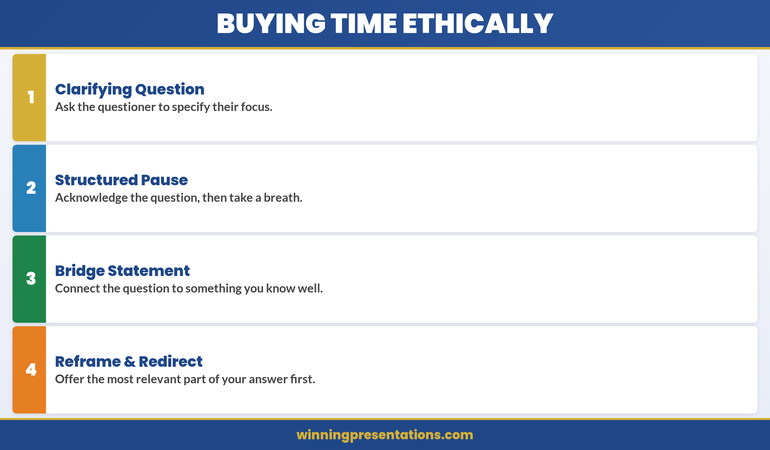
Four ethical techniques for buying time in Q&A: clarifying question, structured pause, bridge statement, and reframe and redirect

Related reading: When You Don’t Know the Answer in a Presentation explores how to handle questions that truly lie outside your scope—a different challenge, but one that shares the same foundation of honest pause.

Structured Response Buying Time

The most elegant time-buying technique is also the most useful: signposting your response structure aloud before you deliver the substance.

The technique: Say: “I’ll address this in three parts—the context, the decision, and the timeline.” Now you’ve bought yourself thinking time, but you’ve also given the audience a roadmap. They know where you’re going, so when you pause between sections, they understand it as intentional, not hesitant.

This is not filler. This is architecture. You’re showing the rigour behind your thinking, and the audience trusts structured thinking.

Where buying time becomes ethical, here, is that your structure is genuine. You’re not inventing three parts to stall; you’re using structure to organise a response that actually has three components. The buying time is the bonus.

Pro move: As you walk through each section, your thinking sharpens. By part three, you’re not buying time any longer—you’re in command. This is the difference between feeling rescued by a technique and owning it.

The system I teach in the Executive Q&A Handling System walks you through how to recognise which technique to deploy in real time, so you’re never deciding how to buy time while under pressure.

Body Language That Buys Credibility

The pause itself is only half the message. How you hold your body during that pause determines whether the room interprets it as thoughtfulness or uncertainty.

The non-negotiables: Keep your posture open. Don’t fold your arms or shift your weight. Maintain eye contact with the questioner. If you drop your gaze, the room reads it as evasion, not reflection.

Your breathing matters. Most executives hold their breath during a pause, which makes them physically tense. Breathe. Slowly. This settles your nervous system and keeps your thinking clear. It’s also visible to an attentive audience—they’ll see composure, not panic.

One more thing: nod slightly as you take the pause. It signals, “I heard you, I’m considering this seriously.” That’s a non-verbal form of acknowledgement, and it costs nothing.

For a deeper dive into how your physical presence shapes perception in Q&A, the bridging technique article covers how to use stance and gesture as strategic tools, not just accessories to your words.

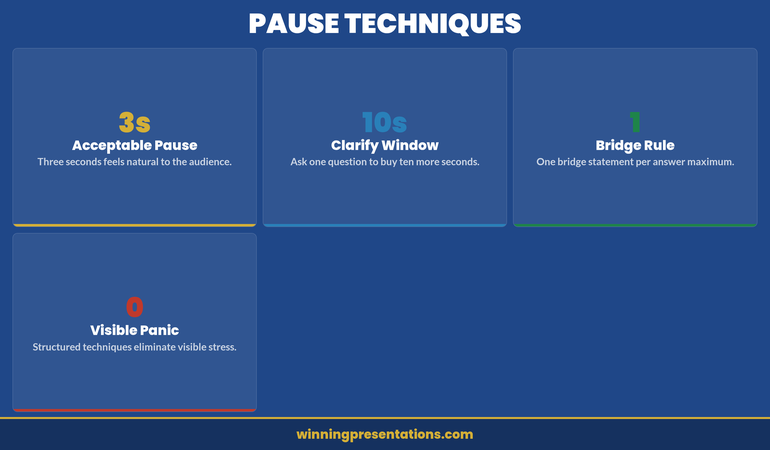
Q&A pause techniques dashboard showing acceptable pause duration, clarify window, bridge rule, and visible panic reduction

Ready to stop fearing the pause?

The Executive Q&A Handling System (£39) includes video modules on timing, scripting, and real-world scenarios. Build the confidence that transforms pressure into presence.

Access the System

When Buying Time Becomes Stalling

There’s a line between ethical pause and evasion. Know where it is.

Buying time is legitimate when:

  • You’re gathering your thoughts to give a more accurate answer.
  • You’re signalling that the question deserves serious consideration, not a throwaway response.
  • You’re using the pause to listen more deeply to what the questioner is actually asking.
  • You’re creating space for your own nervous system to settle so you can think clearly.

Buying time becomes stalling when:

  • You’re using the pause to dodge a question you don’t want to answer.
  • You’re repeating the question three times just to fill silence.
  • You’re offering non-answers cloaked in strategic language.
  • You’re buying time so frequently that the audience stops believing you’re ever thinking and starts suspecting you’re always hiding.

The distinction matters. Boards and senior leadership teams can smell the difference. They’ve been in rooms with hundreds of executives. They know a genuine pause from theatre.

The strongest executives use buying time tactically, not as a default. They know when to pause and when to answer sharply. The short answer framework covers exactly when a quick, crisp response is more powerful than a measured one.

Frequently Asked Questions

How long should a pause actually be?

Two to four seconds feels like an eternity when you’re standing in front of a room. It reads as composure to the audience. Anything longer than five seconds starts to feel intentional avoidance. The sweet spot is where you’ve caught your breath, reset your thinking, and are ready to speak with precision—usually somewhere in that two-to-four window.

What if I pause and my mind genuinely goes blank?

That’s anxiety, not a technique failure. If you’ve paused and your mind hasn’t returned, acknowledge it. “That’s a good question. Let me circle back to that after I finish this thought,” or “I want to give you a proper answer rather than rush this—let me follow up with you tomorrow.” Honesty in that moment is more credible than desperate filler words. The system walks you through how to prepare so your mind has something to work with, even under pressure.

Is buying time a sign of weakness?

No. It’s a sign that you value accuracy over speed. In executive environments, that’s strength. The executives who lose credibility are the ones who speak first and think second. Buying time—strategically—is how senior leaders protect their authority in real time.

Stay Sharp

New frameworks for high-stakes presentations land in The Winning Edge every week. Subscribe and never feel unprepared in Q&A again.

Subscribe Now

The executives who command boardrooms aren’t the ones who never need to pause. They’re the ones who’ve made peace with silence and turned it into their most powerful tool.

Mary Beth Hazeldine is Owner & Managing Director of Winning Presentations. With 24 years of corporate banking experience at JPMorgan Chase, PwC, Royal Bank of Scotland, and Commerzbank, she advises executives across financial services, healthcare, technology, and government on structuring presentations for high-stakes funding rounds and approvals.

27 Feb 2026
A professional woman standing alone at the end of an empty corporate boardroom after her presentation, surrounded by vacant leather chairs, capturing the silence and isolation when no one asks questions

No Questions After Your Presentation? That Silence Isn’t Approval

When nobody asks questions after your presentation, it rarely means unanimous agreement. It almost always means your audience disengaged before you finished. The silence feels comfortable in the moment — but the decision that follows is usually “deferred,” “let’s revisit,” or a quiet no. This article gives you three techniques to prevent post-presentation silence and one recovery protocol for when it’s already happened.

Eight executives. Forty-five minutes. Zero questions.

I was 18 months into my role at JPMorgan Chase, presenting a credit facility to the investment committee. I’d prepared for weeks. The analysis was tight. The recommendation was clear. When I finished and said “any questions?” — silence. Complete, polite, devastating silence.

I walked out thinking it went well. No pushback meant agreement, right?

The decision came back “deferred” — which in investment banking means nobody cared enough to engage. My presentation hadn’t failed on content. It had failed on engagement. The committee hadn’t disagreed with me. They’d stopped listening to me somewhere around slide 11.

The second time I presented to that committee, I planted three decision hooks throughout the deck — specific moments designed to make them lean in. Five questions in Q&A. Approved same meeting.

That was the day I learned: silence after a presentation isn’t the absence of objections. It’s the absence of interest. And interest is something you have to engineer deliberately.

🎯 Presenting to a committee or leadership team this week? Quick diagnostic: count the number of moments in your deck where you deliberately invite the audience to react — not at the end, but during the presentation. If the answer is zero, silence in Q&A is almost guaranteed. → Need the exact system for engineering audience engagement? Get the Executive Q&A Handling System → £39

Why Silence Is Worse Than Tough Questions

Most professionals fear hostile questions. They shouldn’t. The most dangerous Q&A outcome isn’t a difficult question — it’s no questions at all.

Here’s why. When someone asks a tough question, they’re telling you three things: they listened, they care about the outcome, and they’re mentally engaged with your recommendation. Even a hostile question is a form of investment. That person is spending cognitive energy on your proposal.

Silence means none of those things happened.

In 24 years of corporate banking — across JPMorgan Chase, PwC, Royal Bank of Scotland, and Commerzbank — I’ve sat in hundreds of committee meetings. The presentations that got approved almost always generated questions. The ones that got deferred or quietly rejected? Silence.

Why does nobody ask questions after my presentation?

There are three common reasons: your content was too dense for the audience to process in real time, your structure didn’t create natural engagement points, or your conclusion didn’t require a decision. In all three cases, the fix is structural — not about your delivery or confidence. You need to build question-generating moments into your deck, not hope they emerge after it.

The pattern I’ve observed across thousands of executive presentations is consistent: silence is almost never about content quality. It’s about structural engagement. A brilliant 35-slide analysis that doesn’t create tension, choice points, or moments of surprise will get silence every time — regardless of how good the data is.

This is exactly what kills engagement in most corporate presentations — the assumption that good content automatically produces good discussion.

The Silence Protocol: 3 Prevention Techniques

After that JPMorgan experience, I spent years studying what separated presentations that generated rich Q&A from those that got polite silence. The difference was never the presenter’s confidence or charisma. It was always structural.

The presentations that generated questions had something built into them — deliberate engagement architecture. I call these the three prevention techniques.

Each one works by creating what psychologists call “knowledge gaps” — moments where the audience’s brain recognises it needs more information. When you create enough of these gaps during your presentation, questions become inevitable. The audience isn’t choosing to engage. They can’t help it.


Diagram showing The Silence Protocol with three prevention techniques: decision hooks, open loops, and planted controversy, plus one recovery method for post-presentation silence

Technique 1: Decision Hooks

A decision hook is a moment in your presentation where you explicitly frame a choice — and then move on without resolving it completely.

Here’s what this looks like in practice. Instead of presenting your recommendation as a conclusion, you present it as one of two possible paths: “There are two ways we could approach this implementation — a phased rollout over 12 months, or a full deployment in Q3. I’m recommending the phased approach, and I’ll show you why in the next three slides.”

The audience now has something to evaluate. They’re not passively receiving information. They’re mentally testing your recommendation against the alternative you just planted. By the time you reach Q&A, at least one person will ask about the path you didn’t recommend.

Where to place decision hooks: Slide 3 (after your executive summary), at the midpoint of your presentation, and one slide before your recommendation. Three hooks is the minimum. I plant them at the same points where I’d forecast likely questions using a question map — because the same structural moments that generate questions are the ones where hooks land hardest.

The formula: “There are [two/three] ways to approach [specific decision]. I’m recommending [option] because [one-sentence reason]. Let me show you the evidence.”

Diagram showing where to place decision hooks in a presentation: after the executive summary at slide 3, at the midpoint, and before the recommendation, with the decision hook formula and three reasons why it works

Turn Post-Presentation Silence Into Engaged, Productive Questions

The Executive Q&A Handling System gives you the complete framework for engineering audience engagement — including the question forecasting method, decision hook templates, and the Headline → Reason → Proof → Close structure that creates natural question points throughout any presentation.

  • The Question Forecasting method — predict and plant the exact questions your audience will ask
  • Engagement trigger templates that create knowledge gaps your audience can’t ignore
  • Recovery scripts for when silence has already happened (the “redirect and re-engage” protocol)
  • The 4-part answer structure that turns every question into a credibility-building moment

Get the Executive Q&A Handling System → £39

Built from 24 years of investment committee presentations at JPMorgan, RBS, and Commerzbank — where silence meant a deferred decision and lost revenue.

Technique 2: Open Loops

An open loop is a piece of information you introduce but don’t complete. Your audience’s brain will hold that loop open until it gets resolved — and if you don’t resolve it fully during the presentation, they’ll ask about it in Q&A.

This isn’t manipulation. It’s how the brain processes incomplete information. Psychologists call it the Zeigarnik effect: unfinished tasks create cognitive tension that demands resolution.

Here’s an example from a real client presentation. A director was presenting a restructuring plan to the board. Instead of laying out every detail sequentially, she opened with: “This restructuring will affect three departments — but the impact on each is very different. I’ll walk you through engineering and operations today. The third department is where the real decision sits, and I’ve saved it for the end.”

The board was leaning forward by slide 4. By the time she reached the third department, two members had already prepared questions. The Q&A ran 20 minutes — exactly what she wanted.

How to create open loops:

  • The preview loop: “I’ll share the data that changed our recommendation — but first, let me show you what we originally assumed.”
  • The exception loop: “This approach works in every scenario except one. I’ll get to that exception in a moment.”
  • The contrast loop: “Our competitor took the opposite approach. The results are striking — and I’ll show you why our path is different.”

Each of these creates a gap your audience needs filled. And if you leave even one loop partially open, someone will ask about it. That’s not a risk — that’s the entire point.

The Executive Q&A Handling System includes engagement trigger templates for all three loop types — pre-written, ready to adapt to your specific presentation context.

Is silence after a presentation good or bad?

In almost every corporate context, silence after a presentation is a negative signal. It typically indicates one of three things: the audience didn’t understand enough to form questions, the content didn’t create enough engagement to provoke curiosity, or the decision-makers have already mentally checked out. The rare exception is when the recommendation is so clear and well-supported that immediate approval follows — but in 24 years, I’ve seen that happen perhaps five times. If silence is followed by “we’ll come back to you” rather than an immediate decision, it wasn’t agreement. It was disengagement.

Technique 3: Planted Controversy

This is the technique most executives resist — and the one that works most reliably.

A planted controversy is a moment where you deliberately present a counterargument to your own recommendation. Not to undermine yourself — to create intellectual tension that demands discussion.

Here’s why it works. When you present a recommendation with no counterpoint, the audience has nothing to push against. Agreement is passive. But when you say “The strongest argument against this approach is X — and here’s why I still recommend it,” you’ve given the audience something to evaluate. You’ve shown intellectual honesty. And you’ve created a natural question point.

At Commerzbank, I watched a risk director use this brilliantly. He was recommending a credit line extension that the committee was likely to reject. Instead of pretending the risk didn’t exist, he opened his recommendation slide with: “The obvious concern with this extension is the sector’s volatility over the past two quarters. If I were sitting where you are, I’d ask why we’re recommending increased exposure.”

He then answered his own planted question with three data points. The committee didn’t need to voice the objection — he’d already addressed it. But the technique had a secondary effect: it opened the door for more nuanced questions. Instead of “isn’t this too risky?” they asked “what’s the exit strategy if volatility continues?” — a far more productive conversation.

How to plant controversy effectively:

  • Identify the strongest objection to your recommendation before you present
  • State it directly: “The biggest risk with this approach is…”
  • Answer it with evidence — but leave 10% of ambiguity
  • That 10% becomes a Q&A question you’ve already prepared for

This technique connects directly to question forecasting — if you can predict what the audience will object to, you can plant that controversy deliberately and control the conversation.

Stop Hearing Silence After Every Presentation You Give

The silence problem isn’t about your delivery or your data. It’s about structure — and structure is fixable. The Executive Q&A Handling System gives you the complete engagement architecture so you never face dead silence again.

  • Decision hook templates you can drop into any presentation in 10 minutes
  • The open loop formula that makes your audience need to ask questions
  • Planted controversy scripts for high-stakes committee presentations
  • The complete recovery protocol for when silence has already happened

Get the Executive Q&A Handling System → £39

Used by executives presenting to investment committees, boards, and senior leadership — where silence means a deferred decision.

The Recovery: When Silence Has Already Happened

Prevention is ideal. But sometimes you’re standing at the front of a room and it’s already happened. You’ve said “any questions?” and you’re staring at eight faces that aren’t going to speak.

First: do not fill the silence yourself. The instinct is to keep talking — to summarise, to add caveats, to ramble into your own recommendation. Every word you say in that moment reduces the pressure on the audience to engage. The silence is uncomfortable for them too. Let it work.

Wait a full five seconds. It will feel like thirty. Then use one of these recovery lines:

he Silence Recovery Protocol showing Step 0 wait 5 seconds followed by three recovery options: The Redirect, The Specific Question, and The Stakeholder Call, each with the exact script to use and why it works

The redirect: “Let me ask this a different way — if you were going to push back on one part of this recommendation, which part would it be?”

This works because it reframes the question from “do you have anything to say?” (which allows passivity) to “which specific thing would you challenge?” (which assumes engagement).

The specific question: “The implementation timeline is where I expect the most debate. What’s your reaction to the Q3 target?”

This works because it removes the paradox of choice. Instead of asking the audience to generate a question from nothing, you’re giving them a specific anchor to respond to.

The stakeholder call: “[Name], I know this affects your division directly — what’s your initial reaction?”

This works because it shifts from an open-room question (where diffusion of responsibility means nobody speaks) to a direct, personal invitation. One person speaking breaks the silence for everyone.

The Executive Q&A Handling System includes the complete recovery protocol — including 12 ready-to-use redirect scripts for different meeting types and seniority levels.

How do you encourage questions after a presentation?

The most effective way to encourage questions isn’t to ask for them differently at the end — it’s to build question-generating moments throughout the presentation itself. Decision hooks, open loops, and planted controversies all create cognitive gaps that the audience needs resolved. By the time you reach Q&A, the questions already exist in their minds. You don’t need to encourage them. You just need to create the space for them to emerge. If you’re already at the “any questions?” moment and facing silence, redirect with a specific prompt: “If you were going to challenge one part of this, which part would it be?” This reframes from passive to active and almost always breaks the silence.

Is This Right For You?

The Executive Q&A Handling System is built for you if:

  • You present to committees, boards, or senior leadership where Q&A determines the outcome
  • You’ve experienced post-presentation silence and the “deferred” decisions that follow
  • You want to engineer engagement into your presentation structure rather than hope it happens
  • You need recovery scripts for when silence has already occurred

It’s probably not right if you already get strong audience engagement and your Q&A sessions run long. In that case, you might benefit more from handling the difficult questions that do come up.

24 Years of Investment Committee Presentations. Every Silence Lesson Turned Into a System.

From JPMorgan Chase to Commerzbank, I’ve presented to — and sat on — the committees where silence means your proposal dies quietly. The Executive Q&A Handling System is everything I learned about engineering the questions that get decisions made.

  • Question forecasting templates that predict exactly what your audience will ask
  • The Headline → Reason → Proof → Close answer structure used in investment banking
  • 12 recovery scripts for different meeting types and seniority levels
  • The complete engagement architecture: decision hooks, open loops, planted controversy

Get the Executive Q&A Handling System → £39

Trained thousands of executives to handle every Q&A scenario — including the one where nobody says a word.

Frequently Asked Questions

What if the silence genuinely means they agree?

It’s possible but rare. In my experience, genuine agreement after a presentation is followed by an immediate decision — “approved,” “let’s proceed,” or a direct next-step conversation. If the silence is followed by “we’ll come back to you,” “let’s take this offline,” or “deferred for further review,” it wasn’t agreement. It was disengagement. The safest approach is to build engagement architecture into every presentation. If they genuinely agree, the techniques in this article won’t harm your outcome. If they don’t agree, the techniques will surface the real objections before the meeting ends.

Won’t planting controversy make me look uncertain about my own recommendation?

The opposite. Addressing the strongest counterargument to your own recommendation demonstrates intellectual honesty and thoroughness. Investment committees and senior leadership teams respect presenters who acknowledge risk rather than pretend it doesn’t exist. The key is in the execution: state the counterargument clearly, then answer it with evidence. You’re not expressing doubt — you’re showing you’ve already considered and resolved the most likely objection.

How many decision hooks is too many?

Three is the sweet spot for a 20–30 minute presentation. One after your executive summary, one at the midpoint, and one before your final recommendation. More than five and the audience feels manipulated — each hook creates cognitive work, and too many will exhaust rather than engage. Fewer than two and you’re relying on the content alone to generate questions, which rarely works in committee settings.

📬 Get weekly presentation strategies that actually work in corporate environments.

Every week: one executive presentation technique, one real-world example, zero fluff. Join thousands of professionals who present to decision-makers.

Subscribe to the Winning Presentations newsletter →

📊 Presenting a budget defence this quarter? When finance wants to cut your team’s funding, the wrong slide structure guarantees you lose. Read: The Budget Defence Presentation: When Finance Wants to Cut Your Team’s Funding

Your next step: Before your next committee or leadership presentation, count the engagement moments in your deck. If you have fewer than three decision hooks, open loops, or planted controversies, add them now. The difference between silence and five productive questions isn’t talent or confidence — it’s structure.

About the Author

Mary Beth Hazeldine is the Owner & Managing Director of Winning Presentations. With 24 years in corporate banking — including roles at JPMorgan Chase, PwC, Royal Bank of Scotland, and Commerzbank — she has trained thousands of executives in high-stakes presentations and supported high-stakes funding rounds and approvals. A qualified clinical hypnotherapist and NLP practitioner, Mary Beth combines boardroom experience with evidence-based psychology to help professionals present with authority and close with confidence.

14 Jan 2026
q&a anxiety presentation techniques - how to transform hostile questions into opportunities for credibility

Q&A Anxiety Presentation: The Technique That Turns Hostile Questions Into Opportunities

Quick Answer: Q&A anxiety stems from loss of control, not lack of knowledge. The reframe that changes everything: hostile questions aren’t attacks—they’re opportunities to demonstrate expertise and build credibility. Use the Acknowledge-Bridge-Control technique: validate the concern, find common ground, then guide the conversation where you want it to go.

The question came like a punch to the chest.

“Given that your last two projects ran over budget, why should we trust these numbers?”

I was presenting to the PwC leadership team, and a senior partner had just challenged my credibility in front of everyone. My face flushed. My mind raced to defend, to explain, to justify.

But I’d been training for this moment.

Instead of defending, I paused. Took a breath. And said: “You’re right to ask that. Trust has to be earned. Let me show you exactly what’s different this time.”

The room shifted. What could have been a career-damaging moment became the most credibility-building two minutes of my presentation.

That’s when I learned: hostile questions aren’t threats. They’re opportunities—if you know how to reframe them.

Dreading the Q&A More Than the Presentation Itself?

You are not alone. Most executives say the Q&A is where their confidence collapses — not during the slides. The difference between freezing and flourishing under fire? A structured system for handling any question, including the hostile ones. The Executive Q&A Handling System gives you that system: question prediction frameworks, real-time response techniques, and 51 AI prompts to stress-test your answers before the room does.

Explore the System →

Why Hostile Questions Trigger Panic

When someone challenges you publicly, your brain doesn’t distinguish between professional criticism and physical threat. The amygdala fires. Cortisol floods your system. You’re in fight-or-flight before you’ve processed the actual question.

This is why smart, knowledgeable people freeze under hostile questioning. It’s not about competence—it’s about biology.

The solution isn’t to suppress the response. It’s to reframe the situation before your threat system takes over.

Here’s the reframe that changed everything for me: A hostile question is a gift.

Think about it. The questioner has just told you exactly what concerns them. They’ve revealed their objection, their fear, their agenda. Now you can address it directly instead of guessing what resistance exists in the room.

For a complete guide to managing the Q&A, see our hub article on presentation Q&A techniques.

Reframing hostile questions - from threat to opportunity mindset shift for presentation Q&A

The Acknowledge-Bridge-Control Technique

This three-step technique transforms any hostile question into an opportunity:

Step 1: Acknowledge

Validate the concern genuinely. Not defensively, not dismissively—genuinely.

  • “You’re right to raise that.”
  • “That’s a fair challenge.”
  • “I understand why that’s concerning.”

Acknowledgment disarms hostility. The questioner expected resistance. When you validate instead, the temperature drops immediately.

Step 2: Bridge

Find common ground before presenting your perspective.

  • “We both want this project to succeed…”
  • “Like you, I’m focused on minimising risk…”
  • “The underlying concern—getting this right—is one I share…”

Bridging moves you from opposition to collaboration. You’re no longer adversaries; you’re two people trying to solve the same problem.

Step 3: Control

Now guide the conversation to your key point.

  • “…which is why this approach includes three safeguards we didn’t have before.”
  • “…and here’s specifically what’s different this time.”
  • “…let me show you the data that addresses that directly.”

You’ve validated, connected, and now you’re leading. The hostile question has become your platform.

This technique is part of a broader framework for handling presentation Q&A with confidence.

The Questions Behind the Questions

Most hostile questions aren’t really about what they seem to be about:

  • “Why should we trust these numbers?” = “I’m worried about being burned again.”
  • “This seems overly optimistic.” = “I need reassurance about downside scenarios.”
  • “Have you considered X?” = “I want to feel heard and included.”
  • “This is the third time we’ve discussed this.” = “I’m frustrated with the pace of progress.”

When you address the emotion behind the question—not just the words—you transform the interaction. The questioner feels understood, and understanding builds trust faster than data ever can.

For more strategies on managing challenging interactions, explore our guide to presentation Q&A.

Stop Dreading the Questions

Turn Every Hostile Question Into a Credibility-Building Moment

The Executive Q&A Handling System (£39, instant access): seven field-tested Q&A techniques that signal leadership under pressure, scripts for hostile and loaded questions, the Parking Lot method and four other frameworks for managing derailing questions, and 51 AI prompts to rehearse difficult scenarios before you face them live.

Designed for executives who present to boards, investors, and senior leadership — where the questions matter more than the slides.

Get the Q&A Handling System →

The Winning Edge — Weekly Presentation Insights

Weekly techniques for high-stakes presentations, Q&A preparation, and executive communication from 25 years in corporate boardrooms.

Subscribe Free →

If you present to boards, investors, or senior leadership, the Executive Q&A Handling System gives you a structured approach to preparing for and handling any question — including the ones designed to test you.

Frequently Asked Questions

Why does the Q&A cause more anxiety than the presentation?

During the presentation, you control content, timing, and direction. In Q&A, that control vanishes—questions are unpredictable, and you’re reacting in real-time. Your brain interprets this loss of control as threat, triggering anxiety even when you know your material. More techniques in our full presentation Q&A guide.

How do I stop feeling attacked during hostile questions?

Reframe the question as information-seeking, not attack. Most hostile questions stem from the questioner’s frustration, fear, or agenda—not from your failure. Responding with curiosity instead of defensiveness transforms the dynamic.

What’s the best technique for handling aggressive questions?

The Acknowledge-Bridge-Control technique: Acknowledge the concern genuinely, Bridge to common ground, then Control the direction by offering your perspective. This validates the questioner while keeping you in command of the response.

Prepare for the Unpredictable

Know What They Will Ask Before They Ask It

The Executive Q&A Handling System (£39) includes a question prediction framework that maps the 5 categories of questions your audience will ask — so you walk in with answers ready, not hoping for the best.

Get the Q&A Handling System →

About the Author

Mary Beth Hazeldine is the Owner & Managing Director of Winning Presentations. With 25 years of corporate banking experience at JPMorgan Chase, PwC, Royal Bank of Scotland, and Commerzbank, she has delivered high-stakes presentations in boardrooms across three continents.

A qualified clinical hypnotherapist and NLP practitioner, Mary Beth combines executive communication expertise with evidence-based techniques for managing presentation anxiety. She advises executives across financial services, healthcare, technology, and government on structuring presentations for high-stakes Q&A sessions.

Book a discovery call | View services

14 Jan 2026
presentation q&a techniques - how to handle questions with confidence after your presentation

Presentation Q&A: Why the Questions Terrify You More Than the Presentation


Quick Answer: The Q&A triggers more fear than the presentation because you lose control. You’ve rehearsed your slides; you can’t rehearse unpredictable questions. The solution isn’t predicting every question—it’s building a framework for handling any question. Prepare by category (challenges, gaps, critics), master bridging techniques, and remember: the audience wants you to succeed.

Still Panicking About Q&A?

You’re not alone. Most executives rank Q&A as their biggest presentation fear. The difference between panicked executives and calm ones? A structured system for handling any question. The Executive Q&A Handling System gives you exactly that: a question prediction framework, real-time response techniques, and 51 AI prompts to practise difficult scenarios.

Explore the System →

The Presentation That Nearly Ruined My Career

I delivered the best presentation of my career at Commerzbank in 2008. Twenty-two minutes of polished content, clear data, compelling recommendations. The CFO was nodding. My boss looked pleased.

Then came the Q&A. The first question was fine. The second was manageable. The third came from a director I’d never met: “Your projections assume a 12% market growth rate. What’s your evidence for that, given the current regulatory environment?”

I had evidence. Somewhere. In my backup slides. Which I couldn’t find. While twelve executives watched me fumble through my deck, my credibility evaporating with each passing second.

I eventually found the data. But by then, the damage was done. My carefully constructed presentation had been overshadowed by ninety seconds of visible panic.

That evening, I realised something that changed how I approach every presentation: the Q&A isn’t an afterthought. It’s where credibility is won or lost.

Over the following decade, I became obsessed with Q&A preparation. I interviewed executives who seemed effortlessly confident under questioning. I studied hostage negotiators and crisis communicators. I tested techniques with clients across industries.

What I discovered is that Q&A confidence has almost nothing to do with knowing all the answers. It comes from having a system for handling any question—including the ones you can’t predict.

Stop Rehearsing Every Possible Question

You can’t predict every question. But 95% of difficult questions fall into just 5 categories. Learn which ones matter for your presentation, and you’ll handle any curveball with calm certainty.

The Executive Q&A Handling System (£39) teaches you:

  • The 5-category preparation framework (done in under 30 minutes)
  • Bridging techniques that buy thinking time and signal confidence
  • Hostile question responses that reframe attacks into opportunities
  • 51 AI prompts to stress-test your answers before the room does

Master Your Q&A →

Designed for executives across banking, consulting, and technology. Master your Q&A in one afternoon.

The Psychology of Unpredictability

Why does Q&A trigger more anxiety than the presentation itself? The answer lies in control. During your presentation, you control what information you share, the order, pace, timing, which points to emphasise, when to pause. During Q&A, you control almost nothing. Questions come from anywhere. You’re reacting, not leading. Your carefully rehearsed structure is gone.

This loss of control activates your brain’s threat response. Suddenly you’re not presenting—you’re defending. Your body shifts into fight-or-flight mode, which is exactly the wrong state for clear, confident communication.

The physical symptoms follow: racing heart, shallow breathing, mind going blank. These aren’t signs of incompetence. They’re signs that your nervous system has misidentified a question as a threat.

Understanding this is the first step to managing it. Q&A anxiety isn’t about your knowledge or preparation. It’s about your brain’s response to unpredictability. And that response can be retrained.

How to Prepare When You Can’t Predict

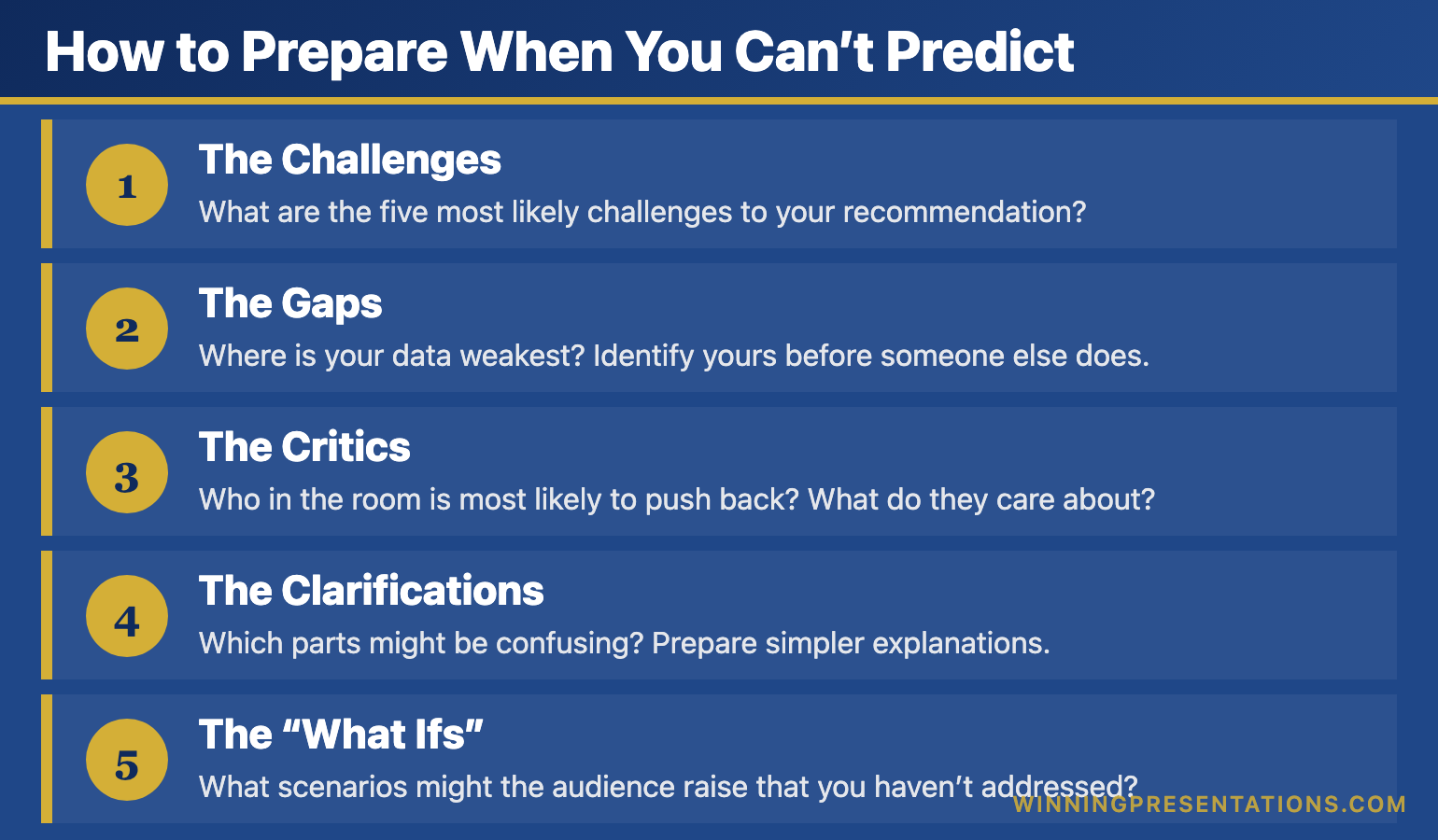
You can’t anticipate every question. But you can prepare for every category of question. Before any presentation, work through five preparation categories:

  1. The Challenges – What are the five most likely challenges to your recommendation?
  2. The Gaps – Where is your data weakest? Identify yours before someone else does.
  3. The Critics – Who in the room is most likely to push back? What do they care about?
  4. The Clarifications – Which parts might be confusing? Prepare simpler explanations.
  5. The “What Ifs” – What scenarios might the audience raise that you haven’t addressed?

This category-based preparation is more valuable than trying to predict specific questions. For more on anticipating objections, see our guide on how to handle difficult questions in a presentation.

Want a structured framework that handles 95% of difficult questions? The Executive Q&A Handling System teaches you category-based preparation, real-time bridging techniques, and hostile question responses—all in one afternoon.

What to Say When You Don’t Know

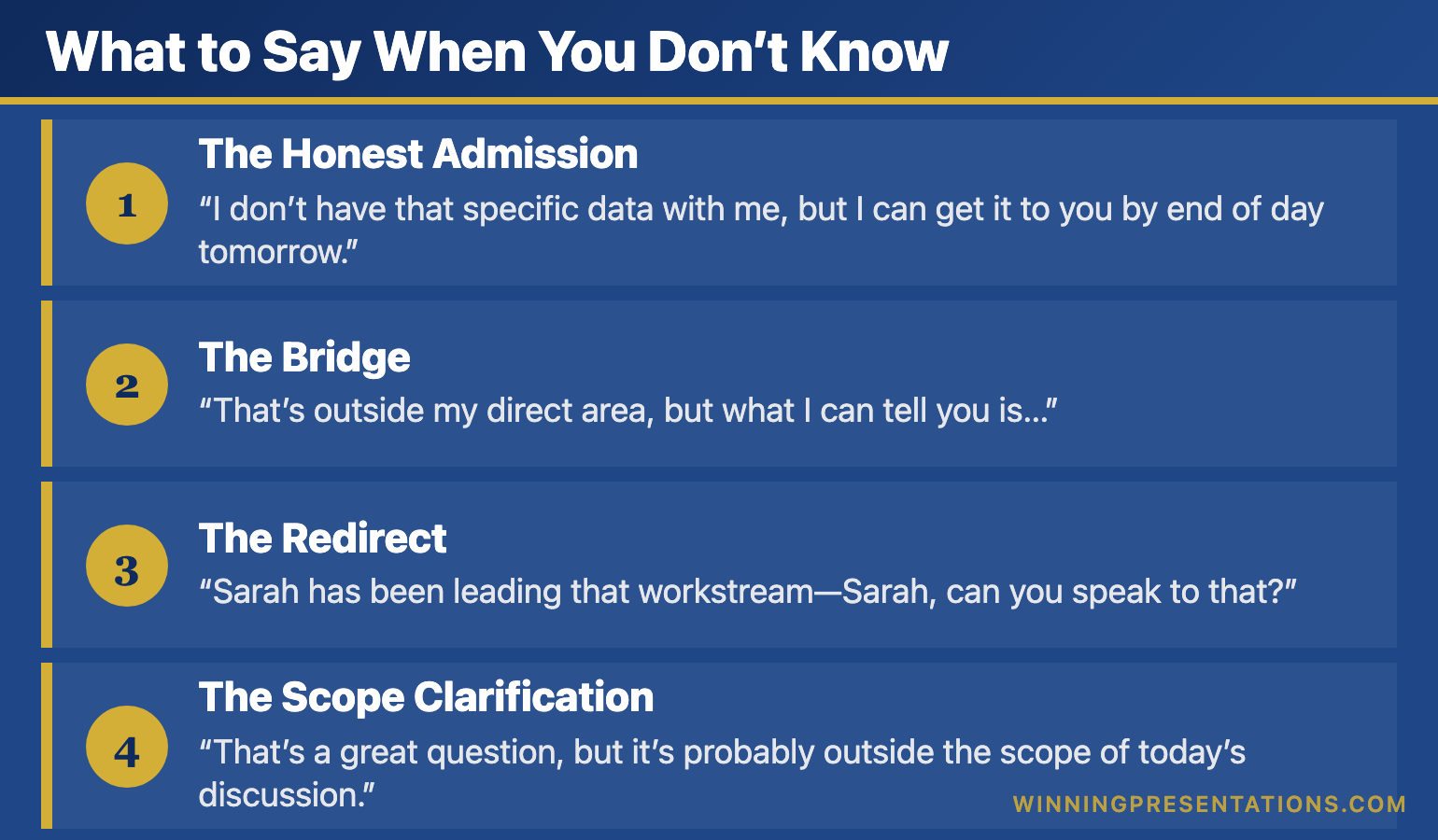
Here’s a liberating truth: you don’t need to know everything. The most confident executives all share one trait: they’re comfortable saying “I don’t know.” But they say it strategically:

  • The Honest Admission: “I don’t have that specific data with me, but I can get it to you by end of day tomorrow.”
  • The Bridge: “That’s outside my direct area, but what I can tell you is…”
  • The Redirect: “Sarah has been leading that workstream—Sarah, can you speak to that?”
  • The Scope Clarification: “That’s a great question, but it’s probably outside the scope of today’s discussion.”

What you should never do: guess, bluff, or provide data you’re not certain about.

Handling Hostile and Loaded Questions

Not all questions are neutral. Some come with a hidden agenda. Some carry hostility. Difficult question types include:

  • The Loaded Question – reframe the premise before answering
  • The Hostile Question – stay curious, not defensive; treat it as information-seeking
  • The Agenda Question – acknowledge the alternative viewpoint without abandoning your position
  • The Ambush Question – ask for context if unfamiliar; take your time before responding

Key principle: hostile questions are often about emotion, not information. Your job is to address the underlying concern, not just the surface question.

The Difference Between Flustered and Composed

The executives who stay calm under hostile questioning share one thing: they’ve practised specific response techniques until they become automatic. They don’t think—they respond with precision.

Inside the Executive Q&A Handling System (£39, instant access):

  • 7 structured Q&A techniques that signal leadership under pressure
  • Scripts for hostile, loaded, and ambush questions
  • The Parking Lot technique and 4 other methods for handling questions that would derail the discussion
  • 51 AI-powered question prompts for personalised practice

Handle Any Question →

Immediate digital download, ready to use before your next presentation.

7 Techniques That Transform Q&A

These seven techniques have been tested with executives. Each one addresses a specific challenge in Q&A delivery:

  1. Repeat and Reframe – Echo the question back in your own words. This buys thinking time, demonstrates you understood, and shifts the framing to your advantage.
  2. The 30-Second Rule – Keep answers to 30 seconds maximum. Brevity signals confidence; rambling signals uncertainty.
  3. Bridge to Strength – Never leave an answer on a defensive note. Bridge to a point of strength or a supporting fact.
  4. The Parking Lot – For questions that derail the discussion, offer to discuss offline: “That’s important. Let’s park it and I’ll follow up with you.”
  5. Evidence Anchoring – When answering, point to a specific piece of data or research. Vagueness breeds doubt; specificity builds credibility.
  6. The Pause – Pause for 2-3 seconds before answering. It reads as thoughtful, not uncertain. Silence is underused power.
  7. End on Your Terms – Summarise your key point before moving to the next question. Don’t let the questioner have the last word on your topic.

For the specific anxiety that hits during Q&A rather than in planned content, the Q&A anxiety guide addresses the in-the-moment recovery techniques.

Case Study: From Q&A Terror to Q&A Confidence

Priya was a senior manager at a technology company. Brilliant during presentations—her slides were polished, her data was solid, her delivery was engaging. But the moment the first question came, she fell apart. Racing heart, defensive tone, rambling answers.

The problem wasn’t her knowledge. She over-prepared on content and under-prepared on Q&A. We restructured her preparation:

  • Week before: Work through the 5-category objection prep framework. Identify every possible challenge, gap, and critic.
  • Day before: Ask a colleague to challenge her with difficult questions. One hour of real dialogue beats days of solo preparation.
  • Morning of: 10 minutes practising “I don’t know” responses and pause techniques. Physical calibration, not content review.

We also addressed the physical response: before each practice question, she would pause for 2 seconds, take a full breath, then answer. By the time of her next board presentation, this was automatic.

The result: she handled an aggressive line of questioning from the toughest director in the room. No hesitation. No defensiveness. Clear, evidence-anchored answers with strategic pauses. When she finished, the CEO asked her to lead the follow-up strategic initiative.

Frequently Asked Questions

1. Why is the Q&A scarier than the presentation itself?

During a presentation, you control the content, pace, and flow. During Q&A, you lose control. Questions come from anywhere, and you’re reacting instead of leading. This perceived loss of control triggers your threat response—fight-or-flight—which is exactly the wrong neurological state for calm communication.

2. How do I prepare for questions I can’t predict?

You prepare by category instead of by specific question. Work through five categories: the challenges to your recommendation, the gaps in your data, the likely critics in the room, clarifications that might be needed, and “what if” scenarios. This framework captures 95% of difficult questions before they’re asked.

3. What do I do when I don’t know the answer?

You say so—strategically. Use one of four approaches: the honest admission (“I don’t have that data, but I’ll get it by tomorrow”), the bridge (“That’s outside my area, but here’s what I can tell you”), the redirect (“Sarah’s leading that—Sarah, you take this one”), or the scope clarification (“That’s outside today’s scope”). Never guess or bluff.

4. How do I handle hostile questions in a presentation?

Reframe the premise. If someone asks “Doesn’t your plan ignore the regulatory risk?” you might respond: “Actually, our plan was built around regulatory compliance. Here’s why…” Treat hostile questions as information-seeking, not attacks. Stay curious, not defensive.

5. Should I repeat the question before answering?

Yes—but reframe it. Echo the question back in your own words. This demonstrates understanding, buys you thinking time, and shifts the framing slightly in your favour. Example: “So you’re asking whether the timeline accounts for implementation lag—great question.”

6. How long should my Q&A answers be?

Aim for 30 seconds maximum. Longer than that, you’re rambling—which signals uncertainty. Keep it short, evidence-anchored, and end on a point of strength. If they want more detail, they’ll ask.

Get Weekly Insights on Presentation Mastery

Join executives who receive The Winning Edge—weekly strategies for presenting with confidence, handling difficult stakeholders, and leading through communication.

Subscribe to The Winning Edge

Free Resource: CFO Questions Cheatsheet

If you’re presenting to finance leadership, you need this. The CFO Questions Cheatsheet covers the 20 questions CFOs ask most frequently, with research-backed answers and talking points for each. Download free.

Download the Cheatsheet

Q&A Is Where Leaders Are Made

The presentation shows you can prepare. The Q&A shows you can think. It’s the moment where audiences decide whether you’re a functional expert or a leader worth following.

The executives who master Q&A aren’t smarter. They’re not better informed. They’ve simply applied a system—a framework for handling unpredictable questions with calm certainty. They prepare by category, they bridge to strength, they’re comfortable saying “I don’t know,” and they pause before speaking.

That system is learnable. In a few hours of focused preparation, you can transform Q&A from your biggest fear into your greatest strength. You can be the executive in the room who stays composed when others panic. Who clarifies when others fumble. Who builds credibility during questioning instead of just defending.

If Commerzbank taught me anything, it’s this: your presentation is the opening act. Your Q&A is where the audience decides whether you’re worth believing.

Related Resources


About the Author

Mary Beth Hazeldine is the Owner & Managing Director of Winning Presentations. She spent 25 years in banking, including roles at JPMorgan Chase, PwC, RBS, and Commerzbank. A qualified clinical hypnotherapist and NLP practitioner, she advises executives across financial services, healthcare, technology, and government on presenting with confidence and credibility. She specialises in Q&A preparation, stakeholder management, and high-stakes presentation confidence.